

SIST EN 15512:2021+A1:2022
(Main)Steel static storage systems - Adjustable pallet racking systems - Principles for structural design
General Information
- Abstract
This document specifies the structural design requirements applicable to all types of adjustable beam pallet rack systems fabricated from steel members intended for the storage of unit loads and subject to predominantly static loads. Both un-braced and braced systems are included.
This document gives guidelines for the design of clad rack buildings where requirements are not covered in the EN 1993 series. The requirements of this document also apply to ancillary structures, where rack components are employed as the main structural members.
This document does not cover other generic types of storage structures. Specifically, this document does not apply to mobile storage systems, drive-in, drive-through, pallet live storage, push back, shuttle systems, systems where two or more cranes operates one above another in the same aisle and cantilever racks or static steel shelving systems.
For the specific design of adjustable pallet racking for use in seismic areas, this document is to be used in combination with EN 16681.
- Status
- Published
- Publication Date
- 23-Mar-2022
- Technical Committee
- I13 - Imaginarni 13
- Current Stage
- 6060 - National Implementation/Publication (Adopted Project)
- Start Date
- 23-Mar-2022
- Due Date
- 28-May-2022
- Completion Date
- 24-Mar-2022


Overview
SIST EN 15512:2021+A1:2022 - also published as EN 15512:2020+A1:2022 - is the European standard that specifies principles for the structural design of adjustable beam pallet racking systems fabricated from steel. It applies to steel static storage systems intended for the storage of unit loads and subject to predominantly static loads. The standard covers both braced and un‑braced pallet racks, provides guidance for clad rack buildings, and applies to ancillary structures where racking components act as primary structural members.
Key topics and technical requirements
The standard sets out the structural design framework rather than prescriptive construction details. Key technical topics include:
- Scope and exclusions: Applies to adjustable pallet racking; explicitly excludes mobile storage systems, drive‑in/drive‑through systems, pallet live, push‑back, shuttle systems, multi‑crane aisles, cantilever racks, and static steel shelving systems.
- Basis of design: Design working life, limit state design principles (ultimate and serviceability limit states), and required combinations of actions.
- Actions and loadings: Permanent, variable and accidental actions relevant to pallet racking, including combinations and partial factors consistent with Eurocode principles.
- Materials and durability: Requirements for steel material properties, floor material considerations (concrete, bituminous, etc.), and durability provisions.
- Structural analysis: Modelling assumptions, joint modelling, ground‑structure interaction, global analysis and stability, including effects of geometric imperfections.
- Member design: Resistance checks and buckling considerations for beams and uprights, buckling curves, torsional and flexural buckling lengths.
- Frame bracing and run spacers: Design of bracing systems, robustness and buckling length provisions.
- Joints and connectors: Design resistance for beam end connectors, locks, splices and combined actions.
- Serviceability: Deflection limits and serviceability checks for beams and rack‑supported floors.
- Seismic design: For seismic zones, EN 15512 is to be used in combination with EN 16681.
Practical applications and target users
This standard is essential for professionals involved in the design, manufacture, installation and regulation of pallet racking:
- Structural and warehouse engineers designing adjustable pallet racking systems
- Racking manufacturers and component designers
- Facility managers and warehouse planners specifying storage systems
- Building authorities, safety inspectors and compliance officers
- Consultants preparing structural reports for clad rack buildings or rack‑based ancillary structures
Use EN 15512 to ensure safe, code‑compliant structural racking design, to assess stability and durability, and to integrate racking with building structures when Eurocode guidance is insufficient.
Related standards
- EN 16681 - Seismic design of pallet racking (used alongside EN 15512 in seismic areas)
- EN 1993 series (Eurocode 3) - Steel structures (for general steel design principles referenced by EN 15512)
- EN 1990 - Basis of structural design (for limit state methodology and design principles)
Relations
- Effective Date
- 28-Jan-2026
- Effective Date
- 28-Jan-2026
- Effective Date
- 28-Jan-2026
- Refers
SIST EN 15635:2009 - Steel static storage systems - Application and maintenance of storage equipment - Effective Date
- 28-Jan-2026
- Effective Date
- 28-Jan-2026
- Effective Date
- 28-Jan-2026
- Effective Date
- 28-Jan-2026
- Effective Date
- 28-Jan-2026
- Effective Date
- 28-Jan-2026
- Effective Date
- 28-Jan-2026
- Effective Date
- 28-Jan-2026
- Effective Date
- 28-Jan-2026
- Effective Date
- 28-Jan-2026
- Effective Date
- 24-Nov-2021
- Effective Date
- 24-Nov-2021
Frequently Asked Questions
SIST EN 15512:2021+A1:2022 is a standard published by the Slovenian Institute for Standardization (SIST). Its full title is "Steel static storage systems - Adjustable pallet racking systems - Principles for structural design". This standard covers: This document specifies the structural design requirements applicable to all types of adjustable beam pallet rack systems fabricated from steel members intended for the storage of unit loads and subject to predominantly static loads. Both un-braced and braced systems are included. This document gives guidelines for the design of clad rack buildings where requirements are not covered in the EN 1993 series. The requirements of this document also apply to ancillary structures, where rack components are employed as the main structural members. This document does not cover other generic types of storage structures. Specifically, this document does not apply to mobile storage systems, drive-in, drive-through, pallet live storage, push back, shuttle systems, systems where two or more cranes operates one above another in the same aisle and cantilever racks or static steel shelving systems. For the specific design of adjustable pallet racking for use in seismic areas, this document is to be used in combination with EN 16681.
This document specifies the structural design requirements applicable to all types of adjustable beam pallet rack systems fabricated from steel members intended for the storage of unit loads and subject to predominantly static loads. Both un-braced and braced systems are included. This document gives guidelines for the design of clad rack buildings where requirements are not covered in the EN 1993 series. The requirements of this document also apply to ancillary structures, where rack components are employed as the main structural members. This document does not cover other generic types of storage structures. Specifically, this document does not apply to mobile storage systems, drive-in, drive-through, pallet live storage, push back, shuttle systems, systems where two or more cranes operates one above another in the same aisle and cantilever racks or static steel shelving systems. For the specific design of adjustable pallet racking for use in seismic areas, this document is to be used in combination with EN 16681.
SIST EN 15512:2021+A1:2022 is classified under the following ICS (International Classification for Standards) categories: 53.080 - Storage equipment. The ICS classification helps identify the subject area and facilitates finding related standards.
SIST EN 15512:2021+A1:2022 has the following relationships with other standards: It is inter standard links to SIST EN 1090-4:2018, SIST EN 1993-1-8:2005, SIST EN ISO 7438:2021, SIST EN 15635:2009, SIST EN 1991-1-1:2004, SIST EN 15620:2021, SIST EN 1993-1-3:2007, SIST EN 16681:2016, SIST EN ISO 6892-1:2020, SIST EN 1992-4:2018, SIST EN 1993-1-1:2005, SIST EN 15629:2009, SIST EN 15620:2009, SIST EN 15512:2021, SIST EN 15512:2021/oprA1:2021. Understanding these relationships helps ensure you are using the most current and applicable version of the standard.
SIST EN 15512:2021+A1:2022 is available in PDF format for immediate download after purchase. The document can be added to your cart and obtained through the secure checkout process. Digital delivery ensures instant access to the complete standard document.
Standards Content (Sample)
SLOVENSKI STANDARD
01-maj-2022
Stabilni jekleni sistemi za skladiščenje - Sistemi za nastavljive regale za palete -
Načela dimenzioniranja
Steel static storage systems - Adjustable pallet racking systems - Principles for structural
design
Ortsfeste Regalsysteme aus Stahl - Verstellbare Palettenregale - Grundlagen der
statischen Bemessung
Systèmes de stockage statiques en acier - Systèmes de rayonnages à palettes réglables
- Principes applicables au calcul des structures
Ta slovenski standard je istoveten z: EN 15512:2020+A1:2022
ICS:
53.080 Skladiščna oprema Storage equipment
2003-01.Slovenski inštitut za standardizacijo. Razmnoževanje celote ali delov tega standarda ni dovoljeno.
EN 15512:2020+A1
EUROPEAN STANDARD
NORME EUROPÉENNE
March 2022
EUROPÄISCHE NORM
ICS 53.080 Supersedes EN 15512:2020
English Version
Steel static storage systems - Adjustable pallet racking
systems - Principles for structural design
Systèmes de stockage statiques en acier - Systèmes de Ortsfeste Regalsysteme aus Stahl - Verstellbare
rayonnages à palettes réglables - Principes applicables Palettenregale - Grundlagen der statischen Bemessung
au calcul des structures
This European Standard was approved by CEN on 8 June 2020 and includes Amendment 1 approved by CEN on 14 January 2022.
CEN members are bound to comply with the CEN/CENELEC Internal Regulations which stipulate the conditions for giving this
European Standard the status of a national standard without any alteration. Up-to-date lists and bibliographical references
concerning such national standards may be obtained on application to the CEN-CENELEC Management Centre or to any CEN
member.
This European Standard exists in three official versions (English, French, German). A version in any other language made by
translation under the responsibility of a CEN member into its own language and notified to the CEN-CENELEC Management
Centre has the same status as the official versions.
CEN members are the national standards bodies of Austria, Belgium, Bulgaria, Croatia, Cyprus, Czech Republic, Denmark, Estonia,
Finland, France, Germany, Greece, Hungary, Iceland, Ireland, Italy, Latvia, Lithuania, Luxembourg, Malta, Netherlands, Norway,
Poland, Portugal, Republic of North Macedonia, Romania, Serbia, Slovakia, Slovenia, Spain, Sweden, Switzerland, Turkey and
United Kingdom.
EUROPEAN COMMITTEE FOR STANDARDIZATION
COMITÉ EUROPÉEN DE NORMALISATION
EUROPÄISCHES KOMITEE FÜR NORMUNG
CEN-CENELEC Management Centre: Rue de la Science 23, B-1040 Brussels
© 2022 CEN All rights of exploitation in any form and by any means reserved Ref. No. EN 15512:2020+A1:2022 E
worldwide for CEN national Members.
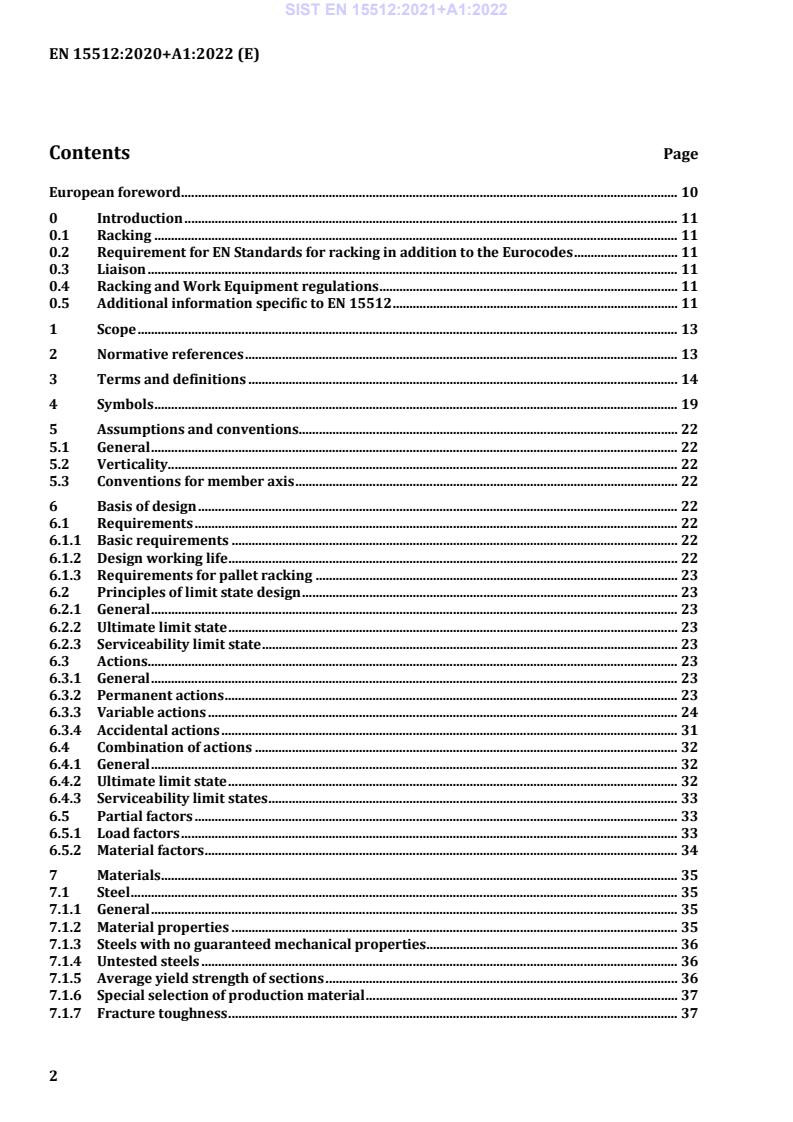
Contents Page
European foreword . 10
0 Introduction . 11
0.1 Racking . 11
0.2 Requirement for EN Standards for racking in addition to the Eurocodes . 11
0.3 Liaison . 11
0.4 Racking and Work Equipment regulations . 11
0.5 Additional information specific to EN 15512 . 11
1 Scope . 13
2 Normative references . 13
3 Terms and definitions . 14
4 Symbols . 19
5 Assumptions and conventions . 22
5.1 General . 22
5.2 Verticality. 22
5.3 Conventions for member axis . 22
6 Basis of design . 22
6.1 Requirements . 22
6.1.1 Basic requirements . 22
6.1.2 Design working life . 22
6.1.3 Requirements for pallet racking . 23
6.2 Principles of limit state design . 23
6.2.1 General . 23
6.2.2 Ultimate limit state . 23
6.2.3 Serviceability limit state . 23
6.3 Actions . 23
6.3.1 General . 23
6.3.2 Permanent actions . 23
6.3.3 Variable actions . 24
6.3.4 Accidental actions . 31
6.4 Combination of actions . 32
6.4.1 General . 32
6.4.2 Ultimate limit state . 32
6.4.3 Serviceability limit states . 33
6.5 Partial factors . 33
6.5.1 Load factors . 33
6.5.2 Material factors . 34
7 Materials . 35
7.1 Steel . 35
7.1.1 General . 35
7.1.2 Material properties . 35
7.1.3 Steels with no guaranteed mechanical properties. 36
7.1.4 Untested steels . 36
7.1.5 Average yield strength of sections . 36
7.1.6 Special selection of production material . 37
7.1.7 Fracture toughness . 37
7.1.8 Dimensional tolerances . 37
7.2 Floor materials . 38
7.2.1 Concrete floors. 38
7.2.2 Bituminous floors . 38
7.2.3 Other floor materials . 38
8 Durability. 38
9 Structural analysis . 39
9.1 Structural modelling for analysis . 39
9.1.1 Structural modelling for analysis and basic assumption . 39
9.1.2 Joint modelling . 39
9.1.3 Ground-structure interaction . 42
9.1.4 Racks braced against the building structure . 45
9.2 Global analysis . 45
9.2.1 Effects of deformed geometry of the structure . 45
9.2.2 Method of analysis . 46
9.2.3 Structural stability of frames . 47
9.3 Imperfections . 53
9.3.1 General . 53
9.3.2 Global imperfections . 53
9.3.3 Local bracing imperfections . 55
9.3.4 Member imperfections . 56
10 Ultimate limit states . 57
10.1 Resistance of cross-sections and members . 57
10.1.1 General . 57
10.1.2 Section properties . 57
10.1.3 Compression members . 58
10.1.4 Bending members . 60
10.1.5 Tension members . 60
10.2 Design of beams. 62
10.2.1 General . 62
10.2.2 Effects of interaction between unit load and beam . 62
10.2.3 Correction for looseness . 63
10.2.4 Plastic design resistance . 63
10.2.5 Buckling length of beams in braced pallet racks . 63
10.2.6 Beams subject to bending and torsion . 64
10.2.7 Beams affected by distortion . 65
10.3 Design of uprights . 65
10.3.1 General . 65
10.3.2 Buckling curves . 65
10.3.3 Flexural buckling length . 66
10.3.4 Torsional buckling length . 68
10.4 Design of frame bracing . 71
10.4.1 General . 71
10.4.2 Robustness . 71
10.4.3 Buckling length of frame bracing . 71
10.5 Design of run spacers . 73
11 Serviceability limit states . 74
11.1 General . 74
11.2 Beams . 74
11.3 Beams in walkways or rack supported floors . 74
12 Design of joints . 74
12.1 General . 74
12.2 Design of beam end connectors . 74
12.2.1 Design resistance of moment and shear . 74
12.2.2 Combination of moment and shear . 74
12.2.3 Reversed moment . 74
12.3 Design of beam connector locks . 75
12.4 Design of splices . 75
12.5 Design of base plates . 75
12.5.1 General . 75
12.5.2 Compression . 76
12.5.3 Tension . 77
12.6 Design of anchorages . 77
12.6.1 General . 77
12.6.2 Robustness. 77
13 Design assisted by testing . 77
13.1 General . 77
13.2 Requirements for tests . 78
13.2.1 Equipment . 78
13.2.2 Support conditions . 78
13.2.3 Application of the load . 78
13.2.4 Increments of the test load . 79
13.2.5 Test materials . 79
13.2.6 Assembly of test specimens . 79
13.2.7 Test reports . 79
13.3 Interpretation of test results . 80
13.3.1 Definition of failure load . 80
13.3.2 Adjustment of test results . 80
13.3.3 Derivation of characteristic values . 82
13.3.4 Characteristic values for a family of tests . 83
13.3.5 Interpolation between test results . 84
14 Marking and labelling – Identification of performance of rack installations. 84
Annex A (normative) Testing . 85
A.1 Materials tests . 85
A.1.1 Tensile tests . 85
A.1.1.1 General . 85
A.1.1.2 Tensile test from beam end connector . 85
A.1.2 Bend tests . 85
A.2 Tests on components . 86
A.2.1 Stub column compression test . 86
A.2.1.1 Purpose of the test . 86
A.2.1.2 Test arrangement and method . 86
A.2.1.3 Corrections to the observations. 87
A.2.1.4 Derivation of the results . 88
A.2.2 Compression tests on uprights – Checks for the effects of distortional buckling . 88
A.2.2.1 Purpose of the test . 88
A.2.2.2 Test arrangement and method . 88
A.2.2.3 Corrections to the observations . 89
A.2.2.4 Derivation of the test results . 89
A.2.3 Compression tests on uprights – Determination of buckling curves . 90
A.2.3.1 Purpose of the test . 90
A.2.3.2 Test arrangement . 91
A.2.3.3 Test method . 92
A.2.3.4 Corrections to the observations . 92
A.2.3.5 Derivation of the column curve . 93
A.2.4 Frame shear stiffness tests . 94
A.2.4.1 Purpose of the tests . 94
A.2.4.2 Method A, loading the frame in the longitudinal direction . 94
A.2.4.2.1 Test arrangement . 94
A.2.4.2.2 Test method . 96
A.2.4.2.3 Corrections to the observations . 96
A.2.4.2.4 Derivation of results . 96
A.2.4.3 Alternative method B using a cross-aisle reversible shear load on a frame . 97
A.2.4.3.1 General . 97
A.2.4.3.2 Test arrangement . 97
A.2.4.3.3 Test method . 98
A.2.4.3.4 Corrections to the observations . 99
A.2.4.3.5 Derivation of results . 99
A.2.5 Bending tests on upright sections . 100
A.2.5.1 Purpose of the test . 100
A.2.5.2 Test arrangement . 100
A.2.5.3 Test method . 102
A.2.5.4 Corrections to the observations . 102
A.2.5.5 Derivation of results . 102
A.2.6 Bending tests on beams . 102
A.2.6.1 Purpose of the test . 102
A.2.6.2 Test arrangement . 102
A.2.6.3 Test method . 104
A.2.6.4 Corrections to the observations . 104
A.2.6.5 Derivation of the results . 104
A.3 Tests on connections . 105
A.3.1 Bending tests on beam end connectors . 105
A.3.1.1 Purpose of the test . 105
A.3.1.2 Test arrangements . 105
A.3.1.3 Test procedure . 107
A.3.1.4 Corrections to the observations. 107
A.3.1.5 Derivation of the results and procedure to define curves . 108
A.3.1.5.1 Procedure 1: . 108
A.3.1.5.2 Procedure 2: . 108
A.3.1.5.3 General . 108
A.3.1.5.4 Procedure to derive a bi-linear curve . 109
A.3.1.5.5 Procedure to derive a multilinear curve . 109
A.3.2 Looseness tests on beam end connectors . 111
A.3.2.1 Purpose of the test . 111
A.3.2.2 Alternative 'A' Test arrangement using a double acting jack . 111
A.3.2.2.1 General . 111
A.3.2.2.2 Test Method . 111
A.3.2.2.3 Corrections to the observations . 112
A.3.2.2.4 Derivation of results . 112
A.3.2.3 Alternative ‘B’ using two cantilever beams and a central upright . 112
A.3.2.3.1 Test arrangement . 112
A.3.2.3.2 Test Method . 114
A.3.2.3.3 Corrections to the observations . 114
A.3.2.3.4 Derivation of results . 114
A.3.3 Shear tests on beam end connectors and connector locks . 114
A.3.3.1 Purpose of the test . 114
A.3.3.2 Test arrangement . 114
A.3.3.3 Test method . 116
A.3.3.4 Corrections to the observations. 116
A.3.3.5 Derivation of results . 116
A.3.4 Moment-shear interaction test of beam end connectors . 116
A.3.4.1 Purpose of the test . 116
A.3.4.2 Test arrangement . 116
A.3.4.3 Test procedure . 116
A.3.4.4 Corrections to the observations. 116
A.3.4.5 Derivation of the bending and shear resistance . 116
A.3.4.6 Derivation of the moment-shear interaction curve . 117
A.3.4.7 Generalized moment-shear relationship . 117
A.3.5 Floor connections test . 117
A.3.5.1 Purpose of the test . 117
A.3.5.2 Reuse of concrete blocks . 118
A.3.5.3 Alternative ‘A’ using two lengths of upright with a central concrete block . 118
A.3.5.3.1 Test arrangement . 118
A.3.5.3.2 Test method . 120
A.3.5.4 Alternative ‘B’ using a single length of upright with an end concrete block . 121
A.3.5.4.1 Test arrangement . 121
A.3.5.4.2 Test Method . 123
A.3.5.5 Corrections to the observations . 123
A.3.5.6 Derivation of the Results . 123
A.3.6 Upright splices test . 124
A.3.6.1 Purpose of the test . 124
A.3.6.2 Test arrangement . 124
A.3.6.3 Test method . 125
A.3.6.4 Corrections to observations. 125
A.3.6.5 Derivation of results . 125
Annex B (informative) Approximate method . 126
B.1 General . 126
B.2 Approximate down-aisle stability analysis – Amplified sway method. 126
B.2.1 General . 126
B.2.2 Amplification factor . 128
B.2.3 Linear elastic analysis . 128
B.2.4 Elastic critical value . 128
B.3 Approximate down-aisle analysis of a regular storage rack . 128
B.3.1 Approximate equation for regular construction . 128
B.3.2 Additional bending moments due to pattern loading . 131
B.3.3 Design Moments . 131
B.3.4 Design loads in outer columns . 132
B.4 Approximate cross-aisle stability analysis . 133
B.4.1 General . 133
B.4.2 Global buckling of upright frames . 133
B.4.3 Shear stiffness of upright frame . 133
B.4.4 Amplification factor β . 134
B.5 Approximate design for symmetrically loaded beams . 137
B.5.1 Mid-span bending moment . 137
B.5.2 Deflection . 138
B.5.3 Shear force . 138
B.5.4 Beam end connector . 139
B.5.5 Equivalent beam loads . 139
Annex C (informative) Correction of beam moments and deflection due to looseness . 141
Annex D (informative) Frame looseness. 143
D.1 General . 143
D.2 Frame bracing types . 143
D.3 Looseness . 144
Annex E (normative) Resistance of compression member according to EN 1993-1-1 and −3 . 146
E.1 Cross-sectional verification . 146
E.2 Design strength with respect to flexural buckling .
...