

SIST EN 12952-2:2022
(Main)Water-tube boilers and auxiliary installations - Part 2: Materials for pressure parts of boilers and accessories
General Information
- Abstract
This European Standard specifies the requirements for the product forms for use in pressure parts of water-tube boilers and for parts welded on to pressure parts:
plates;
wrought seamless tubes;
electrically welded tubes;
submerged, plasma and TIG arc-welded tubes;
forgings;
castings;
rolled bars;
welding consumables;
fasteners;
seamless composite tubes.
- Status
- Published
- Public Enquiry End Date
- 02-Apr-2020
- Publication Date
- 17-Jan-2022
- Technical Committee
- TLP - Pressure vessels
- Current Stage
- 6060 - National Implementation/Publication (Adopted Project)
- Start Date
- 17-Jan-2022
- Due Date
- 24-Mar-2022
- Completion Date
- 18-Jan-2022

Overview - EN 12952-2:2021 (CEN)
EN 12952-2:2021, published by CEN, defines the material requirements and product forms for pressure parts of water‑tube boilers and components welded to those parts. It applies to plates, tubes (seamless, electrically welded, submerged/plasma/TIG welded), forgings, castings, rolled bars, welding consumables, fasteners and seamless composite tubes. The standard supports safe design, manufacture and conformity of pressure equipment used in water‑tube boilers and links to EU pressure‑equipment requirements.
Key topics and technical requirements
- Scope of product forms: explicit coverage of flat products, various tube types, forgings, castings, bars, fasteners and welding consumables, including composite tubing.
- Material selection: guidance on selecting materials with regard to service conditions (temperature, pressure, corrosion) and fabrication methods.
- Material specification content: required information for material orders and documentation (references to harmonized European product standards and particular material appraisals).
- Manufacture and heat treatment: requirements for manufacture, heat‑treatment condition and chemical composition where applicable.
- Mechanical and technological properties: mandatory evaluation of mechanical properties and testing regimes required by the product standard or approvals.
- Inspection and documentation: obligations for compliance and inspection documentation (see EN 764‑4 and EN 764‑5 cross‑references).
- Special materials: procedures for creep‑rupture strength values for new materials (Annex B) and detailed rules for composite tubes (Annex C).
- Marking and nondestructive examination (NDE): marking rules and NDE requirements (e.g., ultrasonic testing references) for pressure components.
Practical applications and users
EN 12952-2 is intended for:
- Boiler manufacturers and fabricators specifying or purchasing pressure‑part materials.
- Design and engineering teams ensuring material selection suits operating temperature/pressure and fabrication processes.
- Inspection bodies and notified bodies verifying material conformity and inspection documentation for compliance with pressure‑equipment directives.
- Material and welding suppliers preparing certified products and welding consumables for boiler use.
- Procurement and quality managers enforcing traceability, marking and test records.
Using EN 12952-2 helps ensure material compatibility, safe operation of water‑tube boilers, and regulatory compliance across EU markets.
Related standards
- EN 12952 series (Parts 1, 3–18) - complete guidance for water‑tube boilers and auxiliary installations
- EN 764‑4, EN 764‑5 - technical delivery conditions and inspection documentation for metallic materials
- EN 10028 series, EN 1092‑1, EN 10160 - referenced product and testing standards
Keywords: EN 12952-2:2021, water‑tube boilers, materials for pressure parts, CEN, pressure equipment, composite tubes, welding consumables, material specification.
Relations
- Effective Date
- 01-Feb-2022
- Effective Date
- 28-Jan-2026
- Effective Date
- 28-Jan-2026
- Effective Date
- 28-Jan-2026
- Effective Date
- 28-Jan-2026
- Effective Date
- 28-Jan-2026
- Effective Date
- 28-Jan-2026
- Effective Date
- 28-Jan-2026
- Effective Date
- 28-Jan-2026
- Effective Date
- 28-Jan-2026
- Effective Date
- 28-Jan-2026
- Effective Date
- 28-Jan-2026
- Effective Date
- 28-Jan-2026
- Effective Date
- 28-Jan-2026
- Effective Date
- 28-Jan-2026
Get Certified
Connect with accredited certification bodies for this standard

DNV
DNV is an independent assurance and risk management provider.

Lloyd's Register
Lloyd's Register is a global professional services organisation specialising in engineering and technology.
DNV Energy Systems
Energy and renewable energy certification.
Sponsored listings
Frequently Asked Questions
SIST EN 12952-2:2022 is a standard published by the Slovenian Institute for Standardization (SIST). Its full title is "Water-tube boilers and auxiliary installations - Part 2: Materials for pressure parts of boilers and accessories". This standard covers: This European Standard specifies the requirements for the product forms for use in pressure parts of water-tube boilers and for parts welded on to pressure parts: plates; wrought seamless tubes; electrically welded tubes; submerged, plasma and TIG arc-welded tubes; forgings; castings; rolled bars; welding consumables; fasteners; seamless composite tubes.
This European Standard specifies the requirements for the product forms for use in pressure parts of water-tube boilers and for parts welded on to pressure parts: plates; wrought seamless tubes; electrically welded tubes; submerged, plasma and TIG arc-welded tubes; forgings; castings; rolled bars; welding consumables; fasteners; seamless composite tubes.
SIST EN 12952-2:2022 is classified under the following ICS (International Classification for Standards) categories: 27.060.30 - Boilers and heat exchangers. The ICS classification helps identify the subject area and facilitates finding related standards.
SIST EN 12952-2:2022 has the following relationships with other standards: It is inter standard links to SIST EN 12952-2:2011, SIST EN ISO 10893-10:2011, SIST EN ISO 17632:2016, SIST EN ISO 3580:2018, SIST EN 10028-2:2017, SIST EN 16668:2016+A1:2018, SIST EN 10160:2001, SIST EN ISO 2566-2:2000, SIST EN ISO 17633:2018, SIST EN 10273:2016, SIST EN 10213:2008+A1:2016, SIST EN 12952-7:2012, SIST EN ISO 24598:2019, SIST EN 4566:2022, SIST EN 764-5:2015. Understanding these relationships helps ensure you are using the most current and applicable version of the standard.
SIST EN 12952-2:2022 is associated with the following European legislation: EU Directives/Regulations: 2014/68/EU; Standardization Mandates: M/071. When a standard is cited in the Official Journal of the European Union, products manufactured in conformity with it benefit from a presumption of conformity with the essential requirements of the corresponding EU directive or regulation.
SIST EN 12952-2:2022 is available in PDF format for immediate download after purchase. The document can be added to your cart and obtained through the secure checkout process. Digital delivery ensures instant access to the complete standard document.
Standards Content (Sample)
SLOVENSKI STANDARD
01-februar-2022
Nadomešča:
SIST EN 12952-2:2011
Vodocevni kotli in pomožne napeljave - 2. del: Materiali za tlačno obremenjene
dele in opremo kotla
Water-tube boilers and auxiliary installations - Part 2: Materials for pressure parts of
boilers and accessories
Wasserrohrkessel und Anlagenkomponenten - Teil 2: Werkstoffe für drucktragende
Kesselteile und Zubehör
Chaudières à tubes d'eau et installations auxiliaires - Partie 2: Matériaux des parties
sous pression des chaudières et accessoires
Ta slovenski standard je istoveten z: EN 12952-2:2021
ICS:
27.060.30 Grelniki vode in prenosniki Boilers and heat exchangers
toplote
2003-01.Slovenski inštitut za standardizacijo. Razmnoževanje celote ali delov tega standarda ni dovoljeno.
EN 12952-2
EUROPEAN STANDARD
NORME EUROPÉENNE
December 2021
EUROPÄISCHE NORM
ICS 27.040 Supersedes EN 12952-2:2011
English Version
Water-tube boilers and auxiliary installations - Part 2:
Materials for pressure parts of boilers and accessories
Chaudières à tubes d'eau et installations auxiliaires - Wasserrohrkessel und Anlagenkomponenten - Teil 2:
Partie 2: Matériaux des parties sous pression des Werkstoffe für drucktragende Kesselteile und Zubehör
chaudières et accessoires
This European Standard was approved by CEN on 1 November 2021.
CEN members are bound to comply with the CEN/CENELEC Internal Regulations which stipulate the conditions for giving this
European Standard the status of a national standard without any alteration. Up-to-date lists and bibliographical references
concerning such national standards may be obtained on application to the CEN-CENELEC Management Centre or to any CEN
member.
This European Standard exists in three official versions (English, French, German). A version in any other language made by
translation under the responsibility of a CEN member into its own language and notified to the CEN-CENELEC Management
Centre has the same status as the official versions.
CEN members are the national standards bodies of Austria, Belgium, Bulgaria, Croatia, Cyprus, Czech Republic, Denmark, Estonia,
Finland, France, Germany, Greece, Hungary, Iceland, Ireland, Italy, Latvia, Lithuania, Luxembourg, Malta, Netherlands, Norway,
Poland, Portugal, Republic of North Macedonia, Romania, Serbia, Slovakia, Slovenia, Spain, Sweden, Switzerland, Turkey and
United Kingdom.
EUROPEAN COMMITTEE FOR STANDARDIZATION
COMITÉ EUROPÉEN DE NORMALISATION
EUROPÄISCHES KOMITEE FÜR NORMUNG
CEN-CENELEC Management Centre: Rue de la Science 23, B-1040 Brussels
© 2021 CEN All rights of exploitation in any form and by any means reserved Ref. No. EN 12952-2:2021 E
worldwide for CEN national Members.
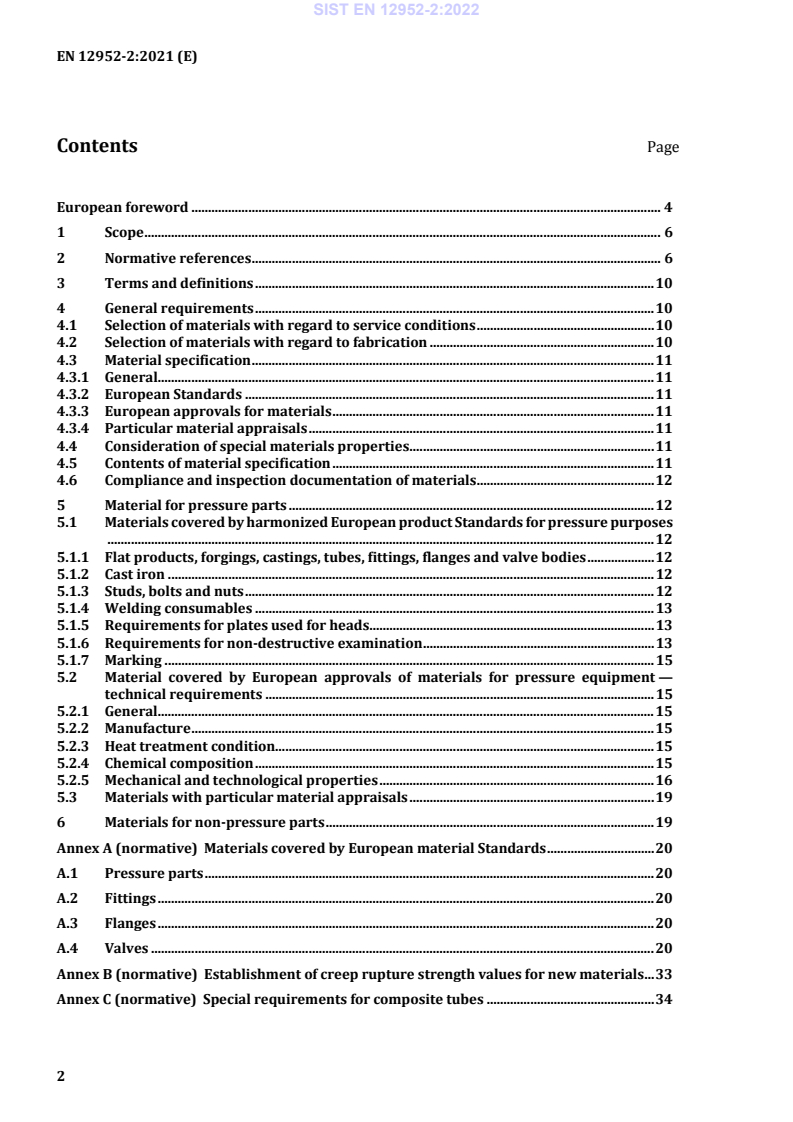
Contents Page
European foreword . 4
1 Scope . 6
2 Normative references . 6
3 Terms and definitions . 10
4 General requirements . 10
4.1 Selection of materials with regard to service conditions . 10
4.2 Selection of materials with regard to fabrication . 10
4.3 Material specification . 11
4.3.1 General. 11
4.3.2 European Standards . 11
4.3.3 European approvals for materials . 11
4.3.4 Particular material appraisals . 11
4.4 Consideration of special materials properties . 11
4.5 Contents of material specification . 11
4.6 Compliance and inspection documentation of materials . 12
5 Material for pressure parts . 12
5.1 Materials covered by harmonized European product Standards for pressure purposes
................................................................................................................................................................... 12
5.1.1 Flat products, forgings, castings, tubes, fittings, flanges and valve bodies . 12
5.1.2 Cast iron . 12
5.1.3 Studs, bolts and nuts . 12
5.1.4 Welding consumables . 13
5.1.5 Requirements for plates used for heads . 13
5.1.6 Requirements for non-destructive examination . 13
5.1.7 Marking . 15
5.2 Material covered by European approvals of materials for pressure equipment —
technical requirements . 15
5.2.1 General. 15
5.2.2 Manufacture . 15
5.2.3 Heat treatment condition. 15
5.2.4 Chemical composition . 15
5.2.5 Mechanical and technological properties . 16
5.3 Materials with particular material appraisals . 19
6 Materials for non-pressure parts . 19
Annex A (normative) Materials covered by European material Standards . 20
A.1 Pressure parts . 20
A.2 Fittings . 20
A.3 Flanges . 20
A.4 Valves . 20
Annex B (normative) Establishment of creep rupture strength values for new materials . 33
Annex C (normative) Special requirements for composite tubes . 34
C.1 General . 34
C.2 Special requirements for composite tubing. 34
C.2.1 Composite tubing . 34
C.2.2 General . 34
C.2.3 Chemical composition . 34
C.2.4 Mechanical and technological properties . 34
C.2.4.1 Tensile test of ferritic pressure retaining inner core . 34
C.2.4.2 Ring expanding test (composite tube) . 34
C.2.5 Tolerances . 35
C.2.5.1 Permissible variations in Outside diameter and wall thickness . 35
C.2.5.2 Permissible variations in straightness . 35
C.2.6 Surface finish . 35
C.2.7 Ultrasonic testing . 35
C.2.7.1 Ultrasonic testing of the metallurgical bond in composite tubes . 35
C.2.7.1.1 Extent of testing . 35
C.2.7.1.2 Reference standard . 35
C.2.7.1.3 Acceptance criteria . 35
C.2.7.2 Ultrasonic testing of composite tubes concerning longitudinal and transverse
imperfections . 36
C.2.7.2.1 Method of testing . 36
C.2.7.2.2 Reference standard . 36
C.2.7.2.3 Calibration . 36
C.2.8 Thickness check of stainless steel component . 36
C.2.8.1 General . 36
C.2.8.2 Calibration. 36
C.2.8.3 Acceptance criteria . 36
C.2.9 Summary of tests and examinations . 37
C.3 Marking . 37
C.3.1 General . 37
C.3.2 Additional marking requirements . 37
Annex D (informative) Significant technical changes between this document and the
previous edition . 38
Annex ZA (informative) Relationship between this European Standard and the essential
requirements of Directive 2014/68/EU aimed to be covered . 39
Bibliography . 40
European foreword
This document (EN 12952-2:2021) has been prepared by Technical Committee CEN/TC 269 “Shell and
water-tube boilers”, the secretariat of which is held by DIN.
This European Standard shall be given the status of a national standard, either by publication of an
identical text or by endorsement, at the latest by June 2022, and conflicting national standards shall be
withdrawn at the latest by June 2022.
Attention is drawn to the possibility that some of the elements of this document may be the subject of
patent rights. CEN shall not be held responsible for identifying any or all such patent rights.
This document supersedes EN 12952-2:2011.
Annex D provides details of significant technical changes between this document and the previous
edition.
EN 12952 series concerning water-tube boilers and auxiliary installations consists of the following parts:
• Part 1: General;
• Part 2: Materials for pressure parts of boilers and accessories;
• Part 3: Design and calculation for pressure parts;
• Part 4: In service boiler life expectancy calculations;
• Part 5: Workmanship and construction of pressure parts of the boiler;
• Part 6: Inspection during construction, documentation and marking of pressure parts of the boiler;
• Part 7: Requirements for equipment for the boiler;
• Part 8: Requirements for firing systems for liquid and gaseous fuels for the boiler;
• Part 9: Requirements for firing systems for pulverized solid fuels for the boiler;
• Part 10: Requirements for safeguards against excessive pressure;
• Part 11: Requirements for limiting devices of the boiler and accessories;
• Part 12: Requirements for boiler feedwater and boiler water quality;
• Part 13: Requirements for flue gas cleaning systems;
• Part 14: Requirements for flue gas DENOX systems using liquefied pressurized ammonia and ammonia
water solution;
• Part 15: Acceptance tests;
• Part 16: Requirements for grate and fluidized-bed firing systems for solid fuels for the boiler;
• CR 12952 Part 17: Guideline for the involvement of an inspection body independent of the
manufacturer.
• Part 18: Operating Instructions
Although these parts can be obtained separately, it should be recognized that the parts are inter-
dependent. As such, the design and manufacture of water-tube boilers requires the application of more
than one part in order for the requirements of the document to be satisfactorily fulfilled.
NOTE A “Boiler Helpdesk” has been established in CEN/TC 269 which can be contacted for any questions
regarding the application of EN 12952 series and EN 12953 series, see the following website: http://www.boiler-
helpdesk.din.de
This document has been prepared under a Standardization Request given to CEN by the European
Commission and the European Free Trade Association, and supports essential requirements of EU
Directive(s) / Regulation(s).
For relationship with EU Directive(s) / Regulation(s), see informative Annex ZA, which is an integral part
of this document.
Any feedback and questions on this document should be directed to the users’ national standards body.
A complete listing of these bodies can be found on the CEN website.
According to the CEN-CENELEC Internal Regulations, the national standards organisations of the
following countries are bound to implement this European Standard: Austria, Belgium, Bulgaria, Croatia,
Cyprus, Czech Republic, Denmark, Estonia, Finland, France, Germany, Greece, Hungary, Iceland, Ireland,
Italy, Latvia, Lithuania, Luxembourg, Malta, Netherlands, Norway, Poland, Portugal, Republic of North
Macedonia, Romania, Serbia, Slovakia, Slovenia, Spain, Sweden, Switzerland, Turkey and the United
Kingdom.
1 Scope
This document specifies the requirements for the product forms for use in pressure parts of water-tube
boilers and for parts welded on to pressure parts:
• plates;
• wrought seamless tubes;
• electrically welded tubes;
• submerged, plasma and TIG arc-welded tubes;
• forgings;
• castings;
• rolled bars;
• welding consumables;
• fasteners;
• seamless composite tubes.
2 Normative references
The following documents are referred to in the text in such a way that some or all of their content
constitutes requirements of this document. For dated references, only the edition cited applies. For
undated references, the latest edition of the referenced document (including any amendments) applies.
EN 764-4:2014, Pressure equipment - Part 4: Establishment of technical delivery conditions for metallic
materials
EN 764-5:2014, Pressure equipment - Part 5: Inspection documentation of metallic materials and
compliance with the material specification
EN 1092-1:2018, Flanges and their joints - Circular flanges for pipes, valves, fittings and accessories, PN
designated - Part 1: Steel flanges
EN 1759-1:2004, Flanges and their joint - Circular flanges for pipes, valves, fittings and accessories, Class
designated - Part 1: Steel flanges, NPS 1/2 to 24
EN 10021:2006, General technical delivery conditions for steel products
EN 10028-2:2017, Flat products made of steels for pressure purposes - Part 2: Non-alloy and alloy steels
with specified elevated temperature properties
EN 10028-3:2017, Flat products made of steels for pressure purposes - Part 3: Weldable fine grain steels,
normalized
EN 10028-7:2016, Flat products made of steels for pressure purposes - Part 7: Stainless steels
EN 10160:1999, Ultrasonic testing of steel flat product of thickness equal or greater than 6 mm (reflection
method)
EN 10164:2018, Steel products with improved deformation properties perpendicular to the surface of the
product - Technical delivery conditions
EN 10213:2007+A1:2016, Steel castings for pressure purposes
EN 10216-2:2013+A1:2019, Seamless steel tubes for pressure purposes - Technical delivery conditions -
Part 2: Non-alloy and alloy steel tubes with specified elevated temperature properties
EN 10216-3:2013, Seamless steel tubes for pressure purposes - Technical delivery conditions - Part 3: Alloy
fine grain steel tubes
EN 10216-5:2021, Seamless steel tubes for pressure purposes - Technical delivery conditions - Part 5:
Stainless steel tubes
EN 10217-2:2019, Welded steel tubes for pressure purposes - Technical delivery conditions - Part 2: Electric
welded non-alloy and alloy steel tubes with specified elevated temperature properties
EN 10217-3:2019, Welded steel tubes for pressure purposes - Technical delivery conditions - Part 3: Electric
welded and submerged arc welded alloy fine grain steel tubes with specified room, elevated and low
temperature properties
EN 10217-5:2019, Welded steel tubes for pressure purposes - Technical delivery conditions - Part 5:
Submerged arc welded non-alloy and alloy steel tubes with specified elevated temperature properties
EN 10222-2:2017+A1:2021, Steel forgings for pressure purposes - Part 2: Ferritic and martensitic steels
with specified elevated temperatures properties
EN 10222-3:2017, Steel forgings for pressure purposes - Part 3: Nickel steels with specified low temperature
properties
EN 10222-4:2017+A1:2021, Steel forgings for pressure purposes - Part 4: Weldable fine grain steels with
high proof strength
EN 10222-5:2017, Steel forgings for pressure purposes - Part 5: Martensitic, austenitic and austenitic-
ferritic stainless steels
EN 10228-1:2016, Non-destructive testing of steel forgings - Part 1: Magnetic particle inspection
EN 10228-3:2016, Non-destructive testing of steel forgings - Part 3: Ultrasonic testing of ferritic or
martensitic steel forgings
EN 10253-2:2021, Butt-welding pipe fittings - Part 2: Non alloy and ferritic alloy steels with specific
inspection requirements
EN 10253-4:2008/AC:2009, Butt-welding pipe fittings - Part 4: Wrought austenitic and austenitic-ferritic
(duplex) stainless steels with specific inspection requirements
EN 10254:1999, Steel closed die forgings - General technical delivery conditions
EN 10269:2013, Steels and nickel alloys for fasteners with specified elevated and/or low temperature
properties
EN 10273:2016, Hot rolled weldable steel bars for pressure purposes with specified elevated temperature
properties
EN 10308:2001, Non destructive testing - Ultrasonic testing of steel bars
EN 10314:2016, Method for the derivation of minimum values of proof strength of steel at elevated
temperatures
EN 12074:2000, Welding consumables - Quality requirements for manufacture, supply and distribution of
consumables for welding and allied processes
EN 12952-3:2011, Water-tube boilers and auxiliary installations - Part 3: Design and calculation for
pressure parts of the boiler
EN 12952-5:2021, Water-tube boilers and auxiliary installations — Part 5: Workmanship and construction
of pressure parts of the boiler
EN 12952-6:2021, Water-tube boilers and auxiliary installations — Part 6: Inspection during construction,
documentation and marking of pressure parts of the boiler
EN 12952-7:2012, Water-tube boilers and auxiliary installations - Part 7: Requirements for equipment for
the boiler
EN 12952-12:2003, Water-tube boilers and auxiliary installations - Part 12: Requirements for boiler
feedwater and boiler water quality
EN 13479:2017, Welding consumables - General product standard for filler metals and fluxes for fusion
welding of metallic materials
EN 16668:2016+A1:2018, Industrial valves - Requirements and testing for metallic valves as pressure
accessories
EN ISO 148-1:2016, Metallic materials - Charpy pendulum impact test - Part 1: Test method (ISO 148-
1:2016)
EN ISO 544:2017, Welding consumables - Technical delivery conditions for filler materials and fluxes - Type
of product, dimensions, tolerances and markings (ISO 544:2017)
EN ISO 636:2017, Welding consumables - Rods, wires and deposits for tungsten inert gas welding of non-
alloy and fine-grain steels - Classification (ISO 636:2017)
EN ISO 2560:2020, Welding consumables - Covered electrodes for manual metal arc welding of non-alloy
and fine grain steels - Classification (ISO 2560:2020)
EN ISO 2566-1:1999, Steel - Conversion of elongation values - Part 1: Carbon and low alloy steels (ISO 2566-
1:1984)
EN ISO 2566-2:1999, Steel - Conversion of elongation values - Part 2: Austenitic steels (ISO 2566-2:1984)
EN ISO 3580:2017, Welding consumables - Covered electrodes for manual metal arc welding of creep-
resisting steels - Classification (ISO 3580:2017)
EN ISO 3581:2016, Welding consumables - Covered electrodes for manual metal arc welding of stainless
and heat-resisting steels - Classification (ISO 3581:2016, Corrected version 2017-11-01)
EN ISO 6892-1:2019, Metallic materials - Tensile testing - Part 1: Method of test at room temperature (ISO
6892-1:2019)
EN ISO 6892-2:2018, Metallic materials - Tensile testing - Part 2: Method of test at elevated temperature
(ISO 6892-2:2018)
EN ISO 8495:2013, Metallic materials - Tube - Ring-expanding test (ISO 8495:2013)
EN ISO 10893-10:2011, Non-destructive testing of steel tubes - Part 10: Automated full peripheral
ultrasonic testing of seamless and welded (except submerged arc-welded) steel tubes for the detection of
longitudinal and/or transverse imperfections (ISO 10893-10:2011)
EN ISO 14171:2016, Welding consumables - Solid wire electrodes, tubular cored electrodes and
electrode/flux combinations for submerged arc welding of non alloy and fine grain steels - Classification
(ISO 14171:2016)
EN ISO 14174:2019, Welding consumables - Fluxes for submerged arc welding and electroslag welding -
Classification (ISO 14174:2019)
EN ISO 14341:2020, Welding consumables - Wire electrodes and weld deposits for gas shielded metal arc
welding of non alloy and fine grain steels - Classification (ISO 14341:2020)
EN ISO 14343:2017, Welding consumables - Wire electrodes, strip electrodes, wires and rods for arc welding
of stainless and heat resisting steels - Classification (ISO 14343:2017)
EN ISO 14344:2010, Welding consumables - Procurement of filler materials and fluxes (ISO 14344:2010)
EN ISO 16834:2012, Welding consumables - Wire electrodes, wires, rods and deposits for gas shielded arc
welding of high strength steels - Classification (ISO 16834:2012)
EN ISO 17632:2015, Welding consumables - Tubular cored electrodes for gas shielded and non-gas shielded
metal arc welding of non-alloy and fine grain steels - Classification (ISO 17632:2015)
EN ISO 17633:2018, Welding consumables - Tubular cored electrodes and rods for gas shielded and non-
gas shielded metal arc welding of stainless and heat-resisting steels - Classification (ISO 17633:2017)
EN ISO 17634:2015, Welding consumables - Tubular cored electrodes for gas shielded metal arc welding of
creep-resisting steels - Classification (ISO 17634:2015)
EN ISO 18276:2017, Welding consumables - Tubular cored electrodes for gas-shielded and non-gas-
shielded metal arc welding of high strength steels - Classification (ISO 18276:2017)
EN ISO 20378:2018, Welding consumables - Rods for gas welding of non-alloy and creep-resisting steels -
Classification (ISO 20378:2017)
EN ISO 21952:2012, Welding consumables - Wire electrodes, wires, rods and deposits for gas shielded arc
welding of creep-resisting steels - Classification (ISO 21952:2012)
EN ISO 24598:2019, Welding consumables - Solid wire electrodes, tubular cored electrodes and electrode-
flux combinations for submerged arc welding of creep-resisting steels - Classification (ISO 24598:2019)
EN ISO 26304:2018, Welding consumables - Solid wire electrodes, tubular cored electrodes and electrode-
flux combinations for submerged arc welding of high strength steels - Classification (ISO 26304:2017)
ISO 6303:1981, Pressure vessel steels not included in ISO 2604, Parts 1 to 6 — Derivation of long-time stress
rupture properties
ISO 18275:2018, Welding consumables — Covered electrodes for manual metal arc welding of high-
strength steels — Classification
CEN ISO/TR 15608:2017, Welding - Guidelines for a metallic materials grouping system
(ISO/TR 15608:2017)
CEN ISO/TR 20172:2009, Welding - Grouping systems for materials - European materials
(ISO/TR 20172:2009)
3 Terms and definitions
No terms and definitions are listed in this document.
ISO and IEC maintain terminological databases for use in standardization at the following addresses:
• ISO Online browsing platform: available at http://www.iso.org/obp
• IEC Electropedia: available at http://www.electropedia.org/
4 General requirements
4.1 Selection of materials with regard to service conditions
The manufacturer of the water-tube boilers shall select the material (including welding consumables) for
the manufacture of the boilers so that, when the delivered material (including welding consumables)
complies with the requirements specified in the material order and when the design rules in
EN 12952-3:2011 and the rules for the fabrication, inspection and testing of the boilers in
EN 12952-5:2021 and EN 12952-6:2021 are observed, the boilers can be operated without hazard under
the service conditions (pressures, temperatures, environments, etc.) for the life time provided in the
order for the boiler.
The materials specified in Clause 5 which satisfy the elongation and impact energy requirements of
5.2.5.3 and 5.2.5.4 respectively shall not be considered prone to brittle fracture during manufacture and
subsequent operation in accordance with the provisions of this document. It is also considered that for
operation within the parameters specified in EN 12952-3:2011 using feedwater and boiler water as
specified in EN 12952-12:2003 the selected materials will not be significantly affected by ageing or
chemical attack.
4.2 Selection of materials with regard to fabrication
The selection of the materials of construction for pressure parts of water-tube boilers and to parts welded
on pressure parts shall take into account the suitability of the material with regard to fabrication, e.g. cold
and hot forming, weldability, expanding, and heat treatment.
NOTE The rules for forming or post weld heat treatment are included in EN 12952-5:2021.
4.3 Material specification
4.3.1 General
The selection and order of materials for pressure parts shall be based on one of the following material
specifications for pressure equipment in the form of:
a) harmonized European material Standards;
b) European approval of material (EAM);
c) particular material appraisals.
4.3.2 European Standards
Materials in accordance with harmonized European Standards shall be selected for types, treatment
conditions and dimensions of products frequently used in Europe.
NOTE Materials in accordance with European Standards are given in Annex A.
4.3.3 European approvals for materials
European approvals for materials are intended for repeated use. They are established in accordance with
EN 764-4:2014 and apply to materials or treatment conditions and product forms or dimensions not
covered in a European material Standard for pressure equipment. Additionally to the requirements of
EN 764-4:2014 the requirements of this document shall be met.
NOTE Reference of available European approvals for materials is published in the Official Journal of the
European Union.
4.3.4 Particular material appraisals
Particular material appraisals apply for individual cases as for example:
a) a material or a product form or a thickness not covered by a European material Standard or EAM
intended for use in a particular pressure equipment;
b) a product specified in a European material Standard or EAM for materials for pressure equipment is
intended in an exceptional case for service conditions outside its specified range of application.
Where relevant to the pressure equipment under consideration the requirements given in
EN 764-4:2014 should be considered. Additionally to the requirements of EN 764-4:2014 the
requirements of this document shall be met.
4.4 Consideration of special materials properties
When materials are chosen with properties other than those specified in the material specification, or
which can influence the lifetime or the safe service behaviour of the water-tube boiler, they shall be taken
into account when selecting the material and its dimensions.
NOTE Examples are the scaling or ageing behaviour of the material.
4.5 Contents of material specification
The different types of specifications for materials for water-tube boilers include the clauses given in
Table 1 as a minimum.
Table 1 — Content of specifications for materials for pressure parts
Clauses EN standards European material data Particular
sheets material
appraisals
a
Unrestricted restricted
Scope X
References X
Definitions (X)
Requirements X
Inspection X
see EN 764-4:2014
Marking X
Guidelines for processing the material Z
etc. (welding, heat treatment, forming,
flame-cutting)
Restrictions on application Z
X = in all cases
(X) = if necessary
Z = the relevant guidelines for fabrication and the restrictions on application are, where necessary,
given in EN 12952-5:2021
a
If applicable by reference to a European Standard for pressure purposes.
4.6 Compliance and inspection documentation of materials
Manufacturers and stockists of materials for pressure parts including welding consumables shall follow
the requirements in accordance with EN 764-5:2014. They shall provide sufficient evidence of their
capability to deliver materials with consistent quality in accordance with the specifications and
EN 764-5:2014.
5 Material for pressure parts
5.1 Materials covered by harmonized European product Standards for pressure
purposes
5.1.1 Flat products, forgings, castings, tubes, fittings, flanges and valve bodies
The material shall be ordered and delivered in accordance with Annex A. The additional requirements
given in this clause shall be taken into account. Harmonized supporting standards are EN 1092-1:2018,
EN 1759-1:2004 and EN 16668:2016+A1:2018.
5.1.2 Cast iron
Spheroidal graphite cast iron shall not be used in the construction of pressure parts, except for valves and
fittings as indicated in EN 12952-7:2012, within the design limits specified in EN 12952-3:2011. The use
of other types of cast iron is not permitted.
5.1.3 Studs, bolts and nuts
Requirements for studs, bolts and nuts shall be in accordance with EN 10269:2013.
5.1.4 Welding consumables
The welding consumables (electrodes, filler wires, filler rods, fluxes, fusible inserts) shall be selected so
that the mechanical properties of the weld metal are compatible with the relevant requirements of the
base materials.
The welding consumables are classified or specified, respectively, in accordance with the following
standards: EN 12074:2000, EN ISO 20378:2018, EN 13479:2017, EN ISO 544:2017, EN ISO 636:2017,
EN ISO 2560:2020, EN ISO 3580:2017, EN ISO 14171:2016, EN ISO 14174:2019, EN ISO 14341:2020,
EN ISO 14343:2017, EN ISO 14344:2010, EN ISO 16834:2012, EN ISO 17632:2015, EN ISO 17633:2018,
EN ISO 17634:2015, EN ISO 18276:2017, EN ISO 21952:2012, EN ISO 24598:2019, EN ISO 26304:2018,
EN ISO 3581:2016, ISO 18275:2018.
Technical delivery conditions for welding consumables and additives used for welding of pressure parts
and their structural attachments shall comply with EN 12074:2000 or EN ISO 544:2017.
Equivalent national/international provisions are admissible, provided they meet the same criteria
concerning the requirements for the manufacturing, delivery, distribution, test procedures and
evaluation of welding consumables and additives regarding the requirements for the quality
management system.
5.1.5 Requirements for plates used for heads
Plates which are to be used in the manufacture of heads shall represent the quality class Z35 in
accordance with EN 10164:2018 (see EN 12952-3:2011, 10.3.1).
5.1.6 Requirements for non-destructive examination
The non-destructive examination (NDE) requirement for materials in the various product forms shall be
as given below.
a) plates:
Ultrasonic testing (UT) in accordance with EN 10160:1999, class S1.
b) Tubes — seamless:
Seamless tubes shall be tested in accordance with EN 10216 (series) test category 2 (TC2). For
unalloyed seamless tubes with design temperatures below 450 °C and design pressures below
42 bar, it is permitted to perform test category 1 (TC1) in accordance with
EN 10216-2:2013+A1:2019.
1) longitudinal imperfections:
UT in accordance with EN ISO 10893-10:2011
acceptance level: U2 sub-category B for cold finished and machined tubes
U2 sub-category C for all other conditions.
2) transverse imperfections:
UT in accordance with EN ISO 10893-10:2011
acceptance level: U2 sub-category C for all headers with outside diameters > 142 mm.
3) tube ends:
UT in accordance with EN ISO 10893-10:2011, Annex B;
acceptance level: U2 sub-category B or C as for longitudinal imperfections.
This is only mandatory for fixed length tubes. When the tubes are in close end to end contact, it
can be accepted that 100 % (full length) ultrasonic examination has taken place, and therefore
no additional tube end examination is required.
c) tubes – welded:
Welded tubes of test category 2 (TC2) in accordance with EN 10217-2:2019. For unalloyed welded
steel tubes with design temperatures below 450 °C and design pressures below 42 bar, it is
permitted to perform test category 1 (TC1) in accordance with EN 10217-2:2019. However, the
longitudinal weld shall be subject to ultrasonic testing.
1) longitudinal imperfections:
UT in accordance with EN ISO 10893-10:2011
acceptance level: U2 sub-category C.
2) transverse imperfections:
UT in accordance with EN ISO 10893-10:2011
acceptance level: U2 sub-category C for all headers with outside diameter > 142 mm.
3) tube ends:
UT in accordance with EN ISO 10893-10:2011, Annex B
acceptance level: U2 sub-category C as for longitudinal imperfections.
This is only mandatory for fixed length tubes. When the tubes are in close end to end contact, it
can be assumed that 100 % (full length) ultrasonic testing has taken place, and therefore no
additional tube end examination is required. The requirements Annex I, 3.1.2 and 3.1.3 of
Pressure Equipment Directive 2014/68/EU should be taken into account.
d) Forgings and rolled bars:
For pressure part of boilers, rolled bars in accordance with EN 10273:2016 as well as forgings shall
be examined according to EN 10222-2:2017+A1:2021, EN 10222-3:2017,
EN 10222-4:2017+A1:2021 and EN 10222-5:2017 in accordance with EN 10228-1:2016 up to
EN 10228-3:2016. The volumetric testing in accordance with EN 10228-3:2016 shall be carried out
in quality class 3 as 100 % examination with straight-beam probe scanning and angle-beam probe
scanning.
Steel die forgings for pressure parts of boilers shall be delivered as specified in EN 10254:1999. A
volumetric testing as a complete examination in quality class 3 of the forged or rolled stock for die
forgings has to be performed according to EN 10308:2001.
e) Steel castings:
Steel castings shall be delivered and tested in accordance with EN 10213:2007+A1:2016.
f) Butt-welding pipe fittings:
Butt-welding pipe fittings shall be tested in accordance with EN 10253-2:2021.
5.1.7 Marking
Marking shall be carried out in accordance with the requirements of EN 12952-5:2021, 6.3. For methods
of marking see European Standards for materials.
5.2 Material covered by European approvals of materials for pressure equipment —
technical requirements
5.2.1 General
The material shall be covered by a European approval of material (EAM) established in EN 764-4:2014.
This data sheet shall meet the requirements in accordance with Table 1.
The non-destructive examination (NDE) requirement for materials in the various product forms
according to 5.1.6 shall be specified as well for materials according to EN as for materials covered by
European approvals as for materials with particular material appraisal.
NOTE The term “cast”, when related to chemical composition, is used in the same way as in all European base
materials standards and refers to the material in its molten condition.
5.2.2 Manufacture
If the properties specified can be reliably achieved only when special methods of manufacture are applied
(e.g. vacuum melting, treatment of the cast with nitrogen binding elements, or, in the case of welded tubes,
defined welding methods are applied), these methods shall be considered.
Rimming steels and semi-killed steels shall not be used.
5.2.3 Heat treatment condition
The heat treatment condition of the material at the time of delivery shall be specified.
Plates to be hot formed may be supplied in any suitable condition, e.g. as rolled, hot finished, normalized
and tempered.
Carbon and carbon manganese steel plates (Steel group 1, 2) to be cold formed shall be supplied in the
normalized condition.
Low alloy steel plates (Steel group 4, 5) to be cold formed shall be supplied in the normalized and
tempered condition except that, where metallurgically suitable and where post-welded heat treatment
will suffice as the tempering treatment, plates supplied in the normalized condition shall be permitted.
Electrically welded tubes shall be supplied in the normalized condition.
5.2.4 Chemical composition
The chemical composition for the cast analysis and for the product analysis shall be specified. For steels
intended for welding or forming, the values specified should not exceed the values given in Table 2. Steels
for which the values are higher than those given in Table 2 may be used subject to appropriate welding
approvals with appropriate heat treatment.
Table 2 — General requirements for the chemical composition of steels for welding and forming
Steel Maximum content according to analysis
% C % P % S
cast product cast product cast product
Ferritic steels 0,23 0,25 0,035 0,040 0,020 0,025
Austenitic steels 0,10 0,11 0,035 0,040 0,015 0,018
Elements not specified in the EAM shall not be added intentionally, except for finishing the cast. All
reasonable precautions shall be taken to prevent the addition of elements from scrap or other materials
used in the manufacture, but residual elements may be present, provided the mechanical properties and
applicability are not adversely affected.
5.2.5 Mechanical and technological properties
5.2.5.1 General
The following property values shall be specified for each type of material, so that they reflect the specific
properties of the individual steel grade.
5.2.5.2 Tensile properties at room temperature
The tests shall be carried out in accordance with EN ISO 6892-1:2019.
a) Yield or proof strength values
For all ferritic steels, the minimum value for the upper yield strength R or, for cases where no
eH, min
yield phenomenon occurs, the minimum proof strength for 0,2 % non-proportional extension R
p0,2,
shall be specified.
min
For austenitic steels, the minimum proof strength values for 1 % non-proportional extension R
p1,0, min
and, where appropriate, additionally R values shall be specified.
p0,2, min
b) Tensile strength
For the tensile strength, a minimum value R and, unless no maximum yield or proof strength
m, min
value is specified, a maximum value R shall be specified.
m, max
The specified minimum tensile strength shall be not less than 320 MPa. The specified maximum
tensile strength should not exceed the specified minimum tensile strength by more than
1) 120 MPa for carbon and carbon manganese steels;
2) 150 MPa for alloy steels, except austenitic steels;
3) 200 MPa for austenitic steel
...