

SIST EN 15428:2008
Soil improvers and growing media - Determination of particle size distribution
- Abstract
This document specifies a method of determination of particle size distribution in soil improvers and growing media.
- Status
- Published
- Publication Date
- 12-Feb-2008
- Technical Committee
- KAT - Soil quality
- Current Stage
- 6060 - National Implementation/Publication (Adopted Project)
- Start Date
- 28-Jan-2008
- Due Date
- 03-Apr-2008
- Completion Date
- 13-Feb-2008

SIST EN 15428:2008 is the SIST version of EN 15428:2007. It specifies a sieve-based method for determining particle size distribution in soil improvers and growing media, using an air-dried sample and a mechanical sieving machine. The standard is written for laboratories and technical users who need to measure and report the size fractions in these products.
What does SIST EN 15428:2008 specify?
SIST EN 15428:2008 specifies a method for determining particle size distribution in soil improvers and growing media. The method is intended for samples supplied in the form in which they are used, and it is organized as a full test method with calculations, precision information and reporting rules.
| Annex | What it covers |
|---|---|
| Annex A | Optimization of the sieving machine |
| Annex B | Results of an interlaboratory trial to determine particle size |
The main body is arranged in clauses 1 to 12: scope, normative references, terms and definitions, principle, apparatus, machine optimization, test sample, air drying, procedure, calculations and expression of results, precision, and test report.
What are the key requirements of SIST EN 15428:2008?
Sample preparation and suitability
SIST EN 15428:2008 requires sampling in accordance with EN 12579 and preparation in accordance with EN 13040:2007 up to Clause 7. The sample should be ready for use, which matters because the method is meant to describe the product as it is supplied, not as an ideal laboratory material.
The standard also notes that it may not suit all materials, such as sticky or non-flowing products. In practice, that tells the user to check whether a product can be handled and sieved without changing its character.
Sieving setup and machine control
SIST EN 15428:2008 uses a mechanical sieving-shaking machine with vertical vibration, adjustable amplitude and interval timing. The sieve set is defined by the standard and uses openings from 31,5 mm down to 1,0 mm plus a reception tray. This matters because the fractions are only comparable when the same sieve series is used.
The sieving machine must be optimized before first use and then optimized annually, following Annex A. For routine work, that means the laboratory must control the machine setting rather than assuming the same vibration works for every product.
Drying and sub-sample size
SIST EN 15428:2008 requires air drying of representative portions at 40 °C and analysis within 24 h after drying. The remaining moisture content in the sub-samples shall not exceed 15 % of the total weight. This limits sticking, clogging and size changes caused by moisture.
The analytical portion depends on the expected amount of material below 8 mm, and Table 1 gives the sub-sample volumes for 200 mm and 300 mm sieves. In practice, this prevents overloading the sieves and helps the material pass through evenly.
Calculation and result checks
SIST EN 15428:2008 defines how to calculate the fraction distribution from the weights of the sieve, the reception tray and the retained material. The results are expressed as mass fractions on a dry matter basis and rounded to whole numbers.
For quality control, the standard requires the three sub-samples to be compared through a coefficient of variance. If a portion exceeds 20 %, the sample is considered insufficiently homogeneous and the analysis should be repeated. That gives the user a practical check on whether the result is reliable.
Reporting and precision
SIST EN 15428:2008 requires the test report to identify the standard used, the sample, the analytical methods, the results and any departures or optional details that may have affected the outcome. Annex B summarizes precision data from interlaboratory trials, which helps users judge how the method performed across different materials.
What terms does SIST EN 15428:2008 define?
- Soil improvers - materials used to improve soil properties and handled here as test materials for sieve analysis.
- Growing media - materials used as a plant-growing substrate and tested in the same way as soil improvers.
- Particle size distribution - the proportion of material in each sieve fraction and in the reception tray.
- Test sample - the prepared material taken for the sieving determination.
- Sub-sample - a reduced portion taken from the test sample for one sieving run.
- Dry matter basis - reporting results after moisture has been removed from the measured mass.
- Repeatability - agreement between repeated results under the same conditions.
- Reproducibility - agreement between results obtained in different laboratories.
Who uses SIST EN 15428:2008?
SIST EN 15428:2008 is used by testing laboratories, manufacturers of soil improvers and growing media, and quality managers who need to verify product consistency. It also supports buyers and specifiers who compare products by sieve fraction. The standard is relevant wherever particle size affects handling, product grading or declared specifications.
What changed in SIST EN 15428:2008 from the previous edition?
SIST EN 15428:2008 is identical to EN 15428:2007.
Which standards are used with SIST EN 15428:2008?
- EN 12579 - provides the sampling method for soil improvers and growing media.
- EN 13040:2007 - provides sample preparation and the method for determining moisture content.
- CR 13456:1999 - provides terms and definitions used by the standard.
- ISO 565 - gives the nominal sizes of sieve openings used for the test sieves.
What does the SIST EN 15428:2008 document contain?
The document contains the sieving principle, apparatus requirements, the machine optimization procedure, sample preparation and air-drying instructions, and the calculation rules for particle size fractions. It also includes Table 1 for sample volumes and the sieve series used in the method. Annex A gives a practical optimization procedure for the sieving machine, and Annex B summarizes interlaboratory trial results for several product types. The report clause lists the information that must be recorded when the test is finished.
Relations
- Effective Date
- 25-Aug-2026
- Effective Date
- 28-Jan-2026
- Effective Date
- 28-Jan-2026
- Effective Date
- 28-Jan-2026
- Refers
SIST EN 12503-2:2002 - Sports mats - Part 2: Pole vault and high jump mats, safety requirements - Effective Date
- 28-Jan-2026
- Effective Date
- 28-Jan-2026
Get Certified
Connect with accredited certification bodies for this standard

Control Union Certifications
Global certification for agriculture and sustainability.

ECOCERT
Organic and sustainability certification.

FSC International
Forest Stewardship Council certification.
Sponsored listings
Frequently Asked Questions
SIST EN 15428:2008 is a standard published by the Slovenian Institute for Standardization (SIST). Its full title is "Soil improvers and growing media - Determination of particle size distribution". This standard covers: This document specifies a method of determination of particle size distribution in soil improvers and growing media.
This document specifies a method of determination of particle size distribution in soil improvers and growing media.
SIST EN 15428:2008 is classified under the following ICS (International Classification for Standards) categories: 65.080 - Fertilizers. The ICS classification helps identify the subject area and facilitates finding related standards.
SIST EN 15428:2008 has the following relationships with other standards: It is inter standard links to SIST ISO 565:2003, SIST EN 13040:2008, SIST EN 12579:2024, SIST CR 13456:2002, SIST EN 12503-2:2002, SIST-TS CEN/TS 15534-2:2007. Understanding these relationships helps ensure you are using the most current and applicable version of the standard.
SIST EN 15428:2008 is associated with the following European legislation: EU Directives/Regulations: 2013-01-3557. When a standard is cited in the Official Journal of the European Union, products manufactured in conformity with it benefit from a presumption of conformity with the essential requirements of the corresponding EU directive or regulation.
SIST EN 15428:2008 is available in PDF format for immediate download after purchase. The document can be added to your cart and obtained through the secure checkout process. Digital delivery ensures instant access to the complete standard document.
Standards Content (Sample)
2003-01.Slovenski inštitut za standardizacijo. Razmnoževanje celote ali delov tega standarda ni dovoljeno.Soil improvers and growing media - Determination of particle size distributionAmendements du sol et supports de culture - Détermination de la répartition granulométriqueBodenverbesserungsmittel und Kultursubstrate - Bestimmung der KorngrößenverteilungTa slovenski standard je istoveten z:EN 15428:2007SIST EN 15428:2008en,fr,de65.080ICS:SLOVENSKI
STANDARDSIST EN 15428:200801-marec-2008
EUROPEAN STANDARDNORME EUROPÉENNEEUROPÄISCHE NORMEN 15428September 2007ICS 65.080 English VersionSoil improvers and growing media - Determination of particlesize distributionAmendements du sol et supports de culture -Détermination de la répartition granulométriqueBodenverbesserungsmittel und Kultursubstrate -Bestimmung der PartikelgrößenverteilungThis European Standard was approved by CEN on 28 July 2007.CEN members are bound to comply with the CEN/CENELEC Internal Regulations which stipulate the conditions for giving this EuropeanStandard the status of a national standard without any alteration. Up-to-date lists and bibliographical references concerning such nationalstandards may be obtained on application to the CEN Management Centre or to any CEN member.This European Standard exists in three official versions (English, French, German). A version in any other language made by translationunder the responsibility of a CEN member into its own language and notified to the CEN Management Centre has the same status as theofficial versions.CEN members are the national standards bodies of Austria, Belgium, Bulgaria, Cyprus, Czech Republic, Denmark, Estonia, Finland,France, Germany, Greece, Hungary, Iceland, Ireland, Italy, Latvia, Lithuania, Luxembourg, Malta, Netherlands, Norway, Poland, Portugal,Romania, Slovakia, Slovenia, Spain, Sweden, Switzerland and United Kingdom.EUROPEAN COMMITTEE FOR STANDARDIZATIONCOMITÉ EUROPÉEN DE NORMALISATIONEUROPÄISCHES KOMITEE FÜR NORMUNGManagement Centre: rue de Stassart, 36
B-1050 Brussels© 2007 CENAll rights of exploitation in any form and by any means reservedworldwide for CEN national Members.Ref. No. EN 15428:2007: E
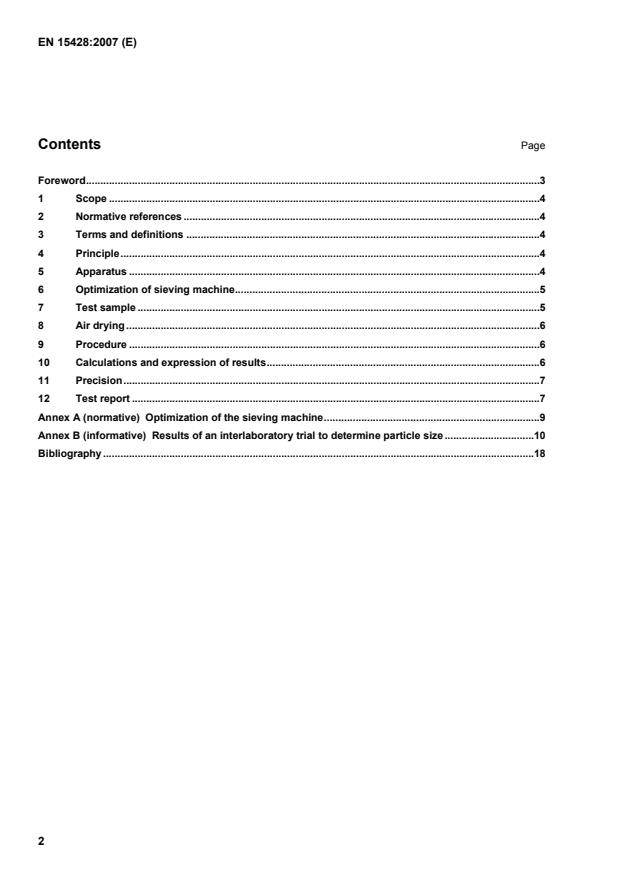
Optimization of the sieving machine.9 Annex B (informative)
Results of an interlaboratory trial to determine particle size.10 Bibliography.18
5 Apparatus 5.1
Sieving-shaking machine, vertical vibrating movement, with amplitude adjustment, and interval timer. Sieving time: 7 min in periods of 10 s shaking and 1 s rest with an amplitude in the range between 0,5 mm and 1,5 mm. 5.2
Test sieves, diameter 200 mm or 300 mm, rim height 55 mm, aperture sizes as listed in ISO 565, of stainless steel woven wire with square openings 31,5 mm, 16,0 mm, 8,0 mm, 4,0 mm, 2,0 mm, 1,0 mm, and reception tray, sieve lid. 5.3
Drying oven, forced air suction, adjustable to 40 °C ± 5 °C. NOTE Care should be taken to prevent loss of fine lightweight particles. 5.4
Three drying trays, rim height ca 50 mm ± 10 mm, minimum bottom area of 400 cm2, heat proof to 50 °C. 5.5
Balance with a weighing range at least 4 kg and an accuracy 0,1 g. 5.6
Apparatus for sample division, comprising any suitable equipment for combining and reducing the samples which preserves the characteristics of the product. Depending on the particle size, material and
6 Optimization of sieving machine Prior to its first use the shaking machine shall be optimized as described in Annex A. Optimization shall be repeated annually. 7 Test sample 7.1 General For the determination of the particle size distribution materials shall be sampled in accordance with EN 12579. This European Standard is applicable to samples supplied in a form in which they are used and is not necessarily applicable to or suitable for all types of growing medium or soil improver, for example material that is not able to flow when used or is sticky. Samples shall be analysed in a state ready to be used. Prepare the test sample in accordance with EN 13040:2007 up to Clause 7. 7.2 Determination of the sub-sample volume First determine the analytical sample size. For fine materials, use a smaller volume than for coarser materials to reduce the risk of blocking the sieves (see Table 1). Place the 8,0 mm mesh sieve (5.2) on the sieving machine with the reception tray under it. Reduce the sample to the size of the sub-sample using an apparatus for sample division (5.6). Transfer the appropriate sub-sample (750 ml for 300 mm sieve and 375 ml for 200 mm sieve) to the sieve and place the lid on the sieve. Secure to the sieving tower and switch on the sieving machine (5.1) for 1 min at the standard setting. For samples in which the moisture content is too high, first air dry the sample in a drying oven for 16 h (5.3). NOTE If the moisture content is too high, the sample will not pass through the sieve. After sieving, weigh the sieve (c), the reception tray with the sample (a), then dry-clean the sieve and reception tray and weigh them empty (d and b respectively).
Calculate the fraction according to 10.1. Table 1 — Sample volumes Sieve diameter Sub-sample portion
If 0 mm to 8 mm fraction ≤ 50 % w/w total Sub-sample portion
If 0 mm to 8 mm fraction > 50 % w/w total
200 mm 375 ml 125 ml 300 mm 750 ml 250 ml
8 Air drying Take three representative appropriate volumes (see Table 1) of the sample as received using an apparatus for sample division (5.6) and place them into 3 separate drying trays. Spread the sample over the surface of the tray as uniformly as possible and weigh. Place the trays in the drying oven (5.3) at 40 °C for at least 16 h and re-weigh. Calculate the moisture loss. After drying, the remaining moisture content in the sub-samples shall not exceed 15 % of the total weight. The moisture content shall be determined as described in EN 13040:2007. 9 Procedure Determine the particle size distribution within 24 h after drying. Store the sample in a dry atmosphere until sieving can be performed.
NOTE As samples absorb moisture, volume changes can occur. Assemble the sieves in order of aperture size, with the largest aperture at the top, on top of the reception tray on the sieving machine. Distribute all the dried sub-sample (Clause 8) equally on the upper sieve. Place the lid on the upper sieve and secure the sieves. Switch on the sieving machine for 7 min at the prescribed setting (Clause 6). Determine the weight fractions of each sieve and of the reception tray. Dry-clean the sieves and the reception tray. When the three sub-samples have been sieved and weighed, determine the empty weights of the sieves and the reception tray. Calculate the fraction distribution as described in 10.2. 10 Calculations and expression of results 10.1 Calculation of fraction distribution during sample pre-treatment Calculate the fraction distribution during sample pre-treatment as follows: The sieving fraction greater than 8 mm is given by
100% )()(-
mass)by
(% mm 8 fraction
Sieving×−+−>badcdc=
(1) The sieving fraction smaller than 8 mm is given by
100% )()( mass)by
(% mm 8-0fraction
Sieving×−+−−badcba=
(2) where a
is the weight of reception tray plus sample, expressed in g; b
is the weight of the empty reception tray, expressed in g; c
is the weight of the 8,0 mm sieve plus sample, expressed in g;
is the weight of the empty 8,0 mm sieve, expressed in g. 10.2 Calculation of fraction distribution of a sample The portion masses are expressed on the total mass of the sample.
weight%100
massraction ×∑xxxAAZZZF
(3) where x = 1.7
1 - sieve 31,5 mm
2 - sieve 16 mm
3 - sieve 8 mm
4 - sieve 4 mm
5 - sieve 2 mm
6 - sieve 1 mm
7 - reception tray
A1.7
= (weight sieve plus sample - weight empty sieve). For each fraction determine the average and round it to the nearest whole percent. Then determine the coefficient of variance of the three sub-samples according to the calculation below (example calculation of portion x). Do this for portions 2 to 6 and only for the three largest fractions. Disregard the portion of > 31,5 mm. If the coefficient of variance of a portion is greater than 20 % the sample should be considered as insufficiently homogenous. The analysis should be repeated in its entirety. nZZZG∑xx verageA
(4) where: n = number of replicates (3 or 4) 100
Variance of oefficient×−−∑x2xxxG1"/!n"G!ZZZVcC
(5) 11 Precision Typical performance characteristics for precision and accuracy are shown in Table B.1 to Table B.7. 12 Test report The test report shall include the following information: a) reference to the European Standard (EN 15428:2007);
Optimization of the sieving machine A.1 Test sample Homogeneous, peat type 1, < 16 mm, fraction 0 to 1 mm 10 to 40 %. A.2 Sample pre-treatment Take a sub-sample of the test sample (for 300 mm sieve take 500 ml, for 200 mm sieve take 250 ml) from which the particles greater than 16 mm have been sieved out manually; dry this sample for 24 h at 40 °C. Place sieves and reception tray on the sieving machine in such
...