

SIST EN 528:2021+A1:2022
(Main)Rail dependent storage and retrieval equipment - Safety requirements for S/R machines
General Information
- Abstract
This document applies to all types of Storage and Retrieval (S/R) machines, restricted to the rails on which they travel within and outside the aisles for the storage and retrieval of unit loads and/or long goods such as bar materials and/or for order picking or similar duties. These machines shall embody lifting means along a mast and may include lateral handling facilities. Also included is the transfer equipment used to change between aisles. Control of machines may range from manual to fully automatic.
S/R-machine-related satellite vehicles according to definition 3.20 are included as a load-handling-device (LHD).
References in this standard to racking, buildings and systems only apply where it is necessary to assess the hazards and risks at their interfaces with S/R machines.
This document deals with all significant hazards relevant to rail dependent storage and retrieval equipment, when they are used under the conditions intended by the manufacturer including reasonably foreseeable misuse (see Annex F "List of significant hazards")).
This document applies to machines and equipment that are manufactured after the date of issue of this document.
Illustrations of examples of machines and transfer equipment to which this standard applies are shown in Annex A.
Safety requirements and/or measures in this standard apply to equipment used under indoor conditions. However, additional risk assessments and safety measures need to be considered for uses in severe conditions, e.g. extremely high temperatures, loads, the nature of which could lead to a dangerous situation (e.g. especially brittle loads, explosives), earthquake effects and also contact with foodstuff.
This document also deals with the technical requirements for electromagnetic compatibility (EMC).
- Status
- Published
- Publication Date
- 24-Aug-2022
- Technical Committee
- DTN - Lift and transport appliances
- Current Stage
- 6060 - National Implementation/Publication (Adopted Project)
- Start Date
- 22-Jul-2022
- Due Date
- 26-Sep-2022
- Completion Date
- 25-Aug-2022
- Directive
- 2006/42/EC - Directive 2006/42/EC of the European Parliament and of the Council of 17 May 2006 on machinery, and amending Directive 95/16/EC (recast)OJ Ref: OJ L 194, TIP C, L 7.9.2026 UMIK 20.1.2027 OJ Date: 02-Aug-2023 Conflicting Date: 20-Jan-2027
Buy Documents


Overview
SIST EN 528:2021+A1:2022 is the CEN European safety standard, adopted by SIST, that specifies safety requirements for rail dependent storage and retrieval (S/R) equipment. It applies to S/R machines that travel on rails inside and outside aisles for handling unit loads, long goods (e.g., bars) or order picking duties. The standard covers machines with lifting means along a mast (including lateral handling), transfer equipment between aisles, and S/R-related satellite vehicles considered as load-handling-devices (LHDs). Control modes range from manual to fully automatic. The standard addresses all significant hazards during intended use and reasonably foreseeable misuse (see Annex F) and includes technical requirements for electromagnetic compatibility (EMC). It applies to equipment manufactured after publication and primarily targets indoor use; severe environments (extreme temperatures, brittle/explosive loads, seismic effects, food contact) require additional risk assessment.
Key Topics and Technical Requirements
The standard organizes safety measures and verification across machine subsystems. Major topics include:
- Control positions and control equipment: design, access/egress, operator safeguards, mode/key interlocks, stop and emergency stop functions.
- Hoist unit safety: braking systems, lift/lower limits, overload and slack protection, safety gear and overspeed devices, suspension elements and drive types (hydraulic, lead-screw, rack & pinion).
- Travel unit requirements: travel brakes, speed reduction systems, travel limits, anti-derailment devices and stability considerations.
- Load handling devices (LHDs) and satellites: load stability, load position monitoring, interlocks and rotating device controls.
- Electrical equipment and EMC: supply conditions, shock protection, isolation, suspension of safeguarding and EMC verification.
- Transfer equipment: retention of position, movement control, interlocking and stability.
- Maintenance, commissioning and verification: maintenance positions, emergency control, speed limitation, testing (static/dynamic load tests), EMC and noise verification, and documentation requirements.
- Machine environment and safeguarding: safety clearances, limiting access, load entry/exit points, escape routes, protection against falling/unintentional load movement.
Illustrative examples are provided in Annex A; Annex F lists significant hazards to be addressed.
Applications and Who Uses This Standard
SIST EN 528:2021+A1:2022 is essential for:
- Manufacturers and designers of S/R machines, LHDs and aisle transfer systems
- Warehouse automation integrators and system engineers implementing high-bay racking and order-picking systems
- Safety engineers and compliance officers performing risk assessments and conformity checks
- Maintenance teams and commissioning personnel who must follow verification and test procedures
- Procurement and operations managers specifying safe S/R equipment for distribution centers, cold stores and manufacturing storage
Use cases include automated high-bay warehouses, long-goods storage systems, multi-aisle retrieval systems and satellite vehicle solutions.
Related Standards
SIST EN 528:2021+A1:2022 interfaces with other European standards on racking, machine safety, EMC and noise measurement. Users should consult relevant EN standards for racking, electrical safety and EMC to ensure full compliance in system interfaces.
Keywords: SIST EN 528:2021+A1:2022, rail dependent storage and retrieval equipment, S/R machines, safety requirements, EMC, load-handling device, warehouse automation, risk assessment.
Relations
- Effective Date
- 09-Feb-2026
- Effective Date
- 09-Feb-2026
- Effective Date
- 09-Feb-2026
- Effective Date
- 09-Feb-2026
- Effective Date
- 28-Jan-2026
- Effective Date
- 28-Jan-2026
- Effective Date
- 28-Jan-2026
- Effective Date
- 28-Jan-2026
- Effective Date
- 28-Jan-2026
- Effective Date
- 28-Jan-2026
- Effective Date
- 28-Jan-2026
- Effective Date
- 28-Jan-2026
- Effective Date
- 28-Jan-2026
- Effective Date
- 28-Jan-2026
- Effective Date
- 28-Jan-2026
Buy Documents
Frequently Asked Questions
SIST EN 528:2021+A1:2022 is a standard published by the Slovenian Institute for Standardization (SIST). Its full title is "Rail dependent storage and retrieval equipment - Safety requirements for S/R machines". This standard covers: This document applies to all types of Storage and Retrieval (S/R) machines, restricted to the rails on which they travel within and outside the aisles for the storage and retrieval of unit loads and/or long goods such as bar materials and/or for order picking or similar duties. These machines shall embody lifting means along a mast and may include lateral handling facilities. Also included is the transfer equipment used to change between aisles. Control of machines may range from manual to fully automatic. S/R-machine-related satellite vehicles according to definition 3.20 are included as a load-handling-device (LHD). References in this standard to racking, buildings and systems only apply where it is necessary to assess the hazards and risks at their interfaces with S/R machines. This document deals with all significant hazards relevant to rail dependent storage and retrieval equipment, when they are used under the conditions intended by the manufacturer including reasonably foreseeable misuse (see Annex F "List of significant hazards")). This document applies to machines and equipment that are manufactured after the date of issue of this document. Illustrations of examples of machines and transfer equipment to which this standard applies are shown in Annex A. Safety requirements and/or measures in this standard apply to equipment used under indoor conditions. However, additional risk assessments and safety measures need to be considered for uses in severe conditions, e.g. extremely high temperatures, loads, the nature of which could lead to a dangerous situation (e.g. especially brittle loads, explosives), earthquake effects and also contact with foodstuff. This document also deals with the technical requirements for electromagnetic compatibility (EMC).
This document applies to all types of Storage and Retrieval (S/R) machines, restricted to the rails on which they travel within and outside the aisles for the storage and retrieval of unit loads and/or long goods such as bar materials and/or for order picking or similar duties. These machines shall embody lifting means along a mast and may include lateral handling facilities. Also included is the transfer equipment used to change between aisles. Control of machines may range from manual to fully automatic. S/R-machine-related satellite vehicles according to definition 3.20 are included as a load-handling-device (LHD). References in this standard to racking, buildings and systems only apply where it is necessary to assess the hazards and risks at their interfaces with S/R machines. This document deals with all significant hazards relevant to rail dependent storage and retrieval equipment, when they are used under the conditions intended by the manufacturer including reasonably foreseeable misuse (see Annex F "List of significant hazards")). This document applies to machines and equipment that are manufactured after the date of issue of this document. Illustrations of examples of machines and transfer equipment to which this standard applies are shown in Annex A. Safety requirements and/or measures in this standard apply to equipment used under indoor conditions. However, additional risk assessments and safety measures need to be considered for uses in severe conditions, e.g. extremely high temperatures, loads, the nature of which could lead to a dangerous situation (e.g. especially brittle loads, explosives), earthquake effects and also contact with foodstuff. This document also deals with the technical requirements for electromagnetic compatibility (EMC).
SIST EN 528:2021+A1:2022 is classified under the following ICS (International Classification for Standards) categories: 53.080 - Storage equipment. The ICS classification helps identify the subject area and facilitates finding related standards.
SIST EN 528:2021+A1:2022 has the following relationships with other standards: It is inter standard links to SIST EN IEC 61000-6-2:2019, SIST ISO 16625:2015, SIST EN 60204-32:2009, SIST EN 61496-1:2014, SIST EN 894-1:2000+A1:2008, SIST EN ISO 4871:2009, SIST EN 81-50:2020, SIST EN 614-1:2006+A1:2009, SIST EN 12385-4:2003+A1:2008, SIST EN ISO 7731:2008, SIST EN 353-1:2014+A1:2018, SIST EN ISO 4413:2011, SIST EN ISO 13856-1:2013, SIST EN 341:2011, SIST EN ISO 14119:2014. Understanding these relationships helps ensure you are using the most current and applicable version of the standard.
SIST EN 528:2021+A1:2022 is associated with the following European legislation: EU Directives/Regulations: 2006/42/EC, EUR-PUB; Standardization Mandates: M/396. When a standard is cited in the Official Journal of the European Union, products manufactured in conformity with it benefit from a presumption of conformity with the essential requirements of the corresponding EU directive or regulation.
SIST EN 528:2021+A1:2022 is available in PDF format for immediate download after purchase. The document can be added to your cart and obtained through the secure checkout process. Digital delivery ensures instant access to the complete standard document.
Standards Content (Sample)
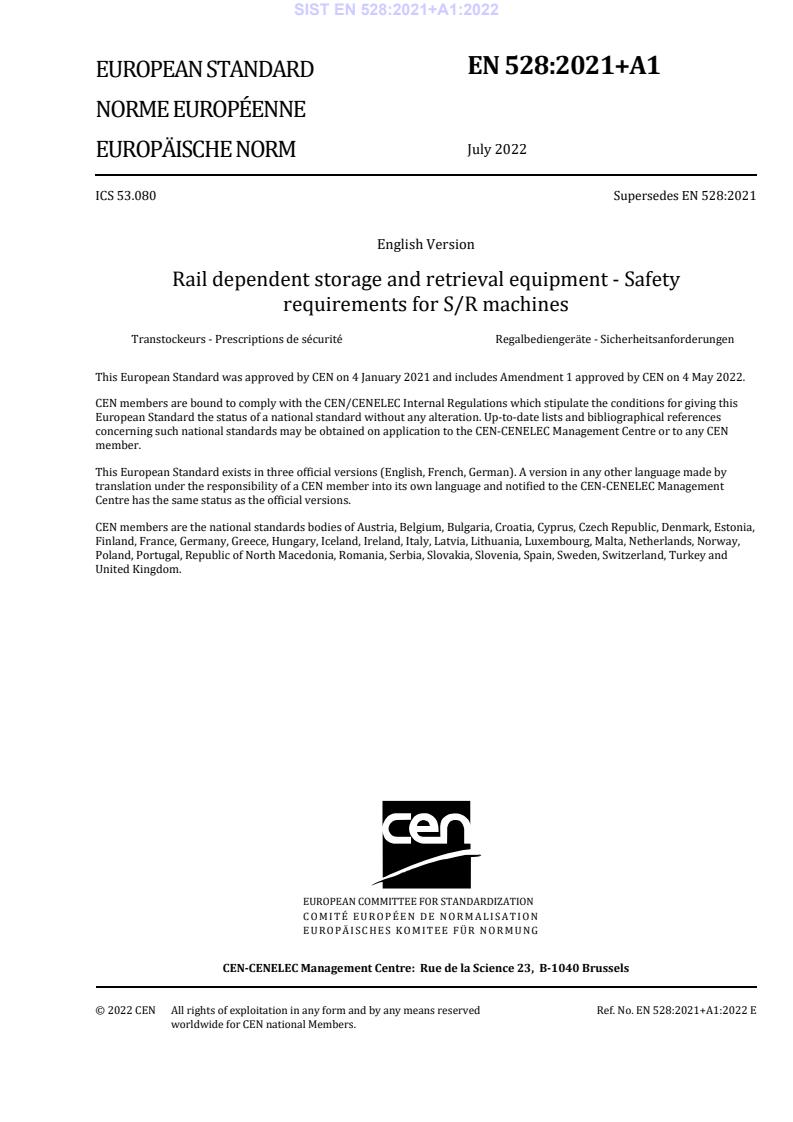
SLOVENSKI STANDARD
01-oktober-2022
Regalna dvigala in oprema - Varnostne zahteve
Rail dependent storage and retrieval equipment - Safety requirements for S/R machines
Regalbediengeräte - Sicherheitsanforderungen
Transtockeurs - Prescriptions de sécurité
Ta slovenski standard je istoveten z: EN 528:2021+A1:2022
ICS:
53.080 Skladiščna oprema Storage equipment
2003-01.Slovenski inštitut za standardizacijo. Razmnoževanje celote ali delov tega standarda ni dovoljeno.
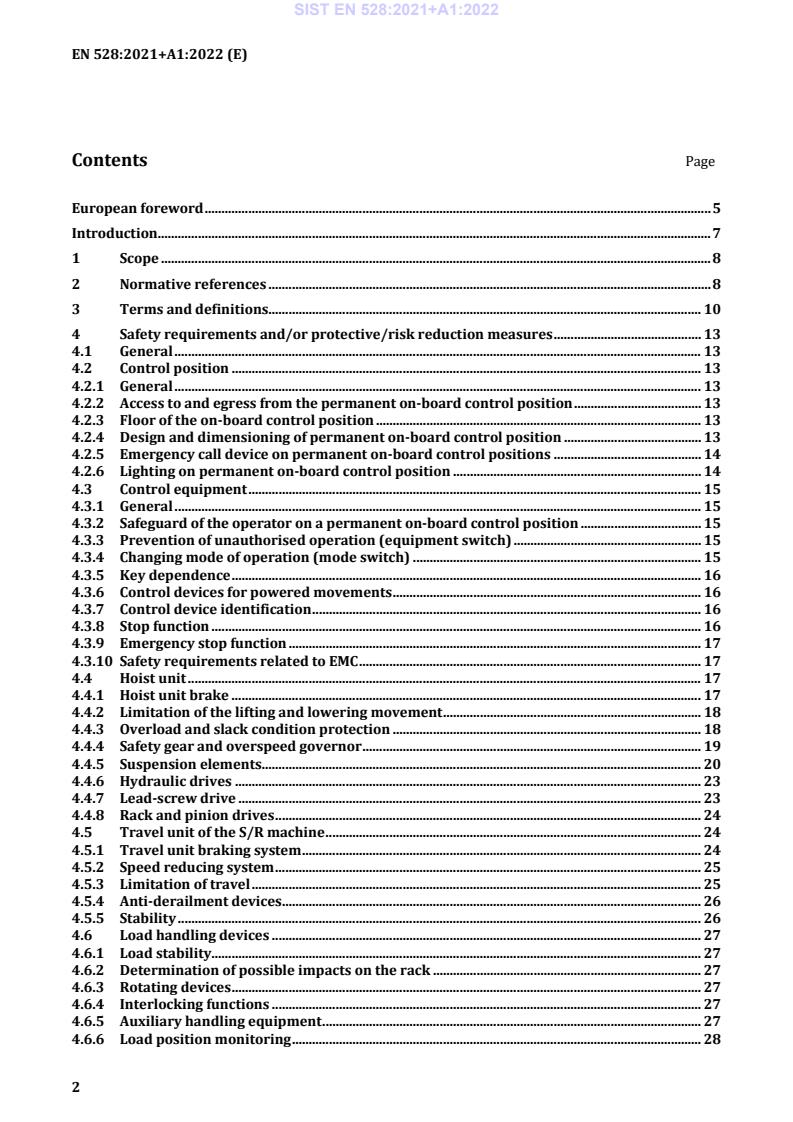
EN 528:2021+A1
EUROPEAN STANDARD
NORME EUROPÉENNE
July 2022
EUROPÄISCHE NORM
ICS 53.080 Supersedes EN 528:2021
English Version
Rail dependent storage and retrieval equipment - Safety
requirements for S/R machines
Transtockeurs - Prescriptions de sécurité Regalbediengeräte - Sicherheitsanforderungen
This European Standard was approved by CEN on 4 January 2021 and includes Amendment 1 approved by CEN on 4 May 2022.
CEN members are bound to comply with the CEN/CENELEC Internal Regulations which stipulate the conditions for giving this
European Standard the status of a national standard without any alteration. Up-to-date lists and bibliographical references
concerning such national standards may be obtained on application to the CEN-CENELEC Management Centre or to any CEN
member.
This European Standard exists in three official versions (English, French, German). A version in any other language made by
translation under the responsibility of a CEN member into its own language and notified to the CEN-CENELEC Management
Centre has the same status as the official versions.
CEN members are the national standards bodies of Austria, Belgium, Bulgaria, Croatia, Cyprus, Czech Republic, Denmark, Estonia,
Finland, France, Germany, Greece, Hungary, Iceland, Ireland, Italy, Latvia, Lithuania, Luxembourg, Malta, Netherlands, Norway,
Poland, Portugal, Republic of North Macedonia, Romania, Serbia, Slovakia, Slovenia, Spain, Sweden, Switzerland, Turkey and
United Kingdom.
EUROPEAN COMMITTEE FOR STANDARDIZATION
COMITÉ EUROPÉEN DE NORMALISATION
EUROPÄISCHES KOMITEE FÜR NORMUNG
CEN-CENELEC Management Centre: Rue de la Science 23, B-1040 Brussels
© 2022 CEN All rights of exploitation in any form and by any means reserved Ref. No. EN 528:2021+A1:2022 E
worldwide for CEN national Members.
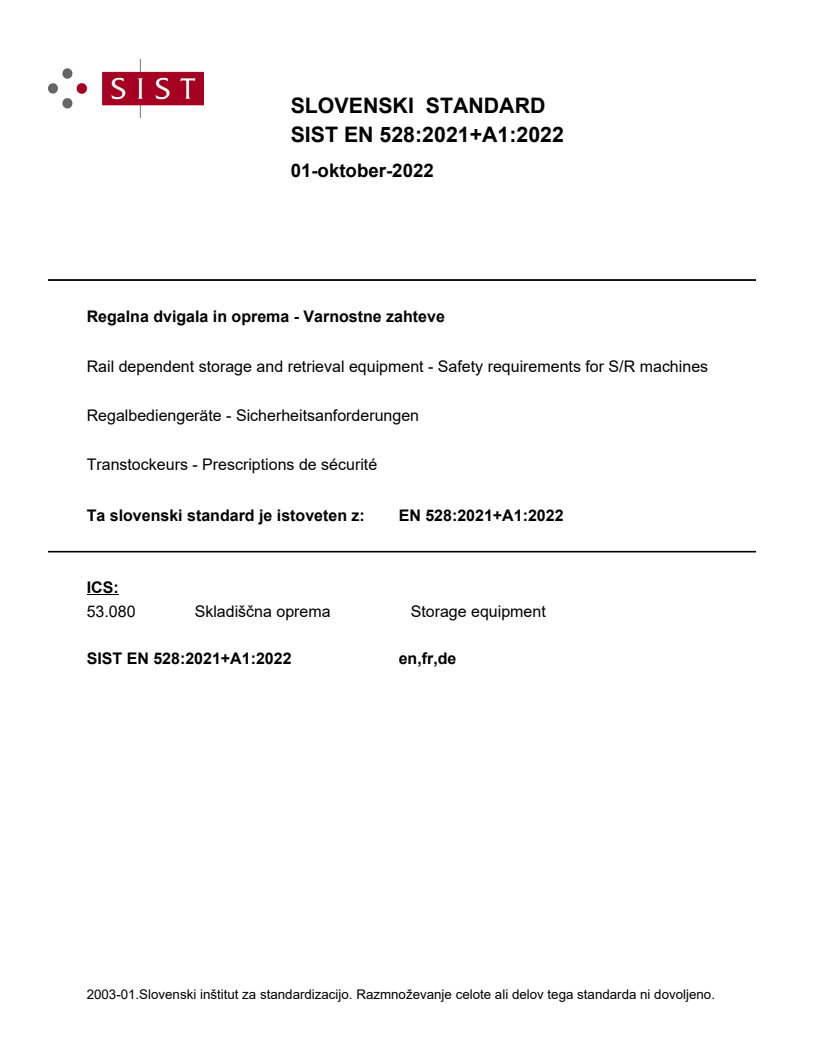
Contents Page
European foreword . 5
Introduction. 7
1 Scope . 8
2 Normative references . 8
3 Terms and definitions. 10
4 Safety requirements and/or protective/risk reduction measures . 13
4.1 General . 13
4.2 Control position . 13
4.2.1 General . 13
4.2.2 Access to and egress from the permanent on-board control position . 13
4.2.3 Floor of the on-board control position . 13
4.2.4 Design and dimensioning of permanent on-board control position . 13
4.2.5 Emergency call device on permanent on-board control positions . 14
4.2.6 Lighting on permanent on-board control position . 14
4.3 Control equipment . 15
4.3.1 General . 15
4.3.2 Safeguard of the operator on a permanent on-board control position . 15
4.3.3 Prevention of unauthorised operation (equipment switch) . 15
4.3.4 Changing mode of operation (mode switch) . 15
4.3.5 Key dependence . 16
4.3.6 Control devices for powered movements . 16
4.3.7 Control device identification . 16
4.3.8 Stop function . 16
4.3.9 Emergency stop function . 17
4.3.10 Safety requirements related to EMC . 17
4.4 Hoist unit . 17
4.4.1 Hoist unit brake . 17
4.4.2 Limitation of the lifting and lowering movement . 18
4.4.3 Overload and slack condition protection . 18
4.4.4 Safety gear and overspeed governor . 19
4.4.5 Suspension elements . 20
4.4.6 Hydraulic drives . 23
4.4.7 Lead-screw drive . 23
4.4.8 Rack and pinion drives . 24
4.5 Travel unit of the S/R machine . 24
4.5.1 Travel unit braking system . 24
4.5.2 Speed reducing system . 25
4.5.3 Limitation of travel . 25
4.5.4 Anti-derailment devices . 26
4.5.5 Stability . 26
4.6 Load handling devices . 27
4.6.1 Load stability. 27
4.6.2 Determination of possible impacts on the rack . 27
4.6.3 Rotating devices . 27
4.6.4 Interlocking functions . 27
4.6.5 Auxiliary handling equipment . 27
4.6.6 Load position monitoring . 28
4.6.7 Satellites . 28
4.7 Electrical equipment . 28
4.7.1 General . 28
4.7.2 Electrical supply conditions . 28
4.7.3 Environment . 28
4.7.4 Supply disconnecting (isolating) device . 28
4.7.5 Protection against electric shock . 29
4.7.6 Suspension of safeguarding . 29
4.7.7 Overriding of safety functions . 29
4.8 Transfer device . 29
4.8.1 General . 29
4.8.2 Retention of position . 30
4.8.3 Movement . 30
4.8.4 Interlocking functions . 30
4.8.5 Stability . 30
4.9 Maintenance repair and fault clearance . 30
4.9.1 General . 30
4.9.2 Maintenance position . 30
4.9.3 Emergency control position . 31
4.9.4 Speed limitation .31
4.9.5 Communication . 32
4.9.6 Protection from operating machines (S/R machines and its transfer equipment) . 32
4.9.7 Access along the mast . 32
4.10 Machine environment . 34
4.10.1 General . 34
4.10.2 Communication of force information . 34
4.10.3 Safety clearances . 34
4.10.4 Safeguarding of persons (Limiting access) . 34
4.10.5 Load entry / exit points . 35
4.10.6 Escape from dangerous areas . 36
4.10.7 Protection against unintentional load movement. 37
4.10.8 Protection against falling . 38
5 Verification of safety requirements and/or measures . 38
5.1 Examination . 38
5.1.1 General . 38
5.1.2 Movements to be done . 38
5.1.3 Test of the safety gear . 38
5.1.4 Verification of the mechanical limits of travel . 39
5.1.5 Test of the lowering control valve . 39
5.1.6 Written record . 39
5.2 EMC . 39
5.3 Noise . 39
5.3.1 General . 39
5.3.2 Noise measurement . 39
5.3.3 Declaration . 40
5.4 Load tests . 41
5.4.1 Test load . 41
5.4.2 Static load test . 41
5.4.3 Dynamic load test . 41
5.4.4 Load test record . 41
6 Information for use . 41
6.1 General . 41
6.2 Erection on site. 41
6.3 Commissioning . 41
6.3.1 Method statement . 41
6.3.2 Instructions . 42
6.3.3 Training . 42
6.3.4 Safety devices . 42
6.3.5 Individual elements of the machine . 42
6.3.6 Integrated commissioning . 42
6.4 Normal operation . 42
6.4.1 General . 42
6.4.2 Operation and use . 42
6.4.3 Maintenance, repair and fault-clearing . 42
6.4.4 Spare parts . 42
6.4.5 Certification of suspension elements . 42
6.4.6 Noise declaration . 42
6.4.7 Test report . 43
6.4.8 Minimum markings . 43
6.4.9 Conditions for the safe operation of equipment . 43
6.5 Fault finding/troubleshooting . 46
6.5.1 General . 46
6.5.2 Description of safe access and egress to trouble points on the S/R machine . 46
6.5.3 Description of safe access and egress to trouble points at the interface between S/R
machine and racking . 46
6.5.4 Description of safe access and egress to trouble points at the interface between the
S/R machine and the conveying system . 46
6.5.5 Training . 46
6.6 Rescue of persons . 46
6.7 Maintenance, inspection, testing and training . 46
6.7.1 General . 46
6.7.2 Maintenance . 46
6.7.3 Periodic maintenance and testing . 47
6.7.4 Training . 48
6.8 Dismantling . 48
Annex A (informative) Figures. 49
Annex B (normative) Performance levels according to EN ISO 13849-1:2015 . 57
Annex C (normative) Preventing access to dangerous movements across the load entry/exit
points . 64
Annex D (normative) Access to restricted areas . 76
Annex E (normative) Verification of safety requirements and/or measures . 79
Annex F (normative) List of significant and relevant hazards . 86
Annex ZA (informative) Relationship between this European Standard and the Essential
Requirements of EU Directive 2006/42/EU aimed to be covered . 91
Bibliography . 99
European foreword
This document (EN 528:2021+A1:2022) has been prepared by Technical Committee CEN/TC 149
“Power-operated warehouse equipment”, the secretariat of which is held by DIN.
This European Standard shall be given the status of a national standard, either by publication of an
identical text or by endorsement, at the latest by January 2023, and conflicting national standards shall
be withdrawn at the latest by January 2023.
Attention is drawn to the possibility that some of the elements of this document may be the subject of
patent rights. CEN shall not be held responsible for identifying any or all such patent rights.
This document has been prepared under a Standardization Request given to CEN by the European
Commission and the European Free Trade Association and supports essential requirements of EU
Directive(s) / Regulation(s).
For relationship with EU Directive(s) / Regulation(s), see informative Annex ZA, which is an integral part
of this document.
This document includes Amendment 1 approved by CEN on 4 May 2022.
This document supersedes !EN 528:2021".
The start and finish of text introduced or altered by amendment is indicated in the text by tags !".
The main changes compared to the previous edition EN 528:2008 are as follows:
— clearer / more understandable Annex C dealing with preventing access to dangerous movements
across the load entry/exit points;
— Annex ZA has been updated by introducing the generic template for Annex ZA amended in
accordance with decision of EU commission;
— revision and adaption of Annex B Performance level according to EN ISO 13849-1:2015;
— the scope has been stated more precisely;
— more readable and clearer text in standard due to avoidness of separate chapters for automatic and
manual machines;
— amendment or rather change of the following definitions (3):
— on-board control position (3.4), permanent on-board control position (3.5), load entry / exit
points (3.7), working place (3.8), pick and deposit station (3.9), restricted area (3.11), danger
area (3.12), satellite vehicle (3.15), powered access cabin (3.20), climb assistance system (3.21),
rated speed (3.22), normal operation (3.25), deleted definition 3.22 and renamed following
definitions;
— speed limitation (4.9.4) has been updated and been stated more precisely;
— where a powered access cabin is provided, it shall comply with the requirements for control positions
(4.9.7.2);
— Detachable ladders may be used up to a maximum height of 3 m (4.9.7);
— safety gear required for lifting carriages, that are designed to carry person(s) (4.4.4.1);
— the ratio of the minimum breaking force to the maximum static force for all types of suspension
elements to the lifting of persons has been reduced from 10 to 8 (4.4.5.1);
— requirements for additional person(s) on the lifting carriage has been stated more precisely (4.9.2.2);
— ladder along the mast shall be fitted with a guided type of a fall arresters according with EN 353-
1:2014+A1:2017 and anchor points at the transition points (4.9.3);
— prevention against load falling into adjacent automatically operated aisles: Safety level (PLr) is not
more depending on the frequency of access to the aisle (4.10.7.3);
— physical safety backstops shall be dimensioned according to the loads that occur (4.10.7);
— information on the planned dismantling of the installation is required in information for use (6.8).
According to the CEN-CENELEC Internal Regulations, the national standards organizations of the
following countries are bound to implement this European Standard: Austria, Belgium, Bulgaria, Croatia,
Cyprus, Czech Republic, Denmark, Estonia, Finland, France, Germany, Greece, Hungary, Iceland, Ireland,
Italy, Latvia, Lithuania, Luxembourg, Malta, Netherlands, Norway, Poland, Portugal, Republic of North
Macedonia, Romania, Serbia, Slovakia, Slovenia, Spain, Sweden, Switzerland, Turkey and the United
Kingdom.
Introduction
This document is a type C standard as stated in EN ISO 12100:2010.
This document is of relevance, in particular, for the following stakeholder groups representing the market
players with regard to machinery safety:
— machine manufacturers (small, medium and large enterprises);
— health and safety bodies (regulars, accident prevention organizations, market surveillance etc.).
Others can be affected by the level of machinery safety achieved with the means of the document by the
above-mentioned stakeholder groups:
— machine users/employers (small, medium and large enterprises);
— machine users/employees (e.g. trade unions, organizations for people with special needs);
— service providers, e.g. for maintenance (small, medium and large enterprises).
The above-mentioned stakeholder groups have been given possibility to participate at the drafting
process of this document.
The machinery concerned and the extent to which hazards, hazardous situations and hazardous events
are covered are indicated in the Scope of this standard.
When requirements of this type-C standard are different from those which are stated in type-A or type-B
standards, the requirements of this type-C standard take precedence over the requirements of the other
standards, for machines that have been designed and built according to the requirements of this type-C
standard.
While producing this standard, it was assumed that:
a) only competent persons operate the machine;
b) components without specific requirements are:
1) designed in accordance with the usual engineering practice and calculation codes, including all
failure modes;
2) of suitable mechanical and electrical construction;
3) made of materials with adequate strength and of suitable quality;
c) harmful materials, such as asbestos are not used as part of the machine;
d) components are kept in good repair and working order, so that the required characteristics remain
despite wear;
e) by design of the load bearing elements, safe operation of the machine is ensured for loading ranging
from zero to 100 % of the rated possibilities;
f) discussions have taken place between the user and the supplier concerning particular conditions for
the use and places of use of the machinery;
g) working area is adequately lit;
h) places of installation allow a safe use of the machine.
1 Scope
This document is applicable to all types of Storage and Retrieval (S/R) machines, restricted to the rails
on which they travel within and outside the aisles for the storage and retrieval of unit loads and/or long
goods such as bar materials and/or for order picking or similar duties. These machines embody lifting
means along a mast and may include lateral handling facilities. Also included is the transfer equipment
used to change between aisles. Control of machines may range from manual to fully automatic.
S/R-machine-related satellite vehicles according to definition 3.15 are included as a load-handling-device
(LHD).
References in this standard to racking, buildings and systems only apply where it is necessary to assess
the hazards and risks at their interfaces with S/R machines.
This document deals with all significant hazards relevant to rail dependent storage and retrieval
equipment, when they are used under the conditions intended by the manufacturer including reasonably
foreseeable misuse (see Annex F “List of significant hazards”).
This document is applicable to machines and equipment that are manufactured after the date of issue of
this document. A transition period of 12 months is proposed.
Figures of examples of machines and transfer equipment to which this standard applies are shown in
Annex A.
Safety requirements and/or measures in this standard apply to equipment used under indoor conditions.
However, additional risk assessments and safety measures need to be considered for uses in severe
conditions, e.g. extremely high temperatures, loads, the nature of which could lead to a dangerous
situation (e.g. especially brittle loads, explosives), earthquake effects and also contact with foodstuff.
This document also deals with the technical requirements for electromagnetic compatibility (EMC).
2 Normative references
The following documents are referred to in the text in such a way that some or all of their content
constitutes requirements of this document. For dated references, only the edition cited applies. For
undated references, the latest edition of the referenced document (including any amendments) applies.
EN 81-50:2020, Safety rules for the construction and installation of lifts — Examinations and tests — Part
50: Design rules, calculations, examinations and tests of lift components
EN 341:2011, Personal fall protection equipment — Descender devices for rescue
EN 353-1:2014+A1:2017, Personal fall protection equipment — Guided type fall arresters including an
anchor line — Part 1: Guided type fall arresters including a rigid anchor line
EN 358:2018, Personal protective equipment for work positioning and prevention of falls from a height —
Belts and lanyards for work positioning or restraint
EN 361:2002, Personal protective equipment against falls from a height — Full body harnesses
EN 363:2018, Personal fall protection equipment — Personal fall protection systems
EN 614-1:2006+A1:2009, Safety of machinery — Ergonomic design principles — Part 1: Terminology and
general principles
EN 795:2012, Personal fall protection equipment — Anchor devices
EN 894-1:1997+A1:2008, Safety of machinery — Ergonomics requirements for the design of displays and
control actuators — Part 1: General principles for human interactions with displays and control actuators
EN 894-2:1997+A1:2008, Safety of machinery — Ergonomics requirements for the design of displays and
control actuators — Part 2: Displays
EN 894-3:2000+A1:2008, Safety of machinery — Ergonomics requirements for the design of displays and
control actuators — Part 3: Control actuators
EN 12385-4:2002+A1:2008, Steel wire ropes — Safety — Part 4: Stranded ropes for general lifting
applications
EN 13501-1:2018, Fire classification of construction products and building elements — Part 1:
Classification using data from reaction to fire tests
!EN 14449:2005, Glass in building — Laminated glass and laminated safety glass — Product
standard"
EN 60204-32:2008, Safety of machinery — Electrical equipment of machines — Part 32: Requirements for
hoisting machines (IEC 60204-32:2008)
EN IEC 61000-6-2:2019, Electromagnetic compatibility (EMC) — Part 6-2: Generic standards — Immunity
for industrial environments (IEC 61000-6-2:2016)
EN 61496-1:2013, Safety of machinery — Electro-sensitive protective equipment — Part 1: General
requirements and tests
EN ISO 4413:2010, Hydraulic fluid power — General rules and safety requirements for systems and their
components (ISO 4413:2010)
EN ISO 4871:2009, Acoustics — Declaration and verification of noise emission values of machinery and
equipment (ISO 4871:1996)
EN ISO 7731:2008, Ergonomics — Danger signals for public and work areas — Auditory danger signals
(ISO 7731:2003)
EN ISO 11201:2010, Acoustics — Noise emitted by machinery and equipment — Determination of emission
sound pressure levels at a work station and at other specified positions in an essentially free field over a
reflecting plane with negligible environmental corrections (ISO 11201:2010)
EN ISO 12100:2010, Safety of machinery — General principles for design — Risk assessment and risk
reduction (ISO 12100:2010)
EN ISO 13849-1:2015, Safety of machinery — Safety-related parts of control systems — Part 1: General
principles for design (ISO 13849-1:2015)
EN ISO 13850:2015, Safety of machinery — Emergency stop function — Principles for design
(ISO 13850:2015)
EN ISO 13851:2019, Safety of machinery — Two-hand control devices — Principles for design and selection
(ISO 13851:2019)
EN ISO 13855:2010, Safety of machinery — Positioning of safeguards with respect to the approach speeds
of parts of the human body (ISO 13855:2010)
EN ISO 13856-1:2013, Safety of machinery — Pressure-sensitive protective devices — Part 1: General
principles for design and testing of pressure-sensitive mats and pressure-sensitive floors (ISO 13856-1:2013)
EN ISO 13857:2019, Safety of machinery — Safety distances to prevent hazard zones being reached by
upper and lower limbs (ISO 13857:2019)
EN ISO 14119:2013, Safety of machinery — Interlocking devices associated with guards — Principles for
design and selection (ISO 14119:2013)
EN ISO 14120:2015, Safety of machinery — Guards — General requirements for the design and
construction of fixed and movable guards (ISO 14120:2015)
EN ISO 14122-1:2016, Safety of machinery — Permanent means of access to machinery — Part 1: Choice
of fixed means and general requirements of access (ISO 14122-1:2016)
EN ISO 14122-2:2016, Safety of machinery — Permanent means of access to machinery — Part 2: Working
platforms and walkways (ISO 14122-2:2016)
EN ISO 14122-3:2016, Safety of machinery — Permanent means of access to machinery — Part 3: Stairs,
stepladders and guard-rails (ISO 14122-3:2016)
EN ISO 14122-4:2016, Safety of machinery — Permanent means of access to machinery — Part 4: Fixed
ladders (ISO 14122-4:2016)
ISO 16625:2013, Cranes and hoists — Selection of wire ropes, drums and sheaves
3 Terms and definitions
For the purposes of this document, the terms and definitions given in EN ISO 12100:2010 and the
following apply.
ISO and IEC maintain terminological databases for use in standardization at the following addresses:
— IEC Electropedia: available at http://www.electropedia.org/
— ISO Online browsing platform: available at https://www.iso.org/obp
3.1
control position
every place, from where the machine can be controlled, including external control position (3.2),
emergency control position (3.3) and on-board control position (3.4)
3.2
external control position
control position placed outside of the operational area of the S/R machine, from where the movements
of the machine can be controlled
3.3
emergency control position
position on the machine or inside the danger area of the machine, from where the machine can be
controlled in case of fault clearing (emergency) or maintenance works
3.4
on-board control position
protected position on the machine, from where the movements of the machine can be controlled
(includes permanent on-board-control position as defined in 3.5)
3.5
permanent on-board control position
protected position on the machine, from where the movements of the machine can be controlled,
intended to be used by an on-board operator in the normal operation
Note 1 to entry: Permanent on-board control is fitted e.g. for on-board picking.
3.6
maintenance position
position on or off the S/R machine intended for maintenance and repair
3.7
load entry / exit points
points where loads were transferred into or out of the restricted area or danger area
3.8
working place
place where persons carry out their duties
3.9
pick and deposit station
location where a load can be picked up from or deposited to the conveyor by the S/R-machine
Note1 to entry: Within the document “pick and deposit” is abbreviated as “P&D”
3.10
traffic area
area, which is accessible to or reachable without opening a guard, activating a trip device or using
additional means
3.11
restricted area
enclosed area where only authorized operators who are especially skilled to do maintenance, trouble
shooting and repairing work have access to
Note 1 to entry: See also Annex D.
3.12
danger area
area where persons can be exposed to danger during operation of the machine
3.13
load handling device
part of the S/R machine for carrying the specified loads (including one or more satellite vehicles, related
to the S/R machine)
Note1 to entry: Within the document “load handling device” is abbreviated as “LHD”.
3.14
transfer device
device for transferring a S/R machine from one aisle to another and which is not integral with the S/R
machine
3.15
satellite vehicle
vehicle intended for transferring loads into or out of the rack structure by leaving the S/R machine
Note 1 to entry: There may be one or more satellite-vehicles per S/R machine.
3.16
lifting carriage
part of the machine moving vertically along the mast and carrying both load handling device and load; it
may also carry (depending on type of machine) an on-board control position or an emergency control
position
3.17
rated load
maximum load which the machine has been designed to carry, excluding the mass of operator(s) and any
part of the machine
3.18
test load
rated load plus additional load for test purposes
3.19
specified load
load with specified characteristics (mass, dimensions, pallet or container, packaging, etc.) which the
machine has been designed to carry
3.20
powered access cabin
enclosed cabin moving independently from the lifting carriage along the mast in order to provide access
to and egress from the lifting carriage and/or maintenance platforms
Note 1 to entry: The on-board control position may be installed within this powered access cabin.
3.21
climb assistance system
powered device used in conjunction with a full body harness in order to ease climbing by providing a
defined lifting force (below person`s weight) along the access ladder
3.22
rated speed
maximum speed of the machine for which it has been designed and for which normal operation is
guaranteed by the manufacturer
3.23
safety gear
mechanical device for stopping and maintaining stationary the lifting carriage in case of overspeed in the
downward direction
3.24
key
opening or switching device that can be mechanical, electrical, magnetic or similar with unique
characteristics
3.25
normal operation
operating condition where the S/R machine is operating in accordance with the manufacturer’s
instructions primarily for the storage, retrieval and reorganisation of specified loads
3.26
system axes
directions, in which the S/R machine can move
Note 1 to entry: x = aisle length direction; y = aisle vertical direction; z = aisle lateral direction.
4 Safety requirements and/or protective/risk reduction measures
4.1 General
Machinery shall comply with the safety requirements and/or protective/risk reduction measures of this
clause.
In addition, the machine shall be designed according to the principles of EN ISO 12100:2010 for relevant
but not significant hazards which are not dealt with by this document.
Means of access shall comply with EN ISO 14122:2016 parts 1 to 4 except as otherwise specified in this
document.
In the design of machines and sub-assemblies provisions for lifting shall be considered. Safety distances
shall comply with EN ISO 13857:2019 apart from the deviations stated in this standard.
Guards shall comply with EN ISO 14120:2015 and interlo
...
SLOVENSKI STANDARD
01-oktober-2022
Regalna dvigala in oprema - Varnostne zahteve
Rail dependent storage and retrieval equipment - Safety requirements for S/R machines
Regalbediengeräte - Sicherheitsanforderungen
Transtockeurs - Prescriptions de sécurité
Ta slovenski standard je istoveten z: EN 528:2021+A1:2022
ICS:
53.080 Skladiščna oprema Storage equipment
2003-01.Slovenski inštitut za standardizacijo. Razmnoževanje celote ali delov tega standarda ni dovoljeno.
EN 528:2021+A1
NORME EUROPÉENNE
EUROPÄISCHE NORM
Juillet 2022
EUROPEAN STANDARD
ICS 53.080 Remplace l' EN 528:2021
Version Française
Transtockeurs - Prescriptions de sécurité
Regalbediengeräte - Sicherheitsanforderungen Rail dependent storage and retrieval equipment -
Safety requirements for S/R machines
La présente Norme européenne a été adoptée par le CEN le 4 Janvier 2021 et comprend l'amendement 1 adopté par le CEN le 4
Mai 2022.
Les membres du CEN sont tenus de se soumettre au Règlement Intérieur du CEN/CENELEC, qui définit les conditions dans
lesquelles doit être attribué, sans modification, le statut de norme nationale à la Norme européenne. Les listes mises à jour et les
références bibliographiques relatives à ces normes nationales peuvent être obtenues auprès du Centre de Gestion du CEN-
CENELEC ou auprès des membres du CEN.
La présente Norme européenne existe en trois versions officielles (allemand, anglais, français). Une version dans une autre
langue faite par traduction sous la responsabilité d'un membre du CEN dans sa langue nationale et notifiée au Centre de Gestion
du CEN-CENELEC, a le même statut que les versions officielles.
Les membres du CEN sont les organismes nationaux de normalisation des pays suivants: Allemagne, Autriche, Belgique, Bulgarie,
Chypre, Croatie, Danemark, Espagne, Estonie, Finlande, France, Grèce, Hongrie, Irlande, Islande, Italie, Lettonie, Lituanie,
Luxembourg, Malte, Norvège, Pays-Bas, Pologne, Portugal, République de Macédoine du Nord, République de Serbie, République
Tchèque, Roumanie, Royaume-Uni, Slovaquie, Slovénie, Suède, Suisse et Turquie.
COMITÉ EUROPÉEN DE NORMALISATION
EUROPÄISCHES KOMITEE FÜR NORMUNG
EUROPEAN COMMITTEE FOR STANDARDIZATION
CEN-CENELEC Management Centre: Rue de la Science 23, B-1040 Bruxelles
© 2022 CEN Tous droits d'exploitation sous quelque forme et de quelque manière Réf. n° EN 528:2021+A1:2022 F
que ce soit réservés dans le monde entier aux membres nationaux du
CEN.
Sommaire
Page
Avant-propos européen . 5
Introduction . 7
1 Domaine d'application. 9
2 Références normatives . 9
3 Termes et définitions . 11
4 Prescriptions de sécurité et/ou mesures de protection/réduction des risques . 14
4.1 Généralités . 14
4.2 Poste de commande . 15
4.2.1 Généralités . 15
4.2.2 Accès et sortie du poste de commande embarqué permanent . 15
4.2.3 Plancher du poste de commande embarqué . 15
4.2.4 Calcul et dimensionnement du poste de commande embarqué permanent . 15
4.2.5 Dispositif d'appel d'urgence au poste de commande embarqué permanent . 17
4.2.6 Éclairage au poste de commande embarqué permanent . 17
4.3 Équipement de commande . 17
4.3.1 Généralités . 17
4.3.2 Protection de l'opérateur au poste de commande embarqué permanent. 17
4.3.3 Protection d'un fonctionnement non autorisé (commutateur de l'équipement) . 18
4.3.4 Changement de mode de fonctionnement (commutateur de mode) . 18
4.3.5 Dépendances des clés. 18
4.3.6 Dispositifs de commande pour les mouvements motorisés. 19
4.3.7 Identification des dispositifs de commande. 19
4.3.8 Fonction d'arrêt. 19
4.3.9 Fonction d'arrêt d'urgence. 19
4.3.10 Prescriptions de sécurité liées à la compatibilité électromagnétique (CEM). 20
4.4 Unité de levage. 20
4.4.1 Frein de l'unité de levage. 20
4.4.2 Limitation du mouvement de montée et de descente . 21
4.4.3 Protection contre les surcharges et les mous de câbles. 21
4.4.4 Parachute et régulateur de survitesse. 22
4.4.5 Éléments de suspension . 23
4.4.6 Entraînements hydrauliques . 26
4.4.7 Entraînements à vis . 27
4.4.8 Entraînements par pignon-crémaillère . 28
4.5 Unité de translation du transtockeur . 28
4.5.1 Système de freinage de l'unité de translation . 28
4.5.2 Système réducteur de vitesse . 29
4.5.3 Limitation de la translation . 30
4.5.4 Dispositifs anti-déraillement . 30
4.5.5 Stabilité. 30
4.6 Dispositifs de manutention de charge . 31
4.6.1 Stabilité de la charge . 31
4.6.2 Détermination des impacts éventuels sur le rayonnage . 31
4.6.3 Dispositifs rotatifs . 32
4.6.4 Fonctions de verrouillage . 32
4.6.5 Équipement de manutention auxiliaire . 32
4.6.6 Surveillance de la position de la charge . 32
4.6.7 Chariots satellites . 33
4.7 Équipement électrique. 33
4.7.1 Généralités. 33
4.7.2 Conditions d'alimentation électrique . 33
4.7.3 Environnement . 33
4.7.4 Interrupteur-sectionneur principal (isolateur) . 33
4.7.5 Protection contre les chocs électriques. 34
4.7.6 Suspension des dispositifs de protection. 34
4.7.7 Affranchissement des fonctions de sécurité . 34
4.8 Dispositif de transfert . 35
4.8.1 Généralités. 35
4.8.2 Maintien en position . 35
4.8.3 Mouvement . 35
4.8.4 Fonctions de verrouillage . 35
4.8.5 Stabilité . 35
4.9 Maintenance, réparation et élimination des défauts . 35
4.9.1 Généralités. 35
4.9.2 Poste de maintenance . 35
4.9.3 Poste de commande d'urgence . 36
4.9.4 Limitation de vitesse. 37
4.9.5 Communication . 38
4.9.6 Protection contre les machines en fonctionnement (transtockeurs et dispositifs de
transfert) . 38
4.9.7 Accès le long du mât . 38
4.10 Environnement de la machine . 40
4.10.1 Généralités. 40
4.10.2 Communication des informations relatives aux efforts . 40
4.10.3 Espaces libres de sécurité . 41
4.10.4 Protection des personnes (limitation d'accès) . 41
4.10.5 Points d'entrée/de sortie de charges . 42
4.10.6 Évacuation des zones dangereuses . 43
4.10.7 Protection contre les mouvements non intentionnels des charges . 44
4.10.8 Protection contre les chutes . 45
5 Vérification des prescriptions de sécurité et/ou mesures de protection. 45
5.1 Examen. 45
5.1.1 Généralités. 45
5.1.2 Mouvements à réaliser. 46
5.1.3 Essai du parachute. 46
5.1.4 Vérification des limitations mécaniques de la course de translation . 46
5.1.5 Essai de la vanne de commande de descente . 46
5.1.6 Enregistrements écrits. 46
5.2 Compatibilité électromagnétique (CEM). 47
5.3 Bruit . 47
5.3.1 Généralités. 47
5.3.2 Mesurage du bruit. 47
5.3.3 Déclaration . 48
5.4 Essais de charges . 48
5.4.1 Charge d'essai . 48
5.4.2 Essai de charge statique . 49
5.4.3 Essai de charge dynamique . 49
5.4.4 Enregistrement des essais de charges . 49
6 Informations pour l'utilisation . 49
6.1 Généralités . 49
6.2 Montage sur site . 49
6.3 Mise en service. 49
6.3.1 Déclaration des méthodes à utiliser . 49
6.3.2 Instructions. 50
6.3.3 Formation . 50
6.3.4 Dispositifs de sécurité. 50
6.3.5 Composants individuels de la machine . 50
6.3.6 Mise en service intégrée. 50
6.4 Fonctionnement normal . 50
6.4.1 Généralités . 50
6.4.2 Fonctionnement et utilisation . 50
6.4.3 Maintenance, réparation et élimination des défauts . 50
6.4.4 Pièces de rechange . 50
6.4.5 Certification des éléments de suspension . 50
6.4.6 Déclaration de bruit. 51
6.4.7 Rapport d'essai . 51
6.4.8 Marquage minimal . 51
6.4.9 Conditions pour le fonctionnement en toute sécurité de l'équipement . 52
6.5 Recherche de défauts/de panne . 54
6.5.1 Généralités . 54
6.5.2 Description de l'accès et de la sortie en toute sécurité aux points de panne sur le
transtockeur . 54
6.5.3 Description de l'accès et de la sortie en toute sécurité aux points de panne à
l'interface entre le transtockeur et le rayonnage. 54
6.5.4 Description de l'accès et de la sortie en toute sécurité aux points de panne à
l'interface entre le transtockeur et le système de convoyage . 54
6.5.5 Formation . 55
6.6 Sauvetage de personnes . 55
6.7 Maintenance, inspection, essais et formation. 55
6.7.1 Généralités . 55
6.7.2 Maintenance . 55
6.7.3 Maintenance périodique et essais . 56
6.7.4 Formation . 57
6.8 Démontage . 57
Annexe A (informative) Figures . 58
Annexe B (normative) Niveaux de performance conformément à l'EN ISO 13849-1:2015 . 66
Annexe C (normative) Protection de l'accès au regard des mouvements dangereux par les
points d'entrée/de sortie de charges . 75
Annexe D (normative) Accès aux zones d'accès restreint . 87
Annexe E (normative) Vérification des prescriptions de sécurité et/ou mesures de
protection . 90
Annexe F (informative) Liste des phénomènes dangereux significatifs et pertinents . 98
Annexe ZA (informative) Relation entre la présente Norme européenne et les exigences
essentielles concernées de la Directive 2006/42/CE .104
Bibliographie .112
Avant-propos européen
Le présent document (EN 528:2021+A1:2022) a été élaboré par le Comité Technique CEN/TC 149
« Équipements de stockage motorisés », dont le secrétariat est tenu par DIN.
Cette Norme européenne devra recevoir le statut de norme nationale, soit par publication d'un texte
identique, soit par entérinement, au plus tard en janvier 2023, et toutes les normes nationales en
contradiction devront être retirées au plus tard en janvier 2023.
L'attention est appelée sur le fait que certains des éléments du présent document peuvent faire l'objet de
droits de propriété intellectuelle ou de droits analogues. Le CEN ne saurait être tenu pour responsable de
ne pas avoir identifié de tels droits de propriété et averti de leur existence.
Le présent document a été élaboré en réponse à une demande de normalisation adressée au CEN par la
Commission européenne et l'Association européenne de libre-échange, et vient à l'appui des exigences
essentielles de la ou des Directives UE/du ou des Règlements UE.
Pour la relation avec la ou les Directives UE/le ou les Règlements UE, voir l'Annexe ZA, informative, qui
fait partie intégrante du présent document.
Le présent document inclut l'Amendement 1 approuvé par le CEN le 4 mai 2022.
Le présent document remplace l'!EN 528:2021".
Le début et la fin du texte ajouté ou modifié par l'amendement sont indiqués dans le texte par les repères
!".
Les principales modifications apportées par rapport à l'édition précédente, l'EN 528:2008, sont les
suivantes :
— l'Annexe C, ayant trait à la protection de l'accès aux mouvements dangereux par les points
d'entrée/de sortie de charges, a été rendue plus claire et compréhensible ;
— l'Annexe ZA a été mise à jour selon le modèle générique pour l'Annexe ZA, modifié conformément à
la décision de la Commission européenne ;
— l'Annexe B, Niveaux de performance conformément à l'EN ISO 13849-1:2015, a été révisée et
adaptée ;
— le domaine d'application a été précisé ;
— le texte de la norme a été rendu plus lisible et clair, grâce à l'absence de recours à des chapitres
séparés pour les machines automatiques et manuelles ;
— les définitions (Article 3) suivantes ont été ajoutées ou modifiées :
— poste de commande embarqué (3.4), poste de commande embarqué permanent (3.5), points
d'entrée/de sortie de charges (3.7), poste de travail (3.8), station de prélèvement et de
dépôt (3.9), zone d'accès restreint (3.11), zone dangereuse (3.12), chariot satellite (3.15), cabine
d'accès motorisée (3.20), système d'assistance à la montée (3.21), vitesse nominale (3.22),
fonctionnement normal (3.25), supprimé la définition 3.22 et renommé les définitions
suivantes ;
— la limitation de vitesse (4.9.4) a été mise à jour et précisée ;
— lorsqu'une cabine d'accès motorisée est prévue, elle doit être conforme aux prescriptions relatives
aux postes de commande (4.9.7.2) ;
— les échelles amovibles peuvent être utilisées jusqu'à une hauteur maximale de 3 m (4.9.7) ;
— un parachute est requis pour les chariots élévateurs qui sont conçus pour transporter des
personnes (4.4.4.1) ;
— le rapport entre la force de rupture minimale et la force statique maximale, sur tous les types
d'éléments de suspension destinés au levage de personnes, a été ramené de 10 à 8 (4.4.5.1) ;
— les prescriptions relatives aux personnes supplémentaires sur le chariot élévateur ont été
précisées (4.9.2.2) ;
— l'échelle longeant le mât doit être équipée d'un antichute mobile conformément à
l'EN 353-1:2014+A1:2017, et de dispositifs d'ancrage aux postes de transfert (4.9.3) ;
— concernant la prévention contre les chutes de charges dans des allées adjacentes à fonctionnement
automatique : le niveau de sécurité (PLr) ne dépend plus de la fréquence d'accès à l'allée (4.10.7.3) ;
— les butées arrière physiques de sécurité doivent être dimensionnées en fonction des charges
appliquées (4.10.7) ;
— les informations concernant le démontage prévu de l'installation sont requises dans les informations
pour l'utilisation (6.8).
Selon le Règlement Intérieur du CEN/CENELEC, les instituts de normalisation nationaux des pays
suivants sont tenus de mettre cette Norme européenne en application : Allemagne, Autriche, Belgique,
Bulgarie, Chypre, Croatie, Danemark, Espagne, Estonie, Finlande, France, Grèce, Hongrie, Irlande, Islande,
Italie, Lettonie, Lituanie, Luxembourg, Malte, Norvège, Pays-Bas, Pologne, Portugal, République de
Macédoine du Nord, République tchèque, Roumanie, Royaume-Uni, Serbie, Slovaquie, Slovénie, Suède,
Suisse et Turquie.
Introduction
Le présent document est une norme de type C tel que mentionné dans l'EN ISO 12100:2010.
Le présent document concerne, en particulier, les groupes de parties prenantes suivants représentant les
acteurs du marché en ce qui concerne la sécurité des machines :
— fabricants de machines (petites, moyennes et grandes entreprises) ;
— organismes de santé et de sécurité (autorités réglementaires, organismes de prévention des risques
professionnels, surveillance du marché, etc.).
D'autres partenaires peuvent être concernés par le niveau de sécurité des machines atteint à l'aide du
document par les groupes de parties prenantes mentionnés ci-dessus :
— utilisateurs de machines/employeurs (petites, moyennes et grandes entreprises) ;
— utilisateurs de machines/salariés (par exemple, syndicats de salariés, organisations représentant des
personnes ayant des besoins particuliers) ;
— prestataires de services, par exemple sociétés de maintenance (petites, moyennes et grandes
entreprises).
Les groupes de parties prenantes mentionnés ci-dessus ont eu la possibilité de participer à l'élaboration
du présent document.
Les machines concernées et l'étendue des phénomènes dangereux, situations dangereuses et événements
dangereux couverts sont indiquées dans le domaine d'application de la présente norme.
Lorsque des prescriptions de la présente norme de type C sont différentes de celles énoncées dans les
normes de type A ou les normes de type B, les prescriptions de la présente norme de type C ont priorité
sur celles des autres normes pour les machines ayant été conçues et fabriquées conformément aux
prescriptions de la présente norme de type C.
Pendant l'élaboration de la présente norme, il a été supposé que :
a) seules des personnes compétentes font fonctionner la machine ;
b) les composants ne faisant pas l'objet de prescriptions spécifiques sont :
1) conçus conformément à la pratique d'ingénierie et aux codes de calcul usuels, y compris tous les
modes de défaillance ;
2) d'une construction mécanique et électrique appropriée ;
3) fabriqués avec des matériaux de résistance adéquate et de qualité appropriée ;
c) les matériaux nocifs, tels que l'amiante, ne sont pas utilisés dans les pièces de la machine ;
d) les composants sont maintenus en bon état de marche et de réparation, de sorte que les
caractéristiques requises sont conservées en dépit de l'usure ;
e) par conception des éléments porteurs, un fonctionnement en toute sécurité de la machine est assuré
pour des charges allant de zéro à 100 % des possibilités nominales ;
f) les conditions particulières et les lieux particuliers d'utilisation des machines ont fait l'objet d'une
discussion entre l'utilisateur et le fournisseur ;
g) la zone de travail est convenablement éclairée ;
h) les lieux d'installation permettent une utilisation en toute sécurité de la machine.
1 Domaine d'application
Le présent document s'applique à tous les types d'appareils appelés transtockeurs destinés au stockage
et au déstockage de charges unitaires et/ou de produits longs comme des barres, et/ou à la préparation
de commandes ou tâches similaires, dont les déplacements dans et en dehors des allées sont guidés par
les rails. Ces appareils comprennent des moyens de levage le long d'un mât et éventuellement des
dispositifs de préhension latérale. Le présent document s'applique également au matériel permettant le
transfert d'une allée à une autre. La commande des appareils peut aller du mode manuel au mode
entièrement automatique.
Les chariots satellites associés à un transtockeur conformes à la définition 3.15 sont considérés comme
un dispositif de manutention de charge.
Les références faites dans la présente norme aux rayonnages, aux bâtiments et aux systèmes ne
s'appliquent que lorsqu'il est nécessaire d'évaluer les phénomènes dangereux et les risques encourus au
niveau de leurs interfaces avec les transtockeurs.
Le présent document traite de tous les phénomènes dangereux significatifs relatifs aux transtockeurs,
lorsque ceux-ci sont utilisés dans les conditions prévues par le fabricant, y compris les mauvais usages
raisonnablement prévisibles (voir Annexe F « Liste des phénomènes dangereux significatifs »).
Le présent document s'applique aux appareils et équipements qui ont été fabriqués après sa date de
parution. Une période de transition de 12 mois est proposée.
Des figures d'exemples de transtockeurs et de dispositifs de transfert auxquels s'applique la présente
norme sont données à l'Annexe A.
Les prescriptions et/ou mesures de sécurité indiquées dans la présente norme s'appliquent aux appareils
d'intérieur. Toutefois, il est nécessaire de considérer des appréciations de risques et des mesures de
sécurité supplémentaires lors d'utilisations dans des conditions extrêmes comme, par exemple, les
températures extrêmement élevées, les charges dont la nature est susceptible d'engendrer une situation
dangereuse (par exemple, charges particulièrement fragiles, explosifs), les effets sismiques et également
le contact avec la nourriture.
Le présent document traite également des prescriptions techniques relatives à la compatibilité
électromagnétique (CEM).
2 Références normatives
Les documents suivants sont cités dans le texte de sorte qu’ils constituent, pour tout ou partie de leur
contenu, des exigences du présent document. Pour les références datées, seule l'édition citée s'applique.
Pour les références non datées, la dernière édition du document de référence s'applique (y compris les
éventuels amendements).
EN 81-50:2020, Règles de sécurité pour la construction et l'installation des élévateurs — Examens et
essais — Partie 50 : Règles de conception, calculs, examens et essais des composants pour élévateurs
EN 341:2011, Équipement de protection individuelle contre les chutes — Descendeurs pour sauvetage
EN 353-1:2014+A1:2017, Équipement de protection individuelle contre les chutes de hauteur — Antichutes
mobiles incluant un support d'assurage — Partie 1 : Antichutes mobiles incluant un support d'assurage
rigide
EN 358:2018, Équipement de protection individuelle de maintien au travail et de prévention contre les
chutes de hauteur — Ceintures et longes de maintien au travail ou de retenue
EN 361:2002, Équipement de protection individuelle contre les chutes de hauteur — Harnais d'antichute
EN 363:2018, Équipement de protection individuelle contre les chutes de hauteur — Systèmes individuels
de protection contre les chutes
EN 614-1:2006+A1:2009, Sécurité des machines — Principes ergonomiques de conception —
Partie 1 : Terminologie et principes généraux
EN 795:2012, Équipement de protection individuelle contre les chutes — Dispositifs d'ancrage
EN 894-1:1997+A1:2008, Sécurité des machines — Exigences ergonomiques pour la conception des
dispositifs de signalisation et des organes de service — Partie 1 : Principes généraux des interactions entre
l'homme et les dispositifs de signalisation et organes de service
EN 894-2:1997+A1:2008, Sécurité des machines — Exigences ergonomiques pour la conception des
dispositifs de signalisation et des organes de service — Partie 2 : Dispositifs de signalisation
EN 894-3:2000+A1:2008, Sécurité des machines — Exigences ergonomiques pour la conception des
dispositifs de signalisation et des organes de service — Partie 3 : Organes de service
EN 12385-4:2002+A1:2008, Câbles en acier — Sécurité — Partie 4 : Câbles à torons pour applications
générales de levage
EN 13501-1:2018, Classement au feu des produits et éléments de construction — Partie 1 : Classement à
partir des données d'essais de réaction au feu
!EN 14449:2005, Verre dans la construction — Verre feuilleté et verre feuilleté de sécurité — Évaluation
de la conformité/norme de produit"
EN 60204-32:2008, Sécurité des machines — Équipement électrique des machines — Partie 32 : Exigences
pour les appareils de levage (IEC 60204-32:2008)
EN IEC 61000-6-2:2019, Compatibilité électromagnétique (CEM) — Partie 6-2 : Normes génériques —
Immunité pour les environnements industriels (IEC 61000-6-2:2016)
EN 61496-1:2013, Sécurité des machines — Équipements de protection électro-sensibles —
Partie 1 : Prescriptions générales et essais
EN ISO 4413:2010, Transmissions hydrauliques — Règles générales et exigences de sécurité relatives aux
systèmes et leurs composants (ISO 4413:2010)
EN ISO 4871:2009, Acoustique — Déclaration et vérification des valeurs d'émission sonore des machines et
équipements (ISO 4871:1996)
EN ISO 7731:2008, Ergonomie — Signaux de danger pour lieux publics et lieux de travail — Signaux de
danger auditifs (ISO 7731:2003)
EN ISO 11201:2010, Acoustique — Bruit émis par les machines et équipements — Détermination des
niveaux de pression acoustique d'émission au poste de travail et en d'autres positions spécifiées dans des
conditions approchant celles du champ libre sur plan réfléchissant avec des corrections d'environnement
négligeables (ISO 11201:2010)
EN ISO 12100:2010, Sécurité des machines — Principes généraux de conception — Appréciation du risque
et réduction du risque (ISO 12100:2010)
EN ISO 13849-1:2015, Sécurité des machines — Parties des systèmes de commande relatives à la sécurité —
Partie 1 : Principes généraux de conception (ISO 13849-1:2015)
EN ISO 13850:2015, Sécurité des machines — Fonction d'arrêt d'urgence — Principes de conception
(ISO 13850:2015)
EN ISO 13851:2019, Sécurité des machines — Dispositifs de commande bimanuelle — Principes de
conception et de choix (ISO 13851:2019)
EN ISO 13855:2010, Sécurité des machines — Positionnement des moyens de protection par rapport à la
vitesse d'approche des parties du corps (ISO 13855:2010)
EN ISO 13856-1:2013, Sécurité des machines — Dispositifs de protection sensibles à la pression —
Partie 1 : Principes généraux de conception et d'essai des tapis et planchers sensibles à la pression
(ISO 13856-1:2013)
EN ISO 13857:2019, Sécurité des machines — Distances de sécurité empêchant les membres supérieurs et
inférieurs d'atteindre les zones dangereuses (ISO 13857:2019)
EN ISO 14119:2013, Sécurité des machines — Dispositifs de verrouillage associés à des protecteurs —
Principes de conception et de choix (ISO 14119:2013)
EN ISO 14120:2015, Sécurité des machines — Protecteurs — Prescriptions générales pour la conception et
la construction des protecteurs fixes et mobiles (ISO 14120:2015)
EN ISO 14122-1:2016, Sécurité des machines — Moyens d'accès permanents aux machines —
Partie 1 : Choix d'un moyen d'accès et des exigences générales d'accès (ISO 14122-1:2016)
EN ISO 14122-2:2016, Sécurité des machines — Moyens d'accès permanents aux machines —
Partie 2 : Plates-formes de travail et passerelles (ISO 14122-2:2016)
EN ISO 14122-3:2016, Sécurité des machines — Moyens d'accès permanents aux machines —
Partie 3 : Escaliers, échelles à marches et garde-corps (ISO 14122-3:2016)
EN ISO 14122-4:2016, Sécurité des machines — Moyens d'accès permanents aux machines —
Partie 4 : Échelles fixes (ISO 14122-4:2016)
ISO 16625:2013, Appareils de levage à charge suspendue et treuils — Choix des câbles, tambours et poulies
3 Termes et définitions
Pour les besoins du présent document, les termes et les définitions donnés dans l'EN ISO 12100:2010
ainsi que les suivants, s'appliquent.
L'ISO et l'IEC tiennent à jour des bases de données terminologiques destinées à être utilisées en
normalisation, consultables aux adresses suivantes :
— IEC Electropedia : disponible à l'adresse http://www.electropedia.org/
— ISO Online browsing platform : disponible à l'adresse https://www.iso.org/obp
3.1
poste de l'opérateur
tout emplacement, à partir duquel la machine peut être contrôlée, comprenant le poste de commande
extérieur (3.2), le poste de commande d'urgence (3.3) et le poste de commande embarqué (3.4)
3.2
poste de commande extérieur
emplacement situé en dehors du transtockeur, à partir duquel les mouvements de la machine peuvent
être contrôlés
3.3
poste de commande d'urgence
emplacement situé sur la machine ou à l'intérieur de la zone dangereuse de la machine, à partir duquel la
machine peut être commandée pendant une manœuvre de dégagement (urgence) ou une opération de
maintenance
3.4
poste de commande embarqué
emplacement protégé situé sur la machine, à partir duquel les mouvements de la machine peuvent être
contrôlés (incluant le poste de commande embarqué permanent défini en 3.5)
3.5
poste de commande embarqué permanent
emplacement protégé situé sur la machine, à partir duquel les mouvements de la machine peuvent être
contrôlés, destiné à être utilisé par un opérateur embarqué dans le cadre d'un fonctionnement norma l
Note 1 à l'article : Le poste de commande embarqué permanent est, par exemple, prévu pour le prélèvement
embarqué.
3.6
poste de maintenance
emplacement sur ou en dehors du transtockeurs destiné à la maintenance et aux réparations
3.7
points d'entrée/de sortie de charges
points où les charges sont transférées dans ou hors de la zone d'accès restreint ou de la zone dangereuse
3.8
poste de travail
endroit où des personnes exécutent leurs tâches
3.9
station de prélèvement et de dépôt
emplacement où une charge peut être prélevée ou déposée sur le convoyeur par le transtockeur
Note 1 à l'article : Dans le présent document, « prélèvement et dépôt » est abrégé en « P&D ».
3.10
zone de circulation
zone accessible sans ouvrir de protecteur, ni activer de dispositif sensible, ni utiliser d'autres moyens
3.11
zone d'accès restreint
zone fermée à laquelle seuls les opérateurs autorisés qui sont particulièrement qualifiés pour effectuer
des travaux de maintenance, de résolution des défaillances et de réparation ont accès
Note 1 à l'article : Voir aussi l'Annexe D.
3.12
zone dangereuse
zone où les personnes sont susceptibles d'être exposées à des dangers pendant le fonctionnement de la
machine
3.13
dispositif de manutention de charge
partie du transtockeur destinée à transporter les charges spécifiées (comprenant un ou plusieurs chariots
satellites, associé(s) au transtockeur)
Note 1 à l'article : Dans le présent document, « dispositif de manutention de charge » est abrégé en « LHD ».
3.14
dispositif de transfert
dispositif utilisé pour transférer un transtockeur d'une allée à une autre, lequel ne fait pas partie
intégrante du transtockeur
3.15
chariot satellite
véhicule utilisé pour transférer des charges dans ou hors des rayonnages en se détachant du transtockeur
Note 1 à l'article : Un transtockeur peut posséd
...