

oSIST prEN 17166:2024
(Main)Fans - Procedures and methods to determine the energy efficiency for the electrical input power range of 125 W up to 500 kW
- Abstract
This document provides procedures and methods for measuring and/or calculating the energy efficiency and associated characteristics of fans when driven by electric motors. This document deals with the following fan types;
- axial fan;
- centrifugal forward curved fan, centrifugal radial bladed fan;
- centrifugal backward curved fan without housing, including centrifugal backward aerofoil fans;
- centrifugal backward curved fan with housing, including centrifugal backward aerofoil fans;
- mixed flow fan;
- cross flow fan;
- jet fan.
It provides procedures and methods to evaluate the compliance of the fan efficiency against minimum efficiency requirements.
This document includes stand-alone fans and fans that are integrated in other products. It gives guidance to manufacturers in providing information to surveillance authorities to describe the full extent of the fan by describing boundaries, significant elements and additional parts.
Some units previously identified as fans are now defined as Uni-Directional Ventilation Units. This document explains and shows by way of examples the difference between fans and Uni-Directional Ventilation Units.
This standard does not include:
- Uni-Directional Ventilation Units;
- fans that are designed specifically to operate in toxic, highly corrosive or flammable environments or in environments with abrasive substances, see Annex C.
- Status
- Not Published
- Public Enquiry End Date
- 31-Oct-2024
- Technical Committee
- OGS - Heating for buildings
- Current Stage
- 4020 - Public enquire (PE) (Adopted Project)
- Start Date
- 04-Sep-2024
- Due Date
- 22-Jan-2025
- Completion Date
- 28-Oct-2024
oSIST prEN 17166:2024 is a CEN draft European Standard for fans driven by electric motors in the 125 W to 500 kW electrical input range. It sets procedures and methods to measure or calculate energy efficiency and related characteristics, and to check whether a fan meets minimum efficiency requirements. It is written for manufacturers, importers, test laboratories, and market surveillance authorities that need a common way to rate stand-alone fans and fans integrated into other products.
What does oSIST prEN 17166:2024 specify?
oSIST prEN 17166:2024 specifies how to identify, test, calculate, classify, and document the energy efficiency of covered fans. It applies to axial, centrifugal, mixed flow, cross flow, and jet fans, and it explains how to treat fans that are built into other energy-related products.
The standard is organized into seven main clauses:
- Scope
- Normative references
- Terms and definitions
- Requirements
- Testing and calculation methods
- Evaluation of conformity
- Classification and designation
It also includes informative annexes that support boundary definition, test selection, excluded environments, report formats, product information, and the link to ecodesign requirements.
| Annex | What it covers |
|---|---|
| Annex A | Explanatory notes on fans integrated in other energy-related products |
| Annex B | Flow chart for not-final-assembly efficiency |
| Annex C | Toxic, highly corrosive, flammable, abrasive substances |
| Annex D | Guide to using the standard |
| Annex E | Significant elements of a fan |
| Annex F | Suggested format for compliance reports requested by market surveillance authorities |
| Annex G | Basic fan types with cross reference to Regulation 327/2011 |
| Annex H | Product information requirements |
| Annex I | Installation and maintenance information |
| Annex ZA | Relationship with Commission Regulation (EU) No 327/2011 |
The scope excludes Uni-Directional Ventilation Units and fans designed specifically for toxic, highly corrosive, flammable, or abrasive environments.
What are the key requirements of oSIST prEN 17166:2024?
oSIST prEN 17166:2024 focuses on getting a reproducible efficiency result for the fan as it is actually declared, tested, and supplied. The practical point is that the manufacturer has to define the fan boundary, choose the right test route, and document the result in a way that surveillance authorities can check.
Fan type and measurement category
Clause 4 requires the manufacturer to identify the fan type and select an applicable measurement category and efficiency category. The fan types are the listed axial, centrifugal, mixed flow, cross flow, and jet fan variants, and the measurement category must match the intended installation arrangement.
In practice, this choice matters because the same fan can give different results depending on whether it is tested with free inlet, ducted inlet, ducted outlet, or both. The selected category also determines whether the efficiency is static or total.
Test conditions and acceptable methods
Clause 5 requires testing or calculation at the maximum safe operating speed, and the fan under test must not recognize or adapt to the test conditions in a way that improves its result. That keeps the result comparable between suppliers.
For experimental rating, the standard allows three main routes:
- EN ISO 5801:2017 on standardized airways
- EN ISO 5802:2008 for in situ testing
- EN ISO 13350:2015 for jet fans
The preferred route is standardized-airway testing, and jet fans use the jet-fan method. Where a suitable standardized airway is not available, the standard allows modified-speed testing, sub-scale testing for larger fans, or on-site testing, depending on the case.
Boundary and significant elements
oSIST prEN 17166:2024 puts strong emphasis on the fan boundary and the significant elements. Clause 5.3 requires the manufacturer or importer/distributor to state which parts belong to the fan, and those parts must be the ones actually used in the test and later in the declared assembly.
This matters because the result only represents the tested configuration. The document treats items such as impeller, housing, motor, transmissions, guide vanes, diffusers, and structural supports as significant when they affect conversion into air power. Protective guards are not part of the measurement, and the protective element of grid-mounted motors is removed for testing.
Final assembly, not final assembly, and VSD
Clause 5.4 covers final assembly fans. These are tested as the complete fan system, and the overall efficiency is based on air power divided by electrical input power, or by drive-control electrical input power when an integral variable speed drive (VSD) is used.
Clause 5.6 covers not final assembly fans. Their efficiency is built up from measured or calculated component efficiencies, including impeller or shaft efficiency, transmission efficiency, motor efficiency, and a compensation factor for suboptimal matching of components.
Clause 5.7 adds a VSD compensation factor when the fan is intended to be used with a VSD. In practice, this means the declared efficiency must reflect the drive arrangement the fan will actually use.
Test information, report content, and conformity
Clause 5.8 sets the data that must be recorded, including the tested fan identification, measurement category, test method, inlet and outlet areas where relevant, speed, torque or power limits, and the required performance values. Clause 5.9 turns that into the test report, including the best efficiency duty point and the way the efficiency was determined.
Clause 6 gives two ways to check conformity against minimum efficiency requirements:
- compare efficiency grades
- compare efficiency values
Clause 7 then classifies the fan by type, measurement category, efficiency category, target energy efficiency, and efficiency grade. That is the basis for declaration and product documentation.
What terms does oSIST prEN 17166:2024 define?
oSIST prEN 17166:2024 defines the core language used to rate a fan consistently across testing, calculation, and documentation.
- Fan - a rotary-bladed machine that uses one or more impellers to maintain continuous air or gas flow.
- Integrated fan - a fan that is built into another product and still has at least an impeller, stator, and motor.
- Stand-alone fan - a fan installed as a separate entity and not integrated into another product.
- Significant element - a part needed for continuous conversion of power into air flow and pressure, or for improving that conversion.
- Measurement category - the test configuration defined by the ducting arrangement around the fan.
- Efficiency category - the way fan energy efficiency is expressed, as static efficiency or total efficiency.
- Final assembly - a finished fan assembly that already contains all elements needed to convert electric energy into fan air power.
- Not final assembly - a partial fan assembly that still needs one or more external components to operate as a fan.
Who uses oSIST prEN 17166:2024?
oSIST prEN 17166:2024 is used by fan manufacturers, importers, and distributors when they design the declared fan boundary and prepare the efficiency rating. Test laboratories use it to choose the test method, set up the fan, and report the result.
Quality and compliance teams use it to prepare technical files, product information, and surveillance reports. Market surveillance authorities use it to check whether the declared fan type, test method, significant elements, and efficiency claim match the standard. It is also useful for buyers and engineers who need to compare fan offers on the same basis.
Which standards are used with oSIST prEN 17166:2024?
oSIST prEN 17166:2024 relies on a small set of testing, vocabulary, and efficiency standards to build its method.
- EN ISO 5801:2017 - standardized-airway fan performance testing, used for most laboratory measurements.
- EN ISO 5802:2008 - in situ fan performance testing, used when the fan has to be measured on site.
- EN ISO 13350:2015 - jet fan performance testing, including thrust-based evaluation.
- EN ISO 12759-4:2019 - fan efficiency classification, used for the efficiency grade and related concepts.
- EN ISO 13349-1:2022 - fan vocabulary and definitions of categories, used for the core terminology.
- ISO 13348:2007 - tolerance, conversion, and technical data presentation, used for scaling and result conversion.
- EN 60034-2-1:2014 - motor loss and efficiency determination, used when motor efficiency is part of the calculation chain.
The bibliography also points to EN 60034-30-1:2014, EN 61800-9-1:2017, IEC/TS 60034-30-2:2016, EN 17291, and Commission Regulation (EU) No 327/2011 as related documents.
What does the oSIST prEN 17166:2024 document contain?
oSIST prEN 17166:2024 contains tables that map fan types to measurement and efficiency categories, default transmission efficiency values, VSD compensation factors, and the conformity logic for minimum efficiency. It also includes a table linking the standard to Commission Regulation (EU) No 327/2011.
The annexes add figures and examples showing fan boundaries, integrated fans, and the difference between fans and Uni-Directional Ventilation Units. Annex D provides a decision tree for choosing the right method, and Annex B provides a flow chart for not-final-assembly efficiency.
The document also gives a suggested compliance report structure, product-information content, and installation and maintenance information. In practice, this is the part that helps manufacturers turn a test result into a declaration, a technical file, and the information shown on the product or the website.
Get Certified
Connect with accredited certification bodies for this standard

Institut za varilstvo d.o.o. (Welding Institute)
Slovenia's leading welding institute since 1952. ISO 3834, EN 1090, pressure equipment certification, NDT personnel, welder qualification. Only IIW Au
Sponsored listings
Frequently Asked Questions
oSIST prEN 17166:2024 is a draft published by the Slovenian Institute for Standardization (SIST). Its full title is "Fans - Procedures and methods to determine the energy efficiency for the electrical input power range of 125 W up to 500 kW". This standard covers: This document provides procedures and methods for measuring and/or calculating the energy efficiency and associated characteristics of fans when driven by electric motors. This document deals with the following fan types; - axial fan; - centrifugal forward curved fan, centrifugal radial bladed fan; - centrifugal backward curved fan without housing, including centrifugal backward aerofoil fans; - centrifugal backward curved fan with housing, including centrifugal backward aerofoil fans; - mixed flow fan; - cross flow fan; - jet fan. It provides procedures and methods to evaluate the compliance of the fan efficiency against minimum efficiency requirements. This document includes stand-alone fans and fans that are integrated in other products. It gives guidance to manufacturers in providing information to surveillance authorities to describe the full extent of the fan by describing boundaries, significant elements and additional parts. Some units previously identified as fans are now defined as Uni-Directional Ventilation Units. This document explains and shows by way of examples the difference between fans and Uni-Directional Ventilation Units. This standard does not include: - Uni-Directional Ventilation Units; - fans that are designed specifically to operate in toxic, highly corrosive or flammable environments or in environments with abrasive substances, see Annex C.
This document provides procedures and methods for measuring and/or calculating the energy efficiency and associated characteristics of fans when driven by electric motors. This document deals with the following fan types; - axial fan; - centrifugal forward curved fan, centrifugal radial bladed fan; - centrifugal backward curved fan without housing, including centrifugal backward aerofoil fans; - centrifugal backward curved fan with housing, including centrifugal backward aerofoil fans; - mixed flow fan; - cross flow fan; - jet fan. It provides procedures and methods to evaluate the compliance of the fan efficiency against minimum efficiency requirements. This document includes stand-alone fans and fans that are integrated in other products. It gives guidance to manufacturers in providing information to surveillance authorities to describe the full extent of the fan by describing boundaries, significant elements and additional parts. Some units previously identified as fans are now defined as Uni-Directional Ventilation Units. This document explains and shows by way of examples the difference between fans and Uni-Directional Ventilation Units. This standard does not include: - Uni-Directional Ventilation Units; - fans that are designed specifically to operate in toxic, highly corrosive or flammable environments or in environments with abrasive substances, see Annex C.
oSIST prEN 17166:2024 is classified under the following ICS (International Classification for Standards) categories: 23.120 - Ventilators. Fans. Air-conditioners. The ICS classification helps identify the subject area and facilitates finding related standards.
oSIST prEN 17166:2024 is associated with the following European legislation: EU Directives/Regulations: 327/2011; Standardization Mandates: M/500. When a standard is cited in the Official Journal of the European Union, products manufactured in conformity with it benefit from a presumption of conformity with the essential requirements of the corresponding EU directive or regulation.
oSIST prEN 17166:2024 is available in PDF format for immediate download after purchase. The document can be added to your cart and obtained through the secure checkout process. Digital delivery ensures instant access to the complete standard document.
Standards Content (Sample)
SLOVENSKI STANDARD
01-oktober-2024
Ventilatorji - Postopki in metode za ugotavljanje energijske učinkovitosti za
naprave z električno vhodno močjo v območju od 125 W do vključno 500 kW
Fans - Procedures and methods to determine the energy efficiency for the electrical input
power range of 125 W up to 500 kW
Ventilatoren - Verfahren und Methoden zur Ermittlung der Energieeffizienz für die
elektrische Eingangsleistung im Bereich von 125 W bis 500 kW
Ventilateurs - Procédures et méthodes pour déterminer l'efficacité énergétique pour la
gamme de puissance d'entrée électrique de 125 W jusqu'à 500 kW
Ta slovenski standard je istoveten z: prEN 17166
ICS:
23.120 Zračniki. Vetrniki. Klimatske Ventilators. Fans. Air-
naprave conditioners
2003-01.Slovenski inštitut za standardizacijo. Razmnoževanje celote ali delov tega standarda ni dovoljeno.
DRAFT
EUROPEAN STANDARD
prEN 17166
NORME EUROPÉENNE
EUROPÄISCHE NORM
August 2024
ICS 23.120
English Version
Fans - Procedures and methods to determine the energy
efficiency for the electrical input power range of 125 W up
to 500 kW
Ventilateurs - Procédures et méthodes pour Ventilatoren - Verfahren und Methoden zur Ermittlung
déterminer et évaluer l'efficacité énergétique pour la der Energieeffizienz für die elektrische
gamme de puissance d'entrée électrique de 125 W Eingangsleistung im Bereich von 125 W bis 500 kW
jusqu'à 500 kW
This draft European Standard is submitted to CEN members for enquiry. It has been drawn up by the Technical Committee
CEN/TC 156.
If this draft becomes a European Standard, CEN members are bound to comply with the CEN/CENELEC Internal Regulations
which stipulate the conditions for giving this European Standard the status of a national standard without any alteration.
This draft European Standard was established by CEN in three official versions (English, French, German). A version in any other
language made by translation under the responsibility of a CEN member into its own language and notified to the CEN-CENELEC
Management Centre has the same status as the official versions.
CEN members are the national standards bodies of Austria, Belgium, Bulgaria, Croatia, Cyprus, Czech Republic, Denmark, Estonia,
Finland, France, Germany, Greece, Hungary, Iceland, Ireland, Italy, Latvia, Lithuania, Luxembourg, Malta, Netherlands, Norway,
Poland, Portugal, Republic of North Macedonia, Romania, Serbia, Slovakia, Slovenia, Spain, Sweden, Switzerland, Türkiye and
United Kingdom.
Recipients of this draft are invited to submit, with their comments, notification of any relevant patent rights of which they are
aware and to provide supporting documentation.
Warning : This document is not a European Standard. It is distributed for review and comments. It is subject to change without
notice and shall not be referred to as a European Standard.
EUROPEAN COMMITTEE FOR STANDARDIZATION
COMITÉ EUROPÉEN DE NORMALISATION
EUROPÄISCHES KOMITEE FÜR NORMUNG
CEN-CENELEC Management Centre: Rue de la Science 23, B-1040 Brussels
© 2024 CEN All rights of exploitation in any form and by any means reserved Ref. No. prEN 17166:2024 E
worldwide for CEN national Members.
prEN 17166:2024 (E)
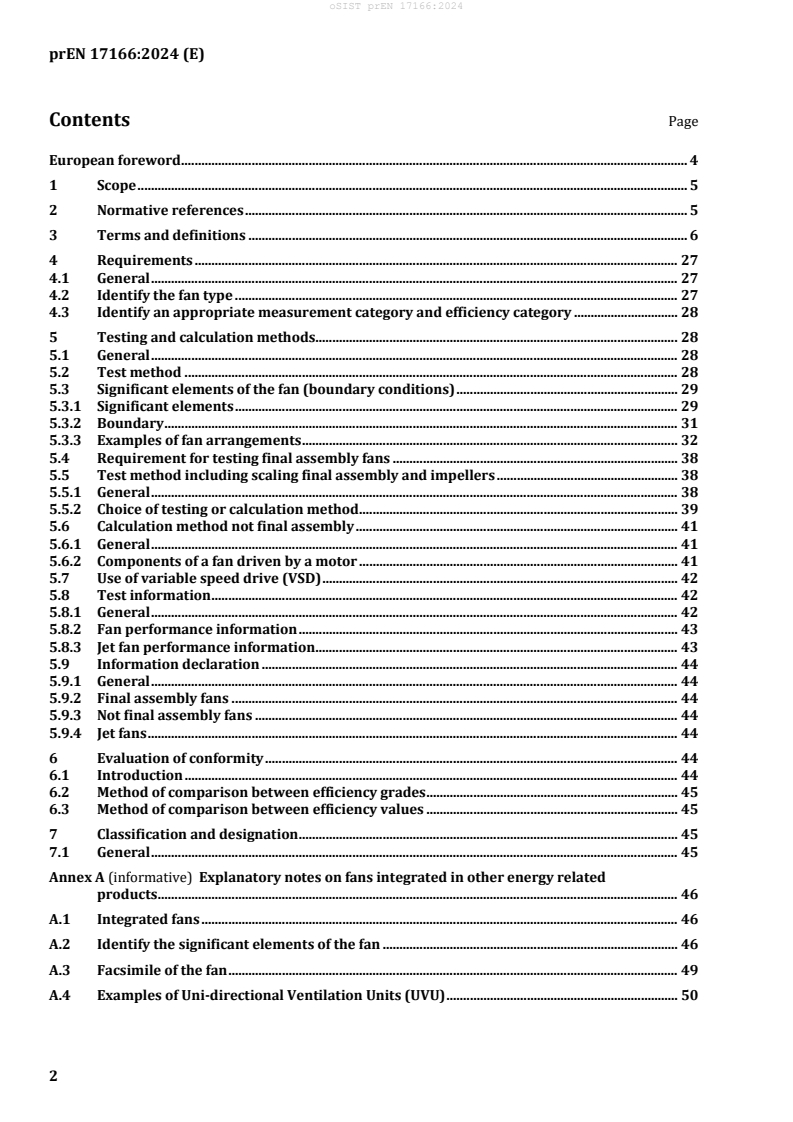
Contents Page
European foreword . 4
1 Scope . 5
2 Normative references . 5
3 Terms and definitions . 6
4 Requirements . 27
4.1 General . 27
4.2 Identify the fan type . 27
4.3 Identify an appropriate measurement category and efficiency category . 28
5 Testing and calculation methods . 28
5.1 General . 28
5.2 Test method . 28
5.3 Significant elements of the fan (boundary conditions) . 29
5.3.1 Significant elements . 29
5.3.2 Boundary . 31
5.3.3 Examples of fan arrangements . 32
5.4 Requirement for testing final assembly fans . 38
5.5 Test method including scaling final assembly and impellers . 38
5.5.1 General . 38
5.5.2 Choice of testing or calculation method . 39
5.6 Calculation method not final assembly . 41
5.6.1 General . 41
5.6.2 Components of a fan driven by a motor . 41
5.7 Use of variable speed drive (VSD) . 42
5.8 Test information . 42
5.8.1 General . 42
5.8.2 Fan performance information . 43
5.8.3 Jet fan performance information . 43
5.9 Information declaration . 44
5.9.1 General . 44
5.9.2 Final assembly fans . 44
5.9.3 Not final assembly fans . 44
5.9.4 Jet fans . 44
6 Evaluation of conformity . 44
6.1 Introduction . 44
6.2 Method of comparison between efficiency grades . 45
6.3 Method of comparison between efficiency values . 45
7 Classification and designation . 45
7.1 General . 45
Annex A (informative) Explanatory notes on fans integrated in other energy related
products . 46
A.1 Integrated fans . 46
A.2 Identify the significant elements of the fan . 46
A.3 Facsimile of the fan . 49
A.4 Examples of Uni-directional Ventilation Units (UVU) . 50
prEN 17166:2024 (E)
Annex B (informative) Method to determine not-final-assembly efficiency flow chart . 53
Annex C (informative) Toxic, highly corrosive, flammable, abrasive substances . 54
C.1 Arduous environments . 54
C.2 Toxic . 54
C.3 Highly corrosive . 54
C.4 Flammable . 54
C.5 Abrasive . 55
Annex D (informative) Guide to using the standard . 56
Annex E (informative) Significant elements of a fan . 58
Annex F (informative) Suggested format for compliance reports requested by market
surveillance authorities . 59
Annex G (informative) Basic fan types with cross reference to Regulation 327/2011 . 62
Annex H (informative) Product information requirements . 63
Annex I (informative) Installation and maintenance information . 65
Annex ZA (informative) Relationship between this European Standard and the ecodesign
requirements of Commission Regulation (EU) No 327/2011 [OJEU L 90/8] aimed to
be covered . 66
Bibliography . 68
prEN 17166:2024 (E)
European foreword
This document (prEN 17166:2024) has been prepared by Technical Committee CEN/TC 156 “Ventilation
for buildings”, the secretariat of which is held by BSI.
This document is currently submitted to the CEN Enquiry.
This document has been prepared under a standardization request addressed to CEN by the European
Commission. The Standing Committee of the EFTA States subsequently approves these requests for its
Member States.
For the relationship with EU Legislation, see informative Annex ZA, which is an integral part of this
document.
prEN 17166:2024 (E)
1 Scope
This document provides procedures and methods for measuring and/or calculating the energy efficiency
and associated characteristics of fans when driven by electric motors. This document deals with the
following fan types;
— axial fan;
— centrifugal forward curved fan, centrifugal radial bladed fan;
— centrifugal backward curved fan without housing, including centrifugal backward aerofoil fans;
— centrifugal backward curved fan with housing, including centrifugal backward aerofoil fans;
— mixed flow fan;
— cross flow fan;
— jet fan.
It provides procedures and methods to evaluate the compliance of the fan efficiency against minimum
efficiency requirements.
This document includes stand-alone fans and fans that are integrated in other products. It gives guidance
to manufacturers in providing information to surveillance authorities to describe the full extent of the fan
by describing boundaries, significant elements and additional parts.
Some units previously identified as fans are now defined as Uni-Directional Ventilation Units. This
document explains and shows by way of examples the difference between fans and Uni-Directional
Ventilation Units.
This standard does not include:
— Uni-Directional Ventilation Units;
— fans that are designed specifically to operate in toxic, highly corrosive or flammable environments
or in environments with abrasive substances, see Annex C.
2 Normative references
The following documents are referred to in the text in such a way that some or all of their content
constitutes requirements of this document. For dated references, only the edition cited applies. For
undated references, the latest edition of the referenced document (including any amendments) applies.
EN 60034-2-1:2014, Rotating electrical machines — Part 2-1: Standard methods for determining losses and
efficiency from tests (excluding machines for traction vehicles) (IEC 60034-2-1:2014)
EN ISO 5801:2017, Fans — Performance testing using standardized airways (ISO 5801:2017)
EN ISO 5802:2008, Industrial fans — Performance testing in situ (ISO 5802:2001)
EN ISO 12759-4:2019, Fans — Efficiency classification for fans — Part 4: Driven fans at maximum
operating speed (ISO 12759-4:2019)
EN ISO 13349-1:2022, Fans — Vocabulary and definitions of categories — Part 1: Vocabulary (ISO 13349-
1:2022)
prEN 17166:2024 (E)
EN ISO 13350:2015, Fans — Performance testing of jet fans (ISO 13350:2015)
ISO 13348:2007, Industrial fans — Tolerances, methods of conversion and technical data presentation
3 Terms and definitions
For the purposes of this document, the following terms and definitions apply.
ISO and IEC maintain terminology databases for use in standardization at the following addresses:
— ISO Online browsing platform: available at https://www.iso.org/obp
— IEC Electropedia: available at https://www.electropedia.org
3.1
fan
rotary-bladed machine that receives mechanical energy and utilizes it by means of one or more impellers
fitted with blades to maintain a continuous flow of air or other gas passing through it and whose work
per unit mass does not normally exceed 25 kJ/kg
[SOURCE: EN ISO 13349-1:2022, definition 3.1.1]
Note 1 to entry: A fan in this standard is a configuration of significant elements, see 5.3.1. These significant
elements are required for continuous conversion of electrical power into air volume flow rate and pressure.
Note 2 to entry: A fan as defined in Regulation 327/2011 means a configuration of at least an impeller, stator and
motor. These items are considered significant elements.
Note 3 to entry: A fan is a version of a Motor Driven Unit (MDU) and consists of at least a configuration of an
impeller, stator and motor.
Note 4 to entry: A fan in this standard is an Extended Product that consist of Driven Equipment and Motor
System, see Figure 1.
3.1.1
integrated fan
fan that is integrated into another product with the fan being a configuration of at least an impeller, stator
and motor
Note 1 to entry: Based on Article 1 (1) of Regulation 327/2011.
Note 2 to entry: An additional casing around the fan is not part of the fan, but part of another energy related
product. Please refer to 5.3 for further information.
Note 3 to entry: Integrated also means a fan embedded within another energy related product.
Note 4 to entry: Annex A provides further information.
3.1.2
stand-alone fan
fan that is installed as a unique entity and not integrated into any other product
Note 1 to entry: It may or may not have ducting connected to its inlet and outlet.
prEN 17166:2024 (E)
3.2
fan driven by motor
fan driven by an electrical motor (included all transmissions and drives)
Note 1 to entry: One or more impellers fitted to or connected to a motor, with or without a drive mechanism, or
a housing or a means of variable speed drive.
Note 2 to entry: See Figure 12.
3.3
extended product
EP
driven equipment together with its connected motor system
Figure 1 — Illustration of extended product – fan driven by motor
Note 1 to entry: The extended product in this standard is ‘fan driven by motor’ reference 3.2.
Note 2 to entry: A Complete Drive Module (CDM) is also known as an VSD (see 3.17).
[SOURCE: adapted from EN 61800-9-1:2017, 3.1.3 with additional details for a fan as the driven
equipment]
3.4
impeller
rotating part of the fan that is imparting energy into the gas flow and is also known as the fan wheel
3.5
fan type
fan of specific and typical design primarily distinguished by the geometry of its impeller and the resulting
gas path through the fan
prEN 17166:2024 (E)
3.5.1
axial, mixed flow and centrifugal fan
fan types which are identified by the angle α, average value of the angles α and α (see figures)
1 2
α = (α + α )/2 (1)
1 2
where
α1 is the angle of the tangent at the hub at the intersection of the blade trailing edge with the
hub;
α2 is the angle of the tangent at the shroud or at the outer diameter of the blade at the
intersection of the blade trailing edge with the shroud or with the outer diameter of the blade,
given that, if the hub and/or shroud are not axisymmetric, angles α1 and α2 are the average
values in circumferential direction.
Note 1 to entry: The fan types are defined as in Table 1.
Table 1 — Fan type defined by the relationship of the blade and the shroud/hub
Fan type Angle α
Centrifugal fan α ≥ °70
Mixed flow fan 20° ≤ α < 70°
Axial fan α < 20°
Note 2 to entry: Centrifugal fans contain the types „centrifugal radial bladed fan“ (including radial tip),
„centrifugal forward curved fan“ and „centrifugal backward curved fan“ (including also backward inclined and
backward curved aerofoil bladed fans).
Key
1 inflow
2 outflow
3 axis of rotation
Left hand image: centrifugal fan
Middle image: mixed flow fan
Right hand image: axial fan
Figure 2 — Differentiation by angles
prEN 17166:2024 (E)
3.5.2
axial fan
axial-flow fan in which the air enters and leaves the impeller along essentially cylindrical surfaces coaxial
with the fan
Note 1 to entry: Within the scope of this document, a fan is an axial fan when its angle α is within the limits
provided in Table 1.
[SOURCE: EN ISO 13349-1:2022, definition 3.5.2]
Note 2 to entry: The definition in EU 327/2011 differs from that above and is stated as: Axial fan’ means a fan
that propels gas in the direction axial to the rotational axis of one or more impeller(s) with a swirling tangential
motion created by the rotating impeller(s). The axial fan may or may not be equipped with a cylindrical housing,
inlet or outlet guide vanes or an orifice panel or orifice ring.
3.5.3
mixed-flow fan
fan in which the fluid path through the impeller is intermediate between the centrifugal and axial-flow
types
[SOURCE: EN ISO 13349-1:2022, definition 3.5.9, modified – deleted “See Figures 5 and 11”]
Note 1 to entry: Within the scope of this document, a fan is a mixed-flow fan when its angle α is within the limits
provided in Table 1.
Note 2 to entry: See to 3.5.1.
3.5.4
centrifugal fan
fan in which the fluid enters the impeller with an essentially axial direction and leaves it in a direction
perpendicular, or near perpendicular to this axis (see Table 1 and Figure 2)
Note 1 to entry: Within the scope of this document, a fan is a centrifugal fan when its angle α is within the limits
provided in Table 1.
Note 2 to entry: For further details see 3.5.1.
3.5.5
cross flow fan
tangential fan
fan in which the fluid path through the impeller is in a direction essentially at right angles to its axis both
entering and leaving the impeller at its periphery (see Figure 3)
[SOURCE: EN ISO 13349-1:2022, definition 3.5.11]
prEN 17166:2024 (E)
Key
a flow of air
Figure 3 — Cross flow fan
3.5.6
jet fan
impulse fan
fan used for producing a jet of air in a space and unconnected to any ducting (see Figures 4 and 5)
Note 1 to entry: Jet fans performance and efficiency are determined by the thrust measurements only (see
EN ISO 13350:2015).
Note 2 to entry: The air jet can be used, for example, for adding momentum to the air within a tunnel or other
space (e.g. enclosed car park), or for intensifying the heat transfer in a determined zone.
Key
a flow of air
Figure 4 — Axial jet fan
prEN 17166:2024 (E)
Key
1 inlet
2 discharge
Figure 5 — Centrifugal jet fan
3.6 Detailed specification of centrifugal fan types
3.6.1
centrifugal forward curved fan
centrifugal fan with curved blades, where the outward direction of the blades at the periphery is inclined
forward relative to the direction of rotation (see Figure 6)
Figure 6 — Impeller of a centrifugal forward curved fan
[SOURCE: EN ISO 13349-1:2022, Figure 13]
prEN 17166:2024 (E)
3.6.2
centrifugal backward curved fan
centrifugal fan with curved blades, where the outward direction of the blades at the periphery is inclined
backwards relative to the direction of rotation (see Figure 7)
Figure 7 — Impeller of a centrifugal backward curved fan
[SOURCE: EN ISO 13349-1:2022, Figure 13]
3.6.3
centrifugal backward inclined fan
centrifugal fan with flat blades, where the outward direction of the blades at the periphery is inclined
backwards relative to the direction of rotation (see Figure 8)
Figure 8 — Impeller of a centrifugal backward inclined fan
[SOURCE: EN ISO 13349-1:2022, Figure 13]
prEN 17166:2024 (E)
3.6.4
centrifugal backward aerofoil fan
centrifugal fan with aerofoil blades (where the thickness of the blade is not constant throughout its
length), and where the outward direction of the blades at the periphery is inclined backwards relative to
the direction of rotation (see Figure 9)
Figure 9 — Impeller of a centrifugal backward aerofoil fan
[SOURCE: EN ISO 13349-1:2022, Figure 13]
3.6.5
centrifugal radial tip fan
centrifugal fan with flat or curved blades, where the outward direction of the blades at the periphery is
radially orientated (see Figure 10)
Figure 10 — Impeller of a centrifugal radial tip fan
[SOURCE: EN ISO 13349-1:2022, Figure 13]
prEN 17166:2024 (E)
3.7
significant element
part which is required for continuous conversion of power (electrical or mechanical) into air volume flow
rate and pressure or improve the efficiency of such conversion
Note 1 to entry: Other parts may be existing, outside of the boundary of the fan, which interfere with the airflow.
They are there for some purpose, which is not related to the function of the fan itself. As a general rule, such parts
shall not be considered significant elements, and they shall not be included in the tested fan.
Note 2 to entry: Annex E provides further information.
3.8
housing
stationary part which interacts with the air stream passing through the impeller, contributing to improve
the efficiency, and which physically surrounds the impeller
Note 1 to entry: A housing could be a device around the impeller which guides the gas steam towards, through
and from the impeller.
Note 2 to entry: A housing may have additional parts included within the housing or attached to the housing to
affect the performance of the fan. Such as:
— inlet cone, also known as venturi inlet, inlet bell, inlet radius;
— inlet guide vane;
— outlet guide vane;
— diffuser.
Note 3 to entry: A casing is in addition to a fan and interferes with the airflow. In this standard, it is not the same
as a housing.
3.8.1
inlet cone
venturi inlet
inlet bell
inlet radius
device that steers the air into the impeller and reduces the vena contracta and turbulence that would
occur at the entrance of the impeller
3.8.2
inlet guide vanes
vanes positioned before the impeller to guide the gas stream towards the impeller and which may or may
not be adjustable
3.8.3
outlet guide vanes
vanes positioned after the impeller to guide the gas stream from the impeller and which may or may not
be adjustable
3.8.4
diffuser
device that improves the fan performance thorough static recovery
prEN 17166:2024 (E)
3.8.5
orifice ring
ring with an opening in which the fan sits and which allows the fan to be fixed to other structures
3.8.6
orifice panel
panel with an opening in which the fan sits and which allows the fan to be fixed to other structures
3.8.7
fan without housing
fan designed to function without a housing
3.8.8
fan with housing
fan designed to function with a housing
3.9
stator
stationary part of the fan which interacts with the air stream passing through the impeller and, within
the geometrical air-stream envelope between defined fan inlet- and outlet sections, includes any part that
may increase, and excludes any non-fan component that may decrease, the fan efficiency
3.10
casing
stationary part which interacts with the air stream passing through the impeller but does not improve
the fan efficiency
Note 1 to entry: It is an element that may be additional to the housing.
Note 2 to entry: For example, the casing may be all parts of a ventilation unit (VU) in addition to the fan housing.
A casing is referred to in definition 1 of article 2 of Regulation 1253/2014.
3.11
specific ratio
stagnation pressure measured at the fan outlet divided by the stagnation pressure at the fan inlet at the
optimal energy efficiency point of the fan; also known as compression ratio
3.12
measurement category
fan test configuration according to the arrangement of standardised test airways; also known as
installation category according to EN ISO 5801:2017, Clause 11 and EN ISO 13349-1:2022 definition 3.2
3.12.1
measurement category A
test configuration composed of the fan under test without any inlet or outlet duct fitted, optionally tested
with the ancillaries supplied with the fan, i.e. protection grid, inlet bell, etc
Note 1 to entry: Also known as test configuration category A (see EN ISO 5801:2017, 6.2).
prEN 17166:2024 (E)
3.12.2
measurement category B
test configuration composed of the fan under test with an outlet duct fitted, simulating ducted conditions,
optionally tested with the ancillaries supplied with the fan
Note 1 to entry: Also known as test configuration category B (see EN ISO 5801:2017, 6.3).
3.12.3
measurement category C
test configuration composed of the fan under test with an inlet duct fitted, simulating ducted conditions,
optionally tested with the ancillaries supplied with the fan
Note 1 to entry: Also known as test configuration category C (see EN ISO 5801:2017, 6.4).
3.12.4
measurement category D
test configuration composed of the fan under test with an inlet and an outlet duct fitted, simulating ducted
conditions, optionally tested with the ancillaries supplied with the fan
Note 1 to entry: Also known as test configuration category D (see EN ISO 5801:2017, 6.5).
3.12.5
measurement category E
test configuration with free inlet and free outlet without a partition
Note 1 to entry: Also known as test configuration category E.
[SOURCE: EN ISO 13349-1:2022, definition 3.2.5]
Note 2 to entry: It is defined in EN ISO 5801:2017 but is not relevant to this standard.
Note 3 to entry: In this measurement category a fan cannot produce any static pressure rise.
prEN 17166:2024 (E)
3.13 Power
Key
A drive/control electrical input power (Ped)
1 VSD (η )
ed
B motor input power (P )
e
2 motor (η )
m
C motor output power (Po)
3 transmission (ηT)
D fan shaft power (P )
a
4 bearings (and other mechanical parts) (η )
b
E fan impeller power (Pr)
5 impeller and stator (ηr)
F fan air power (Pu)
Figure 11 — Power diagram of drive system
prEN 17166:2024 (E)
3.13.1
fan gas power
depending on the installation category used to rate the fan, means either the fan air power (installations
B and D) or the fan static air power (installations A and C)
3.13.2
fan air power
P
u
also known as fan total air power; conventional output power which is the product of the mass flow rate
and the fan work per unit mass, or the product of the inlet volume flow rate, the compressibility
coefficient and the fan pressure
q × p × kp (2)
f
[SOURCE: EN ISO 12759-4:2019, definition 3.16]
3.13.3
fan static air power
P
us
conventional output power which is the product of the mass flow rate and the fan static work per unit
mass, or the product of the inlet volume flow rate, the compressibility coefficient and the fan static
pressure
q × p × kp (3)
fs
[SOURCE: EN ISO 12759-4:2019, definition 3.17]
3.13.4
impeller power
P
r
mechanical power supplied to the fan impeller
[SOURCE: EN ISO 12759-4:2019, definition 3.18]
3.13.5
fan shaft power
P
a
mechanical power supplied to the fan shaft
[SOURCE: EN ISO 12759-4:2019, definition 3.19]
Note 1 to entry: Fan shaft power includes bearing losses, while fan impeller power does not.
Note 2 to entry: When the impeller is directly supported on the motor shaft the fan shaft power and the fan
impeller power are the same.
prEN 17166:2024 (E)
3.13.6
nominal motor power
P
N
rated output power of an electric motor
3.13.7
motor output power
P
o
shaft power output of the electric motor
3.13.8
motor input power
P
e
electrical input power supplied at the terminals of an electric motor
3.13.9
drive control electrical input power
P
ed
electrical input power measured at the input terminals to the variable speed drive of a motor
3.13.10
Unit input power at best efficiency point
P
BEP
Input power at the best operating point at the inherent speed of the fan
Note 1 to entry: best efficiency point is also known as optimum energy efficiency point.
3.14
efficiency
ratio between air power and a known input power
3.14.1
efficiency category
fan gas output energy form used to determine the fan energy efficiency, either static efficiency or total
efficiency where:
a) 'fan static pressure' (p ) has been used to determine fan gas power in the efficiency formula for fan
fs
static efficiency, and
b) 'fan total pressure' (p ) has been used to determine fan gas power in the efficiency formula for total
f
efficiency
3.14.1.1
total efficiency
η
f
energy efficiency of a fan, based upon measurement of the ‘fan total pressure’ (p )
f
Note 1 to entry: There are several total efficiencies depending on the power selected as an input, all of them using
fan air power as the measure of the output power (see 3.14.2 and Table 2).
prEN 17166:2024 (E)
3.14.1.2
static efficiency
η
fs
energy efficiency of a fan, based upon measurement of the ‘fan static pressure’ (p )
fs
Note 1 to entry: There are several static efficiencies depending on the power selected as an input, all of them
using fan air power as the measure of the output power (see 3.14.2 and Table 2).
3.14.2
efficiency definitions depending on input power
definitions of the efficiency dependent on which power is chosen as the input power
Note 1 to entry: Each one of the following definitions of efficiency is based on a different choice of which power
should be used as input power. Each one may be either a total or a static efficiency, as defined in 3.14.1.1 or 3.14.1.2,
respectively.
3.14.2.1
overall efficiency for a fan with variable speed drive
η
ed
fan air power divided by the drive control electrical input power for the fan with variable speed drive
3.14.2.2
overall efficiency for a fan without variable speed drive
ηe
fan air power divided by the motor input power for the fan without variable speed drive
3.14.2.3
fan efficiency based on motor output power
η
o
fan air power divided by the motor output power
3.14.2.4
fan shaft efficiency
η
a
fan air power divided by the fan shaft power
[SOURCE: EN ISO 12759-4:2019, definition 3.24]
Note 1 to entry: Shaft power, P , includes bearing losses, while impeller power, P , does not.
a r
3.14.2.5
fan impeller efficiency
η
r
fan air power divided by the impeller power
[SOURCE: EN ISO 12759-4:2019, definition 3.23]
prEN 17166:2024 (E)
3.14.2.6 Relationship between powers and efficiencies
Table 2 — Relationship between powers and efficiencies
Input powers Installation category
A and C B and D
Fan static air power (P ) Fan air power (P )
us u
Static efficiencies Total efficiencies
Drive/control electrical input power η = P /P η = P /P
eds us ed ed u ed
(P )
ed
Motor input power (P ) η = P /P η = P /P
e es us e e u e
Motor output power (P ) η = P /P η = P /P
o os us o o u o
Fan shaft power (P ) η = P /P η = P /P
a as us a a u a
Fan impeller power (P ) η = P /P η = P /P
r rs us r r u r
3.14.3
motor efficiency
η
m
motor output power divided by the motor input power (see EN 60034-2-1:2014)
3.14.4
variable speed drive efficiency
ηc
motor input power divided by the drive control electrical input power
3.14.5
efficiency grade
N
parameter in the calculation of the target energy efficiency of a fan of a declared electric input power at
its optimum energy efficiency point (expressed as parameter ‘N’ in the calculation of the fan energy
efficiency)
Note 1 to entry: This quantity in other standards is also called Fan and Motor Efficiency Grade (FMEG) (NG).
Reference EN ISO 12759-4:2019, Clause 4.
3.14.6
fan efficiency grade
N
e
efficiency grade calculated from the fan efficiency and power consumption at the optimum efficiency
operating point (best efficiency point BEP), using the curve which is appropriate for the applicable fan
type
3.14.7
target energy efficiency
η
target
minimum energy efficiency to meet the requirements set out by Regulation for a fan
Note 1 to entry: It is based on the fan type, its electrical input power at its point of optimum energy efficiency and
the specified efficiency grade.
prEN 17166:2024 (E)
3.15 Fan pressure
3.15.1
fan total pressure
p
f
for velocities (v ) which are below 65 m/s, in which case the values of total pressure and stagnation
pressure are practically the same, difference between total pressures at the fan outlet and the fan inlet:
p = p − p (4)
f tot2 tot1
for v2.ref ≥ 65 m/s, in which case the total pressures will be replaced by stagnation pressures, difference
between the stagnation pressures at the fan outlet and the fan inlet:
p = p − p (5)
f sg2 sg1
Note 1 to entry: For the establishment of the value (v ) see EN ISO 5801:2017, Clause 13.
Note 2 to entry: In other standards, fan total pressure is also expressed as fan pressure.
3.15.2
fan dynamic pressure
p
fd
dynamic pressure of the fan defined at the fan outlet with the average velocity:
v
pp ρ⋅ (6)
fd d2 2
[SOURCE: EN ISO 5801:2017, definition 3.32]
3.15.3
fan static pressure
p
fs
for velocities (v ) below 65 m/s, difference between the static pressure at the fan outlet and the total
pressure at the fan inlet:
p = p − p = p − p − p = p – p (7)
fs 2 tot1 tot2 d2 tot1 f fd
Note 1 to entry: For v2.ref ≥ 65 m/s the total pressures shall be replaced by stagnation pressures:
p = p − p = p − p ⋅ f − p = p − p ⋅ f (8)
fs 2 sg1 sg2 d2 M2 sg1 f fd M2
difference between the static pressure at the fan outlet and the stagnation pressure at the fan inlet.
Note 2 to entry: For the establishment of the value 65 m/s see EN ISO 5801:2017, Clause 13.
= =
prEN 17166:2024 (E)
3.15.4
absolute stagnation pressure
p
sg
absolute pressure, if the air were brought to rest via an isentropic process:
κ
κ− 1 κ−1
p =p×+1 × Ma =p+ f × p (9)
sg M d
[SOURCE: EN ISO 5801:2017, definition 3.29]
3.16
Mach factor
f
M
correction factor applied to the dynamic pressure, to compensate for compressibility effects
Note 1 to entry: The Mach factor f may be calculated by:
M
pp−
sg
f = (10)
M
p
d
4 6
2−×κ Ma 2−×κκ3− 2 × Ma
( ) ( ) ( )
Ma
f =1++ + + . (11)
M
4 24 192
3.17
variable speed drive
VSD
electronic power converter integrated - or functioning as one system - with the motor and the fan, that
continuously adapts the electrical power supplied to the electric motor in order to control the mechanical
power output of the motor according to the torque-speed characteristic of the load being driven by the
motor, excluding variable voltage controllers where only the supply voltage for the motor is varied
3.18
volume flow rate
q
v1
mass flow rate divided by the density at fan inlet:
q
m
q = (12)
v1
ρ
[SOURCE: EN ISO 5801:2017, definition 3.23]
3.18.1
inlet stagnation volume flow rate
q
vsg1
volume of air that passes through the fan per unit of time (in m /s) and is calculated on the basis of the
mass of air moved by the fan (in kg/s) divided by the stagnation density of this air at the fan inlet (in
kg/m )
prEN 17166:2024 (E)
3.19
compressibility factor
compressibility coefficient
k
p
dimensionless coefficient to take into account the influence of air compressibility on fan air power; equal
to the ratio of the mechanical work done by the fan on the air to the work that would be done on an
incompressible fluid with the same mass flow, inlet density and pressure ratio given by:
P
u
k = (13)
p
qp×
V f
sg1
[SOURCE: EN ISO 5801:2017, definition 3.44]
Note 1 to entry: It is calculated taking into account the fan pressure as ‘total pressure’ (k ) or ‘static pressure’
p
(k ) and total or static air power, when the pressure is above 2 000 Pa.
ps
Note 2 to entry: Also included in EN ISO 5801:2017, definition 3.44.
3.20 Types of assembly
3.20.1
final assembly
finished or assembled on-site assembly of a fan that contains all the elements to convert electric energy
into fan air power without the need to add more parts or components
Note 1 to entry: The definition of final assembly in the description of a fan is introduced in the Eco-design Fan
Regulation and has no meaning in other directives e.g. machinery safety directive.
Note 2 to entry: The final assembly includes all and only those essential parts used to undertake the test, being
fully described in the test report.
3.20.2
not final assembly
assembly of fan parts, consisting of at least the impeller, which needs one or more externally supplied
components in order to be able to convert electric energy into fan air power
Note 1 to entry: The term not final assembly is introduced in the Eco-design Fan Regulation and must not be
confused with the term ”partly completed machinery” used in Machinery Directive.
Note 2 to entry: The efficiency of a 'not final assembly' fan to be determined using one of the methods described
in 5.6.
3.20.3
fan integrated in other energy related products
fan which is an integral part of another product
Note 1 to entry: Its efficiency to be determined based on the definitions of 'final assembly' or 'not final assembly'
fan.
prEN 17166:2024 (E)
3.21
direct drive
driving arrangement for a fan where the impeller is fixed to the motor shaft, either directly or with a co-
axial coupling, and where the impeller speed is identical to the motor’s rotational speed
Note 1 to entry: Fan shaft power equals motor output power in the case of direct drive.
Note 2 to entry: Impeller power equals motor output power in the case of direct drive where the impeller is fixed
to the motor shaft.
3.22
transmission
driving arrangement for a fan which is not ‘direct drive’ as defined above. Such driving arrangements may
include transmissions using a belt-drive, gearbox or slipping coupling
Key
Ped electrical input power
Pu volume flow and pressure (air power)
a variable speed device loss (heat)
b motor losses (heat)
c belt losses (heat)
d bearing losses (heat)
e impeller and housing aerodynamic losses (heat)
Figure 12 — Typical belt driven fan showing power losses
prEN 17166:2024 (E)
3.23 Drive (transmission and motor/control system)
Key
1 high efficiency (flat belt)
2 low efficiency (vee-belt)
Figure 13 — Default efficiency values for belt drives
3.23.1
drive (transmission and motor/control system)
device used to power the fan including motor, mechanical transmission (e.g. belt drive, couplings),
motor/control system e.g. variable frequency controller, electronic commutator, etc. (see Figure 13)
3.23.2
low-efficiency drive
transmission using a belt whose width is less than three times the height of the belt or using some other
form of transmission apart from a ‘high-efficiency drive’
3.23.3
high-efficiency drive
transmission using a belt whose width is at least three times the height of the belt or using toothed gears
oSIST p
...