

SIST EN 1097-1:2024
(Main)Tests for mechanical and physical properties of aggregates - Part 1: Determination of the resistance to wear (micro-Deval)
General Information
- Abstract
This document specifies the reference method used for type testing and in case of dispute, for determining the resistance to wear of coarse aggregates (main text) and aggregates for railway ballast (Annex A) by abrasion in the micro-Deval apparatus. Other methods can be used for other purposes, such as factory production control, provided that an appropriate working relationship with the relevant reference method has been established.
This document applies to natural, manufactured, recycled or lightweight (LWA) aggregates.
NOTE This document does not apply to all types of LWA.
The reference test is performed with the addition of water. Annex B gives details of how the test can be performed without the addition of water.
Annex A specifies the method to determine the resistance to wear of aggregates for railway ballast without abrasive charge.
Annex C specifies the test performed with alternative narrow size fractions.
Annexes D and E specify methods for determining the wear of fine aggregates.
Precision data for the reference test method are given in Annex F.
Annex A is normative and Annexes B, C, D, E and F are informative.
WARNING – The use of this part of EN 1097 can involve hazardous materials, operations and equipment (such as dust, noise and heavy lifts). It does not purport to address all of the safety or environmental problems associated with its use. It is the responsibility of users of this document to take appropriate measures to ensure the safety and health of personnel and the environment prior to application of this document, and fulfil statutory and regulatory requirements for this purpose.
- Status
- Published
- Public Enquiry End Date
- 24-May-2021
- Publication Date
- 11-Feb-2024
- Technical Committee
- AGR - Aggregates
- Current Stage
- 6060 - National Implementation/Publication (Adopted Project)
- Start Date
- 24-Jan-2024
- Due Date
- 30-Mar-2024
- Completion Date
- 12-Feb-2024

Overview
SIST EN 1097-1:2024 specifies the reference method for determining the resistance to wear of coarse aggregates and aggregates for railway ballast using the micro-Deval apparatus. Published by the European Committee for Standardization (CEN), this standard is fundamental for assessing the durability and performance of natural, manufactured, recycled, or certain lightweight aggregates intended for construction and civil engineering applications.
This test is essential for evaluating mechanical properties, particularly wear resistance, which plays a crucial role in the suitability of aggregates for use in roads, railways, and other infrastructure. The micro-Deval test method ensures that consistent and reliable results are obtained across different laboratories and applications, supporting product certification, type testing, and dispute resolution.
Key Topics
Scope and Applicability
- Applies to natural, manufactured, recycled, and specific lightweight aggregates.
- Reference method for type testing and legal or contractual dispute resolution.
- Includes methods for aggregates for railway ballast (Annex A) and alternative procedures for specific requirements.
Test Procedure
- Aggregates are subjected to rotational abrasion in a micro-Deval drum with steel balls and water.
- For railway ballast, an adapted method is provided that omits the steel balls.
- Calculation of the micro-Deval coefficient expresses the resistance to wear based on the percentage of material passing a 1.6 mm test sieve after the abrasion process.
- Options for dry testing (without water) and use of alternative narrow size fractions (Annexes B and C).
Reporting and Safety
- Strict guidelines for sample preparation, test conditions, and calculation of results.
- Requirements for comprehensive test reporting, including sample origin, test method, size fraction, and observations.
- Users must consider health, safety, and environmental precautions, especially regarding dust, noise, and heavy apparatus.
Precision and Validity
- The standard provides guidance on precision and repeatability of test results (Annex F).
- Outlines the importance of establishing equivalence if alternative control methods are used.
Applications
Construction Quality Control
- Ensures aggregates meet performance specifications for use in concrete, asphalt, and road base layers.
- Vital for demonstrating aggregate compliance in procurement and tendering processes.
Rail Infrastructure
- Specialized test methods for railway ballast help ensure track stability, longevity, and safety by selecting materials with proven resistance to abrasion.
Research and Development
- Laboratories and producers use results to develop and improve high-performance aggregates and recycled materials.
- Supports the evaluation of new sources or types of aggregate, including recycled and lightweight variants.
Factory Production Control (FPC)
- Can be integrated into ongoing quality assurance systems, provided that the alternative in-house methods are correlated to the reference method outlined in the standard.
Related Standards
SIST EN 1097-1:2024 is part of a suite of European standards covering aggregate testing and properties. Key related standards include:
- EN 932 Series: General properties of aggregates
- EN 933 Series: Geometrical properties (e.g., particle size distribution)
- EN 1367 Series: Thermal and weathering properties
- EN 1744 Series: Chemical properties
- EN 13179 Series: Filler properties for bituminous mixtures
- Other Parts of EN 1097:
- Part 2: Determination of resistance to fragmentation
- Part 3: Loose bulk density and voids
- Part 4: Voids of dry compacted filler
- Part 5: Water content determination
- Part 6: Particle density and water absorption
- Part 8: Polished stone value
- Part 9: Abrasion from studded tyres (Nordic test)
By adhering to SIST EN 1097-1:2024, organizations can ensure harmonized, repeatable measurements of aggregate wear resistance, supporting infrastructure quality, safety, and regulatory compliance across Europe.
Keywords: EN 1097-1, micro-Deval, aggregate testing, resistance to wear, mechanical properties, construction materials, railway ballast, CEN standards, abrasion test, quality control.
Relations
- Effective Date
- 01-Mar-2024
- Effective Date
- 28-Jan-2026
- Effective Date
- 28-Jan-2026
- Effective Date
- 28-Jan-2026
- Effective Date
- 28-Jan-2026
- Effective Date
- 28-Jan-2026
- Effective Date
- 28-Jan-2026
- Effective Date
- 28-Jan-2026
- Referred By
SIST EN 12620:2013 - Aggregates for concrete - Effective Date
- 28-Jan-2026
- Effective Date
- 28-Jan-2026
- Effective Date
- 28-Jan-2026
- Effective Date
- 28-Jan-2026
- Effective Date
- 28-Jan-2026
- Effective Date
- 28-Jan-2026
- Referred By
SIST EN 13055:2016 - Lightweight aggregates - Effective Date
- 28-Jan-2026
Get Certified
Connect with accredited certification bodies for this standard

DIBt (Deutsches Institut für Bautechnik)
German Institute for Building Technology.
DIN CERTCO
DIN Group product certification.

Aboma Certification B.V.
Specialized in construction, metal, and transport sectors.
Sponsored listings
Frequently Asked Questions
SIST EN 1097-1:2024 is a standard published by the Slovenian Institute for Standardization (SIST). Its full title is "Tests for mechanical and physical properties of aggregates - Part 1: Determination of the resistance to wear (micro-Deval)". This standard covers: This document specifies the reference method used for type testing and in case of dispute, for determining the resistance to wear of coarse aggregates (main text) and aggregates for railway ballast (Annex A) by abrasion in the micro-Deval apparatus. Other methods can be used for other purposes, such as factory production control, provided that an appropriate working relationship with the relevant reference method has been established. This document applies to natural, manufactured, recycled or lightweight (LWA) aggregates. NOTE This document does not apply to all types of LWA. The reference test is performed with the addition of water. Annex B gives details of how the test can be performed without the addition of water. Annex A specifies the method to determine the resistance to wear of aggregates for railway ballast without abrasive charge. Annex C specifies the test performed with alternative narrow size fractions. Annexes D and E specify methods for determining the wear of fine aggregates. Precision data for the reference test method are given in Annex F. Annex A is normative and Annexes B, C, D, E and F are informative. WARNING – The use of this part of EN 1097 can involve hazardous materials, operations and equipment (such as dust, noise and heavy lifts). It does not purport to address all of the safety or environmental problems associated with its use. It is the responsibility of users of this document to take appropriate measures to ensure the safety and health of personnel and the environment prior to application of this document, and fulfil statutory and regulatory requirements for this purpose.
This document specifies the reference method used for type testing and in case of dispute, for determining the resistance to wear of coarse aggregates (main text) and aggregates for railway ballast (Annex A) by abrasion in the micro-Deval apparatus. Other methods can be used for other purposes, such as factory production control, provided that an appropriate working relationship with the relevant reference method has been established. This document applies to natural, manufactured, recycled or lightweight (LWA) aggregates. NOTE This document does not apply to all types of LWA. The reference test is performed with the addition of water. Annex B gives details of how the test can be performed without the addition of water. Annex A specifies the method to determine the resistance to wear of aggregates for railway ballast without abrasive charge. Annex C specifies the test performed with alternative narrow size fractions. Annexes D and E specify methods for determining the wear of fine aggregates. Precision data for the reference test method are given in Annex F. Annex A is normative and Annexes B, C, D, E and F are informative. WARNING – The use of this part of EN 1097 can involve hazardous materials, operations and equipment (such as dust, noise and heavy lifts). It does not purport to address all of the safety or environmental problems associated with its use. It is the responsibility of users of this document to take appropriate measures to ensure the safety and health of personnel and the environment prior to application of this document, and fulfil statutory and regulatory requirements for this purpose.
SIST EN 1097-1:2024 is classified under the following ICS (International Classification for Standards) categories: 91.100.15 - Mineral materials and products. The ICS classification helps identify the subject area and facilitates finding related standards.
SIST EN 1097-1:2024 has the following relationships with other standards: It is inter standard links to SIST EN 1097-1:2011, SIST EN 933-2:2020, SIST EN 932-5:2012, SIST EN 933-1:2012, SIST EN 13043:2002, SIST EN 13450:2013, SIST EN 12620:2002+A1:2008, SIST EN 13043:2013, SIST EN 12620:2013, SIST EN 13242:2013, SIST EN 13242:2003+A1:2008, SIST EN 13286-44:2004, SIST EN 16236:2018, SIST EN 12697-5:2019, SIST EN 13055:2016. Understanding these relationships helps ensure you are using the most current and applicable version of the standard.
SIST EN 1097-1:2024 is associated with the following European legislation: EU Directives/Regulations: 305/2011; Standardization Mandates: M/124, M/125. When a standard is cited in the Official Journal of the European Union, products manufactured in conformity with it benefit from a presumption of conformity with the essential requirements of the corresponding EU directive or regulation.
SIST EN 1097-1:2024 is available in PDF format for immediate download after purchase. The document can be added to your cart and obtained through the secure checkout process. Digital delivery ensures instant access to the complete standard document.
Standards Content (Sample)
SLOVENSKI STANDARD
01-marec-2024
Nadomešča:
SIST EN 1097-1:2011
Preskusi mehanskih in fizikalnih lastnosti agregatov - 1. del: Določevanje
odpornosti proti obrabi (mikro Deval)
Tests for mechanical and physical properties of aggregates - Part 1: Determination of the
resistance to wear (micro-Deval)
Prüfverfahren für mechanische und physikalische Eigenschaften von Gesteinskörnungen
- Teil 1: Bestimmung des Widerstandes gegen Verschleiß (Micro-Deval)
Essais pour déterminer les caractéristiques mécaniques et physiques des granulats -
Partie 1 : Détermination de la résistance à l'usure (micro-Deval)
Ta slovenski standard je istoveten z: EN 1097-1:2023
ICS:
91.100.15 Mineralni materiali in izdelki Mineral materials and
products
2003-01.Slovenski inštitut za standardizacijo. Razmnoževanje celote ali delov tega standarda ni dovoljeno.
EN 1097-1
EUROPEAN STANDARD
NORME EUROPÉENNE
December 2023
EUROPÄISCHE NORM
ICS 91.100.15 Supersedes EN 1097-1:2011
English Version
Tests for mechanical and physical properties of aggregates
- Part 1: Determination of the resistance to wear (micro-
Deval)
Essais pour déterminer les caractéristiques Prüfverfahren für mechanische und physikalische
mécaniques et physiques des granulats - Partie 1 : Eigenschaften von Gesteinskörnungen - Teil 1:
Détermination de la résistance à l'usure (micro-Deval) Bestimmung des Widerstandes gegen Verschleiß
(Micro-Deval)
This European Standard was approved by CEN on 27 November 2023.
CEN members are bound to comply with the CEN/CENELEC Internal Regulations which stipulate the conditions for giving this
European Standard the status of a national standard without any alteration. Up-to-date lists and bibliographical references
concerning such national standards may be obtained on application to the CEN-CENELEC Management Centre or to any CEN
member.
This European Standard exists in three official versions (English, French, German). A version in any other language made by
translation under the responsibility of a CEN member into its own language and notified to the CEN-CENELEC Management
Centre has the same status as the official versions.
CEN members are the national standards bodies of Austria, Belgium, Bulgaria, Croatia, Cyprus, Czech Republic, Denmark, Estonia,
Finland, France, Germany, Greece, Hungary, Iceland, Ireland, Italy, Latvia, Lithuania, Luxembourg, Malta, Netherlands, Norway,
Poland, Portugal, Republic of North Macedonia, Romania, Serbia, Slovakia, Slovenia, Spain, Sweden, Switzerland, Türkiye and
United Kingdom.
EUROPEAN COMMITTEE FOR STANDARDIZATION
COMITÉ EUROPÉEN DE NORMALISATION
EUROPÄISCHES KOMITEE FÜR NORMUNG
CEN-CENELEC Management Centre: Rue de la Science 23, B-1040 Brussels
© 2023 CEN All rights of exploitation in any form and by any means reserved Ref. No. EN 1097-1:2023 E
worldwide for CEN national Members.
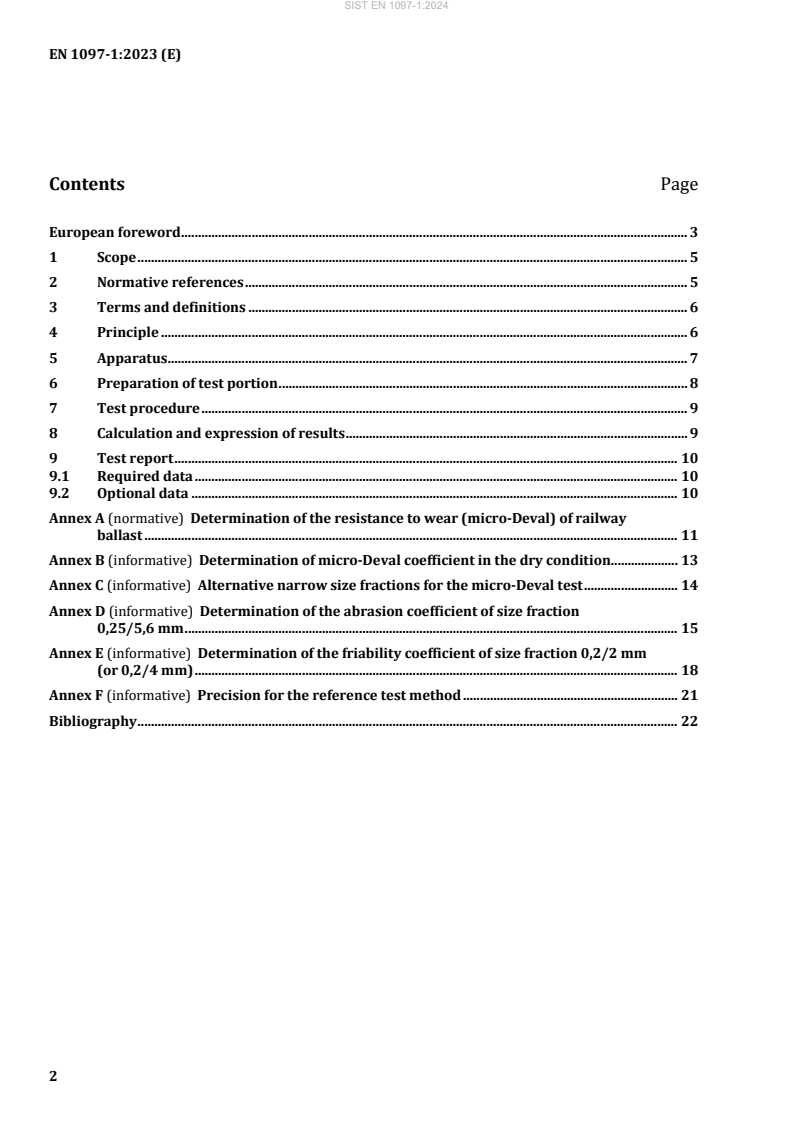
Contents Page
European foreword . 3
1 Scope . 5
2 Normative references . 5
3 Terms and definitions . 6
4 Principle . 6
5 Apparatus . 7
6 Preparation of test portion . 8
7 Test procedure . 9
8 Calculation and expression of results . 9
9 Test report . 10
9.1 Required data . 10
9.2 Optional data . 10
Annex A (normative) Determination of the resistance to wear (micro-Deval) of railway
ballast . 11
Annex B (informative) Determination of micro-Deval coefficient in the dry condition . 13
Annex C (informative) Alternative narrow size fractions for the micro-Deval test . 14
Annex D (informative) Determination of the abrasion coefficient of size fraction
0,25/5,6 mm . 15
Annex E (informative) Determination of the friability coefficient of size fraction 0,2/2 mm
(or 0,2/4 mm) . 18
Annex F (informative) Precision for the reference test method . 21
Bibliography . 22
European foreword
This document (EN 1097-1:2023) has been prepared by Technical Committee CEN/TC 154 “Aggregates”,
the secretariat of which is held by BSI.
This European Standard shall be given the status of a national standard, either by publication of an
identical text or by endorsement, at the latest by June 2024, and conflicting national standards shall be
withdrawn at the latest by June 2024.
Attention is drawn to the possibility that some of the elements of this document may be the subject of
patent rights. CEN shall not be held responsible for identifying any or all such patent rights.
This document supersedes EN 1097-1:2011.
In comparison with the previous edition, the following technical modifications have been made:
a) The European foreword, the Scope, the Terms and definitions and the Test report content have been
updated according to the current rules;
b) Lightweight aggregates have been included in the Scope;
c) The Normative references have been extended with EN 933-2, and ISO 3290-1 has been moved to
the Bibliography;
d) The definition of M or M has been added in Clause 3;
DE DE,RB
e) In Clause 5, the description of the micro-Deval apparatus has been clarified. In addition, the
requirement on steel balls to comply with ISO 3290-1 has been deleted since it was too sharp
compared with the specified diameter tolerance. A new Note with reference to ISO 3290-1 has been
added. A new Note about the hardness of steel ball diameters has been added. Two optional
apparatus, a gauge and a magnet, have been added;
f) In the test procedure, amount of water is expressed in mass instead of volume. Subsequently,
EN ISO 4788 Laboratory glassware has been deleted from Clause 2, Graduated glass cylinder has
been deleted from Clause 5 Apparatus, and B.2 Apparatus has been deleted;
g) The formulae for calculation of M and M have included the actual initial masses instead of
DE DE,RB
500 g resp. 10 000 g;
h) The tested size fraction of the aggregate has been moved from optional data to required data;
i) Annex A has been completed to contain full text, not only the clauses expressing additions or
modifications to main text clauses. Formula (A.1) has been changed and instructions to report the
mean value have been added in A.6;
j) In Annex C, the term “range classification” has been replaced by the term “size fraction”;
k) New informative Annexes D and E have been added and specify methods for determination of the
wear of fine aggregates.
l) In addition, the Principle and Annex C have been simplified and the Bibliography has been
supplemented.
This document forms part of a series of tests for mechanical and physical properties of aggregates. Test
methods for other properties of aggregates are covered by the following European Standards:
— EN 932 (all parts), Tests for general properties of aggregates
— EN 933 (all parts), Tests for geometrical properties of aggregates
— EN 1367 (all parts), Tests for thermal and weathering properties of aggregates
— EN 1744 (all parts), Tests for chemical properties of aggregates
— EN 13179 (all parts), Tests for filler aggregate used in bituminous mixtures
The other parts of EN 1097 include:
— Part 2: Methods for the determination of resistance to fragmentation
— Part 3: Determination of loose bulk density and voids
— Part 4: Determination of the voids of dry compacted filler
— Part 5: Determination of the water content by drying in a ventilated oven
— Part 6: Determination of particle density and water absorption
— Part 7: Determination of the particle density of filler — Pyknometer method
— Part 8: Determination of the polished stone value
— Part 9: Determination of the resistance to wear by abrasion from studded tyres — Nordic test
— Part 10: Determination of water suction height
— Part 11: Determination of the compressibility and of the compressive strength of lightweight aggregates
Any feedback and questions on this document should be directed to the users’ national standards body.
A complete listing of these bodies can be found on the CEN website.
According to the CEN-CENELEC Internal Regulations, the national standards organisations of the
following countries are bound to implement this European Standard: Austria, Belgium, Bulgaria, Croatia,
Cyprus, Czech Republic, Denmark, Estonia, Finland, France, Germany, Greece, Hungary, Iceland, Ireland,
Italy, Latvia, Lithuania, Luxembourg, Malta, Netherlands, Norway, Poland, Portugal, Republic of North
Macedonia, Romania, Serbia, Slovakia, Slovenia, Spain, Sweden, Switzerland, Türkiye and the United
Kingdom.
1 Scope
This document specifies the reference method used for type testing and in case of dispute, for
determining the resistance to wear of coarse aggregates (main text) and aggregates for railway ballast
(Annex A) by abrasion in the micro-Deval apparatus. Other methods can be used for other purposes, such
as factory production control, provided that an appropriate working relationship with the relevant
reference method has been established.
This document applies to natural, manufactured, recycled or lightweight (LWA) aggregates.
NOTE This document does not apply to all types of LWA.
The reference test is performed with the addition of water. Annex B gives details of how the test can be
performed without the addition of water.
Annex A specifies the method to determine the resistance to wear of aggregates for railway ballast
without abrasive charge.
Annex C specifies the test performed with alternative narrow size fractions.
Annexes D and E specify methods for determining the wear of fine aggregates.
Precision data for the reference test method are given in Annex F.
Annex A is normative and Annexes B, C, D, E and F are informative.
WARNING – The use of this part of EN 1097 can involve hazardous materials, operations and equipment
(such as dust, noise and heavy lifts). It does not purport to address all of the safety or environmental
problems associated with its use. It is the responsibility of users of this document to take appropriate
measures to ensure the safety and health of personnel and the environment prior to application of this
document, and fulfil statutory and regulatory requirements for this purpose.
2 Normative references
The following documents are referred to in the text in such a way that some or all of their content
constitutes requirements of this document. For dated references, only the edition cited applies. For
undated references, the latest edition of the referenced document (including any amendments) applies.
EN 932-2, Tests for general properties of aggregates — Part 2: Methods for reducing laboratory samples
EN 932-5, Tests for general properties of aggregates — Part 5: Common equipment and calibration
EN 933-1, Tests for geometrical properties of aggregates — Part 1: Determination of particle size
distribution — Sieving method
EN 933-2, Tests for geometrical properties of aggregates — Part 2: Determination of particle size
distribution — Test sieves, nominal size of apertures
3 Terms and definitions
For the purposes of this document, the following terms and definitions apply.
ISO and IEC maintain terminological databases for use in standardization at the following addresses:
— IEC Electropedia: available at https://www.electropedia.org/
— ISO Online browsing platform: available at https://www.iso.org/obp/ui
3.1
test portion
d /D
0 0
sample used as a whole in a single test
3.2
test specimen
sample used in a single determination when a test method requires more than one determination of a
property
3.3
laboratory sample
sample intended for laboratory testing
3.4
constant mass
mass determined by successive weighings performed at least 1 h apart and not differing by more than
0,1 %
Note 1 to entry: In many cases, constant mass can be achieved after a test portion has been dried for a pre-
determined period in a specified oven at (110 ± 5) °C. Test laboratories can determine the time required to achieve
constant mass for specific types and sizes of sample dependent upon the drying capacity of the oven used.
3.5
micro-Deval coefficient
M or M
DE DE,RB
coefficient expressing the wear after completion of the test as the mass percentage of the test portion
passing the 1,6 mm sieve
Note 1 to entry: M is the coefficient for normal weight and lightweight aggregates; M is the coefficient for
DE DE,RB
aggregates for railway ballast.
4 Principle
A test portion of a single-sized aggregate, 10 mm to 14 mm, is rotated together with steel balls and water
in a steel drum. The contents roll within the drum with an abrading action. After the specified number of
revolutions, the contents are removed from the drum and the test portion is sieved on the 1,6 mm sieve.
The micro-Deval coefficient expresses the wear after completion of the test as the mass percentage of the
test portion passing the 1,6 mm sieve.
NOTE A lower value of the micro-Deval coefficient indicates a better resistance to wear.
5 Apparatus
Unless otherwise stated, all apparatus shall conform to the general requirements of EN 932-5.
5.1 General apparatus
5.1.1 Equipment for reducing laboratory samples, as specified in EN 932-2.
5.1.2 Balance, capable of weighing both the test specimen and the charge to an accuracy of 0,1 % of
the mass of the test specimen.
5.1.3 Test sieves, 1,6 mm, 8 mm, 10 mm, 11,2 mm (or 12,5 mm) and 14 mm, which shall conform to
EN 933-2.
5.1.4 Ventilated oven, controlled to maintain a temperature of (110 ± 5) °C.
5.1.5 Washing bottle.
5.2 Additional apparatus required for the determination of the micro-Deval coefficient
5.2.1 Micro-Deval apparatus, comprising the following essential parts.
NOTE An example of an apparatus that has been found to be satisfactory is shown in Figure 1.
Key
1 drums 5 flexible coupling
2 electric motor and reduction gearing 6 drive wheel
3 fixed shaft 7 cross section of a drum
4 frame
Figure 1 — Typical micro-Deval apparatus
5.2.1.1 Hollow drums, made of stainless steel at least 3 mm thick and closed at one end. They shall be
closed by flat lids at least 8 mm thick and fitted with watertight and dust tight seals.
The drums shall have an internal diameter of (200 ± 1) mm and an internal length measured from the
base to the inside of the lid of (154 ± 1) mm. The inner surface of the drums shall be free of protrusions
resulting from welding or the method of attachment.
The drums shall be placed on two fixed shafts which rotate about a horizontal axis.
5.2.1.2 Abrasive charge, consisting of steel balls (10,0 ± 0,5) mm in diameter.
NOTE 1 The lower limit of deviation is a working tolerance limit. The upper limit of deviation is a manufacturing
tolerance limit.
NOTE 2 Steel bearing balls compliant with ISO 3290-1 [1] are also compliant with this document.
NOTE 3 Steel ball diameter can be checked quickly by passing the balls over parallel bars 9,5 mm apart.
NOTE 4 A hardness of the steel balls between HRC 52 and HRC 67 is suitable.
5.2.1.3 Motor, imparting a rotational speed to the drums of (100 ± 5) r/min.
NOTE A motor capacity of about 1 kW is suitable.
5.2.1.4 Revolution counter, which will automatically stop the motor after the specified number of
revolutions.
+0,1
5.2.2 Gauge (optional), to control minimum ball size, fitted with slots 9,5 mm.
( )
−0,0
5.2.3 Magnet (optional), for removal of the steel balls from the aggregate test specimen after abrasion.
6 Preparation of test portion
The test portion shall consist of two test specimens, each having a mass of (500 ± 3) g. Record the mass,
m , for each test specimen.
NOTE Alternative size fractions d /D for certain end uses are specified in Annex C. Testing other size fractions
0 0
can produce results different from those obtained using the 10/14 mm size fraction.
The test shall be carried out on aggregate passing the 14 mm sieve and retained on the 10 mm sieve. In
addition, the grading of the test portion shall conform to at least one of the following requirements:
a) between 30 % and 40 % passing a 11,2 mm sieve; or
b) between 60 % and 70 % passing a 12,5 mm sieve.
Sieve the laboratory sample using the 10 mm, 11,2 mm (or 12,5 mm) and 14 mm sieves to give separate
fractions in the range 10 mm to 11,2 mm (or 12,5 mm) and 11,2 mm (or 12,5 mm) to 14 mm.
Wash each fraction on the sieve defining the lower limit of the size fraction. Dry the fractions to constant
mass at (110 ± 5) °C.
Allow the fractions to cool to ambient temperature. Mix the two fractions to provide a modified 10 mm
to 14 mm laboratory sample which complies with the appropriate additional grading requirements given
in paragraph 2 of this clause.
Reduce the modified laboratory sample prepared from the mixed fractions to test portion size in
accordance with EN 932-2.
It is also acceptable to directly reduce the mass of each individual size fraction to the required mass in
the test specimen.
7 Test procedure
Place a charge of steel balls (5 000 ± 5) g into each of the two separate drums. Then, add a test specimen
to each drum.
Add (2,50 ± 0,05) kg of water to each drum.
Fit a lid to each drum and place each drum on the two shafts.
Rotate the drums at a speed of (100 ± 5) r/min for (12 000 ± 10) revolutions.
After the test, collect the aggregate and the steel balls in a pan, taking care to avoid the loss of any
aggregate. Using a washing bottle, carefully wash the inside of the drum and the lid, and retain the
washings.
Empty the material and all the washings on to the 1,6 mm sieve protected by an 8 mm guard sieve. Wash
the materials in a stream of clean water.
Carefully separate the aggregate particles retained on the 8 mm guard sieve from the steel balls, taking
care not to lose any aggregate particles. The aggregate particles may be picked out by hand, or the balls
may be removed from the sieve using a magnet.
Place the aggregate particles retained on the 8 mm guard sieve onto a tray. Add the material retained on
the 1,6 mm sieve to the same tray.
Dry the tray and its contents in the oven at (
...