

SIST ISO 19130-1:2019
(Main)Geographic information -- Imagery sensor models for geopositioning -- Part 1: Fundamentals
General Information
- Abstract
This document identifies the information required to determine the relationship between the position of a remotely sensed pixel in image coordinates and its geoposition. It supports exploitation of remotely sensed images. It defines the metadata to be distributed with the image to enable user determination of geographic position from the observations.
This document specifies several ways in which information in support of geopositioning can be provided.
a) It may be provided as a sensor description with the associated physical and geometric information necessary to rigorously construct a PSM. For the case where precise geoposition information is needed, this document identifies the mathematical equations for rigorously constructing PSMs that relate 2D image space to 3D ground space and the calculation of the associated propagated errors. This document provides detailed information for three types of passive electro-optical/ IR sensors (frame, pushbroom and whiskbroom) and for an active microwave sensing system SAR. It provides a framework by which these sensor models can be extended to other sensor types.
b) It can be provided as a TRM, using functions whose coefficients are based on a PSM so that they provide information for precise geopositioning, including the calculation of errors, as precisely as the PSM they replace.
c) It can be provided as a CM that provides a functional fitting based on observed relationships between the geopositions of a set of GCPs and their image coordinates.
d) It can be provided as a set of GCPs that can be used to develop a CM or to refine a PSM or TRM.
This document does not specify either how users derive geoposition data or the format or content of the data the users generate.
- Status
- Published
- Public Enquiry End Date
- 29-Jun-2017
- Publication Date
- 29-Sep-2019
- Technical Committee
- GIG - Geographic information
- Current Stage
- 6060 - National Implementation/Publication (Adopted Project)
- Start Date
- 16-Sep-2019
- Due Date
- 21-Nov-2019
- Completion Date
- 30-Sep-2019
Buy Documents



ISO 19130-1:2018 - Geographic information -- Imagery sensor models for geopositioning

ISO 19130-1:2018 - Geographic information — Imagery sensor models for geopositioning — Part 1: Fundamentals/5/2018
Overview
SIST ISO 19130-1:2019 - "Geographic information - Imagery sensor models for geopositioning - Part 1: Fundamentals" defines the geolocation information imagery data providers must supply so users can convert image coordinates (pixels) to ground coordinates (geoposition). The standard standardizes imagery sensor models, metadata requirements, and model options used for precise geopositioning of remotely sensed data from optical and SAR sensors.
Key topics and technical requirements
- Purpose: Identify the minimum information and metadata required to determine the relationship between a pixel in image coordinates and its geographic position.
- Supported model types:
- Physical Sensor Model (PSM) - rigorous sensor description with physical and geometric parameters. ISO 19130‑1 identifies the mathematical equations for constructing PSMs for frame, pushbroom, whiskbroom optical/IR sensors and SAR (synthetic aperture radar), and specifies associated error propagation calculations.
- True Replacement Model (TRM) - functional models whose coefficients are derived from a PSM to provide equivalent geopositioning accuracy.
- Correspondence Model (CM) - empirical functional fitting based on observed relationships between Ground Control Points (GCPs) and image coordinates.
- Ground Control Points (GCPs) - sets of control points usable to develop or refine CMs, TRMs, or PSMs.
- Metadata and schemas: Specifies metadata components and profiles to accompany imagery so users can perform geopositioning. Annexes provide data dictionary, coordinate system guidance, and sensor-specific metadata profiles (frame, pushbroom/whiskbroom, SAR).
- Quality & conformance: Includes provisions for error metrics, quality information, conformance/testing guidance and how metadata supports precision claims.
- Limitations: The document does not prescribe how users must derive geoposition data or the format/content of user-generated results.
Practical applications and target users
- Remote sensing and satellite data providers preparing imagery for distribution
- GIS and photogrammetry professionals performing orthorectification, mapping, and image analysis
- Mapping agencies, defense and intelligence organizations, and commercial imagery vendors seeking standardized geolocation metadata
- Software developers building geopositioning, orthorectification, and sensor modelling tools
- Researchers integrating heterogeneous imagery sources for change detection, asset monitoring, and geospatial analytics
Related standards and resources
- Part of the ISO 19130 series; references other ISO geographic information standards (coordinate systems, metadata).
- Key supporting annexes: Annex A (conformance/testing), Annex B (geolocation data dictionary), Annex C (coordinate systems), and informative metadata profiles for specific sensor types.
Keywords: ISO 19130-1, SIST ISO 19130-1:2019, imagery sensor models, geopositioning, Physical Sensor Model, TRM, Correspondence Model, SAR, pushbroom, frame sensor, whiskbroom, ground control points, geolocation metadata, remote sensing.
Relations
- Replaces
SIST-TS ISO/TS 19130:2010 - Geographic information - Imagery sensor models for geopositioning - Effective Date
- 01-Nov-2019
Buy Documents
ISO 19130-1:2018 - Geographic information -- Imagery sensor models for geopositioning
ISO 19130-1:2018 - Geographic information — Imagery sensor models for geopositioning — Part 1: Fundamentals/5/2018
Get Certified
Connect with accredited certification bodies for this standard

BSI Group
BSI (British Standards Institution) is the business standards company that helps organizations make excellence a habit.

NYCE
Mexican standards and certification body.
Sponsored listings
Frequently Asked Questions
SIST ISO 19130-1:2019 is a standard published by the Slovenian Institute for Standardization (SIST). Its full title is "Geographic information -- Imagery sensor models for geopositioning -- Part 1: Fundamentals". This standard covers: This document identifies the information required to determine the relationship between the position of a remotely sensed pixel in image coordinates and its geoposition. It supports exploitation of remotely sensed images. It defines the metadata to be distributed with the image to enable user determination of geographic position from the observations. This document specifies several ways in which information in support of geopositioning can be provided. a) It may be provided as a sensor description with the associated physical and geometric information necessary to rigorously construct a PSM. For the case where precise geoposition information is needed, this document identifies the mathematical equations for rigorously constructing PSMs that relate 2D image space to 3D ground space and the calculation of the associated propagated errors. This document provides detailed information for three types of passive electro-optical/ IR sensors (frame, pushbroom and whiskbroom) and for an active microwave sensing system SAR. It provides a framework by which these sensor models can be extended to other sensor types. b) It can be provided as a TRM, using functions whose coefficients are based on a PSM so that they provide information for precise geopositioning, including the calculation of errors, as precisely as the PSM they replace. c) It can be provided as a CM that provides a functional fitting based on observed relationships between the geopositions of a set of GCPs and their image coordinates. d) It can be provided as a set of GCPs that can be used to develop a CM or to refine a PSM or TRM. This document does not specify either how users derive geoposition data or the format or content of the data the users generate.
This document identifies the information required to determine the relationship between the position of a remotely sensed pixel in image coordinates and its geoposition. It supports exploitation of remotely sensed images. It defines the metadata to be distributed with the image to enable user determination of geographic position from the observations. This document specifies several ways in which information in support of geopositioning can be provided. a) It may be provided as a sensor description with the associated physical and geometric information necessary to rigorously construct a PSM. For the case where precise geoposition information is needed, this document identifies the mathematical equations for rigorously constructing PSMs that relate 2D image space to 3D ground space and the calculation of the associated propagated errors. This document provides detailed information for three types of passive electro-optical/ IR sensors (frame, pushbroom and whiskbroom) and for an active microwave sensing system SAR. It provides a framework by which these sensor models can be extended to other sensor types. b) It can be provided as a TRM, using functions whose coefficients are based on a PSM so that they provide information for precise geopositioning, including the calculation of errors, as precisely as the PSM they replace. c) It can be provided as a CM that provides a functional fitting based on observed relationships between the geopositions of a set of GCPs and their image coordinates. d) It can be provided as a set of GCPs that can be used to develop a CM or to refine a PSM or TRM. This document does not specify either how users derive geoposition data or the format or content of the data the users generate.
SIST ISO 19130-1:2019 is classified under the following ICS (International Classification for Standards) categories: 07.040 - Astronomy. Geodesy. Geography; 35.240.70 - IT applications in science. The ICS classification helps identify the subject area and facilitates finding related standards.
SIST ISO 19130-1:2019 has the following relationships with other standards: It is inter standard links to SIST-TS ISO/TS 19130:2010. Understanding these relationships helps ensure you are using the most current and applicable version of the standard.
SIST ISO 19130-1:2019 is available in PDF format for immediate download after purchase. The document can be added to your cart and obtained through the secure checkout process. Digital delivery ensures instant access to the complete standard document.
Standards Content (Sample)
SLOVENSKI STANDARD
01-november-2019
Nadomešča:
SIST-TS ISO/TS 19130:2010
Geografske informacije - Modeli zaznavanja podob za geopozicioniranje - 1. del:
Osnove
Geographic information -- Imagery sensor models for geopositioning -- Part 1:
Fundamentals
Information géographique -- Modèles de capteurs d'images et géopositionnement --
Partie 1: Principes de base
Ta slovenski standard je istoveten z: ISO 19130-1:2018
ICS:
07.040 Astronomija. Geodezija. Astronomy. Geodesy.
Geografija Geography
35.240.70 Uporabniške rešitve IT v IT applications in science
znanosti
2003-01.Slovenski inštitut za standardizacijo. Razmnoževanje celote ali delov tega standarda ni dovoljeno.
INTERNATIONAL ISO
STANDARD 19130-1
First edition
2018-09
Geographic information — Imagery
sensor models for geopositioning —
Part 1:
Fundamentals
Information géographique — Modèles de capteurs d'images et
géopositionnement —
Partie 1: Principes de base
Reference number
©
ISO 2018
© ISO 2018
All rights reserved. Unless otherwise specified, or required in the context of its implementation, no part of this publication may
be reproduced or utilized otherwise in any form or by any means, electronic or mechanical, including photocopying, or posting
on the internet or an intranet, without prior written permission. Permission can be requested from either ISO at the address
below or ISO’s member body in the country of the requester.
ISO copyright office
CP 401 • Ch. de Blandonnet 8
CH-1214 Vernier, Geneva
Phone: +41 22 749 01 11
Fax: +41 22 749 09 47
Email: copyright@iso.org
Website: www.iso.org
Published in Switzerland
ii © ISO 2018 – All rights reserved
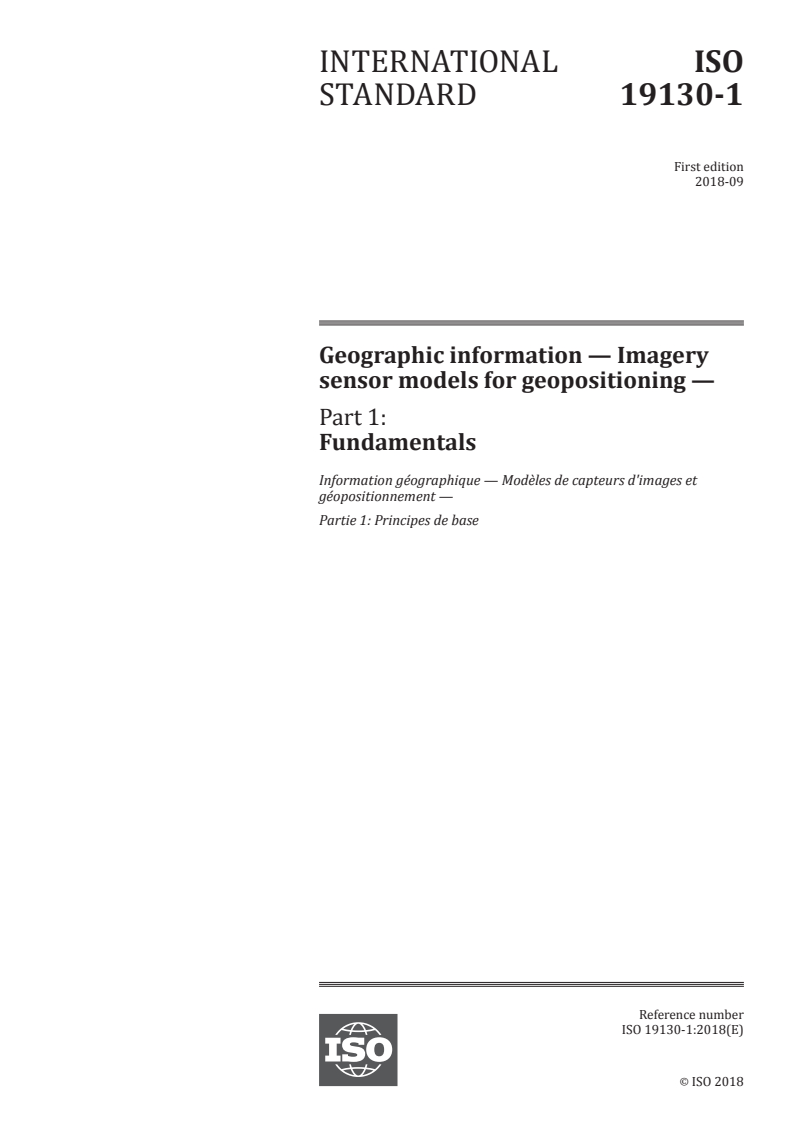
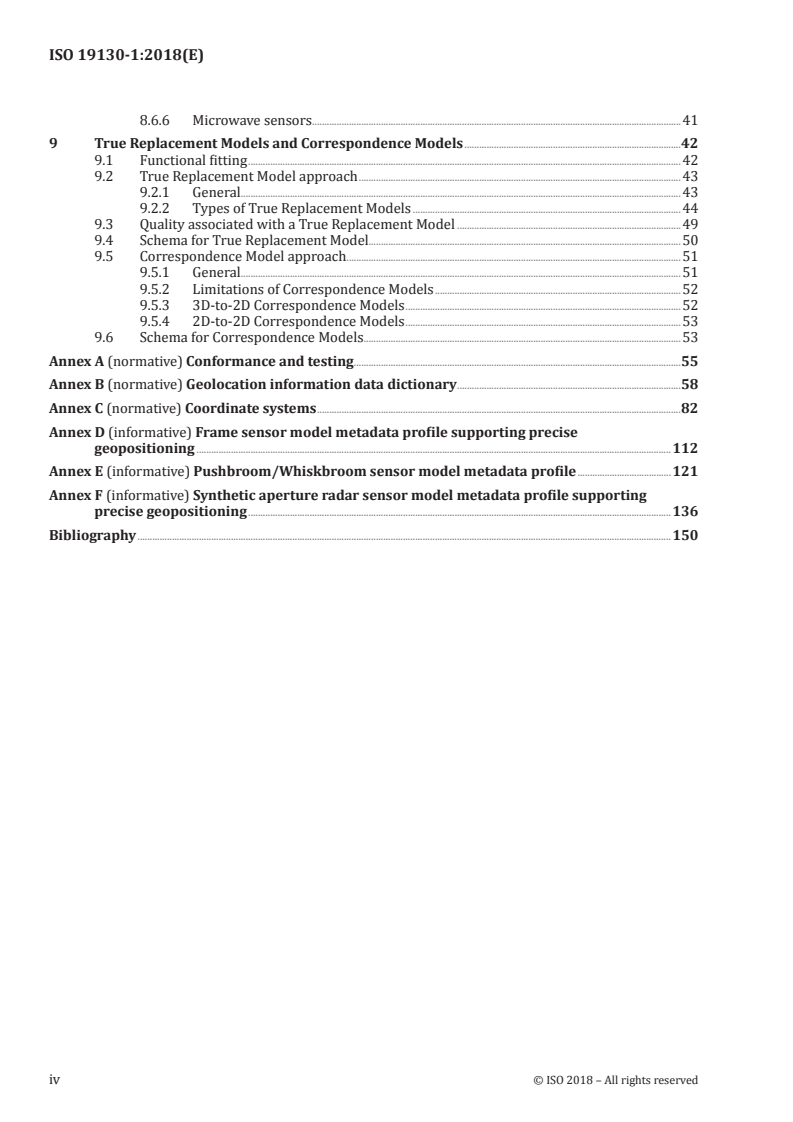
Contents Page
Foreword .v
Introduction .vi
1 Scope . 1
2 Normative references . 1
3 Terms and definitions . 2
4 Symbols and abbreviated terms .11
5 Conformance .12
6 Notation .13
7 Image geopositioning: Overview and common elements .13
7.1 General .13
7.2 Type of geopositioning information .14
7.3 Calibration data .15
7.3.1 General.15
7.3.2 Geometric calibration .15
7.3.3 Radiometric calibration .15
7.4 Ground control points .16
7.4.1 General.16
7.4.2 Control point types .16
7.4.3 Control point schema .17
8 Physical Sensor Models.18
8.1 Sensor types .18
8.1.1 General.18
8.1.2 Frame sensor .19
8.1.3 Pushbroom sensor .20
8.1.4 Whiskbroom sensor .21
8.1.5 Synthetic Aperture Radar (SAR) .22
8.2 Physical Sensor Model approach .24
8.2.1 Physical Sensor Model introduction .24
8.2.2 Physical Sensor Model parameters .24
8.2.3 Interior sensor parameters .24
8.2.4 Exterior sensor/platform parameters .25
8.2.5 Ground-to-image function .26
8.2.6 Image-to-ground function.28
8.2.7 Error propagation .29
8.2.8 Adjustable model parameters .29
8.3 Quality associated with Physical Sensor Models .29
8.4 Physical Sensor Model metadata .31
8.4.1 General.31
8.4.2 Overview of the Physical Sensor Model schema .31
8.5 Location and orientation .32
8.5.1 Overview .32
8.5.2 Position .32
8.5.3 Attitude .33
8.5.4 Dynamics .34
8.5.5 Position and orientation of a sensor relative to the platform .35
8.6 Sensor parameters .36
8.6.1 SD_SensorParameters .36
8.6.2 Detector array .37
8.6.3 Sensor system and operation .38
8.6.4 SD_OpticsOperation .39
8.6.5 Distortion correction . .40
8.6.6 Microwave sensors . .41
9 True Replacement Models and Correspondence Models .42
9.1 Functional fitting .42
9.2 True Replacement Model approach .43
9.2.1 General.43
9.2.2 Types of True Replacement Models .44
9.3 Quality associated with a True Replacement Model .49
9.4 Schema for True Replacement Model.50
9.5 Correspondence Model approach .51
9.5.1 General.51
9.5.2 Limitations of Correspondence Models .52
9.5.3 3D-to-2D Correspondence Models .52
9.5.4 2D-to-2D Correspondence Models .53
9.6 Schema for Correspondence Models .53
Annex A (normative) Conformance and testing .55
Annex B (normative) Geolocation information data dictionary .58
Annex C (normative) Coordinate systems .82
Annex D (informative) Frame sensor model metadata profile supporting precise
geopositioning .112
Annex E (informative) Pushbroom/Whiskbroom sensor model metadata profile .121
Annex F (informative) Synthetic aperture radar sensor model metadata profile supporting
precise geopositioning .136
Bibliography .150
iv © ISO 2018 – All rights reserved
Foreword
ISO (the International Organization for Standardization) is a worldwide federation of national standards
bodies (ISO member bodies). The work of preparing International Standards is normally carried out
through ISO technical committees. Each member body interested in a subject for which a technical
committee has been established has the right to be represented on that committee. International
organizations, governmental and non-governmental, in liaison with ISO, also take part in the work.
ISO collaborates closely with the International Electrotechnical Commission (IEC) on all matters of
electrotechnical standardization.
The procedures used to develop this document and those intended for its further maintenance are
described in the ISO/IEC Directives, Part 1. In particular, the different approval criteria needed for the
different types of ISO documents should be noted. This document was drafted in accordance with the
editorial rules of the ISO/IEC Directives, Part 2 (see www .iso .org/directives).
Attention is drawn to the possibility that some of the elements of this document may be the subject of
patent rights. ISO shall not be held responsible for identifying any or all such patent rights. Details of
any patent rights identified during the development of the document will be in the Introduction and/or
on the ISO list of patent declarations received (see www .iso .org/patents).
Any trade name used in this document is information given for the convenience of users and does not
constitute an endorsement.
For an explanation of the voluntary nature of standards, the meaning of ISO specific terms and
expressions related to conformity assessment, as well as information about ISO's adherence to the
World Trade Organization (WTO) principles in the Technical Barriers to Trade (TBT) see www .iso
.org/iso/foreword .html.
This document was prepared by Technical Committee ISO/TC 211, Geographic information/Geomatics.
This first edition of ISO 19130 cancels and replaces ISO/TS 19130:2010, which has been technically
revised.
The main changes compared to the previous edition are:
— part number 1 was added to reflect that ISO 19130 is now divided into several parts;
— normative references are updated to reflect revisions;
— Annex B is updated to reference the updated versions of the ISO geographic information standards.
A list of all the parts in the ISO 19130 series, can be found on the ISO website.
Any feedback or questions on this document should be directed to the user’s national standards body. A
complete listing of these bodies can be found at www .iso .org/members .html.
Introduction
The purpose of this document is to specify the geolocation information that an imagery data provider
shall supply in order for the user to be able to find the earth location of the data using a Physical Sensor
Model (PSM), a True Replacement Model (TRM) or a Correspondence Model (CM). Detailed PSMs are
defined for passive electro-optical visible/ IR sensors (frame, pushbroom and whiskbroom) and for an
active microwave sensing system (SAR). A set of components from which models for other sensors can
be constructed is also provided. Metadata required for geopositioning using a TRM, a CM, or ground
control points (GCPs) are also specified. The intent is to standardize sensor descriptions and specify the
minimum geolocation metadata requirements for data providers and geopositioning imagery systems.
Vast amounts of data from imaging systems are collected, processed and distributed by government
mapping and remote sensing agencies and commercial data vendors. In order for this data to be
useful in extraction of geographic information, it requires further processing. Geopositioning, which
determines the ground coordinates of an object from image coordinates, is a fundamental processing
step. Because of the diversity of sensor types and the lack of a common sensor model standard, data
from different producers can contain different parametric information, lack parameters required to
describe the sensor that produces the data, or lack ancillary information necessary for geopositioning
and analysing the data. Consequently, a separate software package often has to be developed to deal
with data from each individual sensor or data producer. Standard sensor models and geolocation
metadata allow agencies or vendors to develop generalized software products that are applicable to
data from multiple data producers or from multiple sensors. With such a standard, different producers
can describe the geolocation information of their data in the same way, thus promoting interoperability
of data between application systems and facilitating data exchange.
This document defines the set of metadata elements specified for providing sensor model and other
geopositioning data to users. For the case where a PSM is provided, it includes a location model and
metadata relevant to all sensors; it also includes metadata specific to whiskbroom, pushbroom, frame,
and SAR sensors. It also includes metadata for functional fit geopositioning, where the function is part
of a CM or a TRM. This document also provides a schema for all of these metadata elements.
vi © ISO 2018 – All rights reserved
INTERNATIONAL STANDARD ISO 19130-1:2018(E)
Geographic information — Imagery sensor models for
geopositioning —
Part 1:
Fundamentals
1 Scope
This document identifies the information required to determine the relationship between the position
of a remotely sensed pixel in image coordinates and its geoposition. It supports exploitation of remotely
sensed images. It defines the metadata to be distributed with the image to enable user determination of
geographic position from the observations.
This document specifies several ways in which information in support of geopositioning can be
provided.
a) It may be provided as a sensor description with the associated physical and geometric information
necessary to rigorously construct a PSM. For the case where precise geoposition information is
needed, this document identifies the mathematical equations for rigorously constructing PSMs that
relate 2D image space to 3D ground space and the calculation of the associated propagated errors.
This document provides detailed information for three types of passive electro-optical/ IR sensors
(frame, pushbroom and whiskbroom) and for an active microwave sensing system SAR. It provides
a framework by which these sensor models can be extended to other sensor types.
b) It can be provided as a TRM, using functions whose coefficients are based on a PSM so that they
provide information for precise geopositioning, including the calculation of errors, as precisely as
the PSM they replace.
c) It can be provided as a CM that provides a functional fitting based on observed relationships
between the geopositions of a set of GCPs and their image coordinates.
d) It can be provided as a set of GCPs that can be used to develop a CM or to refine a PSM or TRM.
This document does not specify either how users derive geoposition data or the format or content of the
data the users generate.
2 Normative references
The following referenced documents are indispensable for the application of this document. For dated
references, only the edition cited applies. For undated references, the latest edition of the referenced
document (including any amendments) applies.
ISO 19103:2015, Geographic information — Conceptual schema language
ISO 19107, Geographic information — Spatial schema
ISO 19108, Geographic information — Temporal schema
ISO 19111:2007, Geographic information — Spatial referencing by coordinates
ISO 19115-1:2014, Geographic information — Metadata — Part 1: Fundamentals
ISO 19115-2:2009, Geographic information — Metadata — Part 2: Extensions for imagery and gridded data
ISO 19123, Geographic information — Schema for coverage geometry and functions
ISO 19157:2013, Geographic information — Data quality
3 Terms and definitions
For the purposes of this document, the following terms and definitions apply.
ISO and IEC maintain terminological databases for use in standardization at the following addresses:
— IEC Electropedia: available at http: //www .electropedia .org/
— ISO Online browsing platform: available at http: //www .iso .org/obp
3.1
active sensing system
sensing system that emits energy that the sensor (3.79) uses to perform sensing
3.2
adjustable model parameters
model parameters that can be refined using available additional information, such as ground control
points (3.42), to improve or enhance modelling corrections
3.3
along-track
direction in which the sensor (3.79) platform moves
3.4
aperture reference point
APR
3D location of the centre of the synthetic aperture
Note 1 to entry: It is usually expressed in ECEF coordinates (3.11) in metres.
3.5
attitude
orientation of a body, described by the angles between the axes of that body’s coordinate system (3.13)
and the axes of an external coordinate system
[SOURCE: ISO 19116:2004, 4.2, modified – NOTE is deleted.]
3.6
attribute
named property of an entity
Note 1 to entry: In this document, the property relates to a geometrical, topological, thematic, or other
characteristic of an entity.
[SOURCE: ISO/IEC 2382:2015, 2121440, modified – Note 1 to entry has been added.]
3.7
azimuth resolution
〈SAR〉 resolution in the cross-range direction
Note 1 to entry: This is usually measured in terms of the impulse response (3.56) of the SAR (3.76) sensor (3.79)
and processing system. It is a function of the size of the synthetic aperture, or alternatively the dwell time (i.e. a
larger aperture results in a longer dwell time results in better resolution).
2 © ISO 2018 – All rights reserved
3.8
beam width
〈SAR〉 useful angular width of the beam of electromagnetic energy
Note 1 to entry: Beam width is usually measured in radians and as the angular width between two points that
have 50 % of the power (3 dB below) of the centre of the beam. It is a property of the antenna. Power emitted
outside of this angle is too little to provide a usable return.
3.9
broadside
〈SAR〉 direction orthogonal to the velocity vector and parallel to the plane tangent to the Earth's ellipsoid
(3.21) at the nadir point of the ARP (3.4)
3.10
calibrated focal length
distance between the perspective centre (3.62) and the image plane (3.53) that is the result of balancing
positive and negative radial lens distortions during sensor (3.79) calibration
3.11
coordinate
one of a sequence of n numbers designating the position of a point in n-dimensional space
Note 1 to entry: In a coordinate reference system (3.12), the coordinate numbers are qualified by units.
[SOURCE: ISO 19111:2007, 4.5]
3.12
coordinate reference system
CRS
coordinate system (3.13) that is related to an object by a datum (3.17)
Note 1 to entry: For geodetic and vertical datums, the object will be the Earth.
[SOURCE: ISO 19111:2007, 4.8]
3.13
coordinate system
set of mathematical rules for specifying how coordinates (3.11) are to be assigned to points
[SOURCE: ISO 19111:2007, 4.10]
3.14
Correspondence Model
CM
functional relationship between ground and image (3.47) coordinates (3.11) based on the correlation
between a set of ground control points (3.42) and their corresponding image coordinates
3.15
cross-track
perpendicular to the direction in which the collection platform moves
3.16
data
reinterpretable representation of information in a formalised manner suitable for communication,
interpretation, or processing
[SOURCE: ISO/IEC 2382:2015, 2121272]
3.17
datum
parameter or set of parameters that define the position of the origin, the scale, and the orientation of a
coordinate system (3.13)
[SOURCE: ISO 19111:2007, 4.14]
3.18
detector
device that generates an output signal in response to an energy input
3.19
Doppler angle
〈SAR〉 angle between the velocity vector and the range vector (3.72)
3.20
Doppler shift
wavelength change resulting from relative motion of source and detector (3.18)
Note 1 to entry: In the SAR (3.76) context, it is the frequency shift imposed on a radar signal due to relative
motion between the transmitter and the object being illuminated.
3.21
ellipsoid
surface formed by the rotation of an ellipse about a main axis
Note 1 to entry: The Earth ellipsoid is a mathematical ellipsoid figure of the Earth which is used as a reference
frame for computations in geodesy, astronomy and the geosciences.
[SOURCE: ISO 19111:2007, 4.17, modified – a new Note 1 to entry replaces NOTE.]
3.22
ellipsoidal coordinate system
geodetic coordinate system
coordinate system (3.13) in which position is specified by geodetic latitude (3.30), geodetic longitude
(3.31) and (in the three-dimensional case) ellipsoidal height (3.23)
[SOURCE: ISO 19111:2007, 4.18]
3.23
ellipsoidal height
geodetic height
h
distance of a point from the ellipsoid (3.21) measured along the perpendicular from the ellipsoid to this
point, positive if upwards or outside of the ellipsoid
Note 1 to entry: Only used as part of a three-dimensional ellipsoidal coordinate system (3.22) and never on its own.
[SOURCE: ISO 19111:2007, 4.19]
3.24
error propagation
process of determining the uncertainties of derived quantities from the known uncertainties of the
quantities on which the derived quantity is dependent
Note 1 to entry: Error propagation is governed by the mathematical function relating the derived quantity to the
quantities from which it was derived.
3.25
external coordinate reference system
coordinate reference system (3.12) whose datum (3.17) is independent of the object that is located by it
4 © ISO 2018 – All rights reserved
3.26
fiducial centre
point determined on the basis of the camera fiducial marks (3.27)
Note 1 to entry: When there are four fiducial marks, fiducial centre is the intersection of the two lines connecting
the pairs of opposite fiducial marks.
3.27
fiducial mark
index marks, typically four or eight rigidly connected with the camera body, which form images (3.47)
on the film negative and define the image coordinate reference system (3.48)
Note 1 to entry: When a camera is calibrated the distances between fiducial marks are precisely measured and
assigned coordinates (3.11) that assist in correcting for film distortion.
3.28
frame sensor
sensor (3.79) that detects and collects all of the data (3.16) for an image (3.47) (frame/rectangle) at an
instant of time
3.29
geodetic datum
datum (3.17) describing the relationship of a two- or three-dimensional coordinate system (3.13) to
the Earth
Note 1 to entry: In most cases, the geodetic datum includes an ellipsoid (3.21) description.
[SOURCE: ISO 19111:2007, 4.24, modified – Note 1 to entry has been added.]
3.30
geodetic latitude
ellipsoidal latitude
φ
angle from the equatorial plane to the perpendicular to the ellipsoid (3.21) through a given point,
northwards treated as positive
[SOURCE: ISO 19111:2007, 4.25]
3.31
geodetic longitude
ellipsoidal longitude
λ
angle from the prime meridian plane to the meridian plane of a given point, eastward treated as positive
[SOURCE: ISO 19111:2007, 4.26]
3.32
geoid
equipotential surface of the Earth’s gravity field which is everywhere perpendicular to the direction of
gravity and which best fits mean sea level either locally or globally
[SOURCE: ISO 19111:2007, 3.27]
3.33
geographic information
information concerning phenomena implicitly or explicitly associated with a location relative to the Earth
[SOURCE: ISO 19101-1:2014, 4.1.18]
3.34
geolocating
geopositioning (3.36) an object using a Physical Sensor Model (3.63)or a True Replacement Model (3.86)
3.35
geolocation information
information used to determine geographic location corresponding to image (3.47) location
[SOURCE: ISO 19115-2:2009, 4.11]
3.36
geopositioning
determination of the geographic position of an object
Note 1 to entry: While there are many methods for geopositioning, this document is focused on geopositioning
from image (3.47) coordinates (3.11).
3.37
georeferencing
geopositioning (3.36) an object using a Correspondence Model (3.14)derived from a set of points for
which both ground and image (3.47) coordinates (3.11) are known
3.38
gimbal
mechanical device consisting of two or more rings connected in such a way that each rotates freely
around an axis that is a diameter of the next ring toward the outermost ring of the set
Note 1 to entry: An object mounted on a three-ring gimbal will remain horizontally suspended on a plane
between the rings regardless as to the stability of the base.
3.39
grazing angle
〈SAR〉 vertical angle from the local surface tangent plane to the slant range direction (3.70)
3.40
grid
network composed of two or more sets of curves in which the members of each set intersect the
members of the other sets in an algorithmic way
Note 1 to entry: The curves partition a space into grid cells.
[SOURCE: ISO 19123:2005, 4.1.23]
3.41
grid coordinates
sequence of two or more numbers specifying a position with respect to its location on a grid (3.40)
[SOURCE: ISO 19115-2:2009, 4.16]
3.42
ground control point
GCP
point on the earth that has an accurately known geographic position
[SOURCE: ISO 19115-2:2009, 4.18]
3.43
ground range
〈SAR〉 magnitude of the range vector (3.72) projected onto the ground
Note 1 to entry: Ground range of an image (3.47) is represented by the distance from the nadir point of the
antenna to a point in the scene. Usually measured in the horizontal plane, but can also be measured as true
distance along the ground, DEM, geoid (3.32) or ellipsoid (3.21) surface.
6 © ISO 2018 – All rights reserved
3.44
ground reference point
GRP
3D position of a reference point on the ground for a given synthetic aperture
Note 1 to entry: It is usually the centre point of an image (3.47) (Spotlight) or an image line (Stripmap). It is
usually expressed in ECEF coordinates (3.11) in metres.
3.45
ground sampling distance
linear distance between pixel (3.64) centres on the ground
Note 1 to entry: This definition also applies for water surfaces.
3.46
gyroscope
device consisting of a spinning rotor mounted in a gimbal (3.38) so that its axis of rotation maintains a
fixed orientation
Note 1 to entry: The rotor spins on a fixed axis while the structure around it rotates or tilts. In airplanes, the
pitch and orientation of the airplane is measured against the steady spin of the gyroscope. In space, where the
four compass points are meaningless, the gyroscope’s axis of rotation is used as a reference point for navigation.
An inertial navigation system includes three gimbal-mounted gyroscopes, used to measure roll, pitch, and yaw.
3.47
image
gridded coverage whose attribute (3.6) values are a numerical representation of a physical parameter
Note 1 to entry: The physical parameters are the result of measurement by a sensor (3.79) or a prediction from
a model.
[SOURCE: ISO 19115-2:2009, 4.19]
3.48
image coordinate reference system
coordinate reference system (3.12) based on an image datum (3.49)
[SOURCE: ISO 19111:2007, 4.30]
3.49
image datum
engineering datum (3.17) which defines the relationship of a coordinate system (3.13) to an image (3.47)
[SOURCE: ISO 19111:2007, 4.31]
3.50
image distortion
deviation between the actual location of an image point (3.54) and the location that theoretically would
result from the geometry of the imaging process without any errors
3.51
image formation
〈SAR〉 process by which an image (3.47) is generated from collected phase history data in a SAR
(3.76) system
3.52
image-identifiable ground control point
ground control point (3.42) associated with a marker or other object on the ground that can be
recognized in an image (3.47)
Note 1 to entry: The ground control point may be marked in the image, or the user may be provided with an
unambiguous description of the ground control point so that it can be found in the image.
3.53
image plane
plane behind an imaging lens where images (3.47) of objects within the depth of field of the lens are
in focus
3.54
image point
point on the image (3.47) that uniquely represents an object point (3.60)
3.55
imagery
representation of phenomena as images (3.47) produced by electronic and/or optical techniques
Note 1 to entry: In this document, it is assumed that the phenomena have been sensed or detected by one or more
devices such as radars, cameras, photometers and IR and multispectral scanners.
[SOURCE: ISO 19101-2:2018, 3.14]
3.56
impulse response
IPR
width of the return generated by a small point reflector, which equates to the smallest distance between
two point reflectors that can be distinguished as two objects
3.57
incident angle
vertical angle between the line from the detected element to the sensor (3.79)and the local surface
normal (tangent plane normal)
3.58
internal coordinate reference system
coordinate reference system (3.12) having a datum (3.17) specified with reference to the object itself
3.59
metadata
information about a resource
[SOURCE: ISO 19115-1:2014, 4.10]
3.60
object point
point in the object space that is imaged by a sensor (3.79)
Note 1 to entry: In remote sensing (3.74) and aerial photogrammetry an object point is a point defined in an
Earth-fixed coordinate reference system (3.12).
3.61
passive sensor
sensor (3.79) that detects and collects energy from an independent source
EXAMPLE Many optical sensors collect reflected solar energy.
3.62
perspective centre
projection centre
point located in three dimensions through which all rays between object points (3.60) and image points
(3.54) appear to pass geometrically
3.63
Physical Sensor Model
PSM
sensor model (3.80) based on the physical configuration of a sensing system
8 © ISO 2018 – All rights reserved
3.64
pixel
smallest element of a digital image (3.47) to which attributes (3.6) are assigned
Note 1 to entry: This term originated as a contraction of “picture element”.
Note 2 to entry: Related to the concept of a grid (3.40) cell.
[SOURCE: ISO 19101-2:2018, 3.28]
3.65
platform coordinate reference system
engineering coordinate reference system (3.12) fixed to the collection platform within which positions
on the collection platform are defined
3.66
principal point of autocollimation
point of intersection between the image plane (3.53) and the normal from the perspective centre (3.62)
3.67
principal point of best symmetry
centre of the circles of equal distortion of the lens positioned in the image plane (3.53)
3.68
pushbroom sensor
sensor (3.79) that collects a single cross-track (3.15) image (3.47) line at one time and constructs a larger
image from a set of adjacent lines resulting from the along-track (3.3) motion of the sensor
3.69
range bin
〈SAR〉 group of radar returns that all have the same range
3.70
range direction
slant range direction
〈SAR〉 direction of the range vector (3.72)
3.71
range resolution
spatial resolution in the range direction (3.70)
Note 1 to entry: For a SAR (3.76) sensor (3.79), it is usually measured in terms of the impulse response (3.56) of the
sensor (3.79) and processing system. It is a function of the bandwidth of the pulse.
3.72
range vector
vector from the antenna to a point in the scene
3.73
rectified grid
grid (3.40) for which there is an affine transformation between the grid coordinates (3.41) and the
coordinates (3.11) of an external coordinate reference system (3.25)
Note 1 to entry: If the coordinate reference system (3.12) is related to the Earth by a datum (3.17), the grid is a
georectified grid.
[SOURCE: ISO 19123:2005, 4.1.32]
3.74
remote sensing
collection and interpretation of information about an object without being in physical contact with
the object
[SOURCE: ISO 19101-2:2018, 3.33]
3.75
resolution (of a sensor)
smallest difference between indications of a sensor (3.79) that can be meaningfully distinguished
Note 1 to entry: For imagery (3.55), resolution refers to radiometric, spectral, spatial and temporal resolutions.
[SOURCE: ISO 19101-2:2018, 3.34]
3.76
Synthetic Aperture Radar
SAR
imaging radar system that simulates the use of a long physical antenna by collecting multiple returns
from each target as the actual antenna moves along the track
Note 1 to entry: The electromagnetic radiation is at microwave frequencies and is sent in pulses.
3.77
scan mode
SAR (3.76) mode in which the antenna beam is steered to illuminate a swath of ground at various angles
relative to flight path throughout the collection
Note 1 to entry: Steering the antenna also allows dwell time to be increased and provides the ability to collect
strips at angles non-parallel to the flight direction and with better resolution than stripmap mode (3.85).
3.78
ScanSAR mode
special case of stripmap mode (3.85) that uses an electronically steerable antenna to quickly change the
swath being imaged during collection to collect multiple parallel swaths in one pass
3.79
sensor
element of a measuring system that is directly affected by a phenomenon, body, or substance carrying a
quantity to be measured
[SOURCE: ISO/IEC Guide 99:2007, 3.8]
3.80
sensor model
〈geopositioning〉 mathematical description of the relationship between the three-dimensional object
space and the 2D plane of the associated image (3.47) produced by a sensor (3.79)
3.81
slant plane
〈SAR〉 plane that passes through the sensor (3.79) velocity vector and the GRP
3.82
slant range
〈SAR〉 magnitude of the range vector (3.72)
3.83
spotlight mode
〈SAR〉 SAR (3.76) mode in which the antenna beam is steered to illuminate one area during collection
Note 1 to entry: Spotlight mode provides the ability to collect higher resolution SAR data (3.16) over relatively
smaller patches of ground surface.
10 © ISO 2018 – All rights reserved
3.84
squint angle
〈SAR〉 angle measured from the broadside (3.9) direction vector to the range direction (3.70) vector in
the slant plane (3.81)
3.85
stripmap mode
〈SAR〉 SAR (3.76) mode in which the antenna beam is fixed throughout the collection of an image (3.47)
Note 1 to entry: Doppler angle (3.19) in processed products is fixed for all pixels (3.64). It provides the ability to
collect SAR data (3.16) over strips of land over a fixed swath of ground range (3.43) parallel to the direction of flight.
3.86
True Replacement Model
TRM
model using functions whose coefficients are based on a Physical Sensor Model (3.63)
3.87
whiskbroom sensor
sensor (3.79) that sweeps a detector (3.18) forming cross-track (3.15) image (3.47) line(s) and constructs
a larger image from a set of adjacent lines using the along-track (3.3) motion of the sensor’s collection
platform
4 Symbols and abbreviated terms
ARP Aperture Reference Point
CCD Charge-Coupled Device
CCS Common Coordinate System
CM Correspondence Model
CCS Common Coordinate System
CRS Coordinate Reference System
DEM Digital Elevation Model
DLT Direct Linear Transform
ECEF Earth-Centred, Earth-Fixed
ENU East-North-Up
EO Exterior Orientation
FSP Flight Stabilization Platform
GCP Ground Control Point
GNSS Global Navigation Satellite System
GRP Ground Reference Point
GSD Ground Sample Distance
IMU Inertial Measurement Unit
INS Inertial Navigation System
IRF Inertial Reference Frame
IPR Impulse Response
IR Infrared
MSL Mean Sea Level
NED North-East-Down
PHD Phase History Data
PSM Physical Sensor Model
RAR Real Aperture Radar
RMS Root Mean Square
RPC Rational Polynomial Coefficient
RSM Replacement Sensor Model
SAR Synthetic Aperture Radar
SCS Sensor Coordinate System
TRM True Replacement Model
VPHD Video Phase History Data
WGS 84 World Geodetic System 1984
2D Two-dimensional
3D Three-dimensional
5 Conformance
This document specifies four conformance classes. There is one conformance class for each of the
methods specified for providing geopositioning information. Any set of geopositioning information
claiming conformance to this document shall s
...
INTERNATIONAL ISO
STANDARD 19130-1
First edition
2018-09
Geographic information — Imagery
sensor models for geopositioning —
Part 1:
Fundamentals
Information géographique — Modèles de capteurs d'images et
géopositionnement —
Partie 1: Principes de base
Reference number
©
ISO 2018
© ISO 2018
All rights reserved. Unless otherwise specified, or required in the context of its implementation, no part of this publication may
be reproduced or utilized otherwise in any form or by any means, electronic or mechanical, including photocopying, or posting
on the internet or an intranet, without prior written permission. Permission can be requested from either ISO at the address
below or ISO’s member body in the country of the requester.
ISO copyright office
CP 401 • Ch. de Blandonnet 8
CH-1214 Vernier, Geneva
Phone: +41 22 749 01 11
Fax: +41 22 749 09 47
Email: copyright@iso.org
Website: www.iso.org
Published in Switzerland
ii © ISO 2018 – All rights reserved
Contents Page
Foreword .v
Introduction .vi
1 Scope . 1
2 Normative references . 1
3 Terms and definitions . 2
4 Symbols and abbreviated terms .11
5 Conformance .12
6 Notation .13
7 Image geopositioning: Overview and common elements .13
7.1 General .13
7.2 Type of geopositioning information .14
7.3 Calibration data .15
7.3.1 General.15
7.3.2 Geometric calibration .15
7.3.3 Radiometric calibration .15
7.4 Ground control points .16
7.4.1 General.16
7.4.2 Control point types .16
7.4.3 Control point schema .17
8 Physical Sensor Models.18
8.1 Sensor types .18
8.1.1 General.18
8.1.2 Frame sensor .19
8.1.3 Pushbroom sensor .20
8.1.4 Whiskbroom sensor .21
8.1.5 Synthetic Aperture Radar (SAR) .22
8.2 Physical Sensor Model approach .24
8.2.1 Physical Sensor Model introduction .24
8.2.2 Physical Sensor Model parameters .24
8.2.3 Interior sensor parameters .24
8.2.4 Exterior sensor/platform parameters .25
8.2.5 Ground-to-image function .26
8.2.6 Image-to-ground function.28
8.2.7 Error propagation .29
8.2.8 Adjustable model parameters .29
8.3 Quality associated with Physical Sensor Models .29
8.4 Physical Sensor Model metadata .31
8.4.1 General.31
8.4.2 Overview of the Physical Sensor Model schema .31
8.5 Location and orientation .32
8.5.1 Overview .32
8.5.2 Position .32
8.5.3 Attitude .33
8.5.4 Dynamics .34
8.5.5 Position and orientation of a sensor relative to the platform .35
8.6 Sensor parameters .36
8.6.1 SD_SensorParameters .36
8.6.2 Detector array .37
8.6.3 Sensor system and operation .38
8.6.4 SD_OpticsOperation .39
8.6.5 Distortion correction . .40
8.6.6 Microwave sensors . .41
9 True Replacement Models and Correspondence Models .42
9.1 Functional fitting .42
9.2 True Replacement Model approach .43
9.2.1 General.43
9.2.2 Types of True Replacement Models .44
9.3 Quality associated with a True Replacement Model .49
9.4 Schema for True Replacement Model.50
9.5 Correspondence Model approach .51
9.5.1 General.51
9.5.2 Limitations of Correspondence Models .52
9.5.3 3D-to-2D Correspondence Models .52
9.5.4 2D-to-2D Correspondence Models .53
9.6 Schema for Correspondence Models .53
Annex A (normative) Conformance and testing .55
Annex B (normative) Geolocation information data dictionary .58
Annex C (normative) Coordinate systems .82
Annex D (informative) Frame sensor model metadata profile supporting precise
geopositioning .112
Annex E (informative) Pushbroom/Whiskbroom sensor model metadata profile .121
Annex F (informative) Synthetic aperture radar sensor model metadata profile supporting
precise geopositioning .136
Bibliography .150
iv © ISO 2018 – All rights reserved
Foreword
ISO (the International Organization for Standardization) is a worldwide federation of national standards
bodies (ISO member bodies). The work of preparing International Standards is normally carried out
through ISO technical committees. Each member body interested in a subject for which a technical
committee has been established has the right to be represented on that committee. International
organizations, governmental and non-governmental, in liaison with ISO, also take part in the work.
ISO collaborates closely with the International Electrotechnical Commission (IEC) on all matters of
electrotechnical standardization.
The procedures used to develop this document and those intended for its further maintenance are
described in the ISO/IEC Directives, Part 1. In particular, the different approval criteria needed for the
different types of ISO documents should be noted. This document was drafted in accordance with the
editorial rules of the ISO/IEC Directives, Part 2 (see www .iso .org/directives).
Attention is drawn to the possibility that some of the elements of this document may be the subject of
patent rights. ISO shall not be held responsible for identifying any or all such patent rights. Details of
any patent rights identified during the development of the document will be in the Introduction and/or
on the ISO list of patent declarations received (see www .iso .org/patents).
Any trade name used in this document is information given for the convenience of users and does not
constitute an endorsement.
For an explanation of the voluntary nature of standards, the meaning of ISO specific terms and
expressions related to conformity assessment, as well as information about ISO's adherence to the
World Trade Organization (WTO) principles in the Technical Barriers to Trade (TBT) see www .iso
.org/iso/foreword .html.
This document was prepared by Technical Committee ISO/TC 211, Geographic information/Geomatics.
This first edition of ISO 19130 cancels and replaces ISO/TS 19130:2010, which has been technically
revised.
The main changes compared to the previous edition are:
— part number 1 was added to reflect that ISO 19130 is now divided into several parts;
— normative references are updated to reflect revisions;
— Annex B is updated to reference the updated versions of the ISO geographic information standards.
A list of all the parts in the ISO 19130 series, can be found on the ISO website.
Any feedback or questions on this document should be directed to the user’s national standards body. A
complete listing of these bodies can be found at www .iso .org/members .html.
Introduction
The purpose of this document is to specify the geolocation information that an imagery data provider
shall supply in order for the user to be able to find the earth location of the data using a Physical Sensor
Model (PSM), a True Replacement Model (TRM) or a Correspondence Model (CM). Detailed PSMs are
defined for passive electro-optical visible/ IR sensors (frame, pushbroom and whiskbroom) and for an
active microwave sensing system (SAR). A set of components from which models for other sensors can
be constructed is also provided. Metadata required for geopositioning using a TRM, a CM, or ground
control points (GCPs) are also specified. The intent is to standardize sensor descriptions and specify the
minimum geolocation metadata requirements for data providers and geopositioning imagery systems.
Vast amounts of data from imaging systems are collected, processed and distributed by government
mapping and remote sensing agencies and commercial data vendors. In order for this data to be
useful in extraction of geographic information, it requires further processing. Geopositioning, which
determines the ground coordinates of an object from image coordinates, is a fundamental processing
step. Because of the diversity of sensor types and the lack of a common sensor model standard, data
from different producers can contain different parametric information, lack parameters required to
describe the sensor that produces the data, or lack ancillary information necessary for geopositioning
and analysing the data. Consequently, a separate software package often has to be developed to deal
with data from each individual sensor or data producer. Standard sensor models and geolocation
metadata allow agencies or vendors to develop generalized software products that are applicable to
data from multiple data producers or from multiple sensors. With such a standard, different producers
can describe the geolocation information of their data in the same way, thus promoting interoperability
of data between application systems and facilitating data exchange.
This document defines the set of metadata elements specified for providing sensor model and other
geopositioning data to users. For the case where a PSM is provided, it includes a location model and
metadata relevant to all sensors; it also includes metadata specific to whiskbroom, pushbroom, frame,
and SAR sensors. It also includes metadata for functional fit geopositioning, where the function is part
of a CM or a TRM. This document also provides a schema for all of these metadata elements.
vi © ISO 2018 – All rights reserved
INTERNATIONAL STANDARD ISO 19130-1:2018(E)
Geographic information — Imagery sensor models for
geopositioning —
Part 1:
Fundamentals
1 Scope
This document identifies the information required to determine the relationship between the position
of a remotely sensed pixel in image coordinates and its geoposition. It supports exploitation of remotely
sensed images. It defines the metadata to be distributed with the image to enable user determination of
geographic position from the observations.
This document specifies several ways in which information in support of geopositioning can be
provided.
a) It may be provided as a sensor description with the associated physical and geometric information
necessary to rigorously construct a PSM. For the case where precise geoposition information is
needed, this document identifies the mathematical equations for rigorously constructing PSMs that
relate 2D image space to 3D ground space and the calculation of the associated propagated errors.
This document provides detailed information for three types of passive electro-optical/ IR sensors
(frame, pushbroom and whiskbroom) and for an active microwave sensing system SAR. It provides
a framework by which these sensor models can be extended to other sensor types.
b) It can be provided as a TRM, using functions whose coefficients are based on a PSM so that they
provide information for precise geopositioning, including the calculation of errors, as precisely as
the PSM they replace.
c) It can be provided as a CM that provides a functional fitting based on observed relationships
between the geopositions of a set of GCPs and their image coordinates.
d) It can be provided as a set of GCPs that can be used to develop a CM or to refine a PSM or TRM.
This document does not specify either how users derive geoposition data or the format or content of the
data the users generate.
2 Normative references
The following referenced documents are indispensable for the application of this document. For dated
references, only the edition cited applies. For undated references, the latest edition of the referenced
document (including any amendments) applies.
ISO 19103:2015, Geographic information — Conceptual schema language
ISO 19107, Geographic information — Spatial schema
ISO 19108, Geographic information — Temporal schema
ISO 19111:2007, Geographic information — Spatial referencing by coordinates
ISO 19115-1:2014, Geographic information — Metadata — Part 1: Fundamentals
ISO 19115-2:2009, Geographic information — Metadata — Part 2: Extensions for imagery and gridded data
ISO 19123, Geographic information — Schema for coverage geometry and functions
ISO 19157:2013, Geographic information — Data quality
3 Terms and definitions
For the purposes of this document, the following terms and definitions apply.
ISO and IEC maintain terminological databases for use in standardization at the following addresses:
— IEC Electropedia: available at http: //www .electropedia .org/
— ISO Online browsing platform: available at http: //www .iso .org/obp
3.1
active sensing system
sensing system that emits energy that the sensor (3.79) uses to perform sensing
3.2
adjustable model parameters
model parameters that can be refined using available additional information, such as ground control
points (3.42), to improve or enhance modelling corrections
3.3
along-track
direction in which the sensor (3.79) platform moves
3.4
aperture reference point
APR
3D location of the centre of the synthetic aperture
Note 1 to entry: It is usually expressed in ECEF coordinates (3.11) in metres.
3.5
attitude
orientation of a body, described by the angles between the axes of that body’s coordinate system (3.13)
and the axes of an external coordinate system
[SOURCE: ISO 19116:2004, 4.2, modified – NOTE is deleted.]
3.6
attribute
named property of an entity
Note 1 to entry: In this document, the property relates to a geometrical, topological, thematic, or other
characteristic of an entity.
[SOURCE: ISO/IEC 2382:2015, 2121440, modified – Note 1 to entry has been added.]
3.7
azimuth resolution
〈SAR〉 resolution in the cross-range direction
Note 1 to entry: This is usually measured in terms of the impulse response (3.56) of the SAR (3.76) sensor (3.79)
and processing system. It is a function of the size of the synthetic aperture, or alternatively the dwell time (i.e. a
larger aperture results in a longer dwell time results in better resolution).
2 © ISO 2018 – All rights reserved
3.8
beam width
〈SAR〉 useful angular width of the beam of electromagnetic energy
Note 1 to entry: Beam width is usually measured in radians and as the angular width between two points that
have 50 % of the power (3 dB below) of the centre of the beam. It is a property of the antenna. Power emitted
outside of this angle is too little to provide a usable return.
3.9
broadside
〈SAR〉 direction orthogonal to the velocity vector and parallel to the plane tangent to the Earth's ellipsoid
(3.21) at the nadir point of the ARP (3.4)
3.10
calibrated focal length
distance between the perspective centre (3.62) and the image plane (3.53) that is the result of balancing
positive and negative radial lens distortions during sensor (3.79) calibration
3.11
coordinate
one of a sequence of n numbers designating the position of a point in n-dimensional space
Note 1 to entry: In a coordinate reference system (3.12), the coordinate numbers are qualified by units.
[SOURCE: ISO 19111:2007, 4.5]
3.12
coordinate reference system
CRS
coordinate system (3.13) that is related to an object by a datum (3.17)
Note 1 to entry: For geodetic and vertical datums, the object will be the Earth.
[SOURCE: ISO 19111:2007, 4.8]
3.13
coordinate system
set of mathematical rules for specifying how coordinates (3.11) are to be assigned to points
[SOURCE: ISO 19111:2007, 4.10]
3.14
Correspondence Model
CM
functional relationship between ground and image (3.47) coordinates (3.11) based on the correlation
between a set of ground control points (3.42) and their corresponding image coordinates
3.15
cross-track
perpendicular to the direction in which the collection platform moves
3.16
data
reinterpretable representation of information in a formalised manner suitable for communication,
interpretation, or processing
[SOURCE: ISO/IEC 2382:2015, 2121272]
3.17
datum
parameter or set of parameters that define the position of the origin, the scale, and the orientation of a
coordinate system (3.13)
[SOURCE: ISO 19111:2007, 4.14]
3.18
detector
device that generates an output signal in response to an energy input
3.19
Doppler angle
〈SAR〉 angle between the velocity vector and the range vector (3.72)
3.20
Doppler shift
wavelength change resulting from relative motion of source and detector (3.18)
Note 1 to entry: In the SAR (3.76) context, it is the frequency shift imposed on a radar signal due to relative
motion between the transmitter and the object being illuminated.
3.21
ellipsoid
surface formed by the rotation of an ellipse about a main axis
Note 1 to entry: The Earth ellipsoid is a mathematical ellipsoid figure of the Earth which is used as a reference
frame for computations in geodesy, astronomy and the geosciences.
[SOURCE: ISO 19111:2007, 4.17, modified – a new Note 1 to entry replaces NOTE.]
3.22
ellipsoidal coordinate system
geodetic coordinate system
coordinate system (3.13) in which position is specified by geodetic latitude (3.30), geodetic longitude
(3.31) and (in the three-dimensional case) ellipsoidal height (3.23)
[SOURCE: ISO 19111:2007, 4.18]
3.23
ellipsoidal height
geodetic height
h
distance of a point from the ellipsoid (3.21) measured along the perpendicular from the ellipsoid to this
point, positive if upwards or outside of the ellipsoid
Note 1 to entry: Only used as part of a three-dimensional ellipsoidal coordinate system (3.22) and never on its own.
[SOURCE: ISO 19111:2007, 4.19]
3.24
error propagation
process of determining the uncertainties of derived quantities from the known uncertainties of the
quantities on which the derived quantity is dependent
Note 1 to entry: Error propagation is governed by the mathematical function relating the derived quantity to the
quantities from which it was derived.
3.25
external coordinate reference system
coordinate reference system (3.12) whose datum (3.17) is independent of the object that is located by it
4 © ISO 2018 – All rights reserved
3.26
fiducial centre
point determined on the basis of the camera fiducial marks (3.27)
Note 1 to entry: When there are four fiducial marks, fiducial centre is the intersection of the two lines connecting
the pairs of opposite fiducial marks.
3.27
fiducial mark
index marks, typically four or eight rigidly connected with the camera body, which form images (3.47)
on the film negative and define the image coordinate reference system (3.48)
Note 1 to entry: When a camera is calibrated the distances between fiducial marks are precisely measured and
assigned coordinates (3.11) that assist in correcting for film distortion.
3.28
frame sensor
sensor (3.79) that detects and collects all of the data (3.16) for an image (3.47) (frame/rectangle) at an
instant of time
3.29
geodetic datum
datum (3.17) describing the relationship of a two- or three-dimensional coordinate system (3.13) to
the Earth
Note 1 to entry: In most cases, the geodetic datum includes an ellipsoid (3.21) description.
[SOURCE: ISO 19111:2007, 4.24, modified – Note 1 to entry has been added.]
3.30
geodetic latitude
ellipsoidal latitude
φ
angle from the equatorial plane to the perpendicular to the ellipsoid (3.21) through a given point,
northwards treated as positive
[SOURCE: ISO 19111:2007, 4.25]
3.31
geodetic longitude
ellipsoidal longitude
λ
angle from the prime meridian plane to the meridian plane of a given point, eastward treated as positive
[SOURCE: ISO 19111:2007, 4.26]
3.32
geoid
equipotential surface of the Earth’s gravity field which is everywhere perpendicular to the direction of
gravity and which best fits mean sea level either locally or globally
[SOURCE: ISO 19111:2007, 3.27]
3.33
geographic information
information concerning phenomena implicitly or explicitly associated with a location relative to the Earth
[SOURCE: ISO 19101-1:2014, 4.1.18]
3.34
geolocating
geopositioning (3.36) an object using a Physical Sensor Model (3.63)or a True Replacement Model (3.86)
3.35
geolocation information
information used to determine geographic location corresponding to image (3.47) location
[SOURCE: ISO 19115-2:2009, 4.11]
3.36
geopositioning
determination of the geographic position of an object
Note 1 to entry: While there are many methods for geopositioning, this document is focused on geopositioning
from image (3.47) coordinates (3.11).
3.37
georeferencing
geopositioning (3.36) an object using a Correspondence Model (3.14)derived from a set of points for
which both ground and image (3.47) coordinates (3.11) are known
3.38
gimbal
mechanical device consisting of two or more rings connected in such a way that each rotates freely
around an axis that is a diameter of the next ring toward the outermost ring of the set
Note 1 to entry: An object mounted on a three-ring gimbal will remain horizontally suspended on a plane
between the rings regardless as to the stability of the base.
3.39
grazing angle
〈SAR〉 vertical angle from the local surface tangent plane to the slant range direction (3.70)
3.40
grid
network composed of two or more sets of curves in which the members of each set intersect the
members of the other sets in an algorithmic way
Note 1 to entry: The curves partition a space into grid cells.
[SOURCE: ISO 19123:2005, 4.1.23]
3.41
grid coordinates
sequence of two or more numbers specifying a position with respect to its location on a grid (3.40)
[SOURCE: ISO 19115-2:2009, 4.16]
3.42
ground control point
GCP
point on the earth that has an accurately known geographic position
[SOURCE: ISO 19115-2:2009, 4.18]
3.43
ground range
〈SAR〉 magnitude of the range vector (3.72) projected onto the ground
Note 1 to entry: Ground range of an image (3.47) is represented by the distance from the nadir point of the
antenna to a point in the scene. Usually measured in the horizontal plane, but can also be measured as true
distance along the ground, DEM, geoid (3.32) or ellipsoid (3.21) surface.
6 © ISO 2018 – All rights reserved
3.44
ground reference point
GRP
3D position of a reference point on the ground for a given synthetic aperture
Note 1 to entry: It is usually the centre point of an image (3.47) (Spotlight) or an image line (Stripmap). It is
usually expressed in ECEF coordinates (3.11) in metres.
3.45
ground sampling distance
linear distance between pixel (3.64) centres on the ground
Note 1 to entry: This definition also applies for water surfaces.
3.46
gyroscope
device consisting of a spinning rotor mounted in a gimbal (3.38) so that its axis of rotation maintains a
fixed orientation
Note 1 to entry: The rotor spins on a fixed axis while the structure around it rotates or tilts. In airplanes, the
pitch and orientation of the airplane is measured against the steady spin of the gyroscope. In space, where the
four compass points are meaningless, the gyroscope’s axis of rotation is used as a reference point for navigation.
An inertial navigation system includes three gimbal-mounted gyroscopes, used to measure roll, pitch, and yaw.
3.47
image
gridded coverage whose attribute (3.6) values are a numerical representation of a physical parameter
Note 1 to entry: The physical parameters are the result of measurement by a sensor (3.79) or a prediction from
a model.
[SOURCE: ISO 19115-2:2009, 4.19]
3.48
image coordinate reference system
coordinate reference system (3.12) based on an image datum (3.49)
[SOURCE: ISO 19111:2007, 4.30]
3.49
image datum
engineering datum (3.17) which defines the relationship of a coordinate system (3.13) to an image (3.47)
[SOURCE: ISO 19111:2007, 4.31]
3.50
image distortion
deviation between the actual location of an image point (3.54) and the location that theoretically would
result from the geometry of the imaging process without any errors
3.51
image formation
〈SAR〉 process by which an image (3.47) is generated from collected phase history data in a SAR
(3.76) system
3.52
image-identifiable ground control point
ground control point (3.42) associated with a marker or other object on the ground that can be
recognized in an image (3.47)
Note 1 to entry: The ground control point may be marked in the image, or the user may be provided with an
unambiguous description of the ground control point so that it can be found in the image.
3.53
image plane
plane behind an imaging lens where images (3.47) of objects within the depth of field of the lens are
in focus
3.54
image point
point on the image (3.47) that uniquely represents an object point (3.60)
3.55
imagery
representation of phenomena as images (3.47) produced by electronic and/or optical techniques
Note 1 to entry: In this document, it is assumed that the phenomena have been sensed or detected by one or more
devices such as radars, cameras, photometers and IR and multispectral scanners.
[SOURCE: ISO 19101-2:2018, 3.14]
3.56
impulse response
IPR
width of the return generated by a small point reflector, which equates to the smallest distance between
two point reflectors that can be distinguished as two objects
3.57
incident angle
vertical angle between the line from the detected element to the sensor (3.79)and the local surface
normal (tangent plane normal)
3.58
internal coordinate reference system
coordinate reference system (3.12) having a datum (3.17) specified with reference to the object itself
3.59
metadata
information about a resource
[SOURCE: ISO 19115-1:2014, 4.10]
3.60
object point
point in the object space that is imaged by a sensor (3.79)
Note 1 to entry: In remote sensing (3.74) and aerial photogrammetry an object point is a point defined in an
Earth-fixed coordinate reference system (3.12).
3.61
passive sensor
sensor (3.79) that detects and collects energy from an independent source
EXAMPLE Many optical sensors collect reflected solar energy.
3.62
perspective centre
projection centre
point located in three dimensions through which all rays between object points (3.60) and image points
(3.54) appear to pass geometrically
3.63
Physical Sensor Model
PSM
sensor model (3.80) based on the physical configuration of a sensing system
8 © ISO 2018 – All rights reserved
3.64
pixel
smallest element of a digital image (3.47) to which attributes (3.6) are assigned
Note 1 to entry: This term originated as a contraction of “picture element”.
Note 2 to entry: Related to the concept of a grid (3.40) cell.
[SOURCE: ISO 19101-2:2018, 3.28]
3.65
platform coordinate reference system
engineering coordinate reference system (3.12) fixed to the collection platform within which positions
on the collection platform are defined
3.66
principal point of autocollimation
point of intersection between the image plane (3.53) and the normal from the perspective centre (3.62)
3.67
principal point of best symmetry
centre of the circles of equal distortion of the lens positioned in the image plane (3.53)
3.68
pushbroom sensor
sensor (3.79) that collects a single cross-track (3.15) image (3.47) line at one time and constructs a larger
image from a set of adjacent lines resulting from the along-track (3.3) motion of the sensor
3.69
range bin
〈SAR〉 group of radar returns that all have the same range
3.70
range direction
slant range direction
〈SAR〉 direction of the range vector (3.72)
3.71
range resolution
spatial resolution in the range direction (3.70)
Note 1 to entry: For a SAR (3.76) sensor (3.79), it is usually measured in terms of the impulse response (3.56) of the
sensor (3.79) and processing system. It is a function of the bandwidth of the pulse.
3.72
range vector
vector from the antenna to a point in the scene
3.73
rectified grid
grid (3.40) for which there is an affine transformation between the grid coordinates (3.41) and the
coordinates (3.11) of an external coordinate reference system (3.25)
Note 1 to entry: If the coordinate reference system (3.12) is related to the Earth by a datum (3.17), the grid is a
georectified grid.
[SOURCE: ISO 19123:2005, 4.1.32]
3.74
remote sensing
collection and interpretation of information about an object without being in physical contact with
the object
[SOURCE: ISO 19101-2:2018, 3.33]
3.75
resolution (of a sensor)
smallest difference between indications of a sensor (3.79) that can be meaningfully distinguished
Note 1 to entry: For imagery (3.55), resolution refers to radiometric, spectral, spatial and temporal resolutions.
[SOURCE: ISO 19101-2:2018, 3.34]
3.76
Synthetic Aperture Radar
SAR
imaging radar system that simulates the use of a long physical antenna by collecting multiple returns
from each target as the actual antenna moves along the track
Note 1 to entry: The electromagnetic radiation is at microwave frequencies and is sent in pulses.
3.77
scan mode
SAR (3.76) mode in which the antenna beam is steered to illuminate a swath of ground at various angles
relative to flight path throughout the collection
Note 1 to entry: Steering the antenna also allows dwell time to be increased and provides the ability to collect
strips at angles non-parallel to the flight direction and with better resolution than stripmap mode (3.85).
3.78
ScanSAR mode
special case of stripmap mode (3.85) that uses an electronically steerable antenna to quickly change the
swath being imaged during collection to collect multiple parallel swaths in one pass
3.79
sensor
element of a measuring system that is directly affected by a phenomenon, body, or substance carrying a
quantity to be measured
[SOURCE: ISO/IEC Guide 99:2007, 3.8]
3.80
sensor model
〈geopositioning〉 mathematical description of the relationship between the three-dimensional object
space and the 2D plane of the associated image (3.47) produced by a sensor (3.79)
3.81
slant plane
〈SAR〉 plane that passes through the sensor (3.79) velocity vector and the GRP
3.82
slant range
〈SAR〉 magnitude of the range vector (3.72)
3.83
spotlight mode
〈SAR〉 SAR (3.76) mode in which the antenna beam is steered to illuminate one area during collection
Note 1 to entry: Spotlight mode provides the ability to collect higher resolution SAR data (3.16) over relatively
smaller patches of ground surface.
10 © ISO 2018 – All rights reserved
3.84
squint angle
〈SAR〉 angle measured from the broadside (3.9) direction vector to the range direction (3.70) vector in
the slant plane (3.81)
3.85
stripmap mode
〈SAR〉 SAR (3.76) mode in which the antenna beam is fixed throughout the collection of an image (3.47)
Note 1 to entry: Doppler angle (3.19) in processed products is fixed for all pixels (3.64). It provides the ability to
collect SAR data (3.16) over strips of land over a fixed swath of ground range (3.43) parallel to the direction of flight.
3.86
True Replacement Model
TRM
model using functions whose coefficients are based on a Physical Sensor Model (3.63)
3.87
whiskbroom sensor
sensor (3.79) that sweeps a detector (3.18) forming cross-track (3.15) image (3.47) line(s) and constructs
a larger image from a set of adjacent lines using the along-track (3.3) motion of the sensor’s collection
platform
4 Symbols and abbreviated terms
ARP Aperture Reference Point
CCD Charge-Coupled Device
CCS Common Coordinate System
CM Correspondence Model
CCS Common Coordinate System
CRS Coordinate Reference System
DEM Digital Elevation Model
DLT Direct Linear Transform
ECEF Earth-Centred, Earth-Fixed
ENU East-North-Up
EO Exterior Orientation
FSP Flight Stabilization Platform
GCP Ground Control Point
GNSS Global Navigation Satellite System
GRP Ground Reference Point
GSD Ground Sample Distance
IMU Inertial Measurement Unit
INS Inertial Navigation System
IRF Inertial Reference Frame
IPR Impulse Response
IR Infrared
MSL Mean Sea Level
NED North-East-Down
PHD Phase History Data
PSM Physical Sensor Model
RAR Real Aperture Radar
RMS Root Mean Square
RPC Rational Polynomial Coefficient
RSM Replacement Sensor Model
SAR Synthetic Aperture Radar
SCS Sensor Coordinate System
TRM True Replacement Model
VPHD Video Phase History Data
WGS 84 World Geodetic System 1984
2D Two-dimensional
3D Three-dimensional
5 Conformance
This document specifies four conformance classes. There is one conformance class for each of the
methods specified for providing geopositioning information. Any set of geopositioning information
claiming conformance to this document shall satisfy the requirements for at least one conformance
class as specified in Table 1. The requirements for each class are shown by the presence of an X in the
boxes for all clauses in the application test suite (ATS) required for that class. If the requirement is
conditional, the box contains a C.
Table 1 — Conformance classes
Subclause
Conformance classes A.1 A.2.1 A.2.2 A.3.1 A.3.2 A.3.3 A.3.4 A.3.5 A.4 A.5 A.6
Correspondence model X X X X X
SAR X X X X X
Physical sensor
electro- X X X X X
model
optical
True replacement model X X X
GCP collection X X X C C C C C C C C
12 © ISO 2018 – All rights reserved
6 Notation
Clauses 7, 8, and 9 of this document present a conceptual schema, specified in the Unified Modeling
Language (UML), describing the characteristics of sensor models. ISO 19103 describes the way in which
UML is used in the ISO 19100 family of standards. It differs from standard UML only in the existence and
interpretation of some special stereotypes, in particular, “CodeList” and “Union”. ISO 19103 specifies
the basic data types used in the UML model and the data dictionary in this document.
Annex B contains a data dictionary fo
...
INTERNATIONAL ISO
STANDARD 19130-1
First edition
2018-09
Geographic information — Imagery
sensor models for geopositioning —
Part 1:
Fundamentals
Information géographique — Modèles de capteurs d'images et
géopositionnement —
Partie 1: Principes de base
Reference number
©
ISO 2018
© ISO 2018
All rights reserved. Unless otherwise specified, or required in the context of its implementation, no part of this publication may
be reproduced or utilized otherwise in any form or by any means, electronic or mechanical, including photocopying, or posting
on the internet or an intranet, without prior written permission. Permission can be requested from either ISO at the address
below or ISO’s member body in the country of the requester.
ISO copyright office
CP 401 • Ch. de Blandonnet 8
CH-1214 Vernier, Geneva
Phone: +41 22 749 01 11
Fax: +41 22 749 09 47
Email: copyright@iso.org
Website: www.iso.org
Published in Switzerland
ii © ISO 2018 – All rights reserved
Contents Page
Foreword .v
Introduction .vi
1 Scope . 1
2 Normative references . 1
3 Terms and definitions . 2
4 Symbols and abbreviated terms .11
5 Conformance .12
6 Notation .13
7 Image geopositioning: Overview and common elements .13
7.1 General .13
7.2 Type of geopositioning information .14
7.3 Calibration data .15
7.3.1 General.15
7.3.2 Geometric calibration .15
7.3.3 Radiometric calibration .15
7.4 Ground control points .16
7.4.1 General.16
7.4.2 Control point types .16
7.4.3 Control point schema .17
8 Physical Sensor Models.18
8.1 Sensor types .18
8.1.1 General.18
8.1.2 Frame sensor .19
8.1.3 Pushbroom sensor .20
8.1.4 Whiskbroom sensor .21
8.1.5 Synthetic Aperture Radar (SAR) .22
8.2 Physical Sensor Model approach .24
8.2.1 Physical Sensor Model introduction .24
8.2.2 Physical Sensor Model parameters .24
8.2.3 Interior sensor parameters .24
8.2.4 Exterior sensor/platform parameters .25
8.2.5 Ground-to-image function .26
8.2.6 Image-to-ground function.28
8.2.7 Error propagation .29
8.2.8 Adjustable model parameters .29
8.3 Quality associated with Physical Sensor Models .29
8.4 Physical Sensor Model metadata .31
8.4.1 General.31
8.4.2 Overview of the Physical Sensor Model schema .31
8.5 Location and orientation .32
8.5.1 Overview .32
8.5.2 Position .32
8.5.3 Attitude .33
8.5.4 Dynamics .34
8.5.5 Position and orientation of a sensor relative to the platform .35
8.6 Sensor parameters .36
8.6.1 SD_SensorParameters .36
8.6.2 Detector array .37
8.6.3 Sensor system and operation .38
8.6.4 SD_OpticsOperation .39
8.6.5 Distortion correction . .40
8.6.6 Microwave sensors . .41
9 True Replacement Models and Correspondence Models .42
9.1 Functional fitting .42
9.2 True Replacement Model approach .43
9.2.1 General.43
9.2.2 Types of True Replacement Models .44
9.3 Quality associated with a True Replacement Model .49
9.4 Schema for True Replacement Model.50
9.5 Correspondence Model approach .51
9.5.1 General.51
9.5.2 Limitations of Correspondence Models .52
9.5.3 3D-to-2D Correspondence Models .52
9.5.4 2D-to-2D Correspondence Models .53
9.6 Schema for Correspondence Models .53
Annex A (normative) Conformance and testing .55
Annex B (normative) Geolocation information data dictionary .58
Annex C (normative) Coordinate systems .82
Annex D (informative) Frame sensor model metadata profile supporting precise
geopositioning .112
Annex E (informative) Pushbroom/Whiskbroom sensor model metadata profile .121
Annex F (informative) Synthetic aperture radar sensor model metadata profile supporting
precise geopositioning .136
Bibliography .150
iv © ISO 2018 – All rights reserved
Foreword
ISO (the International Organization for Standardization) is a worldwide federation of national standards
bodies (ISO member bodies). The work of preparing International Standards is normally carried out
through ISO technical committees. Each member body interested in a subject for which a technical
committee has been established has the right to be represented on that committee. International
organizations, governmental and non-governmental, in liaison with ISO, also take part in the work.
ISO collaborates closely with the International Electrotechnical Commission (IEC) on all matters of
electrotechnical standardization.
The procedures used to develop this document and those intended for its further maintenance are
described in the ISO/IEC Directives, Part 1. In particular, the different approval criteria needed for the
different types of ISO documents should be noted. This document was drafted in accordance with the
editorial rules of the ISO/IEC Directives, Part 2 (see www .iso .org/directives).
Attention is drawn to the possibility that some of the elements of this document may be the subject of
patent rights. ISO shall not be held responsible for identifying any or all such patent rights. Details of
any patent rights identified during the development of the document will be in the Introduction and/or
on the ISO list of patent declarations received (see www .iso .org/patents).
Any trade name used in this document is information given for the convenience of users and does not
constitute an endorsement.
For an explanation of the voluntary nature of standards, the meaning of ISO specific terms and
expressions related to conformity assessment, as well as information about ISO's adherence to the
World Trade Organization (WTO) principles in the Technical Barriers to Trade (TBT) see www .iso
.org/iso/foreword .html.
This document was prepared by Technical Committee ISO/TC 211, Geographic information/Geomatics.
This first edition of ISO 19130 cancels and replaces ISO/TS 19130:2010, which has been technically
revised.
The main changes compared to the previous edition are:
— part number 1 was added to reflect that ISO 19130 is now divided into several parts;
— normative references are updated to reflect revisions;
— Annex B is updated to reference the updated versions of the ISO geographic information standards.
A list of all the parts in the ISO 19130 series, can be found on the ISO website.
Any feedback or questions on this document should be directed to the user’s national standards body. A
complete listing of these bodies can be found at www .iso .org/members .html.
Introduction
The purpose of this document is to specify the geolocation information that an imagery data provider
shall supply in order for the user to be able to find the earth location of the data using a Physical Sensor
Model (PSM), a True Replacement Model (TRM) or a Correspondence Model (CM). Detailed PSMs are
defined for passive electro-optical visible/ IR sensors (frame, pushbroom and whiskbroom) and for an
active microwave sensing system (SAR). A set of components from which models for other sensors can
be constructed is also provided. Metadata required for geopositioning using a TRM, a CM, or ground
control points (GCPs) are also specified. The intent is to standardize sensor descriptions and specify the
minimum geolocation metadata requirements for data providers and geopositioning imagery systems.
Vast amounts of data from imaging systems are collected, processed and distributed by government
mapping and remote sensing agencies and commercial data vendors. In order for this data to be
useful in extraction of geographic information, it requires further processing. Geopositioning, which
determines the ground coordinates of an object from image coordinates, is a fundamental processing
step. Because of the diversity of sensor types and the lack of a common sensor model standard, data
from different producers can contain different parametric information, lack parameters required to
describe the sensor that produces the data, or lack ancillary information necessary for geopositioning
and analysing the data. Consequently, a separate software package often has to be developed to deal
with data from each individual sensor or data producer. Standard sensor models and geolocation
metadata allow agencies or vendors to develop generalized software products that are applicable to
data from multiple data producers or from multiple sensors. With such a standard, different producers
can describe the geolocation information of their data in the same way, thus promoting interoperability
of data between application systems and facilitating data exchange.
This document defines the set of metadata elements specified for providing sensor model and other
geopositioning data to users. For the case where a PSM is provided, it includes a location model and
metadata relevant to all sensors; it also includes metadata specific to whiskbroom, pushbroom, frame,
and SAR sensors. It also includes metadata for functional fit geopositioning, where the function is part
of a CM or a TRM. This document also provides a schema for all of these metadata elements.
vi © ISO 2018 – All rights reserved
INTERNATIONAL STANDARD ISO 19130-1:2018(E)
Geographic information — Imagery sensor models for
geopositioning —
Part 1:
Fundamentals
1 Scope
This document identifies the information required to determine the relationship between the position
of a remotely sensed pixel in image coordinates and its geoposition. It supports exploitation of remotely
sensed images. It defines the metadata to be distributed with the image to enable user determination of
geographic position from the observations.
This document specifies several ways in which information in support of geopositioning can be
provided.
a) It may be provided as a sensor description with the associated physical and geometric information
necessary to rigorously construct a PSM. For the case where precise geoposition information is
needed, this document identifies the mathematical equations for rigorously constructing PSMs that
relate 2D image space to 3D ground space and the calculation of the associated propagated errors.
This document provides detailed information for three types of passive electro-optical/ IR sensors
(frame, pushbroom and whiskbroom) and for an active microwave sensing system SAR. It provides
a framework by which these sensor models can be extended to other sensor types.
b) It can be provided as a TRM, using functions whose coefficients are based on a PSM so that they
provide information for precise geopositioning, including the calculation of errors, as precisely as
the PSM they replace.
c) It can be provided as a CM that provides a functional fitting based on observed relationships
between the geopositions of a set of GCPs and their image coordinates.
d) It can be provided as a set of GCPs that can be used to develop a CM or to refine a PSM or TRM.
This document does not specify either how users derive geoposition data or the format or content of the
data the users generate.
2 Normative references
The following referenced documents are indispensable for the application of this document. For dated
references, only the edition cited applies. For undated references, the latest edition of the referenced
document (including any amendments) applies.
ISO 19103:2015, Geographic information — Conceptual schema language
ISO 19107, Geographic information — Spatial schema
ISO 19108, Geographic information — Temporal schema
ISO 19111:2007, Geographic information — Spatial referencing by coordinates
ISO 19115-1:2014, Geographic information — Metadata — Part 1: Fundamentals
ISO 19115-2:2009, Geographic information — Metadata — Part 2: Extensions for imagery and gridded data
ISO 19123, Geographic information — Schema for coverage geometry and functions
ISO 19157:2013, Geographic information — Data quality
3 Terms and definitions
For the purposes of this document, the following terms and definitions apply.
ISO and IEC maintain terminological databases for use in standardization at the following addresses:
— IEC Electropedia: available at http: //www .electropedia .org/
— ISO Online browsing platform: available at http: //www .iso .org/obp
3.1
active sensing system
sensing system that emits energy that the sensor (3.79) uses to perform sensing
3.2
adjustable model parameters
model parameters that can be refined using available additional information, such as ground control
points (3.42), to improve or enhance modelling corrections
3.3
along-track
direction in which the sensor (3.79) platform moves
3.4
aperture reference point
APR
3D location of the centre of the synthetic aperture
Note 1 to entry: It is usually expressed in ECEF coordinates (3.11) in metres.
3.5
attitude
orientation of a body, described by the angles between the axes of that body’s coordinate system (3.13)
and the axes of an external coordinate system
[SOURCE: ISO 19116:2004, 4.2, modified – NOTE is deleted.]
3.6
attribute
named property of an entity
Note 1 to entry: In this document, the property relates to a geometrical, topological, thematic, or other
characteristic of an entity.
[SOURCE: ISO/IEC 2382:2015, 2121440, modified – Note 1 to entry has been added.]
3.7
azimuth resolution
〈SAR〉 resolution in the cross-range direction
Note 1 to entry: This is usually measured in terms of the impulse response (3.56) of the SAR (3.76) sensor (3.79)
and processing system. It is a function of the size of the synthetic aperture, or alternatively the dwell time (i.e. a
larger aperture results in a longer dwell time results in better resolution).
2 © ISO 2018 – All rights reserved
3.8
beam width
〈SAR〉 useful angular width of the beam of electromagnetic energy
Note 1 to entry: Beam width is usually measured in radians and as the angular width between two points that
have 50 % of the power (3 dB below) of the centre of the beam. It is a property of the antenna. Power emitted
outside of this angle is too little to provide a usable return.
3.9
broadside
〈SAR〉 direction orthogonal to the velocity vector and parallel to the plane tangent to the Earth's ellipsoid
(3.21) at the nadir point of the ARP (3.4)
3.10
calibrated focal length
distance between the perspective centre (3.62) and the image plane (3.53) that is the result of balancing
positive and negative radial lens distortions during sensor (3.79) calibration
3.11
coordinate
one of a sequence of n numbers designating the position of a point in n-dimensional space
Note 1 to entry: In a coordinate reference system (3.12), the coordinate numbers are qualified by units.
[SOURCE: ISO 19111:2007, 4.5]
3.12
coordinate reference system
CRS
coordinate system (3.13) that is related to an object by a datum (3.17)
Note 1 to entry: For geodetic and vertical datums, the object will be the Earth.
[SOURCE: ISO 19111:2007, 4.8]
3.13
coordinate system
set of mathematical rules for specifying how coordinates (3.11) are to be assigned to points
[SOURCE: ISO 19111:2007, 4.10]
3.14
Correspondence Model
CM
functional relationship between ground and image (3.47) coordinates (3.11) based on the correlation
between a set of ground control points (3.42) and their corresponding image coordinates
3.15
cross-track
perpendicular to the direction in which the collection platform moves
3.16
data
reinterpretable representation of information in a formalised manner suitable for communication,
interpretation, or processing
[SOURCE: ISO/IEC 2382:2015, 2121272]
3.17
datum
parameter or set of parameters that define the position of the origin, the scale, and the orientation of a
coordinate system (3.13)
[SOURCE: ISO 19111:2007, 4.14]
3.18
detector
device that generates an output signal in response to an energy input
3.19
Doppler angle
〈SAR〉 angle between the velocity vector and the range vector (3.72)
3.20
Doppler shift
wavelength change resulting from relative motion of source and detector (3.18)
Note 1 to entry: In the SAR (3.76) context, it is the frequency shift imposed on a radar signal due to relative
motion between the transmitter and the object being illuminated.
3.21
ellipsoid
surface formed by the rotation of an ellipse about a main axis
Note 1 to entry: The Earth ellipsoid is a mathematical ellipsoid figure of the Earth which is used as a reference
frame for computations in geodesy, astronomy and the geosciences.
[SOURCE: ISO 19111:2007, 4.17, modified – a new Note 1 to entry replaces NOTE.]
3.22
ellipsoidal coordinate system
geodetic coordinate system
coordinate system (3.13) in which position is specified by geodetic latitude (3.30), geodetic longitude
(3.31) and (in the three-dimensional case) ellipsoidal height (3.23)
[SOURCE: ISO 19111:2007, 4.18]
3.23
ellipsoidal height
geodetic height
h
distance of a point from the ellipsoid (3.21) measured along the perpendicular from the ellipsoid to this
point, positive if upwards or outside of the ellipsoid
Note 1 to entry: Only used as part of a three-dimensional ellipsoidal coordinate system (3.22) and never on its own.
[SOURCE: ISO 19111:2007, 4.19]
3.24
error propagation
process of determining the uncertainties of derived quantities from the known uncertainties of the
quantities on which the derived quantity is dependent
Note 1 to entry: Error propagation is governed by the mathematical function relating the derived quantity to the
quantities from which it was derived.
3.25
external coordinate reference system
coordinate reference system (3.12) whose datum (3.17) is independent of the object that is located by it
4 © ISO 2018 – All rights reserved
3.26
fiducial centre
point determined on the basis of the camera fiducial marks (3.27)
Note 1 to entry: When there are four fiducial marks, fiducial centre is the intersection of the two lines connecting
the pairs of opposite fiducial marks.
3.27
fiducial mark
index marks, typically four or eight rigidly connected with the camera body, which form images (3.47)
on the film negative and define the image coordinate reference system (3.48)
Note 1 to entry: When a camera is calibrated the distances between fiducial marks are precisely measured and
assigned coordinates (3.11) that assist in correcting for film distortion.
3.28
frame sensor
sensor (3.79) that detects and collects all of the data (3.16) for an image (3.47) (frame/rectangle) at an
instant of time
3.29
geodetic datum
datum (3.17) describing the relationship of a two- or three-dimensional coordinate system (3.13) to
the Earth
Note 1 to entry: In most cases, the geodetic datum includes an ellipsoid (3.21) description.
[SOURCE: ISO 19111:2007, 4.24, modified – Note 1 to entry has been added.]
3.30
geodetic latitude
ellipsoidal latitude
φ
angle from the equatorial plane to the perpendicular to the ellipsoid (3.21) through a given point,
northwards treated as positive
[SOURCE: ISO 19111:2007, 4.25]
3.31
geodetic longitude
ellipsoidal longitude
λ
angle from the prime meridian plane to the meridian plane of a given point, eastward treated as positive
[SOURCE: ISO 19111:2007, 4.26]
3.32
geoid
equipotential surface of the Earth’s gravity field which is everywhere perpendicular to the direction of
gravity and which best fits mean sea level either locally or globally
[SOURCE: ISO 19111:2007, 3.27]
3.33
geographic information
information concerning phenomena implicitly or explicitly associated with a location relative to the Earth
[SOURCE: ISO 19101-1:2014, 4.1.18]
3.34
geolocating
geopositioning (3.36) an object using a Physical Sensor Model (3.63)or a True Replacement Model (3.86)
3.35
geolocation information
information used to determine geographic location corresponding to image (3.47) location
[SOURCE: ISO 19115-2:2009, 4.11]
3.36
geopositioning
determination of the geographic position of an object
Note 1 to entry: While there are many methods for geopositioning, this document is focused on geopositioning
from image (3.47) coordinates (3.11).
3.37
georeferencing
geopositioning (3.36) an object using a Correspondence Model (3.14)derived from a set of points for
which both ground and image (3.47) coordinates (3.11) are known
3.38
gimbal
mechanical device consisting of two or more rings connected in such a way that each rotates freely
around an axis that is a diameter of the next ring toward the outermost ring of the set
Note 1 to entry: An object mounted on a three-ring gimbal will remain horizontally suspended on a plane
between the rings regardless as to the stability of the base.
3.39
grazing angle
〈SAR〉 vertical angle from the local surface tangent plane to the slant range direction (3.70)
3.40
grid
network composed of two or more sets of curves in which the members of each set intersect the
members of the other sets in an algorithmic way
Note 1 to entry: The curves partition a space into grid cells.
[SOURCE: ISO 19123:2005, 4.1.23]
3.41
grid coordinates
sequence of two or more numbers specifying a position with respect to its location on a grid (3.40)
[SOURCE: ISO 19115-2:2009, 4.16]
3.42
ground control point
GCP
point on the earth that has an accurately known geographic position
[SOURCE: ISO 19115-2:2009, 4.18]
3.43
ground range
〈SAR〉 magnitude of the range vector (3.72) projected onto the ground
Note 1 to entry: Ground range of an image (3.47) is represented by the distance from the nadir point of the
antenna to a point in the scene. Usually measured in the horizontal plane, but can also be measured as true
distance along the ground, DEM, geoid (3.32) or ellipsoid (3.21) surface.
6 © ISO 2018 – All rights reserved
3.44
ground reference point
GRP
3D position of a reference point on the ground for a given synthetic aperture
Note 1 to entry: It is usually the centre point of an image (3.47) (Spotlight) or an image line (Stripmap). It is
usually expressed in ECEF coordinates (3.11) in metres.
3.45
ground sampling distance
linear distance between pixel (3.64) centres on the ground
Note 1 to entry: This definition also applies for water surfaces.
3.46
gyroscope
device consisting of a spinning rotor mounted in a gimbal (3.38) so that its axis of rotation maintains a
fixed orientation
Note 1 to entry: The rotor spins on a fixed axis while the structure around it rotates or tilts. In airplanes, the
pitch and orientation of the airplane is measured against the steady spin of the gyroscope. In space, where the
four compass points are meaningless, the gyroscope’s axis of rotation is used as a reference point for navigation.
An inertial navigation system includes three gimbal-mounted gyroscopes, used to measure roll, pitch, and yaw.
3.47
image
gridded coverage whose attribute (3.6) values are a numerical representation of a physical parameter
Note 1 to entry: The physical parameters are the result of measurement by a sensor (3.79) or a prediction from
a model.
[SOURCE: ISO 19115-2:2009, 4.19]
3.48
image coordinate reference system
coordinate reference system (3.12) based on an image datum (3.49)
[SOURCE: ISO 19111:2007, 4.30]
3.49
image datum
engineering datum (3.17) which defines the relationship of a coordinate system (3.13) to an image (3.47)
[SOURCE: ISO 19111:2007, 4.31]
3.50
image distortion
deviation between the actual location of an image point (3.54) and the location that theoretically would
result from the geometry of the imaging process without any errors
3.51
image formation
〈SAR〉 process by which an image (3.47) is generated from collected phase history data in a SAR
(3.76) system
3.52
image-identifiable ground control point
ground control point (3.42) associated with a marker or other object on the ground that can be
recognized in an image (3.47)
Note 1 to entry: The ground control point may be marked in the image, or the user may be provided with an
unambiguous description of the ground control point so that it can be found in the image.
3.53
image plane
plane behind an imaging lens where images (3.47) of objects within the depth of field of the lens are
in focus
3.54
image point
point on the image (3.47) that uniquely represents an object point (3.60)
3.55
imagery
representation of phenomena as images (3.47) produced by electronic and/or optical techniques
Note 1 to entry: In this document, it is assumed that the phenomena have been sensed or detected by one or more
devices such as radars, cameras, photometers and IR and multispectral scanners.
[SOURCE: ISO 19101-2:2018, 3.14]
3.56
impulse response
IPR
width of the return generated by a small point reflector, which equates to the smallest distance between
two point reflectors that can be distinguished as two objects
3.57
incident angle
vertical angle between the line from the detected element to the sensor (3.79)and the local surface
normal (tangent plane normal)
3.58
internal coordinate reference system
coordinate reference system (3.12) having a datum (3.17) specified with reference to the object itself
3.59
metadata
information about a resource
[SOURCE: ISO 19115-1:2014, 4.10]
3.60
object point
point in the object space that is imaged by a sensor (3.79)
Note 1 to entry: In remote sensing (3.74) and aerial photogrammetry an object point is a point defined in an
Earth-fixed coordinate reference system (3.12).
3.61
passive sensor
sensor (3.79) that detects and collects energy from an independent source
EXAMPLE Many optical sensors collect reflected solar energy.
3.62
perspective centre
projection centre
point located in three dimensions through which all rays between object points (3.60) and image points
(3.54) appear to pass geometrically
3.63
Physical Sensor Model
PSM
sensor model (3.80) based on the physical configuration of a sensing system
8 © ISO 2018 – All rights reserved
3.64
pixel
smallest element of a digital image (3.47) to which attributes (3.6) are assigned
Note 1 to entry: This term originated as a contraction of “picture element”.
Note 2 to entry: Related to the concept of a grid (3.40) cell.
[SOURCE: ISO 19101-2:2018, 3.28]
3.65
platform coordinate reference system
engineering coordinate reference system (3.12) fixed to the collection platform within which positions
on the collection platform are defined
3.66
principal point of autocollimation
point of intersection between the image plane (3.53) and the normal from the perspective centre (3.62)
3.67
principal point of best symmetry
centre of the circles of equal distortion of the lens positioned in the image plane (3.53)
3.68
pushbroom sensor
sensor (3.79) that collects a single cross-track (3.15) image (3.47) line at one time and constructs a larger
image from a set of adjacent lines resulting from the along-track (3.3) motion of the sensor
3.69
range bin
〈SAR〉 group of radar returns that all have the same range
3.70
range direction
slant range direction
〈SAR〉 direction of the range vector (3.72)
3.71
range resolution
spatial resolution in the range direction (3.70)
Note 1 to entry: For a SAR (3.76) sensor (3.79), it is usually measured in terms of the impulse response (3.56) of the
sensor (3.79) and processing system. It is a function of the bandwidth of the pulse.
3.72
range vector
vector from the antenna to a point in the scene
3.73
rectified grid
grid (3.40) for which there is an affine transformation between the grid coordinates (3.41) and the
coordinates (3.11) of an external coordinate reference system (3.25)
Note 1 to entry: If the coordinate reference system (3.12) is related to the Earth by a datum (3.17), the grid is a
georectified grid.
[SOURCE: ISO 19123:2005, 4.1.32]
3.74
remote sensing
collection and interpretation of information about an object without being in physical contact with
the object
[SOURCE: ISO 19101-2:2018, 3.33]
3.75
resolution (of a sensor)
smallest difference between indications of a sensor (3.79) that can be meaningfully distinguished
Note 1 to entry: For imagery (3.55), resolution refers to radiometric, spectral, spatial and temporal resolutions.
[SOURCE: ISO 19101-2:2018, 3.34]
3.76
Synthetic Aperture Radar
SAR
imaging radar system that simulates the use of a long physical antenna by collecting multiple returns
from each target as the actual antenna moves along the track
Note 1 to entry: The electromagnetic radiation is at microwave frequencies and is sent in pulses.
3.77
scan mode
SAR (3.76) mode in which the antenna beam is steered to illuminate a swath of ground at various angles
relative to flight path throughout the collection
Note 1 to entry: Steering the antenna also allows dwell time to be increased and provides the ability to collect
strips at angles non-parallel to the flight direction and with better resolution than stripmap mode (3.85).
3.78
ScanSAR mode
special case of stripmap mode (3.85) that uses an electronically steerable antenna to quickly change the
swath being imaged during collection to collect multiple parallel swaths in one pass
3.79
sensor
element of a measuring system that is directly affected by a phenomenon, body, or substance carrying a
quantity to be measured
[SOURCE: ISO/IEC Guide 99:2007, 3.8]
3.80
sensor model
〈geopositioning〉 mathematical description of the relationship between the three-dimensional object
space and the 2D plane of the associated image (3.47) produced by a sensor (3.79)
3.81
slant plane
〈SAR〉 plane that passes through the sensor (3.79) velocity vector and the GRP
3.82
slant range
〈SAR〉 magnitude of the range vector (3.72)
3.83
spotlight mode
〈SAR〉 SAR (3.76) mode in which the antenna beam is steered to illuminate one area during collection
Note 1 to entry: Spotlight mode provides the ability to collect higher resolution SAR data (3.16) over relatively
smaller patches of ground surface.
10 © ISO 2018 – All rights reserved
3.84
squint angle
〈SAR〉 angle measured from the broadside (3.9) direction vector to the range direction (3.70) vector in
the slant plane (3.81)
3.85
stripmap mode
〈SAR〉 SAR (3.76) mode in which the antenna beam is fixed throughout the collection of an image (3.47)
Note 1 to entry: Doppler angle (3.19) in processed products is fixed for all pixels (3.64). It provides the ability to
collect SAR data (3.16) over strips of land over a fixed swath of ground range (3.43) parallel to the direction of flight.
3.86
True Replacement Model
TRM
model using functions whose coefficients are based on a Physical Sensor Model (3.63)
3.87
whiskbroom sensor
sensor (3.79) that sweeps a detector (3.18) forming cross-track (3.15) image (3.47) line(s) and constructs
a larger image from a set of adjacent lines using the along-track (3.3) motion of the sensor’s collection
platform
4 Symbols and abbreviated terms
ARP Aperture Reference Point
CCD Charge-Coupled Device
CCS Common Coordinate System
CM Correspondence Model
CCS Common Coordinate System
CRS Coordinate Reference System
DEM Digital Elevation Model
DLT Direct Linear Transform
ECEF Earth-Centred, Earth-Fixed
ENU East-North-Up
EO Exterior Orientation
FSP Flight Stabilization Platform
GCP Ground Control Point
GNSS Global Navigation Satellite System
GRP Ground Reference Point
GSD Ground Sample Distance
IMU Inertial Measurement Unit
INS Inertial Navigation System
IRF Inertial Reference Frame
IPR Impulse Response
IR Infrared
MSL Mean Sea Level
NED North-East-Down
PHD Phase History Data
PSM Physical Sensor Model
RAR Real Aperture Radar
RMS Root Mean Square
RPC Rational Polynomial Coefficient
RSM Replacement Sensor Model
SAR Synthetic Aperture Radar
SCS Sensor Coordinate System
TRM True Replacement Model
VPHD Video Phase History Data
WGS 84 World Geodetic System 1984
2D Two-dimensional
3D Three-dimensional
5 Conformance
This document specifies four conformance classes. There is one conformance class for each of the
methods specified for providing geopositioning information. Any set of geopositioning information
claiming conformance to this document shall satisfy the requirements for at least one conformance
class as specified in Table 1. The requirements for each class are shown by the presence of an X in the
boxes for all clauses in the application test suite (ATS) required for that class. If the requirement is
conditional, the box contains a C.
Table 1 — Conformance classes
Subclause
Conformance classes A.1 A.2.1 A.2.2 A.3.1 A.3.2 A.3.3 A.3.4 A.3.5 A.4 A.5 A.6
Correspondence model X X X X X
SAR X X X X X
Physical sensor
electro- X X X X X
model
optical
True replacement model X X X
GCP collection X X X C C C C C C C C
12 © ISO 2018 – All rights reserved
6 Notation
Clauses 7, 8, and 9 of this document present a conceptual schema, specified in the Unified Modeling
Language (UML), describing the characteristics of sensor models. ISO 19103 describes the way in which
UML is used in the ISO 19100 family of standards. It differs from standard UML only in the existence and
interpretation of some special stereotypes, in particular, “CodeList” and “Union”. ISO 19103 specifies
the basic data types used in the UML model and the data dictionary in this document.
Annex B contains a data dictionary fo
...