


SIST-TP IEC/TR 61439-0:2016
Low-voltage switchgear and controlgear assemblies - Part 0: Guidance to specifying assemblies
Low-voltage switchgear and controlgear assemblies - Part 0: Guidance to specifying assemblies
Within the IEC 61439 series of standards for low-voltage switchgear and controlgear
assemblies (ASSEMBLIES), there are system and application details that are specified by the
user to enable the manufacturer to produce an ASSEMBLY that meets the needs and
expectations of the user.
This Part of IEC 61439, which is a technical report identifies, from the user’s perspective,
those functions and characteristics that should be defined when specifying ASSEMBLIES. It
provides:
– an explanation of the ASSEMBLY characteristics and options within the IEC 61439 series;
– a guidance on how to select the appropriate option and to define characteristics so as to
meet specific application needs, using a functional approach; and
– an assistance in the specification of ASSEMBLIES.
References within this technical report to the interface characteristics of an ASSEMBLY and the
requirements with which they will comply assume that the ASSEMBLY is designed,
manufactured, and verified in accordance with the relevant IEC 61439 part.
V skupini standardov IEC 61439, Sestavi nizkonapetostnih stikalnih in krmilnih naprav (sestavi), so zbrane sistemske in druge podrobnosti za uporabo, ki jih specificira uporabnik, da omogoči proizvajalcu izdelati sestav, ki bo izpolnjeval potrebe in pričakovanja uporabnika.
Ta del IEC 61439 je tehnično poročilo, ki z uporabnikove perspektive identificira tiste funkcije in karakteristike, ki so potrebne za specifikacijo sestava. Zagotavlja:
– razlago karakteristik sestava in možnosti v okviru skupine standardov IEC 61439,
– navodila, kako z uporabo funkcionalnega pristopa primerno izbrati in določiti karakteristike sestava tako, da bodo ustrezale specifičnim potrebam uporabe, in
– pomoč pri specificiranju sestavov.
Sklicevanje v tem tehničnem poročilu na karakteristike vmesnika sestava in na zahteve, s katerimi so skladne, ustvarja domnevo, da je sestav konstruiran, izdelan in preverjen v skladu z ustreznim delom IEC 61439.
Sestavi nizkonapetostnih stikalnih in krmilnih naprav - 0. del: Navodila za specificiranje sestavov
General Information
- Status
- Published
- Publication Date
- 12-May-2016
- Technical Committee
- SKA - Switchgear and control gear
- Current Stage
- 6300 - Translation of adopted SIST international/foreign standards (Local Project)
- Start Date
- 16-Jan-2017
- Due Date
- 21-Jan-2017
- Completion Date
- 19-May-2017
Overview
SIST-TP IEC/TR 61439-0:2016 (IEC/TR 61439-0) is a technical report that provides user-focused guidance for specifying low-voltage switchgear and controlgear assemblies (LV assemblies). Part 0 of the IEC 61439 series clarifies the assembly characteristics, options and interface requirements that a user should define so a manufacturer can produce an assembly that meets operational, safety and verification expectations. The report assumes the assembly will be designed, manufactured and verified in accordance with the relevant parts of the IEC 61439 series.
Key topics and technical requirements
The report does not replace prescriptive standards but explains what to specify and why. Major topics covered include:
- Electrical system requirements: earthing system, nominal voltage, rated frequency, transient overvoltages and on-site testing needs.
- Short-circuit withstand capability: specifying prospective short-circuit currents at supply terminals and coordination with short-circuit protective devices (SCPDs).
- Protection of persons: guidance on basic and fault protection, protective conductor requirements, electrical separation and insulation strategies.
- Installation environment: location type, IP/IK ratings, ambient temperature, humidity, pollution degree, altitude, EMC environment and special service conditions (e.g., corrosive atmospheres, seismic).
- Installation method and interfaces: assembly type, portability, conductor types/directions/terminations, maximum dimensions and weight.
- Storage, handling and transport: packing, transport methods and environmental protections.
- Operating arrangements and maintenance: access, isolation, maintenance under voltage, internal separation, gangways and upgrade/extension capabilities.
- Current carrying capability: rated currents, diversity factors, neutral sizing and conductor cross-sections.
- Design and verification processes: recommendations on design verification, routine verification and record keeping.
- Annex guidance: informative annexes provide specification checklists for other IEC 61439 parts (e.g., IEC 61439-2 through -7).
Practical applications and who uses it
This technical report is valuable to:
- Specifying engineers and consultants preparing performance-based procurement documents for switchgear and controlgear assemblies.
- Manufacturers and panel builders to interpret user requirements and prepare compliant offers.
- Project managers, procurement teams and asset owners who need clear functional specifications to ensure safety, maintainability and site compatibility.
- Testing and commissioning teams to understand on-site verification expectations.
Benefits include clearer user-manufacturer communication, reduced risk of misinterpretation, and facilitation of assemblies that meet operational, safety and verification needs.
Related standards
- IEC 61439 series (design, verification and construction requirements for LV assemblies) - this TR complements the normative parts (e.g., IEC 61439-1, -2, etc.) by focusing on specification practices and user-manufacturer interfaces.



Frequently Asked Questions
SIST-TP IEC/TR 61439-0:2016 is a technical report published by the Slovenian Institute for Standardization (SIST). Its full title is "Low-voltage switchgear and controlgear assemblies - Part 0: Guidance to specifying assemblies". This standard covers: Within the IEC 61439 series of standards for low-voltage switchgear and controlgear assemblies (ASSEMBLIES), there are system and application details that are specified by the user to enable the manufacturer to produce an ASSEMBLY that meets the needs and expectations of the user. This Part of IEC 61439, which is a technical report identifies, from the user’s perspective, those functions and characteristics that should be defined when specifying ASSEMBLIES. It provides: – an explanation of the ASSEMBLY characteristics and options within the IEC 61439 series; – a guidance on how to select the appropriate option and to define characteristics so as to meet specific application needs, using a functional approach; and – an assistance in the specification of ASSEMBLIES. References within this technical report to the interface characteristics of an ASSEMBLY and the requirements with which they will comply assume that the ASSEMBLY is designed, manufactured, and verified in accordance with the relevant IEC 61439 part. V skupini standardov IEC 61439, Sestavi nizkonapetostnih stikalnih in krmilnih naprav (sestavi), so zbrane sistemske in druge podrobnosti za uporabo, ki jih specificira uporabnik, da omogoči proizvajalcu izdelati sestav, ki bo izpolnjeval potrebe in pričakovanja uporabnika. Ta del IEC 61439 je tehnično poročilo, ki z uporabnikove perspektive identificira tiste funkcije in karakteristike, ki so potrebne za specifikacijo sestava. Zagotavlja: – razlago karakteristik sestava in možnosti v okviru skupine standardov IEC 61439, – navodila, kako z uporabo funkcionalnega pristopa primerno izbrati in določiti karakteristike sestava tako, da bodo ustrezale specifičnim potrebam uporabe, in – pomoč pri specificiranju sestavov. Sklicevanje v tem tehničnem poročilu na karakteristike vmesnika sestava in na zahteve, s katerimi so skladne, ustvarja domnevo, da je sestav konstruiran, izdelan in preverjen v skladu z ustreznim delom IEC 61439.
Within the IEC 61439 series of standards for low-voltage switchgear and controlgear assemblies (ASSEMBLIES), there are system and application details that are specified by the user to enable the manufacturer to produce an ASSEMBLY that meets the needs and expectations of the user. This Part of IEC 61439, which is a technical report identifies, from the user’s perspective, those functions and characteristics that should be defined when specifying ASSEMBLIES. It provides: – an explanation of the ASSEMBLY characteristics and options within the IEC 61439 series; – a guidance on how to select the appropriate option and to define characteristics so as to meet specific application needs, using a functional approach; and – an assistance in the specification of ASSEMBLIES. References within this technical report to the interface characteristics of an ASSEMBLY and the requirements with which they will comply assume that the ASSEMBLY is designed, manufactured, and verified in accordance with the relevant IEC 61439 part. V skupini standardov IEC 61439, Sestavi nizkonapetostnih stikalnih in krmilnih naprav (sestavi), so zbrane sistemske in druge podrobnosti za uporabo, ki jih specificira uporabnik, da omogoči proizvajalcu izdelati sestav, ki bo izpolnjeval potrebe in pričakovanja uporabnika. Ta del IEC 61439 je tehnično poročilo, ki z uporabnikove perspektive identificira tiste funkcije in karakteristike, ki so potrebne za specifikacijo sestava. Zagotavlja: – razlago karakteristik sestava in možnosti v okviru skupine standardov IEC 61439, – navodila, kako z uporabo funkcionalnega pristopa primerno izbrati in določiti karakteristike sestava tako, da bodo ustrezale specifičnim potrebam uporabe, in – pomoč pri specificiranju sestavov. Sklicevanje v tem tehničnem poročilu na karakteristike vmesnika sestava in na zahteve, s katerimi so skladne, ustvarja domnevo, da je sestav konstruiran, izdelan in preverjen v skladu z ustreznim delom IEC 61439.
SIST-TP IEC/TR 61439-0:2016 is classified under the following ICS (International Classification for Standards) categories: 29.130.20 - Low voltage switchgear and controlgear. The ICS classification helps identify the subject area and facilitates finding related standards.
SIST-TP IEC/TR 61439-0:2016 is available in PDF format for immediate download after purchase. The document can be added to your cart and obtained through the secure checkout process. Digital delivery ensures instant access to the complete standard document.
Standards Content (Sample)
SLOVENSKI STANDARD
01-junij-2016
Sestavi nizkonapetostnih stikalnih in krmilnih naprav - 0. del: Navodila za
specificiranje sestavov
Low-voltage switchgear and controlgear assemblies - Part 0: Guidance to specifying
assemblies
Ta slovenski standard je istoveten z:
ICS:
29.130.20 Nizkonapetostne stikalne in Low voltage switchgear and
krmilne naprave controlgear
2003-01.Slovenski inštitut za standardizacijo. Razmnoževanje celote ali delov tega standarda ni dovoljeno.
IEC/TR 61439-0 ®
Edition 2.0 2013-04
TECHNICAL
REPORT
Low-voltage switchgear and controlgear assemblies –
Part 0: Guidance to specifying assemblies
INTERNATIONAL
ELECTROTECHNICAL
COMMISSION
PRICE CODE
XB
ICS 29.130.20 ISBN 978-2-83220-787-1
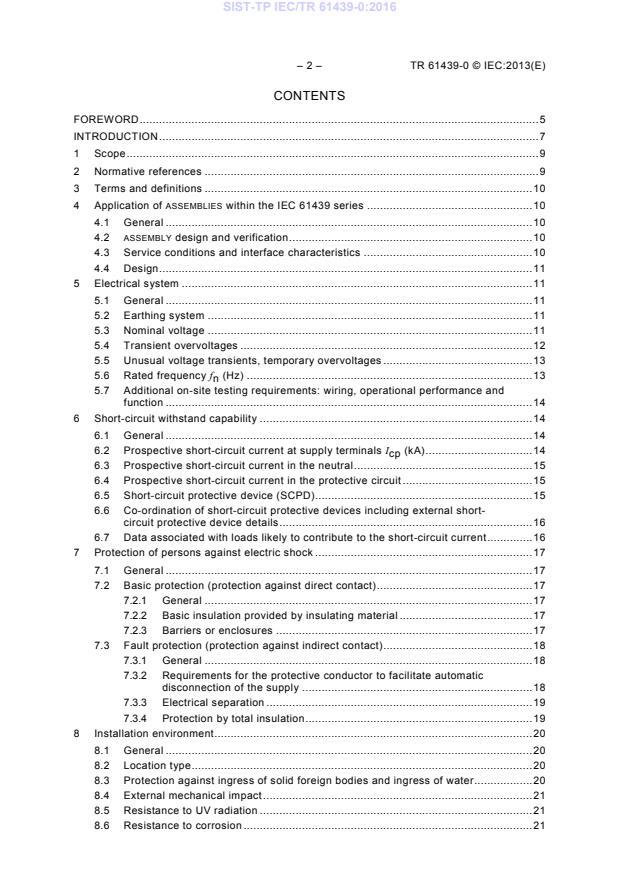
– 2 – TR 61439-0 © IEC:2013(E)
CONTENTS
FOREWORD . 5
INTRODUCTION . 7
1 Scope . 9
2 Normative references . 9
3 Terms and definitions . 10
4 Application of ASSEMBLIES within the IEC 61439 series . 10
4.1 General . 10
4.2 ASSEMBLY design and verification . 10
4.3 Service conditions and interface characteristics . 10
4.4 Design . 11
5 Electrical system . 11
5.1 General . 11
5.2 Earthing system . 11
5.3 Nominal voltage . 11
5.4 Transient overvoltages . 12
5.5 Unusual voltage transients, temporary overvoltages . 13
5.6 Rated frequency f (Hz) . 13
n
5.7 Additional on-site testing requirements: wiring, operational performance and
function . 14
6 Short-circuit withstand capability . 14
6.1 General . 14
6.2 Prospective short-circuit current at supply terminals I (kA) . 14
cp
6.3 Prospective short-circuit current in the neutral . 15
6.4 Prospective short-circuit current in the protective circuit . 15
6.5 Short-circuit protective device (SCPD). 15
6.6 Co-ordination of short-circuit protective devices including external short-
circuit protective device details . 16
6.7 Data associated with loads likely to contribute to the short-circuit current . 16
7 Protection of persons against electric shock . 17
7.1 General . 17
7.2 Basic protection (protection against direct contact) . 17
7.2.1 General . 17
7.2.2 Basic insulation provided by insulating material . 17
7.2.3 Barriers or enclosures . 17
7.3 Fault protection (protection against indirect contact) . 18
7.3.1 General . 18
7.3.2 Requirements for the protective conductor to facilitate automatic
disconnection of the supply . 18
7.3.3 Electrical separation . 19
7.3.4 Protection by total insulation . 19
8 Installation environment . 20
8.1 General . 20
8.2 Location type . 20
8.3 Protection against ingress of solid foreign bodies and ingress of water . 20
8.4 External mechanical impact . 21
8.5 Resistance to UV radiation . 21
8.6 Resistance to corrosion . 21
TR 61439-0 © IEC:2013(E) – 3 –
8.7 Ambient air temperature . 21
8.8 Maximum relative humidity . 21
8.9 Pollution degree . 22
8.10 Altitude . 22
8.11 EMC environment . 22
8.12 Special service conditions . 23
8.12.1 General . 23
8.12.2 Climatic conditions . 24
8.12.3 Protection against ingress of solid foreign bodies and ingress of
water . 24
8.12.4 Shock, vibration, seismic occurrence and external mechanical impact
(IK) . 24
8.12.5 Fire and explosion hazards . 24
8.12.6 Exceptional overvoltages . 25
8.12.7 EMC environment . 25
9 Installation method . 25
9.1 General . 25
9.2 Assembly type . 25
9.3 Portability . 26
9.4 Maximum overall dimensions and weight . 26
9.5 External conductor type(s) . 26
9.6 Direction(s) of external conductors . 26
9.7 External conductor material . 26
9.8 External phase conductor, cross-sections, and terminations . 27
9.9 External PE, N, PEN conductors cross-sections, and terminations . 27
9.10 Special terminal identification requirements . 27
10 Storage and handling . 28
10.1 General . 28
10.2 Maximum dimensions and weight of transport units . 28
10.3 Methods of transport (e.g. forklift, crane) . 28
10.4 Environmental conditions different from the service conditions . 28
10.5 Packing details . 28
11 Operating arrangements . 28
11.1 General . 28
11.2 Access to manually operated devices . 29
11.3 Isolation of load installation equipment items . 29
12 Maintenance and upgrade capabilities . 30
12.1 General . 30
12.2 Requirements related to accessibility for inspection and similar operations . 30
12.3 Requirements related to accessibility for maintenance in service by
authorized persons . 30
12.4 Requirements related to extension under voltage . 31
12.5 Protection against direct contact with hazardous live internal parts during
maintenance or upgrade . 31
12.6 Method of functional units connection . 31
12.7 Operating and maintenance gangways within an ASSEMBLY . 32
12.8 Internal separation . 32
13 Current carrying capability . 32
13.1 General . 32
– 4 – TR 61439-0 © IEC:2013(E)
13.2 Rated current I (A) (maximum current allowable) . 32
nA
13.3 Rated current of circuits I (A) . 33
nc
13.4 Rated diversity factor (RDF) . 33
13.5 Ratio of cross-section of the neutral conductor to phase conductors . 33
13.5.1 General . 33
13.5.2 Phase conductors up to and including 16 mm . 33
13.5.3 Phase conductors above 16 mm . 33
14 ASSEMBLY design and routine verification processes . 34
14.1 Design verification . 34
14.1.1 Object. 34
14.1.2 Methods . 34
14.1.3 Records . 34
14.2 Routine verification . 34
14.2.1 General . 34
14.2.2 Records . 35
Annex A (informative) Cross-section of copper conductors suitable for connection to
terminals for external conductors . 36
Annex B (informative) Forms of internal separation (see 12.8) . 37
Annex C (informative) Specification guidance for IEC 61439-2 . 41
Annex D (informative) Specification guidance for IEC 61439-3 . 47
Annex E (informative) Specification guidance for IEC 61439-4 . 51
Annex F (informative) Specification guidance for future IEC 61439-5 . 55
Annex G (informative) Specification guidance for IEC 61439-6 . 56
Annex H (informative) Specification guidance for IEC 61439-7 . 60
Annex I (informative) List of notes concerning certain countries . 61
Bibliography . 62
Figure 1 – Required rated impulse withstand voltage . 13
Figure B.1 – Symbols used in Figures B.2 and B.3 . 38
Figure B.2 – Forms 1 and 2 . 39
Figure B.3 – Forms 3 and 4 . 40
Table A.1 – Cross-section of copper conductors suitable for connection to terminals
for external conductors . 36
Table B.1 – Forms of internal separation. 37
Table C.1 – Items subject to agreement between the ASSEMBLY manufacturer and the
user . 41
Table C.2 – Examples of optional items subject to agreement between the ASSEMBLY
manufacturer and the user . 45
Table D.1 – Items subject to agreement between the ASSEMBLY manufacturer and the
user . 47
Table E.1 – Items subject to agreement between the ASSEMBLY manufacturer and the
user . 51
Table G.1 – Items subject to agreement between the ASSEMBLY manufacturer and the
user . 56
TR 61439-0 © IEC:2013(E) – 5 –
INTERNATIONAL ELECTROTECHNICAL COMMISSION
____________
LOW-VOLTAGE SWITCHGEAR AND CONTROLGEAR ASSEMBLIES –
Part 0: Guidance to specifying assemblies
FOREWORD
1) The International Electrotechnical Commission (IEC) is a worldwide organization for standardization comprising
all national electrotechnical committees (IEC National Committees). The object of IEC is to promote
international co-operation on all questions concerning standardization in the electrical and electronic fields. To
this end and in addition to other activities, IEC publishes International Standards, Technical Specifications,
Technical Reports, Publicly Available Specifications (PAS) and Guides (hereafter referred to as “IEC
Publication(s)”). Their preparation is entrusted to technical committees; any IEC National Committee interested
in the subject dealt with may participate in this preparatory work. International, governmental and non-
governmental organizations liaising with the IEC also participate in this preparation. IEC collaborates closely
with the International Organization for Standardization (ISO) in accordance with conditions determined by
agreement between the two organizations.
2) The formal decisions or agreements of IEC on technical matters express, as nearly as possible, an international
consensus of opinion on the relevant subjects since each technical committee has representation from all
interested IEC National Committees.
3) IEC Publications have the form of recommendations for international use and are accepted by IEC National
Committees in that sense. While all reasonable efforts are made to ensure that the technical content of IEC
Publications is accurate, IEC cannot be held responsible for the way in which they are used or for any
misinterpretation by any end user.
4) In order to promote international uniformity, IEC National Committees undertake to apply IEC Publications
transparently to the maximum extent possible in their national and regional publications. Any divergence
between any IEC Publication and the corresponding national or regional publication shall be clearly indicated in
the latter.
5) IEC itself does not provide any attestation of conformity. Independent certification bodies provide conformity
assessment services and, in some areas, access to IEC marks of conformity. IEC is not responsible for any
services carried out by independent certification bodies.
6) All users should ensure that they have the latest edition of this publication.
7) No liability shall attach to IEC or its directors, employees, servants or agents including individual experts and
members of its technical committees and IEC National Committees for any personal injury, property damage or
other damage of any nature whatsoever, whether direct or indirect, or for costs (including legal fees) and
expenses arising out of the publication, use of, or reliance upon, this IEC Publication or any other IEC
Publications.
8) Attention is drawn to the Normative references cited in this publication. Use of the referenced publications is
indispensable for the correct application of this publication.
9) Attention is drawn to the possibility that some of the elements of this IEC Publication may be the subject of
patent rights. IEC shall not be held responsible for identifying any or all such patent rights.
The main task of IEC technical committees is to prepare International Standards. However, a
technical committee may propose the publication of a technical report when it has collected
data of a different kind from that which is normally published as an International Standard, for
example "state of the art".
IEC 61439-0, which is a technical report, has been prepared by subcommittee 17D: Low-
voltage switchgear and controlgear assemblies, of IEC technical committee 17: Switchgear
and controlgear.
This second edition cancels and replaces the first edition published in 2010. It constitutes a
technical revision.
This second edition includes the following significant technical changes with respect to the
previous edition:
– alignment with IEC 61439-1:2011;
– alignment of Annex B with Annex AA of IEC 61439-2:2011;
– alignment of Table C.1 with Table BB.1 of IEC 61439-2:2011;
– 6 – TR 61439-0 © IEC:2013(E)
– addition of a new Annex D regarding IEC 61439-3;
– addition of a new Annex E regarding IEC 61439-4;
– addition of a new Annex G regarding IEC 61439-6;
– general editorial review.
The text of this technical report is based on the following documents:
Enquiry draft Report on voting
17D/458/DTR 17D/467A/RVC
Full information on the voting for the approval of this technical report can be found in the
report on voting indicated in the above table.
This publication has been drafted in accordance with the ISO/IEC Directives, Part 2.
The reader’s attention is drawn to the fact that Annex I lists all of the “in-some-country”
clauses on differing practices of a less permanent nature relating to the subject of this
Technical Report.
A list of all parts of the IEC 61439 series, under the general title Low-voltage switchgear and
controlgear assemblies, can be found on the IEC web site.
The committee has decided that the contents of this publication will remain unchanged until
the stability date indicated on the IEC web site under "http://webstore.iec.ch" in the data
related to the specific publication. At this date, the publication will be
• reconfirmed,
• withdrawn,
• replaced by a revised edition, or
• amended.
A bilingual version of this publication may be issued at a later date.
TR 61439-0 © IEC:2013(E) – 7 –
INTRODUCTION
For the purposes of this technical report, the user is the party who specifies or selects the
ASSEMBLY characteristics. The user may be the same party as the one who will use and
operate the ASSEMBLY, or someone acting on their behalf. The aim of this technical report is to
provide the user with guidance on the specification that should be provided in order to
achieve the desired design of an assembly. Throughout this technical report, the term
ASSEMBLY is used for a low-voltage switchgear and controlgear assembly. The term
“manufacturer” refers to the ASSEMBLY manufacturer unless specifically noted otherwise.
The purpose of the IEC 61439 series of standards is to harmonize as far as practicable, all
the general rules and requirements that apply to ASSEMBLIES. The series further seeks, in
order to obtain uniformity of requirements for ASSEMBLIES, consistency in the verification of
ASSEMBLIES and to avoid the need for verification to other standards.
All those requirements for the various ASSEMBLIES that can be considered as general, together
with specific subjects of wide interest and application, e.g. temperature rise, dielectric
properties, have therefore been gathered in IEC 61439-1 as general rules. For each type of
ASSEMBLY only two main standards are necessary to determine all requirements and the
corresponding methods of verification:
1) the standard giving the general rules and designated “Part 1”, and
2) the specific ASSEMBLY standard, hereinafter referred to as the relevant ASSEMBLY
standard.
The IEC 61439 series of standards encompasses ASSEMBLIES for a wide variety of uses, some
of which have specific needs as dictated by their particular application. In order to define
clearly these specific needs, relevant ASSEMBLY standards focussed on a particular type of
application have been (or are being) developed. These are identified as IEC 61439-2 to
IEC 61439-7, inclusive (see list below). Each relevant ASSEMBLY standard with reference to
IEC 61439-1, the general rules, as appropriate, specifies the characteristics and performance
required by an ASSEMBLY within its defined scope of application. Each relevant ASSEMBLY
standard includes, as an annex, a template for “items subject to agreement between the
ASSEMBLY manufacturer and the user” to facilitate the specifying of an ASSEMBLY. These are
reproduced and explained in this technical report.
General characteristics of all types of assemblies are considered in this Technical Report.
Details of which are applicable to each type of assembly can be determined by reference to
the Specification Template in Annex ‘C’ onwards.
Within this technical report, reference to IEC 61439 means the series of ASSEMBLY standards,
including:
• IEC 61439-1:2011, Low-voltage switchgear and controlgear assemblies – Part 1: General
rules
• IEC 61439-2:2011, Low-voltage switchgear and controlgear assemblies – Part 2: Power
switchgear and controlgear assemblies
• IEC 61439-3:2012, Low-voltage switchgear and controlgear assemblies – Part 3:
Distribution boards intended to be operated by ordinary persons (DBO)
• IEC 61439-4:2012, Low-voltage switchgear and controlgear assemblies – Part 4:
Particular requirements for assemblies for construction sites (ACS)
• IEC 61439-5:2010, Low-voltage switchgear and controlgear assemblies – Part 5:
Assemblies for power distribution in public networks
• IEC 61439-6:2012, Low-voltage switchgear and controlgear assemblies – Part 6: Busbar
trunking systems (busways)
– 8 – TR 61439-0 © IEC:2013(E)
• IEC 61439-7:2013, Low-voltage switchgear and controlgear assemblies – Part 7:
Assemblies for specific applications such as marinas, camping sites, market squares,
electrical vehicles charging stations
A reference to “general rules” means a reference to IEC 61439-1:2011.
A reference to “ASSEMBLY standard” means the relevant part of the IEC 61439 series (e.g.
Part 2, 3, etc.).
A reference to “product standard” means the relevant part or parts of the IEC standard for the
components used in the ASSEMBLY (e.g. IEC 60947-2 for circuit breakers).
___________
To be published.
TR 61439-0 © IEC:2013(E) – 9 –
LOW-VOLTAGE SWITCHGEAR AND CONTROLGEAR ASSEMBLIES –
Part 0: Guidance to specifying assemblies
1 Scope
Within the IEC 61439 series of standards for low-voltage switchgear and controlgear
assemblies (ASSEMBLIES), there are system and application details that are specified by the
user to enable the manufacturer to produce an ASSEMBLY that meets the needs and
expectations of the user.
This Part of IEC 61439, which is a technical report identifies, from the user’s perspective,
those functions and characteristics that should be defined when specifying ASSEMBLIES. It
provides:
– an explanation of the ASSEMBLY characteristics and options within the IEC 61439 series;
– a guidance on how to select the appropriate option and to define characteristics so as to
meet specific application needs, using a functional approach; and
– an assistance in the specification of ASSEMBLIES.
References within this technical report to the interface characteristics of an ASSEMBLY and the
requirements with which they will comply assume that the ASSEMBLY is designed,
manufactured, and verified in accordance with the relevant IEC 61439 part.
2 Normative references
The following documents, in whole or in part, are normatively referenced in this document and
are indispensable for its application. For dated references, only the edition cited applies. For
undated references, the latest edition of the referenced document (including any
amendments) applies.
CISPR 11, Industrial, scientific and medical equipment – Radio-frequency disturbance
characteristics – Limits and methods of measurement
IEC 60364-4-41, Low-voltage electrical installations – Part 4-41: Protection for safety –
Protection against electric shock
IEC 60364-6, Low-voltage electrical installations – Part 6: Verification
IEC 60445, Basic and safety principles for man-machine interface, marking and
identification – Identification of equipment terminals, conductor terminations and conductors
IEC 60529, Degrees of protection provided by enclosures (IP Code)
IEC 61439-1:2011, Low-voltage switchgear and controlgear assemblies – Part 1: General
rules
IEC 62262, Degrees of protection provided by enclosures for electrical equipment against
external mechanical impacts (IK code)
– 10 – TR 61439-0 © IEC:2013(E)
3 Terms and definitions
For the purposes of this document, the terms and definitions given in the relevant ASSEMBLY
standard apply (e.g. IEC 61439-2).
4 Application of ASSEMBLIES within the IEC 61439 series
4.1 General
ASSEMBLIES manufactured in accordance with the relevant ASSEMBLY standard of the
IEC 61439 series of standards are suitable for installation in the majority of operating
environments. Many of the characteristics of ASSEMBLIES are fully defined within the standard
and do not require further consideration by the user. In some instances there may be a default
condition specified within the standard and a range of other identified alternative options, from
which the user may choose to suit the application. For other characteristics, the user may be
required to choose from a list of options within the standard.
Where special and exceptionally onerous conditions exist, the user should identify these in
their specification. Examples of these onerous conditions include: high UV radiation
applications, conditions of high particulates/pollutants, more stringent short circuit conditions,
special fault protection, special protection due to risk of fire, explosions, burns, etc.
In some instances, the user may wish to seek the advice of experts in order to identify their
requirements correctly, e.g. with regard to system harmonics.
The annexes from Annex C onward provide specification templates that the user should
complete when defining the interface characteristics and application requirements for an
ASSEMBLY in accordance with the relevant ASSEMBLY standard. An explanation of each
interface characteristic is given in the subsequent clauses.
4.2 ASSEMBLY design and verification
An ASSEMBLY is intended to be used within an electrical installation of defined characteristics.
The ASSEMBLY may be designed and verified with a specific set of application criteria, to suit a
particular use, or more usually, it may be designed and verified to meet typical application
criteria that make it usable in a range of common applications.
The configuration for a particular user application of an ASSEMBLY usually requires four main
steps:
a) definition or selection of service conditions and interface characteristics. The user should
specify these characteristics;
b) design of the ASSEMBLY by the manufacturer to meet the arrangements, characteristics,
and functions particular to the application. The design will generally be based on
previously developed standard ASSEMBLY arrangements, characteristics, and functions;
c) for ASSEMBLIES or parts of ASSEMBLIES where the design is not previously proven, design
verification carried out by the manufacturer;
d) routine verification, carried out on each ASSEMBLY by the manufacturer.
For further information on the design and routine verification carried out by the manufacturer,
see Clause 14.
4.3 Service conditions and interface characteristics
The characteristics of the ASSEMBLY should be compatible with the ratings of the circuits to
which it is connected and the installation conditions.
TR 61439-0 © IEC:2013(E) – 11 –
Where no user specification is provided, information given in the manufacturer's
documentation may take the place of an agreement between the manufacturer and the user.
It is assumed that the user will provide an electrical single line diagram, or equivalent, to
define the incoming and outgoing circuit arrangements, loads, external conductors, and
selected interface characteristics that are required for the application of a specific ASSEMBLY.
4.4 Design
Once the user has specified any arrangements, characteristics, or functions particular to the
application, the manufacturer is responsible for the design of the ASSEMBLY and ensuring it
complies with the relevant ASSEMBLY standard in the IEC 61439 series. From the information
provided by the user, the manufacturer will derive additional ASSEMBLY characteristics in order
to provide an ASSEMBLY that fulfils the user’s stated application requirements.
5 Electrical system
5.1 General
The electrical system determines the characteristics (capabilities) an ASSEMBLY should
possess in order to perform its required duty safely. The characteristics of the ASSEMBLY
should at all times be at least equal to the needs of the application and, where essential, they
may exceed those offered in the standard options detailed in the IEC 61439 series.
The user should provide an electrical single line diagram and/or any other information
necessary to define their requirements for the ASSEMBLY, as detailed in 5.2 to 5.6 below.
5.2 Earthing system
The means of earthing a low-voltage network, when, how and where, differs from application
to application. For a particular network, the earthing system used may be dictated by local
regulation, the supply authority, legacy requirements, or the benefits of one system relative to
others.
The standard configurations of earthing system are TT, TN-C, TN-C-S, IT, TN-S. Specific
systems require and/or permit different solutions. For example, during the isolation of a supply
for maintenance:
• in TN-C systems, the PEN conductor is not permitted to be isolated or switched, but,
• in TN-S systems and TN-C-S systems the neutral conductors may or may not be isolated
or switched (see IEC 60364-5-53:2001, 536.1.2).
The design of the auxiliary circuits should take into account the supply earthing system to
ensure that an earth-fault does not cause unintentional operation.
It is therefore essential that users specify the earthing system.
5.3 Nominal voltage
The nominal voltage of the electrical system determines a number of the ASSEMBLY
characteristics.
The user should specify the nominal voltage of the system.
When provided with the nominal voltage, the manufacturer will determine the appropriate
values for other rated voltages including:
• the rated operational voltage U (of a circuit of an ASSEMBLY)
e
– 12 – TR 61439-0 © IEC:2013(E)
This is the voltage at which all the devices in a circuit, or a group of circuits, are capable
of performing a specified function, for example switching a particular load a given number
of times. In all cases, the rated operational voltage of a main circuit of an ASSEMBLY will be
at least equal to the rated voltage of the ASSEMBLY.
• the rated insulation voltage U
i
Like U , the rated insulation voltage also applies to a circuit or group of circuits of the
e
ASSEMBLY. It is the long-term voltage withstand capability of the insulation and is never
less than the rated operational voltage. Generally an insulation voltage equal to the
operational voltage is sufficient, but where particularly arduous conditions apply, a higher
insulation voltage may be appropriate.
5.4 Transient overvoltages
All networks experience occasional transient overvoltages caused by switching, lightning, etc.
Generally, within a low-voltage network, the magnitude of the overvoltages is reduced as the
distance from the source of supply is increased. It is therefore possible to have ASSEMBLIES
suitable for different levels of overvoltage as determined by their location in the electrical
network.
Various levels of overvoltage category are defined using a series of roman numbers.
The overvoltage category options are:
• Category I: Specially protected level (internal to equipment, not normally applicable to an
ASSEMBLY)
• Category II: Load level (appliance, equipment, not normally applicable to an ASSEMBLY)
• Category III: Distribution circuit level (typical industrial applications)
Examples: Equipment which is part of the fixed electrical installation and other equipment where a high degree
of availability is expected, e.g. distribution boards, motor control centres.
• Category IV: Origin of installation level (service entrance)
Examples: Equipment to be used at or in the proximity of the origin of the electrical installation upstream of the
main distribution board, e.g. electricity meter, primary overcurrent protective device.
The manufacturer will determine the likely overvoltage category from the electrical system,
single line diagram. Where exceptional overvoltage conditions apply, the user should specify
the required overvoltage category option for their application.
From the overvoltage category, the nominal voltage and the type of electrical supply system
the manufacturer will determine the appropriate values for the rated impulse withstand voltage
(U ). This relationship is illustrated for information in Figure 1.
imp
TR 61439-0 © IEC:2013(E) – 13 –
OVC IV
OVC III
OVC II
2,5
2,5
1,5
2,5
1,5
0,8
1,5
0,8
0,5
100 200 300 400 500 600 700 800 900 1 000
Maximum operational voltage to earth (V)
= phase-to-phase voltage for IT systems
= phase-to earth voltage for TN and TT systems
IEC 2361/10
Figure 1 – Required rated impulse withstand voltage
The rated impulse withstand voltage U is a measure of the ASSEMBLY’s tolerance to
imp
transient overvoltages. In normal networks, it will be equal to or higher than the transient
overvoltages occurring in the system(s) to which the circuit is designed to be connected.
5.5 Unusual voltage transients, temporary overvoltages
The ASSEMBLY will be capable of withstanding:
• transient overvoltage – short duration overvoltage of a few milliseconds or less, oscillatory
or non-oscillatory, usually highly damped, and
• temporary overvoltage – overvoltage at power frequency of relatively long duration
(several seconds).
The rated impulse withstand voltage (U ) defines the transient overvoltage to be withstood,
imp
ranging from 0,33 kV to 12 kV.
The rated insulation voltage (U ) defines the level of temporary overvoltage to be withstood.
i
If unusual voltage transients or temporary overvoltages are anticipated, the user should
specify the conditions to be met. Where such unusual conditions apply, it is important that
they are identified in order that the appropriate ASSEMBLY can be provided (guidance is
provided e.g. in IEC 61643-12 for transient overvoltages).
5.6 Rated frequency f (Hz)
n
ASSEMBLIES are designed to operate at a particular (rated) frequency or over a range of
frequencies or with direct current. Connecting a circuit of an ASSEMBLY to a supply with a
frequency outside its intended range can result in devices not operating correctly, altered
Rated impulse withstand voltage (kV)
– 14 – TR 61439-0 © IEC:2013(E)
interrupting capacity and in the case of higher current, the current carrying ability may be
affected. Standard frequencies are 50 Hz, and 60 Hz.
Unless otherwise stated, the manufacturer of the ASSEMBLY will assume it is suitable for a
frequency within the limits of 98 % to 102 % of the rated frequency.
The user should specify the nominal frequency of the system as the required rated frequency
of the ASSEMBLY. If any of the circuits within the ASSEMBLY are required to operate at different
frequencies, this should be identified accordingly by the user in the specification.
5.7 Additional on-site testing requirements: wiring, operational performance and
function
The routine verification is intended to detect faults in materials and workmanship, to confirm
an ASSEMBLY has been manufactured in accordance with the design specification and to
ascertain proper functioning of the complete ASSEMBLY. It is made on each ASSEMBLY normally
at the manufacturer’s premises.
ASSEMBLIES do not require any on-site testing to re-confirm the integrity of the ASSEMBLY. In
cases where the ASSEMBLIES are delivered in sections, the manufacturer may recommend
tests to confirm the ASSEMBLY has been correctly coupled on site.
IEC 60364-6 defines on-site verification to check the correct integration of the ASSEMBLY into
the electrical system. Where additional on-site testing by the manufacturer is required, the
user should specify these tests.
6 Short-circuit withstand capability
6.1 General
Short-circuits within correctly designed and managed networks are a very rare occurrence,
but when they occur, they place abnormal demands on ASSEMBLIES. Short-circuit currents and
short-circuit current breaking may cause different kinds of stresses:
• extremely high forces between conductors,
• very high temperature rise in a very short time,
• air ionisation due to arc breaking, resulting in lower air insulation,
• overpressure due to arc breaking, resulting in high forces applied to the enclosure.
ASSEMBLIES should be capable of withstanding the thermal and dynamic stresses resulting
from short-circuit currents emanating from the supplies to which they are connected.
Unless otherwise specified in the manufacturer’s operating and maintenance instructions,
ASSEMBLIES that have been subjected to a short-circuit should be subject to inspection and/or
maintenance by skilled personnel to determine the suitability of the ASSEMBLY for further
service.
6.2 Prospective short-circuit current at supply terminals I (kA)
cp
The prospective short-circuit current is the current that would flow if the supply conductors to
the ASSEMBLY were short-circuited with negligible impedance at the supply terminals of the
ASSEMBLY. In most cases, faults occurring in practise have an impedance that results in a
lower fault current compared to the prospective short-circuit current. Therefore, the selection
of an ASSEMBLY which is designed and verified for the prospective fault current usually
includes some safety margin.
TR 61439-0 © IEC:2013(E) – 15 –
The prospective short-circuit current is usually expressed as an r.m.s. short time current for a
specified duration, e.g. 0,2 s, 1 s or 3 s, or a conditional short-circuit current, which is a
reduced let through current limited by the operation of the upstream protective device.
From this current, an ASSEMBLY is assigned a short-circuit rating by the ASSEMBLY
manufacturer, defin
...
SLOVENSKO SIST-TP IEC/TR 61439-0
TEHNIČNO
junij 2016
POROČILO
Sestavi nizkonapetostnih stikalnih in krmilnih naprav –
0. del: Navodila za specificiranje sestavov
Low-voltage switchgear and controlgear assemblies –
Part 0: Guidance to specifying assemblies
Referenčna oznaka
ICS 29.130.20 SIST-TP IEC/TR 61439-0:2016 (sl)
Nadaljevanje na straneh 2 do 63
© 2017-06. Slovenski inštitut za standardizacijo. Razmnoževanje ali kopiranje celote ali delov tega standarda ni dovoljeno.
SIST-TP IEC/TR 61439-0 : 2016
NACIONALNI UVOD
Tehnično poročilo SIST-TP IEC/TR 61439-0 (sl), Sestavi nizkonapetostnih stikalnih in krmilnih naprav –
0. del: Navodila za specificiranje sestavov, 2016, ima status slovenskega tehničnega poročila in je
istoveten mednarodnemu tehničnemu poročilu IEC/TR 61439-0 (en), Low-voltage switchgear and
controlgear assemblies – Part 0: Guidance to specifying assemblies, 2013.
NACIONALNI PREDGOVOR
Mednarodno tehnično poročilo IEC/TR 61439-0 je pripravil tehnični odbor Mednarodne elektrotehniške
komisije IEC/TC 17D Sestavi nizkonapetostnih stikalnih in krmilnih naprav. Slovensko tehnično poročilo
primeru spora glede besedila slovenskega prevoda v tem standardu je odločilen izvirni mednarodni
standard v angleškem jeziku. Slovensko izdajo standarda je potrdil tehnični odbor SIST/TC SKA Stikalni
in krmilni aparati.
Odločitev za privzem tega standarda je v juniju 2016 sprejel tehnični odbor SIST/TC SKA Stikalni in
krmilni aparati.
ZVEZA S STANDARDI
S privzemom tega evropskega standarda veljajo za omejeni namen referenčnih standardov vsi
standardi, navedeni v izvirniku, razen tistih, ki so že sprejeti v nacionalno standardizacijo:
SIST EN 55011:2016 Industrijska, znanstvena in medicinska (ISM) radiofrekvenčna oprema –
Karakteristike občutljivosti za radijske motnje – Mejne vrednosti in
merilne metode
SIST IEC 60364-4-41:2006 Nizkonapetostne električne inštalacije – 4-41. del: Zaščitni ukrepi –
Zaščita pred električnim udarom
SIST IEC 60364-6:2006 Nizkonapetostne električne inštalacije – 6. del: Preverjanje
SIST EN 60445:2011 Osnovna in varnostna načela za vmesnik človek-stroj, označevanje in
razpoznavanje – Razpoznavanje terminalov opreme, končnikov vodnikov
in vodnikov (IEC 60445:2010)
SIST EN 60529:1997 Stopnja zaščite, ki jo zagotavlja ohišje (koda IP) (IEC 60529:1989)
(vsebuje popravek AC:1993)
SIST EN 61439-1:2012 Sestavi nizkonapetostnih stikalnih in krmilnih naprav – 1. del: Splošna
pravila (IEC 61439-1:2011)
SIST EN 62262:2007 Stopnje zaščite pred mehanskimi udarci, ki jo ohišja nudijo električni
opremi (koda IK) (IEC 62262:2002) (istoveten z EN 50102:1995 +
A1:1998)
OSNOVA ZA IZDAJO STANDARDA
– privzem standarda IEC/TR 61439-0:2013
OPOMBI
– Povsod, kjer se v besedilu tehničnega poročila uporablja izraz “mednarodno tehnično poročilo”, v
– Nacionalni uvod in nacionalni predgovor nista sestavni del standarda.
SIST-TP IEC/TR 61439-0 : 2016
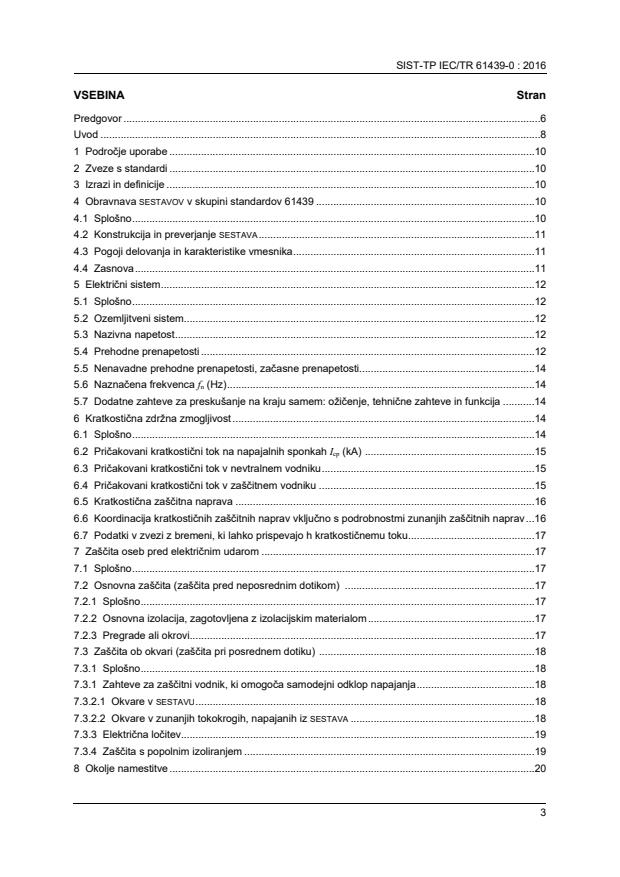
VSEBINA Stran
Predgovor .6
Uvod .8
1 Področje uporabe .10
2 Zveze s standardi .10
3 Izrazi in definicije .10
4 Obravnava SESTAVOV v skupini standardov 61439 .10
4.1 Splošno .10
4.2 Konstrukcija in preverjanje SESTAVA .11
4.3 Pogoji delovanja in karakteristike vmesnika .11
4.4 Zasnova .11
5 Električni sistem .12
5.1 Splošno .12
5.2 Ozemljitveni sistem .12
5.3 Nazivna napetost .12
5.4 Prehodne prenapetosti .12
5.5 Nenavadne prehodne prenapetosti, začasne prenapetosti.14
5.6 Naznačena frekvenca f (Hz) .14
n
5.7 Dodatne zahteve za preskušanje na kraju samem: ožičenje, tehnične zahteve in funkcija .14
6 Kratkostična zdržna zmogljivost .14
6.1 Splošno .14
6.2 Pričakovani kratkostični tok na napajalnih sponkah I (kA) .15
cp
6.3 Pričakovani kratkostični tok v nevtralnem vodniku .15
6.4 Pričakovani kratkostični tok v zaščitnem vodniku .15
6.5 Kratkostična zaščitna naprava .16
6.6 Koordinacija kratkostičnih zaščitnih naprav vključno s podrobnostmi zunanjih zaščitnih naprav .16
6.7 Podatki v zvezi z bremeni, ki lahko prispevajo h kratkostičnemu toku .17
7 Zaščita oseb pred električnim udarom .17
7.1 Splošno .17
7.2 Osnovna zaščita (zaščita pred neposrednim dotikom) .17
7.2.1 Splošno .17
7.2.2 Osnovna izolacija, zagotovljena z izolacijskim materialom .17
7.2.3 Pregrade ali okrovi .17
7.3 Zaščita ob okvari (zaščita pri posrednem dotiku) .18
7.3.1 Splošno .18
7.3.1 Zahteve za zaščitni vodnik, ki omogoča samodejni odklop napajanja .18
7.3.2.1 Okvare v SESTAVU .18
7.3.2.2 Okvare v zunanjih tokokrogih, napajanih iz SESTAVA .18
7.3.3 Električna ločitev .19
7.3.4 Zaščita s popolnim izoliranjem .19
8 Okolje namestitve .20
SIST-TP IEC/TR 61439-0 : 2016
8.1.Splošno .20
8.2 Vrsta mesta namestitve .20
8.3 Zaščita pred vdorom trdnih tujkov in vode.20
8.4 Zunanji mehanski vplivi .21
8.5 Odpornost proti UV-sevanju .21
8.6 Odpornost proti koroziji.21
8.7 Temperatura zraka okolice .21
8.8 Največja relativna vlažnost .21
8.9 Stopnja onesnaženja .22
8.10 Nadmorska višina .22
8.11 Okolje EMC .22
8.12 Posebni obratovalni pogoji .23
8.12.1 Splošno .23
8.12.2 Klimatski pogoji .24
8.12.3 Zaščita pred vdorom trdnih tujkov in vode .24
8.12.4 Udar, vibracija, seizmični pojav in zunanji mehanski vpliv (IK) .24
8.12.5 Nevarnosti požara in eksplozij .24
8.12.6 Izjemne prenapetosti .24
8.12.7 Okolje EMC .24
9 Metoda nameščanja .25
9.1 Splošno .25
9.2 Izvedba sestava .25
9.3 Prenosnost .25
9.4 Največje zunanje mere in masa .25
9.5 Vrsta(-e) zunanjih vodnikov .26
9.6 Smer(-i) zunanjih vodnikov .26
9.7 Material zunanjih vodnikov .26
9.8 Zunanji fazni vodnik, prerezi in končniki .26
9.9 Prerezi zunanjih vodnikov PE, N, PEN in končnikov .27
9.10 Posebne zahteve za označevanje sponk .27
10 Skladiščenje in ravnanje .27
10.1 Splošno .27
10.2 Največje mere in masa transportnih enot .27
10.3 Načini transporta (npr. viličar, žerjav) .27
10.4 Okoljski pogoji, različni od obratovalnih pogojev .28
10.5 Posebnosti embaliranja .28
11 Postavitev SESTAVA pri obratovanju .28
11.1 Splošno .28
11.2 Dostop do ročno upravljanih naprav .28
11.3 Ločevanje opreme pod napetostjo .29
12 Vzdrževanje in možnosti nadgradnje .29
12.1 Splošno .29
SIST-TP IEC/TR 61439-0 : 2016
12.2 Zahteve v zvezi z dostopnostjo pri pregledu in podobnih operacijah .29
12.3 Zahteve v zvezi z dostopnostjo, ko pooblaščene osebe izvajajo vzdrževanje
med obratovanjem .30
12.4 Zahteve za širitev SESTAVOV, ki so pod napetostjo .30
12.5 Zaščita pred neposrednim dotikom z nevarnimi notranjmi deli pod napetostjo
med vzdrževanjem ali nadgradnjo .31
12.6 Način priključevanja funkcijskih enot .31
12.7 Prehodi v SESTAVU za upravljanje in vzdrževanje .31
12.8 Notranja ločitev .31
13 Dopustni tok .32
13.1 Splošno .32
13.2 Naznačeni tok I (A) (največji dovoljeni tok) .32
nA
13.3 Naznačeni toki tokokrogov I (A) .32
nC
13.4 Naznačeni faktor obremenitve (RDF) .32
13.5 Razmerje prerezov nevtralnega vodnika in faznih vodnikov .33
13.5.1 Splošno .33
13.5.2 Fazni vodniki do vključno 16 mm .33
13.5.3 Fazni vodniki nad 16 mm .33
14 Konstrukcija SESTAVA in procesi kosovnega preverjanja .33
14.1 Preverjanje zasnove .33
14.1.1 Namen .33
14.1.2 Metode .33
14.1.3 Zapisi .34
14.2 Kosovno preverjanje .34
14.2.1 Splošno .34
14.2.2 Zapisi .34
Dodatek A (informativni) Prerez bakrenih vodnikov, primernih za priključek na sponke
za zunanje vodnike .35
Dodatek B (informativni): Oblike notranjih ločitev .36
Dodatek C (informativni): Navodilo za specificiranje po IEC 61439-2 .40
Dodatek D (informativni): Navodilo za specificiranje po IEC 61439-3 .47
Dodatek E (informativni): Navodilo za specificiranje po IEC 61439-4 .51
Dodatek F (informativni): Navodilo za specificiranje po IEC 61439-5 .55
Dodatek G (informativni): Navodilo za specificiranje po IEC 61439-6 .56
Dodatek H (informativni): Navodilo za specificiranje po IEC 61439-7 .61
Dodatek I (informativni): Seznam opomb za posamezne države .62
Literatura.63
SIST-TP IEC/TR 61439-0 : 2016
MEDNARODNA ELEKTROTEHNIŠKA KOMISIJA
SESTAVI NIZKONAPETOSTNIH STIKALNIH IN KRMILNIH NAPRAV –
0. del: Navodila za specificiranje sestavov
PREDGOVOR
1) IEC (Mednarodna elektrotehniška komisija) je svetovna organizacija za standardizacijo, ki združuje vse nacionalne
elektrotehnične komiteje (nacionalni komiteji IEC). Cilj IEC je pospeševati mednarodno sodelovanje v vseh vprašanjih
standardizacije s področja elektrotehnike in elektronike. V ta namen poleg drugih aktivnosti izdaja mednarodne standarde,
tehnične specifikacije, tehnična poročila, javnosti dostopne specifikacije (PAS) in vodila (v nadaljevanju: publikacije IEC). Za
njihovo pripravo so odgovorni tehnični odbori. Vsak nacionalni komite IEC, ki ga zanima obravnavana tema, lahko sodeluje v
tem pripravljalnem delu. Prav tako lahko v pripravi sodelujejo mednarodne organizacije ter vladne in nevladne ustanove, ki
so povezane z IEC. IEC deluje v tesni povezavi z mednarodno organizacijo za standardizacijo ISO skladno s pogoji,
določenimi v soglasju med obema organizacijama.
2) Uradne odločitve ali sporazumi IEC o tehničnih vprašanjih, pripravljeni v tehničnih odborih, v katerih so prisotni vsi nacionalni
komiteji, ki jih tema zanima, izražajo, kolikor je mogoče, mednarodno soglasje o obravnavani temi.
3) Publikacije IEC imajo obliko priporočil za njihovo uporabo na mednarodni ravni in jih kot takšne sprejmejo nacionalni komiteji
IEC. Čeprav IEC skuša na vse primerne načine zagotavljati točnost tehničnih vsebin v publikacijah IEC, IEC ne more biti
odgovoren za način, kako se določila uporabljajo, ter za morebitne napačne razlage končnih uporabnikov.
4) Da bi pospeševali mednarodno poenotenje, so se nacionalni komiteji IEC zavezali, da bodo v svojih nacionalnih in regionalnih
standardih čim pregledneje uporabljali mednarodne standarde. Vsako odstopanje med standardom IEC in ustreznim
nacionalnim ali regionalnim standardom je treba v slednjem jasno označiti.
5) IEC sam ne izvaja potrjevanja skladnosti. Storitve ugotavljanja skladnosti in na nekaterih območjih tudi dostop do znakov
skladnosti IEC izvajajo neodvisni certifikacijski organi. IEC ne prevzema nikakršne odgovornosti za storitve, ki jih izvajajo
neodvisni certifikacijski organi.
6) Vsi uporabniki naj bi si zagotovili zadnjo izdajo teh publikacij.
7) IEC ali njegovi direktorji, zaposleni, uslužbenci ali agenti, vključno s samostojnimi strokovnjaki ter člani tehničnih odborov in
nacionalnih komitejev IEC, ne prevzemajo nobene odgovornosti za kakršno koli osebno poškodbo, škodo na premoženju ali
katero koli drugo škodo kakršne koli vrste, bodisi posredne ali neposredne, ali za stroške (vključno z zakonitim lastništvom)
in izdatke, povezane s publikacijo, njeno uporabo ali zanašanjem na to publikacijo IEC ali katero koli drugo publikacijo IEC.
8) Pozornost je treba posvetiti normativnim virom, na katere se sklicuje ta publikacija. Uporaba navedenih publikacij je nujna za
pravilno uporabo te publikacije.
9) Opozoriti je treba na možnost, da bi lahko bil kateri od elementov tega mednarodnega standarda predmet patentnih pravic.
IEC ni odgovoren za identificiranje nobene od teh patentnih pravic.
Glavna naloga tehničnih odborov IEC je pripravljati mednarodne standarde. Vendar lahko tehnični odbor
predlaga publikacijo kot tehnično poročilo, dokler zbira različne vrste informacij, po navadi potrebne za
izdajo mednarodnega standarda, na primer "stanje tehnike".
Tehnično poročilo IEC 61439-0 je pripravil pododbor 17D Sestavi nizkonapetostnih stikalnih in krmilnih
naprav pri tehničnem odboru IEC 17 Stikalne in krmilne naprave.
Ta druga izdaja razveljavlja in zamenjuje prvo izdajo, objavljeno v letu 2010. Predstavlja tehnično
revizijo.
Ta druga izdaja vključuje naslednje pomembne tehnične spremembe glede na prejšnjo izdajo:
̶ uskladitev z IEC 61439-1:2011;
̶ uskladitev dodatka B z dodatkom AA iz IEC 61439-2:2011;
SIST-TP IEC/TR 61439-0 : 2016
̶ uskladitev preglednice C.1 s preglednico BB.1 iz IEC 61439-2:2011;
̶ dodan nov dodatek D glede na IEC 61439-3;
̶ dodan nov dodatek E glede na IEC 61439-4;
̶ dodan nov dodatek G glede na IEC 61439-6;
̶ splošen redakcijski pregled.
Besedilo tega tehničnega poročila temelji na naslednjih dokumentih:
Glasovanje o osnutku Poročilo o glasovanju
17D/458/DTR 17D/467A/RVC
Celotna informacija o glasovanju za odobritev tega tehničnega odbora je na voljo v poročilu o
glasovanju, navedenem v gornji preglednici.
Ta publikacija je pripravljena v skladu z 2. delom Direktiv ISO/IEC.
Bralca je treba opozoriti na dejstvo, da so v dodatku I navedene vse določbe "v nekaterih državah", ki v
praksi ponekod odstopajo od predmeta tega tehničnega poročila.
Seznam vseh delov serije standardov IEC 61439 s splošnim naslovom Sestavi nizkonapetostnih
stikalnih in krmilnih naprav je na voljo na spletni strani IEC.
Tehnični odbor je sklenil, da bo vsebina te publikacije ostala nespremenjena do datuma stabilnosti,
navedenega na spletni strani IEC pod http://webstore.iec.ch, v podatkih, povezanih s posebno izdajo.
Po tem datumu bo publikacija:
– ponovno potrjena,
– razveljavljena,
– nadomeščena z revidirano izdajo ali
– dopolnjena.
Dvojezična verzija te publikacije lahko izide pozneje.
SIST-TP IEC/TR 61439-0 : 2016
Uvod
V tem tehničnem poročilu je uporabnik tista stranka, ki podrobno določa ali izbira karakteristike SESTAVA.
Uporabnik je lahko ista stranka kot tista, ki bo uporabljala in vodila obratovanje SESTAVA, ali nekdo, ki
deluje v njegovem imenu. Cilj tega tehničnega poročila je zagotoviti uporabniku navodilo o
specifikacijah, ki jih je treba zagotoviti za dosego želene konstrukcije SESTAVA. V celotnem tehničnem
poročilu se izraz SESTAV uporablja za sestav nizkonapetostnih stikalnih in krmilnih naprav. Izraz
"proizvajalec" se nanaša na proizvajalca SESTAVA, razen če ni navedeno drugače.
Namen skupine standardov IEC 61439 je harmonizirati, kolikor je mogoče, vsa splošna pravila in
zahteve, ki veljajo za SESTAVE. Nadalje skuša doseči poenotenje zahtev za SESTAV in usklajenost pri
preverjanju SESTAVOV ter odpraviti potrebo po preverjanju po drugih standardih.
Vse zahteve za različne SESTAVE, ki se lahko štejejo za splošne, so zato skupaj s posebnimi vsebinami
širšega interesa in uporabe, npr. dvig temperature, dielektrične lastnosti, zbrane v IEC 61439-1 kot
splošna pravila. Za vsak tip SESTAVA sta potrebna samo dva glavna standarda za določitev vseh zahtev
in pripadajočih metod preverjanja:
1) standard s splošnimi pravili, označen kot "1. del", in
2) poseben standard za SESTAV, v nadaljevanju imenovan kot ustrezni standard SESTAVA.
Skupina standardov IEC 61439 vključuje SESTAVE za številne različne uporabe, od katerih imajo nekateri
posebne potrebe, ki jih narekuje njihova posebna uporaba. Zaradi jasne določitve teh specifičnih potreb
so bili razviti (ali so v razvoju) ustrezni standardi za SESTAVE, usmerjeni v posebni tip uporabe. Ti so
označeni kot IEC 61439-2 do vključno IEC 61439-7 (glej seznam spodaj). Vsak ustrezni standard za
SESTAV, ki se sklicuje na IEC 61439-1 ali splošna pravila, kot je primerno, določa karakteristike in
tehnične zahteve, ki jih zahteva SESTAV za svoje področje uporabe. Vsak ustrezni standard za SESTAV
vsebuje kot dodatek še predlogo za "postavke, ki so predmet dogovora med proizvajalcem SESTAVA in
uporabnikom", kar olajšuje specificiranje SESTAVA. Ti predmeti so prikazani in razloženi v tem tehničnem
poročilu.
V tem tehničnem poročilu so obravnavane splošne karakteristike vseh vrst sestavov. Podrobnosti, ki se
uporabijo za vsako vrsto sestava, se lahko določijo s sklicevanjem na predlogo za specifikacijo v
dodatku C.
Sklicevanje na IEC 61439 v tem tehničnem poročilu pomeni skupino standardov za SESTAVE, in sicer:
– IEC 61439-1:2011, Sestavi nizkonapetostnih stikalnih in krmilnih naprav – 1. del: Splošna pravila
– IEC 61439-2:2011, Sestavi nizkonapetostnih stikalnih in krmilnih naprav – 2. del: Sestavi
močnostnih stikalnih in krmilnih naprav
– IEC 61439-3:2012, Sestavi nizkonapetostnih stikalnih in krmilnih naprav – 3. del: Električni
razdelilniki, s katerimi lahko ravnajo nestrokovnjaki (DBO)
– IEC 61439-4:2012, Sestavi nizkonapetostnih stikalnih in krmilnih naprav – 4. del: Posebne zahteve
za sestave na gradbiščih (ACS)
– IEC 61439-5, 2010, Nizkonapetostne stikalne in krmilne naprave – 5. del: Sestavi za distribucijo
električne energije v javnih omrežjih
– IEC 61439-6:2012, Sestavi nizkonapetostnih in krmilnih naprav – 6. del: Zbiralčni povezovalni
sistemi (zbiralčna vodila)
– IEC 61439-7:2013, Sestavi nizkonapetostnih stikalnih in krmilnih naprav – 7. del: Sestavi za
posebne aplikacije, npr. za marine, prostore za kampiranje, tržnice, napajalne postaje za električna
vozila
Sklic na "splošna pravila" pomeni sklic na IEC 61439-1:2011.
SIST-TP IEC/TR 61439-0 : 2016
Sklic na "standard za SESTAV" pomeni ustrezni del skupine standardov IEC 61439 (npr. 2., 3. del itd.).
Sklic na "standard za proizvod" pomeni ustrezni del ali dele standarda IEC za sestavne dele,
uporabljene v SESTAVU (npr. IEC 60947-2 za odklopnike).
SIST-TP IEC/TR 61439-0 : 2016
Sestavi nizkonapetostnih stikalnih in krmilnih naprav – 0. del: Navodila za
specificiranje sestavov
1 Področje uporabe
V skupini standardov IEC 61439, Sestavi nizkonapetostnih stikalnih in krmilnih naprav (SESTAVI), so
zbrane sistemske in druge podrobnosti za uporabo, ki jih specificira uporabnik, da omogoči proizvajalcu
izdelati SESTAV, ki bo izpolnjeval potrebe in pričakovanja uporabnika.
Ta del IEC 61439 je tehnično poročilo, ki z uporabnikove perspektive identificira tiste funkcije in
karakteristike, ki so potrebne za specifikacijo SESTAVA. Zagotavlja:
– razlago karakteristik SESTAVA in možnosti v okviru skupine standardov IEC 61439,
– navodila, kako z uporabo funkcionalnega pristopa primerno izbrati in določiti karakteristike SESTAVA
tako, da bodo ustrezale specifičnim potrebam uporabe, in
– pomoč pri specificiranju SESTAVOV.
Sklicevanje v tem tehničnem poročilu na karakteristike vmesnika SESTAVA in na zahteve, s katerimi so
skladne, ustvarja domnevo, da je SESTAV konstruiran, izdelan in preverjen v skladu z ustreznim delom
IEC 61439.
2 Zveze s standardi
Za uporabo tega standarda so, delno ali v celoti, nujno potrebni spodaj navedeni referenčni dokumenti.
Pri datiranih sklicevanjih se uporablja le navedena izdaja. Pri nedatiranih sklicevanjih se uporablja
zadnja izdaja publikacije (vključno z dopolnili).
CISPR 11 Industrijska, znanstvena in medicinska oprema – Karakteristike
radiofrekvenčnih motenj – Mejne vrednosti in merilne metode
IEC 60364-4-41 Nizkonapetostne električne inštalacije – 4-41. del: Zaščitni ukrepi – Zaščita
pred električnim udarom
IEC 60364-6 Nizkonapetostne električne inštalacije – 6. del: Preverjanje
IEC 60445 Osnovna in varnostna načela za vmesnik človek-stroj, označevanje in
razpoznavanje – Razpoznavanje terminalov opreme, končnikov vodnikov in
vodnikov
IEC 60529 Stopnje zaščite, ki jih zagotavljajo ohišja (koda IP)
IEC 61439-1:2011 Sestavi nizkonapetostnih stikalnih in krmilnih naprav – 1. del: Splošna pravila
IEC 62262 Stopnje zaščite pred mehanskimi udarci, ki jo ohišja nudijo električni opremi
(koda IK)
3 Izrazi in definicije
V tem dokumentu se uporabljajo izrazi in definicije, navedeni v ustreznem standardu za SESTAV (npr.
IEC 61439-2).
4 Obravnava SESTAVOV v skupini standardov 61439
4.1 Splošno
SESTAVI, izdelani v skladu z ustreznim standardom za SESTAV iz skupine standardov IEC 61439, so
primerni za vgradnjo v večino obratovalnih okolij. Številne karakteristike SESTAVOV so v celoti določene
v standardih in od uporabnika ne zahtevajo dodatne obravnave. V nekaterih primerih so lahko privzeti
pogoji podrobno navedeni v standardu in pri drugih prepoznanih alternativnih opcijah, iz katerih lahko
SIST-TP IEC/TR 61439-0 : 2016
uporabnik izbira za prilagoditev uporabi. Druge karakteristike pa bo morda uporabnik moral izbrati iz
seznama opcij v standardu.
Kadar obstajajo posebni in izjemno zahtevni pogoji, jih mora uporabnik navesti v svoji specifikaciji.
Primeri takih zahtevnih pogojev vključujejo: aplikacije, ki uporabljajo močna ultravijolična sevanja,
pogoje onesnaženja z delci/onesnaževali, strožje pogoje pri kratkih stikih, posebno zaščito ob okvari,
posebno zaščito pred tveganjem požara, eksplozij, vžigov itd.
V nekaterih primerih morda uporabnik želi dobiti nasvet strokovnjakov, da bi lahko pravilno razumel
njihove zahteve, na primer o harmonikih v sistemu.
V dodatkih od C naprej so predstavljene predloge, ki jih morajo uporabniki izpolniti pri določanju
karakteristik vmesnika in zahtev za uporabo SESTAVA v skladu z ustreznim standardom za SESTAV.
Obrazložitev vsake karakteristike vmesnika je navedena v nadaljevanju.
4.2 Konstrukcija in preverjanje SESTAVA
SESTAV je namenjen za uporabo v električni inštalaciji, ki ima določene karakteristike. Zasnovan in
preverjen je lahko z določenim naborom meril uporabe, da ustreza posebni uporabi, ali bolj običajno, je
lahko zasnovan in preverjen, da izpolnjuje tipična merila uporabe, ki zagotavljajo njegovo uporabnost v
območju splošnih uporab.
Konfiguracija za posebno uporabo SESTAVA pri uporabniku navadno zahteva štiri glavne korake:
a) določitev ali izbira obratovalnih pogojev in karakteristik vmesnika. Te karakteristike naj določi
uporabnik;
b) snovanje SESTAVA, ki ga opravi proizvajalec, da le-ta ustreza razporeditvi, karakteristikam in
posebnim funkcijam uporabe. Zasnova bo navadno temeljila na že prej razvitih standardnih
razporeditvah SESTAVA, karakteristikah in funkcijah;
c) preverjanje zasnove SESTAVOV ali delov SESTAVOV, katerih zasnova še ni bila preskušena, ki ga
izvede proizvajalec;
d) kosovno preverjanje vsakega SESTAVA, ki ga opravi proizvajalec.
Za dodatne informacije o preverjanju zasnove in kosovnem preverjanju, ki ju izvaja proizvajalec, glej
točko 14.
4.3 Pogoji delovanja in karakteristike vmesnika
Karakteristike SESTAVA naj bodo združljive z naznačenimi vrednostmi tokokrogov, na katere je priključen,
in s pogoji namestitve.
Kadar uporabnik ni navedel specifikacij, se lahko informacije iz dokumentacije proizvajalca štejejo za
dogovor med uporabnikom in proizvajalcem.
Domneva se, da bo uporabnik predložil enočrtno električno shemo ali nekaj enakovrednega za določitev
razporeditve dovodnih in odvodnih tokokrogov, obremenitev, zunanjih vodnikov in izbranih karakteristik
vmesnikov, ki se zahtevajo za uporabo določenega SESTAVA.
4.4 Zasnova
Ko je uporabnik specificiral vse razporeditve, karakteristike ali posebne funkcije za uporabo, je
proizvajalec odgovoren za zasnovo SESTAVA in za zagotovitev skladnosti s standardom za SESTAV iz
skupine standardov IEC 61439. Iz informacij, ki jih je predložil uporabnik, bo proizvajalec izpeljal dodatne
karakteristike SESTAVA, da bo ta v celoti izpolnjeval zahteve uporabnika za uporabo.
SIST-TP IEC/TR 61439-0 : 2016
5 Električni sistem
5.1 Splošno
Električni sistem določa karakteristike (zmogljivosti) SESTAVA, ki naj jih ta ima za varno izpolnjevanje
zahtevanih funkcij. Karakteristike SESTAVA naj bodo ves čas vsaj take, kot jih zahteva aplikacija, in kjer
je nujno, lahko presegajo standardne opcije, določene v skupini IEC 61439.
Uporabnik naj predloži enočrtno električno shemo in/ali vsako drugo informacijo, potrebno za določitev
zahtev SESTAVA, kot je podrobno opisano spodaj v točkah 5.2 do 5.6.
5.2 Ozemljitveni sistem
Sredstva za ozemljitev nizkonapetostnega omrežja se razlikujejo od uporabe do uporabe glede na kdaj,
kako in kje. Za posamezno omrežje se lahko uporabi ozemljitveni sistem, ki ga določajo lokalni predpis,
upravljavec omrežja, zakonske zahteve ali prednosti enega sistema pred drugimi.
Standardne konfiguracije ozemljitvenih sistemov so: TT, TN-C, TN-C-S, IT in TN-S. Posebni sistemi
zahtevajo in/ali dovoljujejo različne rešitve. Na primer, med ločitvijo napajanja pri vzdrževanju:
– v sistemih TN-C ni dovoljeno vodnika PEN ločiti ali preklopiti, toda
– v sistemih TN-S in TN-C-S se nevtralni vodniki smejo ali ne smejo ločiti ali preklopiti (glej IEC
60364-5-53:2001, 536.1.2).
Pri zasnovi pomožnih tokokrogov naj se upošteva ozemljitveni sistem napajanja, da se zagotovi, da
zemeljski stik ne povzroči nenamernega delovanja.
Zato je bistveno, da uporabniki specificirajo ozemljitveni sistem.
5.3 Nazivna napetost
Nazivna napetost električnega sistema določa številne karakteristike SESTAVA.
Uporabnik naj opredeli nazivno napetost sistema.
Po določitvi nazivne napetosti bo proizvajalec določil ustrezne vrednosti za druge naznačene napetosti,
vključno:
– z naznačeno obratovalno napetostjo U (tokokroga SESTAVA)
e
To je napetost, pri kateri so vse naprave v tokokrogu ali skupini tokokrogov sposobne izvajati
specificirane funkcije, na primer izvesti dano število preklopov določenega bremena. V vseh primerih
bo naznačena obratovalna napetost glavnega tokokroga SESTAVA najmanj enaka naznačeni napetosti
SESTAVA.
– z naznačeno izolacijsko napetostjo U
i
Podobno kot U tudi naznačena izolacijska napetost velja za tokokrog ali skupino tokokrogov SESTAVA.
e
To je dolgotrajna zdržna napetost izolacije in ni nikoli manjša od naznačene obratovalne napetosti.
Navadno je dovolj, da je izolacijska napetost enaka obratovalni napetosti, v posebej težavnih pogojih
pa je lahko priporočljiva uporaba višje izolacijske napetosti.
5.4 Prehodne prenapetosti
V vseh omrežjih nastajajo občasno prehodne prenapetosti, ki jih povzročajo preklapljanje, bliskanje itd.
Navadno se v nizkonapetostnem omrežju magnituda prenapetosti zmanjšuje z večanjem razdalje od
vira napajanja. Zato je mogoče imeti SESTAVE, primerne za različne nivoje prenapetosti, ki jih določa
njihova lokacija v električnem omrežju.
SIST-TP IEC/TR 61439-0 : 2016
Različni nivoji kategorij prenapetosti so podani z uporabo niza rimskih številk.
Prenapetostne kategorije so lahko:
– kategorija I: posebej zaščiten nivo (v notranjosti do opreme, normalno se ne uporablja za SESTAV),
– kategorija II: nivo bremena (aparat, oprema, normalno se ne uporablja za SESTAV),
– kategorija III: nivo distribucijskih tokokrogov (tipična industrijska uporaba),
Primeri: Oprema, ki je del stalne inštalacije, in druga oprema, kjer se pričakuje visoka stopnja razpoložljivosti, na primer električni
razdelilniki, motorski nadzorni centri.
– kategorija IV: nivo točke napajanja (vstopno napajanje).
Primeri: Oprema, ki se uporablja v točki napajanja ali električne inštalacije v njeni bližini v smeri proti glavnemu
distribucijskemu razdelilniku, npr. električni števec, primarna nadtokovna zaščita.
Proizvajalec bo prenapetostno kategorijo verjetno ugotovil iz enočrtne sheme električnega sistema. Kjer
obstaja možnost izjemnih prenapetostnih pogojev, naj uporabnik zanje specificira zahtevano
prenapetostno kategorijo.
Iz prenapetostne kategorije, nazivne napetosti in vrste električnega napajalnega sistema bo proizvajalec
določil primerne vrednosti za naznačeno zdržno udarno napetost (U ). To razmerje je za informacijo
imp
prikazano na sliki 1.
Slika 1: Zahtevana naznačena zdržna udarna napetost
Naznačena zdržna udarna napetost (U ) je merilo za odpornost SESTAVA proti prehodnim
imp
prenapetostim. V normalnih omrežjih bo napetost U enaka ali višja kot prehodne prenapetosti, ki
imp
nastajajo v sistemu, za katerega je tokokrog zasnovan za priključitev.
SIST-TP IEC/TR 61439-0 : 2016
5.5 Nenavadne prehodne prenapetosti, začasne prenapetosti
SESTAV mora biti sposoben zdržati:
– prehodno prenapetost – kratkotrajno prenapetost s trajanjem nekaj milisekund ali manj, nihajočo
ali nenihajočo, navadno močno dušeno, in
– začasno prenapetost – prenapetost omrežne frekvence z relativno dolgim trajanjem (nekaj
sekund).
Naznačena zdržna udarna napetost (U ) definira prehodno prenapetost, ki jo mora zdržati, v območju
imp
od 0,33 kV do 12 kV.
Naznačena izolacijska napetost (U ) določa nivo začasne prenapetosti, ki jo mora vzdržati.
i
Če se pričakujejo nenavadne prehodne ali začasne prenapetosti, naj uporabnik specificira pogoje, ki jih
je treba izpolnjevati. Kjer se pojavljajo taki nenavadni pogoji, jih je pomembno prepoznati, da se lahko
dobavi primeren SESTAV (navodilo za prehodne prenapetosti je npr. v IEC 61643-12).
5.6 Naznačena frekvenca f (Hz)
n
SESTAVI so zasnovani za obratovanje pri določeni (naznačeni) frekvenci ali v območju frekvenc ali z
enosmernim tokom. Priključitev tokokroga SESTAVA na napajanje s frekvenco, ki je zunaj predvidenega
območja, lahko povzroči nepravilno delovanje naprav, spremembo izklopne zmogljivosti, pri večjem toku
pa je lahko prizadeta tokovna zmogljivost. Standardni frekvenci sta 50 Hz in 60 Hz.
Če ni določeno drugače, bo proizvajalec SESTAVA predpostavil, da je SESTAV primeren za frekvenco v
mejah od 98 % do 102 % naznačene frekvence.
Uporabnik naj določi nazivno frekvenco sistema kot zahtevano naznačeno frekvenco SESTAVA. Če se v
kateremkoli tokokrogu v SESTAVU zahteva delovanje pri različnih frekvencah, naj uporabnik to navede v
specifikaciji.
5.7 Dodatne zahteve za preskušanje na kraju samem: ožičenje, tehnične zahteve in funkcija
Kosovno preverjanje je namenjeno odkrivanju okvar v materialu in izdelavi, da se potrdi, da je SESTAV
izdelan v skladu s specifikacijo zasnove, in da se zagotovi pravilno delovanje celotnega SESTAVA. Po
navadi se preverja vsak SESTAV v prostorih proizvajalca.
Za SESTAVE se ne zahteva nobeno preskušanje na kraju samem, da bi se ponovno potrdila njegova
neoporečnost. Če se SESTAVI dobavijo po delih, lahko proizvajalec priporoči preskuse za potrditev, da
je SESTAV na kraju samem pravilno sestavljen.
IEC 60364-6 določa preverjanje na kraju samem, da se preveri pravilnost vključitve SESTAVA v električni
sistem. Kadar proizvajalec zahteva dodatno preskušanje na kraju samem, mora uporabnik te preskuse
specificirati.
6 Kratkostična zdržna zmogljivost
6.1 Splošno
Kratki stiki so v pravilno načrtovanih in vodenih omrežjih redki, če pa pride do njih, imajo izredne zahteve
do SESTAVOV. Kratkostični toki in prekinjanje kratkostičnih tokov lahko povzroči različne obremenitve:
– ekstremno velike sile med vodniki,
– velike segretke v zelo kratkem času,
– ionizacijo zraka zaradi prekinitve obloka, kar posledično zniža zračno izolacijo,
SIST-TP IEC/TR 61439-0 : 2016
– nadtlak zaradi prekinitve obloka, kar povzroči delovanje velikih sil na okrov.
SESTAVI naj bodo sposobni zdržati termične in dinamične obremenitve, ki jih povzročajo kratkostični toki
iz napajanj, na katera so priključeni.
Če v proizvajalčevih navodilih za obratovanje in vzdrževanje ni določeno drugače, naj SESTAVE, ki so
bili izpostavljeni kratkemu stiku, pregleda in/ali servisira strokovna oseba, da ugotovi njihovo primernost
za nadaljnjo uporabo.
6.2 Pričakovani kratkostični tok na napajalnih sponkah I (kA)
cp
Pričakovani kratkostični tok je tok, ki bi tekel, če bi bili napajalni vodniki SESTAVA na njegovih napajalnih
sponkah kratko sklenjeni z zanemarljivo impedanco. V večini primerov imajo okvare, ki nastanejo v
praksi, impedanco, ki povzroči manjši okvarni tok v primerjavi s pričakovanim kratkostičnim tokom. Zato
izbira SESTAVA, zasnovanega in preverjenega na pričakovani okvarni tok, navadno vključuje nekaj
varnostne rezerve.
Pričakovani kratkostični tok je navadno izražen kot efektivna vrednost kratkotrajnega toka za določeno
trajanje, na primer 0,2 sekunde, 1 sekundo ali 3 sekunde, oziroma kot pogojni kratkostični tok, ki omejuje
delovanje navzgornje zaščitne naprave.
Iz tega toka proizvajalec SESTAVA dodeli SESTAVU vredn
...
Questions, Comments and Discussion
Ask us and Technical Secretary will try to provide an answer. You can facilitate discussion about the standard in here.
Loading comments...