

oSIST prEN 12525:2024
(Main)Agricultural machinery - Front loaders - Safety
General Information
- Abstract
This document specifies safety requirements and their verification for the design and construction of front loaders designed to be mounted on agricultural and forestry tractors (as defined in the Regulation EU 167/2013).
It deals with all significant hazards, hazardous situations and events relevant to front loaders when used as intended and under the conditions of misuse which are reasonably foreseeable. This includes hazards related to the handling of unit loads during operations (for example, using bale forks), hazards related to mounting/demounting the lifting arms to/from the frame mounted on the tractor, and also hazards related to devices for mounting/demounting attachments to/from the lifting arms.
In addition, it specifies the type of information on safe working practices.
Hazards related to the mounted attachments with or without powered functions are excluded, as well as hazards related to visibility and those related to the mobile elevating work platform applications to a front loader, because the front loader is not designed to lift and/or transport people. Front loaders with fully or partially self-evolving behaviour or logic and/or with varying levels of autonomy are also excluded.
Environmental aspects, other than noise, have not been considered in this document. Noise is not relevant for front loaders.
This document is not applicable to front loaders which are manufactured before the date of its publication as EN.
- Status
- Not Published
- Public Enquiry End Date
- 30-Nov-2024
- Technical Committee
- IMKG - Machinery for agriculture and forestry
- Current Stage
- 4020 - Public enquire (PE) (Adopted Project)
- Start Date
- 02-Oct-2024
- Due Date
- 19-Feb-2025
- Completion Date
- 28-Nov-2024


Overview
The oSIST prEN 12525:2024:2024 standard, developed by CEN, establishes essential safety requirements and verification methods for front loaders designed to be mounted on agricultural and forestry tractors, as defined under EU Regulation 167/2013. This updated European standard supersedes EN 12525:2000+A2:2010 and targets key safety aspects of front loader design, construction, and operation to minimize risks during intended use and reasonably foreseeable misuse.
This standard specifically addresses hazards related to the handling of unit loads (e.g., bale forks), mounting and demounting lifting arms and attachments, hydraulic circuit safety, operator controls, service and maintenance safety measures, and protection from falling objects. It excludes risks stemming from mounted powered attachments, visibility issues, mobile elevating work platforms, and autonomous or semi-autonomous front loader systems.
As a type C standard complementing EN ISO 4254-1:2015, oSIST prEN 12525:2024 provides specialized safety provisions uniquely applicable to front loaders on tractors, ensuring machinery safety compliance within the agricultural sector.
Key Topics
- Scope and Applicability: Safety requirements for front loaders mounted on agricultural/forestry tractors, excluding pre-existing loaders manufactured before this edition's publication.
- Hazard Identification: Risks involving load handling, attachment mounting/demounting, unintended lowering, and falling objects.
- Mounting and Stability: Specifications for the mounting frame, fastening devices, and stability of the combined tractor-front loader system under operation.
- Hydraulic System Safety: Requirements for hydraulic circuit integrity, including protection against unintended load lowering and secure routing of pressure hoses near the operator.
- Operator Controls and Safety-Related Parts: Design and arrangement of control elements to enhance safe operation and prevent accidental movements.
- Service and Maintenance Practices: Clear safety instructions for routine service, maintenance, and repair activities to prevent accidents.
- Information and Marking: Guidelines on operator manuals, safety signs, and instructions detailing safe working practices and permissible tractor-loader combinations.
- Verification and Testing: Procedures to verify compliance with safety requirements, including test methods for locking systems and prevention of unintended lowering.
- Stability and Load Capacity Calculations: Annexes provide detailed methods to assess maximum lifting capacities and ensure compatibility with tractor stability requirements.
- Alignment with EU Directives: The standard incorporates essential requirements from EU Machinery Directive 2006/42/EC and Regulation (EU) 2023/1230, ensuring legal conformity.
Applications
- Agricultural Machinery Manufacturers: Utilization of oSIST prEN 12525:2024 to design and build front loaders that meet recognized safety benchmarks, minimizing risk and enhancing product reliability.
- Tractor and Forestry Equipment Suppliers: Reference for selecting compatible front loader systems ensuring safe integration with tractors.
- Health and Safety Regulators: Framework for assessing front loader safety compliance and enforcing market surveillance.
- Operators and Maintenance Personnel: Improved safety guidelines to reduce incidents during loading tasks, attachment handling, and maintenance services.
- Training and Instructional Programs: Basis for developing operator manuals, instructional signage, and safety training specifically tailored to front loader operations.
Related Standards
- EN ISO 4254-1:2015 - Agricultural machinery safety - General requirements covering hazards common to all agricultural machines.
- EN ISO 12100:2010 – Safety of machinery - General principles for risk assessment and risk reduction.
- EN ISO 13849-1:2023 – Safety-related parts of control systems - Design principles for control system safety.
- EN ISO 14982 (Parts 1 & 2) – Agricultural and forestry machinery electromagnetic compatibility requirements.
- EU Regulation 167/2013 – Establishes definitions and requirements for tractors used with front loaders.
By adhering to oSIST prEN 12525:2024:2024, stakeholders ensure that agricultural front loaders achieve high safety performance while complying with European legal frameworks, thereby protecting operators, preventing equipment damage, and promoting efficient agricultural operations.
Relations
- Effective Date
- 21-Dec-2022
Get Certified
Connect with accredited certification bodies for this standard

Control Union Certifications
Global certification for agriculture and sustainability.

ECOCERT
Organic and sustainability certification.

FSC International
Forest Stewardship Council certification.
Sponsored listings
Frequently Asked Questions
oSIST prEN 12525:2024 is a draft published by the Slovenian Institute for Standardization (SIST). Its full title is "Agricultural machinery - Front loaders - Safety". This standard covers: This document specifies safety requirements and their verification for the design and construction of front loaders designed to be mounted on agricultural and forestry tractors (as defined in the Regulation EU 167/2013). It deals with all significant hazards, hazardous situations and events relevant to front loaders when used as intended and under the conditions of misuse which are reasonably foreseeable. This includes hazards related to the handling of unit loads during operations (for example, using bale forks), hazards related to mounting/demounting the lifting arms to/from the frame mounted on the tractor, and also hazards related to devices for mounting/demounting attachments to/from the lifting arms. In addition, it specifies the type of information on safe working practices. Hazards related to the mounted attachments with or without powered functions are excluded, as well as hazards related to visibility and those related to the mobile elevating work platform applications to a front loader, because the front loader is not designed to lift and/or transport people. Front loaders with fully or partially self-evolving behaviour or logic and/or with varying levels of autonomy are also excluded. Environmental aspects, other than noise, have not been considered in this document. Noise is not relevant for front loaders. This document is not applicable to front loaders which are manufactured before the date of its publication as EN.
This document specifies safety requirements and their verification for the design and construction of front loaders designed to be mounted on agricultural and forestry tractors (as defined in the Regulation EU 167/2013). It deals with all significant hazards, hazardous situations and events relevant to front loaders when used as intended and under the conditions of misuse which are reasonably foreseeable. This includes hazards related to the handling of unit loads during operations (for example, using bale forks), hazards related to mounting/demounting the lifting arms to/from the frame mounted on the tractor, and also hazards related to devices for mounting/demounting attachments to/from the lifting arms. In addition, it specifies the type of information on safe working practices. Hazards related to the mounted attachments with or without powered functions are excluded, as well as hazards related to visibility and those related to the mobile elevating work platform applications to a front loader, because the front loader is not designed to lift and/or transport people. Front loaders with fully or partially self-evolving behaviour or logic and/or with varying levels of autonomy are also excluded. Environmental aspects, other than noise, have not been considered in this document. Noise is not relevant for front loaders. This document is not applicable to front loaders which are manufactured before the date of its publication as EN.
oSIST prEN 12525:2024 is classified under the following ICS (International Classification for Standards) categories: 65.060.10 - Agricultural tractors and trailed vehicles. The ICS classification helps identify the subject area and facilitates finding related standards.
oSIST prEN 12525:2024 has the following relationships with other standards: It is inter standard links to SIST EN 12525:2000+A2:2010. Understanding these relationships helps ensure you are using the most current and applicable version of the standard.
oSIST prEN 12525:2024 is associated with the following European legislation: EU Directives/Regulations: 2006/42/EC, 2023/1230, 2023/1230; Standardization Mandates: M/396, M/605. When a standard is cited in the Official Journal of the European Union, products manufactured in conformity with it benefit from a presumption of conformity with the essential requirements of the corresponding EU directive or regulation.
oSIST prEN 12525:2024 is available in PDF format for immediate download after purchase. The document can be added to your cart and obtained through the secure checkout process. Digital delivery ensures instant access to the complete standard document.
Standards Content (Sample)
SLOVENSKI STANDARD
01-november-2024
Nadomešča:
SIST EN 12525:2000+A2:2010
Kmetijski stroji - Sprednji nakladalnik - Varnost
Agricultural machinery - Front loaders - Safety
Landmaschinen - Frontlader - Sicherheit
Machine agricole - Chargeurs frontaux - Sécurité
Ta slovenski standard je istoveten z: prEN 12525
ICS:
65.060.10 Kmetijski traktorji in prikolice Agricultural tractors and
trailed vehicles
2003-01.Slovenski inštitut za standardizacijo. Razmnoževanje celote ali delov tega standarda ni dovoljeno.
DRAFT
EUROPEAN STANDARD
NORME EUROPÉENNE
EUROPÄISCHE NORM
September 2024
ICS 65.060.10 Will supersede EN 12525:2000+A2:2010
English Version
Agricultural machinery - Front loaders - Safety
Matériel agricole - Chargeurs frontaux - Sécurité Landmaschinen - Frontlader - Sicherheit
This draft European Standard is submitted to CEN members for enquiry. It has been drawn up by the Technical Committee
CEN/TC 144.
If this draft becomes a European Standard, CEN members are bound to comply with the CEN/CENELEC Internal Regulations
which stipulate the conditions for giving this European Standard the status of a national standard without any alteration.
This draft European Standard was established by CEN in three official versions (English, French, German). A version in any other
language made by translation under the responsibility of a CEN member into its own language and notified to the CEN-CENELEC
Management Centre has the same status as the official versions.
CEN members are the national standards bodies of Austria, Belgium, Bulgaria, Croatia, Cyprus, Czech Republic, Denmark, Estonia,
Finland, France, Germany, Greece, Hungary, Iceland, Ireland, Italy, Latvia, Lithuania, Luxembourg, Malta, Netherlands, Norway,
Poland, Portugal, Republic of North Macedonia, Romania, Serbia, Slovakia, Slovenia, Spain, Sweden, Switzerland, Türkiye and
United Kingdom.
Recipients of this draft are invited to submit, with their comments, notification of any relevant patent rights of which they are
aware and to provide supporting documentation.
Warning : This document is not a European Standard. It is distributed for review and comments. It is subject to change without
notice and shall not be referred to as a European Standard.
EUROPEAN COMMITTEE FOR STANDARDIZATION
COMITÉ EUROPÉEN DE NORMALISATION
EUROPÄISCHES KOMITEE FÜR NORMUNG
CEN-CENELEC Management Centre: Rue de la Science 23, B-1040 Brussels
© 2024 CEN All rights of exploitation in any form and by any means reserved Ref. No. prEN 12525:2024 E
worldwide for CEN national Members.
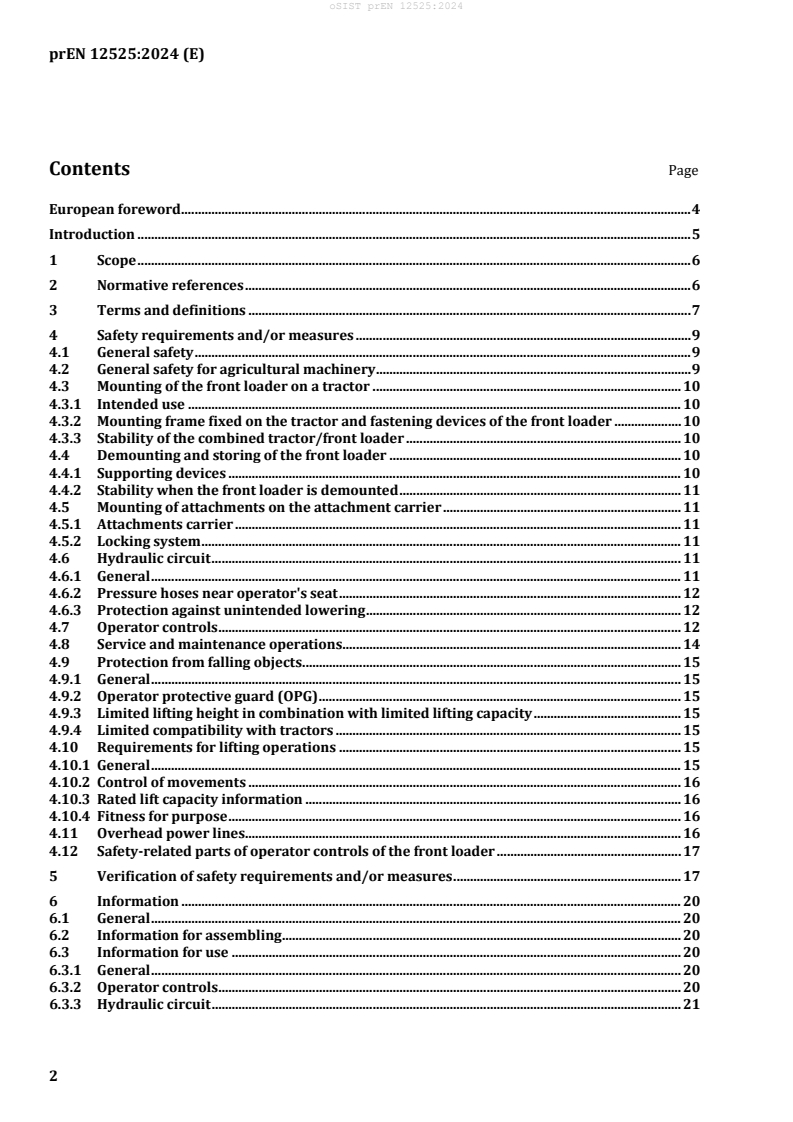
Contents Page
European foreword . 4
Introduction . 5
1 Scope . 6
2 Normative references . 6
3 Terms and definitions . 7
4 Safety requirements and/or measures . 9
4.1 General safety . 9
4.2 General safety for agricultural machinery . 9
4.3 Mounting of the front loader on a tractor . 10
4.3.1 Intended use . 10
4.3.2 Mounting frame fixed on the tractor and fastening devices of the front loader . 10
4.3.3 Stability of the combined tractor/front loader . 10
4.4 Demounting and storing of the front loader . 10
4.4.1 Supporting devices . 10
4.4.2 Stability when the front loader is demounted . 11
4.5 Mounting of attachments on the attachment carrier . 11
4.5.1 Attachments carrier . 11
4.5.2 Locking system . 11
4.6 Hydraulic circuit . 11
4.6.1 General . 11
4.6.2 Pressure hoses near operator's seat . 12
4.6.3 Protection against unintended lowering . 12
4.7 Operator controls . 12
4.8 Service and maintenance operations . 14
4.9 Protection from falling objects . 15
4.9.1 General . 15
4.9.2 Operator protective guard (OPG) . 15
4.9.3 Limited lifting height in combination with limited lifting capacity . 15
4.9.4 Limited compatibility with tractors . 15
4.10 Requirements for lifting operations . 15
4.10.1 General . 15
4.10.2 Control of movements . 16
4.10.3 Rated lift capacity information . 16
4.10.4 Fitness for purpose . 16
4.11 Overhead power lines . 16
4.12 Safety-related parts of operator controls of the front loader . 17
5 Verification of safety requirements and/or measures . 17
6 Information . 20
6.1 General . 20
6.2 Information for assembling . 20
6.3 Information for use . 20
6.3.1 General . 20
6.3.2 Operator controls . 20
6.3.3 Hydraulic circuit . 21
6.3.4 Mounting of lifting arms . 21
6.3.5 Demounting and storing of the front loader . 21
6.3.6 Mounting and demounting of attachments . 21
6.3.7 Use of the front loader . 22
6.3.8 Maintenance . 22
6.4 Marking . 23
6.5 Safety and instructional signs . 23
Annex A (normative) Stability of the tractor/front loader combination . 25
A.1 Effects on the stability . 25
A.2 Means to ensure stability . 25
Annex B (informative) Locking system . 27
Annex C (informative) Float position . 28
Annex D (normative) Test method and acceptance criteria for means to avoid unintended
lowering . 29
D.1 Test procedure . 29
D.2 Acceptance criteria . 29
Annex E (informative) Examples of the use of attachments suitable for the tasks to be
accomplished, and examples of misuse. . 30
Annex F (normative) Determination of maximum lifting capacity . 38
Annex G (normative) OPG validation . 39
G.1 OPG dimensions . 39
G.2 Structural integrity . 39
G.3 Test report . 40
Annex ZA (informative) Relationship between this European Standard and the essential
requirements of Directive 2006/42/EC aimed to be covered . 41
Annex ZB (informative) Relationship between this European Standard and the essential
requirements of Regulation (EU) 2023/1230 aimed to be covered. 45
Bibliography . 50
European foreword
This document (prEN 12525:2024) has been prepared by Technical Committee CEN/TC 144 “Tractors
and machinery for agriculture and forestry”, the secretariat of which is held by AFNOR.
This document is currently submitted to the CEN Enquiry.
This document will supersede EN 12525:2000+A2:2010.
This document has been prepared under a standardization request addressed to CEN by the European
Commission. The Standing Committee of the EFTA States subsequently approves these requests for its
Member States.
For the relationship with EU Legislation, see informative Annexes ZA and ZB, which are an integral part
of this document.
The main changes compared to the previous edition are as follows:
— new requirements about the risk of falling objects, including requirements for the allowed
combinations tractors-front loader to be specified in the operator’s manual;
— alignment to CEN Guide 414;
— new Figures 2 and 3, showing the controls arrangement which also allows the floating function for
bucket unload;
— this new edition is not a stand-alone standard, but it applies together with EN ISO 4254-1:2015 ;
— electromagnetic compatibility is now covered;
— new Annex F to determine the maximum lifting capacity;
— new requirements for lifting loads;
— Performance Levels required are now specified.
Introduction
This European Standard is a type C standard as defined in EN ISO 12100:2010.
The machinery concerned and the extent to which hazards, hazardous situations and events are covered
are indicated in the scope of this document. These hazards are specific to front loaders.
When provisions of this type C standard are different from those which are stated in type A or B
standards, the provisions of this type C standard take precedence over the provisions of the other
standards, for machines that have been designed and built according to the provisions of this type C
standard.
Hazards that are common to agricultural machines (self-propelled, mounted, semi-mounted and trailed)
are dealt with in EN ISO 4254-1:2015 .
EN 12525 provides requirements for front loaders in addition to those of EN ISO 4254-1:2015 .
This document is of relevance, in particular, for the following stakeholder groups representing the market
players with regard to machinery safety:
— machine manufacturers (small, medium and large enterprises);
— health and safety bodies (regulators, accident prevention organizations, market surveillance, etc.).
Others can be affected by the level of machinery safety achieved with the means of the document by the
above-mentioned stakeholder groups:
— machine users/employers (small, medium and large enterprises);
— machine users/employees (for example trade unions, organizations for people with special needs);
— service providers, for example for maintenance (small, medium and large enterprises);
— consumers (in case of machinery intended for use by consumers).
The above-mentioned stakeholder groups have been given the possibility to participate at the drafting
process of this document.
1 Scope
This document specifies safety requirements and their verification for the design and construction of
front loaders designed to be mounted on agricultural and forestry tractors (as defined in the Regulation
EU 167/2013).
It deals with all significant hazards, hazardous situations and events relevant to front loaders when used
as intended and under the conditions of misuse which are reasonably foreseeable. This includes hazards
related to the handling of unit loads during operations (for example, using bale forks), hazards related to
mounting/demounting the lifting arms to/from the frame mounted on the tractor, and also hazards
related to devices for mounting/demounting attachments to/from the lifting arms.
In addition, it specifies the type of information on safe working practices.
Hazards related to the mounted attachments with or without powered functions are excluded, as well as
hazards related to visibility and those related to the mobile elevating work platform applications to a
front loader, because the front loader is not designed to lift and/or transport people. Front loaders with
fully or partially self-evolving behaviour or logic and/or with varying levels of autonomy are also
excluded.
Environmental aspects, other than noise, have not been considered in this document.
This document is not applicable to front loaders which are manufactured before the date of its publication
as EN.
2 Normative references
The following documents are referred to in the text in such a way that some or all of their content
constitutes requirements of this document. For dated references, only the edition cited applies. For
undated references, the latest edition of the referenced document (including any amendments) applies.
EN ISO 4254-1:2015, Agricultural machinery - Safety - Part 1: General requirements (ISO 4254-1:2013)
EN ISO 12100:2010, Safety of machinery — General principles for design — Risk assessment and risk
reduction
EN ISO 13849-1:2023, Safety of machinery - Safety-related parts of control systems - Part 1: General
principles for design (ISO 13849-1:2023)
EN ISO 14982-1:—, Agricultural and forestry machinery — Electromagnetic compatibility — Part 1:
General EMC requirements
EN ISO 14982-2:—, Agricultural and forestry machinery — Electromagnetic compatibility — Part 2:
Additional EMC requirements for functional safety
As impacted by EN ISO 4254-1:2015/A1:2021.
Under preparation. Stage as of June 2024: prEN ISO 14982-1:2021 (ISO/FDIS 14982-1 - FDIS/Formal Vote to be
started).
Under preparation. Stage as of June 2024: prEN ISO 14982-2:2021 (ISO/FDIS 14982-2 - FDIS/Formal Vote to be
started ).
EN ISO 25119-1:2023, Tractors and machinery for agriculture and forestry - Safety-related parts of
control systems - Part 1: General principles for design and development (ISO 25119-1:2018)
EN ISO 25119-2:2023, Tractors and machinery for agriculture and forestry - Safety-related parts of control
systems - Part 2: Concept phase (ISO 25119-2:2019)
EN ISO 25119-3:2023, Tractors and machinery for agriculture and forestry - Safety-related parts of
control systems - Part 3: Series development, hardware and software (ISO 25119-3:2018)
EN ISO 25119-4:2023, Tractors and machinery for agriculture and forestry - Safety-related parts of
control systems - Part 4: Production, operation, modification and supporting processes (ISO 25119-4:2018)
ISO 3600:2022, Tractors, machinery for agriculture and forestry, powered lawn and garden equipment -
Operator’s manuals - Content and format
ISO 3767-2:2016, Tractors, machinery for agriculture and forestry, powered lawn and garden equipment
— Symbols for operator controls and other displays — Part 2: Symbols for agricultural tractors and
machinery
ISO 10448:2021, Agricultural tractors — Hydraulic pressure for implements
ISO 11684:2023, Tractors, machinery for agriculture and forestry, powered lawn and garden equipment-
Safety labels — General principles
3 Terms and definitions
For the purposes of this document, the terms and definitions given in EN ISO 12100:2010 apply.
ISO and IEC maintain terminology databases for use in standardization at the following addresses:
— IEC Electropedia: available at https://www.electropedia.org/
— ISO Online browsing platform: available at https://www.iso.org/obp/
3.1
front loader
unit consisting of non-telescopic lifting arms and fastening devices designed to be mounted on a frame
on the front of a tractor and equipped with a basic attachment and which may mount other types of
allowable attachments
Note 1 to entry See Figure 1.
As impacted by EN ISO 25119-1:2023/A1:2023.
As impacted by EN ISO 25119-3:2023/A1:2023.
As impacted by EN ISO 25119-4:2023/A1:2023.
As impacted by ISO 3767-2:2016/AMD 1:2020.
3.2
basic attachment
working attachment, without powered functions, to be mounted on a front loader
EXAMPLE Bucket, pallet fork or bale spear.
Note 1 to entry: This is used to perform the conformity assessment of the front loader.
3.3
allowable attachment
working attachment, with or without powered functions, to be mounted on a front loader according to
the front loader instructions, which replaces the basic attachment(s)
3.4
attachment without powered functions
attachment where there are no movements or functions actuated by power other than directly applied
manual effort
Note 1 to entry: See Figure 1.
3.5
attachment with powered functions
attachment where there is at least one movement or function, as part of the attachment, which is actuated
by power other than directly applied manual effort
3.6
supporting device
device for supporting the lifting arms in a stable condition when it is demounted from the tractor
Note 1 to entry: For example, for storage, see Figure 1.
3.7
operator controls of the front loader
control equipment supplied with the front loader to enable the loader and attachments to be operated
from the driving position of the tractor
3.8
locking system
mechanical system which engages with and retains the attachment enabling it to perform its intended
function
3.9
float position
position of operator control(s) that allows the actuator (for example hydraulic cylinders) free movement
triggered by external forces (for example gravity, unevennes of the ground, etc.)
Note 1 to entry: See Annex C.
3.10
Operator Protective Guard
OPG
fixed or self-adjusting guard designed to protect the operator from a unit load that may fall from the
attachment and/or roll along the lifting arms of the front loader
Note 1 to entry: See Annex G.
Key
1 example of basic attachment
2 attachment carrier
3 lifting arms
4 supporting devices
5 fastening devices
6 mounting frame (fixed on the tractor)
7 attachment pivot point
Figure 1 — Front loader
3.11
failure-simulating device
hydraulic valve(s) used for simulating a hydraulic line rupture in the front loader circuit
3.12
test load
mass (50 ± 10) % of the maximum lifting capacity determined according to Annex F
4 Safety requirements and/or measures
4.1 General safety
Front loader shall comply with the safety requirements and/or protective measures of this clause. In
addition, it shall be designed according to the principles of EN ISO 12100:2010 for hazards relevant but
not significant, which are not dealt with by this document.
4.2 General safety for agricultural machinery
Except where otherwise specified in this document, the front loader shall be designed in accordance with
EN ISO 4254-1:2015 .
4.3 Mounting of the front loader on a tractor
4.3.1 Intended use
The front loader shall be designed for specific model(s) of tractor(s), taking into account the specific
technical characteristics of the tractor(s) and the intended use of the combined unit. The tractor(s) which
is (are) suitable for the mounting and use with the front loader shall be clearly identified in the front
loader’s operator’s manual or be accessible from it, in terms of specific tractor model(s) or specifying the
range of all the needed technical features. See also 4.9.
4.3.2 Mounting frame fixed on the tractor and fastening devices of the front loader
The design of the mounting frame and its fastening devices intended for use with front loaders that are
demountable and have supporting devices:
— shall allow the operator alone to mount and demount the front loader,
— shall take ergonomic principles for the engagement system into account,
— shall indicate that the front loader is safely connected, once it has been locked, or the locking
mechanism cannot be engaged unless the front loader is correctly mounted,
— shall not disengage unintentionally by use or by failure of the engagement system. This requirement
can be met for example by use of a locking system.
The operator’s manual shall indicate the operation(s) and/or manoeuvre(s) to make, before using the
front loader, in order to confirm that mounting is properly made according to 6.3.4.
4.3.3 Stability of the combined tractor/front loader
4.3.3.1 General
The stability of the combined tractor/front loader is dependent on the range and capacity of the
attachment with or without powered functions, on the arrangement of the front loader on the tractor and
on the type of tractor. Improvements in stability can be achieved by fitting a counterweight to the rear of
the tractor or ballasting the rear wheels and observing limits to driving and operating conditions.
4.3.3.2 Longitudinal static stability
For ensuring a sufficient longitudinal static stability the counterweight to be fitted shall be determined
according to Annex A.
4.3.3.3 Longitudinal dynamic stability
Specific instructions shall be provided regarding the longitudinal dynamic stability while the tractor is
travelling in the operator’s manual according to 6.3.6.
4.3.3.4 Lateral stability during lifting
Specific instructions shall be provided regarding the lateral stability during lifting in the operator’s
manual according to 6.3.7.
4.4 Demounting and storing of the front loader
4.4.1 Supporting devices
Devices shall be provided to support the demounted lifting arms when stored on the ground. They shall:
— be so designed that the strength of the structure is able to hold the weight of the lifting arms and of
the heaviest allowable attachment with or without powered functions, under the conditions specified
in 4.4.2;
— have a supporting surface area which exerts a ground pressure of not more than 400 kPa. This
requirement shall be met with any allowable attachment in the lowered position;
— have a locking device to prevent inadvertent lowering and creation of drawing-in or trapping hazards
at the supporting devices themselves;
— be available at any time when demounting the lifting arms. They shall be attached to the lifting arms
or stored separately from the front loader somewhere on the vehicle. When the supporting devices
are stored on the vehicle, a dedicated storage solution shall be provided.
The supporting devices shall be so designed that they can be fastened and have their height adjusted by
the operator standing beside the lifting arms or sitting on the seat of the tractor.
4.4.2 Stability when the front loader is demounted
When the front loader is standing demounted using supporting devices on horizontal, firm ground in
configuration(s) and position defined in the operator’s manual, the configuration(s) shall be capable of
resisting a force of 400 N applied in any direction, without tilting.
NOTE A configuration can be the front loader with or without an attachment mounted.
The configuration(s) as recommended in the operator's manual shall also fulfill EN ISO 4254-1:2015 ,
6.2.1.1.
If the recommended configuration(s) requires a minimum weight of an attachment, the weight shall be
stated in the operator’s manual.
4.5 Mounting of attachments on the attachment carrier
4.5.1 Attachments carrier
The device shall be so designed that mounting and demounting of an attachment can be done by the
operator alone.
4.5.2 Locking system
The locking system for allowable attachments shall not unintentionally be disengaged, by use of the
attachment or by failure of the locking system, under any operating conditions. This requirement can, for
example, be met by use of a locking valve in a hydraulic system or a spring load that generates a positive
force on the locking system.
It shall be possible to check the position of the locking system (open/close) from the driving position of
the tractor (see Annex B for an example). This is not required to be possible at all front loader positions.
4.6 Hydraulic circuit
4.6.1 General
EN ISO 4254-1:2015 , 4.13, shall apply.
The system shall be so designed that it can transmit the full hydraulic power of the tractor or have the
incoming hydraulic power limited by a pressure limiting valve supplied with the front loader.
If the setting pressure of the hydraulic circuit is not known, then the pressure requirements of
ISO 10448:2021 shall apply.
The maximum lifting capacity shall be determined according to Annex F.
4.6.2 Pressure hoses near operator's seat
Unprotected pressure hoses having a pressure of more than 5 MPa (50 bar) shall be located at a distance
greater than 1 m from the operator in his normal driving position. Hoses shall be protected in such a way
that, in the case of failure, the operator cannot be reached by liquid at a temperature of more than 50 °C.
4.6.3 Protection against unintended lowering
If the front loader is also designed for operations requiring the presence of a person near to the load when
the front loader is in the raised position, the hydraulic lifting arm cylinder(s) shall be equipped with a
safety device according to Annex D to avoid unintentional lowering of the lifting arm. That safety device
shall remain active in case of failure of the control circuit’s energy supply.
If this safety device can be activated or deactivated for operations that do not require the presence of a
person near to the load the following additional requirements apply:
— it shall be possible to activate or to deactivate the safety device from the operator station;
— operator control to deactivate the safety device shall be designed and located so that it cannot be
actuated unintentionally by the operator;
— current state (active or deactivated) of the safety device shall be clearly indicated and clearly visible
from the operator’s position and from the loading area.
The correct method of operation including warnings shall be explained in the operator’s manual in
accordance with 6.3.2.
The front loader shall be equipped with a mandatory sign indicating that the safety device shall be
activated for operations requiring presence of a person near the load (see 6.5).
The information for use of front loaders which are not designed for operations requiring the presence of
a person near to the load when the front loader is in the raised position shall comply with 6.3.7 and 6.5.
4.7 Operator controls
Control movements of the lifting arms, the attachments carrier and the powered functions of the
attachments shall be of the hold-to-run type, except float positions and the attachments’ powered
functions that are designed to be continuous (for example sweepers, sand spreading buckets, etc.). The
float position of the lowering or the dumping can only be engaged after actuating the lowering of the front
loader or dumping of the attachment respectively (see Figures 2 and 3).
The controls shall be designed and arranged so that they are:
— accessible and recognizable;
— marked on or near the control according to Figures 2 or 3. Other control symbols where not specified
as above shall conform to ISO 3767-2:2016 .
Unintentional operation of the front loader controls shall be prevented by:
— positively isolating the controls from the hydraulic supply so they cannot be used (for example, the
controls are normally disabled and in order to use them, it is first necessary to give consent through
a separate control); or
— locking of the controls so they cannot be operated (for example with a mechanical or electronical
locking system); or
— the arrangement and design of the controls (for example by recessing fingertip controls).
If the internal controls of the tractor can be used to operate the front loader, then all the necessary
information about this shall be provided in the operator’s manual.
Operator controls of the front loader which are managed electronically, shall fulfil EN ISO 14982-1:—
and EN ISO 14982-2:— . This requirement is not applicable if internal controls of the tractor can be used
to operate the front loader.
Figure 2 — Layout and marking two-lever control or one change-over lever control, on the right
of the seat
Key
1 front loader
2 seat
Figure 3— Layout and marking single-lever control in both possible cases, on the left and on the
right of the seat
4.8 Service and maintenance operations
During maintenance, it shall be possible to prevent inadvertent lowering of the raised lifting arms.
Mechanical supports or hydraulic locking devices shall be provided in accordance with
EN ISO 4254-1:2015 , 4.11.1.1 in order to enable maintenance and service operations to be carried out
by the operator under raised parts of the lifting arms.
It shall be possible to operate the hydraulic locking or mechanical supporting devices without the
operator having to stand in, or reach into, the moving range of the lifting arms and attachment. When the
, 4.11.1.4 shall apply.
supports are manually operated, EN ISO 4254-1:2015
The hydraulic locking devices shall be positioned on the hydraulic cylinder or in the lines leading to the
hydraulic cylinder.
Mechanical supports shall withstand at least 1,5 times the mass of the front loader.
Mounting and demounting of the lifting arms on the tractor and of allowable attachments on the lifting
arms shall be designed to be accomplished by the operator alone.
EN ISO 4254-1:2015 , 4.17.2 shall apply.
Hoisting points shall be provided on the lifting arms in accordance with EN ISO 4254-1:2015 , 4.17.4, and
shall be clearly marked and located at the point of balance.
NOTE Hoisting points can either be a hook or a ring attached to the arm, a cut-out in the arm, or a suitable place
to fix a rope.
4.9 Protection from falling objects
4.9.1 General
The operator shall be protected against the risks of objects falling or sliding from the attachment towards
the operator station.
This requirement shall be fulfilled by at least one of the alternatives given in 4.9.2, or 4.9.3, or 4.9.4.
4.9.2 Operator protective guard (OPG)
An operator protective guard (OPG) shall be fitted on the front loader.
The OPG shall:
— comply with Annex G, and
— be permanently fixed to the front loader or be removable only with tools.
When the OPG is fitted on the front loader, the whole device (front loader with OPG) shall comply with
4.4.2.
When the front loader is equipped with OPG, the front loader can be installed on tractors having all
possible configurations of ROPS, including 2-posts ROPS. This shall be stated in the operator’s manual of
the front loader.
4.9.3 Limited lifting height in combination with limited lifting capacity
The maximum height of the attachment pivot point allowed by design shall not exceed the 110 % of the
height of the attachment pivot point from the ground.
The maximum lifting capacity, determined according to Annex F, shall not exceed 400 kg.
When the front loader has a limited lifting height in combination with limited lifting capacity according
to this clause, the front loader can be installed on tractors having all possible configurations of ROPS,
including 2-posts ROPS.
This shall be stated in the operator’s manual of the front loader.
4.9.4 Limited compatibility with tractors
If the front loader is not equipped with any of the systems specified in 4.9.2, 4.9.3, then to fulfil 4.9.1 the
operator’s manual of the front loader shall specify that the front loader can only be installed on tractors
having
— a ROPS cab, or
— a four-posts ROPS having the distance between the posts in front of the driving position not greater
than 1 200 mm, measured along at least one horizontal line. This line shall be vertically located
between 0 mm and 600 mm from the tractor’s hood.
4.10 Requirements for lifting operations
4.10.1 General
The following requirements shall apply only in case the front loader is equipped, or intended to be
equipped, with an attachment to move unit loads (for example, bale forks); they shall not apply if the
front loader is only intended to be equipped with attachments to move bulk material (for example,
bucket).
4.10.2 Control of movements
The front loader shall be designed to avoid the uncontrolled descent of the lifting arms in case of failure
of the hydraulic power supply, and in case of normal stop of the operations controlled by the operator.
Hydraulic hoses shall be protected as far as possible from tearing out by a falling object.
4.10.3 Rated lift capacity information
Rated lift capacity information shall be provided for front loaders configured for lifting operations as
intended in the operator’s manual. The information shall be legible, durable, and in a prominent position,
readable by the operator from the operator’s position. The rated lift capacity information shall also be in
the operator’s manual. The rated lift capacity information may be provided for example by a film/decal,
electronically by a monitor, or a table or flip chart affixed in a prominent position.
4.10.4 Fitness for purpose
4.10.4.1 General
As a general rule, static and dynamic tests shall be carried out on each front loader after it has been
assembled and before it is first put into service. For machinery produced in series, where the production
techniques employed and the application of a duly documented quality control system make it possible
to guarantee that every machine produced will have identical characteristics when fully assembled, static
or dynamic tests on adequate samples of the machinery can be considered as fulfilling this requirement.
Test load Q1 is defined as the rated maximum lifting capacity of the front loader, determined according
to Annex F.
4.10.4.2 Static tests
The purpose of the static test is to demonstrate the overall structural integrity in static conditions of the
front loader. Front loaders shall be tested on firm level ground at 125 % of Q1 in the respective position.
The front loader shall be considered as passing the test if the test load is supported for 10 min without
permanent deformation or patent defect.
4.10.4.3 Dynamic tests
The purpose of the dynamic test is to demonstrate the overall structural integrity in dynamic condition
of the front loader. Front loaders shall be tested at 110 % of Q1 in a range of movements (for example
lifting, reaching) at maximum lifting speed. The machine shall be considered as passing the test if the test
is completed without permanent deformation or patent defect.
4.11 Overhead power lines
NOTE If the maximum lifting height of the front loader is lower than 4 m, the risk of contact with overhead
power lines is considered not relevant.
To avoid the risk of contact with overhead power lines for the front loaders which have a maximum lifting
height (identified as point 3 in Annex F) greater or equal to 4m, the following requirements apply:
— the operator’s manual shall give specific instructions;
— a safety sign shall be provided on the front loader, clearly visible when entering the operator station.
4.12 Safety-related parts of operator controls of the front loader
Safety-related parts of the operator controls of the front loader that perform the relevant safety function
shall achieve the Performance Level required (PLr) specified in Table 2, according to
4 5
EN ISO 13849-1:2023 and/or EN ISO 25119-1:2023 , EN ISO 25119-2:2023, EN ISO 25119-3:2023 ,
EN ISO 25119-4:2023 .
Table 2 — Performance levels required for safety-related parts of the operator controls of the
front loader
Paragraph of this standard PLr (1) AgPLr (2)
4.3.2 (locking of the engagement to the tractor, if electronically controlled) c c
4.3.2 (indication of the safe connection, if electronically controlled) b b
4.5.2 (locking system of the attachment, if electronically controlled) c c
4.6.3 (safety device for operations which require the presence of a person c c
near to the load when lifted, if electronically controlled)
4.7 (Controls, only if provided directly by front loader manufacturer) c c
4.9.3 (levelling system with tilt limitation) c c
4.10.2 (control of movements, if electronically controlled) c c
(1) as defined in EN ISO 13849-1:2023;
4 5
(2) as defined in EN ISO 25119-1:2023 , EN ISO 25119-2:2023, EN ISO 25119-3:2023 ,
EN ISO 25119-4:2023
Additional functions shall be implemented according to EN ISO 13849-1:2023 or EN ISO 25119-1:2023 ,
5 6
EN ISO 25119-2:2023, EN ISO 25119-3:2023 , EN ISO 25119-4:2023 , and require specific risk analysis
and definition of appropriate performance level.
5 Verification of safety requirements and/or measures
The requirements shall be verified according to Table 3. When in a row more than one box is ticked, it
shall be intended that all the corresponding verification mean apply, unless otherwise specified.
Table 3 — Verification
a b
Clause of Inspection Measurement Test Design Procedure/reference
c
this verification
document
4.3.1 X X Check the technical features of
the front loader.
Inspect (read) the operator’s
manual.
4.3.2 X X Check the technical features of
the front loader.
Inspect (read) the operator’s
manual.
a b
Clause of Inspection Measurement Test Design Procedure/reference
c
this verification
document
4.3.3 X Inspect (read) the operator’s
manual.
4.4.1 X X X Check the technical features of
the front loader.
Measure the supporting
surface area to calculate the
ground pressure.
Inspect (read)
...