


kSIST FprEN 2002-002:2025
(Main)Aerospace series - Metallic materials - Test methods - Part 2: Tensile testing at elevated temperature
Aerospace series - Metallic materials - Test methods - Part 2: Tensile testing at elevated temperature
This document is applicable to the tensile testing and specifies the requirements of metallic materials at elevated temperature for aerospace applications.
It is applied when referred to in the EN technical specification or material standard unless otherwise specified on the drawing, order or inspection schedule.
Luft- und Raumfahrt - Metallische Werkstoffe - Prüfverfahren - Teil 002: Zugversuch bei Hochtemperatur
No Scope available
Série aérospatiale - Matériaux métalliques - Méthodes d’essais applicables - Partie 2 : Essais de traction à temperature élevée
Le présent document est applicable aux essais de traction et spécifie les exigences relatives aux matériaux métalliques à température ambiante pour les applications aérospatiales.
Il est applicable lorsqu'il est cité en référence dans la spécification technique ou la norme de matériau EN, sauf spécification contraire figurant sur le dessin, la commande ou la fiche d'essais.
Aeronavtika - Kovinski materiali - Preskusne metode - 2. del: Natezni preskus pri povišani temperaturi
General Information
- Status
- Not Published
- Public Enquiry End Date
- 26-Nov-2024
- Technical Committee
- I13 - Imaginarni 13
- Current Stage
- 5020 - Formal vote (FV) (Adopted Project)
- Start Date
- 03-Dec-2025
- Due Date
- 21-Jan-2026
- Completion Date
- 03-Dec-2025
Relations
- Effective Date
- 19-Jan-2023
Overview
The kSIST FprEN 2002-002:2025:2024 standard, developed by CEN, specifies the test methods for tensile testing of metallic materials at elevated temperatures tailored for aerospace applications. This standard applies to ferrous and non-ferrous alloys and is part of the aerospace series of metallic material standards aimed at ensuring material performance and safety in demanding aerospace environments. It governs the procedures, requirements, and reporting related to tensile tests performed at high temperatures, thereby contributing to the reliability and durability of aerospace components.
Key Topics
Scope & Application:
This document outlines tensile testing requirements for metallic materials under elevated temperature conditions, mainly for aerospace use. It is applicable where referenced in EN technical or material standards, drawings, or inspection schedules.Test Sample Specifications:
Defines shapes, dimensions, and preparation methods of test pieces, including sheets, strips, bars, tubes, and wires with varying thicknesses and diameters.Testing Equipment & Personnel:
Standard mandates the use of calibrated tensile testing machines, extensometers, thermocouples for temperature measurement, and qualified personnel to perform tests correctly.Testing Procedures:
- Determining original cross-sectional area and gauge lengths
- Use of appropriate gripping and extensometer attachment methods
- Control and monitoring of test temperature
- Specified test speeds to ensure reproducible results
- Calculation of mechanical properties like Young’s modulus, proof stress, tensile strength, elongation, and reduction of area after fracture
Terminology & Definitions:
Clarifies key terms such as proportional and non-proportional test pieces, gauge length, tensile strength (Rm), proof stress (Rp), elongation (A), and reduction of area (Z). The definitions align with EN 4259 and ISO standards, ensuring consistent interpretation.Safety Considerations:
Emphasizes compliance with local health and safety regulations, handling of hazardous materials, and safe operation of testing equipment.Reporting Requirements:
The standard specifies comprehensive test reporting protocols to document test conditions, equipment, sample details, test results, and any deviations or observations.
Applications
The kSIST FprEN 2002-002:2025 standard plays a critical role in:
Aerospace Materials Certification:
Ensuring metallic alloys used in aircraft structures, engines, and components maintain mechanical integrity at elevated operating temperatures.Material Development and Quality Control:
Helping manufacturers validate the tensile properties of new or existing alloys to meet aerospace performance requirements.Regulatory Compliance:
Providing a harmonized testing framework referenced by aerospace suppliers and regulatory bodies to guarantee material traceability and safety.Research and Engineering:
Supporting engineers and metallurgists in understanding material behavior under thermal stresses encountered during flight or engine operation.
Related Standards
kSIST FprEN 2002-002:2025 is part of a broader series of aerospace metallic material standards and references key normative documents:
- EN 4259: Aerospace series - Metallic materials - Definition of general terms
- EN 60584-2: Thermocouples - Part 2: Tolerances
- EN ISO 7500-1: Metallic materials - Calibration and verification of static uniaxial testing machines (tension/compression)
- EN ISO 9513: Metallic materials - Calibration of extensometer systems used in uniaxial testing
These interconnected standards collectively provide a comprehensive framework for material testing, calibration, and terminology to ensure precision and uniformity in aerospace materials characterization.
By conforming to kSIST FprEN 2002-002:2025:2024, aerospace manufacturers and testing laboratories can reliably assess the tensile behavior of metallic materials at elevated temperatures. This ensures materials not only meet stringent aerospace quality and safety criteria but also enhances durability and performance during critical high-temperature service conditions.

Frequently Asked Questions
kSIST FprEN 2002-002:2025 is a draft published by the Slovenian Institute for Standardization (SIST). Its full title is "Aerospace series - Metallic materials - Test methods - Part 2: Tensile testing at elevated temperature". This standard covers: This document is applicable to the tensile testing and specifies the requirements of metallic materials at elevated temperature for aerospace applications. It is applied when referred to in the EN technical specification or material standard unless otherwise specified on the drawing, order or inspection schedule.
This document is applicable to the tensile testing and specifies the requirements of metallic materials at elevated temperature for aerospace applications. It is applied when referred to in the EN technical specification or material standard unless otherwise specified on the drawing, order or inspection schedule.
kSIST FprEN 2002-002:2025 is classified under the following ICS (International Classification for Standards) categories: 49.025.05 - Ferrous alloys in general; 49.025.15 - Non-ferrous alloys in general. The ICS classification helps identify the subject area and facilitates finding related standards.
kSIST FprEN 2002-002:2025 has the following relationships with other standards: It is inter standard links to SIST EN 2002-002:2006. Understanding these relationships helps ensure you are using the most current and applicable version of the standard.
kSIST FprEN 2002-002:2025 is available in PDF format for immediate download after purchase. The document can be added to your cart and obtained through the secure checkout process. Digital delivery ensures instant access to the complete standard document.
Standards Content (Sample)
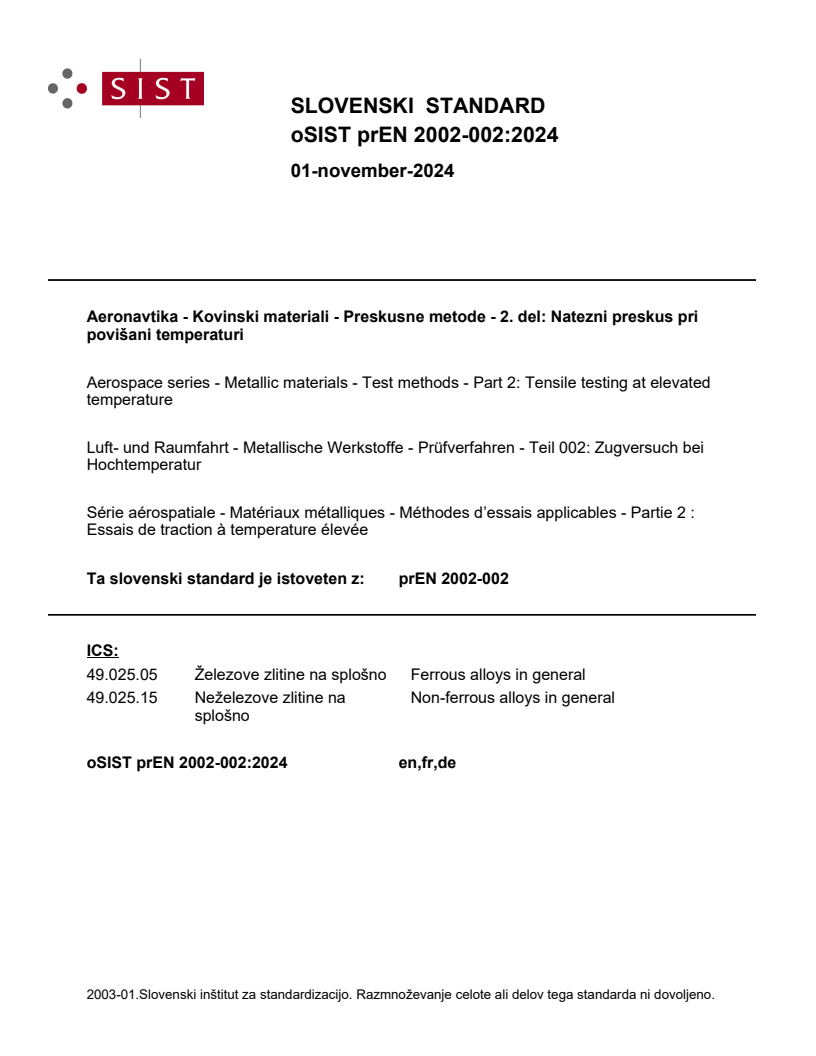
SLOVENSKI STANDARD
oSIST prEN 2002-002:2024
01-november-2024
Aeronavtika - Kovinski materiali - Preskusne metode - 2. del: Natezni preskus pri
povišani temperaturi
Aerospace series - Metallic materials - Test methods - Part 2: Tensile testing at elevated
temperature
Luft- und Raumfahrt - Metallische Werkstoffe - Prüfverfahren - Teil 002: Zugversuch bei
Hochtemperatur
Série aérospatiale - Matériaux métalliques - Méthodes d’essais applicables - Partie 2 :
Essais de traction à temperature élevée
Ta slovenski standard je istoveten z: prEN 2002-002
ICS:
49.025.05 Železove zlitine na splošno Ferrous alloys in general
49.025.15 Neželezove zlitine na Non-ferrous alloys in general
splošno
oSIST prEN 2002-002:2024 en,fr,de
2003-01.Slovenski inštitut za standardizacijo. Razmnoževanje celote ali delov tega standarda ni dovoljeno.
oSIST prEN 2002-002:2024
oSIST prEN 2002-002:2024
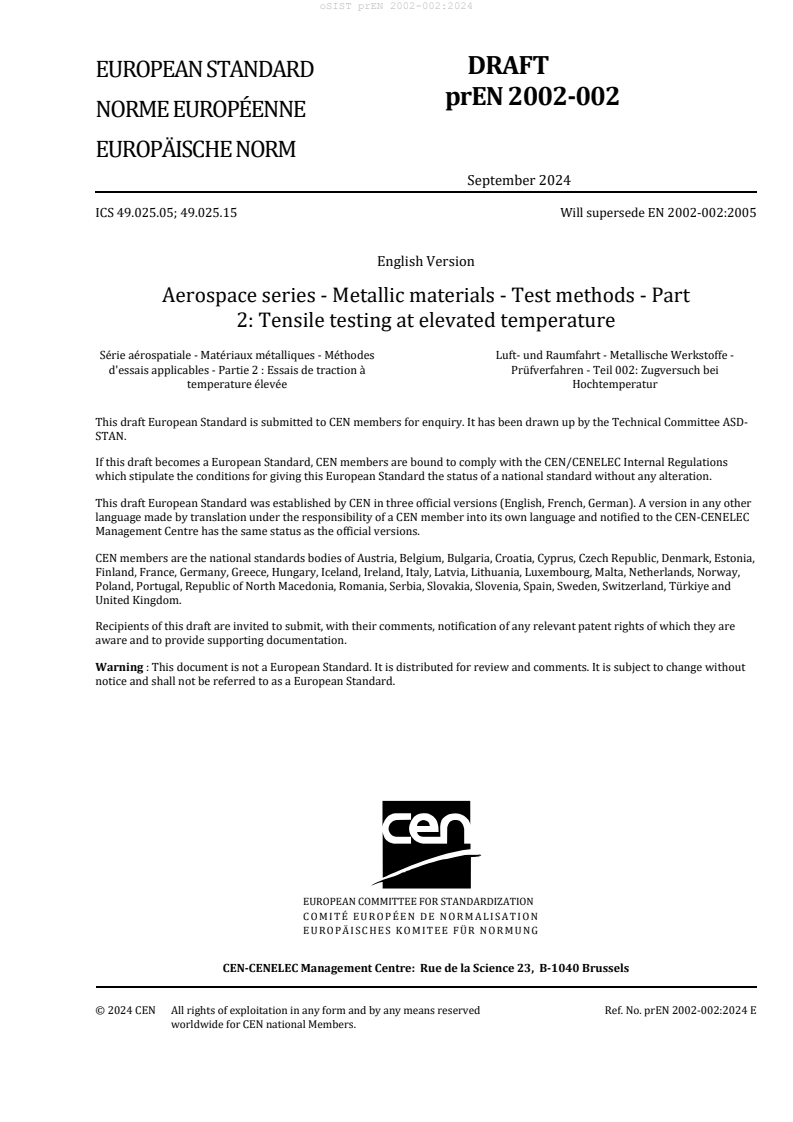
DRAFT
EUROPEAN STANDARD
prEN 2002-002
NORME EUROPÉENNE
EUROPÄISCHE NORM
September 2024
ICS 49.025.05; 49.025.15 Will supersede EN 2002-002:2005
English Version
Aerospace series - Metallic materials - Test methods - Part
2: Tensile testing at elevated temperature
Série aérospatiale - Matériaux métalliques - Méthodes Luft- und Raumfahrt - Metallische Werkstoffe -
d'essais applicables - Partie 2 : Essais de traction à Prüfverfahren - Teil 002: Zugversuch bei
temperature élevée Hochtemperatur
This draft European Standard is submitted to CEN members for enquiry. It has been drawn up by the Technical Committee ASD-
STAN.
If this draft becomes a European Standard, CEN members are bound to comply with the CEN/CENELEC Internal Regulations
which stipulate the conditions for giving this European Standard the status of a national standard without any alteration.
This draft European Standard was established by CEN in three official versions (English, French, German). A version in any other
language made by translation under the responsibility of a CEN member into its own language and notified to the CEN-CENELEC
Management Centre has the same status as the official versions.
CEN members are the national standards bodies of Austria, Belgium, Bulgaria, Croatia, Cyprus, Czech Republic, Denmark, Estonia,
Finland, France, Germany, Greece, Hungary, Iceland, Ireland, Italy, Latvia, Lithuania, Luxembourg, Malta, Netherlands, Norway,
Poland, Portugal, Republic of North Macedonia, Romania, Serbia, Slovakia, Slovenia, Spain, Sweden, Switzerland, Türkiye and
United Kingdom.
Recipients of this draft are invited to submit, with their comments, notification of any relevant patent rights of which they are
aware and to provide supporting documentation.
Warning : This document is not a European Standard. It is distributed for review and comments. It is subject to change without
notice and shall not be referred to as a European Standard.
EUROPEAN COMMITTEE FOR STANDARDIZATION
COMITÉ EUROPÉEN DE NORMALISATION
EUROPÄISCHES KOMITEE FÜR NORMUNG
CEN-CENELEC Management Centre: Rue de la Science 23, B-1040 Brussels
© 2024 CEN All rights of exploitation in any form and by any means reserved Ref. No. prEN 2002-002:2024 E
worldwide for CEN national Members.
oSIST prEN 2002-002:2024
prEN 2002-002:2024 (E)
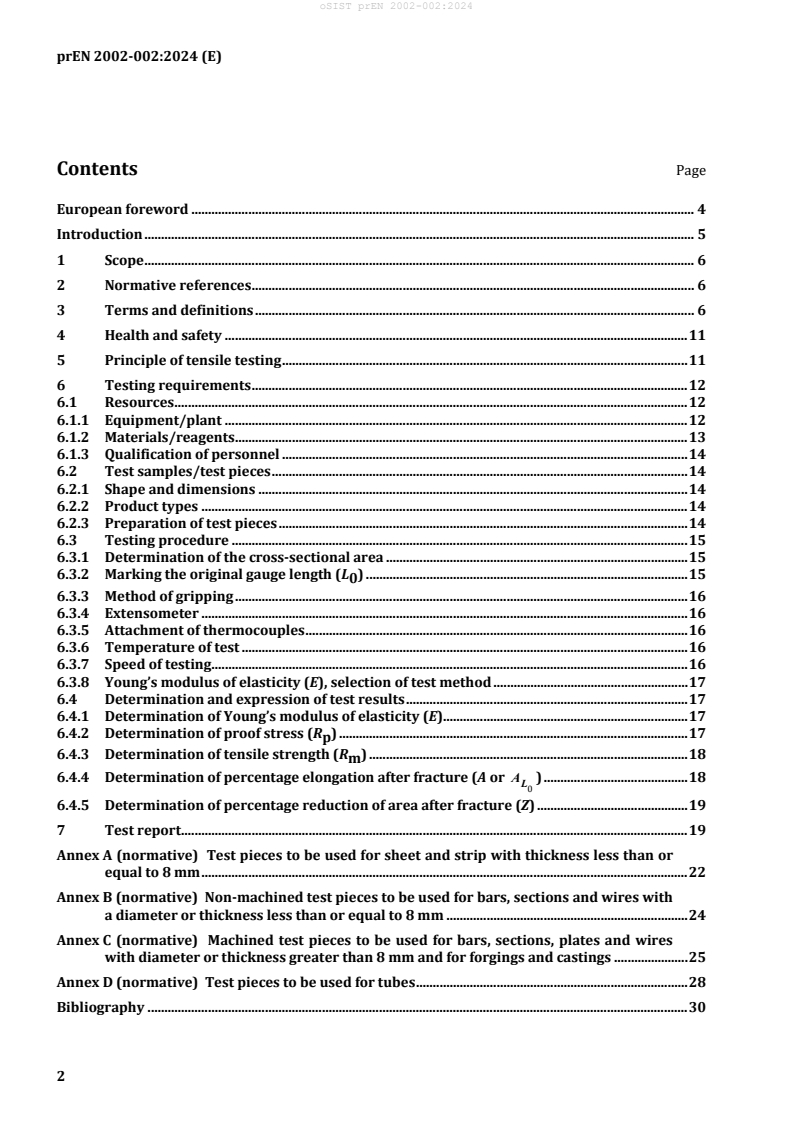
Contents Page
European foreword . 4
Introduction . 5
1 Scope . 6
2 Normative references . 6
3 Terms and definitions . 6
4 Health and safety . 11
5 Principle of tensile testing . 11
6 Testing requirements . 12
6.1 Resources . 12
6.1.1 Equipment/plant . 12
6.1.2 Materials/reagents . 13
6.1.3 Qualification of personnel . 14
6.2 Test samples/test pieces . 14
6.2.1 Shape and dimensions . 14
6.2.2 Product types . 14
6.2.3 Preparation of test pieces . 14
6.3 Testing procedure . 15
6.3.1 Determination of the cross-sectional area . 15
6.3.2 Marking the original gauge length (L ) . 15
6.3.3 Method of gripping . 16
6.3.4 Extensometer . 16
6.3.5 Attachment of thermocouples . 16
6.3.6 Temperature of test . 16
6.3.7 Speed of testing . 16
6.3.8 Young’s modulus of elasticity (E), selection of test method . 17
6.4 Determination and expression of test results . 17
6.4.1 Determination of Young’s modulus of elasticity (E) . 17
6.4.2 Determination of proof stress (R ) . 17
p
6.4.3 Determination of tensile strength (R ) . 18
m
6.4.4 Determination of percentage elongation after fracture (A or A ) . 18
L
6.4.5 Determination of percentage reduction of area after fracture (Z) . 19
7 Test report . 19
Annex A (normative) Test pieces to be used for sheet and strip with thickness less than or
equal to 8 mm . 22
Annex B (normative) Non-machined test pieces to be used for bars, sections and wires with
a diameter or thickness less than or equal to 8 mm . 24
Annex C (normative) Machined test pieces to be used for bars, sections, plates and wires
with diameter or thickness greater than 8 mm and for forgings and castings . 25
Annex D (normative) Test pieces to be used for tubes . 28
Bibliography . 30
oSIST prEN 2002-002:2024
prEN 2002-002:2024 (E)
oSIST prEN 2002-002:2024
prEN 2002-002:2024 (E)
European foreword
This document (prEN 2002-002:2024) has been prepared by ASD-STAN.
After enquiries and votes carried out in accordance with the rules of this Association, this document has
received the approval of the National Associations and the Official Services of the member countries of
ASD-STAN, prior to its presentation to CEN.
This document is currently submitted to the CEN Enquiry.
This document will supersede EN 2002-002:2005.
The main changes with respect to the previous edition are as follows:
— EN 2002-002 (P4), 11/2005 — General editorial improvements and XXX.
oSIST prEN 2002-002:2024
prEN 2002-002:2024 (E)
Introduction
This document is part of the series of EN metallic material standards for aerospace applications.
The general organization of this series is described in EN 4258.
oSIST prEN 2002-002:2024
prEN 2002-002:2024 (E)
1 Scope
This document specifies the requirements for the tensile testing of metallic materials at elevated
temperature for aerospace applications.
It is applied when referred to in the EN technical specification or material standard unless otherwise
specified on the drawing, order or inspection schedule.
2 Normative references
The following documents are referred to in the text in such a way that some or all of their content
constitutes requirements of this document. For dated references, only the edition cited applies. For
undated references, the latest edition of the referenced document (including any amendments) applies.
EN 4259, Aerospace series — Metallic materials — Definition of general terms
EN 60584-2, Thermocouples — Part 2: Tolerances
EN ISO 7500-1, Metallic materials — Calibration and verification of static uniaxial testing machines —
Part 1: Tension/compression testing machines — Calibration and verification of the force-measuring
system (ISO 7500-1)
EN ISO 9513, Metallic materials — Calibration of extensometer systems used in uniaxial testing
(ISO 9513:2012, Corrected version 2015-06)
3 Terms and definitions
For the purposes of this document, the terms and definitions given in EN 4259 and the following apply.
ISO and IEC maintain terminology databases for use in standardization at the following addresses:
— ISO Online browsing platform: available at https://www.iso.org/obp/
— IEC Electropedia: available at https://www.electropedia.org/
3.1
test piece
portion of the test sample on which the tensile test is carried out
3.2
proportional test piece
test piece with an original gauge length (L ) having a specified relationship to the square root of the
cross-sectional area (S )
Note 1 to entry: The proportionality coefficient, K, has the internationally recognized value of 5,65 for test pieces
of circular cross-section. The gauge length of a proportional test piece is therefore equal to 5,65√(S_0). Certain
material standards use proportional test pieces with other than the 5,65 proportionality coefficient. In this case,
see A for the percentage elongation symbol used.
x
3.3
non-proportional test piece
test piece where the original gauge length is independent of the cross-sectional area
oSIST prEN 2002-002:2024
prEN 2002-002:2024 (E)
3.4
extension
increase of the extensometer gauge length (L ) at any moment during the test
e
Note 1 to entry: The unit is mm.
3.5
limit of proportionality
stress at which the stress-strain (or force-extension) relationship deviates from a straight line
Note 1 to entry: The unit is MPa.
3.6
percentage elongation
A
elongation after fracture expressed as a percentage of the original gauge
length (L ) for a proportional test piece with an original gauge length of L = 5,65 S
0 0
Note 1 to entry: For non-standard proportional test piece, see A .
x
LL−
u 0
× 100.
Note 2 to entry: A =
L
Note 3 to entry: The unit is %.
3.7
percentage elongation
A
L0
elongation after fracture expressed as a percentage of the original gauge
length (L ) for a non-proportional test piece with an original gauge length of L
0 0
Note 1 to entry: For a non-proportional test piece, the original gauge length is given in millimetres, e.g. A .
50mm
LL−
u 0
Note 2 to entry: A = × 100.
L0
L
Note 3 to entry: The unit is %.
3.8
percentage elongation
A
x
elongation after fracture expressed as a percentage of the
original gauge length (L ) for a non-standard proportional test piece with an original gauge length of
L = x
EXAMPLE L = A
0 4D
Note 1 to entry: A non-standard proportional test piece is one in which the proportionality coefficient has a value
other than 5,65. In the example above the gauge length is four times the diameter, equivalent to a proportionality
coefficient of 4,51.
oSIST prEN 2002-002:2024
prEN 2002-002:2024 (E)
Note 2 to entry: The unit is %.
3.9
test piece thickness
a
thickness of a test piece of rectangular cross-section or wall thickness of a tube
Note 1 to entry: The unit is mm.
3.10
test piece width
b
width of test pieces of rectangular cross-section, average width of the longitudinal strip taken from a
tube or width of a flat wire
Note 1 to entry: The unit is mm.
3.11
tube external diameter
D
external diameter of a tube
Note 1 to entry: The unit is mm.
3.12
test piece diameter
d
diameter of the parallel length of a circular test piece or diameter of round wire or internal diameter of
a tube
Note 1 to entry: The unit is mm.
3.13
Young's modulus of elasticity
E
value of the increment in stress divided by the corresponding increment in strain for the straight
portion of the stress-strain (or force-extension) diagram
Note 1 to entry: The unit is GPa.
3.14
maximum force
F
m
greatest force which the test piece withstands during the test
Note 1 to entry: The unit is N.
3.15
gauge length
L
length of the cylindrical or prismatic portion of the test piece on which elongation is measured
Note 1 to entry: The unit is mm.
oSIST prEN 2002-002:2024
prEN 2002-002:2024 (E)
3.16
parallel length
L
c
length of the reduced section of the parallel portion of the test piece
Note 1 to entry: The concept of parallel length is replaced by the concept of distance between grips for non-
machined test pieces.
Note 2 to entry: The unit is mm.
3.17
extensometer gauge length
L
e
length of the parallel portion of the test piece used for the measurement of extension by means of an
extensometer at any moment during the test
Note 1 to entry: This length may differ from L but can be of any value greater than b, d or D (see above) but shall
be less than the parallel length (L ).
c
Note 2 to entry: It is recommended that the extensometer gauge length is as large as possible.
Note 3 to entry: The unit is mm.
3.18
original gauge length
L
gauge length before the application of force
Note 1 to entry: The unit is mm.
3.19
test piece length
L
t
total length of test piece
Note 1 to entry: The unit is mm.
3.20
final gauge length
L
u
gauge length after fracture of the test piece
Note 1 to entry: The unit is mm.
3.21
elongation
L -L
u 0
elongation after fracture
Note 1 to entry: The permanent increase in the original gauge length (L ) after fracture.
Note 2 to entry: The unit is mm.
oSIST prEN 2002-002:2024
prEN 2002-002:2024 (E)
3.22
tensile strength
R
m
maximum force (F ) divided by the original cross-sectional area (S ) of the test piece
m 0
Note 1 to entry: The unit is MPa.
3.23
proof stress
R
p
stress at which a non-proportional extension is equal to a specified percentage of the extensometer
gauge length (L )
e
Note 1 to entry: See Figure 1.
Note 2 to entry: The symbol used is followed by a suffix giving the prescribed percentage of the original gauge
length for example: R .
p0,2
Note 3 to entry: The unit is MPa.
3.24
test piece transition radius
r
radius at ends of parallel length
Note 1 to entry: The unit is mm.
3.25
ridge transition radius
r
radius at ridge
Note 1 to entry: The unit is mm.
3.26
original cross-sectional area
S
original cross-sectional area of the parallel length
Note 1 to entry: The unit is mm .
3.27
minimum cross-sectional area
S
u
minimum cross-sectional area of test piece after fracture
Note 1 to entry: The unit is mm .
oSIST prEN 2002-002:2024
prEN 2002-002:2024 (E)
3.28
percentage reduction of area after fracture
Z
maximum decrease of the cross-sectional area (S – S ) expressed as a percentage of the original cross-
0 u
S − S
0 u
sectional area (S ) i.e Z = × 100
S
Note 1 to entry: The unit is %.
3.29
strain
ε
extension of any moment during the test divided by the original gauge length (L ) of the test piece
3.30
stress
σ
force at any moment during the test divided by the original cross-section area (S ) of the test piece
Note 1 to entry: The unit is MPa.
3.31
specified temperature
θ
temperature at which the test is to be carried out
Note 1 to entry: The unit is °C.
3.32
indicated temperature
θ
i
temperature which is measured at the surface of the parallel length of the test piece
Note 1 to entry: The unit is °C.
4 Health and safety
It is presupposed that resources, test pieces, test samples, test materials, test equipment and test
procedures comply with the current health and safety regulations/laws of the countries where the test
is to be carried out.
It is presupposed that where materials and/or reagents that may be hazardous to health are specified,
appropriate precautions in conformity with local regulations and/or laws are taken.
5 Principle of tensile testing
The test involves straining a test piece by a tensile force at elevated temperature to fracture for the
purpose of determining one or more of the following properties: Young’s modulus of elasticity, proof
stress, tensile strength, elongation, reduction of area.
oSIST prEN 2002-002:2024
prEN 2002-002:2024 (E)
6 Testing requirements
6.1 Resources
6.1.1 Equipment/plant
6.1.1.1 Testing machine
Testing machine accuracy shall be verified at intervals not exceeding 12 months in accordance with
EN ISO 7500-1 and shall be certified to Class 1 or better.
The design of the testing machine shall permit automatic loading alignment. Otherwise, the loading
system alignment shall be checked at least annually with a strain-gauged test piece. The difference
between the recorded maximum and minimum strains shall not exceed 10 % of the mean strain at an
appropriate verification force relative to the forces expected during a subsequent series of tests.
Reference may be made to ASTM E1012 for a verification method.
It may be computer-controlled and capable of automatic calculation and recording of Young’s modulus
of elasticity, proof stress, tensile strength and elongation.
6.1.1.2 Extensometer
The extensometer shall be a type suitable for use at elevated temperatures.
The extensometer accuracy shall be verified at intervals not exceeding 12 months in accordance with
EN ISO 9513 and shall be certified for determination of:
a) Young’s modulus of elasticity to Class 0,5 or better and a type that is capable of measuring
extension on both sides of a test piece and allows readings to be averaged is preferred;
b) proof stress to Class 1 or better.
6.1.1.3 Grips
Grips shall consist of screwed holders, shouldered holders, wedge pieces, pin grips or other means such
that the tensile test force is applied axially.
The use of screwed holders is recommended and shall be mandatory in case of dispute.
Grips for tubes may, in addition, use plugs that shall be of:
a) an appropriate diameter in order to be gripped at both ends;
b) a length at least equal to that of the grips and may project beyond the grips for a maximum length
equal to the external diameter of the tube;
c) a shape that shall have no effect on the deformation of the gauge length.
oSIST prEN 2002-002:2024
prEN 2002-002:2024 (E)
6.1.1.4 Heating device
The heating device for the test piece:
a) shall be such that the test piece can be heated to the specified temperature (θ);
b) shall be able to maintain an indicated test temperature (θ ), which at any time throughout the
i
duration of the test and at any point within the gauge length, shall not deviate from the specified
temperature (θ) by more than the values shown in Table 1;
Table 1 — Tolerances on test temperature
Test temperature Tolerance
θ ≤ 600 °C ±3 °C
600 °C < θ ≤ 800 °C ±4 °C
800 °C < θ ≤ 1 000 °C ±5 °C
θ > 1 000 °C ±1 %
The permitted deviation in temperature along the original gauge length (L ) shall comply with the
above at least until the point corresponding to the proof stress of non-proportional elongation is
reached.
The heating characteristics of the furnace and temperature control system shall prevent the limits
specified above being exceeded during the heating of the test piece.
6.1.1.5 Temperature measurements
Platinum/platinum-rhodium thermocouples of type R or type S to Class 1 according to EN 60584-2 shall
be used. They shall be verified over the working temperature range by a method traceable to the
international unit (SI) of temperature, at intervals not exceeding one year.
6.1.1.6 Recording
A recorder/data logger, accurate to ± 1,0 °C and with a resolution of 0,5 °C, shall be verified at intervals
not exceeding 12 months.
Verification shall be performed using a thermocouple measuring/simulating instrument, accurate
to ± 0,5 °C and with a resolution of 0,2 °C, itself verified at intervals not exceeding 12 months.
Verification errors shall be recorded in a report.
6.1.2 Materials/reagents
Materials/reagents may include suitable:
a) degreasing fluids;
b) recording paper;
c) means of electronic recording, if appropriate;
oSIST prEN 2002-002:2024
prEN 2002-002:2024 (E)
d) marking inks;
e) refractory materials.
6.1.3 Qualification of personnel
Testing to the requirements of this test method shall only be undertaken and/or supervised by
personnel who have demonstrated their competence by a suitable education or appropriate training
and experience. Such competence shall be documented in an appropriate form.
6.2 Test samples/test pieces
6.2.1 Shape and dimensions
The shape and dimensions of the test piece depend on the shape and dimensions of the metallic product
and the mechanical properties which are to be determined.
Where sufficient material is available the test piece shall be obtained by machining a sample from the
product in accordance with Annex A, C or D. However, product of constant cross-section (section, bar
and wire in accordance with Annex B) may be subjected to test without being machined.
A machi
...
Questions, Comments and Discussion
Ask us and Technical Secretary will try to provide an answer. You can facilitate discussion about the standard in here.
Loading comments...