

SIST EN IEC 62443-3-3:2019
(Main)Industrial communication networks - Network and system security - Part 3-3: System security requirements and security levels (IEC 62443-3-3:2013)
General Information
- Abstract
This part of the IEC 62443 series provides detailed technical control system requirements (SRs) associated with the seven foundational requirements (FRs) described in IEC 62443‑1‑1 including defining the requirements for control system capability security levels, SL-C(control system). These requirements would be used by various members of the industrial automation and control system (IACS) community along with the defined zones and conduits for the system under consideration (SuC) while developing the appropriate control system target SL, SL-T(control system), for a specific asset.
As defined in IEC 62443‑1‑1 there are a total of seven FRs:
a) Identification and authentication control (IAC),
b) Use control (UC),
c) System integrity (SI),
d) Data confidentiality (DC),
e) Restricted data flow (RDF),
f) Timely response to events (TRE), and
g) Resource availability (RA).
These seven requirements are the foundation for control system capability SLs, SL-C (control system). Defining security capability at the control system level is the goal and objective of this standard as opposed to target SLs, SL-T, or achieved SLs, SL-A, which are out of scope.
See IEC 62443‑2‑1 for an equivalent set of non-technical, program-related, capability SRs necessary for fully achieving a control system target SL.
- Status
- Published
- Public Enquiry End Date
- 30-Jan-2019
- Publication Date
- 10-Oct-2019
- Technical Committee
- MOV - Measuring equipment for electromagnetic quantities
- Current Stage
- 6060 - National Implementation/Publication (Adopted Project)
- Start Date
- 09-May-2019
- Due Date
- 14-Jul-2019
- Completion Date
- 11-Oct-2019


Overview
EN IEC 62443-3-3:2019 (IEC 62443-3-3) is a technical part of the IEC 62443 industrial cybersecurity series that specifies detailed system security requirements (SRs) and defines control system capability security levels (SL‑C). Adopted by CENELEC as EN IEC 62443-3-3:2019, this standard focuses on specifying the technical controls for Industrial Automation and Control Systems (IACS) at the control-system level. It complements program-level guidance in IEC 62443‑2‑1 and is intended to be applied against defined zones and conduits of a System under Consideration (SuC). Note: defining target SLs (SL‑T) or achieved SLs (SL‑A) is out of scope.
Key topics and technical requirements
EN IEC 62443-3-3 organizes requirements around the seven foundational requirements (FRs) from IEC 62443‑1‑1. Major technical topics include:
- Identification & authentication control (IAC): human, device and software identification, account and authenticator management, PKI and password strength, wireless access.
- Use control (UC): authorization enforcement, session lock/termination, control for portable/mobile devices and mobile code.
- System integrity (SI): measures to ensure firmware/software/process integrity.
- Data confidentiality (DC) and Restricted data flow (RDF): encryption, segmentation, and permitted communication pathways.
- Timely response to events (TRE): logging, alerting and incident response considerations.
- Resource availability (RA): protections against denial of service and resilience measures.
- Detailed SRs (e.g., SR 1.1–1.15, SR 2.1–2.8, etc.) provide requirement statements, rationale, enhancements and how each maps to security levels (SL‑C).
Applications
This standard is used to:
- Define technical security requirements for control systems during design and procurement.
- Specify capability expectations for control‑system vendors and integrators.
- Guide implementation of zone-and-conduit architectures and network segmentation.
- Support security assessments, audits and product evaluation against SL‑C criteria.
- Inform secure configuration of authentication, authorization, encryption and device management.
Who uses this standard
- Industrial asset owners and operators (OT/IACS).
- System integrators and control‑system engineers.
- Product vendors and OEMs delivering PLCs, RTUs, HMIs and industrial network devices.
- Cybersecurity assessors, auditors and compliance teams.
Related standards
- IEC 62443‑1‑1 (terminology, concepts, models)
- IEC 62443‑2‑1 (security program and processes)
- IEC 62443‑4‑1 and 62443‑4‑2 (product development and component requirements)
- ISO/IEC 27002 (information security controls)
Keywords: EN IEC 62443-3-3:2019, IEC 62443-3-3, industrial cybersecurity, IACS security, control system security, security levels SL‑C, zones and conduits, system security requirements.
Relations
- Referred By
SIST EN 17928-1:2025 - Gas infrastructure - Injection stations - Part 1: General requirements - Effective Date
- 09-Feb-2026
- Effective Date
- 09-Feb-2026
- Effective Date
- 03-Feb-2026
- Referred By
SIST EN IEC 62769-2:2023 - Field Device Integration (FDI®) - Part 2: Client (IEC 62769-2:2023) - Effective Date
- 03-Feb-2026
- Effective Date
- 03-Feb-2026
- Referred By
SIST EN IEC 62769-2:2021 - Field Device Integration (FDI) - Part 2: FDI Client (IEC 62769-2:2021) - Effective Date
- 03-Feb-2026
- Effective Date
- 03-Feb-2026
- Effective Date
- 03-Feb-2026
- Effective Date
- 03-Feb-2026
- Effective Date
- 03-Feb-2026
- Effective Date
- 03-Feb-2026
- Effective Date
- 03-Feb-2026
- Effective Date
- 17-Sep-2019
Get Certified
Connect with accredited certification bodies for this standard

BSI Group
BSI (British Standards Institution) is the business standards company that helps organizations make excellence a habit.

Bureau Veritas
Bureau Veritas is a world leader in laboratory testing, inspection and certification services.

DNV
DNV is an independent assurance and risk management provider.
Sponsored listings
Frequently Asked Questions
SIST EN IEC 62443-3-3:2019 is a standard published by the Slovenian Institute for Standardization (SIST). Its full title is "Industrial communication networks - Network and system security - Part 3-3: System security requirements and security levels (IEC 62443-3-3:2013)". This standard covers: This part of the IEC 62443 series provides detailed technical control system requirements (SRs) associated with the seven foundational requirements (FRs) described in IEC 62443‑1‑1 including defining the requirements for control system capability security levels, SL-C(control system). These requirements would be used by various members of the industrial automation and control system (IACS) community along with the defined zones and conduits for the system under consideration (SuC) while developing the appropriate control system target SL, SL-T(control system), for a specific asset. As defined in IEC 62443‑1‑1 there are a total of seven FRs: a) Identification and authentication control (IAC), b) Use control (UC), c) System integrity (SI), d) Data confidentiality (DC), e) Restricted data flow (RDF), f) Timely response to events (TRE), and g) Resource availability (RA). These seven requirements are the foundation for control system capability SLs, SL-C (control system). Defining security capability at the control system level is the goal and objective of this standard as opposed to target SLs, SL-T, or achieved SLs, SL-A, which are out of scope. See IEC 62443‑2‑1 for an equivalent set of non-technical, program-related, capability SRs necessary for fully achieving a control system target SL.
This part of the IEC 62443 series provides detailed technical control system requirements (SRs) associated with the seven foundational requirements (FRs) described in IEC 62443‑1‑1 including defining the requirements for control system capability security levels, SL-C(control system). These requirements would be used by various members of the industrial automation and control system (IACS) community along with the defined zones and conduits for the system under consideration (SuC) while developing the appropriate control system target SL, SL-T(control system), for a specific asset. As defined in IEC 62443‑1‑1 there are a total of seven FRs: a) Identification and authentication control (IAC), b) Use control (UC), c) System integrity (SI), d) Data confidentiality (DC), e) Restricted data flow (RDF), f) Timely response to events (TRE), and g) Resource availability (RA). These seven requirements are the foundation for control system capability SLs, SL-C (control system). Defining security capability at the control system level is the goal and objective of this standard as opposed to target SLs, SL-T, or achieved SLs, SL-A, which are out of scope. See IEC 62443‑2‑1 for an equivalent set of non-technical, program-related, capability SRs necessary for fully achieving a control system target SL.
SIST EN IEC 62443-3-3:2019 is classified under the following ICS (International Classification for Standards) categories: 25.040.01 - Industrial automation systems in general; 35.030 - IT Security; 35.110 - Networking. The ICS classification helps identify the subject area and facilitates finding related standards.
SIST EN IEC 62443-3-3:2019 has the following relationships with other standards: It is inter standard links to SIST EN 17928-1:2025, SIST EN 12186:2026, SIST EN IEC 62443-3-2:2020, SIST EN IEC 62769-2:2023, SIST EN IEC 62657-2:2022, SIST EN IEC 62769-2:2021, SIST EN IEC 62933-5-1:2024, SIST-TS CLC/TS 62603-1:2015, SIST-TS CLC/TS 50701:2021, SIST EN IEC 61375-2-6:2019, SIST-TS CLC/TS 50701:2024, SIST EN IEC 62443-4-2:2019, SIST EN IEC 62443-3-3:2019/AC:2020. Understanding these relationships helps ensure you are using the most current and applicable version of the standard.
SIST EN IEC 62443-3-3:2019 is available in PDF format for immediate download after purchase. The document can be added to your cart and obtained through the secure checkout process. Digital delivery ensures instant access to the complete standard document.
Standards Content (Sample)
SLOVENSKI STANDARD
01-november-2019
Industrijska komunikacijska omrežja - Zaščita omrežja in sistema - 3-3. del:
Zahteve za zaščito in nivoje varnosti sistemov (IEC 62443-3-3:2013)
Industrial communication networks - Network and system security - Part 3-3: System
security requirements and security levels (IEC 62443-3-3:2013)
Industrielle Kommunikationsnetze - IT-Sicherheit für Netze und Systeme - Teil 3-3:
Systemanforderungen zur IT-Sicherheit und Security-Level (IEC 62443-3-3:2013)
Réseaux industriels de communication - Sécurité dans les réseaux et les systèmes -
Partie-3: Exigences relatives à la sécurité dans les systèmes et niveaux de sécurité
(IEC 62443-3-3:2013)
Ta slovenski standard je istoveten z: EN IEC 62443-3-3:2019
ICS:
25.040.01 Sistemi za avtomatizacijo v Industrial automation
industriji na splošno systems in general
35.030 Informacijska varnost IT Security
2003-01.Slovenski inštitut za standardizacijo. Razmnoževanje celote ali delov tega standarda ni dovoljeno.
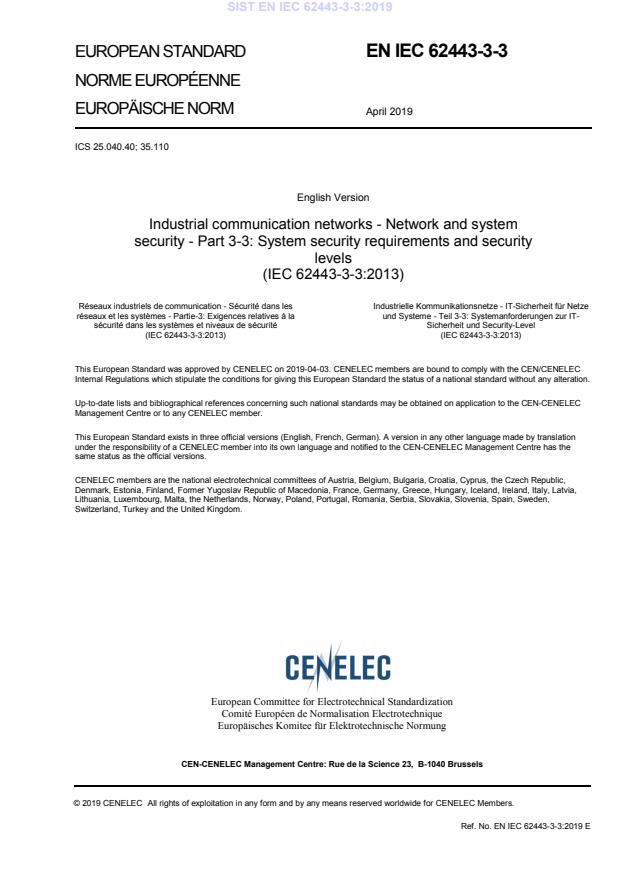
EUROPEAN STANDARD EN IEC 62443-3-3
NORME EUROPÉENNE
EUROPÄISCHE NORM
April 2019
ICS 25.040.40; 35.110
English Version
Industrial communication networks - Network and system
security - Part 3-3: System security requirements and security
levels
(IEC 62443-3-3:2013)
Réseaux industriels de communication - Sécurité dans les Industrielle Kommunikationsnetze - IT-Sicherheit für Netze
réseaux et les systèmes - Partie-3: Exigences relatives à la und Systeme - Teil 3-3: Systemanforderungen zur IT-
sécurité dans les systèmes et niveaux de sécurité Sicherheit und Security-Level
(IEC 62443-3-3:2013) (IEC 62443-3-3:2013)
This European Standard was approved by CENELEC on 2019-04-03. CENELEC members are bound to comply with the CEN/CENELEC
Internal Regulations which stipulate the conditions for giving this European Standard the status of a national standard without any alteration.
Up-to-date lists and bibliographical references concerning such national standards may be obtained on application to the CEN-CENELEC
Management Centre or to any CENELEC member.
This European Standard exists in three official versions (English, French, German). A version in any other language made by translation
under the responsibility of a CENELEC member into its own language and notified to the CEN-CENELEC Management Centre has the
same status as the official versions.
CENELEC members are the national electrotechnical committees of Austria, Belgium, Bulgaria, Croatia, Cyprus, the Czech Republic,
Denmark, Estonia, Finland, Former Yugoslav Republic of Macedonia, France, Germany, Greece, Hungary, Iceland, Ireland, Italy, Latvia,
Lithuania, Luxembourg, Malta, the Netherlands, Norway, Poland, Portugal, Romania, Serbia, Slovakia, Slovenia, Spain, Sweden,
Switzerland, Turkey and the United Kingdom.
European Committee for Electrotechnical Standardization
Comité Européen de Normalisation Electrotechnique
Europäisches Komitee für Elektrotechnische Normung
CEN-CENELEC Management Centre: Rue de la Science 23, B-1040 Brussels
© 2019 CENELEC All rights of exploitation in any form and by any means reserved worldwide for CENELEC Members.
Ref. No. EN IEC 62443-3-3:2019 E
European foreword
This document (EN IEC 62443-3-3:2019) consists of the text of IEC 62443-3-3:2013 prepared by
IEC/TC 65 "Industrial-process measurement, control and automation".
The following dates are fixed:
• latest date by which the document has to be implemented at national (dop) 2020-04-03
level by publication of an identical national standard or by endorsement
• latest date by which the national standards conflicting with the (dow) 2022-04-03
document have to be withdrawn
Attention is drawn to the possibility that some of the elements of this document may be the subject of
patent rights. CENELEC shall not be held responsible for identifying any or all such patent rights.
Endorsement notice
The text of the International Standard IEC 62443-3-3:2013 was approved by CENELEC as a
European Standard without any modification.
In the official version, for Bibliography, the following notes have to be added for the standards
indicated:
IEC 62443-2-4 NOTE Harmonized as EN IEC 62443-2-4
IEC 62443-4-1 NOTE Harmonized as EN IEC 62443-4-1
IEC 62443-4-2 NOTE Harmonized as EN IEC 62443-4-2
ISO/IEC 27002 NOTE Harmonized as EN ISO/IEC 27002
Annex ZA
(normative)
Normative references to international publications
with their corresponding European publications
The following documents are referred to in the text in such a way that some or all of their content
constitutes requirements of this document. For dated references, only the edition cited applies. For
undated references, the latest edition of the referenced document (including any amendments)
applies.
NOTE 1 Where an International Publication has been modified by common modifications, indicated by (mod), the relevant
EN/HD applies.
NOTE 2 Up-to-date information on the latest versions of the European Standards listed in this annex is available here:
www.cenelec.eu.
Publication Year Title EN/HD Year
IEC 62443-2-1 - Industrial communication networks - - -
Network and system security - Part 2-1:
Establishing an industrial automation and
control system security program
IEC/TS 62443-1-1 2009 Industrial communication networks - - -
Network and system security - Part 1-1:
Terminology, concepts and models
IEC 62443-3-3 ®
Edition 1.0 2013-08
INTERNATIONAL
STANDARD
colour
inside
Industrial communication networks – Network and system security –
Part 3-3: System security requirements and security levels
INTERNATIONAL
ELECTROTECHNICAL
COMMISSION
PRICE CODE
XC
ICS 25.040.40; 35.110 ISBN 978-2-8322-1036-9
– 2 – 62443-3-3 © IEC:2013(E)
CONTENTS
FOREWORD . 9
0 Introduction . 11
0.1 Overview . 11
0.2 Purpose and intended audience . 12
0.3 Usage within other parts of the IEC 62443 series . 12
1 Scope . 14
2 Normative references . 14
3 Terms, definitions, abbreviated terms, acronyms, and conventions . 14
3.1 Terms and definitions . 14
3.2 Abbreviated terms and acronyms . 20
3.3 Conventions . 22
4 Common control system security constraints . 22
4.1 Overview . 22
4.2 Support of essential functions . 23
4.3 Compensating countermeasures . 23
4.4 Least privilege . 24
5 FR 1 – Identification and authentication control . 24
5.1 Purpose and SL-C(IAC) descriptions . 24
5.2 Rationale . 24
5.3 SR 1.1 – Human user identification and authentication . 24
5.3.1 Requirement . 24
5.3.2 Rationale and supplemental guidance . 24
5.3.3 Requirement enhancements . 25
5.3.4 Security levels . 25
5.4 SR 1.2 – Software process and device identification and authentication . 26
5.4.1 Requirement . 26
5.4.2 Rationale and supplemental guidance . 26
5.4.3 Requirement enhancements . 26
5.4.4 Security levels . 27
5.5 SR 1.3 – Account management . 27
5.5.1 Requirement . 27
5.5.2 Rationale and supplemental guidance . 27
5.5.3 Requirement enhancements . 27
5.5.4 Security levels . 27
5.6 SR 1.4 – Identifier management . 28
5.6.1 Requirement . 28
5.6.2 Rationale and supplemental guidance . 28
5.6.3 Requirement enhancements . 28
5.6.4 Security levels . 28
5.7 SR 1.5 – Authenticator management . 28
5.7.1 Requirement . 28
5.7.2 Rationale and supplemental guidance . 28
5.7.3 Requirement enhancements . 29
5.7.4 Security levels . 29
5.8 SR 1.6 – Wireless access management . 30
5.8.1 Requirement . 30
62443-3-3 © IEC:2013(E) – 3 –
5.8.2 Rationale and supplemental guidance . 30
5.8.3 Requirement enhancements . 30
5.8.4 Security levels . 30
5.9 SR 1.7 – Strength of password-based authentication . 30
5.9.1 Requirement . 30
5.9.2 Rationale and supplemental guidance . 30
5.9.3 Requirement enhancements . 31
5.9.4 Security levels . 31
5.10 SR 1.8 – Public key infrastructure (PKI) certificates . 31
5.10.1 Requirement . 31
5.10.2 Rationale and supplemental guidance . 31
5.10.3 Requirement enhancements . 32
5.10.4 Security levels . 32
5.11 SR 1.9 – Strength of public key authentication . 32
5.11.1 Requirement . 32
5.11.2 Rationale and supplemental guidance . 32
5.11.3 Requirement enhancements . 33
5.11.4 Security levels . 33
5.12 SR 1.10 – Authenticator feedback . 33
5.12.1 Requirement . 33
5.12.2 Rationale and supplemental guidance . 33
5.12.3 Requirement enhancements . 33
5.12.4 Security levels . 33
5.13 SR 1.11 – Unsuccessful login attempts . 34
5.13.1 Requirement . 34
5.13.2 Rationale and supplemental guidance . 34
5.13.3 Requirement enhancements . 34
5.13.4 Security levels . 34
5.14 SR 1.12 – System use notification . 34
5.14.1 Requirement . 34
5.14.2 Rationale and supplemental guidance . 34
5.14.3 Requirement enhancements . 35
5.14.4 Security levels . 35
5.15 SR 1.13 – Access via untrusted networks . 35
5.15.1 Requirement . 35
5.15.2 Rationale and supplemental guidance . 35
5.15.3 Requirement enhancements . 35
5.15.4 Security levels . 35
6 FR 2 – Use control . 36
6.1 Purpose and SL-C(UC) descriptions . 36
6.2 Rationale . 36
6.3 SR 2.1 – Authorization enforcement . 36
6.3.1 Requirement . 36
6.3.2 Rationale and supplemental guidance . 36
6.3.3 Requirement enhancements . 37
6.3.4 Security levels . 37
6.4 SR 2.2 – Wireless use control . 37
6.4.1 Requirement . 37
6.4.2 Rationale and supplemental guidance . 38
– 4 – 62443-3-3 © IEC:2013(E)
6.4.3 Requirement enhancements . 38
6.4.4 Security levels . 38
6.5 SR 2.3 – Use control for portable and mobile devices . 38
6.5.1 Requirement . 38
6.5.2 Rationale and supplemental guidance . 38
6.5.3 Requirement enhancements . 39
6.5.4 Security levels . 39
6.6 SR 2.4 – Mobile code . 39
6.6.1 Requirement . 39
6.6.2 Rationale and supplemental guidance . 39
6.6.3 Requirement enhancements . 39
6.6.4 Security levels . 39
6.7 SR 2.5 – Session lock . 40
6.7.1 Requirement . 40
6.7.2 Rationale and supplemental guidance . 40
6.7.3 Requirement enhancements . 40
6.7.4 Security levels . 40
6.8 SR 2.6 – Remote session termination . 40
6.8.1 Requirement . 40
6.8.2 Rationale and supplemental guidance . 40
6.8.3 Requirement enhancements . 40
6.8.4 Security levels . 41
6.9 SR 2.7 – Concurrent session control . 41
6.9.1 Requirement . 41
6.9.2 Rationale and supplemental guidance . 41
6.9.3 Requirement enhancements . 41
6.9.4 Security levels . 41
6.10 SR 2.8 – Auditable events . 41
6.10.1 Requirement . 41
6.10.2 Rationale and supplemental guidance . 41
6.10.3 Requirement enhancements . 42
6.10.4 Security levels . 42
6.11 SR 2.9 – Audit storage capacity. 42
6.11.1 Requirement . 42
6.11.2 Rationale and supplemental guidance . 42
6.11.3 Requirement enhancements . 42
6.11.4 Security levels . 43
6.12 SR 2.10 – Response to audit processing failures . 43
6.12.1 Requirement . 43
6.12.2 Rationale and supplemental guidance . 43
6.12.3 Requirement enhancements . 43
6.12.4 Security levels . 43
6.13 SR 2.11 – Timestamps . 43
6.13.1 Requirement . 43
6.13.2 Rationale and supplemental guidance . 43
6.13.3 Requirement enhancements . 44
6.13.4 Security levels . 44
6.14 SR 2.12 – Non-repudiation . 44
6.14.1 Requirement . 44
62443-3-3 © IEC:2013(E) – 5 –
6.14.2 Rationale and supplemental guidance . 44
6.14.3 Requirement enhancements . 44
6.14.4 Security levels . 44
7 FR 3 – System integrity . 45
7.1 Purpose and SL-C(SI) descriptions . 45
7.2 Rationale . 45
7.3 SR 3.1 – Communication integrity. 45
7.3.1 Requirement . 45
7.3.2 Rationale and supplemental guidance . 45
7.3.3 Requirement enhancements . 46
7.3.4 Security levels . 46
7.4 SR 3.2 – Malicious code protection . 46
7.4.1 Requirement . 46
7.4.2 Rationale and supplemental guidance . 46
7.4.3 Requirement enhancements . 47
7.4.4 Security levels . 47
7.5 SR 3.3 – Security functionality verification . 47
7.5.1 Requirement . 47
7.5.2 Rationale and supplemental guidance . 47
7.5.3 Requirement enhancements . 48
7.5.4 Security levels . 48
7.6 SR 3.4 – Software and information integrity . 48
7.6.1 Requirement . 48
7.6.2 Rationale and supplemental guidance . 48
7.6.3 Requirement enhancements . 49
7.6.4 Security levels . 49
7.7 SR 3.5 – Input validation . 49
7.7.1 Requirement . 49
7.7.2 Rationale and supplemental guidance . 49
7.7.3 Requirement enhancements . 49
7.7.4 Security levels . 49
7.8 SR 3.6 – Deterministic output . 50
7.8.1 Requirement . 50
7.8.2 Rationale and supplemental guidance . 50
7.8.3 Requirement enhancements . 50
7.8.4 Security levels . 50
7.9 SR 3.7 – Error handling . 50
7.9.1 Requirement . 50
7.9.2 Rationale and supplemental guidance . 50
7.9.3 Requirement enhancements . 50
7.9.4 Security levels . 51
7.10 SR 3.8 – Session integrity . 51
7.10.1 Requirement . 51
7.10.2 Rationale and supplemental guidance . 51
7.10.3 Requirement enhancements . 51
7.10.4 Security levels . 51
7.11 SR 3.9 – Protection of audit information . 52
7.11.1 Requirement . 52
7.11.2 Rationale and supplemental guidance . 52
– 6 – 62443-3-3 © IEC:2013(E)
7.11.3 Requirement enhancements . 52
7.11.4 Security levels . 52
8 FR 4 – Data confidentiality . 52
8.1 Purpose and SL-C(DC) descriptions . 52
8.2 Rationale . 52
8.3 SR 4.1 – Information confidentiality . 53
8.3.1 Requirement . 53
8.3.2 Rationale and supplemental guidance . 53
8.3.3 Requirement enhancements . 53
8.3.4 Security levels . 53
8.4 SR 4.2 – Information persistence . 54
8.4.1 Requirement . 54
8.4.2 Rationale and supplemental guidance . 54
8.4.3 Requirement enhancements . 54
8.4.4 Security levels . 54
8.5 SR 4.3 – Use of cryptography . 54
8.5.1 Requirement . 54
8.5.2 Rationale and supplemental guidance . 55
8.5.3 Requirement enhancements . 55
8.5.4 Security levels . 55
9 FR 5 – Restricted data flow . 55
9.1 Purpose and SL-C(RDF) descriptions . 55
9.2 Rationale . 55
9.3 SR 5.1 – Network segmentation . 56
9.3.1 Requirement . 56
9.3.2 Rationale and supplemental guidance . 56
9.3.3 Requirement enhancements . 56
9.3.4 Security levels . 57
9.4 SR 5.2 – Zone boundary protection . 57
9.4.1 Requirement . 57
9.4.2 Rationale and supplemental guidance . 57
9.4.3 Requirement enhancements . 57
9.4.4 Security levels . 58
9.5 SR 5.3 – General purpose person-to-person communication restrictions . 58
9.5.1 Requirement . 58
9.5.2 Rationale and supplemental guidance . 58
9.5.3 Requirement enhancements . 58
9.5.4 Security levels . 59
9.6 SR 5.4 – Application partitioning. 59
9.6.1 Requirement . 59
9.6.2 Rationale and supplemental guidance . 59
9.6.3 Requirement enhancements . 59
9.6.4 Security levels . 59
10 FR 6 – Timely response to events . 59
10.1 Purpose and SL-C(TRE) descriptions . 59
10.2 Rationale . 60
10.3 SR 6.1 – Audit log accessibility . 60
10.3.1 Requirement . 60
10.3.2 Rationale and supplemental guidance . 60
62443-3-3 © IEC:2013(E) – 7 –
10.3.3 Requirement enhancements . 60
10.3.4 Security levels . 60
10.4 SR 6.2 – Continuous monitoring . 60
10.4.1 Requirement . 60
10.4.2 Rationale and supplemental guidance . 60
10.4.3 Requirement enhancements . 61
10.4.4 Security levels . 61
11 FR 7 – Resource availability . 61
11.1 Purpose and SL-C(RA) descriptions . 61
11.2 Rationale . 61
11.3 SR 7.1 – Denial of service protection . 62
11.3.1 Requirement . 62
11.3.2 Rationale and supplemental guidance . 62
11.3.3 Requirement enhancements . 62
11.3.4 Security levels . 62
11.4 SR 7.2 – Resource management . 62
11.4.1 Requirement . 62
11.4.2 Rationale and supplemental guidance . 62
11.4.3 Requirement enhancements . 62
11.4.4 Security levels . 63
11.5 SR 7.3 – Control system backup . 63
11.5.1 Requirement . 63
11.5.2 Rationale and supplemental guidance . 63
11.5.3 Requirement enhancements . 63
11.5.4 Security levels . 63
11.6 SR 7.4 – Control system recovery and reconstitution . 63
11.6.1 Requirement . 63
11.6.2 Rationale and supplemental guidance . 63
11.6.3 Requirement enhancements . 64
11.6.4 Security levels . 64
11.7 SR 7.5 – Emergency power . 64
11.7.1 Requirement . 64
11.7.2 Rationale and supplemental guidance . 64
11.7.3 Requirement enhancements . 64
11.7.4 Security levels . 64
11.8 SR 7.6 – Network and security configuration settings . 64
11.8.1 Requirement . 64
11.8.2 Rationale and supplemental guidance . 64
11.8.3 Requirement enhancements . 65
11.8.4 Security levels . 65
11.9 SR 7.7 – Least functionality . 65
11.9.1 Requirement . 65
11.9.2 Rationale and supplemental guidance . 65
11.9.3 Requirement enhancements . 65
11.9.4 Security levels . 65
11.10 SR 7.8 – Control system component inventory . 66
11.10.1 Requirement . 66
11.10.2 Rationale and supplemental guidance . 66
11.10.3 Requirement enhancements . 66
– 8 – 62443-3-3 © IEC:2013(E)
11.10.4 Security levels . 66
Annex A (informative) Discussion of the SL vector . 67
Annex B (informative) Mapping of SRs and REs to FR SL levels 1-4 . 75
Bibliography . 79
Figure 1 – Structure of the IEC 62443 series . 13
Figure A.1 – High-level process-industry example showing zones and conduits . 69
Figure A.2 – High-level manufacturing example showing zones and conduits . 70
Figure A.3 – Schematic of correlation of the use of different SL types . 71
Table B.1 – Mapping of SRs and REs to FR SL levels 1-4 (1 of 4) . 75
62443-3-3 © IEC:2013(E) – 9 –
INTERNATIONAL ELECTROTECHNICAL COMMISSION
____________
INDUSTRIAL COMMUNICATION NETWORKS –
NETWORK AND SYSTEM SECURITY –
Part 3-3: System security requirements and security levels
FOREWORD
1) The International Electrotechnical Commission (IEC) is a worldwide organization for standardization comprising
all national electrotechnical committees (IEC National Committees). The object of IEC is to promote
international co-operation on all questions concerning standardization in the electrical and electronic fields. To
this end and in addition to other activities, IEC publishes International Standards, Technical Specifications,
Technical Reports, Publicly Available Specifications (PAS) and Guides (hereafter referred to as “IEC
Publication(s)”). Their preparation is entrusted to technical committees; any IEC National Committee interested
in the subject dealt with may participate in this preparatory work. International, governmental and non-
governmental organizations liaising with the IEC also participate in this preparation. IEC collaborates closely
with the International Organization for Standardization (ISO) in accordance with conditions determined by
agreement between the two organizations.
2) The formal decisions or agreements of IEC on technical matters express, as nearly as possible, an international
consensus of opinion on the relevant subjects since each technical committee has representation from all
interested IEC National Committees.
3) IEC Publications have the form of recommendations for international use and are accepted by IEC National
Committees in that sense. While all reasonable efforts are made to ensure that the technical content of IEC
Publications is accurate, IEC cannot be held responsible for the way in which they are used or for any
misinterpretation by any end user.
4) In order to promote international uniformity, IEC National Committees undertake to apply IEC Publications
transparently to the maximum extent possible in their national and regional publications. Any divergence
between any IEC Publication and the corresponding national or regional publication shall be clearly indicated in
the latter.
5) IEC itself does not provide any attestation of conformity. Independent certification bodies provide conformity
assessment services and, in some areas, access to IEC marks of conformity. IEC is not responsible for any
services carried out by independent certification bodies.
6) All users should ensure that they have the latest edition of this publication.
7) No liability shall attach to IEC or its directors, employees, servants or agents including individual experts and
members of its technical committees and IEC National Committees for any personal injury, property damage or
other damage of any nature whatsoever, whether direct or indirect, or for costs (including legal fees) and
expenses arising out of the publication, use of, or reliance upon, this IEC Publication or any other IEC
Publications.
8) Attention is drawn to the Normative references cited in this publication. Use of the referenced publications is
indispensable for the correct application of this publication.
9) Attention is drawn to the possibility that some of the elements of this IEC Publication may be the subject of
patent rights. IEC shall not be held responsible for identifyi
...