


SIST EN IEC 61158-5-28:2023
(Main)Industrial communication networks - Fieldbus specifications - Part 5-28: Application layer service definition - Type 28 elements (IEC 61158-5-28:2023)
Industrial communication networks - Fieldbus specifications - Part 5-28: Application layer service definition - Type 28 elements (IEC 61158-5-28:2023)
IEC 61558-5-28:2023 provides common elements for basic time-critical and non-time-critical messaging communications between application programs in an automation environment and material specific to Type 28 fieldbus. The term "time-critical" is used to represent the presence of a time-window, in which one or more specified actions are required to be completed with some defined level of certainty.
Industrielle Kommunikationsnetze - Feldbusse - Teil 5-28: Dienstfestlegungen des Application Layer (Anwendungsschicht) - Typ 28-Elemente (IEC 61158-5-28:2023)
Réseaux de communication industriels - Spécifications des bus de terrain - Partie 5-28: Définition des services de la couche application - Eléments de type 28 (IEC 61158-5-28:2023)
L'IEC 61558-5-28:2023 donne les éléments communs visant à assurer les communications de messagerie de base prioritaires et non prioritaires entre les programmes d’application d’un environnement d’automatisation et d’un matériel spécifique au bus de terrain de type 28. Le terme "prioritaire" est utilisé pour indiquer la présence d’une fenêtre temporelle, dans laquelle il est exigé de réaliser une ou plusieurs actions spécifiées selon un niveau défini de certitude.
Industrijska komunikacijska omrežja - Specifikacije za procesna vodila - 5-28. del: Definicija opravil na aplikacijski ravni - Elementi tipa 28 (IEC 61158-5-28:2023)
Aplikacijska raven procesnih vodil (FAL) uporabniškim programom omogoča dostop do komunikacijskega okolja procesnih vodil. Glede na to je mogoče aplikacijsko raven procesnih vodil šteti za »okno med ustreznimi aplikacijami«.
Ta del standarda IEC 61158 določa skupne elemente za osnovne časovno kritične in časovno nekritične sporočilne komunikacije med aplikacijami v avtomatizacijskem okolju ter material, specifičen za procesna vodila tipa 28. Izraz »časovno kritičen« se uporablja za predstavitev prisotnosti časovnega okna, v okviru katerega se zahteva dokončanje enega ali več opredeljenih dejanj z določeno stopnjo gotovosti.
Ta dokument na abstrakten način določa na zunaj vidno opravilo, ki ga zagotavlja aplikacijska raven procesnih vodil različnih tipov v smislu:
– abstraktnega modela za določanje aplikacijskih virov (objektov), ki ga lahko upravljajo uporabniki prek opravila aplikacijske ravni procesnih vodil;
– primitivnih dejanj in dogodkov opravila;
– parametrov, povezanih z vsakim primitivnim dejanjem in dogodkom, ter obliko, ki jo prevzamejo; in
– medsebojnih povezav med temi dejanji in dogodki ter njihovimi veljavnimi zaporedji.
Namen tega dokumenta je opredeliti opravila, ki se zagotavljajo za:
– uporabnika aplikacijske ravni procesnih vodil na meji med uporabniško in aplikacijsko ravnjo referenčnega modela procesnega vodila, in
– upravljanje sistemov na meji med aplikacijsko ravnjo in upravljanjem sistemov za referenčni model procesnega vodila.
Ta dokument določa strukturo in opravila aplikacijske ravni procesnih vodil IEC v skladu z osnovnim referenčnim modelom OSI (ISO/IEC 7498-1) ter strukturo aplikacijske ravni OSI (ISO/IEC 9545).
Opravila in protokole aplikacijske ravni procesnih vodil zagotavljajo aplikacijski osebki (AE) aplikacijske ravni procesnih vodil znotraj aplikacijskih procesov. Aplikacijski osebek aplikacijske ravni procesnih vodil sestavljata sklop objektno usmerjenih aplikacijskih opravilnih elementov (ASE) in osebek za upravljanje ravni (LME), ki upravlja aplikacijski osebek. Aplikacijski opravilni elementi zagotavljajo komunikacijska opravila, ki delujejo na sklopu povezanih razredov objektov aplikacijskega procesa (APO). Med aplikacijske opravilne elemente aplikacijske ravni procesnih vodil spada aplikacijski opravilni element za upravljanje, ki zagotavlja skupen sklop opravil za upravljanje primerkov razredov aplikacijske ravni procesnih vodil.
Čeprav ta opravila določajo način izdajanja ter dostavljanja zahtev in odzivov z vidika aplikacij, ne zajemajo specifikacije v zvezi s tem, kako naj se nanje odzovejo aplikacije, ki te zahteve in odzive oddajajo. To pomeni, da vedenjski vidiki aplikacij niso opredeljeni; opredeljena je le definicija zahtev in odzivov, ki jih lahko pošiljajo/prejemajo. Tako se uporabnikom aplikacijske ravni procesnih vodil omogoči večja prilagodljivost pri standardizaciji takega vedenja objektov. Poleg teh opravil so v tem dokumentu opredeljena tudi nekatera podporna opravila, da se omogoči dostop do aplikacijske ravni procesnih vodil za nadzorovanje nekaterih vidikov njenega delovanja.
General Information
- Status
- Published
- Publication Date
- 05-Oct-2023
- Technical Committee
- MOV - Measuring equipment for electromagnetic quantities
- Current Stage
- 6060 - National Implementation/Publication (Adopted Project)
- Start Date
- 04-Jul-2023
- Due Date
- 08-Sep-2023
- Completion Date
- 06-Oct-2023
Overview
EN IEC 61158-5-28:2023 - Industrial communication networks - Fieldbus specifications - Part 5-28: Application layer service definition - Type 28 elements defines the application‑layer (AL) services, data types and behaviour for Type 28 fieldbus systems. The standard provides common elements for both time‑critical (real‑time) and non‑time‑critical messaging between application programs in automation environments, and supplies Type 28–specific material such as ASEs (Application Service Elements), data mapping and management tables.
Keywords: EN IEC 61158-5-28:2023, fieldbus, application layer, Type 28, industrial communication networks, time‑critical messaging, real‑time.
Key Topics
- Application layer service definitions - formal description of AL services including Read/Write and other service primitives.
- Data types and structures (ASE data types) - fixed‑length types, strings, constructed types and bitmaps used by Type 28.
- Communication models - Publisher/Subscriber (P/S) and Client/Server (C/S) interaction patterns covering RT (real‑time) and nRT (non‑real‑time) messaging.
- Time management - time synchronization, time queries and time management information tables to support deterministic, time‑windowed operations.
- Addressing, resource and network management ASEs - NETWORKID, MAC/IP mapping, join/leave network procedures and diagnostic mapping.
- Data mapping and integration - mapping of AL data buffers to transport payloads and examples of OPC UA ↔ Type 28 mapping (informative annex).
- Virtualization and examples - virtualization ASE and illustrative examples for service data mapping, RTA processing and virtualization solutions.
- Conformance and protocol stack - relationship of the Type 28 AL with lower layer specifications (see related Data‑link and Protocol parts).
Applications and Who Uses It
- Automation engineers & system integrators - for designing interoperable control systems that require deterministic messaging and clear AL semantics.
- Device and stack implementers - vendors building Type 28‑compliant fieldbus devices, gateways, or protocol stacks.
- Network architects - planning time‑critical messaging, synchronization and addressing strategies across industrial Ethernet/fieldbus networks.
- Standards and compliance teams - creating test suites and verifying conformance with application layer service definitions.
Benefits: enables interoperable fieldbus implementations, supports deterministic time‑windows for critical control tasks, and facilitates integration with higher‑level systems (e.g., OPC UA, IP networks).
Related Standards
- IEC/EN IEC 61158 series (Parts 1, 4‑28, 6‑28)
- IEC 61784 series (industrial network profiles)
- ISO/IEC OSI references (ISO/IEC 7498‑1, 9545) and relevant Ethernet/IP mappings
This standard is essential for anyone implementing or integrating Type 28 fieldbus application‑layer functionality in industrial process measurement, control and automation systems.

Frequently Asked Questions
SIST EN IEC 61158-5-28:2023 is a standard published by the Slovenian Institute for Standardization (SIST). Its full title is "Industrial communication networks - Fieldbus specifications - Part 5-28: Application layer service definition - Type 28 elements (IEC 61158-5-28:2023)". This standard covers: IEC 61558-5-28:2023 provides common elements for basic time-critical and non-time-critical messaging communications between application programs in an automation environment and material specific to Type 28 fieldbus. The term "time-critical" is used to represent the presence of a time-window, in which one or more specified actions are required to be completed with some defined level of certainty.
IEC 61558-5-28:2023 provides common elements for basic time-critical and non-time-critical messaging communications between application programs in an automation environment and material specific to Type 28 fieldbus. The term "time-critical" is used to represent the presence of a time-window, in which one or more specified actions are required to be completed with some defined level of certainty.
SIST EN IEC 61158-5-28:2023 is classified under the following ICS (International Classification for Standards) categories: 25.040 - Industrial automation systems; 25.040.40 - Industrial process measurement and control; 33.040.40 - Data communication networks; 35.100.70 - Application layer; 35.110 - Networking. The ICS classification helps identify the subject area and facilitates finding related standards.
SIST EN IEC 61158-5-28:2023 is available in PDF format for immediate download after purchase. The document can be added to your cart and obtained through the secure checkout process. Digital delivery ensures instant access to the complete standard document.
Standards Content (Sample)
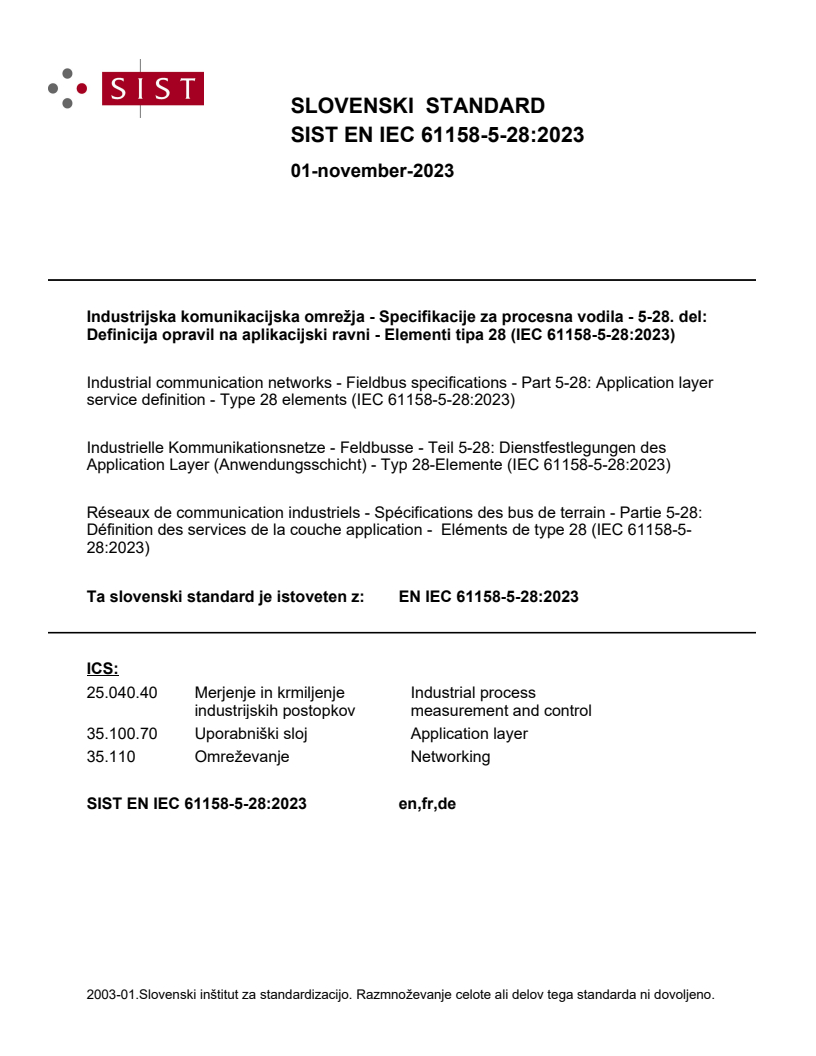
SLOVENSKI STANDARD
01-november-2023
Industrijska komunikacijska omrežja - Specifikacije za procesna vodila - 5-28. del:
Definicija opravil na aplikacijski ravni - Elementi tipa 28 (IEC 61158-5-28:2023)
Industrial communication networks - Fieldbus specifications - Part 5-28: Application layer
service definition - Type 28 elements (IEC 61158-5-28:2023)
Industrielle Kommunikationsnetze - Feldbusse - Teil 5-28: Dienstfestlegungen des
Application Layer (Anwendungsschicht) - Typ 28-Elemente (IEC 61158-5-28:2023)
Réseaux de communication industriels - Spécifications des bus de terrain - Partie 5-28:
Définition des services de la couche application - Eléments de type 28 (IEC 61158-5-
28:2023)
Ta slovenski standard je istoveten z: EN IEC 61158-5-28:2023
ICS:
25.040.40 Merjenje in krmiljenje Industrial process
industrijskih postopkov measurement and control
35.100.70 Uporabniški sloj Application layer
35.110 Omreževanje Networking
2003-01.Slovenski inštitut za standardizacijo. Razmnoževanje celote ali delov tega standarda ni dovoljeno.
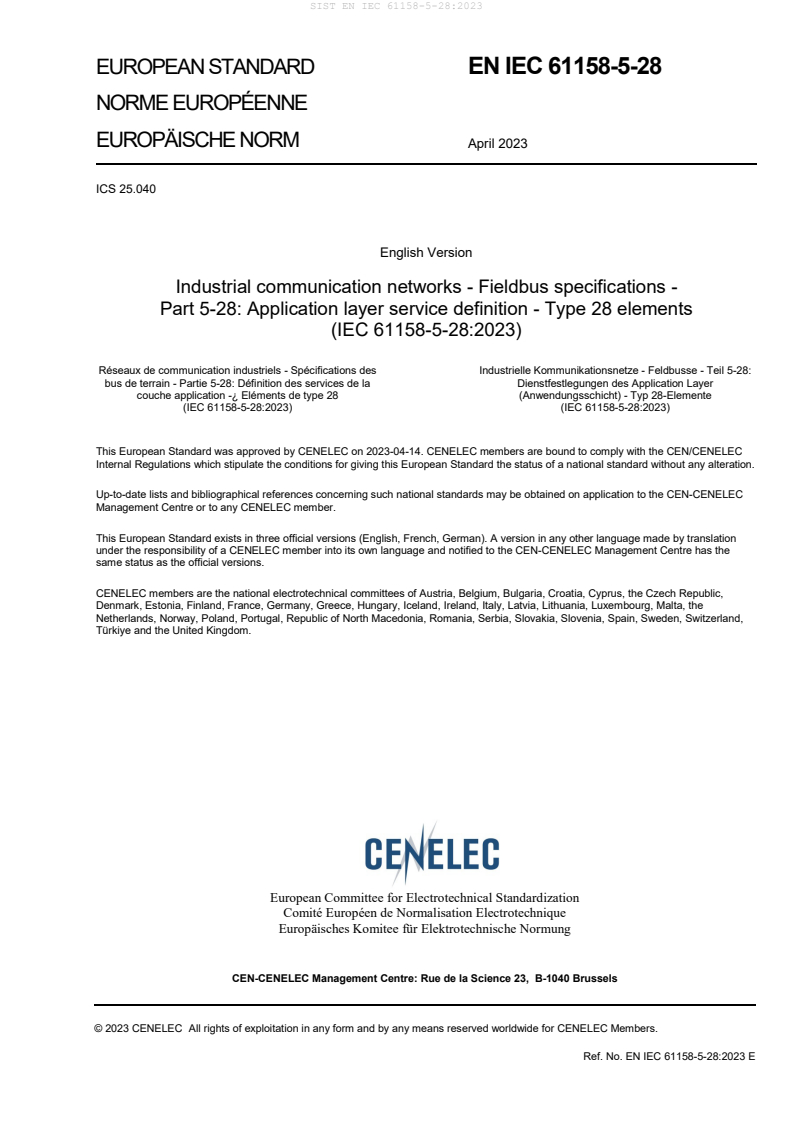
EUROPEAN STANDARD EN IEC 61158-5-28
NORME EUROPÉENNE
EUROPÄISCHE NORM April 2023
ICS 25.040
English Version
Industrial communication networks - Fieldbus specifications -
Part 5-28: Application layer service definition - Type 28 elements
(IEC 61158-5-28:2023)
Réseaux de communication industriels - Spécifications des Industrielle Kommunikationsnetze - Feldbusse - Teil 5-28:
bus de terrain - Partie 5-28: Définition des services de la Dienstfestlegungen des Application Layer
couche application -¿ Eléments de type 28 (Anwendungsschicht) - Typ 28-Elemente
(IEC 61158-5-28:2023) (IEC 61158-5-28:2023)
This European Standard was approved by CENELEC on 2023-04-14. CENELEC members are bound to comply with the CEN/CENELEC
Internal Regulations which stipulate the conditions for giving this European Standard the status of a national standard without any alteration.
Up-to-date lists and bibliographical references concerning such national standards may be obtained on application to the CEN-CENELEC
Management Centre or to any CENELEC member.
This European Standard exists in three official versions (English, French, German). A version in any other language made by translation
under the responsibility of a CENELEC member into its own language and notified to the CEN-CENELEC Management Centre has the
same status as the official versions.
CENELEC members are the national electrotechnical committees of Austria, Belgium, Bulgaria, Croatia, Cyprus, the Czech Republic,
Denmark, Estonia, Finland, France, Germany, Greece, Hungary, Iceland, Ireland, Italy, Latvia, Lithuania, Luxembourg, Malta, the
Netherlands, Norway, Poland, Portugal, Republic of North Macedonia, Romania, Serbia, Slovakia, Slovenia, Spain, Sweden, Switzerland,
Türkiye and the United Kingdom.
European Committee for Electrotechnical Standardization
Comité Européen de Normalisation Electrotechnique
Europäisches Komitee für Elektrotechnische Normung
CEN-CENELEC Management Centre: Rue de la Science 23, B-1040 Brussels
© 2023 CENELEC All rights of exploitation in any form and by any means reserved worldwide for CENELEC Members.
Ref. No. EN IEC 61158-5-28:2023 E
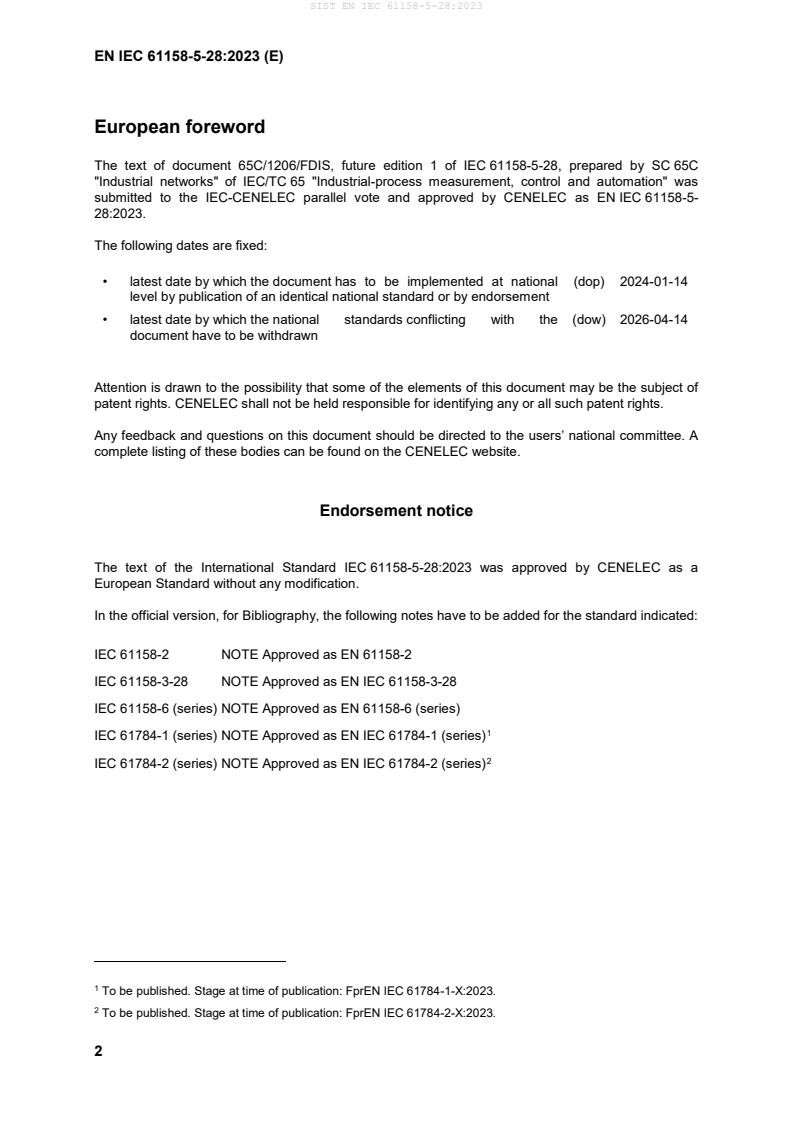
European foreword
The text of document 65C/1206/FDIS, future edition 1 of IEC 61158-5-28, prepared by SC 65C
"Industrial networks" of IEC/TC 65 "Industrial-process measurement, control and automation" was
submitted to the IEC-CENELEC parallel vote and approved by CENELEC as EN IEC 61158-5-
28:2023.
The following dates are fixed:
• latest date by which the document has to be implemented at national (dop) 2024-01-14
level by publication of an identical national standard or by endorsement
• latest date by which the national standards conflicting with the (dow) 2026-04-14
document have to be withdrawn
Attention is drawn to the possibility that some of the elements of this document may be the subject of
patent rights. CENELEC shall not be held responsible for identifying any or all such patent rights.
Any feedback and questions on this document should be directed to the users’ national committee. A
complete listing of these bodies can be found on the CENELEC website.
Endorsement notice
The text of the International Standard IEC 61158-5-28:2023 was approved by CENELEC as a
European Standard without any modification.
In the official version, for Bibliography, the following notes have to be added for the standard indicated:
IEC 61158-2 NOTE Approved as EN 61158-2
IEC 61158-3-28 NOTE Approved as EN IEC 61158-3-28
IEC 61158-6 (series) NOTE Approved as EN 61158-6 (series)
IEC 61784-1 (series) NOTE Approved as EN IEC 61784-1 (series)
IEC 61784-2 (series) NOTE Approved as EN IEC 61784-2 (series)
To be published. Stage at time of publication: FprEN IEC 61784-1-X:2023.
To be published. Stage at time of publication: FprEN IEC 61784-2-X:2023.
Annex ZA
(normative)
Normative references to international publications
with their corresponding European publications
The following documents are referred to in the text in such a way that some or all of their content
constitutes requirements of this document. For dated references, only the edition cited applies. For
undated references, the latest edition of the referenced document (including any amendments)
applies.
NOTE 1 Where an International Publication has been modified by common modifications, indicated by (mod), the
relevant EN/HD applies.
NOTE 2 Up-to-date information on the latest versions of the European Standards listed in this annex is available
here: www.cencenelec.eu.
Publication Year Title EN/HD Year
IEC 61158-1 2023 Industrial communication networks - EN IEC 61158-1 2023
Fieldbus specifications - Part 1: Overview
and guidance for the IEC 61158 and IEC
61784 series
IEC 61158-4-28 2023 Industrial communication networks - EN IEC 61158-4-28 2023
Fieldbus specifications - Part 4-28: Data-
link layer protocol specification - Type 28
elements
IEC 61158-6-28 2023 Industrial communication networks - EN IEC 61158-6-28 2023
Fieldbus specifications - Part 6-28:
Application layer protocol specification -
Type 28 elements
ISO/IEC 7498-1 1994 Information technology - Open Systems - -
Interconnection - Basic reference model:
The basic model
ISO/IEC 7498-3 1997 Information technology - Open Systems - -
Interconnection - Basic reference model:
Naming and addressing
ISO/IEC 8822 - Information technology - Open Systems - -
Interconnection - Presentation service
definition
ISO/IEC 8824-1 - Information technology - Abstract Syntax - -
Notation One (ASN.1) - Part 1:
Specification of basic notation
ISO/IEC 9545 - Information technology - Open Systems - -
Interconnection - Application layer
structure
ISO/IEC 10731 1994 Information technology - Open Systems - -
Interconnection - Basic Reference Model -
Conventions for the definition of OSI
services
IETF RFC 2460 1998 Internet Protocol - Version 6 (IPv6) - - -
Specification
IETF RFC 791 1981 Internet Protocol - -
ISO/IEC/IEEE 8802-3 2021 Telecommunications and exchange - -
between information technology systems -
Requirements for local and metropolitan
area networks - Part 3: Standard for
Ethernet
IEC 61158-5-28 ®
Edition 1.0 2023-03
INTERNATIONAL
STANDARD
NORME
INTERNATIONALE
Industrial communication networks –Fieldbus specifications –
Part 5-28: Application layer service definition – Type 28 elements
Réseaux de communication industriels – Spécifications des bus de terrain –
Partie 5-28: Définition des services de la couche application –
Éléments de type 28
INTERNATIONAL
ELECTROTECHNICAL
COMMISSION
COMMISSION
ELECTROTECHNIQUE
INTERNATIONALE
ICS 25.040 ISBN 978-2-8322-6583-3
– 2 – IEC 61158-5-28:2023 © IEC 2023
CONTENTS
FOREWORD . 5
INTRODUCTION . 7
1 Scope . 8
1.1 Overview. 8
1.2 Specifications . 9
1.3 Conformance . 9
2 Normative references . 9
3 Terms, definitions, symbols, abbreviated terms and conventions . 10
3.1 Referenced terms and definitions . 10
3.1.1 ISO/IEC 7498-1 terms . 10
3.1.2 ISO/IEC 8822 terms . 10
3.1.3 ISO/IEC 9545 terms . 11
3.1.4 ISO/IEC 8824 terms . 11
3.2 Additional terms and definitions for this IEC 61158-5-28 . 11
3.3 Abbreviations and symbols . 12
3.4 Conventions . 13
3.4.1 Overview . 13
3.4.2 Conventions for class definitions . 13
3.4.3 Conventions for service definitions . 14
4 Concepts . 15
5 Data type ASE . 15
5.1 General . 15
5.1.1 Overview . 15
5.1.2 Overview of basic types . 16
5.1.3 Overview of fixed-length types . 16
5.1.4 Overview of constructed types . 17
5.2 AL defined data types . 17
5.2.1 Fixed length types . 17
5.2.2 String type . 19
5.2.3 Structure type . 20
6 Type 28 communication model specification . 25
6.1 General . 25
6.2 Protocol stack for Type 28 fieldbus . 26
6.3 Data mapping modelling. 27
6.4 Overview of Type 28 communication model . 29
6.4.1 General . 29
6.4.2 P/S . 29
6.4.3 C/S . 30
6.5 AL related management information table . 30
6.5.1 General . 30
6.5.2 Time management information table . 31
6.5.3 Network management information table . 32
6.6 ASEs . 33
6.6.1 Overview . 33
6.6.2 RT data ASE. 34
6.6.3 nRT data ASE . 36
IEC 61158-5-28:2023 © IEC 2023 – 3 –
6.6.4 Time ASE . 38
6.6.5 Resource ASE . 41
6.6.6 Addressing ASE . 43
6.6.7 Management ASE . 48
6.6.8 Virtualization ASE . 55
6.7 Application service . 58
6.7.1 Overview . 58
6.7.2 Read service . 58
6.7.3 Write service . 58
Annex A (informative) Example of service data mapping DTU message . 60
Annex B (informative) Example of OPC UA data model and Type 28 data model
mapping . 61
Annex C (informative) Example of RTA service processing . 62
Annex D (informative) Type 28 virtualization solution example . 63
Bibliography . 66
Figure 1 – Data type class hierarchy example . 16
Figure 2 – BITMAP data type . 20
Figure 3 – AL in fieldbus protocol stack architecture . 26
Figure 4 – Type 28 AL protocol architecture . 26
Figure 5 – Data mapping modelling object structure . 27
Figure 6 – Diagram of mapping data buffers and service data variables . 28
Figure 7 – Diagram of P/S model . 29
Figure 8 – P/S model of PUSH mode . 30
Figure 9 – P/S model of PULL mode . 30
Figure 10 – Diagram of C/S communication model . 30
Figure 11 – RT data transmission model . 35
Figure 12 – Diagram of nRT data request response model . 37
Figure 13 – Diagram of nRT data AP interaction based on C/S communication model . 38
Figure 14 – Diagram of nRT data AP interaction based on P/S communication model . 38
Figure 15 – Time synchronization application interaction process . 40
Figure 16 – Time query process . 41
Figure 17 – Resource AP interaction based on C/S communication model . 43
Figure 18 – Resource ASE local service function diagram . 43
Figure 19 – NETWORKID identification field structure . 44
Figure 20 – NETWORKID interaction process diagram . 46
Figure 21 – Diagram of MAC mapping table service function. 46
Figure 22 – IP mapping table service function diagram . 47
Figure 23 – Type 28 AL data message mapped to IP payload data payload . 47
Figure 24 – Type 28 AL protocol header and IP protocol header mapping . 48
Figure 25 – IP data message is mapped to valid data of Type 28 AL data message . 48
Figure 26 – Static configuration initialization process . 51
Figure 27 – Join the network interaction process . 52
Figure 28 – Passively exit the network interaction process . 53
– 4 – IEC 61158-5-28:2023 © IEC 2023
Figure 29 – Actively exit network interaction process . 54
Figure 30 – Diagram of diagnostic object mapping . 54
Figure 31 – Diagram of the logging process . 55
Figure 32 – A physical bus divided into two virtual bus domain diagrams . 56
Figure 33 – Diagram of virtualized AP interaction based on C/S communication model . 57
Figure 34 – Virtualization ASE local implementation diagram . 58
Figure A.1 – Data transmission unit message content example . 60
Figure B.1 – OPC UA data model and mapping of Type 28 data model . 61
Figure C.1 – Example of RTA service processing . 62
Figure D.1 – Diagram of Type 28 industrial bus service deployment . 63
Figure D.2 – Diagram of networking topology based on the virtualized bus . 63
Figure D.3 – Virtual network topology based on logical business function RT1 . 64
Table 1 – TIMEV type data coding . 17
Table 2 – TIMEDATE type coding . 18
Table 3 – TIMEOFDAY type coding . 18
Table 4 – TIMEDIFFER type coding . 19
Table 5 – VISIBLESTRING type data coding . 19
Table 6 – Description of time information structure TIMEINFO_S . 20
Table 7 – Description of clock option information structure CLOCK_OPTION_INFO_S . 21
Table 8 – Description of network configuration parameter structure
NETWORK_CFG_PARA_S . 22
Table 9 – Description of MAC mapping table NETWORKID_MAC_MAP_TABLE_S . 23
Table 10 – Description of IP mapping table structure IP_MAP_TABLE_S . 24
Table 11 – Service data mapping table parameter list . 29
Table 12 – Time management information table . 31
Table 13 – Network management information table . 32
Table 14 – Communication models supported by Type 28 AL ASEs . 33
Table 15 – Application service interface return value list . 33
Table 16 – RT data service interface parameters . 34
Table 17 – nRT data service interface parameters . 36
Table 18 – Timing service interface parameters . 39
Table 19 – Resource service interface parameters . 42
Table 20 – Addressing service interface parameters . 45
Table 21 – Management service interface parameters . 49
Table 22 – Virtual service interface parameters . 56
Table 23 – Read service parameters . 58
Table 24 – Write service parameters . 59
Table 25 – Application service errcode . 59
Table D.1 – Virtual bus environment node NETWORKID list . 65
IEC 61158-5-28:2023 © IEC 2023 – 5 –
INTERNATIONAL ELECTROTECHNICAL COMMISSION
____________
INDUSTRIAL COMMUNICATION NETWORKS –
FIELDBUS SPECIFICATIONS –
Part 5-28: Application layer service definition –
Type 28 elements
FOREWORD
1) The International Electrotechnical Commission (IEC) is a worldwide organization for standardization comprising
all national electrotechnical committees (IEC National Committees). The object of IEC is to promote international
co-operation on all questions concerning standardization in the electrical and electronic fields. To this end and
in addition to other activities, IEC publishes International Standards, Technical Specifications, Technical Reports,
Publicly Available Specifications (PAS) and Guides (hereafter referred to as "IEC Publication(s)"). Their
preparation is entrusted to technical committees; any IEC National Committee interested in the subject dealt with
may participate in this preparatory work. International, governmental and non-governmental organizations liaising
with the IEC also participate in this preparation. IEC collaborates closely with the International Organization for
Standardization (ISO) in accordance with conditions determined by agreement between the two organizations.
2) The formal decisions or agreements of IEC on technical matters express, as nearly as possible, an international
consensus of opinion on the relevant subjects since each technical committee has representation from all
interested IEC National Committees.
3) IEC Publications have the form of recommendations for international use and are accepted by IEC National
Committees in that sense. While all reasonable efforts are made to ensure that the technical content of IEC
Publications is accurate, IEC cannot be held responsible for the way in which they are used or for any
misinterpretation by any end user.
4) In order to promote international uniformity, IEC National Committees undertake to apply IEC Publications
transparently to the maximum extent possible in their national and regional publications. Any divergence between
any IEC Publication and the corresponding national or regional publication shall be clearly indicated in the latter.
5) IEC itself does not provide any attestation of conformity. Independent certification bodies provide conformity
assessment services and, in some areas, access to IEC marks of conformity. IEC is not responsible for any
services carried out by independent certification bodies.
6) All users should ensure that they have the latest edition of this publication.
7) No liability shall attach to IEC or its directors, employees, servants or agents including individual experts and
members of its technical committees and IEC National Committees for any personal injury, property damage or
other damage of any nature whatsoever, whether direct or indirect, or for costs (including legal fees) and
expenses arising out of the publication, use of, or reliance upon, this IEC Publication or any other IEC
Publications.
8) Attention is drawn to the Normative references cited in this publication. Use of the referenced publications is
indispensable for the correct application of this publication.
9) Attention is drawn to the possibility that some of the elements of this IEC Publication may be the subject of patent
rights. IEC shall not be held responsible for identifying any or all such patent rights.
Attention is drawn to the fact that the use of the associated protocol type is restricted by its
intellectual-property-right holders. In all cases, the commitment to limited release of intellectual-
property-rights made by the holders of those rights permits a layer protocol type to be used with
other layer protocols of the same type, or in other type combinations explicitly
authorized by its intellectual-property-right holders.
NOTE Combinations of protocol types are specified in the IEC 61784-1 series and the IEC 61784-2 series.
IEC 61158-5-28 has been prepared by subcommittee 65C: Industrial networks, of IEC technical
committee 65: Industrial-process measurement, control and automation. It is an International
Standard.
– 6 – IEC 61158-5-28:2023 © IEC 2023
The text of this International Standard is based on the following documents:
Draft Report on voting
65C/1206/FDIS 65C/1235/RVD
Full information on the voting for its approval can be found in the report on voting indicated in
the above table.
The language used for the development of this International Standard is English.
This document was drafted in accordance with ISO/IEC Directives, Part 2, and developed in
accordance with ISO/IEC Directives, Part 1 and ISO/IEC Directives, IEC Supplement, available
at www.iec.ch/members_experts/refdocs. The main document types developed by IEC are
described in greater detail at www.iec.ch/publications.
A list of all parts of the IEC 61158 series, published under the general title Industrial
communication networks – Fieldbus specifications, can be found on the IEC web site.
The committee has decided that the contents of this document will remain unchanged until the
stability date indicated on the IEC website under webstore.iec.ch in the data related to the
specific document. At this date, the document will be
• reconfirmed,
• withdrawn,
• replaced by a revised edition, or
• amended.
IEC 61158-5-28:2023 © IEC 2023 – 7 –
INTRODUCTION
This document is one of a series produced to facilitate the interconnection of automation system
components. It is related to other standards in the set as defined by the "three-layer" fieldbus
reference model described in IEC 61158-1.
The application service is provided by the application protocol making use of the services
available from the data-link or other immediately lower layer. This document defines the
application service characteristics that fieldbus applications and/or system management can
exploit.
Throughout the set of fieldbus standards, the term "service" refers to the abstract capability
provided by one layer of the OSI Basic Reference Model to the layer immediately above. Thus,
the application layer service defined in this document is a conceptual architectural service,
independent of administrative and implementation divisions.
– 8 – IEC 61158-5-28:2023 © IEC 2023
INDUSTRIAL COMMUNICATION NETWORKS –
FIELDBUS SPECIFICATIONS –
Part 5-28: Application layer service definition –
Type 28 elements
1 Scope
1.1 Overview
The fieldbus Application Layer (FAL) provides user programs with a means to access the
fieldbus communication environment. In this respect, the FAL can be considered as a window
between corresponding application programs.
This part of IEC 61158 provides common elements for basic time-critical and non-time-critical
messaging communications between application programs in an automation environment and
material specific to Type 28 fieldbus. The term "time-critical" is used to represent the presence
of a time-window, in which one or more specified actions are required to be completed with
some defined level of certainty.
This document defines in an abstract way the externally visible service provided by the different
Types of the fieldbus Application Layer in terms of
• an abstract model for defining application resources (objects) capable of being manipulated
by users via the use of the FAL service,
• the primitive actions and events of the service,
• the parameters associated with each primitive action and event, and the form which they
take, and
• the interrelationship between these actions and events, and their valid sequences.
The purpose of this document is to define the services provided to
• the FAL user at the boundary between the user and the Application Layer of the Fieldbus
Reference Model, and
• Systems Management at the boundary between the Application Layer and Systems
Management of the Fieldbus Reference Model.
This document specifies the structure and services of the IEC fieldbus Application Layer, in
conformance with the OSI Basic Reference Model (ISO/IEC 7498-1) and the OSI Application
Layer Structure (ISO/IEC 9545).
FAL services and protocols are provided by FAL application-entities (AE) contained within the
application processes. The FAL AE is composed of a set of object-oriented Application Service
Elements (ASEs) and a Layer Management Entity (LME) that manages the AE. The ASEs
provide communication services that operate on a set of related application process object
(APO) classes. One of the FAL ASEs is a management ASE that provides a common set of
services for the management of the instances of FAL classes.
Although these services specify, from the perspective of applications, how to request and
response are issued and delivered, they do not include a specification of what the requesting
and responding applications are to do with them. That is, the behavioural aspects of the
applications are not specified; only a definition of what requests and responses they can
send/receive is specified. This permits greater flexibility to the FAL users in standardizing such
IEC 61158-5-28:2023 © IEC 2023 – 9 –
object behaviour. In addition to these services, some supporting services are also defined in
this document to provide access to the FAL to control certain aspects of its operation.
1.2 Specifications
The principal objective of this document is to specify the characteristics of conceptual
application layer services suitable for time-critical communications, and thus supplement the
OSI Basic Reference Model in guiding the development of application layer protocols for time-
critical communications.
A secondary objective is to provide migration paths from previously existing industrial
communications protocols. It is this latter objective which gives rise to the diversity of services
standardized as the various types of IEC 61158, and the corresponding protocols standardized
in the IEC 61158-6 series.
This document can be used as the basis for formal application programming-interfaces.
Nevertheless, it is not a formal programming interface, and any such interface will address
implementation issues not covered by this document, including
• the sizes and octet ordering of various multi-octet service parameters, and
• the correlation of paired request and confirm, or indication and response, primitives.
1.3 Conformance
This document does not specify individual implementations or products, nor does it constrain
the implementations of application layer entities within industrial automation systems.
There is no conformance of equipment to this application layer service definition standard.
Instead, conformance is achieved through implementation of conforming application layer
protocols that fulfils the Type 28 application layer services as defined in this document.
2 Normative references
The following documents are referred to in the text in such a way that some or all of their content
constitutes requirements of this document. For dated references, only the edition cited applies.
For undated references, the latest edition of the referenced document (including any
amendments) applies.
NOTE All parts of the IEC 61158 series, as well as the IEC 61784-1 series and the IEC 61784-2 series are
maintained simultaneously. Cross -references to these documents within the text therefore refer to the editions as
dated in this list of normative references.
IEC 61158-1:2023, Industrial communication networks – Fieldbus specifications – Part 1:
Overview and guidance for the IEC 61158 and IEC 61784 series
IEC 61158-4-28:2023, Industrial communication networks – Fieldbus specifications – Part 4-28:
Data-link layer protocol specification – Type 28 elements
IEC 61158-6-28:2023, Industrial communication networks – Fieldbus specifications – Part 6-28:
Application layer protocol specification – Type 28 elements
ISO/IEC 7498-1:1994, Information technology – Open Systems Interconnection – Basic
Reference Model: The Basic Model
ISO/IEC 7498-3:1997, Information technology – Open Systems Interconnection – Basic
Reference Model: Naming and addressing
– 10 – IEC 61158-5-28:2023 © IEC 2023
ISO/IEC 8822, Information technology – Open Systems Interconnection – Presentation service
definition
ISO/IEC 8824-1, Information technology – Abstract Syntax Notation One (ASN.1) – Part 1:
Specification of basic notation
ISO/IEC 9545, Information technology – Open Systems Interconnection – Application Layer
structure
ISO/IEC 10731:1994, Information technology – Open Systems Interconnection – Basic
Reference Model – Conventions for the definition of OSI services
ISO/IEC/IEEE 8802-3:2021, Information technology – Telecommunications and information
exchange between systems – Local and metropolitan area networks – Specific requirements –
Part 3: Standard for Ethernet
IETF RFC 791, J. Postel, Internet Protocol, September 1981, available at https://www.rfc-
editor.org/info/rfc791 [viewed 2022-02-18]
IETF RFC 2460, S. Deering and R. Hinden, “Internet Protocol, Version 6 (IPv6) Specification”,
December 1998, available at https://www.rfc-editor.org/info/rfc2460 [viewed 2022-02-18]
3 Terms, definitions, symbols, abbreviated terms and conventions
For the purposes of this document, the following terms, definitions, symbols, abbreviated terms
and conventions apply.
ISO and IEC maintain terminological databases for use in standardization at the following
addresses:
• IEC Electropedia: available at https://www.electropedia.org/
• ISO Online browsing platform: available at https://www.iso.org/obp
3.1 Referenced terms and definitions
3.1.1 ISO/IEC 7498-1 terms
For the purposes of this document, the following terms given in ISO/IEC 7498-1 apply:
• application entity
• application process
• application protocol data unit
• application service element
• application entity invocation
• application process invocation
• application transaction
• real open system
• transfer syntax
3.1.2 ISO/IEC 8822 terms
For the purposes of this document, the following terms given in ISO/IEC 8822 apply:
• abstract syntax
IEC 61158-5-28:2023 © IEC 2023 – 11 –
• presentation context
3.1.3 ISO/IEC 9545 terms
For the purposes of this document, the following terms given in ISO/IEC 9545 apply:
• application-entity-invocation
• application-entity-type
• application-process-invocation
• application-process-type
• application-service-element
3.1.4 ISO/IEC 8824 terms
For the purposes of this document, the following terms given in ISO/IEC 8824 apply:
• object identifier
• type
3.2 Additional terms and definitions for this IEC 61158-5-28
The following terms and definitions apply to this document.
3.2.1
clock query
get clock information from the management node or terminal node device
3.2.2
clock synchronization
clock calibration of the terminal node device
3.2.3
control device
device that controls all field devices for logical operations, timing, calculations, etc.
3.2.4
cyclic
events which repeat in a regular and repetitive manner
3.2.5
cyclic time
time of cyclic processing of a device or module
3.2.6
field device
physical entity that is connected to the process or to factory equipment and has at least one
signalling element that communicates with other signalling element(s) via a cable
3.2.7
management node
device for allocating and managing Type 28 network physical communication resources
3.2.8
non-RT Data
data insensitive to time deterministic requirements
– 12 – IEC 61158-5-28:2023 © IEC 2023
3.2.9
RT Data
data sensitive to time deterministic requirements
3.2.10
terminal node
device in Type 28 network that communicates based on allocated physical communication
resources
3.3 Abbreviations and symbols
AL Application layer
ALCE Application layer clock entity
ALDE Application layer data entity
ALME Application layer management entity
ALS Application layer service
AE Application entity
AP Application process
APO AP object
AR Application relationship
ASE Application service elements
C/S Client/Server
DL- Data-link layer (as a prefix)
DLCE Data-link clock entity
DLDE Data-link data entity
DLE Data-link entity
DLL Data-link layer
DLS Data-link service
DLP Data-link protocol
DLS-user Data-link service user
DTC Data transmission channel
DTS Data transmission service
DTU Data transmission unit
DLSDU Data-link service data unit
DLPDU Data-link protocol data unit
MAC Medium access control
MN Management node
NodeID Node identifier
nRT non-Real-Time
PhL Physical layer
RT Real-Time
RTA Real-Time acyclic
RTC Real-Time cyclic
TN Terminal node
IEC 61158-5-28:2023 © IEC 2023 – 13 –
3.4 Conventions
3.4.1 Overview
The FAL is defined as a set of object-oriented ASEs. Each ASE is specified in a separate
subclause. Each ASE specification is composed of two parts, including its class specification
and its service specification.
The class specification defines the attributes of the class. The service specification defines the
services that are provided by the ASE.
3.4.2 Conventions for class definitions
Class definitions are described using templates. Each template consists of a list of attributes
for the class. The general form of the template is shown below:
FAL ASE: ASE Name
CLASS: Class Name
CLASS ID #
PARENT CLASS: Parent Class Name
ATTRIBUTES:
1 (o) Key Attribute: numeric identifier
2 (o) Key Attribute: Name
3 (m) Attribute: attribute name(values)
4 (m) Attribute: attribute name(values)
4.1 (s) Attribute: attribute name(values)
4.2 (s) Attribute: attribute name(values)
4.3 (s) Attribute: attribute name(values)
5 (c) Constraint: constraint expression
5.1 (m) Attribute: attribute name(values)
5.2 (o) Attribute: attribute name(values)
6 (m) Attribute: attribute name(values)
6.1 (s) Attribute: attribute name(values)
6.2 (s) Attribute: attribute name(values)
SERVICES:
1 (o) OpsService service name
2 (c) Constraint: constraint expression
3.1 (o) OpsService service name
3 (m) MgtService: service name
(1) The "FAL ASE:" entry is the name of the FAL ASE that provides the services for the class
being specified.
(2) The "CLASS:" entry is the name of the class being specified. All objects defined using this
template will be an instance of this class. The class may be specified by this document, or
by a user of this document.
(3) The "CLASS ID:" entry is a number that identifies the class being specified. This number is
unique within the FAL ASE that will provide the services for this class. When qualified by
the identity of its FAL ASE, it unambiguously identifies the class within the scope of the FAL.
The value "NULL" indicates that the class cannot be instantiated. Class IDs between 1 and
99, 240 and 767 are reserved by this document to identify standardized classes. CLASS IDs
between 100 and 199, 768 and 1 279 are allocated for identifying user defined classes.
– 14 – IEC 61158-5-28:2023 © IEC 2023
(4) The "PARENT CLASS:" entry is the name of the parent class for the class being specified.
All attributes defined for the parent class and inherited by it are inherited for the class being
defined, and therefore do not have to be redefined in the template for this class.
NOTE The parent-class "TOP" indicates that the class being defined is an initial class definition. The parent class
TOP is used as a starting point from which all other classes are defined. The use of TOP is reserved for classes
defined by this document.
(5) The "ATTRIBUTES" label indicate that the following entries are attributes defined for the
class.
a) Each of the attribute entries contains a line number in column 1; a mandatory (m) /
optional (o) / conditional (c) / selector (s) indicator in column 2; an attribute type label in
column 3; a name o
...
Questions, Comments and Discussion
Ask us and Technical Secretary will try to provide an answer. You can facilitate discussion about the standard in here.
Loading comments...