

kSIST FprEN IEC 60034-1:2025
(Main)Rotating electrical machines - Part 1: Rating and performance
General Information
- Abstract
IEC 60034-1:2026 is available as IEC 60034-1:2026 RLV which contains the International Standard and its Redline version, showing all changes of the technical content compared to the previous edition.
IEC 60034-1:2026 is applicable to all rotating electric machines, except rotating electric machines for rail and road vehicles, which are covered by the IEC 60349 series of standards. Machines with integrated EMC-active components such as a variable frequency converter are considered being a power drive system (see the IEC 61800 series of standards). In such cases, this document applies to the motor component of the power drive system only. Machines within the scope of this document can also be subject to superseding, modifying or additional requirements in other standards, for example, IEC 60079 and IEC 60092.
NOTE If particular clauses of this document are modified to meet special applications, for example machines subject to radioactivity or machines for aerospace, all other clauses apply insofar as they are compatible. This fifteenth edition cancels and replaces the fourteenth edition published in 2022. This edition constitutes a technical revision.
This edition includes the following significant technical changes with respect to the previous edition:
Clause 1: Clarification with respect to machines with integrated EMC-active components added
Clause 2: Normative references updated
Clause 3: Note on meaning of “agreement” deleted; list of abbreviations added
Clause 4.2.9, 4.2.10: References to IEC TS 60034-25 deleted, as converter duty is now defined in 3.36
Clause 5.1: Reference to IEC TS 60034-25 converted into note
Clause 6.6 Clarification of requirements
Clause 7.2.1: Reference to IEC TS 60034-25 converted into note
Clause 7.5: Clarification of requirements
Clause 7.6: Reference to IEC TS 60034-25 converted into note
Clause 8.1: Clarification of references
Clause 8.6.1: Clarification on choice of method for large machines
Table 11: Updated values for thermal class 200 (N)
Clause 8.10.3: Clarification of requirements
Clause 9.2: Clarification on test voltage for old machines after rewinding
Table 17: Items 9 and 10 merged and clarified
Clause 9.7: Clarification on overspeed test for machines held at stock added
Table 20: Clarification on test speed for converter duty machines
Clause 10.2: Clarification of term ‘digital form’
Clause :10.3 Note on QR code deleted
Clause 11.1: Reference to protective earth test added
Clause 13.1: Clarifying flowchart added
Clause 13.2.2: Clarification on motors with integrated VSD added
Clause 13.3: Clarification of requirements after consultation with ACEC
Clause 13.5: Clarification of requirements after consultation with ACEC
Clause 14: Note on safety converted to normal text
- Status
- Not Published
- Public Enquiry End Date
- 30-Oct-2024
- Technical Committee
- ERS - Rotating machinery
- Current Stage
- 5020 - Formal vote (FV) (Adopted Project)
- Start Date
- 26-Aug-2025
- Due Date
- 14-Oct-2025
- Completion Date
- 15-Oct-2025

Overview
The kSIST FprEN IEC 60034-1:2025 standard, published by CLC, specifies the rating and performance criteria for rotating electrical machines. This comprehensive document addresses essential parameters, test methods, and performance characteristics applicable to a broad range of rotating machinery including motors, generators, and synchronous compensators.
By establishing uniform requirements on machine ratings, duty types, thermal performance, and electrical operating conditions, this standard ensures reliable, efficient, and safe operation of rotating electrical machines. It is a valuable reference for manufacturers, testing laboratories, and engineers involved in the design, production, and application of these machines.
Key Topics
Machine Duty Types
The standard classifies machine duties into ten types (S1 to S10), covering continuous, short-time, periodic, and non-periodic load conditions. Each duty type is clearly defined to guide rating and testing procedures:- Continuous running duty (S1)
- Short-time duty (S2)
- Intermittent and periodic duties with various load and braking scenarios (S3–S10)
Rating Assignment and Classes
Detailed procedures for determining machine ratings based on duty types are specified, including continuous, short-time, and periodic ratings. Output values and preferred voltage-output combinations are standardized to facilitate machine selection and comparison.Site and Electrical Operating Conditions
The standard addresses critical site influences such as altitude, ambient temperature, and cooling coolant temperature. Electrical parameters include supply voltage characteristics, voltage variations during starting and operation, and special conditions like unearthed systems and static power converters.Thermal Performance and Testing
Specifies thermal class definitions, reference coolant types, and testing conditions to evaluate temperature rise in machine components. Methods for temperature measurement, including resistance, embedded temperature detectors (ETD), and thermometer methods, are standardized.Performance and Routine Tests
Comprehensive test requirements such as withstand voltage, excess current, momentary torque, overspeed, short-circuit current, commutation, and insulation resistance tests ensure machines meet safety and operational reliability criteria.Documentation and Information Requirements
Establishes minimum information for machine rating plates and product documentation, facilitating transparency and ease of use for end-users and maintenance personnel.
Applications
Industrial Motor and Generator Manufacturing
Manufacturers utilize this standard to design and rate motors and generators in accordance with international best practices and safety benchmarks. This promotes product quality and international market compatibility.Machine Testing and Certification
Testing agencies apply these procedures to certify electrical rotating machines against defined performance and thermal limits, ensuring compliance and operational safety.Installation and Maintenance
Engineers and technical personnel rely on rating classifications and operating condition specifications to select appropriate machines for particular applications and ensure correct installation and operational environments.Energy and Power Systems
Utilities and industrial plants implement this standard to guarantee the efficiency and reliability of their rotating electrical machines, supporting stable power generation and distribution.
Related Standards
- IEC 60034 series – Covers various parts detailing testing, performance, vibration limits, efficiency classes, and environmental considerations for rotating electrical machinery.
- IEC 60072 series – Dimensions and design of rotating electrical machines to facilitate standardization across equipment.
- ISO 9001 – Quality management frameworks applicable during production and testing of machines.
- IEC 60529 – Degrees of protection provided by enclosures of electrical equipment, relevant for housing rotating machinery.
- IEC 61800 series – Standards for adjustable speed electrical power drive systems often interfaced with rotating machines.
Keywords: rotating electrical machines, machine rating, IEC 60034-1, motor performance, generator rating, thermal performance, duty types, electrical testing, machine standards, motor duty classification, rotating machinery standards, electrical machine testing, rated output, site conditions, voltage characteristics, insulation resistance, routine tests, thermal class
Relations
- Effective Date
- 15-Sep-2026
- Effective Date
- 18-Aug-2026
- Effective Date
- 12-Dec-2023
Get Certified
Connect with accredited certification bodies for this standard

IMQ S.p.A. (Certification)
Italian electrical product certification.

SLG Prüf- und Zertifizierungs GmbH
German testing and certification body.

UL Solutions
Global safety science company with testing, inspection and certification.
Sponsored listings
Frequently Asked Questions
kSIST FprEN IEC 60034-1:2025 is a draft published by the Slovenian Institute for Standardization (SIST). Its full title is "Rotating electrical machines - Part 1: Rating and performance". This standard covers: <!-- NEW! -->IEC 60034-1:2026 is available as <a href="https://webstore.iec.ch/publication/112762">IEC 60034-1:2026 RLV</a> which contains the International Standard and its Redline version, showing all changes of the technical content compared to the previous edition.</br></br>IEC 60034-1:2026 is applicable to all rotating electric machines, except rotating electric machines for rail and road vehicles, which are covered by the IEC 60349 series of standards. Machines with integrated EMC-active components such as a variable frequency converter are considered being a power drive system (see the IEC 61800 series of standards). In such cases, this document applies to the motor component of the power drive system only. Machines within the scope of this document can also be subject to superseding, modifying or additional requirements in other standards, for example, IEC 60079 and IEC 60092. NOTE If particular clauses of this document are modified to meet special applications, for example machines subject to radioactivity or machines for aerospace, all other clauses apply insofar as they are compatible. This fifteenth edition cancels and replaces the fourteenth edition published in 2022. This edition constitutes a technical revision. This edition includes the following significant technical changes with respect to the previous edition: Clause 1: Clarification with respect to machines with integrated EMC-active components added Clause 2: Normative references updated Clause 3: Note on meaning of “agreement” deleted; list of abbreviations added Clause 4.2.9, 4.2.10: References to IEC TS 60034-25 deleted, as converter duty is now defined in 3.36 Clause 5.1: Reference to IEC TS 60034-25 converted into note Clause 6.6 Clarification of requirements Clause 7.2.1: Reference to IEC TS 60034-25 converted into note Clause 7.5: Clarification of requirements Clause 7.6: Reference to IEC TS 60034-25 converted into note Clause 8.1: Clarification of references Clause 8.6.1: Clarification on choice of method for large machines Table 11: Updated values for thermal class 200 (N) Clause 8.10.3: Clarification of requirements Clause 9.2: Clarification on test voltage for old machines after rewinding Table 17: Items 9 and 10 merged and clarified Clause 9.7: Clarification on overspeed test for machines held at stock added Table 20: Clarification on test speed for converter duty machines Clause 10.2: Clarification of term ‘digital form’ Clause :10.3 Note on QR code deleted Clause 11.1: Reference to protective earth test added Clause 13.1: Clarifying flowchart added Clause 13.2.2: Clarification on motors with integrated VSD added Clause 13.3: Clarification of requirements after consultation with ACEC Clause 13.5: Clarification of requirements after consultation with ACEC Clause 14: Note on safety converted to normal text
<!-- NEW! -->IEC 60034-1:2026 is available as <a href="https://webstore.iec.ch/publication/112762">IEC 60034-1:2026 RLV</a> which contains the International Standard and its Redline version, showing all changes of the technical content compared to the previous edition.</br></br>IEC 60034-1:2026 is applicable to all rotating electric machines, except rotating electric machines for rail and road vehicles, which are covered by the IEC 60349 series of standards. Machines with integrated EMC-active components such as a variable frequency converter are considered being a power drive system (see the IEC 61800 series of standards). In such cases, this document applies to the motor component of the power drive system only. Machines within the scope of this document can also be subject to superseding, modifying or additional requirements in other standards, for example, IEC 60079 and IEC 60092. NOTE If particular clauses of this document are modified to meet special applications, for example machines subject to radioactivity or machines for aerospace, all other clauses apply insofar as they are compatible. This fifteenth edition cancels and replaces the fourteenth edition published in 2022. This edition constitutes a technical revision. This edition includes the following significant technical changes with respect to the previous edition: Clause 1: Clarification with respect to machines with integrated EMC-active components added Clause 2: Normative references updated Clause 3: Note on meaning of “agreement” deleted; list of abbreviations added Clause 4.2.9, 4.2.10: References to IEC TS 60034-25 deleted, as converter duty is now defined in 3.36 Clause 5.1: Reference to IEC TS 60034-25 converted into note Clause 6.6 Clarification of requirements Clause 7.2.1: Reference to IEC TS 60034-25 converted into note Clause 7.5: Clarification of requirements Clause 7.6: Reference to IEC TS 60034-25 converted into note Clause 8.1: Clarification of references Clause 8.6.1: Clarification on choice of method for large machines Table 11: Updated values for thermal class 200 (N) Clause 8.10.3: Clarification of requirements Clause 9.2: Clarification on test voltage for old machines after rewinding Table 17: Items 9 and 10 merged and clarified Clause 9.7: Clarification on overspeed test for machines held at stock added Table 20: Clarification on test speed for converter duty machines Clause 10.2: Clarification of term ‘digital form’ Clause :10.3 Note on QR code deleted Clause 11.1: Reference to protective earth test added Clause 13.1: Clarifying flowchart added Clause 13.2.2: Clarification on motors with integrated VSD added Clause 13.3: Clarification of requirements after consultation with ACEC Clause 13.5: Clarification of requirements after consultation with ACEC Clause 14: Note on safety converted to normal text
kSIST FprEN IEC 60034-1:2025 is classified under the following ICS (International Classification for Standards) categories: 29.160.01 - Rotating machinery in general. The ICS classification helps identify the subject area and facilitates finding related standards.
kSIST FprEN IEC 60034-1:2025 has the following relationships with other standards: It is inter standard links to oSIST prEN IEC/IEEE 80005-3:2026, kSIST FprEN IEC 60034-8:2026, kSIST FprEN IEC 60034-1:2022. Understanding these relationships helps ensure you are using the most current and applicable version of the standard.
kSIST FprEN IEC 60034-1:2025 is associated with the following European legislation: EU Directives/Regulations: 2014/30/EU, 2014/35/EU; Standardization Mandates: M/511, M/552. When a standard is cited in the Official Journal of the European Union, products manufactured in conformity with it benefit from a presumption of conformity with the essential requirements of the corresponding EU directive or regulation.
kSIST FprEN IEC 60034-1:2025 is available in PDF format for immediate download after purchase. The document can be added to your cart and obtained through the secure checkout process. Digital delivery ensures instant access to the complete standard document.
Standards Content (Sample)
SLOVENSKI STANDARD
oSIST prEN IEC 60034-1:2024
01-oktober-2024
Električni rotacijski stroji - 1. del: Nazivni podatki in preskus lastnosti
Rotating electrical machines - Part 1: Rating and performance
Drehende elektrische Maschinen - Teil 1: Bemessung und Betriebsverhalten
Machines électriques tournantes - Partie 1: Caractéristiques assignées et
caractéristiques de fonctionnement
Ta slovenski standard je istoveten z: prEN IEC 60034-1:2024
ICS:
29.160.01 Rotacijski stroji na splošno Rotating machinery in
general
oSIST prEN IEC 60034-1:2024 en
2003-01.Slovenski inštitut za standardizacijo. Razmnoževanje celote ali delov tega standarda ni dovoljeno.
oSIST prEN IEC 60034-1:2024
oSIST prEN IEC 60034-1:2024
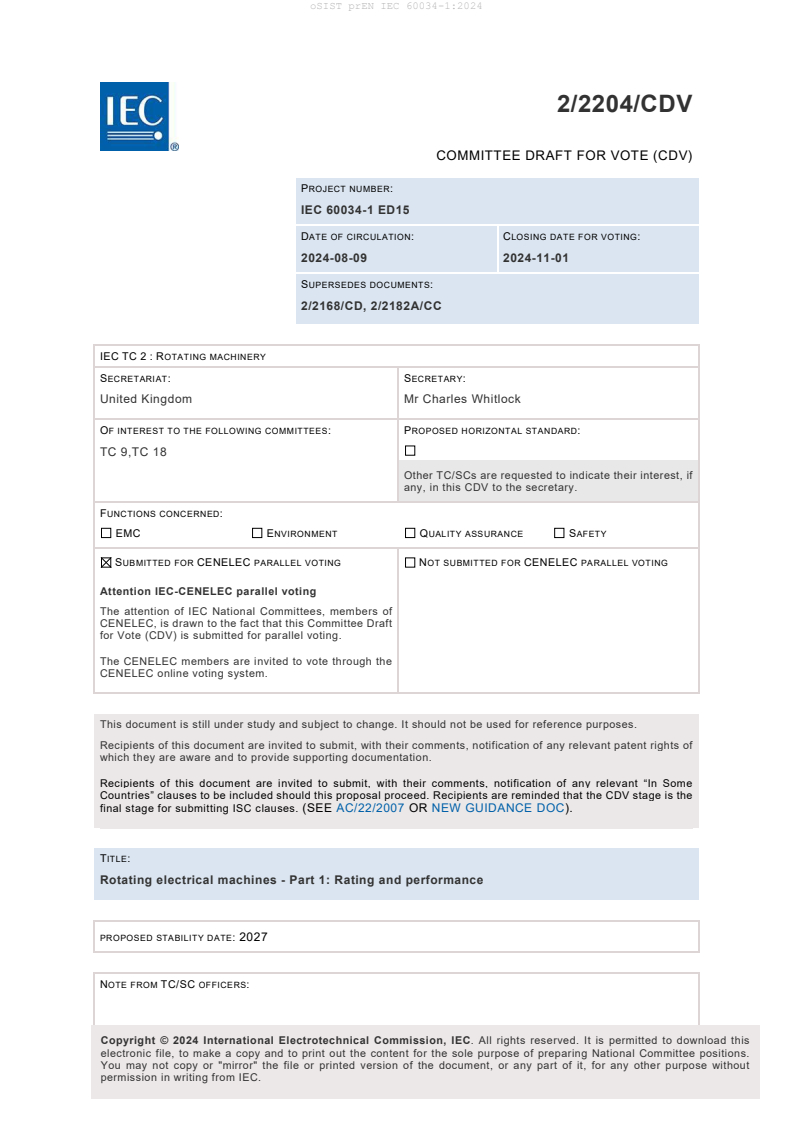
2/2204/CDV
COMMITTEE DRAFT FOR VOTE (CDV)
PROJECT NUMBER:
IEC 60034-1 ED15
DATE OF CIRCULATION: CLOSING DATE FOR VOTING:
2024-08-09 2024-11-01
SUPERSEDES DOCUMENTS:
2/2168/CD, 2/2182A/CC
IEC TC 2 : ROTATING MACHINERY
SECRETARIAT: SECRETARY:
United Kingdom Mr Charles Whitlock
OF INTEREST TO THE FOLLOWING COMMITTEES: PROPOSED HORIZONTAL STANDARD:
TC 9,TC 18
Other TC/SCs are requested to indicate their interest, if
any, in this CDV to the secretary.
FUNCTIONS CONCERNED:
EMC ENVIRONMENT QUALITY ASSURANCE SAFETY
SUBMITTED FOR CENELEC PARALLEL VOTING NOT SUBMITTED FOR CENELEC PARALLEL VOTING
Attention IEC-CENELEC parallel voting
The attention of IEC National Committees, members of
CENELEC, is drawn to the fact that this Committee Draft
for Vote (CDV) is submitted for parallel voting.
The CENELEC members are invited to vote through the
CENELEC online voting system.
This document is still under study and subject to change. It should not be used for reference purposes.
Recipients of this document are invited to submit, with their comments, notification of any relevant patent rights of
which they are aware and to provide supporting documentation.
Recipients of this document are invited to submit, with their comments, notification of any relevant “In Some
Countries” clauses to be included should this proposal proceed. Recipients are reminded that the CDV stage is the
final stage for submitting ISC clauses. (SEE AC/22/2007 OR NEW GUIDANCE DOC).
TITLE:
Rotating electrical machines - Part 1: Rating and performance
PROPOSED STABILITY DATE: 2027
NOTE FROM TC/SC OFFICERS:
electronic file, to make a copy and to print out the content for the sole purpose of preparing National Committee positions.
You may not copy or "mirror" the file or printed version of the document, or any part of it, for any other purpose without
permission in writing from IEC.
oSIST prEN IEC 60034-1:2024
IEC CDV 60034-1 ED15 © IEC 2024 – 2 – 2/2204/CDV
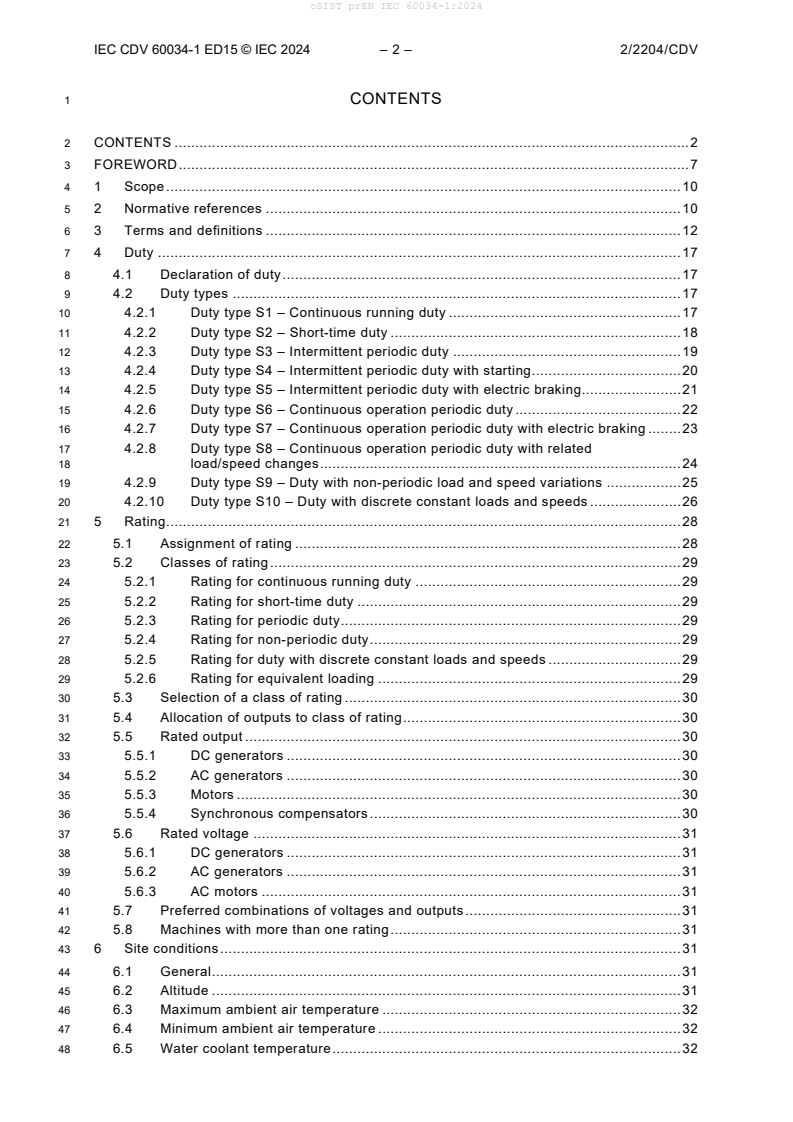
1 CONTENTS
2 CONTENTS . 2
3 FOREWORD . 7
4 1 Scope . 10
5 2 Normative references . 10
6 3 Terms and definitions . 12
7 4 Duty . 17
8 4.1 Declaration of duty . 17
9 4.2 Duty types . 17
10 4.2.1 Duty type S1 – Continuous running duty . 17
11 4.2.2 Duty type S2 – Short-time duty . 18
12 4.2.3 Duty type S3 – Intermittent periodic duty . 19
13 4.2.4 Duty type S4 – Intermittent periodic duty with starting . 20
14 4.2.5 Duty type S5 – Intermittent periodic duty with electric braking. 21
15 4.2.6 Duty type S6 – Continuous operation periodic duty . 22
16 4.2.7 Duty type S7 – Continuous operation periodic duty with electric braking . 23
17 4.2.8 Duty type S8 – Continuous operation periodic duty with related
18 load/speed changes . 24
19 4.2.9 Duty type S9 – Duty with non-periodic load and speed variations . 25
20 4.2.10 Duty type S10 – Duty with discrete constant loads and speeds . 26
21 5 Rating. 28
22 5.1 Assignment of rating . 28
23 5.2 Classes of rating . 29
24 5.2.1 Rating for continuous running duty . 29
25 5.2.2 Rating for short-time duty . 29
26 5.2.3 Rating for periodic duty . 29
27 5.2.4 Rating for non-periodic duty . 29
28 5.2.5 Rating for duty with discrete constant loads and speeds . 29
29 5.2.6 Rating for equivalent loading . 29
30 5.3 Selection of a class of rating . 30
31 5.4 Allocation of outputs to class of rating . 30
32 5.5 Rated output . 30
33 5.5.1 DC generators . 30
34 5.5.2 AC generators . 30
35 5.5.3 Motors . 30
36 5.5.4 Synchronous compensators . 30
37 5.6 Rated voltage . 31
38 5.6.1 DC generators . 31
39 5.6.2 AC generators . 31
40 5.6.3 AC motors . 31
41 5.7 Preferred combinations of voltages and outputs . 31
42 5.8 Machines with more than one rating . 31
43 6 Site conditions . 31
44 6.1 General . 31
45 6.2 Altitude . 31
46 6.3 Maximum ambient air temperature . 32
47 6.4 Minimum ambient air temperature . 32
48 6.5 Water coolant temperature . 32
oSIST prEN IEC 60034-1:2024
IEC CDV 60034-1 ED15 © IEC 2024 – 3 – 2/2204/CDV
49 6.6 Standstill, storage and transport . 32
50 6.7 Purity of hydrogen coolant . 32
51 7 Electrical operating conditions . 32
52 7.1 Electrical supply . 32
53 7.2 Form and symmetry of voltages and currents . 33
54 7.2.1 AC motors . 33
55 7.2.2 AC generators . 34
56 7.2.3 Synchronous machines . 34
57 7.2.4 DC motors supplied from static power converters . 35
58 7.3 Voltage during starting of AC motors . 36
59 7.4 Voltage and frequency variations during operation . 36
60 7.5 Three-phase AC machines operating on unearthed systems . 38
61 7.6 Voltage (peak and gradient) withstand levels . 39
62 8 Thermal performance and tests . 39
63 8.1 Thermal class . 39
64 8.2 Reference coolant . 39
65 8.3 Conditions for thermal tests . 40
66 8.3.1 Electrical supply . 40
67 8.3.2 Temperature of machine before test . 40
68 8.3.3 Temperature of coolant . 40
69 8.3.4 Measurement of coolant temperature during test . 41
70 8.4 Temperature rise of a part of a machine . 41
71 8.5 Methods of measurement of temperature . 41
72 8.5.1 General . 41
73 8.5.2 Resistance method . 41
74 8.5.3 Embedded temperature detector (ETD) method . 41
75 8.5.4 Thermometer method. 42
76 8.6 Determination of winding temperature . 42
77 8.6.1 Choice of method . 42
78 8.6.2 Determination by resistance method . 42
79 8.6.3 Determination by ETD method . 44
80 8.6.4 Determination by thermometer method . 44
81 8.7 Duration of thermal tests . 45
82 8.7.1 Rating for continuous running duty . 45
83 8.7.2 Rating for short-time duty . 45
84 8.7.3 Rating for periodic duty . 45
85 8.7.4 Ratings for non-periodic duty and for duty with discrete constant loads . 45
86 8.8 Determination of the thermal equivalent time constant for machines of
87 duty type S9 . 45
88 8.9 Measurement of bearing temperature . 45
89 8.10 Limits of temperature and of temperature rise . 46
90 8.10.1 General . 46
91 8.10.2 Indirect cooled windings . 46
92 8.10.3 Direct cooled windings . 50
93 8.10.4 Adjustments to take account of hydrogen purity on test . 51
94 8.10.5 Permanently short-circuited windings, magnetic cores and all structural
95 components (other than bearings) whether or not in contact with
96 insulation . 51
97 8.10.6 Commutators and sliprings, open or enclosed and their brushes and
98 brushgear . 51
99 9 Other performance and tests . 53
oSIST prEN IEC 60034-1:2024
IEC CDV 60034-1 ED15 © IEC 2024 – 4 – 2/2204/CDV
100 9.1 Routine tests. 53
101 9.2 Withstand voltage test . 54
102 9.3 Occasional excess current . 57
103 9.3.1 General . 57
104 9.3.2 Generators . 58
105 9.3.3 Motors (except commutator motors and permanent magnet motors) . 58
106 9.3.4 Commutator machines . 58
107 9.4 Momentary excess torque for motors . 58
108 9.4.1 Polyphase induction motors and DC motors . 58
109 9.4.2 Polyphase synchronous motors . 59
110 9.4.3 Other motors . 59
111 9.5 Pull-up torque and locked-rotor torque for cage induction motors with direct
112 online starting . 59
113 9.6 Safe operating speed of cage induction motors . 59
114 9.7 Overspeed . 59
115 9.8 Short-circuit current for synchronous machines . 60
116 9.9 Short-circuit withstand test for synchronous machines . 61
117 9.10 Commutation test for commutator machines . 61
118 9.11 Total harmonic distortion (THD) for synchronous machines . 61
119 9.11.1 General . 61
120 9.11.2 Limits . 61
121 9.11.3 Tests . 61
122 9.12 Protective earth test . 62
123 9.13 Measurement of insulation resistance and polarization index of winding
124 insulation . 62
125 9.14 Shaft-voltage test . 63
126 10 Information requirements . 63
127 10.1 General . 63
128 10.2 Product documentation . 63
129 10.3 Rating plate . 63
130 10.4 Information content . 63
131 10.4.1 General . 63
132 10.4.2 Minimum information requirements . 64
133 10.4.3 All AC machines . 64
134 10.4.4 All DC machines . 65
135 10.4.5 Machines over 5 kW (or 5 kVA) rated output . 65
136 10.4.6 Optional information . 65
137 11 Miscellaneous requirements . 65
138 11.1 Protective earthing of machines . 65
139 11.2 Shaft-end key(s) . 67
140 12 Tolerances . 67
141 12.1 General . 67
142 12.2 Tolerances on values of quantities . 67
143 13 Electromagnetic compatibility (EMC) . 69
144 13.1 General . 69
145 13.2 Immunity . 69
146 13.2.1 Machines not incorporating electronic circuits . 69
147 13.2.2 Machines incorporating electronic circuits . 69
148 13.3 Emission . 69
149 13.4 Immunity tests . 70
oSIST prEN IEC 60034-1:2024
IEC CDV 60034-1 ED15 © IEC 2024 – 5 – 2/2204/CDV
150 13.5 Emission measurements . 70
151 14 Application requirements . 70
152 Annex A (informative) Guidance for the application of duty type S10 and for
153 establishing the value of relative thermal life expectancy TL . 71
154 Annex B (informative) Electromagnetic compatibility (EMC) limits . 72
155 Bibliography . 73
157 Figure 1 – Continuous running duty – Duty type S1 . 18
158 Figure 2 – Short-time duty – Duty type S2 . 19
159 Figure 3 – Intermittent periodic duty – Duty type S3 . 20
160 Figure 4 – Intermittent periodic duty with starting – Duty type S4 . 21
161 Figure 5 – Intermittent periodic duty with electric braking – Duty type S5 . 22
162 Figure 6 – Continuous operation periodic duty – Duty type S6 . 23
163 Figure 7 – Continuous operation periodic duty with electric braking – Duty type S7 . 24
164 Figure 8 – Continuous operation periodic duty with related load/speed changes – Duty
165 type S8 . 25
166 Figure 9 – Duty with non-periodic load and speed variations – Duty type S9 . 26
167 Figure 10 – Duty with discrete constant loads – Duty type S10 . 28
168 Figure 11 – Voltage and frequency limits for motors and for generators except
169 generators or synchronous compensators within the scope of IEC 60034-3 and hydro
170 generators within the scope of IEC 60034-33 . 38
171 Figure 12 – Worst case increase in temperature rise (∆θ) and recommended reduction
172 of output power (∆P) of motors as a function of the combined change of voltage and
173 frequency |∆∅| (indicative guideline to users of motors and generators only) . 38
174 Figure 13 – Factor K for determining R . 62
PE,M
176 Table 1 – Preferred voltage ratings . 31
177 Table 2 – Unbalanced operating conditions for synchronous machines . 35
178 Table 3 – CCC symbol designation . 36
179 Table 4 – Primary functions of machines . 37
180 Table 5 – Reference coolant (see also Table 11) . 40
181 Table 6 – Time interval . 43
182 Table 7 – Measuring points . 45
183 Table 8 – Limits of temperature rise of windings indirectly cooled by air. 47
184 Table 9 – Limits of temperature rise of windings indirectly cooled by hydrogen . 48
185 Table 10 – Adjustments to limits of temperature rise at the operating site of indirect
186 cooled windings to take account of non-reference operating conditions and ratings . 49
187 Table 11 – Assumed maximum ambient temperature . 50
188 Table 12 – Adjusted limits of temperature rise at the test site (∆θ ) for windings
T
189 indirectly cooled by air to take account of test site operating conditions . 51
190 Table 13 – Limits of temperature of directly cooled windings and their coolants . 52
191 Table 14 – Adjustments to limits of temperature at the operating site for windings
192 directly cooled by air or hydrogen to take account of non-reference operating
193 conditions and ratings . 52
194 Table 15 – Adjusted limits of temperature at the test site θ for windings directly
T
195 cooled by air to take account of test site operating conditions . 53
oSIST prEN IEC 60034-1:2024
IEC CDV 60034-1 ED15 © IEC 2024 – 6 – 2/2204/CDV
196 Table 16 – Minimum routine tests for machines assembled and tested in the factory of
197 the manufacturer . 54
198 Table 17 – Withstand voltage tests . 56
199 Table 18 – Test voltage factors for machines with an assigned Impulse Voltage
200 Insulation Class (IVIC) according to IEC 60034-18-41 and IEC 60034-18-42. 57
201 Table 19 – Maximum safe operating speed (min− ) of three-phase single-speed cage
202 induction motors for voltages up to and including 1 000 V . 59
203 Table 20 – Overspeeds . 60
204 Table 21 – Cross-sectional areas of earthing conductors . 67
205 Table 22 – Schedule of tolerances on values of quantities . 67
206 Table B.1 – Electromagnetic emission limits per CISPR 11 Class B Group 1. 72
207 Table B.2 – Electromagnetic emission limits per CISPR 11 Class A Group 1. 72
oSIST prEN IEC 60034-1:2024
IEC CDV 60034-1 ED15 © IEC 2024 – 7 – 2/2204/CDV
210 INTERNATIONAL ELECTROTECHNICAL COMMISSION
211 ____________
213 ROTATING ELECTRICAL MACHINES –
215 Part 1: Rating and performance
217 FOREWORD
218 1) The International Electrotechnical Commission (IEC) is a worldwide organization for standardization comprising
219 all national electrotechnical committees (IEC National Committees). The object of IEC is to promote international
220 co-operation on all questions concerning standardization in the electrical and electronic fields. To this end and
221 in addition to other activities, IEC publishes International Standards, Technical Specifications, Technical Reports,
222 Publicly Available Specifications (PAS) and Guides (hereafter referred to as “IEC Publication(s)”). Their
223 preparation is entrusted to technical committees; any IEC National Committee interested in the subject dealt with
224 may participate in this preparatory work. International, governmental and non-governmental organizations liaising
225 with the IEC also participate in this preparation. IEC collaborates closely with the International Organization for
226 Standardization (ISO) in accordance with conditions determined by agreement between the two organizations.
227 2) The formal decisions or agreements of IEC on technical matters express, as nearly as possible, an international
228 consensus of opinion on the relevant subjects since each technical committee has representation from all
229 interested IEC National Committees.
230 3) IEC Publications have the form of recommendations for international use and are accepted by IEC National
231 Committees in that sense. While all reasonable efforts are made to ensure that the technical content of IEC
232 Publications is accurate, IEC cannot be held responsible for the way in which they are used or for any
233 misinterpretation by any end user.
234 4) In order to promote international uniformity, IEC National Committees undertake to apply IEC Publications
235 transparently to the maximum extent possible in their national and regional publications. Any divergence between
236 any IEC Publication and the corresponding national or regional publication shall be clearly indicated in the latter.
237 5) IEC itself does not provide any attestation of conformity. Independent certification bodies provide conformity
238 assessment services and, in some areas, access to IEC marks of conformity. IEC is not responsible for any
239 services carried out by independent certification bodies.
240 6) All users should ensure that they have the latest edition of this publication.
241 7) No liability shall attach to IEC or its directors, employees, servants or agents including individual experts and
242 members of its technical committees and IEC National Committees for any personal injury, property damage or
243 other damage of any nature whatsoever, whether direct or indirect, or for costs (including legal fees) and
244 expenses arising out of the publication, use of, or reliance upon, this IEC Publication or any other IEC
245 Publications.
246 8) Attention is drawn to the Normative references cited in this publication. Use of the referenced publications is
247 indispensable for the correct application of this publication.
248 9) Attention is drawn to the possibility that some of the elements of this IEC Publication may be the subject of patent
249 rights. IEC shall not be held responsible for identifying any or all such patent rights.
250 IEC 60034-1 has been prepared by IEC technical committee 2: Rotating machinery. It is an
251 International Standard.
252 This fifteenth edition cancels and replaces the fourteenth edition published in 2022. This edition
253 constitutes a technical revision.
oSIST prEN IEC 60034-1:2024
IEC CDV 60034-1 ED15 © IEC 2024 – 8 – 2/2204/CDV
254 This edition includes the following significant technical changes with respect to the previous
255 edition:
Clause or
Change
subclause
1 Clarification with respect to machines with integrated EMC-active components added
2 Normative references updated
3 Note on meaning of “agreement” deleted
4.2.9, 4.2.10 References to IEC TS 60034-25 deleted, as converter duty is now defined in 3.36
5.1 Reference to IEC TS 60034-25 converted into note
6.6 Clarification of requirements
7.2.1 Reference to IEC TS 60034-25 converted into note
7.5 Clarification of requirements
7.6 Reference to IEC TS 60034-25 converted into note
8.1 Clarification of references
8.6.1 Clarification on choice of method for large machines
Table 11 Updated values for thermal class 200 (N)
8.10.3 Clarification of requirements
9.2 Clarification on test voltage for old machines after rewinding
Table 17 Items 9 and 10 merged and clarified
9.7 Clarification on overspeed test for machines held at stock added
Table 20 Clarification on test speed for converter duty machines
10.2 Clarification of term ‘digital form’
10.3 Note on QR code deleted
11.1 Reference to protective earth test added
13.2.2 Clarification on motors with integrated VSD added
13.3 Clarification of requirements after consultation with ACEC
13.5 Clarification of requirements after consultation with ACEC
14 Note on safety converted to normal text
256 The text of this International Standard is based on the following documents:
Draft Report on voting
2/xxx/FDIS 2/xxx/RVD
258 Full information on the voting for its approval can be found in the report on voting indicated in
259 the above table.
260 The language used for the development of this International Standard is English.
261 This document was drafted in accordance with ISO/IEC Directives, Part 2, and developed in
262 accordance with ISO/IEC Directives, Part 1 and ISO/IEC Directives, IEC Supplement, available
263 at www.iec.ch/members_experts/refdocs. The main document types developed by IEC are
264 described in greater detail at www.iec.ch/standardsdev/publications.
265 A list of all parts of the IEC 60034 series, published under the general title Rotating electrical
266 machines, can be found on the IEC website.
oSIST prEN IEC 60034-1:2024
IEC CDV 60034-1 ED15 © IEC 2024 – 9 – 2/2204/CDV
267 The committee has decided that the contents of this document will remain unchanged until the
268 stability date indicated on the IEC website under webstore.iec.ch in the data related to the
269 specific document. At this date, the document will be
270 • reconfirmed,
271 • withdrawn,
272 • replaced by a revised edition, or
273 • amended.
IMPORTANT – The "colour inside" logo on the cover page of this document indicates that it
contains colours which are considered to be useful for the correct understanding of its
contents. Users should therefore print this document using a colour printer.
oSIST prEN IEC 60034-1:2024
IEC CDV 60034-1 ED15 © IEC 2024 – 10 – 2/2204/CDV
277 ROTATING ELECTRICAL MACHINES –
279 Part 1: Rating and performance
283 1 Scope
284 This part of IEC 60034 is applicable to all rotating electric machines, except rotating electric
285 machines for rail and road vehicles, which are covered by the IEC 60349 series of standards.
286 Machines with integrated EMC-active components such as a variable frequency converter are
287 considered being a power drive system (see the IEC 61800 series of standards). In such cases, this
288 standard applies to the motor component of the power drive system only.
289 Machines within the scope of this document can also be subject to superseding, modifying or
290 additional requirements in other standards, for example, IEC 60079 and IEC 60092.
291 NOTE If particular clauses of this document are modified to meet special applications, for example machines subject
292 to radioactivity or machines for aerospace, all other clauses apply insofar as they are compatible.
293 2 Normative references
294 The following documents are referred to in the text in such a way that some or all of their content
295 constitutes requirements of this document. For dated references, only the edition cited applies.
296 For undated references, the latest edition of the referenced document (including any
297 amendments) applies.
298 IEC 60027-1:1992, Letters symbols to be used in electrical technology – Part 1: General
299 IEC 60027-1:1992/AMD1:1997
300 IEC 60027-1:1992/AMD2:2005
301 IEC 60027-4:2006, Letter symbols to be used in electrical technology – Part 4: Rotating electric
302 machines
303 IEC 60034-2 (all parts), Rotating electrical machines – Part 2: Standard methods for
304 determining losses and efficiency from tests (excluding machines for traction vehicles)
305 IEC 60034-3:2020, Rotating electrical machines – Part 3: Specific requirements for
306 synchronous generators driven by steam turbines or combustion gas turbines and for
307 synchronous compensators
308 IEC 60034-5:2020, Rotating electrical machines – Part 5: Degrees of protection provided by the
309 integral design of rotating electrical machines (IP code) – Classification
310 IEC 60034-6:1991, Rotating electrical machines – Part 6: Methods of cooling (IC code)
311 IEC 60034-8:2007, Rotating electrical machines – Part 8: Terminal markings and direction of
312 rotation
313 IEC 60034-8:2007/AMD1:2014
314 IEC 60034-12:2016, Rotating electrical machines – Part 12: Starting performance of single-
315 speed three-phase cage induction motors
316 IEC 60034-15:2009, Rotating electrical machines – Part 15: Impulse voltage withstand levels
317 of form-wound stator coils for rotating AC machines
318 IEC 60034-18-1:2022, Rotating electrical machines - Part 18-1: Functional evaluation of
319 insulation systems - General guidelines
320 IEC 60034-18-21:2012, Functional evaluation of insulation systems - Test procedures for wire-
321 wound windings - Thermal evaluation and classification
oSIST prEN IEC 60034-1:2024
IEC CDV 60034-1 ED15 © IEC 2024 – 11 – 2/2204/CDV
322 IEC 60034-18-31:2012, Functional evaluation of insulation systems - Test procedures for form-
323 wound windings - Thermal evaluation and classification of insulation systems used in machines
324 up to and including 50 MVA and 15 kV
325 IEC 60034-18-32: 2022, Functional evaluation of insulation systems - Test procedures for form-
326 wound windings - Electrical evaluation of insulation systems used in machines up to and
327 including 50 MVA and 15 kV
328 IEC 60034-18-34:2012, Functional evaluation of insulation systems - Test procedures for form-
329 wound windings - Evaluation of thermomechanical endurance of insulation systems
330 IEC 60034-18-41:2014, Rotating electrical machines – Part 18-41: Partial discharge free
331 electrical insulation systems (Type I) used in rotating electrical machines fed from voltage
332 converters – Qualification and quality control tests
333 IEC 60034-18-41:2014/AMD1:2019
334 IEC 60034-18-42:2017, Rotating electrical machines – Part 18-42: Partial discharge resistant
335 electrical insulation systems (Type II) used in rotating electrical machines fed from voltage
336 converters – Qualification tests
337 IEC 60034-18-42:2017/AMD1:2020
338 IEC 60034-19:2014, Rotating electrical machines – Part 19: Specific test methods for d.c.
339 machines on conventional and rectifier-fed supplies
340 IEC 60034-27-4:2018, Rotating electrical machines – Part 27-4: Measurement of insulation
341 resistance and polarization index of winding insulation of rotating electrical machines
342 IEC 60034-29:2008, Rotating electrical machines – Part 29: Equivalent loading and
343 superposition techniques – Indirect testing to determine temperature rise
344 IEC 60034-30-1:2014, Rotating electrical machines – Part 30-1: Efficiency classes of line
345 operated AC motors (IE-code)
346 IEC 60034-30-3:2024, Rotating electrical machines – Part 30-3: Efficiency classes of high
347 voltage AC motors (IE code)
348 IEC 60034-33:2022 Rotating electrical machines – Part 33: Specific technical requirements for
349 hydro generators
350 IEC 60050-411:1996, International Electrotechnical Vocabulary (IEV) – Part 411: Rotating
351 machinery
352 IEC 60050-411:1996/AMD1:2007
353 IEC 60050-411:1996/AMD2:2021
354 IEC 60060-1:2010, High-voltage test techniques – Part 1: General definitions and test
355 requirements
356 IEC 60085:2007, Electrical insulation – Thermal evaluation and designation
357 IEC 60204-1:2016, Safety of machinery – Electrical equipment of machines – Part 1: General
358 requirements
359 IEC 60204-11:2018, Safety of machinery – Electrical equipment of machines – Part 11:
360 Requirements for equipment for voltages above 1 000 V AC or 1 500 V DC and not exceeding
361 36 kV
362 IEC 60335-1:2020, Household and similar electrical appliances – Safety – Part 1: General
363 requirements
364 IEC 60364 (all parts), Low-voltage electrical installations
365 IEC 60417:2002, Graphical symbols for use on equipment – 12-month subscription to regularly
366 updated online database comprising all graphical symbols published in IEC 60417
367 IEC 60445:2017, Basic and safety principles for man-machine interface, marking and
368 identification – Identification of equipment terminals, conductor terminations and conductors
oSIST prEN IEC 60034-1:2024
IEC CDV 60034-1 ED15 © IEC 2024 – 12 – 2/2204/CDV
369 IEC 60664-1:2020, Insulation coordination for equipment within low-voltage systems – Part 1:
370 Principles, requirements and tests
371 IEC 61148:2011, Terminal markings for valve device stacks and assemblies and for power
372 conversion equipment
373 CISPR 11:2015, Industrial, scientific and medical equipment – Radio-frequency disturbance
374 characteristics – Limits and methods of measurement
375 CISPR 11:2015/AMD1:2016
376 CISPR 11:2015/AMD2:2019
377 CISPR 14 (all parts), Electromagnetic compatibility – Requirements for household appliances,
378 electric tools and similar apparatus
379 CISPR 16 (all parts), Specification for radio disturbance and immunity measuring apparatus
380 and methods
381 3 Terms and definitions
382 For the purposes of this document, the terms and definitions in IEC 60050-411, and the
383 following apply.
384 NOTE 1 For definitions concerning cooling and coolants, other than those in 3.17 to 3.22, see IEC 60034-6.
385 NOTE 2 For the purposes of this document, the term ‘agreement’ means ‘agreement between the manufacturer and
386 purchaser’.
387 ISO and IEC maintain terminological databases for use in standardization at the following
388 addresses:
389 • IEC Electropedia: available at http://www.electropedia.org/
390 • ISO Online browsing platform: available at http://www.iso.org/obp
391 3.1
392 rated value
393 quantity value assigned, generally by a manufacturer, for a specified operating condition of a
394 machine
395 Note 1 to entry: The rated voltage or voltage range is the rated voltage or voltage range between lines at the
396 machine terminals.
397 [SOURCE: IEC 60050-411:1996, 411-51-23]
398 3.2
399 rating
400 set of rated values and operating conditions
401 [SOURCE: IEC 60050-411:1996, 411-51-24]
402 3.3
403 rated output
404 value of the output included in the rating
405 3.4
406 load
407 all the values of the, in case of a generator, electrical and, in case of a motor, mechanical
408 quantities that signify the demand made on a rotating machine by an electrical circuit or a
409 mechanism at a given instant
410 [SOURCE: IEC 60050-411:1996, 411-51-01, modified – “in case of a generator” and “in case of
411 a motor” have been added.]
412 3.5
413 no-load
414 state of a machine rotating with zero output power (but under otherwise normal operating
415 conditions)
oSIST prEN IEC 60034-1:2024
IEC CDV 60034-1 ED15 © IEC 2024 – 13 – 2/2204/CDV
416 [SOURCE: IEC 60050-411:1996, 411-51-02, modified – “(but under otherwise normal operating
417 conditions)” has been added.]
418 3.6
419 full load
420 load which causes a machine to operate at its rating
421 [SOURCE: IEC 60050-411:1996, 411-51-10]
422 3.7
423 full load value
424 quantity value for a machine operating at full load
425 Note 1 to entry: This concept applies to power, torque, current, speed, etc.
426 [SOURCE: IEC 60050-411:1996, 411-51-11]
427 3.8
428 rest and de-energized
429 complete absence of all movement and of all electrical supply or mechanical drive
430 [SOURCE: IEC 60050-411:1996, 411-51-03]
431 3.9
432 duty
433 statement of the load(s) to which the machine is subjected, including, if applicable, starting,
434 electric braking, no-load and rest and de-energized periods, and including their durations and
435 sequence in time
436 [SOURCE: IEC 60050-411:1996, 411-51-06]
437 3.10
438 duty type
439 continuous, short-time or periodic duty, comprising one or more loads remaining constant for
440 the duration specified, or a non-periodic duty in which generally load and speed vary within the
...