

SIST EN 303 978 V2.2.1:2025
(Main)Satellite Earth Stations and Systems (SES) - Earth Stations on Mobile Platforms (ESOMP) communicating with satellites in geostationary orbit, operating in the 27,5 GHz to 30,0 GHz and 17,3 GHz to 20,2 GHz frequency bands - Harmonised Standard for access to radio spectrum
General Information
- Abstract
The present document specifies technical characteristics and methods of measurements for Earth Stations on Mobile
Platforms (ESOMP) equipment with the following characteristics:
• The ESOMP is designed for both mobile and stationary operation.
• The ESOMP operates on various mobile platforms such as trains, maritime vessels, aircraft and other vehicles.
• The ESOMP is controlled and monitored by a Network Control Facility (NCF). This function may be
performed centrally (e.g. for a network of ESOMPs with a central hub) or it could be performed within the
ESOMP for autonomous control. The NCF is outside the scope of the present document.
• The ESOMP transmit and receive frequencies are shown in table 1.
NOTE: The relationship between the present document and essential requirements of article 3.2 of
Directive 2014/53/EU [i.11] is given in annex A.
- Status
- Published
- Public Enquiry End Date
- 30-Nov-2024
- Publication Date
- 08-Jan-2025
- Technical Committee
- MOC - Mobile Communications
- Current Stage
- 6060 - National Implementation/Publication (Adopted Project)
- Start Date
- 06-Jan-2025
- Due Date
- 13-Mar-2025
- Completion Date
- 09-Jan-2025
- Directive
- 2014/53/EU - Directive 2014/53/EU of The European Parliament and of the Council of 16 April 2014 on the harmonisation of the laws of the Member States relating to the making available on the market of radio equipment and repealing Directive 1999/5/ECOJ Ref: 14.8.2025, OJ L OJ Date: 14-Aug-2025
Buy Documents
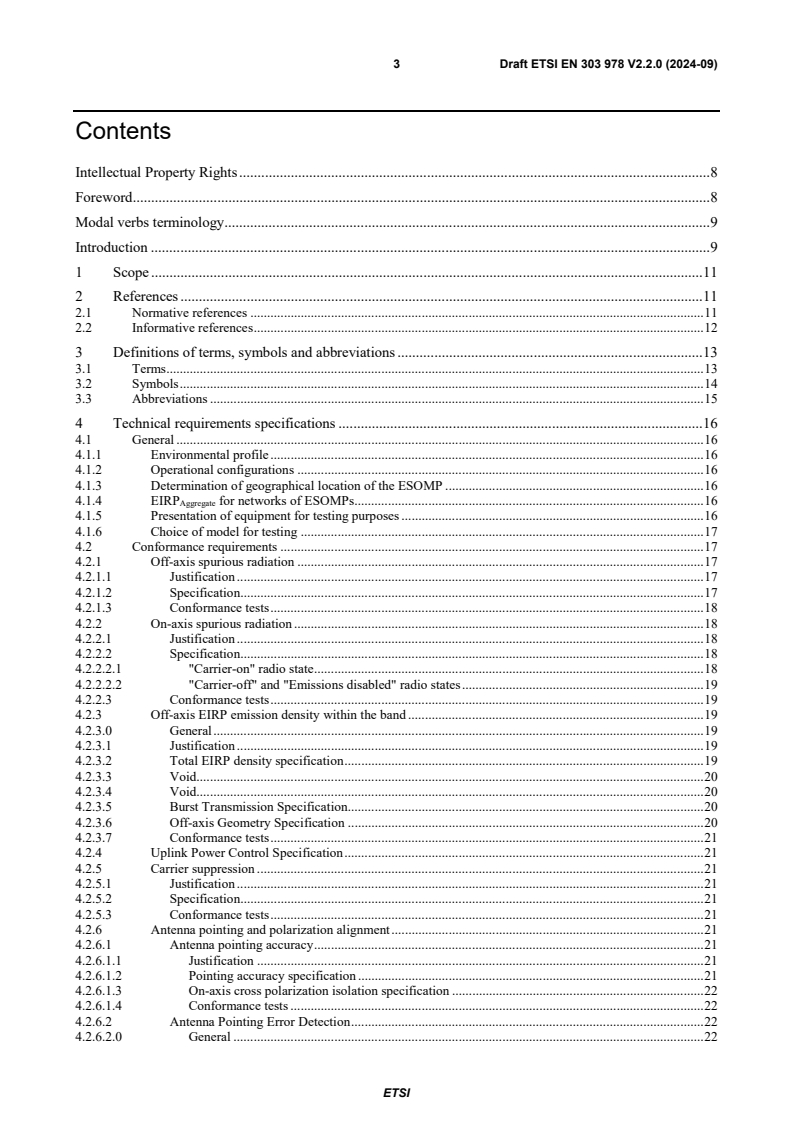
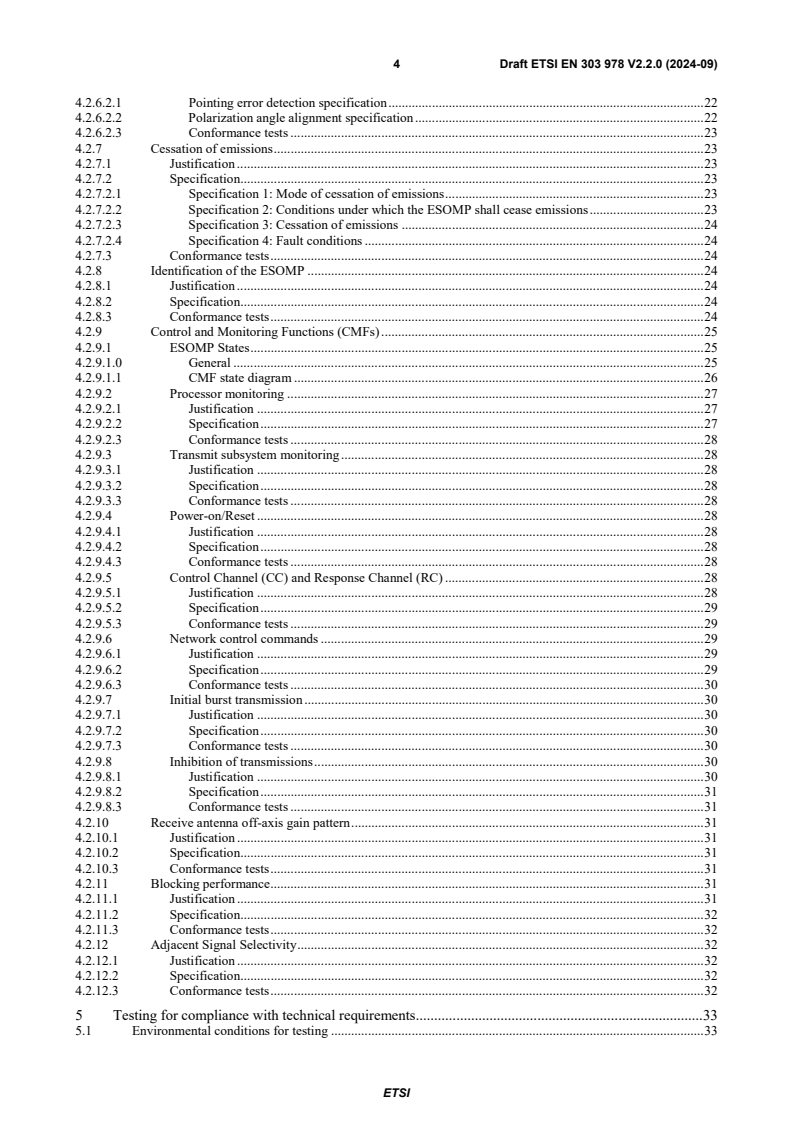
ETSI EN 303 978 V2.2.0 (2024-09) - Satellite Earth Stations and Systems (SES); Earth Stations on Mobile Platforms (ESOMP) communicating with satellites in geostationary orbit, operating in the 27,5 GHz to 30,0 GHz and 17,3 GHz to 20,2 GHz frequency bands; Harmonised Standard for access to radio spectrum
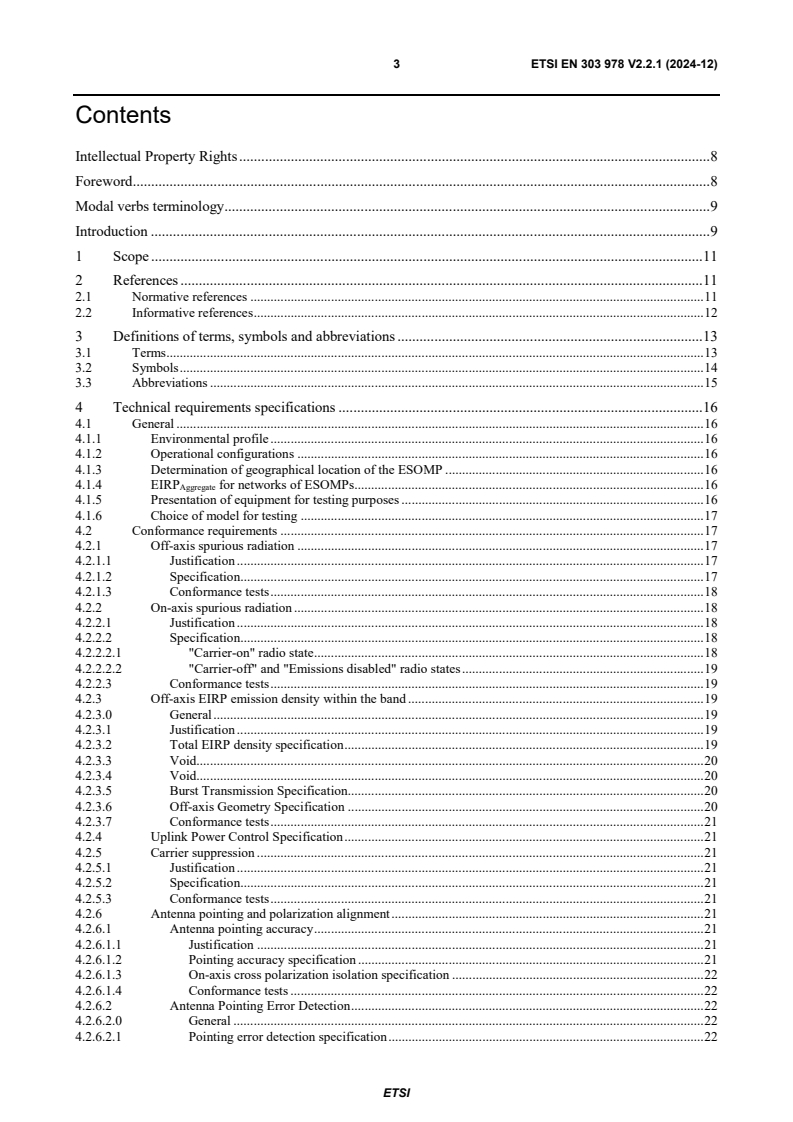
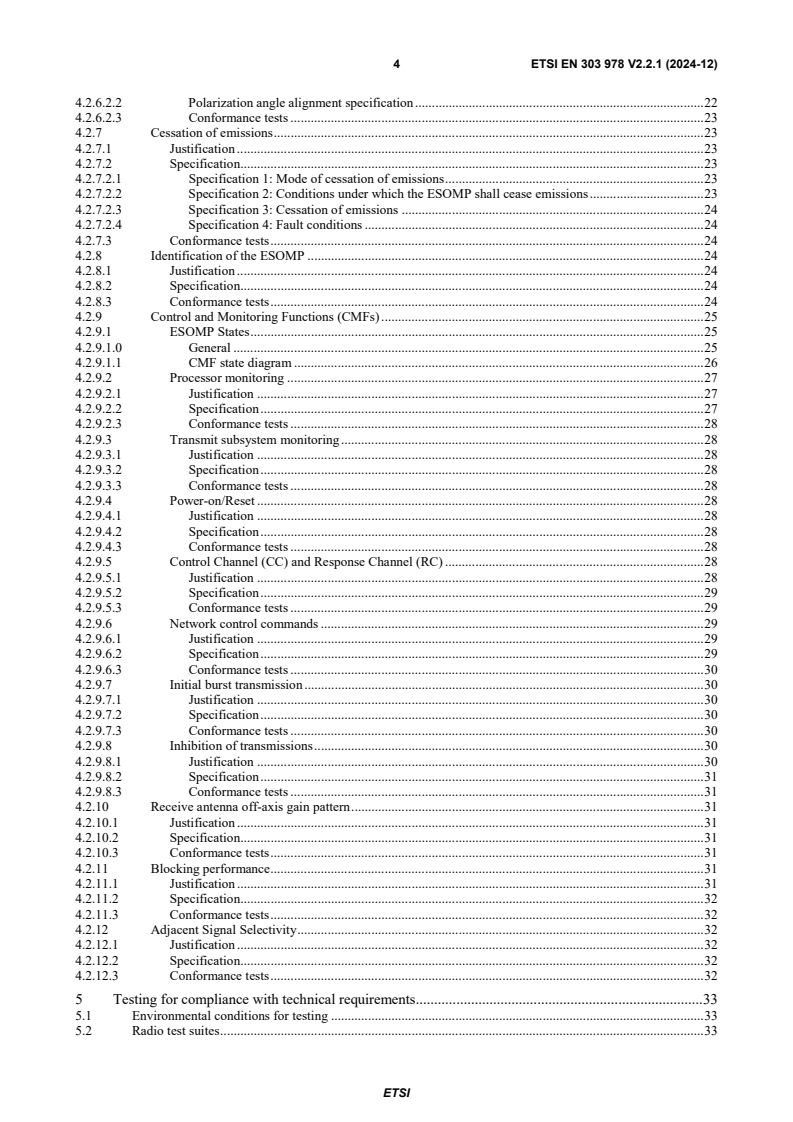
ETSI EN 303 978 V2.2.1 (2024-12) - Satellite Earth Stations and Systems (SES); Earth Stations on Mobile Platforms (ESOMP) communicating with satellites in geostationary orbit, operating in the 27,5 GHz to 30,0 GHz and 17,3 GHz to 20,2 GHz frequency bands; Harmonised Standard for access to radio spectrum

Overview
SIST EN 303 978 V2.2.1:2025 is a harmonised European standard (identical to ETSI EN 303 978 V2.2.1) that defines technical characteristics and measurement methods for Satellite Earth Stations on Mobile Platforms (ESOMP) communicating with satellites in geostationary orbit (GSO). It covers ESOMP equipment that can operate both mobile and stationary, on platforms such as trains, maritime vessels, aircraft and other vehicles, and which operate in the 27.5 GHz–30.0 GHz and 17.3 GHz–20.2 GHz frequency bands. The standard is published for access to radio spectrum and includes the relationship to essential requirements of Article 3.2 of Directive 2014/53/EU (see annex A).
Key topics and technical requirements
The document focuses on practical, testable requirements for ESOMP devices. Key technical topics include:
- Frequency bands and channelization - defined transmit/receive allocations for ESOMP in the specified GSO bands (see table 1 of the standard).
- Conformance testing and measurement methods - standardized procedures for verifying compliance with emission and performance limits.
- Spurious and on‑axis/off‑axis emissions - limits and test methods to control interference with adjacent services.
- EIRP and emission density - total and off‑axis EIRP density specifications for single units and networks of ESOMPs.
- Uplink Power Control (UPC) - requirements to manage transmitted power and reduce interference into the satellite or neighbouring services.
- Antenna performance - pointing accuracy, polarization alignment, on‑axis cross‑polarization isolation and pointing‑error detection.
- Control & Monitoring Functions (CMFs) - states, processor and transmit monitoring, control channel/response channel behavior, network control commands and initial burst transmission rules.
- Cessation of emissions and fault handling - modes and conditions under which the ESOMP must stop transmissions.
- Identification and presentation for testing - device identification and test configuration rules.
Practical applications and who uses this standard
SIST EN 303 978 is intended for professionals involved in the design, manufacture, testing, certification and operation of mobile satellite terminals and networks:
- Equipment manufacturers - to design ESOMP products that meet harmonised spectrum access requirements.
- Test laboratories and conformity assessors - to perform mandated conformance tests and produce test reports.
- Network operators and integrators - to ensure ESOMPs operated on trains, ships, aircraft or fleets meet operational and interference rules.
- Regulators and certification bodies - to assess compliance with radio spectrum access rules and Directive 2014/53/EU requirements.
- System engineers - for guidance on antenna pointing, power control and networked ESOMP behavior.
Related standards
- ETSI EN 303 978 V2.2.1 (2024-12) - the originating ETSI deliverable.
- Directive 2014/53/EU (Radio Equipment Directive) - essential requirements referenced in annex A.
Keywords: satellite earth stations, ESOMP, geostationary orbit, 27.5–30 GHz, 17.3–20.2 GHz, harmonised standard, radio spectrum access, EIRP, uplink power control, antenna pointing, conformance tests.
Buy Documents
ETSI EN 303 978 V2.2.0 (2024-09) - Satellite Earth Stations and Systems (SES); Earth Stations on Mobile Platforms (ESOMP) communicating with satellites in geostationary orbit, operating in the 27,5 GHz to 30,0 GHz and 17,3 GHz to 20,2 GHz frequency bands; Harmonised Standard for access to radio spectrum
ETSI EN 303 978 V2.2.1 (2024-12) - Satellite Earth Stations and Systems (SES); Earth Stations on Mobile Platforms (ESOMP) communicating with satellites in geostationary orbit, operating in the 27,5 GHz to 30,0 GHz and 17,3 GHz to 20,2 GHz frequency bands; Harmonised Standard for access to radio spectrum
Get Certified
Connect with accredited certification bodies for this standard

ANCE
Mexican certification and testing association.

Intertek Slovenia
Intertek testing, inspection, and certification services in Slovenia.

LNE (Laboratoire National de Métrologie et d'Essais)
French national laboratory for metrology and testing.
Sponsored listings
Frequently Asked Questions
SIST EN 303 978 V2.2.1:2025 is a standard published by the Slovenian Institute for Standardization (SIST). Its full title is "Satellite Earth Stations and Systems (SES) - Earth Stations on Mobile Platforms (ESOMP) communicating with satellites in geostationary orbit, operating in the 27,5 GHz to 30,0 GHz and 17,3 GHz to 20,2 GHz frequency bands - Harmonised Standard for access to radio spectrum". This standard covers: The present document specifies technical characteristics and methods of measurements for Earth Stations on Mobile Platforms (ESOMP) equipment with the following characteristics: • The ESOMP is designed for both mobile and stationary operation. • The ESOMP operates on various mobile platforms such as trains, maritime vessels, aircraft and other vehicles. • The ESOMP is controlled and monitored by a Network Control Facility (NCF). This function may be performed centrally (e.g. for a network of ESOMPs with a central hub) or it could be performed within the ESOMP for autonomous control. The NCF is outside the scope of the present document. • The ESOMP transmit and receive frequencies are shown in table 1. NOTE: The relationship between the present document and essential requirements of article 3.2 of Directive 2014/53/EU [i.11] is given in annex A.
The present document specifies technical characteristics and methods of measurements for Earth Stations on Mobile Platforms (ESOMP) equipment with the following characteristics: • The ESOMP is designed for both mobile and stationary operation. • The ESOMP operates on various mobile platforms such as trains, maritime vessels, aircraft and other vehicles. • The ESOMP is controlled and monitored by a Network Control Facility (NCF). This function may be performed centrally (e.g. for a network of ESOMPs with a central hub) or it could be performed within the ESOMP for autonomous control. The NCF is outside the scope of the present document. • The ESOMP transmit and receive frequencies are shown in table 1. NOTE: The relationship between the present document and essential requirements of article 3.2 of Directive 2014/53/EU [i.11] is given in annex A.
SIST EN 303 978 V2.2.1:2025 is classified under the following ICS (International Classification for Standards) categories: 33.060.30 - Radio relay and fixed satellite communications systems. The ICS classification helps identify the subject area and facilitates finding related standards.
SIST EN 303 978 V2.2.1:2025 is associated with the following European legislation: EU Directives/Regulations: 2014/53/EU. When a standard is cited in the Official Journal of the European Union, products manufactured in conformity with it benefit from a presumption of conformity with the essential requirements of the corresponding EU directive or regulation.
SIST EN 303 978 V2.2.1:2025 is available in PDF format for immediate download after purchase. The document can be added to your cart and obtained through the secure checkout process. Digital delivery ensures instant access to the complete standard document.
Standards Content (Sample)
Draft ETSI EN 303 978 V2.2.0 (2024-09)
HARMONISED EUROPEAN STANDARD
Satellite Earth Stations and Systems (SES);
Earth Stations on Mobile Platforms (ESOMP)
communicating with satellites in geostationary orbit,
operating in the 27,5 GHz to 30,0 GHz and
17,3 GHz to 20,2 GHz frequency bands;
Harmonised Standard for access to radio spectrum
2 Draft ETSI EN 303 978 V2.2.0 (2024-09)
Reference
REN/SES-00468
Keywords
antenna, earth station, GSO, mobile, regulation,
satellite
ETSI
650 Route des Lucioles
F-06921 Sophia Antipolis Cedex - FRANCE
Tel.: +33 4 92 94 42 00 Fax: +33 4 93 65 47 16
Siret N° 348 623 562 00017 - APE 7112B
Association à but non lucratif enregistrée à la
Sous-Préfecture de Grasse (06) N° w061004871
Important notice
The present document can be downloaded from the
ETSI Search & Browse Standards application.
The present document may be made available in electronic versions and/or in print. The content of any electronic and/or
print versions of the present document shall not be modified without the prior written authorization of ETSI. In case of any
existing or perceived difference in contents between such versions and/or in print, the prevailing version of an ETSI
deliverable is the one made publicly available in PDF format on ETSI deliver.
Users should be aware that the present document may be revised or have its status changed,
this information is available in the Milestones listing.
If you find errors in the present document, please send your comments to
the relevant service listed under Committee Support Staff.
If you find a security vulnerability in the present document, please report it through our
Coordinated Vulnerability Disclosure (CVD) program.
Notice of disclaimer & limitation of liability
The information provided in the present deliverable is directed solely to professionals who have the appropriate degree of
experience to understand and interpret its content in accordance with generally accepted engineering or
other professional standard and applicable regulations.
No recommendation as to products and services or vendors is made or should be implied.
In no event shall ETSI be held liable for loss of profits or any other incidental or consequential damages.
Any software contained in this deliverable is provided "AS IS" with no warranties, express or implied, including but not
limited to, the warranties of merchantability, fitness for a particular purpose and non-infringement of intellectual property
rights and ETSI shall not be held liable in any event for any damages whatsoever (including, without limitation, damages
for loss of profits, business interruption, loss of information, or any other pecuniary loss) arising out of or related to the use
of or inability to use the software.
Copyright Notification
No part may be reproduced or utilized in any form or by any means, electronic or mechanical, including photocopying and
microfilm except as authorized by written permission of ETSI.
The content of the PDF version shall not be modified without the written authorization of ETSI.
The copyright and the foregoing restriction extend to reproduction in all media.
© ETSI 2024.
All rights reserved.
ETSI
3 Draft ETSI EN 303 978 V2.2.0 (2024-09)
Contents
Intellectual Property Rights . 8
Foreword . 8
Modal verbs terminology . 9
Introduction . 9
1 Scope . 11
2 References . 11
2.1 Normative references . 11
2.2 Informative references . 12
3 Definitions of terms, symbols and abbreviations . 13
3.1 Terms . 13
3.2 Symbols . 14
3.3 Abbreviations . 15
4 Technical requirements specifications . 16
4.1 General . 16
4.1.1 Environmental profile . 16
4.1.2 Operational configurations . 16
4.1.3 Determination of geographical location of the ESOMP . 16
4.1.4 EIRP for networks of ESOMPs . 16
Aggregate
4.1.5 Presentation of equipment for testing purposes . 16
4.1.6 Choice of model for testing . 17
4.2 Conformance requirements . 17
4.2.1 Off-axis spurious radiation . 17
4.2.1.1 Justification . 17
4.2.1.2 Specification. 17
4.2.1.3 Conformance tests . 18
4.2.2 On-axis spurious radiation . 18
4.2.2.1 Justification . 18
4.2.2.2 Specification. 18
4.2.2.2.1 "Carrier-on" radio state . 18
4.2.2.2.2 "Carrier-off" and "Emissions disabled" radio states . 19
4.2.2.3 Conformance tests . 19
4.2.3 Off-axis EIRP emission density within the band . 19
4.2.3.0 General . 19
4.2.3.1 Justification . 19
4.2.3.2 Total EIRP density specification . 19
4.2.3.3 Void. 20
4.2.3.4 Void. 20
4.2.3.5 Burst Transmission Specification . 20
4.2.3.6 Off-axis Geometry Specification . 20
4.2.3.7 Conformance tests . 21
4.2.4 Uplink Power Control Specification . 21
4.2.5 Carrier suppression . 21
4.2.5.1 Justification . 21
4.2.5.2 Specification. 21
4.2.5.3 Conformance tests . 21
4.2.6 Antenna pointing and polarization alignment . 21
4.2.6.1 Antenna pointing accuracy . 21
4.2.6.1.1 Justification . 21
4.2.6.1.2 Pointing accuracy specification . 21
4.2.6.1.3 On-axis cross polarization isolation specification . 22
4.2.6.1.4 Conformance tests . 22
4.2.6.2 Antenna Pointing Error Detection . 22
4.2.6.2.0 General . 22
ETSI
4 Draft ETSI EN 303 978 V2.2.0 (2024-09)
4.2.6.2.1 Pointing error detection specification . 22
4.2.6.2.2 Polarization angle alignment specification . 22
4.2.6.2.3 Conformance tests . 23
4.2.7 Cessation of emissions . 23
4.2.7.1 Justification . 23
4.2.7.2 Specification. 23
4.2.7.2.1 Specification 1: Mode of cessation of emissions . 23
4.2.7.2.2 Specification 2: Conditions under which the ESOMP shall cease emissions . 23
4.2.7.2.3 Specification 3: Cessation of emissions . 24
4.2.7.2.4 Specification 4: Fault conditions . 24
4.2.7.3 Conformance tests . 24
4.2.8 Identification of the ESOMP . 24
4.2.8.1 Justification . 24
4.2.8.2 Specification. 24
4.2.8.3 Conformance tests . 24
4.2.9 Control and Monitoring Functions (CMFs) . 25
4.2.9.1 ESOMP States . 25
4.2.9.1.0 General . 25
4.2.9.1.1 CMF state diagram . 26
4.2.9.2 Processor monitoring . 27
4.2.9.2.1 Justification . 27
4.2.9.2.2 Specification . 27
4.2.9.2.3 Conformance tests . 28
4.2.9.3 Transmit subsystem monitoring . 28
4.2.9.3.1 Justification . 28
4.2.9.3.2 Specification . 28
4.2.9.3.3 Conformance tests . 28
4.2.9.4 Power-on/Reset . 28
4.2.9.4.1 Justification . 28
4.2.9.4.2 Specification . 28
4.2.9.4.3 Conformance tests . 28
4.2.9.5 Control Channel (CC) and Response Channel (RC) . 28
4.2.9.5.1 Justification . 28
4.2.9.5.2 Specification . 29
4.2.9.5.3 Conformance tests . 29
4.2.9.6 Network control commands . 29
4.2.9.6.1 Justification . 29
4.2.9.6.2 Specification . 29
4.2.9.6.3 Conformance tests . 30
4.2.9.7 Initial burst transmission . 30
4.2.9.7.1 Justification . 30
4.2.9.7.2 Specification . 30
4.2.9.7.3 Conformance tests . 30
4.2.9.8 Inhibition of transmissions . 30
4.2.9.8.1 Justification . 30
4.2.9.8.2 Specification . 31
4.2.9.8.3 Conformance tests . 31
4.2.10 Receive antenna off-axis gain pattern . 31
4.2.10.1 Justification . 31
4.2.10.2 Specification. 31
4.2.10.3 Conformance tests . 31
4.2.11 Blocking performance . 31
4.2.11.1 Justification . 31
4.2.11.2 Specification. 32
4.2.11.3 Conformance tests . 32
4.2.12 Adjacent Signal Selectivity . 32
4.2.12.1 Justification . 32
4.2.12.2 Specification. 32
4.2.12.3 Conformance tests . 32
5 Testing for compliance with technical requirements . 33
5.1 Environmental conditions for testing . 33
ETSI
5 Draft ETSI EN 303 978 V2.2.0 (2024-09)
5.2 Radio test suites . 33
6 Test methods for all aspects of the ESOMP . 33
6.1 General . 33
6.1.0 Introduction. 33
6.1.1 Uplink power control . 33
6.1.1.1 General . 33
6.1.1.2 Test method . 34
6.1.2 Measuring receiver . 34
6.2 Off-axis spurious radiation . 35
6.2.0 Introduction. 35
6.2.1 Test method . 35
6.2.1.0 Void. 35
6.2.1.1 General . 35
6.2.1.2 Multi-carrier operation . 35
6.2.2 Measurements up to 1 000 MHz . 36
6.2.2.1 Test site . 36
6.2.2.2 Measuring receivers . 36
6.2.2.3 Procedure . 36
6.2.3 Measurements above 1 000 MHz . 36
6.2.3.0 General . 36
6.2.3.1 Identification of the significant frequencies of spurious radiation . 37
6.2.3.1.1 Test site. 37
6.2.3.1.2 Procedure . 37
6.2.3.2 Measurement of radiated power levels of identified spurious radiation . 37
6.2.3.2.1 Test site. 37
6.2.3.2.2 Procedure . 37
6.2.3.3 Measurement of conducted spurious radiation at the antenna flange . 38
6.2.3.3.1 Test site. 38
6.2.3.3.2 Procedure . 39
6.3 On-axis spurious radiation . 39
6.3.1 Test method . 39
6.3.1.0 General . 39
6.3.1.1 Test site . 39
6.3.1.2 Method of measurement . 39
6.3.1.2.1 General . 39
6.3.1.2.2 Method of measurement at the antenna flange . 39
6.3.1.2.3 Method of measurement for an EUT with antenna . 40
6.4 Off-axis EIRP emission density within the band . 41
6.4.1 Test method . 41
6.4.1.0 Introduction . 41
6.4.1.1 Transmit output power density . 42
6.4.1.1.1 General . 42
6.4.1.1.2 Test site. 42
6.4.1.1.3 Method of measurement . 42
6.4.1.2 Antenna transmit gain . 43
6.4.1.2.1 General . 43
6.4.1.2.2 Test site. 43
6.4.1.2.3 Method of measurement . 43
6.4.1.3 Antenna transmit radiation patterns . 44
6.4.1.3.1 General . 44
6.4.1.3.2 Test site. 44
6.4.1.3.3 Test arrangement . 45
6.4.1.3.4 Co-polar radiation pattern - azimuth . 45
6.4.1.3.5 Co-polar radiation pattern - elevation . 45
6.4.1.3.6 Cross-polar radiation pattern - azimuth . 46
6.4.1.3.7 Cross-polar radiation pattern - elevation . 46
6.4.2 Computation of results . 47
6.5 Carrier suppression . 47
6.5.1 Test method . 47
6.6 Antenna pointing . 47
6.6.1 General . 47
ETSI
6 Draft ETSI EN 303 978 V2.2.0 (2024-09)
6.6.2 Test method . 48
6.7 Polarization angle alignment capability . 48
6.7.1 General . 48
6.7.2 Test site . 48
6.7.3 Test method . 48
6.8 Cessation of emissions of the ESOMP . 49
6.8.0 General . 49
6.8.1 Test Method . 49
6.8.1.1 Required documentation . 49
6.8.1.2 Cessation of emissions from the "Transmission enabled" state . 49
6.8.1.3 Cessation of emission from the "Transmission disabled" state . 49
6.8.1.4 Cessation of emission from the "Initial Phase" state . 50
6.8.1.4.1 EUTs transmitting initial bursts . 50
6.8.1.4.2 EUTs not transmitting initial bursts . 50
6.8.1.5 "Single action" means of cessation of emissions. 51
6.8.1.6 Fault conditions . 51
6.9 Identification of ESOMP . 52
6.9.1 Test arrangement . 52
6.9.2 Test method . 52
6.10 Control and monitoring functions . 52
6.10.0 General . 52
6.10.1 Test arrangement . 52
6.10.2 Processor monitoring- Test method . 52
6.10.3 Transmit subsystem monitoring-Test method . 53
6.10.4 Power-on/Reset-Test method . 53
6.10.5 Control Channel (CC) and Response Channel (RC) - Test method . 53
6.10.6 Network Control commands-Test method . 54
6.10.7 Initial burst transmission-Test method . 55
6.10.8 Inhibition of transmission-Test method . 55
6.11 Receive antenna off-axis gain pattern . 56
6.11.1 Test method . 56
6.11.1.1 Test site . 56
6.11.1.2 Method of measurement . 56
6.11.1.3 Computation . 57
6.12 Blocking performance . 57
6.12.1 Test method . 57
6.13 Adjacent Signal Selectivity . 58
6.13.1 Test method . 58
6.14 Test for determination of geographical location of the ESOMP . 58
6.14.1 Test arrangement . 58
6.14.2 Test method . 58
Annex A (informative): Relationship between the present document and the essential
requirements of Directive 2014/53/EU . 59
Annex B: Void . 61
Annex C (normative): Radiated measurement . 62
C.1 Test sites and general arrangements for measurements involving the use of radiated fields . 62
C.1.0 General . 62
C.1.1 Anechoic Chamber . 62
C.1.2 Anechoic Chamber with a conductive ground plane . 63
C.1.3 Open Area Test Site (OATS) . 64
C.1.4 Minimum requirements for test sites for measurements above 18 GHz . 65
C.1.5 Test antenna . 65
C.1.6 Substitution antenna . 66
C.1.7 Measuring antenna . 66
C.2 Guidance on the use of radiation test sites . 66
C.2.0 General . 66
C.2.1 Verification of the test site . 66
C.2.2 Preparation of the EUT . 66
ETSI
7 Draft ETSI EN 303 978 V2.2.0 (2024-09)
C.2.3 Power supplies to the EUT . 66
C.2.4 Range length . 67
C.2.5 Site preparation . 67
C.3 Coupling of signals . 68
C.3.1 General . 68
C.4 Standard test methods . 68
C.4.0 General . 68
C.4.1 Calibrated setup . 68
C.4.2 Substitution method . 69
Annex D (normative): Conducted measurements . 70
Annex E (informative): General Requirements for RF Cables . 71
Annex F (informative): RF Waveguides . 72
Annex G (informative): Applicability of parameters given in ETSI EG 203 336 . 74
Annex H (informative): Maximum measurement uncertainty . 76
Annex I (informative): Bibliography . 77
Annex J (informative): Change history . 78
History . 79
ETSI
8 Draft ETSI EN 303 978 V2.2.0 (2024-09)
Intellectual Property Rights
Essential patents
IPRs essential or potentially essential to normative deliverables may have been declared to ETSI. The declarations
pertaining to these essential IPRs, if any, are publicly available for ETSI members and non-members, and can be
found in ETSI SR 000 314: "Intellectual Property Rights (IPRs); Essential, or potentially Essential, IPRs notified to
ETSI in respect of ETSI standards", which is available from the ETSI Secretariat. Latest updates are available on the
ETSI Web server (https://ipr.etsi.org/).
Pursuant to the ETSI Directives including the ETSI IPR Policy, no investigation regarding the essentiality of IPRs,
including IPR searches, has been carried out by ETSI. No guarantee can be given as to the existence of other IPRs not
referenced in ETSI SR 000 314 (or the updates on the ETSI Web server) which are, or may be, or may become,
essential to the present document.
Trademarks
The present document may include trademarks and/or tradenames which are asserted and/or registered by their owners.
ETSI claims no ownership of these except for any which are indicated as being the property of ETSI, and conveys no
right to use or reproduce any trademark and/or tradename. Mention of those trademarks in the present document does
not constitute an endorsement by ETSI of products, services or organizations associated with those trademarks.
DECT™, PLUGTESTS™, UMTS™ and the ETSI logo are trademarks of ETSI registered for the benefit of its
Members. 3GPP™ and LTE™ are trademarks of ETSI registered for the benefit of its Members and of the 3GPP
Organizational Partners. oneM2M™ logo is a trademark of ETSI registered for the benefit of its Membe
...
HARMONISED EUROPEAN STANDARD
Satellite Earth Stations and Systems (SES);
Earth Stations on Mobile Platforms (ESOMP)
communicating with satellites in geostationary orbit,
operating in the 27,5 GHz to 30,0 GHz and
17,3 GHz to 20,2 GHz frequency bands;
Harmonised Standard for access to radio spectrum
2 ETSI EN 303 978 V2.2.1 (2024-12)
Reference
REN/SES-00468
Keywords
antenna, earth station, GSO, mobile, regulation,
satellite
ETSI
650 Route des Lucioles
F-06921 Sophia Antipolis Cedex - FRANCE
Tel.: +33 4 92 94 42 00 Fax: +33 4 93 65 47 16
Siret N° 348 623 562 00017 - APE 7112B
Association à but non lucratif enregistrée à la
Sous-Préfecture de Grasse (06) N° w061004871
Important notice
The present document can be downloaded from the
ETSI Search & Browse Standards application.
The present document may be made available in electronic versions and/or in print. The content of any electronic and/or
print versions of the present document shall not be modified without the prior written authorization of ETSI. In case of any
existing or perceived difference in contents between such versions and/or in print, the prevailing version of an ETSI
deliverable is the one made publicly available in PDF format on ETSI deliver repository.
Users should be aware that the present document may be revised or have its status changed,
this information is available in the Milestones listing.
If you find errors in the present document, please send your comments to
the relevant service listed under Committee Support Staff.
If you find a security vulnerability in the present document, please report it through our
Coordinated Vulnerability Disclosure (CVD) program.
Notice of disclaimer & limitation of liability
The information provided in the present deliverable is directed solely to professionals who have the appropriate degree of
experience to understand and interpret its content in accordance with generally accepted engineering or
other professional standard and applicable regulations.
No recommendation as to products and services or vendors is made or should be implied.
In no event shall ETSI be held liable for loss of profits or any other incidental or consequential damages.
Any software contained in this deliverable is provided "AS IS" with no warranties, express or implied, including but not
limited to, the warranties of merchantability, fitness for a particular purpose and non-infringement of intellectual property
rights and ETSI shall not be held liable in any event for any damages whatsoever (including, without limitation, damages
for loss of profits, business interruption, loss of information, or any other pecuniary loss) arising out of or related to the use
of or inability to use the software.
Copyright Notification
No part may be reproduced or utilized in any form or by any means, electronic or mechanical, including photocopying and
microfilm except as authorized by written permission of ETSI.
The content of the PDF version shall not be modified without the written authorization of ETSI.
The copyright and the foregoing restriction extend to reproduction in all media.
© ETSI 2024.
All rights reserved.
ETSI
3 ETSI EN 303 978 V2.2.1 (2024-12)
Contents
Intellectual Property Rights . 8
Foreword . 8
Modal verbs terminology . 9
Introduction . 9
1 Scope . 11
2 References . 11
2.1 Normative references . 11
2.2 Informative references . 12
3 Definitions of terms, symbols and abbreviations . 13
3.1 Terms . 13
3.2 Symbols . 14
3.3 Abbreviations . 15
4 Technical requirements specifications . 16
4.1 General . 16
4.1.1 Environmental profile . 16
4.1.2 Operational configurations . 16
4.1.3 Determination of geographical location of the ESOMP . 16
4.1.4 EIRP for networks of ESOMPs . 16
Aggregate
4.1.5 Presentation of equipment for testing purposes . 16
4.1.6 Choice of model for testing . 17
4.2 Conformance requirements . 17
4.2.1 Off-axis spurious radiation . 17
4.2.1.1 Justification . 17
4.2.1.2 Specification. 17
4.2.1.3 Conformance tests . 18
4.2.2 On-axis spurious radiation . 18
4.2.2.1 Justification . 18
4.2.2.2 Specification. 18
4.2.2.2.1 "Carrier-on" radio state . 18
4.2.2.2.2 "Carrier-off" and "Emissions disabled" radio states . 19
4.2.2.3 Conformance tests . 19
4.2.3 Off-axis EIRP emission density within the band . 19
4.2.3.0 General . 19
4.2.3.1 Justification . 19
4.2.3.2 Total EIRP density specification . 19
4.2.3.3 Void. 20
4.2.3.4 Void. 20
4.2.3.5 Burst Transmission Specification . 20
4.2.3.6 Off-axis Geometry Specification . 20
4.2.3.7 Conformance tests . 21
4.2.4 Uplink Power Control Specification . 21
4.2.5 Carrier suppression . 21
4.2.5.1 Justification . 21
4.2.5.2 Specification. 21
4.2.5.3 Conformance tests . 21
4.2.6 Antenna pointing and polarization alignment . 21
4.2.6.1 Antenna pointing accuracy . 21
4.2.6.1.1 Justification . 21
4.2.6.1.2 Pointing accuracy specification . 21
4.2.6.1.3 On-axis cross polarization isolation specification . 22
4.2.6.1.4 Conformance tests . 22
4.2.6.2 Antenna Pointing Error Detection . 22
4.2.6.2.0 General . 22
4.2.6.2.1 Pointing error detection specification . 22
ETSI
4 ETSI EN 303 978 V2.2.1 (2024-12)
4.2.6.2.2 Polarization angle alignment specification . 22
4.2.6.2.3 Conformance tests . 23
4.2.7 Cessation of emissions . 23
4.2.7.1 Justification . 23
4.2.7.2 Specification. 23
4.2.7.2.1 Specification 1: Mode of cessation of emissions . 23
4.2.7.2.2 Specification 2: Conditions under which the ESOMP shall cease emissions . 23
4.2.7.2.3 Specification 3: Cessation of emissions . 24
4.2.7.2.4 Specification 4: Fault conditions . 24
4.2.7.3 Conformance tests . 24
4.2.8 Identification of the ESOMP . 24
4.2.8.1 Justification . 24
4.2.8.2 Specification. 24
4.2.8.3 Conformance tests . 24
4.2.9 Control and Monitoring Functions (CMFs) . 25
4.2.9.1 ESOMP States . 25
4.2.9.1.0 General . 25
4.2.9.1.1 CMF state diagram . 26
4.2.9.2 Processor monitoring . 27
4.2.9.2.1 Justification . 27
4.2.9.2.2 Specification . 27
4.2.9.2.3 Conformance tests . 28
4.2.9.3 Transmit subsystem monitoring . 28
4.2.9.3.1 Justification . 28
4.2.9.3.2 Specification . 28
4.2.9.3.3 Conformance tests . 28
4.2.9.4 Power-on/Reset . 28
4.2.9.4.1 Justification . 28
4.2.9.4.2 Specification . 28
4.2.9.4.3 Conformance tests . 28
4.2.9.5 Control Channel (CC) and Response Channel (RC) . 28
4.2.9.5.1 Justification . 28
4.2.9.5.2 Specification . 29
4.2.9.5.3 Conformance tests . 29
4.2.9.6 Network control commands . 29
4.2.9.6.1 Justification . 29
4.2.9.6.2 Specification . 29
4.2.9.6.3 Conformance tests . 30
4.2.9.7 Initial burst transmission . 30
4.2.9.7.1 Justification . 30
4.2.9.7.2 Specification . 30
4.2.9.7.3 Conformance tests . 30
4.2.9.8 Inhibition of transmissions . 30
4.2.9.8.1 Justification . 30
4.2.9.8.2 Specification . 31
4.2.9.8.3 Conformance tests . 31
4.2.10 Receive antenna off-axis gain pattern . 31
4.2.10.1 Justification . 31
4.2.10.2 Specification. 31
4.2.10.3 Conformance tests . 31
4.2.11 Blocking performance . 31
4.2.11.1 Justification . 31
4.2.11.2 Specification. 32
4.2.11.3 Conformance tests . 32
4.2.12 Adjacent Signal Selectivity . 32
4.2.12.1 Justification . 32
4.2.12.2 Specification. 32
4.2.12.3 Conformance tests . 32
5 Testing for compliance with technical requirements . 33
5.1 Environmental conditions for testing . 33
5.2 Radio test suites . 33
ETSI
5 ETSI EN 303 978 V2.2.1 (2024-12)
6 Test methods for all aspects of the ESOMP . 33
6.1 General . 33
6.1.0 Introduction. 33
6.1.1 Uplink power control . 33
6.1.1.1 General . 33
6.1.1.2 Test method . 34
6.1.2 Measuring receiver . 34
6.2 Off-axis spurious radiation . 35
6.2.0 Introduction. 35
6.2.1 Test method . 35
6.2.1.0 Void. 35
6.2.1.1 General . 35
6.2.1.2 Multi-carrier operation . 35
6.2.2 Measurements up to 1 000 MHz . 36
6.2.2.1 Test site . 36
6.2.2.2 Measuring receivers . 36
6.2.2.3 Procedure . 36
6.2.3 Measurements above 1 000 MHz . 36
6.2.3.0 General . 36
6.2.3.1 Identification of the significant frequencies of spurious radiation . 37
6.2.3.1.1 Test site. 37
6.2.3.1.2 Procedure . 37
6.2.3.2 Measurement of radiated power levels of identified spurious radiation . 37
6.2.3.2.1 Test site. 37
6.2.3.2.2 Procedure . 37
6.2.3.3 Measurement of conducted spurious radiation at the antenna flange . 38
6.2.3.3.1 Test site. 38
6.2.3.3.2 Procedure . 39
6.3 On-axis spurious radiation . 39
6.3.1 Test method . 39
6.3.1.0 General . 39
6.3.1.1 Test site . 39
6.3.1.2 Method of measurement . 39
6.3.1.2.1 General . 39
6.3.1.2.2 Method of measurement at the antenna flange . 39
6.3.1.2.3 Method of measurement for an EUT with antenna . 40
6.4 Off-axis EIRP emission density within the band . 41
6.4.1 Test method . 41
6.4.1.0 Introduction . 41
6.4.1.1 Transmit output power density . 42
6.4.1.1.1 General . 42
6.4.1.1.2 Test site. 42
6.4.1.1.3 Method of measurement . 42
6.4.1.2 Antenna transmit gain . 43
6.4.1.2.1 General . 43
6.4.1.2.2 Test site. 43
6.4.1.2.3 Method of measurement . 43
6.4.1.3 Antenna transmit radiation patterns . 44
6.4.1.3.1 General . 44
6.4.1.3.2 Test site. 44
6.4.1.3.3 Test arrangement . 45
6.4.1.3.4 Co-polar radiation pattern - azimuth . 45
6.4.1.3.5 Co-polar radiation pattern - elevation . 45
6.4.1.3.6 Cross-polar radiation pattern - azimuth . 46
6.4.1.3.7 Cross-polar radiation pattern - elevation . 46
6.4.2 Computation of results . 47
6.5 Carrier suppression . 47
6.5.1 Test method . 47
6.6 Antenna pointing . 47
6.6.1 General . 47
6.6.2 Test method . 48
6.7 Polarization angle alignment capability . 48
ETSI
6 ETSI EN 303 978 V2.2.1 (2024-12)
6.7.1 General . 48
6.7.2 Test site . 48
6.7.3 Test method . 48
6.8 Cessation of emissions of the ESOMP . 49
6.8.0 General . 49
6.8.1 Test Method . 49
6.8.1.1 Required documentation . 49
6.8.1.2 Cessation of emissions from the "Transmission enabled" state . 49
6.8.1.3 Cessation of emission from the "Transmission disabled" state . 49
6.8.1.4 Cessation of emission from the "Initial Phase" state . 50
6.8.1.4.1 EUTs transmitting initial bursts . 50
6.8.1.4.2 EUTs not transmitting initial bursts . 50
6.8.1.5 "Single action" means of cessation of emissions. 51
6.8.1.6 Fault conditions . 51
6.9 Identification of ESOMP . 52
6.9.1 Test arrangement . 52
6.9.2 Test method . 52
6.10 Control and monitoring functions . 52
6.10.0 General . 52
6.10.1 Test arrangement . 52
6.10.2 Processor monitoring- Test method . 52
6.10.3 Transmit subsystem monitoring-Test method . 53
6.10.4 Power-on/Reset-Test method . 53
6.10.5 Control Channel (CC) and Response Channel (RC) - Test method . 53
6.10.6 Network Control commands-Test method . 54
6.10.7 Initial burst transmission-Test method . 55
6.10.8 Inhibition of transmission-Test method . 55
6.11 Receive antenna off-axis gain pattern . 56
6.11.1 Test method . 56
6.11.1.1 Test site . 56
6.11.1.2 Method of measurement . 56
6.11.1.3 Computation . 57
6.12 Blocking performance . 57
6.12.1 Test method . 57
6.13 Adjacent Signal Selectivity . 58
6.13.1 Test method . 58
6.14 Test for determination of geographical location of the ESOMP . 58
6.14.1 Test arrangement . 58
6.14.2 Test method . 58
Annex A (informative): Relationship between the present document and the essential
requirements of Directive 2014/53/EU . 59
Annex B: Void . 61
Annex C (normative): Radiated measurement . 62
C.1 Test sites and general arrangements for measurements involving the use of radiated fields . 62
C.1.0 General . 62
C.1.1 Anechoic Chamber . 62
C.1.2 Anechoic Chamber with a conductive ground plane . 63
C.1.3 Open Area Test Site (OATS) . 64
C.1.4 Minimum requirements for test sites for measurements above 18 GHz . 65
C.1.5 Test antenna . 65
C.1.6 Substitution antenna . 66
C.1.7 Measuring antenna . 66
C.2 Guidance on the use of radiation test sites . 66
C.2.0 General . 66
C.2.1 Verification of the test site . 66
C.2.2 Preparation of the EUT . 66
C.2.3 Power supplies to the EUT . 66
C.2.4 Range length . 67
ETSI
7 ETSI EN 303 978 V2.2.1 (2024-12)
C.2.5 Site preparation . 67
C.3 Coupling of signals . 68
C.3.1 General . 68
C.4 Standard test methods . 68
C.4.0 General . 68
C.4.1 Calibrated setup . 68
C.4.2 Substitution method . 69
Annex D (normative): Conducted measurements . 70
Annex E (informative): General Requirements for RF Cables . 71
Annex F (informative): RF Waveguides . 72
Annex G (informative): Applicability of parameters given in ETSI EG 203 336 . 74
Annex H (informative): Maximum measurement uncertainty . 76
Annex I (informative): Bibliography . 77
Annex J (informative): Change history . 78
History . 79
ETSI
8 ETSI EN 303 978 V2.2.1 (2024-12)
Intellectual Property Rights
Essential patents
IPRs essential or potentially essential to normative deliverables may have been declared to ETSI. The declarations
pertaining to these essential IPRs, if any, are publicly available for ETSI members and non-members, and can be
found in ETSI SR 000 314: "Intellectual Property Rights (IPRs); Essential, or potentially Essential, IPRs notified to
ETSI in respect of ETSI standards", which is available from the ETSI Secretariat. Latest updates are available on the
ETSI IPR online database.
Pursuant to the ETSI Directives including the ETSI IPR Policy, no investigation regarding the essentiality of IPRs,
including IPR searches, has been carried out by ETSI. No guarantee can be given as to the existence of other IPRs not
referenced in ETSI SR 000 314 (or the updates on the ETSI Web server) which are, or may be, or may become,
essential to the present document.
Trademarks
The present document may include trademarks and/or tradenames which are asserted and/or registered by their owners.
ETSI claims no ownership of these except for any which are indicated as being the property of ETSI, and conveys no
right to use or reproduce any trademark and/or tradename. Mention of those trademarks in the present document does
not constitute an endorsement by ETSI of products, services or organizations associated with those trademarks.
DECT™, PLUGTESTS™, UMTS™ and the ETSI logo are trademarks of ETSI registered for the benefit of its
Members. 3GPP™, LTE™ and 5G™ logo are trademarks of ETSI registered for the benefit of its Members and of the
3GPP Organizational Partners. oneM2M™ logo is a trademark of ETSI registered for the benefit of its Members and of ®
the oneM2M Partners. GSM and
...
SLOVENSKI STANDARD
01-marec-2025
Satelitske zemeljske postaje in sistemi (SES) - Zemeljske postaje na mobilnih
platformah (ESOMP), ki komunicirajo s sateliti v geostacionarni orbiti in delujejo v
frekvenčnih pasovih od 27,5 GHz do 30,0 GHz in od 17,3 GHz do 20,2 GHz -
Harmonizirani standard za dostop do radijskega spektra
Satellite Earth Stations and Systems (SES) - Earth Stations on Mobile Platforms
(ESOMP) communicating with satellites in geostationary orbit, operating in the 27,5 GHz
to 30,0 GHz and 17,3 GHz to 20,2 GHz frequency bands - Harmonised Standard for
access to radio spectrum
Ta slovenski standard je istoveten z: ETSI EN 303 978 V2.2.1 (2024-12)
ICS:
33.060.30 Radiorelejni in fiksni satelitski Radio relay and fixed satellite
komunikacijski sistemi communications systems
2003-01.Slovenski inštitut za standardizacijo. Razmnoževanje celote ali delov tega standarda ni dovoljeno.
HARMONISED EUROPEAN STANDARD
Satellite Earth Stations and Systems (SES);
Earth Stations on Mobile Platforms (ESOMP)
communicating with satellites in geostationary orbit,
operating in the 27,5 GHz to 30,0 GHz and
17,3 GHz to 20,2 GHz frequency bands;
Harmonised Standard for access to radio spectrum
2 ETSI EN 303 978 V2.2.1 (2024-12)
Reference
REN/SES-00468
Keywords
antenna, earth station, GSO, mobile, regulation,
satellite
ETSI
650 Route des Lucioles
F-06921 Sophia Antipolis Cedex - FRANCE
Tel.: +33 4 92 94 42 00 Fax: +33 4 93 65 47 16
Siret N° 348 623 562 00017 - APE 7112B
Association à but non lucratif enregistrée à la
Sous-Préfecture de Grasse (06) N° w061004871
Important notice
The present document can be downloaded from the
ETSI Search & Browse Standards application.
The present document may be made available in electronic versions and/or in print. The content of any electronic and/or
print versions of the present document shall not be modified without the prior written authorization of ETSI. In case of any
existing or perceived difference in contents between such versions and/or in print, the prevailing version of an ETSI
deliverable is the one made publicly available in PDF format on ETSI deliver repository.
Users should be aware that the present document may be revised or have its status changed,
this information is available in the Milestones listing.
If you find errors in the present document, please send your comments to
the relevant service listed under Committee Support Staff.
If you find a security vulnerability in the present document, please report it through our
Coordinated Vulnerability Disclosure (CVD) program.
Notice of disclaimer & limitation of liability
The information provided in the present deliverable is directed solely to professionals who have the appropriate degree of
experience to understand and interpret its content in accordance with generally accepted engineering or
other professional standard and applicable regulations.
No recommendation as to products and services or vendors is made or should be implied.
In no event shall ETSI be held liable for loss of profits or any other incidental or consequential damages.
Any software contained in this deliverable is provided "AS IS" with no warranties, express or implied, including but not
limited to, the warranties of merchantability, fitness for a particular purpose and non-infringement of intellectual property
rights and ETSI shall not be held liable in any event for any damages whatsoever (including, without limitation, damages
for loss of profits, business interruption, loss of information, or any other pecuniary loss) arising out of or related to the use
of or inability to use the software.
Copyright Notification
No part may be reproduced or utilized in any form or by any means, electronic or mechanical, including photocopying and
microfilm except as authorized by written permission of ETSI.
The content of the PDF version shall not be modified without the written authorization of ETSI.
The copyright and the foregoing restriction extend to reproduction in all media.
© ETSI 2024.
All rights reserved.
ETSI
3 ETSI EN 303 978 V2.2.1 (2024-12)
Contents
Intellectual Property Rights . 8
Foreword . 8
Modal verbs terminology . 9
Introduction . 9
1 Scope . 11
2 References . 11
2.1 Normative references . 11
2.2 Informative references . 12
3 Definitions of terms, symbols and abbreviations . 13
3.1 Terms . 13
3.2 Symbols . 14
3.3 Abbreviations . 15
4 Technical requirements specifications . 16
4.1 General . 16
4.1.1 Environmental profile . 16
4.1.2 Operational configurations . 16
4.1.3 Determination of geographical location of the ESOMP . 16
4.1.4 EIRP for networks of ESOMPs . 16
Aggregate
4.1.5 Presentation of equipment for testing purposes . 16
4.1.6 Choice of model for testing . 17
4.2 Conformance requirements . 17
4.2.1 Off-axis spurious radiation . 17
4.2.1.1 Justification . 17
4.2.1.2 Specification. 17
4.2.1.3 Conformance tests . 18
4.2.2 On-axis spurious radiation . 18
4.2.2.1 Justification . 18
4.2.2.2 Specification. 18
4.2.2.2.1 "Carrier-on" radio state . 18
4.2.2.2.2 "Carrier-off" and "Emissions disabled" radio states . 19
4.2.2.3 Conformance tests . 19
4.2.3 Off-axis EIRP emission density within the band . 19
4.2.3.0 General . 19
4.2.3.1 Justification . 19
4.2.3.2 Total EIRP density specification . 19
4.2.3.3 Void. 20
4.2.3.4 Void. 20
4.2.3.5 Burst Transmission Specification . 20
4.2.3.6 Off-axis Geometry Specification . 20
4.2.3.7 Conformance tests . 21
4.2.4 Uplink Power Control Specification . 21
4.2.5 Carrier suppression . 21
4.2.5.1 Justification . 21
4.2.5.2 Specification. 21
4.2.5.3 Conformance tests . 21
4.2.6 Antenna pointing and polarization alignment . 21
4.2.6.1 Antenna pointing accuracy . 21
4.2.6.1.1 Justification . 21
4.2.6.1.2 Pointing accuracy specification . 21
4.2.6.1.3 On-axis cross polarization isolation specification . 22
4.2.6.1.4 Conformance tests . 22
4.2.6.2 Antenna Pointing Error Detection . 22
4.2.6.2.0 General . 22
4.2.6.2.1 Pointing error detection specification . 22
ETSI
4 ETSI EN 303 978 V2.2.1 (2024-12)
4.2.6.2.2 Polarization angle alignment specification . 22
4.2.6.2.3 Conformance tests . 23
4.2.7 Cessation of emissions . 23
4.2.7.1 Justification . 23
4.2.7.2 Specification. 23
4.2.7.2.1 Specification 1: Mode of cessation of emissions . 23
4.2.7.2.2 Specification 2: Conditions under which the ESOMP shall cease emissions . 23
4.2.7.2.3 Specification 3: Cessation of emissions . 24
4.2.7.2.4 Specification 4: Fault conditions . 24
4.2.7.3 Conformance tests . 24
4.2.8 Identification of the ESOMP . 24
4.2.8.1 Justification . 24
4.2.8.2 Specification. 24
4.2.8.3 Conformance tests . 24
4.2.9 Control and Monitoring Functions (CMFs) . 25
4.2.9.1 ESOMP States . 25
4.2.9.1.0 General . 25
4.2.9.1.1 CMF state diagram . 26
4.2.9.2 Processor monitoring . 27
4.2.9.2.1 Justification . 27
4.2.9.2.2 Specification . 27
4.2.9.2.3 Conformance tests . 28
4.2.9.3 Transmit subsystem monitoring . 28
4.2.9.3.1 Justification . 28
4.2.9.3.2 Specification . 28
4.2.9.3.3 Conformance tests . 28
4.2.9.4 Power-on/Reset . 28
4.2.9.4.1 Justification . 28
4.2.9.4.2 Specification . 28
4.2.9.4.3 Conformance tests . 28
4.2.9.5 Control Channel (CC) and Response Channel (RC) . 28
4.2.9.5.1 Justification . 28
4.2.9.5.2 Specification . 29
4.2.9.5.3 Conformance tests . 29
4.2.9.6 Network control commands . 29
4.2.9.6.1 Justification . 29
4.2.9.6.2 Specification . 29
4.2.9.6.3 Conformance tests . 30
4.2.9.7 Initial burst transmission . 30
4.2.9.7.1 Justification . 30
4.2.9.7.2 Specification . 30
4.2.9.7.3 Conformance tests . 30
4.2.9.8 Inhibition of transmissions . 30
4.2.9.8.1 Justification . 30
4.2.9.8.2 Specification . 31
4.2.9.8.3 Conformance tests . 31
4.2.10 Receive antenna off-axis gain pattern . 31
4.2.10.1 Justification . 31
4.2.10.2 Specification. 31
4.2.10.3 Conformance tests . 31
4.2.11 Blocking performance . 31
4.2.11.1 Justification . 31
4.2.11.2 Specification. 32
4.2.11.3 Conformance tests . 32
4.2.12 Adjacent Signal Selectivity . 32
4.2.12.1 Justification . 32
4.2.12.2 Specification. 32
4.2.12.3 Conformance tests . 32
5 Testing for compliance with technical requirements . 33
5.1 Environmental conditions for testing . 33
5.2 Radio test suites . 33
ETSI
5 ETSI EN 303 978 V2.2.1 (2024-12)
6 Test methods for all aspects of the ESOMP . 33
6.1 General . 33
6.1.0 Introduction. 33
6.1.1 Uplink power control . 33
6.1.1.1 General . 33
6.1.1.2 Test method . 34
6.1.2 Measuring receiver . 34
6.2 Off-axis spurious radiation . 35
6.2.0 Introduction. 35
6.2.1 Test method . 35
6.2.1.0 Void. 35
6.2.1.1 General . 35
6.2.1.2 Multi-carrier operation . 35
6.2.2 Measurements up to 1 000 MHz . 36
6.2.2.1 Test site . 36
6.2.2.2 Measuring receivers . 36
6.2.2.3 Procedure . 36
6.2.3 Measurements above 1 000 MHz . 36
6.2.3.0 General . 36
6.2.3.1 Identification of the significant frequencies of spurious radiation . 37
6.2.3.1.1 Test site. 37
6.2.3.1.2 Procedure . 37
6.2.3.2 Measurement of radiated power levels of identified spurious radiation . 37
6.2.3.2.1 Test site. 37
6.2.3.2.2 Procedure . 37
6.2.3.3 Measurement of conducted spurious radiation at the antenna flange . 38
6.2.3.3.1 Test site. 38
6.2.3.3.2 Procedure . 39
6.3 On-axis spurious radiation . 39
6.3.1 Test method . 39
6.3.1.0 General . 39
6.3.1.1 Test site . 39
6.3.1.2 Method of measurement . 39
6.3.1.2.1 General . 39
6.3.1.2.2 Method of measurement at the antenna flange . 39
6.3.1.2.3 Method of measurement for an EUT with antenna . 40
6.4 Off-axis EIRP emission density within the band . 41
6.4.1 Test method . 41
6.4.1.0 Introduction . 41
6.4.1.1 Transmit output power density . 42
6.4.1.1.1 General . 42
6.4.1.1.2 Test site. 42
6.4.1.1.3 Method of measurement . 42
6.4.1.2 Antenna transmit gain . 43
6.4.1.2.1 General . 43
6.4.1.2.2 Test site. 43
6.4.1.2.3 Method of measurement . 43
6.4.1.3 Antenna transmit radiation patterns . 44
6.4.1.3.1 General . 44
6.4.1.3.2 Test site. 44
6.4.1.3.3 Test arrangement . 45
6.4.1.3.4 Co-polar radiation pattern - azimuth . 45
6.4.1.3.5 Co-polar radiation pattern - elevation . 45
6.4.1.3.6 Cross-polar radiation pattern - azimuth . 46
6.4.1.3.7 Cross-polar radiation pattern - elevation . 46
6.4.2 Computation of results . 47
6.5 Carrier suppression . 47
6.5.1 Test method . 47
6.6 Antenna pointing . 47
6.6.1 General . 47
6.6.2 Test method . 48
6.7 Polarization angle alignment capability . 48
ETSI
6 ETSI EN 303 978 V2.2.1 (2024-12)
6.7.1 General . 48
6.7.2 Test site . 48
6.7.3 Test method . 48
6.8 Cessation of emissions of the ESOMP . 49
6.8.0 General . 49
6.8.1 Test Method . 49
6.8.1.1 Required documentation . 49
6.8.1.2 Cessation of emissions from the "Transmission enabled" state . 49
6.8.1.3 Cessation of emission from the "Transmission disabled" state . 49
6.8.1.4 Cessation of emission from the "Initial Phase" state . 50
6.8.1.4.1 EUTs transmitting initial bursts . 50
6.8.1.4.2 EUTs not transmitting initial bursts . 50
6.8.1.5 "Single action" means of cessation of emissions. 51
6.8.1.6 Fault conditions . 51
6.9 Identification of ESOMP . 52
6.9.1 Test arrangement . 52
6.9.2 Test method . 52
6.10 Control and monitoring functions . 52
6.10.0 General . 52
6.10.1 Test arrangement . 52
6.10.2 Processor monitoring- Test method . 52
6.10.3 Transmit subsystem monitoring-Test method . 53
6.10.4 Power-on/Reset-Test method . 53
6.10.5 Control Channel (CC) and Response Channel (RC) - Test method . 53
6.10.6 Network Control commands-Test method . 54
6.10.7 Initial burst transmission-Test method . 55
6.10.8 Inhibition of transmission-Test method . 55
6.11 Receive antenna off-axis gain pattern . 56
6.11.1 Test method . 56
6.11.1.1 Test site . 56
6.11.1.2 Method of measurement . 56
6.11.1.3 Computation . 57
6.12 Blocking performance . 57
6.12.1 Test method . 57
6.13 Adjacent Signal Selectivity . 58
6.13.1 Test method . 58
6.14 Test for determination of geographical location of the ESOMP . 58
6.14.1 Test arrangement . 58
6.14.2 Test method . 58
Annex A (informative): Relationship between the present document and the essential
requirements of Directive 2014/53/EU . 59
Annex B: Void . 61
Annex C (normative): Radiated measurement . 62
C.1 Test sites and general arrangements for measurements involving the use of radiated fields . 62
C.1.0 General . 62
C.1.1 Anechoic Chamber . 62
C.1.2 Anechoic Chamber with a conductive ground plane . 63
C.1.3 Open Area Test Site (OATS) . 64
C.1.4 Minimum requirements for test sites for measurements above 18 GHz . 65
C.1.5 Test antenna . 65
C.1.6 Substitution antenna . 66
C.1.7 Measuring antenna . 66
C.2 Guidance on the use of radiation test sites . 66
C.2.0 General . 66
C.2.1 Verification of the test site . 66
C.2.2 Preparation of the EUT . 66
C.2.3 Power supplies to the EUT . 66
C.2.4 Range length . 67
ETSI
7 ETSI EN 303 978 V2.2.1 (2024-12)
C.2.5 Site preparation . 67
C.3 Coupling of signals . 68
C.3.1 General . 68
C.4 Standard test methods . 68
C.4.0 General . 68
C.4.1 Calibrated setup . 68
C.4.2 Substitution method . 69
Annex D (normative): Conducted measurements . 70
Annex E (informative): General Requirements for RF Cables . 71
Annex F (informative): RF Waveguides . 72
Annex G (informative): Applicability of parameters given in ETSI EG 203 336 . 74
Annex H (informative): Maximum measurement uncertainty . 76
Annex I (informative): Bibliography . 77
Annex J (informative): Change history . 78
History . 79
ETSI
8 ETSI EN 303 978 V2.2.1 (2024-12)
Intellectual Property Rights
Essential patents
IPRs essential or potentially essential to normative deliverables may have been declared to ETSI. The declarations
pertaining to these essential IPRs, if any, are publicly available for ETSI members and non-members, and can be
found in ETSI SR 000 314: "Intellectual Property Rights (IPRs); Essential, or potentially Essential, IPRs notified to
ETSI in
...