

SIST EN 14534:2024
(Main)Postal services - Quality of service - Measurement of the transit time of end-to-end services for bulk mail
General Information
- Abstract
This European Standard specifies methods for measuring the end-to-end transit-time of domestic and cross-border bulk mail, collected, processed and delivered by postal service operators. It considers methods using representative end-to-end samples for all types of bulk-mail services with defined transit-time service-levels as offered to the postal customer. It specifies a set of minimum requirements for the design of a quality-of-service measurement system for bulk mail, involving the selection and distribution of test mail sent by business senders and received by selected panellists.
This European Standard is applicable to the measurement of end-to-end priority and non-priority bulk-mail services. For the purpose of this standard, bulk mail services can include all types of addressed bulk mail including, but not limited to letter mail, direct mail, magazines and newspapers and encombrant-format mailings.
This European Standard relates to the measurement of bulk-mail services offered to businesses that have pick-ups at their offices or give their mail to postal service operators. If a third party agent acts for the postal operator, then the time the mail is handed over to the agent will form part of the measurement. Where a third party agent acts for the sending customer, the measurement will be from the point when mail is handed over to the postal operator.
This European Standard is of modular structure. It is designed to assess the service performance of postal operators for bulk mail services on the level of a single bulk mailing as defined by the postal customer or any aggregations thereof, including the performance of an individual customer / operator or the performance of a group of customers / operators or the performance at national level.
The standardized QoS measurement-method provides a uniform way for measuring the end-to-end transit time of postal items. Using a standardized measurement-method will ensure that the measurement will be done in an objective and equal way for all operators in accordance with the requirements of the Directive 97/67/EC and its amendments.
The end-to-end service measured may be provided by one operator or by a group of operators working either together in the same distribution chain or parallel in different distribution chains. The method for end-to-end measurement specified in this European Standard is not designed to provide results for the measurement of parts of the distribution chain.
This standard does not include other service performance indicators than those related to end-to-end transit time. In particular, this standard does not measure whether the timings of collections meet customers’ requirements.
The transit-time quality-of-service result will be expressed as percentage of mail delivered by, on or between expected dates. These dates can be defined absolute as calendar-days or relative to the date of induction. The transit time calculation rule will be in whole days.
This quality of service indicator does not measure the postal operator’s overall performance in a way, which provides direct comparison of postal service operators. This European Standard nevertheless provides minimum requirements for the comparability of end-to-end transit-time measurement results of specific bulk mailings.
This European Standard is not applicable for the measurement of end-to-end transit-times of single-piece mail services and hybrid mail, which require different measurement systems and methodologies (see, for example, EN 13850, Postal Services - Quality of Services - Measurement of the transit time of end-to-end services for single piece priority mail and first class mail. (...)
- Status
- Published
- Public Enquiry End Date
- 19-Jul-2022
- Publication Date
- 15-Jan-2024
- Technical Committee
- I13 - Imaginarni 13
- Current Stage
- 6060 - National Implementation/Publication (Adopted Project)
- Start Date
- 03-Jan-2024
- Due Date
- 09-Mar-2024
- Completion Date
- 16-Jan-2024

Overview
SIST EN 14534:2024 is a European Standard developed by CEN focusing on the quality of service for postal operations. It specifically defines standardized methods for measuring the end-to-end transit time of domestic and cross-border bulk mail as handled by postal service operators. The standard applies to all forms of bulk mail-such as letter mail, direct mail, magazines, newspapers, and large-format mailings-delivered to businesses, either collected at the customer’s site or dropped at postal operator facilities.
This standard provides a modular, transparent, and statistically robust framework for Quality of Service (QoS) measurement, enabling postal operators, regulators, and business customers to objectively assess timeliness of bulk mail deliveries. Importantly, SIST EN 14534:2024 aligns with the EU’s regulatory requirements and the 97/67/EC Directive on postal services.
Key Topics
- End-to-End Transit Time Measurement
- Defines how to measure the time taken for bulk mail from collection or induction to final delivery.
- Focuses on both priority and non-priority mail services.
- Representative Sampling
- Outlines the design and implementation of representative test mailings, using business senders and panellists.
- Ensures that samples reflect real-world mailing characteristics and are statistically sound.
- Induction and Handover Points
- Specifies how to determine the official starting point of measurement, whether mail is given directly to the postal operator or through an agent.
- Statistical Requirements
- Sets minimum requirements for accuracy, integrity, and comparability of measurements across different operators or jurisdictions.
- Modular Design
- Allows for assessment at the level of a single bulk mailing, groupings of mailings, or national aggregates.
- Quality Control and Auditing
- Requires systems for quality control and independent auditing of the measurement process.
Applications
SIST EN 14534:2024 delivers significant practical value in several areas:
- Postal Operators
- Provides a reliable framework to monitor, evaluate, and improve their end-to-end service performance for bulk business mail.
- Supports objective reporting to regulators and large business clients.
- Business Mailers
- Enables business senders to benchmark delivery performance against agreed service levels and manage expectations in direct mail or subscription-based communications.
- Regulators and Authorities
- Offers a standardized approach for auditing operator performance in domestic and cross-border services, contributing to effective market oversight.
- Service Comparison
- Facilitates comparability of bulk mail delivery metrics within a country and across different European markets.
Note: The standard is not applicable to single-piece mail or hybrid mail, which are covered under other standards such as EN 13850.
Related Standards
For comprehensive postal service measurement and compliance, reference these related standards:
- EN 13850: Measurement of transit time for single piece priority mail and first-class mail.
- ICC/ESOMAR International Code: Guidance on marketing and social research practices relevant to sample design and data integrity.
SIST EN 14534:2024 ensures that all involved stakeholders benefit from an objective, transparent, and replicable method for measuring postal quality of service for bulk mail. This ultimately contributes to a higher standard of accountability and performance in the European postal sector.
Keywords: SIST EN 14534:2024, postal services, quality of service, bulk mail, end-to-end transit time, measurement, CEN standard, business mail, postal operators, quality control, EU postal directive, service performance, test mail, cross-border mail, domestic mail, transit time measurement
Relations
- Effective Date
- 28-Jan-2026
- Effective Date
- 19-Jan-2023
Get Certified
Connect with accredited certification bodies for this standard

Great Wall Tianjin Quality Assurance Center
Established 1993, first batch to receive national accreditation with IAF recognition.
Hong Kong Quality Assurance Agency (HKQAA)
Hong Kong's leading certification body.

Innovative Quality Certifications Pvt. Ltd. (IQCPL)
Known for integrity, providing ethical & impartial Assessment & Certification. CMMI Institute Partner.
Sponsored listings
Frequently Asked Questions
SIST EN 14534:2024 is a standard published by the Slovenian Institute for Standardization (SIST). Its full title is "Postal services - Quality of service - Measurement of the transit time of end-to-end services for bulk mail". This standard covers: This European Standard specifies methods for measuring the end-to-end transit-time of domestic and cross-border bulk mail, collected, processed and delivered by postal service operators. It considers methods using representative end-to-end samples for all types of bulk-mail services with defined transit-time service-levels as offered to the postal customer. It specifies a set of minimum requirements for the design of a quality-of-service measurement system for bulk mail, involving the selection and distribution of test mail sent by business senders and received by selected panellists. This European Standard is applicable to the measurement of end-to-end priority and non-priority bulk-mail services. For the purpose of this standard, bulk mail services can include all types of addressed bulk mail including, but not limited to letter mail, direct mail, magazines and newspapers and encombrant-format mailings. This European Standard relates to the measurement of bulk-mail services offered to businesses that have pick-ups at their offices or give their mail to postal service operators. If a third party agent acts for the postal operator, then the time the mail is handed over to the agent will form part of the measurement. Where a third party agent acts for the sending customer, the measurement will be from the point when mail is handed over to the postal operator. This European Standard is of modular structure. It is designed to assess the service performance of postal operators for bulk mail services on the level of a single bulk mailing as defined by the postal customer or any aggregations thereof, including the performance of an individual customer / operator or the performance of a group of customers / operators or the performance at national level. The standardized QoS measurement-method provides a uniform way for measuring the end-to-end transit time of postal items. Using a standardized measurement-method will ensure that the measurement will be done in an objective and equal way for all operators in accordance with the requirements of the Directive 97/67/EC and its amendments. The end-to-end service measured may be provided by one operator or by a group of operators working either together in the same distribution chain or parallel in different distribution chains. The method for end-to-end measurement specified in this European Standard is not designed to provide results for the measurement of parts of the distribution chain. This standard does not include other service performance indicators than those related to end-to-end transit time. In particular, this standard does not measure whether the timings of collections meet customers’ requirements. The transit-time quality-of-service result will be expressed as percentage of mail delivered by, on or between expected dates. These dates can be defined absolute as calendar-days or relative to the date of induction. The transit time calculation rule will be in whole days. This quality of service indicator does not measure the postal operator’s overall performance in a way, which provides direct comparison of postal service operators. This European Standard nevertheless provides minimum requirements for the comparability of end-to-end transit-time measurement results of specific bulk mailings. This European Standard is not applicable for the measurement of end-to-end transit-times of single-piece mail services and hybrid mail, which require different measurement systems and methodologies (see, for example, EN 13850, Postal Services - Quality of Services - Measurement of the transit time of end-to-end services for single piece priority mail and first class mail. (...)
This European Standard specifies methods for measuring the end-to-end transit-time of domestic and cross-border bulk mail, collected, processed and delivered by postal service operators. It considers methods using representative end-to-end samples for all types of bulk-mail services with defined transit-time service-levels as offered to the postal customer. It specifies a set of minimum requirements for the design of a quality-of-service measurement system for bulk mail, involving the selection and distribution of test mail sent by business senders and received by selected panellists. This European Standard is applicable to the measurement of end-to-end priority and non-priority bulk-mail services. For the purpose of this standard, bulk mail services can include all types of addressed bulk mail including, but not limited to letter mail, direct mail, magazines and newspapers and encombrant-format mailings. This European Standard relates to the measurement of bulk-mail services offered to businesses that have pick-ups at their offices or give their mail to postal service operators. If a third party agent acts for the postal operator, then the time the mail is handed over to the agent will form part of the measurement. Where a third party agent acts for the sending customer, the measurement will be from the point when mail is handed over to the postal operator. This European Standard is of modular structure. It is designed to assess the service performance of postal operators for bulk mail services on the level of a single bulk mailing as defined by the postal customer or any aggregations thereof, including the performance of an individual customer / operator or the performance of a group of customers / operators or the performance at national level. The standardized QoS measurement-method provides a uniform way for measuring the end-to-end transit time of postal items. Using a standardized measurement-method will ensure that the measurement will be done in an objective and equal way for all operators in accordance with the requirements of the Directive 97/67/EC and its amendments. The end-to-end service measured may be provided by one operator or by a group of operators working either together in the same distribution chain or parallel in different distribution chains. The method for end-to-end measurement specified in this European Standard is not designed to provide results for the measurement of parts of the distribution chain. This standard does not include other service performance indicators than those related to end-to-end transit time. In particular, this standard does not measure whether the timings of collections meet customers’ requirements. The transit-time quality-of-service result will be expressed as percentage of mail delivered by, on or between expected dates. These dates can be defined absolute as calendar-days or relative to the date of induction. The transit time calculation rule will be in whole days. This quality of service indicator does not measure the postal operator’s overall performance in a way, which provides direct comparison of postal service operators. This European Standard nevertheless provides minimum requirements for the comparability of end-to-end transit-time measurement results of specific bulk mailings. This European Standard is not applicable for the measurement of end-to-end transit-times of single-piece mail services and hybrid mail, which require different measurement systems and methodologies (see, for example, EN 13850, Postal Services - Quality of Services - Measurement of the transit time of end-to-end services for single piece priority mail and first class mail. (...)
SIST EN 14534:2024 is classified under the following ICS (International Classification for Standards) categories: 03.240 - Postal services. The ICS classification helps identify the subject area and facilitates finding related standards.
SIST EN 14534:2024 has the following relationships with other standards: It is inter standard links to SIST EN 13850:2020, SIST EN 14534:2016. Understanding these relationships helps ensure you are using the most current and applicable version of the standard.
SIST EN 14534:2024 is available in PDF format for immediate download after purchase. The document can be added to your cart and obtained through the secure checkout process. Digital delivery ensures instant access to the complete standard document.
Standards Content (Sample)
SLOVENSKI STANDARD
01-februar-2024
Poštne storitve - Kakovost storitev - Merjenje časa prenosa od sprejema do
vročitve pri množični pošti
Postal services - Quality of service - Measurement of the transit time of end-to-end
services for bulk mail
Postalische Dienstleistungen - Dienstqualität - Messung der Durchlaufzeit von
Massensendungen von Ende zu Ende
Services postaux - Qualité de service - Mesure du délai d'acheminement des services de
bout en bout pour le courrier en nombre
Ta slovenski standard je istoveten z: EN 14534:2023
ICS:
03.240 Poštne storitve Postal services
2003-01.Slovenski inštitut za standardizacijo. Razmnoževanje celote ali delov tega standarda ni dovoljeno.
EN 14534
EUROPEAN STANDARD
NORME EUROPÉENNE
December 2023
EUROPÄISCHE NORM
ICS 03.240 Supersedes EN 14534:2016
English Version
Postal services - Quality of service - Measurement of the
transit time of end-to-end services for bulk mail
Services postaux - Qualité de service - Mesure du délai Postalische Dienstleistungen - Dienstqualität - Messung
d'acheminement des services de bout en bout pour le der Durchlaufzeit von Massensendungen von Ende zu
courrier en nombre Ende
This European Standard was approved by CEN on 8 October 2023.
CEN members are bound to comply with the CEN/CENELEC Internal Regulations which stipulate the conditions for giving this
European Standard the status of a national standard without any alteration. Up-to-date lists and bibliographical references
concerning such national standards may be obtained on application to the CEN-CENELEC Management Centre or to any CEN
member.
This European Standard exists in three official versions (English, French, German). A version in any other language made by
translation under the responsibility of a CEN member into its own language and notified to the CEN-CENELEC Management
Centre has the same status as the official versions.
CEN members are the national standards bodies of Austria, Belgium, Bulgaria, Croatia, Cyprus, Czech Republic, Denmark, Estonia,
Finland, France, Germany, Greece, Hungary, Iceland, Ireland, Italy, Latvia, Lithuania, Luxembourg, Malta, Netherlands, Norway,
Poland, Portugal, Republic of North Macedonia, Romania, Serbia, Slovakia, Slovenia, Spain, Sweden, Switzerland, Türkiye and
United Kingdom.
EUROPEAN COMMITTEE FOR STANDARDIZATION
COMITÉ EUROPÉEN DE NORMALISATION
EUROPÄISCHES KOMITEE FÜR NORMUNG
CEN-CENELEC Management Centre: Rue de la Science 23, B-1040 Brussels
© 2023 CEN All rights of exploitation in any form and by any means reserved Ref. No. EN 14534:2023 E
worldwide for CEN national Members.
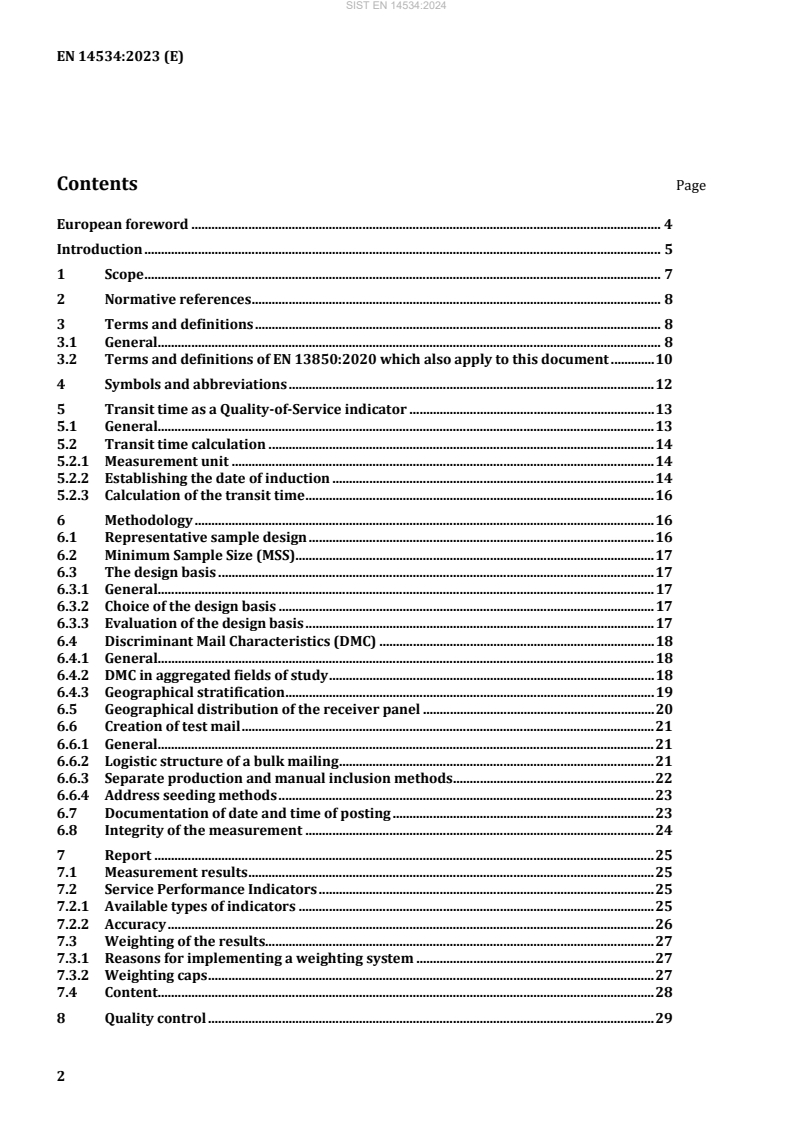
Contents Page
European foreword . 4
Introduction . 5
1 Scope . 7
2 Normative references . 8
3 Terms and definitions . 8
3.1 General. 8
3.2 Terms and definitions of EN 13850:2020 which also apply to this document . 10
4 Symbols and abbreviations . 12
5 Transit time as a Quality-of-Service indicator . 13
5.1 General. 13
5.2 Transit time calculation . 14
5.2.1 Measurement unit . 14
5.2.2 Establishing the date of induction . 14
5.2.3 Calculation of the transit time . 16
6 Methodology . 16
6.1 Representative sample design . 16
6.2 Minimum Sample Size (MSS). 17
6.3 The design basis . 17
6.3.1 General. 17
6.3.2 Choice of the design basis . 17
6.3.3 Evaluation of the design basis . 17
6.4 Discriminant Mail Characteristics (DMC) . 18
6.4.1 General. 18
6.4.2 DMC in aggregated fields of study . 18
6.4.3 Geographical stratification . 19
6.5 Geographical distribution of the receiver panel . 20
6.6 Creation of test mail . 21
6.6.1 General. 21
6.6.2 Logistic structure of a bulk mailing . 21
6.6.3 Separate production and manual inclusion methods . 22
6.6.4 Address seeding methods . 23
6.7 Documentation of date and time of posting . 23
6.8 Integrity of the measurement . 24
7 Report . 25
7.1 Measurement results . 25
7.2 Service Performance Indicators . 25
7.2.1 Available types of indicators . 25
7.2.2 Accuracy . 26
7.3 Weighting of the results. 27
7.3.1 Reasons for implementing a weighting system . 27
7.3.2 Weighting caps . 27
7.4 Content . 28
8 Quality control . 29
9 The Annexes . 29
Annex A (normative) Accuracy calculation . 31
Annex B (normative) Transit Time Calculation . 42
Annex C (normative) Comparability of Measurement Results . 46
Annex D (normative) Design of aggregated Fields of Study . 52
Annex E (normative) Additional Requirements for continuous Fields of Study [CMS/SCMS]
................................................................................................................................................................... 57
Annex F (normative) Quality control . 65
Annex G (normative) Auditing . 68
Annex H (informative) Purpose of postal Quality of Service standards . 70
Annex I (informative) Considerations before implementing EN 14534 . 75
Annex J (informative) Design basis . 81
Annex K (informative) Implementing EN 14534 . 90
Annex L (informative) Application of the accuracy calculation . 111
Bibliography . 123
European foreword
This document (EN 14534:2023) has been prepared by Technical Committee CEN/TC 331 “Postal
services”, the secretariat of which is held by AFNOR.
This European Standard shall be given the status of a national standard, either by publication of an
identical text or by endorsement, at the latest by May 2024, and conflicting national standards shall be
withdrawn at the latest by May 2024.
Attention is drawn to the possibility that some of the elements of this document may be the subject of
patent rights. CEN shall not be held responsible for identifying any or all such patent rights.
This document supersedes EN 14534:2016.
Annexes A to Annex G are normative.
Annexes A to Annex C and Annex F are covering the measurement of a single bulk mail induction.
Annex D, Annex E and Annex G are covering additional requirements for the measurement of aggregated
or continuous fields of study.
Annexes H to Annex L are informative.
Any feedback and questions on this document should be directed to the users’ national standards body.
A complete listing of these bodies can be found on the CEN website.
According to the CEN-CENELEC Internal Regulations, the national standards organisations of the
following countries are bound to implement this European Standard: Austria, Belgium, Bulgaria, Croatia,
Cyprus, Czech Republic, Denmark, Estonia, Finland, France, Germany, Greece, Hungary, Iceland, Ireland,
Italy, Latvia, Lithuania, Luxembourg, Malta, Netherlands, Norway, Poland, Portugal, Republic of North
Macedonia, Romania, Serbia, Slovakia, Slovenia, Spain, Sweden, Switzerland, Türkiye and the United
Kingdom.
Introduction
The European Commission emphasizes the need to have common rules for the development of
community postal services and the improvement of Quality-of-Service (QoS). The Commission has
identified requirements for postal QoS-Measurement systems that include:
— independent end-to-end measurement capabilities;
— a focus on national and cross-border distribution service performance;
— a single, uniform and reliable system for monitoring distribution service performance within the
Union.
The Commission has acknowledged that the different postal traditions and cultures in Europe would not
allow for the establishment of one common unified European measurement system and that national
systems should have sufficient freedom to reflect needs and peculiarities of national markets. On the
other hand, they should fulfil a defined set of minimum requirements to satisfy the information interests
if applicable of the Commission, the regulatory authorities, postal customers and postal operators
themselves.
The objective of this standard is to define a modular QoS measurement system in a competitive
commercial context. The measurement is designed to estimate the end-to-end transit time quality of
service given to the postal customer. The measurement can be set up domestically in each European
country and cross-border between the European countries.
This document refers to a number of principles and minimum requirements to be applied for the
measurement of the end-to-end transit time service-level of bulk mail services. It is widely applicable for
single-induction as well as continuous measurement applications. It provides recommendations on the
comparability of different bulk mail transit time QoS measurement results and their use as key
performance indicators.
This bulk mail standard has been developed from the requirements of EN 13850, Postal services – Quality
of service - Measurement of the transit time of end-to-end services for single piece priority mail and first-
class mail. Both European Standards consider methods using a representative end-to-end sample of all
types of addressed mail appropriate for their coverage. For the measurement of bulk mail services, a
separate standard is required for the following reasons:
— Senders: Members of the public posting single items are replaced by businesses, small in number –
posting large volumes of mail. Third party agents (consolidators, mailing houses, letter shops) may
also act on behalf of posting customers.
— Contracted Services: Mail posted in bulk will often be mailed under a contract between the
customer and the postal operator. Typically, bulk services require customers to standardize format
and weight of their mailing, undertake a level of pre-sortation or to present mail in different ways
according to the contract conditions.
— Volumes of mailings: Bulk mailings are large. They may contain thousands or millions of items.
— Performance Measures: On-time performance measures are expanded to provide different types of
(i) on, (ii) by or (iii) between specific-dates performance depending on what is agreed with the postal
customers or is specified for this service.
— Discriminant Characteristics: Test items shall match the characteristics of customer mailings. The
range of characteristics relevant for the performance varies by type of mail service, and a wider set
of potential characteristics should be considered. Greater flexibility is required to define for what
part of the real mail logistics the results are representative for.
— Production of Test Mail: For the inclusion of test mail in the customers bulk mailings a variety of
methods may be appropriate. They include database-seeding methods used in different stages of the
customer’s mail production process as well as methods to include pre-produced test items in the
customer’s bulk mailing between production and induction of the customers’ real mail.
— Dates of induction: The rules and requirements for bulk mail induction are more complex and may
be specific to the contract between customer and postal operator.
1 Scope
This document specifies methods for measuring the end-to-end transit time of domestic and cross-border
bulk mail, collected, processed and delivered by postal service operators. It considers methods using
representative end-to-end samples for all types of bulk mail services with defined transit time service-
levels as offered to the postal customer. It specifies a set of minimum requirements for the design of a
quality-of-service measurement system for bulk mail, involving the selection and distribution of test mail
sent by business senders and received by selected panellists.
This document is applicable to the measurement of end-to-end priority and non-priority bulk mail
services. For the purpose of this standard, bulk mail services can include all types of addressed bulk mail
including, but not limited to letter mail, direct mail, magazines and newspapers and encombrant-format
mailings.
This document relates to the measurement of bulk mail services offered to businesses that have pick-ups
at their offices or give their mail to postal service operators. If a third-party agent acts for the postal
operator, then the time the mail is handed over to the agent will form part of the measurement. Where a
third-party agent acts for the sending customer, the measurement will be from the point when mail is
handed over to the postal operator.
This document is of modular structure. It is designed to assess the service performance of postal operators
for bulk mail services on the level of a single bulk mailing as defined by the postal customer or any
aggregations thereof, including the performance of an individual customer / operator or the performance
of a group of customers/operators or the performance at national level.
The standardized QoS measurement-method provides a uniform way for measuring the end-to-end
transit time of postal items. Using a standardized measurement-method will ensure that the
measurement will be done in an objective and equal way for all operators in accordance with the
requirements of the current Postal Directive.
The end-to-end service measured may be provided by one operator or by a group of operators working
either together in the same distribution chain or parallel in different distribution chains. The method for
end-to-end measurement specified in this document is not designed to provide results for the
measurement of parts of the distribution chain.
This document does not include other service performance indicators than those related to end-to-end
transit time. In particular, this standard does not measure whether the timings of collections meet
customers’ requirements.
The transit time quality-of-service result will be expressed as percentage of mail delivered by, on or
between expected dates. These dates can be defined absolute as calendar-days or relative to the date of
induction. The transit time calculation rule will be in whole days.
This quality of service indicator does not measure the postal operator’s overall performance in a way,
which provides direct comparison of postal service operators. This document nevertheless provides
minimum requirements for the comparability of end-to-end transit time measurement results of specific
bulk mailings.
This document is not applicable for the measurement of end-to-end transit times of single-piece mail
services and hybrid mail, which require different measurement systems and methodologies (see, for
example, EN 13850, Postal Services — Quality of Services — Measurement of the transit time of end-to-end
services for single piece priority mail and first-class mail.
In certain circumstances, this standard allows a choice between alternatives to be made subject to the
approval of the regulator. This approval is only necessary if the service is within the universal service
obligation.
This document includes specifications for the quality control and auditing of the measurement system.
2 Normative references
The following documents are referred to in the text in such a way that some or all of their content
constitutes requirements of this document. For dated references, only the edition cited applies. For
undated references, the latest edition of the referenced document (including any amendments) applies.
EN 13850:2020, Postal services - Quality of services - Measurement of the transit time of end-to-end services
for single piece priority mail and first class mail
ICC/ESOMAR, International Code of Marketing and Social Research Practice (latest version)
3 Terms and definitions
For the purposes of this document, the terms and definitions given in EN 13850:2020 and the following
apply.
ISO and IEC maintain terminology databases for use in standardization at the following addresses:
— ISO Online browsing platform: available at https://www.iso.org/obp/
— IEC Electropedia: available at https://www.electropedia.org/
3.1 General
3.1.1
bulk mail
large volume of mail having similar mail and induction characteristics
Note 1 to entry: Bulk mail items are usually from the same weight group and share the same size or shape
characteristics.
Note 2 to entry: Bulk mail items have usually a common sender and share the same point(s) of induction.
Note 3 to entry: Bulk mail senders often share the outward processing of bulk mail by pre-sorting or segregating
the mail to enable the postal operator to by-pass the first sortation stages.
Note 4 to entry: Regarding the volume and/or requirements of the induction process, bulk mail does not qualify as
single piece mail.
3.1.2
bulk mailing
bulk mail posted by a single postal customer at the same induction point(s)
Note 1 to entry: A bulk mailing is defined by the postal customer, usually being a business.
Note 2 to entry: A bulk mailing usually covers one induction date or, in some cases, a small number of consecutive
days of operation.
Note 3 to entry: Large bulk mailings may be inducted at more than one postal operator, depending on the areas of
destination.
Note 4 to entry: Large bulk mailings may be inducted at two or three induction points, depending on the areas of
destination.
The listed terms and definitions of EN 13850 also apply to this EN; the terms specific to EN 14534 are included in
this EN.
3.1.3
bulk mail campaign
finite set of bulk mailings following a defined pattern
Note 1 to entry: A bulk mail campaign is defined by the postal customer, usually being a business.
Note 2 to entry: A bulk mail campaign may comprise bulk mailings with different types of bulk mail.
Note 3 to entry: A bulk mail campaign may consist of cycles or waves in time of bulk mailings of similar nature.
3.1.4
(bulk mail) sender
organization sending bulk mail, usually being a business
Note 1 to entry: The bulk mail sender can be the postal customer or his agent.
Note 2 to entry: The postal customer or the customer’s agent can be a consolidator or a mailing house / letter shop
3.1.5
business panellist
panellist with an address other than a household address such as a company or an organization
3.1.6
continuous measurement
measurement with mail allocated to all months of the year, and within the months to all weekdays of
operation of the postal operator (‘strictly continuous measurement’)
Note 1 to entry: A measurement is also continuous in the context of this standard if bulk mailings are measured
regularly with the same methodology for at least a calendar year (‘continuous measurement’).
Note 2 to entry: Relevant weekdays of operation are all possible weekdays of posting in accordance with the field
of study and the chosen transit time calculation rule (see Annex B)
3.1.7
dimension
mail characteristic with at least two modes, used to form subgroups of mail flows whose quality of service
is to be compared
3.1.8
fixed date of induction
contracted date, on which mail items that have been collected and put on hold, are to be distributed from
their point of storage
Note 1 to entry: Contracted fixed dates of induction are to be accompanied by a last date of collection and a last
collection time.
3.1.9
induction
takeover of the responsibility concerning a postal item and its distribution by a postal service provider
Note 1 to entry: ‘Induction’ is equivalent to ‘Posting’ when the posting is done before the last collection time.
3.1.10
induction point
physical location at which postal items are placed into the collection/acceptance system that is under the
responsibility of the induction postal operator
3.1.11
last collection time
advertised last time for collection or contracted latest time for collection
Note 1 to entry: The last collection time is often also called last acceptance time for which the postal operator states
the transit time target.
Note 2 to entry: This is often not equal to the actual collection time, because from the postal work-organization
point of view, the collection usually happens some time later than the advertised last collection time (e.g. the
collection routing timetable can only be defined with some tolerance).
3.1.12
last date of collection
contracted latest date for posting/collection for bulk mailings with a fixed date of induction
3.1.13
split induction
bulk mailing with more than one induction date
Note 1 to entry: It may be possible to assign to each delivery destination of a split induction exactly one induction
date.
3.2 Terms and definitions of EN 13850:2020 which also apply to this document
— accuracy
— aggregation
— audit
— average (arithmetic mean)
— characteristic
— continuous measurement
— corrective action
— country
— cross-border mail
— date of delivery
— date of induction (J)
— date of posting
— delivery point
— design basis
— design factor
— discriminant characteristic
— distribution
— domestic mail
— effective sample size
— end-to-end
— estimate
— estimator
— field of study
— independent performance monitoring organization
— measurement period
— metered mail
— non-priority item
— office of exchange
— on-time performance
— on-time probability
— one-operator field of study
— panel turnover
— panel rotation
— pick-up time
— postal area
— postal catchment area
— postal item
— postal performance indicator
— postal service
— posting
— priority item, first class item, a-class item
— private panellist
— quality
— quality assurance
— quality control
— real mail flow
— real mail study
— rural
— service standard
— single piece mail
— sorting centre
— stratification
— study domain
— test item
— time of delivery
— time of posting
— transit time
— urban
— user
— weighting
4 Symbols and abbreviations
CMS Continuous Measurement System
CMW Calculated Mode Weights
df Design factor
DMC Discriminant Mail Characteristic
EC European Commission
ESS Effective Sample Size
EtE End-to-End
IFW Individual Final Weight
IRV Intra-Relation Variation
IT Information Technology
J Date of induction
LDC Last Date of Collection
MSS Minimum Sample Size
P Date of Posting
QoS Quality of Service
RMW Real mail Mode-Weights
RMS Real Mail Studies
RSW Real mail Strata-Weights
RtT Relation-to-Total Variation
SCMS Strictly Continuous Measurement System
SIP Single Induction Point
SRS Simple Random Sample
StrRS Stratified Random Sample
StrEtE Stratified End-to-End Sample
SWB Standard Weighting Basis
USO Universal Service Obligation
WB Weighting Basis
5 Transit time as a Quality-of-Service indicator
5.1 General
The bulk mail transit time Quality-of-Service (QoS) is usually to be expressed as the percentage of mail
distributed within the end-to-end transit time target. All performance indicators shall refer to the on-time
performance, i.e. either the bulk mail end-to-end transit time or the percentage of mail delivered (i) by,
(ii) on or (iii) between expected dates. These dates shall be defined absolute as calendar-days or relative
to the date of induction J+n .
( )
The measurement process involves the selection and distribution of test items sent by selected
businesses and received by selected panellists. The sample design gives the specifications for the business
senders, receiver panellists and items to be representative of the chosen design basis. The design basis is
the most appropriate structural information available to characterize all real mail distributed in the field
of study.
The sample design shall be representative of the chosen design basis. The design basis shall be selected
according to its ability to characterize all real mail distributed in the field of study. If the field of study is
composed of several study domains, it is the QoS measurement for the overall field, which shall comply
with the requirements of this document.
The system for measuring the distribution of the end-to-end transit time of bulk mail items shall be robust
and shall give a statistical measurement at a defined level of accuracy. The measurement methodology
shall be objective and shall be auditable.
5.2 Transit time calculation
5.2.1 Measurement unit
The transit time of a postal item shall be measured in units of days and expressed as J+n days with J
( )
being the date of induction. The method for establishing the date of induction shall be agreed between
the organization commissioning the measurement system and the independent performance monitoring
organization. For measurement purposes, the date of induction J is when the postal operator takes
responsibility for starting the distribution process of the posted mail in accordance with a QoS target. The
handover to the postal operator may be made by the business sender or an agent acting on behalf of the
business sender.
5.2.2 Establishing the date of induction
It is the responsibility of the independent performance monitoring organization to put in place an
inclusion method, which provides for consistent, accurate dates and times of posting. The method(s) used
to obtain accurate dates and times of posting shall be agreed between the sending bulk mail customer
and the independent performance monitoring organization before a method of inclusion is implemented.
The agreed inclusion method(s) shall facilitate the identification of the date of induction based on:
— the date and time of posting; and
— the last collection date and time;
for each individual test item in the sample, keeping in mind the postal logistics of the service provider.
For most bulk mailings, one date of induction will suffice for all items that are posted. In some cases,
however, a posting may be spread over two or more days (multi-day induction) and knowledge of where
each item is within the bulk mailing will be key to determining accurate dates of induction. In a
measurement of a multi-day induction different times or even dates of posting might be applied to the
same delivery destinations (split induction). The information needed for handling split-inductions is often
more complex and systems feasible for verification, if they exist at all, more extensive than in the one-day
induction case.
One way of overcoming some of these problems is to adapt the inclusion method to the type of mailing in
question (see 6.6). Different inclusion methods may help the sending customer to provide accurate
date(s) and time(s) of posting.
Depending on the contract between business sender and postal operator, the date of induction for each
mail item is – alternatively – the date of the:
— (i) Actual collection from the sender’s or agent’s premises;
— (ii) Contracted collection from the sender’s or agent’s premises, provided the contracted bulk
mailing is ready for handover on the contracted date;
— (iii) Advertised collection time after posting by the sender at a postal induction point;
— (iv) Final collection or posting in a series of collections/postings to cover a delivery destination;
— (v) Contracted fixed start of the distribution process after the mail items have been collected/posted,
put on hold and stored for a time at a defined location in the postal network (interim storage)
under the condition that the posting takes place before the agreed last collection date and time. For items
with a time of posting later than the last collection time, the date of induction is set to the next valid date
of induction for this type of mail (for details see B.2).
It is essential that a common understanding of the determination of the date of induction is reached
between all concerned parties before the start of the measurement. This shall be documented.
The following steps shall be undertaken to minimize the recording errors for date and time of posting:
— The date and time of posting shall be provided to the independent performance monitoring
organization by the sending bulk mail customer or the sending customer’s agent, e.g. a mailing house.
This information may be provided electronically, by manual observation or by written
documentation.
— Where practicable, the actual production of all test items shall be verifiable, in cases where address
seeding by the customer or his agent (see also 6.6.4) is the preferred mode of test mail production
and placement.
— Where practicable, the date and time of posting shall be verifiable using information from the postal
operator.
— In multi-day bulk mailings, the business sender and the independent performance measuring
organization shall agree on a method to verify the exact date and time of posting of the relevant
mailing(s) to all delivery destinations.
EXAMPLE 1 This may be done, for example, by using existing electronic or logistic information or by deploying
personnel of the performance monitoring organization.
Delivery destinations should be derived from the organizational structure of the postal operator or any
other structure, which determines the sorting, packing and routing order of the mailing.
Table 1 — One and Multi-Day Inductions
Options Required Information Possible info from postal operator
All mail has the same induction date Date and time of posting of Postal operator may be able to confirm the
the total bulk mailing date of induction
Split induction type I: Date and time of posting is If information on each delivery unit is
required for each delivery captured, the postal operator may be able to
More than one induction date, with each
unit confirm the date of induction for each
delivery destination posted completely on
destination
one induction date
Split induction type II Date and time of posting is The postal operator is unlikely to be able to
required for individual items confirm the date of induction
At least one delivery destination with more
than one possible induction date.
NOTE To reduce the likelihood of type II splits, it is advisable to decide for the smallest identifiable logistic
entity (e.g. postal destination documented on the tray or palette) to serve as delivery destination in the context of
this document.
If type II split inductions (see Table 1) are likely to appear there is a risk that, for some items, it is not
possible to determine a distinct induction date. In these cases, the postal operator and the business
customer shall agree on a procedure how to deal with these items.
EXAMPLE 2 These items will be declared invalid, because the date of induction cannot be determined.
EXAMPLE 3 The date of induction associated with the last of the split postings per delivery unit will be taken.
The following minimum requirements for the recording of the date and time of posting shall apply:
— Recording errors shall be small enough so that they do not affect the survey results, taking into
account the accuracy claimed for them.
— The method of seeding shall be the one which leaves least scope for error and which provides dates
of induction sufficient to meet the above requirements.
— Tests shall be made by the independent performance monitoring organization to monitor the level
of inaccuracy in recording dates of induction.
Each sending customer may require a unique approach from the independent performance monitoring
organization.
5.2.3 Calculation of the transit time
For the purpose of this document, transit times for domestic and cross-border mail shall be calculated
according to the calculation rule as presented in B.3. Published regional holidays shall be subtracted in
the calculation of transit time.
The calculation of the transit time takes into account test items posted before the last collection time of
the day for the type of mail in the field of study. The last collection time is taken preferably as stated in
the induction documentation (actual collection time of the postal collection service) or otherwise as
announced by the postal operator (planned collection / latest acceptance time at a postal point of
induction). If a test item is posted after the last collection time, then the date of induction J should be
adjusted to the next induction date for this type of mail.
The transit time calculation rule shall be agreed, fixed and documented before the start of the
measurement. This includes the type of last collection times to be applied.
It is necessary to ensure that panellists can identify the delivery of the item to the address or the receipt
of the item to a named individual. If P.O. Boxes are to be included in the sample, panellists will need to be
able to confirm that they collect the mail daily after the published pick-up time. If there are items included
in the survey, which are not letterbox-friendly or for some other reason cannot be delivered without the
presence of the panellist, it is the first attempt to deliver that shall count as the day of delivery if the date
of the first attempt to deliver can be retrieved from a written notification.
Only valid test mail items shall be included in the calculations (see also F.7). All postal items required for
cumulative reporting according to 7.2.1 shall be considered in the calculations. Postal items not delivered
within this timeframe may be excluded, because they may be deemed as lost or are not detectable in the
system any more within the reporting period.
6 Methodology
6.1 Representative sample design
The measurement shall be based on a defined methodology. It shall be carried out by an independent
performance monitoring organization.
The methodology shall be based on test mail volumes representative of the chosen design basis. It shall
define indicators that are representative of the transit time QoS provided in the measurement period.
The design basis shall be defined before the start of the measurement in accordance with the field of
study. Statements regarding the representativity of the measurement shall be made in relation to the
chosen design basis.
This document is designed to be able to monitor an individual bulk mailing. However, the field of study
may also be defined as all bulk mail items of an individual customer or a small group of customers or –
more generally – of a representative sample of a postal operator’s or a country’s bulk mail customers.
The test mail method shall consist of a process in which businesses act as senders and panellists act as
receivers. Senders induct test items into the postal operator’s mail network and register date and time of
posting; receivers register the date of delivery. Receivers shall be spread all over the field of study in
order to fulfil the specifications of minimum sample size, maximum panellist workload, stratification and
geographical coverage.
The sending and receiving process shall be organized properly in order to fulfil the specifications of the
sample design. The test mail shall be selected or manufactured in such a way as to fulfil the specifications
of the discriminant mail characteristics. A representative sample design may be realized either by a strict
proportionality of the test mail flows with respect to the design basis, or by an over-representation or an
under-representation of some strata. The latter requires corrective weighting, which allows restoring the
proportionality.
6.2 Minimum Sample Size (MSS)
250 test items shall be the Minimum Sample Size (MSS) for a single bulk mailing. With this MSS, reliable
results can be achieved for performance levels above 85 %.
A maximum of one test item per bulk mailing shall be allocated to any receiver.
6.3 The design basis
6.3.1 General
The design basis may be determined in different ways. The standard design basis is based on real mail
volumes.
The design basis shall be provided by the stakeholder(s) commissioning the measurement.
6.3.2 Choice of the design basis
Depending on the availability of real mail volume data at the planning stage, each of the two types of
design bases may be an appropriate choice:
— 1st choice: Measured or registered real mail volumes (standard design basis, historical data);
— 2nd choice: Estimates via logistic or management data (alternative design basis, historical data).
It is possible that the type of design basis varies between the discriminant mail-characteristics, for
example if real mail data are only available for some of the discriminant mail characteristics but not for
all. For each discriminant mail-characteristic the most reliable design basis available shall be chosen.
The provision of the distribution of the following real mail characteristics as a minimum is mandatory:
— the discriminant characteristics according to 6.4.2;
— the geographical stratification according to 6.4.3.
6.3.3 Evaluation of the design basis
6.3.3.1 Real mail evaluations
If available and reliable, the results of real mail evaluations shall be used as the standard design basis.
Real mail evaluations shall be done before or parallel to the set up of the measurement system in order
to gain real mail volume information and to obtain the structural information needed for the
determination of the sample design. For a data-update, further evaluations may be run before or parallel
to the measurement period.
The real mail evaluations shall:
Accuracy of ±5 % (design factor =1; Agresti-Coull Interval
...