SIST EN 17855:2024
(Main)Foodstuffs - Minimum performance requirements for quantitative measurement of the food allergens milk, egg, peanut, hazelnut, almond, walnut, cashew, pecan nut, brazil nut, pistachio nut, macadamia nut, wheat, lupine, sesame, mustard, soy, celery, fish, molluscs and crustaceans
Foodstuffs - Minimum performance requirements for quantitative measurement of the food allergens milk, egg, peanut, hazelnut, almond, walnut, cashew, pecan nut, brazil nut, pistachio nut, macadamia nut, wheat, lupine, sesame, mustard, soy, celery, fish, molluscs and crustaceans
This document specifies minimum performance requirements for methods that quantify the food allergens milk, egg, peanut, hazelnut, almond, brazil nut, macadamia nut, cashew, pistachio nut, walnut, pecan nut, lupine, sesame, mustard, soy, celery, fish, molluscs, crustaceans, and wheat in raw and processed foodstuffs. Within the scope of this document, minimum requirements for an LOQ (Limit of Quantification) will be derived from threshold data of allergic consumers. For quantitative antibody-based methods, a normative annex will describe what specific information the method developer needs to deliver and how performance characteristics shall be validated. Regarding PCR and LC-MS/MS, information on performance characteristics are in parts covered by EN 15634-1 and EN 17644. This document does not apply to fragmented or hydrolysed food allergens, such as casein hydrolysates or soy sauce. It also does not apply to methods that deliver qualitative results only. Methods that cover gluten-containing cereals (wheat, rye, and barley) with regard to coeliac disease are covered by EN 17254.
Lebensmittel - Minimal-Leistungsanforderungen für die Bestimmung der Lebensmittelallergene Milch, Ei, Erdnuss, Haselnuss, Mandel, Walnuss, Cashew, Pekannuss, Paranuss, Pistazie, Macadamia, Weizen, Lupine, Sesam, Senf, Soja, Sellerie, Fisch, Weichtiere und Schalentiere
Dieses Dokument legt Mindestleistungsanforderungen für Verfahren zur Quantifizierung der Lebensmittelallergene Milch, Ei, Erdnuss, Haselnuss, Mandel, Paranuss, Macadamianuss, Cashew, Pistazie, Walnuss, Pekannuss, Lupine, Sesam, Senf, Soja, Sellerie, Fisch, Weichtiere, Krustentiere und Weizen in rohen und verarbeiteten Lebensmitteln fest. Im Rahmen dieses Dokuments werden die Mindestanforderungen für die Bestimmungsgrenze (LOQ, en: limit of quantification) aus den Schwellenwerten allergischer Verbraucher abgeleitet. Bei quantitativen antikörperbasierten Verfahren wird in einem normativen Anhang beschrieben, welche spezifischen Informationen der Verfahrensentwickler liefern muss und wie die Leistungsmerkmale validiert werden müssen. Für PCR und LC MS/MS sind die Informationen zu den Leistungsmerkmalen zum Teil in EN 15634-1 und EN 17644 enthalten. Dieses Dokument ist nicht anzuwenden für fragmentierte oder hydrolysierte Lebensmittelallergene, wie z. B. Kaseinhydrolysate oder Sojasauce. Es ist auch nicht anzuwenden für Verfahren, die nur qualitative Ergebnisse liefern. Verfahren, die glutenhaltiges Getreide (Weizen, Roggen und Gerste) im Hinblick auf Zöliakie abdecken, werden von EN 17254 abgedeckt.
Produits alimentaires - Performances minimales requises pour la mesure quantitative des allergènes alimentaires lait, oeuf, arachide, noisette, amande, noix, noix de cajou, noix de pécan, noix du Brésil, pistache, noix de macadamia, blé, lupin, sésame, moutarde, soja, céleri, poisson, mollusques et crustacés
Le présent document définit les performances minimales requises pour les méthodes de quantification des allergènes lait, oeuf, arachide, noisette, amande, noix du Brésil, noix de macadamia, noix de cajou, pistache, noix, noix de pécan, lupin, sésame, moutarde, soja, céleri, poisson, mollusques, crustacés et blé dans les denrées alimentaires brutes et transformées. Dans le domaine d’application du présent document, les exigences minimales concernant une LOQ (limite de quantification) sont dérivées des données de seuil des consommateurs allergiques. Pour les méthodes quantitatives basées sur les anticorps, une annexe normative précise les informations spécifiques que le développeur de la méthode doit fournir et la façon dont les caractéristiques de performances doivent être validées. En ce qui concerne les méthodes PCR et CL-SM/SM, les informations relatives aux caractéristiques de performances sont, en partie, couvertes par l’EN 15634-1 et l’EN 17644 . Le présent document ne s’applique pas aux allergènes alimentaires fragmentés ou hydrolysés, tels que les hydrolysats de caséine ou la sauce soja. Il ne s’applique pas non plus aux méthodes qui fournissent uniquement des résultats qualitatifs. Les méthodes destinées aux céréales contenant du gluten (blé, seigle et orge) en ce qui concerne la maladie coeliaque sont couvertes par l’EN 17254.
Živila - Minimalne zahteve za kvantitativno določanje alergenov v živilih: mleko, jajca, arašidi, lešniki, mandlji, orehi, indijski oreščki, pekan (ameriški) orehi, brazilski oreščki, pistacije, makadamije, pšenica, volčji bob, sezam, gorčica, soja, zelena, ribe, mehkužci in raki
Ta dokument določa minimalne zahteve za metode kvantitativnega določanja alergenov (mleko, jajca, arašidi, lešniki, mandlji, brazilski oreščki, makadamije, indijski oreščki, pistacije, pekan orehi, orehi, volčji bob, sezam, gorčica, soja, zelena, ribe, mehkužci, raki in pšenica) v surovih in predelanih živilih. Znotraj področja uporabe tega dokumenta so minimalne zahteve za količinsko omejitev (LOQ) izpeljane iz podatkov o pragu alergičnih potrošnikov. Za kvantitativne metode, ki temeljijo na protitelesih, so v normativnem dodatku opisane posebne informacije, ki jih mora zagotoviti razvijalec metode, in način potrjevanja učinkovitosti. Informacije o učinkovitosti metod polimerazne verižne reakcije (PCR) in tekočinske kromatografije s tandemsko masno spektrometrijo (LC-MS/MS) so delno zajete v standardih EN 15634-1 in EN 17644. Ta dokument se ne uporablja za fragmentirane ali hidrolizirane alergene v živilih, kot so kazeinski hidrolizati ali sojina omaka. Prav tako se ne uporablja za metode, ki dajejo le kvalitativne rezultate. Metode za žita, ki vsebujejo gluten (pšenica, rž in ječmen) v povezavi s celiakijo, so zajete v standardu EN 17254.
General Information
- Status
- Published
- Public Enquiry End Date
- 08-Sep-2022
- Publication Date
- 28-May-2024
- Technical Committee
- KŽP - Agricultural food products
- Current Stage
- 6060 - National Implementation/Publication (Adopted Project)
- Start Date
- 23-May-2024
- Due Date
- 28-Jul-2024
- Completion Date
- 29-May-2024
Overview
EN 17855:2024 (CEN) defines minimum performance requirements for quantitative measurement of key food allergens in raw and processed foods. The standard covers milk, egg, peanut, tree nuts (hazelnut, almond, walnut, cashew, pecan, brazil nut, pistachio, macadamia), wheat, lupine, sesame, mustard, soy, celery, fish, molluscs and crustaceans. Limits of Quantification (LOQ) are derived from WHO/FAO reference doses (RfD) and VITAL ED05 threshold data to link analytical capability with consumer protection. EN 17855:2024 applies to antibody-based, PCR and LC‑MS/MS quantitative methods, but excludes fragmented or hydrolysed allergens (e.g., casein hydrolysates, soy sauce) and qualitative-only tests.
Key Topics
- Scope & allergen list: comprehensive commodity list and definitions for each food allergen covered.
- LOQ derivation: establishment of LOQ requirements based on allergenic reference doses (RfD/ED05) to align analytical sensitivity with health-based thresholds.
- Method types: guidance for immunoassays (ELISA, lateral flow), PCR, and LC‑MS/MS quantification approaches.
- Antibody-based methods: Annex A (normative) specifies required information from method developers and prescribes validation elements (LOD, LOQ, trueness, recovery, precision, specificity, cross‑reactivity, robustness, stability, measurement uncertainty).
- Validation & performance: cross-reference to EN 15634‑1 and EN 17644 for additional performance characteristics and validation principles.
- Exclusions & special cases: methods for coeliac-related gluten detection (wheat, rye, barley) are handled in EN 17254; hydrolysed/fragmented allergens are out of scope.
Applications
EN 17855:2024 is intended for practical use by:
- Test kit and method developers - to design and validate quantitative immunoassays and provide required performance data.
- Food testing laboratories - to select, validate and verify methods that meet minimum LOQ and performance criteria for routine allergen quantification.
- Regulators and accreditation bodies - to assess analytical suitability for compliance, surveillance and enforcement.
- Food manufacturers and retailers - to support supplier testing, risk assessment and precautionary allergen labelling decisions (using VITAL and RfD guidance).
- Research organizations - for harmonised reporting and inter-laboratory studies involving ELISA, PCR and LC‑MS/MS allergen methods.
Related Standards
- EN 15634‑1 - Detection of food allergens by immunological methods (general).
- EN 17644 - Method performance characteristics (reference).
- EN 17254 - Gluten quantification for coeliac disease (wheat, rye, barley).
Keywords: EN 17855:2024, food allergen quantification, LOQ, ELISA, LC‑MS/MS, PCR, method validation, VITAL, RfD, food testing.
Frequently Asked Questions
SIST EN 17855:2024 is a standard published by the Slovenian Institute for Standardization (SIST). Its full title is "Foodstuffs - Minimum performance requirements for quantitative measurement of the food allergens milk, egg, peanut, hazelnut, almond, walnut, cashew, pecan nut, brazil nut, pistachio nut, macadamia nut, wheat, lupine, sesame, mustard, soy, celery, fish, molluscs and crustaceans". This standard covers: This document specifies minimum performance requirements for methods that quantify the food allergens milk, egg, peanut, hazelnut, almond, brazil nut, macadamia nut, cashew, pistachio nut, walnut, pecan nut, lupine, sesame, mustard, soy, celery, fish, molluscs, crustaceans, and wheat in raw and processed foodstuffs. Within the scope of this document, minimum requirements for an LOQ (Limit of Quantification) will be derived from threshold data of allergic consumers. For quantitative antibody-based methods, a normative annex will describe what specific information the method developer needs to deliver and how performance characteristics shall be validated. Regarding PCR and LC-MS/MS, information on performance characteristics are in parts covered by EN 15634-1 and EN 17644. This document does not apply to fragmented or hydrolysed food allergens, such as casein hydrolysates or soy sauce. It also does not apply to methods that deliver qualitative results only. Methods that cover gluten-containing cereals (wheat, rye, and barley) with regard to coeliac disease are covered by EN 17254.
This document specifies minimum performance requirements for methods that quantify the food allergens milk, egg, peanut, hazelnut, almond, brazil nut, macadamia nut, cashew, pistachio nut, walnut, pecan nut, lupine, sesame, mustard, soy, celery, fish, molluscs, crustaceans, and wheat in raw and processed foodstuffs. Within the scope of this document, minimum requirements for an LOQ (Limit of Quantification) will be derived from threshold data of allergic consumers. For quantitative antibody-based methods, a normative annex will describe what specific information the method developer needs to deliver and how performance characteristics shall be validated. Regarding PCR and LC-MS/MS, information on performance characteristics are in parts covered by EN 15634-1 and EN 17644. This document does not apply to fragmented or hydrolysed food allergens, such as casein hydrolysates or soy sauce. It also does not apply to methods that deliver qualitative results only. Methods that cover gluten-containing cereals (wheat, rye, and barley) with regard to coeliac disease are covered by EN 17254.
SIST EN 17855:2024 is classified under the following ICS (International Classification for Standards) categories: 07.100.30 - Food microbiology; 67.050 - General methods of tests and analysis for food products. The ICS classification helps identify the subject area and facilitates finding related standards.
You can purchase SIST EN 17855:2024 directly from iTeh Standards. The document is available in PDF format and is delivered instantly after payment. Add the standard to your cart and complete the secure checkout process. iTeh Standards is an authorized distributor of SIST standards.
Standards Content (Sample)
SLOVENSKI STANDARD
01-julij-2024
Živila - Minimalne zahteve za kvantitativno določanje alergenov v živilih: mleko,
jajca, arašidi, lešniki, mandlji, orehi, indijski oreščki, pekan orehi, brazilski oreščki,
pistacije, makadamijei, pšenica, volčji bob, sezam, gorčica, soja, zelena, ribe,
mehkužci in raki
Foodstuffs - Minimum performance requirements for quantitative measurement of the
food allergens milk, egg, peanut, hazelnut, almond, walnut, cashew, pecan nut, brazil
nut, pistachio nut, macadamia nut, wheat, lupine, sesame, mustard, soy, celery, fish,
molluscs and crustaceans
Lebensmittel - Minimal-Leistungsanforderungen für die Bestimmung der
Lebensmittelallergene Milch, Ei, Erdnuss, Haselnuss, Mandel, Walnuss, Cashew,
Pekannuss, Paranuss, Pistazie, Macadamia, Weizen, Lupine, Sesam, Senf, Soja,
Sellerie, Fisch, Weichtiere und Schalentiere
Produits alimentaires - Performances minimales requises pour la mesure quantitative
des allergènes alimentaires lait, oeuf, arachide, noisette, amande, noix, noix de cajou,
noix de pécan, noix du Brésil, pistache, noix de macadamia, blé, lupin, sésame,
moutarde, soja, céleri, poisson, mollusques et crustacés
Ta slovenski standard je istoveten z: EN 17855:2024
ICS:
07.100.30 Mikrobiologija živil Food microbiology
67.050 Splošne preskusne in General methods of tests and
analizne metode za živilske analysis for food products
proizvode
2003-01.Slovenski inštitut za standardizacijo. Razmnoževanje celote ali delov tega standarda ni dovoljeno.
EN 17855
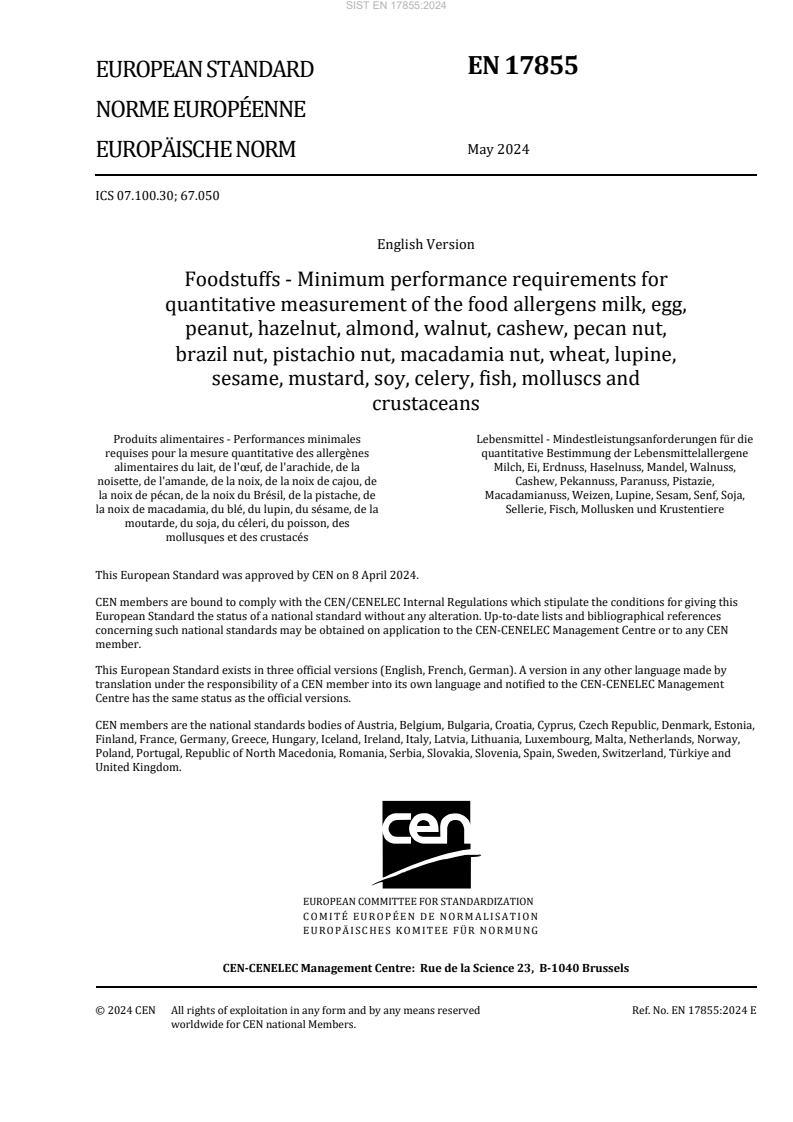
EUROPEAN STANDARD
NORME EUROPÉENNE
May 2024
EUROPÄISCHE NORM
ICS 07.100.30; 67.050
English Version
Foodstuffs - Minimum performance requirements for
quantitative measurement of the food allergens milk, egg,
peanut, hazelnut, almond, walnut, cashew, pecan nut,
brazil nut, pistachio nut, macadamia nut, wheat, lupine,
sesame, mustard, soy, celery, fish, molluscs and
crustaceans
Produits alimentaires - Performances minimales Lebensmittel - Mindestleistungsanforderungen für die
requises pour la mesure quantitative des allergènes quantitative Bestimmung der Lebensmittelallergene
alimentaires du lait, de l'œuf, de l'arachide, de la Milch, Ei, Erdnuss, Haselnuss, Mandel, Walnuss,
noisette, de l'amande, de la noix, de la noix de cajou, de Cashew, Pekannuss, Paranuss, Pistazie,
la noix de pécan, de la noix du Brésil, de la pistache, de Macadamianuss, Weizen, Lupine, Sesam, Senf, Soja,
la noix de macadamia, du blé, du lupin, du sésame, de la Sellerie, Fisch, Mollusken und Krustentiere
moutarde, du soja, du céleri, du poisson, des
mollusques et des crustacés
This European Standard was approved by CEN on 8 April 2024.
CEN members are bound to comply with the CEN/CENELEC Internal Regulations which stipulate the conditions for giving this
European Standard the status of a national standard without any alteration. Up-to-date lists and bibliographical references
concerning such national standards may be obtained on application to the CEN-CENELEC Management Centre or to any CEN
member.
This European Standard exists in three official versions (English, French, German). A version in any other language made by
translation under the responsibility of a CEN member into its own language and notified to the CEN-CENELEC Management
Centre has the same status as the official versions.
CEN members are the national standards bodies of Austria, Belgium, Bulgaria, Croatia, Cyprus, Czech Republic, Denmark, Estonia,
Finland, France, Germany, Greece, Hungary, Iceland, Ireland, Italy, Latvia, Lithuania, Luxembourg, Malta, Netherlands, Norway,
Poland, Portugal, Republic of North Macedonia, Romania, Serbia, Slovakia, Slovenia, Spain, Sweden, Switzerland, Türkiye and
United Kingdom.
EUROPEAN COMMITTEE FOR STANDARDIZATION
COMITÉ EUROPÉEN DE NORMALISATION
EUROPÄISCHES KOMITEE FÜR NORMUNG
CEN-CENELEC Management Centre: Rue de la Science 23, B-1040 Brussels
© 2024 CEN All rights of exploitation in any form and by any means reserved Ref. No. EN 17855:2024 E
worldwide for CEN national Members.
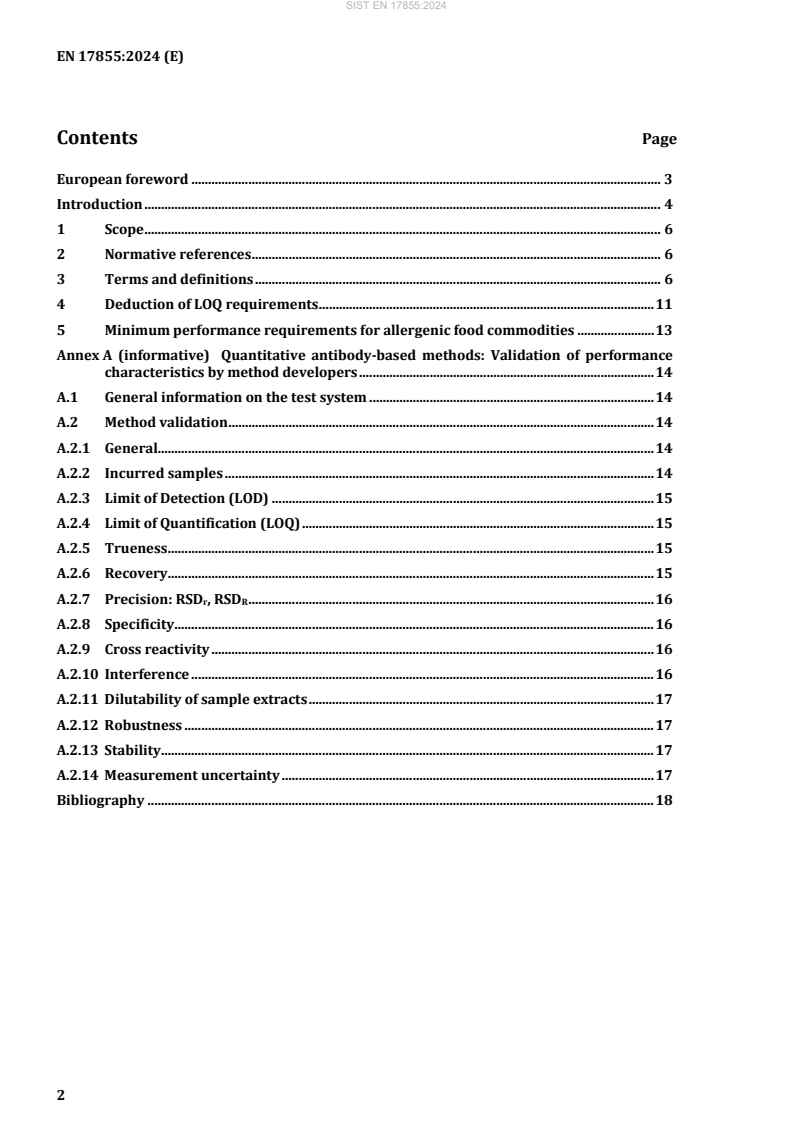
Contents Page
European foreword . 3
Introduction . 4
1 Scope . 6
2 Normative references . 6
3 Terms and definitions . 6
4 Deduction of LOQ requirements . 11
5 Minimum performance requirements for allergenic food commodities . 13
Annex A (informative) Quantitative antibody-based methods: Validation of performance
characteristics by method developers . 14
A.1 General information on the test system . 14
A.2 Method validation . 14
A.2.1 General. 14
A.2.2 Incurred samples . 14
A.2.3 Limit of Detection (LOD) . 15
A.2.4 Limit of Quantification (LOQ) . 15
A.2.5 Trueness . 15
A.2.6 Recovery . 15
A.2.7 Precision: RSD , RSD . 16
r R
A.2.8 Specificity . 16
A.2.9 Cross reactivity . 16
A.2.10 Interference . 16
A.2.11 Dilutability of sample extracts . 17
A.2.12 Robustness . 17
A.2.13 Stability . 17
A.2.14 Measurement uncertainty . 17
Bibliography . 18
European foreword
This document (EN 17855:2024) has been prepared by Technical Committee CEN/TC 275 “Food
analysis – Horizontal methods”, the secretariat of which is held by DIN.
This European Standard shall be given the status of a national standard, either by publication of an
identical text or by endorsement, at the latest by November 2024, and conflicting national standards shall
be withdrawn at the latest by November 2024.
Attention is drawn to the possibility that some of the elements of this document may be the subject of
patent rights. CEN shall not be held responsible for identifying any or all such patent rights.
Any feedback and questions on this document should be directed to the users’ national standards body.
A complete listing of these bodies can be found on the CEN website.
According to the CEN-CENELEC Internal Regulations, the national standards organisations of the
following countries are bound to implement this European Standard: Austria, Belgium, Bulgaria, Croatia,
Cyprus, Czech Republic, Denmark, Estonia, Finland, France, Germany, Greece, Hungary, Iceland, Ireland,
Italy, Latvia, Lithuania, Luxembourg, Malta, Netherlands, Norway, Poland, Portugal, Republic of North
Macedonia, Romania, Serbia, Slovakia, Slovenia, Spain, Sweden, Switzerland, Türkiye and the United
Kingdom.
Introduction
Allergic reaction to food components and legislation
While eating is necessary to sustain life and to enhance the quality of life for most individuals,
some individuals experience adverse, Immunoglobulin E (IgE)-mediated (allergic) reactions to
certain food commodities. The reactions can range from mild symptoms up to life-threatening
anaphylactic shock. As Coeliac disease is not an allergy, there is a separate document for minimum
performance requirements for determination of gluten by ELISA (see EN 17254 [1]).
Allergic consumers react mostly to the proteins found in a food commodity, which always consist of a
mixture of different proteins; for example, milk proteins are composed of α/β/γ/κ-caseins, β-
lactoglobulin, α-lactalbumin and several minor proteins. Allergic consumers react differently to various
proteins from a given commodity. Furthermore, allergenic reactions to food commodities vary among
consumers from different parts of the world, as shown by the corresponding regional food allergen
legislations in Europe, Canada, Australia/New Zealand, the USA or Japan. These legislations are essential
due to the established global food trade, as they ensure the protection of the consumers across the various
regions against exposure to allergenic commodities, regardless of the food’s origin.
While no regulatory limits for allergens in food are established yet, the VITAL (Voluntary Incidental Trace
Allergen Labelling) values act as a common base of understanding and a way to handle results [2]. These
values are absolute amounts of protein from the allergenic commodity below which more than 95 % or
99 % of the susceptible consumers will not react in an adverse way. Since this amount of protein could
occur in any amount of food that will be ingested, the linkage to an analytical result (reported as mass of
−1
total protein of the allergenic food ingredient per mass of food, expressed as mg kg ) is quite challenging.
Measurement of food allergens
It is often advisable to measure one or more major marker proteins that represent a significant part of
the protein content of the food commodity. When the allergenic food commodity is fractionated into more
than one commodity, such as casein and whey in milk, test kit manufacturers often develop systems to
measure the main protein of each fraction.
The amount of an allergenic food commodity in food samples can be quantified by different methods.
While mass spectrometry and nucleic acid-based methods (e.g. PCR, Polymerase chain reaction) can be
applied, the enzyme-linked immunosorbent assay (ELISA) and lateral flow devices (LFD) are the most
commonly used techniques.
The ELISA and LFD use specific monoclonal or polyclonal antibodies targeting epitopes that are specific
for the allergenic food commodity. Currently, sandwich ELISA is generally used to quantify the protein
level by comparing the colour reactions of sample solutions to calibrators. Some ELISA systems require
conversion factors to be applied. These factors are either (i) included in the calibration (when the results
are expressed as “total protein content”) or (ii) require the use of a calibration factor (when the results
refer to the content of specific protein(s), such as caseins in milk). Most LFDs provide qualitative results
in food allergen analysis.
The PCR method aims to detect a specific DNA sequence that codes for a protein in the investigated
commodity. At present, quantifying the numbers of DNA copies from an extracted sample is challenging.
The complexity further increases when estimating the corresponding protein concentrations from
estimated DNA copy numbers due to the lack of certified reference materials. For example, PCR is not
suitable for the detection of DNA in milk and egg due to the extremely low level of specific DNA to be
detected.
In LC-MS (Liquid chromatography mass spectrometry) analysis, proteins are extracted from a sample
and enzymatically digested into peptides. The peptides, including specific marker peptides, undergo
separation by chromatography, followed by fragmentation and quantification by LC-MS. Isotopically
labelled peptides are used as internal standards, while synthetic natural peptides (with well
characterized purity) are used for calibration. The concentration of a single marker peptide is re-
calculated to single proteins applying conversion factors and finally to the total allergenic protein content
for a given allergen. Recently, an LC-MS method for quantification of milk proteins was published that
does not require any conversion factor [3].
While reliable analytical methods are required for compliance with national and international
regulations worldwide, there are no harmonized guidelines available regarding specific requirements on
performance of quantitative methods for food allergenic commodity and regarding specific information
to be provided by the test kit manufacturers. Some guidance is provided by an AOAC publication [4].
1 Scope
This document specifies minimum performance requirements for methods that quantify the following
food allergens in raw and processed foodstuffs: milk, egg, peanut, hazelnut, almond, brazil nut,
macadamia nut, cashew, pistachio nut, walnut, pecan nut, lupine, sesame, mustard, soy, celery, fish,
molluscs, crustaceans, and wheat. The minimum requirements for the Limit of Quantification (LOQ),
presented in this document, are derived from the reference doses (RfD) and VITAL eliciting dose (ED05)
published by the World Health Organization (WHO) and the Food and Agriculture Organization (FAO) of
the United Nations.
Annex A provides specific information for quantitative antibody-based methods, which should be
supplied by the method developers. In addition, it provides guidance on how performance characteristics
should be determined in the form of a validation study. The principles described in this document equally
apply to PCR and LC-MS/MS methods.
More information on performance characteristics is available in EN 15634-1 [5] and EN 17644 [6].
Methods that describe gluten-containing cereals (wheat, rye, and barley) with regard to coeliac disease
are covered by EN 17254 [1].
This document does not apply to fragmented or hydrolysed food allergens, such as casein hydrolysates
or soy sauce. It also does not apply to qualitative methods.
2 Normative references
The following documents are referred to in the text in such a way that some or all of their content
constitutes requirements of this document. For dated references, only the edition cited applies. For
undated references, the latest edition of the referenced document (including any amendments) applies.
EN 15633-1, Foodstuffs - Detection of food allergens by immunological methods - Part 1: General
considerations
EN 15842, Foodstuffs - Detection of food allergens - General considerations and validation of methods
3 Terms and definitions
For the purposes of this document, the terms and definitions given in EN 15633-1 and EN 15842 and the
following apply.
ISO and IEC maintain terminological databases for use in standardization at the following addresses:
— ISO Online browsing platform: available at https://www.iso.org/obp
— IEC Electropedia: available at https://www.electropedia.org/
3.1
milk
secretion of mammary glands from all farmed mammals such as cows, buffalos, goats and sheep
Note 1 to entry: Milk consists of the casein and whey fraction, which are often used separated during food
production. [7]
Note 2 to entry: The European Commission Notice 2017/C 428/01 [8] mandates to declare milk from farmed
mammals; it should be noted that only milk of species that will be consumed in significant amounts by consumers
in Europe are of interest.
Note 3 to entry: This document explicitly exempts plant derived “milks” e.g. from almond or soy from the definition
of milk.
3.2
egg
oval, thin-shelled reproductive body of a bird, especially that of a hen, used as food
Note 1 to entry: Egg consists of egg yolk and egg white, which are often used in a fractionated way during food
production. [9][10]
Note 2 to entry: Whole egg is a combination of pasteurized chicken (Gallus gallus domesticus) egg whites and egg
yolks blended together in their entity in natural proportions as described in AOAC SMPR 2017.020 [11].
Note 3 to entry: The European Commission Notice 2017/C 428/01 [8] mandates to declare eggs from all farmed
animals; it should be noted that only eggs of species that will be consumed in significant amounts by consumers in
Europe are of interest.
3.3
peanut
seed from Arachis hypogaea without pods but with husks
Note 1 to entry: Peanuts are sometimes defatted and nearly always roasted during food production.
Note 2 to entry: If empty pods are used in any food e.g. in spice mixtures these will also contain traces of peanut
seeds.
Note 3 to entry: Refer to Codex Alimentarius Standard for peanuts CXS 200-1995 [12].
3.4
hazelnut
seed from Corylus avellana without shell but with husks
Note 1 to entry: In accordance with United Nations Economic Commission for Europe (UNECE) standards, varieties
grown from Corylus avellana and Corylus maxima and their hybrids.
Note 2 to entry: Seeds from Corylus colurna are also edible.
Note 3 to entry: Hazelnuts are sometimes defatted and often roasted during food production.
3.5
almond
seed from Amygdalus communis, Syn. Prunus dulcis without shell but with husks
Note 1 to entry: Prunus dulcis var. fragilis/amara are also consumed.
Note 2 to entry: Prunus dulcis var. amara (bitter almond) is toxic to all consumers but assumed to be as allergic as
Prunus dulcis var. dulcis (sweet almond).
3.6
Brazil nut
seed from Bertholletia excelsa without shell but with husks
3.7
macadamia nut
seed of the stone fruit of the genus Macadamia without shell
Note 1 to entry: In accordance with UNECE standards, varieties (cultivars) grown from Macadamia (M.)
integrifolia, M. tetraphylla, M. ternifolia and their hybrids.
Note 2 to entry: Macadamia nuts are also called Queensland nut.
3.8
cashew
seed from Anacardium occidentale without shell
3.9
pistachio nut
seed from Pistacia vera without shell
Note 1 to entry: Pistachio nuts are consumed roasted or un-roasted.
3.10
walnut
seed of the stone fruit of the genus Juglans regia without shell but with husks
Note 1 to entry: Juglans nigra (Black walnut) is not used commercially but edible.
3.11
pecan nut
seed from Carya illinoinensis without shell
3.12
lupine
seed from plants of the genus Lupinus
Note 1 to entry: Lupinus (L.) albus, L. angustifolius, and L. luteus are of commercial interest.
3.13
sesame
seed from Sesamum indicum
Note 1 to entry: The most traded sesame is off-white coloured, but other common colours are buff, tan, gold, brown,
reddish, gray and black.
3.14
mustard
seed from Sinapis alba, Brassica nigra, and Brassica juncea
Note 1 to entry: B. nigra and B. juncea do not belong to the genus Sinapis but are also used as “mustard”.
3.15
soy
seed from Glycine max
Note 1 to entry: The term ‘soybean’ is often used as a synonym for soy (seeds).
Note 2 to entry: Soybeans are always processed to remove (or obtain) oil or to remove/deactivate unwanted
substances like enzyme inhibitors.
Note 3 to entry: Soy is added as flour, protein concentrate, and protein isolate during food production by various
separation and extraction processes.
Note 4 to entry: Soy lecithin is often used as emulsifier in foods, which contains only trace amounts of soy protein.
Note 5 to entry: Refer to Codex Alimentarius Gene
...
SLOVENSKI STANDARD
01-julij-2024
Živila - Minimalne zahteve za kvantitativno določanje alergenov v živilih: mleko,
jajca, arašidi, lešniki, mandlji, orehi, indijski oreščki, pekan (ameriški) orehi,
brazilski oreščki, pistacije, makadamije, pšenica, volčji bob, sezam, gorčica, soja,
zelena, ribe, mehkužci in raki
Foodstuffs - Minimum performance requirements for quantitative measurement of the
food allergens milk, egg, peanut, hazelnut, almond, walnut, cashew, pecan nut, brazil
nut, pistachio nut, macadamia nut, wheat, lupine, sesame, mustard, soy, celery, fish,
molluscs and crustaceans
Lebensmittel - Minimal-Leistungsanforderungen für die Bestimmung der
Lebensmittelallergene Milch, Ei, Erdnuss, Haselnuss, Mandel, Walnuss, Cashew,
Pekannuss, Paranuss, Pistazie, Macadamia, Weizen, Lupine, Sesam, Senf, Soja,
Sellerie, Fisch, Weichtiere und Schalentiere
Produits alimentaires - Performances minimales requises pour la mesure quantitative
des allergènes alimentaires lait, oeuf, arachide, noisette, amande, noix, noix de cajou,
noix de pécan, noix du Brésil, pistache, noix de macadamia, blé, lupin, sésame,
moutarde, soja, céleri, poisson, mollusques et crustacés
Ta slovenski standard je istoveten z: EN 17855:2024
ICS:
07.100.30 Mikrobiologija živil Food microbiology
67.050 Splošne preskusne in General methods of tests and
analizne metode za živilske analysis for food products
proizvode
2003-01.Slovenski inštitut za standardizacijo. Razmnoževanje celote ali delov tega standarda ni dovoljeno.
EN 17855
EUROPEAN STANDARD
NORME EUROPÉENNE
May 2024
EUROPÄISCHE NORM
ICS 07.100.30; 67.050
English Version
Foodstuffs - Minimum performance requirements for
quantitative measurement of the food allergens milk, egg,
peanut, hazelnut, almond, walnut, cashew, pecan nut,
brazil nut, pistachio nut, macadamia nut, wheat, lupine,
sesame, mustard, soy, celery, fish, molluscs and
crustaceans
Produits alimentaires - Performances minimales Lebensmittel - Mindestleistungsanforderungen für die
requises pour la mesure quantitative des allergènes quantitative Bestimmung der Lebensmittelallergene
alimentaires du lait, de l'œuf, de l'arachide, de la Milch, Ei, Erdnuss, Haselnuss, Mandel, Walnuss,
noisette, de l'amande, de la noix, de la noix de cajou, de Cashew, Pekannuss, Paranuss, Pistazie,
la noix de pécan, de la noix du Brésil, de la pistache, de Macadamianuss, Weizen, Lupine, Sesam, Senf, Soja,
la noix de macadamia, du blé, du lupin, du sésame, de la Sellerie, Fisch, Mollusken und Krustentiere
moutarde, du soja, du céleri, du poisson, des
mollusques et des crustacés
This European Standard was approved by CEN on 8 April 2024.
CEN members are bound to comply with the CEN/CENELEC Internal Regulations which stipulate the conditions for giving this
European Standard the status of a national standard without any alteration. Up-to-date lists and bibliographical references
concerning such national standards may be obtained on application to the CEN-CENELEC Management Centre or to any CEN
member.
This European Standard exists in three official versions (English, French, German). A version in any other language made by
translation under the responsibility of a CEN member into its own language and notified to the CEN-CENELEC Management
Centre has the same status as the official versions.
CEN members are the national standards bodies of Austria, Belgium, Bulgaria, Croatia, Cyprus, Czech Republic, Denmark, Estonia,
Finland, France, Germany, Greece, Hungary, Iceland, Ireland, Italy, Latvia, Lithuania, Luxembourg, Malta, Netherlands, Norway,
Poland, Portugal, Republic of North Macedonia, Romania, Serbia, Slovakia, Slovenia, Spain, Sweden, Switzerland, Türkiye and
United Kingdom.
EUROPEAN COMMITTEE FOR STANDARDIZATION
COMITÉ EUROPÉEN DE NORMALISATION
EUROPÄISCHES KOMITEE FÜR NORMUNG
CEN-CENELEC Management Centre: Rue de la Science 23, B-1040 Brussels
© 2024 CEN All rights of exploitation in any form and by any means reserved Ref. No. EN 17855:2024 E
worldwide for CEN national Members.
Contents Page
European foreword . 3
Introduction . 4
1 Scope . 6
2 Normative references . 6
3 Terms and definitions . 6
4 Deduction of LOQ requirements . 11
5 Minimum performance requirements for allergenic food commodities . 13
Annex A (informative) Quantitative antibody-based methods: Validation of performance
characteristics by method developers . 14
A.1 General information on the test system . 14
A.2 Method validation . 14
A.2.1 General. 14
A.2.2 Incurred samples . 14
A.2.3 Limit of Detection (LOD) . 15
A.2.4 Limit of Quantification (LOQ) . 15
A.2.5 Trueness . 15
A.2.6 Recovery . 15
A.2.7 Precision: RSD , RSD . 16
r R
A.2.8 Specificity . 16
A.2.9 Cross reactivity . 16
A.2.10 Interference . 16
A.2.11 Dilutability of sample extracts . 17
A.2.12 Robustness . 17
A.2.13 Stability . 17
A.2.14 Measurement uncertainty . 17
Bibliography . 18
European foreword
This document (EN 17855:2024) has been prepared by Technical Committee CEN/TC 275 “Food
analysis – Horizontal methods”, the secretariat of which is held by DIN.
This European Standard shall be given the status of a national standard, either by publication of an
identical text or by endorsement, at the latest by November 2024, and conflicting national standards shall
be withdrawn at the latest by November 2024.
Attention is drawn to the possibility that some of the elements of this document may be the subject of
patent rights. CEN shall not be held responsible for identifying any or all such patent rights.
Any feedback and questions on this document should be directed to the users’ national standards body.
A complete listing of these bodies can be found on the CEN website.
According to the CEN-CENELEC Internal Regulations, the national standards organisations of the
following countries are bound to implement this European Standard: Austria, Belgium, Bulgaria, Croatia,
Cyprus, Czech Republic, Denmark, Estonia, Finland, France, Germany, Greece, Hungary, Iceland, Ireland,
Italy, Latvia, Lithuania, Luxembourg, Malta, Netherlands, Norway, Poland, Portugal, Republic of North
Macedonia, Romania, Serbia, Slovakia, Slovenia, Spain, Sweden, Switzerland, Türkiye and the United
Kingdom.
Introduction
Allergic reaction to food components and legislation
While eating is necessary to sustain life and to enhance the quality of life for most individuals,
some individuals experience adverse, Immunoglobulin E (IgE)-mediated (allergic) reactions to
certain food commodities. The reactions can range from mild symptoms up to life-threatening
anaphylactic shock. As Coeliac disease is not an allergy, there is a separate document for minimum
performance requirements for determination of gluten by ELISA (see EN 17254 [1]).
Allergic consumers react mostly to the proteins found in a food commodity, which always consist of a
mixture of different proteins; for example, milk proteins are composed of α/β/γ/κ-caseins, β-
lactoglobulin, α-lactalbumin and several minor proteins. Allergic consumers react differently to various
proteins from a given commodity. Furthermore, allergenic reactions to food commodities vary among
consumers from different parts of the world, as shown by the corresponding regional food allergen
legislations in Europe, Canada, Australia/New Zealand, the USA or Japan. These legislations are essential
due to the established global food trade, as they ensure the protection of the consumers across the various
regions against exposure to allergenic commodities, regardless of the food’s origin.
While no regulatory limits for allergens in food are established yet, the VITAL (Voluntary Incidental Trace
Allergen Labelling) values act as a common base of understanding and a way to handle results [2]. These
values are absolute amounts of protein from the allergenic commodity below which more than 95 % or
99 % of the susceptible consumers will not react in an adverse way. Since this amount of protein could
occur in any amount of food that will be ingested, the linkage to an analytical result (reported as mass of
−1
total protein of the allergenic food ingredient per mass of food, expressed as mg kg ) is quite challenging.
Measurement of food allergens
It is often advisable to measure one or more major marker proteins that represent a significant part of
the protein content of the food commodity. When the allergenic food commodity is fractionated into more
than one commodity, such as casein and whey in milk, test kit manufacturers often develop systems to
measure the main protein of each fraction.
The amount of an allergenic food commodity in food samples can be quantified by different methods.
While mass spectrometry and nucleic acid-based methods (e.g. PCR, Polymerase chain reaction) can be
applied, the enzyme-linked immunosorbent assay (ELISA) and lateral flow devices (LFD) are the most
commonly used techniques.
The ELISA and LFD use specific monoclonal or polyclonal antibodies targeting epitopes that are specific
for the allergenic food commodity. Currently, sandwich ELISA is generally used to quantify the protein
level by comparing the colour reactions of sample solutions to calibrators. Some ELISA systems require
conversion factors to be applied. These factors are either (i) included in the calibration (when the results
are expressed as “total protein content”) or (ii) require the use of a calibration factor (when the results
refer to the content of specific protein(s), such as caseins in milk). Most LFDs provide qualitative results
in food allergen analysis.
The PCR method aims to detect a specific DNA sequence that codes for a protein in the investigated
commodity. At present, quantifying the numbers of DNA copies from an extracted sample is challenging.
The complexity further increases when estimating the corresponding protein concentrations from
estimated DNA copy numbers due to the lack of certified reference materials. For example, PCR is not
suitable for the detection of DNA in milk and egg due to the extremely low level of specific DNA to be
detected.
In LC-MS (Liquid chromatography mass spectrometry) analysis, proteins are extracted from a sample
and enzymatically digested into peptides. The peptides, including specific marker peptides, undergo
separation by chromatography, followed by fragmentation and quantification by LC-MS. Isotopically
labelled peptides are used as internal standards, while synthetic natural peptides (with well
characterized purity) are used for calibration. The concentration of a single marker peptide is re-
calculated to single proteins applying conversion factors and finally to the total allergenic protein content
for a given allergen. Recently, an LC-MS method for quantification of milk proteins was published that
does not require any conversion factor [3].
While reliable analytical methods are required for compliance with national and international
regulations worldwide, there are no harmonized guidelines available regarding specific requirements on
performance of quantitative methods for food allergenic commodity and regarding specific information
to be provided by the test kit manufacturers. Some guidance is provided by an AOAC publication [4].
1 Scope
This document specifies minimum performance requirements for methods that quantify the following
food allergens in raw and processed foodstuffs: milk, egg, peanut, hazelnut, almond, brazil nut,
macadamia nut, cashew, pistachio nut, walnut, pecan nut, lupine, sesame, mustard, soy, celery, fish,
molluscs, crustaceans, and wheat. The minimum requirements for the Limit of Quantification (LOQ),
presented in this document, are derived from the reference doses (RfD) and VITAL eliciting dose (ED05)
published by the World Health Organization (WHO) and the Food and Agriculture Organization (FAO) of
the United Nations.
Annex A provides specific information for quantitative antibody-based methods, which should be
supplied by the method developers. In addition, it provides guidance on how performance characteristics
should be determined in the form of a validation study. The principles described in this document equally
apply to PCR and LC-MS/MS methods.
More information on performance characteristics is available in EN 15634-1 [5] and EN 17644 [6].
Methods that describe gluten-containing cereals (wheat, rye, and barley) with regard to coeliac disease
are covered by EN 17254 [1].
This document does not apply to fragmented or hydrolysed food allergens, such as casein hydrolysates
or soy sauce. It also does not apply to qualitative methods.
2 Normative references
The following documents are referred to in the text in such a way that some or all of their content
constitutes requirements of this document. For dated references, only the edition cited applies. For
undated references, the latest edition of the referenced document (including any amendments) applies.
EN 15633-1, Foodstuffs - Detection of food allergens by immunological methods - Part 1: General
considerations
EN 15842, Foodstuffs - Detection of food allergens - General considerations and validation of methods
3 Terms and definitions
For the purposes of this document, the terms and definitions given in EN 15633-1 and EN 15842 and the
following apply.
ISO and IEC maintain terminological databases for use in standardization at the following addresses:
— ISO Online browsing platform: available at https://www.iso.org/obp
— IEC Electropedia: available at https://www.electropedia.org/
3.1
milk
secretion of mammary glands from all farmed mammals such as cows, buffalos, goats and sheep
Note 1 to entry: Milk consists of the casein and whey fraction, which are often used separated during food
production. [7]
Note 2 to entry: The European Commission Notice 2017/C 428/01 [8] mandates to declare milk from farmed
mammals; it should be noted that only milk of species that will be consumed in significant amounts by consumers
in Europe are of interest.
Note 3 to entry: This document explicitly exempts plant derived “milks” e.g. from almond or soy from the definition
of milk.
3.2
egg
oval, thin-shelled reproductive body of a bird, especially that of a hen, used as food
Note 1 to entry: Egg consists of egg yolk and egg white, which are often used in a fractionated way during food
production. [9][10]
Note 2 to entry: Whole egg is a combination of pasteurized chicken (Gallus gallus domesticus) egg whites and egg
yolks blended together in their entity in natural proportions as described in AOAC SMPR 2017.020 [11].
Note 3 to entry: The European Commission Notice 2017/C 428/01 [8] mandates to declare eggs from all farmed
animals; it should be noted that only eggs of species that will be consumed in significant amounts by consumers in
Europe are of interest.
3.3
peanut
seed from Arachis hypogaea without pods but with husks
Note 1 to entry: Peanuts are sometimes defatted and nearly always roasted during food production.
Note 2 to entry: If empty pods are used in any food e.g. in spice mixtures these will also contain traces of peanut
seeds.
Note 3 to entry: Refer to Codex Alimentarius Standard for peanuts CXS 200-1995 [12].
3.4
hazelnut
seed from Corylus avellana without shell but with husks
Note 1 to entry: In accordance with United Nations Economic Commission for Europe (UNECE) standards, varieties
grown from Corylus avellana and Corylus maxima and their hybrids.
Note 2 to entry: Seeds from Corylus colurna are also edible.
Note 3 to entry: Hazelnuts are sometimes defatted and often roasted during food production.
3.5
almond
seed from Amygdalus communis, Syn. Prunus dulcis without shell but with husks
Note 1 to entry: Prunus dulcis var. fragilis/amara are also consumed.
Note 2 to entry: Prunus dulcis var. amara (bitter almond) is toxic to all consumers but assumed to be as allergic as
Prunus dulcis var. dulcis (sweet almond).
3.6
Brazil nut
seed from Bertholletia excelsa without shell but with husks
3.7
macadamia nut
seed of the stone fruit of the genus Macadamia without shell
Note 1 to entry: In accordance with UNECE standards, varieties (cultivars) grown from Macadamia (M.)
integrifolia, M. tetraphylla, M. ternifolia and their hybrids.
Note 2 to entry: Macadamia nuts are also called Queensland nut.
3.8
cashew
seed from Anacardium occidentale without shell
3.9
pistachio nut
seed from Pistacia vera without shell
Note 1 to entry: Pistachio nuts are consumed roasted or un-roasted.
3.10
walnut
seed of the stone fruit of the genus Juglans regia without shell but with husks
Note 1 to entry: Juglans nigra (Black walnut) is not used commercially but edible.
3.11
pecan nut
seed from Carya illinoinensis without shell
3.12
lupine
seed from plants of the genus Lupinus
Note 1 to entry: Lupinus (L.) albus, L. angustifolius, and L. luteus are of commercial interest.
3.13
sesame
seed from Sesamum indicum
Note 1 to entry: The most traded sesame is off-white coloured, but other common colours are buff, tan, gold, brown,
reddish, gray and black.
3.14
mustard
seed from Sinapis alba, Brassica nigra, and Brassica juncea
Note 1 to entry: B. nigra and B. juncea do not belong to the genus Sinapis but are also used as “mustard”.
3.15
soy
seed from Glycine max
Note 1 to entry: The term ‘soybean’ is often used as a synonym for soy (seeds).
Note 2 to entry: Soybeans are always processed to remove (or obtain) oil or to remove/deactivate unwanted
substances like enzyme inhibitors.
Note 3 to entry: Soy is added as flour, protein concentrate, and protein isolate during food production by various
separation and extraction processes.
Note 4 to entry: Soy lecithin is often used as emulsifier in foods, which contains only trace amounts of soy protein.
Note 5 to entry: Refer to Codex Alimentarius
...
Die SIST EN 17855:2024 ist ein entscheidendes Dokument, das grundlegende Leistungsanforderungen für die quantitative Messung von Lebensmittelallergenen definiert. Der Geltungsbereich dieser Norm umfasst eine Vielzahl von Allergenen, darunter Milch, Eier, Erdnüsse und verschiedene Nüsse wie Haselnüsse, Mandeln und Macadamia. Durch die Festlegung der Mindestanforderungen für die Messung dieser Allergene in Roh- und verarbeiteten Lebensmitteln stellt die Norm sicher, dass lebensmittelverarbeitende Unternehmen und Labore eine konsistente und verlässliche Methode zur Bestimmung des Vorhandenseins von Allergenen nutzen können. Ein wesentlicher Stärke dieser Norm ist die Ableitung der minimalen Anforderungen für die Limit of Quantification (LOQ) aus Schwellenwertdaten allergischer Verbraucher. Dies gewährleistet, dass die Methoden nicht nur technisch machbar sind, sondern auch praktisch relevant für den Schutz von Allergikern. Der normative Anhang für quantitative antikörperbasierte Methoden, der spezifische Informationen für Methodenanwender bereitstellt und Validierungsanforderungen festlegt, hebt die Relevanz sowie die praktische Anwendbarkeit der Norm hervor. Zusätzlich wird die Relevanz der SIST EN 17855:2024 durch ihre Bezugnahme auf bestehende Normen wie EN 15634-1 und EN 17644 unterstrichen, die bereits spezifische Leistungsmerkmale für molekularbiologische Analysemethoden wie PCR und LC-MS/MS abdecken. Dies zeigt, dass die Norm in ein breiteres Netzwerk von Standards integriert ist, was die harmonisierte Anwendung und den Austausch von Informationen in der Branche erleichtert. Ein bemerkenswerter Aspekt dieser Norm ist, dass sie nicht für fragmentierte oder hydrolysierte Lebensmittelallergene gilt, was die Anwendung auf spezifische Analysemethoden fokussiert und Fehlinterpretationen vermeidet. Damit schafft die SIST EN 17855:2024 ein klares Verständnis für Lebensmittelproduzenten, Prüfer und Verbraucher hinsichtlich der quantitativen Analyse von Allergenen und trägt entscheidend zur Lebensmittelsicherheit bei.
La norme SIST EN 17855:2024 établit des exigences minimales de performance pour la quantification des allergènes alimentaires tels que le lait, les œufs, les fruits à coque et les diverses protéines de poisson et de mollusques. Son champ d'application est clairement défini, spécifiant que les méthodes approuvées doivent s'appliquer tant aux denrées alimentaires crues qu'aux aliments transformés. Ce document est essentiel pour les fabricants qui souhaitent garantir la sécurité de leurs produits vis-à-vis des consommateurs allergiques puisqu'il s'appuie sur des données seuils d'allergènes pour en déterminer les limites de quantification (LOQ). Un des points forts de cette norme réside dans son annex normatif concernant les méthodes basées sur les anticorps, qui fournit des prescriptions précises sur les informations requises pour les développeurs de méthodes ainsi que sur la validation des caractéristiques de performance. Cela facilite l'harmonisation au sein de l'industrie et assure que les méthodes de détection soient homogènes et fiables. De plus, pour les méthodes telles que la PCR et la LC-MS/MS, les caractéristiques de performance sont abordées en référence aux normes EN 15634-1 et EN 17644, renforçant ainsi la pertinence de SIST EN 17855:2024 dans le cadre plus large de la sécurité alimentaire et de la qualité des analyses. Il est également important de noter que cette norme exclut clairement les allergènes fragmentés ou hydrolysés, garantissant que les méthodes recommandées s'appliquent uniquement à des allergènes dans leur forme intacte, ce qui est crucial pour une évaluation précise du risque allergique. En outre, les méthodes qui traitent des céréales contenant du gluten en ce qui concerne la maladie coeliaque sont traitées par une autre norme, EN 17254, soulignant ainsi la spécialisation ciblée de SIST EN 17855:2024. Par conséquent, la norme SIST EN 17855:2024 se présente comme une référence incontournable pour l'industrie alimentaire, facilitant la mise en œuvre de méthodes de détection rigoureuses qui répondent aux besoins de sécurité des consommateurs et aux exigences réglementaires.
SIST EN 17855:2024は、食品アレルゲンの定量的測定における最低性能要件を定めた重要な標準です。この標準の主な範囲は、牛乳、卵、ピーナッツ、ヘーゼルナッツ、アーモンド、ブラジルナッツ、マカダミアナッツ、カシューナッツ、ピスタチオ、くるみ、ペカンナッツ、ルピナス、ゴマ、マスタード、大豆、セロリ、魚、軟体動物、甲殻類、及び小麦を含む食品の生及び加工品におけるアレルゲンの定量的測定方法です。 この標準の強みは、アレルギー消費者のしきい値データに基づいて、定量限界(LOQ)の最低要求事項が導出されている点です。さらに、定量的抗体ベースの方法に関して、方法開発者が提供する必要がある特定の情報と性能特性の検証方法が定義されていることも特筆すべきです。このように、標準は食品業界におけるアレルゲン管理の透明性と正確性を高めるための基盤を提供しています。 加えて、PCRやLC-MS/MSに関する情報も包括的にカバーされており、EN 15634-1およびEN 17644の関連部品における性能特性についても言及されています。これは、先進的な技術を用いた安全性検査においても、この標準がどのように適応できるかを示しています。ただし、加水分解されたアレルゲンや定性的結果のみを提供する方法には適用されないため、利用範囲が明確に定義されています。これは、誤解を避けるための重要なポイントです。 全体として、SIST EN 17855:2024は、食品安全と消費者保護の観点から非常に関連性の高い標準であり、特にアレルゲンに対する厳しい規制が求められる現在において、その重要性はますます増しています。この文書は、業界における信頼性の高い定量的測定を実現するための貴重なガイドラインを提供しており、食品事業者にとって不可欠なリソースとなるでしょう。
The SIST EN 17855:2024 standard provides a comprehensive framework for the quantitative measurement of significant food allergens, including milk, egg, peanut, various nuts, and several others relevant to food safety and consumer health. Its scope is particularly pertinent as it delineates the minimum performance requirements for methods that quantify food allergens in both raw and processed foodstuffs. One of the key strengths of this standard is its focus on establishing a robust Limit of Quantification (LOQ) derived from threshold data of allergic consumers. This emphasizes the standard's commitment to enhancing the safety and accuracy of allergen detection, which is critical for protecting individuals with food allergies. The inclusion of a normative annex highlights the need for method developers to provide specific information and validate performance characteristics, thus ensuring consistency and reliability across different testing methodologies. Moreover, the document’s integration with existing technical standards, such as EN 15634-1 and EN 17644 for quantitative antibody-based methods, showcases its relevance in the broader context of food safety regulations and analytical testing practices. This alignment with established standards reinforces the credibility of the measurements and protocols that food businesses must adhere to. The exclusion of fragmented or hydrolyzed food allergens from the standard's applicability clarifies its focus and ensures that the methods provided are relevant to the intended targets, thereby preventing confusion and ensuring the standard fulfills its primary purpose effectively. Moreover, while it does not apply to qualitative methods, the emphasis on quantitative approaches meets the needs of consumers who require precise allergen information for safety. In summary, SIST EN 17855:2024 stands out as a vital reference for food safety professionals and laboratories engaged in allergen testing, ensuring they meet rigorous standards that reflect consumer safety, method validation, and stringent performance requirements in the realm of food allergens. Its relevance in today's food industry cannot be overstated, given the rising awareness and prevalence of food allergies.
SIST EN 17855:2024 표준은 다양한 식품 알레르겐에 대한 정량 측정을 위한 최소 성능 요구 사항을 명시하고 있습니다. 이 문서의 범위는 우유, 계란, 땅콩, 헤이즐넛, 아몬드, 브라질 너트, 마카다미아 너트, 캐슈 너트, 피스타치오 너트, 호두, 피칸 너트, 루핀, 참깨, 겨자, 대두, 셀러리, 생선, 연체동물 및 갑각류, 밀 등의 알레르겐이 포함된 원료 및 가공 식품에서의 정량적 측정을 다룹니다. 이 표준의 강점은 알레르기 소비자들의 임계값 데이터에서 파생된 LOQ(정량 한계)에 대한 최소 요구 사항을 제공한다는 점입니다. 이는 제조업체가 알레르겐의 존재를 체계적으로 확인할 수 있도록 지원하여 소비자의 안전을 보장하는 데 큰 의의를 가집니다. 또한, 정량적 항체 기반 방법의 경우, 방법 개발자가 제공해야 할 특정 정보와 성능 특성을 검증하는 방법에 대한 규범적 부록이 포함되어 있어 응용 가능성이 높습니다. PCR 및 LC-MS/MS와 관련된 성능 특성은 EN 15634-1 및 EN 17644에 의해 다루어지고 있으며, 이는 사용자가 현대적이고 검증된 방법을 통해 알레르겐을 효과적으로 정량화할 수 있도록 돕습니다. 또한, 이 표준은 케이스 인 효소 가수분해물이나 간장과 같은 분해된 알레르겐에 대해서는 적용되지 않으며, 정성 결과만 제공하는 방법에 대한 제한이 명확하게 설정되어 있습니다. 식품 안전 분야에서의 SIST EN 17855:2024 표준은 식품 제조업체 및 관련 분야 전문가들에게 알레르겐 관리를 위한 체계적이고 실용적인 지침을 제공함으로써, 지속적인 식품 안전성을 담보하는 데 기여할 것입니다.


Questions, Comments and Discussion
Ask us and Technical Secretary will try to provide an answer. You can facilitate discussion about the standard in here.
Loading comments...