

SIST EN 13098:2019
(Main)Workplace exposure - Measurement of airborne microorganisms and microbial compounds - General requirements
General Information
- Abstract
This document specifies general requirements for the measurement of microorganisms and microbial compounds.
This document provides also guidelines for the assessment of workplace exposure to airborne microorganisms including the determination of total number and culturable number of microorganisms and microbial compounds in the workplace atmosphere.
This document does not apply to the measurement of viruses.
- Status
- Published
- Public Enquiry End Date
- 09-Oct-2018
- Publication Date
- 12-Sep-2019
- Technical Committee
- KAZ - Air quality
- Current Stage
- 6060 - National Implementation/Publication (Adopted Project)
- Start Date
- 14-Jun-2019
- Due Date
- 19-Aug-2019
- Completion Date
- 13-Sep-2019



Overview
EN 13098:2019 (CEN) - "Workplace exposure - Measurement of airborne microorganisms and microbial compounds - General requirements" provides general requirements and guidelines for measuring airborne microorganisms and microbial compounds in workplace atmospheres. The standard defines objectives and strategies for representative exposure assessment, specifies sampling and analytical considerations for determining total cell counts and culturable numbers (CFU), and sets out documentation and reporting expectations. Note: EN 13098:2019 does not apply to the measurement of viruses.
Key topics and technical requirements
- Scope and purpose: Guidance for assessing occupational exposure to airborne microorganisms and microbial compounds and reducing measurement uncertainty.
- Measurement strategy: Establishing objectives, defining measurement tasks, collecting background information, and implementing a sampling strategy that reflects exposure variability.
- Sampling principles: Requirements for sampler selection, categories of samplers, pump requirements, operator skills, and procedures for transport and storage of samples to preserve biological integrity.
- Analytical methods: Requirements for laboratory methods, validation, documentation, determination of culturable fraction (CFU), direct cell counts (microscopy), and detection of microbial compounds (e.g., allergens, glucans, mycotoxins - as listed in the standard).
- Uncertainty and variability: Consideration of measurement uncertainty and temporal/spatial variability in workplace exposure.
- Expression of results and reporting: Standardized formats for expressing concentrations, cultivation results, microscopic counts, and microbial compound data; guidance on test reports.
- Normative and informative annexes:
- Annex A: Recommendations for selecting measurement procedures
- Annex B: Sampling form example
- Annex C (normative): Detailed procedures for determination by cultivation
- Annex E: Formulae and calculation examples for colony counting
Practical applications and users
EN 13098:2019 is used to design and perform consistent, representative bioaerosol measurements in workplaces such as:
- Healthcare facilities, laboratories, pharmaceutical manufacturing
- Food and beverage production, agriculture, waste management, composting plants
- Building inspection, HVAC and indoor air quality investigations Primary users include occupational hygienists, environmental and industrial microbiology laboratories, health and safety professionals, employers, regulators, and researchers who require robust methods for assessing worker exposure to airborne microorganisms and microbial compounds.
Related standards and references
- EN 482 - Workplace exposure: general requirements for chemical agent measurements
- EN 1540 - Workplace exposure terminology
- EN ISO 13137 - Pumps for personal sampling of chemical and biological agents
EN 13098:2019 updates the previous edition by expanding measurable bioaerosol compounds, adding new measurement techniques and definitions, and improving guidance on measurement strategy and analytical procedures. Use this standard to achieve more reliable, comparable workplace bioaerosol exposure data.
Relations
- Effective Date
- 01-Oct-2019
- Effective Date
- 28-Jan-2026
- Effective Date
- 28-Jan-2026
- Effective Date
- 28-Jan-2026
- Effective Date
- 28-Jan-2026
- Effective Date
- 28-Jan-2026
- Effective Date
- 28-Jan-2026
- Referred By
SIST EN ISO 16000-19:2014 - Indoor air - Part 19: Sampling strategy for moulds (ISO 16000-19:2012) - Effective Date
- 28-Jan-2026
Get Certified
Connect with accredited certification bodies for this standard

CIS Institut d.o.o.
Personal Protective Equipment (PPE) certification body. Notified Body NB-2890 for EU Regulation 2016/425 PPE.

Kiwa BDA Testing
Building and construction product certification.
Kmetijski inštitut Slovenije
Agricultural Institute of Slovenia. Soil testing, plant health, agricultural product analysis.
Sponsored listings
Frequently Asked Questions
SIST EN 13098:2019 is a standard published by the Slovenian Institute for Standardization (SIST). Its full title is "Workplace exposure - Measurement of airborne microorganisms and microbial compounds - General requirements". This standard covers: This document specifies general requirements for the measurement of microorganisms and microbial compounds. This document provides also guidelines for the assessment of workplace exposure to airborne microorganisms including the determination of total number and culturable number of microorganisms and microbial compounds in the workplace atmosphere. This document does not apply to the measurement of viruses.
This document specifies general requirements for the measurement of microorganisms and microbial compounds. This document provides also guidelines for the assessment of workplace exposure to airborne microorganisms including the determination of total number and culturable number of microorganisms and microbial compounds in the workplace atmosphere. This document does not apply to the measurement of viruses.
SIST EN 13098:2019 is classified under the following ICS (International Classification for Standards) categories: 07.100.99 - Other standards related to microbiology; 13.040.30 - Workplace atmospheres. The ICS classification helps identify the subject area and facilitates finding related standards.
SIST EN 13098:2019 has the following relationships with other standards: It is inter standard links to SIST EN 13098:2003, SIST EN 482:2021, SIST EN 1540:2022, SIST EN ISO 13137:2023, SIST-TP CEN/TR 15230:2005, SIST EN 14042:2003, SIST EN 14583:2022, SIST EN ISO 16000-19:2014. Understanding these relationships helps ensure you are using the most current and applicable version of the standard.
SIST EN 13098:2019 is available in PDF format for immediate download after purchase. The document can be added to your cart and obtained through the secure checkout process. Digital delivery ensures instant access to the complete standard document.
Standards Content (Sample)
SLOVENSKI STANDARD
01-oktober-2019
Nadomešča:
SIST EN 13098:2003
Izpostavljenost na delovnem mestu - Ugotavljanje prisotnosti mikroorganizmov v
zraku in merjenje njihovih metabolitov - Splošne zahteve
Workplace exposure - Measurement of airborne microorganisms and microbial
compounds - General requirements
Exposition am Arbeitsplatz - Messung von Mikroorganismen und mikrobiellen
Bestandteilen in der Luft - Allgemeine Anforderungen
Exposition sur les lieux de travail - Mesurage de microorganismes et en suspension
dans l'air - Exigences générales
Ta slovenski standard je istoveten z: EN 13098:2019
ICS:
07.100.99 Drugi standardi v zvezi z Other standards related to
mikrobiologijo microbiology
13.040.30 Kakovost zraka na delovnem Workplace atmospheres
mestu
2003-01.Slovenski inštitut za standardizacijo. Razmnoževanje celote ali delov tega standarda ni dovoljeno.
EN 13098
EUROPEAN STANDARD
NORME EUROPÉENNE
September 2019
EUROPÄISCHE NORM
ICS 07.100.99; 13.040.30 Supersedes EN 13098:2000
English Version
Workplace exposure - Measurement of airborne
microorganisms and microbial compounds - General
requirements
Exposition sur les lieux de travail - Mesurage de Exposition am Arbeitsplatz - Messung von
microorganismes et en suspension dans l'air - luftgetragenen Mikroorganismen und mikrobiellen
Exigences générales Bestandteilen - Allgemeine Anforderungen
This European Standard was approved by CEN on 10 June 2019.
CEN members are bound to comply with the CEN/CENELEC Internal Regulations which stipulate the conditions for giving this
European Standard the status of a national standard without any alteration. Up-to-date lists and bibliographical references
concerning such national standards may be obtained on application to the CEN-CENELEC Management Centre or to any CEN
member.
This European Standard exists in three official versions (English, French, German). A version in any other language made by
translation under the responsibility of a CEN member into its own language and notified to the CEN-CENELEC Management
Centre has the same status as the official versions.
CEN members are the national standards bodies of Austria, Belgium, Bulgaria, Croatia, Cyprus, Czech Republic, Denmark, Estonia,
Finland, France, Germany, Greece, Hungary, Iceland, Ireland, Italy, Latvia, Lithuania, Luxembourg, Malta, Netherlands, Norway,
Poland, Portugal, Republic of North Macedonia, Romania, Serbia, Slovakia, Slovenia, Spain, Sweden, Switzerland, Turkey and
United Kingdom.
EUROPEAN COMMITTEE FOR STANDARDIZATION
COMITÉ EUROPÉEN DE NORMALISATION
EUROPÄISCHES KOMITEE FÜR NORMUNG
CEN-CENELEC Management Centre: Rue de la Science 23, B-1040 Brussels
© 2019 CEN All rights of exploitation in any form and by any means reserved Ref. No. EN 13098:2019 E
worldwide for CEN national Members.
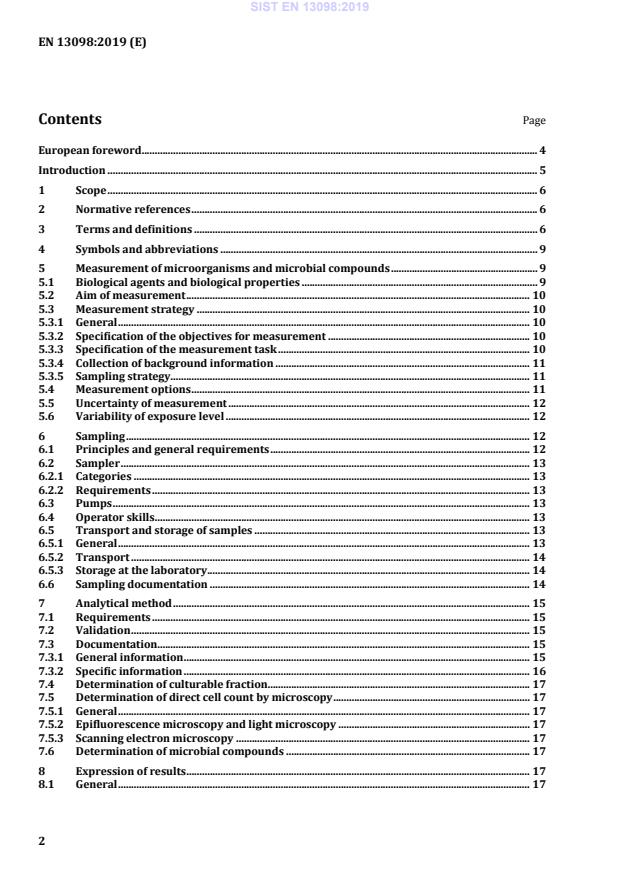
Contents Page
European foreword . 4
Introduction . 5
1 Scope . 6
2 Normative references . 6
3 Terms and definitions . 6
4 Symbols and abbreviations . 9
5 Measurement of microorganisms and microbial compounds . 9
5.1 Biological agents and biological properties . 9
5.2 Aim of measurement . 10
5.3 Measurement strategy . 10
5.3.1 General . 10
5.3.2 Specification of the objectives for measurement . 10
5.3.3 Specification of the measurement task . 10
5.3.4 Collection of background information . 11
5.3.5 Sampling strategy. 11
5.4 Measurement options . 11
5.5 Uncertainty of measurement . 12
5.6 Variability of exposure level . 12
6 Sampling . 12
6.1 Principles and general requirements . 12
6.2 Sampler . 13
6.2.1 Categories . 13
6.2.2 Requirements . 13
6.3 Pumps . 13
6.4 Operator skills . 13
6.5 Transport and storage of samples . 13
6.5.1 General . 13
6.5.2 Transport . 14
6.5.3 Storage at the laboratory. 14
6.6 Sampling documentation . 14
7 Analytical method . 15
7.1 Requirements . 15
7.2 Validation . 15
7.3 Documentation . 15
7.3.1 General information . 15
7.3.2 Specific information . 16
7.4 Determination of culturable fraction. 17
7.5 Determination of direct cell count by microscopy . 17
7.5.1 General . 17
7.5.2 Epifluorescence microscopy and light microscopy . 17
7.5.3 Scanning electron microscopy . 17
7.6 Determination of microbial compounds . 17
8 Expression of results . 17
8.1 General . 17
8.2 Cultivation methods . 17
8.3 Microscopic methods . 18
8.4 Microbial compounds. 18
9 Test report . 18
Annex A (informative) Recommendations for selection of exposure measuring procedures . 19
Annex B (informative) Sampling form example . 31
Annex C (normative) Determination of airborne microorganisms by cultivation . 33
C.1 General . 33
C.2 Requirements . 33
C.2.1 Suspension media and dilution media . 33
C.2.2 Cultivation media . 33
C.2.3 Cultivation temperature and incubation period . 33
C.2.4 Colony counts . 34
C.2.5 Identification . 34
Annex D (informative) List of generic media . 35
Annex E (informative) Formula and calculation examples for colony counting . 36
E.1 Calculation . 36
E.2 Examples . 37
Bibliography . 39
European foreword
This document (EN 13098:2019) has been prepared by Technical Committee CEN/TC 137 “Assessment
of workplace exposure to chemical and biological agents”, the secretariat of which is held by DIN.
This European Standard shall be given the status of a national standard, either by publication of an
identical text or by endorsement, at the latest by March 2020, and conflicting national standards shall
be withdrawn at the latest by March 2020.
Attention is drawn to the possibility that some of the elements of this document may be the subject of
patent rights. CEN shall not be held responsible for identifying any or all such patent rights.
This document supersedes EN 13098:2000.
The major technical changes between this European Standard and the previous edition are as follows:
a) document title changed;
b) list of measurable bioaerosol compounds extended;
c) new measuring techniques added;
d) new definitions for “allergen”, “cell count of microorganisms”, “glucan”, “microbial compound”,
“mycotoxin”, and “RFc-recombinant” added;
e) existing definitions technically revised, where necessary;
f) terms and definitions already referred to in EN 1540 deleted;
g) 5.3 on “Measurement strategy” improved by providing more details;
h) Annex A updated with regard to new techniques and methods;
i) Annex B updated with new compounds that can be measured;
j) Annex C updated with regard to new counting strategies and identification methods;
k) new Annex E on “Formula and calculation examples for colony counting” added;
l) Bibliography updated and divided in informative references and other information resources;
m) whole document editorially and technically revised.
According to the CEN-CENELEC Internal Regulations, the national standards organisations of the
following countries are bound to implement this European Standard: Austria, Belgium, Bulgaria,
Croatia, Cyprus, Czech Republic, Denmark, Estonia, Finland, France, Germany, Greece, Hungary, Iceland,
Ireland, Italy, Latvia, Lithuania, Luxembourg, Malta, Netherlands, Norway, Poland, Portugal, Republic of
North Macedonia, Romania, Serbia, Slovakia, Slovenia, Spain, Sweden, Switzerland, Turkey and the
United Kingdom.
Introduction
Representative assessment of occupational exposure to airborne microbial organisms or compounds is
challenging. However, because of potential health consequences following exposure, it is important to
be able to evaluate and control exposure. The sampling equipment used can introduce its own critical
limitations, such as the assessment of the health-related aerosol fractions. Some sampling equipment is
capable only of measuring culturable microorganisms, while others allow the characterization of both,
the total number of microbial cells and the culturable fraction. Both preservation of samples and
analytical procedures can induce difficulties and uncertainties due to changes of microbial population
and/or unwanted interferences. However, by adhering to the principles outlined in this European
Standard for choice of sampling and analytical procedures, these uncertainties can be reduced and
controlled, allowing comparable and representative measurements to be made.
1 Scope
This document specifies general requirements for the measurement of microorganisms and microbial
compounds.
This document provides also guidelines for the assessment of workplace exposure to airborne
microorganisms including the determination of total number and culturable number of microorganisms
and microbial compounds in the workplace atmosphere.
This document does not apply to the measurement of viruses.
2 Normative references
The following documents are referred to in the text in such a way that some or all of their content
constitutes requirements of this document. For dated references, only the edition cited applies. For
undated references, the latest edition of the referenced document (including any amendments) applies.
EN 482, Workplace exposure — General requirements for the performance of procedures for the
measurement of chemical agents
EN 1540, Workplace exposure — Terminology
EN ISO 13137, Workplace atmospheres — Pumps for personal sampling of chemical and biological
agents — Requirements and test methods (ISO 13137)
3 Terms and definitions
For the purposes of this document, the terms and definitions given in EN 1540 and the following apply.
ISO and IEC maintain terminological databases for use in standardization at the following addresses:
— IEC Electropedia: available at http://www.electropedia.org/
— ISO Online browsing platform: available at http://www.iso.org/obp
3.1
actinomycetes
filamentous Gram-positive, aerobic or anaerobic bacteria belonging to the phylum Actinobacteria
Note 1 to entry: Filamentous actinomycetes form a branching network of thin filaments called a mycelium. Most
actinomycetes replicate by conidia-like spores which can easily be made airborne.
3.2
allergen
substance that can cause an allergic reaction in sensitized person
Note 1 to entry: Allergens from microbiological origin are usually proteins or glycoproteins derived from fungi
or bacteria.
3.3
bacteria
large group of prokaryotic microorganisms with one chromosome in a nuclear region and which
replicate only asexually by cell division
Note 1 to entry: Different cell-wall chemistry is used for the classification of Gram-positive and Gram-negative
bacteria. Morphological criteria divide into spheres (cocci) and rods bacilli. Some species produce endospores as
survival units.
3.4
biological preservation efficiency
capability of a sampler to maintain the viability of airborne microorganisms during collection and also
to keep the microbial products intact
3.5
cell count of microorganisms
number of microorganisms determined as single organisms (or a corresponding measure)
Note 1 to entry: Both the viable and the non-viable micro-organisms are included.
3.6
colony forming unit
CFU
unit by which the culturable number (3.7) is given
Note 1 to entry: One colony forming unit can originate from one single microorganism, an aggregate of many
microorganisms or from one or many microorganisms attached to one particle.
Note 2 to entry: The number of outgrown colonies can depend on cultivation conditions.
3.7
culturable number
number of microorganisms, single cells or aggregates able to form colonies on a solid nutrient medium
3.8
elevated level
level above normal background level of microorganisms in a specified environment
3.9
endotoxin
constituent of the external membrane of Gram-negative bacteria (lipopolysaccharide), consisting of a
complex lipid, lipid A, which is covalently bound to a polysaccharide
Note 1 to entry: “Free endotoxin” is liberated after cell death and by budding from living cells. Lipid A is the
active (toxic) part and is a potent pro-inflammatory substance and can induce febrile, bronchial and other
symptoms in exposed workers. The composition and the toxicity of endotoxin differ between species.
3.10
endotoxin unit
unit standardized against the defined reference material, reference standard endotoxin
3.11
filtration
collection of particles suspended in gas or liquid by flow through a porous medium
3.12
fungi
diverse group of eukaryotic microorganisms with membrane-bound nucleus comprising several
chromosomes
Note 1 to entry: Multiplication is mainly asexual but several groups replicate also by sexual spores. Filamentous
fungi (moulds) grow in lengthy hyphae and form compact tufts called mycelia. Asexual spores (conidia) are easily
made airborne. Yeasts are usually unicellular, of spherical shape and their cells multiply sexually or asexually by
budding.
3.13
glucan
polysaccharide molecule present in the cell walls of eukaryotes and prokaryotes including most molds,
upper fungi, yeasts, algae and certain bacteria
Note 1 to entry: Glucan is also referred as (1,3)-β-D-glucan.
3.14
impaction
collection of airborne particles accelerated through a nozzle or orifice on a surface by inertia effect
3.15
impingement
combination of impaction onto a surface and subsequent dispersion into a liquid medium
3.16
Limulus Amoebocyte Lysate
enzymes extracted from the blood cells of the horse shoe crab (Limulus polyphemus) that are activated
by endotoxin and other molecules (glucans etc.)
3.17
microbial compound
cell or cell wall component or metabolite of microbial origin
Note 1 to entry: Endotoxins, glucans, mycotoxins and enzymes are examples of microbial compounds. Microbial
DNA is also included in this definition.
3.18
microorganism
microbiological entity of any type, cellular or non-cellular, capable of replication or of transferring
genetic material, or entities that have lost these properties
Note 1 to entry: The term microorganism covers the term “biological agent” defined in EN 1540.
3.19
mycotoxin
toxic secondary metabolite produced by fungi
Note 1 to entry: One fungal species can produce many different mycotoxins, and several species can produce
the same mycotoxin.
3.20
physical sampling efficiency
capability of the sampler to collect particles with specific sizes suspended in workplace air
3.21
RFc-recombinant
synthetic version of Factor C, an element found in the blood cells of horseshoe crabs
Note 1 to entry: Factor C is the essential biological component of bacterial endotoxin testing.
3.22
sieve sampler
multi-orifice impactor
3.23
total sampling efficiency
product of physical sampling efficiency (3.20) and biological preservation efficiency (3.4)
3.24
viable number of microorganisms
number of microorganisms having a potential for metabolic activity
Note 1 to entry: A viable microorganism is not necessarily culturable (also called “viable but not culturable”),
which means that the number of culturable microorganisms is often only part of the viable number.
4 Symbols and abbreviations
ATP adenosine triphosphate
CFU colony forming unit
CV coefficient of variation
DNA desoxyribonucleic acid
ELISA enzyme-linked immunosorbent assay
EU endotoxin unit
GSD geometric standard deviation
LAL Limulus Amoebocyte Lysate
LPS lipopolysaccharide
PCR polymerase chain reaction
SEM scanning electron microscope
5 Measurement of microorganisms and microbial compounds
5.1 Biological agents and biological properties
Bioaerosols can contain different microorganisms and/or microbial compounds originating from these.
Microorganisms can be classified in different taxonomic groups including bacteria, fungi, protozoa,
algae and viruses. These can be further classified to family, genus or species level. Immunologic
reactions (e.g. allergic) and/or toxic reactions as well as infections can result from exposure to
microorganisms and microbial compounds.
5.2 Aim of measurement
The measurement of microorganisms and microbial compounds in the workplace air has two
objectives:
a) to assess workers' exposure, and/or
b) to assess the biological characteristics of air at different locations and/or at different times and
over different time periods.
It is essential to state the purpose of the measurement and how the results will be interpreted.
NOTE 1 Measurement tasks can be to locate sources emitting microorganisms and/or microbial compounds, to
measure a worker's exposure during work shift, to identify peaks in exposure, to test the efficiency of control
measures, or to control actions taken to diminish the exposure.
NOTE 2 It can be useful to be able to measure both, viable and non-viable bioaerosols.
5.3 Measurement strategy
5.3.1 General
The measurement strategy describes the action plan that allows for interpretation of measurement
data. The action plan shall consist of the following:
a) specification of the objectives for measurement (see 5.3.2);
b) specification of the measurement task (see 5.3.3);
c) collection of background information (see 5.3.4);
d) sampling strategy (see 5.3.5).
5.3.2 Specification of the objectives for measurement
The objectives for measurement shall be given and a strategy settled that is adapted to the objectives. It
is also to be considered that no OELs are available for the interpretation of measurement data.
5.3.3 Specification of the measurement task
Examples for measurement tasks are to
— locate the sources emitting microorganisms and/or microbial compounds,
— measure a worker’s exposure during work shift (e.g. task- or process-related),
— identify peak exposure,
— control actions taken to diminish the exposure,
— test the efficiency of control measures.
5.3.4 Collection of background information
Background information should comprise
— the identification of potential onsite sources,
— expected biological agents, route of exposure and potentially exposed persons,
— expected concentrations or exposure levels of biological agents,
— the variability of the biological agents in space, time and particle size.
5.3.5 Sampling strategy
The sampling strategy shall specify the design of a sampling plan, which describes what should be
measured, and where, when and how measurement should be done.
The sampling plan usually includes:
— the definition of the target biological agent(s) and the corresponding analytical method(s),
— the determination of the sampling method(s) (sampling device, collection substrate, flow rate, etc.),
— the type of sampling (static sampling/personal sampling),
— the setting of sampling parameters (location, number, frequency and duration),
— requirements on sample transportation.
NOTE 1 It can be useful to know the environmental conditions (e.g. relative humidity, temperature, wind
speed), especially when extreme environmental conditions are to be expected.
NOTE 2 Passive methods (e.g. surface swabs, electrostatic dust collectors) can be applied to complement air
sampling information.
For assessment of measuring results reference samples, such as outdoor air, non-exposed workplace air
(e.g. from another office in the same workplace area) or workplace air before starting of work activity,
shall be taken, if background exposure is not known.
It is essential to verify that the sampling strategy is representative to exposure and that sampling and
analysis correspond to the assessment objectives and to the search for the targeted component of the
bioaerosol (see 5.1).
5.4 Measurement options
The following approaches can be used to measure microorganisms and microbial compounds:
— direct counting of microbial cells by microscopy including culturable, non-culturable but viable and
non-viable ones;
— enumeration of microbial cells and cell aggregates by culturing on agar media (the culturable
number);
— quantification of cellular components of microorganisms, from viable, non-viable or disintegrated
microorganisms, for example, constituents of cell structure such as endotoxin, glucans and
ergosterol;
— quantification of primary metabolites (such as ATP or chitinase from fungi) which can serve as
markers for microorganisms or of their vital activity;
— quantification of secondary metabolites (for example, mycotoxins and volatile organic compounds
(VOCs)) which derive from microorganisms and carried by other particles in the bioaerosol.
5.5 Uncertainty of measurement
The uncertainty of measurement originates from the sampling procedure, samples preservation and the
analytical method. Sampling procedures and analytical methods shall be validated. Reproducibility shall
be determined.
NOTE Validation of methods for measurements of microorganisms can be limited by lack of reference
materials and/or reference methods. However, the study of method characteristics can be assessed in laboratory
assays with microbial cultures, liquid solutions and experimental bioaerosols.
5.6 Variability of exposure level
The variability in exposure levels of microorganisms over time and between worker or working areas
can be very high and much higher than the precision of measuring procedures.
NOTE Geometric standard deviations (GSD) of 4 to 6, are not unusual or a measurement with a duration of
8 h. As a consequence, the uncertainty in the estimation of long-term exposure from a single measurement is high.
5 −3
For example, if the geometric mean is 4 ×10 m microorganisms and GSD = 5, then the 95 %
43− 73−
confidence interval of one measurement is 1,6× 10 m to 10 m . Shorter sampling periods will
further increase the uncertainty.
Identification of the causes of the variability can help to reduce the measurement effort by targeted
sampling of special tasks or exposure situations.
6 Sampling
6.1 Principles and general requirements
Sampling of bioaerosols should be made in accordance with the principles of sampling to assess
workers' exposure to other substances hazardous to health according to EN 689, where applicable.
However, bioaerosol sampling should take into account additional requirements. For example,
bioaerosol generation can be intermittent and of short duration, and be related to specific work
activities. To obtain a relative profile of exposure, several consecutive measurements should be
performed according to a specific strategy. This is also consistent with other sampling procedures for
bioaerosol measurement, such as direct collection onto agar media, which dictate that the sampling
period should be of short duration.
Before carrying out any sampling operation at the workplace, the technical and plant specific
parameters in the working area shall be examined and the operating procedures considered which can
influence the worker's exposure to microorganisms, in order to set up a sampling strategy.
If necessary, a sample should be taken as background reference in a non-contaminated area or outdoor.
6.2 Sampler
6.2.1 Categories
A wide range of bioaerosol sampling devices are available. However, they broadly fall into four
categories according to their principles of collection, as follows:
— impaction onto a solid or a semi-solid surface such as agar medium or into a liquid;
— impingement into a liquid;
— filtration;
— electrostatic precipitation.
Some methods are appropriate only for static sampling, while others can also be used for personal
sampling from workers' breathing zones. It is necessary to be aware of the principles of collection and
of their advantages and limitations, as some will be better than others for sampling in some work
environments. The method of sampling will often determine the subsequent analytical procedures.
NOTE For recommendations regarding selection of measuring procedures see Annex A.
6.2.2 Requirements
The sampler shall be fit for the purpose of the measurement to be done and shall be compatible with the
requirements on analysis. Especially, the sampler shall be cleaned/disinfected between samplings.
The sampler used shall have a known and documented sampling efficiency, for example, capable of
sampling total microorganisms, viable microorganisms or microbial components. The physical sampling
efficiency of the sampler shall be known and documented and related to the aerodynamic diameter of
collected particles.
NOTE In practise, sampler efficiency is usually tested using inert particles only.
The sampler should be able to collect the health-related fractions of aerosols according to EN 481.
To determine the viable number/culturable number of microorganisms, the sampler shall be tested
with relevant microorganisms to establish the biological preservation efficiency. The ability of sampling
medium to maintain the integrity of the sampled organisms shall be known.
6.3 Pumps
The pumps used for personal sampling shall fulfil the requirements specified in EN ISO 13137.
6.4 Operator skills
The operator shall be trained in aseptic techniques to avoid contamination of the sample during any
sampling phase. This includes knowledge about sampling equipment and how to perform the sampling.
6.5 Transport and storage of samples
6.5.1 General
Cross-contamination during transport and storage should be avoided.
6.5.2 Transport
The transport conditions which can affect the microbial composition of the collected sample shall be
documented (duration, environmental conditions, sample temperature).
Temperature extremes shall be avoided (can cause die off). Liquid samples shall be chilled directly after
sampling and transported within a range from about 2 °C to 8 °C.
Samples shall be delivered to the analytical laboratory as quickly as possible. For cultivation this shall
ideally be done within 24 h of sampling. When delays in transportation are unavoidable, the samples
shall be stored under controlled conditions (see 6.5.3).
6.5.3 Storage at the laboratory
Samples on culture plates shall be incubated immediately after arrival at the laboratory. For other
samples, where storage before analysis is unavoidable, the samples shall be stored in conditions, such
as refrigeration, which minimize changes to the composition of the sample. These conditions shall be
documented and validated. Exposure to visible and ultraviolet light sources and air pollutants shall be
minimized. Samples for analysis of some microbial compounds shall be stored at about −20 °C or below
(these storage conditions are not required for all microbial compounds).
6.6 Sampling documentation
The sampling operations carried out shall be documented to obtain comparable and reliable
concentration values of microorganisms and microbial compounds.
The sampling documentation shall include at least the following information:
a) name of the organization and person performing the sampling;
b) date of sampling;
c) purpose of sampling, target microorganisms and microbial compounds;
d) a unique identifier code for the sample;
e) name and address of the company where the sampling was carried out, or a unique identifier to
preserve confidentiality;
f) description of workplace including bioaerosol generating activities;
g) type and name of sampler and type and name of collection substrate used including volume of
collection medium used for liquid samplers;
h) type of sampling (personal or static);
i) positioning of sampling equipment;
j) location of sampling inlet and the orientation relative to air movement, where applicable;
k) start and end time of sampling and duration;
l) flow rate, in litres per minute;
m) sampled volume;
n) sampled health-related fraction (see EN 481);
o) details about transport and storage of samples;
p) environmental conditions (temperature, relative humidity, outdoor weather conditions);
q) other observations.
For sampling documentation it is generally good practice to follow the instructions given by a sampling
form. For an example of a sampling form see Annex B.
7 Analytical method
7.1 Requirements
Samples shall be prepared for analysis as soon as possible, if justified.
If the sample is not storable, analysis shall be done as soon as possible after sampling and transport.
The method used for analysis of the sample shall be described in detail, including limit of quantification,
limit of detection, precision, bias and its limitations.
The methods used for sample preparation shall be documented, for example, suspension, dilution and
inoculation conditions, as this can have an influence on the number of measurement units by disrupting
collected particles. If it is unavoidable to treat samples in a way that can influence the size and number
of the particles, this shall be documented.
When cultivation is used, the media, suspension and dilution liquids, cultivation temperature and
cultivation time shall be given.
Microscopic methods shall include number of microorganisms counted, number of fields counted,
proportion of suspension liquid analysed, magnification of the microscope and calculations of the
number.
The laboratory personnel performing the analysis shall have demonstrable training and competency in
aseptic techniques and ability to handle microbiological samples following “good laboratory practice”
7.2 Validation
The performance of procedures shall meet the requirements given in EN 482. The analytical method
shall be validated, when possible against appropriate reference standards.
7.3 Documentation
7.3.1 General information
The following information shall be given in any documentation of the analytical method:
a) name of the laboratory and person performing the analysis,
b) date and start of analysis,
c) origin of the sample analysed,
d) storage conditions in the laboratory,
e) details of the analytical method used, including reference to documented standard operating
procedures,
f) any deviations from the method routinely used, with reasons.
7.3.2 Specific information
7.3.2.1 General
In addition to the general information listed in 7.3.1 specific information is required to document
— analysis by culturing of bioaerosols collected on/in agar media, into liquids and on filters
(see 7.3.2.2),
— analysis by microscopy (see 7.3.2.3), and
— analysis of microbial compounds and metabolites (see 7.3.2.4).
7.3.2.2 Analysis of culturable microorganisms
7.3.2.2.1 Samples collected on/in agar media
In addition to the general information listed in 7.3.1, for samples collected on/in agar media the type of
cultivation media, and commercial name and provider if not homemade, the incubation conditions and
the incubation time shall be stated in the documentation.
7.3.2.2.2 Samples collected into liquids
In addition to the general information listed in 7.3.1, for samples collected into liquids the collection
substrate, i.e. the medium into which bioaerosol samples were collected, details of the dilution liquid
and volumes used and the volume and method of inoculation on/in agar media shall be stated in the
documentation.
7.3.2.2.3 Samples collected on filters
In addition to the general information listed in 7.3.1, for samples collected on filters the filter type (pore
size, material), the extraction method (extraction liquid and volume), the dilution liquid and volumes
used as well as the method of inoculation shall be stated in the documentation.
7.3.2.3 Analysis by microscopy
7.3.2.3.1 Light microscopy and fluorescence microscopy
In addition to the general information listed in 7.3.1, for analysis by light microscopy and fluorescence
microscopy the suspension liquid, dilution liquid, staining method and microscopic factors shall be
stated in the documentation.
When counting chambers are used the procedure shall be described in detail.
7.3.2.3.2 Scanning electron microscopy
In addition to the general information listed in 7.3.1, for analysis by scanning electron microscopy the
coating material and microscopic factors shall be stated in the documentation.
7.3.2.4 Analysis of microbial compounds and metabolites
In addition to the general information listed in 7.3.1, for analysis of microbial compounds, type of
sample (filter, liquid), extraction procedure and apparatus, volume and type of extraction and dilution
liquid as well as the analytical method and reference standard used shall be stated in the
documentation.
7.4 Determination of culturable fraction
The culturable fraction can be determined by incubation of microorganisms deposited directly on agar
media, or by suspending the microorganisms in liquid and subsequent inoculation of agar media.
Further dilution of the suspension might be needed to obtain the required concentration. When
determining culturable fraction of microorganisms collected on filters, the filters can either be placed
directly on agar media or the deposit can be extracted from the filter into liquid. Extraction shall be
done in a standardized way, for example, by shaking, washing or ultrasonic treatment.
For further details see Annex C.
7.5 Determination of direct cell count by microscopy
7.5.1 General
The direct cell count of microorganisms is determined using microscopy which determine culturable,
non-culturable but viable as well as non-viable microorganisms.
The precision of microscopic counts shall be estimated.
7.5.2 Epifluorescence microscopy and light microscopy
Epifluorescence microscopy and light microscopy can be used when the sample has been collected on a
filter or in a liquid. The microorganisms on at least 40 fields or 200 microorganisms should be counted.
The fields can be chosen at random or evenly distributed over the whole filter. Microorganisms shall be
counted using a calibrated eyepiece graticule.
7.5.3 Scanning electron microscopy
Microorganisms collected on filters with a smooth surface, for example, capillary pore carbonate filters
can be counted by means of a scanning electron microscope (SEM). Bacterial cells can be difficult to
recognize and they are also likely to collapse if not fixed and/or freeze-dried before examination with
the SEM. Filter samples can be prepared directly for the SEM if the particle density is not too high,
otherwise the filter deposit can be resuspended and a subsample refiltered.
7.6 Determination of microbial compounds
Sampling and analytical procedures shall be validated to ensure consistent recovery of microbial
compounds.
The amount of microbial compounds shall be determined using validated methods against a known
standard, as there can be variations in results when using different standards.
NOTE It has been shown that filter type and extraction procedure have an influence on recovery. The
procedures can be validated by the use of spiked samples.
8 Expression of results
8.1 General
Expression of results should include limits of detection and limits of quantification, where possible.
The number of replicate analyses, the number of analyses shall also be given.
8.2 Cultivation methods
When microbial numbers have been derived from counting colonies grown on agar plates, the results
shall be expressed as colony forming units per cubic metre of air (CFU/ ).
m
8.3 Microscopic methods
When microbial numbers have been derived from microscopic counting, the results shall be expressed
as the total number of microorganisms per cubic metre of air sampled.
8.4 Microbial compounds
Endotoxin shall be expressed as endotoxin
...