

SIST EN 302 571 V2.1.1:2017
(Main)Intelligent Transport Systems (ITS) - Radiocommunications equipment operating in the 5 855 MHz to 5 925 MHz frequency band - Harmonised Standard covering the essential requirements of article 3.2 of Directive 2014/53/EU
General Information
- Abstract
The present document specifies technical characteristics and methods of measurement for radio transmitters and
receivers operating in the frequency range 5 855 MHz to 5 925 MHz. The spectrum usage conditions are set out in
ECC Decision (08)01 [i.1] for the frequency range 5 875 MHz to 5 925 MHz (with 5 905 MHz to 5 925 MHz
considered as a future ITS extension) and in ECC Recommendation (08)01 [i.2] for the frequency range 5 855 MHz
to 5 875 MHz. The Commission Decision 2008/671/EC [i.3] mandates a harmonised use of the frequency band
5 875 MHz to 5 905 MHz dedicated to safety-related applications of ITS throughout the member states of the European
Union. Table 1 outlines the 5 GHz ITS frequency band segmentation.
- Status
- Published
- Public Enquiry End Date
- 22-Jun-2016
- Publication Date
- 01-Mar-2017
- Technical Committee
- MOC - Mobile Communications
- Current Stage
- 6060 - National Implementation/Publication (Adopted Project)
- Start Date
- 20-Feb-2017
- Due Date
- 27-Apr-2017
- Completion Date
- 02-Mar-2017
- Mandate
- M/284
Buy Documents


ETSI EN 302 571 V2.0.0 (2016-03) - Intelligent Transport Systems (ITS); Radiocommunications equipment operating in the 5 855 MHz to 5 925 MHz frequency band; Harmonised Standard covering the essential requirements of article 3.2 of Directive 2014/53/EU


ETSI EN 302 571 V2.1.1 (2016-12) - Intelligent Transport Systems (ITS); Radiocommunications equipment operating in the 5 855 MHz to 5 925 MHz frequency band; Harmonised Standard covering the essential requirements of article 3.2 of Directive 2014/53/EU

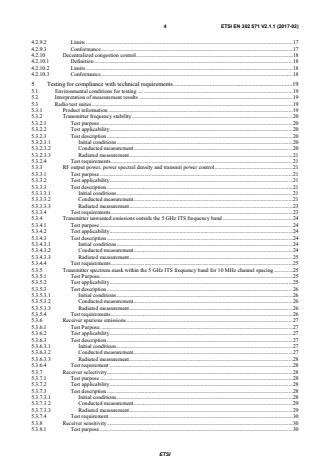
ETSI EN 302 571 V2.1.1 (2017-02) - Intelligent Transport Systems (ITS); Radiocommunications equipment operating in the 5 855 MHz to 5 925 MHz frequency band; Harmonised Standard covering the essential requirements of article 3.2 of Directive 2014/53/EU

Overview
SIST EN 302 571 V2.1.1:2017 sets out the harmonised technical standards for radio communications equipment operating within the 5 855 MHz to 5 925 MHz frequency band for Intelligent Transport Systems (ITS). Developed by SIST and identical to ETSI EN 302 571 V2.1.1, this standard ensures compliance with Article 3.2 of Directive 2014/53/EU on Radio Equipment. It addresses requirements for both transmitters and receivers used in ITS applications, supporting interoperability, safety, and regulatory conformity across the European Union.
The standard plays a critical role in the harmonised deployment of ITS, enabling radio equipment to reliably support vehicle-to-vehicle (V2V), vehicle-to-infrastructure (V2I), and other transport-related communication functions. It incorporates requirements for spectrum sharing, interference mitigation, and operational performance, and provides clear guidelines for testing and conformity assessment.
Key Topics
Frequency Band Segmentation:
- 5 855 MHz to 5 875 MHz for ITS non-safety applications
- 5 875 MHz to 5 905 MHz dedicated to safety-related ITS applications
- 5 905 MHz to 5 925 MHz reserved for future ITS expansion
Technical Requirements:
- Frequency stability
- Output power and power spectral density
- Transmit power control
- Spectrum mask for emissions
- Unwanted transmitter and receiver emissions
- Selectivity and sensitivity for reliable operation
Measurement and Testing Methods:
- Procedures for conducted and radiated measurements
- Environmental profile recommendations for testing
- Conformance assessment methods
Interference Mitigation:
- Co-existence measures for CEN DSRC and HDR DSRC road tolling systems
- Decentralized congestion control to ensure effective spectrum use
Regulatory Alignment:
- Compliance with ECC Decision (08)01, ECC Recommendation (08)01, and Commission Decision 2008/671/EC
- Satisfies EU essential requirements under Directive 2014/53/EU
Applications
- Road Safety Systems: Equipment compliant with this standard is foundational for safety-critical ITS applications, such as collision avoidance, emergency vehicle warning, and cooperative awareness services.
- Smart Traffic Management: Supports V2I communications for traffic signal priority, traffic flow optimization, and intelligent traffic light systems.
- Tolling and Payment: Ensures compatibility and minimal interference with electronic toll collection technologies using CEN DSRC and HDR DSRC standards.
- Future ITS Services: Provides a scalable technical basis for emerging automotive and transport applications requiring reliable wireless communications within the specified frequency band.
Related Standards
- ETSI TS 102 792: Details mitigation techniques to avoid interference between CEN DSRC equipment and ITS operating within the 5 GHz band.
- ETSI EN 302 637-2: Specifies requirements for the Cooperative Awareness Basic Service in vehicular communications.
- CEN EN 12253: Covers physical layer characteristics for short-range communication at 5.8 GHz for road transport.
- ETSI ES 200 674-1: Specifies technical and test requirements for high data rate data transmission equipment in the 5.8 GHz ISM band.
- Directive 2014/53/EU: European regulatory framework for market access and compliance for radio equipment.
- ECC Decision (08)01 & ECC Recommendation (08)01: Regulatory documents on frequency band usage for ITS across Europe.
- Commission Decision 2008/671/EC: Mandates harmonised use of 5 875 MHz to 5 905 MHz for ITS safety-related applications.
By conforming to SIST EN 302 571 V2.1.1:2017, manufacturers and implementers of ITS radio equipment can ensure interoperability, meet regulatory needs, and support the safe and efficient deployment of next-generation transport systems in Europe.
Buy Documents
ETSI EN 302 571 V2.0.0 (2016-03) - Intelligent Transport Systems (ITS); Radiocommunications equipment operating in the 5 855 MHz to 5 925 MHz frequency band; Harmonised Standard covering the essential requirements of article 3.2 of Directive 2014/53/EU
ETSI EN 302 571 V2.1.1 (2016-12) - Intelligent Transport Systems (ITS); Radiocommunications equipment operating in the 5 855 MHz to 5 925 MHz frequency band; Harmonised Standard covering the essential requirements of article 3.2 of Directive 2014/53/EU
ETSI EN 302 571 V2.1.1 (2017-02) - Intelligent Transport Systems (ITS); Radiocommunications equipment operating in the 5 855 MHz to 5 925 MHz frequency band; Harmonised Standard covering the essential requirements of article 3.2 of Directive 2014/53/EU
Get Certified
Connect with accredited certification bodies for this standard

BSI Group
BSI (British Standards Institution) is the business standards company that helps organizations make excellence a habit.

NYCE
Mexican standards and certification body.

ANCE
Mexican certification and testing association.
Sponsored listings
Frequently Asked Questions
SIST EN 302 571 V2.1.1:2017 is a standard published by the Slovenian Institute for Standardization (SIST). Its full title is "Intelligent Transport Systems (ITS) - Radiocommunications equipment operating in the 5 855 MHz to 5 925 MHz frequency band - Harmonised Standard covering the essential requirements of article 3.2 of Directive 2014/53/EU". This standard covers: The present document specifies technical characteristics and methods of measurement for radio transmitters and receivers operating in the frequency range 5 855 MHz to 5 925 MHz. The spectrum usage conditions are set out in ECC Decision (08)01 [i.1] for the frequency range 5 875 MHz to 5 925 MHz (with 5 905 MHz to 5 925 MHz considered as a future ITS extension) and in ECC Recommendation (08)01 [i.2] for the frequency range 5 855 MHz to 5 875 MHz. The Commission Decision 2008/671/EC [i.3] mandates a harmonised use of the frequency band 5 875 MHz to 5 905 MHz dedicated to safety-related applications of ITS throughout the member states of the European Union. Table 1 outlines the 5 GHz ITS frequency band segmentation.
The present document specifies technical characteristics and methods of measurement for radio transmitters and receivers operating in the frequency range 5 855 MHz to 5 925 MHz. The spectrum usage conditions are set out in ECC Decision (08)01 [i.1] for the frequency range 5 875 MHz to 5 925 MHz (with 5 905 MHz to 5 925 MHz considered as a future ITS extension) and in ECC Recommendation (08)01 [i.2] for the frequency range 5 855 MHz to 5 875 MHz. The Commission Decision 2008/671/EC [i.3] mandates a harmonised use of the frequency band 5 875 MHz to 5 905 MHz dedicated to safety-related applications of ITS throughout the member states of the European Union. Table 1 outlines the 5 GHz ITS frequency band segmentation.
SIST EN 302 571 V2.1.1:2017 is classified under the following ICS (International Classification for Standards) categories: 33.060.01 - Radiocommunications in general; 35.240.60 - IT applications in transport. The ICS classification helps identify the subject area and facilitates finding related standards.
SIST EN 302 571 V2.1.1:2017 is associated with the following European legislation: EU Directives/Regulations: 2014/53/EU; Standardization Mandates: M/284. When a standard is cited in the Official Journal of the European Union, products manufactured in conformity with it benefit from a presumption of conformity with the essential requirements of the corresponding EU directive or regulation.
SIST EN 302 571 V2.1.1:2017 is available in PDF format for immediate download after purchase. The document can be added to your cart and obtained through the secure checkout process. Digital delivery ensures instant access to the complete standard document.
Standards Content (Sample)
Draft ETSI EN 302 571 V2.0.0 (2016-03)
HARMONISED EUROPEAN STANDARD
Intelligent Transport Systems (ITS);
Radiocommunications equipment operating
in the 5 855 MHz to 5 925 MHz frequency band;
Harmonised Standard covering the essential requirements of
article 3.2 of Directive 2014/53/EU
2 Draft ETSI EN 302 571 V2.0.0 (2016-03)
Reference
REN/ERM-TG37-024
Keywords
harmonised standard, ITS, radio, regulation,
transport
ETSI
650 Route des Lucioles
F-06921 Sophia Antipolis Cedex - FRANCE
Tel.: +33 4 92 94 42 00 Fax: +33 4 93 65 47 16
Siret N° 348 623 562 00017 - NAF 742 C
Association à but non lucratif enregistrée à la
Sous-Préfecture de Grasse (06) N° 7803/88
Important notice
The present document can be downloaded from:
http://www.etsi.org/standards-search
The present document may be made available in electronic versions and/or in print. The content of any electronic and/or
print versions of the present document shall not be modified without the prior written authorization of ETSI. In case of any
existing or perceived difference in contents between such versions and/or in print, the only prevailing document is the
print of the Portable Document Format (PDF) version kept on a specific network drive within ETSI Secretariat.
Users of the present document should be aware that the document may be subject to revision or change of status.
Information on the current status of this and other ETSI documents is available at
https://portal.etsi.org/TB/ETSIDeliverableStatus.aspx
If you find errors in the present document, please send your comment to one of the following services:
https://portal.etsi.org/People/CommiteeSupportStaff.aspx
Copyright Notification
No part may be reproduced or utilized in any form or by any means, electronic or mechanical, including photocopying
and microfilm except as authorized by written permission of ETSI.
The content of the PDF version shall not be modified without the written authorization of ETSI.
The copyright and the foregoing restriction extend to reproduction in all media.
© European Telecommunications Standards Institute 2016.
All rights reserved.
TM TM TM
DECT , PLUGTESTS , UMTS and the ETSI logo are Trade Marks of ETSI registered for the benefit of its Members.
TM
3GPP and LTE™ are Trade Marks of ETSI registered for the benefit of its Members and
of the 3GPP Organizational Partners.
GSM® and the GSM logo are Trade Marks registered and owned by the GSM Association.
ETSI
3 Draft ETSI EN 302 571 V2.0.0 (2016-03)
Contents
Intellectual Property Rights . 7
Foreword . 7
Modal verbs terminology . 7
1 Scope . 8
2 References . 8
2.1 Normative references . 8
2.2 Informative references . 9
3 Definitions, symbols and abbreviations . 10
3.1 Definitions . 10
3.2 Symbols . 10
3.3 Abbreviations . 11
4 Technical requirements specifications . 11
4.1 Environmental profile . 11
4.2 Conformance requirements . 11
4.2.1 Transmitter frequency stability . 11
4.2.1.1 Definition . 11
4.2.1.2 Limits . 12
4.2.1.3 Conformance . 12
4.2.2 RF output power . 12
4.2.2.1 Definition . 12
4.2.2.2 Limits . 12
4.2.2.3 Conformance . 12
4.2.3 Power spectral density . 13
4.2.3.1 Definition . 13
4.2.3.2 Limits . 13
4.2.3.3 Conformance . 13
4.2.4 Transmit power control . 13
4.2.4.1 Definition . 13
4.2.4.2 Limits . 13
4.2.4.3 Conformance . 13
4.2.5 Transmitter unwanted emissions . 13
4.2.5.1 Transmitter unwanted emissions outside the 5 GHz ITS frequency band . 13
4.2.5.1.1 Definition. 13
4.2.5.1.2 Limits . 13
4.2.5.1.3 Conformance . 14
4.2.5.2 Transmitter spectrum mask within the 5 GHz ITS frequency band for 10 MHz channels . 14
4.2.5.2.1 Definition. 14
4.2.5.2.2 Limits . 14
4.2.5.2.3 Conformance . 14
4.2.6 Receiver spurious emissions . 14
4.2.6.1 Definition . 14
4.2.6.2 Limits . 15
4.2.6.3 Conformance . 15
4.2.7 Receiver selectivity . 15
4.2.7.1 Definition . 15
4.2.7.2 Limits . 15
4.2.7.3 Conformance . 16
4.2.8 Receiver sensitivity . 16
4.2.8.1 Definition . 16
4.2.8.2 Limits . 16
4.2.8.3 Conformance . 16
4.2.9 Interference mitigation for CEN DSRC and HDR DSRC in the frequency band 5 795 MHz to 5 815
MHz . 17
4.2.9.1 Definition . 17
4.2.9.2 Limits . 17
ETSI
4 Draft ETSI EN 302 571 V2.0.0 (2016-03)
4.2.9.3 Conformance . 17
4.2.10 Decentralized congestion control . 17
4.2.10.1 Definition . 17
4.2.10.2 Limits . 17
4.2.10.3 Conformance . 18
5 Testing for compliance with technical requirements . 18
5.1 Environmental conditions for testing . 18
5.2 Interpretation of measurement results . 18
5.3 Essential radio test suites . 19
5.3.1 Product information . 19
5.3.2 Transmitter frequency stability . 19
5.3.2.1 Test purpose . 19
5.3.2.2 Test applicability . 19
5.3.2.3 Test description . 20
5.3.2.3.1 Initial conditions . 20
5.3.2.3.2 Conducted measurement. 20
5.3.2.3.3 Radiated measurement . 20
5.3.2.4 Test requirements . 20
5.3.3 RF output power, power spectral density and transmit power control . 20
5.3.3.1 Test purpose . 20
5.3.3.2 Test applicability . 21
5.3.3.3 Test description . 21
5.3.3.3.1 Initial conditions . 21
5.3.3.3.2 Conducted measurement. 21
5.3.3.3.3 Radiated measurement . 22
5.3.3.4 Test requirements . 23
5.3.4 Transmitter unwanted emissions outside the 5 GHz ITS frequency band . 23
5.3.4.1 Test purpose . 23
5.3.4.2 Test applicability . 23
5.3.4.3 Test description . 23
5.3.4.3.1 Initial conditions . 23
5.3.4.3.2 Conducted measurement. 23
5.3.4.3.3 Radiated measurement . 24
5.3.4.4 Test requirements . 24
5.3.5 Transmitter spectrum mask within the 5 GHz ITS frequency band for 10 MHz channel spacing . 24
5.3.5.1 Test Purpose . 24
5.3.5.2 Test applicability . 24
5.3.5.3 Test description . 25
5.3.5.3.1 Initial conditions . 25
5.3.5.3.2 Conducted measurement. 25
5.3.5.3.3 Radiated measurement . 25
5.3.5.4 Test requirements . 25
5.3.6 Receiver spurious emissions . 25
5.3.6.1 Test Purpose . 25
5.3.6.2 Test applicability . 25
5.3.6.3 Test description . 26
5.3.6.3.1 Initial conditions . 26
5.3.6.3.2 Conducted measurement. 26
5.3.6.3.3 Radiated measurement . 26
5.3.6.4 Test requirement . 26
5.3.7 Receiver selectivity . 27
5.3.7.1 Test purpose . 27
5.3.7.2 Test applicability . 27
5.3.7.3 Test description . 27
5.3.7.3.1 Initial conditions . 27
5.3.7.3.2 Conducted measurement. 27
5.3.7.3.3 Radiated measurement . 28
5.3.7.4 Test requirement . 28
5.3.8 Receiver sensitivity . 28
5.3.8.1 Test purpose . 28
5.3.8.2 Test applicability . 28
ETSI
5 Draft ETSI EN 302 571 V2.0.0 (2016-03)
5.3.8.3 Test description . 28
5.3.8.3.1 Initial conditions . 28
5.3.8.3.2 Conducted measurement. 29
5.3.8.3.3 Radiated measurement . 29
5.3.8.4 Test requirement . 29
5.3.9 CEN DSRC and HDR DSRC protection . 29
5.3.9.1 Test Purpose . 29
5.3.9.2 Test applicability . 29
5.3.9.3 Test description . 29
5.3.9.3.1 Initial conditions . 29
5.3.9.3.2 Measurement of RF output power, unwanted emissions, and transmit duty cycle in
coexistence mode. 30
5.3.9.4 Test requirements . 30
5.3.10 CEN DSRC and HDR DSRC detection . 30
5.3.10.1 Test Purpose . 30
5.3.10.2 Initial conditions . 30
5.3.10.3 Test of detecting CEN DSRC and HDR DSRC transmissions . 31
5.3.10.3.1 Test purpose . 31
5.3.10.3.2 Test applicability . 31
5.3.10.3.3 Test description . 31
5.3.10.3.4 Test requirements . 32
Annex A (normative): Relationship between the present document and the essential
requirements of Directive 2014/53/EU . 33
Annex B (normative): Test sites and arrangements for radiated measurements . 34
B.1 Test sites . 34
B.1.1 Open air test sites . 34
B.1.2 Anechoic chamber . 35
B.1.2.1 General . 35
B.1.2.2 Description . 35
B.1.2.3 Influence of parasitic reflections . 35
B.1.2.4 Calibration and mode of use . 35
B.2 Test antenna . 36
B.3 Substitution antenna . 37
Annex C (normative): General description of measurement . 38
C.1 Introduction . 38
C.2 Conducted measurements . 38
C.3 Radiated measurements . 38
C.4 Substitution measurement . 39
Annex D (informative): Guidance on declaring the environmental profile . 40
D.1 Recommended environmental profile . 40
D.2 Temperatures . 40
D.2.1 Introduction . 40
D.2.2 Normal environmental conditions . 40
D.2.3 Extreme environmental conditions . 40
D.3 Test power source . 40
D.3.1 Introduction . 40
D.3.2 Normal test power source . 41
D.3.2.1 AC mains voltage . 41
D.3.2.2 Regulated lead-acid battery power sources used on vehicles. 41
D.3.2.3 Other power sources . 41
D.3.3 Extreme test source voltages . 41
D.3.3.1 AC mains voltage . 41
ETSI
6 Draft ETSI EN 302 571 V2.0.0 (2016-03)
D.3.3.2 Regulated lead-acid battery power sources used on vehicles. 41
D.3.3.3 Power sources using other types of batteries . 41
D.3.3.4 Other power sources . 41
D.3.4 Procedure for equipment designed for continuous transmission . 42
D.3.5 Procedure for equipment designed for intermittent transmission . 42
Annex E (informative): Bibliography . 43
Annex F (informative): Change History . 44
History . 45
ETSI
7 Draft ETSI EN 302 571 V2.0.0 (2016-03)
Intellectual Property Rights
IPRs essential or potentially essential to the present document may have been declared to ETSI. The information
pertaining to these essential IPRs, if any, is publicly available for ETSI members and non-members, and can be found
in ETSI SR 000 314: "Intellectual Property Rights (IPRs); Essential, or potentially Essential, IPRs notified to ETSI in
respect of ETSI standards", which is available from the ETSI Secretariat. Latest updates are available on the ETSI Web
server (https://ipr.etsi.org/).
Pursuant to the ETSI IPR Policy, no investigation, including IPR searches, has been carried out by ETSI. No guarantee
can be given as to the existence of other IPRs not referenced in ETSI SR 000 314 (or the updates on the ETSI Web
server) which are, or may be, or may become, essential to the present document.
Foreword
This draft Harmonised European Standard (EN) has been produced by ETSI Technical Committee Electromagnetic
compatibility and Radio spectrum Matters (ERM), and is now submitted for the combined Public Enquiry and Vote
phase of the ETSI standards EN Approval Procedure.
The present document has been prepared under the Commission's standardisation request C(2015) 5376 final [i.5] to
provide one voluntary means of conforming to the essential requirements of Directive 2014/53/EU on the harmonisation
of the laws of the Member States relating to the making available on the market of radio equipment and repealing
Directive 1999/5/EC [i.4].
Once the present document is cited in the Official Journal of the European Union under that Directive, compliance with
the normative clauses of the present document given in table A.1 confers, within the limits of the scope of the present
document, a presumption of conformity with the corresponding essential requirements of that Directive, and associated
EFTA regulations.
Proposed national transposition dates
Date of latest announcement of this EN (doa): 3 months after ETSI publication
Date of latest publication of new National Standard
or endorsement of this EN (dop/e): 6 months after doa
Date of withdrawal of any conflicting National Standard (dow): 12 June 2017
Modal verbs terminology
In the present document "shall", "shall not", "should", "should not", "may", "need not", "will", "will not", "can" and
"cannot" are to be interpreted as described in clause 3.2 of the ETSI Drafting Rules (Verbal forms for the expression of
provisions).
"must" and "must not" are NOT allowed in ETSI deliverables except when used in direct citation.
ETSI
8 Draft ETSI EN 302 571 V2.0.0 (2016-03)
1 Scope
The present document applies to radio transmitters and receivers for Intelligent Transport Systems (ITS) operating in
the frequency range 5 855 GHz to 5 925 GHz. The spectrum usage conditions are set out in ECC Decision (08)01 [i.1]
for the frequency range 5 875 GHz to 5 925 GHz and in ECC Recommendation (08)01 [i.2] for the frequency range
5 855 GHz to 5 875 GHz. The Commission Decision 2008/671/EC [i.3] mandates a harmonised use of the frequency
band 5 875 GHz to 5 905 GHz dedicated to safety-related applications of ITS throughout the member states of the
European Union. Table 1 outlines the 5 GHz ITS frequency band segmentation.
Table 1: 5 GHz ITS frequency band segmentation
Frequency band Frequency range Usage Regulation
ITS-G5B 5 855 MHz to 5 875 MHz ITS non-safety applications ECC Recommendation (08)01 [i.2]
Commission Decision
ITS-G5A 5 875 MHz to 5 905 MHz ITS road safety 2008/671/EC [i.3],
ECC Decision (08)01 [i.1]
ITS-G5D 5 905 MHz to 5 925 MHz Future ITS applications ECC Decision (08)01 [i.1]
The present document contains requirements to demonstrate that radio equipment both effectively uses and supports the
efficient use of radio spectrum in order to avoid harmful interference.
Interference mitigation techniques in the present document are provided to protect road tolling applications using CEN
DSRC or HDR DSRC.
2 References
2.1 Normative references
References are either specific (identified by date of publication and/or edition number or version number) or
non-specific. For specific references, only the cited version applies. For non-specific references, the latest version of the
referenced document (including any amendments) applies.
Referenced documents which are not found to be publicly available in the expected location might be found at
http://docbox.etsi.org/Reference.
NOTE: While any hyperlinks included in this clause were valid at the time of publication, ETSI cannot guarantee
their long term validity.
The following referenced documents are necessary for the application of the present document.
[1] ETSI TS 102 792 (V1.2.1) (06-2015): "Intelligent Transport Systems (ITS); Mitigation techniques
to avoid interference between European CEN Dedicated Short Range Communication (CEN
DSRC) equipment and Intelligent Transport Systems (ITS) operating in the 5 GHz frequency
range".
[2] ETSI EN 302 637-2 (V1.3.2) (11-2014): "Intelligent Transport Systems (ITS); Vehicular
Communications; Basic Set of Applications; Part 2: Specification of Cooperative Awareness Basic
Service".
[3] Void.
[4] CISPR 16 (parts 1-1 (2015), 1-4 (2010) and 1-5 (2014)): "Specifications for radio disturbance and
immunity measuring apparatus and methods; Part 1: Radio disturbance and immunity measuring
apparatus".
[5] ETSI TS 102 687 (V1.1.1) (07-2011): "Intelligent Transport Systems (ITS); Decentralized
Congestion Control Mechanisms for Intelligent Transport Systems operating in the 5 GHz range;
Access layer part".
[6] ETSI TS 103 175 (V1.1.1) (06-2015): "Intelligent Transport Systems (ITS); Cross Layer DCC
Management Entity for operation in the ITS G5A and ITS G5B medium".
ETSI
9 Draft ETSI EN 302 571 V2.0.0 (2016-03)
[7] CEN EN 12253:2004: "Road transport and traffic telematics - Dedicated short-range
communication - Physical layer using microwave at 5,8 GHz".
[8] ETSI ES 200 674-1 (V2.4.1) (05-2013): "Intelligent Transport Systems (ITS); Road Transport and
Traffic Telematics (RTTT); Dedicated Short Range Communications (DSRC); Part 1: Technical
characteristics and test methods for High Data Rate (HDR) data transmission equipment operating
in the 5,8 GHz Industrial, Scientific and Medical (ISM) band".
[9] ETSI TS 102 917-1 (V1.1.1) (01-2013): "Intelligent Transport Systems (ITS); Test specifications
for the channel congestion control algorithms operating in the 5,9 GHz range; Part 1: Protocol
Implementation Conformance Statement (PICS)".
[10] ETSI TS 102 917-2 (V1.1.1) (01-2013): "Intelligent Transport Systems (ITS); Test specifications
for the channel congestion control algorithms operating in the 5,9 GHz range; Part 2: Test Suite
Structure and Test Purposes (TSS & TP)".
[11] ETSI TS 102 917-3 (V1.1.1) (01-2013): "Intelligent Transport Systems (ITS); Test specifications
for the channel congestion control algorithms operating in the 5,9 GHz range; Part 3: Abstract Test
Suite (ATS) and partial Protocol Implementation eXtra Information for Testing (PIXIT)".
[12] IEEE 802.11™-2012: "IEEE Standard for Information technology - Telecommunications and
information exchange between systems - Local and metropolitan area networks - Specific
requirements - Part 11: Wireless LAN Medium Access Control (MAC) and Physical Layer (PHY)
Specifications".
2.2 Informative references
References are either specific (identified by date of publication and/or edition number or version number) or
non-specific. For specific references, only the cited version applies. For non-specific references, the latest version of the
referenced document (including any amendments) applies.
NOTE: While any hyperlinks included in this clause were valid at the time of publication, ETSI cannot guarantee
their long term validity.
The following referenced documents are not necessary for the application of the present document but they assist the
user with regard to a particular subject area.
[i.1] ECC Decision (08)01: "ECC Decision of 14 March 2008 on the harmonised use of the 5875-5925
frequency band for Intelligent Transport Systems (ITS)", approved 14 March 2008 and amended 3
July 2015.
[i.2] ECC Recommendation (08)01:"Use of band 5855-5875 MHz for Intelligent Transport Systems
(ITS)," approved 21 February 2008 and amended 3 July 2015.
[i.3] Commission Decision 2008/671/EC of 5 August on the harmonised use of radio spectrum in the
5875-5905 MHz frequency band for safety related application of Intelligent Transport Systems
(ITS).
[i.4] Directive 2014/53/EU of the European Parliament and of the Council of 16 April 2014 on the
harmonisation of the laws of the Member States relating to the making available on the market of
radio equipment and repealing Directive 1999/5/EC.
[i.5] Commission Implementing Decision C(2015) 5376 final of 4.8.2015 on a standardisation request
to the European Committee for Electrotechnical Standardisation and to the European
Telecommunications Standards Institute as regards radio equipment in support of Directive
2014/53/EU of the European Parliament and of the Council.
[i.6] ETSI TR 100 028 (all parts) (V1.4.1) (12-2001): "Electromagnetic compatibility and Radio
spectrum Matters (ERM); Uncertainties in the measurement of mobile radio equipment
characteristics".
[i.7] ETSI TR 100 028-2 (V1.4.1) (12-2001): "Electromagnetic compatibility and Radio spectrum
Matters (ERM); Uncertainties in the measurement of mobile radio equipment characteristics;
Part 2".
ETSI
10 Draft ETSI EN 302 571 V2.0.0 (2016-03)
3 Definitions, symbols and abbreviations
3.1 Definitions
For the purposes of the present document, the terms and definitions given in Directive 2014/53/EU [i.4] and the
following apply:
5 GHz ITS frequency band: frequency bands ITS-G5A, ITS-G5B and ITS-G5D as outlined in Table 1
dedicated antenna: removable antenna supplied and tested with the radio equipment, designed as an indispensable part
of the equipment
NOTE: The dedicated antenna has been designed or developed for one or more specific types of equipment. It is
the combination of dedicated antenna and radio equipment that is expected to be compliant with the
regulations.
duty cycle: defined as the ratio, expressed as a percentage of the maximum transmitter "on" time on one carrier
frequency, relative to a second period
integral antenna: antenna designed as a fixed part of the equipment, without the use of an external connector and as
such which cannot be disconnected from the equipment by the user
NOTE: An integral antenna may be fitted internally or externally.
protected status: status of a CEN DSRC or a HDR DSRC station that is eligible to deploy a roadside unit certificate to
sign a protected zone CAM or/and is included in the official protected zone database
radiated measurements: measurements which involve the absolute measurement of a radiated field
vehicle: all kinds of land mobile vehicle
EXAMPLE: Road vehicle and rail vehicle.
3.2 Symbols
For the purposes of the present document, the following symbols apply:
dB decibel
dBi antenna gain relative to isotropic radiator in decibel
dBc decibel relative to carrier power
E electrical field strength
f frequency
f nominal centre frequency
c
G antenna gain
P highest power level
H
P lowest power level
L
R distance
T maximum temperature
max
T minimum temperature
min
T minimum time between two transmissions
off
T maximum duration of a transmission
on
V maximum voltage
max
V minimum voltage
min
V nominal voltage
nominal
Ω ohm
µs microsecond
ETSI
11 Draft ETSI EN 302 571 V2.0.0 (2016-03)
3.3 Abbreviations
For the purposes of the present document, the following abbreviations apply:
AC Alternative Current
BPSK Binary Phase Shift Keying
CAM Cooperative Awareness Message
CBR Channel Busy Ratio
CCH Control Channel
CEN Comité Européen de Normalisation (European Committee for Standardization)
CISPR Comité International Spécial des Perturbations Radioélectriques (International Special Committee
on Radio Interference)
DC Direct Current
DCC Decentralized Congestion Control
DSRC Dedicated Short Range Communication (CEN DRSC = tolling at 5,8 GHz)
DUT Device Under Test
e.i.r.p. equivalent isotropically radiated power
e.r.p. effective radiated power
EC European Commission
ECC Electronic Communication Committee
EMC ElectroMagnetic Compatibility
HDR High Data Rate
HS Harmonised Standard
ITS Intelligent Transport Systems
LP Linear Polarized
OOB Out-Of-Band
PD mean Power Density
PER Packet Error Rate
-6
ppm parts per million = 10
PSD Power Spectral Density
QAM Quadrature Amplitude Modulation
QPSK Quadrature Phase Shift Keying
RF Radio Frequency
RMS Root Mean Square
TPC Transmit Power Control
VSWR Voltage Standing Wave Ratio
4 Technical requirements specifications
4.1 Environmental profile
The technical requirements of the present document apply under the environmental profile for operation of the
equipment, which shall be stated by the manufacturer. The equipment shall comply with all the technical requirements
of the present document at all times when operating within the boundary limits of the stated operational environmental
profile.
Recommended environmental profile parameters are summarized in Annex D.
4.2 Conformance requirements
4.2.1 Transmitter frequency stability
4.2.1.1 Definition
The equipment is required to operate on the applicable specific carrier centre frequencies that correspond to the nominal
carrier frequencies, f , as defined in Table 2.
c
ETSI
12 Draft ETSI EN 302 571 V2.0.0 (2016-03)
Table 2: Nominal carrier frequency allocations
Carrier centre frequency f , (MHz)
Channel name Maximum channel bandwidth (MHz)
c
G5-SCH4 5 860 10
G5-SCH3 5 870 10
G5-SCH1 5 880 10
G5-SCH2 5 890 10
G5-CCH 5 900 10
G5-SCH5 5 910 10
G5-SCH6 5 920 10
The frequency channels together with the channel names conta
...
Final draft ETSI EN 302 571 V2.1.1 (2016-12)
HARMONISED EUROPEAN STANDARD
Intelligent Transport Systems (ITS);
Radiocommunications equipment operating
in the 5 855 MHz to 5 925 MHz frequency band;
Harmonised Standard covering the essential requirements
of article 3.2 of Directive 2014/53/EU
2 Final draft ETSI EN 302 571 V2.1.1 (2016-12)
Reference
REN/ERM-TG37-024
Keywords
harmonised standard, ITS, radio, regulation,
transport
ETSI
650 Route des Lucioles
F-06921 Sophia Antipolis Cedex - FRANCE
Tel.: +33 4 92 94 42 00 Fax: +33 4 93 65 47 16
Siret N° 348 623 562 00017 - NAF 742 C
Association à but non lucratif enregistrée à la
Sous-Préfecture de Grasse (06) N° 7803/88
Important notice
The present document can be downloaded from:
http://www.etsi.org/standards-search
The present document may be made available in electronic versions and/or in print. The content of any electronic and/or
print versions of the present document shall not be modified without the prior written authorization of ETSI. In case of any
existing or perceived difference in contents between such versions and/or in print, the only prevailing document is the
print of the Portable Document Format (PDF) version kept on a specific network drive within ETSI Secretariat.
Users of the present document should be aware that the document may be subject to revision or change of status.
Information on the current status of this and other ETSI documents is available at
https://portal.etsi.org/TB/ETSIDeliverableStatus.aspx
If you find errors in the present document, please send your comment to one of the following services:
https://portal.etsi.org/People/CommiteeSupportStaff.aspx
Copyright Notification
No part may be reproduced or utilized in any form or by any means, electronic or mechanical, including photocopying
and microfilm except as authorized by written permission of ETSI.
The content of the PDF version shall not be modified without the written authorization of ETSI.
The copyright and the foregoing restriction extend to reproduction in all media.
© European Telecommunications Standards Institute 2016.
All rights reserved.
TM TM TM
DECT , PLUGTESTS , UMTS and the ETSI logo are Trade Marks of ETSI registered for the benefit of its Members.
TM
3GPP and LTE™ are Trade Marks of ETSI registered for the benefit of its Members and
of the 3GPP Organizational Partners.
GSM® and the GSM logo are Trade Marks registered and owned by the GSM Association.
ETSI
3 Final draft ETSI EN 302 571 V2.1.1 (2016-12)
Contents
Intellectual Property Rights . 7
Foreword . 7
Modal verbs terminology . 7
1 Scope . 8
2 References . 8
2.1 Normative references . 8
2.2 Informative references . 9
3 Definitions, symbols and abbreviations . 10
3.1 Definitions . 10
3.2 Symbols . 10
3.3 Abbreviations . 11
4 Technical requirements specifications . 11
4.1 Environmental profile . 11
4.2 Conformance requirements . 12
4.2.1 Transmitter frequency stability . 12
4.2.1.1 Definition . 12
4.2.1.2 Limits . 12
4.2.1.3 Conformance . 12
4.2.2 RF output power . 13
4.2.2.1 Definition . 13
4.2.2.2 Limits . 13
4.2.2.3 Conformance . 13
4.2.3 Power spectral density . 13
4.2.3.1 Definition . 13
4.2.3.2 Limits . 13
4.2.3.3 Conformance . 13
4.2.4 Transmit power control . 13
4.2.4.1 Definition . 13
4.2.4.2 Limits . 13
4.2.4.3 Conformance . 13
4.2.5 Transmitter unwanted emissions . 13
4.2.5.1 Transmitter unwanted emissions outside the 5 GHz ITS frequency band . 13
4.2.5.1.1 Definition. 13
4.2.5.1.2 Limits . 14
4.2.5.1.3 Conformance . 14
4.2.5.2 Transmitter spectrum mask within the 5 GHz ITS frequency band for 10 MHz channels . 15
4.2.5.2.1 Definition. 15
4.2.5.2.2 Limits . 15
4.2.5.2.3 Conformance . 15
4.2.6 Receiver spurious emissions . 15
4.2.6.1 Definition . 15
4.2.6.2 Limits . 15
4.2.6.3 Conformance . 15
4.2.7 Receiver selectivity . 16
4.2.7.1 Definition . 16
4.2.7.2 Limits . 16
4.2.7.3 Conformance . 16
4.2.8 Receiver sensitivity . 16
4.2.8.1 Definition . 16
4.2.8.2 Limits . 17
4.2.8.3 Conformance . 17
4.2.9 Interference mitigation for CEN DSRC and HDR DSRC in the frequency band 5 795 MHz to 5 815
MHz . 17
4.2.9.1 Definition . 17
ETSI
4 Final draft ETSI EN 302 571 V2.1.1 (2016-12)
4.2.9.2 Limits . 17
4.2.9.3 Conformance . 17
4.2.10 Decentralized congestion control . 18
4.2.10.1 Definition . 18
4.2.10.2 Limits . 18
4.2.10.3 Conformance . 18
5 Testing for compliance with technical requirements . 19
5.1 Environmental conditions for testing . 19
5.2 Interpretation of measurement results . 19
5.3 Radio test suites . 19
5.3.1 Product information . 19
5.3.2 Transmitter frequency stability . 20
5.3.2.1 Test purpose . 20
5.3.2.2 Test applicability . 20
5.3.2.3 Test description . 20
5.3.2.3.1 Initial conditions . 20
5.3.2.3.2 Conducted measurement. 20
5.3.2.3.3 Radiated measurement . 21
5.3.2.4 Test requirements . 21
5.3.3 RF output power, power spectral density and transmit power control . 21
5.3.3.1 Test purpose . 21
5.3.3.2 Test applicability . 21
5.3.3.3 Test description . 21
5.3.3.3.1 Initial conditions . 21
5.3.3.3.2 Conducted measurement. 21
5.3.3.3.3 Radiated measurement . 23
5.3.3.4 Test requirements . 23
5.3.4 Transmitter unwanted emissions outside the 5 GHz ITS frequency band . 24
5.3.4.1 Test purpose . 24
5.3.4.2 Test applicability . 24
5.3.4.3 Test description . 24
5.3.4.3.1 Initial conditions . 24
5.3.4.3.2 Conducted measurement. 24
5.3.4.3.3 Radiated measurement . 25
5.3.4.4 Test requirements . 25
5.3.5 Transmitter spectrum mask within the 5 GHz ITS frequency band for 10 MHz channel spacing . 25
5.3.5.1 Test Purpose . 25
5.3.5.2 Test applicability . 25
5.3.5.3 Test description . 26
5.3.5.3.1 Initial conditions . 26
5.3.5.3.2 Conducted measurement. 26
5.3.5.3.3 Radiated measurement . 26
5.3.5.4 Test requirements . 26
5.3.6 Receiver spurious emissions . 27
5.3.6.1 Test Purpose . 27
5.3.6.2 Test applicability . 27
5.3.6.3 Test description . 27
5.3.6.3.1 Initial conditions . 27
5.3.6.3.2 Conducted measurement. 27
5.3.6.3.3 Radiated measurement . 28
5.3.6.4 Test requirement . 28
5.3.7 Receiver selectivity . 28
5.3.7.1 Test purpose . 28
5.3.7.2 Test applicability . 28
5.3.7.3 Test description . 28
5.3.7.3.1 Initial conditions . 28
5.3.7.3.2 Conducted measurement. 29
5.3.7.3.3 Radiated measurement . 29
5.3.7.4 Test requirement . 30
5.3.8 Receiver sensitivity . 30
5.3.8.1 Test purpose . 30
ETSI
5 Final draft ETSI EN 302 571 V2.1.1 (2016-12)
5.3.8.2 Test applicability . 30
5.3.8.3 Test description . 30
5.3.8.3.1 Initial conditions . 30
5.3.8.3.2 Conducted measurement. 30
5.3.8.3.3 Radiated measurement . 31
5.3.8.4 Test requirement . 31
5.3.9 CEN DSRC and HDR DSRC protection . 31
5.3.9.1 Test Purpose . 31
5.3.9.2 Test applicability . 31
5.3.9.3 Test description . 31
5.3.9.3.1 Initial conditions . 31
5.3.9.3.2 Measurement of RF output power, unwanted emissions, and transmit duty cycle in
coexistence mode. 31
5.3.9.4 Test requirements . 32
5.3.10 CEN DSRC and HDR DSRC detection . 32
5.3.10.1 Test Purpose . 32
5.3.10.2 Initial conditions . 32
5.3.10.3 Test of detecting CEN DSRC and HDR DSRC transmissions . 32
5.3.10.3.1 Test purpose . 32
5.3.10.3.2 Test applicability . 32
5.3.10.3.3 Test description . 32
5.3.10.3.4 Test requirements . 34
5.3.11 Decentralized congestion control . 34
5.3.11.1 Test purpose . 34
5.3.11.2 Test applicability . 34
5.3.11.3 Test description . 34
5.3.11.3.1 Initial conditions . 34
5.3.11.3.2 Conducted measurement. 34
5.3.11.3.3 Radiated measurement . 35
5.3.11.4 Test requirement . 35
Annex A (informative): Relationship between the present document and the essential
requirements of Directive 2014/53/EU . 36
Annex B (normative): Test sites and arrangements for radiated measurements . 37
B.1 Test sites . 37
B.1.1 Open air test sites . 37
B.1.2 Anechoic chamber . 38
B.1.2.1 General . 38
B.1.2.2 Description . 38
B.1.2.3 Influence of parasitic reflections . 38
B.1.2.4 Calibration and mode of use . 38
B.2 Test antenna . 39
B.3 Substitution antenna . 40
Annex C (normative): General description of measurement . 41
C.1 Introduction . 41
C.2 Conducted measurements . 41
C.3 Radiated measurements . 41
C.4 Substitution measurement . 42
Annex D (informative): Guidance on declaring the environmental profile . 44
D.1 Recommended environmental profile . 44
D.2 Temperatures . 44
D.2.1 Introduction . 44
D.2.2 Normal environmental conditions . 44
ETSI
6 Final draft ETSI EN 302 571 V2.1.1 (2016-12)
D.2.3 Extreme environmental conditions . 44
D.3 Test power source . 45
D.3.1 Introduction . 45
D.3.2 Normal test power source . 45
D.3.2.1 AC mains voltage . 45
D.3.2.2 Regulated lead-acid battery power sources used on vehicles. 45
D.3.2.3 Other power sources . 45
D.3.3 Extreme test source voltages . 45
D.3.3.1 AC mains voltage . 45
D.3.3.2 Regulated lead-acid battery power sources used on vehicles. 45
D.3.3.3 Power sources using other types of batteries . 45
D.3.3.4 Other power sources . 46
D.3.4 Procedure for equipment designed for continuous transmission . 46
D.3.5 Procedure for equipment designed for intermittent transmission . 46
Annex E (informative): Bibliography . 47
Annex F (informative): Change History . 48
History . 49
ETSI
7 Final draft ETSI EN 302 571 V2.1.1 (2016-12)
Intellectual Property Rights
IPRs essential or potentially essential to the present document may have been declared to ETSI. The information
pertaining to these essential IPRs, if any, is publicly available for ETSI members and non-members, and can be found
in ETSI SR 000 314: "Intellectual Property Rights (IPRs); Essential, or potentially Essential, IPRs notified to ETSI in
respect of ETSI standards", which is available from the ETSI Secretariat. Latest updates are available on the ETSI Web
server (https://ipr.etsi.org/).
Pursuant to the ETSI IPR Policy, no investigation, including IPR searches, has been carried out by ETSI. No guarantee
can be given as to the existence of other IPRs not referenced in ETSI SR 000 314 (or the updates on the ETSI Web
server) which are, or may be, or may become, essential to the present document.
Foreword
This final draft Harmonised European Standard (EN) has been produced by ETSI Technical Committee
Electromagnetic compatibility and Radio spectrum Matters (ERM), and is now submitted for the Vote phase of the
ETSI standards EN Approval Procedure.
The present document has been prepared under the Commission's standardisation request C(2015) 5376 final [i.5] to
provide one voluntary means of conforming to the essential requirements of Directive 2014/53/EU on the harmonisation
of the laws of the Member States relating to the making available on the market of radio equipment and repealing
Directive 1999/5/EC [i.4].
Once the present document is cited in the Official Journal of the European Union under that Directive, compliance with
the normative clauses of the present document given in Table A.1 confers, within the limits of the scope of the present
document, a presumption of conformity with the corresponding essential requirements of that Directive, and associated
EFTA regulations.
Proposed national transposition dates
Date of latest announcement of this EN (doa): 3 months after ETSI publication
Date of latest publication of new National Standard
or endorsement of this EN (dop/e): 6 months after doa
Date of withdrawal of any conflicting National Standard (dow): 18 months after doa
Modal verbs terminology
In the present document "shall", "shall not", "should", "should not", "may", "need not", "will", "will not", "can" and
"cannot" are to be interpreted as described in clause 3.2 of the ETSI Drafting Rules (Verbal forms for the expression of
provisions).
"must" and "must not" are NOT allowed in ETSI deliverables except when used in direct citation.
ETSI
8 Final draft ETSI EN 302 571 V2.1.1 (2016-12)
1 Scope
The present document specifies technical characteristics and methods of measurement for radio transmitters and
receivers operating in the frequency range 5 855 MHz to 5 925 MHz. The spectrum usage conditions are set out in
ECC Decision (08)01 [i.1] for the frequency range 5 875 MHz to 5 925 MHz (with 5 905 MHz to 5 925 MHz
considered as a future ITS extension) and in ECC Recommendation (08)01 [i.2] for the frequency range 5 855 MHz
to 5 875 MHz. The Commission Decision 2008/671/EC [i.3] mandates a harmonised use of the frequency band
5 875 MHz to 5 905 MHz dedicated to safety-related applications of ITS throughout the member states of the European
Union. Table 1 outlines the 5 GHz ITS frequency band segmentation.
Table 1: 5 GHz ITS frequency band segmentation
Frequency range Usage Regulation
5 855 MHz to 5 875 MHz ITS non-safety applications ECC Recommendation (08)01 [i.2]
Commission Decision 2008/671/EC [i.3],
5 875 MHz to 5 905 MHz ITS road safety
ECC Decision (08)01 [i.1]
5 905 MHz to 5 925 MHz Future ITS applications ECC Decision (08)01 [i.1]
The present document covers the essential requirements of article 3.2 of Directive 2014/53/EU [i.4] under the
conditions identified in annex A.
Interference mitigation techniques in the present document are provided to protect road tolling applications using CEN
DSRC or HDR DSRC.
2 References
2.1 Normative references
References are specific, identified by date of publication and/or edition number or version number. Only the cited
version applies.
Referenced documents which are not found to be publicly available in the expected location might be found at
http://docbox.etsi.org/Reference.
NOTE: While any hyperlinks included in this clause were valid at the time of publication, ETSI cannot guarantee
their long term validity.
The following referenced documents are necessary for the application of the present document.
[1] ETSI TS 102 792 (V1.2.1) (06-2015): "Intelligent Transport Systems (ITS); Mitigation techniques
to avoid interference between European CEN Dedicated Short Range Communication (CEN
DSRC) equipment and Intelligent Transport Systems (ITS) operating in the 5 GHz frequency
range".
[2] ETSI EN 302 637-2 (V1.3.2) (11-2014): "Intelligent Transport Systems (ITS); Vehicular
Communications; Basic Set of Applications; Part 2: Specification of Cooperative Awareness Basic
Service".
[3] Void.
[4] CISPR 16 (parts 1-1 (2015), 1-4 (2010) and 1-5 (2014)): "Specifications for radio disturbance and
immunity measuring apparatus and methods; Part 1: Radio disturbance and immunity measuring
apparatus".
[5] CEN EN 12253:2004: "Road transport and traffic telematics - Dedicated short-range
communication - Physical layer using microwave at 5,8 GHz".
ETSI
9 Final draft ETSI EN 302 571 V2.1.1 (2016-12)
[6] ETSI ES 200 674-1 (V2.4.1) (05-2013): "Intelligent Transport Systems (ITS); Road Transport and
Traffic Telematics (RTTT); Dedicated Short Range Communications (DSRC); Part 1: Technical
characteristics and test methods for High Data Rate (HDR) data transmission equipment operating
in the 5,8 GHz Industrial, Scientific and Medical (ISM) band".
2.2 Informative references
References are either specific (identified by date of publication and/or edition number or version number) or
non-specific. For specific references, only the cited version applies. For non-specific references, the latest version of the
referenced document (including any amendments) applies.
NOTE: While any hyperlinks included in this clause were valid at the time of publication, ETSI cannot guarantee
their long term validity.
The following referenced documents are not necessary for the application of the present document but they assist the
user with regard to a particular subject area.
[i.1] ECC Decision (08)01: "ECC Decision of 14 March 2008 on the harmonised use of the 5875-5925
frequency band for Intelligent Transport Systems (ITS)", approved 14 March 2008 and amended
3 July 2015.
[i.2] ECC Recommendation (08)01:"Use of band 5855-5875 MHz for Intelligent Transport Systems
(ITS)", approved 21 February 2008 and amended 3 July 2015.
[i.3] Commission Decision 2008/671/EC of 5 August on the harmonised use of radio spectrum in the
5875-5905 MHz frequency band for safety related application of Intelligent Transport Systems
(ITS).
[i.4] Directive 2014/53/EU of the European Parliament and of the Council of 16 April 2014 on the
harmonisation of the laws of the Member States relating to the making available on the market of
radio equipment and repealing Directive 1999/5/EC.
[i.5] Commission Implementing Decision C(2015) 5376 final of 4.8.2015 on a standardisation request
to the European Committee for Electrotechnical Standardisation and to the European
Telecommunications Standards Institute as regards radio equipment in support of Directive
2014/53/EU of the European Parliament and of the Council.
[i.6] ETSI TR 100 028 (all parts) (V1.4.1) (12-2001): "Electromagnetic compatibility and Radio
spectrum Matters (ERM); Uncertainties in the measurement of mobile radio equipment
characteristics".
[i.7] ETSI TR 100 028-2 (V1.4.1) (12-2001): "Electromagnetic compatibility and Radio spectrum
Matters (ERM); Uncertainties in the measurement of mobile radio equipment characteristics;
Part 2".
[i.8] ETSI TS 103 175 (V1.1.1) (06-2015): "Intelligent Transport Systems (ITS); Cross Layer DCC
Management Entity for operation in the ITS G5A and ITS G5B medium".
[i.9] IEEE 802.11™-2012: "IEEE Standard for Information technology - Telecommunications and
information exchange between systems - Local and metropolitan area networks - Specific
requirements - Part 11: Wireless LAN Medium Access Control (MAC) and Physical Layer (PHY)
Specifications".
ETSI
10 Final draft ETSI EN 302 571 V2.1.1 (2016-12)
3 Definitions, symbols and abbreviations
3.1 Definitions
For the purposes of the present document, the terms and definitions given in Directive 2014/53/EU [i.4] and the
following apply:
5 GHz ITS frequency band: frequency bands 5 855 MHz to 5 875 MHz (ITS-G5A), 5 875 MHz to 5 905 MHz
(ITS-G5B) and 5 905 MHz to 5 925 MHz (ITS-G5D)
channel busy ratio (CBR): time-dependent value between zero and one representing the fraction of time that a single
radio channel is busy with transmissions
dedicated antenna: removable antenna supplied and tested with the radio equipment, designed as an indispensable part
of the equipment
NOTE: The dedicated antenna has been designed or developed for one or more specific types of equipment. It is
the combination of dedicated antenna and radio equipment that is expected to be compliant with the
regulations.
duty cycle: defined as the ratio, expressed as a percentage of the transmitter total "on" time on one carrier frequency,
relative to 1 second period
integral antenna: antenna designed as a fixed part of the equipment, without the use of an external connector and as
such which cannot be disconnected from the equipment by the user
NOTE: An integral antenna may be fitted internally or externally.
protected zone: area defined where mitigation mechanisms are applied to protect CEN DSRC and HDR DSRC road
tolls
radiated measurements: measurements which involve the absolute measurement of a radiated field
vehicle: all kinds of land mobile vehicle
EXAMPLE: Road vehicle and rail vehicle.
3.2 Symbols
For the purposes of the present document, the following symbols apply:
dB decibel
dBi antenna gain relative to isotropic radiator in decibel
dBc decibel relative to carrier power
E electrical field strength
f frequency
f nominal centre frequency
c
G antenna gain
P highest power level
H
P lowest power level
L
P lowest TPC power level
M
P transmit power level
T
R distance
T period of time the channel is busy
busy
T period of time
CBR
T maximum temperature
max
T minimum temperature
min
T time between two transmissions
off
ETSI
11 Final draft ETSI EN 302 571 V2.1.1 (2016-12)
T duration of a transmission
on
V maximum voltage
max
V minimum voltage
min
V nominal voltage
nominal
Ω ohm
µs microsecond
3.3 Abbreviations
For the purposes of the present document, the following abbreviations apply:
AC Alternative Current
BPSK Binary Phase Shift Keying
CAM Cooperative Awareness Message
CBR Channel Busy Ratio
CEN Comité Européen de Normalisation (European Committee for Standardization)
CISPR Comité International Spécial des Perturbations Radioélectriques (International Special Committee
on Radio Interference)
DC Direct Current
DCC Decentralized Congestion Control
DSRC Dedicated Short Range Communication (CEN DRSC = tolling at 5,8 GHz)
DUT Device Under Test
e.i.r.p. equivalent isotropically radiated power
e.r.p. effective radiated power
EC European Commission
ECC Electronic Communication Committee
EFTA European Free Trade Association
EMC ElectroMagnetic Compatibility
EN European Norm
EU European Union
HDR High Data Rate
ITS Intelligent Transport Systems
LP Linear Polarized
OOB Out-Of-Band
PD mean Power Density
PER Packet Error Rate
-6
ppm parts per million = 10
PSD Power Spectral Density
QAM Quadrature Amplitude Modulation
QPSK Quadrature Phase Shift Keying
RF Radio Frequency
RMS Root Mean Square
TPC Transmit Power Control
VSWR Voltage Standing Wave Ratio
4 Technical requirements specifications
4.1 Environmental profile
The technical requirements of the present document apply under the environmental profile for operation of the
equipment, which shall be declared by the manufacturer. The equipment shall comply with all the technical
requirements of the present document which are identified as applicable in annex A at all times when operating within
the boundary limits of the declared operational environmental profile.
Recommended environmental profile parameters are summarized in annex D.
ETSI
12 Final draft ETSI EN 302 571 V2.1.1 (2016-12)
4.2 Conformance requirements
4.2.1 Transmitter frequency stability
4.2.1.1 Definition
The equipmen
...
HARMONISED EUROPEAN STANDARD
Intelligent Transport Systems (ITS);
Radiocommunications equipment operating
in the 5 855 MHz to 5 925 MHz frequency band;
Harmonised Standard covering the essential requirements
of article 3.2 of Directive 2014/53/EU
2 ETSI EN 302 571 V2.1.1 (2017-02)
Reference
REN/ERM-TG37-024
Keywords
harmonised standard, ITS, radio, regulation,
transport
ETSI
650 Route des Lucioles
F-06921 Sophia Antipolis Cedex - FRANCE
Tel.: +33 4 92 94 42 00 Fax: +33 4 93 65 47 16
Siret N° 348 623 562 00017 - NAF 742 C
Association à but non lucratif enregistrée à la
Sous-Préfecture de Grasse (06) N° 7803/88
Important notice
The present document can be downloaded from:
http://www.etsi.org/standards-search
The present document may be made available in electronic versions and/or in print. The content of any electronic and/or
print versions of the present document shall not be modified without the prior written authorization of ETSI. In case of any
existing or perceived difference in contents between such versions and/or in print, the only prevailing document is the
print of the Portable Document Format (PDF) version kept on a specific network drive within ETSI Secretariat.
Users of the present document should be aware that the document may be subject to revision or change of status.
Information on the current status of this and other ETSI documents is available at
https://portal.etsi.org/TB/ETSIDeliverableStatus.aspx
If you find errors in the present document, please send your comment to one of the following services:
https://portal.etsi.org/People/CommiteeSupportStaff.aspx
Copyright Notification
No part may be reproduced or utilized in any form or by any means, electronic or mechanical, including photocopying
and microfilm except as authorized by written permission of ETSI.
The content of the PDF version shall not be modified without the written authorization of ETSI.
The copyright and the foregoing restriction extend to reproduction in all media.
© European Telecommunications Standards Institute 2017.
All rights reserved.
TM TM TM
DECT , PLUGTESTS , UMTS and the ETSI logo are Trade Marks of ETSI registered for the benefit of its Members.
TM
3GPP and LTE™ are Trade Marks of ETSI registered for the benefit of its Members and
of the 3GPP Organizational Partners.
GSM® and the GSM logo are Trade Marks registered and owned by the GSM Association.
ETSI
3 ETSI EN 302 571 V2.1.1 (2017-02)
Contents
Intellectual Property Rights . 7
Foreword . 7
Modal verbs terminology . 7
1 Scope . 8
2 References . 8
2.1 Normative references . 8
2.2 Informative references . 9
3 Definitions, symbols and abbreviations . 10
3.1 Definitions . 10
3.2 Symbols . 10
3.3 Abbreviations . 11
4 Technical requirements specifications . 11
4.1 Environmental profile . 11
4.2 Conformance requirements . 12
4.2.1 Transmitter frequency stability . 12
4.2.1.1 Definition . 12
4.2.1.2 Limits . 12
4.2.1.3 Conformance . 12
4.2.2 RF output power . 13
4.2.2.1 Definition . 13
4.2.2.2 Limits . 13
4.2.2.3 Conformance . 13
4.2.3 Power spectral density . 13
4.2.3.1 Definition . 13
4.2.3.2 Limits . 13
4.2.3.3 Conformance . 13
4.2.4 Transmit power control . 13
4.2.4.1 Definition . 13
4.2.4.2 Limits . 13
4.2.4.3 Conformance . 13
4.2.5 Transmitter unwanted emissions . 13
4.2.5.1 Transmitter unwanted emissions outside the 5 GHz ITS frequency band . 13
4.2.5.1.1 Definition. 13
4.2.5.1.2 Limits . 14
4.2.5.1.3 Conformance . 14
4.2.5.2 Transmitter spectrum mask within the 5 GHz ITS frequency band for 10 MHz channels . 15
4.2.5.2.1 Definition. 15
4.2.5.2.2 Limits . 15
4.2.5.2.3 Conformance . 15
4.2.6 Receiver spurious emissions . 15
4.2.6.1 Definition . 15
4.2.6.2 Limits . 15
4.2.6.3 Conformance . 15
4.2.7 Receiver selectivity . 16
4.2.7.1 Definition . 16
4.2.7.2 Limits . 16
4.2.7.3 Conformance . 16
4.2.8 Receiver sensitivity . 16
4.2.8.1 Definition . 16
4.2.8.2 Limits . 17
4.2.8.3 Conformance . 17
4.2.9 Interference mitigation for CEN DSRC and HDR DSRC in the frequency band 5 795 MHz to 5 815
MHz . 17
4.2.9.1 Definition . 17
ETSI
4 ETSI EN 302 571 V2.1.1 (2017-02)
4.2.9.2 Limits . 17
4.2.9.3 Conformance . 17
4.2.10 Decentralized congestion control . 18
4.2.10.1 Definition . 18
4.2.10.2 Limits . 18
4.2.10.3 Conformance . 18
5 Testing for compliance with technical requirements . 19
5.1 Environmental conditions for testing . 19
5.2 Interpretation of measurement results . 19
5.3 Radio test suites . 19
5.3.1 Product information . 19
5.3.2 Transmitter frequency stability . 20
5.3.2.1 Test purpose . 20
5.3.2.2 Test applicability . 20
5.3.2.3 Test description . 20
5.3.2.3.1 Initial conditions . 20
5.3.2.3.2 Conducted measurement. 20
5.3.2.3.3 Radiated measurement . 21
5.3.2.4 Test requirements . 21
5.3.3 RF output power, power spectral density and transmit power control . 21
5.3.3.1 Test purpose . 21
5.3.3.2 Test applicability . 21
5.3.3.3 Test description . 21
5.3.3.3.1 Initial conditions . 21
5.3.3.3.2 Conducted measurement. 21
5.3.3.3.3 Radiated measurement . 23
5.3.3.4 Test requirements . 23
5.3.4 Transmitter unwanted emissions outside the 5 GHz ITS frequency band . 24
5.3.4.1 Test purpose . 24
5.3.4.2 Test applicability . 24
5.3.4.3 Test description . 24
5.3.4.3.1 Initial conditions . 24
5.3.4.3.2 Conducted measurement. 24
5.3.4.3.3 Radiated measurement . 25
5.3.4.4 Test requirements . 25
5.3.5 Transmitter spectrum mask within the 5 GHz ITS frequency band for 10 MHz channel spacing . 25
5.3.5.1 Test Purpose . 25
5.3.5.2 Test applicability . 25
5.3.5.3 Test description . 26
5.3.5.3.1 Initial conditions . 26
5.3.5.3.2 Conducted measurement. 26
5.3.5.3.3 Radiated measurement . 26
5.3.5.4 Test requirements . 26
5.3.6 Receiver spurious emissions . 27
5.3.6.1 Test Purpose . 27
5.3.6.2 Test applicability . 27
5.3.6.3 Test description . 27
5.3.6.3.1 Initial conditions . 27
5.3.6.3.2 Conducted measurement. 27
5.3.6.3.3 Radiated measurement . 28
5.3.6.4 Test requirement . 28
5.3.7 Receiver selectivity . 28
5.3.7.1 Test purpose . 28
5.3.7.2 Test applicability . 28
5.3.7.3 Test description . 28
5.3.7.3.1 Initial conditions . 28
5.3.7.3.2 Conducted measurement. 29
5.3.7.3.3 Radiated measurement . 29
5.3.7.4 Test requirement . 30
5.3.8 Receiver sensitivity . 30
5.3.8.1 Test purpose . 30
ETSI
5 ETSI EN 302 571 V2.1.1 (2017-02)
5.3.8.2 Test applicability . 30
5.3.8.3 Test description . 30
5.3.8.3.1 Initial conditions . 30
5.3.8.3.2 Conducted measurement. 30
5.3.8.3.3 Radiated measurement . 31
5.3.8.4 Test requirement . 31
5.3.9 CEN DSRC and HDR DSRC protection . 31
5.3.9.1 Test Purpose . 31
5.3.9.2 Test applicability . 31
5.3.9.3 Test description . 31
5.3.9.3.1 Initial conditions . 31
5.3.9.3.2 Measurement of RF output power, unwanted emissions, and transmit duty cycle in
coexistence mode. 31
5.3.9.4 Test requirements . 32
5.3.10 CEN DSRC and HDR DSRC detection . 32
5.3.10.1 Test Purpose . 32
5.3.10.2 Initial conditions . 32
5.3.10.3 Test of detecting CEN DSRC and HDR DSRC transmissions . 32
5.3.10.3.1 Test purpose . 32
5.3.10.3.2 Test applicability . 32
5.3.10.3.3 Test description . 32
5.3.10.3.4 Test requirements . 34
5.3.11 Decentralized congestion control . 34
5.3.11.1 Test purpose . 34
5.3.11.2 Test applicability . 34
5.3.11.3 Test description . 34
5.3.11.3.1 Initial conditions . 34
5.3.11.3.2 Conducted measurement. 34
5.3.11.3.3 Radiated measurement . 35
5.3.11.4 Test requirement . 35
Annex A (informative): Relationship between the present document and the essential
requirements of Directive 2014/53/EU . 36
Annex B (normative): Test sites and arrangements for radiated measurements . 37
B.1 Test sites . 37
B.1.1 Open air test sites . 37
B.1.2 Anechoic chamber . 38
B.1.2.1 General . 38
B.1.2.2 Description . 38
B.1.2.3 Influence of parasitic reflections . 38
B.1.2.4 Calibration and mode of use . 38
B.2 Test antenna . 39
B.3 Substitution antenna . 40
Annex C (normative): General description of measurement . 41
C.1 Introduction . 41
C.2 Conducted measurements . 41
C.3 Radiated measurements . 41
C.4 Substitution measurement . 42
Annex D (informative): Guidance on declaring the environmental profile . 44
D.1 Recommended environmental profile . 44
D.2 Temperatures . 44
D.2.1 Introduction . 44
D.2.2 Normal environmental conditions . 44
ETSI
6 ETSI EN 302 571 V2.1.1 (2017-02)
D.2.3 Extreme environmental conditions . 44
D.3 Test power source . 45
D.3.1 Introduction . 45
D.3.2 Normal test power source . 45
D.3.2.1 AC mains voltage . 45
D.3.2.2 Regulated lead-acid battery power sources used on vehicles. 45
D.3.2.3 Other power sources . 45
D.3.3 Extreme test source voltages . 45
D.3.3.1 AC mains voltage . 45
D.3.3.2 Regulated lead-acid battery power sources used on vehicles. 45
D.3.3.3 Power sources using other types of batteries . 45
D.3.3.4 Other power sources . 46
D.3.4 Procedure for equipment designed for continuous transmission . 46
D.3.5 Procedure for equipment designed for intermittent transmission . 46
Annex E (informative): Bibliography . 47
Annex F (informative): Change History . 48
History . 49
ETSI
7 ETSI EN 302 571 V2.1.1 (2017-02)
Intellectual Property Rights
IPRs essential or potentially essential to the present document may have been declared to ETSI. The information
pertaining to these essential IPRs, if any, is publicly available for ETSI members and non-members, and can be found
in ETSI SR 000 314: "Intellectual Property Rights (IPRs); Essential, or potentially Essential, IPRs notified to ETSI in
respect of ETSI standards", which is available from the ETSI Secretariat. Latest updates are available on the ETSI Web
server (https://ipr.etsi.org/).
Pursuant to the ETSI IPR Policy, no investigation, including IPR searches, has been carried out by ETSI. No guarantee
can be given as to the existence of other IPRs not referenced in ETSI SR 000 314 (or the updates on the ETSI Web
server) which are, or may be, or may become, essential to the present document.
Foreword
This Harmonised European Standard (EN) has been produced by ETSI Technical Committee Electromagnetic
compatibility and Radio spectrum Matters (ERM).
The present document has been prepared under the Commission's standardisation request C(2015) 5376 final [i.5] to
provide one voluntary means of conforming to the essential requirements of Directive 2014/53/EU on the harmonisation
of the laws of the Member States relating to the making available on the market of radio equipment and repealing
Directive 1999/5/EC [i.4].
Once the present document is cited in the Official Journal of the European Union under that Directive, compliance with
the normative clauses of the present document given in Table A.1 confers, within the limits of the scope of the present
document, a presumption of conformity with the corresponding essential requirements of that Directive, and associated
EFTA regulations.
National transposition dates
Date of adoption of this EN: 6 February 2017
Date of latest announcement of this EN (doa): 31 May 2017
Date of latest publication of new National Standard
or endorsement of this EN (dop/e): 30 November 2017
Date of withdrawal of any conflicting National Standard (dow): 30 November 2018
Modal verbs terminology
In the present document "shall", "shall not", "should", "should not", "may", "need not", "will", "will not", "can" and
"cannot" are to be interpreted as described in clause 3.2 of the ETSI Drafting Rules (Verbal forms for the expression of
provisions).
"must" and "must not" are NOT allowed in ETSI deliverables except when used in direct citation.
ETSI
8 ETSI EN 302 571 V2.1.1 (2017-02)
1 Scope
The present document specifies technical characteristics and methods of measurement for radio transmitters and
receivers operating in the frequency range 5 855 MHz to 5 925 MHz. The spectrum usage conditions are set out in
ECC Decision (08)01 [i.1] for the frequency range 5 875 MHz to 5 925 MHz (with 5 905 MHz to 5 925 MHz
considered as a future ITS extension) and in ECC Recommendation (08)01 [i.2] for the frequency range 5 855 MHz
to 5 875 MHz. The Commission Decision 2008/671/EC [i.3] mandates a harmonised use of the frequency band
5 875 MHz to 5 905 MHz dedicated to safety-related applications of ITS throughout the member states of the European
Union. Table 1 outlines the 5 GHz ITS frequency band segmentation.
Table 1: 5 GHz ITS frequency band segmentation
Frequency range Usage Regulation
5 855 MHz to 5 875 MHz ITS non-safety applications ECC Recommendation (08)01 [i.2]
Commission Decision 2008/671/EC [i.3],
5 875 MHz to 5 905 MHz ITS road safety
ECC Decision (08)01 [i.1]
5 905 MHz to 5 925 MHz Future ITS applications ECC Decision (08)01 [i.1]
The present document covers the essential requirements of article 3.2 of Directive 2014/53/EU [i.4] under the
conditions identified in annex A.
Interference mitigation techniques in the present document are provided to protect road tolling applications using CEN
DSRC or HDR DSRC.
2 References
2.1 Normative references
References are specific, identified by date of publication and/or edition number or version number. Only the cited
version applies.
Referenced documents which are not found to be publicly available in the expected location might be found at
http://docbox.etsi.org/Reference.
NOTE: While any hyperlinks included in this clause were valid at the time of publication, ETSI cannot guarantee
their long term validity.
The following referenced documents are necessary for the application of the present document.
[1] ETSI TS 102 792 (V1.2.1) (06-2015): "Intelligent Transport Systems (ITS); Mitigation techniques
to avoid interference between European CEN Dedicated Short Range Communication (CEN
DSRC) equipment and Intelligent Transport Systems (ITS) operating in the 5 GHz frequency
range".
[2] ETSI EN 302 637-2 (V1.3.2) (11-2014): "Intelligent Transport Systems (ITS); Vehicular
Communications; Basic Set of Applications; Part 2: Specification of Cooperative Awareness Basic
Service".
[3] Void.
[4] CISPR 16 (parts 1-1 (2015), 1-4 (2010) and 1-5 (2014)): "Specifications for radio disturbance and
immunity measuring apparatus and methods; Part 1: Radio disturbance and immunity measuring
apparatus".
[5] CEN EN 12253:2004: "Road transport and traffic telematics - Dedicated short-range
communication - Physical layer using microwave at 5,8 GHz".
ETSI
9 ETSI EN 302 571 V2.1.1 (2017-02)
[6] ETSI ES 200 674-1 (V2.4.1) (05-2013): "Intelligent Transport Systems (ITS); Road Transport and
Traffic Telematics (RTTT); Dedicated Short Range Communications (DSRC); Part 1: Technical
characteristics and test methods for High Data Rate (HDR) data transmission equipment operating
in the 5,8 GHz Industrial, Scientific and Medical (ISM) band".
2.2 Informative references
References are either specific (identified by date of publication and/or edition number or version number) or
non-specific. For specific references, only the cited version applies. For non-specific references, the latest version of the
referenced document (including any amendments) applies.
NOTE: While any hyperlinks included in this clause were valid at the time of publication, ETSI cannot guarantee
their long term validity.
The following referenced documents are not necessary for the application of the present document but they assist the
user with regard to a particular subject area.
[i.1] ECC Decision (08)01: "ECC Decision of 14 March 2008 on the harmonised use of the 5875-5925
frequency band for Intelligent Transport Systems (ITS)", approved 14 March 2008 and amended
3 July 2015.
[i.2] ECC Recommendation (08)01:"Use of band 5855-5875 MHz for Intelligent Transport Systems
(ITS)", approved 21 February 2008 and amended 3 July 2015.
[i.3] Commission Decision 2008/671/EC of 5 August on the harmonised use of radio spectrum in the
5875-5905 MHz frequency band for safety related application of Intelligent Transport Systems
(ITS).
[i.4] Directive 2014/53/EU of the European Parliament and of the Council of 16 April 2014 on the
harmonisation of the laws of the Member States relating to the making available on the market of
radio equipment and repealing Directive 1999/5/EC.
[i.5] Commission Implementing Decision C(2015) 5376 final of 4.8.2015 on a standardisation request
to the European Committee for Electrotechnical Standardisation and to the European
Telecommunications Standards Institute as regards radio equipment in support of Directive
2014/53/EU of the European Parliament and of the Council.
[i.6] ETSI TR 100 028 (all parts) (V1.4.1) (12-2001): "Electromagnetic compatibility and Radio
spectrum Matters (ERM); Uncertainties in the measurement of mobile radio equipment
characteristics".
[i.7] ETSI TR 100 028-2 (V1.4.1) (12-2001): "Electromagnetic compatibility and Radio spectrum
Matters (ERM); Uncertainties in the measurement of mobile radio equipment characteristics;
Part 2".
[i.8] ETSI TS 103 175 (V1.1.1) (06-2015): "Intelligent Transport Systems (ITS); Cross Layer DCC
Management Entity for operation in the ITS G5A and ITS G5B medium".
[i.9] IEEE 802.11™-2012: "IEEE Standard for Information technology - Telecommunications and
information exchange between systems - Local and metropolitan area networks - Specific
requirements - Part 11: Wireless LAN Medium Access Control (MAC) and Physical Layer (PHY)
Specifications".
ETSI
10 ETSI EN 302 571 V2.1.1 (2017-02)
3 Definitions, symbols and abbreviations
3.1 Definitions
For the purposes of the present document, the terms and definitions given in Directive 2014/53/EU [i.4] and the
following apply:
5 GHz ITS frequency band: frequency bands 5 855 MHz to 5 875 MHz (ITS-G5B), 5 875 MHz to 5 905 MHz
(ITS-G5A) and 5 905 MHz to 5 925 MHz (ITS-G5D)
channel busy ratio (CBR): time-dependent value between zero and one representing the fraction of time that a single
radio channel is busy with transmissions
dedicated antenna: removable antenna supplied and tested with the radio equipment, designed as an indispensable part
of the equipment
NOTE: The dedicated antenna has been designed or developed for one or more specific types of equipment. It is
the combination of dedicated antenna and radio equipment that is expected to be compliant with the
regulations.
duty cycle: defined as the ratio, expressed as a percentage of the transmitter total "on" time on one carrier frequency,
relative to 1 second period
integral antenna: antenna designed as a fixed part of the equipment, without the use of an external connector and as
such which cannot be disconnected from the equipment by the user
NOTE: An integral antenna may be fitted internally or externally.
protected zone: area defined where mitigation mechanisms are applied to protect CEN DSRC and HDR DSRC road
tolls
radiated measurements: measurements which involve the absolute measurement of a radiated field
vehicle: all kinds of land mobile vehicle
EXAMPLE: Road vehicle and rail vehicle.
3.2 Symbols
For the purposes of the present document, the following symbols apply:
dB decibel
dBi antenna gain relative to isotropic radiator in decibel
dBc decibel relative to carrier power
E electrical field strength
f frequency
f nominal centre frequency
c
G antenna gain
P highest power level
H
P lowest power level
L
P lowest TPC power level
M
P transmit power level
T
R distance
T period of time the channel is busy
busy
T period of time
CBR
T maximum temperature
max
T minimum temperature
min
T time between two transmissions
off
ETSI
11 ETSI EN 302 571 V2.1.1 (2017-02)
T duration of a transmission
on
V maximum voltage
max
V minimum voltage
min
V nominal voltage
nominal
Ω ohm
µs microsecond
3.3 Abbreviations
For the purposes of the present document, the following abbreviations apply:
AC Alternative Current
BPSK Binary Phase Shift Keying
CAM Cooperative Awareness Message
CBR Channel Busy Ratio
CEN Comité Européen de Normalisation (European Committee for Standardization)
CISPR Comité International Spécial des Perturbations Radioélectriques (International Special Committee
on Radio Interference)
DC Direct Current
DCC Decentralized Congestion Control
DSRC Dedicated Short Range Communication (CEN DRSC = tolling at 5,8 GHz)
DUT Device Under Test
e.i.r.p. equivalent isotropically radiated power
e.r.p. effective radiated power
EC European Commission
ECC Electronic Communication Committee
EFTA European Free Trade Association
EMC ElectroMagnetic Compatibility
EN European Norm
EU European Union
HDR High Data Rate
ITS Intelligent Transport Systems
LP Linear Polarized
OOB Out-Of-Band
PD mean Power Density
PER Packet Error Rate
-6
ppm parts per million = 10
PSD Power Spectral Density
QAM Quadrature Amplitude Modulation
QPSK Quadrature Phase Shift Keying
RF Radio Frequency
RMS Root Mean Square
TPC Transmit Power Control
VSWR Voltage Standing Wave Ratio
4 Technical requirements specifications
4.1 Environmental profile
The technical requirements of the present document apply under the environmental profile for operation of the
equipment, which shall be declared by the manufacturer. The equipment shall comply with all the technical
requirements of the present document which are identified as applicable in annex A at all times when operating within
the boundary limits of the declared operational environmental profile.
Recommended environmental profile parameters are summarized in annex D.
ETSI
12 ETSI EN 302 571 V2.1.1 (2017-02)
4.2 Conformance requirements
4.2.1 Transmitter frequency stability
4.2.1.1 Definition
The equipment is required to operate on the applicable specific carrier centre frequencies that correspond to the nominal
carrier frequencies, f , as defined in Table 2.
c
Table 2: Nominal carrier frequency allocations
Carrier c
...
2003-01.Slovenski inštitut za standardizacijo. Razmnoževanje celote ali delov tega standarda ni dovoljeno.Intelligent Transport Systems (ITS) - Radiocommunications equipment operating in the 5 855 MHz to 5 925 MHz frequency band - Harmonised Standard covering the essential requirements of article 3.2 of Directive 2014/53/EU35.240.60Uporabniške rešitve IT v prometuIT applications in transport33.060.01Radijske komunikacije na splošnoRadiocommunications in generalICS:Ta slovenski standard je istoveten z:ETSI EN 302 571 V2.1.1 (2017-02)SIST EN 302 571 V2.1.1:2017en01-april-2017SIST EN 302 571 V2.1.1:2017SLOVENSKI
STANDARD
HARMONISED EUROPEAN STANDARD SIST EN 302 571 V2.1.1:2017
ETSI ETSI EN 302 571 V2.1.1 (2017-02) 2
Reference REN/ERM-TG37-024 Keywords harmonised standard, ITS, radio, regulation, transport ETSI 650 Route des Lucioles F-06921 Sophia Antipolis Cedex - FRANCE
Tel.: +33 4 92 94 42 00
Fax: +33 4 93 65 47 16
Siret N° 348 623 562 00017 - NAF 742 C Association à but non lucratif enregistrée à la Sous-Préfecture de Grasse (06) N° 7803/88
Important notice The present document can be downloaded from: http://www.etsi.org/standards-search The present document may be made available in electronic versions and/or in print. The content of any electronic and/or print versions of the present document shall not be modified without the prior written authorization of ETSI. In case of any existing or perceived difference in contents between such versions and/or in print, the only prevailing document is the print of the Portable Document Format (PDF) version kept on a specific network drive within ETSI Secretariat. Users of the present document should be aware that the document may be subject to revision or change of status. Information on the current status of this and other ETSI documents is available at https://portal.etsi.org/TB/ETSIDeliverableStatus.aspx If you find errors in the present document, please send your comment to one of the following services: https://portal.etsi.org/People/CommiteeSupportStaff.aspx Copyright Notification No part may be reproduced or utilized in any form or by any means, electronic or mechanical, including photocopying and microfilm except as authorized by written permission of ETSI. The content of the PDF version shall not be modified without the written authorization of ETSI. The copyright and the foregoing restriction extend to reproduction in all media.
© European Telecommunications Standards Institute 2017. All rights reserved.
DECTTM, PLUGTESTSTM, UMTSTM and the ETSI logo are Trade Marks of ETSI registered for the benefit of its Members. 3GPPTM and LTE™ are Trade Marks of ETSI registered for the benefit of its Members and of the 3GPP Organizational Partners. GSM® and the GSM logo are Trade Marks registered and owned by the GSM Association. SIST EN 302 571 V2.1.1:2017
ETSI ETSI EN 302 571 V2.1.1 (2017-02) 3 Contents Intellectual Property Rights . 7 Foreword . 7 Modal verbs terminology . 7 1 Scope . 8 2 References . 8 2.1 Normative references . 8 2.2 Informative references . 9 3 Definitions, symbols and abbreviations . 10 3.1 Definitions . 10 3.2 Symbols . 10 3.3 Abbreviations . 11 4 Technical requirements specifications . 11 4.1 Environmental profile . 11 4.2 Conformance requirements . 12 4.2.1 Transmitter frequency stability . 12 4.2.1.1 Definition . 12 4.2.1.2 Limits . 12 4.2.1.3 Conformance . 12 4.2.2 RF output power . 13 4.2.2.1 Definition . 13 4.2.2.2 Limits . 13 4.2.2.3 Conformance . 13 4.2.3 Power spectral density . 13 4.2.3.1 Definition . 13 4.2.3.2 Limits . 13 4.2.3.3 Conformance . 13 4.2.4 Transmit power control . 13 4.2.4.1 Definition . 13 4.2.4.2 Limits . 13 4.2.4.3 Conformance . 13 4.2.5 Transmitter unwanted emissions . 13 4.2.5.1 Transmitter unwanted emissions outside the 5 GHz ITS frequency band . 13 4.2.5.1.1 Definition. 13 4.2.5.1.2 Limits . 14 4.2.5.1.3 Conformance . 14 4.2.5.2 Transmitter spectrum mask within the 5 GHz ITS frequency band for 10 MHz channels . 15 4.2.5.2.1 Definition. 15 4.2.5.2.2 Limits . 15 4.2.5.2.3 Conformance . 15 4.2.6 Receiver spurious emissions . 15 4.2.6.1 Definition . 15 4.2.6.2 Limits . 15 4.2.6.3 Conformance . 15 4.2.7 Receiver selectivity . 16 4.2.7.1 Definition . 16 4.2.7.2 Limits . 16 4.2.7.3 Conformance . 16 4.2.8 Receiver sensitivity . 16 4.2.8.1 Definition . 16 4.2.8.2 Limits . 17 4.2.8.3 Conformance . 17 4.2.9 Interference mitigation for CEN DSRC and HDR DSRC in the frequency band 5 795 MHz to 5 815 MHz . 17 4.2.9.1 Definition . 17 SIST EN 302 571 V2.1.1:2017
ETSI ETSI EN 302 571 V2.1.1 (2017-02) 4 4.2.9.2 Limits . 17 4.2.9.3 Conformance . 17 4.2.10 Decentralized congestion control . 18 4.2.10.1 Definition . 18 4.2.10.2 Limits . 18 4.2.10.3 Conformance . 18 5 Testing for compliance with technical requirements . 19 5.1 Environmental conditions for testing . 19 5.2 Interpretation of measurement results . 19 5.3 Radio test suites . 19 5.3.1 Product information . 19 5.3.2 Transmitter frequency stability . 20 5.3.2.1 Test purpose . 20 5.3.2.2 Test applicability . 20 5.3.2.3 Test description . 20 5.3.2.3.1 Initial conditions . 20 5.3.2.3.2 Conducted measurement. 20 5.3.2.3.3 Radiated measurement . 21 5.3.2.4 Test requirements . 21 5.3.3 RF output power, power spectral density and transmit power control . 21 5.3.3.1 Test purpose . 21 5.3.3.2 Test applicability . 21 5.3.3.3 Test description . 21 5.3.3.3.1 Initial conditions . 21 5.3.3.3.2 Conducted measurement. 21 5.3.3.3.3 Radiated measurement . 23 5.3.3.4 Test requirements . 23 5.3.4 Transmitter unwanted emissions outside the 5 GHz ITS frequency band . 24 5.3.4.1 Test purpose . 24 5.3.4.2 Test applicability . 24 5.3.4.3 Test description . 24 5.3.4.3.1 Initial conditions . 24 5.3.4.3.2 Conducted measurement. 24 5.3.4.3.3 Radiated measurement . 25 5.3.4.4 Test requirements . 25 5.3.5 Transmitter spectrum mask within the 5 GHz ITS frequency band for 10 MHz channel spacing . 25 5.3.5.1 Test Purpose . 25 5.3.5.2 Test applicability . 25 5.3.5.3 Test description . 26 5.3.5.3.1 Initial conditions . 26 5.3.5.3.2 Conducted measurement. 26 5.3.5.3.3 Radiated measurement . 26 5.3.5.4 Test requirements . 26 5.3.6 Receiver spurious emissions . 27 5.3.6.1 Test Purpose . 27 5.3.6.2 Test applicability . 27 5.3.6.3 Test description . 27 5.3.6.3.1 Initial conditions . 27 5.3.6.3.2 Conducted measurement. 27 5.3.6.3.3 Radiated measurement . 28 5.3.6.4 Test requirement . 28 5.3.7 Receiver selectivity . 28 5.3.7.1 Test purpose . 28 5.3.7.2 Test applicability . 28 5.3.7.3 Test description . 28 5.3.7.3.1 Initial conditions . 28 5.3.7.3.2 Conducted measurement. 29 5.3.7.3.3 Radiated measurement . 29 5.3.7.4 Test requirement . 30 5.3.8 Receiver sensitivity . 30 5.3.8.1 Test purpose . 30 SIST EN 302 571 V2.1.1:2017
ETSI ETSI EN 302 571 V2.1.1 (2017-02) 5 5.3.8.2 Test applicability . 30 5.3.8.3 Test description . 30 5.3.8.3.1 Initial conditions . 30 5.3.8.3.2 Conducted measurement. 30 5.3.8.3.3 Radiated measurement . 31 5.3.8.4 Test requirement . 31 5.3.9 CEN DSRC and HDR DSRC protection . 31 5.3.9.1 Test Purpose . 31 5.3.9.2 Test applicability . 31 5.3.9.3 Test description . 31 5.3.9.3.1 Initial conditions . 31 5.3.9.3.2 Measurement of RF output power, unwanted emissions, and transmit duty cycle in coexistence mode. 31 5.3.9.4 Test requirements . 32 5.3.10 CEN DSRC and HDR DSRC detection . 32 5.3.10.1 Test Purpose . 32 5.3.10.2 Initial conditions . 32 5.3.10.3 Test of detecting CEN DSRC and HDR DSRC transmissions . 32 5.3.10.3.1 Test purpose . 32 5.3.10.3.2 Test applicability . 32 5.3.10.3.3 Test description . 32 5.3.10.3.4 Test requirements . 34 5.3.11 Decentralized congestion control . 34 5.3.11.1 Test purpose . 34 5.3.11.2 Test applicability . 34 5.3.11.3 Test description . 34 5.3.11.3.1 Initial conditions . 34 5.3.11.3.2 Conducted measurement. 34 5.3.11.3.3 Radiated measurement . 35 5.3.11.4 Test requirement . 35 Annex A (informative): Relationship between the present document and the essential requirements of Directive 2014/53/EU . 36 Annex B (normative): Test sites and arrangements for radiated measurements . 37 B.1 Test sites . 37 B.1.1 Open air test sites . 37 B.1.2 Anechoic chamber . 38 B.1.2.1 General . 38 B.1.2.2 Description . 38 B.1.2.3 Influence of parasitic reflections . 38 B.1.2.4 Calibration and mode of use . 38 B.2 Test antenna . 39 B.3 Substitution antenna . 40 Annex C (normative): General description of measurement . 41 C.1 Introduction . 41 C.2 Conducted measurements . 41 C.3 Radiated measurements . 41 C.4 Substitution measurement . 42 Annex D (informative): Guidance on declaring the environmental profile . 44 D.1 Recommended environmental profile . 44 D.2 Temperatures . 44 D.2.1 Introduction . 44 D.2.2 Normal environmental conditions . 44 SIST EN 302 571 V2.1.1:2017
ETSI ETSI EN 302 571 V2.1.1 (2017-02) 6 D.2.3 Extreme environmental conditions . 44 D.3 Test power source . 45 D.3.1 Introduction . 45 D.3.2 Normal test power source . 45 D.3.2.1 AC mains voltage . 45 D.3.2.2 Regulated lead-acid battery power sources used on vehicles. 45 D.3.2.3 Other power sources . 45 D.3.3 Extreme test source voltages . 45 D.3.3.1 AC mains voltage . 45 D.3.3.2 Regulated lead-acid battery power sources used on vehicles. 45 D.3.3.3 Power sources using other types of batteries . 45 D.3.3.4 Other power sources . 46 D.3.4 Procedure for equipment designed for continuous transmission . 46 D.3.5 Procedure for equipment designed for intermittent transmission . 46 Annex E (informative): Bibliography . 47 Annex F (informative): Change History . 48 History . 49
ETSI ETSI EN 302 571 V2.1.1 (2017-02) 7 Intellectual Property Rights IPRs essential or potentially essential to the present document may have been declared to ETSI. The information pertaining to these essential IPRs, if any, is publicly available for ETSI members and non-members, and can be found in ETSI SR 000 314: "Intellectual Property Rights (IPRs); Essential, or potentially Essential, IPRs notified to ETSI in respect of ETSI standards", which is available from the ETSI Secretariat. Latest updates are available on the ETSI Web server (https://ipr.etsi.org/). Pursuant to the ETSI IPR Policy, no investigation, including IPR searches, has been carried out by ETSI. No guarantee can be given as to the existence of other IPRs not referenced in ETSI SR 000 314 (or the updates on the ETSI Web server) which are, or may be, or may become, essential to the present document. Foreword This Harmonised European Standard (EN) has been produced by ETSI Technical Committee Electromagnetic compatibility and Radio spectrum Matters (ERM). The present document has been prepared under the Commission's standardisation request C(2015) 5376 final [i.5] to provide one voluntary means of conforming to the essential requirements of Directive 2014/53/EU on the harmonisation of the laws of the Member States relating to the making available on the market of radio equipment and repealing Directive 1999/5/EC [i.4]. Once the present document is cited in the Official Journal of the European Union under that Directive, compliance with the normative clauses of the present document given in Table A.1 confers, within the limits of the scope of the present document, a presumption of conformity with the corresponding essential requirements of that Directive, and associated EFTA regulations.
National transposition dates Date of adoption of this EN: 6 February 2017 Date of latest announcement of this EN (doa): 31 May 2017 Date of latest publication of new National Standard or endorsement of this EN (dop/e):
30 November 2017 Date of withdrawal of any conflicting National Standard (dow): 30 November 2018
Modal verbs terminology In the present document "shall", "shall not", "should", "should not", "may", "need not", "will", "will not", "can" and "cannot" are to be interpreted as described in clause 3.2 of the ETSI Drafting Rules (Verbal forms for the expression of provisions). "must" and "must not" are NOT allowed in ETSI deliverables except when used in direct citation.
ETSI ETSI EN 302 571 V2.1.1 (2017-02) 8 1 Scope The present document specifies technical characteristics and methods of measurement for radio transmitters and receivers operating in the frequency range 5 855 MHz to 5 925 MHz. The spectrum usage conditions are set out in ECC Decision (08)01 [i.1] for the frequency range 5 875 MHz to 5 925 MHz (with 5 905 MHz to 5 925 MHz considered as a future ITS extension) and in ECC Recommendation (08)01 [i.2] for the frequency range 5 855 MHz to 5 875 MHz. The Commission Decision 2008/671/EC [i.3] mandates a harmonised use of the frequency band 5 875 MHz to 5 905 MHz dedicated to safety-related applications of ITS throughout the member states of the European Union. Table 1 outlines the 5 GHz ITS frequency band segmentation. Table 1: 5 GHz ITS frequency band segmentation Frequency range Usage Regulation 5 855 MHz to 5 875 MHz ITS non-safety applications ECC Recommendation (08)01 [i.2] 5 875 MHz to 5 905 MHz ITS road safety Commission Decision 2008/671/EC [i.3], ECC Decision (08)01 [i.1] 5 905 MHz to 5 925 MHz Future ITS applications ECC Decision (08)01 [i.1]
The present document covers the essential requirements of article 3.2 of Directive 2014/53/EU [i.4] under the conditions identified in annex A. Interference mitigation techniques in the present document are provided to protect road tolling applications using CEN DSRC or HDR DSRC. 2 References 2.1 Normative references References are specific, identified by date of publication and/or edition number or version number. Only the cited version applies. Referenced documents which are not found to be publicly available in the expected location might be found at http://docbox.etsi.org/Reference. NOTE: While any hyperlinks included in this clause were valid at the time of publication, ETSI cannot guarantee their long term validity. The following referenced documents are necessary for the application of the present document. [1] ETSI TS 102 792 (V1.2.1) (06-2015): "Intelligent Transport Systems (ITS); Mitigation techniques to avoid interference between European CEN Dedicated Short Range Communication (CEN DSRC) equipment and Intelligent Transport Systems (ITS) operating in the 5 GHz frequency range". [2] ETSI EN 302 637-2 (V1.3.2) (11-2014): "Intelligent Transport Systems (ITS); Vehicular Communications; Basic Set of Applications; Part 2: Specification of Cooperative Awareness Basic Service". [3] Void. [4] CISPR 16 (parts 1-1 (2015), 1-4 (2010) and 1-5 (2014)): "Specifications for radio disturbance and immunity measuring apparatus and methods; Part 1: Radio disturbance and immunity measuring apparatus". [5] CEN EN 12253:2004: "Road transport and traffic telematics - Dedicated short-range communication - Physical layer using microwave at 5,8 GHz". SIST EN 302 571 V2.1.1:2017
ETSI ETSI EN 302 571 V2.1.1 (2017-02) 9 [6] ETSI ES 200 674-1 (V2.4.1) (05-2013): "Intelligent Transport Systems (ITS); Road Transport and Traffic Telematics (RTTT); Dedicated Short Range Communications (DSRC); Part 1: Technical characteristics and test methods for High Data Rate (HDR) data transmission equipment operating in the 5,8 GHz Industrial, Scientific and Medical (ISM) band". 2.2 Informative references References are either specific (identified by date of publication and/or edition number or version number) or non-specific. For specific references, only the cited version applies. For non-specific references, the latest version of the referenced document (including any amendments) applies. NOTE: While any hyperlinks included in this clause were valid at the time of publication, ETSI cannot guarantee their long term validity. The following referenced documents are not necessary for the application of the present document but they assist the user with regard to a particular subject area. [i.1] ECC Decision (08)01: "ECC Decision of 14 March 2008 on the harmonised use of the 5875-5925 frequency band for Intelligent Transport Systems (ITS)", approved 14 March 2008 and amended 3 July 2015. [i.2] ECC Recommendation (08)01:"Use of band 5855-5875 MHz for Intelligent Transport Systems (ITS)", approved 21 February 2008 and amended 3 July 2015. [i.3] Commission Decision 2008/671/EC of 5 August on the harmonised use of radio spectrum in the 5875-5905 MHz frequency band for safety related application of Intelligent Transport Systems (ITS). [i.4] Directive 2014/53/EU of the European Parliament and of the Council of 16 April 2014 on the harmonisation of the laws of the Member States relating to the making available on the market of radio equipment and repealing Directive 1999/5/EC. [i.5] Commission Implementing Decision C(2015) 5376 final of 4.8.2015 on a standardisation request to the European Committee for Electrotechnical Standardisation and to the European Telecommunications Standards Institute as regards radio equipment in support of Directive 2014/53/EU of the European Parliament and of the Council. [i.6] ETSI TR 100 028 (all parts) (V1.4.1) (12-2001): "Electromagnetic compatibility and Radio spectrum Matters (ERM); Uncertainties in the measurement of mobile radio equipment characteristics". [i.7] ETSI TR 100 028-2 (V1.4.1) (12-2001): "Electromagnetic compatibility and Radio spectrum Matters (ERM); Uncertainties in the measurement of mobile radio equipment characteristics; Part 2". [i.8] ETSI TS 103 175 (V1.1.1) (06-2015): "Intelligent Transport Systems (ITS); Cross Layer DCC Management Entity for operation in the ITS G5A and ITS G5B medium". [i.9] IEEE 802.11™-2012: "IEEE Standard for Information technology - Telecommunications and information exchange between systems - Local and metropolitan area networks - Specific requirements - Part 11: Wireless LAN Medium Access Control (MAC) and Physical Layer (PHY) Specifications". SIST EN 302 571 V2.1.1:2017
ETSI ETSI EN 302 571 V2.1.1 (2017-02) 10 3 Definitions, symbols and abbreviations 3.1 Definitions For the purposes of the present document, the terms and definitions given in Directive 2014/53/EU [i.4] and the following apply: 5 GHz ITS frequency band: frequency bands 5 855 MHz to 5 875 MHz (ITS-G5B), 5 875 MHz to 5 905 MHz (ITS-G5A) and 5 905 MHz to 5 925 MHz (ITS-G5D) channel busy ratio (CBR): time-dependent value between zero and one representing the fraction of time that a single radio channel is busy with transmissions dedicated antenna: removable antenna supplied and tested with the radio equipment, designed as an indispensable part of the equipment NOTE: The dedicated antenna has been designed or developed for one or more specific types of equipment. It is the combination of dedicated antenna and radio equipment that is expected to be compliant with the regulations. duty cycle: defined as the ratio, expressed as a percentage of the transmitter total "on" time on one carrier frequency, relative to 1 second period integral antenna: antenna designed as a fixed part of the equipment, without the use of an external connector and as such which cannot be disconnected from the equipment by the user NOTE: An integral antenna may be fitted internally or externally. protected zone: area defined where mitigation mechanisms are applied to protect CEN DSRC and HDR DSRC road tolls radiated measurements: measurements which involve the absolute measurement of a radiated field vehicle: all kinds of land mobile vehicle EXAMPLE: Road vehicle and rail vehicle. 3.2 Symbols For the purposes of the present document, the following symbols apply: dB decibel dBi antenna gain relative to isotropic radiator in decibel dBc decibel relative to carrier power E electrical field strength f frequency fc nominal centre frequency G antenna gain PH highest power level PL lowest power level PM lowest TPC power level PT transmit power level R distance Tbusy period of time the channel is busy TCBR period of time Tmax maximum temperature Tmin minimum temperature Toff time between two transmissions SIST EN 302 571 V2.1.1:2017
ETSI ETSI EN 302 571 V2.1.1 (2017-02) 11 Ton duration of a transmission
Vmax maximum voltage Vmin minimum voltage Vnominal nominal voltage Ω ohm µs microsecond 3.3 Abbreviations For the purposes of the present document, the following abbreviations apply: AC Alternative Current BPSK Binary Phase Shift Keying CAM Cooperative Awareness Message CBR Channel Busy Ratio CEN Comité Européen de Normalisation (European Committee for Standardization) CISPR Comité International Spécial des Perturbations Radioélectriques (International Special Committee on Radio Interference) DC Direct Current DCC Decentralized Congestion Control DSRC Dedicated Short Range Communication (CEN DRSC = tolling at 5,8 GHz) DUT Device Under Test e.i.r.p. equivalent isotropically radiated power e.r.p. effective radiated power EC European Commission ECC Electronic Communication Committee EFTA European Free Trade Association EMC ElectroMagnetic Compatibility EN European Norm EU European Union HDR High Data Rate ITS Intelligent Transport Systems LP Linear Polarized OOB Out-Of-Band PD mean Power Density PER Packet Error Rate ppm parts per million = 10-6 PSD Power Spectral Density QAM Quadrature Amplitude Modulation QPSK Quadrature Phase Shift Keying RF Radio Frequency RMS Root Mean Square TPC Transmit Power Control VSWR Voltage Standing Wave Ratio 4 Technical requirements specifications 4.1 Environmental profile The technical requirements of the present document apply under the environmental profile for operation of the equipment, which shall be declared by the manufacturer. The equipment shall comply with all the technical requirements of the present document which are identified as applicable in annex A at all times when operating within the boundary limits of the declared operational environmental profile. Recommended environmental profile parameters are summarized in annex D. SIST EN 302 571 V2.1.1:2017
ETSI ETSI EN 302 571 V2.1.1 (2017-02) 12 4.2 Conformance requirements 4.2.1 Transmitter frequency stability 4.2.1.1 Definition The equipment is required to operate on the applicable specific carrier centre frequencies that correspond to the nominal carrier frequencies, fc, as defined in Table 2. Table 2: Nominal carrier frequency allocations Carrier centre frequency fc (MHz) Maximum channel bandwidth (MHz) 5 860 10 5 870 10 5 880 10 5 890 10 5 900 10 5 910 10 5 920 10
The frequency channels together with th
...