

SIST-TS ETSI/TS 103 765-2 V1.1.1:2026
(Main)Rail Telecommunications (RT) - Future Railway Mobile Communication System (FRMCS) - Building Blocks and Functions - Part 2: Service Stratum
- Abstract
The present document defines the Service Stratum for the Future Railway Mobile Communications System (FRMCS). In general, the FRMCS Service Stratum provides communication service and corresponding complementary service resulting from 3GPP Mission Critical Services (MCX) and 3GPP multimedia system. While FRMCS is defined in various FRMCS ETSI Technical Specifications, the present document determines necessary components of the FRMCS Service Stratum, encompassing:
• Building blocks and corresponding reference points of 3GPP MCX/IMS.
• Reference points between MC systems/IMS for interconnection and unilateral use by MC organizations
(MC migration).
• Reference points between the MC system/IMS and external systems.
• QoS and priority management.
• User identification, authentication and authorization for the use of the FRMCS service stratum.
• Communication security aspects.
• Complementary and auxiliary service, e.g. alternative user addressing schemes.
- Status
- Not Published
- Public Enquiry End Date
- 30-Sep-2025
- Technical Committee
- MOC - Mobile Communications
- Current Stage
- 6060 - National Implementation/Publication (Adopted Project)
- Start Date
- 22-Oct-2026
- Due Date
- 27-Dec-2026
Buy Documents
ETSI TS 103 765-2 V1.0.0 (2025-07) - Rail Telecommunications (RT); Future Railway Mobile Communication System (FRMCS); Building Blocks and Functions; Part 2: Service Stratum
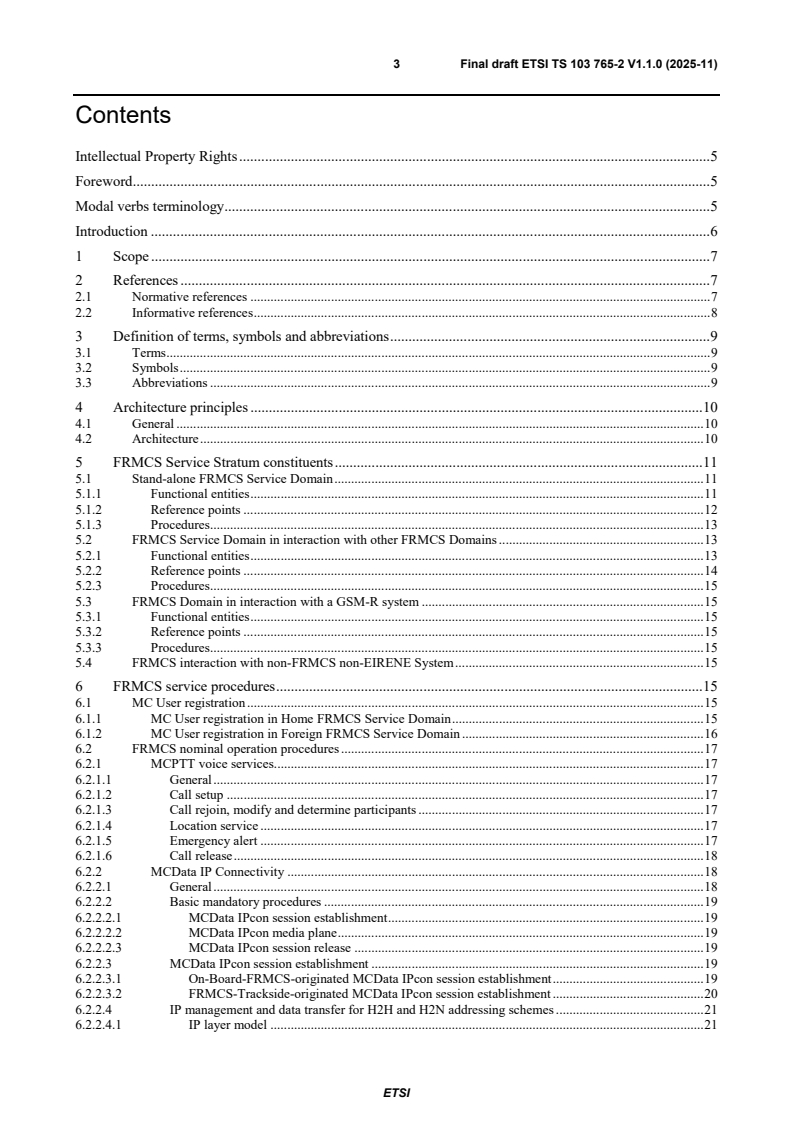
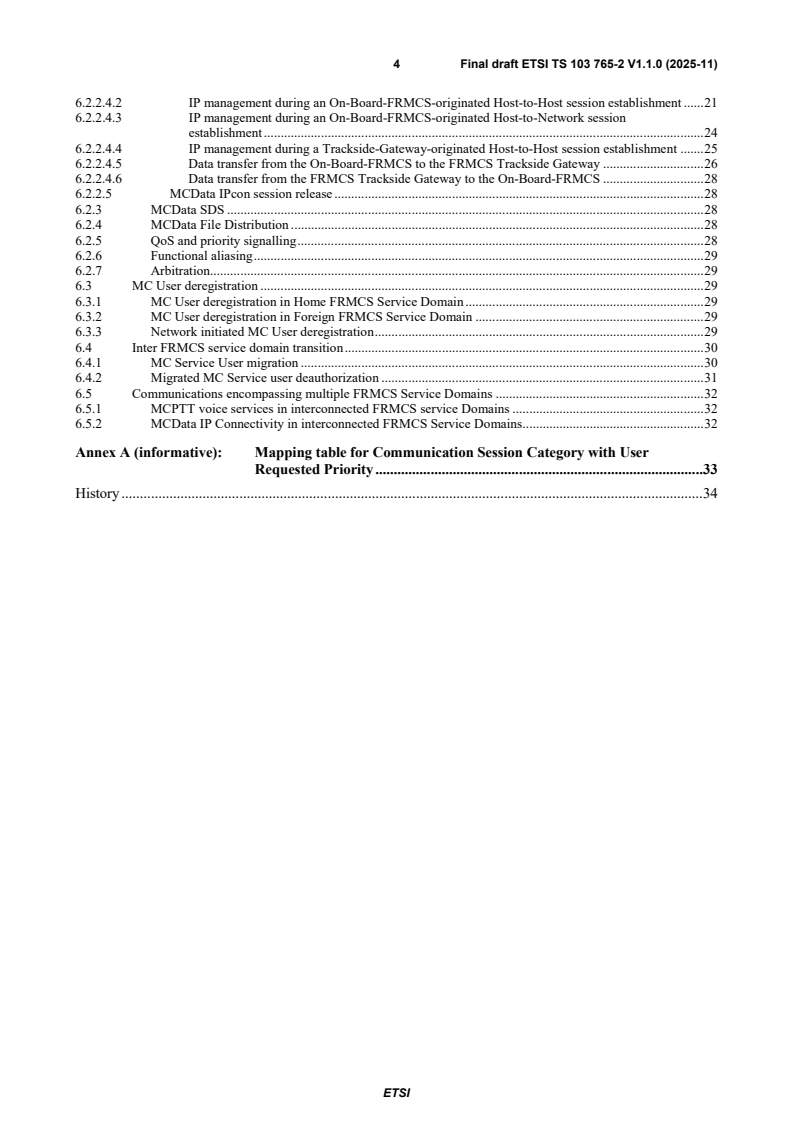
ETSI TS 103 765-2 V1.1.0 (2025-11) - Rail Telecommunications (RT); Future Railway Mobile Communication System (FRMCS); Building Blocks and Functions; Part 2: Service Stratum
ETSI TS 103 765-2 V1.1.1 (2026-01) - Rail Telecommunications (RT); Future Railway Mobile Communication System (FRMCS); Building Blocks and Functions; Part 2: Service Stratum

SIST-TS ETSI/TS 103 765-2 V1.1.1:2026 is an ETSI Technical Specification for Rail Telecommunications. It defines the FRMCS Service Stratum for the Future Railway Mobile Communication System (FRMCS), including the building blocks, reference points, and procedures used to provide mission-critical communication services and complementary services for railway users and systems.
What does SIST-TS ETSI/TS 103 765-2 V1.1.1:2026 specify?
SIST-TS ETSI/TS 103 765-2 V1.1.1:2026 specifies the Service Stratum of FRMCS. In practice, that means it focuses on how FRMCS communication services are assembled, connected, secured, and used across railway service domains.
The document is organized into architecture principles, service stratum constituents, and service procedures. Clause 4 describes the service-stratum architecture, clause 5 defines the key building blocks and reference points, and clause 6 details the procedures for registration, nominal operation, deregistration, and migration. Annex A is informative and gives an example mapping for QoS and priority signalling.
The scope centers on 3GPP Mission Critical Services (MCX) and the 3GPP multimedia system. It also covers interworking with GSM-R, connection to external systems, user identification and authorization, communication security, and complementary services such as alternative user addressing schemes.
| Annex | What it covers |
|---|---|
| Annex A | Example mapping table for Communication Session Category, Sub-category, and the <user-requested-priority> field |
What are the key requirements of SIST-TS ETSI/TS 103 765-2 V1.1.1:2026?
SIST-TS ETSI/TS 103 765-2 V1.1.1:2026 defines how the FRMCS Service Stratum is built and how the main mission-critical services behave. The most important requirements are the architecture model, the service-domain functions, the inter-domain reference points, and the procedures for registration, operation, and migration.
Service stratum architecture
Clause 4 says the FRMCS service stratum uses a service client-server approach in on-network operation mode. It supports different service domains and uses transport-stratum unicast paths through TAPs. In practice, this means implementers need to place the service logic above the transport layer and keep service signaling and user data aligned with the transport model.
Clause 4 also covers interconnection with other FRMCS service domains, interworking with GSM-R, and interconnection with external systems such as MFCN. This matters because railway systems often need to communicate beyond one domain or one technology.
Functional entities in the stand-alone service domain
Clause 5.1 requires the stand-alone FRMCS Service Domain to support common service-core functions such as configuration management, identity management, key management, location management, and functional alias management. It also requires MCPTT and MCData server entities for the supported services. In practice, the service domain must be able to authenticate users, manage profiles, handle locations, and support the mission-critical voice and data services that rail operators depend on.
Reference points and interconnection
Clause 5.1.2 defines the reference points for IMS/SIP and HTTP signalling, the common service core, MCPTT, and MCData. These tables show how clients, cores, servers, databases, and distribution functions relate to each other. For engineers, this is the practical interface map for integration and interoperability.
Clause 5.2 adds the inter-domain reference points used for application and control plane signalling between FRMCS service domains. It also mentions topology hiding, out-of-band sharing of certificates, and interconnection security. This matters when separate railway organizations need to exchange services while keeping their internal topology protected.
Registration, authentication, and authorization
Clause 6.1 describes MC User registration in a Home FRMCS Service Domain and in a Foreign FRMCS Service Domain. The procedure includes bootstrapping configuration, user authentication, profile and group configuration, SIP registration, and service authorization. The document also states that the security mechanisms include SIP Digest for certain accesses and that IMS AKA is limited to FRMCS Handhelds. In practice, this is the sequence that brings a user onto the service and controls what services that user can use.
MCPTT operation
Clause 6.2.1 covers MCPTT ad hoc group voice services, including call setup, rejoin, modification of participant lists, participant determination, location reporting, emergency alert, and call release. The document ties these procedures to the MCPTT specifications it cites and limits the service coverage to ad hoc group call and emergency alert realized through ad hoc group call. For operators, this means the standard focuses on group voice behavior and emergency handling rather than general-purpose voice calling.
MCData IP connectivity
Clause 6.2.2 defines MCData IPcon as transparent IP connectivity using GRE over UDP tunnelling. It supports two models: Host-to-Host (H2H) and Host-to-Network (H2N). The clause also defines session establishment, media plane behavior, session release, IP address management, NAT handling, and the use of virtual IP pools on the on-board and trackside sides. In practice, this is the core of how railway IP traffic is carried through FRMCS while preserving the expected application addresses.
QoS, priority, and functional aliasing
Clause 6.2.5 states that the user-requested priority from the MC session request is used to indicate QoS and priority, and that the Resource-Priority header field remains set to Normal. The <user-requested-priority> value is a six-digit non-negative integer built from a Communication Session Category and a Sub-category. This is important because rail traffic often needs deterministic handling for signaling, emergency voice, and control applications.
Clause 6.2.6 covers functional aliasing for MCData and MCPTT servers. Clause 6.4 covers migration between FRMCS service domains and the related deauthorization steps. Together, these clauses define how services follow the user when they move between home and foreign domains.
What terms does SIST-TS ETSI/TS 103 765-2 V1.1.1:2026 define?
SIST-TS ETSI/TS 103 765-2 V1.1.1:2026 defines and uses several key terms and abbreviations that are central to FRMCS service behavior.
- FRMCS SIP Core - the SIP core entity set used for FRMCS service signaling, either aligned with IMS core behavior or with the reference points defined for mission-critical support.
- MCX - Mission Critical Services, the 3GPP service family that underpins FRMCS mission-critical communication.
- MCPTT - Mission-Critical Push-To-Talk, the voice service used for ad hoc group calls and emergency alert handling.
- MCData - Mission Critical Data, the data service family that includes SDS and IP connectivity.
- H2H - Host-to-Host, a transparent IP connection between two host entities with defined IP addresses.
- H2N - Host-to-Network, a transparent IP connection between one host and an IP network with multiple connected hosts.
- QoS - Quality of Service, used here with priority signalling to classify and steer railway communication sessions.
Who uses SIST-TS ETSI/TS 103 765-2 V1.1.1:2026?
SIST-TS ETSI/TS 103 765-2 V1.1.1:2026 is used by railway communications engineers, system architects, and equipment suppliers working on FRMCS. It is relevant to on-board and trackside implementations, service-domain integration, and interoperability with other railway or public mobile systems.
It also matters to operators and technical managers who need to define how MCPTT and MCData services are registered, authorized, prioritized, and migrated across service domains. Buyers and quality managers use it to check whether a solution supports the expected FRMCS service-domain functions, reference points, and procedures.
Which standards are used with SIST-TS ETSI/TS 103 765-2 V1.1.1:2026?
- ETSI TR 103 791 - provides the FRMCS terminology used by the document.
- ETSI TS 103 764 - gives the FRMCS system architecture context and the IP address ranges used in the service-layer model.
- ETSI TS 103 765-1 - supplies the Transport Stratum and the TAPs used by the service stratum.
- ETSI TS 103 765-3 and ETSI TS 103 765-4 - define the on-board and trackside functions and interfaces that carry the client-side procedures.
- ETSI TS 103 792 - supports the GSM-R interworking reference points.
- ETSI TS 123 280, ETSI TS 123 379, ETSI TS 123 282, ETSI TS 124 379, ETSI TS 124 282, ETSI TS 124 582 - define the MCX architecture and the MCPTT and MCData service behavior used throughout the document.
- ETSI TS 133 180, ETSI TS 124 482, ETSI TS 124 484, ETSI TS 124 229, ETSI TS 133 203, ETSI TS 123 203, ETSI TS 123 503 - provide the security, authentication, SIP, and policy-control procedures referenced by the service-stratum workflows.
- UIC FIS-7970 - supplies the ad hoc group call criteria used for MCPTT operation.
What does the SIST-TS ETSI/TS 103 765-2 V1.1.1:2026 document contain?
The document contains a system architecture figure, several reference-point tables, and detailed procedure sequences. Figure 4.2-1 shows the service-domain architecture and its interfaces to transport, GSM-R, and external systems.
Tables 5.1.2-1 to 5.1.2-4 organize the reference points for IMS/SIP, HTTP, common service core, MCPTT, and MCData. Clause 6 then lays out the operational procedures for user registration, MCPTT voice services, MCData IP connectivity, QoS and priority signalling, functional aliasing, deregistration, and domain transition.
Annex A contains an informative mapping table that illustrates how Communication Session Category and Sub-category relate to the <user-requested-priority> field. This is useful when designing or checking priority handling, without repeating the mapping values here.
Buy Documents
ETSI TS 103 765-2 V1.0.0 (2025-07) - Rail Telecommunications (RT); Future Railway Mobile Communication System (FRMCS); Building Blocks and Functions; Part 2: Service Stratum
ETSI TS 103 765-2 V1.1.0 (2025-11) - Rail Telecommunications (RT); Future Railway Mobile Communication System (FRMCS); Building Blocks and Functions; Part 2: Service Stratum
ETSI TS 103 765-2 V1.1.1 (2026-01) - Rail Telecommunications (RT); Future Railway Mobile Communication System (FRMCS); Building Blocks and Functions; Part 2: Service Stratum
Get Certified
Connect with accredited certification bodies for this standard

IRIS Certification (UNIFE)
International Railway Industry Standard certification.

TÜV SÜD Rail GmbH
TÜV SÜD railway certification services.

ANCE
Mexican certification and testing association.
Sponsored listings
Frequently Asked Questions
SIST-TS ETSI/TS 103 765-2 V1.1.1:2026 is a standard published by the Slovenian Institute for Standardization (SIST). Its full title is "Rail Telecommunications (RT) - Future Railway Mobile Communication System (FRMCS) - Building Blocks and Functions - Part 2: Service Stratum". This standard covers: The present document defines the Service Stratum for the Future Railway Mobile Communications System (FRMCS). In general, the FRMCS Service Stratum provides communication service and corresponding complementary service resulting from 3GPP Mission Critical Services (MCX) and 3GPP multimedia system. While FRMCS is defined in various FRMCS ETSI Technical Specifications, the present document determines necessary components of the FRMCS Service Stratum, encompassing: • Building blocks and corresponding reference points of 3GPP MCX/IMS. • Reference points between MC systems/IMS for interconnection and unilateral use by MC organizations (MC migration). • Reference points between the MC system/IMS and external systems. • QoS and priority management. • User identification, authentication and authorization for the use of the FRMCS service stratum. • Communication security aspects. • Complementary and auxiliary service, e.g. alternative user addressing schemes.
The present document defines the Service Stratum for the Future Railway Mobile Communications System (FRMCS). In general, the FRMCS Service Stratum provides communication service and corresponding complementary service resulting from 3GPP Mission Critical Services (MCX) and 3GPP multimedia system. While FRMCS is defined in various FRMCS ETSI Technical Specifications, the present document determines necessary components of the FRMCS Service Stratum, encompassing: • Building blocks and corresponding reference points of 3GPP MCX/IMS. • Reference points between MC systems/IMS for interconnection and unilateral use by MC organizations (MC migration). • Reference points between the MC system/IMS and external systems. • QoS and priority management. • User identification, authentication and authorization for the use of the FRMCS service stratum. • Communication security aspects. • Complementary and auxiliary service, e.g. alternative user addressing schemes.
SIST-TS ETSI/TS 103 765-2 V1.1.1:2026 is classified under the following ICS (International Classification for Standards) categories: 33.060.01 - Radiocommunications in general; 45.020 - Railway engineering in general. The ICS classification helps identify the subject area and facilitates finding related standards.
SIST-TS ETSI/TS 103 765-2 V1.1.1:2026 is available in PDF format for immediate download after purchase. The document can be added to your cart and obtained through the secure checkout process. Digital delivery ensures instant access to the complete standard document.
Standards Content (Sample)
Draft ETSI TS 103 765-2 V1.0.0 (2025-07)
TECHNICAL SPECIFICATION
Rail Telecommunications (RT);
Future Railway Mobile Communication System (FRMCS);
Building Blocks and Functions;
Part 2: Service Stratum
2 Draft ETSI TS 103 765-2 V1.0.0 (2025-07)
Reference
DTS/RT-0084
Keywords
architecture, FRMCS, railways
ETSI
650 Route des Lucioles
F-06921 Sophia Antipolis Cedex - FRANCE
Tel.: +33 4 92 94 42 00 Fax: +33 4 93 65 47 16
Siret N° 348 623 562 00017 - APE 7112B
Association à but non lucratif enregistrée à la
Sous-Préfecture de Grasse (06) N° w061004871
Important notice
The present document can be downloaded from the
ETSI Search & Browse Standards application.
The present document may be made available in electronic versions and/or in print. The content of any electronic and/or
print versions of the present document shall not be modified without the prior written authorization of ETSI. In case of any
existing or perceived difference in contents between such versions and/or in print, the prevailing version of an ETSI
deliverable is the one made publicly available in PDF format on ETSI deliver repository.
Users should be aware that the present document may be revised or have its status changed,
this information is available in the Milestones listing.
If you find errors in the present document, please send your comments to
the relevant service listed under Committee Support Staff.
If you find a security vulnerability in the present document, please report it through our
Coordinated Vulnerability Disclosure (CVD) program.
Notice of disclaimer & limitation of liability
The information provided in the present deliverable is directed solely to professionals who have the appropriate degree of
experience to understand and interpret its content in accordance with generally accepted engineering or
other professional standard and applicable regulations.
No recommendation as to products and services or vendors is made or should be implied.
No representation or warranty is made that this deliverable is technically accurate or sufficient or conforms to any law
and/or governmental rule and/or regulation and further, no representation or warranty is made of merchantability or fitness
for any particular purpose or against infringement of intellectual property rights.
In no event shall ETSI be held liable for loss of profits or any other incidental or consequential damages.
Any software contained in this deliverable is provided "AS IS" with no warranties, express or implied, including but not
limited to, the warranties of merchantability, fitness for a particular purpose and non-infringement of intellectual property
rights and ETSI shall not be held liable in any event for any damages whatsoever (including, without limitation, damages
for loss of profits, business interruption, loss of information, or any other pecuniary loss) arising out of or related to the use
of or inability to use the software.
Copyright Notification
No part may be reproduced or utilized in any form or by any means, electronic or mechanical, including photocopying and
microfilm except as authorized by written permission of ETSI.
The content of the PDF version shall not be modified without the written authorization of ETSI.
The copyright and the foregoing restriction extend to reproduction in all media.
© ETSI 2025.
All rights reserved.
ETSI
3 Draft ETSI TS 103 765-2 V1.0.0 (2025-07)
Contents
Intellectual Property Rights . 5
Foreword . 5
Modal verbs terminology . 5
Introduction . 6
1 Scope . 7
2 References . 7
2.1 Normative references . 7
2.2 Informative references . 8
3 Definition of terms, symbols and abbreviations . 9
3.1 Terms . 9
3.2 Symbols . 9
3.3 Abbreviations . 9
4 Architecture principles . 10
4.1 General . 10
4.2 Architecture . 10
5 FRMCS Service Stratum constituents . 11
5.1 Stand-alone FRMCS Service Domain . 11
5.1.1 Functional entities . 11
5.1.2 Reference points . 12
5.1.3 Procedures. 13
5.2 FRMCS Service Domain in interaction with other FRMCS Domains . 13
5.2.1 Functional entities . 13
5.2.2 Reference points . 14
5.2.3 Procedures. 15
5.3 FRMCS Domain in interaction with a GSM-R system . 15
5.3.1 Functional entities . 15
5.3.2 Reference points . 15
5.3.3 Procedures. 15
5.4 FRMCS interaction with non-FRMCS non-EIRENE System . 15
6 FRMCS service procedures . 15
6.1 MC User registration . 15
6.1.1 MC User registration in Home FRMCS Service Domain . 15
6.1.2 MC User registration in Foreign FRMCS Service Domain . 16
6.2 FRMCS nominal operation procedures . 17
6.2.1 MCPTT voice services . 17
6.2.1.1 General . 17
6.2.1.2 Call setup . 17
6.2.1.3 Call rejoin, modify and determine participants . 17
6.2.1.4 Location service . 17
6.2.1.5 Emergency alert . 17
6.2.1.6 Call release . 18
6.2.2 MCData IP Connectivity . 18
6.2.2.1 General . 18
6.2.2.2 Basic mandatory procedures . 19
6.2.2.2.1 MCData IPcon session establishment . 19
6.2.2.2.2 MCData IPcon media plane . 19
6.2.2.2.3 MCData IPcon session release . 19
6.2.2.3 MCData IPcon session establishment . 19
6.2.2.3.1 On-Board-FRMCS-originated MCData IPcon session establishment . 19
6.2.2.3.2 FRMCS-Trackside-originated MCData IPcon session establishment . 20
6.2.2.4 IP management and data transfer for H2H and H2N addressing schemes . 21
6.2.2.4.1 IP layer model . 21
ETSI
4 Draft ETSI TS 103 765-2 V1.0.0 (2025-07)
6.2.2.4.2 IP management during an On-Board-FRMCS-originated Host-to-Host session establishment . 21
6.2.2.4.3 IP management during an On-Board-FRMCS-originated Host-to-Network session
establishment . 24
6.2.2.4.4 IP management during a Trackside-Gateway-originated Host-to-Host session establishment . 25
6.2.2.4.5 Data transfer from the On-Board-FRMCS to the FRMCS Trackside Gateway . 26
6.2.2.4.6 Data transfer from the FRMCS Trackside Gateway to the On-Board-FRMCS . 28
6.2.2.5 MCData IPcon session release . 28
6.2.3 MCData SDS . 28
6.2.4 MCData File Distribution . 28
6.2.5 QoS and priority signalling . 28
6.2.6 Functional aliasing . 29
6.2.7 Arbitration. 29
6.3 MC User deregistration . 29
6.3.1 MC User deregistration in Home FRMCS Service Domain . 29
6.3.2 MC User deregistration in Foreign FRMCS Service Domain . 29
6.3.3 Network initiated MC User deregistration . 29
6.4 Inter FRMCS service domain transition . 30
6.4.1 MC Service User migration . 30
6.4.2 Migrated MC Service user deauthorization . 31
6.5 Communications encompassing multiple FRMCS Service Domains . 32
6.5.1 MCPTT voice services in interconnected FRMCS service Domains . 32
6.5.2 MCData IP Connectivity in interconnected FRMCS Service Domains . 32
Annex A (informative): Mapping table for Communication Session Category with User
Requested Priority . 33
History . 34
ETSI
5 Draft ETSI TS 103 765-2 V1.0.0 (2025-07)
Intellectual Property Rights
Essential patents
IPRs essential or potentially essential to normative deliverables may have been declared to ETSI. The declarations
pertaining to these essential IPRs, if any, are publicly available for ETSI members and non-members, and can be
found in ETSI SR 000 314: "Intellectual Property Rights (IPRs); Essential, or potentially Essential, IPRs notified to
ETSI in respect of ETSI standards", which is available from the ETSI Secretariat. Latest updates are available on the
ETSI IPR online database.
Pursuant to the ETSI Directives including the ETSI IPR Policy, no investigation regarding the essentiality of IPRs,
including IPR searches, has been carried out by ETSI. No guarantee can be given as to the existence of other IPRs not
referenced in ETSI SR 000 314 (or the updates on the ETSI Web server) which are, or may be, or may become,
essential to the present document.
Trademarks
The present document may include trademarks and/or tradenames which are asserted and/or registered by their owners.
ETSI claims no ownership of these except for any which are indicated as being the property of ETSI, and conveys no
right to use or reproduce any trademark and/or tradename. Mention of those trademarks in the present document does
not constitute an endorsement by ETSI of products, services or organizations associated with those trademarks.
DECT™, PLUGTESTS™, UMTS™ and the ETSI logo are trademarks of ETSI registered for the benefit of its
Members. 3GPP™, LTE™ and 5G™ logo are trademarks of ETSI registered for the benefit of its Members and of the
3GPP Organizational Partners. oneM2M™ logo is a trademark of ETSI registered for the benefit of its Members and of ®
the oneM2M Partners. GSM and the GSM logo are trademarks registered and owned by the GSM Association.
DECT™, PLUGTESTS™, UMTS™ and the ETSI logo are trademarks of ETSI registered for the benefit of its
Members. 3GPP™ and LTE™ are trademarks of ETSI registered for the benefit of its Members and of the 3GPP
Organizational Partners. oneM2M™ logo is a trademark of ETSI registered for the benefit of its Members and of the ®
oneM2M Partners. GSM and the GSM logo are trademarks registered and owned by the GSM Association.
Foreword
This Technical Specification (TS) has been produced by ETSI Technical Committee Railway Telecommunications (RT)
and is now submitted for the combined Public Enquiry and Vote phase of the ETSI Standardisation Request deliverable
Approval Procedure (SRdAP).
The present document is part 2 of a multi-part deliverable covering Building Blocks and Functions for the Future
Railway Mobile Communication System (FRMCS), as identified below:
Part 1: "Transport Stratum";
Part 2: "Service Stratum";
Part 3: "Train On-Board functions and interfaces";
Part 4: "Trackside functions and interfaces";
Part 5: "User Equipment (UE) capabilities".
Modal verbs terminology
In the present document "shall", "shall not", "should", "should not", "may", "need not", "will", "will not", "can" and
"cannot" are to be interpreted as described in clause 3.2 of the ETSI Drafting Rules (Verbal forms for the expression of
provisions).
"must" and "must not" are NOT allowed in ETSI deliverables except when used in direct citation.
ETSI
6 Draft ETSI TS 103 765-2 V1.0.0 (2025-07)
Introduction
As the needs of the railway sector continue to evolve, ongoing digitalisation presents the appropriate response. In 2012,
UIC initiated efforts to develop the Future Railway Mobile Communication System (FRMCS) - a modern replacement
for GSM-R, which is expected to become obsolete in the early 2030s. This UIC project resulted in the creation of the
FRMCS Functional Requirements Specification (FRS) and the FRMCS System Requirements Specification (SRS), both
of which focus primarily on the communication needs of railways and serve as the foundation for developing the
GSM-R successor.
The present document defines the building blocks and functions of the FRMCS Service Stratum, detailing how these
components interact i.e. interfaces and procedures, and provide FRMCS services to users and groups of users using
them for communicating amongst each other.
ETSI
7 Draft ETSI TS 103 765-2 V1.0.0 (2025-07)
1 Scope
The present document defines the Service Stratum for the Future Railway Mobile Communications System (FRMCS).
In general, the FRMCS Service Stratum provides communication service and corresponding complementary service
resulting from 3GPP Mission Critical Services (MCX) and 3GPP multimedia system.
While FRMCS is defined in various FRMCS ETSI Technical Specifications, the present document determines
necessary components of the FRMCS Service Stratum, encompassing:
• Building blocks and corresponding reference points of 3GPP MCX/IMS.
• Reference points between MC systems/IMS for interconnection and unilateral use by MC organizations
(MC migration).
• Reference points between the MC system/IMS and external systems.
• QoS and priority management.
• User identification, authentication and authorization for the use of the FRMCS service stratum.
• Communication security aspects.
• Complementary and auxiliary service, e.g. alternative user addressing schemes.
2 References
2.1 Normative references
References are either specific (identified by date of publication and/or edition number or version number) or
non-specific. For specific references, only the cited version applies. For non-specific references, the latest version of the
referenced document (including any amendments) applies.
Referenced documents which are not found to be publicly available in the expected location might be found in the
ETSI docbox.
NOTE: While any hyperlinks included in this clause were valid at the time of publication, ETSI cannot guarantee
their long-term validity.
The following referenced documents are necessary for the application of the present document.
[1] ETSI TS 123 228 (V18.9.0): "Digital cellular telecommunications system (Phase 2+) (GSM);
Universal Mobile Telecommunications System (UMTS); LTE; 5G; IP Multimedia Subsystem
(IMS); Stage 2 (3GPP TS 23.228 version 18.9.0 Release 18)".
[2] ETSI TS 123 280 (V18.12.0): "LTE; Common functional architecture to support mission critical
services; Stage 2 (3GPP TS 23.280 version 18.12.0 Release 18)".
[3] ETSI TS 124 482 (V18.0.1): "LTE; Mission Critical Services (MCS) identity management;
Protocol specification (3GPP TS 24.482 version 18.0.1 Release 18)".
[4] ETSI TS 124 484 (V18.7.0): "LTE; Mission Critical Services (MCS) configuration management;
Protocol specification (3GPP TS 24.484 version 18.7.0 Release 18)".
[5] ETSI TS 133 180 (V18.1.0): "LTE; Security of the Mission Critical (MC) service (3GPP
TS 33.180 version 18.1.0 Release 18)".
[6] ETSI TS 123 379 (V18.12.0): "LTE; Functional architecture and information flows to support
Mission Critical Push To Talk (MCPTT); Stage 2 (3GPP TS 23.379 version 18.12.0 Release 18)".
[7] ETSI TS 124 379 (V18.10.0): "LTE; Mission Critical Push To Talk (MCPTT) call control;
Protocol specification (3GPP TS 24.379 version 18.10.0 Release 18)".
ETSI
8 Draft ETSI TS 103 765-2 V1.0.0 (2025-07)
[8] ETSI TS 123 282 (V18.10.0): "LTE; Functional architecture and information flows to support
Mission Critical Data (MCData); Stage 2 (3GPP TS 23.282 version 18.10.0 Release 18)".
[9] ETSI TS 124 282 (V18.10.0): "LTE; Mission Critical Data (MCData) signalling control; Protocol
specification (3GPP TS 24.282 version 18.10.0 Release 18)".
[10] ETSI TS 124 582 (V18.2.0): "LTE; Mission Critical Data (MCData) media plane control; Protocol
specification (3GPP TS 24.582 version 18.2.0 Release 18)".
[11] ETSI TS 123 281 (V18.9.0): "LTE; Functional architecture and information flows to support
Mission Critical Video (MCVideo); Stage 2 (3GPP TS 23.281 version 18.9.0 Release 18).
[12] ETSI TS 123 002 (V18.0.0): "Digital cellular telecommunications system (Phase 2+) (GSM);
Universal Mobile Telecommunications System (UMTS); LTE; Network architecture (3GPP
TS 23.002 version 18.0.0 Release 18)".
[13] ETSI TS 124 229 (V18.7.0): "Digital cellular telecommunications system (Phase 2+) (GSM);
Universal Mobile Telecommunications System (UMTS); LTE; 5G; IP multimedia call control
protocol based on Session Initiation Protocol (SIP) and Session Description Protocol (SDP);
Stage 3 (3GPP TS 24.229 version 18.7.0 Release 18)".
[14] ETSI TS 133 203 (V18.1.0): "Digital cellular telecommunications system (Phase 2+) (GSM);
Universal Mobile Telecommunications System (UMTS); LTE; 3G security; Access security for
IP-based services (3GPP TS 33.203 version 18.1.0 Release 18)".
[15] ETSI TS 103 765-1: "Rail Telecommunications (RT); Future Railway Mobile Communication
System (FRMCS); Building Blocks and Functions; Part 1: Transport Stratum".
[16] ETSI TS 103 792: "Rail Telecommunications (RT); Future Railway Mobile Communication
System (FRMCS); Interworking with GSM-R".
[17] UIC FIS-7970: "Future Railway Mobile Communication System; Functional Interface
Specification", Version 2.0.0.
[18] ETSI TS 123 283 (V18.2.0): "LTE; Mission Critical Communication Interworking with Land
Mobile Radio Systems (3GPP TS 23.283 version 18.2.0 Release 18)".
[19] ETSI TS 123 203 (V18.0.0): "Digital cellular telecommunications system (Phase 2+) (GSM);
Universal Mobile Telecommunications System (UMTS); LTE; Policy and charging control
architecture (3GPP TS 23.203 version 18.0.0 Release 18)".
[20] ETSI TS 123 503 (V18.9.0): "5G; Policy and charging control framework for the 5G System
(5GS); Stage 2 (3GPP TS 23.503 version 18.9.0 Release 18)".
2.2 Informative references
References are either specific (identified by date of publication and/or edition number or version number) or
non-specific. For specific references, only the cited version applies. For non-specific references, the latest version of the
referenced document (including any amendments) applies.
NOTE: While any hyperlinks included in this clause were valid at the time of publication, ETSI cannot guarantee
their long-term validity.
The following referenced documents may be useful in implementing an ETSI deliverable or add to the reader's
understanding, but are not required for conformance to the present document.
[i.1] ETSI TR 103 791: "Rail Telecommunications (RT); Future Railway Mobile Communication
System (FRMCS); Terminology for FRMCS specifications".
[i.2] ETSI TS 103 764: "Rail Telecommunications (RT); Future Railway Mobile Communication
System (FRMCS); System Architecture".
ETSI
9 Draft ETSI TS 103 765-2 V1.0.0 (2025-07)
[i.3] ETSI TS 103 765-3: "Rail Telecommunications (RT); Future Railway Mobile Communication
System (FRMCS); Building Blocks and Functions; Part 3: Train On-Board functions and
interfaces".
[i.4] ETSI TS 103 765-4: "Rail Telecommunications (RT); Future Railway Mobile Communication
System (FRMCS); Building Blocks and Functions; Part 4: Trackside functions and interfaces".
3 Definition of terms, symbols and abbreviations
3.1 Terms
For the purposes of the present document, the terms given in ETSI TR 103 791 [i.1] and the following apply:
FRMCS SIP Core: Set of entities either:
• compliant with ETSI TS 123 228 [1] (3GPP IP multimedia core network subsystem);
• or supporting the reference points identified in ETSI TS 123 280 [2], clause 7.5.3 compliant with the reference
points defined in ETSI TS 123 002 [12].
3.2 Symbols
Void.
3.3 Abbreviations
For the purposes of the present document, the following abbreviations apply:
3GPP 3G Partnership Project
5GC 5G Core
AKA Authentication and Key Agreement
API Application Programming Interface
AS Application Server
ATO Automatic Train Operation
ATP Automatic Train Protection
ATP Automatic Train Protection (new)
CSC Common Service Core
CSCF Call Session Control Function
DNS Domain Name Service
FQDN Fully Qualified Domain Name
FRMCS Future Railway Mobile Communication System
FROP FRMCS On-Board Profile
FRS Functional Requirement Specification (UIC)
FS FRMCS InterWorking Function
IWF
FS FRMCS Network-to-Network Interface
NNI
FS FRMCS Other Network Interface
ONI
GRE Generic Routing Encapsulation
GSM-R Global System for Mobile communications - Railways
H2H Host-to-Host
H2N Host-to-Network
HSS Home Subscriber Server
HTTP Hyper Text Transfer Protocol
IBCF Interconnect Border Control Function
IdM Identity Management
IMS IP Multimedia Subsystem
IP Internet Protocol
IPcon IP connectivity
IWF InterWorking Function
ETSI
10 Draft ETSI TS 103 765-2 V1.0.0 (2025-07)
LC Loose-Coupled (Application)
MC Mission-Critical
MCPTT Mission-Critical Push-To-Talk
MCX Mission Critical Service
MFCN Mobile Fixed Communication Network
NAT Network Address Translation
NDS Network Domain Security
NEF Network Exposure Function
NNI Network-to-Network Interface
OB On-Board FRMCS
ONI Other Network Interface
NOTE: ONI only gets used as part of FSoni, which is in the list already.
PCF Policy Control Function
PLMN Public Land Mobile Network
QoS Quality of Service
SAP Service Access Point
SCTP Stream Control Transmission Protocol
SDS (MCData) Short Data Service
SIP Session Initiation Protocol
SRS System Requirement Specification (UIC)
TAP Transport Access Point
TCMS Train Control and Management System
TLS Transport Layer Security
TrGW Transition GateWay
TS TrackSide
UDP User Datagram Protocol
UE User Equipment
URI Uniform Resource Identifier
4 Architecture principles
4.1 General
Clause 4 describes system architecture of the Service Stratum to support communication services and complementary
services for FRMCS. The system architecture is applicable for FRMCS using 3GPP Mission Critical Services (MCX)
and the related MCX architecture defined in ETSI TS 123 280 [2], ETSI TS 123 379 [6], ETSI TS 123 281 [11] and
ETSI TS 123 282 [8] from 3GPP Release 18 onwards.
4.2 Architecture
The system architecture of the FRMCS service stratum is illustrated in Figure 4.2-1.
The FRMCS service stratum may consist of different domains, independent of the geographical allocation, and follows
the Service Client - Server approach (Figure 4.2-1) applicable in on-network operation mode.
The necessary interconnection between the different FRMCS service domains enables the service stratum users to
reference point.
communicate between them using SAP interconnection via FSNNI
For communication with legacy railway communication systems, i.e. GSM-R, the FRMCS Service Stratum enables the
necessary interworking using SAP Legacy Systems via FS reference point (Figure 4.2-1) for this purpose.
IWF
For the communication with external systems, e.g. MFCN, the FRMCS Service Stratum enables the necessary
interconnection/interworking using the SAP External Systems via FS reference point (Figure 4.2-1).
ONI
For the transmission of the communications between Service Client and Service Server encompassing signalling and
user data, the FRMCS service stratum (Figure 4.2-1) uses unicast transmission paths of the FRMCS transport stratum
using the TAPs in accordance with ETSI TS 103 765-1 [15].
ETSI
11 Draft ETSI TS 103 765-2 V1.0.0 (2025-07)
The components of the various SAPs are described in more detail in the following clauses.
Non -FRMCS &
Other FRMCS
Non -EIRENE
Service Domains
Service Domains
Scope of ETSI TS 103 765-2
Interconnection
Interworking
FS
NNI
FS
ONI
FRMCS
Service
Domain
Service Function(s)
FRMCS
Application
FRMCS Service Server(s)
Service
c
c
5GS
Client(s)
TAP TAP
Data Network
FRMCS Service Domain
Transport Stratum
Legacy Interworking
Application Interconnection
OB
APP FS
IWF
TS
APP
Legacy Service Domain
GSM-R
Figure 4.2-1: FRMCS Service Stratum - system architecture
5 FRMCS Service Stratum constituents
5.1 Stand-alone FRMCS Service Domain
5.1.1 Functional entities
The signalling control functions of the FRMCS Service Stratum shall comply with ETSI TS 123 280 [2].
The FRMCS Service Domain shall support the following functional server entities as described in ETSI TS 123 280 [2],
clause 7.4.2.2:
• Configuration management server.
• Identity management server.
• Key management server.
• Location management server.
• Functional alias management server.
The FRMCS Service Domain shall support the following functional server entities for the MCPTT service (limited to
MCPTT ad hoc group call and emergency alert realized through MCPTT ad hoc group call):
• MCPTT server as described in ETSI TS 123 379 [6], clause 7.4.2.3.2.
• Floor control server as described in ETSI TS 123 379 [6], clause 7.4.2.3.4.
• Media distribution function as described in ETSI TS 123 379 [6], clause 7.4.2.3.5.
• MCPTT user database as described in ETSI TS 123 379 [6], clause 7.4.2.3.7.
ETSI
12 Draft ETSI TS 103 765-2 V1.0.0 (2025-07)
The FRMCS Service Domain shall support the following functional server entities for the MCData service (limited to
MCData IPCon and MCData SDS):
• MCData server as described in ETSI TS 123 282 [8], clause 6.4.3.1.2.
• MCData user database as described in ETSI TS 123 282 [8], clause 6.4.3.1.3.
• MCData notification server as described in ETSI TS 123 282 [8], clause 6.4.3.5.
5.1.2 Reference points
The FRMCS Service Domain shall support the following reference points between Service Client and Service Server:
• reference points for IMS/SIP and HTTP signalling as listed in Table 5.1.2-1;
• reference points for Common service core as listed in Table 5.1.2-2;
• reference points for MCPTT as listed in Table 5.1.2-3; and
• reference points for MCData (SDS, IPcon) as listed in Table 5.1.2-4.
Table 5.1.2-1: Reference Points of a stand-alone FRMCS Service Domain
for IMS/SIP and HTTP Signalling
MCx Endpoints Underlying MCx ETSI Reference IMS FRMCS SIP Core
Reference signalling/control Reference points
Point plane
SIP-1 SIP Signalling user agent - Gm ETSI TS 123 002 [12] P-CSCF-UE (Gm I/F)
FRMCS SIP Core
SIP-2 FRMCS SIP Core - Application ISC and Ma ETSI TS 123 002 [12] (I-)CSCF - AS (ISC,
Server (AS) Ma I/F)
HTTP-1 HTTP client - HTTP proxy Ut ETSI TS 123 002 [12] UE-AS (Ut I/F)
HTTP-2 HTTP proxy - HTTP server HTTP ETSI TS 123 280 [2]
AAA-1 SIP database - FRMCS SIP core Cx ETSI TS 123 002 [12] HSS* - CSCF (Cx I/F)
AAA-2 FRMCS SIP core - Diameter Cx ETSI TS 123 002 [12]
proxy
Table 5.1.2-2: Reference Points of a stand-alone FRMCS
Service Domain for Common Service Core
MCx Endpoints Underlying MCx ETSI Reference
Reference signalling/control plane
Point
CSC-1 Identity management Client - Identity HTTPS (TLS) ETSI TS 133 180 [5]
management Server
CSC-4 Configuration management Client - HTTP-1 and HTTP-2 SIP-1 and ETSI TS 123 280 [2]
Configuration management Server SIP-2
CSC-5 Configuration management Server - MC HTTP-1 and HTTP-2, SIP-2 ETSI TS 123 280 [2]
service server
CSC-8 Key management Client - Key management HTTP-1 and HTTP-2 ETSI TS 123 280 [2]
Server
CSC-9 Key management Server - MC service server HTTP-1 and HTTP-2 ETSI TS 123 280 [2]
CSC-10 Key management Server - Group management HTTP-1, HTTP-2 (and may use ETSI TS 123 280 [2]
Server HTTP-3)
CSC-13 Configuration management Server - MC ETSI TS 123 280 [2]
service user database
CSC-14 Location management Client - Location SIP-1 and SIP-2, HTTP-1 and ETSI TS 123 280 [2]
management Server HTTP-2
CSC-15 Location management Server - MC service SIP-1 and SIP-2, HTTP-1 and ETSI TS 123 280 [2]
server HTTP-2
ETSI
13 Draft ETSI TS 103 765-2 V1.0.0 (2025-07)
Table 5.1.2-3: Reference Points of a stand-alone FRMCS Service Domain for MCPTT
MCx Reference Endpoints Underlying MCx signalling/control ETSI Reference
Point plane
MCPTT-1 MCPTT Server - MCPTT Client SIP-1, SIP-2, HTTP-1, HTTP-2 ETSI TS 123 379 [6]
(via SIP/IMS Core)
MCPTT-2 MCPTT Server - MCPTT User AAA-1 ETSI TS 123 379 [6]
database
MCPTT-4 Floor control server - Floor SGi ETSI TS 123 379 [6]
participant ETSI TS 123 002 [12]
MCPTT-5 MCPTT Server - 5GC N5/Rx (via PCF for trusted domain) ETSI TS 123 379 [6]
N33 (via NEF for un-trusted domain) ETSI TS 123 203 [19]
ETSI TS 123 503 [20]
MCPTT-7 Media distribution function - Media SGi ETSI TS 123 379 [6]
mixer ETSI TS 123 002 [12]
Table 5.1.2-4: Reference Points of a stand-alone FRMCS Service Domain for MCData (SDS and IPcon)
MCx Reference Endpoints Underlying MCx signalling/control ETSI Reference
Point plane
MCData-2 MCData server - MCData user SCTP based Diameter management ETSI TS 123 282 [8]
database application protocol ETSI TS 123 283 [18]
MCData-5 MCData server - 5GC N5/Rx (via PCF for trusted domain) ETSI TS 123 282 [8]
N33 (via NEF for un-trusted domain) ETSI TS 123 203 [19]
ETSI TS 123 503 [20]
MCData-10 Message notification client - ETSI TS 123 282 [8]
MCData notification server
MCData-SDS-1 MCData Server - MCData Client SIP-1 ETSI TS 123 282 [8]
SIP-2
MCData-SDS-2 SDS distribution function - SDS SGi ETSI TS 123 282 [8]
function (unicast) ETSI TS 123 002 [12]
MCData-IPcon-1 MCData Server - MCData Client SIP-1 ETSI TS 123 282 [8]
SIP-2
MCData-IPcon-2 U-IPcon distribution function - ETSI TS 123 282 [8]
U-IPcon function (unicast)
NOTE: Interface AAA-1 may not be exposed as described in ETSI TS 123 280 [2], clause 9.2.2.2, note 1.
5.1.3 Procedures
The FRMCS Service Domain shall support the functionalities required for the following procedures of clause 6:
• MC User registration in Home FRMCS Service Domain.
• MC User deregistration in Home FRMCS Service Domain.
• FRMCS nominal operation procedures.
5.2 FRMCS Service Domain in interaction with other FRMCS
Domains
5.2.1 Functional entities
To provide the necessary signalling and voice codec adaptation for interworking with external networks, the FRMCS
Service Domain shall support the following functions of the IP Multimedia Core Network Subsystem defined in ETSI
TS 123 228 [1]:
• IBCF and TrGW for interworking with public wireless systems, such as PLMN or other FRMCS service
domains as described in ETSI TS 124 229 [13].
ETSI
14 Draft ETSI TS 103 765-2 V1.0.0 (2025-07)
The FRMCS Service Domain shall support the following functional server entities for the MCPTT service:
• MC gateway server as described in ETSI TS 123 379 [6], clause 7.4.2.3.8.
The FRMCS Service Domain shall support the following functional server entities for the MCData service:
• MC gateway server as described in ETSI TS 123 282 [8], clause 6.4.3.1.5.
5.2.2 Reference points
This clause specifies the reference points between two FRMCS service domains.
FS provides the following functionalities to comply with SAP Interconnection:
NNI
• Support of inter-FRMCS service domain application and control plane signalling (SIP and HTTP signalling).
• Communication services between MC Service Users served by different FRMCS Service Domains.
• Topology hiding support.
• Inter-FRMCS service domain out of band sharing (certificate exchange between FRMCS service domains).
• Inter-FRMCS service domain interconnection security.
NOTE: Out of band sharing mechanism is not specified in the present document and subject to agreement
between FRMCS operators.
The FRMCS Service Domain shall support the following reference points which constitute FS at the Service Stratum
NNI
for the MC application plane and MC signalling control plane:
• MCX-1 as specified in ETSI TS 123 280 [2], clause 7.5.2.19.
• CSC-17 as specified in ETSI TS 123 280 [2], clause 7.5.2.17.
• CSC-20 as specified in ETSI TS 123 280 [2], clause 7.5.2.21.
• CSC-21 as specified in ETSI TS 123 280 [2], clause 7.5.2.22.
• CSC-22 as specified in ETSI TS 123 280 [2], clause 7.5.2.23.
• CSC-23 as specified in ETSI TS 123 280 [2], clause 7.5.2.24.
• CSC-24 as specified in ETSI TS 123 280 [2], clause 7.5.2.25.
• SIP-3 as specified in ETSI TS 123 280 [2], clause 7.5.3.4.
• HTTP-3 as specified in ETSI TS 123 280 [2], clause 7.5.3.7.
• AAA-2 as specified in ETSI TS 123 280 [2], clause 7.5.3.9.
The FRMCS Service Domain shall support the following reference points which constitute FS at the Service Stratum
NNI
for the MCPTT service:
• MCPTT-3 as specified in ETSI TS 123 379 [6], clause 7.5.2.4.
• MCPTT-10 as specified in ETSI TS 123 379 [6], clause 7.5.2.13.
The FRMCS Service Domain shall support the following reference points which constitute FS at the Service Stratum
NNI
for the MCData service:
• MCData-3 as specified in ETSI TS 123 282 [8], clause 6.4.4.1.3.
• MCData-9 as specified in ETSI TS 123 282 [8], clause 6.4.4.1.8.
• MCData-10 as specified in ETSI TS 123 282 [8], clause 6.4.4.1.9.
ETSI
15 Draft ETSI TS 103 765-2 V1.0.0 (2025-07)
5.2.3 Procedures
The FRMCS Service Domain shall support the functionalities required for the following procedures of clause 6:
• MC User registration in Foreign FRMCS Service Domain.
• MC User deregistration in Foreign FRMCS Service Domain.
• Inter FRMCS service domain transition.
• Communications encompassing multiple FRMCS Service Domains.
5.3 FRMCS Domain in interaction with a GSM-R system
5.3.1 Functional entities
No additional functional entities are required for a FRMCS Service Domain in interaction with a GSM-R system.
5.3.2 Reference points
The FRMCS Service Domain shall support the following reference points as specified ETSI TS 103 792 [16],
clause 5.2:
• IWF-1.
• IWF-2.
• IWF-3.
5.3.3 Procedures
No additional procedures are required for a FRMCS Service Domain in interaction with a GSM-R system.
5.4 FRMCS interaction with non-FRMCS non-EIRENE System
The present document does not specify normative requirements applicable to interaction of FRMCS with non-FRMCS
non-EIRENE System.
6 FRMCS service procedures
6.1 MC User registration
6.1.1 MC User registration in Home FRMCS Service Domain
This clause describes the MC User registration procedure in Home FRMCS Service Domain.
The values passed into this procedure by its caller entity (e.g. On-Board FRMCS in ETSI TS 103 765-3 [i.3] or FRMCS
Trackside Gateway in ETSI TS 103 765-4 [i.4]) shall be used by the IdM Client and individual MC Service clients
involved in the procedures referenced below. These values are MC User ID and its associated password, scope and
IMS/SIP credential.
ETSI
16 Draft ETSI TS 103 765-2 V1.0.0 (2025-07)
The MC User registration procedure in Home FRMCS Service Domain is constituted of the following steps:
Step 1 - Bootstrap of MC default/initial configurations
The MC procedures for the configuration of MCS UE initial configuration Management Object and the default MCS
user profile configuration Management Object(s) shall conform to ETSI TS 124 484 [4], clause 4.2.2 for the online
configuration case.
NOTE: The URIs of Configuration Management Server and the Identity Management Server are retrieved from
FROP.
Step 2 - MC User authentication and MC token acquiring
The IdM Client procedures for user authentication in primary MC system shall conform to ETSI TS 124 482 [3],
clause 6.2.1.
The IdM Server procedures for user authentication in primary MC system shall conform to ETSI TS 124 482 [3],
clause 6.3.1.
Step 3 - Configuration of MC service user profile and MC service group
The MC procedures for subscribing to the MCS UE configuration document, the MCS user profile configuration
document and the MCS service configuration document for each enabled MC Service shall conform to ETSI
TS 124 484 [4], clause 4.2.2 for the online configuration case.
Step 4 - SIP registration
The signalling user agent shall establish a secure connection to the SIP core for the purpose of SIP authentication and
registration and subsequently perform the SIP level registration as per ETSI TS 133 180 [5], clause 5.1.1, step B-1.
Step 5 - MC Service User authorization per MC Service in the scope
All MC clients scoped for the authenticated MC User ID in step 2 shall perform the MC service authorization sending
the access token to the MC server using SIP PUBLISH message as per ETSI TS 133 180 [5], clause 5.1.3.2.3.
SIP Digest shall be used as security mechanism with for MC clients of tight coupled and loose coupled applications.
SIP Digest shall be used for FRMCS SIP Core access authentication over non-3GPP access including NDS/IP as per
Annex N (SIP Digest without TLS) and Annex O (SIP Digest with TLS) of ETSI TS 133 203 [14]. IMS AKA as
specified in ETSI TS 133 203 [14] should be limited to FRMCS Handhelds.
6.1.2 MC User registration in Foreign FRMCS Service Domain
This clause describes the MC User registration in Foreign FRMCS Service Domain.
The values passed into this procedure by its caller entity (i.e. On-Board FRMCS in ETSI TS 103 765-3 [i.3]) shall be
used by the IdM Client and individual MC Service clients involved in the procedures referenced below. These values
are MC User ID and its associated password, scope and the IMS/SIP credentials in the Home FRMCS Service Domain
and in the Foreign FRMCS Se
...
Final draft ETSI TS 103 765-2 V1.1.0 (2025-11)
TECHNICAL SPECIFICATION
Rail Telecommunications (RT);
Future Railway Mobile Communication System (FRMCS);
Building Blocks and Functions;
Part 2: Service Stratum
2 Final draft ETSI TS 103 765-2 V1.1.0 (2025-11)
Reference
DTS/RT-0084
Keywords
architecture, FRMCS, railways
ETSI
650 Route des Lucioles
F-06921 Sophia Antipolis Cedex - FRANCE
Tel.: +33 4 92 94 42 00 Fax: +33 4 93 65 47 16
Siret N° 348 623 562 00017 - APE 7112B
Association à but non lucratif enregistrée à la
Sous-Préfecture de Grasse (06) N° w061004871
Important notice
The present document can be downloaded from the
ETSI Search & Browse Standards application.
The present document may be made available in electronic versions and/or in print. The content of any electronic and/or
print versions of the present document shall not be modified without the prior written authorization of ETSI. In case of any
existing or perceived difference in contents between such versions and/or in print, the prevailing version of an ETSI
deliverable is the one made publicly available in PDF format on ETSI deliver repository.
Users should be aware that the present document may be revised or have its status changed,
this information is available in the Milestones listing.
If you find errors in the present document, please send your comments to
the relevant service listed under Committee Support Staff.
If you find a security vulnerability in the present document, please report it through our
Coordinated Vulnerability Disclosure (CVD) program.
Notice of disclaimer & limitation of liability
The information provided in the present deliverable is directed solely to professionals who have the appropriate degree of
experience to understand and interpret its content in accordance with generally accepted engineering or
other professional standard and applicable regulations.
No recommendation as to products and services or vendors is made or should be implied.
No representation or warranty is made that this deliverable is technically accurate or sufficient or conforms to any law
and/or governmental rule and/or regulation and further, no representation or warranty is made of merchantability or fitness
for any particular purpose or against infringement of intellectual property rights.
In no event shall ETSI be held liable for loss of profits or any other incidental or consequential damages.
Any software contained in this deliverable is provided "AS IS" with no warranties, express or implied, including but not
limited to, the warranties of merchantability, fitness for a particular purpose and non-infringement of intellectual property
rights and ETSI shall not be held liable in any event for any damages whatsoever (including, without limitation, damages
for loss of profits, business interruption, loss of information, or any other pecuniary loss) arising out of or related to the use
of or inability to use the software.
Copyright Notification
No part may be reproduced or utilized in any form or by any means, electronic or mechanical, including photocopying and
microfilm except as authorized by written permission of ETSI.
The content of the PDF version shall not be modified without the written authorization of ETSI.
The copyright and the foregoing restriction extend to reproduction in all media.
© ETSI 2025.
All rights reserved.
ETSI
3 Final draft ETSI TS 103 765-2 V1.1.0 (2025-11)
Contents
Intellectual Property Rights . 5
Foreword . 5
Modal verbs terminology . 5
Introduction . 6
1 Scope . 7
2 References . 7
2.1 Normative references . 7
2.2 Informative references . 8
3 Definition of terms, symbols and abbreviations . 9
3.1 Terms . 9
3.2 Symbols . 9
3.3 Abbreviations . 9
4 Architecture principles . 10
4.1 General . 10
4.2 Architecture . 10
5 FRMCS Service Stratum constituents . 11
5.1 Stand-alone FRMCS Service Domain . 11
5.1.1 Functional entities . 11
5.1.2 Reference points . 12
5.1.3 Procedures. 13
5.2 FRMCS Service Domain in interaction with other FRMCS Domains . 13
5.2.1 Functional entities . 13
5.2.2 Reference points . 14
5.2.3 Procedures. 15
5.3 FRMCS Domain in interaction with a GSM-R system . 15
5.3.1 Functional entities . 15
5.3.2 Reference points . 15
5.3.3 Procedures. 15
5.4 FRMCS interaction with non-FRMCS non-EIRENE System . 15
6 FRMCS service procedures . 15
6.1 MC User registration . 15
6.1.1 MC User registration in Home FRMCS Service Domain . 15
6.1.2 MC User registration in Foreign FRMCS Service Domain . 16
6.2 FRMCS nominal operation procedures . 17
6.2.1 MCPTT voice services . 17
6.2.1.1 General . 17
6.2.1.2 Call setup . 17
6.2.1.3 Call rejoin, modify and determine participants . 17
6.2.1.4 Location service . 17
6.2.1.5 Emergency alert . 17
6.2.1.6 Call release . 18
6.2.2 MCData IP Connectivity . 18
6.2.2.1 General . 18
6.2.2.2 Basic mandatory procedures . 19
6.2.2.2.1 MCData IPcon session establishment . 19
6.2.2.2.2 MCData IPcon media plane . 19
6.2.2.2.3 MCData IPcon session release . 19
6.2.2.3 MCData IPcon session establishment . 19
6.2.2.3.1 On-Board-FRMCS-originated MCData IPcon session establishment . 19
6.2.2.3.2 FRMCS-Trackside-originated MCData IPcon session establishment . 20
6.2.2.4 IP management and data transfer for H2H and H2N addressing schemes . 21
6.2.2.4.1 IP layer model . 21
ETSI
4 Final draft ETSI TS 103 765-2 V1.1.0 (2025-11)
6.2.2.4.2 IP management during an On-Board-FRMCS-originated Host-to-Host session establishment . 21
6.2.2.4.3 IP management during an On-Board-FRMCS-originated Host-to-Network session
establishment . 24
6.2.2.4.4 IP management during a Trackside-Gateway-originated Host-to-Host session establishment . 25
6.2.2.4.5 Data transfer from the On-Board-FRMCS to the FRMCS Trackside Gateway . 26
6.2.2.4.6 Data transfer from the FRMCS Trackside Gateway to the On-Board-FRMCS . 28
6.2.2.5 MCData IPcon session release . 28
6.2.3 MCData SDS . 28
6.2.4 MCData File Distribution . 28
6.2.5 QoS and priority signalling . 28
6.2.6 Functional aliasing . 29
6.2.7 Arbitration. 29
6.3 MC User deregistration . 29
6.3.1 MC User deregistration in Home FRMCS Service Domain . 29
6.3.2 MC User deregistration in Foreign FRMCS Service Domain . 29
6.3.3 Network initiated MC User deregistration . 29
6.4 Inter FRMCS service domain transition . 30
6.4.1 MC Service User migration . 30
6.4.2 Migrated MC Service user deauthorization . 31
6.5 Communications encompassing multiple FRMCS Service Domains . 32
6.5.1 MCPTT voice services in interconnected FRMCS service Domains . 32
6.5.2 MCData IP Connectivity in interconnected FRMCS Service Domains . 32
Annex A (informative): Mapping table for Communication Session Category with User
Requested Priority . 33
History . 34
ETSI
5 Final draft ETSI TS 103 765-2 V1.1.0 (2025-11)
Intellectual Property Rights
Essential patents
IPRs essential or potentially essential to normative deliverables may have been declared to ETSI. The declarations
pertaining to these essential IPRs, if any, are publicly available for ETSI members and non-members, and can be
found in ETSI SR 000 314: "Intellectual Property Rights (IPRs); Essential, or potentially Essential, IPRs notified to
ETSI in respect of ETSI standards", which is available from the ETSI Secretariat. Latest updates are available on the
ETSI IPR online database.
Pursuant to the ETSI Directives including the ETSI IPR Policy, no investigation regarding the essentiality of IPRs,
including IPR searches, has been carried out by ETSI. No guarantee can be given as to the existence of other IPRs not
referenced in ETSI SR 000 314 (or the updates on the ETSI Web server) which are, or may be, or may become,
essential to the present document.
Trademarks
The present document may include trademarks and/or tradenames which are asserted and/or registered by their owners.
ETSI claims no ownership of these except for any which are indicated as being the property of ETSI, and conveys no
right to use or reproduce any trademark and/or tradename. Mention of those trademarks in the present document does
not constitute an endorsement by ETSI of products, services or organizations associated with those trademarks.
DECT™, PLUGTESTS™, UMTS™ and the ETSI logo are trademarks of ETSI registered for the benefit of its
Members. 3GPP™, LTE™ and 5G™ logo are trademarks of ETSI registered for the benefit of its Members and of the
3GPP Organizational Partners. oneM2M™ logo is a trademark of ETSI registered for the benefit of its Members and of ®
the oneM2M Partners. GSM and the GSM logo are trademarks registered and owned by the GSM Association.
Foreword
This final draft Technical Specification (TS) has been produced by ETSI Technical Committee Railway
Telecommunications (RT), and is now submitted for the Vote phase of the ETSI Standardisation Request deliverable
Approval Procedure (SRdAP).
The present document is part 2 of a multi-part deliverable covering Building Blocks and Functions for the Future
Railway Mobile Communication System (FRMCS), as identified below:
Part 1: "Transport Stratum";
Part 2: "Service Stratum";
Part 3: "Train On-Board functions and interfaces";
Part 4: "Trackside functions and interfaces";
Part 5: "User Equipment (UE) capabilities".
Modal verbs terminology
In the present document "shall", "shall not", "should", "should not", "may", "need not", "will", "will not", "can" and
"cannot" are to be interpreted as described in clause 3.2 of the ETSI Drafting Rules (Verbal forms for the expression of
provisions).
"must" and "must not" are NOT allowed in ETSI deliverables except when used in direct citation.
ETSI
6 Final draft ETSI TS 103 765-2 V1.1.0 (2025-11)
Introduction
As the needs of the railway sector continue to evolve, ongoing digitalisation presents the appropriate response. In 2012,
UIC initiated efforts to develop the Future Railway Mobile Communication System (FRMCS) - a modern replacement
for GSM-R, which is expected to become obsolete in the early 2030s. This UIC project resulted in the creation of the
FRMCS Functional Requirements Specification (FRS) and the FRMCS System Requirements Specification (SRS), both
of which focus primarily on the communication needs of railways and serve as the foundation for developing the
GSM-R successor.
The present document defines the building blocks and functions of the FRMCS Service Stratum, detailing how these
components interact i.e. interfaces and procedures, and provide FRMCS services to users and groups of users using
them for communicating amongst each other.
ETSI
7 Final draft ETSI TS 103 765-2 V1.1.0 (2025-11)
1 Scope
The present document defines the Service Stratum for the Future Railway Mobile Communications System (FRMCS).
In general, the FRMCS Service Stratum provides communication service and corresponding complementary service
resulting from 3GPP Mission Critical Services (MCX) and 3GPP multimedia system.
While FRMCS is defined in various FRMCS ETSI Technical Specifications, the present document determines
necessary components of the FRMCS Service Stratum, encompassing:
• Building blocks and corresponding reference points of 3GPP MCX/IMS.
• Reference points between MC systems/IMS for interconnection and unilateral use by MC organizations
(MC migration).
• Reference points between the MC system/IMS and external systems.
• QoS and priority management.
• User identification, authentication and authorization for the use of the FRMCS service stratum.
• Communication security aspects.
• Complementary and auxiliary service, e.g. alternative user addressing schemes.
2 References
2.1 Normative references
References are either specific (identified by date of publication and/or edition number or version number) or
non-specific. For specific references, only the cited version applies. For non-specific references, the latest version of the
referenced document (including any amendments) applies.
Referenced documents which are not found to be publicly available in the expected location might be found in the
ETSI docbox.
NOTE: While any hyperlinks included in this clause were valid at the time of publication, ETSI cannot guarantee
their long-term validity.
The following referenced documents are necessary for the application of the present document.
[1] ETSI TS 123 228 (V18.9.0): "Digital cellular telecommunications system (Phase 2+) (GSM);
Universal Mobile Telecommunications System (UMTS); LTE; 5G; IP Multimedia Subsystem
(IMS); Stage 2 (3GPP TS 23.228 version 18.9.0 Release 18)".
[2] ETSI TS 123 280 (V18.12.0): "LTE; Common functional architecture to support mission critical
services; Stage 2 (3GPP TS 23.280 version 18.12.0 Release 18)".
[3] ETSI TS 124 482 (V18.0.1): "LTE; Mission Critical Services (MCS) identity management;
Protocol specification (3GPP TS 24.482 version 18.0.1 Release 18)".
[4] ETSI TS 124 484 (V18.7.0): "LTE; Mission Critical Services (MCS) configuration management;
Protocol specification (3GPP TS 24.484 version 18.7.0 Release 18)".
[5] ETSI TS 133 180 (V18.1.0): "LTE; Security of the Mission Critical (MC) service (3GPP
TS 33.180 version 18.1.0 Release 18)".
[6] ETSI TS 123 379 (V18.12.0): "LTE; Functional architecture and information flows to support
Mission Critical Push To Talk (MCPTT); Stage 2 (3GPP TS 23.379 version 18.12.0 Release 18)".
[7] ETSI TS 124 379 (V18.10.0): "LTE; Mission Critical Push To Talk (MCPTT) call control;
Protocol specification (3GPP TS 24.379 version 18.10.0 Release 18)".
ETSI
8 Final draft ETSI TS 103 765-2 V1.1.0 (2025-11)
[8] ETSI TS 123 282 (V18.10.0): "LTE; Functional architecture and information flows to support
Mission Critical Data (MCData); Stage 2 (3GPP TS 23.282 version 18.10.0 Release 18)".
[9] ETSI TS 124 282 (V18.10.0): "LTE; Mission Critical Data (MCData) signalling control; Protocol
specification (3GPP TS 24.282 version 18.10.0 Release 18)".
[10] ETSI TS 124 582 (V18.2.0): "LTE; Mission Critical Data (MCData) media plane control; Protocol
specification (3GPP TS 24.582 version 18.2.0 Release 18)".
[11] ETSI TS 123 281 (V18.9.0): "LTE; Functional architecture and information flows to support
Mission Critical Video (MCVideo); Stage 2 (3GPP TS 23.281 version 18.9.0 Release 18).
[12] ETSI TS 123 002 (V18.0.0): "Digital cellular telecommunications system (Phase 2+) (GSM);
Universal Mobile Telecommunications System (UMTS); LTE; Network architecture (3GPP
TS 23.002 version 18.0.0 Release 18)".
[13] ETSI TS 124 229 (V18.7.0): "Digital cellular telecommunications system (Phase 2+) (GSM);
Universal Mobile Telecommunications System (UMTS); LTE; 5G; IP multimedia call control
protocol based on Session Initiation Protocol (SIP) and Session Description Protocol (SDP);
Stage 3 (3GPP TS 24.229 version 18.7.0 Release 18)".
[14] ETSI TS 133 203 (V18.1.0): "Digital cellular telecommunications system (Phase 2+) (GSM);
Universal Mobile Telecommunications System (UMTS); LTE; 3G security; Access security for
IP-based services (3GPP TS 33.203 version 18.1.0 Release 18)".
[15] ETSI TS 103 765-1: "Rail Telecommunications (RT); Future Railway Mobile Communication
System (FRMCS); Building Blocks and Functions; Part 1: Transport Stratum".
[16] ETSI TS 103 792: "Rail Telecommunications (RT); Future Railway Mobile Communication
System (FRMCS); Interworking with GSM-R".
[17] UIC FIS-7970: "Future Railway Mobile Communication System; Functional Interface
Specification", Version 2.1.0.
[18] ETSI TS 123 283 (V18.2.0): "LTE; Mission Critical Communication Interworking with Land
Mobile Radio Systems (3GPP TS 23.283 version 18.2.0 Release 18)".
[19] ETSI TS 123 203 (V18.0.0): "Digital cellular telecommunications system (Phase 2+) (GSM);
Universal Mobile Telecommunications System (UMTS); LTE; Policy and charging control
architecture (3GPP TS 23.203 version 18.0.0 Release 18)".
[20] ETSI TS 123 503 (V18.9.0): "5G; Policy and charging control framework for the 5G System
(5GS); Stage 2 (3GPP TS 23.503 version 18.9.0 Release 18)".
2.2 Informative references
References are either specific (identified by date of publication and/or edition number or version number) or
non-specific. For specific references, only the cited version applies. For non-specific references, the latest version of the
referenced document (including any amendments) applies.
NOTE: While any hyperlinks included in this clause were valid at the time of publication, ETSI cannot guarantee
their long-term validity.
The following referenced documents may be useful in implementing an ETSI deliverable or add to the reader's
understanding, but are not required for conformance to the present document.
[i.1] ETSI TR 103 791: "Rail Telecommunications (RT); Future Railway Mobile Communication
System (FRMCS); Terminology for FRMCS specifications".
[i.2] ETSI TS 103 764: "Rail Telecommunications (RT); Future Railway Mobile Communication
System (FRMCS); System Architecture".
ETSI
9 Final draft ETSI TS 103 765-2 V1.1.0 (2025-11)
[i.3] ETSI TS 103 765-3: "Rail Telecommunications (RT); Future Railway Mobile Communication
System (FRMCS); Building Blocks and Functions; Part 3: Train On-Board functions and
interfaces".
[i.4] ETSI TS 103 765-4: "Rail Telecommunications (RT); Future Railway Mobile Communication
System (FRMCS); Building Blocks and Functions; Part 4: Trackside functions and interfaces".
3 Definition of terms, symbols and abbreviations
3.1 Terms
For the purposes of the present document, the terms given in ETSI TR 103 791 [i.1] and the following apply:
FRMCS SIP Core: Set of entities either:
• compliant with ETSI TS 123 228 [1] (3GPP IP multimedia core network subsystem);
• or supporting the reference points identified in ETSI TS 123 280 [2], clause 7.5.3 compliant with the reference
points defined in ETSI TS 123 002 [12].
3.2 Symbols
Void.
3.3 Abbreviations
For the purposes of the present document, the following abbreviations apply:
3GPP 3G Partnership Project
5GC 5G Core
AKA Authentication and Key Agreement
API Application Programming Interface
APP Application
AS Application Server
ATO Automatic Train Operation
ATP Automatic Train Protection
CSC Common Service Core
DNS Domain Name Service
FIS Functional Requirement Specification (UIC)
FQDN Fully Qualified Domain Name
FRMCS Future Railway Mobile Communication System
FROP FRMCS On-Board Profile
FRS Functional Requirement Specification (UIC)
FS FRMCS InterWorking Function
IWF
FS FRMCS Network-to-Network Interface
NNI
FS FRMCS Other Network Interface
ONI
GRE Generic Routing Encapsulation
GSM-R Global System for Mobile communications - Railways
H2H Host-to-Host
H2N Host-to-Network
HTTP Hyper Text Transfer Protocol
IBCF Interconnect Border Control Function
IdM Identity Management
IMS IP Multimedia Subsystem
IP Internet Protocol
IPcon IP connectivity
IWF InterWorking Function
LC Loose-Coupled (Application)
ETSI
10 Final draft ETSI TS 103 765-2 V1.1.0 (2025-11)
MC Mission-Critical
MCPTT Mission-Critical Push-To-Talk
MCX Mission Critical Service
MFCN Mobile Fixed Communication Network
NAT Network Address Translation
NDS Network Domain Security
NEF Network Exposure Function
NNI Network-to-Network Interface
OB On-Board FRMCS
ONI Other Network Interface
NOTE: ONI only gets used as part of FSoni, which is in the list already.
PCF Policy Control Function
PLMN Public Land Mobile Network
QoS Quality of Service
SAP Service Access Point
SCTP Stream Control Transmission Protocol
SDS (MCData) Short Data Service
SIP Session Initiation Protocol
SLC Super-Loose Coupled
SRS System Requirement Specification (UIC)
TAP Transport Access Point
TCMS Train Control and Management System
TLS Transport Layer Security
TrGW Transition GateWay
TS TrackSide
UDP User Datagram Protocol
UE User Equipment
URI Uniform Resource Identifier
4 Architecture principles
4.1 General
Clause 4 describes system architecture of the Service Stratum to support communication services and complementary
services for FRMCS. The system architecture is applicable for FRMCS using 3GPP Mission Critical Services (MCX)
and the related MCX architecture defined in ETSI TS 123 280 [2], ETSI TS 123 379 [6], ETSI TS 123 281 [11] and
ETSI TS 123 282 [8] from 3GPP Release 18 onwards.
4.2 Architecture
The system architecture of the FRMCS service stratum is illustrated in Figure 4.2-1.
The FRMCS service stratum may consist of different domains, independent of the geographical allocation, and follows
the Service Client - Server approach (Figure 4.2-1) applicable in on-network operation mode.
The necessary interconnection between the different FRMCS service domains enables the service stratum users to
reference point.
communicate between them using SAP interconnection via FSNNI
For communication with legacy railway communication systems, i.e. GSM-R, the FRMCS Service Stratum enables the
necessary interworking using SAP Legacy Systems via FS reference point (Figure 4.2-1) for this purpose.
IWF
For the communication with external systems, e.g. MFCN, the FRMCS Service Stratum enables the necessary
interconnection/interworking using the SAP External Systems via FS reference point (Figure 4.2-1).
ONI
For the transmission of the communications between Service Client and Service Server encompassing signalling and
user data, the FRMCS service stratum (Figure 4.2-1) uses unicast transmission paths of the FRMCS transport stratum
using the TAPs in accordance with ETSI TS 103 765-1 [15].
ETSI
11 Final draft ETSI TS 103 765-2 V1.1.0 (2025-11)
The components of the various SAPs are described in more detail in the following clauses.
Non -FRMCS &
Other FRMCS
Non -EIRENE
Service Domains
Service Domains
Scope of ETSI TS 103 765-2
Interconnection
Interworking
FS
NNI
FS
ONI
FRMCS
Service
Domain
Service Function(s)
FRMCS
Application
FRMCS Service Server(s)
Service
c
c
5GS
Client(s)
TAP TAP
Data Network
FRMCS Service Domain
Transport Stratum
Legacy Interworking
Application Interconnection
OB
APP FS
IWF
TS
APP
Legacy Service Domain
GSM-R
Figure 4.2-1: FRMCS Service Stratum - system architecture
5 FRMCS Service Stratum constituents
5.1 Stand-alone FRMCS Service Domain
5.1.1 Functional entities
The signalling control functions of the FRMCS Service Stratum shall comply with ETSI TS 123 280 [2].
The FRMCS Service Domain shall support the following functional server entities as described in ETSI TS 123 280 [2],
clause 7.4.2.2:
• Configuration management server.
• Identity management server.
• Key management server.
• Location management server.
• Functional alias management server.
The FRMCS Service Domain shall support the following functional server entities for the MCPTT service (limited to
MCPTT ad hoc group call and emergency alert realized through MCPTT ad hoc group call):
• MCPTT server as described in ETSI TS 123 379 [6], clause 7.4.2.3.2.
• Floor control server as described in ETSI TS 123 379 [6], clause 7.4.2.3.4.
• Media distribution function as described in ETSI TS 123 379 [6], clause 7.4.2.3.5.
• MCPTT user database as described in ETSI TS 123 379 [6], clause 7.4.2.3.7.
ETSI
12 Final draft ETSI TS 103 765-2 V1.1.0 (2025-11)
The FRMCS Service Domain shall support the following functional server entities for the MCData service (limited to
MCData IPCon and MCData SDS):
• MCData server as described in ETSI TS 123 282 [8], clause 6.4.3.1.2.
• MCData user database as described in ETSI TS 123 282 [8], clause 6.4.3.1.3.
• MCData notification server as described in ETSI TS 123 282 [8], clause 6.4.3.5.
5.1.2 Reference points
The FRMCS Service Domain shall support the following reference points between Service Client and Service Server:
• reference points for IMS/SIP and HTTP signalling as listed in Table 5.1.2-1;
• reference points for Common service core as listed in Table 5.1.2-2;
• reference points for MCPTT as listed in Table 5.1.2-3; and
• reference points for MCData (SDS, IPcon) as listed in Table 5.1.2-4.
Table 5.1.2-1: Reference Points of a stand-alone FRMCS Service Domain
for IMS/SIP and HTTP Signalling
MCx Reference Endpoints Underlying MCx ETSI Reference
Point signalling/control plane
SIP-1 SIP Signalling user agent - FRMCS SIP Core Gm ETSI TS 123 002 [12]
SIP-2 FRMCS SIP Core - Application Server (AS) ISC and Ma ETSI TS 123 002 [12]
HTTP-1 HTTP client - HTTP proxy Ut ETSI TS 123 002 [12]
HTTP-2 HTTP proxy - HTTP server HTTP ETSI TS 123 280 [2]
AAA-1 SIP database - FRMCS SIP core Cx ETSI TS 123 002 [12]
AAA-2 FRMCS SIP core - Diameter proxy Cx ETSI TS 123 002 [12]
Table 5.1.2-2: Reference Points of a stand-alone FRMCS
Service Domain for Common Service Core
MCx Endpoints Underlying MCx ETSI Reference
Reference signalling/control plane
Point
CSC-1 Identity management Client - Identity HTTPS (TLS) ETSI TS 133 180 [5]
management Server
CSC-4 Configuration management Client - HTTP-1 and HTTP-2 SIP-1 and ETSI TS 123 280 [2]
Configuration management Server SIP-2
CSC-5 Configuration management Server - MC HTTP-1 and HTTP-2, SIP-2 ETSI TS 123 280 [2]
service server
CSC-8 Key management Client - Key management HTTP-1 and HTTP-2 ETSI TS 123 280 [2]
Server
CSC-9 Key management Server - MC service server HTTP-1 and HTTP-2 ETSI TS 123 280 [2]
CSC-10 Key management Server - Group management HTTP-1, HTTP-2 (and may use ETSI TS 123 280 [2]
Server HTTP-3)
CSC-13 Configuration management Server - MC ETSI TS 123 280 [2]
service user database
CSC-14 Location management Client - Location SIP-1 and SIP-2, HTTP-1 and ETSI TS 123 280 [2]
management Server HTTP-2
CSC-15 Location management Server - MC service SIP-1 and SIP-2, HTTP-1 and ETSI TS 123 280 [2]
server HTTP-2
ETSI
13 Final draft ETSI TS 103 765-2 V1.1.0 (2025-11)
Table 5.1.2-3: Reference Points of a stand-alone FRMCS Service Domain for MCPTT
MCx Reference Endpoints Underlying MCx signalling/control ETSI Reference
Point plane
MCPTT-1 MCPTT Server - MCPTT Client SIP-1, SIP-2, HTTP-1, HTTP-2 ETSI TS 123 379 [6]
(via SIP/IMS Core)
MCPTT-2 MCPTT Server - MCPTT User AAA-1 ETSI TS 123 379 [6]
database
MCPTT-4 Floor control server - Floor SGi ETSI TS 123 379 [6]
participant ETSI TS 123 002 [12]
MCPTT-5 MCPTT Server - 5GC N5/Rx (via PCF for trusted domain) ETSI TS 123 379 [6]
N33 (via NEF for un-trusted domain) ETSI TS 123 203 [19]
ETSI TS 123 503 [20]
MCPTT-7 Media distribution function - Media SGi ETSI TS 123 379 [6]
mixer ETSI TS 123 002 [12]
Table 5.1.2-4: Reference Points of a stand-alone FRMCS Service Domain for MCData (SDS and IPcon)
MCx Reference Endpoints Underlying MCx signalling/control ETSI Reference
Point plane
MCData-2 MCData server - MCData user SCTP based Diameter management ETSI TS 123 282 [8]
database application protocol ETSI TS 123 283 [18]
MCData-5 MCData server - 5GC N5/Rx (via PCF for trusted domain) ETSI TS 123 282 [8]
N33 (via NEF for un-trusted domain) ETSI TS 123 203 [19]
ETSI TS 123 503 [20]
MCData-10 Message notification client - ETSI TS 123 282 [8]
MCData notification server
MCData-SDS-1 MCData Server - MCData Client SIP-1 ETSI TS 123 282 [8]
SIP-2
MCData-SDS-2 SDS distribution function - SDS SGi ETSI TS 123 282 [8]
function (unicast) ETSI TS 123 002 [12]
MCData-IPcon-1 MCData Server - MCData Client SIP-1 ETSI TS 123 282 [8]
SIP-2
MCData-IPcon-2 U-IPcon distribution function - ETSI TS 123 282 [8]
U-IPcon function (unicast)
NOTE: Interface AAA-1 may not be exposed as described in ETSI TS 123 280 [2], clause 9.2.2.2, note 1.
5.1.3 Procedures
The FRMCS Service Domain shall support the functionalities required for the following procedures of clause 6:
• MC User registration in Home FRMCS Service Domain.
• MC User deregistration in Home FRMCS Service Domain.
• FRMCS nominal operation procedures.
5.2 FRMCS Service Domain in interaction with other FRMCS
Domains
5.2.1 Functional entities
To provide the necessary signalling and voice codec adaptation for interworking with external networks, the FRMCS
Service Domain shall support the following functions of the IP Multimedia Core Network Subsystem defined in ETSI
TS 123 228 [1]:
• IBCF and TrGW for interworking with public wireless systems, such as PLMN or other FRMCS service
domains as described in ETSI TS 124 229 [13].
ETSI
14 Final draft ETSI TS 103 765-2 V1.1.0 (2025-11)
The FRMCS Service Domain shall support the following functional server entities for the MCPTT service:
• MC gateway server as described in ETSI TS 123 379 [6], clause 7.4.2.3.8.
The FRMCS Service Domain shall support the following functional server entities for the MCData service:
• MC gateway server as described in ETSI TS 123 282 [8], clause 6.4.3.1.5.
5.2.2 Reference points
This clause specifies the reference points between two FRMCS service domains.
FS provides the following functionalities to comply with SAP Interconnection:
NNI
• Support of inter-FRMCS service domain application and control plane signalling (SIP and HTTP signalling).
• Communication services between MC Service Users served by different FRMCS Service Domains.
• Topology hiding support.
• Inter-FRMCS service domain out of band sharing (certificate exchange between FRMCS service domains).
• Inter-FRMCS service domain interconnection security.
NOTE: Out of band sharing mechanism is not specified in the present document and subject to agreement
between FRMCS operators.
The FRMCS Service Domain shall support the following reference points which constitute FS at the Service Stratum
NNI
for the MC application plane and MC signalling control plane:
• MCX-1 as specified in ETSI TS 123 280 [2], clause 7.5.2.19.
• CSC-17 as specified in ETSI TS 123 280 [2], clause 7.5.2.17.
• CSC-20 as specified in ETSI TS 123 280 [2], clause 7.5.2.21.
• CSC-21 as specified in ETSI TS 123 280 [2], clause 7.5.2.22.
• CSC-22 as specified in ETSI TS 123 280 [2], clause 7.5.2.23.
• CSC-23 as specified in ETSI TS 123 280 [2], clause 7.5.2.24.
• CSC-24 as specified in ETSI TS 123 280 [2], clause 7.5.2.25.
• SIP-3 as specified in ETSI TS 123 280 [2], clause 7.5.3.4.
• HTTP-3 as specified in ETSI TS 123 280 [2], clause 7.5.3.7.
• AAA-2 as specified in ETSI TS 123 280 [2], clause 7.5.3.9.
The FRMCS Service Domain shall support the following reference points which constitute FS at the Service Stratum
NNI
for the MCPTT service:
• MCPTT-3 as specified in ETSI TS 123 379 [6], clause 7.5.2.4.
• MCPTT-10 as specified in ETSI TS 123 379 [6], clause 7.5.2.13.
The FRMCS Service Domain shall support the following reference points which constitute FS at the Service Stratum
NNI
for the MCData service:
• MCData-3 as specified in ETSI TS 123 282 [8], clause 6.4.4.1.3.
• MCData-9 as specified in ETSI TS 123 282 [8], clause 6.4.4.1.8.
• MCData-10 as specified in ETSI TS 123 282 [8], clause 6.4.4.1.9.
ETSI
15 Final draft ETSI TS 103 765-2 V1.1.0 (2025-11)
5.2.3 Procedures
The FRMCS Service Domain shall support the functionalities required for the following procedures of clause 6:
• MC User registration in Foreign FRMCS Service Domain.
• MC User deregistration in Foreign FRMCS Service Domain.
• Inter FRMCS service domain transition.
• Communications encompassing multiple FRMCS Service Domains.
5.3 FRMCS Domain in interaction with a GSM-R system
5.3.1 Functional entities
No additional functional entities are required for a FRMCS Service Domain in interaction with a GSM-R system.
5.3.2 Reference points
The FRMCS Service Domain shall support the following reference points as specified ETSI TS 103 792 [16],
clause 5.2:
• IWF-1.
• IWF-2.
• IWF-3.
5.3.3 Procedures
No additional procedures are required for a FRMCS Service Domain in interaction with a GSM-R system.
5.4 FRMCS interaction with non-FRMCS non-EIRENE System
The present document does not specify normative requirements applicable to interaction of FRMCS with non-FRMCS
non-EIRENE System.
6 FRMCS service procedures
6.1 MC User registration
6.1.1 MC User registration in Home FRMCS Service Domain
This clause describes the MC User registration procedure in Home FRMCS Service Domain.
The values passed into this procedure by its caller entity (e.g. On-Board FRMCS in ETSI TS 103 765-3 [i.3] or FRMCS
Trackside Gateway in ETSI TS 103 765-4 [i.4]) shall be used by the IdM Client and individual MC Service clients
involved in the procedures referenced below. These values are MC User ID and its associated password, scope and
IMS/SIP credential.
ETSI
16 Final draft ETSI TS 103 765-2 V1.1.0 (2025-11)
The MC User registration procedure in Home FRMCS Service Domain is constituted of the following steps:
Step 1 - Bootstrap of MC default/initial configurations
The MC procedures for the configuration of MCS UE initial configuration Management Object and the default MCS
user profile configuration Management Object(s) shall conform to ETSI TS 124 484 [4], clause 4.2.2 for the online
configuration case.
NOTE: The URIs of Configuration Management Server and the Identity Management Server are retrieved from
FROP.
Step 2 - MC User authentication and MC token acquiring
The IdM Client procedures for user authentication in primary MC system shall conform to ETSI TS 124 482 [3],
clause 6.2.1.
The IdM Server procedures for user authentication in primary MC system shall conform to ETSI TS 124 482 [3],
clause 6.3.1.
Step 3 - Configuration of MC service user profile and MC service group
The MC procedures for subscribing to the MCS UE configuration document, the MCS user profile configuration
document and the MCS service configuration document for each enabled MC Service shall conform to ETSI
TS 124 484 [4], clause 4.2.2 for the online configuration case.
Step 4 - SIP registration
The signalling user agent shall establish a secure connection to the SIP core for the purpose of SIP authentication and
registration and subsequently perform the SIP level registration as per ETSI TS 133 180 [5], clause 5.1.1, step B-1.
Step 5 - MC Service User authorization per MC Service in the scope
All MC clients scoped for the authenticated MC User ID in step 2 shall perform the MC service authorization sending
the access token to the MC server using SIP PUBLISH message as per ETSI TS 133 180 [5], clause 5.1.3.2.3.
SIP Digest shall be used as security mechanism with for MC clients of tight coupled and loose coupled applications.
SIP Digest shall be used for FRMCS SIP Core access authentication over non-3GPP access including NDS/IP as per
Annex N (SIP Digest without TLS) and Annex O (SIP Digest with TLS) of ETSI TS 133 203 [14]. IMS AKA as
specified in ETSI TS 133 203 [14] should be limited to FRMCS Handhelds.
6.1.2 MC User registration in Foreign FRMCS Service Domain
This clause describes the MC User registration in Foreign FRMCS Service Domain.
The values passed into this procedure by its caller entity (i.e. On-Board FRMCS in ETSI TS 103 765-3 [i.3]) shall be
used by the IdM Client and individual MC Service clients involved in the procedures referenced below. These values
are MC User ID and its associated password, scope and the IMS/SIP credentials in the Home FRMCS Service Domain
and in the Foreign FRMCS Service Domain.
The MC User registration procedure in Foreign FRMCS Service Domain for a MC user associated to interoperable
applications is constituted of the following steps:
Step 1 - MC User authentication in primary MC system and selection of user profile to permit migration to the
selected partner MC system
If this has not been executed previously, the steps 1 to 3 in clause 6.1.1 shall be performed. In this step, the MC client
obtains the MC service user
...
ETSI TS 103 765-2 V1.1.1 (2026-01)
TECHNICAL SPECIFICATION
Rail Telecommunications (RT);
Future Railway Mobile Communication System (FRMCS);
Building Blocks and Functions;
Part 2: Service Stratum
2 ETSI TS 103 765-2 V1.1.1 (2026-01)
Reference
DTS/RT-0084
Keywords
architecture, FRMCS, railways
ETSI
650 Route des Lucioles
F-06921 Sophia Antipolis Cedex - FRANCE
Tel.: +33 4 92 94 42 00 Fax: +33 4 93 65 47 16
Siret N° 348 623 562 00017 - APE 7112B
Association à but non lucratif enregistrée à la
Sous-Préfecture de Grasse (06) N° w061004871
Important notice
The present document can be downloaded from the
ETSI Search & Browse Standards application.
The present document may be made available in electronic versions and/or in print. The content of any electronic and/or
print versions of the present document shall not be modified without the prior written authorization of ETSI. In case of any
existing or perceived difference in contents between such versions and/or in print, the prevailing version of an ETSI
deliverable is the one made publicly available in PDF format on ETSI deliver repository.
Users should be aware that the present document may be revised or have its status changed,
this information is available in the Milestones listing.
If you find errors in the present document, please send your comments to
the relevant service listed under Committee Support Staff.
If you find a security vulnerability in the present document, please report it through our
Coordinated Vulnerability Disclosure (CVD) program.
Notice of disclaimer & limitation of liability
The information provided in the present deliverable is directed solely to professionals who have the appropriate degree of
experience to understand and interpret its content in accordance with generally accepted engineering or
other professional standard and applicable regulations.
No recommendation as to products and services or vendors is made or should be implied.
No representation or warranty is made that this deliverable is technically accurate or sufficient or conforms to any law
and/or governmental rule and/or regulation and further, no representation or warranty is made of merchantability or fitness
for any particular purpose or against infringement of intellectual property rights.
In no event shall ETSI be held liable for loss of profits or any other incidental or consequential damages.
Any software contained in this deliverable is provided "AS IS" with no warranties, express or implied, including but not
limited to, the warranties of merchantability, fitness for a particular purpose and non-infringement of intellectual property
rights and ETSI shall not be held liable in any event for any damages whatsoever (including, without limitation, damages
for loss of profits, business interruption, loss of information, or any other pecuniary loss) arising out of or related to the use
of or inability to use the software.
Copyright Notification
No part may be reproduced or utilized in any form or by any means, electronic or mechanical, including photocopying and
microfilm except as authorized by written permission of ETSI.
The content of the PDF version shall not be modified without the written authorization of ETSI.
The copyright and the foregoing restriction extend to reproduction in all media.
© ETSI 2026.
All rights reserved.
ETSI
3 ETSI TS 103 765-2 V1.1.1 (2026-01)
Contents
Intellectual Property Rights . 5
Foreword . 5
Modal verbs terminology . 5
Introduction . 6
1 Scope . 7
2 References . 7
2.1 Normative references . 7
2.2 Informative references . 8
3 Definition of terms, symbols and abbreviations . 9
3.1 Terms . 9
3.2 Symbols . 9
3.3 Abbreviations . 9
4 Architecture principles . 10
4.1 General . 10
4.2 Architecture . 10
5 FRMCS Service Stratum constituents . 11
5.1 Stand-alone FRMCS Service Domain . 11
5.1.1 Functional entities . 11
5.1.2 Reference points . 12
5.1.3 Procedures. 13
5.2 FRMCS Service Domain in interaction with other FRMCS Domains . 13
5.2.1 Functional entities . 13
5.2.2 Reference points . 14
5.2.3 Procedures. 15
5.3 FRMCS Domain in interaction with a GSM-R system . 15
5.3.1 Functional entities . 15
5.3.2 Reference points . 15
5.3.3 Procedures. 15
5.4 FRMCS interaction with non-FRMCS non-EIRENE System . 15
6 FRMCS service procedures . 15
6.1 MC User registration . 15
6.1.1 MC User registration in Home FRMCS Service Domain . 15
6.1.2 MC User registration in Foreign FRMCS Service Domain . 16
6.2 FRMCS nominal operation procedures . 17
6.2.1 MCPTT voice services . 17
6.2.1.1 General . 17
6.2.1.2 Call setup . 17
6.2.1.3 Call rejoin, modify and determine participants . 17
6.2.1.4 Location service . 17
6.2.1.5 Emergency alert . 17
6.2.1.6 Call release . 18
6.2.2 MCData IP Connectivity . 18
6.2.2.1 General . 18
6.2.2.2 Basic mandatory procedures . 19
6.2.2.2.1 MCData IPcon session establishment . 19
6.2.2.2.2 MCData IPcon media plane . 19
6.2.2.2.3 MCData IPcon session release . 19
6.2.2.3 MCData IPcon session establishment . 19
6.2.2.3.1 On-Board-FRMCS-originated MCData IPcon session establishment . 19
6.2.2.3.2 FRMCS-Trackside-originated MCData IPcon session establishment . 20
6.2.2.4 IP management and data transfer for H2H and H2N addressing schemes . 21
6.2.2.4.1 IP layer model . 21
ETSI
4 ETSI TS 103 765-2 V1.1.1 (2026-01)
6.2.2.4.2 IP management during an On-Board-FRMCS-originated Host-to-Host session establishment . 21
6.2.2.4.3 IP management during an On-Board-FRMCS-originated Host-to-Network session
establishment . 24
6.2.2.4.4 IP management during a Trackside-Gateway-originated Host-to-Host session establishment . 25
6.2.2.4.5 Data transfer from the On-Board-FRMCS to the FRMCS Trackside Gateway . 26
6.2.2.4.6 Data transfer from the FRMCS Trackside Gateway to the On-Board-FRMCS . 28
6.2.2.5 MCData IPcon session release . 28
6.2.3 MCData SDS . 28
6.2.4 MCData File Distribution . 28
6.2.5 QoS and priority signalling . 28
6.2.6 Functional aliasing . 29
6.2.7 Arbitration. 29
6.3 MC User deregistration . 29
6.3.1 MC User deregistration in Home FRMCS Service Domain . 29
6.3.2 MC User deregistration in Foreign FRMCS Service Domain . 29
6.3.3 Network initiated MC User deregistration . 29
6.4 Inter FRMCS service domain transition . 30
6.4.1 MC Service User migration . 30
6.4.2 Migrated MC Service user deauthorization . 31
6.5 Communications encompassing multiple FRMCS Service Domains . 32
6.5.1 MCPTT voice services in interconnected FRMCS service Domains . 32
6.5.2 MCData IP Connectivity in interconnected FRMCS Service Domains . 32
Annex A (informative): Mapping table for Communication Session Category with User
Requested Priority . 33
History . 34
ETSI
5 ETSI TS 103 765-2 V1.1.1 (2026-01)
Intellectual Property Rights
Essential patents
IPRs essential or potentially essential to normative deliverables may have been declared to ETSI. The declarations
pertaining to these essential IPRs, if any, are publicly available for ETSI members and non-members, and can be
found in ETSI SR 000 314: "Intellectual Property Rights (IPRs); Essential, or potentially Essential, IPRs notified to
ETSI in respect of ETSI standards", which is available from the ETSI Secretariat. Latest updates are available on the
ETSI IPR online database.
Pursuant to the ETSI Directives including the ETSI IPR Policy, no investigation regarding the essentiality of IPRs,
including IPR searches, has been carried out by ETSI. No guarantee can be given as to the existence of other IPRs not
referenced in ETSI SR 000 314 (or the updates on the ETSI Web server) which are, or may be, or may become,
essential to the present document.
Trademarks
The present document may include trademarks and/or tradenames which are asserted and/or registered by their owners.
ETSI claims no ownership of these except for any which are indicated as being the property of ETSI, and conveys no
right to use or reproduce any trademark and/or tradename. Mention of those trademarks in the present document does
not constitute an endorsement by ETSI of products, services or organizations associated with those trademarks.
DECT™, PLUGTESTS™, UMTS™ and the ETSI logo are trademarks of ETSI registered for the benefit of its
Members. 3GPP™, LTE™ and 5G™ logo are trademarks of ETSI registered for the benefit of its Members and of the
3GPP Organizational Partners. oneM2M™ logo is a trademark of ETSI registered for the benefit of its Members and of ®
the oneM2M Partners. GSM and the GSM logo are trademarks registered and owned by the GSM Association.
Foreword
This Technical Specification (TS) has been produced by ETSI Technical Committee Railway Telecommunications
(RT).
The present document is part 2 of a multi-part deliverable covering Building Blocks and Functions for the Future
Railway Mobile Communication System (FRMCS), as identified below:
Part 1: "Transport Stratum";
Part 2: "Service Stratum";
Part 3: "Train On-Board functions and interfaces";
Part 4: "Trackside functions and interfaces";
Part 5: "User Equipment (UE) capabilities".
Modal verbs terminology
In the present document "shall", "shall not", "should", "should not", "may", "need not", "will", "will not", "can" and
"cannot" are to be interpreted as described in clause 3.2 of the ETSI Drafting Rules (Verbal forms for the expression of
provisions).
"must" and "must not" are NOT allowed in ETSI deliverables except when used in direct citation.
ETSI
6 ETSI TS 103 765-2 V1.1.1 (2026-01)
Introduction
As the needs of the railway sector continue to evolve, ongoing digitalisation presents the appropriate response. In 2012,
UIC initiated efforts to develop the Future Railway Mobile Communication System (FRMCS) - a modern replacement
for GSM-R, which is expected to become obsolete in the early 2030s. This UIC project resulted in the creation of the
FRMCS Functional Requirements Specification (FRS) and the FRMCS System Requirements Specification (SRS), both
of which focus primarily on the communication needs of railways and serve as the foundation for developing the
GSM-R successor.
The present document defines the building blocks and functions of the FRMCS Service Stratum, detailing how these
components interact i.e. interfaces and procedures, and provide FRMCS services to users and groups of users using
them for communicating amongst each other.
ETSI
7 ETSI TS 103 765-2 V1.1.1 (2026-01)
1 Scope
The present document defines the Service Stratum for the Future Railway Mobile Communications System (FRMCS).
In general, the FRMCS Service Stratum provides communication service and corresponding complementary service
resulting from 3GPP Mission Critical Services (MCX) and 3GPP multimedia system.
While FRMCS is defined in various FRMCS ETSI Technical Specifications, the present document determines
necessary components of the FRMCS Service Stratum, encompassing:
• Building blocks and corresponding reference points of 3GPP MCX/IMS.
• Reference points between MC systems/IMS for interconnection and unilateral use by MC organizations
(MC migration).
• Reference points between the MC system/IMS and external systems.
• QoS and priority management.
• User identification, authentication and authorization for the use of the FRMCS service stratum.
• Communication security aspects.
• Complementary and auxiliary service, e.g. alternative user addressing schemes.
2 References
2.1 Normative references
References are either specific (identified by date of publication and/or edition number or version number) or
non-specific. For specific references, only the cited version applies. For non-specific references, the latest version of the
referenced document (including any amendments) applies.
Referenced documents which are not found to be publicly available in the expected location might be found in the
ETSI docbox.
NOTE: While any hyperlinks included in this clause were valid at the time of publication, ETSI cannot guarantee
their long-term validity.
The following referenced documents are necessary for the application of the present document.
[1] ETSI TS 123 228 (V18.9.0): "Digital cellular telecommunications system (Phase 2+) (GSM);
Universal Mobile Telecommunications System (UMTS); LTE; 5G; IP Multimedia Subsystem
(IMS); Stage 2 (3GPP TS 23.228 version 18.9.0 Release 18)".
[2] ETSI TS 123 280 (V18.12.0): "LTE; Common functional architecture to support mission critical
services; Stage 2 (3GPP TS 23.280 version 18.12.0 Release 18)".
[3] ETSI TS 124 482 (V18.0.1): "LTE; Mission Critical Services (MCS) identity management;
Protocol specification (3GPP TS 24.482 version 18.0.1 Release 18)".
[4] ETSI TS 124 484 (V18.7.0): "LTE; Mission Critical Services (MCS) configuration management;
Protocol specification (3GPP TS 24.484 version 18.7.0 Release 18)".
[5] ETSI TS 133 180 (V18.1.0): "LTE; Security of the Mission Critical (MC) service (3GPP
TS 33.180 version 18.1.0 Release 18)".
[6] ETSI TS 123 379 (V18.12.0): "LTE; Functional architecture and information flows to support
Mission Critical Push To Talk (MCPTT); Stage 2 (3GPP TS 23.379 version 18.12.0 Release 18)".
[7] ETSI TS 124 379 (V18.10.0): "LTE; Mission Critical Push To Talk (MCPTT) call control;
Protocol specification (3GPP TS 24.379 version 18.10.0 Release 18)".
ETSI
8 ETSI TS 103 765-2 V1.1.1 (2026-01)
[8] ETSI TS 123 282 (V18.10.0): "LTE; Functional architecture and information flows to support
Mission Critical Data (MCData); Stage 2 (3GPP TS 23.282 version 18.10.0 Release 18)".
[9] ETSI TS 124 282 (V18.10.0): "LTE; Mission Critical Data (MCData) signalling control; Protocol
specification (3GPP TS 24.282 version 18.10.0 Release 18)".
[10] ETSI TS 124 582 (V18.2.0): "LTE; Mission Critical Data (MCData) media plane control; Protocol
specification (3GPP TS 24.582 version 18.2.0 Release 18)".
[11] ETSI TS 123 281 (V18.9.0): "LTE; Functional architecture and information flows to support
Mission Critical Video (MCVideo); Stage 2 (3GPP TS 23.281 version 18.9.0 Release 18).
[12] ETSI TS 123 002 (V18.0.0): "Digital cellular telecommunications system (Phase 2+) (GSM);
Universal Mobile Telecommunications System (UMTS); LTE; Network architecture (3GPP
TS 23.002 version 18.0.0 Release 18)".
[13] ETSI TS 124 229 (V18.7.0): "Digital cellular telecommunications system (Phase 2+) (GSM);
Universal Mobile Telecommunications System (UMTS); LTE; 5G; IP multimedia call control
protocol based on Session Initiation Protocol (SIP) and Session Description Protocol (SDP);
Stage 3 (3GPP TS 24.229 version 18.7.0 Release 18)".
[14] ETSI TS 133 203 (V18.1.0): "Digital cellular telecommunications system (Phase 2+) (GSM);
Universal Mobile Telecommunications System (UMTS); LTE; 3G security; Access security for
IP-based services (3GPP TS 33.203 version 18.1.0 Release 18)".
[15] ETSI TS 103 765-1: "Rail Telecommunications (RT); Future Railway Mobile Communication
System (FRMCS); Building Blocks and Functions; Part 1: Transport Stratum".
[16] ETSI TS 103 792: "Rail Telecommunications (RT); Future Railway Mobile Communication
System (FRMCS); Interworking with GSM-R".
[17] UIC FIS-7970: "Future Railway Mobile Communication System; Functional Interface
Specification", Version 2.1.0.
[18] ETSI TS 123 283 (V18.2.0): "LTE; Mission Critical Communication Interworking with Land
Mobile Radio Systems (3GPP TS 23.283 version 18.2.0 Release 18)".
[19] ETSI TS 123 203 (V18.0.0): "Digital cellular telecommunications system (Phase 2+) (GSM);
Universal Mobile Telecommunications System (UMTS); LTE; Policy and charging control
architecture (3GPP TS 23.203 version 18.0.0 Release 18)".
[20] ETSI TS 123 503 (V18.9.0): "5G; Policy and charging control framework for the 5G System
(5GS); Stage 2 (3GPP TS 23.503 version 18.9.0 Release 18)".
2.2 Informative references
References are either specific (identified by date of publication and/or edition number or version number) or
non-specific. For specific references, only the cited version applies. For non-specific references, the latest version of the
referenced document (including any amendments) applies.
NOTE: While any hyperlinks included in this clause were valid at the time of publication, ETSI cannot guarantee
their long-term validity.
The following referenced documents may be useful in implementing an ETSI deliverable or add to the reader's
understanding, but are not required for conformance to the present document.
[i.1] ETSI TR 103 791: "Rail Telecommunications (RT); Future Railway Mobile Communication
System (FRMCS); Terminology for FRMCS specifications".
[i.2] ETSI TS 103 764: "Rail Telecommunications (RT); Future Railway Mobile Communication
System (FRMCS); System Architecture".
ETSI
9 ETSI TS 103 765-2 V1.1.1 (2026-01)
[i.3] ETSI TS 103 765-3: "Rail Telecommunications (RT); Future Railway Mobile Communication
System (FRMCS); Building Blocks and Functions; Part 3: Train On-Board functions and
interfaces".
[i.4] ETSI TS 103 765-4: "Rail Telecommunications (RT); Future Railway Mobile Communication
System (FRMCS); Building Blocks and Functions; Part 4: Trackside functions and interfaces".
3 Definition of terms, symbols and abbreviations
3.1 Terms
For the purposes of the present document, the terms given in ETSI TR 103 791 [i.1] and the following apply:
FRMCS SIP Core: Set of entities either:
• compliant with ETSI TS 123 228 [1] (3GPP IP multimedia core network subsystem);
• or supporting the reference points identified in ETSI TS 123 280 [2], clause 7.5.3 compliant with the reference
points defined in ETSI TS 123 002 [12].
3.2 Symbols
Void.
3.3 Abbreviations
For the purposes of the present document, the following abbreviations apply:
3GPP 3G Partnership Project
5GC 5G Core
AKA Authentication and Key Agreement
API Application Programming Interface
APP Application
AS Application Server
ATO Automatic Train Operation
ATP Automatic Train Protection
CSC Common Service Core
DNS Domain Name Service
FIS Functional Requirement Specification (UIC)
FQDN Fully Qualified Domain Name
FRMCS Future Railway Mobile Communication System
FROP FRMCS On-Board Profile
FRS Functional Requirement Specification (UIC)
FS FRMCS InterWorking Function
IWF
FS FRMCS Network-to-Network Interface
NNI
FS FRMCS Other Network Interface
ONI
GRE Generic Routing Encapsulation
GSM-R Global System for Mobile communications - Railways
H2H Host-to-Host
H2N Host-to-Network
HTTP Hyper Text Transfer Protocol
IBCF Interconnect Border Control Function
IdM Identity Management
IMS IP Multimedia Subsystem
IP Internet Protocol
IPcon IP connectivity
IWF InterWorking Function
LC Loose-Coupled (Application)
ETSI
10 ETSI TS 103 765-2 V1.1.1 (2026-01)
MC Mission-Critical
MCPTT Mission-Critical Push-To-Talk
MCX Mission Critical Service
MFCN Mobile Fixed Communication Network
NAT Network Address Translation
NDS Network Domain Security
NEF Network Exposure Function
NNI Network-to-Network Interface
OB On-Board FRMCS
ONI Other Network Interface
NOTE: ONI only gets used as part of FSoni, which is in the list already.
PCF Policy Control Function
PLMN Public Land Mobile Network
QoS Quality of Service
SAP Service Access Point
SCTP Stream Control Transmission Protocol
SDS (MCData) Short Data Service
SIP Session Initiation Protocol
SLC Super-Loose Coupled
SRS System Requirement Specification (UIC)
TAP Transport Access Point
TCMS Train Control and Management System
TLS Transport Layer Security
TrGW Transition GateWay
TS TrackSide
UDP User Datagram Protocol
UE User Equipment
URI Uniform Resource Identifier
4 Architecture principles
4.1 General
Clause 4 describes system architecture of the Service Stratum to support communication services and complementary
services for FRMCS. The system architecture is applicable for FRMCS using 3GPP Mission Critical Services (MCX)
and the related MCX architecture defined in ETSI TS 123 280 [2], ETSI TS 123 379 [6], ETSI TS 123 281 [11] and
ETSI TS 123 282 [8] from 3GPP Release 18 onwards.
4.2 Architecture
The system architecture of the FRMCS service stratum is illustrated in Figure 4.2-1.
The FRMCS service stratum may consist of different domains, independent of the geographical allocation, and follows
the Service Client - Server approach (Figure 4.2-1) applicable in on-network operation mode.
The necessary interconnection between the different FRMCS service domains enables the service stratum users to
reference point.
communicate between them using SAP interconnection via FSNNI
For communication with legacy railway communication systems, i.e. GSM-R, the FRMCS Service Stratum enables the
necessary interworking using SAP Legacy Systems via FS reference point (Figure 4.2-1) for this purpose.
IWF
For the communication with external systems, e.g. MFCN, the FRMCS Service Stratum enables the necessary
interconnection/interworking using the SAP External Systems via FS reference point (Figure 4.2-1).
ONI
For the transmission of the communications between Service Client and Service Server encompassing signalling and
user data, the FRMCS service stratum (Figure 4.2-1) uses unicast transmission paths of the FRMCS transport stratum
using the TAPs in accordance with ETSI TS 103 765-1 [15].
ETSI
11 ETSI TS 103 765-2 V1.1.1 (2026-01)
The components of the various SAPs are described in more detail in the following clauses.
Non -FRMCS &
Other FRMCS
Non -EIRENE
Service Domains
Service Domains
Scope of ETSI TS 103 765-2
Interconnection
Interworking
FS
NNI
FS
ONI
FRMCS
Service
Domain
Service Function(s)
FRMCS
Application
FRMCS Service Server(s)
Service
c
c
5GS
Client(s)
TAP TAP
Data Network
FRMCS Service Domain
Transport Stratum
Legacy Interworking
Application Interconnection
OB
APP FS
IWF
TS
APP
Legacy Service Domain
GSM-R
Figure 4.2-1: FRMCS Service Stratum - system architecture
5 FRMCS Service Stratum constituents
5.1 Stand-alone FRMCS Service Domain
5.1.1 Functional entities
The signalling control functions of the FRMCS Service Stratum shall comply with ETSI TS 123 280 [2].
The FRMCS Service Domain shall support the following functional server entities as described in ETSI TS 123 280 [2],
clause 7.4.2.2:
• Configuration management server.
• Identity management server.
• Key management server.
• Location management server.
• Functional alias management server.
The FRMCS Service Domain shall support the following functional server entities for the MCPTT service (limited to
MCPTT ad hoc group call and emergency alert realized through MCPTT ad hoc group call):
• MCPTT server as described in ETSI TS 123 379 [6], clause 7.4.2.3.2.
• Floor control server as described in ETSI TS 123 379 [6], clause 7.4.2.3.4.
• Media distribution function as described in ETSI TS 123 379 [6], clause 7.4.2.3.5.
• MCPTT user database as described in ETSI TS 123 379 [6], clause 7.4.2.3.7.
ETSI
12 ETSI TS 103 765-2 V1.1.1 (2026-01)
The FRMCS Service Domain shall support the following functional server entities for the MCData service (limited to
MCData IPCon and MCData SDS):
• MCData server as described in ETSI TS 123 282 [8], clause 6.4.3.1.2.
• MCData user database as described in ETSI TS 123 282 [8], clause 6.4.3.1.3.
• MCData notification server as described in ETSI TS 123 282 [8], clause 6.4.3.5.
5.1.2 Reference points
The FRMCS Service Domain shall support the following reference points between Service Client and Service Server:
• reference points for IMS/SIP and HTTP signalling as listed in Table 5.1.2-1;
• reference points for Common service core as listed in Table 5.1.2-2;
• reference points for MCPTT as listed in Table 5.1.2-3; and
• reference points for MCData (SDS, IPcon) as listed in Table 5.1.2-4.
Table 5.1.2-1: Reference Points of a stand-alone FRMCS Service Domain
for IMS/SIP and HTTP Signalling
MCx Reference Endpoints Underlying MCx ETSI Reference
Point signalling/control plane
SIP-1 SIP Signalling user agent - FRMCS SIP Core Gm ETSI TS 123 002 [12]
SIP-2 FRMCS SIP Core - Application Server (AS) ISC and Ma ETSI TS 123 002 [12]
HTTP-1 HTTP client - HTTP proxy Ut ETSI TS 123 002 [12]
HTTP-2 HTTP proxy - HTTP server HTTP ETSI TS 123 280 [2]
AAA-1 SIP database - FRMCS SIP core Cx ETSI TS 123 002 [12]
AAA-2 FRMCS SIP core - Diameter proxy Cx ETSI TS 123 002 [12]
Table 5.1.2-2: Reference Points of a stand-alone FRMCS
Service Domain for Common Service Core
MCx Endpoints Underlying MCx ETSI Reference
Reference signalling/control plane
Point
CSC-1 Identity management Client - Identity HTTPS (TLS) ETSI TS 133 180 [5]
management Server
CSC-4 Configuration management Client - HTTP-1 and HTTP-2 SIP-1 and ETSI TS 123 280 [2]
Configuration management Server SIP-2
CSC-5 Configuration management Server - MC HTTP-1 and HTTP-2, SIP-2 ETSI TS 123 280 [2]
service server
CSC-8 Key management Client - Key management HTTP-1 and HTTP-2 ETSI TS 123 280 [2]
Server
CSC-9 Key management Server - MC service server HTTP-1 and HTTP-2 ETSI TS 123 280 [2]
CSC-10 Key management Server - Group management HTTP-1, HTTP-2 (and may use ETSI TS 123 280 [2]
Server HTTP-3)
CSC-13 Configuration management Server - MC ETSI TS 123 280 [2]
service user database
CSC-14 Location management Client - Location SIP-1 and SIP-2, HTTP-1 and ETSI TS 123 280 [2]
management Server HTTP-2
CSC-15 Location management Server - MC service SIP-1 and SIP-2, HTTP-1 and ETSI TS 123 280 [2]
server HTTP-2
ETSI
13 ETSI TS 103 765-2 V1.1.1 (2026-01)
Table 5.1.2-3: Reference Points of a stand-alone FRMCS Service Domain for MCPTT
MCx Reference Endpoints Underlying MCx signalling/control ETSI Reference
Point plane
MCPTT-1 MCPTT Server - MCPTT Client SIP-1, SIP-2, HTTP-1, HTTP-2 ETSI TS 123 379 [6]
(via SIP/IMS Core)
MCPTT-2 MCPTT Server - MCPTT User AAA-1 ETSI TS 123 379 [6]
database
MCPTT-4 Floor control server - Floor SGi ETSI TS 123 379 [6]
participant ETSI TS 123 002 [12]
MCPTT-5 MCPTT Server - 5GC N5/Rx (via PCF for trusted domain) ETSI TS 123 379 [6]
N33 (via NEF for un-trusted domain) ETSI TS 123 203 [19]
ETSI TS 123 503 [20]
MCPTT-7 Media distribution function - Media SGi ETSI TS 123 379 [6]
mixer ETSI TS 123 002 [12]
Table 5.1.2-4: Reference Points of a stand-alone FRMCS Service Domain for MCData (SDS and IPcon)
MCx Reference Endpoints Underlying MCx signalling/control ETSI Reference
Point plane
MCData-2 MCData server - MCData user SCTP based Diameter management ETSI TS 123 282 [8]
database application protocol ETSI TS 123 283 [18]
MCData-5 MCData server - 5GC N5/Rx (via PCF for trusted domain) ETSI TS 123 282 [8]
N33 (via NEF for un-trusted domain) ETSI TS 123 203 [19]
ETSI TS 123 503 [20]
MCData-10 Message notification client - ETSI TS 123 282 [8]
MCData notification server
MCData-SDS-1 MCData Server - MCData Client SIP-1 ETSI TS 123 282 [8]
SIP-2
MCData-SDS-2 SDS distribution function - SDS SGi ETSI TS 123 282 [8]
function (unicast) ETSI TS 123 002 [12]
MCData-IPcon-1 MCData Server - MCData Client SIP-1 ETSI TS 123 282 [8]
SIP-2
MCData-IPcon-2 U-IPcon distribution function - ETSI TS 123 282 [8]
U-IPcon function (unicast)
NOTE: Interface AAA-1 may not be exposed as described in ETSI TS 123 280 [2], clause 9.2.2.2, note 1.
5.1.3 Procedures
The FRMCS Service Domain shall support the functionalities required for the following procedures of clause 6:
• MC User registration in Home FRMCS Service Domain.
• MC User deregistration in Home FRMCS Service Domain.
• FRMCS nominal operation procedures.
5.2 FRMCS Service Domain in interaction with other FRMCS
Domains
5.2.1 Functional entities
To provide the necessary signalling and voice codec adaptation for interworking with external networks, the FRMCS
Service Domain shall support the following functions of the IP Multimedia Core Network Subsystem defined in ETSI
TS 123 228 [1]:
• IBCF and TrGW for interworking with public wireless systems, such as PLMN or other FRMCS service
domains as described in ETSI TS 124 229 [13].
ETSI
14 ETSI TS 103 765-2 V1.1.1 (2026-01)
The FRMCS Service Domain shall support the following functional server entities for the MCPTT service:
• MC gateway server as described in ETSI TS 123 379 [6], clause 7.4.2.3.8.
The FRMCS Service Domain shall support the following functional server entities for the MCData service:
• MC gateway server as described in ETSI TS 123 282 [8], clause 6.4.3.1.5.
5.2.2 Reference points
This clause specifies the reference points between two FRMCS service domains.
FS provides the following functionalities to comply with SAP Interconnection:
NNI
• Support of inter-FRMCS service domain application and control plane signalling (SIP and HTTP signalling).
• Communication services between MC Service Users served by different FRMCS Service Domains.
• Topology hiding support.
• Inter-FRMCS service domain out of band sharing (certificate exchange between FRMCS service domains).
• Inter-FRMCS service domain interconnection security.
NOTE: Out of band sharing mechanism is not specified in the present document and subject to agreement
between FRMCS operators.
The FRMCS Service Domain shall support the following reference points which constitute FS at the Service Stratum
NNI
for the MC application plane and MC signalling control plane:
• MCX-1 as specified in ETSI TS 123 280 [2], clause 7.5.2.19.
• CSC-17 as specified in ETSI TS 123 280 [2], clause 7.5.2.17.
• CSC-20 as specified in ETSI TS 123 280 [2], clause 7.5.2.21.
• CSC-21 as specified in ETSI TS 123 280 [2], clause 7.5.2.22.
• CSC-22 as specified in ETSI TS 123 280 [2], clause 7.5.2.23.
• CSC-23 as specified in ETSI TS 123 280 [2], clause 7.5.2.24.
• CSC-24 as specified in ETSI TS 123 280 [2], clause 7.5.2.25.
• SIP-3 as specified in ETSI TS 123 280 [2], clause 7.5.3.4.
• HTTP-3 as specified in ETSI TS 123 280 [2], clause 7.5.3.7.
• AAA-2 as specified in ETSI TS 123 280 [2], clause 7.5.3.9.
The FRMCS Service Domain shall support the following reference points which constitute FS at the Service Stratum
NNI
for the MCPTT service:
• MCPTT-3 as specified in ETSI TS 123 379 [6], clause 7.5.2.4.
• MCPTT-10 as specified in ETSI TS 123 379 [6], clause 7.5.2.13.
The FRMCS Service Domain shall support the following reference points which constitute FS at the Service Stratum
NNI
for the MCData service:
• MCData-3 as specified in ETSI TS 123 282 [8], clause 6.4.4.1.3.
• MCData-9 as specified in ETSI TS 123 282 [8], clause 6.4.4.1.8.
• MCData-10 as specified in ETSI TS 123 282 [8], clause 6.4.4.1.9.
ETSI
15 ETSI TS 103 765-2 V1.1.1 (2026-01)
5.2.3 Procedures
The FRMCS Service Domain shall support the functionalities required for the following procedures of clause 6:
• MC User registration in Foreign FRMCS Service Domain.
• MC User deregistration in Foreign FRMCS Service Domain.
• Inter FRMCS service domain transition.
• Communications encompassing multiple FRMCS Service Domains.
5.3 FRMCS Domain in interaction with a GSM-R system
5.3.1 Functional entities
No additional functional entities are required for a FRMCS Service Domain in interaction with a GSM-R system.
5.3.2 Reference points
The FRMCS Service Domain shall support the following reference points as specified ETSI TS 103 792 [16],
clause 5.2:
• IWF-1.
• IWF-2.
• IWF-3.
5.3.3 Procedures
No additional procedures are required for a FRMCS Service Domain in interaction with a GSM-R system.
5.4 FRMCS interaction with non-FRMCS non-EIRENE System
The present document does not specify normative requirements applicable to interaction of FRMCS with non-FRMCS
non-EIRENE System.
6 FRMCS service procedures
6.1 MC User registration
6.1.1 MC User registration in Home FRMCS Service Domain
This clause describes the MC User registration procedure in Home FRMCS Service Domain.
The values passed into this procedure by its caller entity (e.g. On-Board FRMCS in ETSI TS 103 765-3 [i.3] or FRMCS
Trackside Gateway in ETSI TS 103 765-4 [i.4]) shall be used by the IdM Client and individual MC Service clients
involved in the procedures referenced below. These values are MC User ID and its associated password, scope and
IMS/SIP credential.
ETSI
16 ETSI TS 103 765-2 V1.1.1 (2026-01)
The MC User registration procedure in Home FRMCS Service Domain is constituted of the following steps:
Step 1 - Bootstrap of MC default/initial configurations
The MC procedures for the configuration of MCS UE initial configuration Management Object and the default MCS
user profile configuration Management Object(s) shall conform to ETSI TS 124 484 [4], clause 4.2.2 for the online
configuration case.
NOTE: The URIs of Configuration Management Server and the Identity Management Server are retrieved from
FROP.
Step 2 - MC User authentication and MC token acquiring
The IdM Client procedures for user authentication in primary MC system shall conform to ETSI TS 124 482 [3],
clause 6.2.1.
The IdM Server procedures for user authentication in primary MC system shall conform to ETSI TS 124 482 [3],
clause 6.3.1.
Step 3 - Configuration of MC service user profile and MC service group
The MC procedures for subscribing to the MCS UE configuration document, the MCS user profile configuration
document and the MCS service configuration document for each enabled MC Service shall conform to ETSI
TS 124 484 [4], clause 4.2.2 for the online configuration case.
Step 4 - SIP registration
The signalling user agent shall establish a secure connection to the SIP core for the purpose of SIP authentication and
registration and subsequently perform the SIP level registration as per ETSI TS 133 180 [5], clause 5.1.1, step B-1.
Step 5 - MC Service User authorization per MC Service in the scope
All MC clients scoped for the authenticated MC User ID in step 2 shall perform the MC service authorization sending
the access token to the MC server using SIP PUBLISH message as per ETSI TS 133 180 [5], clause 5.1.3.2.3.
SIP Digest shall be used as security mechanism with for MC clients of tight coupled and loose coupled applications.
SIP Digest shall be used for FRMCS SIP Core access authentication over non-3GPP access including NDS/IP as per
Annex N (SIP Digest without TLS) and Annex O (SIP Digest with TLS) of ETSI TS 133 203 [14]. IMS AKA as
specified in ETSI TS 133 203 [14] should be limited to FRMCS Handhelds.
6.1.2 MC User registration in Foreign FRMCS Service Domain
This clause describes the MC User registration in Foreign FRMCS Service Domain.
The values passed into this procedure by its caller entity (i.e. On-Board FRMCS in ETSI TS 103 765-3 [i.3]) shall be
used by the IdM Client and individual MC Service clients involved in the procedures referenced below. These values
are MC User ID and its associated password, scope and the IMS/SIP credentials in the Home FRMCS Service Domain
and in the Foreign FRMCS Service Domain.
The MC User registration procedure in Foreign FRMCS Service Domain for a MC user associated to interoperable
applications is constituted of the following steps:
Step 1 - MC User authentication in primary MC system and selection of user profile to permit migration to the
selected partner MC system
If this has not been executed previously, the steps 1 to 3 in clause 6.1.1 shall be performed. In this step, the MC client
obtains the MC service user profile from the primary MC system to permit migration to the selected partner MC system
(each user profile received from the primary MC system contains a list of partner MC systems to which migration is
permitted using that user profile, together with their access information).
NOTE 1: The "selected partner MC system" is the one w
...
SLOVENSKI STANDARD
oSIST-TS ETSI/prTS 103 765-2 V1.0.0:2025
01-september-2025
Železniške telekomunikacije (RT) - Prihodnji sistem radijskih komunikacij za
železnice (FRMCS) - Gradniki in funkcionalnosti - 2. del: Storitvena raven
Rail Telecommunications (RT) - Future Railway Mobile Communication System
(FRMCS) - Building Blocks and Functions - Part 2: Service Stratum
Ta slovenski standard je istoveten z: ETSI TS 103 765-2 V1.0.0 (2025-07)
ICS:
33.060.01 Radijske komunikacije na Radiocommunications in
splošno general
45.020 Železniška tehnika na Railway engineering in
splošno general
oSIST-TS ETSI/prTS 103 765-2 en
V1.0.0:2025
2003-01.Slovenski inštitut za standardizacijo. Razmnoževanje celote ali delov tega standarda ni dovoljeno.
oSIST-TS ETSI/prTS 103 765-2 V1.0.0:2025
oSIST-TS ETSI/prTS 103 765-2 V1.0.0:2025
Draft ETSI TS 103 765-2 V1.0.0 (2025-07)
TECHNICAL SPECIFICATION
Rail Telecommunications (RT);
Future Railway Mobile Communication System (FRMCS);
Building Blocks and Functions;
Part 2: Service Stratum
oSIST-TS ETSI/prTS 103 765-2 V1.0.0:2025
2 Draft ETSI TS 103 765-2 V1.0.0 (2025-07)
Reference
DTS/RT-0084
Keywords
architecture, FRMCS, railways
ETSI
650 Route des Lucioles
F-06921 Sophia Antipolis Cedex - FRANCE
Tel.: +33 4 92 94 42 00 Fax: +33 4 93 65 47 16
Siret N° 348 623 562 00017 - APE 7112B
Association à but non lucratif enregistrée à la
Sous-Préfecture de Grasse (06) N° w061004871
Important notice
The present document can be downloaded from the
ETSI Search & Browse Standards application.
The present document may be made available in electronic versions and/or in print. The content of any electronic and/or
print versions of the present document shall not be modified without the prior written authorization of ETSI. In case of any
existing or perceived difference in contents between such versions and/or in print, the prevailing version of an ETSI
deliverable is the one made publicly available in PDF format on ETSI deliver repository.
Users should be aware that the present document may be revised or have its status changed,
this information is available in the Milestones listing.
If you find errors in the present document, please send your comments to
the relevant service listed under Committee Support Staff.
If you find a security vulnerability in the present document, please report it through our
Coordinated Vulnerability Disclosure (CVD) program.
Notice of disclaimer & limitation of liability
The information provided in the present deliverable is directed solely to professionals who have the appropriate degree of
experience to understand and interpret its content in accordance with generally accepted engineering or
other professional standard and applicable regulations.
No recommendation as to products and services or vendors is made or should be implied.
No representation or warranty is made that this deliverable is technically accurate or sufficient or conforms to any law
and/or governmental rule and/or regulation and further, no representation or warranty is made of merchantability or fitness
for any particular purpose or against infringement of intellectual property rights.
In no event shall ETSI be held liable for loss of profits or any other incidental or consequential damages.
Any software contained in this deliverable is provided "AS IS" with no warranties, express or implied, including but not
limited to, the warranties of merchantability, fitness for a particular purpose and non-infringement of intellectual property
rights and ETSI shall not be held liable in any event for any damages whatsoever (including, without limitation, damages
for loss of profits, business interruption, loss of information, or any other pecuniary loss) arising out of or related to the use
of or inability to use the software.
Copyright Notification
No part may be reproduced or utilized in any form or by any means, electronic or mechanical, including photocopying and
microfilm except as authorized by written permission of ETSI.
The content of the PDF version shall not be modified without the written authorization of ETSI.
The copyright and the foregoing restriction extend to reproduction in all media.
© ETSI 2025.
All rights reserved.
ETSI
oSIST-TS ETSI/prTS 103 765-2 V1.0.0:2025
3 Draft ETSI TS 103 765-2 V1.0.0 (2025-07)
Contents
Intellectual Property Rights . 5
Foreword . 5
Modal verbs terminology . 5
Introduction . 6
1 Scope . 7
2 References . 7
2.1 Normative references . 7
2.2 Informative references . 8
3 Definition of terms, symbols and abbreviations . 9
3.1 Terms . 9
3.2 Symbols . 9
3.3 Abbreviations . 9
4 Architecture principles . 10
4.1 General . 10
4.2 Architecture . 10
5 FRMCS Service Stratum constituents . 11
5.1 Stand-alone FRMCS Service Domain . 11
5.1.1 Functional entities . 11
5.1.2 Reference points . 12
5.1.3 Procedures. 13
5.2 FRMCS Service Domain in interaction with other FRMCS Domains . 13
5.2.1 Functional entities . 13
5.2.2 Reference points . 14
5.2.3 Procedures. 15
5.3 FRMCS Domain in interaction with a GSM-R system . 15
5.3.1 Functional entities . 15
5.3.2 Reference points . 15
5.3.3 Procedures. 15
5.4 FRMCS interaction with non-FRMCS non-EIRENE System . 15
6 FRMCS service procedures . 15
6.1 MC User registration . 15
6.1.1 MC User registration in Home FRMCS Service Domain . 15
6.1.2 MC User registration in Foreign FRMCS Service Domain . 16
6.2 FRMCS nominal operation procedures . 17
6.2.1 MCPTT voice services . 17
6.2.1.1 General . 17
6.2.1.2 Call setup . 17
6.2.1.3 Call rejoin, modify and determine participants . 17
6.2.1.4 Location service . 17
6.2.1.5 Emergency alert . 17
6.2.1.6 Call release . 18
6.2.2 MCData IP Connectivity . 18
6.2.2.1 General . 18
6.2.2.2 Basic mandatory procedures . 19
6.2.2.2.1 MCData IPcon session establishment . 19
6.2.2.2.2 MCData IPcon media plane . 19
6.2.2.2.3 MCData IPcon session release . 19
6.2.2.3 MCData IPcon session establishment . 19
6.2.2.3.1 On-Board-FRMCS-originated MCData IPcon session establishment . 19
6.2.2.3.2 FRMCS-Trackside-originated MCData IPcon session establishment . 20
6.2.2.4 IP management and data transfer for H2H and H2N addressing schemes . 21
6.2.2.4.1 IP layer model . 21
ETSI
oSIST-TS ETSI/prTS 103 765-2 V1.0.0:2025
4 Draft ETSI TS 103 765-2 V1.0.0 (2025-07)
6.2.2.4.2 IP management during an On-Board-FRMCS-originated Host-to-Host session establishment . 21
6.2.2.4.3 IP management during an On-Board-FRMCS-originated Host-to-Network session
establishment . 24
6.2.2.4.4 IP management during a Trackside-Gateway-originated Host-to-Host session establishment . 25
6.2.2.4.5 Data transfer from the On-Board-FRMCS to the FRMCS Trackside Gateway . 26
6.2.2.4.6 Data transfer from the FRMCS Trackside Gateway to the On-Board-FRMCS . 28
6.2.2.5 MCData IPcon session release . 28
6.2.3 MCData SDS . 28
6.2.4 MCData File Distribution . 28
6.2.5 QoS and priority signalling . 28
6.2.6 Functional aliasing . 29
6.2.7 Arbitration. 29
6.3 MC User deregistration . 29
6.3.1 MC User deregistration in Home FRMCS Service Domain . 29
6.3.2 MC User deregistration in Foreign FRMCS Service Domain . 29
6.3.3 Network initiated MC User deregistration . 29
6.4 Inter FRMCS service domain transition . 30
6.4.1 MC Service User migration . 30
6.4.2 Migrated MC Service user deauthorization . 31
6.5 Communications encompassing multiple FRMCS Service Domains . 32
6.5.1 MCPTT voice services in interconnected FRMCS service Domains . 32
6.5.2 MCData IP Connectivity in interconnected FRMCS Service Domains . 32
Annex A (informative): Mapping table for Communication Session Category with User
Requested Priority . 33
History . 34
ETSI
oSIST-TS ETSI/prTS 103 765-2 V1.0.0:2025
5 Draft ETSI TS 103 765-2 V1.0.0 (2025-07)
Intellectual Property Rights
Essential patents
IPRs essential or potentially essential to normative deliverables may have been declared to ETSI. The declarations
pertaining to these essential IPRs, if any, are publicly available for ETSI members and non-members, and can be
found in ETSI SR 000 314: "Intellectual Property Rights (IPRs); Essential, or potentially Essential, IPRs notified to
ETSI in respect of ETSI standards", which is available from the ETSI Secretariat. Latest updates are available on the
ETSI IPR online database.
Pursuant to the ETSI Directives including the ETSI IPR Policy, no investigation regarding the essentiality of IPRs,
including IPR searches, has been carried out by ETSI. No guarantee can be given as to the existence of other IPRs not
referenced in ETSI SR 000 314 (or the updates on the ETSI Web server) which are, or may be, or may become,
essential to the present document.
Trademarks
The present document may include trademarks and/or tradenames which are asserted and/or registered by their owners.
ETSI claims no ownership of these except for any which are indicated as being the property of ETSI, and conveys no
right to use or reproduce any trademark and/or tradename. Mention of those trademarks in the present document does
not constitute an endorsement by ETSI of products, services or organizations associated with those trademarks.
DECT™, PLUGTESTS™, UMTS™ and the ETSI logo are trademarks of ETSI registered for the benefit of its
Members. 3GPP™, LTE™ and 5G™ logo are trademarks of ETSI registered for the benefit of its Members and of the
3GPP Organizational Partners. oneM2M™ logo is a trademark of ETSI registered for the benefit of its Members and of ®
the oneM2M Partners. GSM and the GSM logo are trademarks registered and owned by the GSM Association.
DECT™, PLUGTESTS™, UMTS™ and the ETSI logo are trademarks of ETSI registered for the benefit of its
Members. 3GPP™ and LTE™ are trademarks of ETSI registered for the benefit of its Members and of the 3GPP
Organizational Partners. oneM2M™ logo is a trademark of ETSI registered for the benefit of its Members and of the ®
oneM2M Partners. GSM and the GSM logo are trademarks registered and owned by the GSM Association.
Foreword
This Technical Specification (TS) has been produced by ETSI Technical Committee Railway Telecommunications (RT)
and is now submitted for the combined Public Enquiry and Vote phase of the ETSI Standardisation Request deliverable
Approval Procedure (SRdAP).
The present document is part 2 of a multi-part deliverable covering Building Blocks and Functions for the Future
Railway Mobile Communication System (FRMCS), as identified below:
Part 1: "Transport Stratum";
Part 2: "Service Stratum";
Part 3: "Train On-Board functions and interfaces";
Part 4: "Trackside functions and interfaces";
Part 5: "User Equipment (UE) capabilities".
Modal verbs terminology
In the present document "shall", "shall not", "should", "should not", "may", "need not", "will", "will not", "can" and
"cannot" are to be interpreted as described in clause 3.2 of the ETSI Drafting Rules (Verbal forms for the expression of
provisions).
"must" and "must not" are NOT allowed in ETSI deliverables except when used in direct citation.
ETSI
oSIST-TS ETSI/prTS 103 765-2 V1.0.0:2025
6 Draft ETSI TS 103 765-2 V1.0.0 (2025-07)
Introduction
As the needs of the railway sector continue to evolve, ongoing digitalisation presents the appropriate response. In 2012,
UIC initiated efforts to develop the Future Railway Mobile Communication System (FRMCS) - a modern replacement
for GSM-R, which is expected to become obsolete in the early 2030s. This UIC project resulted in the creation of the
FRMCS Functional Requirements Specification (FRS) and the FRMCS System Requirements Specification (SRS), both
of which focus primarily on the communication needs of railways and serve as the foundation for developing the
GSM-R successor.
The present document defines the building blocks and functions of the FRMCS Service Stratum, detailing how these
components interact i.e. interfaces and procedures, and provide FRMCS services to users and groups of users using
them for communicating amongst each other.
ETSI
oSIST-TS ETSI/prTS 103 765-2 V1.0.0:2025
7 Draft ETSI TS 103 765-2 V1.0.0 (2025-07)
1 Scope
The present document defines the Service Stratum for the Future Railway Mobile Communications System (FRMCS).
In general, the FRMCS Service Stratum provides communication service and corresponding complementary service
resulting from 3GPP Mission Critical Services (MCX) and 3GPP multimedia system.
While FRMCS is defined in various FRMCS ETSI Technical Specifications, the present document determines
necessary components of the FRMCS Service Stratum, encompassing:
• Building blocks and corresponding reference points of 3GPP MCX/IMS.
• Reference points between MC systems/IMS for interconnection and unilateral use by MC organizations
(MC migration).
• Reference points between the MC system/IMS and external systems.
• QoS and priority management.
• User identification, authentication and authorization for the use of the FRMCS service stratum.
• Communication security aspects.
• Complementary and auxiliary service, e.g. alternative user addressing schemes.
2 References
2.1 Normative references
References are either specific (identified by date of publication and/or edition number or version number) or
non-specific. For specific references, only the cited version applies. For non-specific references, the latest version of the
referenced document (including any amendments) applies.
Referenced documents which are not found to be publicly available in the expected location might be found in the
ETSI docbox.
NOTE: While any hyperlinks included in this clause were valid at the time of publication, ETSI cannot guarantee
their long-term validity.
The following referenced documents are necessary for the application of the present document.
[1] ETSI TS 123 228 (V18.9.0): "Digital cellular telecommunications system (Phase 2+) (GSM);
Universal Mobile Telecommunications System (UMTS); LTE; 5G; IP Multimedia Subsystem
(IMS); Stage 2 (3GPP TS 23.228 version 18.9.0 Release 18)".
[2] ETSI TS 123 280 (V18.12.0): "LTE; Common functional architecture to support mission critical
services; Stage 2 (3GPP TS 23.280 version 18.12.0 Release 18)".
[3] ETSI TS 124 482 (V18.0.1): "LTE; Mission Critical Services (MCS) identity management;
Protocol specification (3GPP TS 24.482 version 18.0.1 Release 18)".
[4] ETSI TS 124 484 (V18.7.0): "LTE; Mission Critical Services (MCS) configuration management;
Protocol specification (3GPP TS 24.484 version 18.7.0 Release 18)".
[5] ETSI TS 133 180 (V18.1.0): "LTE; Security of the Mission Critical (MC) service (3GPP
TS 33.180 version 18.1.0 Release 18)".
[6] ETSI TS 123 379 (V18.12.0): "LTE; Functional architecture and information flows to support
Mission Critical Push To Talk (MCPTT); Stage 2 (3GPP TS 23.379 version 18.12.0 Release 18)".
[7] ETSI TS 124 379 (V18.10.0): "LTE; Mission Critical Push To Talk (MCPTT) call control;
Protocol specification (3GPP TS 24.379 version 18.10.0 Release 18)".
ETSI
oSIST-TS ETSI/prTS 103 765-2 V1.0.0:2025
8 Draft ETSI TS 103 765-2 V1.0.0 (2025-07)
[8] ETSI TS 123 282 (V18.10.0): "LTE; Functional architecture and information flows to support
Mission Critical Data (MCData); Stage 2 (3GPP TS 23.282 version 18.10.0 Release 18)".
[9] ETSI TS 124 282 (V18.10.0): "LTE; Mission Critical Data (MCData) signalling control; Protocol
specification (3GPP TS 24.282 version 18.10.0 Release 18)".
[10] ETSI TS 124 582 (V18.2.0): "LTE; Mission Critical Data (MCData) media plane control; Protocol
specification (3GPP TS 24.582 version 18.2.0 Release 18)".
[11] ETSI TS 123 281 (V18.9.0): "LTE; Functional architecture and information flows to support
Mission Critical Video (MCVideo); Stage 2 (3GPP TS 23.281 version 18.9.0 Release 18).
[12] ETSI TS 123 002 (V18.0.0): "Digital cellular telecommunications system (Phase 2+) (GSM);
Universal Mobile Telecommunications System (UMTS); LTE; Network architecture (3GPP
TS 23.002 version 18.0.0 Release 18)".
[13] ETSI TS 124 229 (V18.7.0): "Digital cellular telecommunications system (Phase 2+) (GSM);
Universal Mobile Telecommunications System (UMTS); LTE; 5G; IP multimedia call control
protocol based on Session Initiation Protocol (SIP) and Session Description Protocol (SDP);
Stage 3 (3GPP TS 24.229 version 18.7.0 Release 18)".
[14] ETSI TS 133 203 (V18.1.0): "Digital cellular telecommunications system (Phase 2+) (GSM);
Universal Mobile Telecommunications System (UMTS); LTE; 3G security; Access security for
IP-based services (3GPP TS 33.203 version 18.1.0 Release 18)".
[15] ETSI TS 103 765-1: "Rail Telecommunications (RT); Future Railway Mobile Communication
System (FRMCS); Building Blocks and Functions; Part 1: Transport Stratum".
[16] ETSI TS 103 792: "Rail Telecommunications (RT); Future Railway Mobile Communication
System (FRMCS); Interworking with GSM-R".
[17] UIC FIS-7970: "Future Railway Mobile Communication System; Functional Interface
Specification", Version 2.0.0.
[18] ETSI TS 123 283 (V18.2.0): "LTE; Mission Critical Communication Interworking with Land
Mobile Radio Systems (3GPP TS 23.283 version 18.2.0 Release 18)".
[19] ETSI TS 123 203 (V18.0.0): "Digital cellular telecommunications system (Phase 2+) (GSM);
Universal Mobile Telecommunications System (UMTS); LTE; Policy and charging control
architecture (3GPP TS 23.203 version 18.0.0 Release 18)".
[20] ETSI TS 123 503 (V18.9.0): "5G; Policy and charging control framework for the 5G System
(5GS); Stage 2 (3GPP TS 23.503 version 18.9.0 Release 18)".
2.2 Informative references
References are either specific (identified by date of publication and/or edition number or version number) or
non-specific. For specific references, only the cited version applies. For non-specific references, the latest version of the
referenced document (including any amendments) applies.
NOTE: While any hyperlinks included in this clause were valid at the time of publication, ETSI cannot guarantee
their long-term validity.
The following referenced documents may be useful in implementing an ETSI deliverable or add to the reader's
understanding, but are not required for conformance to the present document.
[i.1] ETSI TR 103 791: "Rail Telecommunications (RT); Future Railway Mobile Communication
System (FRMCS); Terminology for FRMCS specifications".
[i.2] ETSI TS 103 764: "Rail Telecommunications (RT); Future Railway Mobile Communication
System (FRMCS); System Architecture".
ETSI
oSIST-TS ETSI/prTS 103 765-2 V1.0.0:2025
9 Draft ETSI TS 103 765-2 V1.0.0 (2025-07)
[i.3] ETSI TS 103 765-3: "Rail Telecommunications (RT); Future Railway Mobile Communication
System (FRMCS); Building Blocks and Functions; Part 3: Train On-Board functions and
interfaces".
[i.4] ETSI TS 103 765-4: "Rail Telecommunications (RT); Future Railway Mobile Communication
System (FRMCS); Building Blocks and Functions; Part 4: Trackside functions and interfaces".
3 Definition of terms, symbols and abbreviations
3.1 Terms
For the purposes of the present document, the terms given in ETSI TR 103 791 [i.1] and the following apply:
FRMCS SIP Core: Set of entities either:
• compliant with ETSI TS 123 228 [1] (3GPP IP multimedia core network subsystem);
• or supporting the reference points identified in ETSI TS 123 280 [2], clause 7.5.3 compliant with the reference
points defined in ETSI TS 123 002 [12].
3.2 Symbols
Void.
3.3 Abbreviations
For the purposes of the present document, the following abbreviations apply:
3GPP 3G Partnership Project
5GC 5G Core
AKA Authentication and Key Agreement
API Application Programming Interface
AS Application Server
ATO Automatic Train Operation
ATP Automatic Train Protection
ATP Automatic Train Protection (new)
CSC Common Service Core
CSCF Call Session Control Function
DNS Domain Name Service
FQDN Fully Qualified Domain Name
FRMCS Future Railway Mobile Communication System
FROP FRMCS On-Board Profile
FRS Functional Requirement Specification (UIC)
FS FRMCS InterWorking Function
IWF
FS FRMCS Network-to-Network Interface
NNI
FS FRMCS Other Network Interface
ONI
GRE Generic Routing Encapsulation
GSM-R Global System for Mobile communications - Railways
H2H Host-to-Host
H2N Host-to-Network
HSS Home Subscriber Server
HTTP Hyper Text Transfer Protocol
IBCF Interconnect Border Control Function
IdM Identity Management
IMS IP Multimedia Subsystem
IP Internet Protocol
IPcon IP connectivity
IWF InterWorking Function
ETSI
oSIST-TS ETSI/prTS 103 765-2 V1.0.0:2025
10 Draft ETSI TS 103 765-2 V1.0.0 (2025-07)
LC Loose-Coupled (Application)
MC Mission-Critical
MCPTT Mission-Critical Push-To-Talk
MCX Mission Critical Service
MFCN Mobile Fixed Communication Network
NAT Network Address Translation
NDS Network Domain Security
NEF Network Exposure Function
NNI Network-to-Network Interface
OB On-Board FRMCS
ONI Other Network Interface
NOTE: ONI only gets used as part of FSoni, which is in the list already.
PCF Policy Control Function
PLMN Public Land Mobile Network
QoS Quality of Service
SAP Service Access Point
SCTP Stream Control Transmission Protocol
SDS (MCData) Short Data Service
SIP Session Initiation Protocol
SRS System Requirement Specification (UIC)
TAP Transport Access Point
TCMS Train Control and Management System
TLS Transport Layer Security
TrGW Transition GateWay
TS TrackSide
UDP User Datagram Protocol
UE User Equipment
URI Uniform Resource Identifier
4 Architecture principles
4.1 General
Clause 4 describes system architecture of the Service Stratum to support communication services and complementary
services for FRMCS. The system architecture is applicable for FRMCS using 3GPP Mission Critical Services (MCX)
and the related MCX architecture defined in ETSI TS 123 280 [2], ETSI TS 123 379 [6], ETSI TS 123 281 [11] and
ETSI TS 123 282 [8] from 3GPP Release 18 onwards.
4.2 Architecture
The system architecture of the FRMCS service stratum is illustrated in Figure 4.2-1.
The FRMCS service stratum may consist of different domains, independent of the geographical allocation, and follows
the Service Client - Server approach (Figure 4.2-1) applicable in on-network operation mode.
The necessary interconnection between the different FRMCS service domains enables the service stratum users to
reference point.
communicate between them using SAP interconnection via FSNNI
For communication with legacy railway communication systems, i.e. GSM-R, the FRMCS Service Stratum enables the
necessary interworking using SAP Legacy Systems via FS reference point (Figure 4.2-1) for this purpose.
IWF
For the communication with external systems, e.g. MFCN, the FRMCS Service Stratum enables the necessary
interconnection/interworking using the SAP External Systems via FS reference point (Figure 4.2-1).
ONI
For the transmission of the communications between Service Client and Service Server encompassing signalling and
user data, the FRMCS service stratum (Figure 4.2-1) uses unicast transmission paths of the FRMCS transport stratum
using the TAPs in accordance with ETSI TS 103 765-1 [15].
ETSI
oSIST-TS ETSI/prTS 103 765-2 V1.0.0:2025
11 Draft ETSI TS 103 765-2 V1.0.0 (2025-07)
The components of the various SAPs are described in more detail in the following clauses.
Non -FRMCS &
Other FRMCS
Non -EIRENE
Service Domains
Service Domains
Scope of ETSI TS 103 765-2
Interconnection
Interworking
FS
NNI
FS
ONI
FRMCS
Service
Domain
Service Function(s)
FRMCS
Application
FRMCS Service Server(s)
Service
c
c
5GS
Client(s)
TAP TAP
Data Network
FRMCS Service Domain
Transport Stratum
Legacy Interworking
Application Interconnection
OB
APP FS
IWF
TS
APP
Legacy Service Domain
GSM-R
Figure 4.2-1: FRMCS Service Stratum - system architecture
5 FRMCS Service Stratum constituents
5.1 Stand-alone FRMCS Service Domain
5.1.1 Functional entities
The signalling control functions of the FRMCS Service Stratum shall comply with ETSI TS 123 280 [2].
The FRMCS Service Domain shall support the following functional server entities as described in ETSI TS 123 280 [2],
clause 7.4.2.2:
• Configuration management server.
• Identity management server.
• Key management server.
• Location management server.
• Functional alias management server.
The FRMCS Service Domain shall support the following functional server entities for the MCPTT service (limited to
MCPTT ad hoc group call and emergency alert realized through MCPTT ad hoc group call):
• MCPTT server as described in ETSI TS 123 379 [6], clause 7.4.2.3.2.
• Floor control server as described in ETSI TS 123 379 [6], clause 7.4.2.3.4.
• Media distribution function as described in ETSI TS 123 379 [6], clause 7.4.2.3.5.
• MCPTT user database as described in ETSI TS 123 379 [6], clause 7.4.2.3.7.
ETSI
oSIST-TS ETSI/prTS 103 765-2 V1.0.0:2025
12 Draft ETSI TS 103 765-2 V1.0.0 (2025-07)
The FRMCS Service Domain shall support the following functional server entities for the MCData service (limited to
MCData IPCon and MCData SDS):
• MCData server as described in ETSI TS 123 282 [8], clause 6.4.3.1.2.
• MCData user database as described in ETSI TS 123 282 [8], clause 6.4.3.1.3.
• MCData notification server as described in ETSI TS 123 282 [8], clause 6.4.3.5.
5.1.2 Reference points
The FRMCS Service Domain shall support the following reference points between Service Client and Service Server:
• reference points for IMS/SIP and HTTP signalling as listed in Table 5.1.2-1;
• reference points for Common service core as listed in Table 5.1.2-2;
• reference points for MCPTT as listed in Table 5.1.2-3; and
• reference points for MCData (SDS, IPcon) as listed in Table 5.1.2-4.
Table 5.1.2-1: Reference Points of a stand-alone FRMCS Service Domain
for IMS/SIP and HTTP Signalling
MCx Endpoints Underlying MCx ETSI Reference IMS FRMCS SIP Core
Reference signalling/control Reference points
Point plane
SIP-1 SIP Signalling user agent - Gm ETSI TS 123 002 [12] P-CSCF-UE (Gm I/F)
FRMCS SIP Core
SIP-2 FRMCS SIP Core - Application ISC and Ma ETSI TS 123 002 [12] (I-)CSCF - AS (ISC,
Server (AS) Ma I/F)
HTTP-1 HTTP client - HTTP proxy Ut ETSI TS 123 002 [12] UE-AS (Ut I/F)
HTTP-2 HTTP proxy - HTTP server HTTP ETSI TS 123 280 [2]
AAA-1 SIP database - FRMCS SIP core Cx ETSI TS 123 002 [12] HSS* - CSCF (Cx I/F)
AAA-2 FRMCS SIP core - Diameter Cx ETSI TS 123 002 [12]
proxy
Table 5.1.2-2: Reference Points of a stand-alone FRMCS
Service Domain for Common Service Core
MCx Endpoints Underlying MCx ETSI Reference
Reference signalling/control plane
Point
CSC-1 Identity management Client - Identity HTTPS (TLS) ETSI TS 133 180 [5]
management Server
CSC-4 Configuration management Client - HTTP-1 and HTTP-2 SIP-1 and ETSI TS 123 280 [2]
Configuration management Server SIP-2
CSC-5 Configuration management Server - MC HTTP-1 and HTTP-2, SIP-2 ETSI TS 123 280 [2]
service server
CSC-8 Key management Client - Key management HTTP-1 and HTTP-2 ETSI TS 123 280 [2]
Server
CSC-9 Key management Server - MC service server HTTP-1 and HTTP-2 ETSI TS 123 280 [2]
CSC-10 Key management Server - Group management HTTP-1, HTTP-2 (and may use ETSI TS 123 280 [2]
Server HTTP-3)
CSC-13 Configuration management Server - MC ETSI TS 123 280 [2]
service user database
CSC-14 Location management Client - Location SIP-1 and SIP-2, HTTP-1 and ETSI TS 123 280 [2]
management Server HTTP-2
CSC-15 Location management Server - MC service SIP-1 and SIP-2, HTTP-1 and ETSI TS 123 280 [2]
server HTTP-2
ETSI
oSIST-TS ETSI/prTS 103 765-2 V1.0.0:2025
13 Draft ETSI TS 103 765-2 V1.0.0 (2025-07)
Table 5.1.2-3: Reference Points of a stand-alone FRMCS Service Domain for MCPTT
MCx Reference Endpoints Underlying MCx signalling/control ETSI Reference
Point plane
MCPTT-1 MCPTT Server - MCPTT Client SIP-1, SIP-2, HTTP-1, HTTP-2 ETSI TS 123 379 [6]
(via SIP/IMS Core)
MCPTT-2 MCPTT Server - MCPTT User AAA-1 ETSI TS 123 379 [6]
database
MCPTT-4 Floor control server - Floor SGi ETSI TS 123 379 [6]
participant ETSI TS 123 002 [12]
MCPTT-5 MCPTT Server - 5GC N5/Rx (via PCF for trusted domain) ETSI TS 123 379 [6]
N33 (via NEF for un-trusted domain) ETSI TS 123 203 [19]
ETSI TS 123 503 [20]
MCPTT-7 Media distribution function - Media SGi ETSI TS 123 379 [6]
mixer ETSI TS 123 002 [12]
Table 5.1.2-4: Reference Points of a stand-alone FRMCS Service Domain for MCData (SDS and IPcon)
MCx Reference Endpoints Underlying MCx signalling/control ETSI Reference
Point plane
MCData-2 MCData server - MCData user SCTP based Diameter management ETSI TS 123 282 [8]
database application protocol ETSI TS 123 283 [18]
MCData-5 MCData server - 5GC N5/Rx (via PCF for trusted domain) ETSI TS 123 282 [8]
N33 (via NEF for un-trusted domain) ETSI TS 123 203 [19]
ETSI TS 123 503 [20]
MCData-10 Message notification client - ETSI TS 123 282 [8]
MCData notification server
MCData-SDS-1 MCData Server - MCData Client SIP-1 ETSI TS 123 282 [8]
SIP-2
MCData-SDS-2 SDS distribution function - SDS SGi ETSI TS 123 282 [8]
function (unicast) ETSI TS 123 002 [12]
MCData-IPcon-1 MCData Server - MCData Client SIP-1 ETSI TS 123 282 [8]
SIP-2
MCData-IPcon-2 U-IPcon distribution function - ETSI TS 123 282 [8]
U-IPcon function (unicast)
NOTE: Interface AAA-1 may not be exposed as described in ETSI TS 123 280 [2], clause 9.2.2.2, note 1.
5.1.3 Procedures
The FRMCS Service Domain shall support the functionalities required for the following procedures of clause 6:
• MC User registration in Home FRMCS Service Domain.
• MC User deregistration in Home FRMCS Service Domain.
• FRMCS nominal operation procedures.
5.2 FRMCS Service Domain in interaction with other FRMCS
Domains
5.2.1 Functional entities
To provide the necessary signalling and voice codec adaptation for interworking with external networks, the FRMCS
Service Domain shall support the following functions of the IP Multimedia Core Network Subsystem defined in ETSI
TS 123 228 [1]:
• IBCF and TrGW for interworking with public wireless systems, such as PLMN or other FRMCS service
domains as described in ETSI TS 124 229 [13].
ETSI
oSIST-TS ETSI/prTS 103 765-2 V1.0.0:2025
14 Draft ETSI TS 103 765-2 V1.0.0 (2025-07)
The FRMCS Service Domain shall support the following functional server entities for the MCPTT service:
• MC gateway server as described in ETSI TS 123 379 [6], clause 7.4.2.3.8.
The FRMCS Service Domain shall support the following functional server entities for the MCData service:
• MC gateway server as described in ETSI TS 123 282 [8], clause 6.4.3.1.5.
5.2.2 Reference points
This clause specifies the reference points between two FRMCS service domains.
FS provides the following functionalities to comply with SAP Interconnection:
NNI
• Support of inter-FRMCS service domain application and control plane signalling (SIP and HTTP signalling).
• Communication services between MC Service Users served by different FRMCS Service Domains.
• Topology hiding support.
• Inter-FRMCS service domain out of band sharing (certificate exchange between FRMCS service domains).
• Inter-FRMCS service domain interconnection security.
NOTE: Out of band sharing mechanism is not specified in the present document and subject to agreement
between FRMCS operators.
The FRMCS Service Domain shall support the following reference points which constitute FS at the Service Stratum
NNI
for the MC application plane and MC signalling control plane:
• MCX-1 as specified in ETSI TS 123 280 [2], clause 7.5.2.19.
• CSC-17 as specified in ETSI TS 123 280 [2], clause 7.5.2.17.
• CSC-20 as specified in ETSI TS 123 280 [2], clause 7.5.2.21.
• CSC-21 as specified in ETSI TS 123 280 [2], clause 7.5.2.22.
• CSC-22 as specified in ETSI TS 123 280 [2], clause 7.5.2.23.
• CSC-23 as specified in ETSI TS 123 280 [2], clause 7.5.2.24.
• CSC-24 as specified in ETSI TS 123 280 [2], clause 7.5.2.25.
• SIP-3 as specified in ETSI TS 123 280 [2], clause 7.5.3.4.
• HTTP-3 as specified in ETSI TS 123 280 [2], clause 7.5.3.7.
• AAA-2 as specified in ETSI TS 123 280 [2], clause 7.5.3.9.
The FRMCS Service Domain shall support the following reference points which constitute FS at the Service Stratum
NNI
for the MCPTT service:
• MCPTT-3 as specified in ETSI TS 123 379 [6], clause 7.5.2.4.
• MCPTT-10 as specified in ETSI TS 123 379 [6], clause 7.5.2.13.
The FRMCS Service Domain shall support the following reference points which constitute FS at the Service Stratum
NNI
for the MCData service:
• MCData-3 as specified in ETSI TS 123 282 [8], clause 6.4.4.1.3.
• MCData-9 as specified in ETSI TS 123 282 [8], clause 6.4.4.1.8.
• MCData-10 as specified in ETSI TS 123 282 [8], clause 6.4.4.1.9.
ETSI
oSIST-TS ETSI/prTS 103 765-2 V1.0.0:2025
15 Draft ETSI TS 103 765-2 V1.0.0 (2025-07)
5.2.3 Procedures
The FRMCS Service Domain shall support the functionalities required for the following procedures of clause 6:
• MC User registration in Foreign FRMCS Service Domain.
• MC User deregistration in Foreign FRMCS Service Domain.
• Inter FRMCS service domain transition.
• Communications encompassing multiple FRMCS Service Domains.
5.3 FRMCS Domain in interaction with a GSM-R system
5.3.1 Functional entities
No additional functional entities are required for a FRMCS Service Domain in interaction with a GSM-R system.
5.3.2 Reference points
The FRMCS Service Domain shall support the following reference points as specified ETSI TS 103 792 [16],
clause 5.2:
• IWF-1.
• IWF-2.
• IWF-3.
5.3.3 Procedures
No additional procedures are required for a FRMCS Service Domain in interaction with a GSM-R system.
5.4 FRMCS interaction with non-FRMCS non-EIRENE System
The present document does not specify normative requirements applicable to interaction of FRMCS with non-FRMCS
non-EIRENE System.
6 FRMCS service procedures
6.1 MC User registration
6.1.1 MC User registration in Home FRMCS Service Domain
This clause describes the MC User registration procedure in Home FRMCS Service Domain.
The values passed into this procedure by its caller entity (e.g. On-Board FRMCS in ETSI TS 103 765-3 [i.3] or FRMCS
Trackside Gateway in ETSI TS 103 765-4 [i.4]) shall be used by the IdM Client and individual MC Service clients
involved in the procedures referenced below. These values are MC User ID and its associated password, scope and
IMS/SIP credential.
ETSI
oSIST-TS ETSI/prTS 103 765-2 V1.0.0:2025
16 Draft ETSI TS 103 765-2 V1.0.0 (2025-07)
The MC User registration procedure in Home FRMCS Service Domain is constituted of the following steps:
Step 1 - Bootstrap of MC default/initial configurations
The MC procedures for the configuration of MCS UE initial configuration Management Object and the default MCS
user profile configuration Management Object(s) shall conform to ETSI TS 124 484 [4], clause 4.2.2 for the online
configuration case.
NOTE: The URIs of Configuration Management Server and the Identity Management Server are retrieved from
FROP.
Step 2 - MC User authentication and MC token acquiring
The IdM Client procedures for user authentication in primary MC system shall conform to ETSI TS 124 482 [3],
clause 6.2.1.
The IdM Server procedures for user authentication in primary MC system shall conform to ETSI TS 124 482 [3],
clause 6.3.1.
Step 3 - Configuration of MC service user profile and MC service group
The MC procedures for subscribing to the MCS UE configuration document, the MCS user profile configuration
document and the MCS service configuration document fo
...