


oSIST prEN ISO 41002:2025
(Main)Facility management - Development of the facility management organization (ISO/DIS 41002:2025)
Facility management - Development of the facility management organization (ISO/DIS 41002:2025)
Organizations with responsibility for managing facilities, including arrangements for the delivery of facility services, can operate from within a demand organization or be external to it, i.e. on the supply side. The facility management organization, or FMO as it is termed, is the focus of attention for this new standard, which is aimed at providing guidance, with recommendations, on the development of the FMO. The standard will cover governance, leadership, accountability, management oversight, value drivers, risk, organizational structure, stakeholder engagement, social responsibility and ethical behaviour with respect to all FMOs, as well as factors influencing their successful operation. It will also cover the practical matter of the external multi-service provider that aspires to offer management-led facility management over and above the day-to-day delivery of operational facility services.
Facility Management - Entwicklung der Facility Management Organisation (ISO/DIS 41002:2025)
Facility management - Élaboration d'un organisme de facility management (ISO/DIS 41002:2025)
Upravljanje objektov - Razvoj organizacije za upravljanje objektov (ISO/DIS 41002:2025)
General Information
- Status
- Not Published
- Public Enquiry End Date
- 09-Nov-2025
- Technical Committee
- I13 - Imaginarni 13
- Current Stage
- 4020 - Public enquire (PE) (Adopted Project)
- Start Date
- 07-Oct-2025
- Due Date
- 24-Feb-2026
- Completion Date
- 10-Nov-2025
Overview
The oSIST prEN ISO 41002:2025:2025 standard, titled Facility Management - Development of the Facility Management Organization (FMO), is a forthcoming international guideline developed by the European Committee for Standardization (CEN) in collaboration with ISO Technical Committee ISO/TC 267. Scheduled for publication in 2025, this draft international standard aims to provide comprehensive guidance on establishing, structuring, and optimizing facility management organizations across all sectors. It addresses both demand-side internal FMOs within organizations and external FM providers engaged in facility services delivery.
Facility management (FM) integrates people, processes, and places to enhance operational efficiency, sustainability, and user well-being within the built environment. ISO 41002 encompasses governance, leadership, risk management, stakeholder involvement, social responsibility, and ethical behavior-key elements that influence the success of FM organizations. Its practical guidance is designed to support organizations in improving the delivery of facility services aligned with business objectives, regulatory compliance, and sustainable development goals.
Key Topics
Governance and Leadership
Establishing clear oversight mechanisms, leadership roles, accountabilities, and information management systems to ensure effective decision-making and organizational alignment.Value Drivers
Identification and integration of market needs, differentiation strategies, sustainable development goals, environmental performance, and social responsibility as core drivers in FM operations.Risk Management
Assessment and mitigation of threats and opportunities to foster resilience and continual improvement in facility management practices.Stakeholder Engagement
Coordinating communication and involving all relevant stakeholders-including users, suppliers, and regulatory bodies-to enhance collaboration and service delivery.Organizational Structure and Culture
Guidance on FM organizational forms, structures, competencies, knowledge management, and maturity levels to build effective and adaptive FM entities.Success Factors
Strategic alignment with business objectives, sourcing strategies, integration of services, digital transformation, performance monitoring, and continual improvement processes.
Applications
oSIST prEN ISO 41002:2025:2025 is applicable to a wide variety of organizations that own, operate, or manage facilities, including those that operate FM internally or outsource to multi-service providers. Practical applications include:
Internal Facility Management Units
Organizations seeking to develop or optimize their FM function to better support core business strategies and improve operational efficiency.External Facility Service Providers
Companies aspiring to expand beyond day-to-day operations by offering leadership-driven FM solutions that align with client business goals.Consultancy and Advisory Services
Professionals advising on FM organizational development, governance, risk management, and sustainability integration.Public and Private Sector Entities
Both sectors can adopt the guidance to enhance compliance with statutory requirements, social responsibility, and sustainable facility operations.Digital and Technology Integration
Leveraging data and technology for improved planning, control, performance measurement, and FM service delivery.
Related Standards
oSIST prEN ISO 41002:2025:2025 complements and builds upon other established FM standards and frameworks, including:
ISO 41001: Facility Management - Management Systems - Requirements
Provides the framework for establishing and maintaining effective FM systems with a focus on organizational context and continual improvement.ISO 41011: Facility Management - Vocabulary
Defines essential terms used in FM to ensure clear communication and understanding across sectors and stakeholders.Environmental and Sustainability Standards
Aligns with global sustainable development goals and environmental performance measures outlined in ISO 14000 series and other related guidelines.Risk Management Standards (ISO 31000)
Integrates risk evaluation and mitigation practices essential for FM organizational resilience.
By following the recommendations in oSIST prEN ISO 41002:2025, organizations can enhance their facility management capabilities-ensuring compliance, improving quality of life for facility users, and contributing positively to environmental and social sustainability. This standard ultimately supports the maturation of FM organizations to meet evolving business, technological, and societal demands.

Frequently Asked Questions
oSIST prEN ISO 41002:2025 is a draft published by the Slovenian Institute for Standardization (SIST). Its full title is "Facility management - Development of the facility management organization (ISO/DIS 41002:2025)". This standard covers: Organizations with responsibility for managing facilities, including arrangements for the delivery of facility services, can operate from within a demand organization or be external to it, i.e. on the supply side. The facility management organization, or FMO as it is termed, is the focus of attention for this new standard, which is aimed at providing guidance, with recommendations, on the development of the FMO. The standard will cover governance, leadership, accountability, management oversight, value drivers, risk, organizational structure, stakeholder engagement, social responsibility and ethical behaviour with respect to all FMOs, as well as factors influencing their successful operation. It will also cover the practical matter of the external multi-service provider that aspires to offer management-led facility management over and above the day-to-day delivery of operational facility services.
Organizations with responsibility for managing facilities, including arrangements for the delivery of facility services, can operate from within a demand organization or be external to it, i.e. on the supply side. The facility management organization, or FMO as it is termed, is the focus of attention for this new standard, which is aimed at providing guidance, with recommendations, on the development of the FMO. The standard will cover governance, leadership, accountability, management oversight, value drivers, risk, organizational structure, stakeholder engagement, social responsibility and ethical behaviour with respect to all FMOs, as well as factors influencing their successful operation. It will also cover the practical matter of the external multi-service provider that aspires to offer management-led facility management over and above the day-to-day delivery of operational facility services.
oSIST prEN ISO 41002:2025 is classified under the following ICS (International Classification for Standards) categories: 03.080.10 - Maintenance services. Facilities management. The ICS classification helps identify the subject area and facilitates finding related standards.
oSIST prEN ISO 41002:2025 is available in PDF format for immediate download after purchase. The document can be added to your cart and obtained through the secure checkout process. Digital delivery ensures instant access to the complete standard document.
Standards Content (Sample)
SLOVENSKI STANDARD
01-december-2025
Upravljanje objektov - Razvoj organizacije za upravljanje objektov (ISO/DIS
41002:2025)
Facility management - Development of the facility management organization (ISO/DIS
41002:2025)
Facility Management - Entwicklung der Facility Management Organisation (ISO/DIS
41002:2025)
Facility management - Élaboration d'un organisme de facility management (ISO/DIS
41002:2025)
Ta slovenski standard je istoveten z: prEN ISO 41002
ICS:
03.080.10 Vzdrževalne storitve. Maintenance services.
Upravljanje objektov Facilities management
2003-01.Slovenski inštitut za standardizacijo. Razmnoževanje celote ali delov tega standarda ni dovoljeno.
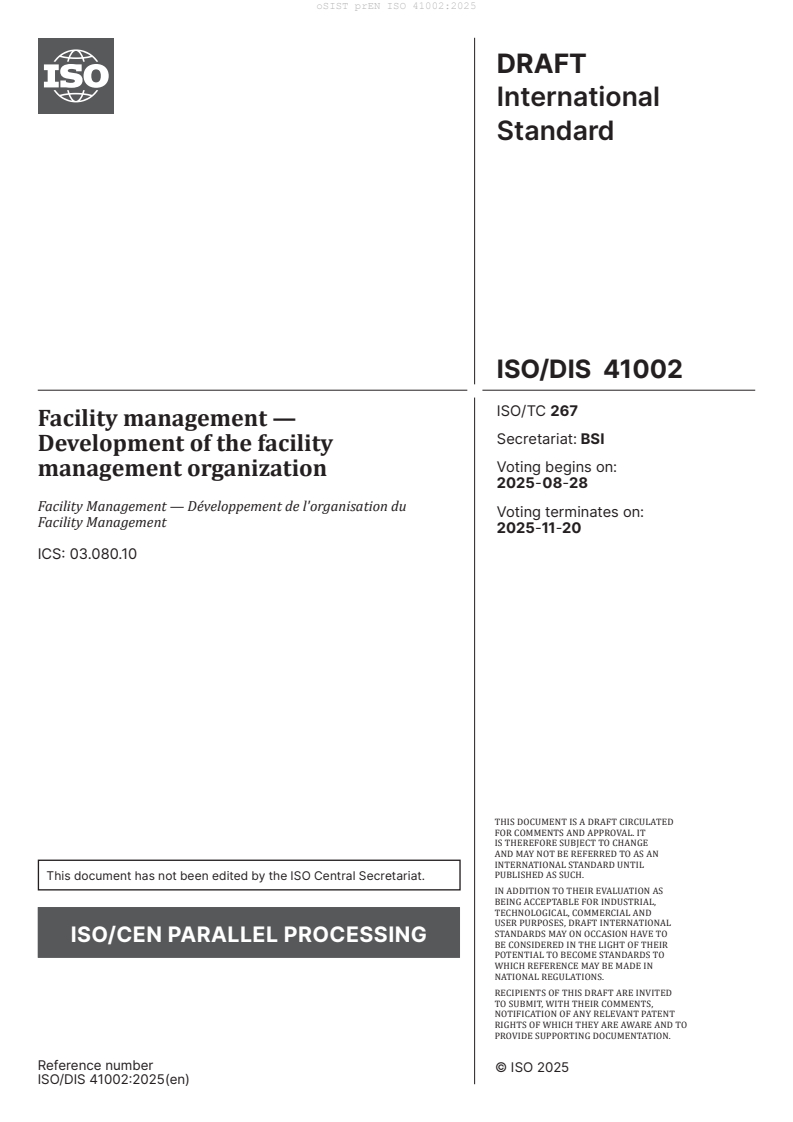
DRAFT
International
Standard
ISO/DIS 41002
ISO/TC 267
Facility management —
Secretariat: BSI
Development of the facility
Voting begins on:
management organization
2025-08-28
Facility Management — Développement de l'organisation du
Voting terminates on:
Facility Management
2025-11-20
ICS: 03.080.10
THIS DOCUMENT IS A DRAFT CIRCULATED
FOR COMMENTS AND APPROVAL. IT
IS THEREFORE SUBJECT TO CHANGE
AND MAY NOT BE REFERRED TO AS AN
INTERNATIONAL STANDARD UNTIL
PUBLISHED AS SUCH.
This document has not been edited by the ISO Central Secretariat.
IN ADDITION TO THEIR EVALUATION AS
BEING ACCEPTABLE FOR INDUSTRIAL,
TECHNOLOGICAL, COMMERCIAL AND
USER PURPOSES, DRAFT INTERNATIONAL
STANDARDS MAY ON OCCASION HAVE TO
ISO/CEN PARALLEL PROCESSING
BE CONSIDERED IN THE LIGHT OF THEIR
POTENTIAL TO BECOME STANDARDS TO
WHICH REFERENCE MAY BE MADE IN
NATIONAL REGULATIONS.
RECIPIENTS OF THIS DRAFT ARE INVITED
TO SUBMIT, WITH THEIR COMMENTS,
NOTIFICATION OF ANY RELEVANT PATENT
RIGHTS OF WHICH THEY ARE AWARE AND TO
PROVIDE SUPPORTING DOCUMENTATION.
Reference number
ISO/DIS 41002:2025(en)
DRAFT
ISO/DIS 41002:2025(en)
International
Standard
ISO/DIS 41002
ISO/TC 267
Facility management —
Secretariat: BSI
Development of the facility
Voting begins on:
management organization
Facility Management — Développement de l'organisation du
Voting terminates on:
Facility Management
ICS: 03.080.10
THIS DOCUMENT IS A DRAFT CIRCULATED
FOR COMMENTS AND APPROVAL. IT
IS THEREFORE SUBJECT TO CHANGE
AND MAY NOT BE REFERRED TO AS AN
INTERNATIONAL STANDARD UNTIL
PUBLISHED AS SUCH.
This document is circulated as received from the committee secretariat.
IN ADDITION TO THEIR EVALUATION AS
BEING ACCEPTABLE FOR INDUSTRIAL,
© ISO 2025
TECHNOLOGICAL, COMMERCIAL AND
USER PURPOSES, DRAFT INTERNATIONAL
All rights reserved. Unless otherwise specified, or required in the context of its implementation, no part of this publication may
STANDARDS MAY ON OCCASION HAVE TO
ISO/CEN PARALLEL PROCESSING
be reproduced or utilized otherwise in any form or by any means, electronic or mechanical, including photocopying, or posting on
BE CONSIDERED IN THE LIGHT OF THEIR
the internet or an intranet, without prior written permission. Permission can be requested from either ISO at the address below
POTENTIAL TO BECOME STANDARDS TO
WHICH REFERENCE MAY BE MADE IN
or ISO’s member body in the country of the requester.
NATIONAL REGULATIONS.
ISO copyright office
RECIPIENTS OF THIS DRAFT ARE INVITED
CP 401 • Ch. de Blandonnet 8
TO SUBMIT, WITH THEIR COMMENTS,
CH-1214 Vernier, Geneva
NOTIFICATION OF ANY RELEVANT PATENT
Phone: +41 22 749 01 11
RIGHTS OF WHICH THEY ARE AWARE AND TO
PROVIDE SUPPORTING DOCUMENTATION.
Email: copyright@iso.org
Website: www.iso.org
Published in Switzerland Reference number
ISO/DIS 41002:2025(en)
ii
ISO/DIS 41002:2025(en)
Contents Page
Foreword .iv
Introduction .v
1 Scope . 1
2 Normative references . 1
3 Terms, definitions and abbreviations . 1
4 Essentials of the FM organization . 3
4.1 Governance .3
4.1.1 Oversight .3
4.1.2 Leadership and management .3
4.1.3 Responsibilities and authorities .4
4.1.4 Information management.4
4.1.5 Management system .5
4.2 Value drivers . .5
4.2.1 General .5
4.2.2 Markets and FM . .5
4.2.3 Differentiation strategies .6
4.2.4 Sustainable development goals .7
4.2.5 Environmental performance .8
4.2.6 Social responsibility .8
4.3 Risk .9
4.3.1 General .9
4.3.2 Threats .9
4.3.3 Opportunities .9
4.4 Stakeholders .9
4.4.1 Engagement.9
4.4.2 Coordination and communication .10
4.5 Organization .11
4.5.1 Forms .11
4.5.2 Structures . 12
4.5.3 Culture and awareness . 13
4.5.4 Knowledge. 13
4.5.5 Maturity . 13
4.5.6 Competences .14
4.5.7 Relationships .14
4.5.8 Key personnel . . 15
4.6 Factors impacting the success of the FM organization. 15
4.6.1 Business strategy and objectives . 15
4.6.2 FM strategy .16
4.6.3 FM policy .16
4.6.4 FM objectives .16
4.6.5 Sourcing strategy.16
4.6.6 Integration of facility services .16
4.6.7 Self-delivery and subcontracting .17
4.6.8 Digital, data and technology .17
4.6.9 Planning and control . .17
4.6.10 Performance .17
4.6.11 Continual improvement.17
Annex A (informative) Stakeholder participation .18
Annex B (informative) Example forms of the FM organization . 19
Bibliography .27
iii
ISO/DIS 41002:2025(en)
Foreword
ISO (the International Organization for Standardization) is a worldwide federation of national standards
bodies (ISO member bodies). The work of preparing International Standards is normally carried out through
ISO technical committees. Each member body interested in a subject for which a technical committee
has been established has the right to be represented on that committee. International organizations,
governmental and non-governmental, in liaison with ISO, also take part in the work. ISO collaborates closely
with the International Electrotechnical Commission (IEC) on all matters of electrotechnical standardization.
The procedures used to develop this document and those intended for its further maintenance are described
in the ISO/IEC Directives, Part 1. In particular, the different approval criteria needed for the different types
of ISO documents should be noted. This document was drafted in accordance with the editorial rules of the
ISO/IEC Directives, Part 2 (see www.iso.org/directives).
ISO draws attention to the possibility that the implementation of this document may involve the use of (a)
patent(s). ISO takes no position concerning the evidence, validity or applicability of any claimed patent
rights in respect thereof. As of the date of publication of this document, ISO [had/had not] received notice of
(a) patent(s) which may be required to implement this document. However, implementers are cautioned that
this may not represent the latest information, which may be obtained from the patent database available at
www.iso.org/patents. ISO shall not be held responsible for identifying any or all such patent rights.
Any trade name used in this document is information given for the convenience of users and does not
constitute an endorsement.
For an explanation of the voluntary nature of standards, the meaning of ISO specific terms and expressions
related to conformity assessment, as well as information about ISO's adherence to the World Trade
Organization (WTO) principles in the Technical Barriers to Trade (TBT), see www.iso.org/iso/foreword.html.
This document was prepared by Technical Committee ISO/TC 267, Facility management.
Any feedback or questions on this document should be directed to the user’s national standards body. A
complete listing of these bodies can be found at www.iso.org/members.html.
iv
ISO/DIS 41002:2025(en)
Introduction
General
Facility management (FM) integrates multiple disciplines in order to have an influence on the efficiency
and productivity of economies of societies, communities and organizations, as well as the manner in which
individuals interact with the built environment. FM affects the safety, well-being and quality of life of much
of the world’s societies and population through the services it manages and delivers (see ISO 41001).
NOTE FM is defined as an organizational function which integrates people, place and process within the built
environment with the purpose of improving the quality of life of people and the productivity of the core business (see
ISO 41011:2024, 3.1.1).
ISO 41001 makes reference to the demand organization and to the organization responsible for FM,
including the delivery of facility services. A distinction is necessary because of the variable nature in which
FM is organized and where facility services might be delivered through personnel within the demand
organization, through external service providers or a combination of the two. If FM is working efficiently
and effectively, the users of a facility can expect the same quality of service regardless of whether the FM
organization is internal or external to the demand organization.
This document is based upon the simple premise that a demand organization requires an arrangement
internally, externally or through a combination of the two, to take responsibility for FM, including the
delivery of facility services.
FM organizations have existed as long as FM itself. Many FM organizations could be held up as models of
efficiency and effectiveness, which others could use to inform their own development of an FM organization.
The benefits of having a formal FM organization include:
— a ready source of skills, knowledge and experience in FM on the strategic, tactical and operational
management levels;
— an efficient, responsive and cost-effective function in support of the demand organization’s business
objectives, strategy and plans;
— a function for managing compliance with statutory and demand organization requirements affecting the
operation of the facility, including the health, safety, security and well-being of users;
— a function for implementing measures to minimize the impact of climate change on the facility and for
contributing to goals and targets consistent with sustainable development.
This document fills a gap in guidance and is applicable to any individual or entity that owns, operates or
manages a facility, or advises on its management, with the intention of:
— providing appropriate support for the demand organization’s core business;
— satisfying the needs of users of the facility and other interested parties;
— complying with statutory and other legal requirements;
— simplifying and clarifying the management of the facility;
— driving organizational change and improving operational efficiency;
— accessing strategic, tactical and operational FM from the market, where appropriate;
— utilization of technology;
— acting responsibly in regard to action on climate change, sustainable development and resilience.
The guidance in this document applies to both an internal and external FM organization.
Process approach
v
ISO/DIS 41002:2025(en)
This document underscores a management-led approach to FM, including the delivery of facility services
of whatever kind. It is explicit in the definition of an FM organization that it is able to function on all three
management levels: strategic, tactical and operational. The ability of the FM organization to provide an efficient,
responsive and effective function in support of the demand organization’s business objectives, strategy and
plans necessitates processes that ensure continuity of purpose through all three management levels.
The document emphasizes the mutual interdependence between the demand organization and its FM
organization. The former’s success depends on the latter and the reverse. For this relationship to succeed and
thrive well into the future, there needs to be purposeful application of the guidance and recommendations in
this document by top management in the demand organization and, where the FM organization is external,
the service provider’s top management.
The context for an external service provider acting as the FM organization is different to that of an internal (or
in-house) service provider. An external service provider acting as the FM organization, and operating on all
three management levels, is likely to be serving the needs of multiple demand organizations simultaneously;
whereas the internal service provider has one demand organization to satisfy. In many countries, the market
for FM comprises few large service providers but many more smaller service providers. Not all of the latter
are expected to operate fully on all three management levels, although they might aspire to do so.
This document provides guidance with recommendations on how internal and external FM organizations
can develop and enhance their capabilities on all three management levels. It identifies the decisions,
functions, processes, information, data and interested parties that enable the demand organization to form
the essential foundation for the FM organization, whether it is internal or external. The subject matter
includes governance, value drivers, risk, stakeholder engagement, organizational structure and factors
impacting the success of the FM organization.
vi
DRAFT International Standard ISO/DIS 41002:2025(en)
Facility management — Development of the facility
management organization
1 Scope
This document gives guidance on the development of a facility management (FM) organization working on
the strategic, tactical and operational management levels to:
a) satisfy the needs and objectives of the demand organization and users of its facility;
b) meet the needs of interested parties and applicable FM requirements consistently;
c) provide a safe, healthy, secure and efficient environment that enhances the workplace experience for users;
d) protect the asset value and resource value of the facility;
e) provide appropriately specified, responsive and cost-effective facility services;
f) implement measures to minimize the impact of climate change on the facility;
g) contribute to goals and targets consistent with sustainable development;
h) improve the usefulness and benefits provided by the FM system.
2 Normative references
The following documents are referred to in the text in such a way that some or all of their content constitutes
requirements of this document. For dated references, only the edition cited applies. For undated references,
the latest edition of the referenced document (including any amendments) applies.
ISO 41001, Facility management — Management systems — Requirements with guidance for use
ISO 41011, Facility management — Vocabulary
ISO 41012, Facility management — Guidance on strategic sourcing and the development of agreements
ISO 37000, Governance of organizations — Guidance
3 Terms, definitions and abbreviations
For the purposes of this document, the terms and definitions given in ISO 41011 and the following apply.
ISO and IEC maintain terminology databases for use in standardization at the following addresses:
— ISO Online browsing platform: available at https:// www .iso .org/ obp
— IEC Electropedia: available at https:// www .electropedia .org/
3.1
business unit
discrete and accountable function or sub-function within an organization
[SOURCE: ISO/TS 21089:2018, 3.28, Note 1 to entry removed]
ISO/DIS 41002:2025(en)
3.2
facility management organization
FM organization
entity responsible for facility management on the strategic, tactical and operational levels
[SOURCE: ISO 41011:2024, 3.1.4, modified]
3.3
greenwashing
false or misleading information, either intentionally or inadvertently, regarding the environmental or
sustainability attributes of a product, asset and activity, which can have consequences on the assessment of
financial and non-financial materiality
[SOURCE: ISO 14100:2022, 3.1.15]
3.4
governance
principles, policies and framework by which an organization is directed, controlled and held to account
[SOURCE: ISO 21505:2017, 3.1, modified]
3.5
management line-of-sight
visibility of decision making from the strategic to the tactical and operational levels in an organization
3.6
self-deliver
service delivery based upon the provider’s own resources
[SOURCE: ISO 41014, 3.4.3, modified]
3.7
siloed working
organizational condition where groups, divisions or departments within the same organization are
disinclined to share knowledge, information and data
3.8
special purpose vehicle
legal entity that separates a financial arrangement or project from its parent organization
3.9
value driver
anything that is added, or perceived to be added, to a product or service to improve its worth to stakeholders
[SOURCE: ISO 41014, 3.6.2]
Abbreviations
ESG environmental, social and governance
GHG greenhouse gases
RACI responsible, accountable, consulted and informed
ISO/DIS 41002:2025(en)
4 Essentials of the FM organization
4.1 Governance
4.1.1 Oversight
Governance creates and maintains an organization with a clear purpose that delivers long-term value
consistent with the expectations of its stakeholders. This means that decision-making within an organization
is based on its ethos, culture, norms, practices, behaviours, structures and processes. These elements
form the bedrock of governance, empowering an organization to thrive with purpose and resilience. The
purpose of governance lies in cultivating environments where trust is nurtured, aspirations are realized
and collective well-being is prioritized. Resilience is about an organization’s adaptive capacity in a complex
and changing environment.
Governance provides a structured framework to which the organization needs to adhere for its effective
management and achievement of its long-term goals. Top management should apply governance to all
areas of administration to establish clarity and control over processes to maintain successful, sustainable
business operations. This is assisted by having a management line-of-sight from the highest (i.e. strategic)
level through to the lowest (i.e. operational) level in the organization.
From the perspective of the supply chain, implementation of governance helps an organization manage
risks arising within the supply chain, ensuring compliance, promoting ethical business relationships,
preserving transparency in operations, achieving cost control, maintaining a high-level of quality, promoting
sustainability, steering continual improvement and facilitating change.
The FM organization should take actionable steps to foster an integrated approach to governance, bringing
together top–down and bottom–up perspectives by:
— establishing robust communication channels to facilitate dialogue and feedback between leadership and
stakeholders;
— prioritizing capability-building initiatives to ensure alignment with overarching business objectives and
local needs;
— incentivizing collaboration and cross-functional teamwork, breaking down siloed working and fostering
collective ownership;
— implementing regular monitoring and evaluation mechanisms to track progress and adapt strategies
accordingly;
— cultivating a culture of inclusivity and empowerment, where diverse voices are valued and integrated
into decision making;
— highlighting the necessity of awareness on the breadth of statutory compliance and how it might be
managed.
Additional proactive measures, such as periodic audits, continuing personal development and professional
development, are fundamental to maintain compliance and should be mandated by the FM organization.
Fostering a culture of accountability and responsibility, empowers teams and individuals and enables them
to navigate challenges, including regulations, with confidence.
The FM organization should develop a coherent policy on its governance and make it available to all
reasonable inquirers (see also ISO 41018).
4.1.2 Leadership and management
There is a close relationship between leadership, management and stakeholder engagement. While each is
essential to achieve an organization’s objectives, distinctions need to be drawn. Leadership embodies vision,
inspiration and the ability to navigate complexity while creating alignment among diverse stakeholders.
Management focuses on strategic planning, resource allocation and operational oversight, dealing directly
ISO/DIS 41002:2025(en)
with the needs of stakeholders. Distinguishing between leadership and management is necessary so that
governance structures are transparent and correctly maintained (see 4.1.3).
While management deals with tasks, processes, systems and leadership is about influencing, inspiring and
empowering individuals to achieve common goals, there remains the practical matter of efficient distribution
of tasks. Effective delegation is key in both leadership and management for enabling efficient distribution of
tasks. The FM organization should take into account individuals’ needs in relation to skills’ development and
autonomy when determining the allocation of tasks.
Clarity in leadership, management and delegation is vital for effective governance. Fostering a culture of
transparency and open dialogue enhances organizational coherence and effectiveness. The FM organization
should establish clear communication channels, delineate roles and responsibilities, and set realistic
expectations. Feedback mechanisms and performance evaluations are then necessary to monitor progress
and identify areas for improvement.
4.1.3 Responsibilities and authorities
The FM organization should be clearly structured and defined to fit the purpose of its existence in
meeting the demand organization’s business objectives, strategy and operational plans. Depending on its
size and diversification, the FM organization’s structure should ideally consist of business units that are
interdependent but without overlapping functions that might reduce their ability to perform. To achieve this
state, the roles, responsibilities and purpose of the business units within the FM organization should be
defined. These definitions can be expected to provide clarity for authorizing and implementing appropriate
processes for each business unit.
To ensure smooth operations, the roles and responsibilities of various levels of leadership and individuals
in the FM organization should be clearly defined. This will provide leadership with an understanding of
how to manage the expectations of the various parties. Additionally, clear and well-defined roles and
responsibilities are likely to help in the treatment of risks related to day-to-day operations and productivity.
The FM organization’s business units, where they are defined, should be provided with the appropriate
level of authority by top management. Levels of authority enable leadership at various levels within the FM
organization to approve work within predefined limits that they have authorized thus making the process of
decision making in the delivery of services as efficient as possible.
The FM organization should establish and maintain appropriate assignment of responsibilities. The
usual form is a matrix or chart denoted RACI (i.e. responsible, accountable, consulted and informed) to
demonstrate who is responsible for what and how the other roles relate to them. Clarity in the nature of a
role and the assignment of tasks to it ensures open and transparent management decision making.
4.1.4 Information management
The FM organization should take steps to ensure that information and data are reliable, secure and accessible
to authorized personnel. Information security and data protection are of critical importance. Failure to
maintain adequate controls could lead to a data breach with implications for the owners of the affected data
and reputational damage for both the demand organization and the FM organization. Safeguarding sensitive
data is a fundamental requirement as well as a matter of compliance with the legislation and data protection
standards.
The FM organization should acknowledge the indispensable role of accurate, reliable and timely information
in driving informed decision-making processes. Necessary information provides the foundation upon which
strategic choices are made, while sufficiency ensures that decision-makers have access to all pertinent data
required for effective analysis.
In this view, it is crucial to differentiate between completeness, accuracy and timeliness in respect of
information in the context of management decision making. While completeness ensures that all relevant
data are included, accuracy guarantees its reliability and timeliness ensures its relevance to the decision-
making timeline.
ISO/DIS 41002:2025(en)
To ensure that information and data remain reliable, secure and accessible to authorized personnel, the FM
organization should implement a multifaceted approach. This includes deploying encryption and access
control mechanisms, conducting regular audits to identify vulnerabilities and providing ongoing training to
personnel on data security practices. Fundamental to this process is determining levels of authorized access
for all personnel.
Furthermore, establishing clear policies and procedures for data handling and enforcing strict compliance
measures are paramount. By fostering a culture of data awareness and accountability throughout the FM
organization, information security can be upheld as a top priority, safeguarding against potential threats
and ensuring the integrity of decision-making processes.
4.1.5 Management system
The FM organization should maintain a management system to support its efficient and effective
management of the facility and the delivery of facility services. The system should be subject to internal
audit and management review on a periodic basis to ensure that it is being operated optimally.
NOTE ISO 41001 sets out the requirements for an FM system.
Once such infrastructure is established, it is the responsibility of process owners within the FM organization
to ensure that the processes are executed as agreed in the documentation supporting operation of the
management system.
4.2 Value drivers
4.2.1 General
Value drivers are the benefits – financial and non-financial – that an organization’s stakeholders expect
to realize from the performance of its core business activities or which are delivered by it to achieve its
core business objectives. The principle applies equally to the demand organization and the FM organization
irrespective of whether the latter is internal or external. In all cases, account should be taken of identified
and perceived benefits, the stakeholders affected by them, and how these might be enhanced or diminished
by FM, including facility services.
4.2.2 Markets and FM
The demand organization should recognize the differences between the work environment for an internal
FM organization and an external service provider offering FM on all three management levels. The internal
FM organization is dedicated to the demand organization, unless there is a sharing of resources with a
body affiliated to the demand organization, and so there is likely to be a fairly stable work environment.
In contrast, an external FM organization is operating in an unpredictable environment in which industry
maturity, competitive dynamics, availability of skilled providers, regulatory environment and cultural
attitudes towards utilizing externally provided services in the specific market, country or demand
organization shape its business outlook and behaviour. These factors can also be of consequence to the
internal FM organization where it is sourcing facility services externally.
In countries with a mature FM industry, there is usually availability of highly skilled and specialist service
providers and labour. Competition and choice can drive service performance and cost-effectiveness and,
in general, there are robust processes, technology and focus on compliance, sustainability, environmental
performance and social responsibility. Where the FM industry is less developed, the demand organization
might find it difficult to recruit personnel and attract service providers to meet their requirements in full
and standards for delivery performance, quality and reliability. Lack of market maturity can drive the
development of internal FM organizations, with in-house service delivery, to secure control over operations.
Stringent regulations within a given market on the operating environment, market for facility services or
demand organization can influence the level and capabilities of internal and external FM organizations.
Specialist service providers can be used to navigating stringent health and safety, environmental and
regulatory environments; however, the demand organization might prefer an internal FM organization to
achieve compliance with global standards where there is less regulatory oversight. In some cultures, there
ISO/DIS 41002:2025(en)
might be a preference for maintaining internal capabilities because of values related to loyalty, job security
or, simply, a lack of confidence in external service providers. Other cultures might be more open to sourcing
from external providers to allow more focus on core business activities and to leverage external expertise.
External FM organizations are subject to the perils of the market for their services. The demand organization
should recognize the uncertainty that markets create and the value drivers that can influence an external
FM organization’s approach. Market-related drivers capable of shaping and enhancing the business of
external FM organizations include:
— market conditions;
— revenues and profitability;
— competent personnel and teams that deliver;
— strong track-record and reputation for excellence;
— measurable environmental and social performance;
— limited exposure to a single client or customer;
— ability to manage cash flow.
The above can be seen as factors that increase the worth of the external FM organization and its services. A
demand organization considering engaging a service provider with a view to appointment as the external
FM organization should understand which value drivers are critical to the success of the service provider’s
decision making and the strength of its commitment.
4.2.3 Differentiation strategies
Business drivers are key inputs and activities that drive operational and financial results. They can include
factors such as cost control, revenue growth, customer and user satisfaction, and innovation. The way the
FM organization seeks to differentiate itself from competitors or position itself within the markets in which
it operates can have a significant impact on FM strategy.
Differentiation in a business context is normally reflected in the business strategy and objectives.
Accordingly, the external FM organization might seek to differentiate itself on any of the following:
— market position;
— pricing strategy (e.g. premium versus low price);
— cost management;
— operational efficiency;
— employee satisfaction and morale;
— quality and competence;
— cultural fit;
— statutory and other legal requirements;
— sustainable development goals;
— innovation and technology adoption.
For example, an external service provider might seek out opportunities where the price for its services is
subject to negotiation and the basis of the formal agreement is a collaborative arrangement (e.g. partnering).
Conversely, a different service provider might be prepared to bid on a fixed-term, fixed-price basis and be
content with a more transactional arrangement.
ISO/DIS 41002:2025(en)
Business drivers and differentiation strategy can significantly influence an FM strategy by directing and
prioritizing resources, shaping operational decisions and determining the focus areas for FM to support the
business strategy and objectives. The following are examples.
— Cost control – if a primary business driver is cost control, the FM strategy might focus on energy efficiency,
reducing waste and optimizing space utilization to lower operational expenses.
— Revenue growth – the FM organization might prioritize creating environments that enhance user
experience or support core business activities.
— Customer and user satisfaction – strategies can include maintaining high standards of cleanliness,
ensuring safety and security, and providing amenities that enhance user experience.
— Innovation – if this drives the business, FM should focus on creating spaces that foster collaboration and
creativity, such as flexible workspaces and innovation hubs.
The demand organization should understand the implications of different arrangements before engaging
with external service providers to take on the responsibilities of an FM organization.
4.2.4 Sustainable development goals
The FM organization has a significant part to play in advancing the UN’s Sustainable Development Goals
[11]
(SDGs) through sustainable practices in energy, water, waste management, health and well-being,
procurement and community involvement. It means that the FM organization might have to adapt its
strategy, operations and culture to prioritize sustainability, innovation, stakeholder engagement and
partnership.
The FM organization should understand how its services contribute to the SDGs, how it will set targets to
demonstrate commitment to the goals and how it will ensure that information to this end is available to all
reasonable inquirers (see ISO/TR 41019). Practical steps can include the following.
a) Assessment and alignment – conduct a thorough assessment of current practices and align them with
relevant SDGs, including understanding the impact of the facility’s operations on energy use, water
conservation, waste management and social inclusion.
b) Strategic integration – integrate SDGs into the business strategy.
c) Stakeholder engagement – engage with key stakeholders to develop and implement sustainability
initiatives.
d) Education and training – provide ongoing education and training for personnel on sustainable practices
and the importance of SDGs.
e) Communication – develop a communication strategy to report on progress, sharing best practices and
fostering transparency with all stakeholders.
f) Innovation and technology – explore and implement innovative solutions and technology to support
sustainable development.
g) Partnerships – collaborate with other organizations, governments and NGOs to amplify the impact of
sustainable development initiatives.
h) Policy and procurement – adopt sustainable procurement policies that prioritize environmentally
friendly products and services, contributing to responsible consumption and production patterns.
i) Reporting and disclosure – track, monitor and report on ESG metrics, ensuring compliance with
reporting frameworks and providing transparency on progress on sustainable development.
...
Questions, Comments and Discussion
Ask us and Technical Secretary will try to provide an answer. You can facilitate discussion about the standard in here.
Loading comments...