

oSIST prEN IEC 63550-2:2025
(Main)Semiconductor devices - Neuromorphic devices - Part 2: Evaluation method of linearity in memristor devices
General Information
- Abstract
- Status
- Not Published
- Public Enquiry End Date
- 27-Nov-2025
- Technical Committee
- I11 - Imaginarni 11
- Current Stage
- 4020 - Public enquire (PE) (Adopted Project)
- Start Date
- 10-Sep-2025
- Due Date
- 28-Jan-2026
- Completion Date
- 19-Nov-2025

Overview
oSIST prEN IEC 63550-2:2025 defines standardized test methods for evaluating the linearity of neuromorphic memristor devices, a key type of semiconductor device used for artificial synapses in neuromorphic computing. This standard is developed by the International Electrotechnical Commission (IEC) through Technical Committee 47, and is also circulated under the CLC system for European harmonization.
Linearity in memristor devices is critical for reliable and high-performing neuromorphic systems, as it directly affects how closely these devices can mimic the adaptable learning behaviors seen in biological synapses. This part of the standard focuses on linearity as a performance characteristic, and provides a uniform approach to testing, reporting, and comparing devices from different manufacturers and technologies.
Key Topics
- Test Methods for Linearity: The standard specifies how to assess the linearity of memristor devices, including protocols for both long-term potentiation (LTP) and long-term depression (LTD). It includes mathematical approaches to evaluate factors affecting linearity in these memory elements.
- Test Apparatus and Conditions: Guidance is provided on the required test equipment, such as semiconductor parameter analyzers and probe stations. Parameters like voltage, current, temperature, humidity, and pressure must be carefully controlled and documented.
- Quantitative Linearity Factors: The document describes how to calculate and interpret linearity coefficients, non-linearity factors, and weight update margins, which are essential for benchmarking memristive devices in neuromorphic systems.
- Reliability and Retention Testing: Methods for evaluating how well memristors retain their conductance states over time-essential for practical, durable applications in neuromorphic hardware-are detailed.
- Test Reporting: Clear guidance on what must be included in the final test report, ensuring transparency and repeatability in memristor evaluation.
Applications
oSIST prEN IEC 63550-2:2025 supports the growing field of neuromorphic engineering, where electronic systems are designed to emulate the architecture and functions of the human brain. Conformance to this standard ensures:
- Consistent Evaluation of Memristive Devices: Manufacturers, researchers, and system integrators gain a common foundation for comparing the linearity and usability of memristive devices.
- Improved Device Selection and Design: Standardized test data assists engineers in selecting suitable memristor devices for artificial neural networks and neuromorphic computing platforms.
- Facilitated Innovation: As neuromorphic devices are applied in edge AI, adaptive sensors, robotics, and advanced memory systems, standardized evaluation helps speed up technology improvement.
- Enhanced Research Collaboration: Laboratories and institutions can validate and compare results internationally thanks to harmonized methodology.
Typical users of this standard include semiconductor manufacturers, research and development laboratories, and electronic systems designers specializing in AI hardware and advanced memory technologies.
Related Standards
- IEC 63550-1: Semiconductor devices - Neuromorphic devices - Part 1: General requirements, definitions, and test methods (foundation for the series).
- IEC 62951-9:2022: Semiconductor devices - Flexible and stretchable semiconductor devices - Part 9: Performance testing methods of one transistor and one resistor (1T1R) resistive memory cells.
- Other IEC/ISO standards on test methods and device reliability for memory and logic semiconductors.
Summary
oSIST prEN IEC 63550-2:2025 delivers vital guidelines for the practical evaluation of linearity in memristor devices, fostering interoperability, comparability, and performance optimization in neuromorphic computing hardware. By standardizing test protocols and reporting, it underpins the advancement of reliable memristive technologies in the modern semiconductor industry.
Keywords: memristor linearity, neuromorphic device testing, semiconductor standards, IEC 63550, memristor evaluation method, LTP, LTD, memory retention, AI hardware standardization.
Frequently Asked Questions
oSIST prEN IEC 63550-2:2025 is a draft published by the Slovenian Institute for Standardization (SIST). Its full title is "Semiconductor devices - Neuromorphic devices - Part 2: Evaluation method of linearity in memristor devices". This standard covers: Semiconductor devices - Neuromorphic devices - Part 2: Evaluation method of linearity in memristor devices
Semiconductor devices - Neuromorphic devices - Part 2: Evaluation method of linearity in memristor devices
oSIST prEN IEC 63550-2:2025 is classified under the following ICS (International Classification for Standards) categories: 31.080.99 - Other semiconductor devices. The ICS classification helps identify the subject area and facilitates finding related standards.
oSIST prEN IEC 63550-2:2025 is available in PDF format for immediate download after purchase. The document can be added to your cart and obtained through the secure checkout process. Digital delivery ensures instant access to the complete standard document.
Standards Content (Sample)
SLOVENSKI STANDARD
01-november-2025
Polprevodniški elementi - Nevromorfne naprave - 2. del: Metoda ocenjevanja
linearnosti v memristorskih napravah
Semiconductor devices - Neuromorphic devices - Part 2: Evaluation method of linearity
in memristor devices
Dispositifs à semiconducteurs - Dispositifs neuromorphiques - Partie 2: Méthode
d’évaluation de la linéarité des dispositifs à memristance
Ta slovenski standard je istoveten z: prEN IEC 63550-2:2025
ICS:
31.080.99 Drugi polprevodniški elementi Other semiconductor devices
2003-01.Slovenski inštitut za standardizacijo. Razmnoževanje celote ali delov tega standarda ni dovoljeno.
47/2942/CDV
COMMITTEE DRAFT FOR VOTE (CDV)
PROJECT NUMBER:
IEC 63550-2 ED1
DATE OF CIRCULATION: CLOSING DATE FOR VOTING:
2025-09-05 2025-11-28
SUPERSEDES DOCUMENTS:
47/2871/CD, 47/2926/CC
IEC TC 47 : SEMICONDUCTOR DEVICES
SECRETARIAT: SECRETARY:
Korea, Republic of Mr Cheolung Cha
OF INTEREST TO THE FOLLOWING COMMITTEES: HORIZONTAL FUNCTION(S):
ASPECTS CONCERNED:
SUBMITTED FOR CENELEC PARALLEL VOTING NOT SUBMITTED FOR CENELEC PARALLEL VOTING
Attention IEC-CENELEC parallel voting
The attention of IEC National Committees, members of
CENELEC, is drawn to the fact that this Committee Draft
for Vote (CDV) is submitted for parallel voting.
The CENELEC members are invited to vote through the
CENELEC online voting system.
This document is still under study and subject to change. It should not be used for reference purposes.
Recipients of this document are invited to submit, with their comments, notification of any relevant patent rights of
which they are aware and to provide supporting documentation.
Recipients of this document are invited to submit, with their comments, notification of any relevant “In Some
Countries” clauses to be included should this proposal proceed. Recipients are reminded that the CDV stage is
the final stage for submitting ISC clauses. (SEE AC/22/2007 OR NEW GUIDANCE DOC).
TITLE:
Semiconductor devices - Neuromorphic devices - Part 2: Evaluation method of
linearity in memristor devices
PROPOSED STABILITY DATE: 2029
NOTE FROM TC/SC OFFICERS:
download this electronic file, to make a copy and to print out the content for the sole purpose of preparing National
Committee positions. You may not copy or "mirror" the file or printed version of the document, or any part of it, for
any other purpose without permission in writing from IEC.
IEC CDV 63550-2 © IEC:2025
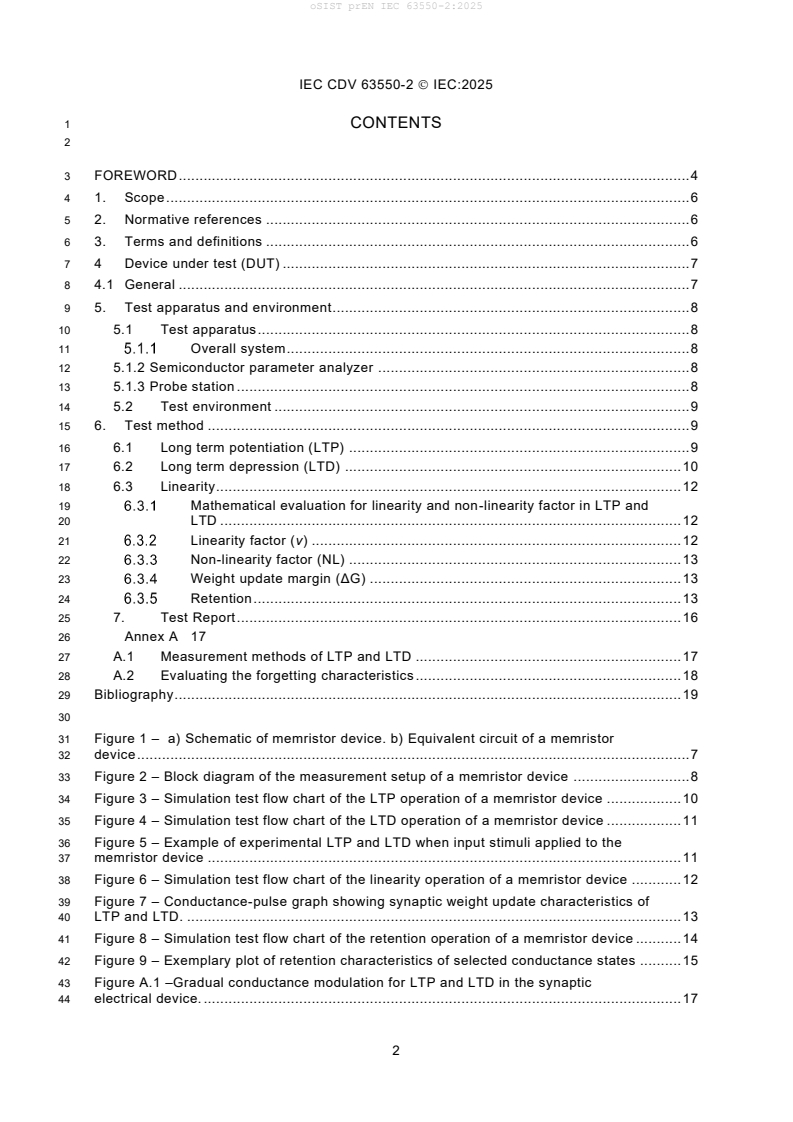
1 CONTENTS
3 FOREWORD . 4
4 1. Scope . 6
5 2. Normative references . 6
6 3. Terms and definitions . 6
7 4 Device under test (DUT) . 7
8 4.1 General . 7
9 5. Test apparatus and environment. 8
10 5.1 Test apparatus . 8
11 Overall system . 8
12 5.1.2 Semiconductor parameter analyzer . 8
13 5.1.3 Probe station . 8
14 5.2 Test environment . 9
15 6. Test method . 9
16 6.1 Long term potentiation (LTP) . 9
17 6.2 Long term depression (LTD) . 10
18 6.3 Linearity . 12
19 Mathematical evaluation for linearity and non-linearity factor in LTP and
20 LTD . 12
21 Linearity factor (ν) . 12
22 Non-linearity factor (NL) . 13
23 Weight update margin (ΔG) . 13
24 Retention . 13
25 7. Test Report . 16
26 Annex A 17
27 A.1 Measurement methods of LTP and LTD . 17
28 A.2 Evaluating the forgetting characteristics . 18
29 Bibliography . 19
31 Figure 1 – a) Schematic of memristor device. b) Equivalent circuit of a memristor
32 device . 7
33 Figure 2 – Block diagram of the measurement setup of a memristor device . 8
34 Figure 3 – Simulation test flow chart of the LTP operation of a memristor device . 10
35 Figure 4 – Simulation test flow chart of the LTD operation of a memristor device . 11
36 Figure 5 – Example of experimental LTP and LTD when input stimuli applied to the
37 memristor device . 11
38 Figure 6 – Simulation test flow chart of the linearity operation of a memristor device . 12
39 Figure 7 – Conductance-pulse graph showing synaptic weight update characteristics of
40 LTP and LTD. . 13
41 Figure 8 – Simulation test flow chart of the retention operation of a memristor device . 14
42 Figure 9 – Exemplary plot of retention characteristics of selected conductance states . 15
43 Figure A.1 –Gradual conductance modulation for LTP and LTD in the synaptic
44 electrical device. . 17
IEC CDV 63550-2 © IEC:2025
45 Figure A.2 – Forgetting behaviour curve and fitted curves of the electrical synapse
46 after consecutive programming pulses. . 18
IEC CDV 63550-2 © IEC:2025
INTERNATIONAL ELECTROTECHNICAL COMMISSION
50 ____________
53 Semiconductor devices - Neuromorphic devices -
55 Part 2: Evaluation method of linearity in memristor devices
FOREWORD
60 1) The International Electrotechnical Commission (IEC) is a worldwide organization for standardization comprising
61 all national electrotechnical committees (IEC National Committees). The object of IEC is to promote international
62 co-operation on all questions concerning standardization in the electrical and electronic fields. To this end and
63 in addition to other activities, IEC publishes International Standards, Technical Specifications, Technical Reports,
64 Publicly Available Specifications (PAS) and Guides (hereafter referred to as “IEC Publication(s)”). Their
65 preparation is entrusted to technical committees; any IEC National Committee interested in the subject dealt with
66 may participate in this preparatory work. International, governmental and non-governmental organizations liaising
67 with the IEC also participate in this preparation. IEC collaborates closely with the International Organization for
68 Standardization (ISO) in accordance with conditions determined by agreement between the two organizations.
69 2) The formal decisions or agreements of IEC on technical matters express, as nearly as possible, an international
70 consensus of opinion on the relevant subjects since each technical committee has representation from all
71 interested IEC National Committees.
72 3) IEC Publications have the form of recommendations for international use and are accepted by IEC National
73 Committees in that sense. While all reasonable efforts are made to ensure that the technical content of IEC
74 Publications is accurate, IEC cannot be held responsible for the way in which they are used or for any
75 misinterpretation by any end user.
76 4) In order to promote international uniformity, IEC National Committees undertake to apply IEC Publications
77 transparently to the maximum extent possible in their national and regional publications. Any divergence between
78 any IEC Publication and the corresponding national or regional publication shall be clearly indicated in the latter.
79 5) IEC itself does not provide any attestation of conformity. Independent certification bodies provide conformity
80 assessment services and, in some areas, access to IEC marks of conformity. IEC is not responsible for any
81 services carried out by independent certification bodies.
82 6) All users should ensure that they have the latest edition of this publication.
83 7) No liability shall attach to IEC or its directors, employees, servants or agents including individual experts and
84 members of its technical committees and IEC National Committees for any personal injury, property damage or
85 other damage of any nature whatsoever, whether direct or indirect, or for costs (including legal fees) and
86 expenses arising out of the publication, use of, or reliance upon, this IEC Publication or any other IEC Publications.
87 8) Attention is drawn to the Normative references cited in this publication. Use of the referenced publications is
88 indispensable for the correct application of this publication.
89 9) IEC draws attention to the possibility that the implementation of this document may involve the use of (a) patent(s).
90 IEC takes no position concerning the evidence, validity or applicability of any claimed patent rights in respect
91 thereof. As of the date of publication of this document, IEC had not received notice of (a) patent(s), which may
92 be required to implement this document. However, implementers are cautioned that this may not represent the
93 latest information, which may be obtained from the patent database available at https://patents.iec.ch. IEC shall
94 not be held responsible for identifying any or all such patent rights.
International Standard IEC 63550-2-X has been prepared by technical committee 47:
Semiconductor devices.
The text of International Standard is based on the following documents:
NP Report on voting
47/XX/NP 47/XX/NP
Full information on the voting for the approval of this standard can be found in the report on
voting indicated in the above table.
IEC CDV 63550-2 © IEC:2025
The language used for the development of this International Standard is English.
This document was drafted in accordance with ISO/IEC Directives, Part 2, and developed in
accordance with ISO/IEC Directives, Part 1 and ISO/IEC Directives, IEC Supplement, and the
ISO/IEC Directives, JTC 1 Supplement available at www.iec.ch/members_experts/refdocs. The
main document types developed by IEC are described in greater detail at
www.iec.ch/publications.
The committee has decided that the contents of this publication will remain unchanged until the
stability date indicated on the IEC web site under "http://webstore.iec.ch" in the data related to
the specific publication. At this date, the publication will be
112 • reconfirmed,
113 • withdrawn,
114 • replaced by a revised edition, or
115 • amended.
IEC CDV 63550-2 © IEC:2025
117 Semiconductor devices - Neuromorphic devices -
119 Part 2: Evaluation method of linearity in memristor devices
1. Scope
This part of IEC 63550-2 specifies the test methods for evaluating the linearity of neuromorphic
memristor devices. The test methods in this international standard include long term
potentiation (LTP), long term depression (LTD), endurance and retention of LTD/LTP, and
linearity. This document is applicable to neuromorphic 2-teminal memristor devices without any
limitations prone to device technology and size.
2. Normative references
The following documents are referred to in the text in such a way that some or all of their content
constitutes requirements of this document. For dated references, only the edition cited applies.
For undated references, the latest edition of the referenced document (including any
amendments) applies.
IEC 62951-9:2022 Semiconductor devices - Flexible and stretchable semiconductor devices
Part 9: Performance testing methods of one transistor and one resistor (1T1R) resistive memory
cells
3. Terms and definitions
For the purpose of this document, the following terms and definitions apply.
ISO and IEC maintain terminological databases for use in standardization at the following
addresses:
140 • IEC Electropedia: available at http://www.electropedia.org/
141 • ISO Online browsing platform: available at http://www.iso.org/obp
3.1
143 potentiation
increase in conductance (synaptic weights) depending on applied voltages over time [SOURCE:
IEC 63550-1:XXX,3.14]
3.2
147 depression
decrease in conductance (synaptic weights) depending on applied voltages over time [SOURCE:
IEC 63550-1:XXX,3.15]
3.3
potentiation voltage
152 V
Po
voltage required to increase the conductance of the memristor after forming process
3.4
155 depression voltage
156 V
De
voltage required to switch to decrease the conductance of the memristor
3.5
159 potentiation time
160 t
Po
time required to increase the conductance of memristor
IEC CDV 63550-2 © IEC:2025
3.6
163 depression time
164 tDe
time required to decrease the conductance of memristor
3.7
167 pulse interval
△t
time interval between the falling edge of the first pulse and the rising edge of the second pulse
of two consecutive pulses [SOURCE: IEC 63550-1:XXX,3.16]
171 synaptic weight
W
scalar value determining the influence of a presynaptic neuron on a postsynaptic neuron
[SOURCE: IEC 63550-1:XXX,3.17]
175 3.8
176 synaptic Plasticity
synaptic plasticity is a property dependent modification of the strength of synaptic weights by
stimuli [SOURCE: IEC 63550-1:XXX,3.18]
180 4 Device under test (DUT)
181 4.1 General
The equivalent circuit diagram and schematic structure of 2-terminal memristor devices (DUT)
is shown in Figure 1. The
...