


SIST EN 378-4:2017+A1:2019
(Main)Refrigerating systems and heat pumps - Safety and environmental requirements - Part 4: Operation, maintenance, repair and recovery
Refrigerating systems and heat pumps - Safety and environmental requirements - Part 4: Operation, maintenance, repair and recovery
This European Standard specifies the requirements for the safety of persons and property, provides guidance for the protection of the environment and establishes procedures for the operation, maintenance and repair of refrigerating systems and the recovery of refrigerants.
The term "refrigerating system" used in this European Standard includes heat pumps.
This standard applies:
a) to refrigerating systems, stationary or mobile, of all sizes including heat pumps;
b) to secondary cooling or heating systems;
c) to the location of the refrigerating systems;
d) to parts replaced and components added after adoption of this standard if they are not identical in function and capacity.
This standard does not cover "motor vehicle air conditioners" constructed according to product standards such as ISO 13043.
Systems using refrigerants other than those listed in FprEN 378-1:2016, Annex E are not covered by this standard unless they have been assigned to a safety class according to ISO 817.
This standard does not apply to goods in storage.
This standard is not applicable to refrigeration systems and heat pumps which were manufactured before the date of its publication as a European Standard except for extensions and modifications to the system which were implemented after publication.
This standard is applicable to new refrigerating systems, extensions or modifications of already existing systems, and for existing stationary systems, being transferred to and operated on another site.
This standard also applies in the case of the conversion of a system to another refrigerant type, in which case conformity to the relevant clauses of parts 1 to 4 of the standard shall be assessed.
This Part 4 of the European Standard specifies requirements for safety and environmental aspects in relation to operation, maintenance, and repair of refrigerating systems and the recovery, reuse and disposal of all types of refrigerant, refrigerant oil, heat-transfer fluid, refrigerating system and part thereof.
These requirements are intended to minimise risks of injury to persons and damage to property and the environment resulting from improper handling of the refrigerants or from contaminants leading to system breakdown and resultant emission of the refrigerant.
Subclauses 4, 5.1.1 to 5.1.4, 5.2, 5.3.1, 5.3.3 and 6.6 of this European Standard are not applicable to unitary systems having a power cord, being factory sealed, and in conformance with EN 60335 series.
Kälteanlagen und Wärmepumpen - Sicherheitstechnische und umweltrelevante Anforderungen - Teil 4: Betrieb, Instandhaltung, Instandsetzung und Rückgewinnung
Diese Europäische Norm legt die Anforderungen an die Sicherheit von Personen und Eigentum fest, liefert eine Anleitung in Hinblick auf den Schutz der Umwelt und enthält Vorgehensweisen für Betrieb, Instandhaltung und Instandsetzung von Kälteanlagen und die Rückgewinnung von Kältemitteln.
Der in dieser Europäischen Norm verwendete Begriff "Kälteanlage" schließt Wärmepumpen mit ein.
Diese Norm gilt für:
a) stationäre und ortsveränderliche Kälteanlagen aller Größen, einschließlich Wärmepumpen;
b) indirekte Kühl- oder Heizsysteme;
c) den Aufstellungsort dieser Kälteanlagen;
d) nach der Annahme dieser Norm ersetzte Teile und hinzugefügte Bauteile, sofern sie nicht in Funktion und Leistung identisch sind.
Die vorliegende Norm deckt keine "Klimaanlagen für Straßenfahrzeuge" ab, die nach Produktnormen wie z. B. ISO 13043 hergestellt wurden.
Kälteanlagen mit anderen als den in EN 378-1:2016, Anhang E, aufgeführten Kältemitteln sind nicht Gegenstand dieser Norm, es sei denn, sie wurden einer Sicherheitsklasse nach ISO 817 zugeordnet.
Die vorliegende Norm gilt nicht für eingelagerte Güter.
Diese Norm gilt nicht für Kälteanlagen und Wärmepumpen, die vor dem Datum ihrer Veröffentlichung als Europäische Norm hergestellt wurden, ausgenommen sind im Anschluss an die Veröffentlichung erfolgte Erweiterungen und Modifizierungen an der Anlage.
Die vorliegende Norm gilt für neue Kälteanlagen, Erweiterungen oder Modifizierungen bereits bestehender Anlagen sowie bestehende stationäre Anlagen, die an einen anderen Standort verbracht und dort betrieben werden.
Diese Norm gilt auch im Falle der Umstellung einer Anlage auf einen anderen Kältemittel-Typ; in diesem Fall ist die Übereinstimmung mit den zutreffenden Abschnitten der Teile 1 bis 4 der Norm zu beurteilen.
Dieser Teil 4 der Europäischen Norm legt Anforderungen fest an die sicherheitstechnischen und umweltrelevanten Aspekte in Bezug auf Betrieb, Instandhaltung und Instandsetzung von Kälteanlagen sowie Rückgewinnung, Wiederverwendung und Entsorgung aller Arten von Kältemitteln, Kältemittelöl und Wärmeträgern, der Kälteanlage sowie deren Teilen.
Diese Anforderungen haben den Zweck, Verletzungsrisiken für Personen sowie Schäden an Eigentum und der Umwelt auf ein Mindestmaß zu verringern, die sich aus dem unsachgemäßem Umgang mit Kältemitteln oder durch Verunreinigungen ergeben, die zu einem Ausfall der Anlage und nachfolgender Kältemittelemission führen.
Die Abschnitte 4, 5.1.1 bis 5.1.4, 5.2, 5.3.1, 5.3.3 und 6.6 dieser Europäischen Norm gelten nicht für betriebsfertige Kältesätze mit Netzanschlusskabel, die im Werk versiegelt wurden und der Normenreihe EN 60335 entsprechen.
Systèmes frigorifiques et pompes à chaleur - Exigences de sécurité et d'environnement - Partie 4 : Fonctionnement, maintenance, réparation et récupération
La présente Norme européenne spécifie les exigences relatives à la sécurité des personnes et des biens, fournit des recommandations pour la protection de l'environnement et établit des modes opératoires pour l'exploitation, la maintenance et la réparation des systèmes frigorifiques et la récupération des fluides frigorigènes.
Le terme « système frigorifique » utilisé dans la présente Norme européenne inclut les pompes à chaleur.
La présente norme s'applique :
a) aux systèmes frigorifiques, fixes ou mobiles, de toutes tailles, y compris les pompes à chaleur ;
b) aux systèmes secondaires de refroidissement ou de chauffage ;
c) à l'emplacement des systèmes frigorifiques ; et
d) aux pièces remplacées et composants ajoutés après l'adoption de la présente norme, si leur fonction ou leur capacité n'est pas identique.
La présente norme ne couvre pas les « climatiseurs pour véhicules automobiles » construits conformément aux normes de produits telles que l'ISO 13043.
Les systèmes utilisant des fluides frigorigènes autres que ceux mentionnés dans l'EN 378-1:2016, Annexe E ne sont pas couverts par la présente norme, sauf si une classe de sécurité leur a été assignée conformément à l'ISO 817.
La présente norme ne s'applique pas aux marchandises en stock.
La présente norme n'est pas applicable aux systèmes frigorifiques et pompes à chaleur fabriqués avant sa date de publication en tant que Norme européenne, à l'exception des extensions et modifications du système mises en œuvre après la publication.
La présente norme s'applique aux systèmes frigorifiques neufs, aux extensions ou modifications de systèmes existants et, pour les systèmes fixes existants, aux systèmes transférés et exploités sur un autre site.
La présente norme s'applique également en cas de transformation d'un système pour un autre type de fluide frigorigène, auquel cas la conformité aux articles applicables des parties 1 à 4 de la norme doit être évaluée.
La présente Partie 4 de la Norme européenne spécifie les exigences en matière de sécurité et d'environnement relatives au fonctionnement, à la maintenance, à la réparation des systèmes frigorifiques et à la récupération, la réutilisation et l'élimination de tous les types de fluides frigorigènes, d'huiles de systèmes frigorifiques, de fluides caloporteurs, de systèmes frigorifiques et de parties de ceux-ci.
Ces exigences sont destinées à réduire au minimum les risques de blessures aux personnes et de dommages aux biens et à l'environnement résultant d'une mauvaise manipulation des fluides frigorigènes ou de polluants entraînant une panne du système et l'émission consécutive de fluide frigorigène.
Les articles/paragraphes 4, 5.1.1 à 5.1.4, 5.2, 5.3.1, 5.3.3 et 6.6 de la présente Norme européenne ne sont pas applicables aux systèmes autonomes ayant un cordon d'alimentation, scellés en usine, et conformes à la série de normes EN 60335.
Hladilni sistemi in toplotne črpalke - Varnostnotehnične in okoljevarstvene zahteve - 4. del: Delovanje, vzdrževanje, popravilo in recikliranje
Ta evropski standard določa zahteve za varnost oseb in premoženja, določa smernice za varstvo okolja ter določa postopke za delovanje, vzdrževanje in popravilo hladilnih sistemov ter izpraznitev hladilnih sredstev.
Pojem »hladilni sistem« v tem evropskem standardu zajema tudi toplotne črpalke.
Ta standard se uporablja za:
a) hladilne sisteme, nepremične ali premične, vseh velikosti, vključno s toplotnimi črpalkami;
b) sekundarne hladilne ali ogrevalne sisteme;
c) mesto postavitve teh hladilnih sistemov; in
d) dele in komponente, ki so bili zamenjani in dodani po sprejetju tega standarda, če nimajo enake funkcije in zmogljivosti.
Ta standard ne zajema »klimatskih naprav motornih vozil«, zasnovanih v skladu s standardi za izdelke, kot je ISO 13043.
Sistemi, ki uporabljajo hladilna sredstva, ki niso navedena v dodatku E standarda FprEN 378-1:2016, niso zajeti v tem standardu, razen če jim je bil dodeljen varnostni razred v skladu s standardom ISO 817.
Ta standard se ne uporablja za skladiščeno blago.
Ta standard se ne uporablja za hladilne sisteme in toplotne črpalke, ki so bile izdelane pred datumom objave standarda kot evropskega standarda, razen za razširitve in spremembe sistema, ki so bile uvedene po objavi.
Ta standard se uporablja za nove hladilne sisteme, razširitve ali spremembe že obstoječih sistemov in za obstoječe stacionarne sisteme, ki se prenesejo in upravljajo na drugem mestu postavitve.
Ta standard se uporablja tudi v primeru predelave sistema za drugo vrsto hladilnega sredstva, pri čemer je treba oceniti skladnost z ustreznimi točkami delov 1–4 tega standarda.
Ta 4. del evropskega standarda določa zahteve za varnostne in okoljske vidike v zvezi z delovanjem, vzdrževanjem in popravilom hladilnih sistemov ter obnovo, ponovno uporabo in odstranjevanjem vseh vrst hladilnih sredstev, hladilnih olj, tekočin za prenos toplote, hladilnih sistemov in njihovih delov.
Namen teh zahtev je čim bolj zmanjšati tveganja za poškodbe oseb ter škodo na premoženju in okolju, ki bi lahko nastala zaradi nepravilnega ravnanja s hladili ali zaradi onesnaževalcev, ki bi povzročili odpoved sistema in posledično uhajanje hladila.
Točke 4, od 5.1.1 do 5.1.4, 5.2, 5.3.1, 5.3.3 in 6.6 tega evropskega standarda se ne uporabljajo za enotne sisteme z napajalnim kablom, ki so tovarniško zatesnjeni in skladni s skupino standardov EN 60335.
General Information
- Status
- Withdrawn
- Publication Date
- 07-Oct-2019
- Withdrawal Date
- 23-Jul-2025
- Technical Committee
- I13 - Imaginarni 13
- Current Stage
- 9900 - Withdrawal (Adopted Project)
- Start Date
- 24-Jul-2025
- Due Date
- 16-Aug-2025
- Completion Date
- 24-Jul-2025
Relations
- Effective Date
- 07-Aug-2019
- Effective Date
- 07-Aug-2019
- Effective Date
- 04-Jun-2025



Frequently Asked Questions
SIST EN 378-4:2017+A1:2019 is a standard published by the Slovenian Institute for Standardization (SIST). Its full title is "Refrigerating systems and heat pumps - Safety and environmental requirements - Part 4: Operation, maintenance, repair and recovery". This standard covers: This European Standard specifies the requirements for the safety of persons and property, provides guidance for the protection of the environment and establishes procedures for the operation, maintenance and repair of refrigerating systems and the recovery of refrigerants. The term "refrigerating system" used in this European Standard includes heat pumps. This standard applies: a) to refrigerating systems, stationary or mobile, of all sizes including heat pumps; b) to secondary cooling or heating systems; c) to the location of the refrigerating systems; d) to parts replaced and components added after adoption of this standard if they are not identical in function and capacity. This standard does not cover "motor vehicle air conditioners" constructed according to product standards such as ISO 13043. Systems using refrigerants other than those listed in FprEN 378-1:2016, Annex E are not covered by this standard unless they have been assigned to a safety class according to ISO 817. This standard does not apply to goods in storage. This standard is not applicable to refrigeration systems and heat pumps which were manufactured before the date of its publication as a European Standard except for extensions and modifications to the system which were implemented after publication. This standard is applicable to new refrigerating systems, extensions or modifications of already existing systems, and for existing stationary systems, being transferred to and operated on another site. This standard also applies in the case of the conversion of a system to another refrigerant type, in which case conformity to the relevant clauses of parts 1 to 4 of the standard shall be assessed. This Part 4 of the European Standard specifies requirements for safety and environmental aspects in relation to operation, maintenance, and repair of refrigerating systems and the recovery, reuse and disposal of all types of refrigerant, refrigerant oil, heat-transfer fluid, refrigerating system and part thereof. These requirements are intended to minimise risks of injury to persons and damage to property and the environment resulting from improper handling of the refrigerants or from contaminants leading to system breakdown and resultant emission of the refrigerant. Subclauses 4, 5.1.1 to 5.1.4, 5.2, 5.3.1, 5.3.3 and 6.6 of this European Standard are not applicable to unitary systems having a power cord, being factory sealed, and in conformance with EN 60335 series.
This European Standard specifies the requirements for the safety of persons and property, provides guidance for the protection of the environment and establishes procedures for the operation, maintenance and repair of refrigerating systems and the recovery of refrigerants. The term "refrigerating system" used in this European Standard includes heat pumps. This standard applies: a) to refrigerating systems, stationary or mobile, of all sizes including heat pumps; b) to secondary cooling or heating systems; c) to the location of the refrigerating systems; d) to parts replaced and components added after adoption of this standard if they are not identical in function and capacity. This standard does not cover "motor vehicle air conditioners" constructed according to product standards such as ISO 13043. Systems using refrigerants other than those listed in FprEN 378-1:2016, Annex E are not covered by this standard unless they have been assigned to a safety class according to ISO 817. This standard does not apply to goods in storage. This standard is not applicable to refrigeration systems and heat pumps which were manufactured before the date of its publication as a European Standard except for extensions and modifications to the system which were implemented after publication. This standard is applicable to new refrigerating systems, extensions or modifications of already existing systems, and for existing stationary systems, being transferred to and operated on another site. This standard also applies in the case of the conversion of a system to another refrigerant type, in which case conformity to the relevant clauses of parts 1 to 4 of the standard shall be assessed. This Part 4 of the European Standard specifies requirements for safety and environmental aspects in relation to operation, maintenance, and repair of refrigerating systems and the recovery, reuse and disposal of all types of refrigerant, refrigerant oil, heat-transfer fluid, refrigerating system and part thereof. These requirements are intended to minimise risks of injury to persons and damage to property and the environment resulting from improper handling of the refrigerants or from contaminants leading to system breakdown and resultant emission of the refrigerant. Subclauses 4, 5.1.1 to 5.1.4, 5.2, 5.3.1, 5.3.3 and 6.6 of this European Standard are not applicable to unitary systems having a power cord, being factory sealed, and in conformance with EN 60335 series.
SIST EN 378-4:2017+A1:2019 is classified under the following ICS (International Classification for Standards) categories: 27.080 - Heat pumps; 27.200 - Refrigerating technology. The ICS classification helps identify the subject area and facilitates finding related standards.
SIST EN 378-4:2017+A1:2019 has the following relationships with other standards: It is inter standard links to SIST EN 378-4:2017, SIST EN 378-4:2017/kFprA1:2019, SIST EN ISO 5149-4:2025. Understanding these relationships helps ensure you are using the most current and applicable version of the standard.
SIST EN 378-4:2017+A1:2019 is available in PDF format for immediate download after purchase. The document can be added to your cart and obtained through the secure checkout process. Digital delivery ensures instant access to the complete standard document.
Standards Content (Sample)
SLOVENSKI STANDARD
01-december-2019
Hladilni sistemi in toplotne črpalke - Varnostnotehnične in okoljevarstvene zahteve
- 4. del: Delovanje, vzdrževanje, popravilo in recikliranje
Refrigerating systems and heat pumps - Safety and environmental requirements - Part 4:
Operation, maintenance, repair and recovery
Kälteanlagen und Wärmepumpen - Sicherheitstechnische und umweltrelevante
Anforderungen - Teil 4: Betrieb, Instandhaltung, Instandsetzung und Rückgewinnung
Systèmes frigorifiques et pompes à chaleur - Exigences de sécurité et d'environnement -
Partie 4 : Fonctionnement, maintenance, réparation et récupération
Ta slovenski standard je istoveten z: EN 378-4:2016+A1:2019
ICS:
27.080 Toplotne črpalke Heat pumps
27.200 Hladilna tehnologija Refrigerating technology
2003-01.Slovenski inštitut za standardizacijo. Razmnoževanje celote ali delov tega standarda ni dovoljeno.
EN 378-4:2016+A1
EUROPEAN STANDARD
NORME EUROPÉENNE
September 2019
EUROPÄISCHE NORM
ICS 27.080; 27.200 Supersedes EN 378-4:2016
English Version
Refrigerating systems and heat pumps - Safety and
environmental requirements - Part 4: Operation,
maintenance, repair and recovery
Systèmes frigorifiques et pompes à chaleur - Exigences Kälteanlagen und Wärmepumpen -
de sécurité et d'environnement - Partie 4 : Sicherheitstechnische und umweltrelevante
Fonctionnement, maintenance, réparation et Anforderungen - Teil 4: Betrieb, Instandhaltung,
récupération Instandsetzung und Rückgewinnung
This European Standard was approved by CEN on 3 September 2016 and includes Amendment 1 approved by CEN on 26 August
2019.
CEN members are bound to comply with the CEN/CENELEC Internal Regulations which stipulate the conditions for giving this
European Standard the status of a national standard without any alteration. Up-to-date lists and bibliographical references
concerning such national standards may be obtained on application to the CEN-CENELEC Management Centre or to any CEN
member.
This European Standard exists in three official versions (English, French, German). A version in any other language made by
translation under the responsibility of a CEN member into its own language and notified to the CEN-CENELEC Management
Centre has the same status as the official versions.
CEN members are the national standards bodies of Austria, Belgium, Bulgaria, Croatia, Cyprus, Czech Republic, Denmark, Estonia,
Finland, France, Germany, Greece, Hungary, Iceland, Ireland, Italy, Latvia, Lithuania, Luxembourg, Malta, Netherlands, Norway,
Poland, Portugal, Republic of North Macedonia, Romania, Serbia, Slovakia, Slovenia, Spain, Sweden, Switzerland, Turkey and
United Kingdom.
EUROPEAN COMMITTEE FOR STANDARDIZATION
COMITÉ EUROPÉEN DE NORMALISATION
EUROPÄISCHES KOMITEE FÜR NORMUNG
CEN-CENELEC Management Centre: Rue de la Science 23, B-1040 Brussels
© 2019 CEN All rights of exploitation in any form and by any means reserved Ref. No. EN 378-4:2016+A1:2019 E
worldwide for CEN national Members.
Contents Page
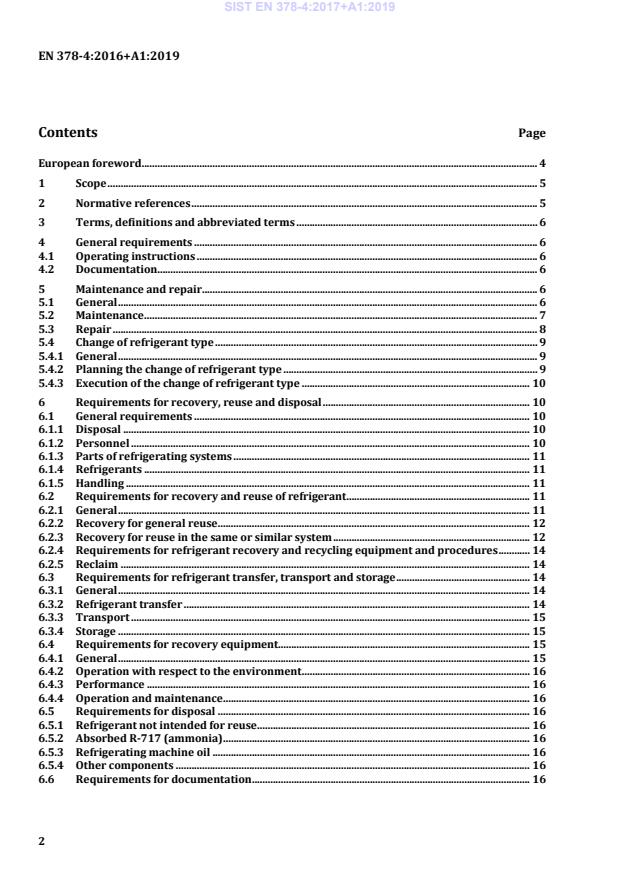
European foreword . 4
1 Scope . 5
2 Normative references . 5
3 Terms, definitions and abbreviated terms . 6
4 General requirements . 6
4.1 Operating instructions . 6
4.2 Documentation . 6
5 Maintenance and repair. 6
5.1 General . 6
5.2 Maintenance . 7
5.3 Repair . 8
5.4 Change of refrigerant type . 9
5.4.1 General . 9
5.4.2 Planning the change of refrigerant type . 9
5.4.3 Execution of the change of refrigerant type . 10
6 Requirements for recovery, reuse and disposal . 10
6.1 General requirements . 10
6.1.1 Disposal . 10
6.1.2 Personnel . 10
6.1.3 Parts of refrigerating systems . 11
6.1.4 Refrigerants . 11
6.1.5 Handling . 11
6.2 Requirements for recovery and reuse of refrigerant. 11
6.2.1 General . 11
6.2.2 Recovery for general reuse . 12
6.2.3 Recovery for reuse in the same or similar system . 12
6.2.4 Requirements for refrigerant recovery and recycling equipment and procedures . 14
6.2.5 Reclaim . 14
6.3 Requirements for refrigerant transfer, transport and storage . 14
6.3.1 General . 14
6.3.2 Refrigerant transfer . 14
6.3.3 Transport . 15
6.3.4 Storage . 15
6.4 Requirements for recovery equipment. 15
6.4.1 General . 15
6.4.2 Operation with respect to the environment . 16
6.4.3 Performance . 16
6.4.4 Operation and maintenance . 16
6.5 Requirements for disposal . 16
6.5.1 Refrigerant not intended for reuse . 16
6.5.2 Absorbed R-717 (ammonia) . 16
6.5.3 Refrigerating machine oil . 16
6.5.4 Other components . 16
6.6 Requirements for documentation . 16
Annex A (normative) Draining the oil from a refrigerating system . 17
A.1 General . 17
A.2 Ammonia systems . 17
A.2.1 General . 17
A.2.2 Draining procedure . 17
Annex B (informative) Guide specification for recycled refrigerant . 18
Annex C (informative) Handling and storage of refrigerants . 19
C.1 General . 19
C.2 Handling . 19
C.3 Storage . 20
C.4 Special provisions for handling ammonia vapour during maintenance or
decommissioning . 20
C.4.1 General . 20
C.4.2 Limitations of ammonia vapour absorption . 21
C.4.3 Procedure for ammonia vapour absorption . 21
C.4.4 Disposal of the aqua-ammonia solution . 22
Annex D (informative) !In-service inspection . 23
Annex E (informative) Guidelines for repairs of equipment using flammable refrigerants . 26
E.1 General requirements for equipment . 26
E.2 Repairs to electrical components . 26
E.2.1 Repairs to electrical components . 26
E.2.2 Repairs to sealed components . 26
E.2.3 Repairs to intrinsically safe components. 27
E.3 Repairs to refrigerating system. 27
E.4 Requirements for the competent persons . 28
Bibliography . 29
European foreword
This document (EN 378-4:2016+A1:2019) has been prepared by Technical Committee CEN/TC 182
“Refrigerating systems, safety and environmental requirements”, the secretariat of which is held by DIN.
This European Standard shall be given the status of a national standard, either by publication of an
identical text or by endorsement, at the latest by March 2020, and conflicting national standards shall
be withdrawn at the latest by March 2020.
Attention is drawn to the possibility that some of the elements of this document may be the subject of
patent rights. CEN shall not be held responsible for identifying any or all such patent rights.
This document includes Amendment 1 approved by CEN on 26 August 2019.
This document supersedes !EN 378-4:2016".
The start and finish of text introduced or altered by amendment is indicated in the text by tags !".
EN 378 consists of the following parts under the general title “Refrigerating systems and heat pumps —
Safety and environmental requirements”:
— Part 1: Basic requirements, definitions, classification and selection criteria;
— Part 2: Design, construction, testing, marking and documentation;
— Part 3: Installation site and personal protection;
— Part 4: Operation, maintenance, repair and recovery.
The main changes in part 4 with respect to the previous edition are listed below:
— harmonisation as far as possible with ISO 5149:2014;
— addition of vacuum procedure in 5.3.8;
— addition of moisture test in 6.2.3.
According to the CEN-CENELEC Internal Regulations, the national standards organisations of the
following countries are bound to implement this European Standard: Austria, Belgium, Bulgaria,
Croatia, Cyprus, Czech Republic, Denmark, Estonia, Finland, France, Germany, Greece, Hungary, Iceland,
Ireland, Italy, Latvia, Lithuania, Luxembourg, Malta, Netherlands, Norway, Poland, Portugal, Republic of
North Macedonia, Romania, Serbia, Slovakia, Slovenia, Spain, Sweden, Switzerland, Turkey and the
United Kingdom.
1 Scope
This European Standard specifies the requirements for the safety of persons and property, provides
guidance for the protection of the environment and establishes procedures for the operation,
maintenance and repair of refrigerating systems and the recovery of refrigerants.
The term “refrigerating system” used in this European Standard includes heat pumps.
This standard applies:
a) to refrigerating systems, stationary or mobile, of all sizes including heat pumps;
b) to secondary cooling or heating systems;
c) to the location of the refrigerating systems;
d) to parts replaced and components added after adoption of this standard if they are not identical in
function and capacity.
This standard does not cover “motor vehicle air conditioners” constructed according to product
standards such as ISO 13043.
Systems using refrigerants other than those listed in EN 378-1:2016, Annex E are not covered by this
standard unless they have been assigned to a safety class according to ISO 817.
This standard does not apply to goods in storage.
This standard is not applicable to refrigeration systems and heat pumps which were manufactured
before the date of its publication as a European Standard except for extensions and modifications to the
system which were implemented after publication.
This standard is applicable to new refrigerating systems, extensions or modifications of already existing
systems, and for existing stationary systems, being transferred to and operated on another site.
This standard also applies in the case of the conversion of a system to another refrigerant type, in which
case conformity to the relevant clauses of parts 1 to 4 of the standard shall be assessed.
This Part 4 of the European Standard specifies requirements for safety and environmental aspects in
relation to operation, maintenance, and repair of refrigerating systems and the recovery, reuse and
disposal of all types of refrigerant, refrigerant oil, heat-transfer fluid, refrigerating system and part
thereof.
These requirements are intended to minimise risks of injury to persons and damage to property and the
environment resulting from improper handling of the refrigerants or from contaminants leading to
system breakdown and resultant emission of the refrigerant.
Subclauses 4, 5.1.1 to 5.1.4, 5.2, 5.3.1, 5.3.3 and 6.6 of this European Standard are not applicable to
unitary systems having a power cord, being factory sealed, and in conformance with EN 60335 series.
2 Normative references
The following documents, in whole or in part, are normatively referenced in this document and are
indispensable for its application. For dated references, only the edition cited applies. For undated
references, the latest edition of the referenced document (including any amendments) applies.
EN 378-1:2016, Refrigerating systems and heat pumps — Safety and environmental requirements - Part
1: Basic requirements, definitions, classification and selection criteria
EN 378-2:2016, Refrigerating systems and heat pumps — Safety and environmental requirements —
Part 2: Design, construction, testing, marking and documentation
EN 378-3, Refrigerating systems and heat pumps — Safety and environmental requirements — Part 3:
Installation site and personal protection
ISO 11650, Performance of refrigerant recovery and/or recycling equipment
ISO 13043, Road vehicles — Refrigerant systems used in mobile air conditioning systems (MAC) — Safety
requirements
IEC 60335-2-104, Household and similar electrical appliances — Safety — Part 2-104: Particular
requirements for appliances to recover and/or recycle refrigerant from air conditioning and refrigeration
equipment
3 Terms, definitions and abbreviated terms
For the purposes of this document, the terms, definitions and abbreviated terms given in EN 378-
1:2016 apply.
4 General requirements
4.1 Operating instructions
4.1.1 Before a new refrigerating system is put into service, the person responsible for placing the
system in operation shall ensure that the operating personnel are instructed according to 4.1.2.
NOTE It is advisable that the operating personnel are present during evacuation, charging with refrigerant
and adjustment of the refrigerating system as well as, if possible, during assembly on site.
4.1.2 Care shall be taken to ensure that the personnel charged with the operation, supervision and
maintenance of the refrigerating system are adequately instructed and competent with respect to their
tasks, as well as the safety measures to be observed, and the properties and handling of the refrigerant
used. Typical in-service inspection requirements are shown in Annex D.
4.2 Documentation
The logbook shall be updated following any maintenance or repair. The logbook shall either be kept in
the machinery room, or the data shall be stored digitally by the operator with a printout in the
machinery room, in which case the information shall be accessible to the competent person when
servicing or testing.
5 Maintenance and repair
5.1 General
5.1.1 Each refrigerating system shall be subjected to preventive maintenance in accordance with the
instruction manual (see EN 378-2).
NOTE The frequency of such maintenance depends on the type, size, age, use, etc. of the system. In many
cases more than one maintenance service is required in the course of one year in accordance with legal
requirements.
5.1.2 The operator of the refrigerating system shall ensure that the system is inspected, regularly
supervised and maintained.
5.1.3 Systems should be subject to tightness inspection in accordance with Annex D by a competent
person. If, during the inspection the suspicion of a leak exists, e.g. through refrigerant temperature
checks or capacity reduction, then the leak shall be located with suitable detection equipment and shall
be repaired and checked again after the repair in accordance with national regulations. The results of
the inspection and measures taken afterwards shall be included in the logbook.
Refer to Annex D for detailed specification regarding in service inspection.
5.1.4 The operator of the refrigerating system shall also be responsible when another person uses the
refrigerating system, unless another division of responsibility has been agreed upon.
5.1.5 Regular maintenance which does not include work on, nor adjustment of, the refrigerating
system and which requires no specialized knowledge of refrigeration engineering shall be carried out
by a person of appropriate competence.
5.1.6 In the case of refrigerating systems located within a ventilated enclosure and considered as
indirect systems under EN 378-1, only authorized persons shall be permitted in the space surrounding
the enclosure during maintenance and repair operations because the separation between refrigerant
containing parts and occupants of the room is no longer effective and leaks of refrigerant into the
surrounding space become possible.
5.1.7 Any markings to the compressor or equipment shall be refreshed if any of the existing text has
become illegible.
5.1.8 The mixing of different refrigerants within a system shall not be permitted under any
circumstances. Change of the refrigerant type shall be in accordance with 5.4.
5.2 Maintenance
5.2.1 Maintenance shall be undertaken by a competent person in such a way that:
a) accidents to personnel are prevented;
b) damage to goods is prevented;
c) components of the system remain in good working order;
d) the purpose and availability of the system are maintained;
e) leakage of refrigerant or oil is identified and remedied;
f) waste of energy is minimised.
5.2.2 The extent and time schedule for maintenance shall be fully described in the instruction manual
(see EN 378-2).
5.2.3 If the discharge line of a pressure relief device is connected into a common discharge line and
the device is temporarily dismounted for reasons of testing and maintenance, the connecting ends of
the remaining ends entering into the common discharge header are to be blocked.
5.2.4 When a secondary cooling or heating system is used, the composition of the heat-transfer fluid
shall be periodically tested in accordance with the manufacturer’s instructions and the secondary
system shall be tested and inspected for the presence of refrigerant from the primary circuit.
5.2.5 Regular leak tests and inspections shall be carried out including checking of the safety
equipment.
NOTE See Annex D.
5.2.6 When oil is drained from a refrigerating system it shall be carried out safely in accordance with
the instruction manual. A procedure is provided in Annex A.
5.3 Repair
5.3.1 Repairs on refrigerant containing components shall be carried out by a competent person in the
following order, if appropriate:
a) conducting a hazard analysis and risk assessment for the proposed repair;
b) instructing the maintenance staff;
c) emptying, recovery and evacuating;
d) disconnecting and safeguarding of the components to be repaired (e.g. compressor, pressure vessel,
piping);
e) cleaning and purging (e.g. with nitrogen);
f) releasing for repair;
g) carrying out the repair;
h) testing and checking of the repaired component (pressure test, leakage test, functional test, see
EN 378-2);
i) evacuating and recharging with refrigerant.
5.3.2 Refrigerant leaks shall be identified and repaired without undue delay.
5.3.3 During each periodic maintenance the following tasks shall be performed:
a) all safety, control and measurement devices and alarm systems shall be checked to verify their
correct operation;
b) leakage tests shall be carried out at the relevant part of the refrigerating system.
This shall also apply where appropriate following any repair.
5.3.4 Maintenance and repair requiring the assistance of other skilled personnel (such as welders,
electricians, measuring and control specialists) shall be carried out under the supervision of a
competent person.
5.3.5 Welding and brazing shall only be carried out by competent personnel and only after the section
has been purged according to an approved procedure.
NOTE Welding or the use of arc-producing and flame-producing apparatus requires specific personnel and
welding or brazing procedure approvals.
5.3.6 Replacements of components or changes to the refrigerating system shall be ordered and
carried out by a competent person or, for systems that do not require periodic maintenance, by an
authorized repair service centre.
5.3.7 After a pressure relief valve, which discharges to atmosphere, has been actuated, it shall be
replaced if it is not tight.
5.3.8 The vacuum procedure shall be applied as follows. A stationary vacuum pump shall be
connected to the assembly or relevant part of an assembly and an absolute pressure of less than 270 Pa
shall be achieved. The achieved pressure should be maintained at this level for sufficient time after the
pump has been isolated from the assembly to ensure that the moisture has been removed and the
system is not leaking. For smaller systems a lower vacuum pressure may be necessary. The competent
person (according to EN 13313) that executes this operation, shall decide when the vacuum can be
broken and whether the vacuum procedure should be repeated. At the end of the vacuum procedure,
the assembly can be filled with the appropriate refrigerant. A certificate for the vacuum and filling
procedure shall be provided. This certificate indicates the method used, the results of the procedure, the
pressures applied and the duration of the test. A similar documentation in the logbook is regarded
equal.
5.4 Change of refrigerant type
5.4.1 General
In the event of a change of the refrigerant type used in the refrigerating system, the following planning
and execution activities shall be carried out and conformance to the relevant requirements of EN 378-1,
EN 378-2 and EN 378-3 shall be implemented where applicable.
5.4.2 Planning the change of refrigerant type
Before changing the refrigerant type a plan shall be prepared. It shall include at least the following
actions:
a) verify that the refrigerating system and components are suitable for the refrigerant type change;
b) examine all materials used in the refrigerating system to ensure they are compatible with the new
refrigerant type;
c) determine whether the existing lubricant type is suitable for use with the new refrigerant type;
d) verify that the system allowable pressure (PS) shall not be exceeded;
e) verify that the relief valve required discharge capacity is adequate for the new refrigerant type;
f) verify that the motor and switchgear current ratings are adequate for the new refrigerant type;
g) verify that the receiver is sufficiently large for the new refrigerant charge;
h) if the new refrigerant has a different classification, ensure that the consequences of the change of
refrigerant classification are addressed.
Guidance on equipment suitability for refrigerant type change should be sought from the original
equipment manufacturer, new refrigerant manufacturer and lubricant manufacturer, as appropriate.
5.4.3 Execution of the change of refrigerant type
Follow the recommendations of the equipment manufacturer, the compressor manufacturer, the
refrigerant supplier or apply the following procedure in accordance with the plan developed according
to 5.4.2:
a) record a full set of system operating parameters to establish baseline performance;
b) repair any issues identified by a);
c) conduct a thorough leak check and identify any joints and seals to be replaced;
d) recover the original refrigerant in accordance with 6.2;
e) drain the lubricant;
f) check whether the lubricant is in good condition. If not, then remove the residual lubricant from the
system;
g) change the joints, seals, indicating and control devices, filters, oil filters, driers and relief valves as
required;
h) conduct a thorough leak check and repair any joints and seals as required;
i) evacuate the system to less than 132 Pa absolute pressure;
j) charge with lubricant;
k) charge with refrigerant;
l) adjust indicating and control devices, including software modifications if required;
m) amend all indications as to the refrigerant type used, including the log book and documentation at
operating site;
n) record a full set of system operating parameters to compare with the previous baseline
performance.
6 Requirements for recovery, reuse and disposal
6.1 General requirements
6.1.1 Disposal
Disposal of refrigerating systems and parts shall be undertaken in accordance with national regulations.
6.1.2 Personnel
Recovery, reuse, recycle, reclaim and disposal shall only be undertaken by competent persons. See
Figure 1 for the relationship between the processes.
Figure 1 — Simplified representation of the relationship between the processes
6.1.3 Parts of refrigerating systems
All parts of refrigerating systems, e.g. refrigerant, oil, heat-transfer fluid, filter, drier, insulation material,
shall be recovered, reused and/or disposed of properly (see 6.5).
6.1.4 Refrigerants
All refrigerants shall be recovered for reuse, recycled or reclaimed for reuse, or shall be disposed of
properly (see 6.5).
Destruction of refrigerants shall require an authorised facility for destruction.
6.1.5 Handling
The method of handling of the refrigerant shall be decided before it is removed from the refrigerating
system or the equipment (see also Annex C).
Such decision shall be based upon considerations including:
— history of the refrigerating system;
— type and disposition of the refrigerant in the refrigerating system;
— reason for removal of the refrigerant from the refrigerating system;
— condition of the refrigerating system or the equipment and whether or not it is to be returned to
service.
6.2 Requirements for recovery and reuse of refrigerant
6.2.1 General
The directions given regarding the treatment of recovered refrigerant before reuse shall apply to all
types of refrigerant.
Dependent on the situation, recovered refrigerant shall follow one of the paths indicated in Figure 2.
Figure 2 — Flow chart for recovered refrigerant
6.2.2 Recovery for general reuse
Recovered refrigerants intended for reuse in refrigerating systems shall be reclaimed and shall comply
with the appropriate specification for new refrigerants.
NOTE Pass and fail criteria are outlined in AHRI 700:2015.
The acceptability shall be determined before reuse of the refrigerant.
6.2.3 Recovery for reuse in the same or similar system
6.2.3.1 For reuse in the same system
For halocarbon refrigerants, the following tests shall be carried out.
a) Acid test
The acid test uses the titration principle to detect any compound that ionises as an acid. The test
−6
requires a sample of between 100 g and 120 g and has a lower detection limit of 0,1 × 10 by mass
(as HCl).
If the acid test fails, the total refrigerant charge shall undergo a recycling or reclaiming process, and
the filter drier(s) in the refrigerating system shall be replaced.
NOTE 1 Pass and fail criteria are outlined in AHRI 700:2015.
Such a test is usually not required if recovery is from a refrigerating system during its manufacture.
NOTE 2 Refrigerant recovered from a refrigerating system (e.g. removed overcharge, refrigerant taken out
for system service, local non-contaminating repair, major overhaul or replacement of a component) can
normally be returned to the same system.
When a refrigerating system has been taken out of service because of heavy contamination of the
refrigerant or motor burnout, the refrigerant shall be reclaimed or disposed of properly.
The evacuation and charging procedures specified in this European Standard shall be followed
when returning the refrigerant to the refrigerating system.
NOTE 3 It is recommended that the refrigerant is recharged through a filter drier to remove moisture
which may have contaminated the fluid during recovery.
b) Moisture test
The Coulometric Karl Fischer Titration shall be used for determining the water content of
refrigerants. This method can be used for refrigerants that are either a liquid or a gas at room
temperature. For all refrigerants, the sample for water analysis shall be taken from the liquid phase
of the container to be tested.
If the moisture test fails, the total refrigerant charge shall undergo a recycling or reclaiming
process, and the filter drier(s) in the refrigerating system shall be replaced.
6.2.3.2 For use in a similar system
The use of recycled refrigerant in a refrigerating system, which is similar in function and components,
shall comply with the following requirements:
— the system is serviced by the competent person or company who recycled the refrigerant;
— the recycling equipment complies with the requirements of 6.2.4;
— the history of the refrigerant and the refrigerating system is known from the date of
commissioning;
— the competent person or company informs the operator when recycled refrigerant is used and the
source from which it comes and the result of the tests or, if necessary, of the analysis.
For halocarbon refrigerants, tests shall be carried out in accordance with 6.2.3.1.
If any of the above conditions is not met or the history of the refrigerant indicates a heavy
contamination of the refrigerant, e.g. motor burnout, then the refrigerant shall be either reclaimed or
disposed of properly.
A recycled refrigerant should comply with the specifications in Annex B.
6.2.4 Requirements for refrigerant recovery and recycling equipment and procedures
Recovery and recycling equipment shall comply with IEC 60335-2-104 and for halocarbon refrigerants
with ISO 11650.
Equipment shall be regularly inspected to verify that equipment and instruments are well maintained
and in good order. Equipment and instruments shall be function tested and calibrated regularly.
6.2.5 Reclaim
6.2.5.1 Analysis
A refrigerant sent for reclaim shall be analysed and either reclaimed or disposed of properly.
6.2.5.2 Specification
After the refrigerant has been reclaimed it shall meet the specifications for new refrigerant.
NOTE Reclaimed refrigerant can be used as new refrigerant.
6.3 Requirements for refrigerant transfer, transport and storage
6.3.1 General
Appropriate safety practices shall be followed during transfer of refrigerant from a refrigerating system
to a refrigerant container for transport or storage.
6.3.2 Refrigerant transfer
6.3.2.1 Procedure
Transfer/evacuation of the refrigerant shall be carried out as follows:
a) If the compressor of the refrigerating system cannot be used for the transfer, refrigerant recovery
equipment shall be connected to the refrigerating system in order to transfer the refrigerant, either
into another part of the refrigerating system, or into a separate container.
b) Before service, repair, etc., which involves opening the system, the pressure of the refrigerating
system or of the relevant parts shall be reduced to 30 kPa absolute or lower.
Thereafter the pressure can be further reduced using a vacuum pump before breaking the vacuum with
dry, oxygen-free nitrogen.
Atmospheric pressure is acceptable for R-744 (carbon dioxide) systems.
c) Before disposal of the refrigerating system, the refrigerating system or its parts shall be evacuated
down to a pressure of 30 kPa absolute or lower.
NOTE 1 The above pressures apply in an ambient temperature of 20 °C. For other temperatures the pressure
will need to be changed accordingly.
NOTE 2 The time required for transfer or emptying is dependent on the pressure. The process should only be
stopped when the pressure remains constant after switching off the compressor of the recovery machine.
6.3.2.2 Refrigerant container
The refrigerant shall only be transferred to a container suitable for the specific refrigerant involved.
The container shall be clearly identified and marked by a colour code or otherwise as being intended to
hold the refrigerant involved.
NOTE 1 AHRI Guideline N provides information on colour coding.
The container with recovered refrigerant shall be specifically marked to note any special conditions, e.g.
“R-407C — Recovered — Do not use before investigation” or “R-717 (Ammonia) — Recovered”.
NOTE 2 National regulations sometimes give a specific colour for recovery cylinders.
NOTE 3 In the case of transport, it is the responsibility of the person recovering the refrigerant to ensure that
the recovery cylinder complies with the ADR legislation (European Agreement Concerning the International
Carriage of Dangerous Goods by Road 1999).
6.3.2.3 Disposable container
A disposable “one way” container shall not be used because of the possibility of the remaining gas
content being discharged into the atmosphere when the container is discarded.
6.3.2.4 Container filling
The refrigerant container shall not be overfilled.
When a container is filled with refrigerant, the maximum charge shall always be observed, taking into
account that possible refrigerant-oil mixtures have a lower density than pure refrigerant. The usable
container capacity shall therefore be reduced for a refrigerant-oil mixture (80 % of maximum
refrigerant charge or 70 % bottle volume, whichever is lower) controlled by mass.
The allowable pressure of the container shall not be exceeded, even temporarily, during any operation.
NOTE 1 Special valves can be fitted to the refrigerant container to avoid the possibility of overfilling.
NOTE 2 Additional information can be found in C.2.
6.3.2.5 Different refrigerants
Different refrigerants shall not be mixed and shall be stored in different containers.
A refrigerant shall not be placed in a container that contains a different or an unknown refrigerant.
An unknown refrigerant already in a container is not to be vented to the atmosphere but shall be
identified and reclaimed or shall be disposed of properly.
NOTE A refrigerant contaminated with another refrigerant may make it impossible to reclaim.
6.3.3 Transport
Refrigerants shall be transported in a safe manner.
6.3.4 Storage
Refrigerants shall be stored in a safe manner.
NOTE Additional information can be found in C.3.
6.4 Requirements for recovery equipment
6.4.1 General
The recovery equipment draws refrigerant/oil out of the refrigerating system and transfers it into a
container in a safe manner, and shall be leak-tight.
Refrigerant recovery machines shall conform to the relevant safety standard e.g. IEC 60335-2-104.
NOTE The equipment can employ replaceable core filter driers to remove moisture, acid, particles and other
contaminants.
6.4.2 Operation with respect to the environment
The recovery equipment shall be operated in such a way as to minimise the risk of emission of
refrigerants or oil to the environment.
6.4.3 Performance
The recovery equipment shall at a temperature of 20 °C be able to operate down to a final pressure of
30 kPa absolute.
NOTE A method for measuring the performance of this equipment is contained in ISO 11650.
6.4.4 Operation and maintenance
The recovery equipment and filters shall be operated and maintained in accordance with ISO 11650 and
the specifications of the manufacturer of the recovery equipment.
When changing replaceable core filter driers in the recovery equipment, the section containing the
filters should be isolated and the refrigerant should be transferred into a suitable storage container
prior to opening the filter shell. Any air introduced into the recovery equipment during the core change
should be removed by evacuation and not by flushing out or purging out with the refrigerant.
6.5 Requirements for disposal
6.5.1 Refrigerant not intended for reuse
Used refrigerant, which is not intended for reuse, shall be dealt with as waste for safe disposal.
Discharge of refrigerants shall only be permitted in a manner which is not harmful to persons, property
and the environment and in accordance with legal requirements.
6.5.2 Absorbed R-717 (ammonia)
After absorbing ammonia in water, the “mixture” shall be dealt with as waste for safe disposal.
NOTE Additional information can be found in C.4.
6.5.3 Refrigerating machine oil
Used oil, which cannot be reprocessed, shall be stored in a separate appropriate container and shall be
dealt with as waste for safe disposal.
6.5.4 Other components
Other components of the refrigerating system containing refrigerant or oil shall be disposed of
appropriately.
When necessary, a person competent in dealing with the disposal of refrigerants and oils should be
consulted.
6.6 Requirements for documentation
All operations of recovery and reuse of refrigerant, and its source, shall be recorded in the logbook of
the refrigerating system (see 4.2). If requested, a certificate shall be supplied by the refrigerant supplier
or by the service company.
Annex A
(normative)
...
Questions, Comments and Discussion
Ask us and Technical Secretary will try to provide an answer. You can facilitate discussion about the standard in here.
Loading comments...