

SIST EN 10244-2:2023
(Main)Steel wire and wire products - Non-ferrous metallic coatings on steel wire - Part 2: Zinc or zinc alloy coatings
General Information
- Abstract
This document specifies the requirement for coating mass, other properties and testing of zinc and zinc alloy coatings on steel wire and steel wire products of circular or other section.
- Status
- Published
- Public Enquiry End Date
- 25-Oct-2022
- Publication Date
- 16-Aug-2023
- Technical Committee
- IFEK - Ferrous metals
- Current Stage
- 6060 - National Implementation/Publication (Adopted Project)
- Start Date
- 06-Jul-2023
- Due Date
- 10-Sep-2023
- Completion Date
- 17-Aug-2023

Overview
EN 10244-2:2023 - published by CEN - specifies requirements and test methods for zinc and zinc-alloy (non‑ferrous) coatings on steel wire and steel wire products of circular or other section. The standard covers coating material quality, coating mass, appearance, adherence and specific test procedures (gravimetric and volumetric mass determination, dipping/immersion test, wrapping/adherence checks). It supersedes EN 10244-2:2009 and is intended for use across CEN member countries.
Key topics and technical requirements
- Scope and purpose: Defines minimum coating mass, other coating properties and testing for Zn and Zn‑alloy coatings on steel wire.
- Coating material requirements: Zinc and alloys shall comply with EN 1179; Zn‑Al alloys reference ASTM B997. Zinc ingots for coatings are typically ≥ 99.95 % purity; electrolytic coatings ≥ 99 % zinc.
- Coating classes: Classes include A, AB, B, C, D, E (A = thick/heavy coatings; AB and others for specific processes). A “regular coating” is defined where no class is specified (minimum 1 g Zn per kg of coated wire - equivalent to coating mass g/m ≥ 2 × wire diameter in mm).
- Mass requirements: Tabulated minimum zinc mass per unit surface area (g/m² or g/m) given by diameter ranges and coating class (see Tables 1 and 2 for Zn and Zn‑Al requirements).
- Appearance and special finishes: Coating should be reasonably smooth and uniform; special finishes (drawing after galvanizing, wax, polished) must be specified at enquiry/order.
- Adherence: Coating adherence assessed by wrapping/wrapping test per EN 10218‑1 (and ISO 7802 reference). Visual/coiling comparison charts support a 1–5 adherence rating.
- Test methods:
- Gravimetric method (reference method) and gaseous volumetric method (faster, routine testing) for coating mass.
- Dipping/immersion test: Procedure and minimum number/duration of dips are provided (Table 3); Zn‑Al alloys have shorter dip durations (e.g., 45 s or 22 s equivalents).
- Sampling rules and precautions for test-piece selection are included.
Applications and users
This standard is essential for:
- Steel wire manufacturers and galvanizers specifying or verifying coating quality.
- Wire product makers (wire ropes, link chains, drawn wires) and OEMs requiring defined corrosion protection levels.
- Procurement/specification writers and quality/inspection labs performing routine or dispute testing.
- Designers and engineers who need consistent corrosion protection data for steel wire components.
Related standards
- EN 10244-1: Non‑ferrous metallic coatings - Part 1: General principles
- EN 1179: Zinc and zinc alloys - Primary zinc
- EN 10218-1: Steel wire and wire products - General - Part 1: Test methods
- ASTM B997: Zn‑Al alloy coatings (referenced for Zn‑Al alloys)
Keywords: EN 10244-2:2023, CEN, steel wire, zinc coating, zinc alloy coatings, coating mass, dipping test, gravimetric, volumetric, zinc‑aluminium, EN 1179, EN 10244-1.
Relations
- Effective Date
- 08-Apr-2026
- Effective Date
- 28-Jan-2026
- Effective Date
- 28-Jan-2026
- Effective Date
- 28-Jan-2026
- Effective Date
- 28-Jan-2026
- Effective Date
- 28-Jan-2026
- Effective Date
- 28-Jan-2026
- Effective Date
- 28-Jan-2026
- Effective Date
- 28-Jan-2026
- Effective Date
- 28-Jan-2026
- Effective Date
- 28-Jan-2026
- Effective Date
- 28-Jan-2026
- Effective Date
- 28-Jan-2026
- Effective Date
- 28-Jan-2026
- Effective Date
- 28-Jan-2026
Get Certified
Connect with accredited certification bodies for this standard

DVS-ZERT GmbH
German welding certification society.

Element Materials Technology
Materials testing and product certification.
Inštitut za kovinske materiale in tehnologije
Institute of Metals and Technology. Materials testing, metallurgical analysis, NDT.
Sponsored listings
Frequently Asked Questions
SIST EN 10244-2:2023 is a standard published by the Slovenian Institute for Standardization (SIST). Its full title is "Steel wire and wire products - Non-ferrous metallic coatings on steel wire - Part 2: Zinc or zinc alloy coatings". This standard covers: This document specifies the requirement for coating mass, other properties and testing of zinc and zinc alloy coatings on steel wire and steel wire products of circular or other section.
This document specifies the requirement for coating mass, other properties and testing of zinc and zinc alloy coatings on steel wire and steel wire products of circular or other section.
SIST EN 10244-2:2023 is classified under the following ICS (International Classification for Standards) categories: 25.220.40 - Metallic coatings; 77.140.65 - Steel wire, wire ropes and link chains. The ICS classification helps identify the subject area and facilitates finding related standards.
SIST EN 10244-2:2023 has the following relationships with other standards: It is inter standard links to SIST EN 16820:2026, SIST EN 12385-1:2003+A1:2008, SIST EN 845-1:2013+A1:2016, SIST EN 10223-3:2014, SIST EN 10264-2:2012, SIST EN 845-3:2013, SIST EN 12115:2021, SIST EN 10264-3:2012, SIST EN 1090-2:2008+A1:2012, SIST EN 1090-2:2018+A1:2024, SIST EN 845-3:2004+A1:2008, SIST EN ISO 21809-5:2017, SIST EN 845-1:2004+A1:2008, SIST EN 10230-1:2000, SIST EN 14195:2015. Understanding these relationships helps ensure you are using the most current and applicable version of the standard.
SIST EN 10244-2:2023 is available in PDF format for immediate download after purchase. The document can be added to your cart and obtained through the secure checkout process. Digital delivery ensures instant access to the complete standard document.
Standards Content (Sample)
SLOVENSKI STANDARD
01-september-2023
Jeklena žica in žični izdelki - Neželezne kovinske prevleke na jekleni žici - 2. del:
Prevleke iz cinka in cinkovih zlitin
Steel wire and wire products - Non-ferrous metallic coatings on steel wire - Part 2: Zinc
or zinc alloy coatings
Stahldraht und Drahterzeugnisse - Überzüge aus Nichteisenmetall auf Stahldraht - Teil
2: Überzüge aus Zink oder Zinklegierungen
Fils et produits tréfilés en acier - Revêtements métalliques non ferreux sur fils d'acier -
Partie 2 : Revêtement de zinc ou d'alliage de zinc
Ta slovenski standard je istoveten z: EN 10244-2:2023
ICS:
25.220.40 Kovinske prevleke Metallic coatings
77.140.65 Jeklene žice, jeklene vrvi in Steel wire, wire ropes and
verige link chains
2003-01.Slovenski inštitut za standardizacijo. Razmnoževanje celote ali delov tega standarda ni dovoljeno.
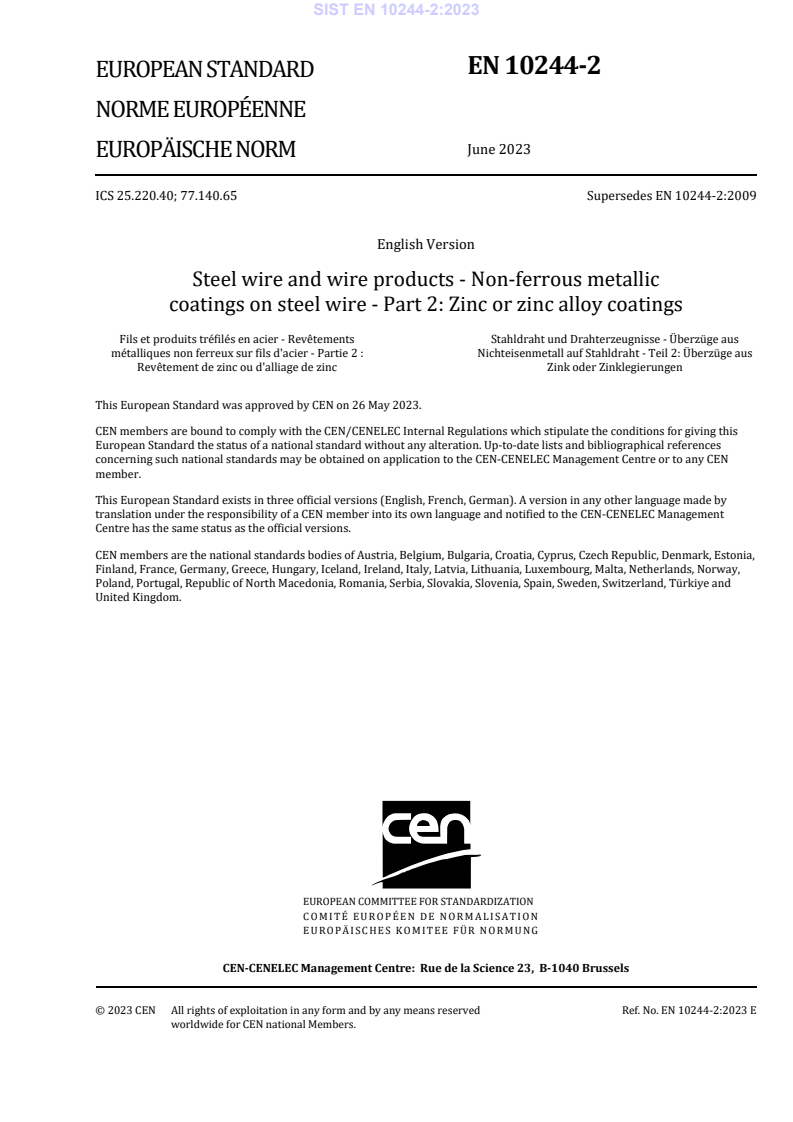
EN 10244-2
EUROPEAN STANDARD
NORME EUROPÉENNE
June 2023
EUROPÄISCHE NORM
ICS 25.220.40; 77.140.65 Supersedes EN 10244-2:2009
English Version
Steel wire and wire products - Non-ferrous metallic
coatings on steel wire - Part 2: Zinc or zinc alloy coatings
Fils et produits tréfilés en acier - Revêtements Stahldraht und Drahterzeugnisse - Überzüge aus
métalliques non ferreux sur fils d'acier - Partie 2 : Nichteisenmetall auf Stahldraht - Teil 2: Überzüge aus
Revêtement de zinc ou d'alliage de zinc Zink oder Zinklegierungen
This European Standard was approved by CEN on 26 May 2023.
CEN members are bound to comply with the CEN/CENELEC Internal Regulations which stipulate the conditions for giving this
European Standard the status of a national standard without any alteration. Up-to-date lists and bibliographical references
concerning such national standards may be obtained on application to the CEN-CENELEC Management Centre or to any CEN
member.
This European Standard exists in three official versions (English, French, German). A version in any other language made by
translation under the responsibility of a CEN member into its own language and notified to the CEN-CENELEC Management
Centre has the same status as the official versions.
CEN members are the national standards bodies of Austria, Belgium, Bulgaria, Croatia, Cyprus, Czech Republic, Denmark, Estonia,
Finland, France, Germany, Greece, Hungary, Iceland, Ireland, Italy, Latvia, Lithuania, Luxembourg, Malta, Netherlands, Norway,
Poland, Portugal, Republic of North Macedonia, Romania, Serbia, Slovakia, Slovenia, Spain, Sweden, Switzerland, Türkiye and
United Kingdom.
EUROPEAN COMMITTEE FOR STANDARDIZATION
COMITÉ EUROPÉEN DE NORMALISATION
EUROPÄISCHES KOMITEE FÜR NORMUNG
CEN-CENELEC Management Centre: Rue de la Science 23, B-1040 Brussels
© 2023 CEN All rights of exploitation in any form and by any means reserved Ref. No. EN 10244-2:2023 E
worldwide for CEN national Members.
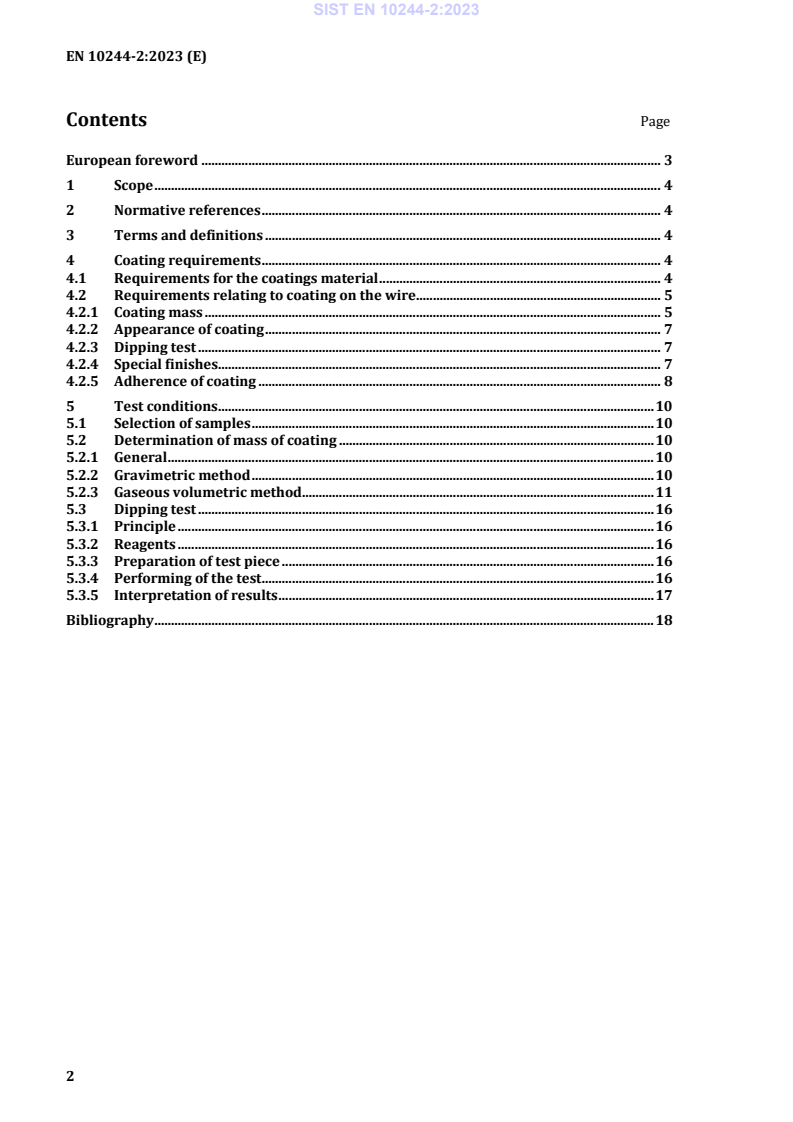
Contents Page
European foreword . 3
1 Scope . 4
2 Normative references . 4
3 Terms and definitions . 4
4 Coating requirements . 4
4.1 Requirements for the coatings material . 4
4.2 Requirements relating to coating on the wire . 5
4.2.1 Coating mass . 5
4.2.2 Appearance of coating . 7
4.2.3 Dipping test . 7
4.2.4 Special finishes . 7
4.2.5 Adherence of coating . 8
5 Test conditions . 10
5.1 Selection of samples . 10
5.2 Determination of mass of coating . 10
5.2.1 General . 10
5.2.2 Gravimetric method . 10
5.2.3 Gaseous volumetric method. 11
5.3 Dipping test . 16
5.3.1 Principle . 16
5.3.2 Reagents . 16
5.3.3 Preparation of test piece . 16
5.3.4 Performing of the test . 16
5.3.5 Interpretation of results . 17
Bibliography . 18
European foreword
This document (EN 10244-2:2023) has been prepared by Technical Committee CEN/TC 459 “ECISS –
European Committee for Iron and Steel Standardization” , the secretariat of which is held by AFNOR.
This European Standard shall be given the status of a national standard, either by publication of an
identical text or by endorsement, at the latest by December 2023, and conflicting national standards
shall be withdrawn at the latest by December 2023.
Attention is drawn to the possibility that some of the elements of this document may be the subject of
patent rights. CEN shall not be held responsible for identifying any or all such patent rights.
This document supersedes EN 10244-2:2009.
In comparison with the previous edition, the following technical modifications have been made:
— the reference towards ASTM B750 for Zn-Alu alloys has been changed to ASTM B997;
— dipping test better specified for Zinc-Alu alloy coatings (see Table 3).
This European Standard series for non-ferrous metallic coating on steel wire is made up of the following
parts:
— Part 1: General principles
— Part 2: Zinc or zinc alloy coatings
— Part 3: Aluminium coatings
— Part 4: Tin coatings
— Part 5: Nickel coatings
— Part 6: Copper, bronze or brass coatings
Any feedback and questions on this document should be directed to the users’ national standards body.
A complete listing of these bodies can be found on the CEN website.
According to the CEN-CENELEC Internal Regulations, the national standards organisations of the
following countries are bound to implement this European Standard: Austria, Belgium, Bulgaria,
Croatia, Cyprus, Czech Republic, Denmark, Estonia, Finland, France, Germany, Greece, Hungary, Iceland,
Ireland, Italy, Latvia, Lithuania, Luxembourg, Malta, Netherlands, Norway, Poland, Portugal, Republic of
North Macedonia, Romania, Serbia, Slovakia, Slovenia, Spain, Sweden, Switzerland, Türkiye and the
United Kingdom.
Through its sub-committee SC 6 “Wire rod and wires” (secretariat: AFNOR).
1 Scope
This document specifies the requirement for coating mass, other properties and testing of zinc and zinc
alloy coatings on steel wire and steel wire products of circular or other section.
2 Normative references
The following documents are referred to in the text in such a way that some or all of their content
constitutes requirements of this document. For dated references, only the edition cited applies. For
undated references, the latest edition of the referenced document (including any amendments) applies.
EN 1179, Zinc and zinc alloys — Primary zinc
EN 10218-1, Steel wire and wire products — General — Part 1: Test methods
EN 10244-1, Steel wire and wire products — Non-ferrous metallic coatings on steel wire — Part 1: General
principles
3 Terms and definitions
For the purposes of this document, the following terms and definitions apply.
ISO and IEC maintain terminology databases for use in standardization at the following addresses:
— IEC Electropedia: available at https://www.electropedia.org/
— ISO Online browsing platform: available at https://www.iso.org/obp/
3.1
wire with zinc or zinc alloy coating
wire to which zinc or zinc alloy coating has first been applied to protect it against corrosion
Note 1 to entry: The coating method may be hot dipping in a bath of molten zinc or by means of an aqueous
solution of suitable electrolyte. In the hot dipping process wiping media may be used to modify the mass of coating.
3.2
zinc or zinc alloy coating
zinc to which other elements are deliberately added in order to obtain particular characteristics
Note 1 to entry: In all cases, the quantity of zinc in the alloy shall be minimum 50 %. The most common alloy
elements are aluminium, tin and nickel, but other elements may also be considered.
3.3
mass of coating
mass of zinc per unit of surface area expressed in grams per square metre of surface of bare wire
4 Coating requirements
4.1 Requirements for the coatings material
The zinc or zinc alloy used for the coating shall comply with the standard EN 1179. For zinc-alloy grades
not mentioned in the EN, the alloy shall be specified at the time of enquiry and order. For Zn-Al alloys,
reference is made to ASTM B997.
The ingot of the material used for the zinc coating shall be of minimum 99,95 % purity (according to Z3
of EN 1179) unless otherwise stated in the relevant product standard or other specification in the order.
Coatings applied by electrolysis shall contain a minimum of 99 % zinc.
4.2 Requirements relating to coating on the wire
4.2.1 Coating mass
The minimum mass of zinc per unit of surface area of the wire shall comply with the requirements of
Table 1.
Table 1 — Mass requirements for a coating of Zn
a
Classes
Diameter d
b
A AB B C D
A x 3
mm
2 2 2 2 2 2
g/m g/m g/m g/m g/m g/m
0,15 ≤ d < 0,20 — — 15 — 10 —
0,20 ≤ d < 0,25 30 20 20 20 15 —
0,25 ≤ d < 0,32 45 30 30 25 15 —
0,32 ≤ d < 0,40 60 30 30 25 15 —
0,40 ≤ d < 0,50 85 55 40 30 15 —
0,50 ≤ d < 0,60 100 70 50 35 20 —
0,60 ≤ d < 0,70 115 80 60 40 20 —
0,70 ≤ d < 0,80 130 90 60 45 20 —
0,80 ≤ d < 0,90 145 100 70 50 20 —
0,90 ≤ d < 1,00 155 110 70 55 25 —
1,00 ≤ d < 1,20 165 115 80 60 25 —
1,20 ≤ d <1,40 180 125 90 65 25 540
1,40 ≤ d < 1,65 195 135 100 70 30 585
1,65 ≤ d < 1,85 205 145 100 75 30 615
1,85 ≤ d < 2,15 215 155 115 80 40 645
2,15 ≤ d < 2,50 230 170 125 85 45 690
2,50 ≤ d < 2,80 245 185 125 95 45 735
2,80 ≤ d < 3,20 255 195 135 100 50 765
3,20 ≤ d < 3,80 265 210 135 105 60 795
3,80 ≤ d < 4,40 275 220 135 110 60 825
4,40 ≤ d < 5,20 280 220 150 110 70 840
5,20 ≤ d < 8,20 290 — — 110 80 870
8,20 ≤ d ≤ 10,00 300 — — 110 80 900
a
The coating class with a designation starting with A relates to thick coatings (generally final coating).
Designations ending in B relate to classes usually but not always obtained by (zinc coating) and
subsequent drawing. Classes C and D are standard classes for low mass coating which are usually
produced, but not exclusively produced, by hot zinc dipping and then wiping.
b
A x 3 relates to very high mass requirement three times higher than class A. Other multiples of Class
A are possible and these classes will be identified in the same way, e.g. A x 4.
If no class of zinc coating or no coating mass is specified in the coating it shall be called “regular coating”.
Such a coating shall be not less than 1 g zinc mass per Kg of zinc coated wire (equivalent to the coating
mass in g/m not less than two times the wire diameter expressed in mm).
The requirements for zinc-aluminium coatings are given in Table 2.
Table 2 — Mass requirements for a coating of ZnAl alloy
a
Mass of coating
g/m
Diameter
mm
b
A AB B E
0,20 ≤ d < 0,25 — 20 20
0,25 ≤ d < 0,40 — 30 30
0,40 ≤ d < 0,50 85 55 40
0,50 ≤ d < 0,60 100 70 50
0,60 ≤ d < 0,70 115 80 60 40
0,70 ≤ d < 0,80 130 90 60
0,80 ≤ d < 0,90 145 100 70
0,90 ≤ d < 1,00 155 110 70
1,00 ≤ d < 1,20 165 115 80
1,20 ≤ d < 1,40 180 125 90
1,40 ≤ d < 1,65 195 135 100
1,65 < d < 1,85 205 145 100
1,85 ≤ d < 2,15 215 155 115
2,15 ≤ d < 2,50 230 170 125
2,50 ≤ d < 2,80 245 185 125
2,80 ≤ d < 3,20 255 195 135
3,20 ≤ d < 3,80 265 210 135
3,80 ≤ d < 4,40 275 220 135
4,40 ≤ d < 5,20 280 220 150
5,20 ≤ d < 8,20 290 — —
8,20 ≤ d < 10,00 300 — —
a
The coating class with a designation starting with A relates to thick coatings (generally final coating).
Designations ending in B relate to classes usually but not always obtained by (zinc coating) and subsequent
drawing.
b
The corrosion resistance of this class E shall be at least equivalent of these from a zinc coating according to
Table 1 class B.
For other zinc alloy coatings, the manufacturer and supplier shall agree on the required coating mass.
4.2.2 Appearance of coating
The coating applied to the wire shall be reasonably smooth and as evenly distributed as industrial
technology allows and not show discontinuities such as bare patches, dross contamination, etc.
NOTE The zinc-aluminium alloy might show difference in colour and become darker with time. This does not
affect the corrosion protection performance.
4.2.3 Dipping test
When specified, the dipping (immersion) test shall be carried out according to the procedure detailed
in 5.3. However, it should be pointed out that there is no correlation between the number of dips and
the mass of the coating and the result is influenced as much by the conditions of manufacture of the
coating as by the uniformity of the coating.
Table 3 gives the minimum number of immersions for coatings of classes A and AB.
The dipping test does not apply to class B, C and D and E.
Table 3 — Minimum number of dips
Class A of coating Class AB of coating
Nominal diameter
Number of dips Number of dips
mm
a b a b
of 1 min of 1/2 min of 1 min of 1/2 min
0,40 ≤ d < 0,60 — 1 — —
0,60 ≤ d < 0,90 1 — — 1
0,90 ≤ d < 1,00 1 1 — 1
1,00 ≤ d < 1,40 1 1 1 —
1,40 ≤ d < 1,65 2 — 1 —
1,65 ≤ d < 1,85 2 — 1 —
1,85 ≤ d < 2,15 2 — 1 1
2,15 ≤ d < 2,80 2 1 1 1
2,80 ≤ d < 4,40 3 — 2 —
4,40 ≤ d < 5,20 3 1 2 —
5,20 ≤ d < 8,20 3 1 — —
8,20 ≤ d < 10,00 4 — — —
a
For Zinc-Alu alloy coatings, one dip equals 45 s instead of 1 min.
b
For Zinc-Alu alloy coatings, one dip equals
...