

SIST EN 16079:2024
(Main)Founding - Compacted (vermicular) graphite cast irons
General Information
- Abstract
This document defines the grades and the corresponding requirements for compacted (vermicular) graphite cast irons.
This document specifies 4 grades of compacted (vermicular) graphite cast iron by a classification based on the minimum mechanical properties measured on machined test pieces prepared from cast samples or samples cut from a casting.
This document does not cover technical delivery conditions for iron castings (see EN 1559-1 [1] and EN 1559-3 [2]).
- Status
- Published
- Public Enquiry End Date
- 28-Feb-2021
- Publication Date
- 07-Jan-2024
- Technical Committee
- IFEK - Ferrous metals
- Current Stage
- 6060 - National Implementation/Publication (Adopted Project)
- Start Date
- 03-Jan-2024
- Due Date
- 09-Mar-2024
- Completion Date
- 08-Jan-2024

Overview
EN 16079:2023 (CEN) specifies grades and requirements for compacted (vermicular) graphite cast irons (CGI). The standard classifies CGI into four material grades based on minimum mechanical properties measured on machined test pieces prepared from cast samples or from samples cut from a casting. EN 16079 focuses on mechanical-property-based designation, section sensitivity (wall-thickness dependence), sampling and test methods - it does not cover technical delivery conditions for iron castings (see EN 1559-1 and EN 1559-3).
Key Topics and Requirements
- Material grades: Four CGI grades are defined by minimum mechanical properties; designation is given by symbol or number (example format: EN‑GJV‑300).
- Mechanical-property basis: Grade designation is based on minimum tensile properties measured on cast samples with a reference size (cast samples of 25 mm thickness/diameter; designation refers to properties for t ≤ 30 mm).
- Sample types: Test pieces may be prepared from separately cast samples, side-by-side cast samples, cast-on samples, or samples cut from the casting - each with defined sampling rules.
- Test methods: The standard references tensile testing, hardness testing and graphite-structure examination (see Clauses 9.x). Tests follow established ISO/EN methods (e.g., EN ISO 6892-1 for tensile testing, EN ISO 6506-1 for Brinell hardness).
- Microstructure & nodularity: Graphite form, nodularity and matrix (ferrite/pearlite) are important; Annex B gives nodularity evaluation procedures and reference images for consistent assessment.
- Section sensitivity: EN 16079 highlights that CGI properties vary with wall thickness; casting design and sample selection must reflect relevant wall thickness for intended application.
- Documentation and retesting: Clauses cover inspection documentation, retest rules, and invalid/nonconforming test results handling.
Applications - Who Uses EN 16079
- Foundries producing compacted (vermicular) graphite cast irons (CGI) for engine blocks, pump housings, cylinder liners, and structural castings.
- Design and component engineers specifying material grades by mechanical requirement rather than only chemistry.
- Quality, metallurgical and inspection teams performing sampling, tensile/hardness testing and microstructural evaluation.
- Procurement and compliance professionals referencing European CGI grade designations in contracts and technical specifications.
Related Standards
- EN 1559-1 / EN 1559-3 - Technical delivery conditions for iron castings (not covered by EN 16079)
- EN ISO 945-1 - Graphite classification by visual analysis
- EN ISO 6892-1 - Tensile testing at room temperature
- EN ISO 6506-1 - Brinell hardness test
- EN 10204 - Types of inspection documents
EN 16079:2023 is essential for specifying and verifying CGI mechanical performance, ensuring consistent material selection, testing and acceptance across the foundry and design chain.
Relations
- Effective Date
- 28-Jan-2026
- Effective Date
- 28-Jan-2026
- Effective Date
- 28-Jan-2026
- Effective Date
- 28-Jan-2026
- Effective Date
- 28-Jan-2026
- Effective Date
- 28-Jan-2026
- Effective Date
- 19-Jan-2023
Get Certified
Connect with accredited certification bodies for this standard

Element Materials Technology
Materials testing and product certification.

Inštitut za kovinske materiale in tehnologije
Institute of Metals and Technology. Materials testing, metallurgical analysis, NDT.
Sponsored listings
Frequently Asked Questions
SIST EN 16079:2024 is a standard published by the Slovenian Institute for Standardization (SIST). Its full title is "Founding - Compacted (vermicular) graphite cast irons". This standard covers: This document defines the grades and the corresponding requirements for compacted (vermicular) graphite cast irons. This document specifies 4 grades of compacted (vermicular) graphite cast iron by a classification based on the minimum mechanical properties measured on machined test pieces prepared from cast samples or samples cut from a casting. This document does not cover technical delivery conditions for iron castings (see EN 1559-1 [1] and EN 1559-3 [2]).
This document defines the grades and the corresponding requirements for compacted (vermicular) graphite cast irons. This document specifies 4 grades of compacted (vermicular) graphite cast iron by a classification based on the minimum mechanical properties measured on machined test pieces prepared from cast samples or samples cut from a casting. This document does not cover technical delivery conditions for iron castings (see EN 1559-1 [1] and EN 1559-3 [2]).
SIST EN 16079:2024 is classified under the following ICS (International Classification for Standards) categories: 77.080.10 - Irons; 77.140.80 - Iron and steel castings. The ICS classification helps identify the subject area and facilitates finding related standards.
SIST EN 16079:2024 has the following relationships with other standards: It is inter standard links to SIST EN 1559-3:2011, SIST EN ISO 6892-1:2020, SIST EN ISO 6506-1:2014, SIST EN 1559-1:2011, SIST EN ISO 945-1:2019, SIST EN 10204:2004, SIST EN 16079:2012. Understanding these relationships helps ensure you are using the most current and applicable version of the standard.
SIST EN 16079:2024 is available in PDF format for immediate download after purchase. The document can be added to your cart and obtained through the secure checkout process. Digital delivery ensures instant access to the complete standard document.
Standards Content (Sample)
SLOVENSKI STANDARD
01-februar-2024
Livarstvo - Železove litine s kompaktnim (vermikularnim) grafitom
Founding - Compacted (vermicular) graphite cast irons
Gießereiwesen - Gusseisen mit Vermiculargraphit
Fonderie - Fontes à graphite vermiculaire (compacté)
Ta slovenski standard je istoveten z: EN 16079:2023
ICS:
77.080.10 Železo Irons
77.140.80 Železni in jekleni ulitki Iron and steel castings
2003-01.Slovenski inštitut za standardizacijo. Razmnoževanje celote ali delov tega standarda ni dovoljeno.
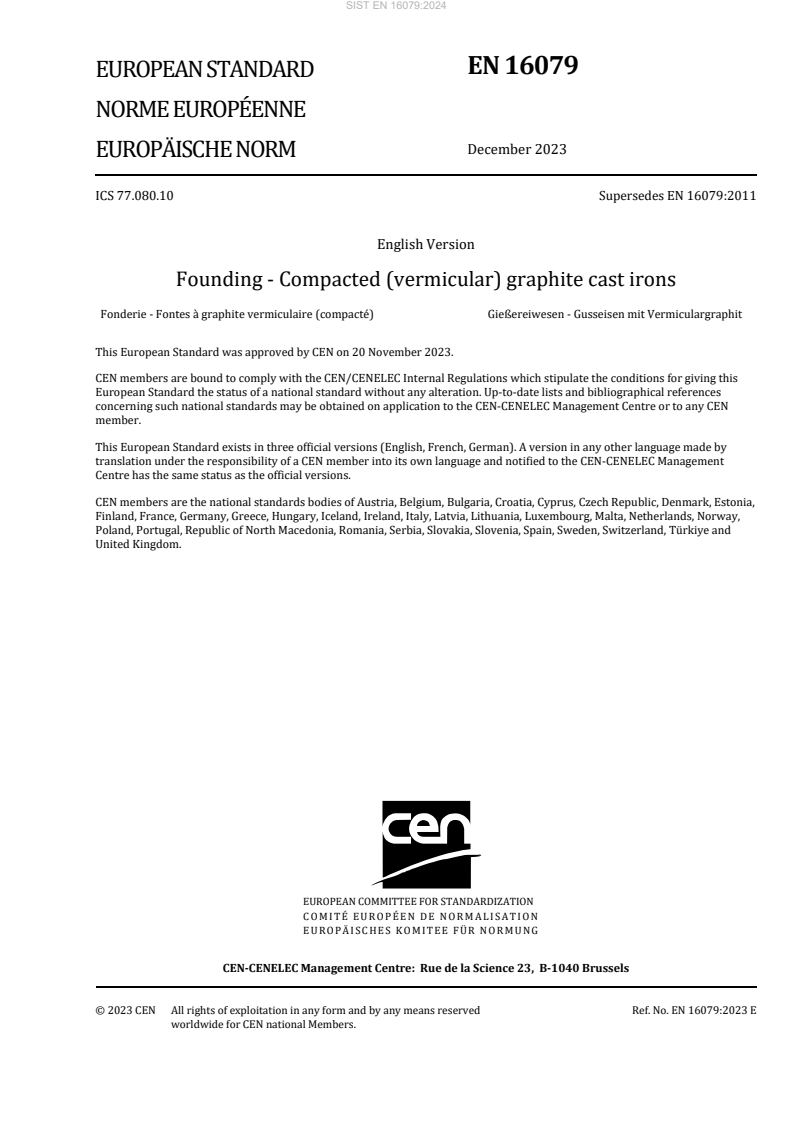
EN 16079
EUROPEAN STANDARD
NORME EUROPÉENNE
December 2023
EUROPÄISCHE NORM
ICS 77.080.10 Supersedes EN 16079:2011
English Version
Founding - Compacted (vermicular) graphite cast irons
Fonderie - Fontes à graphite vermiculaire (compacté) Gießereiwesen - Gusseisen mit Vermiculargraphit
This European Standard was approved by CEN on 20 November 2023.
CEN members are bound to comply with the CEN/CENELEC Internal Regulations which stipulate the conditions for giving this
European Standard the status of a national standard without any alteration. Up-to-date lists and bibliographical references
concerning such national standards may be obtained on application to the CEN-CENELEC Management Centre or to any CEN
member.
This European Standard exists in three official versions (English, French, German). A version in any other language made by
translation under the responsibility of a CEN member into its own language and notified to the CEN-CENELEC Management
Centre has the same status as the official versions.
CEN members are the national standards bodies of Austria, Belgium, Bulgaria, Croatia, Cyprus, Czech Republic, Denmark, Estonia,
Finland, France, Germany, Greece, Hungary, Iceland, Ireland, Italy, Latvia, Lithuania, Luxembourg, Malta, Netherlands, Norway,
Poland, Portugal, Republic of North Macedonia, Romania, Serbia, Slovakia, Slovenia, Spain, Sweden, Switzerland, Türkiye and
United Kingdom.
EUROPEAN COMMITTEE FOR STANDARDIZATION
COMITÉ EUROPÉEN DE NORMALISATION
EUROPÄISCHES KOMITEE FÜR NORMUNG
CEN-CENELEC Management Centre: Rue de la Science 23, B-1040 Brussels
© 2023 CEN All rights of exploitation in any form and by any means reserved Ref. No. EN 16079:2023 E
worldwide for CEN national Members.
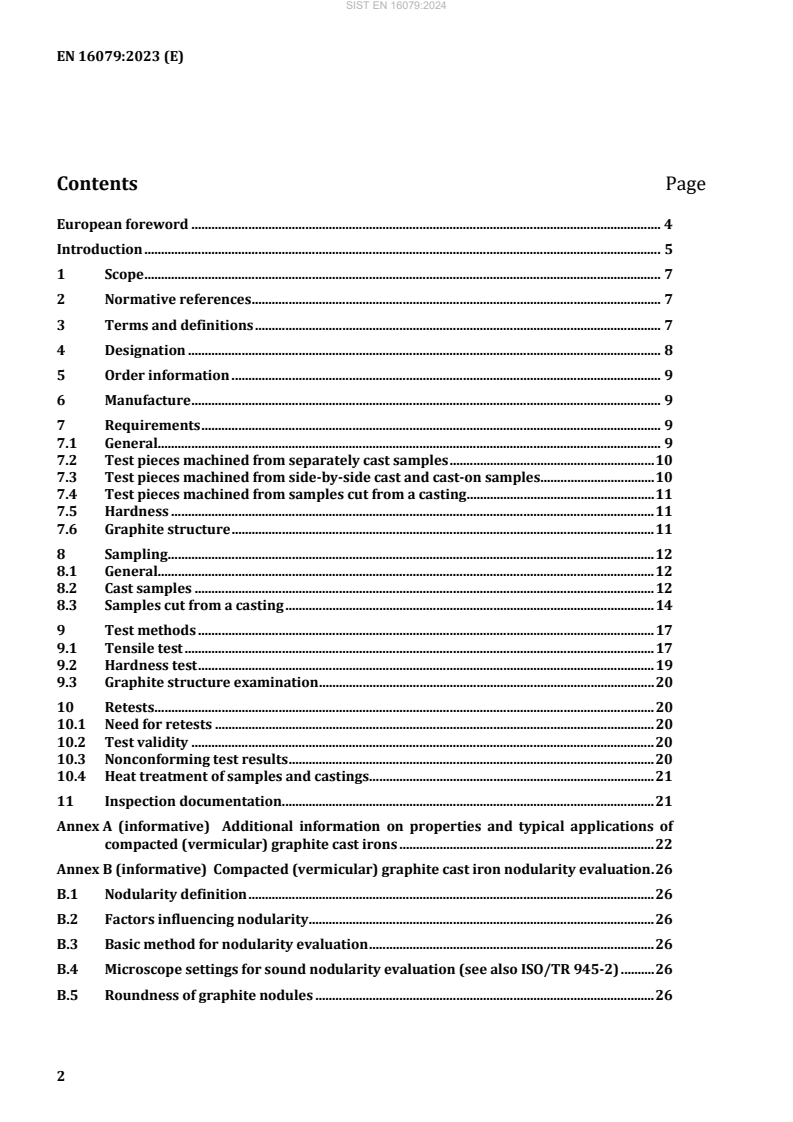
Contents Page
European foreword . 4
Introduction . 5
1 Scope . 7
2 Normative references . 7
3 Terms and definitions . 7
4 Designation . 8
5 Order information . 9
6 Manufacture . 9
7 Requirements . 9
7.1 General. 9
7.2 Test pieces machined from separately cast samples . 10
7.3 Test pieces machined from side-by-side cast and cast-on samples . 10
7.4 Test pieces machined from samples cut from a casting . 11
7.5 Hardness . 11
7.6 Graphite structure . 11
8 Sampling . 12
8.1 General. 12
8.2 Cast samples . 12
8.3 Samples cut from a casting . 14
9 Test methods . 17
9.1 Tensile test . 17
9.2 Hardness test . 19
9.3 Graphite structure examination . 20
10 Retests . 20
10.1 Need for retests . 20
10.2 Test validity . 20
10.3 Nonconforming test results . 20
10.4 Heat treatment of samples and castings . 21
11 Inspection documentation. 21
Annex A (informative) Additional information on properties and typical applications of
compacted (vermicular) graphite cast irons . 22
Annex B (informative) Compacted (vermicular) graphite cast iron nodularity evaluation . 26
B.1 Nodularity definition . 26
B.2 Factors influencing nodularity . 26
B.3 Basic method for nodularity evaluation . 26
B.4 Microscope settings for sound nodularity evaluation (see also ISO/TR 945-2) . 26
B.5 Roundness of graphite nodules . 26
B.6 Classification of rounded graphite particles by a shape factor . 27
B.7 Intermediate graphite particles, understanding sterical effects . 27
B.8 Calculation of percentage nodularity . 28
B.9 Location of testing . 28
B.10 Rating chart – Typical reference images for the determination of nodularity in
compacted (vermicular) graphite cast irons . 28
B.11 Rating chart – Typical reference images for the determination of the roundness of
graphite particles, assigning shape factors . 30
Annex C (informative) Guidance values for tensile properties determined from samples cut
from a casting . 31
Annex D (normative) Sectioning procedure for cast samples . 32
Annex E (informative) Comparison of compacted (vermicular) graphite cast iron material
designations according to EN 1560 [2] and ISO/TR 15931 [6] . 33
Annex F (informative) Changes since the last version . 34
Bibliography . 35
European foreword
This document (EN 16079:2023) has been prepared by Technical Committee CEN/TC 190 “Foundry
technology”, the secretariat of which is held by DIN.
This European Standard shall be given the status of a national standard, either by publication of an
identical text or by endorsement, at the latest by June 2024, and conflicting national standards shall be
withdrawn at the latest by June 2024.
Attention is drawn to the possibility that some of the elements of this document may be the subject of
patent rights. CEN shall not be held responsible for identifying any or all such patent rights.
This document supersedes EN 16079:2011.
Annex F provides details of significant technical changes between EN 16079:2023 and EN 16079:2011.
Any feedback and questions on this document should be directed to the users’ national standards body.
A complete listing of these bodies can be found on the CEN website.
According to the CEN-CENELEC Internal Regulations, the national standards organisations of the
following countries are bound to implement this European Standard: Austria, Belgium, Bulgaria, Croatia,
Cyprus, Czech Republic, Denmark, Estonia, Finland, France, Germany, Greece, Hungary, Iceland, Ireland,
Italy, Latvia, Lithuania, Luxembourg, Malta, Netherlands, Norway, Poland, Portugal, Republic of North
Macedonia, Romania, Serbia, Slovakia, Slovenia, Spain, Sweden, Switzerland, Türkiye and the United
Kingdom.
Introduction
This document defines the grades of compacted (vermicular) graphite cast irons (CGI), in accordance
with the mechanical properties of the material.
The properties of compacted (vermicular) graphite cast irons depend on their graphite and matrix
microstructure. A moderate section sensitivity of the properties results from different cooling velocities
in different wall thickness of the casting. When designating a material grade, section sensitivity needs
consideration.
Table 1 specifies material grades according to their mechanical properties.
Table 1 designates the cast material. The foundry verifies the properties of the castings within its in-
process quality assurance. The customer designates the material grade in view of requirements from
component design. The choice of cast samples is based on the relevant wall thickness to ensure
comparability with the casting.
Table 1 defines minimum property values (ultimate tensile strength) for each material grade, based on
cast samples. For the casting itself, typical property values are given in Table C.1.
Cast iron materials are molten from steel scraps of different compositions (circular economy), pig iron,
alloying elements, carburizers, etc., neither using ready alloys nor applying secondary metallurgical
methods. Depending on the production route used, the chemical composition can vary (Clause 6). The
mechanical properties prevail.
Material designation. The customer designates the material grade based on design requirements (load).
In a casting with complex shape and sections with very different wall thicknesses, property values can
vary over the casting, due to section sensitivity of the properties. A single cast sample cannot be
representative for all sections of the entire casting.
If only one cast sample is possible (e.g. due to cost reasons, space in the mould, or when cutting a sample
from the casting is not possible), the cast sample will represent the most interesting section of the casting,
having the relevant wall thickness.
In case of an inappropriate designation of a material grade, the desired properties may not be reached
locally, in the most interesting, relevant section of the cast component.
This can be avoided by co-operation of customer and foundry early in the design stage. The foundry can
adapt its process in order to fulfil the local properties of the part, defined by the customer.
NOTE The short name is designated according to EN 1560. The designation system by number is based on the
structure and rules of EN 10027-2 [3] and so corresponds with the European numbering system for steel and other
materials.
Property values. The cast sample represents the properties in the relevant wall thickness section of the
casting, given by component design. The minimum tensile properties to be obtained in cast samples
represent today’s reproducible production processes for all types of compacted graphite cast iron
production.
Anticipated values in the casting (Table C.1) are slightly decreasing with increasing wall thickness.
The mechanical properties of the material can be evaluated on machined test pieces prepared from:
— separately cast samples;
— side-by-side cast samples;
— cast-on samples; or
— samples cut from a casting.
For many applications, tensile strength and hardness are not the only properties of interest to casting
designers. Other mechanical or physical properties can be decisive for the use of compacted (vermicular)
graphite cast irons.
Annex A (informative) gives additional information on properties and typical applications of compacted
(vermicular) graphite cast irons.
Annex B describes a procedure for the determination of nodularity of the microstructure. It includes
reference images for visual analysis and guidelines for automated image analysis.
1 Scope
This document defines the grades and the corresponding requirements for compacted (vermicular)
graphite cast irons.
This document specifies four grades of compacted (vermicular) graphite cast iron by a classification
based on the minimum mechanical properties measured on machined test pieces prepared from cast
samples or samples cut from a casting.
This document does not cover technical delivery conditions for iron castings (see EN 1559-1 and
EN 1559-3).
2 Normative references
The following documents are referred to in the text in such a way that some or all of their content
constitutes requirements of this document. For dated references, only the edition cited applies. For
undated references, the latest edition of the referenced document (including any amendments) applies.
EN 1559-1, Founding - Technical conditions of delivery - Part 1: General
EN 1559-3, Founding - Technical conditions of delivery - Part 3: Additional requirements for iron castings
EN 10204, Metallic products - Types of inspection documents
EN ISO 945-1, Microstructure of cast irons - Part 1: Graphite classification by visual analysis (ISO 945-1)
EN ISO 6506-1, Metallic materials - Brinell hardness test - Part 1: Test method (ISO 6506-1)
EN ISO 6892-1, Metallic materials - Tensile testing - Part 1: Method of test at room temperature (ISO 6892-
1)
3 Terms and definitions
For the purposes of this document, the following terms and definitions apply.
ISO and IEC maintain terminological databases for use in standardization at the following addresses:
— ISO Online browsing platform: available at https://www.iso.org/obp
— IEC Electropedia: available at https://www.electropedia.org/
3.1
compacted (vermicular) graphite cast iron
cast material, iron and carbon based, the carbon being present mainly in the form of compacted
(vermicular) graphite particles that appear vermicular on a two-dimensional plane of polish, the graphite
particles being embedded in a matrix consisting of ferrite, ferrite/pearlite, or pearlite
Note 1 to entry: Annex B provides typical compacted (vermicular) graphite cast iron microstructures.
3.2
graphite modification treatment
process that brings the liquid iron into contact with a substance to produce graphite in the predominantly
compacted (vermicular) form during solidification
3.3
nodularity
area percentage of spheroidal graphite particles (forms V and VI given in EN ISO 945-1)
Note 1 to entry: Graphite particles in compacted (vermicular) graphite cast irons are predominantly of form III.
Note 2 to entry: A technique for evaluating the nodularity of compacted (vermicular) graphite cast irons is
described in Annex B.
3.4
cast sample
quantity of material cast to represent the cast material, including separately cast sample, side-by-side
cast sample and cast-on sample
3.5
separately cast sample
sample cast in a separate sand mould under representative manufacturing conditions and material grade
3.6
side-by-side cast sample
sample cast in a mould alongside the casting, with a connected but separate running system
3.7
cast-on sample
sample attached directly to the running system or to the casting
3.8
sample cut from a casting
sample cut from an individual casting, by agreement between the manufacturer and the purchaser
3.9
relevant wall thickness
wall thickness representative of the casting, defined for the determination of the size of the cast samples
to which the mechanical properties apply
4 Designation
The material shall be designated either by symbol or by number as given in Table 1.
As a section sensitive material, Table 1 illustrates the wall thickness dependence of mechanical
properties of compacted (vermicular) graphite cast irons.
The material designation is based on the minimum mechanical properties obtained in cast samples with
a thickness or diameter of 25 mm. The designation is irrespective of the type of cast sample.
The number in position 3 of the designation (symbol) in Table 1 is the minimum tensile strength of the
material grade in the wall thickness range t ≤ 30 mm.
Example Material grade EN-GJV-300. To determine the ultimate tensile strength, a 30 mm diameter
separately cast sample (3.4 to 3.7, Figures 1 to 4) is poured (Type II according to Table 1). The cooling velocity of a
Type II cast sample is the same as a 15 mm thick plate of infinite length, corresponding to a relevant wall thickness
12,5 to 30 mm in the casting. Type II is the most commonly used sample size, used also for designation. The material
grade is designated EN-GJV-300 when the tensile strength exceeds 300 MPa.
In the case of samples cut from the casting, the letter C is added at the end of the designation by symbol.
In the case of test pieces prepared from separately cast samples, the letter “S” is added at the end of the
grade designation. In the case of test pieces prepared from side-by-side cast or cast-on samples, the letter
“U” is added at the end of the grade designation.
NOTE The comparison of EN 16079 grade designations with the grades from the ISO standard for compacted
(vermicular) cast irons, ISO 16112:2017 [4], is given in Annex E.
5 Order information
The following information shall be supplied by the purchaser:
a) the number of this document;
b) the designation of the material;
c) the relevant wall thickness;
d) mechanical properties and their values (7.1 to 7.3);
e) the type and size of cast samples, based on relevant wall thickness and load case from design (7.4). If
samples cut from a casting are required (7.4), the location(s) of sampling in the casting;
f) the location of sampling for metallographic investigation (7.6);
g) any special requirements.
All requirements shall be agreed between the manufacturer and the purchaser by the time of acceptance
of the order e.g. technical delivery conditions according to EN 1559-1 and EN 1559-3.
6 Manufacture
The method of manufacture of compacted (vermicular) graphite cast irons and its chemical composition
shall be left to the discretion of the manufacturer. The manufacturer shall ensure that the requirements
are met for the material grade specified in the order.
When compacted (vermicular) graphite cast irons are to be used for special applications, the chemical
composition and heat treatment can be agreed upon between the manufacturer and the purchaser.
7 Requirements
7.1 General
The property values apply to compacted (vermicular) graphite cast irons poured in sand moulds or
moulds of comparable thermal behaviour.
Subject to an agreement between the manufacturer and the purchaser, the mechanical properties can
apply to castings obtained by alternative methods.
Mechanical properties are wall thickness dependent as shown in Table 1.
NOTE Tensile testing requires sound test pieces in order to guarantee pure uni-axial stress during the test.
7.2 Test pieces machined from separately cast samples
The minimum tensile properties of compacted (vermicular) graphite cast iron, determined using test
pieces machined from separately cast samples according to Figures 1, Figure 2 and Figure 3 shall be as
specified in Table 1.
7.3 Test pieces machined from side-by-side cast and cast-on samples
The minimum tensile properties of compacted (vermicular) graphite cast iron, determined using test
pieces machined from side-by-side cast samples according to Figure 1, Figure 2 or Figure 3 or to cast-on
samples according to Figure 4, shall be as specified in Table 1.
Table 1 — Mechanical properties measured on test pieces machined from separately cast, cast
side-by-side cast or cast-on samples
Relevant wall 0,2 % proof Tensile
Elongation
thickness strength strength
Material designation
R R
t A
p0,2 m
mm MPa MPa %
Symbol Number min. min. min.
12,5 < t ≤ 30 210 300 2,0
EN-GJV-300 5.2100 30 < t ≤ 60 195 275 2,0
60 < t ≤ 200 175 250 2,0
12,5 < t ≤ 30 245 350 1,5
EN-GJV-350 5.2200 30 < t ≤ 60 230 325 1,5
60 < t ≤ 200 210 300 1,5
12,5 < t ≤ 30 280 400 1,0
EN-GJV-400 5.2201 30 < t ≤ 60 260 375 1,0
60 < t ≤ 200 230 325 1,0
12,5 < t ≤ 30 315 450 1,0
EN-GJV-450 5.2300 30 < t ≤ 60 280 400 1,0
60 < t ≤ 200 260 375 1,0
For relevant wall thicknesses greater than 200 mm, the manufacturer and the purchaser shall agree
on the type and size of the cast sample and the minimum values to be obtained.
NOTE 1 The mechanical properties of test pieces machined from cast-on samples can be different from the
properties of the casting itself, but usually give a better approximation than those obtained from separately cast
samples. Additional values are given in Annex A for guidance.
NOTE 2 The percentage reduction in mechanical properties in thick sections depends upon the casting geometry
and its cooling conditions.
7.4 Test pieces machined from samples cut from a casting
In many cases, samples obtained directly from the casting better represent the properties of the casting
itself than cast samples. If applicable, the manufacturer and the purchaser shall agree on:
— the location(s) on a casting where the sample(s) shall be taken;
— the mechanical properties that shall be determined;
— the values of these mechanical properties (for information, see Annex C).
NOTE 1 The properties of castings can vary, depending on the complexity of the castings and variation in their
section thickness and cooling rates.
NOTE 2 Mechanical properties for test pieces cut from a casting are affected not only by material properties
(subject of this document) but also by the local casting soundness (not subject of this document).
7.5 Hardness
Brinell hardness and its range values for the grades listed in Table 1 shall only be specified when agreed
between the manufacturer and the purchaser by the time of acceptance of the order.
Typical Brinell hardness values are given in Annex A, Table A.1 for guidance only.
7.6 Graphite structure
The graphite particles in compacted (vermicular) graphite cast irons shall be predominantly in the
vermicular form (form III according to EN ISO 945-1), when viewed on a two-dimensional plane of polish.
A maximum of 20 % of the graphite particles, in sections representative of the relevant wall thickness,
can be of form IV, form V and form VI according to EN ISO 945-1. In compacted (vermicular) graphite cast
irons, particles similar to form V and form VI can be referred to as “intermediate” particles, as defined in
Annex B.
Samples for metallographic examination shall be taken from locations agreed between the manufacturer
and the purchaser by the time of acceptance of the order.
A method for metallographic evaluation of nodularity in compacted (vermicular) graphite cast iron
microstructures by image analysis is given in Annex B. The manufacturer and the purchaser shall agree
on the graphite structure evaluation method.
Flake (lamellar) graphite (form I according to EN ISO 945-1) is not permitted, except within the surface
rim zone of the casting. Flake graphite is therefore not considered in the calculation of nodularity. If flake
graphite is present (except in the surface rim zone), the microstructure shall be rejected and a nodularity
assessment shall not be conducted. The thickness of the surface rim zone shall be agreed between the
manufacturer and the purchaser by the time of acceptance of the order.
Although the conventional definition of compacted (vermicular) graphite cast iron is within the range of
0 % to 20 % nodularity, a separate agreement can be made between the manufacturer and the purchaser
for other nodularity ranges. However, the maximum nodularity shall be not more than 30 %.
The graphite structure shall be confirmed either by metallographic examination or by non-destructive
methods. In case of dispute, the result of the metallographic examination shall prevail.
8 Sampling
8.1 General
Samples shall be made from the same material as that used to produce the casting(s), which they
represent.
Several types of samples (separately cast samples, cast-on samples, side-by-side cast samples or samples
cut from a casting) can be used, depending on the mass and wall thickness of the casting.
When relevant, the type of sample should be agreed between the manufacturer and the purchaser. Unless
otherwise agreed, the choice of option is left to the discretion of the manufacturer.
When the mass of the casting exceeds 2 000 kg and its relevant wall thickness exceeds 60 mm, cast-on
samples or samples cut from a casting should preferably be used. The dimensions and the location of the
sample shall be agreed between the manufacturer and the purchaser by the time of acceptance of the
order.
All samples shall be adequately marked to guarantee full traceability to the castings that they represent.
The samples shall be subject to the same heat treatment as that of the castings they represent. Tensile
test pieces shall be finally machined from the samples after the heat treatment.
8.2 Cast samples
8.2.1 Size of cast sample
The size of the cast sample shall be in correspondence with the relevant wall thickness of the casting as
shown in Table 2.
If other sizes are used, this, and the minimum tensile s
...