

oSIST prEN 15430-2:2008
(Main)Winter and road service area maintenance equipments - Part 2: Protocol for data transfer between information supplier server and client application server
General Information
- Abstract
The function of the standard is to combine any vehicle equipment with different board computers to any client application server. The communication interface on vehicle is defined by Part 1 of EN 15430. The interface between the information supplier server and the client application server is defined as a specific protocol (flow 3) object of this document. This makes interchangeability possible on both sides of the communication without any restriction in the range of communication technology including memory card, WLAN, GPRS or any other communication media.
- Status
- Not Published
- Public Enquiry End Date
- 31-May-2008
- Technical Committee
- I13 - Imaginarni 13
- Current Stage
- 98 - Abandoned project (Adopted Project)
- Start Date
- 14-Jan-2020
- Due Date
- 19-Jan-2020
- Completion Date
- 14-Jan-2020

Overview
oSIST prEN 15430-2:2008 is a European standard published by CEN that addresses the protocol for data transfer between information supplier servers (ISS) and client application servers (CAS) in the domain of winter and road service area maintenance equipment. This standard enables interoperability between various vehicle equipment, board computers, and client software, facilitating seamless communication and data exchange for road maintenance operations.
The standard defines a common communication protocol and data format, independent of communication media such as memory cards, WLAN, GPRS, or any other technology. It complements Part 1 of EN 15430, which specifies the interface on vehicles between equipment and board computers.
Key Topics
Interoperability and Communication Protocol
- Enables integration of different vendors’ on-vehicle equipment (e.g., spreaders, ploughs).
- Supports multiple board computers and client application software (e.g., databases, analytics).
- Specifies Flow 3 protocol for data exchange between ISS and CAS, ensuring flexibility in communication technology use.
- Defines a flexible XML-based data structure for transferring records, promoting standardization.
Data Structure and Time Synchronization
- Data records follow definitions established in EN 15430-1 and contain information such as:
- Board computer time and date.
- Geolocation data (latitude, longitude, altitude).
- Equipment and manufacturer identifiers.
- Time synchronization responsibility lies with the client application server, ensuring temporal consistency between board computers and servers.
Data Transfer and Server Interfaces
- Communication is based on HTTP/HTTPS requests supporting authentication via username and password.
- Supports querying ISS status, including an ISS alive request to verify server availability.
- Data files received conform to specified XML schemas with standardized naming conventions:
- Format:
<ISS_ID>_<LocalDate>_<LocalTime>_<FileCounter>.xml - This naming facilitates easy file management and tracking.
- Format:
On-Board and Server Roles
- Board computers act as data acquisition systems:
- Receive, merge, and time-stamp data from various vehicle sensors and equipment.
- Support both online (real-time within 60 seconds) and offline data storage.
- Information Supplier Server manages storage and distribution of data from board computers to client applications.
- Client Application Servers retrieve data from ISS for reporting, analysis, or operational management.
Applications
- Winter road maintenance management: Leveraging standardized data acquisition from vehicles to monitor plough operation, salt spreading, and other critical activities.
- Fleet management systems: Integrating multiple types of road service vehicles using unified data protocols to track status and performance.
- Data analytics and reporting: Facilitates real-time and historical operational data access to improve maintenance strategies and resource allocation.
- Remote monitoring: Utilizing various communication technologies (WLAN, GPRS, memory cards) for flexible data transmission from mobile field equipment.
- Software and hardware interoperability: Enables different manufacturers’ products to work together without custom integration complexities.
Related Standards
- EN 15430-1: Specifies the communication interface on vehicles between winter maintenance equipment and board computers.
- ISO 8859-1: Character encoding standard referenced for data encoding consistency.
- Various RFCs: Network protocols such as FTP and HTTP for ensuring correct data communication methods.
- NMEA-0183: Format standards used for geographic data embedded within XML messages.
Keywords: oSIST prEN 15430-2:2008, winter maintenance equipment standard, road service data protocol, information supplier server, client application server, XML data transfer, board computer data, vehicle equipment communication, interoperability standard, road maintenance systems, CEN standards, flow 3 protocol, data acquisition, server communication protocols, GPS data integration, HTTP/HTTPS data exchange.
Relations
- Effective Date
- 28-Jan-2026
- Effective Date
- 28-Jan-2026
- Effective Date
- 28-Jan-2026
Get Certified
Connect with accredited certification bodies for this standard

BSI Group
BSI (British Standards Institution) is the business standards company that helps organizations make excellence a habit.

TÜV Rheinland
TÜV Rheinland is a leading international provider of technical services.

TÜV SÜD
TÜV SÜD is a trusted partner of choice for safety, security and sustainability solutions.
Sponsored listings
Frequently Asked Questions
oSIST prEN 15430-2:2008 is a draft published by the Slovenian Institute for Standardization (SIST). Its full title is "Winter and road service area maintenance equipments - Part 2: Protocol for data transfer between information supplier server and client application server". This standard covers: The function of the standard is to combine any vehicle equipment with different board computers to any client application server. The communication interface on vehicle is defined by Part 1 of EN 15430. The interface between the information supplier server and the client application server is defined as a specific protocol (flow 3) object of this document. This makes interchangeability possible on both sides of the communication without any restriction in the range of communication technology including memory card, WLAN, GPRS or any other communication media.
The function of the standard is to combine any vehicle equipment with different board computers to any client application server. The communication interface on vehicle is defined by Part 1 of EN 15430. The interface between the information supplier server and the client application server is defined as a specific protocol (flow 3) object of this document. This makes interchangeability possible on both sides of the communication without any restriction in the range of communication technology including memory card, WLAN, GPRS or any other communication media.
oSIST prEN 15430-2:2008 is classified under the following ICS (International Classification for Standards) categories: 35.240.60 - IT applications in transport; 43.160 - Special purpose vehicles. The ICS classification helps identify the subject area and facilitates finding related standards.
oSIST prEN 15430-2:2008 has the following relationships with other standards: It is inter standard links to SIST EN 13941:2009+A1:2010, SIST EN ISO 15614-2:2005, SIST EN ISO 15614-4:2005. Understanding these relationships helps ensure you are using the most current and applicable version of the standard.
oSIST prEN 15430-2:2008 is available in PDF format for immediate download after purchase. The document can be added to your cart and obtained through the secure checkout process. Digital delivery ensures instant access to the complete standard document.
Standards Content (Sample)
SLOVENSKI STANDARD
01-april-2008
Oprema zimske službe in vzdrževanje cest - 2. del: Protokol za prenos podatkov
med strežnikom posrednika podatkov in strežnikom stranke
Winter and road service area maintenance equipments - Part 2: Protocol for data transfer
between information supplier server and client application server
Matériel de viabilité hivernale et d'entretien des dépendances routières - Partie 2:
Protocole de transfert des données entre le serveur fournisseur d'information et les
serveurs d'applications clients
Ta slovenski standard je istoveten z: prEN 15430-2
ICS:
35.240.60
43.160
2003-01.Slovenski inštitut za standardizacijo. Razmnoževanje celote ali delov tega standarda ni dovoljeno.
EUROPEAN STANDARD
DRAFT
prEN 15430-2
NORME EUROPÉENNE
EUROPÄISCHE NORM
February 2008
ICS
English Version
Winter and road service area maintenance equipments - Part 2:
Protocol for data transfer between information supplier server
and client application server
This draft European Standard is submitted to CEN members for enquiry. It has been drawn up by the Technical Committee CEN/TC 337.
If this draft becomes a European Standard, CEN members are bound to comply with the CEN/CENELEC Internal Regulations which
stipulate the conditions for giving this European Standard the status of a national standard without any alteration.
This draft European Standard was established by CEN in three official versions (English, French, German). A version in any other language
made by translation under the responsibility of a CEN member into its own language and notified to the CEN Management Centre has the
same status as the official versions.
CEN members are the national standards bodies of Austria, Belgium, Bulgaria, Cyprus, Czech Republic, Denmark, Estonia, Finland,
France, Germany, Greece, Hungary, Iceland, Ireland, Italy, Latvia, Lithuania, Luxembourg, Malta, Netherlands, Norway, Poland, Portugal,
Romania, Slovakia, Slovenia, Spain, Sweden, Switzerland and United Kingdom.
Recipients of this draft are invited to submit, with their comments, notification of any relevant patent rights of which they are aware and to
provide supporting documentation.
Warning : This document is not a European Standard. It is distributed for review and comments. It is subject to change without notice and
shall not be referred to as a European Standard.
EUROPEAN COMMITTEE FOR STANDARDIZATION
COMITÉ EUROPÉEN DE NORMALISATION
EUROPÄISCHES KOMITEE FÜR NORMUNG
Management Centre: rue de Stassart, 36 B-1050 Brussels
© 2008 CEN All rights of exploitation in any form and by any means reserved Ref. No. prEN 15430-2:2008: E
worldwide for CEN national Members.
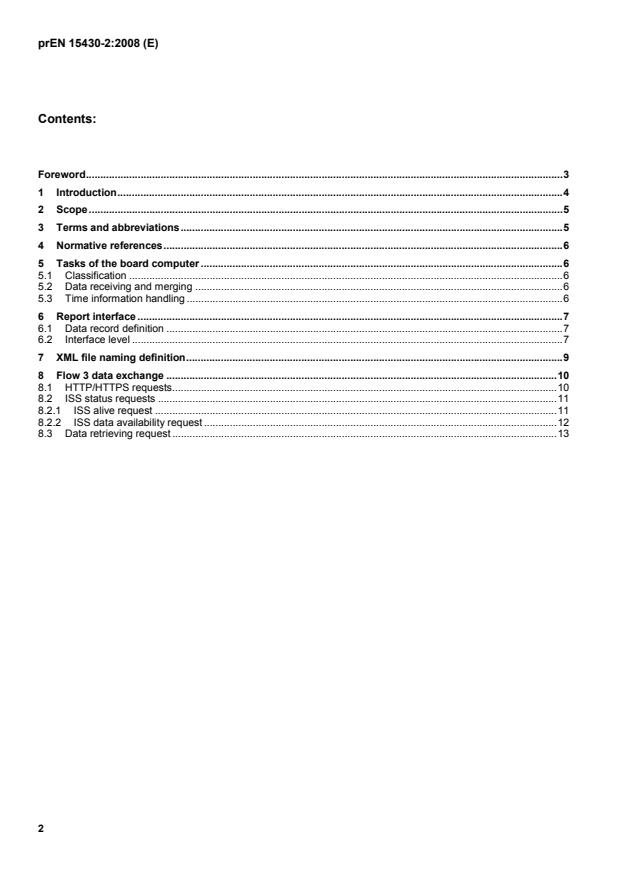
prEN 15430-2:2008 (E)
Contents:
Foreword.3
1 Introduction.4
2 Scope.5
3 Terms and abbreviations.5
4 Normative references.6
5 Tasks of the board computer .6
5.1 Classification .6
5.2 Data receiving and merging .6
5.3 Time information handling .6
6 Report interface .7
6.1 Data record definition .7
6.2 Interface level .7
7 XML file naming definition.9
8 Flow 3 data exchange .10
8.1 HTTP/HTTPS requests.10
8.2 ISS status requests .11
8.2.1 ISS alive request .11
8.2.2 ISS data availability request .12
8.3 Data retrieving request .13
prEN 15430-2:2008 (E)
Foreword
This document (prEN 15430-2:2008) has been prepared by Technical Committee CEN/TC 337 “Winter
maintenance and road service area maintenance equipment”, the secretariat of which is held by AFNOR.
This document is currently submitted to the CEN Enquiry.
prEN 15430-2:2008 (E)
1 Introduction
This document must be considered as the second part of the standard for data acquisition and transmission in the
field of municipal vehicles. The goal of the standard is to allow interoperability between systems (hardware and
software) of different vendors. A customer should be able to combine any:
• on-vehicle equipment (e. g. spreaders and ploughs)
• on-vehicle data acquisition systems (e. g. board computers or enhanced control boxes)
• client application software (e. g. data bases, analyzing or accounting software)
as long as they follow this standard.
The first part of the standard, as described in document EN15430-1, defines the on-board communication (flow 1)
between on-vehicle equipment (data handler) and on-vehicle data acquisition systems (board computer). This
document is meant to describe the data structure, types, ranges, protocol and initial settings required by the
information supplier server (ISS) and client application server (CAS) including synchronized combining of the
various data sources.
Figure1 represents the whole data flow chain from vehicle to office system.
Figure 1: Transmission flow
The present standard doesn’t define any specific rules for items like:
• optional compression, encryption and authentication of the data during data transfer (flow 2).
• data transmission between on-vehicle data acquisition system and information supplier server ( flow 2).
Data transfer between on-vehicle data acquisition systems and the information supplier server has to be lossless.
Section 1 defines the interface between devices and board computer, as described in EN15430-1.
Section 2 addresses the combination of data from different streams and the transmission to a generic information
supplier server.
prEN 15430-2:2008 (E)
Section 3 addresses the data transfer (Flow 3 ) between the information supplier server (ISS) and client application
server (CAS) and it is the purpose of this document.
2 Scope
The function of the standard is to combine any vehicle equipment with different board computers to any client
application server. The communication interface on vehicle is defined by part 1 of the standard. The interface
between the information supplier server and the client application server is defined as a specific protocol (flow 3)
object of the present document. This makes interchangeability possible on both sides of the communication without
any restriction in the range of communication technology including memory card, WLAN, GPRS or any other
communication media.
3 Terms and abbreviations
ISS Information Supplier Server: entity able to store information coming from board
computers and distribute these information to external applications (CAS) using
server process.
CAS Client Application Server: entity able to retrieve information.
ASCII American national Standard Code for Information Interchange
FTP File Transfer Protocol
GPRS General Packet Radio Service
GSM Global System for Mobile communication
HTTP Hyper Text Transfer Protocol
M-Card Memory Card
P2P Point-2-Point
RFC Request For Comments
UMTS Universal Mobile Telephone System
WAN Wide Area Network
WLAN Wireless Local Area Network
Number before h is in hexadecimal notation
h
XML Extended Markup Language
prEN 15430-2:2008 (E)
4 Normative references
This European Standard incorporates by dated or undated reference, provisions from other publications. These
normative references are cited at the appropriate places in the text and the publications are listed hereafter. For
dated references, subsequent amendments to or revisions of any of these publications apply to this European
Standard. Only when incorporated in it by amendment or revision. For undated references the latest edition of the
publication referred to applies.
ISO 8859-1 Character encoding table by the International Organization of Standardization; in the lower 128 codes
identical to the old ASCII standard
RFC The Requests for Comments (RFCs) form a series of notes, started in 1969, about the Internet (originally the
ARPANET). The notes discuss many aspects of computer communication, focusing on networking protocols,
procedures, programs, and concepts.
RFC 0959 File Transfer Protocol (FTP). J. Postel, J. Reynolds. Oct-1985. This obsolete the preceding RFC 765
and earlier FTP RFCs back to the original RFC 114.
5 Tasks of the board computer
5.1 Classification
In EN15430-1 a data acquisition system like a board computer has been presented as black-box with implemented
at least the following main features:
• Receive data from a generic vehicle/equipment data transmission handler (e.g. through RS232 serial interface)
• Store any incoming information in reports.
• Generate one time stamp for every data message.
According to the time gap between record time stamp and ISS time stamp one board computer can be classified
as follows:
1. On-line devices: devices where the time gap between generation at the board computer and acquisition by the
ISS is within 60 seconds. ( e.g: radio, GPRS, UMTS). The ISS has to provide an on-line status information to
the CAS for every connected device.
2. Off-line device: devices where the time gap between generation at the board computer and acquisition by the
ISS is 60 seconds or more.
Every board computer has to ensure 24 hours of non volatile data storage.
5.2 Data receiving and merging
The board computer receives data from one or more device handlers. In addition, it can generate records, e. g. by
receiving GPS data, evaluating sensors or converting non-standard data sources. (described in part 1 of the
standard). Then, the board computer merges the data flow from different devices into one data stream without
applying and modification to the records (record code >= 1). All records should remain in the same order in which
they were generated. The order of records coming from different sources is free. The delay probably introduced by
the data transmission handler can be ignored.
5.3 Time information handling
Time information received from board computers are stored on the ISS without any modification. The ISS has to
add its local time information to the data files.
prEN 15430-2:2008 (E)
6 Report interface
6.1 Data record definition
A data record is a structure of coherent variables in a predefined order according to the
...