

SIST EN 12094-4:2004
(Main)Fixed firefighting systems - Components for gas extinguishing systems - Part 4: Requirements and test methods for container valve assemblies and their actuators
General Information
- Abstract
This document specifies requirements and describes test methods for container valve assemblies for CO2-high-pressure-, Inert Gas- or Halocarbon Gas-fire extinguishing systems, which include a container valve, an actuator and possibly a diptube.
This document specifies requirements and describes test methods for features of the component relevant only for its use in fire extinguishing installations.
Diptubes not assembled to the container valves are not covered by this standard.
NOTE Valve assemblies can be equipped with additional components (e.g. gauges and switches).
- Status
- Published
- Publication Date
- 30-Sep-2004
- Technical Committee
- POZ - Požarna varnost
- Current Stage
- 6060 - National Implementation/Publication (Adopted Project)
- Start Date
- 01-Oct-2004
- Due Date
- 01-Oct-2004
- Completion Date
- 01-Oct-2004
- Directive
- 305/2011 - Regulation (eu) No 305/2011 of the European Parliament and of the Council of 9 march 2011 laying down harmonised conditions for the marketing of construction products and repealing council directive 89/106/eecOJ Ref: C 259 OJ Date: 08-Aug-2014
89/106/EEC - Construction productsOJ Ref: C 263 OJ Date: 26-Oct-2004

Overview
EN 12094-4:2004 is a CEN European standard for fixed firefighting systems that defines requirements and test methods for container valve assemblies and their actuators used in gas extinguishing systems. It covers assemblies for CO2 (high-pressure), Inert Gas and Halocarbon Gas fire suppression installations. The standard applies to a complete container valve assembly (container valve, actuator and, where fitted, diptube) and addresses only features relevant to fire extinguishing installations. Diptubes supplied separately (not assembled to valves) are excluded.
Key topics and technical requirements
- Scope and definitions: classification of valve types (e.g., valves with or without pressure relief) and terminology specific to gas extinguishing components (CO2 high/low pressure, Inert Gas, Halocarbon Gas, diptube, fill ratio).
- Design and materials: metallic valve bodies and internal parts; corrosion-resistant materials (stainless steel, copper, copper alloys or protected steel) for durability in fire protection applications.
- Working pressure: components must be specified by the manufacturer for appropriate working pressures (example: CO2 high-pressure container valves tested at 140 bar).
- Performance requirements: functional operation across ambient/operational temperatures, flow characteristics and resistance coefficients, specified minimum flow area.
- Safety features: pressure relief device classifications and warnings about release into protected zones.
- Mechanical integrity: strength, resistance to internal pressure, leakage limits, vibration resistance, stress-corrosion considerations.
- Operational reliability: actuator performance (manual, pneumatic, etc.), operating force, functional testing and lifecycle checks.
- Diptube requirements: material, attachment method, geometry and installation orientation details when supplied as part of the assembly.
- Testing methods: prescribed tests for function, internal pressure, strength, leakage, flow characteristics, corrosion, vibration, temperature and operational reliability (see clauses 5.x).
- Marking, documentation and conformity: manufacturer data, marking, initial type testing, factory production control and conformity evaluation procedures.
Applications and who uses this standard
- Manufacturers of container valve assemblies, actuators and diptubes - use EN 12094-4 to design, test and declare conformity of components for gas extinguishing systems.
- System designers and specifying engineers for CO2, Inert Gas and Halocarbon gas fire suppression installations - to select compliant components and verify performance.
- Testing laboratories and certification bodies - to perform type testing, factory production control and conformity assessment.
- Installers, maintenance personnel and safety managers - to ensure correct installation, safe operation and ongoing reliability of container valve assemblies.
Related standards
- Other parts of the EN 12094 series covering gas extinguishing system components (control devices, selector valves, nozzles, gauges, etc.) and referenced standards such as EN 849 (cylinder valves), EN ISO 9001 and relevant ISO thread/pressure standards. Use EN 12094-4 alongside the broader EN 12094 family for comprehensive compliance.
Keywords: EN 12094-4:2004, container valve assemblies, gas extinguishing systems, CO2 valve, inert gas, halocarbon gas, actuator testing, diptube, fire suppression standard.
Relations
- Effective Date
- 25-Aug-2026
- Effective Date
- 10-Feb-2026
- Effective Date
- 28-Jan-2026
- Effective Date
- 28-Jan-2026
- Effective Date
- 28-Jan-2026
- Effective Date
- 28-Jan-2026
- Effective Date
- 28-Jan-2026
- Effective Date
- 28-Jan-2026
- Referred By
SIST-TS CEN/TS 14972:2011 - Fixed firefighting systems - Watermist systems - Design and installation - Effective Date
- 28-Jan-2026
- Effective Date
- 28-Jan-2026
- Effective Date
- 28-Jan-2026
- Effective Date
- 28-Jan-2026
- Effective Date
- 28-Jan-2026
- Referred By
SIST EN 334:2019+A1:2025 - Gas pressure regulators for inlet pressure up to 10 MPa (100 bar) - Effective Date
- 28-Jan-2026
- Effective Date
- 28-Jan-2026
Get Certified
Connect with accredited certification bodies for this standard

CIS Institut d.o.o.
Personal Protective Equipment (PPE) certification body. Notified Body NB-2890 for EU Regulation 2016/425 PPE.

Kiwa BDA Testing
Building and construction product certification.
Kmetijski inštitut Slovenije
Agricultural Institute of Slovenia. Soil testing, plant health, agricultural product analysis.
Sponsored listings
Frequently Asked Questions
SIST EN 12094-4:2004 is a standard published by the Slovenian Institute for Standardization (SIST). Its full title is "Fixed firefighting systems - Components for gas extinguishing systems - Part 4: Requirements and test methods for container valve assemblies and their actuators". This standard covers: This document specifies requirements and describes test methods for container valve assemblies for CO2-high-pressure-, Inert Gas- or Halocarbon Gas-fire extinguishing systems, which include a container valve, an actuator and possibly a diptube. This document specifies requirements and describes test methods for features of the component relevant only for its use in fire extinguishing installations. Diptubes not assembled to the container valves are not covered by this standard. NOTE Valve assemblies can be equipped with additional components (e.g. gauges and switches).
This document specifies requirements and describes test methods for container valve assemblies for CO2-high-pressure-, Inert Gas- or Halocarbon Gas-fire extinguishing systems, which include a container valve, an actuator and possibly a diptube. This document specifies requirements and describes test methods for features of the component relevant only for its use in fire extinguishing installations. Diptubes not assembled to the container valves are not covered by this standard. NOTE Valve assemblies can be equipped with additional components (e.g. gauges and switches).
SIST EN 12094-4:2004 is classified under the following ICS (International Classification for Standards) categories: 13.220.10 - Fire-fighting. The ICS classification helps identify the subject area and facilitates finding related standards.
SIST EN 12094-4:2004 has the following relationships with other standards: It is inter standard links to SIST ISO 7-1:1995, SIST EN 60529:1997, SIST EN ISO 9001:2000, SIST EN ISO 10297:2024, SIST EN ISO 228-1:2003, SIST EN ISO 4126-2:2019, oSIST prEN 15116:2005, SIST EN 12094-2:2003, SIST-TS CEN/TS 14972:2011, SIST EN 12561-3:2011, SIST EN 17966:2024, SIST EN 88-2:2008, SIST EN 12561-2:2011, SIST EN 334:2019+A1:2025, SIST EN 15004-1:2008. Understanding these relationships helps ensure you are using the most current and applicable version of the standard.
SIST EN 12094-4:2004 is associated with the following European legislation: EU Directives/Regulations: 305/2011, 89/106/EEC; Standardization Mandates: M/109. When a standard is cited in the Official Journal of the European Union, products manufactured in conformity with it benefit from a presumption of conformity with the essential requirements of the corresponding EU directive or regulation.
SIST EN 12094-4:2004 is available in PDF format for immediate download after purchase. The document can be added to your cart and obtained through the secure checkout process. Digital delivery ensures instant access to the complete standard document.
Standards Content (Sample)
2003-01.Slovenski inštitut za standardizacijo. Razmnoževanje celote ali delov tega standarda ni dovoljeno.RNRWODþQLKUH]HUYRDUMLKOrtsfeste Brandbekämpfungsanlagen - Bauteile für Löschanlagen mit gasförmigen Löschmitteln - Teil 4: Anforderungen und Prüfverfahren für Behälterventilbaugruppen und zugehörige AuslöseeinrichtungenInstallations fixes de lutte contre l'incendie - Eléments constitutifs pour installations d'extinction a gaz - Partie 4: Exigences et méthodes d'essai pour les vannes de réservoir et leurs déclencheursFixed firefighting systems - Components for gas extinguishing systems - Part 4: Requirements and test methods for container valve assemblies and their actuators13.220.10Gašenje požaraFire-fightingICS:Ta slovenski standard je istoveten z:EN 12094-4:2004SIST EN 12094-4:2004en,fr,de01-oktober-2004SIST EN 12094-4:2004SLOVENSKI
STANDARD
EUROPEAN STANDARDNORME EUROPÉENNEEUROPÄISCHE NORMEN 12094-4July 2004ICS 13.220.20English versionFixed firefighting systems - Components for gas extinguishingsystems - Part 4: Requirements and test methods for containervalve assemblies and their actuatorsInstallations fixes de lutte contre l'incendie - Elémentsconstitutifs pour installations d'extinction à gaz - Partie 4:Exigences et méthodes d'essai pour les vannes deréservoir et leurs déclencheursOrtsfeste Brandbekämpfungsanlagen - Bauteile fürLöschanlagen mit gasförmigen Löschmitteln - Teil 4:Anforderungen und Prüfverfahren fürBehälterventilbaugruppen und zugehörigeAuslöseeinrichtungenThis European Standard was approved by CEN on 6 May 2004.CEN members are bound to comply with the CEN/CENELEC Internal Regulations which stipulate the conditions for giving this EuropeanStandard the status of a national standard without any alteration. Up-to-date lists and bibliographical references concerning such nationalstandards may be obtained on application to the Central Secretariat or to any CEN member.This European Standard exists in three official versions (English, French, German). A version in any other language made by translationunder the responsibility of a CEN member into its own language and notified to the Central Secretariat has the same status as the officialversions.CEN members are the national standards bodies of Austria, Belgium, Cyprus, Czech Republic, Denmark, Estonia, Finland, France,Germany, Greece, Hungary, Iceland, Ireland, Italy, Latvia, Lithuania, Luxembourg, Malta, Netherlands, Norway, Poland, Portugal, Slovakia,Slovenia, Spain, Sweden, Switzerland and United Kingdom.EUROPEAN COMMITTEE FOR STANDARDIZATIONCOMITÉ EUROPÉEN DE NORMALISATIONEUROPÄISCHES KOMITEE FÜR NORMUNGManagement Centre: rue de Stassart, 36
B-1050 Brussels© 2004 CENAll rights of exploitation in any form and by any means reservedworldwide for CEN national Members.Ref. No. EN 12094-4:2004: ESIST EN 12094-4:2004
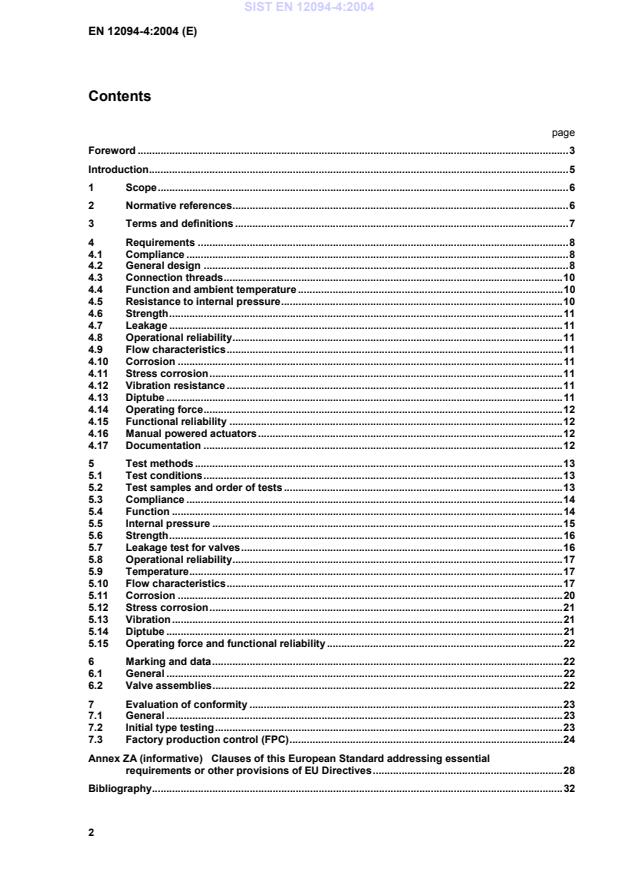
Clauses of this European Standard addressing essential requirements or other provisions of EU Directives.28 Bibliography.32
1) Under preparation. SIST EN 12094-4:2004
1) Under preparation.
1 Scope This document specifies requirements and describes test methods for container valve assemblies for CO2-high-pressure-, Inert Gas- or Halocarbon Gas-fire extinguishing systems, which include a container valve, an actuator and possibly a diptube. This document specifies requirements and describes test methods for features of the component relevant only for its use in fire extinguishing installations. Diptubes not assembled to the container valves are not covered by this standard. NOTE Valve assemblies can be equipped with additional components (e.g. gauges and switches). 2 Normative references The following referenced documents are indispensable for the application of this document. For dated references, only the edition cited applies. For undated references, the latest edition of the referenced document (including any amendments) applies. EN 849, Transportable gas cylinders - Cylinder valves - Specification and type testing. EN 60529, Degrees of protection provided by enclosures (IP-Codes) (IEC 60529:1989). EN 60068-2-6, Environmental testing- Part 2: Tests - Test Fc: Vibration (sinusoidal) (IEC 60068-2-6:1995 + Corrigendum 1995). EN ISO 228-1, Pipe threads where pressure-tight joints are not made on the threads - Part 1: Dimensions, tolerances and designation (ISO 228-1:2000). EN ISO 4126-2, Safety devices for protection against excessive pressure - Part 2: Bursting disc safety devices (ISO 4126-2:2003). EN ISO 9001:2000, Quality management systems – Requirements (ISO 9001:2000). ISO 7-1, Pipe threads where pressure-tight joints are made on the threads - Part 1: Dimensions, tolerances and designation. SIST EN 12094-4:2004
4.2.3 The manufacturer shall specify the free cross-sectional area of the minimum flow way of the valve. In addition the manufacturer may specify the flow characteristics of the component either as an equivalent length or as a flow resistance coefficient. 4.2.4 The manufacturer shall specify the smallest container, the related minimum and maximum fill ratio and, if applicable, the related superpressurization the component shall be used for. 4.2.5 Where the component is assembled with a diptube, the diptube shall be made of metal, rigid or flexible, and shall be fixed to the container valve by mechanical means, e.g. a threaded connection. The geometry of the inlet of the diptube and the length of the diptube related to the container shall be specified SIST EN 12094-4:2004
5.3 Compliance A visual and measurement check shall be made to determine whether the test samples correspond to the description in the technical literature (drawings, parts lists, description of functions, operating and installation instructions). 5.4 Function 5.4.1 General NOTE This test relates to the requirements of 4.2.15 and 4.4.1. 5.4.2 Mount the container valve in the attitude specified by the manufacturer or, if not given, in the attitude where maximum force is required. Verify compliance with the requirements of 4.4.1 by one of the two following methods. Method 1: Connect the inlet of the sample to a suitable gas supply and install a pressure measuring device at the inlet of the sample. Actuate the valve and start gas flow through the sample increasing the pressure until the valve is fully open. Decrease the pressure at the inlet of the sample to 3 bar. Check that the sample remains in its fully open position. SIST EN 12094-4:2004
pressure (010+) %. Maintain this pressure for a time period of (5 01+) min. At the end of this period release the hydraulic pressure. For pyrotechnic powered actuators the test procedure shall be set up with data provided by the manufacturer of the pyrotechnic elements to meet the three times working pressure strength requirement. 5.7 Leakage test for valves NOTE This test relates to the requirements of 4.7. Components for non-liquefied extinguishants (e.g. Inert gases) and for liquefied extinguishants without superpressurization (e.g. CO2) shall be tested in conjunction with the smallest container for which the valve is designed. The container sample shall be charged to the maximum specified fill ratio. Components for liquefied extinguishants with superpressurization shall be tested in conjunction with the smallest container for which the valve is designed. One of the specified container samples shall be charged to the minimum fill ratio and the other to the maximum fill ratio. Both containers shall be superpressurized to the superpressurization pressure. Measure and record the charge mass to an accuracy of ± 0,1 %. For superpressurized liquefied extinguishants additionally measure and record the charge pressure to an accuracy of ± 0,1 %. Expose the assembly to changes of temperature in air: a) lower temperature shall be (- 20 20-) °C, or the manufacturer's recommended minimum service temperature (02−) °C, whichever is the lower; b) higher temperature shall be (5002+) °C, or the manufacturer's recommended maximum service temperature (02+) °C, whichever is the higher; SIST EN 12094-4:2004
manufacturer (02+) °C whichever is the higher, for (2 ± 0,5) h. Carry out five test cycles as described in 5.4.3 a) to d) at test temperature. 5.10 Flow characteristics 5.10.1 General NOTE This test relates to the requirements of 4.9. The flow characteristics of the container valve is determined in combination with the diptube, if applicable. SIST EN 12094-4:2004
Key 1 Supply container 6 Container valve 2 Check valve 7 Container mass 3 Diptube 8 Pressure in the container (p1) 4 Flexible connector 9 Pressure downstream of the sample (p3) 5 Nozzle Figure 1 — Test set-up 1 for measuring resistance coefficient or equivalent length
Key 1 Supply container 7 Container valve 2 Check valve 8 Container mass 3 Diptube 9 Pressure in the container (p1) 4 Flexible connector 10 Pressure upstream of the test pipe (p2) 5 Nozzle 11 Pressure downstream of the test pipe (p3) 6 Test pipe Figure 2 — Test set-up 2 for measuring resistance coefficient or equivalent length SIST EN 12094-4:2004
...