

SIST EN 16603-40:2014
(Main)Space engineering - Part 40: Software
General Information
- Abstract
This software engineering Standard concerns the “product software”, i.e. software that is part of a space system product tree and developed as part of a space project.
This Standard is applicable, to the extent defined by the tailoring process, to all the elements of a space system, including the space segment, the launch service segment and the ground segment.
This Standard covers all aspects of space software engineering including requirements definition, design, production, verification and validation, transfer, operations and maintenance.
It defines the scope of the space software engineering processes and its interfaces with management and product assurance, which are addressed in the Management (–M) and Product assurance (–Q) branches of the ECSS System, and explains how they apply in the software engineering processes.
This Standard reflects the specific methods used in space system developments, and the requirements for the software engineering processes in this context. Together with the requirements found in the other branches of the ECSS Standards, this Standard provides a coherent and complete framework for software engineering in a space project.
This Standard is intended to help the customers to formulate their requirements and suppliers to prepare their responses and to implement the work.
This Standard is not intended to replace textbook material on computer science or technology, and such material is avoided in this Standard. The readers and users of this Standard are assumed to possess general knowledge of computer science.
The scope of this Standard is the software developed as part of a space project, i.e. “Space system product software”. This Standard also applies to the development of non–deliverable software that affects the quality of the deliverable product.
This Standard may be tailored for the specific characteristics and constraints of a space project in conformance with ECSS-S-ST-00.
- Status
- Published
- Publication Date
- 21-Oct-2014
- Technical Committee
- I13 - Imaginarni 13
- Current Stage
- 6060 - National Implementation/Publication (Adopted Project)
- Start Date
- 05-Sep-2014
- Due Date
- 10-Nov-2014
- Completion Date
- 22-Oct-2014



Overview
SIST EN 16603-40:2014 - Space engineering, Part 40: Software - is a European/ECSS software engineering standard for space system product software. It defines the scope and requirements for software developed as part of a space project (space segment, launch service segment and ground segment) and covers the full software lifecycle: requirements definition, architectural and detailed design, implementation, verification & validation, delivery, operations, maintenance and retirement. The Standard is intended to be tailored to project needs (in conformance with ECSS‑S‑ST‑00) and interfaces explicitly with ECSS Management (‑M) and Product Assurance (‑Q) branches.
Key technical topics and requirements
- Software lifecycle processes: software-related system requirements, management, requirements & architecture engineering, design & implementation, verification, validation, delivery & acceptance, operation and maintenance.
- Process interfaces: integration of software engineering with project management and product assurance activities to ensure consistency and traceability across the space system product tree.
- Tailoring: rules and guidance for adapting the standard to project characteristics and software criticality levels.
- Documentation and deliverables: normative annexes defining document templates and content such as Software System Specification (SSS), Software Requirements Specification (SRS), Software Design Document (SDD), Software Verification Plan (SVerP), Software Validation Plan (SValP), Software Release Document (SRelD), Software User Manual (SUM) and others.
- Reviews and audits: planned project and technical reviews (e.g., SRR, PDR, CDR, TRR, QR, AR) and review planning for compliance and risk mitigation.
- Verification & validation: emphasis on planned, traceable verification and independent validation activities to demonstrate fitness for mission and requirements compliance.
- Maintenance & migration: procedures for problem analysis, change control, migration and retirement of software components.
Practical applications and users
This standard is used by:
- Satellite prime contractors and subsystem suppliers developing onboard flight software.
- Ground segment developers (mission control, telemetry/telecommand systems).
- Launch service providers for flight and ground software.
- Systems engineers, software engineers, project managers, configuration managers, QA/product assurance teams and subcontractors responsible for producing, integrating or accepting space software. Practical uses include writing SRS/SDD documents, creating verification/validation plans, tailoring lifecycle processes to project criticality, planning software deliveries and preparing contractual requirements between customers and suppliers.
Related standards and keywords
- Related ECSS branches: Management (‑M) and Product Assurance (‑Q)
- Tailoring reference: ECSS‑S‑ST‑00
- SEO keywords: SIST EN 16603-40:2014, space software engineering, ECSS software standard, software lifecycle, software verification, software validation, SRS, SDD, software product assurance, tailoring for space projects
SIST EN 16603-40:2014 provides a coherent, project-level framework to ensure space software is engineered, verified and delivered with traceability, quality and mission readiness.
Relations
- Effective Date
- 01-Nov-2014
- Effective Date
- 28-Jan-2026
- Effective Date
- 28-Jan-2026
- Effective Date
- 28-Jan-2026
- Referred By
SIST EN 12601:2011 - Reciprocating internal combustion engine driven generating sets - Safety - Effective Date
- 28-Jan-2026
Get Certified
Connect with accredited certification bodies for this standard

BSI Group
BSI (British Standards Institution) is the business standards company that helps organizations make excellence a habit.

BUREAU VERITAS Certification Germany
Bureau Veritas certification in Germany.

Element Materials Technology
Materials testing and product certification.
Sponsored listings
Frequently Asked Questions
SIST EN 16603-40:2014 is a standard published by the Slovenian Institute for Standardization (SIST). Its full title is "Space engineering - Part 40: Software". This standard covers: This software engineering Standard concerns the “product software”, i.e. software that is part of a space system product tree and developed as part of a space project. This Standard is applicable, to the extent defined by the tailoring process, to all the elements of a space system, including the space segment, the launch service segment and the ground segment. This Standard covers all aspects of space software engineering including requirements definition, design, production, verification and validation, transfer, operations and maintenance. It defines the scope of the space software engineering processes and its interfaces with management and product assurance, which are addressed in the Management (–M) and Product assurance (–Q) branches of the ECSS System, and explains how they apply in the software engineering processes. This Standard reflects the specific methods used in space system developments, and the requirements for the software engineering processes in this context. Together with the requirements found in the other branches of the ECSS Standards, this Standard provides a coherent and complete framework for software engineering in a space project. This Standard is intended to help the customers to formulate their requirements and suppliers to prepare their responses and to implement the work. This Standard is not intended to replace textbook material on computer science or technology, and such material is avoided in this Standard. The readers and users of this Standard are assumed to possess general knowledge of computer science. The scope of this Standard is the software developed as part of a space project, i.e. “Space system product software”. This Standard also applies to the development of non–deliverable software that affects the quality of the deliverable product. This Standard may be tailored for the specific characteristics and constraints of a space project in conformance with ECSS-S-ST-00.
This software engineering Standard concerns the “product software”, i.e. software that is part of a space system product tree and developed as part of a space project. This Standard is applicable, to the extent defined by the tailoring process, to all the elements of a space system, including the space segment, the launch service segment and the ground segment. This Standard covers all aspects of space software engineering including requirements definition, design, production, verification and validation, transfer, operations and maintenance. It defines the scope of the space software engineering processes and its interfaces with management and product assurance, which are addressed in the Management (–M) and Product assurance (–Q) branches of the ECSS System, and explains how they apply in the software engineering processes. This Standard reflects the specific methods used in space system developments, and the requirements for the software engineering processes in this context. Together with the requirements found in the other branches of the ECSS Standards, this Standard provides a coherent and complete framework for software engineering in a space project. This Standard is intended to help the customers to formulate their requirements and suppliers to prepare their responses and to implement the work. This Standard is not intended to replace textbook material on computer science or technology, and such material is avoided in this Standard. The readers and users of this Standard are assumed to possess general knowledge of computer science. The scope of this Standard is the software developed as part of a space project, i.e. “Space system product software”. This Standard also applies to the development of non–deliverable software that affects the quality of the deliverable product. This Standard may be tailored for the specific characteristics and constraints of a space project in conformance with ECSS-S-ST-00.
SIST EN 16603-40:2014 is classified under the following ICS (International Classification for Standards) categories: 35.080 - Software; 49.140 - Space systems and operations. The ICS classification helps identify the subject area and facilitates finding related standards.
SIST EN 16603-40:2014 has the following relationships with other standards: It is inter standard links to SIST EN 14160:2004, SIST EN ISO 8528-13:2016, SIST EN 14737-1:2004, SIST EN 1679-1:2000+A1:2011, SIST EN 12601:2011. Understanding these relationships helps ensure you are using the most current and applicable version of the standard.
SIST EN 16603-40:2014 is associated with the following European legislation: Standardization Mandates: M/496. When a standard is cited in the Official Journal of the European Union, products manufactured in conformity with it benefit from a presumption of conformity with the essential requirements of the corresponding EU directive or regulation.
SIST EN 16603-40:2014 is available in PDF format for immediate download after purchase. The document can be added to your cart and obtained through the secure checkout process. Digital delivery ensures instant access to the complete standard document.
Standards Content (Sample)
2003-01.Slovenski inštitut za standardizacijo. Razmnoževanje celote ali delov tega standarda ni dovoljeno.Vesoljska tehnika - 40. del: Programska opremaRaumfahrttechnik - Teil 40: SoftwareIngéniérie spatiale - Partie 40: LogicielSpace engineering - Part 40: Software49.140Vesoljski sistemi in operacijeSpace systems and operations35.080Dokumentiranje razvoja programske opreme in sistemov (sistemska dokumentacija)Software development and system documentationICS:Ta slovenski standard je istoveten z:EN 16603-40:2014SIST EN 16603-40:2014en,fr,de01-november-2014SIST EN 16603-40:2014SLOVENSKI
STANDARDSIST EN 14160:20041DGRPHãþD
EUROPEAN STANDARD NORME EUROPÉENNE EUROPÄISCHE NORM
EN 16603-40
August 2014 ICS 49.140 Supersedes EN 14160:2001
English version
Space engineering - Part 40: Software
Ingéniérie spatiale - Partie 40: Logiciel
Raumfahrttechnik - Teil 40: Software This European Standard was approved by CEN on 10 February 2014.
CEN and CENELEC members are bound to comply with the CEN/CENELEC Internal Regulations which stipulate the conditions for giving this European Standard the status of a national standard without any alteration. Up-to-date lists and bibliographical references concerning such national standards may be obtained on application to the CEN-CENELEC Management Centre or to any CEN and CENELEC member.
This European Standard exists in three official versions (English, French, German). A version in any other language made by translation under the responsibility of a CEN and CENELEC member into its own language and notified to the CEN-CENELEC Management Centre has the same status as the official versions.
CEN and CENELEC members are the national standards bodies and national electrotechnical committees of Austria, Belgium, Bulgaria, Croatia, Cyprus, Czech Republic, Denmark, Estonia, Finland, Former Yugoslav Republic of Macedonia, France, Germany, Greece, Hungary, Iceland, Ireland, Italy, Latvia, Lithuania, Luxembourg, Malta, Netherlands, Norway, Poland, Portugal, Romania, Slovakia, Slovenia, Spain, Sweden, Switzerland, Turkey and United Kingdom.
CEN-CENELEC Management Centre: Avenue Marnix 17, B-1000 Brussels © 2014 CEN/CENELEC All rights of exploitation in any form and by any means reserved worldwide for CEN national Members and for CENELEC Members. Ref. No. EN 16603-40:2014 E SIST EN 16603-40:2014
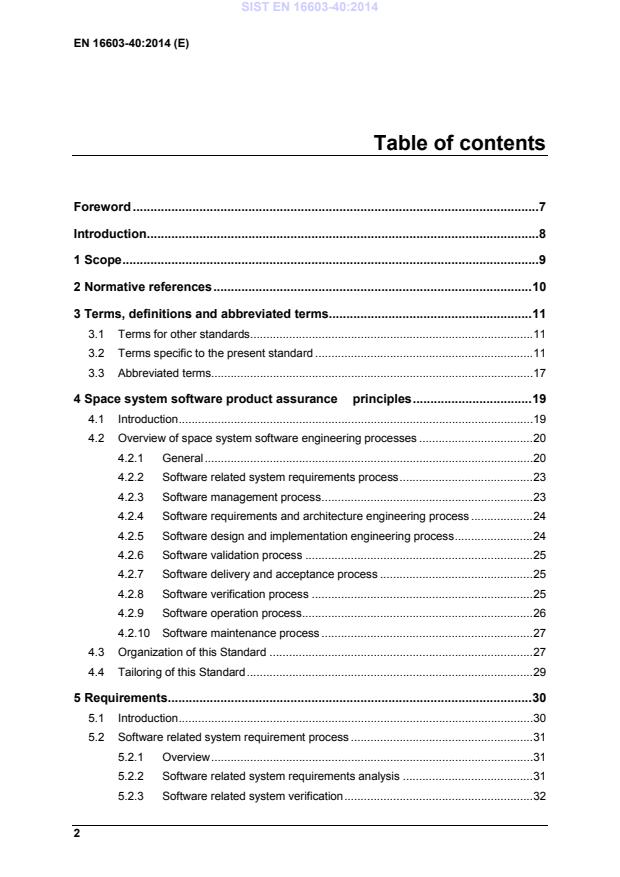
principles . 19 4.1 Introduction . 19 4.2 Overview of space system software engineering processes . 20 4.2.1 General . 20 4.2.2 Software related system requirements process . 23 4.2.3 Software management process . 23 4.2.4 Software requirements and architecture engineering process . 24 4.2.5 Software design and implementation engineering process . 24 4.2.6 Software validation process . 25 4.2.7 Software delivery and acceptance process . 25 4.2.8 Software verification process . 25 4.2.9 Software operation process . 26 4.2.10 Software maintenance process . 27 4.3 Organization of this Standard . 27 4.4 Tailoring of this Standard . 29 5 Requirements . 30 5.1 Introduction . 30 5.2 Software related system requirement process . 31 5.2.1 Overview . 31 5.2.2 Software related system requirements analysis . 31 5.2.3 Software related system verification . 32 SIST EN 16603-40:2014
...