

SIST EN 13684:2018+A1:2025
(Main + Amendment)Garden equipment - Pedestrian controlled lawn aerators and scarifiers - Safety
General Information
- Abstract
This European Standard specifies safety requirements and their verification for the design and construction of pedestrian controlled internal combustion engine powered lawn aerators and scarifiers which are designed for re-generating lawns by, for instance, combing out grass, thatch and moss or cutting vertically into the lawn face using tines which rotate about a horizontal axis. It describes methods of elimination or reduction of hazards arising from their use. In addition, it specifies the type of information to be provided by the manufacturer on safe working practices.
Throughout this document, the term "machine" applies to those machines known as aerators, scarifiers, corers, lawn rakes or grass rakes.
It does not apply to:
- aerators/scarifiers made from a machine falling within the scope of EN 709:1997+A4:2009 when fitted with an aerating/scarifying implement;
- non-powered aerators;
- vertical axis aerators; or
- those aerators which cut into the soil by means of a reciprocating motion or by water pressure.
It deals with all significant hazards, hazardous situations and events relevant to scarifiers and aerators, when they are used as intended and under the conditions foreseeable by the manufacturer (see Clause 4). Environmental hazards have not been considered in this document.
This document is not applicable to aerators/scarifiers which are manufactured before the date of its publication.
- Status
- Published
- Publication Date
- 23-Dec-2024
- Technical Committee
- IMKG - Machinery for agriculture and forestry
- Current Stage
- 6060 - National Implementation/Publication (Adopted Project)
- Start Date
- 18-Dec-2024
- Due Date
- 22-Feb-2025
- Completion Date
- 24-Dec-2024
- Directive
- 2006/42/EC - Directive 2006/42/EC of the European Parliament and of the Council of 17 May 2006 on machinery, and amending Directive 95/16/EC (recast)OJ Ref: 2025/1740, OJ L, OJ L 14.8.2025 OJ Date: 14-Aug-2025

Overview
SIST EN 13684:2018+A1:2025 is the European safety standard for pedestrian controlled lawn aerators and scarifiers. It sets safety requirements and verification methods for the design and construction of internal combustion engine‑powered, hand‑guided aerators, scarifiers, corers and grass rakes that use tines rotating about a horizontal axis to comb out thatch, moss or cut vertically into the lawn face. The standard describes how to eliminate or reduce hazards during normal use and foreseeable misuse, and specifies the information manufacturers must provide about safe working practices.
Note: the standard excludes non‑powered units, vertical‑axis aerators, machines that use reciprocating or water‑pressure cutting, certain implements covered by EN 709:1997+A4:2009, and machines manufactured before its publication.
Key technical topics and requirements
- Hazard identification - lists significant hazards, hazardous situations and events relevant to these machines.
- Power‑driven components and tines - design and strength requirements, mounting integrity and tines stopping time (see Annex F).
- Guards and shielding - construction and attachment requirements to reduce contact and thrown‑object risks.
- Thrown object hazard - test methods, pass/fail criteria and additional testing for debris projection.
- Controls and operator protection - including identification of controls, operator‑presence controls and traction drive safety.
- Stopping, braking and stability - engine stopping, transport position safety and service/parking brake requirements plus stability test methods.
- Hot surfaces and exhaust - protection and test procedures for hot exhaust surfaces and fumes.
- Noise and vibration - noise emission engineering methods (Annex C) and vibration measurement/reduction (Annex E) to support operator safety.
- Electrical and pressurized components - low‑voltage circuits, terminals and pressure risks.
- Information for use and marking - mandatory instructions, safety signs (Annex A), recommended safety instructions (Annex B) and marking durability/testing requirements.
Practical applications - who uses this standard
- Manufacturers and designers of pedestrian lawn aerators and scarifiers - to design compliant, safer products.
- Test laboratories and conformity assessors - to verify compliance using the standard’s test methods (noise, vibration, thrown‑object tests, tine stopping time, stability).
- Importers, distributors and technical documentation teams - to ensure correct user information, marking and safety instructions.
- Safety officers, rental companies and professional groundskeepers - for selecting equipment that meets published safety criteria and for safe operation guidance.
Related standards
- EN 709:1997+A4:2009 (referenced for certain machines/implements)
- CEN‑published measurement and conformity rules referenced in the standard (see Annexes C, E and F for noise, vibration and tine‑related test codes).
Keywords: SIST EN 13684:2018+A1:2025, garden equipment safety, pedestrian controlled lawn aerators, scarifiers safety standard, tines stopping time, thrown object test, noise and vibration testing.
Relations
- Replaces
SIST EN 13684:2018 - Garden equipment - Pedestrian controlled lawn aerators and scarifiers - Safety - Effective Date
- 01-Feb-2025
- Effective Date
- 25-Aug-2026
- Effective Date
- 09-Feb-2026
- Effective Date
- 28-Jan-2026
- Effective Date
- 28-Jan-2026
- Effective Date
- 28-Jan-2026
- Effective Date
- 28-Jan-2026
- Effective Date
- 28-Jan-2026
- Effective Date
- 28-Jan-2026
- Effective Date
- 28-Jan-2026
- Effective Date
- 28-Jan-2026
- Refers
SIST EN ISO 20127:2025 - Dentistry - Physical properties of powered toothbrushes (ISO 20127:2025) - Effective Date
- 28-Jan-2026
- Effective Date
- 28-Jan-2026
- Effective Date
- 28-Jan-2026
- Effective Date
- 28-Jan-2026
Get Certified
Connect with accredited certification bodies for this standard

Control Union Certifications
Global certification for agriculture and sustainability.

ECOCERT
Organic and sustainability certification.

FSC International
Forest Stewardship Council certification.
Sponsored listings
Frequently Asked Questions
SIST EN 13684:2018+A1:2025 is a standard published by the Slovenian Institute for Standardization (SIST). Its full title is "Garden equipment - Pedestrian controlled lawn aerators and scarifiers - Safety". This standard covers: This European Standard specifies safety requirements and their verification for the design and construction of pedestrian controlled internal combustion engine powered lawn aerators and scarifiers which are designed for re-generating lawns by, for instance, combing out grass, thatch and moss or cutting vertically into the lawn face using tines which rotate about a horizontal axis. It describes methods of elimination or reduction of hazards arising from their use. In addition, it specifies the type of information to be provided by the manufacturer on safe working practices. Throughout this document, the term "machine" applies to those machines known as aerators, scarifiers, corers, lawn rakes or grass rakes. It does not apply to: - aerators/scarifiers made from a machine falling within the scope of EN 709:1997+A4:2009 when fitted with an aerating/scarifying implement; - non-powered aerators; - vertical axis aerators; or - those aerators which cut into the soil by means of a reciprocating motion or by water pressure. It deals with all significant hazards, hazardous situations and events relevant to scarifiers and aerators, when they are used as intended and under the conditions foreseeable by the manufacturer (see Clause 4). Environmental hazards have not been considered in this document. This document is not applicable to aerators/scarifiers which are manufactured before the date of its publication.
This European Standard specifies safety requirements and their verification for the design and construction of pedestrian controlled internal combustion engine powered lawn aerators and scarifiers which are designed for re-generating lawns by, for instance, combing out grass, thatch and moss or cutting vertically into the lawn face using tines which rotate about a horizontal axis. It describes methods of elimination or reduction of hazards arising from their use. In addition, it specifies the type of information to be provided by the manufacturer on safe working practices. Throughout this document, the term "machine" applies to those machines known as aerators, scarifiers, corers, lawn rakes or grass rakes. It does not apply to: - aerators/scarifiers made from a machine falling within the scope of EN 709:1997+A4:2009 when fitted with an aerating/scarifying implement; - non-powered aerators; - vertical axis aerators; or - those aerators which cut into the soil by means of a reciprocating motion or by water pressure. It deals with all significant hazards, hazardous situations and events relevant to scarifiers and aerators, when they are used as intended and under the conditions foreseeable by the manufacturer (see Clause 4). Environmental hazards have not been considered in this document. This document is not applicable to aerators/scarifiers which are manufactured before the date of its publication.
SIST EN 13684:2018+A1:2025 is classified under the following ICS (International Classification for Standards) categories: 65.060.70 - Horticultural equipment. The ICS classification helps identify the subject area and facilitates finding related standards.
SIST EN 13684:2018+A1:2025 has the following relationships with other standards: It is inter standard links to SIST EN 13684:2018, SIST ISO 7000:2020, SIST ISO 3864-1:2012, SIST EN ISO 4871:2009, SIST EN ISO 14982:2009, SIST EN 1090-3:2019, SIST EN ISO 20643:2008, SIST EN ISO 12100:2011, SIST EN ISO 9241-971:2022, SIST EN ISO 11688-1:2009, SIST EN ISO 13849-1:2023, SIST EN ISO 20127:2025, SIST EN ISO 11201:2010, SIST EN ISO 13857:2020, SIST EN ISO 7010:2020. Understanding these relationships helps ensure you are using the most current and applicable version of the standard.
SIST EN 13684:2018+A1:2025 is associated with the following European legislation: EU Directives/Regulations: 2006/42/EC; Standardization Mandates: M/396. When a standard is cited in the Official Journal of the European Union, products manufactured in conformity with it benefit from a presumption of conformity with the essential requirements of the corresponding EU directive or regulation.
SIST EN 13684:2018+A1:2025 is available in PDF format for immediate download after purchase. The document can be added to your cart and obtained through the secure checkout process. Digital delivery ensures instant access to the complete standard document.
Standards Content (Sample)
SLOVENSKI STANDARD
01-februar-2025
Nadomešča:
SIST EN 13684:2018
Oprema za nego vrta - Ročno upravljani prezračevalniki travne ruše in rahljalniki
zemlje - Varnost (vključno z dopolnilom A1)
Garden equipment - Pedestrian controlled lawn aerators and scarifiers - Safety
Gartengeräte - Handgeführte Rasen-Bodenbelüfter und Vertikutierer - Sicherheit
Matériel de jardinage - Aérateurs et scarificateurs à conducteur à pied - Sécurité
Ta slovenski standard je istoveten z: EN 13684:2018+A1:2024
ICS:
65.060.70 Vrtnarska oprema Horticultural equipment
2003-01.Slovenski inštitut za standardizacijo. Razmnoževanje celote ali delov tega standarda ni dovoljeno.
EN 13684:2018+A1
EUROPEAN STANDARD
NORME EUROPÉENNE
December 2024
EUROPÄISCHE NORM
ICS 65.060.70 Supersedes EN 13684:2018
English Version
Garden equipment - Pedestrian controlled lawn aerators
and scarifiers - Safety
Matériel de jardinage - Aérateurs et scarificateurs à Gartengeräte - Handgeführte Rasen-Bodenbelüfter und
conducteur à pied - Sécurité Vertikutierer - Sicherheit
This European Standard was approved by CEN on 15 January 2018 and includes Amendment 1 approved by CEN on 6 October
2024.
CEN members are bound to comply with the CEN/CENELEC Internal Regulations which stipulate the conditions for giving this
European Standard the status of a national standard without any alteration. Up-to-date lists and bibliographical references
concerning such national standards may be obtained on application to the CEN-CENELEC Management Centre or to any CEN
member.
This European Standard exists in three official versions (English, French, German). A version in any other language made by
translation under the responsibility of a CEN member into its own language and notified to the CEN-CENELEC Management
Centre has the same status as the official versions.
CEN members are the national standards bodies of Austria, Belgium, Bulgaria, Croatia, Cyprus, Czech Republic, Denmark, Estonia,
Finland, France, Germany, Greece, Hungary, Iceland, Ireland, Italy, Latvia, Lithuania, Luxembourg, Malta, Netherlands, Norway,
Poland, Portugal, Republic of North Macedonia, Romania, Serbia, Slovakia, Slovenia, Spain, Sweden, Switzerland, Türkiye and
United Kingdom.
EUROPEAN COMMITTEE FOR STANDARDIZATION
COMITÉ EUROPÉEN DE NORMALISATION
EUROPÄISCHES KOMITEE FÜR NORMUNG
CEN-CENELEC Management Centre: Rue de la Science 23, B-1040 Brussels
© 2024 CEN All rights of exploitation in any form and by any means reserved Ref. No. EN 13684:2018+A1:2024 E
worldwide for CEN national Members.
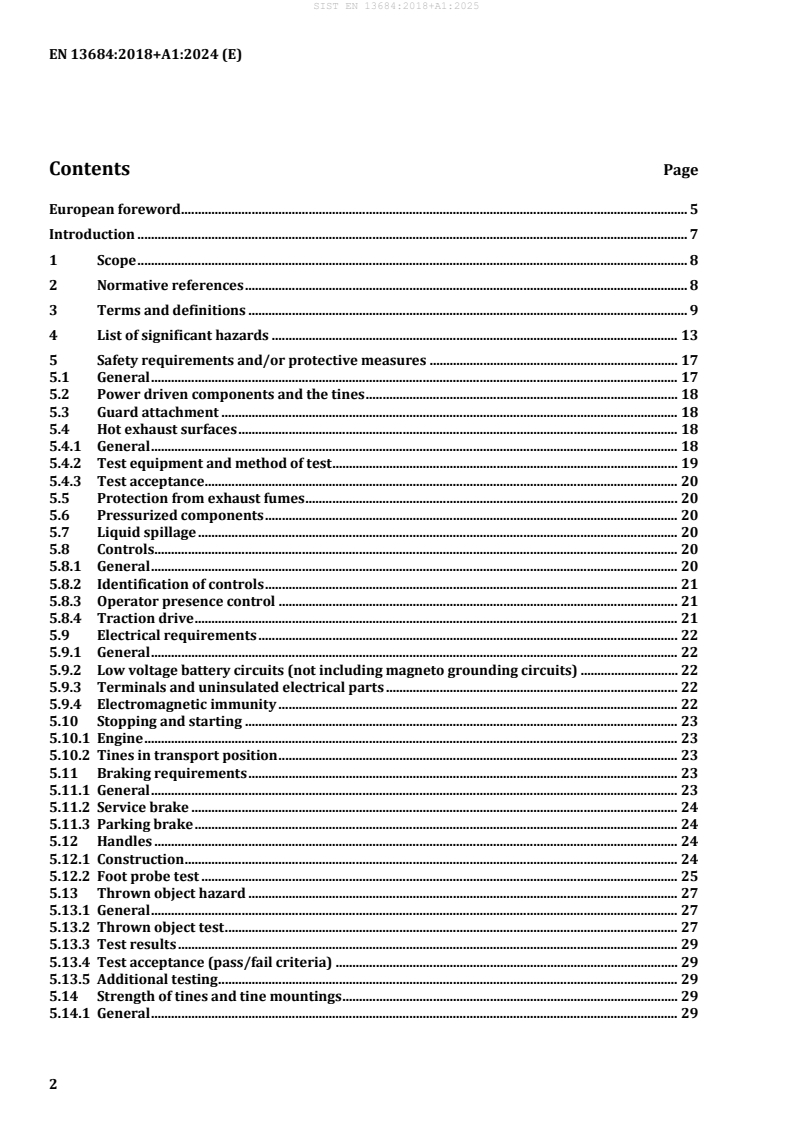
Contents Page
European foreword . 5
Introduction . 7
1 Scope . 8
2 Normative references . 8
3 Terms and definitions . 9
4 List of significant hazards . 13
5 Safety requirements and/or protective measures . 17
5.1 General . 17
5.2 Power driven components and the tines . 18
5.3 Guard attachment . 18
5.4 Hot exhaust surfaces . 18
5.4.1 General . 18
5.4.2 Test equipment and method of test . 19
5.4.3 Test acceptance . 20
5.5 Protection from exhaust fumes . 20
5.6 Pressurized components . 20
5.7 Liquid spillage . 20
5.8 Controls . 20
5.8.1 General . 20
5.8.2 Identification of controls . 21
5.8.3 Operator presence control . 21
5.8.4 Traction drive . 21
5.9 Electrical requirements . 22
5.9.1 General . 22
5.9.2 Low voltage battery circuits (not including magneto grounding circuits) . 22
5.9.3 Terminals and uninsulated electrical parts . 22
5.9.4 Electromagnetic immunity . 22
5.10 Stopping and starting . 23
5.10.1 Engine . 23
5.10.2 Tines in transport position . 23
5.11 Braking requirements . 23
5.11.1 General . 23
5.11.2 Service brake . 24
5.11.3 Parking brake . 24
5.12 Handles . 24
5.12.1 Construction . 24
5.12.2 Foot probe test . 25
5.13 Thrown object hazard . 27
5.13.1 General . 27
5.13.2 Thrown object test . 27
5.13.3 Test results . 29
5.13.4 Test acceptance (pass/fail criteria) . 29
5.13.5 Additional testing . 29
5.14 Strength of tines and tine mountings . 29
5.14.1 General . 29
5.14.2 Test acceptance . 32
5.15 General construction — Guarding and shielding . 32
5.16 Noise . 36
5.16.1 Noise reduction as a safety requirement . 36
5.16.2 Verification of requirements on noise - Noise measurement . 36
5.17 Vibration . 36
5.17.1 Reduction by design and protective measures . 36
5.17.2 Reduction by information. 37
5.17.3 Vibration measurement . 37
5.18 Stability requirements and test method . 37
5.18.1 General . 37
5.18.2 Stability test procedure . 37
5.18.3 Test acceptance . 38
6 Information for use . 38
6.1 Instruction for use . 38
6.2 Technical information . 40
6.3 Marking . 41
6.3.1 Minimum marking . 41
6.3.2 Warnings . 41
6.3.3 Marking durability . 42
6.3.4 Test . 42
Annex A (normative) Safety signs and symbols . 43
A.1 General . 43
A.2 Safety signs and symbols . 44
Annex B (informative) Safety instructions . 46
B.1 General . 46
B.2 Safe operation practices . 46
B.2.1 Training . 46
B.2.2 Preparation . 46
B.2.3 Operation . 47
B.2.4 Maintenance and storage . 48
Annex C (normative) Noise test code — Engineering method (grade 2) . 49
C.1 Scope . 49
C.2 A-weighted sound power level determination . 49
C.3 A-weighted emission sound pressure level measurement . 52
C.4 Requirements for test floor. 53
C.4.1 Artificial surface . 53
C.4.2 Natural grass . 53
C.5 Installation, mounting and operating conditions . 53
C.6 Measurement uncertainty . 54
C.7 Information to be recorded and reported . 54
C.8 Declaration and verification of noise emission values . 55
Annex D (informative) Example of a material and construction fulfilling the requirements
for an artificial surface . 56
D.1 Material . 56
D.2 Construction . 56
Annex E (normative) Vibration . 58
E.1 Quantities to be measured . 58
E.2 Instrumentation . 58
E.2.1 General . 58
E.2.2 Fastening of transducer . 58
E.2.3 Calibration . 58
E.3 Measurement direction and measurement location . 58
E.3.1 Measurement direction . 58
E.3.2 Measurement location . 58
E.4 Test procedure . 61
E.5 Measurement procedure . 63
E.6 Determination of the measurement result . 63
Annex F (normative) Tines stopping time . 64
F.1 General . 64
F.2 Measurement of tines stopping time . 64
Annex ZA (informative) !Relationship between this European Standard and the essential
requirements of Directive 2006/42/EC aimed to be covered" . 66
Bibliography . 70
European foreword
This document (EN 13684:2018+A1:2024) has been prepared by Technical Committee CEN/TC 144
“Tractors and machinery for agriculture and forestry”, the secretariat of which is held by AFNOR.
This European Standard shall be given the status of a national standard, either by publication of an
identical text or by endorsement, at the latest by June 2025 and conflicting national standards shall be
withdrawn at the latest by June 2025.
Attention is drawn to the possibility that some of the elements of this document may be the subject of
patent rights. CEN shall not be held responsible for identifying any or all such patent rights.
This document includes Amendment 1 approved by CEN on 6 October 2024.
This document supersedes !EN 13684:2018".
The start and finish of text introduced or altered by amendment is indicated in the text by tags !".
In comparison with the previous edition [EN 13684:2004+A3:2009], the following modifications have
been made:
— Addition of requirements for:
— electromagnetic immunity;
— engine starting;
— guarding of power driven components;
— machine stability, with a test method.
— Modification of the:
— contents of the instructions;
— machine markings and warnings with new safety signs;
— noise test method;
— vibration test method.
This document has been prepared under a standardization request addressed to CEN by the European
Commission. The Standing Committee of the EFTA States subsequently approves these requests for its
Member States.
For the relationship with EU Legislation, see informative Annex ZA, which is an integral part of this
document.
Any feedback and questions on this document should be directed to the users’ national standards body.
A complete listing of these bodies can be found on the CEN website.
According to the CEN-CENELEC Internal Regulations, the national standards organisations of the
following countries are bound to implement this European Standard: Austria, Belgium, Bulgaria, Croatia,
Cyprus, Czech Republic, Denmark, Estonia, Finland, France, Germany, Greece, Hungary, Iceland, Ireland,
Italy, Latvia, Lithuania, Luxembourg, Malta, Netherlands, Norway, Poland, Portugal, Republic of North
Macedonia, Romania, Serbia, Slovakia, Slovenia, Spain, Sweden, Switzerland, Türkiye and the United
Kingdom.
Introduction
This document is a type-C standard as stated in EN ISO 12100:2010.
This document is of relevance, in particular, for the following stakeholder groups representing the market
players with regard to machinery safety:
— machine manufacturers (small, medium and large enterprises);
— health and safety bodies (regulators, accident prevention organizations, market surveillance, etc.).
Others can be affected by the level of machinery safety achieved with the means of the document by the
above-mentioned stakeholder groups:
— machine users/employers (small, medium and large enterprises);
— machine users/employees (e.g. trade unions, organizations for people with special needs);
— service providers, e.g. for maintenance (small, medium and large enterprises);
— consumers (in case of machinery intended for use by consumers).
The above-mentioned stakeholder groups have been given the possibility to participate at the drafting
process of this document. The machinery concerned and the extent to which hazards, hazardous
situations or hazardous events are covered are indicated in the scope of this document.
When provisions of this type C standard are different from those which are stated in type-A or type -B
standards, the provisions of this type-C standard take precedence over the requirements of the other
standards, for machines that have been designed and built according to the requirements of this type-C
standard.
1 Scope
This European Standard specifies safety requirements and their verification for the design and
construction. It is applicable to pedestrian controlled internal combustion engine powered lawn aerators
and scarifiers which are designed for re-generating lawns by, for instance, combing out grass, thatch and
moss or cutting vertically into the lawn face using tines which rotate about a horizontal axis.
This document deals with all significant hazards, hazardous situations or hazardous events relevant to
pedestrian controlled internal combustion engine powered lawn aerators and scarifiers, when they are
used as intended and under conditions of misuse which are reasonably foreseeable by the manufacturer.
It describes methods of elimination or reduction of hazards arising from their use. In addition, it specifies
the type of information to be provided by the manufacturer on safe working practices.
Throughout this document, the term “machine” applies to those machines known as aerators, scarifiers,
corers, lawn rakes or grass rakes.
It does not apply to:
— aerators/scarifiers made from a machine falling within the scope of EN 709:1997+A4:2009 when
fitted with an aerating/scarifying implement;
— non-powered aerators;
— vertical axis aerators; or
— those aerators which cut into the soil by means of a reciprocating motion or by water pressure.
Environmental hazards have not been considered in this document.
This document is not applicable to aerators/scarifiers which are manufactured before the date of its
publication.
2 Normative references
The following documents are referred to in the text in such a way that some or all of their content
constitutes requirements of this document. For dated references, only the edition cited applies. For
undated references, the latest edition of the referenced document (including any amendments) applies.
EN ISO 354:2003, Acoustics — Measurement of sound absorption in a reverberation room (ISO 354:2003)
EN ISO 3744:2010, Acoustics — Determination of sound power levels and sound energy levels of noise
sources using sound pressure — Engineering methods for an essentially free field over a reflecting plane (ISO
3744:2010)
!EN ISO 4413:2010, Hydraulic fluid power — General rules and safety requirements for systems and their
components (ISO 4413:2010)"
EN ISO 4871:2009, Acoustics — Declaration and verification of noise emission values of machinery and
equipment (ISO 4871:1996)
!EN ISO 7010:2020, Graphical symbols — Safety colours and safety signs — Registered safety signs (ISO
7010:2019, Corrected version 2020-06)"
EN ISO 11201:2010, Acoustics — Noise emitted by machinery and equipment — Determination of emission
sound pressure levels at a work station and at other specified positions in an essentially free field over a
reflecting plane with negligible environmental corrections (ISO 11201:2010)
EN ISO 11688-1:2009, Acoustics — Recommended practice for the design of low-noise machinery and
equipment — Part 1: Planning (ISO/TR 11688-1:1995)
EN ISO 12100:2010, Safety of machinery — General principles for design — Risk assessment and risk
reduction (ISO 12100:2010)
!EN ISO 13849-1:2023, Safety of machinery — Safety-related parts of control systems — Part 1: General
principles for design (ISO 13849-1:2023)"
!EN ISO 13857:2019, Safety of machinery — Safety distances to prevent hazard zones being reached by
upper and lower limbs (ISO 13857:2019)"
EN ISO 14982:2009, Agricultural and forestry machinery — Electromagnetic compatibility — Test
methods and acceptance criteria (ISO 14982:1998)
EN ISO 20643:2008, Mechanical vibration — Hand-held and hand-guided machinery — Principles for
evaluation of vibration emission (ISO 20643:2005)
!ISO 3767-1:2016, Tractors, machinery for agriculture and forestry, powered lawn and garden
equipment — Symbols for operator controls and other displays — Part 1: Common symbols"
!ISO 3767-3:2016, Tractors, machinery for agriculture and forestry, powered lawn and garden
equipment — Symbols for operator controls and other displays — Part 3: Symbols for powered lawn and
garden equipment"
!ISO 3767-4:2016, Tractors, machinery for agriculture and forestry, powered lawn and garden
equipment — Symbols for operator controls and other displays — Part 4: Symbols for forestry
machinery"
!ISO 3864-1:2011, Graphical symbols — Safety colours and safety signs — Part 1: Design principles for
safety signs and safety markings"
!ISO 7000:2019, Graphical symbols for use on equipment — Registered symbols"
!ISO 11684:2023, Tractors, machinery for agriculture and forestry, powered lawn and garden equipment
— Safety labels — General principles"
3 Terms and definitions
For the purposes of this document, the terms and definitions given in EN ISO 12100:2010 and the
following apply.
3.1
braking system
combination of one or more brakes and the related means of operation and control
3.2
catcher
part or combination of parts which provides a means for collecting grass, thatch, moss or other debris
3.3
control
means or device which will control the operation of the machine or any specific operating function
thereof
3.4
working position
depth setting of the tines designated by the manufacturer
3.5
discharge chute
extension of the tine enclosure from the discharge opening, generally used to control the discharge of
material from the tines
3.6
discharge opening
gap or opening in the tine enclosure through which grass, thatch, moss and other debris may be
discharged
3.7
front discharge
action of throwing out grass, thatch and moss so that they will be collected in a catcher which is located
in front of the tines
3.8
handle
part likely to be hand-held for guiding the machine in normal use
3.9
lawn aerator
corer
machine which uses the ground to determine the depth of cut, designed for penetrating the lawn surface
3.10
scarifier
lawn rake
machine designed to scratch the surface, or earth face thereby also combing the lawn
3.11
maximum operating engine speed
highest engine speed obtainable when adjusted in accordance with the machine manufacturer's
specifications and/or instructions with the tines engaged
3.12
normal operation
use of the machine which is specified by the manufacturer and which is consistent with such activities as
combing thatch, starting, stopping, fuelling, connecting to (or disconnecting from) a power source
3.13
normal use
normal operation, plus routine maintenance, servicing, cleaning, transporting, attaching or removing
accessories, and making adjustments as determined by the manufacturer's instructions
3.14
operator control
control requiring operator actuation to perform specific functions
3.15
operator presence control
OPC
control designed so that it will automatically interrupt power to a drive when the operator's actuating
force is removed
3.16
operator zone
zone for persons operating a machine as presented in Figure 1
Dimensions in millimetres
Key
1 operator zone
2 lower forward zone
3 handle
NOTE 1 The operator zone is the area into which the extremities of a 95th percentile male can reach from the
normal operator position.
NOTE 2 The lower forward zone is the area into which a 5th percentile male or a 50th percentile female can
reach when against the handle. This zone can also be reached by a 95th percentile leaning forward against the
handle.
NOTE 3 All barriers (handles) within the operator zone will reduce the zone by the space occupies and protected
by the barrier.
NOTE 4 The operator zone includes the maximum range of movement of all frequently used operator controls
but is not intended to represent preferred operator control positions.
Figure 1 — Operator zone (see 3.16 and 5.8.1)
3.17
parking brake
device incorporated in the machine which, when operated, prevents the machine from moving from a
stationary position and which will remain applied without the operator being present
3.18
power source
engine which provides mechanical energy for movement of the tines and traction drive
3.19
rear discharge
action of throwing out grass, thatch and moss so that they will be collected in a catcher which is located
behind the tines
3.20
service brake
designated primary means for decelerating and stopping a machine from its ground travel speed
3.21
tine
mechanism used to provide the penetrating or scratching action of a machine
3.22
tine enclosure
part or assembly which provides the protective means around the tines
3.23
tine tip circle
path described by the outermost point of the tine as it rotates about its shaft axis
3.24
traction drive
means (system) used to transmit power from the power source to the ground drive means
3.25
width of cut
total width of scarification/aeration measured across the tines at right angles to the direction of travel
3.26
tine assembly
tines together with any supporting part(s), which together perform the aerating or scarifying action
4 List of significant hazards
This clause contains for defined danger zones all the significant hazards, hazardous situations and events
covered by this document, identified by risk assessment as significant for this type of machines and which
require specific action by the designer or manufacturer to eliminate or to reduce the risk (see Table 1).
It is the responsibility of the manufacturer to check whether or not the safety requirements specified in
this document apply to each significant hazards presented by its specific machine and to validate that the
risk assessment is complete with particular attention to:
— the intended use of the machine including maintenance, setting and cleaning and its reasonably
foreseeable misuse;
— the identification of all significant hazards associated with the machine.
Table 1 — List of significant hazards associated with scarifiers and aerators
Ref. Hazard Location or event Clause/subclause
No. of this standard
Hazards, hazardous situations and hazardous events
1 Mechanical hazards due to:
— machine parts or work pieces,
e.g.:
e) inadequacy of mechanical Tine failure/strength 5.14
strength;
— accumulation of energy inside
the machinery e.g.:
g) liquids and gases under Hydraulic fluid 5.6, 6.1
pressure; leakage/burst
1.1 Shearing hazard Contact with moving parts 5.2, 5.3, 5.10.2,
5.15, 6.1, 6.2 and
Annex A
1.2 Cutting or severing hazard Contact with moving parts 5.2, 5.3, 5.10.2,
5.15, 6.1, 6.2 and
Annex A
1.3 Entanglement hazard Contact with moving parts 5.2, 5.3, 5.10.2,
5.15, 6.1, 6.2 and
Annex A
1.4 Drawing-in or trapping hazard Contact with moving parts 5.2, 5.3, 5.10.2,
5.15, 6.1, 6.2 and
Annex A
1.5 Impact hazard Hit by thrown objects 5.3, 5.13
1.6 High pressure fluid injection or Penetration by high 5.6, 6.1
ejection hazard pressure fluid
Ref. Hazard Location or event Clause/subclause
No. of this standard
Hazards, hazardous situations and hazardous events
2 Electrical hazards due to:
2.1 Contact of persons with live parts Contact with live parts 5.9.3
(direct contact)
2.2 Approach to live parts under high Contact with HT ignition 5.9.3
voltage parts
2.3 Thermal radiation or other Protection against circuit 5.9.2.3
phenomena such as the projection overload
of molten particles and chemical
effects from short circuits,
overloads, etc.
3 Thermal hazards, resulting in:
3.1 Burns, scalds and other injuries by Contact with hot parts 5.4
a possible contact of persons with
objects or materials with an
extreme high or low temperature,
by flames or explosions and also by
the radiation of heat sources
4 Hazards generated by noise, resulting in:
4.1 Hearing loss (deafness), other Hearing damage 5.16, 6.1, 6.2 and
physiological disorders (e.g. loss of Annex A, Annex C
balance, loss of awareness)
5 Hazards generated by vibration
5.1 Use of hand-held machines Vibration white finger 5.17, 6.1, Annex E
resulting in a variety of
neurological and vascular
disorders
6 Hazards generated by materials and substances (and their constituent elements)
processed or used by the machinery
6.1 Hazards from contact with or Breathing engine exhaust 5.5, 6.1
inhalation of harmful fluids, gases, fumes
mists, fumes, and dusts
Contact with hazardous 5.7, 6.1
fluids
6.2 Fire or explosion hazard Abrasion of wire insulation 5.9.2.1
etc
Ref. Hazard Location or event Clause/subclause
No. of this standard
Hazards, hazardous situations and hazardous events
7 Hazards generated by neglecting ergonomic principles in machinery design as,
e.g. hazards from:
7.1 Unhealthy postures or excessive Position of controls 5.8.1
effort
7.2 Inadequate consideration of hand- Position of controls 5.8.1
arm or foot-leg anatomy
Position of handle 5.12
7.3 Neglected use of personal Eye and ear protection 6.1, Annex A
protection equipment
7.4 Inadequate design, location or Position of controls 5.8.1, 5.8.2
identification of manual controls
8 Combination of hazards
9 Unexpected start-up, unexpected over-run/over-speed (or any similar
malfunction) from:
9.1 Errors made by the operator (due Removal of guards before 5.3
to mismatch of machinery with stopping machine
human characteristics and abilities,
Over-speed of engine 5.8.1
see 8.6)
Leaving unattended 5.8.3
machine running
9.2 Break-up during operation Broken tines 5.14
9.3 Falling or ejected objects or fluids Thrown objects 5.3, 5.13
Additional hazards, hazardous situations and hazardous events due to mobility
10 Relating to the travelling
function
10.1 Movement when starting the Movement of the machine 5.8.1, 5.8.3, 5.8.4
engine
10.2 Movement without a driver at the Operator presence control 5.8.3
driving position — tines
5.8.4
Operator presence control
— traction
10.3 Insufficient ability of machinery to Stopping from travelling 5.11.1, 5.11.2
be slowed down, stopped and
Keeping stationary 5.11.3, 5.18
immobilized
Ref. Hazard Location or event Clause/subclause
No. of this standard
Hazards, hazardous situations and hazardous events
11 Linked to the work position (including driving station) on the machine
11.1 Mechanical hazards at the work Thrown objects 5.3, 5.13
position:
Feet in contact with tines 5.12
c) fall of objects, penetration by
objects
e) contact of persons with machine
parts or tools (pedestrian
controlled machines)
11.2 Noise at the work position Hearing damage 5.16, 6.1, 6.2 and
Annex A, Annex C
11.3 Vibration at the work position Vibration white finger 5.17, 6.1, Annex E
12 Due to the control system
12.1 Inadequate location of manual Position of controls 5.8.1
controls
12.2 Inadequate design of manual Reverse only with 5.8.4
controls and their mode of rearward movement of
operation control
13 Due to the power source and to the transmission of power
13.1 Hazards from the engine and the Harm from battery vapour 5.9.2.2
batteries
14 From/to third persons
14.1 Unauthorized start-up/use Removable key 5.10.1
14.2 Drift of a part away from its Positive stop control 5.10.1
stopping position
15 Insufficient instructions for the Full instructions 6.1, 6.2 and
driver/operator Annex A
5 Safety requirements and/or protective measures
5.1 General
Machinery shall comply with the safety requirements and/or protective/risk reduction measures of this
Clause. !In addition, the machine shall be designed according to the principles of EN ISO 12100:2010
for relevant but not significant hazards, which are not dealt with by this document (e.g. sharp edges on
the outside of the machine)."
5.2 Power driven components and the tines
All power driven transmission components except the ground-contacting parts of the machine shall be
guarded to prevent contact with these parts during normal operation. For guarding of the tines see 5.15.
!Except where otherwise stated in this document all openings and safety distances shall conform to
EN ISO 13857:2019, 4.2.4.1 or 4.2.4.3 together with Table 4, as appropriate."
Compliance shall be checked by inspection and measurement.
5.3 Guard attachment
Guards allowing access to power driven components, other than the tines, shall be interlocked at least
according to PL = b of !EN ISO 13849-1:2023", to cause the moving parts to come to rest before
r
access can be gained. While the power driven component is exposed it shall not be possible for it to be
driven. Other guards shall be fixed guards and shall not be detachable without the use of tools, or the
construction of the machine shall be such that it cannot be used without the guard in its guarding position.
Guarding shall be designed to prevent hazardous thrown objects. This shall be tested according to 5.13.
5.4 Hot exhaust surfaces
5.4.1 General
Engine exhaust components and their guards with a surface temperature greater than 90 °C for non-
metallic materials or 80 °C for metallic materials, and that are accessible during normal operation shall
be guarded from inadvertent contact so that the tip or conical surface of cone A or B (see Figure 2) shall
not contact any area of 10 cm or more of the hot surface.
Dimensions in millimetres
a) Cone A
b) Cone B
Key
1 horizontal plane
Figure 2 — Test cones (see 5.4.1 and 5.4.2.2)
It is not necessary to test the accessibility of hot parts while they are hot. Allow the hot parts to cool
before using the cone(s).
5.4.2 Test equipment and method of test
5.4.2.1 Temperature measuring equipment
The temperature measuring equipment for hot surfaces shall have an accuracy of ± 2 °C.
5.4.2.2 Method of test
The test shall be conducted in the shade. The power source shall be operated at its maximum operating
engine speed until the surface temperatures stabilize. Identify the hot surface area(s) on the power
source exhaust system and guard. Temperatures shall be determined by correcting the observed
temperature by the difference between the specified ambient and test ambient temperature.
Corrected temperature (°C) = observed temperature (°C) – ambient temperature (°C) + 20 (°C)
When the distance between the identified hot area and the nearest control is > l00 mm, Cone A in Figure 2
shall be used. For a distance ≤ l00 mm between the identified hot area and the nearest control, Cone B in
Figure 2 shall be used.
For Cone A, with the axis of the cone at all positions between 0° and 180° to the horizontal and with the
nose or point of the cone in a downward to horizontal direction, move the cone towards the hot surface.
Cone A shall not be moved in an upward direction. Cone B shall be moved in all directions.
When moving the cone(s), determine if contact is made with the hot surface area(s) by the cone tip or
conical surface of the cone.
5.4.3 Test acceptance
The tip or conical surface of Cone A or Cone B shall
...