

SIST EN 16436-1:2014+A3:2020
(Main)Rubber and plastics hoses, tubing and assemblies for use with propane and butane and their mixtures in the vapour phase - Part 1: Hoses and tubings
General Information
- Abstract
This European Standard specifies the characteristics and performance requirements for tubing and hoses made of either rubber or plastics for use with commercial propane and commercial butane and mixtures thereof, in the vapour phase, for connection of appliances, from:
- pressurized gas container to a regulating device,
- pressurized gas container to an appliance,
- regulating device to an appliance, and
- regulating device to installation pipework,
in environments of a temperature range from -30 °C to +70 °C. Working pressures are from 0 bar to 30 bar.
Three classes are defined in Table 1 according to the maximum working pressures and minimum ambient temperatures.
This European Standard only covers the tubing or hose part of assemblies. The assemblies themselves will be covered by EN 16436-2.
This European Standard does not apply to hoses for:
- welding purposes (see EN ISO 3821, EN 1327);
- propulsion purposes;
- LPG transfer purposes (see EN 1762).
- Status
- Published
- Publication Date
- 08-Jun-2020
- Technical Committee
- PLN - Gas appliances for domestic use
- Current Stage
- 6060 - National Implementation/Publication (Adopted Project)
- Start Date
- 05-Jun-2020
- Due Date
- 10-Aug-2020
- Completion Date
- 09-Jun-2020



Overview
EN 16436-1:2014+A3:2020 is a CEN European Standard that specifies the characteristics and performance requirements for rubber and plastics hoses and tubing used with commercial propane, commercial butane and their mixtures in the vapour phase. It covers hose/tubing used to connect appliances and pressure-regulating equipment (for example: pressurized gas container → regulator, regulator → appliance, and regulator → installation pipework) in ambient temperatures from −30 °C to +70 °C and working pressures up to 30 bar. The standard applies only to the hose or tubing part of assemblies (hose assemblies are addressed in EN 16436-2).
Key Topics and Requirements
- Scope and classification
- Defines three product classes according to maximum working pressure (examples: Class 2 up to 10 bar, Class 3 up to 30 bar) and minimum ambient temperature requirements.
- Materials & construction
- Tubing (single core) and hoses (lining, textile reinforcement - braided or spirally wound - and outer cover) in rubber or thermoplastic.
- Surface colour/marking options (orange; or black/white with a continuous orange line) for traceability and safety.
- Dimensions & tolerances
- Prescribes inside diameters, wall thicknesses and concentricity limits to ensure compatibility with fittings and consistent flow characteristics.
- Mechanical & chemical performance
- Tensile strength and elongation requirements (table includes minimums - e.g., Class 1 tubing shows 7.0 MPa and 250% elongation).
- Accelerated ageing, resistance to n‑pentane, ozone, UV exposure and permeability to propane.
- Pressure, integrity & durability tests
- Hydrostatic proof and burst tests, kinking/crushing resistance, low-temperature flexibility and adhesion between layers.
- Marking & cleanliness
- Identification, durability of marking and internal cleanliness (free from loose particles) are mandatory.
Applications and Users
- Who uses EN 16436-1
- Hose and tubing manufacturers for LPG applications, product designers, quality/test laboratories, certification bodies, equipment OEMs and procurement/specification engineers.
- Typical applications
- Flexible connections between LPG cylinders, pressure regulators and appliances (cookers, heaters, BBQs) where gas is in the vapour phase.
- Installation components where temperature and pressure ranges fall within the standard’s limits.
- Benefits
- Ensures safety, interchangeability and regulatory compliance for LPG hose products used in domestic and commercial appliances.
Related Standards
- EN 16436-2 (hose assemblies)
- EN ISO 1402 (hydrostatic testing)
- EN ISO 4080 (gas permeability)
- EN ISO 8033 (adhesion tests)
- ISO 188 (accelerated ageing)
- EN 1762 / EN ISO 3821 - referenced for excluded applications (LPG transfer, welding hoses)
Keywords: EN 16436-1, LPG hoses, propane and butane vapour, rubber and plastics tubing, hose classification, working pressure, hose testing, CEN standard.
Relations
- Effective Date
- 01-Jul-2020
- Effective Date
- 28-Jan-2026
- Effective Date
- 28-Jan-2026
- Effective Date
- 28-Jan-2026
- Effective Date
- 28-Jan-2026
- Effective Date
- 28-Jan-2026
- Effective Date
- 28-Jan-2026
- Effective Date
- 28-Jan-2026
- Refers
SIST EN ISO 8330:2009 - Rubber and plastics hoses and hose assemblies - Vocabulary (ISO 8330:2007) - Effective Date
- 28-Jan-2026
- Effective Date
- 28-Jan-2026
- Effective Date
- 28-Jan-2026
- Effective Date
- 28-Jan-2026
- Effective Date
- 18-Jan-2023
- Effective Date
- 01-Jul-2020
Get Certified
Connect with accredited certification bodies for this standard

DIN CERTCO
DIN Group product certification.
Institut za varilstvo d.o.o. (Welding Institute)
Slovenia's leading welding institute since 1952. ISO 3834, EN 1090, pressure equipment certification, NDT personnel, welder qualification. Only IIW Au

Smithers Quality Assessments
US management systems and product certification.
Sponsored listings
Frequently Asked Questions
SIST EN 16436-1:2014+A3:2020 is a standard published by the Slovenian Institute for Standardization (SIST). Its full title is "Rubber and plastics hoses, tubing and assemblies for use with propane and butane and their mixtures in the vapour phase - Part 1: Hoses and tubings". This standard covers: This European Standard specifies the characteristics and performance requirements for tubing and hoses made of either rubber or plastics for use with commercial propane and commercial butane and mixtures thereof, in the vapour phase, for connection of appliances, from: - pressurized gas container to a regulating device, - pressurized gas container to an appliance, - regulating device to an appliance, and - regulating device to installation pipework, in environments of a temperature range from -30 °C to +70 °C. Working pressures are from 0 bar to 30 bar. Three classes are defined in Table 1 according to the maximum working pressures and minimum ambient temperatures. This European Standard only covers the tubing or hose part of assemblies. The assemblies themselves will be covered by EN 16436-2. This European Standard does not apply to hoses for: - welding purposes (see EN ISO 3821, EN 1327); - propulsion purposes; - LPG transfer purposes (see EN 1762).
This European Standard specifies the characteristics and performance requirements for tubing and hoses made of either rubber or plastics for use with commercial propane and commercial butane and mixtures thereof, in the vapour phase, for connection of appliances, from: - pressurized gas container to a regulating device, - pressurized gas container to an appliance, - regulating device to an appliance, and - regulating device to installation pipework, in environments of a temperature range from -30 °C to +70 °C. Working pressures are from 0 bar to 30 bar. Three classes are defined in Table 1 according to the maximum working pressures and minimum ambient temperatures. This European Standard only covers the tubing or hose part of assemblies. The assemblies themselves will be covered by EN 16436-2. This European Standard does not apply to hoses for: - welding purposes (see EN ISO 3821, EN 1327); - propulsion purposes; - LPG transfer purposes (see EN 1762).
SIST EN 16436-1:2014+A3:2020 is classified under the following ICS (International Classification for Standards) categories: 23.040.70 - Hoses and hose assemblies; 83.140.40 - Hoses. The ICS classification helps identify the subject area and facilitates finding related standards.
SIST EN 16436-1:2014+A3:2020 has the following relationships with other standards: It is inter standard links to SIST EN 16436-1:2014+A2:2019, SIST EN ISO 1402:2021, SIST EN 772-19:2000, SIST EN ISO 8033:2017, SIST EN ISO 176:2005, SIST EN ISO 4080:2024, SIST EN ISO 10619-2:2021, SIST EN ISO 7326:2016, SIST EN ISO 8330:2009, SIST EN ISO 4671:2022, SIST EN ISO 30013:2011, SIST EN 16905-2:2020, SIST EN 16436-1:2014+A2:2019, SIST EN 16436-1:2014+A2:2019/oprA3:2019. Understanding these relationships helps ensure you are using the most current and applicable version of the standard.
SIST EN 16436-1:2014+A3:2020 is available in PDF format for immediate download after purchase. The document can be added to your cart and obtained through the secure checkout process. Digital delivery ensures instant access to the complete standard document.
Standards Content (Sample)
SLOVENSKI STANDARD
01-julij-2020
Nadomešča:
SIST EN 16436-1:2014+A2:2019
Gumeni in plastični priključki, cevovodi in cevi za propan, butan in njune zmesi v
plinastem stanju - 1. del: Cevi in cevovodi (vključno z dopolnili do A3)
Rubber and plastics hoses, tubing and assemblies for use with propane and butane and
their mixtures in the vapour phase - Part 1: Hoses and tubings
Gummi- und Kunststoff-Schläuche und -Schlauchleitungen mit und ohne Einlage zur
Verwendung mit Propan, Butan und deren Gemischen in der Gasphase - Teil 1:
Schläuche mit und ohne Einlage
Tuyaux, tubes et flexibles en caoutchouc et en plastique pour utilisation avec le propane,
le butane et leurs mélanges en phase vapeur - Partie 1: Tuyaux et tubes
Ta slovenski standard je istoveten z: EN 16436-1:2014+A3:2020
ICS:
83.140.40 Gumene cevi Hoses
2003-01.Slovenski inštitut za standardizacijo. Razmnoževanje celote ali delov tega standarda ni dovoljeno.
EN 16436-1:2014+A3
EUROPEAN STANDARD
NORME EUROPÉENNE
May 2020
EUROPÄISCHE NORM
ICS 23.040.70 Supersedes EN 16436-1:2014+A2:2018
English Version
Rubber and plastics hoses, tubing and assemblies for use
with propane and butane and their mixtures in the vapour
phase - Part 1: Hoses and tubings
Tuyaux, tubes et flexibles en caoutchouc et en plastique Gummi- und Kunststoff-Schläuche und -
pour utilisation avec le propane, le butane et leurs Schlauchleitungen mit und ohne Einlage zur
mélanges en phase vapeur - Partie 1: Tuyaux et tubes Verwendung mit Propan, Butan und deren Gemischen
in der Gasphase - Teil 1: Schläuche mit und ohne
Einlage
This European Standard was approved by CEN on 12 July 2019.
CEN members are bound to comply with the CEN/CENELEC Internal Regulations which stipulate the conditions for giving this
European Standard the status of a national standard without any alteration. Up-to-date lists and bibliographical references
concerning such national standards may be obtained on application to the CEN-CENELEC Management Centre or to any CEN
member.
This European Standard exists in three official versions (English, French, German). A version in any other language made by
translation under the responsibility of a CEN member into its own language and notified to the CEN-CENELEC Management
Centre has the same status as the official versions.
CEN members are the national standards bodies of Austria, Belgium, Bulgaria, Croatia, Cyprus, Czech Republic, Denmark, Estonia,
Finland, France, Germany, Greece, Hungary, Iceland, Ireland, Italy, Latvia, Lithuania, Luxembourg, Malta, Netherlands, Norway,
Poland, Portugal, Republic of North Macedonia, Romania, Serbia, Slovakia, Slovenia, Spain, Sweden, Switzerland, Turkey and
United Kingdom.
EUROPEAN COMMITTEE FOR STANDARDIZATION
COMITÉ EUROPÉEN DE NORMALISATIO N
EUROPÄISCHES KOMITEE FÜR NORMUN G
CEN-CENELEC Management Centre: Rue de la Science 23, B-1040 Brussels
© 2020 CEN All rights of exploitation in any form and by any means reserved Ref. No. EN 16436-1:2014+A3:2020 E
worldwide for CEN national Members.
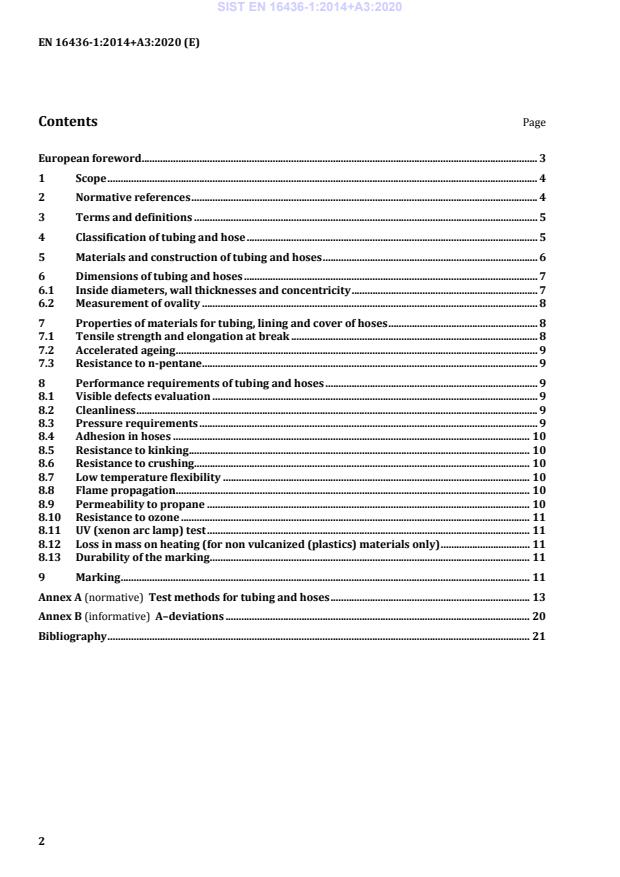
Contents Page
European foreword . 3
1 Scope . 4
2 Normative references . 4
3 Terms and definitions . 5
4 Classification of tubing and hose . 5
5 Materials and construction of tubing and hoses . 6
6 Dimensions of tubing and hoses . 7
6.1 Inside diameters, wall thicknesses and concentricity . 7
6.2 Measurement of ovality . 8
7 Properties of materials for tubing, lining and cover of hoses . 8
7.1 Tensile strength and elongation at break . 8
7.2 Accelerated ageing . 9
7.3 Resistance to n-pentane . 9
8 Performance requirements of tubing and hoses . 9
8.1 Visible defects evaluation . 9
8.2 Cleanliness . 9
8.3 Pressure requirements . 9
8.4 Adhesion in hoses . 10
8.5 Resistance to kinking . 10
8.6 Resistance to crushing . 10
8.7 Low temperature flexibility . 10
8.8 Flame propagation . 10
8.9 Permeability to propane . 10
8.10 Resistance to ozone . 11
8.11 UV (xenon arc lamp) test . 11
8.12 Loss in mass on heating (for non vulcanized (plastics) materials only) . 11
8.13 Durability of the marking . 11
9 Marking . 11
Annex A (normative) Test methods for tubing and hoses . 13
Annex B (informative) A–deviations . 20
Bibliography . 21
European foreword
This document (EN 16436-1:2014+A3:2020) has been prepared by Technical Committee CEN/TC 181
“Dedicated liquefied petroleum gas appliances”, the secretariat of which is held by AFNOR.
This European Standard shall be given the status of a national standard, either by publication of an
identical text or by endorsement, at the latest by November 2020, and conflicting national standards
shall be withdrawn at the latest by November 2020.
Attention is drawn to the possibility that some of the elements of this document may be the subject of
patent rights. CEN shall not be held responsible for identifying any or all such patent rights.
This document includes Amendment 1, approved by CEN on 2015-10-01, Amendment 2, approved by
CEN on 2018-05-13, and Amendment 3, approved by CEN on 2019-07-12.
This document supersedes %EN 16436-1:2014+A2:2018&.
The start and finish of text introduced or altered by amendment is indicated in the text by tags !",
#$ and %&.
According to the CEN-CENELEC Internal Regulations, the national standards organisations of the
following countries are bound to implement this European Standard: Austria, Belgium, Bulgaria,
Croatia, Cyprus, Czech Republic, Denmark, Estonia, Finland, France, Germany, Greece, Hungary, Iceland,
Ireland, Italy, Latvia, Lithuania, Luxembourg, Malta, Netherlands, Norway, Poland, Portugal, Republic of
North Macedonia, Romania, Serbia, Slovakia, Slovenia, Spain, Sweden, Switzerland, Turkey and the
United Kingdom.
1 Scope
This European Standard specifies the characteristics and performance requirements for tubing and
hoses made of either rubber or plastics for use with commercial propane and commercial butane and
mixtures thereof, in the vapour phase, for connection of appliances, from:
— pressurized gas container to a regulating device,
— pressurized gas container to an appliance,
— regulating device to an appliance, and
— regulating device to installation pipework,
in environments of a temperature range from –30 °C to +70 °C. Working pressures are from 0 bar to 30
bar.
Three classes are defined in Table 1 according to the maximum working pressures and minimum
ambient temperatures.
This European Standard only covers the tubing or hose part of assemblies. The assemblies themselves
will be covered by EN 16436-2.
This European Standard does not apply to hoses for:
— welding purposes (see EN ISO 3821, EN 1327);
— propulsion purposes;
— LPG transfer purposes (see EN 1762).
2 Normative references
The following documents, in whole or in part, are normatively referenced in this document and are
indispensable for its application. For dated references, only the edition cited applies. For undated
references, the latest edition of the referenced document (including any amendments) applies.
EN ISO 176, Plastics - Determination of loss of plasticizers - Activated carbon method (ISO 176:2005)
EN ISO 1402, Rubber and plastics hoses and hose assemblies - Hydrostatic testing (ISO 1402:2009)
EN ISO 4080, Rubber and plastics hoses and hose assemblies - Determination of permeability to gas (ISO
4080:2009)
EN ISO 4671, Rubber and plastics hoses and hose assemblies - Methods of measurement of the dimensions
of hoses and the lengths of hose assemblies (ISO 4671:2007)
EN ISO 7326, Rubber and plastics hoses - Assessment of ozone resistance under static conditions (ISO
7326:2016)
EN ISO 8033, Rubber and plastics hoses - Determination of adhesion between components (ISO
8033:2016)
EN ISO 8330:2008, Rubber and plastics hoses and hose assemblies — Vocabulary (ISO 8330:2007)
EN ISO 10619-2, Rubber and plastics hoses and tubing - Measurement of flexibility and stiffness - Part 2:
Bending tests at sub-ambient temperatures (ISO 10619-2:2017)
EN ISO 30013, Rubber and plastics hoses - Methods of exposure to laboratory light sources -
Determination of changes in colour, appearance and other physical properties (ISO 30013:2011)
ISO 37, Rubber, vulcanized or thermoplastic — Determination of tensile stress-strain properties
ISO 105-A02, Textiles — Tests for colour fastness — Part A02: Grey scale for assessing change in colour
ISO 188, Rubber, vulcanized or thermoplastic — Accelerated ageing and heat resistance tests
3 Terms and definitions
For the purposes of this document, the terms and definitions given in EN ISO 8330:2008 and the
following apply.
3.1
commercial butane
hydrocarbon product composed predominantly of butanes and/or butenes
Note 1 to entry: The remaining part can consist mainly of propane/propene and pentane/pentene isomers.
[SOURCE: ISO 9162]
3.2
commercial propane
hydrocarbon product composed predominantly of propane and/or propene
Note 1 to entry: The remaining part can consist mainly of ethane/ethene and butane/butene isomers.
[SOURCE: ISO 9162]
3.3
tubing
single core of plastic or rubber with no reinforcement or cover
3.4
hose
rubber or flexible thermoplastic lining with a reinforcement made of natural or synthetic textile
material applied either spirally wound or braided, and a flexible rubber or thermoplastic outer cover
4 Classification of tubing and hose
One class of tubing and two classes of hose are specified in Table 1 depending on the maximum working
pressure and minimal ambient temperatures.
Table 1 — Classification of tubings and hoses
Maximum working pressure Minimum ambient temperature
Class
bar °C
a
1 (tubing) 0,2 -20
2 (hose) 10 -30
3 (hose) 30
NOTE Classes 1 and 2 are usually used downstream of a pressure regulating device.
5 Materials and construction of tubing and hoses
Class 1 tubing shall be made of rubber or thermoplastic material.
Class 2 and class 3 hoses shall comprise a
— rubber or thermoplastics lining;
— reinforcement of natural or synthetic fibres applied either spirally wound or braided;
— rubber or plastics cover. The outer cover may be pricked to allow any gas trapped between the
inner lining and outer cover to be released.
The surface colour of the tubing or hose shall be:
- orange (see Figure 1a); or
- black with the marking above, on, or below a continuous orange line of 5 mm minimum width (see
Figure 1b); or
- white for classes 1 and 2 with the marking above, on, or below a continuous orange line of 5 mm
minimum width (see Figure 2).
a) option 1
b) option 2
Key
orange colour
black colour
Figure 1 — Possible marking for classes 1, 2 or 3
Key
orange colour
white colour
Figure 2 — Possible marking for classes 1 or 2
6 Dimensions of tubing and hoses
6.1 Inside diameters, wall thicknesses and concentricity
When measured in accordance with EN ISO 4671 the inside diameters, tolerances and concentricity
shall conform to the values given in Table 2.
Table 2 — Dimensions of hoses or tubing
Dimensions in millimetres
Inside diameters 3,2 4,0 5,0 6,3 8,0 9,0 10,0 10,5 12,5 %14,0
Tolerance of inside ± 0,3 ± 0,4 ± 0,4 ± 0,5 ± 0,5 ± 0,5 ± 0,6 ± 0,6 ± 0,6 ± 1,0
diameter
Maximum variation in 0,3 0,4 0,4 0,4 0,5 0,5 0,5 0,5 0,5 0,6
concentricity
Wall thickness class 1 2,5 3,5 3,5 3,5 3,5 3,5 5,0 5,0 5,0 5,0
and class 2
Wall thickness class 3 3,5 4,0 4,0 5,0 5,0 5,0 5,0 5,0 6,0 6,0
Tolerance of wall ± 0,4 ± 0,4 ± 0,4 ± 0,4 ± 0,5 ± 0,5 ± 0,5 ± 0,5 ± 0,5 ± 0,5&
thickness
6.2 Measurement of ovality
When measuring on a hose cross section, the minimum diameter D and the maximum diameter D ,
min max
the ratio D /D shall not be less than 0,80.
min max
7 Properties of materials for tubing, lining and cover of hoses
7.1 Tensile strength and elongation at break
When tested in accordance with A.2, the materials used for tubing, lining and cover of hoses shall
conform to the values given in Table 3.
Table 3 — Requirements for tensile strength and elongation at break
Class Component Tensile strength Elongation at break
min. min.
MPa %
1 Tubing 7,0 250
2, 3 Lining and cover
7.2 Accelerated ageing
After ageing in accordance with ISO 188, using a normal air oven and conditions given in Table 4,
materials used for tubing, for the lining and cover of hoses shall conform to the values given in Table 4.
Table 4 — Requirements for accelerated ageing
Test duration Test temperature Minimum residual Deviation from
Class
value from origin original values
days °C
max
Tensile strength Elongation at
break
1, 14 90 ± 2 75 % ± 50 %
2, 3 28
7.3 Resistance to n-pentane
When tested in accordance with A.3, samples of the lining of hoses or tubing shall have absorption of
n-pentane (α) not exceeding 10 % and an extraction of material by n-penta
...