

SIST EN 12983-1:2023
(Main)Cookware - Domestic cookware for use on top of a stove, cooker or hob - Part 1: General requirements
General Information
- Abstract
This document specifies safety and performance requirements for items of cookware for domestic use on top of a stove, cooker or hob. It is applicable to all cookware regardless of material or method of manufacture. It is also applicable to cookware intended for use both “on top” and “in oven”.
Hob types covered by this document are gas, electric solid plate, electric radiant ring, radiant plate in glass ceramic and induction plate in glass ceramic.
This document is not applicable to pressure cookers, stove top water kettles and coffee makers.
NOTE 1 Requirements for suitability for use in automatic dishwashers are under study by a specialist group and will be added by amendment when completed.
NOTE 2 The requirements for ceramic and glass ceramic are specified in Part 2.
NOTE 3 The additional requirements for cookware for use on induction heating sources are specified in Part 3.
- Status
- Published
- Public Enquiry End Date
- 02-Mar-2020
- Publication Date
- 22-Mar-2023
- Technical Committee
- EPO - Packaging - sales and grouped
- Current Stage
- 6060 - National Implementation/Publication (Adopted Project)
- Start Date
- 08-Mar-2023
- Due Date
- 13-May-2023
- Completion Date
- 23-Mar-2023

Overview
EN 12983-1:2023 is the CEN European standard that defines general safety and performance requirements for domestic cookware used on top of a stove, cooker or hob. Applicable to cookware of any material or manufacture method, this Part 1 document covers use “on top” and items intended for both stove-top and oven use. It excludes pressure cookers, stove-top kettles and coffee makers. The standard was prepared by CEN/TC 194 and approved in January 2023.
Keywords: EN 12983-1:2023, cookware standard, domestic cookware, stove, hob, safety requirements, performance testing
Key topics and technical requirements
EN 12983-1:2023 sets out requirements, test methods and performance criteria across core aspects of cookware design and construction, including:
- Materials - expectations for substrates and food-contact suitability.
- Construction & geometry - dimensional and assembly considerations to ensure safe use on gas, electric solid plate, electric radiant ring, radiant plate in glass-ceramic and induction hobs.
- Furniture (handles, knobs, lids) - selection, position, torque and fatigue resistance, pull-off strength, thermal insulation and resistance to burning.
- Coatings - requirements and tests for vitreous enamel, sol–gel, hard-anodized aluminium, exterior organic and interior non-stick coatings (including adhesion, pencil-hardness and corrosion resistance).
- Performance tests - pouring behaviour, base stability under shock, heat distribution, and suitability for specified heat sources.
- Product information - mandatory point-of-sale and care/use instructions for consumers.
Normative annexes provide detailed test procedures for burning resistance, torque, bending, fatigue, insulating properties, non-stick suitability and more.
Practical applications
This standard is used to:
- Design and validate cookware for consumer safety and performance.
- Define laboratory test programs for compliance and quality control.
- Guide procurement specifications for retailers and OEMs.
- Support regulatory conformity assessments and market surveillance.
Manufacturers rely on EN 12983-1:2023 to reduce liability, improve product reliability and ensure consistent consumer information.
Who should use this standard
- Cookware designers and manufacturers
- Product safety and quality engineers
- Test laboratories and certification bodies
- Retail buyers and private-label brands
- Regulatory and compliance officers
Related standards
- EN 12983-1:2023 is Part 1 (General requirements).
- Part 2 covers ceramic and glass-ceramic specific requirements.
- Part 3 covers additional requirements for induction heating sources.
Note: dishwasher suitability testing is under study and will be added by amendment.
Using EN 12983-1:2023 helps ensure cookware is safe, durable and fit for the range of modern hob technologies while providing clear test methods for verification.
Relations
- Effective Date
- 01-May-2023
- Effective Date
- 01-May-2023
- Effective Date
- 01-May-2023
- Effective Date
- 09-Feb-2026
- Refers
SIST EN 30-1-1:2022+A1:2024 - Domestic cooking appliances burning gas - Part 1-1: Safety - General - Effective Date
- 28-Jan-2026
- Effective Date
- 28-Jan-2026
- Refers
SIST-TP CEN/TR 18217:2026 - Safety of toys - Migration of certain Elements from "Hard" polymers - Effective Date
- 28-Jan-2026
- Effective Date
- 28-Jan-2026
- Effective Date
- 28-Jan-2026
- Effective Date
- 28-Jan-2026
- Effective Date
- 28-Jan-2026
- Effective Date
- 28-Jan-2026
- Effective Date
- 28-Jan-2026
- Effective Date
- 28-Jan-2026
- Effective Date
- 28-Jan-2026
Frequently Asked Questions
SIST EN 12983-1:2023 is a standard published by the Slovenian Institute for Standardization (SIST). Its full title is "Cookware - Domestic cookware for use on top of a stove, cooker or hob - Part 1: General requirements". This standard covers: This document specifies safety and performance requirements for items of cookware for domestic use on top of a stove, cooker or hob. It is applicable to all cookware regardless of material or method of manufacture. It is also applicable to cookware intended for use both “on top” and “in oven”. Hob types covered by this document are gas, electric solid plate, electric radiant ring, radiant plate in glass ceramic and induction plate in glass ceramic. This document is not applicable to pressure cookers, stove top water kettles and coffee makers. NOTE 1 Requirements for suitability for use in automatic dishwashers are under study by a specialist group and will be added by amendment when completed. NOTE 2 The requirements for ceramic and glass ceramic are specified in Part 2. NOTE 3 The additional requirements for cookware for use on induction heating sources are specified in Part 3.
This document specifies safety and performance requirements for items of cookware for domestic use on top of a stove, cooker or hob. It is applicable to all cookware regardless of material or method of manufacture. It is also applicable to cookware intended for use both “on top” and “in oven”. Hob types covered by this document are gas, electric solid plate, electric radiant ring, radiant plate in glass ceramic and induction plate in glass ceramic. This document is not applicable to pressure cookers, stove top water kettles and coffee makers. NOTE 1 Requirements for suitability for use in automatic dishwashers are under study by a specialist group and will be added by amendment when completed. NOTE 2 The requirements for ceramic and glass ceramic are specified in Part 2. NOTE 3 The additional requirements for cookware for use on induction heating sources are specified in Part 3.
SIST EN 12983-1:2023 is classified under the following ICS (International Classification for Standards) categories: 97.040.60 - Cookware, cutlery and flatware. The ICS classification helps identify the subject area and facilitates finding related standards.
SIST EN 12983-1:2023 has the following relationships with other standards: It is inter standard links to SIST EN 12983-1:2001/A1:2005, SIST EN 12983-1:2001, SIST EN 12983-1:2001/AC:2009, SIST EN IEC 60350-2:2025, SIST EN 30-1-1:2022+A1:2024, SIST EN 187-1:1998, SIST-TP CEN/TR 18217:2026, SIST EN ISO 2360:2017, SIST EN ISO 4628-2:2016, SIST EN ISO 2409:2020, SIST EN ISO 28706-1:2012, SIST EN ISO 2064:2000, SIST EN ISO 28706-2:2017, SIST EN 12983-2:2023+A1:2025, SIST EN 12983-2:2023. Understanding these relationships helps ensure you are using the most current and applicable version of the standard.
SIST EN 12983-1:2023 is available in PDF format for immediate download after purchase. The document can be added to your cart and obtained through the secure checkout process. Digital delivery ensures instant access to the complete standard document.
Standards Content (Sample)
SLOVENSKI STANDARD
01-maj-2023
Nadomešča:
SIST EN 12983-1:2001
SIST EN 12983-1:2001/A1:2005
SIST EN 12983-1:2001/AC:2009
Posoda za kuhanje - Posoda za domačo uporabo v pečici, na štedilniku ali kuhalni
plošči - 1. del: Splošne zahteve
Cookware - Domestic cookware for use on top of a stove, cooker or hob - Part 1:
General requirements
Kochgeschirre - Haushaltskochgeschirre zur Verwendung auf einem Herd oder Kochfeld
- Teil 1: Allgemeine Anforderungen
Articles culinaires - Articles culinaires à usage domestique pour cuisinières et plaques de
cuisson - Partie 1: Prescriptions générales
Ta slovenski standard je istoveten z: EN 12983-1:2023
ICS:
97.040.60 Kuhinjska posoda, jedilni Cookware, cutlery and
servisi in jedilni pribor flatware
2003-01.Slovenski inštitut za standardizacijo. Razmnoževanje celote ali delov tega standarda ni dovoljeno.
EN 12983-1
EUROPEAN STANDARD
NORME EUROPÉENNE
February 2023
EUROPÄISCHE NORM
ICS 97.040.60 Supersedes EN 12983-1:2000, EN 12983-
1:2000/A1:2004, EN 12983-1:2000/AC:2008
English Version
Cookware - Domestic cookware for use on top of a stove,
cooker or hob - Part 1: General requirements
Articles culinaires - Articles culinaires à usage Kochgeschirre - Haushaltskochgeschirre zur
domestique pour cuisinières et plaques de cuisson - Verwendung auf einem Herd oder Kochfeld - Teil 1:
Partie 1 : Prescriptions générales Allgemeine Anforderungen
This European Standard was approved by CEN on 9 January 2023.
CEN members are bound to comply with the CEN/CENELEC Internal Regulations which stipulate the conditions for giving this
European Standard the status of a national standard without any alteration. Up-to-date lists and bibliographical references
concerning such national standards may be obtained on application to the CEN-CENELEC Management Centre or to any CEN
member.
This European Standard exists in three official versions (English, French, German). A version in any other language made by
translation under the responsibility of a CEN member into its own language and notified to the CEN-CENELEC Management
Centre has the same status as the official versions.
CEN members are the national standards bodies of Austria, Belgium, Bulgaria, Croatia, Cyprus, Czech Republic, Denmark, Estonia,
Finland, France, Germany, Greece, Hungary, Iceland, Ireland, Italy, Latvia, Lithuania, Luxembourg, Malta, Netherlands, Norway,
Poland, Portugal, Republic of North Macedonia, Romania, Serbia, Slovakia, Slovenia, Spain, Sweden, Switzerland, Türkiye and
United Kingdom.
EUROPEAN COMMITTEE FOR STANDARDIZATION
COMITÉ EUROPÉEN DE NORMALISATION
EUROPÄISCHES KOMITEE FÜR NORMUNG
CEN-CENELEC Management Centre: Rue de la Science 23, B-1040 Brussels
© 2023 CEN All rights of exploitation in any form and by any means reserved Ref. No. EN 12983-1:2023 E
worldwide for CEN national Members.
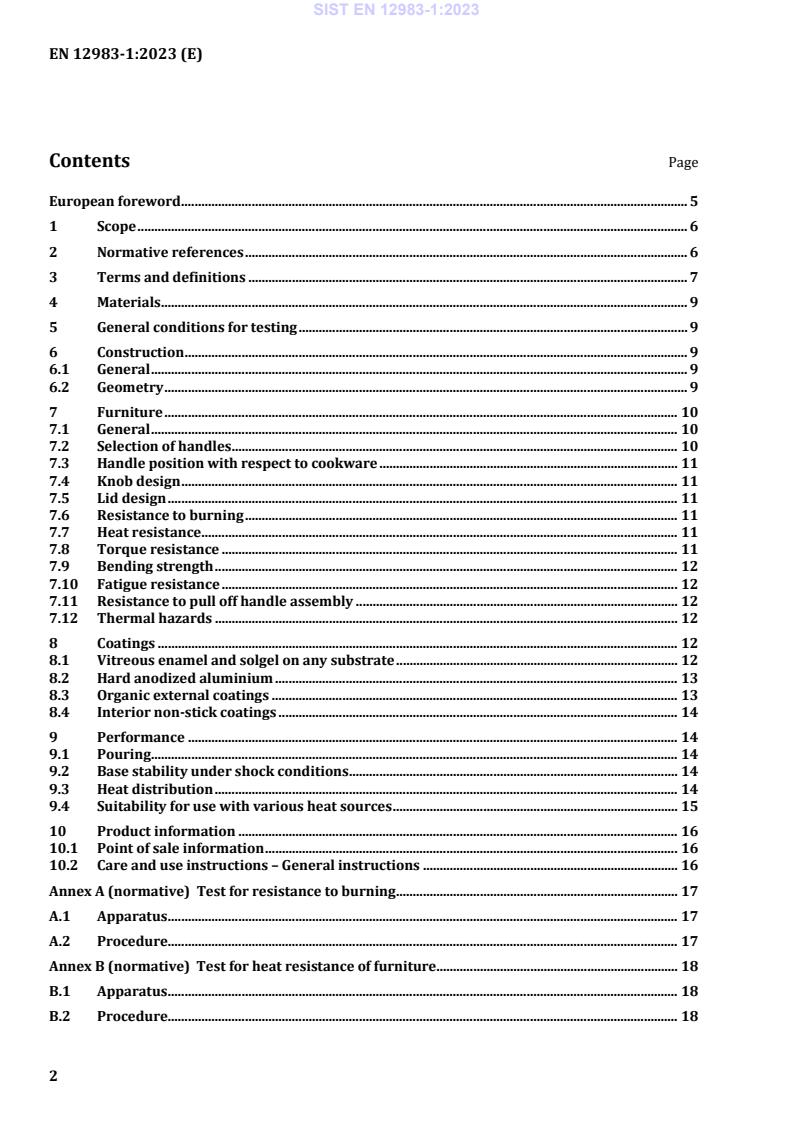
Contents Page
European foreword . 5
1 Scope . 6
2 Normative references . 6
3 Terms and definitions . 7
4 Materials . 9
5 General conditions for testing . 9
6 Construction . 9
6.1 General . 9
6.2 Geometry . 9
7 Furniture . 10
7.1 General . 10
7.2 Selection of handles . 10
7.3 Handle position with respect to cookware . 11
7.4 Knob design . 11
7.5 Lid design . 11
7.6 Resistance to burning . 11
7.7 Heat resistance . 11
7.8 Torque resistance . 11
7.9 Bending strength . 12
7.10 Fatigue resistance . 12
7.11 Resistance to pull off handle assembly . 12
7.12 Thermal hazards . 12
8 Coatings . 12
8.1 Vitreous enamel and solgel on any substrate . 12
8.2 Hard anodized aluminium . 13
8.3 Organic external coatings . 13
8.4 Interior non-stick coatings . 14
9 Performance . 14
9.1 Pouring . 14
9.2 Base stability under shock conditions . 14
9.3 Heat distribution . 14
9.4 Suitability for use with various heat sources . 15
10 Product information . 16
10.1 Point of sale information . 16
10.2 Care and use instructions – General instructions . 16
Annex A (normative) Test for resistance to burning . 17
A.1 Apparatus . 17
A.2 Procedure. 17
Annex B (normative) Test for heat resistance of furniture . 18
B.1 Apparatus . 18
B.2 Procedure. 18
Annex C (normative) Test for resistance to torque . 19
C.1 Apparatus . 19
C.2 Procedure . 19
Annex D (normative) Bending strength test . 21
D.1 Apparatus . 21
D.2 Procedure . 21
Annex E (normative) Handle fatigue test . 22
E.1 Apparatus . 22
E.2 Procedure . 23
Annex F (normative) Test for the insulating properties of furniture . 24
F.1 Apparatus . 24
F.2 Procedure . 25
Annex G (normative) Adhesion test for vitreous enamel on aluminium . 27
G.1 Principles . 27
G.2 Reagents . 27
G.3 Test specimens . 27
G.4 Procedure . 27
Annex H (normative) Resistance to staining of anodised coatings . 28
H.1 Apparatus . 28
H.2 Reagents . 28
H.3 Procedure . 28
Annex I (normative) Resistance to alkali of anodised aluminium . 29
I.1 Apparatus . 29
I.2 Reagents . 29
I.3 Procedure . 29
Annex J (normative) Pencil hardness test for exterior organic coatings . 30
J.1 Apparatus . 30
J.2 Procedure (ambient temperature test) . 30
J.3 Procedure (elevated temperature test) . 31
Annex K (normative) Pouring test . 32
K.1 Apparatus . 32
K.2 Procedure . 32
Annex L (normative) Base stability under shock conditions . 33
L.1 Apparatus . 33
L.2 Procedure . 33
Annex M (normative) Test for resistance to pull . 35
M.1 Apparatus . 35
M.2 Procedure. 35
Annex N (normative) Suitability of non-stick coatings . 37
N.1 Apparatus . 37
N.2 Test batter. 38
N.3 Procedure. 38
N.4 Rating of the pancake release . 40
Annex O (normative) Corrosion resistance of non-stick surfaces . 41
O.1 General . 41
O.2 Procedure. 41
Annex P (normative) Heat distribution . 42
P.1 Apparatus . 42
P.2 Materials . 42
P.3 Procedure. 42
Annex Q (normative) Suitability for gas burner and electric radiant ring and solid plate . 44
Q.1 Apparatus . 44
Q.2 Procedure. 46
Annex R (normative) Suitability for glass ceramic hob with radiant or halogen heaters . 47
R.1 Apparatus . 47
R.2 Procedure. 47
Bibliography . 49
European foreword
This document (EN 12983-1:2023) has been prepared by Technical Committee CEN/TC 194 “Utensils in
contact with food”, the secretariat of which is held by AFNOR.
This European Standard shall be given the status of a national standard, either by publication of an
identical text or by endorsement, at the latest by August 2023, and conflicting national standards shall be
withdrawn at the latest by August 2023.
Attention is drawn to the possibility that some of the elements of this document may be the subject of
patent rights. CEN shall not be held responsible for identifying any or all such patent rights.
This document supersedes EN 12983-1:2000, EN 12983-1:2000/A1:2004 and
EN 12983-1:2000/AC:2008.
The main changes compared to the previous edition are listed below:
— revision of requirements and associated tests for:
— handles;
— coating;
— heat suitability;
— heat distribution;
— inclusion of requirements of CEN/TS 12983-2:2005 (except requirements for ceramic).
Any feedback and questions on this document should be directed to the users’ national standards body.
A complete listing of these bodies can be found on the CEN website.
According to the CEN-CENELEC Internal Regulations, the national standards organisations of the
following countries are bound to implement this European Standard: Austria, Belgium, Bulgaria, Croatia,
Cyprus, Czech Republic, Denmark, Estonia, Finland, France, Germany, Greece, Hungary, Iceland, Ireland,
Italy, Latvia, Lithuania, Luxembourg, Malta, Netherlands, Norway, Poland, Portugal, Republic of North
Macedonia, Romania, Serbia, Slovakia, Slovenia, Spain, Sweden, Switzerland, Türkiye and the United
Kingdom.
1 Scope
This document specifies safety and performance requirements for items of cookware for domestic use on
top of a stove, cooker or hob. It is applicable to all cookware regardless of material or method of
manufacture. It is also applicable to cookware intended for use both “on top” and “in oven”.
Hob types covered by this document are gas, electric solid plate, electric radiant ring, radiant plate in
glass ceramic and induction plate in glass ceramic.
This document is not applicable to pressure cookers, stove top water kettles and coffee makers.
NOTE 1 Requirements for suitability for use in automatic dishwashers are under study by a specialist group and
will be added by amendment when completed.
NOTE 2 The requirements for ceramic and glass ceramic are specified in Part 2.
NOTE 3 The additional requirements for cookware for use on induction heating sources are specified in Part 3.
2 Normative references
The following documents are referred to in the text in such a way that some or all of their content
constitutes requirements of this document. For dated references, only the edition cited applies. For
undated references, the latest edition of the referenced document (including any amendments) applies.
EN 30-1-1, Domestic cooking appliances burning gas - Part 1-1: Safety - General
EN 60350-2, Household electric cooking appliances - Part 2: Hobs - Methods for measuring performance
EN ISO 2064, Metallic and other inorganic coatings - Definitions and conventions concerning the
measurement of thickness (ISO 2064)
EN ISO 2360, Non-conductive coatings on non-magnetic electrically conductive base metals - Measurement
of coating thickness - Amplitude-sensitive eddy-current method (ISO 2360)
EN ISO 2409:2020, Paints and varnishes - Cross-cut test (ISO 2409:2020)
EN ISO 4628-2, Paints and varnishes - Evaluation of degradation of coatings - Designation of quantity and
size of defects, and of intensity of uniform changes in appearance - Part 2: Assessment of degree of blistering
(ISO 4628-2)
EN ISO 28706-1, Vitreous and porcelain enamels - Determination of resistance to chemical corrosion –
Part 1: Determination of resistance to chemical corrosion by acids at room temperature (ISO 28706-1)
EN ISO 28706-2:2017, Vitreous and porcelain enamels - Determination of resistance to chemical corrosion -
Part 2: Determination of resistance to chemical corrosion by boiling acids, boiling neutral liquids, alkaline
liquids and/or their vapours (ISO 28706-2:2017)
ISO 2747, Vitreous and porcelain enamels — Enamelled cooking utensils — Determination of resistance to
thermal shock
ISO 4532, Vitreous and porcelain enamels — Determination of the resistance of enamelled articles to
impact — Pistol test
ISO 10093, Plastics — Fire tests — Standard ignition sources
3 Terms and definitions
For the purposes of this document, the following terms and definitions apply.
ISO and IEC maintain terminology databases for use in standardization at the following addresses:
— IEC Electropedia: available at https://www.electropedia.org/
— ISO Online browsing platform: available at https://www.iso.org/obp
3.1
cookware
utensil, in the form of a hollow container, intended for use in the cooking of food or liquids on the top of
a stove, cooker or hob, and/or in an oven
3.2
fixing system
attachment method, or methods, utilized in fastening a handle to the body of an item of cookware or to
fix a knob to a lid
3.3
capacity
maximum volume of water which can be held by the article on a level surface
Note 1 to entry: 0,1 % (mass fraction) of hand wash detergent shall be added to the water in order to minimize
the surface tension.
3.4
usable capacity
two thirds of the capacity
Note 1 to entry: The true usable capacity of the cookware varies with the food being cooked. The figure given
here is an average value intended for use in test situations only and not as information to the consumer.
3.5
handle
projection integral with or affixed to the body of the cookware and intended to facilitate the carrying and
holding of the article in normal use
3.6
knob
short projection integral with or affixed to the lid of the cookware to facilitate positioning or removal in
normal use
3.7
shallow item
cookware of overall internal depth 1/3 or less of the interior diameter at the rim
3.8
furniture
handles and knobs
3.9
non-stick coating
coating applied to the interior of a cookware to achieve an anti-adherent effect during cooking and
facilitate cleaning
3.10
exterior base diameter
dimension, measured on the exterior bottom of the cookware, across the maximum circumference of
contact when placed on a flat surface
3.11
interior base diameter
diameter, measured on the inside of the cookware, excluding the radius of the body base to the body wall
3.12
glass
inorganic non-metallic material produced by the complete fusion of raw materials at a high temperature
into a homogeneous liquid which is then cooled to a rigid condition essentially without crystallisation
3.13
ceramic
inorganic non-metallic material made by firing a mixture of raw materials at high temperature
Note 1 to entry: The firing temperature is high enough to give the necessary strength to the article, which is
already shaped but is lower than the temperature which is necessary to achieve complete fusion of the mixture.
3.14
glass ceramic
inorganic, non-metallic material produced by the complete fusion of raw materials at high temperatures
into a homogeneous liquid which is then cooled to a rigid material and heat treated to achieve a certain
degree of crystallisation, mainly sub-microscopic small crystallites
3.15
organic coating
kind of polymer coating whose main or primary ingredients are based on compound from organic
chemistry
3.16
ceramic coating
also nominated as sol-gel coating is an inorganic, non-metallic solid and inert film
Note 1 to entry: Mainly composed of silica and can contain some organic substances.
3.17
hard substrate
main material of the body shape
EXAMPLES Aluminium, cast iron, steel.
3.18
concavity
difference of the height between the outside base diameter and the outside base centre of the product
4 Materials
Cookware shall be made of materials of a type and purity that, under normal conditions of use, present
no toxic hazards nor in any way affect the organoleptic qualities of food prepared in it.
NOTE There are European regulations in force regarding products intended to be used in contact with
foodstuffs.
5 General conditions for testing
Unless otherwise specified, the tests shall be carried out at an ambient temperature of (23 ± 5) °C.
When a failure in a test could be caused by the stresses set up by a previous test, the failed test shall be
repeated on a new product.
6 Construction
6.1 General
6.1.1 Stability
The product shall be stable (i.e. shall not tilt), the base shall be in intended contact with the surface (a
slide could be accepted), when placed empty without lid on a (5 ± 0,5)° inclined surface in the least
favourable position.
6.1.2 Hygiene
All surfaces intended to come into contact with food shall be easily cleanable under normal
circumstances.
6.1.3 Mechanical hazards
All components shall be free from burrs, splinters or sharp edges that could cause injury or discomfort to
the user.
6.2 Geometry
6.2.1 Dimensions
The points of measurement of any claimed dimensions shall be made clear to the consumer, e.g. by means
of a simple sketch.
6.2.2 Capacity
If a capacity is claimed, the actual capacity shall be equal or greater than the claimed capacity, when
measured with an accuracy of 0,05 l.
6.2.3 Diameters
Any diameter claimed for the base shall be within ±10 mm of the average of two measurements of the
actual diameter taken at right angles to one another.
Any other claimed diameter shall be within ±5 mm of the average of two measurements of the actual
diameter taken at right angles to one another.
6.2.4 Sizes for non-circular products
Every claimed size shall be within tolerance of ±10 mm.
6.2.5 Base thickness
If a thickness is claimed for the base of a product, the average thickness of the base shall be greater than
85 % of the claimed thickness. The average thickness shall be calculated, by taking the average of the 8
points measured as described in Figure 1.
If more than 22 % of the base area is deliberately deformed for aesthetic or functional reasons, either
internally or externally, no claim for base thickness shall be made.
Dimensions in millimetres
Key
1 measuring points
d base diameter
Figure 1 — Measuring points
6.2.6 Base form
The base, when viewed from the beneath, shall not be convex except for products whose intrinsic design
features preclude them complying with this requirement, e.g. certain woks.
7 Furniture
7.1 General
It is not the intention that all these tests shall be passed in sequence. Except where otherwise stated each
test shall stand alone.
7.2 Selection of handles
All cookware with a capacity greater than 3,75 l or a total weight of 5 kg when filled to capacity with water
shall be fitted with two handles.
7.3 Handle position with respect to cookware
Handles shall be positioned above the centre of gravity of an item of cookware when filled with water to
its capacity. For shallow items there shall be a minimum clearance of 30 mm between the handle and the
horizontal projection of the base of the item of cookware at a point halfway along the handle assembly.
In the case of side handles, the measurement is taken at the lowest point where they are held in normal
use (see Figure 2).
Dimensions in millimetres
Figure 2 — Handle position
7.4 Knob design
It shall be possible to use the knob for its normal purposes without coming into contact with any surface
whose temperature exceeds the values given in 7.12 for the relevant materials.
7.5 Lid design
The design of the lid shall be such that it shall be possible to remove it from the body using a force equal
to the weight of the lid + 2 N in any position at a temperature of (23 ± 5) °C. This test shall be carried out
both before and after bringing a quantity of water, equal to the usable capacity, to the boil and allowing
it to cool to ambient temperature. The lid shall remain in place throughout the boiling and cooling stages.
If the lid is fitted with a locking device, this test shall be carried out with the device disengaged.
NOTE For glass lid thermal resistance, see EN 12983-2:2023, Clause 5.
7.6 Resistance to burning
The underside of the handle or any insert or inlay there, consisting of organic material, shall not drip
molten material or keep burning when tested according to Annex A. Any burning shall self-extinguish
within 15 s of the removal of the flame. Once extinguished the handle material shall not spontaneously
re-ignite. Each material shall be tested at its position.
7.7 Heat resistance
All furniture designed to be attached to the main body of a product shall be free from cracks and blisters
after completion of the test described in Annex B for a temperature of (150 ± 5) °C for 1 h. Purely
decorative features, e.g. thermoplastic inlays or sleeves, are exempt from this requirement.
7.8 Torque resistance
When tested in accordance with Annex C, the movement of the handle shall be no more than 10° in either
direction. There shall be no damage affecting the function caused to the handle, ferrule or fixing system
by this test.
7.9 Bending strength
No part of the handle or handle fixing system shall detach or break with a bending force of 100 N when
tested as described in Annex D during 30 s.
7.10 Fatigue resistance
A handle assembly shall withstand 15 000 cycles, without permanent deformation or permanent
loosening of the handle or its fixing system, when tested as described in Annex E. If any loosening of the
handle is noticed it is acceptable to retighten as mentioned in the use and care manual. Distortion of less
than 5 % of the handle length measured at the end of the handle is ignored unless it affects safety or
function.
7.11 Resistance to pull off handle assembly
When tested as described in Annex M, a handle assembly shall withstand a dynamic impact of 1,5 Nm
without any breakage nor reduction in the security of the handle nor the fixing system.
7.12 Thermal hazards
For the following materials, the maximum temperature shall not exceed:
a) metal 55 °C;
b) plastics 70 °C;
c) wood 89 °C;
d) ceramic, glass, stone 66 °C
when tested as described in Annex F.
If the values exceed these limits or the cookware is claimed to be suitable for deepfrying, the
manufacturer shall indicate in the instructions (see 10.2) that the use of protection is required in order
to ensure a safe handling of the cookware.
It shall not be possible to touch, with a spherical probe 14 mm in diameter, any metal part contained
within the insulated portion of the furniture which exceeds 55 °C when tested as described in Annex F.
8 Coatings
8.1 Vitreous enamel and solgel on any substrate
8.1.1 Citric acid test at room temperature
When the interior enamel coat is tested in accordance with EN ISO 28706-2:2017, Clause 11, the
2 2
maximum acceptable weight loss shall be 5,0 g/m for the liquid phase and 10,0 g/m for the vapour
phase. The interior coating shall be tested in accordance with EN ISO 28706-1. For matte and glossy
surfaces, the result is considered as successful if the sample is in class AA, A+.
8.1.2 Boiling water test
When the interior enamel coat is tested in accordance with EN ISO 28706-2:2017, Clause 14, the
2 2
maximum acceptable weight loss shall be 1,5 g/m for the liquid phase and 4,5 g/m for the vapour.
8.1.3 Thermal shock test
When the coating is tested in accordance with ISO 2747, the minimum acceptable failure temperature
shall be 280 °C.
8.1.4 Resistance to impact
When the coating is tested in accordance with ISO 4532, the coating shall resist a minimum impact of
20 N, showing no damage greater than 2 mm after 24 h.
8.1.5 Adhesion test for vitreous enamel on aluminium
When tested as described in Annex G, exposure of the base metal shall not exceed 3 mm from the test
edge.
8.2 Hard anodized aluminium
8.2.1 Thickness
The minimum average thickness of an anodised layer shall be 25 μm when measured as specified in
EN ISO 2064 and EN ISO 2360.
This check shall be carried out only where the hard anodised coating is not covered by a separate coat of
a different material.
8.2.2 Stain resistance
When tested as described in Annex H, there shall be no staining visible on any surface intended to come
into contact with food.
8.2.3 Alkali resistance
When tested as described in Annex I, there shall be no loss of the insulating properties of the coating of
any surface intended to come into contact with food.
8.2.4 Hardness
Coatings claimed to be hard anodised shall have a hardness greater than 350 HV 0,5 or equivalent.
8.3 Organic external coatings
8.3.1 Cross-cut adhesion test
There shall be no removal of the coating greater than classification 2 when tested as described in
EN ISO 2409:2020 for hard substrates, with the following modifications:
a) precondition the sample by immersing in continuously boiling water for 15 min, allowing it to cool
at ambient temperature and wiping it dry;
b) repeat the test method described in A.2 of EN ISO 2409:2020 a further 3 times applying the tape at
90° to the previous application each time. The tape used shall have an adhesion performance from
360 cN/Cm to 440 cN/Cm.
8.3.2 Pencil hardness test
When tested on the base as described in Annex J, the minimum acceptable hardness shall be 2 H.
8.3.3 Pencil hardness test at elevated temperatures
When tested on the base (bottom) as described in Annex J, with the test surface held at 200 °C, the
minimum acceptable hardness shall be H.
Extreme care should be taken in carrying out this test to avoid burns. Tests 8.3.2 and 8.3.3 are applicable
only in case of flat surface.
8.4 Interior non-stick coatings
8.4.1 General
The requirements given in this clause apply to any surfaces which are claimed to be non-stick.
8.4.2 Cross-cut adhesion test on organic coating
There shall be no removal of the coating greater than classification 2 when tested as described in
EN ISO 2409:2020 for hard substrates, with the following modifications:
1) precondition the test piece by immersing in continuously boiling water for 15 min, allowing it to cool
at ambient temperature and wiping it dry;
2) repeat the test method described in A.2 of EN ISO 2409:2020 a further 3 times applying the tape at
90° to the previous application each time. The tape used shall have an adhesion performance from
360 cN/Cm to 440 cN/Cm.
8.4.3 Non-stick performance
When tested as described in Annex N, any surface claimed to be non-stick shall still have acceptable
pancake release over 5 cooking cycles and shall not show wear through of the coating.
Acceptable pancake release means all food is released with a spatula with some effort (minimum
requirement 50 points on all 5 tests).
8.4.4 Corrosion resistance
When tested as described in Annex O, any surface claimed to be non-stick shall show no blistering
exceeding size 2 density 2 according to EN ISO 4628-2.
9 Performance
9.1 Pouring
When tested as described in Annex K, the liquid shall flow cleanly from the rim. There shall be no
continuous dribbling, but individual droplets may flow back on to the sidewall.
Items of cookware provided with a pouring lip shall be tested to satisfy this requirement only at the
pouring lip.
Shallow products, e.g. frypans and omelette pans, shall only be tested if they are provided with a pouring
lip.
9.2 Base stability under shock conditions
When tested as described in Annex L, the base shall not become convex.
9.3 Heat distribution
When tested as described in Annex P, the temperature at the point where the sugar first melted (190 °C)
shall not exceed 290 °C at the completion of the test.
An infrared camera could be used instead of the sugar. In this case, the point which first reaches a
temperature of 190 °C shall not exceed a temperature of 290°C when the minimum temperature over the
entire interior base reaches 190 °C.
9.4 Suitability for use with various heat sources
9.4.1 Declaration of suitability
The manufacturer or supplier shall declare the heat source(s) for which their products are suitable.
9.4.2 Suitability for glass ceramic hobs with radiant or halogen heaters
The test methods given in Annex R shall be applied for evaluation.
For an item to be compatible with glass ceramic hobs with radiant or halogen heaters, it shall fit with the
followed requirements:
Time shall be lower than the one obtained with the reference pot multiplied by the factor
— 2 for water heating; and
— 5 for oil heating.
9.4.3 Suitability for gas burners and electric radiant ring
For an item to be compatible with gas stove or electric radiant ring (also called spiral resistance), it shall
fit with the followed requirements:
— at room temperature, the bottom shall not be convex, when the product is new or after tested
according with the protocol described in Annex Q;
— at hot temperature, the bottom shall not be convex, when the product is new or after tested
according with the protocol described in Annex Q.
9.4.4 Suitability with electric solid plate
For an item to be suitable with electric solid plate it shall fit with the following requirements:
— at room temperature, when the product is new: the bottom shall not be convex. The value of the
concavity made by the method described in Annex Q, shall not exceed 10 ‰ of the diameter;
— at room temperature, after ageing test (Q.2.2 to Q.2.5): the bottom shall not be convex. The value of
the concavity made by the method described in Annex Q, shall not exceed 10‰ of the diameter;
— at hot temperature (Q.2.6 to Q.2.11), after ageing test: the bottom shall not be convex;
— at room temperature, after hot temperature test (Q.2.6 to Q.2.11): the bottom shall not be convex.
The value of the concavity made by the method described in Annex Q, shall not exceed 10‰ of the
diameter;
— as measured by the method described in Annex Q.
10 Product information
10.1 Point of sale information
All products or their packaging shall be labelled with the following information so that it is visible at the
point of sale:
a) an indication as to the type, material and size of the product, e.g. 0,5 l milkpan or 25 cm frypan;
b) a listing of the heating source types for which the product is suitable. It may be achieved by the use
of generally accepted symbols. Graphic symbols should be in accordance with EN 14916 or ISO 7000;
c) the name of the manufacturer, importer or retailer and reference of the product.
10.2 Care and use instructions – General instructions
All products shall be accompanied by appropriate care, safety and use instructions including the
following:
a) advice on preparation before first use;
b) advice on cleaning after use;
c) advice on care of furniture;
d) advice on obtaining optimum energy efficiency;
e) general safety advice (see also 7.12); pre heating, dry heating, ventilation, attendance;
f) specific advice on the care of non-stick surfaces, if appropriate;
g) specific safety instructions and warnings on the inherent dangers if the product is to be used for deep
frying. In particular, a specified fill level which should not be exceeded;
h) advice on what to do if the product proves to be unsatisfactory;
i) name and contact address of manufacturer, importer or retailer.
Annex A
(normative)
Test for resistance to burning
A.1 Apparatus
Laboratory burner, ignition source P/PF2 as specified in ISO 10093 having a barrel length of
100 mm ± 10 mm and an internal diameter of 9,5 mm ± 0,3 mm. Do not equip the barrel with an end
attachment such as a stabilizer.
Clamp, or other means of attaching the cookware firmly to a rigid base throughout the test, e.g. a G-clamp.
The environment of the test should be such that no deterioration or movement of the flame occurs. Also,
a facility should be provided for the extraction of any fumes immediately after the test.
A.2 Procedure
Attach the cookware to the rigid base.
Position the burner, alight, with airhole closed, so that the tip of the flame just touches the underside of
the end of the combustible part of the handle (see Figure A.1). By means of the gas flow adjust the flame
height to 30 mm ± 2 mm. Ensure that the air hole is closed throughout the test.
Dimensions in millimetres
Figure A.1 — Resistance to burning
Expose the handle to the flame for 30 s ± 1 s, remove the flame and allow the
...