

SIST EN ISO 19956:2005
(Main)Footwear - Test methods for heels - Fatigue resistance (ISO 19956:2004)
General Information
- Abstract
ISO 19956:2004 specifies a test method for determining the ability of heels of ladies' shoes to withstand the repeated small impacts imposed by normal walking. Although intended primarily for plastic heels, the procedure is also usable for testing steel heel dowels on their own.
While the test method is applicable to all types of high heels of any construction, it is particularly useful for injection-moulded plastic heels that incorporate a steel dowel reinforcement.
- Status
- Published
- Publication Date
- 28-Feb-2005
- Technical Committee
- SS SPL - Technical Board for the general field
- Current Stage
- 6060 - National Implementation/Publication (Adopted Project)
- Start Date
- 01-Mar-2005
- Due Date
- 01-Mar-2005
- Completion Date
- 01-Mar-2005

Overview
SIST EN ISO 19956:2005, titled Footwear - Test methods for heels - Fatigue resistance, is an international standard established by CEN for assessing the durability of high-heeled footwear. Specifically, it provides a systematic method to determine a heel's ability to withstand the repeated minor impacts typical of normal walking. The procedure is particularly relevant for injection-moulded plastic heels with steel dowel reinforcements, but it is applicable to heels of any material or construction, including stand-alone steel dowels.
This standard is key in ensuring consistent quality and safety in ladies’ shoes, helping manufacturers, testing laboratories, and quality assurance professionals evaluate heel fatigue resistance objectively.
Key Topics
- Purpose of the Test: Measures fatigue resistance, or a heel’s capacity to withstand repeated loading cycles simulating walking impact.
- Applicability: Designed for all types of high heels, regardless of construction, with special utility for plastic heels with steel reinforcement.
- Test Apparatus: Utilizes a pendulum-based fatigue-testing machine delivering controlled energy impacts at set intervals.
- Sampling and Preparation: Requires three heel samples, securely mounted using a low-melting-point metal alloy to ensure consistency during testing.
- Testing Procedure:
- Heels are subjected to continuous pendulum strikes, each with a specified energy.
- The number of blows until failure or up to a threshold (20,000 cycles) is recorded.
- Observations are made at intervals to detect and log any visible damage.
- Special reporting if damage results directly from the test striker's action rather than normal use.
- Results Expression and Reporting: Documents onset of damage, complete failure, or resilience through maximum cycles. Detailed findings must be included in each test report, encompassing sample details and deviations from the standard method.
Applications
SIST EN ISO 19956:2005 is crucial for various segments of the footwear industry, including:
- Footwear Manufacturers: Used to design and validate the durability of ladies' heels before market release, minimizing product returns and enhancing brand reputation.
- Testing Laboratories: Provides a clear, reproducible protocol for third-party quality control and certification for both plastic and metal-constructed heels.
- Quality Assurance & Compliance: Assists in meeting both regulatory and customer performance requirements in key international markets.
- Product Development: Guides R&D teams in material selection-particularly for injection-moulded plastic heels with steel inserts-by benchmarking fatigue resistance early in the design process.
- Retail and Procurement: Ensures suppliers provide products that comply with fatigue resistance standards, reducing the risk of defective products and associated liabilities.
Related Standards
To ensure robust quality management in footwear production and testing, the following standards are commonly referenced alongside SIST EN ISO 19956:2005:
- EN ISO 20344: Personal protective equipment - Test methods for footwear
- EN ISO 20885: Test methods for heels - Attachment strength
- ISO 19953: Footwear - Test methods for outsoles - Abrasion resistance
- ISO 19952: Footwear - Test method for insoles - Resistance to repeated flexing
Integrating SIST EN ISO 19956:2005 with these related standards creates a comprehensive testing regime, enhancing product safety, durability, and consumer satisfaction in the footwear sector.
Keywords: SIST EN ISO 19956:2005, footwear test methods, heel fatigue resistance, high heel testing, shoe quality testing, CEN footwear standards, injection-moulded plastic heels, heel durability, steel heel dowel testing, ladies’ shoes standards.
Relations
- Effective Date
- 28-Jan-2026
Frequently Asked Questions
SIST EN ISO 19956:2005 is a standard published by the Slovenian Institute for Standardization (SIST). Its full title is "Footwear - Test methods for heels - Fatigue resistance (ISO 19956:2004)". This standard covers: ISO 19956:2004 specifies a test method for determining the ability of heels of ladies' shoes to withstand the repeated small impacts imposed by normal walking. Although intended primarily for plastic heels, the procedure is also usable for testing steel heel dowels on their own. While the test method is applicable to all types of high heels of any construction, it is particularly useful for injection-moulded plastic heels that incorporate a steel dowel reinforcement.
ISO 19956:2004 specifies a test method for determining the ability of heels of ladies' shoes to withstand the repeated small impacts imposed by normal walking. Although intended primarily for plastic heels, the procedure is also usable for testing steel heel dowels on their own. While the test method is applicable to all types of high heels of any construction, it is particularly useful for injection-moulded plastic heels that incorporate a steel dowel reinforcement.
SIST EN ISO 19956:2005 is classified under the following ICS (International Classification for Standards) categories: 61.060 - Footwear. The ICS classification helps identify the subject area and facilitates finding related standards.
SIST EN ISO 19956:2005 has the following relationships with other standards: It is inter standard links to SIST-TP CEN ISO/TR 20573:2008. Understanding these relationships helps ensure you are using the most current and applicable version of the standard.
SIST EN ISO 19956:2005 is available in PDF format for immediate download after purchase. The document can be added to your cart and obtained through the secure checkout process. Digital delivery ensures instant access to the complete standard document.
Standards Content (Sample)
SLOVENSKI STANDARD
01-marec-2005
Obutev – Preskusne metode za pete – Odpornost proti utrujanju (ISO 19956:2004)
Footwear - Test methods for heels - Fatigue resistance (ISO 19956:2004)
Schuhe - Prüfverfahren für Absätze - Ermüdungswiderstand (ISO 19956:2004)
Chaussures - Méthodes d'essai relatives aux talons - Résistance a la fatigue (ISO
19956:2004)
Ta slovenski standard je istoveten z: EN ISO 19956:2004
ICS:
61.060 Obuvala Footwear
2003-01.Slovenski inštitut za standardizacijo. Razmnoževanje celote ali delov tega standarda ni dovoljeno.
EUROPEAN STANDARD
EN ISO 19956
NORME EUROPÉENNE
EUROPÄISCHE NORM
September 2004
ICS 61.060
English version
Footwear - Test methods for heels - Fatigue resistance (ISO
19956:2004)
Chaussures - Méthodes d'essai relatives aux talons - Schuhe - Prüfverfahren für Absätze -
Résistance à la fatigue (ISO 19956:2004) Ermüdungswiderstand (ISO 19956:2004)
This European Standard was approved by CEN on 2 March 2004.
CEN members are bound to comply with the CEN/CENELEC Internal Regulations which stipulate the conditions for giving this European
Standard the status of a national standard without any alteration. Up-to-date lists and bibliographical references concerning such national
standards may be obtained on application to the Central Secretariat or to any CEN member.
This European Standard exists in three official versions (English, French, German). A version in any other language made by translation
under the responsibility of a CEN member into its own language and notified to the Central Secretariat has the same status as the official
versions.
CEN members are the national standards bodies of Austria, Belgium, Cyprus, Czech Republic, Denmark, Estonia, Finland, France,
Germany, Greece, Hungary, Iceland, Ireland, Italy, Latvia, Lithuania, Luxembourg, Malta, Netherlands, Norway, Poland, Portugal, Slovakia,
Slovenia, Spain, Sweden, Switzerland and United Kingdom.
EUROPEAN COMMITTEE FOR STANDARDIZATION
COMITÉ EUROPÉEN DE NORMALISATION
EUROPÄISCHES KOMITEE FÜR NORMUNG
Management Centre: rue de Stassart, 36 B-1050 Brussels
© 2004 CEN All rights of exploitation in any form and by any means reserved Ref. No. EN ISO 19956:2004: E
worldwide for CEN national Members.
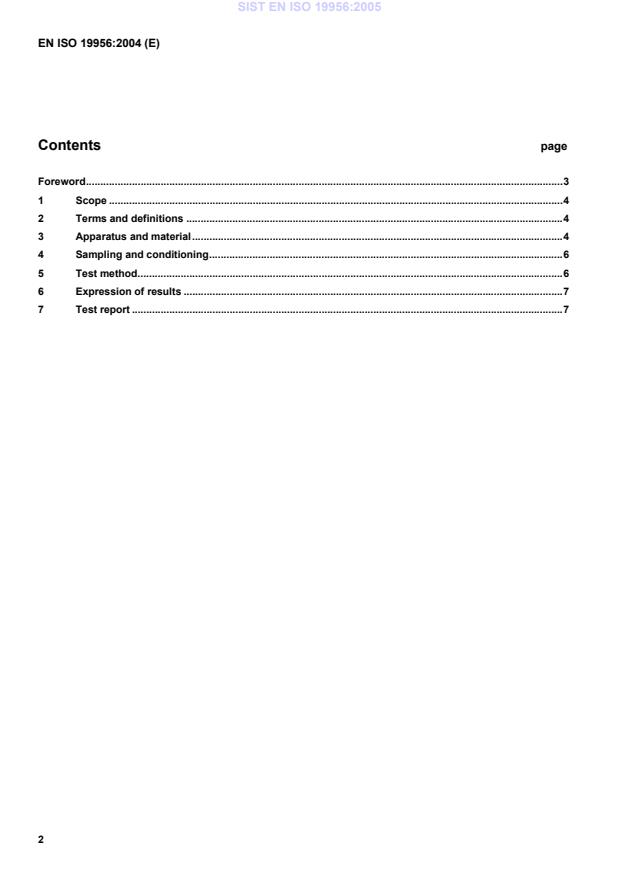
Contents page
Foreword.3
1 Scope .4
2 Terms and definitions .4
3 Apparatus and material.4
4 Sampling and conditioning.6
5 Test method.6
6 Expression of results .7
7 Test report .7
Foreword
This document (EN ISO 19956:2004) has been prepared by Technical Committee CEN /TC 309 "Footwear", the
secretariat of which is held by AENOR, in collaboration with Technical Committee ISO/TC 216 "Footwear".
This European Standard shall be given the status of a national standard, either by publication of an identical text or
by endorsement, at the latest by March 2005, and conflicting national standards shall be withdrawn at the latest by
March 2005.
According to the CEN/CENELEC Internal Regulations, the national standards organizations of the following
countries are bound to implement this European Standard: Austria, Belgium, Cyprus, Czech Republic, Denmark,
Estonia, Finland, France, Germany, Greece, Hungary, Iceland, Ireland, Italy, Latvia, Lithuania, Luxembourg, Malta,
Netherlands, Norway, Poland, Portugal, Slovakia, Slovenia, Spain, Sweden, Switzerland and United Kingdom.
1 Scope
This European Standard specifies a test method for determining the ability of heels of ladies’ shoes to withstand the
repeated small impacts imposed by normal walking. Although intended primarily for plastics heels, the procedure is
also usable for testing steel heel dowels on their own.
NOTE While the test method is applicable to all types of high heels of any construction, it is particularly useful for injection-
moulded plastics heels which incorporate a steel dowel reinforcement. The shape of some heels is such that they have a high
fatigue resistance. It is usually considered unnecessary to test such heels for fatigue resistance.
2 Terms and definitions
For the purposes of this European Standard, the following term and definition apply.
fatigue resistance
resistance of a heel, under specified conditions, to repeated loading cycles.
3 Apparatus and material
3.1 The following apparatus and material shall be used:
3.2 Heel fatigue-testing apparatus, incorporating a motor-driven pendulum which can deliver blows to a test
specimen assembly, each blow having an energy of 0,68 J, at th
...