

SIST EN 15386:2008
Packaging - Flexible laminate and plastic tubes - Test method to determine the print adhesion
General Information
- Abstract
This standard specifies a method for the determination of the print adhesion on flexible laminate and plastic tubes.
It is applicable to flexible laminate and plastic tubes used for packing pharmaceutical, cosmetic, hygiene, food and other household products.
- Status
- Published
- Publication Date
- 03-Dec-2007
- Technical Committee
- EPO - Packaging - sales and grouped
- Current Stage
- 6060 - National Implementation/Publication (Adopted Project)
- Start Date
- 29-Nov-2007
- Due Date
- 03-Feb-2008
- Completion Date
- 04-Dec-2007


Overview
SIST EN 15386:2008, developed by the European Committee for Standardization (CEN), specifies a standardized test method for determining the adhesion of printed ink on flexible laminate and plastic tubes. These tubes are widely used for packaging pharmaceuticals, cosmetics, hygiene products, food, and other household items. Ensuring the print adhesion quality is vital for both product identification and brand integrity across various industries.
The standard outlines procedures for using adhesive tape to test the durability of printing films applied to such packaging materials. By following SIST EN 15386:2008, manufacturers and suppliers can objectively assess whether printed tubes meet required performance criteria for print adhesion.
Key Topics
Scope of Application:
- Applies to flexible laminate and plastic tubes used in pharmaceutical, cosmetic, food, hygiene, and household product packaging.
- Covers both single- and multi-layer laminate constructions.
Print Adhesion Test Method:
- Utilizes adhesive tape to gauge the adhesion of ink films on the tube’s surface.
- Tape is applied and removed under specified conditions to test resistance to peeling and ink removal.
Test Equipment and Procedure:
- Commercially available adhesive tapes with defined adhesive power (minimum 5 N/25 mm, maximum 7 N/25 mm).
- Standardized procedure for applying and removing tape to ensure consistent results.
- Test results categorized based on visible print damage and adhesive tape resistance.
Reporting Requirements:
- Comprehensive test reports must reference EN 15386 and include critical details such as sample identification, number of tubes tested, observed defects, and influencing factors.
- Methodology for special cases, such as batch acceptance and failure severity, to be agreed upon between supplier and customer.
Annex A - Peel Adhesion Test:
- Provides a normative method for quantifying peel adhesion (measured at a 180° angle, at 300 mm/min).
- Specifies test conditions, apparatus, and sample preparation for accurate and repeatable results.
Applications
SIST EN 15386:2008 offers considerable practical value to manufacturers, converters, and quality assurance teams across industries that rely on flexible laminate and plastic tubes for packaging. Key applications include:
- Quality Control: Enables reliable assessment of print adhesion in production lines to prevent print loss during product use, transit, and shelf life.
- Supplier Evaluation: Provides an objective test method for suppliers and buyers to agree upon product acceptance standards.
- Brand Protection: Ensures that branding and regulatory information on packaging remains intact and legible, supporting consumer safety and regulatory compliance.
- Research and Development: Supports development of improved printing processes, ink formulations, and tube substrates for enhanced performance.
- Batch Verification: Facilitates the sampling and acceptance of production batches for large-scale manufacturing.
Related Standards
SIST EN 15386:2008 is part of a broader framework of packaging standards that cover flexible tubes and their properties. Related standards include:
- EN 12374: Packaging - Flexible tubes - Terminology
(Defines the terms used in flexible tube packaging.) - EN 13045: Packaging - Flexible cylindrical plastic tubes - Dimensions and tolerances
(Specifies dimensional attributes and permissible variations.) - EN 13461: Packaging - Cylindrical flexible laminated tubes - Dimensions and tolerances
(Focuses on dimensions for laminated tubes.)
Adhering to SIST EN 15386:2008 supports manufacturers in delivering packaging that meets both performance and regulatory requirements, reinforcing product quality and enhancing customer trust.
Get Certified
Connect with accredited certification bodies for this standard

BRCGS (Brand Reputation Compliance Global Standards)
Global food safety and quality standards owner.
Sponsored listings
Frequently Asked Questions
SIST EN 15386:2008 is a standard published by the Slovenian Institute for Standardization (SIST). Its full title is "Packaging - Flexible laminate and plastic tubes - Test method to determine the print adhesion". This standard covers: This standard specifies a method for the determination of the print adhesion on flexible laminate and plastic tubes. It is applicable to flexible laminate and plastic tubes used for packing pharmaceutical, cosmetic, hygiene, food and other household products.
This standard specifies a method for the determination of the print adhesion on flexible laminate and plastic tubes. It is applicable to flexible laminate and plastic tubes used for packing pharmaceutical, cosmetic, hygiene, food and other household products.
SIST EN 15386:2008 is classified under the following ICS (International Classification for Standards) categories: 55.120 - Cans. Tins. Tubes. The ICS classification helps identify the subject area and facilitates finding related standards.
SIST EN 15386:2008 is available in PDF format for immediate download after purchase. The document can be added to your cart and obtained through the secure checkout process. Digital delivery ensures instant access to the complete standard document.
Standards Content (Sample)
2003-01.Slovenski inštitut za standardizacijo. Razmnoževanje celote ali delov tega standarda ni dovoljeno.Packaging - Flexible laminate and plastic tubes - Test method to determine the print adhesionDGKH]LMHEmballage - Tubes souples plastiques et tubes souples laminés - Méthode d'essai pour déterminer l'adhérence de l'impressionVerpackung - Laminat- und Kunststofftuben - Prüfverfahren zur Bestimmung der Haftfestigkeit der BedruckungTa slovenski standard je istoveten z:EN 15386:2007SIST EN 15386:2008en,fr,de55.120ICS:SLOVENSKI
STANDARDSIST EN 15386:200801-februar-2008
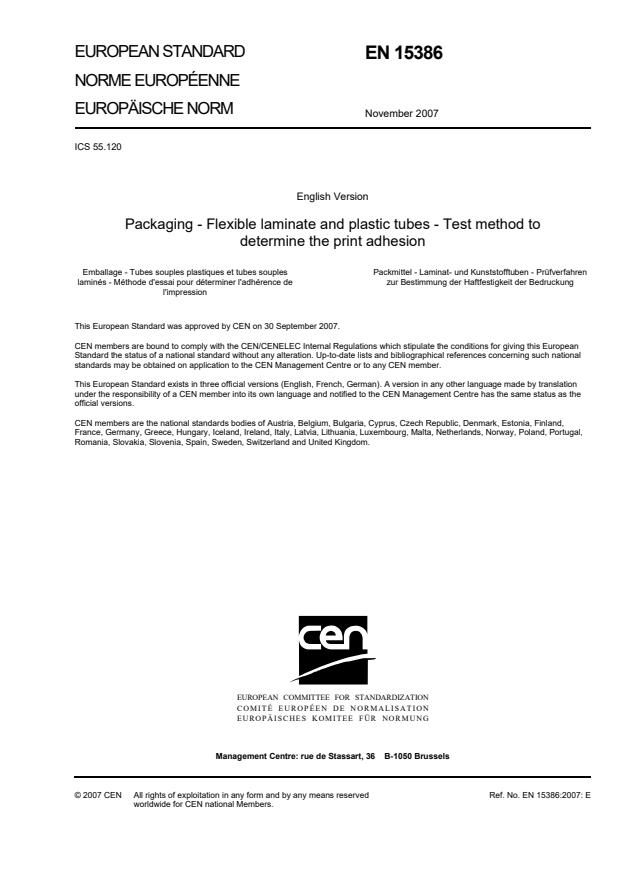
EUROPEAN STANDARDNORME EUROPÉENNEEUROPÄISCHE NORMEN 15386November 2007ICS 55.120 English VersionPackaging - Flexible laminate and plastic tubes - Test method todetermine the print adhesionEmballage - Tubes souples plastiques et tubes soupleslaminés - Méthode d'essai pour déterminer l'adhérence del'impressionPackmittel - Laminat- und Kunststofftuben - Prüfverfahrenzur Bestimmung der Haftfestigkeit der BedruckungThis European Standard was approved by CEN on 30 September 2007.CEN members are bound to comply with the CEN/CENELEC Internal Regulations which stipulate the conditions for giving this EuropeanStandard the status of a national standard without any alteration. Up-to-date lists and bibliographical references concerning such nationalstandards may be obtained on application to the CEN Management Centre or to any CEN member.This European Standard exists in three official versions (English, French, German). A version in any other language made by translationunder the responsibility of a CEN member into its own language and notified to the CEN Management Centre has the same status as theofficial versions.CEN members are the national standards bodies of Austria, Belgium, Bulgaria, Cyprus, Czech Republic, Denmark, Estonia, Finland,France, Germany, Greece, Hungary, Iceland, Ireland, Italy, Latvia, Lithuania, Luxembourg, Malta, Netherlands, Norway, Poland, Portugal,Romania, Slovakia, Slovenia, Spain, Sweden, Switzerland and United Kingdom.EUROPEAN COMMITTEE FOR STANDARDIZATIONCOMITÉ EUROPÉEN DE NORMALISATIONEUROPÄISCHES KOMITEE FÜR NORMUNGManagement Centre: rue de Stassart, 36
B-1050 Brussels© 2007 CENAll rights of exploitation in any form and by any means reservedworldwide for CEN national Members.Ref. No. EN 15386:2007: E
Peel adhesion (180 °) at 300 mm/min.6
The printing ink film is tested by rapidly tearing-off a previously applied adhesive tape. After the tape has been torn off, the divided surfaces are judged by pre-established criteria. 3 Apparatus An adhesive tape of commercial quality equipped with an upper surface made of tear-proof plastic and a pressure sensitive adhesive coating, of which the adhesive power is: minimum 5 N/25 mm and maximum 7 N/25 mm, tested according to Annex A against a glass testing surface. 4 Procedure
Place the printed sample on an even surface. Apply the adhesive tape on the sample and press it on manually across the length of the decoration.
It is important that there is full contact with the surface over the whole area and that no air bubbles remain between adhesive tape and sample surface. Approximately 10 s to 30 s after pressing-on, manually tear off the free end of the adhesive tape in one go from the surface at an angle of about 150 °.
Examine the divided surfaces (printing surface and reverse sid
...