


SIST ES 204 049 V1.1.1:2026
(Main)Integrated broadband cable telecommunication networks (CABLE) - Standalone router specification
Integrated broadband cable telecommunication networks (CABLE) - Standalone router specification
The present document defines a core set of features that enables multiple subscriber devices to gain access to operator provided high-speed data service independently of the underlying access network. This core set of features allows for both IPv4- and IPv6-enabled devices to gain connectivity to the Internet. The core set of features defined in the present document includes the ability to provision multiple CPE devices, a description of how to forward data to and from CPE devices, and also the ability to forward IP multicast traffic to and among CPE devices.
Integrirana širokopasovna kabelska telekomunikacijska omrežja (CABLE) - Specifikacija samostojnega usmerjevalnika
Ta dokument določa osnovni nabor značilnosti, ki napravam z več naročniki omogočajo dostop do storitev hitrega prenosa podatkov, ki jih zagotavlja upravljavec, neodvisno od osnovnega dostopovnega omrežja. Ta osnovni nabor značilnosti omogoča povezljivost z internetom za naprave, ki podpirajo tako IPv4 kot IPv6. Osnovni nabor značilnosti v tem dokumentu vključuje zmožnost oskrbovanja več naprav CPE, opis pošiljanja podatkov v naprave CPE in iz njih ter zmožnost pošiljanja prometa IP za več prejemnikov v naprave CPE in med njimi.
General Information
- Status
- Published
- Publication Date
- 05-Feb-2026
- Technical Committee
- MOC - Mobile Communications
- Current Stage
- 6060 - National Implementation/Publication (Adopted Project)
- Start Date
- 27-Jan-2026
- Due Date
- 03-Apr-2026
- Completion Date
- 06-Feb-2026
Buy Documents


ETSI ES 204 049 V1.1.1 (2025-11) - Integrated broadband cable telecommunication networks (CABLE); Standalone router specification
ETSI ES 204 049 V1.1.1 (2026-01) - Integrated broadband cable telecommunication networks (CABLE); Standalone router specification

Get Certified
Connect with accredited certification bodies for this standard

TL 9000 QuEST Forum
Telecommunications quality management system.

ANCE
Mexican certification and testing association.

Intertek Slovenia
Intertek testing, inspection, and certification services in Slovenia.
Sponsored listings
Frequently Asked Questions
SIST ES 204 049 V1.1.1:2026 is a standard published by the Slovenian Institute for Standardization (SIST). Its full title is "Integrated broadband cable telecommunication networks (CABLE) - Standalone router specification". This standard covers: The present document defines a core set of features that enables multiple subscriber devices to gain access to operator provided high-speed data service independently of the underlying access network. This core set of features allows for both IPv4- and IPv6-enabled devices to gain connectivity to the Internet. The core set of features defined in the present document includes the ability to provision multiple CPE devices, a description of how to forward data to and from CPE devices, and also the ability to forward IP multicast traffic to and among CPE devices.
The present document defines a core set of features that enables multiple subscriber devices to gain access to operator provided high-speed data service independently of the underlying access network. This core set of features allows for both IPv4- and IPv6-enabled devices to gain connectivity to the Internet. The core set of features defined in the present document includes the ability to provision multiple CPE devices, a description of how to forward data to and from CPE devices, and also the ability to forward IP multicast traffic to and among CPE devices.
SIST ES 204 049 V1.1.1:2026 is classified under the following ICS (International Classification for Standards) categories: 33.040.01 - Telecommunication systems in general. The ICS classification helps identify the subject area and facilitates finding related standards.
SIST ES 204 049 V1.1.1:2026 is available in PDF format for immediate download after purchase. The document can be added to your cart and obtained through the secure checkout process. Digital delivery ensures instant access to the complete standard document.
Standards Content (Sample)
Final draft ETSI ES 204 049 V1.1.1 (2025-11)
ETSI STANDARD
Integrated broadband cable telecommunication networks
(CABLE);
Standalone router specification
2 Final draft ETSI ES 204 049 V1.1.1 (2025-11)
Reference
DES/CABLE-0030
Keywords
CPE, IPCable, IPv4, IPv6, security
ETSI
650 Route des Lucioles
F-06921 Sophia Antipolis Cedex - FRANCE
Tel.: +33 4 92 94 42 00 Fax: +33 4 93 65 47 16
Siret N° 348 623 562 00017 - APE 7112B
Association à but non lucratif enregistrée à la
Sous-Préfecture de Grasse (06) N° w061004871
Important notice
The present document can be downloaded from the
ETSI Search & Browse Standards application.
The present document may be made available in electronic versions and/or in print. The content of any electronic and/or
print versions of the present document shall not be modified without the prior written authorization of ETSI. In case of any
existing or perceived difference in contents between such versions and/or in print, the prevailing version of an ETSI
deliverable is the one made publicly available in PDF format on ETSI deliver repository.
Users should be aware that the present document may be revised or have its status changed,
this information is available in the Milestones listing.
If you find errors in the present document, please send your comments to
the relevant service listed under Committee Support Staff.
If you find a security vulnerability in the present document, please report it through our
Coordinated Vulnerability Disclosure (CVD) program.
Notice of disclaimer & limitation of liability
The information provided in the present deliverable is directed solely to professionals who have the appropriate degree of
experience to understand and interpret its content in accordance with generally accepted engineering or
other professional standard and applicable regulations.
No recommendation as to products and services or vendors is made or should be implied.
No representation or warranty is made that this deliverable is technically accurate or sufficient or conforms to any law
and/or governmental rule and/or regulation and further, no representation or warranty is made of merchantability or fitness
for any particular purpose or against infringement of intellectual property rights.
In no event shall ETSI be held liable for loss of profits or any other incidental or consequential damages.
Any software contained in this deliverable is provided "AS IS" with no warranties, express or implied, including but not
limited to, the warranties of merchantability, fitness for a particular purpose and non-infringement of intellectual property
rights and ETSI shall not be held liable in any event for any damages whatsoever (including, without limitation, damages
for loss of profits, business interruption, loss of information, or any other pecuniary loss) arising out of or related to the use
of or inability to use the software.
Copyright Notification
No part may be reproduced or utilized in any form or by any means, electronic or mechanical, including photocopying and
microfilm except as authorized by written permission of ETSI.
The content of the PDF version shall not be modified without the written authorization of ETSI.
The copyright and the foregoing restriction extend to reproduction in all media.
© ETSI 2025.
All rights reserved.
ETSI
3 Final draft ETSI ES 204 049 V1.1.1 (2025-11)
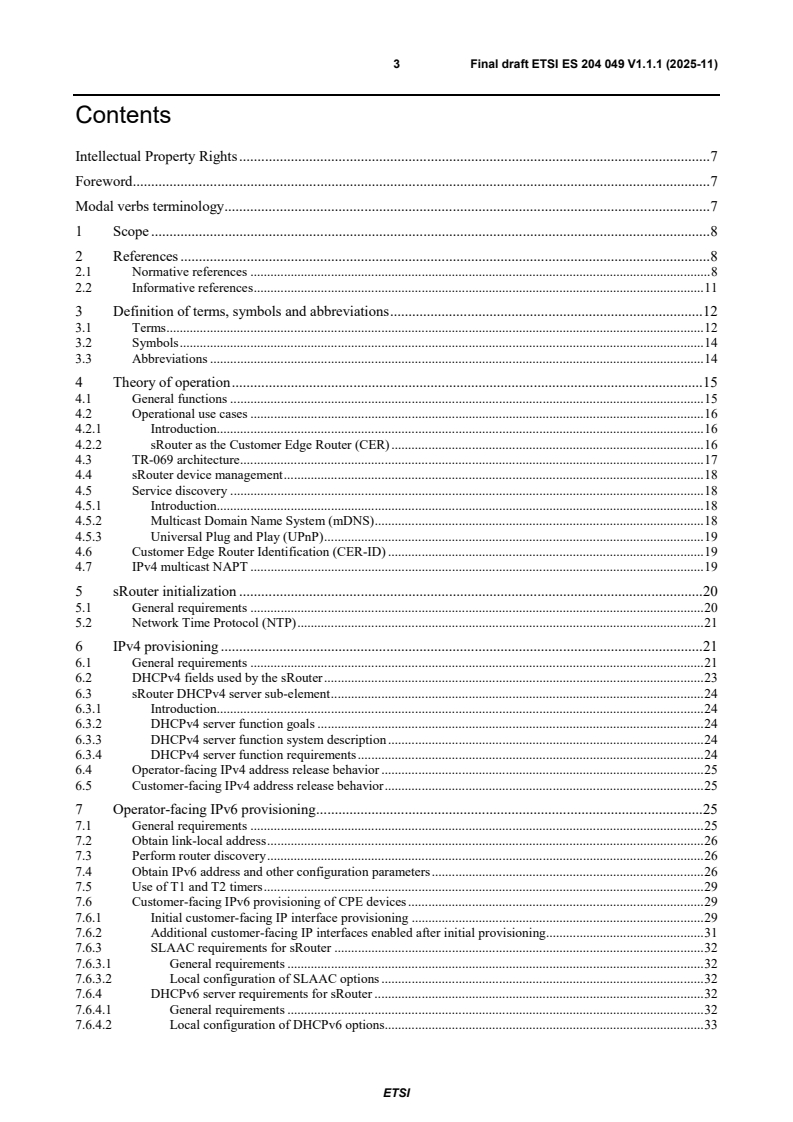
Contents
Intellectual Property Rights . 7
Foreword . 7
Modal verbs terminology . 7
1 Scope . 8
2 References . 8
2.1 Normative references . 8
2.2 Informative references . 11
3 Definition of terms, symbols and abbreviations . 12
3.1 Terms . 12
3.2 Symbols . 14
3.3 Abbreviations . 14
4 Theory of operation . 15
4.1 General functions . 15
4.2 Operational use cases . 16
4.2.1 Introduction. 16
4.2.2 sRouter as the Customer Edge Router (CER) . 16
4.3 TR-069 architecture . 17
4.4 sRouter device management . 18
4.5 Service discovery . 18
4.5.1 Introduction. 18
4.5.2 Multicast Domain Name System ( mD NS) . 18
4.5.3 Universal Plug and Play (UPnP) . 19
4.6 Customer Edge Router Identification (CER-ID) . 19
4.7 IPv4 multicast NAPT . 19
5 sRouter initialization . 20
5.1 General requirements . 20
5.2 Network Time Protocol (NTP) . 21
6 IPv4 provisioning . 21
6.1 General requirements . 21
6.2 DHCPv4 fields used by the sRouter . 23
6.3 sRouter DHCPv4 server sub-element . 24
6.3.1 Introduction. 24
6.3.2 DHCPv4 server function goals . 24
6.3.3 DHCPv4 server function system description . 24
6.3.4 DHCPv4 server function requirements . 24
6.4 Operator-facing IPv4 address release behavior . 25
6.5 Customer-facing IPv4 address release behavior . 25
7 Operator-facing IPv6 provisioning . 25
7.1 General requirements . 25
7.2 Obtain link-local address . 26
7.3 Perform router discovery . 26
7.4 Obtain IPv6 address and other configuration parameters . 26
7.5 Use of T1 and T2 timers . 29
7.6 Customer-facing IPv6 provisioning of CPE devices . 29
7.6.1 Initial customer-facing IP interface provisioning . 29
7.6.2 Additional customer-facing IP interfaces enabled after initial provisioning . 31
7.6.3 SLAAC requirements for sRouter . 32
7.6.3.1 General requirements . 32
7.6.3.2 Local configuration of SLAAC options . 32
7.6.4 DHCPv6 server requirements for sRouter . 32
7.6.4.1 General requirements . 32
7.6.4.2 Local configuration of DHCPv6 options. 33
ETSI
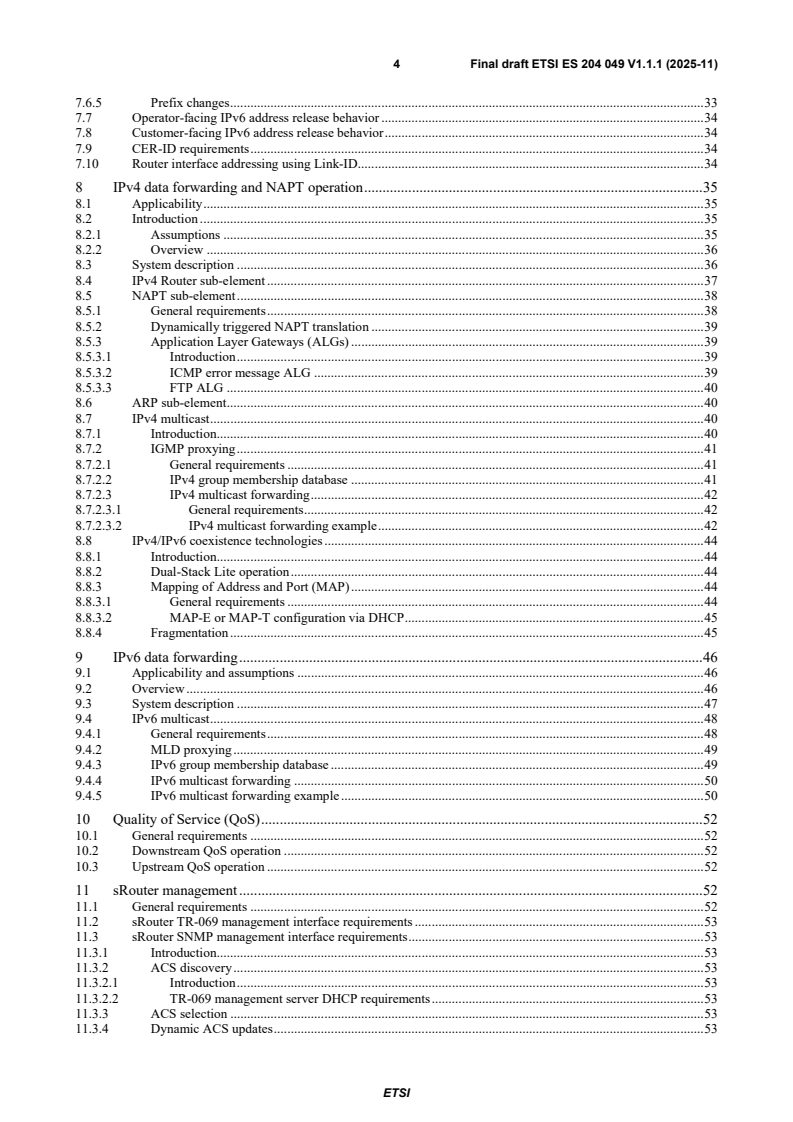
4 Final draft ETSI ES 204 049 V1.1.1 (2025-11)
7.6.5 Prefix changes . 33
7.7 Operator-facing IPv6 address release behavior . 34
7.8 Customer-facing IPv6 address release behavior . 34
7.9 CER-ID requirements . 34
7.10 Router interface addressing using Link-ID. 34
8 IPv4 data forwarding and NAPT operation . 35
8.1 Applicability . 35
8.2 Introduction . 35
8.2.1 Assumptions . 35
8.2.2 Overview . 36
8.3 System description . 36
8.4 IPv4 Router sub-element . 37
8.5 NAPT sub-element . 38
8.5.1 General requirements . 38
8.5.2 Dynamically triggered NAPT translation . 39
8.5.3 Application Layer Gateways (ALGs) . 39
8.5.3.1 Introduction . 39
8.5.3.2 ICMP error message ALG . 39
8.5.3.3 FTP ALG . 40
8.6 ARP sub-element . 40
8.7 IPv4 multicast . 40
8.7.1 Introduction. 40
8.7.2 IGMP proxying . 41
8.7.2.1 General requirements . 41
8.7.2.2 IPv4 group membership database . 41
8.7.2.3 IPv4 multicast forwarding . 42
8.7.2.3.1 General requirements . 42
8.7.2.3.2 IPv4 multicast forwarding example . 42
8.8 IPv4/IPv6 coexistence technologies . 44
8.8.1 Introduction. 44
8.8.2 Dual-Stack Lite operation . 44
8.8.3 Mapping of Address and Port (MAP) . 44
8.8.3.1 General requirements . 44
8.8.3.2 MAP-E or MAP-T configuration via DHCP . 45
8.8.4 Fragmentation . 45
9 IPv6 data forwarding . 46
9.1 Applicability and assumptions . 46
9.2 Overview . 46
9.3 System description . 47
9.4 IPv6 multicast . 48
9.4.1 General requirements . 48
9.4.2 MLD proxying . 49
9.4.3 IPv6 group membership database . 49
9.4.4 IPv6 multicast forwarding . 50
9.4.5 IPv6 multicast forwarding example . 50
10 Quality of Service (QoS) . 52
10.1 General requirements . 52
10.2 Downstream QoS operation . 52
10.3 Upstream QoS operation . 52
11 sRouter management . 52
11.1 General requirements . 52
11.2 sRouter TR-069 management interface requirements . 53
11.3 sRouter SNMP management interface requirements . 53
11.3.1 Introduction. 53
11.3.2 ACS discovery . 53
11.3.2.1 Introduction . 53
11.3.2.2 TR-069 management server DHCP requirements . 53
11.3.3 ACS selection . 53
11.3.4 Dynamic ACS updates . 53
ETSI
5 Final draft ETSI ES 204 049 V1.1.1 (2025-11)
11.3.5 TR-069 CWMP control and credentials . 53
12 Security. 53
12.1 Introduction . 53
12.2 Traffic filtering . 54
12.3 Management security on the operator-facing interface . 54
12.3.1 General requirements . 54
12.3.2 Management server authentication . 55
12.3.3 sRouter authentication . 55
12.4 Secure software update . 56
12.4.1 Introduction. 56
12.4.2 Secure software download . 56
12.4.2.1 Introduction . 56
12.4.2.2 TR-069 secure download . 56
12.4.2.3 SNMP initiated secure software download . 57
12.4.3 Secure boot . 57
12.5 Physical protection of keys in the sRouter . 57
12.6 Private data plane security on operator-facing interface . 58
12.7 Community Wi-Fi security . 58
12.8 IPsec . 58
13 Tunnel management and configuration . 60
13.1 GRE requirements . 60
Annex A (normative): SNMP MIB objects supported by the sRouter . 61
A.1 General requirements . 61
A.2 sRouter interface numbering . 61
A.3 sRouter ifTable requirements . 61
A.4 sRouter ipNetToPhysicalTable requirements . 64
A.5 CLAB-GRE-MIB . 64
A.6 CLAB-GW-MIB . 64
A.7 CLAB-WIFI-MIB . 64
A.8 CLAB-ANI-DEV-MIB . 64
Annex B (normative): Provisioning and operational event messages . 65
Annex C (normative): TR-069 managed objects . 67
C.1 General requirements . 67
C.2 Profiles from TR-181 . 67
C.3 Extensions to TR-181 profiles . 69
C.3.1 GRE tunnelling extensions . 69
C.3.2 sRouter extensions . 70
C.4 Management interface protocol requirements for GRE . 70
Annex D (normative): Simple security recommendations . 72
D.1 Introduction . 72
D.2 Summary of simple security recommendations . 72
D.3 Critical recommendations. 72
D.4 Important recommendations . 74
D.5 BCP recommendations . 75
D.6 Other recommendations . 77
ETSI
6 Final draft ETSI ES 204 049 V1.1.1 (2025-11)
D.7 Recommendations in conflict with operator needs . 77
Annex E (normative): sRouter GRE tunnelling architecture . 78
E.1 Introduction . 78
E.2 Use case for data traffic flow for both private and public SSIDs . 79
E.2.1 General requirements . 79
E.2.2 Private network outbound from LAN . 79
E.2.3 Private network inbound from WAN . 80
E.2.4 Community Wi-Fi user outbound via public SSID . 80
E.2.5 Community Wi-Fi user inbound via public SSID . 80
Annex F (normative): sRouter certificate public key infrastructure . 81
F.1 General requirements . 81
F.2 CableLabs Root CA certificate . 82
F.3 CableLabs Device CA certificate . 83
F.4 sRouter device certificate . 83
F.5 CableLabs Service Provider CA certificate . 84
F.6 Management/provisioning server certificate . 85
F.7 CableLabs DOCSIS CVC CA certificate . 85
F.8 Code Verification Certificate . 86
F.9 Certificate Revocation List (CRL) . 87
Annex G (informative): Example routing with Link-ID . 88
G.1 Scenario . 88
G.2 IP MIB sRouter example . 90
Annex I (informative): Change history . 91
History . 92
ETSI
7 Final draft ETSI ES 204 049 V1.1.1 (2025-11)
Intellectual Property Rights
Essential patents
IPRs essential or potentially essential to normative deliverables may have been declared to ETSI. The declarations
pertaining to these essential IPRs, if any, are publicly available for ETSI members and non-members, and can be
found in ETSI SR 000 314: "Intellectual Property Rights (IPRs); Essential, or potentially Essential, IPRs notified to
ETSI in respect of ETSI standards", which is available from the ETSI Secretariat. Latest updates are available on the
ETSI IPR online database.
Pursuant to the ETSI Directives including the ETSI IPR Policy, no investigation regarding the essentiality of IPRs,
including IPR searches, has been carried out by ETSI. No guarantee can be given as to the existence of other IPRs not
referenced in ETSI SR 000 314 (or the updates on the ETSI Web server) which are, or may be, or may become,
essential to the present document.
Trademarks
The present document may include trademarks and/or tradenames which are asserted and/or registered by their owners.
ETSI claims no ownership of these except for any which are indicated as being the property of ETSI, and conveys no
right to use or reproduce any trademark and/or tradename. Mention of those trademarks in the present document does
not constitute an endorsement by ETSI of products, services or organizations associated with those trademarks.
DECT™, PLUGTESTS™, UMTS™ and the ETSI logo are trademarks of ETSI registered for the benefit of its
Members. 3GPP™, LTE™ and 5G™ logo are trademarks of ETSI registered for the benefit of its Members and of the
3GPP Organizational Partners. oneM2M™ logo is a trademark of ETSI registered for the benefit of its Members and of ®
the oneM2M Partners. GSM and the GSM logo are trademarks registered and owned by the GSM Association.
Foreword
This final draft ETSI Standard (ES) has been produced by ETSI Technical Committee Integrated broadband cable
telecommunication networks (CABLE), and is now submitted for the ETSI Membership Approval Procedure.
Modal verbs terminology
In the present document "shall", "shall not", "should", "should not", "may", "need not", "will", "will not", "can" and
"cannot" are to be interpreted as described in clause 3.2 of the ETSI Drafting Rules (Verbal forms for the expression of
provisions).
"must" and "must not" are NOT allowed in ETSI deliverables except when used in direct citation.
ETSI
8 Final draft ETSI ES 204 049 V1.1.1 (2025-11)
1 Scope
The present document defines a core set of features that enables multiple subscriber devices to gain access to operator
provided high-speed data service independently of the underlying access network. This core set of features allows for
both IPv4- and IPv6-enabled devices to gain connectivity to the Internet. The core set of features defined in the present
document includes the ability to provision multiple CPE devices, a description of how to forward data to and from CPE
devices, and also the ability to forward IP multicast traffic to and among CPE devices.
2 References
2.1 Normative references
References are either specific (identified by date of publication and/or edition number or version number) or
non-specific. For specific references, only the cited version applies. For non-specific references, the latest version of the
referenced document (including any amendments) applies.
Referenced documents which are not found to be publicly available in the expected location might be found in the ETSI
docbox.
NOTE: While any hyperlinks included in the present clause were valid at the time of publication, ETSI cannot
guarantee their long term validity.
The following referenced documents are necessary for the application of the present document.
[1] CableLabs DHCP Options Registry Specification: "CL-SP-CANN-DHCP-Reg-I16-200715",
July 15, 2020, Cable Television Laboratories, Inc.
[2] CableLabs Access Network Independent Device MIB: "CLAB-ANI-DEV-MIB".
[3] CableLabs Generic Route Encapsulation MIB: "CLAB-GRE-MIB".
[4] CableLabs Gateway MIB: "CLAB-GW-MIB".
[5] CableLabs Wireless MIB: "CLAB-WIFI-MIB".
[6] Federal Information Processing Standards Publication (FIPS PUB) 140-3: "Security, Requirements
for Cryptographic Modules", March 2022.
[7] Federal Information Processing Standards Publication (FIPS PUB) 180-4: "Secure Hash
Standard", August 2015.
[8] ISO/IEC 29341-1-1:2011: "Information technology -- UPnP Device Architecture -- Part 1-1:
Universal Plug and Play Architecture Version 1.1", September 12, 2011.
[9] IETF RFC 792: "Internet Control Message Protocol", J. Postel, September 1981.
[10] IETF RFC 826: "An Ethernet Address Resolution Protocol", David C. Plummer, November, 1982.
[11] IETF RFC 1122: "Requirements for Internet Hosts - Communication Layers", R. Braden, October,
1989.
[12] IETF RFC 1812: "Requirements for IP Version 4 Routers", F. Baker, June 1995.
[13] IETF RFC 1901: "Introduction to Community-based SNMPv2", J. Case, K. McCloghrie, M. Rose,
S. Waldbusser, January 1996.
[14] IETF RFC 1907: "Management Information Base for Version 2 of the Simple Network
Management Protocol (SNMPv2)", J. Case, K. McCloghrie, M. Rose, S. Waldbusser,
January 1996.
[15] IETF RFC 1918: "Address Allocation for Private Internets", Y. Rekhter, B. Moskowitz, D.
Karrenberg, G. J. de Groot, E. Lear, February 1996.
ETSI
9 Final draft ETSI ES 204 049 V1.1.1 (2025-11)
[16] IETF RFC 2131: "Dynamic Host Configuration Protocol", R. Droms, March, 1997.
[17] IETF RFC 2473: "Generic Packet Tunneling in IPv6 Specification", A. Conta, S. Deering,
December 1998.
[18] IETF RFC 2710: "Multicast Listener Discovery (MLD) for IPv6", S. Deering, W. Fenner,
B. Haberman, October 1999.
[19] IETF RFC 2784: "Generic Routing Encapsulation (GRE)", D. Farinacci, T. Li, S. Hanks,
D. Meyer, P. Traina, March 2000.
[20] IETF RFC 2827: "Network Ingress Filtering: Defeating Denial of Service Attacks which employ
IP Source Address Spoofing", P. Ferguson, D. Senie, May 2000.
[21] IETF RFC 2863: "The interfaces Group MIB", K. McCloghrie, F. Kastenholz, June 2000.
[22] IETF RFC 2890: "Key and Sequence Number Extensions to GRE", G. Dommety,
September 2000.
[23] IETF RFC 3022: "Traditional IP Network Address Translator (Traditional NAT)", P. Srisuresh,
K. Egevang, January 2001.
[24] IETF RFC 3315: "Dynamic Host Configuration Protocol for IPv6 (DHCPv6)", R. Droms, Ed.,
J. Bound, B. Volz, T. Lemon, C. Perkins, M. Carney, July 2003. .
[25] IETF RFC 3376: "Internet Group Management Protocol", Version 3", B. Cain, S. Deering,
I. Kouvelas, B. Fenner, A. Thyagarajan, October, 2002.
[26] IETF RFC 3418: "Management Information Base (MIB) for the Simple Network Management
Protocol (SNMP)", R. Presuhn, December 2002.
[27] IETF RFC 3633: "IPv6 Prefix Options for Dynamic Host Configuration Protocol (DHCP)
version 6", O. Troan, R. Droms, December 2003.
[28] IETF RFC 3646: "DNS Configuration options for Dynamic Host Configuration Protocol for IPv6
(DHCPv6)", R. Droms, December 2003.
[29] IETF RFC 3736: "Stateless Dynamic Host Configuration Protocol (DHCP) Service for IPv6,
R. Droms", April 2004.
[30] IETF RFC 3810: "Multicast Listener Discovery Version 2 (MLDv2) for IPv6", R. Vida, Ed.,
L. Costa, Ed., June 2004.
[31] IETF RFC 4022: "Management Information Base for the Transmission Control Protocol (TCP)",
R. Raghunarayan, March 2005.
[32] IETF RFC 4113: "Management Information Base for the User Datagram Protocol (UDP)",
B. Fenner, J. Flick, June 2005.
[33] IETF RFC 4191: "Default Router Preferences and More-Specific Routes", R. Draves, D. Thaler,
November 2005.
[34] IETF RFC 4242: "Information Refresh Time Option for Dynamic Host Configuration Protocol for
IPv6 (DHCPv6)", S. Venaas, T. Chown, B. Volz, November 2005.
[35] IETF RFC 4291: "IP Version 6 Addressing Architecture", R. Hinden, S. Deering, February 2006.
[36] IETF RFC 4292: "IP Forwarding Table MIB", B. Haberman, April 2006.
[37] IETF RFC 4293: "Management Information Base for the Internet Protocol (IP)", S. Routhier,
(Editor), Bill Fenner, Brian Haberman, Dave Thaler, April 2006.
[38] IETF RFC 4301: "Security Architecture for the Internet Protocol", S. Kent, K. Seo,
December 2005.
[39] IETF RFC 4346: "The Transport Layer Security (TLS) Protocol Version 1.1", T. Dierks,
E. Rescorla, April 2006.
ETSI
10 Final draft ETSI ES 204 049 V1.1.1 (2025-11)
[40] IETF RFC 4347: "Datagram Transport Layer Security", E. Rescorla, N. Modadugu, April 2006.
[41] IETF RFC 4361: "Node-specific Client Identifiers for Dynamic Host Configuration Protocol
Version Four (DHCPv4)", T. Lemon, B. Sommerfeld, February 2006.
[42] IETF RFC 4443: "Internet Control Message Protocol (ICMPv6) for the Internet Protocol Version 6
(IPv6) Specification", A. Conta, S. Deering, M. Gupta, Ed., March 2006.
[43] IETF RFC 4861: "Neighbor Discovery for IP Version 6 (IPv6)", T. Narten, E. Nordmark,
W. Simpson, H. Soliman, September 2007.
[44] IETF RFC 4862: "IPv6 Stateless Address Autoconfiguration", S. Thomson, T. Narten, T. Jinmei,
September 2007.
[45] IETF RFC 4884: "Extended ICMP to Support Multi-Part Messages", R. Bonica, D. Gan,
D. Tappan, C. Pignataro, April 2007.
[46] IETF RFC 5246: "The Transport Layer Security (TLS) Protocol Version 1.2", T. Dierks,
E. Rescorla, August 2008.
[47] IETF RFC 5280: "Internet X.509 Public Key Infrastructure Certificate and Certificate Revocation
List (CRL) Profile", D. Cooper, S. Santesson, S. Farrell, S. Boeyen, R. Hously, W. Polk,
May 2008.
[48] IETF RFC 5389: "Session Traversal Utilities for NAT (STUN)", J. Rosenberg. R, Mahy,
P. Matthews, D. Wing, October 2008.
[49] IETF RFC 5905: "Network Time Protocol Version 4: Protocol and Algorithms Specification",
D. Mills, J. Martin, J. Burbank, W. Kasch, June 2010.
[50] IETF RFC 5908: "Network Time Protocol (NTP) Server Options for DHCPv6", R. Gayroud,
B. Lourdelet, June 2010.
[51] IETF RFC 5942: "IPv6 Subnet Model: The Relationship Between Links and Subnet Prefixes",
H. Singh, W. Beebee, E. Nordmark, July 2010.
[52] IETF RFC 6092: "Recommended Simple Security Capabilities in Customer Premises Equipment
(CPE) for Providing Residential IPv6 Internet Service", J. Woodyatt, Ed., January 2011.
[53] IETF RFC 6106: "IPv6 Router Advertisement Options for DNS Configuration", J. Jeong, S. Park,
L. Beloeil, S. Madanapalli, November 2010.
[54] IETF RFC 6145: "IP/ICMP Translation Algorithm", X. Li, C. Bao, F. Baker, April 2011.
[55] IETF RFC 6333: "Dual-Stack Lite Broadband Deployments Following IPv4 Exhaustion",
A. Durand, R. Droms, J. Woodyatt, Y. Lee, August 2011.
[56] IETF RFC 6334: "Dynamic Host-Configuration Protocol for IPv6 (DHCPv6) Option for Dual-
Stack Lite", D. Hankins, T. Mrugalski, August 2011.
[57] IETF RFC 6347: "Datagram Transport Layer Security Version 1.2", E. Rescorla, N. Modadugu,
January 2012.
[58] IETF RFC 6540: "IPv6 Support Required for All IP-Capable Nodes", W. George, C. Donley, C.
Liljenstolpe, L. Howard, April 2012.
[59] IETF RFC 6762: "Multicast DNS", S. Cheshire, M. Krochmal, Apple Inc., February 2013.
[60] IETF RFC 7083: "Modification to Default Values of SOL_MAX_RT and INF_MAX_RT,
R. Droms", November 2013.
[61] IETF RFC 7084: "Basic Requirements for IPv6 Customer Edge Routers", H. Singh, W. Beebee,
C. Donley, B. Stark, November 2013.
[62] IETF RFC 7296: "Internet Key Exchange Protocol Version 2 (IKEv2)", C. Kaufman, P. Hoffman,
Y. Nir, P. Eronen, T. Kivinen, October 2014.
ETSI
11 Final draft ETSI ES 204 049 V1.1.1 (2025-11)
[63] IETF RFC 7597: "Mapping of Address and Port with Encapsulation (MAP-E)", O. Troan, W. Dec,
X. Li, C. Bao, S. Matsushima, T. Murakami, T. Taylor, July 2015.
[64] IETF RFC 7599: "Mapping of Address and Port Using Translation (MAP-T)", X. Li, C. Bao,
W. Dec, O. Troan, S. Matsushima, T. Murakami, July 2015.
[65] IETF RFC 2313: PKCS #1: RSA Encryption Version 1.5", March 1998.
[66] Broadband Forum Technical Report BBF TR-069: "CPE WAN Management Protocol v1: Issue 1
Amendment 6, Corrigendum 1: CPE WAN Management Protocol", June 2020.
[67] Broadband Forum Technical Report BBF TR-181: "Device Data Model for TR-069: Issue 2
Amendment 19 Corrigendum 1: Device Data Model for CWMP Endpoints and USP Agents",
April 2025.
[68] ETSI ES 203 311-3: "Integrated broadband cable telecommunication networks (CABLE); Fourth
generation transmission systems for interactive cable television services - IP cable modems; Part 3: ®
MAC and upper layer protocols interface; DOCSIS 3.1 [ANSI/SCTE 220-2 2016]", May 2019.
[69] ETSI ES 203 311-4: "Integrated broadband cable telecommunication networks (CABLE); Fourth
generation transmission systems for interactive cable television s
...
ETSI STANDARD
Integrated broadband cable telecommunication networks
(CABLE);
Standalone router specification
2 ETSI ES 204 049 V1.1.1 (2026-01)
Reference
DES/CABLE-0030
Keywords
CPE, IPCable, IPv4, IPv6, security
ETSI
650 Route des Lucioles
F-06921 Sophia Antipolis Cedex - FRANCE
Tel.: +33 4 92 94 42 00 Fax: +33 4 93 65 47 16
Siret N° 348 623 562 00017 - APE 7112B
Association à but non lucratif enregistrée à la
Sous-Préfecture de Grasse (06) N° w061004871
Important notice
The present document can be downloaded from the
ETSI Search & Browse Standards application.
The present document may be made available in electronic versions and/or in print. The content of any electronic and/or
print versions of the present document shall not be modified without the prior written authorization of ETSI. In case of any
existing or perceived difference in contents between such versions and/or in print, the prevailing version of an ETSI
deliverable is the one made publicly available in PDF format on ETSI deliver repository.
Users should be aware that the present document may be revised or have its status changed,
this information is available in the Milestones listing.
If you find errors in the present document, please send your comments to
the relevant service listed under Committee Support Staff.
If you find a security vulnerability in the present document, please report it through our
Coordinated Vulnerability Disclosure (CVD) program.
Notice of disclaimer & limitation of liability
The information provided in the present deliverable is directed solely to professionals who have the appropriate degree of
experience to understand and interpret its content in accordance with generally accepted engineering or
other professional standard and applicable regulations.
No recommendation as to products and services or vendors is made or should be implied.
No representation or warranty is made that this deliverable is technically accurate or sufficient or conforms to any law
and/or governmental rule and/or regulation and further, no representation or warranty is made of merchantability or fitness
for any particular purpose or against infringement of intellectual property rights.
In no event shall ETSI be held liable for loss of profits or any other incidental or consequential damages.
Any software contained in this deliverable is provided "AS IS" with no warranties, express or implied, including but not
limited to, the warranties of merchantability, fitness for a particular purpose and non-infringement of intellectual property
rights and ETSI shall not be held liable in any event for any damages whatsoever (including, without limitation, damages
for loss of profits, business interruption, loss of information, or any other pecuniary loss) arising out of or related to the use
of or inability to use the software.
Copyright Notification
No part may be reproduced or utilized in any form or by any means, electronic or mechanical, including photocopying and
microfilm except as authorized by written permission of ETSI.
The content of the PDF version shall not be modified without the written authorization of ETSI.
The copyright and the foregoing restriction extend to reproduction in all media.
© ETSI 2026.
All rights reserved.
ETSI
3 ETSI ES 204 049 V1.1.1 (2026-01)
Contents
Intellectual Property Rights . 7
Foreword . 7
Modal verbs terminology . 7
1 Scope . 8
2 References . 8
2.1 Normative references . 8
2.2 Informative references . 11
3 Definition of terms, symbols and abbreviations . 12
3.1 Terms . 12
3.2 Symbols . 14
3.3 Abbreviations . 14
4 Theory of operation . 16
4.1 General functions . 16
4.2 Operational use cases . 17
4.2.1 Introduction. 17
4.2.2 sRouter as the Customer Edge Router (CER) . 17
4.3 TR-069 architecture . 17
4.4 sRouter device management . 18
4.5 Service discovery . 18
4.5.1 Introduction. 18
4.5.2 Multicast Domain Name System ( mD NS) . 18
4.5.3 Universal Plug and Play (UPnP) . 19
4.6 Customer Edge Router Identification (CER-ID) . 20
4.7 IPv4 multicast NAPT . 20
5 sRouter initialization . 21
5.1 General requirements . 21
5.2 Network Time Protocol (NTP) . 21
6 IPv4 provisioning . 22
6.1 General requirements . 22
6.2 DHCPv4 fields used by the sRouter . 23
6.3 sRouter DHCPv4 server sub-element . 24
6.3.1 Introduction. 24
6.3.2 DHCPv4 server function goals . 24
6.3.3 DHCPv4 server function system description . 24
6.3.4 DHCPv4 server function requirements . 24
6.4 Operator-facing IPv4 address release behavior . 25
6.5 Customer-facing IPv4 address release behavior . 26
7 Operator-facing IPv6 provisioning . 26
7.1 General requirements . 26
7.2 Obtain link-local address . 27
7.3 Perform router discovery . 27
7.4 Obtain IPv6 address and other configuration parameters . 27
7.5 Use of T1 and T2 timers . 30
7.6 Customer-facing IPv6 provisioning of CPE devices . 30
7.6.1 Initial customer-facing IP interface provisioning . 30
7.6.2 Additional customer-facing IP interfaces enabled after initial provisioning . 32
7.6.3 SLAAC requirements for sRouter . 32
7.6.3.1 General requirements . 32
7.6.3.2 Local configuration of SLAAC options . 33
7.6.4 DHCPv6 server requirements for sRouter . 33
7.6.4.1 General requirements . 33
7.6.4.2 Local configuration of DHCPv6 options. 34
ETSI
4 ETSI ES 204 049 V1.1.1 (2026-01)
7.6.5 Prefix changes . 34
7.7 Operator-facing IPv6 address release behavior . 34
7.8 Customer-facing IPv6 address release behavior . 35
7.9 CER-ID requirements . 35
7.10 Router interface addressing using Link-ID. 35
8 IPv4 data forwarding and NAPT operation . 36
8.1 Applicability . 36
8.2 Introduction . 36
8.2.1 Assumptions . 36
8.2.2 Overview . 36
8.3 System description . 37
8.4 IPv4 Router sub-element . 38
8.5 NAPT sub-element . 39
8.5.1 General requirements . 39
8.5.2 Dynamically triggered NAPT translation . 40
8.5.3 Application Layer Gateways (ALGs) . 40
8.5.3.1 Introduction . 40
8.5.3.2 ICMP error message ALG . 40
8.5.3.3 FTP ALG . 41
8.6 ARP sub-element . 41
8.7 IPv4 multicast . 41
8.7.1 Introduction. 41
8.7.2 IGMP proxying . 42
8.7.2.1 General requirements . 42
8.7.2.2 IPv4 group membership database . 42
8.7.2.3 IPv4 multicast forwarding . 43
8.7.2.3.1 General requirements . 43
8.7.2.3.2 IPv4 multicast forwarding example . 43
8.8 IPv4/IPv6 coexistence technologies . 45
8.8.1 Introduction. 45
8.8.2 Dual-Stack Lite operation . 45
8.8.3 Mapping of Address and Port (MAP) . 45
8.8.3.1 General requirements . 45
8.8.3.2 MAP-E or MAP-T configuration via DHCP . 46
8.8.4 Fragmentation . 46
9 IPv6 data forwarding . 47
9.1 Applicability and assumptions . 47
9.2 Overview . 47
9.3 System description . 48
9.4 IPv6 multicast . 49
9.4.1 General requirements . 49
9.4.2 MLD proxying . 50
9.4.3 IPv6 group membership database . 50
9.4.4 IPv6 multicast forwarding . 51
9.4.5 IPv6 multicast forwarding example . 51
10 Quality of Service (QoS) . 53
10.1 General requirements . 53
10.2 Downstream QoS operation . 53
10.3 Upstream QoS operation . 53
11 sRouter management . 53
11.1 General requirements . 53
11.2 sRouter TR-069 management interface requirements . 54
11.3 sRouter SNMP management interface requirements . 54
11.3.1 Introduction. 54
11.3.2 ACS discovery . 54
11.3.2.1 Introduction . 54
11.3.2.2 TR-069 management server DHCP requirements . 54
11.3.3 ACS selection . 54
11.3.4 Dynamic ACS updates . 54
ETSI
5 ETSI ES 204 049 V1.1.1 (2026-01)
11.3.5 TR-069 CWMP control and credentials . 54
12 Security. 54
12.1 Introduction . 54
12.2 Traffic filtering . 55
12.3 Management security on the operator-facing interface . 55
12.3.1 General requirements . 55
12.3.2 Management server authentication . 56
12.3.3 sRouter authentication . 56
12.4 Secure software update . 57
12.4.1 Introduction. 57
12.4.2 Secure software download . 57
12.4.2.1 Introduction . 57
12.4.2.2 TR-069 secure download . 57
12.4.2.3 SNMP initiated secure software download . 58
12.4.3 Secure boot . 58
12.5 Physical protection of keys in the sRouter . 58
12.6 Private data plane security on operator-facing interface . 59 ®
12.7 Community Wi-Fi security . 59
12.8 IPsec . 59
13 Tunnel management and configuration . 61
13.1 GRE requirements . 61
Annex A (normative): SNMP MIB objects supported by the sRouter . 62
A.1 General requirements . 62
A.2 sRouter interface numbering . 62
A.3 sRouter ifTable requirements . 63
A.4 sRouter ipNetToPhysicalTable requirements . 65
A.5 CLAB-GRE-MIB . 65
A.6 CLAB-GW-MIB . 65
A.7 CLAB-WIFI-MIB . 65
A.8 CLAB-ANI-DEV-MIB . 65
Annex B (normative): Provisioning and operational event messages . 66
Annex C (normative): TR-069 managed objects . 68
C.1 General requirements . 68
C.2 Profiles from TR-181 . 68
C.3 Extensions to TR-181 profiles . 70
C.3.1 GRE tunnelling extensions . 70
C.3.2 sRouter extensions . 71
C.4 Management interface protocol requirements for GRE . 71
Annex D (normative): Simple security recommendations . 73
D.1 Introduction . 73
D.2 Summary of simple security recommendations . 73
D.3 Critical recommendations. 73
D.4 Important recommendations . 75
D.5 BCP recommendations . 76
D.6 Other recommendations . 78
ETSI
6 ETSI ES 204 049 V1.1.1 (2026-01)
D.7 Recommendations in conflict with operator needs . 78
Annex E (normative): sRouter GRE tunnelling architecture . 79
E.1 Introduction . 79
E.2 Use case for data traffic flow for both private and public SSIDs . 80
E.2.1 General requirements . 80
E.2.2 Private network outbound from LAN . 80
E.2.3 Private network inbound from WAN . 81
E.2.4 Community Wi-Fi user outbound via public SSID . 81
E.2.5 Community Wi-Fi user inbound via public SSID . 81
Annex F (normative): sRouter certificate public key infrastructure . 82
F.1 General requirements . 82
F.2 CableLabs Root CA certificate . 83
F.3 CableLabs Device CA certificate . 84
F.4 sRouter device certificate . 84
F.5 CableLabs Service Provider CA certificate . 85
F.6 Management/provisioning server certificate . 86
F.7 CableLabs DOCSIS CVC CA certificate . 86
F.8 Code Verification Certificate . 87
F.9 Certificate Revocation List (CRL) . 88
Annex G (informative): Example routing with Link-ID . 89
G.1 Scenario . 89
G.2 IP MIB sRouter example . 91
Annex I (informative): Change history . 92
History . 93
ETSI
7 ETSI ES 204 049 V1.1.1 (2026-01)
Intellectual Property Rights
Essential patents
IPRs essential or potentially essential to normative deliverables may have been declared to ETSI. The declarations
pertaining to these essential IPRs, if any, are publicly available for ETSI members and non-members, and can be
found in ETSI SR 000 314: "Intellectual Property Rights (IPRs); Essential, or potentially Essential, IPRs notified to
ETSI in respect of ETSI standards", which is available from the ETSI Secretariat. Latest updates are available on the
ETSI IPR online database.
Pursuant to the ETSI Directives including the ETSI IPR Policy, no investigation regarding the essentiality of IPRs,
including IPR searches, has been carried out by ETSI. No guarantee can be given as to the existence of other IPRs not
referenced in ETSI SR 000 314 (or the updates on the ETSI Web server) which are, or may be, or may become,
essential to the present document.
Trademarks
The present document may include trademarks and/or tradenames which are asserted and/or registered by their owners.
ETSI claims no ownership of these except for any which are indicated as being the property of ETSI, and conveys no
right to use or reproduce any trademark and/or tradename. Mention of those trademarks in the present document does
not constitute an endorsement by ETSI of products, services or organizations associated with those trademarks.
DECT™, PLUGTESTS™, UMTS™ and the ETSI logo are trademarks of ETSI registered for the benefit of its
Members. 3GPP™, LTE™ and 5G™ logo are trademarks of ETSI registered for the benefit of its Members and of the
3GPP Organizational Partners. oneM2M™ logo is a trademark of ETSI registered for the benefit of its Members and of ®
the oneM2M Partners. GSM and the GSM logo are trademarks registered and owned by the GSM Association.
Foreword
This ETSI Standard (ES) has been produced by ETSI Technical Committee Integrated broadband cable
telecommunication networks (CABLE).
Modal verbs terminology
In the present document "shall", "shall not", "should", "should not", "may", "need not", "will", "will not", "can" and
"cannot" are to be interpreted as described in clause 3.2 of the ETSI Drafting Rules (Verbal forms for the expression of
provisions).
"must" and "must not" are NOT allowed in ETSI deliverables except when used in direct citation.
ETSI
8 ETSI ES 204 049 V1.1.1 (2026-01)
1 Scope
The present document defines a core set of features that enables multiple subscriber devices to gain access to operator
provided high-speed data service independently of the underlying access network. This core set of features allows for
both IPv4- and IPv6-enabled devices to gain connectivity to the Internet. The core set of features defined in the present
document includes the ability to provision multiple CPE devices, a description of how to forward data to and from CPE
devices, and also the ability to forward IP multicast traffic to and among CPE devices.
2 References
2.1 Normative references
References are either specific (identified by date of publication and/or edition number or version number) or
non-specific. For specific references, only the cited version applies. For non-specific references, the latest version of the
referenced document (including any amendments) applies.
Referenced documents which are not found to be publicly available in the expected location might be found in the
ETSI docbox.
NOTE: While any hyperlinks included in this clause were valid at the time of publication, ETSI cannot guarantee
their long-term validity.
The following referenced documents are necessary for the application of the present document.
[1] CableLabs' DHCP Options Registry Specification: "CL-SP-CANN-DHCP-Reg-I16-200715",
July 15, 2020, Cable Television Laboratories, Inc.
[2] CableLabs Access Network Independent Device MIB: "CLAB-ANI-DEV-MIB".
[3] CableLabs Generic Route Encapsulation MIB: "CLAB-GRE-MIB".
[4] CableLabs Gateway MIB: "CLAB-GW-MIB".
[5] CableLabs Wireless MIB: "CLAB-WIFI-MIB".
[6] FIPS PUB 140-3: "Security, Requirements for Cryptographic Modules", March 2022.
[7] FIPS PUB 180-4: "Secure Hash Standard (SHS)", August 2015.
[8] ISO/IEC 29341-1-1:2011: "Information technology — UPnP Device Architecture — Part 1-1:
Universal Plug and Play Architecture Version 1.1", September 12, 2011.
[9] IETF RFC 792: "Internet Control Message Protocol", J. Postel, September 1981.
[10] IETF RFC 826: "An Ethernet Address Resolution Protocol: Or Converting Network Protocol
Addresses to 48.bit Ethernet Address for Transmission on Ethernet Hardware", David C. Plummer,
November 1982.
[11] IETF RFC 1122: "Requirements for Internet Hosts - Communication Layers", R. Braden,
October 1989.
[12] IETF RFC 1812: "Requirements for IP Version 4 Routers", F. Baker, June 1995.
[13] IETF RFC 1901: "Introduction to Community-based SNMPv2", J. Case, K. McCloghrie, M. Rose,
S. Waldbusser, January 1996.
[14] IETF RFC 1907: "Management Information Base for Version 2 of the Simple Network
Management Protocol (SNMPv2)", J. Case, K. McCloghrie, M. Rose, S. Waldbusser,
January 1996.
[15] IETF RFC 1918: "Address Allocation for Private Internets", Y. Rekhter, B. Moskowitz,
D. Karrenberg, G. J. de Groot, E. Lear, February 1996.
ETSI
9 ETSI ES 204 049 V1.1.1 (2026-01)
[16] IETF RFC 2131: "Dynamic Host Configuration Protocol", R. Droms, March 1997.
[17] IETF RFC 2473: "Generic Packet Tunneling in IPv6 Specification", A. Conta, S. Deering,
December 1998.
[18] IETF RFC 2710: "Multicast Listener Discovery (MLD) for IPv6", S. Deering, W. Fenner,
B. Haberman, October 1999.
[19] IETF RFC 2784: "Generic Routing Encapsulation (GRE)", D. Farinacci, T. Li, S. Hanks,
D. Meyer, P. Traina, March 2000.
[20] IETF RFC 2827: "Network Ingress Filtering: Defeating Denial of Service Attacks which employ
IP Source Address Spoofing", P. Ferguson, D. Senie, May 2000.
[21] IETF RFC 2863: "The interfaces Group MIB", K. McCloghrie, F. Kastenholz, June 2000.
[22] IETF RFC 2890: "Key and Sequence Number Extensions to GRE", G. Dommety,
September 2000.
[23] IETF RFC 3022: "Traditional IP Network Address Translator (Traditional NAT)", P. Srisuresh,
K. Egevang, January 2001.
[24] IETF RFC 3315: "Dynamic Host Configuration Protocol for IPv6 (DHCPv6)", R. Droms, Ed.,
J. Bound, B. Volz, T. Lemon, C. Perkins, M. Carney, July 2003.
[25] IETF RFC 3376: "Internet Group Management Protocol, Version 3", B. Cain, S. Deering,
I. Kouvelas, B. Fenner, A. Thyagarajan, October 2002.
[26] IETF RFC 3418: "Management Information Base (MIB) for the Simple Network Management
Protocol (SNMP)", R. Presuhn, December 2002.
[27] IETF RFC 3633: "IPv6 Prefix Options for Dynamic Host Configuration Protocol (DHCP)
version 6", O. Troan, R. Droms, December 2003.
[28] IETF RFC 3646: "DNS Configuration options for Dynamic Host Configuration Protocol for IPv6
(DHCPv6)", R. Droms, December 2003.
[29] IETF RFC 3736: "Stateless Dynamic Host Configuration Protocol (DHCP) Service for IPv6",
R. Droms, April 2004.
[30] IETF RFC 3810: "Multicast Listener Discovery Version 2 (MLDv2) for IPv6", R. Vida, Ed.,
L. Costa, Ed., June 2004.
[31] IETF RFC 4022: "Management Information Base for the Transmission Control Protocol (TCP)",
R. Raghunarayan, March 2005.
[32] IETF RFC 4113: "Management Information Base for the User Datagram Protocol (UDP)",
B. Fenner, J. Flick, June 2005.
[33] IETF RFC 4191: "Default Router Preferences and More-Specific Routes", R. Draves, D. Thaler,
November 2005.
[34] IETF RFC 4242: "Information Refresh Time Option for Dynamic Host Configuration Protocol for
IPv6 (DHCPv6)", S. Venaas, T. Chown, B. Volz, November 2005.
[35] IETF RFC 4291: "IP Version 6 Addressing Architecture", R. Hinden, S. Deering, February 2006.
[36] IETF RFC 4292: "IP Forwarding Table MIB", B. Haberman, April 2006.
[37] IETF RFC 4293: "Management Information Base for the Internet Protocol (IP)", S. Routhier, Ed.,
Bill Fenner, Brian Haberman, Dave Thaler, April 2006.
[38] IETF RFC 4301: "Security Architecture for the Internet Protocol", S. Kent, K. Seo,
December 2005.
[39] IETF RFC 4346: "The Transport Layer Security (TLS) Protocol Version 1.1", T. Dierks,
E. Rescorla, April 2006.
ETSI
10 ETSI ES 204 049 V1.1.1 (2026-01)
[40] IETF RFC 4347: "Datagram Transport Layer Security", E. Rescorla, N. Modadugu, April 2006.
[41] IETF RFC 4361: "Node-specific Client Identifiers for Dynamic Host Configuration Protocol
Version Four (DHCPv4)", T. Lemon, B. Sommerfeld, February 2006.
[42] IETF RFC 4443: "Internet Control Message Protocol (ICMPv6) for the Internet Protocol Version 6
(IPv6) Specification", A. Conta, S. Deering, M. Gupta, Ed., March 2006.
[43] IETF RFC 4861: "Neighbor Discovery for IP Version 6 (IPv6)", T. Narten, E. Nordmark,
W. Simpson, H. Soliman, September 2007.
[44] IETF RFC 4862: "IPv6 Stateless Address Autoconfiguration", S. Thomson, T. Narten, T. Jinmei,
September 2007.
[45] IETF RFC 4884: "Extended ICMP to Support Multi-Part Messages", R. Bonica, D. Gan,
D. Tappan, C. Pignataro, April 2007.
[46] IETF RFC 5246: "The Transport Layer Security (TLS) Protocol Version 1.2", T. Dierks,
E. Rescorla, August 2008.
[47] IETF RFC 5280: "Internet X.509 Public Key Infrastructure Certificate and Certificate Revocation
List (CRL) Profile", D. Cooper, S. Santesson, S. Farrell, S. Boeyen, R. Hously, W. Polk,
May 2008.
[48] IETF RFC 5389: "Session Traversal Utilities for NAT (STUN)", J. Rosenberg, R. Mahy,
P. Matthews, D. Wing, October 2008.
[49] IETF RFC 5905: "Network Time Protocol Version 4: Protocol and Algorithms Specification",
D. Mills, J. Martin, J. Burbank, W. Kasch, June 2010.
[50] IETF RFC 5908: "Network Time Protocol (NTP) Server Options for DHCPv6", R. Gayroud,
B. Lourdelet, June 2010.
[51] IETF RFC 5942: "IPv6 Subnet Model: The Relationship Between Links and Subnet Prefixes",
H. Singh, W. Beebee, E. Nordmark, July 2010.
[52] IETF RFC 6092: "Recommended Simple Security Capabilities in Customer Premises Equipment
(CPE) for Providing Residential IPv6 Internet Service", J. Woodyatt, Ed., January 2011.
[53] IETF RFC 6106: "IPv6 Router Advertisement Options for DNS Configuration", J. Jeong, S. Park,
L. Beloeil, S. Madanapalli, November 2010.
[54] IETF RFC 6145: "IP/ICMP Translation Algorithm", X. Li, C. Bao, F. Baker, April 2011.
[55] IETF RFC 6333: "Dual-Stack Lite Broadband Deployments Following IPv4 Exhaustion",
A. Durand, R. Droms, J. Woodyatt, Y. Lee, August 2011.
[56] IETF RFC 6334: "Dynamic Host-Configuration Protocol for IPv6 (DHCPv6) Option for
Dual-Stack Lite", D. Hankins, T. Mrugalski, August 2011.
[57] IETF RFC 6347: "Datagram Transport Layer Security Version 1.2", E. Rescorla, N. Modadugu,
January 2012.
[58] IETF RFC 6540: "IPv6 Support Required for All IP-Capable Nodes", W. George, C. Donley,
C. Liljenstolpe, L. Howard, April 2012.
[59] IETF RFC 6762: "Multicast DNS", S. Cheshire, M. Krochmal, Apple Inc., February 2013.
[60] IETF RFC 7083: "Modification to Default Values of SOL_MAX_RT and INF_MAX_RT",
R. Droms, November 2013.
[61] IETF RFC 7084: "Basic Requirements for IPv6 Customer Edge Routers", H. Singh, W. Beebee,
C. Donley, B. Stark, November 2013.
[62] IETF RFC 7296: "Internet Key Exchange Protocol Version 2 (IKEv2)", C. Kaufman, P. Hoffman,
Y. Nir, P. Eronen, T. Kivinen, October 2014.
ETSI
11 ETSI ES 204 049 V1.1.1 (2026-01)
[63] IETF RFC 7597: "Mapping of Address and Port with Encapsulation (MAP-E)", O. Troan, W. Dec,
X. Li, C. Bao, S. Matsushima, T. Murakami, T. Taylor, July 2015.
[64] IETF RFC 7599: "Mapping of Address and Port Using Translation (MAP-T)", X. Li, C. Bao,
W. Dec, O. Troan, S. Matsushima, T. Murakami, July 2015.
[65] IETF RFC 2313: "PKCS #1: RSA Encryption Version 1.5", March 1998.
[66] Broadband Forum Technical Report BBF TR-069: "CPE WAN Management Protocol v1: Issue 1
Amendment 6, Corrigendum 1: CPE WAN Management Protocol", June 2020.
[67] Broadband Forum Technical Report BBF TR-181: "Device Data Model for TR-069: Issue 2
Amendment 19 Corrigendum 1: Device Data Model for CWMP Endpoints and USP Agents",
April 2025.
[68] ETSI ES 203 311-3: "Integrated broadband cable telecommunication networks (CABLE); Fourth
generation transmission systems for interactive cable television services - IP cable modems; Part 3: ®
MAC and upper layer protocols interface; DOCSIS 3.1 [ANSI/SCTE 220-2 2016]", May 2019.
[69] ETSI ES 203 311-4: "Integrated broadband cable telecommunication networks (CABLE); Fourth
generation transmission systems for interactive cable television services - IP cable modems; Part 4: ®
Cable modem operations support system interface; DOCSIS 3.1 [ANSI/SCTE 220-3 2016]",
May 2019.
[70] ETSI ES 203 311-5: "Integrated broadband cable telecommunication networks (C
...
SLOVENSKI STANDARD
01-marec-2026
Integrirana širokopasovna kabelska telekomunikacijska omrežja (CABLE) -
Specifikacija samostojnega usmerjevalnika
Integrated broadband cable telecommunication networks (CABLE) - Standalone router
specification
Ta slovenski standard je istoveten z: ETSI ES 204 049 V1.1.1 (2026-01)
ICS:
33.040.01 Telekomunikacijski sistemi Telecommunication systems
na splošno in general
2003-01.Slovenski inštitut za standardizacijo. Razmnoževanje celote ali delov tega standarda ni dovoljeno.
ETSI STANDARD
Integrated broadband cable telecommunication networks
(CABLE);
Standalone router specification
2 ETSI ES 204 049 V1.1.1 (2026-01)
Reference
DES/CABLE-0030
Keywords
CPE, IPCable, IPv4, IPv6, security
ETSI
650 Route des Lucioles
F-06921 Sophia Antipolis Cedex - FRANCE
Tel.: +33 4 92 94 42 00 Fax: +33 4 93 65 47 16
Siret N° 348 623 562 00017 - APE 7112B
Association à but non lucratif enregistrée à la
Sous-Préfecture de Grasse (06) N° w061004871
Important notice
The present document can be downloaded from the
ETSI Search & Browse Standards application.
The present document may be made available in electronic versions and/or in print. The content of any electronic and/or
print versions of the present document shall not be modified without the prior written authorization of ETSI. In case of any
existing or perceived difference in contents between such versions and/or in print, the prevailing version of an ETSI
deliverable is the one made publicly available in PDF format on ETSI deliver repository.
Users should be aware that the present document may be revised or have its status changed,
this information is available in the Milestones listing.
If you find errors in the present document, please send your comments to
the relevant service listed under Committee Support Staff.
If you find a security vulnerability in the present document, please report it through our
Coordinated Vulnerability Disclosure (CVD) program.
Notice of disclaimer & limitation of liability
The information provided in the present deliverable is directed solely to professionals who have the appropriate degree of
experience to understand and interpret its content in accordance with generally accepted engineering or
other professional standard and applicable regulations.
No recommendation as to products and services or vendors is made or should be implied.
No representation or warranty is made that this deliverable is technically accurate or sufficient or conforms to any law
and/or governmental rule and/or regulation and further, no representation or warranty is made of merchantability or fitness
for any particular purpose or against infringement of intellectual property rights.
In no event shall ETSI be held liable for loss of profits or any other incidental or consequential damages.
Any software contained in this deliverable is provided "AS IS" with no warranties, express or implied, including but not
limited to, the warranties of merchantability, fitness for a particular purpose and non-infringement of intellectual property
rights and ETSI shall not be held liable in any event for any damages whatsoever (including, without limitation, damages
for loss of profits, business interruption, loss of information, or any other pecuniary loss) arising out of or related to the use
of or inability to use the software.
Copyright Notification
No part may be reproduced or utilized in any form or by any means, electronic or mechanical, including photocopying and
microfilm except as authorized by written permission of ETSI.
The content of the PDF version shall not be modified without the written authorization of ETSI.
The copyright and the foregoing restriction extend to reproduction in all media.
© ETSI 2026.
All rights reserved.
ETSI
3 ETSI ES 204 049 V1.1.1 (2026-01)
Contents
Intellectual Property Rights . 7
Foreword . 7
Modal verbs terminology . 7
1 Scope . 8
2 References . 8
2.1 Normative references . 8
2.2 Informative references . 11
3 Definition of terms, symbols and abbreviations . 12
3.1 Terms . 12
3.2 Symbols . 14
3.3 Abbreviations . 14
4 Theory of operation . 16
4.1 General functions . 16
4.2 Operational use cases . 17
4.2.1 Introduction. 17
4.2.2 sRouter as the Customer Edge Router (CER) . 17
4.3 TR-069 architecture . 17
4.4 sRouter device management . 18
4.5 Service discovery . 18
4.5.1 Introduction. 18
4.5.2 Multicast Domain Name System ( mD NS) . 18
4.5.3 Universal Plug and Play (UPnP) . 19
4.6 Customer Edge Router Identification (CER-ID) . 20
4.7 IPv4 multicast NAPT . 20
5 sRouter initialization . 21
5.1 General requirements . 21
5.2 Network Time Protocol (NTP) . 21
6 IPv4 provisioning . 22
6.1 General requirements . 22
6.2 DHCPv4 fields used by the sRouter . 23
6.3 sRouter DHCPv4 server sub-element . 24
6.3.1 Introduction. 24
6.3.2 DHCPv4 server function goals . 24
6.3.3 DHCPv4 server function system description . 24
6.3.4 DHCPv4 server function requirements . 24
6.4 Operator-facing IPv4 address release behavior . 25
6.5 Customer-facing IPv4 address release behavior . 26
7 Operator-facing IPv6 provisioning . 26
7.1 General requirements . 26
7.2 Obtain link-local address . 27
7.3 Perform router discovery . 27
7.4 Obtain IPv6 address and other configuration parameters . 27
7.5 Use of T1 and T2 timers . 30
7.6 Customer-facing IPv6 provisioning of CPE devices . 30
7.6.1 Initial customer-facing IP interface provisioning . 30
7.6.2 Additional customer-facing IP interfaces enabled after initial provisioning . 32
7.6.3 SLAAC requirements for sRouter . 32
7.6.3.1 General requirements . 32
7.6.3.2 Local configuration of SLAAC options . 33
7.6.4 DHCPv6 server requirements for sRouter . 33
7.6.4.1 General requirements . 33
7.6.4.2 Local configuration of DHCPv6 options. 34
ETSI
4 ETSI ES 204 049 V1.1.1 (2026-01)
7.6.5 Prefix changes . 34
7.7 Operator-facing IPv6 address release behavior . 34
7.8 Customer-facing IPv6 address release behavior . 35
7.9 CER-ID requirements . 35
7.10 Router interface addressing using Link-ID. 35
8 IPv4 data forwarding and NAPT operation . 36
8.1 Applicability . 36
8.2 Introduction . 36
8.2.1 Assumptions . 36
8.2.2 Overview . 36
8.3 System description . 37
8.4 IPv4 Router sub-element . 38
8.5 NAPT sub-element . 39
8.5.1 General requirements . 39
8.5.2 Dynamically triggered NAPT translation . 40
8.5.3 Application Layer Gateways (ALGs) . 40
8.5.3.1 Introduction . 40
8.5.3.2 ICMP error message ALG . 40
8.5.3.3 FTP ALG . 41
8.6 ARP sub-element . 41
8.7 IPv4 multicast . 41
8.7.1 Introduction. 41
8.7.2 IGMP proxying . 42
8.7.2.1 General requirements . 42
8.7.2.2 IPv4 group membership database . 42
8.7.2.3 IPv4 multicast forwarding . 43
8.7.2.3.1 General requirements . 43
8.7.2.3.2 IPv4 multicast forwarding example . 43
8.8 IPv4/IPv6 coexistence technologies . 45
8.8.1 Introduction. 45
8.8.2 Dual-Stack Lite operation . 45
8.8.3 Mapping of Address and Port (MAP) . 45
8.8.3.1 General requirements . 45
8.8.3.2 MAP-E or MAP-T configuration via DHCP . 46
8.8.4 Fragmentation . 46
9 IPv6 data forwarding . 47
9.1 Applicability and assumptions . 47
9.2 Overview . 47
9.3 System description . 48
9.4 IPv6 multicast . 49
9.4.1 General requirements . 49
9.4.2 MLD proxying . 50
9.4.3 IPv6 group membership database . 50
9.4.4 IPv6 multicast forwarding . 51
9.4.5 IPv6 multicast forwarding example . 51
10 Quality of Service (QoS) . 53
10.1 General requirements . 53
10.2 Downstream QoS operation . 53
10.3 Upstream QoS operation . 53
11 sRouter management . 53
11.1 General requirements . 53
11.2 sRouter TR-069 management interface requirements . 54
11.3 sRouter SNMP management interface requirements . 54
11.3.1 Introduction. 54
11.3.2 ACS discovery . 54
11.3.2.1 Introduction . 54
11.3.2.2 TR-069 management server DHCP requirements . 54
11.3.3 ACS selection . 54
11.3.4 Dynamic ACS updates . 54
ETSI
5 ETSI ES 204 049 V1.1.1 (2026-01)
11.3.5 TR-069 CWMP control and credentials . 54
12 Security. 54
12.1 Introduction . 54
12.2 Traffic filtering . 55
12.3 Management security on the operator-facing interface . 55
12.3.1 General requirements . 55
12.3.2 Management server authentication . 56
12.3.3 sRouter authentication . 56
12.4 Secure software update . 57
12.4.1 Introduction. 57
12.4.2 Secure software download . 57
12.4.2.1 Introduction . 57
12.4.2.2 TR-069 secure download . 57
12.4.2.3 SNMP initiated secure software download . 58
12.4.3 Secure boot . 58
12.5 Physical protection of keys in the sRouter . 58
12.6 Private data plane security on operator-facing interface . 59 ®
12.7 Community Wi-Fi security . 59
12.8 IPsec . 59
13 Tunnel management and configuration . 61
13.1 GRE requirements . 61
Annex A (normative): SNMP MIB objects supported by the sRouter . 62
A.1 General requirements . 62
A.2 sRouter interface numbering . 62
A.3 sRouter ifTable requirements . 63
A.4 sRouter ipNetToPhysicalTable requirements . 65
A.5 CLAB-GRE-MIB . 65
A.6 CLAB-GW-MIB . 65
A.7 CLAB-WIFI-MIB . 65
A.8 CLAB-ANI-DEV-MIB . 65
Annex B (normative): Provisioning and operational event messages . 66
Annex C (normative): TR-069 managed objects . 68
C.1 General requirements . 68
C.2 Profiles from TR-181 . 68
C.3 Extensions to TR-181 profiles . 70
C.3.1 GRE tunnelling extensions . 70
C.3.2 sRouter extensions . 71
C.4 Management interface protocol requirements for GRE . 71
Annex D (normative): Simple security recommendations . 73
D.1 Introduction . 73
D.2 Summary of simple security recommendations . 73
D.3 Critical recommendations. 73
D.4 Important recommendations . 75
D.5 BCP recommendations . 76
D.6 Other recommendations . 78
ETSI
6 ETSI ES 204 049 V1.1.1 (2026-01)
D.7 Recommendations in conflict with operator needs . 78
Annex E (normative): sRouter GRE tunnelling architecture . 79
E.1 Introduction . 79
E.2 Use case for data traffic flow for both private and public SSIDs . 80
E.2.1 General requirements . 80
E.2.2 Private network outbound from LAN . 80
E.2.3 Private network inbound from WAN . 81
E.2.4 Community Wi-Fi user outbound via public SSID . 81
E.2.5 Community Wi-Fi user inbound via public SSID . 81
Annex F (normative): sRouter certificate public key infrastructure . 82
F.1 General requirements . 82
F.2 CableLabs Root CA certificate . 83
F.3 CableLabs Device CA certificate . 84
F.4 sRouter device certificate . 84
F.5 CableLabs Service Provider CA certificate . 85
F.6 Management/provisioning server certificate . 86
F.7 CableLabs DOCSIS CVC CA certificate . 86
F.8 Code Verification Certificate . 87
F.9 Certificate Revocation List (CRL) . 88
Annex G (informative): Example routing with Link-ID . 89
G.1 Scenario . 89
G.2 IP MIB sRouter example . 91
Annex I (informative): Change history . 92
History . 93
ETSI
7 ETSI ES 204 049 V1.1.1 (2026-01)
Intellectual Property Rights
Essential patents
IPRs essential or potentially essential to normative deliverables may have been declared to ETSI. The declarations
pertaining to these essential IPRs, if any, are publicly available for ETSI members and non-members, and can be
found in ETSI SR 000 314: "Intellectual Property Rights (IPRs); Essential, or potentially Essential, IPRs notified to
ETSI in respect of ETSI standards", which is available from the ETSI Secretariat. Latest updates are available on the
ETSI IPR online database.
Pursuant to the ETSI Directives including the ETSI IPR Policy, no investigation regarding the essentiality of IPRs,
including IPR searches, has been carried out by ETSI. No guarantee can be given as to the existence of other IPRs not
referenced in ETSI SR 000 314 (or the updates on the ETSI Web server) which are, or may be, or may become,
essential to the present document.
Trademarks
The present document may include trademarks and/or tradenames which are asserted and/or registered by their owners.
ETSI claims no ownership of these except for any which are indicated as being the property of ETSI, and conveys no
right to use or reproduce any trademark and/or tradename. Mention of those trademarks in the present document does
not constitute an endorsement by ETSI of products, services or organizations associated with those trademarks.
DECT™, PLUGTESTS™, UMTS™ and the ETSI logo are trademarks of ETSI registered for the benefit of its
Members. 3GPP™, LTE™ and 5G™ logo are trademarks of ETSI registered for the benefit of its Members and of the
3GPP Organizational Partners. oneM2M™ logo is a trademark of ETSI registered for the benefit of its Members and of ®
the oneM2M Partners. GSM and the GSM logo are trademarks registered and owned by the GSM Association.
Foreword
This ETSI Standard (ES) has been produced by ETSI Technical Committee Integrated broadband cable
telecommunication networks (CABLE).
Modal verbs terminology
In the present document "shall", "shall not", "should", "should not", "may", "need not", "will", "will not", "can" and
"cannot" are to be interpreted as described in clause 3.2 of the ETSI Drafting Rules (Verbal forms for the expression of
provisions).
"must" and "must not" are NOT allowed in ETSI deliverables except when used in direct citation.
ETSI
8 ETSI ES 204 049 V1.1.1 (2026-01)
1 Scope
The present document defines a core set of features that enables multiple subscriber devices to gain access to operator
provided high-speed data service independently of the underlying access network. This core set of features allows for
both IPv4- and IPv6-enabled devices to gain connectivity to the Internet. The core set of features defined in the present
document includes the ability to provision multiple CPE devices, a description of how to forward data to and from CPE
devices, and also the ability to forward IP multicast traffic to and among CPE devices.
2 References
2.1 Normative references
References are either specific (identified by date of publication and/or edition number or version number) or
non-specific. For specific references, only the cited version applies. For non-specific references, the latest version of the
referenced document (including any amendments) applies.
Referenced documents which are not found to be publicly available in the expected location might be found in the
ETSI docbox.
NOTE: While any hyperlinks included in this clause were valid at the time of publication, ETSI cannot guarantee
their long-term validity.
The following referenced documents are necessary for the application of the present document.
[1] CableLabs' DHCP Options Registry Specification: "CL-SP-CANN-DHCP-Reg-I16-200715",
July 15, 2020, Cable Television Laboratories, Inc.
[2] CableLabs Access Network Independent Device MIB: "CLAB-ANI-DEV-MIB".
[3] CableLabs Generic Route Encapsulation MIB: "CLAB-GRE-MIB".
[4] CableLabs Gateway MIB: "CLAB-GW-MIB".
[5] CableLabs Wireless MIB: "CLAB-WIFI-MIB".
[6] FIPS PUB 140-3: "Security, Requirements for Cryptographic Modules", March 2022.
[7] FIPS PUB 180-4: "Secure Hash Standard (SHS)", August 2015.
[8] ISO/IEC 29341-1-1:2011: "Information technology — UPnP Device Architecture — Part 1-1:
Universal Plug and Play Architecture Version 1.1", September 12, 2011.
[9] IETF RFC 792: "Internet Control Message Protocol", J. Postel, September 1981.
[10] IETF RFC 826: "An Ethernet Address Resolution Protocol: Or Converting Network Protocol
Addresses to 48.bit Ethernet Address for Transmission on Ethernet Hardware", David C. Plummer,
November 1982.
[11] IETF RFC 1122: "Requirements for Internet Hosts - Communication Layers", R. Braden,
October 1989.
[12] IETF RFC 1812: "Requirements for IP Version 4 Routers", F. Baker, June 1995.
[13] IETF RFC 1901: "Introduction to Community-based SNMPv2", J. Case, K. McCloghrie, M. Rose,
S. Waldbusser, January 1996.
[14] IETF RFC 1907: "Management Information Base for Version 2 of the Simple Network
Management Protocol (SNMPv2)", J. Case, K. McCloghrie, M. Rose, S. Waldbusser,
January 1996.
[15] IETF RFC 1918: "Address Allocation for Private Internets", Y. Rekhter, B. Moskowitz,
D. Karrenberg, G. J. de Groot, E. Lear, February 1996.
ETSI
9 ETSI ES 204 049 V1.1.1 (2026-01)
[16] IETF RFC 2131: "Dynamic Host Configuration Protocol", R. Droms, March 1997.
[17] IETF RFC 2473: "Generic Packet Tunneling in IPv6 Specification", A. Conta, S. Deering,
December 1998.
[18] IETF RFC 2710: "Multicast Listener Discovery (MLD) for IPv6", S. Deering, W. Fenner,
B. Haberman, October 1999.
[19] IETF RFC 2784: "Generic Routing Encapsulation (GRE)", D. Farinacci, T. Li, S. Hanks,
D. Meyer, P. Traina, March 2000.
[20] IETF RFC 2827: "Network Ingress Filtering: Defeating Denial of Service Attacks which employ
IP Source Address Spoofing", P. Ferguson, D. Senie, May 2000.
[21] IETF RFC 2863: "The interfaces Group MIB", K. McCloghrie, F. Kastenholz, June 2000.
[22] IETF RFC 2890: "Key and Sequence Number Extensions to GRE", G. Dommety,
September 2000.
[23] IETF RFC 3022: "Traditional IP Network Address Translator (Traditional NAT)", P. Srisuresh,
K. Egevang, January 2001.
[24] IETF RFC 3315: "Dynamic Host Configuration Protocol for IPv6 (DHCPv6)", R. Droms, Ed.,
J. Bound, B. Volz, T. Lemon, C. Perkins, M. Carney, July 2003.
[25] IETF RFC 3376: "Internet Group Management Protocol, Version 3", B. Cain, S. Deering,
I. Kouvelas, B. Fenner, A. Thyagarajan, October 2002.
[26] IETF RFC 3418: "Management Information Base (MIB) for the Simple Network Management
Protocol (SNMP)", R. Presuhn, December 2002.
[27] IETF RFC 3633: "IPv6 Prefix Options for Dynamic Host Configuration Protocol (DHCP)
version 6", O. Troan, R. Droms, December 2003.
[28] IETF RFC 3646: "DNS Configuration options for Dynamic Host Configuration Protocol for IPv6
(DHCPv6)", R. Droms, December 2003.
[29] IETF RFC 3736: "Stateless Dynamic Host Configuration Protocol (DHCP) Service for IPv6",
R. Droms, April 2004.
[30] IETF RFC 3810: "Multicast Listener Discovery Version 2 (MLDv2) for IPv6", R. Vida, Ed.,
L. Costa, Ed., June 2004.
[31] IETF RFC 4022: "Management Information Base for the Transmission Control Protocol (TCP)",
R. Raghunarayan, March 2005.
[32] IETF RFC 4113: "Management Information Base for the User Datagram Protocol (UDP)",
B. Fenner, J. Flick, June 2005.
[33] IETF RFC 4191: "Default Router Preferences and More-Specific Routes", R. Draves, D. Thaler,
November 2005.
[34] IETF RFC 4242: "Information Refresh Time Option for Dynamic Host Configuration Protocol for
IPv6 (DHCPv6)", S. Venaas, T. Chown, B. Volz, November 2005.
[35] IETF RFC 4291: "IP Version 6 Addressing Architecture", R. Hinden, S. Deering, February 2006.
[36] IETF RFC 4292: "IP Forwarding Table MIB", B. Haberman, April 2006.
[37] IETF RFC 4293: "Management Information Base for the Internet Protocol (IP)", S. Routhier, Ed.,
Bill Fenner, Brian Haberman, Dave Thaler, April 2006.
[38] IETF RFC 4301: "Security Architecture for the Internet Protocol", S. Kent, K. Seo,
December 2005.
[39] IETF RFC 4346: "The Transport Layer Security (TLS) Protocol Version 1.1", T. Dierks,
E. Rescorla, April 2006.
ETSI
10 ETSI ES 204 049 V1.1.1 (2026-01)
[40] IETF RFC 4347: "Datagram Transport Layer Security", E. Rescorla, N. Modadugu, April 2006.
[41] IETF RFC 4361: "Node-specific Client Identifiers for Dynamic Host Configuration Protocol
Version Four (DHCPv4)", T. Lemon, B. Sommerfeld, February 2006.
[42] IETF RFC 4443: "Internet Control Message Protocol (ICMPv6) for the Internet Protocol Version 6
(IPv6) Specification", A. Conta, S. Deering, M. Gupta, Ed., March 2006.
[43] IETF RFC 4861: "Neighbor Discovery for IP Version 6 (IPv6)", T. Narten, E. Nordmark,
W. Simpson, H. Soliman, September 2007.
[44] IETF RFC 4862: "IPv6 Stateless Address Autoconfiguration", S. Thomson, T. Narten, T. Jinmei,
September 2007.
[45] IETF RFC 4884: "Extended ICMP to Support Multi-Part Messages", R. Bonica, D. Gan,
D. Tappan, C. Pignataro, April 2007.
[46] IETF RFC 5246: "The Transport Layer Security (TLS) Protocol Version 1.2", T. Dierks,
E. Rescorla, August 2008.
[47] IETF RFC 5280: "Internet X.509 Public Key Infrastructure Certificate and Certificate Revocation
List (CRL) Profile", D. Cooper, S. Santesson, S. Farrell, S. Boeyen, R. Hously, W. Polk,
May 2008.
[48] IETF RFC 5389: "Session Traversal Utilities for NAT (STUN)", J. Rosenberg, R. Mahy,
P. Matthews, D. Wing, October 2008.
[49] IETF RFC 5905: "Network Time Protocol Version 4: Protocol and Algorithms Specification",
D. Mills, J. Martin, J. Burbank, W. Kasch, June 2010.
[50] IETF RFC 5908: "Network Time Protocol (NTP) Server Options for DHCPv6", R. Gayroud,
B. Lourdelet, June 2010.
[51] IETF RFC 5942: "IPv6 Subnet Model: The Relationship Between Links and Subnet Prefixes",
H. Singh, W. Beebee, E. Nordmark, July 2010.
[52] IETF RFC 6092: "Recommended Simple Security Capabilities in Customer Premises Equipment
(CPE) for Providing Residential IPv6 Internet Service", J. Woodyatt, Ed., January 2011.
[53] IETF RFC 6106: "IPv6 Router Advertisement Options for DNS Configuration", J. Jeong, S. Park,
L. Beloeil, S. Madanapalli, November 2010.
[54] IETF RFC 6145: "IP/ICMP Translation Algorithm", X. Li, C. Bao, F. Baker, April 2011.
[55] IETF RFC 6333: "Dual-Stack Lite Broadband Deployments Following IPv4 Exhaustion",
A. Durand, R. Droms, J. Woodyatt, Y. Lee, August 2011.
[56] IETF RFC 6334: "Dynamic Host-Configuration Protocol for IPv6 (DHCPv6) Option for
Dual-Stack Lite", D. Hankins, T. Mrugalski, August 2011.
[57] IETF RFC 6347: "Datagram Transport Layer Security Version 1.2", E. Rescorla, N. Modadugu,
January 2012.
[58] IETF RFC 6540: "IPv6 Support Required for All IP-Capable Nodes", W. George, C. Donley,
C. Liljenstolpe, L. Howard, April 2012.
[59] IETF RFC 6762: "Multicast DNS", S. Cheshire, M. Krochmal, Apple Inc., February 2013.
[60] IETF RFC 7083: "Modification to Default Values of SOL_MAX_RT and INF_MAX_RT",
R. Droms, November 2013.
[61] IETF RFC 7084: "Basic Requirements for IPv6 Customer Edge Routers", H. Singh, W. Beebee,
C. Donley, B. Stark, November 2013.
[62] IETF RFC 7296: "Internet Key Exchange Protocol Version 2 (IKEv2)", C. Kaufman, P. Hoffman,
Y. Nir, P. Eronen, T. Kivinen, October 2014.
ETSI
11 ETSI ES 204 049 V1.1.1 (2026-01)
[63] IETF RFC 7597: "Mapping of Address and Port with Encapsulation (MAP-E)", O. Troan, W. Dec,
X. Li, C. Bao, S. Matsushima, T. Murakami, T. Taylor, July 2015.
[64] IETF RFC 7599: "Mapping of Address and Port Using Translation (MAP-T)", X. Li, C. Bao,
W. Dec, O. Troan, S. Matsushima, T. Murakami, July 2015.
[65] IETF RFC 2313: "PKCS #1: RSA Enc
...
Questions, Comments and Discussion
Ask us and Technical Secretary will try to provide an answer. You can facilitate discussion about the standard in here.
Loading comments...