

SIST EN ISO 14971:2020/A11:2022
(Amendment)Medical devices - Application of risk management to medical devices (ISO 14971:2019)
General Information
- Abstract
This document specifies terminology, principles and a process for risk management of medical devices, including software as a medical device and in vitro diagnostic medical devices. The process described in this document intends to assist manufacturers of medical devices to identify the hazards associated with the medical device, to estimate and evaluate the associated risks, to control these risks, and to monitor the effectiveness of the controls.
The requirements of this document are applicable to all phases of the life cycle of a medical device. The process described in this document applies to risks associated with a medical device, such as risks related to biocompatibility, data and systems security, electricity, moving parts, radiation, and usability.
The process described in this document can also be applied to products that are not necessarily medical devices in some jurisdictions and can also be used by others involved in the medical device life cycle.
This document does not apply to:
— decisions on the use of a medical device in the context of any particular clinical procedure; or
— business risk management.
This document requires manufacturers to establish objective criteria for risk acceptability but does not specify acceptable risk levels.
Risk management can be an integral part of a quality management system. However, this document does not require the manufacturer to have a quality management system in place.
NOTE Guidance on the application of this document can be found in ISO/TR 24971[9].
- Status
- Published
- Publication Date
- 18-Jan-2022
- Technical Committee
- VAZ - Healthcare
- Current Stage
- 6060 - National Implementation/Publication (Adopted Project)
- Start Date
- 27-Dec-2021
- Due Date
- 03-Mar-2022
- Completion Date
- 19-Jan-2022
- Directive
- 2017/745 - Regulation (EU) 2017/745 of the European Parliament and of the Council of 5 April 2017 on medical devices, amending Directive 2001/83/EC, Regulation (EC) No 178/2002 and Regulation (EC) No 1223/2009 and repealing Council Directives 90/385/EEC and 93/42/EECOJ Ref: L 138 OJ Date: 17-May-2022

Overview
SIST EN ISO 14971:2020/A11:2022 is a critical European amendment to the international standard ISO 14971:2019, issued by CEN, focused on the application of risk management to medical devices. This standard provides updated terminology, principles, and a comprehensive process aimed at helping manufacturers effectively identify, evaluate, control, and monitor risks throughout the entire life cycle of medical devices, including software as a medical device (SaMD) and in vitro diagnostic medical devices (IVDs).
The amendment aligns risk management practices with the requirements of relevant EU regulations such as Regulation (EU) 2017/745 for medical devices and Regulation (EU) 2017/746 for IVDs. It also emphasizes that while manufacturers must set objective criteria for risk acceptability, the standard does not prescribe specific acceptable risk levels.
Key Topics
Risk Management Process
The standard outlines a systematic process comprising hazard identification, risk estimation and evaluation, risk control implementation, and effectiveness monitoring. This process addresses risks from various sources including:- Biocompatibility issues
- Data and systems security vulnerabilities
- Electrical safety
- Mechanical hazards (moving parts)
- Radiation exposure
- Usability concerns
Scope of Application
EN ISO 14971:2019/A11 applies to all phases of a medical device’s life cycle from design and production to post-market surveillance. This includes devices regulated under EU directives and can also be adapted for products not formally classified as medical devices in some jurisdictions.Regulatory Compliance
The amendment ensures compatibility with the EU’s General Safety and Performance Requirements by providing a voluntary means to demonstrate conformity. It mandates that the manufacturer’s risk acceptability criteria align with EU regulations, supporting compliance with safety obligations.Exclusions
This document does not cover:- Clinical procedure decisions involving the use of devices
- Business or commercial risk management unrelated to medical device safety
Applications
The standard is indispensable for medical device manufacturers, risk managers, and quality assurance professionals who seek to:
- Establish effective risk management systems tailored to medical device safety.
- Align device safety processes with EU regulatory requirements such as MDR 2017/745 and IVDR 2017/746.
- Manage risks associated with software as a medical device (SaMD) and in vitro diagnostic devices.
- Improve patient safety by controlling risks related to biocompatibility and electrical hazards.
- Address emerging risks in medical device technology, including cybersecurity and usability risks.
- Integrate risk management processes seamlessly with existing or future quality management systems.
This standard supports manufacturers in maintaining regulatory compliance while fostering innovation and safe use of medical technology.
Related Standards
- ISO 14971:2019 – The base international standard for risk management of medical devices, setting the groundwork for EN ISO 14971 amendments.
- ISO/TR 24971 – Provides guidance on the application of ISO 14971:2019.
- EU Regulation (EU) 2017/745 – Medical Device Regulation (MDR), covering safety and performance requirements.
- EU Regulation (EU) 2017/746 – In Vitro Diagnostic Medical Devices Regulation (IVDR).
- IEC 62304 – Software lifecycle processes, complementing risk management for SaMD.
- EN ISO 13485 – Quality management system standard for medical devices, often implemented alongside ISO 14971.
Keywords: SIST EN ISO 14971:2020/A11:2022, medical device risk management, ISO 14971 amendment, medical device safety, EU MDR compliance, medical device software risks, in vitro diagnostic devices, risk acceptability criteria, CEN standards, medical device regulatory standards
Relations
- Effective Date
- 28-Jan-2026
- Effective Date
- 28-Jan-2026
- Effective Date
- 28-Jan-2026
- Effective Date
- 28-Jan-2026
- Effective Date
- 28-Jan-2026
- Effective Date
- 10-Nov-2021
Get Certified
Connect with accredited certification bodies for this standard

BSI Group
BSI (British Standards Institution) is the business standards company that helps organizations make excellence a habit.

TÜV Rheinland
TÜV Rheinland is a leading international provider of technical services.

TÜV SÜD
TÜV SÜD is a trusted partner of choice for safety, security and sustainability solutions.
Sponsored listings
Frequently Asked Questions
SIST EN ISO 14971:2020/A11:2022 is a amendment published by the Slovenian Institute for Standardization (SIST). Its full title is "Medical devices - Application of risk management to medical devices (ISO 14971:2019)". This standard covers: This document specifies terminology, principles and a process for risk management of medical devices, including software as a medical device and in vitro diagnostic medical devices. The process described in this document intends to assist manufacturers of medical devices to identify the hazards associated with the medical device, to estimate and evaluate the associated risks, to control these risks, and to monitor the effectiveness of the controls. The requirements of this document are applicable to all phases of the life cycle of a medical device. The process described in this document applies to risks associated with a medical device, such as risks related to biocompatibility, data and systems security, electricity, moving parts, radiation, and usability. The process described in this document can also be applied to products that are not necessarily medical devices in some jurisdictions and can also be used by others involved in the medical device life cycle. This document does not apply to: — decisions on the use of a medical device in the context of any particular clinical procedure; or — business risk management. This document requires manufacturers to establish objective criteria for risk acceptability but does not specify acceptable risk levels. Risk management can be an integral part of a quality management system. However, this document does not require the manufacturer to have a quality management system in place. NOTE Guidance on the application of this document can be found in ISO/TR 24971[9].
This document specifies terminology, principles and a process for risk management of medical devices, including software as a medical device and in vitro diagnostic medical devices. The process described in this document intends to assist manufacturers of medical devices to identify the hazards associated with the medical device, to estimate and evaluate the associated risks, to control these risks, and to monitor the effectiveness of the controls. The requirements of this document are applicable to all phases of the life cycle of a medical device. The process described in this document applies to risks associated with a medical device, such as risks related to biocompatibility, data and systems security, electricity, moving parts, radiation, and usability. The process described in this document can also be applied to products that are not necessarily medical devices in some jurisdictions and can also be used by others involved in the medical device life cycle. This document does not apply to: — decisions on the use of a medical device in the context of any particular clinical procedure; or — business risk management. This document requires manufacturers to establish objective criteria for risk acceptability but does not specify acceptable risk levels. Risk management can be an integral part of a quality management system. However, this document does not require the manufacturer to have a quality management system in place. NOTE Guidance on the application of this document can be found in ISO/TR 24971[9].
SIST EN ISO 14971:2020/A11:2022 is classified under the following ICS (International Classification for Standards) categories: 11.040.01 - Medical equipment in general. The ICS classification helps identify the subject area and facilitates finding related standards.
SIST EN ISO 14971:2020/A11:2022 has the following relationships with other standards: It is inter standard links to SIST EN 1789:2020+A1:2024, SIST EN 12184:2022, SIST EN 12183:2022, SIST EN 13060:2025, SIST EN 14180:2025, SIST EN ISO 14971:2020. Understanding these relationships helps ensure you are using the most current and applicable version of the standard.
SIST EN ISO 14971:2020/A11:2022 is associated with the following European legislation: EU Directives/Regulations: 2017/745, 2017/746; Standardization Mandates: M/565, M/575, M/575 Amd 2. When a standard is cited in the Official Journal of the European Union, products manufactured in conformity with it benefit from a presumption of conformity with the essential requirements of the corresponding EU directive or regulation.
SIST EN ISO 14971:2020/A11:2022 is available in PDF format for immediate download after purchase. The document can be added to your cart and obtained through the secure checkout process. Digital delivery ensures instant access to the complete standard document.
Standards Content (Sample)
SLOVENSKI STANDARD
01-februar-2022
Medicinski pripomočki - Uporaba obvladovanja tveganja pri medicinskih
pripomočkih (ISO 14971:2019) - Dopolnilo A11
Medical devices - Application of risk management to medical devices (ISO 14971:2019)
Medizinprodukte - Anwendung des Risikomanagements auf Medizinprodukte (ISO
14971:2019)
Dispositifs médicaux - Application de la gestion des risques aux dispositifs médicaux
(ISO 14971:2019)
Ta slovenski standard je istoveten z: EN ISO 14971:2019/A11:2021
ICS:
11.040.01 Medicinska oprema na Medical equipment in general
splošno
2003-01.Slovenski inštitut za standardizacijo. Razmnoževanje celote ali delov tega standarda ni dovoljeno.
EUROPEAN STANDARD EN ISO 14971:2019/A11
NORME EUROPÉENNE
EUROPÄISCHE NORM
December 2021
ICS 11.040.01
English version
Medical devices - Application of risk management to
medical devices (ISO 14971:2019)
Dispositifs médicaux - Application de la gestion des Medizinprodukte - Anwendung des
risques aux dispositifs médicaux (ISO 14971:2019) Risikomanagements auf Medizinprodukte (ISO
14971:2019)
This amendment A11 modifies the European Standard EN ISO 14971:2019; it was approved by CEN on 27 October 2021.
CEN and CENELEC members are bound to comply with the CEN/CENELEC Internal Regulations which stipulate the conditions for
inclusion of this amendment into the relevant national standard without any alteration. Up-to-date lists and bibliographical
references concerning such national standards may be obtained on application to the CEN-CENELEC Management Centre or to
any CEN and CENELEC member.
This amendment exists in three official versions (English, French, German). A version in any other language made by translation
under the responsibility of a CEN and CENELEC member into its own language and notified to the CEN-CENELEC Management
Centre has the same status as the official versions.
CEN and CENELEC members are the national standards bodies and national electrotechnical committees of Austria, Belgium,
Bulgaria, Croatia, Cyprus, Czech Republic, Denmark, Estonia, Finland, France, Germany, Greece, Hungary, Iceland, Ireland, Italy,
Latvia, Lithuania, Luxembourg, Malta, Netherlands, Norway, Poland, Portugal, Republic of North Macedonia, Romania, Serbia,
Slovakia, Slovenia, Spain, Sweden, Switzerland, Turkey and United Kingdom.
CEN-CENELEC Management Centre:
Rue de la Science 23, B-1040 Brussels
© 2021 CEN/CENELEC All rights of exploitation in any form and by any means
Ref. No. EN ISO 14971:2019/A11:2021 E
reserved worldwide for CEN national Members and for
CENELEC Members.
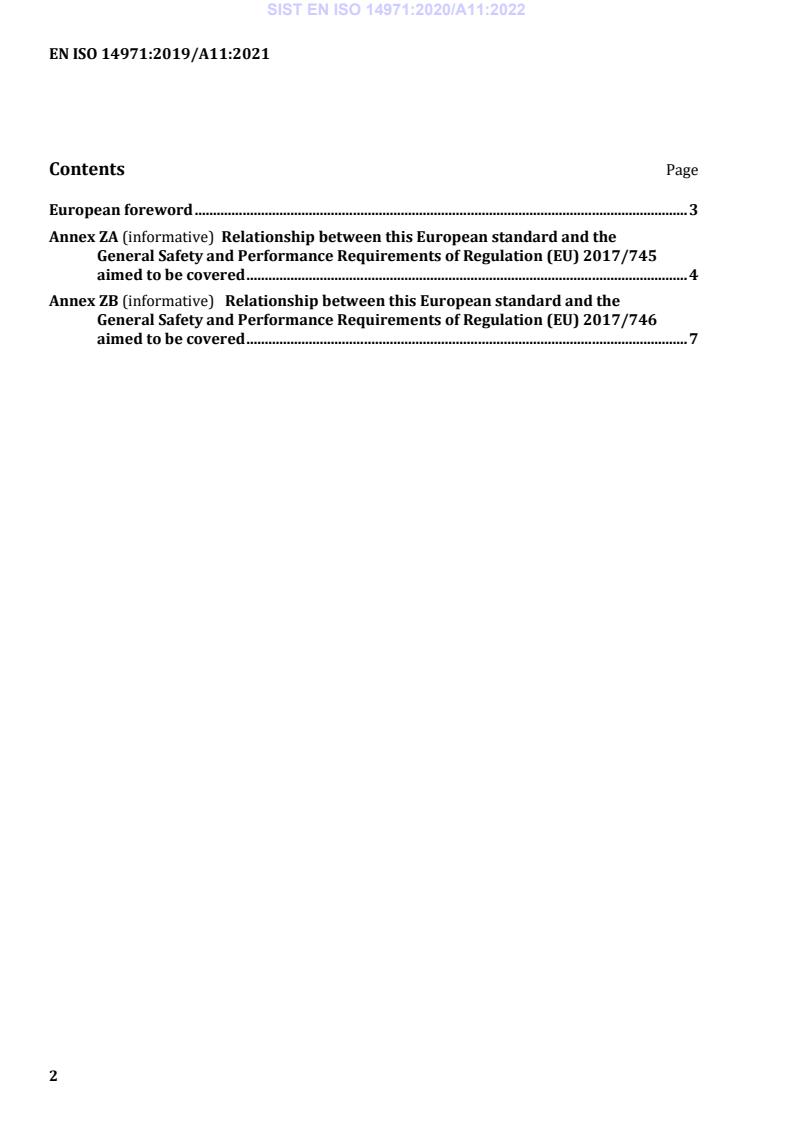
Contents Page
European foreword . 3
Annex ZA (informative) Relationship between this European standard and the
General Safety and Performance Requirements of Regulation (EU) 2017/745
aimed to be covered . 4
Annex ZB (informative) Relationship between this European standard and the
General Safety and Performance Requirements of Regulation (EU) 2017/746
aimed to be covered . 7
European foreword
This document (EN ISO 14971:2019/A11:2021) has been prepared by Technical Committee
CEN/CLC/TC 3 “Quality management and corresponding general aspects for medical devices” the
secretariat of which is held by NEN.
This Amendment to the European Standard EN ISO 14971:2019 shall be given the status of a national
standard, either by publication of an identical text or by endorsement, at the latest by June 2022, and
conflicting national standards shall be withdrawn at the latest by June 2022.
Attention is drawn to the possibility that some of the elements of this document may be the subject of
patent rights. CEN [and/or CENELEC] shall not be held responsible for identifying any or all such patent
rights.
This Amendment to the European Standard EN ISO 14971:2019 has been prepared under a mandate
given to CEN by the European Commission and the European Free Trade Association, and supports
requirements of EU Regulation(s).
For relationship with EU Regulation(s), see informative Annex ZA, and ZB, which are an integral part of
this document.
Any feedback and questions on this document should be directed to the users’ national standards
body/national committee. A complete listing of these bodies can be found on the CEN websites.
According to the CEN-CENELEC Internal Regulations, the national standards organizations of the
following countries are bound to implement this European Standard: Austria, Belgium, Bulgaria, Croatia,
Cyprus, Czech Republic, Denmark, Estonia, Finland, France, Germany, Greece, Hungary, Iceland, Ireland,
Italy, Latvia, Lithuania, Luxembourg, Malta, Netherlands, Norway, Poland, Portugal, Republic of North
Macedonia, Romania, Serbia, Slovakia, Slovenia, Spain, Sweden, Switzerland, Turkey and the United
Kingdom.
Annex ZA
(informative)
Relationship between this European standard and the General Safety and
Performance Requirements of Regulation (EU) 2017/745 aimed to be
covered
This European standard has been prepared under a Commission’s standardisation request M/575 to
provide one voluntary means of conforming to the General Safety and Performance Requirements of
Regulation (EU) 2017/745 of 5 April 2017 concerning medical devices [OJ L 117].
Once this standard is cited in the Official Journal of the European Union under that Regulation, compliance
with the normative clauses of this standard given in Table ZA.1 confers, within the limits of the scope of
this standard, a presumption of conformity with the corresponding General Safety and Performance
Requirements of that Regulation, and associated EFTA regulations.
For application of this European standard under Regulation (EU) 2017/745,
1. the scope is limited to medical devices and accessories for a medical device as defined in that
Regulation and to products regulated as a device under that Regulation;
2. in case of differences between terms defined in this European standard and terms defined in that
Regulation, the terms defined in the Regulation shall prevail;
3. the manufacturer’s policy for establishing criteria for risk acceptability (see 4.2 of this European
standard) shall ensure that the criteria comply with the General Safety and Performance
Requirements of that Regulation.
Explanation on the correspondence of the standard and the General Safety and Performance
Requirements is included in Table ZA.1.
NOTE 1 Where a reference from a clause of this standard to the risk management process is made, the
risk management process needs to be in compliance with Regulation (EU) 2017/745. This means that
risks have to be ‘reduced as far as possible’, ‘reduced to the lowest possible level’, ‘reduced as far as
possible and appropriate’, ‘removed or reduced as far as possible’, ‘eliminated or reduced as far as
possible’, ’removed or minimized as far as possible’, or ‘minimized’, according to the wording of the
corresponding General Safety and Performance Requirement.
NOTE 2 The manufacturer’s policy for determining acceptable risk must be in compliance with General
Safety and Performance Requirements 1, 2, 3, 4, 5, 8, 9, 10, 11, 14, 16, 17, 18, 19, 20, 21 and 22 of the
Regulation.
NOTE 3 This Annex ZA is based on normative references according to the table of references in the
European Foreword, replacing the references in the core text.
NOTE 4 When a General Safety and Performance Requirement does not appear in Table ZA.1, it means
that it is not addressed by this European Standard.
EN ISO 14971:20
...