

SIST EN 17845:2024
(Main)Construction products - Assessment of release of dangerous substances - Determination of biocide residues using liquid chromatography with mass spectrometric detection (LC-MS/MS)
General Information
- Abstract
This document describes a method for the determination of the content of biocides in construction products, (either finished (dried) or in a ready-to-use state) and in eluates thereof, using liquid chromatography and tandem mass spectrometric detection (LC-MS/MS).
For content analysis liquid chromatography with UV-detection can also be used, if sufficient sensitivity and selectivity is ensured (see Annex A (normative)).
The method in this document is validated for the product types listed in Annex D (informative). For eluate analysis quantification limits of 0,1 µg/l can be achieved.
- Status
- Published
- Public Enquiry End Date
- 01-Jul-2022
- Publication Date
- 10-Mar-2024
- Technical Committee
- NES - Dangerous substances
- Current Stage
- 6060 - National Implementation/Publication (Adopted Project)
- Start Date
- 01-Mar-2024
- Due Date
- 06-May-2024
- Completion Date
- 11-Mar-2024

Overview
EN 17845:2023 - "Construction products: Assessment of release of dangerous substances - Determination of biocide residues using liquid chromatography with mass spectrometric detection (LC‑MS/MS)" - is a CEN standard that specifies an analytical method for measuring biocide residues in construction products and in their eluates. The method is based on liquid chromatography coupled with tandem mass spectrometric detection (LC‑MS/MS) (electrospray ionization, MRM mode). For content analysis, HPLC with UV detection is permitted where sensitivity and selectivity are adequate (see Annex A). The standard is part of the modular horizontal approach of CEN/TC 351 and is validated for the product types listed in Annex D.
Key topics and technical requirements
- Scope: Quantification of biocides in finished/dried or ready‑to‑use construction products and in eluates.
- Analytical technique: LC‑MS/MS with electrospray ionization; multiple reaction monitoring (MRM) for selectivity.
- Alternative detection: LC‑UV for content analysis if validation shows sufficient sensitivity/selectivity (Annex A normative).
- Sample preparation:
- Solid/pasty samples: extraction with methanol or methanol/water.
- Eluates: direct injection or pre‑concentration/clean‑up (e.g., SPE) where required (Annex B informative).
- Follow sample preparation guidance in EN 17087.
- Clean‑up options: solid phase extraction or supported liquid–liquid extraction to remove interferences.
- Performance: For eluate analysis, method quantification limits of about 0.1 µg/L can be achieved (validation in Annex D).
- Identification & quantification: Use of internal/external standards, standard addition options and calibration as described (see Clauses 10–11). Quality assurance and recovery/interference tests are part of the procedure.
- Documentation: Test report requirements, calculation methods and validation results are included.
Practical applications
- Compliance testing of building materials and treated products (paints, sealants, timber treatments, coatings) for release of biocidal substances.
- Regulatory and conformity assessment where release of dangerous substances must be demonstrated or quantified.
- Laboratory method for environmental monitoring of leachates from construction products (e.g., to assess leaching during use or end‑of‑life scenarios).
- Method for manufacturers, testing laboratories, product certifiers and regulatory bodies performing content and eluate analyses.
Who should use this standard
- Analytical and environmental testing laboratories performing trace analysis of biocides.
- Product manufacturers and quality control teams assessing biocide content or release.
- Certification bodies, conformity assessors and authorities responsible for construction product safety and environmental compliance.
- Researchers validating leaching behavior and ecotoxicological exposure from construction materials.
Related standards
- EN 17087 - preparation of test portions for release and content analysis
- EN 16687:2023 - terminology for assessment of release of dangerous substances
- EN 16637‑2 / EN 16637‑3 - horizontal leaching/percolation test methods
- CEN/TR 16220 - modular approach overview
Keywords: EN 17845:2023, biocide residues, LC‑MS/MS, construction products, eluates, liquid chromatography, mass spectrometric detection, SPE, MRM, quantification limit 0.1 µg/L.
Relations
- Effective Date
- 28-Jan-2026
- Effective Date
- 28-Jan-2026
- Effective Date
- 28-Jan-2026
- Effective Date
- 28-Jan-2026
- Effective Date
- 28-Jan-2026
- Effective Date
- 28-Jan-2026
Get Certified
Connect with accredited certification bodies for this standard

BSI Group
BSI (British Standards Institution) is the business standards company that helps organizations make excellence a habit.

Bureau Veritas
Bureau Veritas is a world leader in laboratory testing, inspection and certification services.

DNV
DNV is an independent assurance and risk management provider.
Sponsored listings
Frequently Asked Questions
SIST EN 17845:2024 is a standard published by the Slovenian Institute for Standardization (SIST). Its full title is "Construction products - Assessment of release of dangerous substances - Determination of biocide residues using liquid chromatography with mass spectrometric detection (LC-MS/MS)". This standard covers: This document describes a method for the determination of the content of biocides in construction products, (either finished (dried) or in a ready-to-use state) and in eluates thereof, using liquid chromatography and tandem mass spectrometric detection (LC-MS/MS). For content analysis liquid chromatography with UV-detection can also be used, if sufficient sensitivity and selectivity is ensured (see Annex A (normative)). The method in this document is validated for the product types listed in Annex D (informative). For eluate analysis quantification limits of 0,1 µg/l can be achieved.
This document describes a method for the determination of the content of biocides in construction products, (either finished (dried) or in a ready-to-use state) and in eluates thereof, using liquid chromatography and tandem mass spectrometric detection (LC-MS/MS). For content analysis liquid chromatography with UV-detection can also be used, if sufficient sensitivity and selectivity is ensured (see Annex A (normative)). The method in this document is validated for the product types listed in Annex D (informative). For eluate analysis quantification limits of 0,1 µg/l can be achieved.
SIST EN 17845:2024 is classified under the following ICS (International Classification for Standards) categories: 13.020.99 - Other standards related to environmental protection; 71.040.50 - Physicochemical methods of analysis; 91.100.01 - Construction materials in general. The ICS classification helps identify the subject area and facilitates finding related standards.
SIST EN 17845:2024 has the following relationships with other standards: It is inter standard links to SIST EN 16637-3:2024, SIST EN 16687:2024, SIST EN 16637-2:2024, SIST EN 17087:2019, SIST EN 17331:2024, SIST EN 17332:2024. Understanding these relationships helps ensure you are using the most current and applicable version of the standard.
SIST EN 17845:2024 is associated with the following European legislation: EU Directives/Regulations: 305/2011; Standardization Mandates: M/366. When a standard is cited in the Official Journal of the European Union, products manufactured in conformity with it benefit from a presumption of conformity with the essential requirements of the corresponding EU directive or regulation.
SIST EN 17845:2024 is available in PDF format for immediate download after purchase. The document can be added to your cart and obtained through the secure checkout process. Digital delivery ensures instant access to the complete standard document.
Standards Content (Sample)
SLOVENSKI STANDARD
01-april-2024
Gradbeni proizvodi - Ocenjevanje sproščanja nevarnih snovi - Določanje ostankov
biocidov s tekočinsko kromatografijo in tandemsko masno spektrometrijo (LC-
MS/MS)
Construction products - Assessment of release of dangerous substances - Determination
of biocide residues using liquid chromatography with mass spectrometric detection (LC-
MS/MS)
Bauprodukte - Bewertung der Freisetzung von gefährlichen Stoffen - Bestimmung von
Biozid-Rückständen mittels LC-MS/MS
Produits de construction - Évaluation de l'émission de substances dangereuses -
Détermination de la teneur en biocides par chromatographie en phase liquide et
détection par spectrométrie de masse en tandem (LC-MS/MS)
Ta slovenski standard je istoveten z: EN 17845:2023
ICS:
13.020.99 Drugi standardi v zvezi z Other standards related to
varstvom okolja environmental protection
71.040.50 Fizikalnokemijske analitske Physicochemical methods of
metode analysis
91.100.01 Gradbeni materiali na Construction materials in
splošno general
2003-01.Slovenski inštitut za standardizacijo. Razmnoževanje celote ali delov tega standarda ni dovoljeno.
EN 17845
EUROPEAN STANDARD
NORME EUROPÉENNE
November 2023
EUROPÄISCHE NORM
ICS 91.100.01
English Version
Construction products: Assessment of release of
dangerous substances - Determination of biocide residues
using liquid chromatography with mass spectrometric
detection (LC-MS/MS)
Produits de construction : Évaluation de l'émission de Bauprodukte: Bewertung der Freisetzung von
substances dangereuses - Détermination de la teneur gefährlichen Stoffen - Bestimmung von Biozid-
en biocides par chromatographie en phase liquide et Rückständen mittels LC-MS/MS
détection par spectrométrie de masse en tandem (LC-
MS/MS)
This European Standard was approved by CEN on 14 August 2023.
CEN members are bound to comply with the CEN/CENELEC Internal Regulations which stipulate the conditions for giving this
European Standard the status of a national standard without any alteration. Up-to-date lists and bibliographical references
concerning such national standards may be obtained on application to the CEN-CENELEC Management Centre or to any CEN
member.
This European Standard exists in three official versions (English, French, German). A version in any other language made by
translation under the responsibility of a CEN member into its own language and notified to the CEN-CENELEC Management
Centre has the same status as the official versions.
CEN members are the national standards bodies of Austria, Belgium, Bulgaria, Croatia, Cyprus, Czech Republic, Denmark, Estonia,
Finland, France, Germany, Greece, Hungary, Iceland, Ireland, Italy, Latvia, Lithuania, Luxembourg, Malta, Netherlands, Norway,
Poland, Portugal, Republic of North Macedonia, Romania, Serbia, Slovakia, Slovenia, Spain, Sweden, Switzerland, Türkiye and
United Kingdom.
EUROPEAN COMMITTEE FOR STANDARDIZATION
COMITÉ EUROPÉEN DE NORMALISATION
EUROPÄISCHES KOMITEE FÜR NORMUNG
CEN-CENELEC Management Centre: Rue de la Science 23, B-1040 Brussels
© 2023 CEN All rights of exploitation in any form and by any means reserved Ref. No. EN 17845:2023 E
worldwide for CEN national Members.
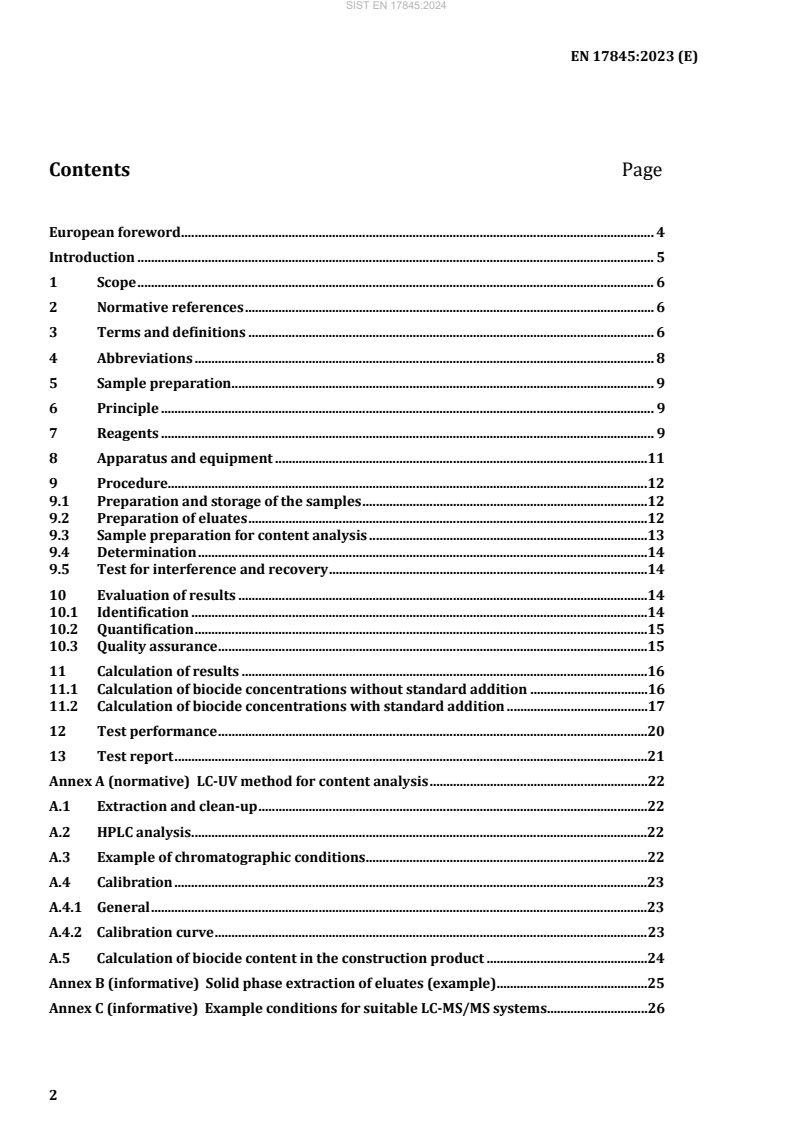
Contents Page
European foreword . 4
Introduction . 5
1 Scope . 6
2 Normative references . 6
3 Terms and definitions . 6
4 Abbreviations . 8
5 Sample preparation . 9
6 Principle . 9
7 Reagents . 9
8 Apparatus and equipment .11
9 Procedure.12
9.1 Preparation and storage of the samples .12
9.2 Preparation of eluates .12
9.3 Sample preparation for content analysis .13
9.4 Determination .14
9.5 Test for interference and recovery .14
10 Evaluation of results .14
10.1 Identification .14
10.2 Quantification .15
10.3 Quality assurance .15
11 Calculation of results .16
11.1 Calculation of biocide concentrations without standard addition .16
11.2 Calculation of biocide concentrations with standard addition .17
12 Test performance .20
13 Test report .21
Annex A (normative) LC-UV method for content analysis .22
A.1 Extraction and clean-up .22
A.2 HPLC analysis .22
A.3 Example of chromatographic conditions .22
A.4 Calibration .23
A.4.1 General .23
A.4.2 Calibration curve .23
A.5 Calculation of biocide content in the construction product .24
Annex B (informative) Solid phase extraction of eluates (example) .25
Annex C (informative) Example conditions for suitable LC-MS/MS systems .26
Annex D (informative) Validation results for biocides in eluates from construction products
................................................................................................................................................................... 31
Bibliography . 33
European foreword
This document (EN 17845:2023) has been prepared by Technical Committee CEN/TC 351 “Construction
products: Assessment of release of dangerous substances”, the secretariat of which is held by NEN.
This European Standard shall be given the status of a national standard, either by publication of an
identical text or by endorsement, at the latest by May 2024, and conflicting national standards shall be
withdrawn at the latest by May 2024.
Attention is drawn to the possibility that some of the elements of this document may be the subject of
patent rights. CEN shall not be held responsible for identifying any or all such patent rights.
This document has been prepared under a Standardization Request given to CEN by the European
Commission and the European Free Trade Association.
Any feedback and questions on this document should be directed to the users’ national standards body.
A complete listing of these bodies can be found on the CEN website.
According to the CEN-CENELEC Internal Regulations, the national standards organisations of the
following countries are bound to implement this European Standard: Austria, Belgium, Bulgaria, Croatia,
Cyprus, Czech Republic, Denmark, Estonia, Finland, France, Germany, Greece, Hungary, Iceland, Ireland,
Italy, Latvia, Lithuania, Luxembourg, Malta, Netherlands, Norway, Poland, Portugal, Republic of North
Macedonia, Romania, Serbia, Slovakia, Slovenia, Spain, Sweden, Switzerland, Türkiye and the United
Kingdom.
Introduction
This document deals with the determination of the content of biocides in construction products and
eluates using liquid chromatography and tandem mass spectrometric detection (LC-MS/MS).
Following an extended evaluation of available methods for content and eluate analysis in construction
products (CEN/TR 16045) and subsequent method evaluation in the robustness validation [Van De
Weghe et al., 2018] it was concluded that eluate analysis and content analysis for biocides can be based
on EN 15637 after some modifications.
This document is part of a modular horizontal approach and belongs to the analytical step. An overview
of all modules which belong to a chain of measurement and the manner how modules are selected is given
in CEN/TR 16220.
In the growing amount of product and sector-oriented test methods it was recognized that many steps in
test procedures are or could be used in test procedures for many products, materials and sectors. It was
supposed that, by careful determination of these steps and selection of specific questions within these
steps, elements of the test procedure could be described in a way that can be used for all materials and
products or for all materials and products with certain specifications.
In this context a horizontal modular approach is adopted in CEN/TC 351. “Horizontal” means that the
methods can be used for a wide range of materials and products with certain properties. “Modular” means
that a test standard developed in this approach concerns a specific step in assessing a property and not
the whole “chain of measurement” (from sampling to analyses). A beneficial feature of this approach is
that “modules” can be replaced by better ones without jeopardizing the standard “chain”.
The use of modular horizontal standards implies the drawing of test schemes as well. Before executing a
test on a certain material or product to determine certain characteristics, it is necessary to draw up a
protocol in which the adequate modules are selected and together form the basis for the entire test
procedure.
1 Scope
This document describes a method for the determination of the content of biocides in construction
products, (either finished (dried) or in a ready-to-use state) and in eluates thereof, using liquid
chromatography and tandem mass spectrometric detection (LC-MS/MS).
For content analysis liquid chromatography with UV-detection can also be used, if sufficient sensitivity
and selectivity is ensured (see Annex A (normative)).
The method in this document is validated for the product types listed in Annex D (informative). For eluate
analysis quantification limits of 0,1 µg/l can be achieved.
2 Normative references
The following documents are referred to in the text in such a way that some or all of their content
constitutes requirements of this document. For dated references, only the edition cited applies. For
undated references, the latest edition of the referenced document (including any amendments) applies.
EN 16637-2, Construction products: Assessment of release of dangerous substances — Part 2: Horizontal
dynamic surface leaching test
EN 16637-3, Construction products: Assessment of release of dangerous substances — Part 3: Horizontal
up-flow percolation test
EN 16687:2023, Construction products: Assessment of release of dangerous substances — Terminology
EN 17087, Construction products: Assessment of release of dangerous substances — Preparation of test
portions from the laboratory sample for testing of release and analysis of content
3 Terms and definitions
For the purposes of this document, the terms and definitions given in EN 16687:2023 and the following
apply.
ISO and IEC maintain terminology databases for use in standardization at the following addresses:
— ISO Online browsing platform: available at https://www.iso.org/obp
— IEC Electropedia: available at https://www.electropedia.org/
3.1
blank value
test result obtained by carrying out the test procedure in the absence of a test portion
[SOURCE: EN 16687:2023, 3.3.1.10; modified – Note 1 to entry removed]
3.2
clean-up
purification of a crude extract to remove interfering compounds
[SOURCE: EN 16687:2023, 3.2.2.27; modified – Note 1 to entry removed]
3.3
external standard
known quantity of the target analytes that is measured in the same series as the solution to be measured
and is used for identification and quantification
[SOURCE: EN 16687:2023, 3.2.2.20]
3.4
extract
solution resulting from extraction of a sample with a solvent
[SOURCE: EN 16687:2023, 3.2.2.13]
3.5
extraction
dissolution of substances in a solvent for subsequent chemical analysis
[SOURCE: EN 16687:2023, 3.2.2.14; modified – Note 1 to entry removed]
3.6
final extract
solution that is obtained after clean-up of the Soxhlet extract through a purification stage
[SOURCE: EN 16687:2023, 3.2.2.18]
3.7
internal standard
known quantity of a substance (where applicable deuterated) not present in the sample, which is added
to the analysis sample in order to determine the recovery
[SOURCE: EN 16687:2023, 3.3.2.10]
3.8
laboratory sample
sample or subsample(s) sent to or received by the laboratory
[SOURCE: EN 16687:2023, 3.2.2.1; modified – Notes to entry removed]
3.9
method detection limit
MDL
lowest analyte concentration that can be detected with a specified analytical method including sample
preparation with a defined statistical probability
[SOURCE: EN 16687:2023, 3.3.1.12; modified – Note 1 to entry removed]
3.10
product matrix
main composition of the product dictating the manner of sample preparation and the type of digestion or
extraction for later chemical analysis
[SOURCE: EN 16687:2023, 3.1.1.2; modified – Note 1 to entry removed]
3.11
sample
portion of material selected from a larger quantity of material
[SOURCE: EN 16687:2023, 3.2.1.5; modified – Notes to entry removed]
3.12
Soxhlet extract
solution that is obtained after extraction of a solid subsample by the Soxhlet technique for determining
organic compounds
[SOURCE: EN 16687:2023, 3.2.2.17]
3.13
Soxhlet extraction
chemical pre-treatment of a solid subsample, where the organic compounds to be determined are
dissolved by the Soxhlet technique
[SOURCE: EN 16687:2023, 3.2.2.16]
3.14
test portion
analytical portion
amount of the test sample taken for testing/analysis purposes, usually of known dimension, mass or
volume
[SOURCE: EN 16687:2023, 3.2.2.3; modified – Examples removed]
3.15
test sample
analytical sample
sample, prepared from the laboratory sample, from which test portions are removed for testing or for
analysis
[SOURCE: EN 16687:2023, 3.2.2.2]
4 Abbreviations
For the purposes of this document, the following abbreviations apply.
a.u. Arbitrary units
DTL Detection limit
HPLC High performance liquid chromatography
NOTE High pressure liquid chromatography is an (outdated) synonym.
ISTD Internal standard solution
LC Liquid chromatography
LOD Limit of detection
MQL Method quantification limit
MRL Maximum residue limit
MRM Multiple reaction monitoring
MS Mass spectrometry;
Mass selective detection
PTFE Polytetrafluoroethylene
SPE Solid phase extraction
5 Sample preparation
To obtain test samples for extraction (and analysis) guidance on sample preparation as specified in
EN 17087 shall be applied.
Precautions shall be taken before and during transport of the laboratory sample as well as during the
time in which the samples are preserved in the laboratory before being analysed, to avoid alteration of
the sample (see CEN/TR 16220).
Extracts are susceptible to change due to physical or chemical reactions which can take place between
the time of extraction and the analysis.
It is therefore essential to take the necessary precautions to minimize these reactions and in the case of
many parameters to analyse the extract with a minimum of delay. The maximum delay is given in the
respective analytical standards.
6 Principle
Quantification of biocides is performed by liquid chromatography with tandem mass spectrometric
detection (LC-MS/MS), using electrospray ionization. Eluates are injected directly into the LC-MS/MS
system.
Solid and pasty samples are extracted with methanol or a methanol/water mixture. Clean-up may be
applied when necessary by solid phase supported liquid-liquid extraction.
To achieve the required selectivity the mass spectrometer is operated in the MRM mode.
7 Reagents
Use reagents of recognized analytical grade, unless otherwise specified. Take every precaution to avoid
possible contamination of water, solvents, inorganic salts, etc.
7.1 Additive for LC-eluent depending on method used, e.g. ammonium formate, formic acid, acetic
acid.
7.2 Water, HPLC quality.
7.3 Dichloromethane, for biocide analysis.
7.4 Methanol, LC-MS/MS quality.
7.5 Internal standard (ISTD) solutions in methanol, mass concentration ρ = 10 µg/ml to 50 µg/ml .
Use as much as possible isotope labelled internal standards, if available and obtainable at reasonable
price. The internal standard solution should be added at the extraction step and to standard solutions.
If no isotope labelled internal standards are used, it is recommended to check whether matrix compounds
are co-eluting with the ISTD to ensure reliable results. Losses of the ISTD during clean-up will result in
an overestimation of analyte concentration. Such losses should thus be minimal.
7.6 Biocide stock solutions.
Prepare individual stock solutions of analytical standards at concentrations that are sufficiently high to
allow the preparation of complex biocide mixtures. The solvent used shall not negatively influence the
stability of the biocides employed.
Usually, store stock solutions at approximately −18 °C. Check the stability of stock solutions during
storage regularly. In some cases, the addition of acids or bases is helpful to enhance stability and extend
the acceptable storage period.
7.7 Biocide mixtures.
Because of the broad applicability of this method and due to the partly divergent pH-stability of biocides,
analyte mixtures of different composition might be needed. These are prepared by mixing together
defined volumes of the required biocide stock solutions (7.6) and appropriately diluting them with
methanol. The analyte concentrations in this mixture should be sufficient to allow the preparation of the
required matrix matched standards (see 7.8.3) with moderate dilution of the blank sample extract (e.g.
less than 20 %).
Usually, biocide mixtures are stored at approximately −18 °C. Since the stability of the biocides in the
mixture can be lower than in stock solutions, stability has to be checked regularly. In some cases, the
addition of acids or bases is helpful to enhance stability and extend acceptable storage times.
7.8 Standard solutions.
7.8.1 Standard solutions prepared in pure solvent (solvent-based standards).
Solvent-based standards are prepared by mixing a certain volume of methanol with known amounts of
biocide mixtures (7.7). The preparation of multiple standards of different biocide concentration is useful
to cover a broad concentration range.
NOTE The linear range of calibration depends on the sensitivity of the instrument and the MS signal response
of the biocide. A calibration range of 0,1 µg/l to 100 µg/l correlates to a biocide content of 0,3 mg/kg to 300 mg/kg
when a 10 g sample is employed (see 9.3.1).
7.8.2 Standard solutions with internal standard prepared in pure solvent.
Solvent-based standards with ISTD are prepared by mixing a certain volume of methanol with known
amounts of biocide mixtures (7.7) and a fixed volume of internal standard solution (7.5).
The volume used shall result in that concentration of ISTD which is obtained in the final extracts after
sample extraction and clean-up (see 9.2 and 9.3). The concentration of internal standard in the final
sample
extract ( c ) is calculated using Formula (1). The preparation of multiple standards of different
ISTD
biocide concentration but with constant ISTD concentration is useful to cover a broad concentration
range.
Vc×× V
sample
ISTD ISTD 1
c = (1)
ISTD
VV×
ex end
where
sample is the concentration of internal standard in the final extract, in µg/ml;
c
ISTD
V is the volume of internal standard solution (7.5) added to the test portion, in ml;
ISTD
c is the concentration of internal standard solution (7.5), in µg/ml;
ISTD
V is the volume used for solid phase supported liquid/liquid extraction, in ml (here:
V = 5 ml);
V is the total volume of extraction solvents, in ml (here: V = 30 ml);
ex ex
V is the final volume of extract obtained after clean-up, in ml (here: V = 0,5 ml).
end end
In case no clean-up is applied Formula (1) simplifies to Formula (2).
Vc×
sample ISTD ISTD
c = (2)
ISTD
V
ex
7.8.3 Standard solutions prepared in blank matrix extracts (matrix-matched standards).
Prepare matrix-matched standards in the same way as the solvent-based standards, however, instead of
pure methanol use extracts of blank samples (prepared as described in 9.3, but without ISTD addition).
To minimize errors caused by matrix induced effects during chromatography, it is best to choose similar
commodities (e.g. sealant for sealant samples, render for render samples, wood for treated wood samples,
insulation foam for insulation foam samples, etc.).
The stability of biocide in matrix-matched standards can be lower than that of standards in pure solvents
and has to be checked more thoroughly.
7.9 Cartridge for solid phase supported liquid/liquid extraction of appropriate sample volume
(e.g. 5 ml or 20 ml), diatomaceous earth, for example ChemElut CE 1005 .
1 3
7.10 Solid phase extraction (SPE) cartridges, e.g. OASIS HLB 6 ml, 200 mg .
8 Apparatus and equipment
Usual laboratory apparatus and, in particular, the following:
8.1 Suitable equipment for sample comminution and grinding.
8.2 Laboratory balance, accuracy: 0,01 g.
8.3 Volumetric flasks, 10 ml and 20 ml.
8.4 Ultrasonic bath.
ChemElut and OASIS HLB are trade names of products. This information is given for the convenience of users of
this European Standard and does not constitute an endorsement by CEN of the product named. Equivalent products
may be used if they can be shown to lead to the same results.
8.5 Centrifuge tubes, suitable to withstand acceleration.
8.6 Centrifuge, capable of producing a relative centrifugal force (RCF) of at least 3000 g (at the bottom
of the tube).
8.7 Round bottom flasks, capacity 50 ml and 250 ml.
8.8 Glass syringe, minimum volume 2 ml.
8.9 Microlitre syringes, for sample fortification.
8.10 Rotary evaporator, with temperature-controlled water bath.
8.11 Syringe filters, 0,45 µm pore size, PTFE membrane.
8.12 Glass vials and caps, 1,8 ml volume, suitable for an autosampler.
8.13 LC-MS/MS system, triple quadrupole mass spectrometer with electrospray interface.
NOTE Depending on construction product, matrix, system interferences, biocide and requirement for limit of
quantification, it is possible that reliable results are to be obtained using a less selective detection system, e.g.
LC/UV.
8.14 SPE equipment, e.g. vacuum manifold.
9 Procedure
9.1 Preparation and storage of the samples
Sample processing and storage procedures should be demonstrated to have no significant effect on the
biocides present in the test sample. Processing should also ensure that the test sample is homogeneous
enough so that sub-sampling variability is acceptable. If a single analytical portion is unlikely to be
representative of the test sample, larger or replicate portions shall be analysed, to provide a better
estimate of the true value. For content analysis, the degree of comminution of solid samples supports
a quantitative biocide extraction.
9.2 Preparation of eluates
Make eluates according to EN 16637-2 and EN 16637-3; centrifuge the eluates, take a test portion, add
internal standard and proceed to 9.4.
Depending on the sensitivity of the instrument and the required limit of quantification it can be necessary
to concentrate the eluates by solid phase extraction (SPE). An example of an SPE procedure is given in
Annex B (informative).
9.3 Sample preparation for content analysis
9.3.1 Extraction
The reduction of the sample shall be carried out in such a way that representative portions are obtained
(see EN 17087). Follow guidance in this document for any other aspects of sample pre-treatment. This
results in the test sample. Calculation of the biocide shall be based on the mass of the original test sample.
For dry sample materials weigh a homogenized portion of 5 g (m ) into the centrifuge tube (8.5). Add
A
10 ml of water and 20 ml of methanol (7.4). Homogenize for approximately 2 min (e.g. using a high-speed
blender). Take at least 10 ml of the resulting extract of 30 ml (= V ) and centrifuge at a minimum of
ex
3 000 g for at least 10 min.
For pasty products, transfer a representative test portion of m = 10 g into a centrifuge tube (8.5). Add
a
10 ml of water and 20 ml of methanol (7.4). Homogenize for approximately 2 min (e.g. using a high-speed
blender). Take at least 10 ml of the resulting extract (V ) and centrifuge at a minimum of 3 000 g for at
ex
least 10 min. If the product is partly or completely dissolved in the extraction solvent, the volume V has
ex
to be corrected, taken the sample volume into account.
As an option an internal standard may be used additionally. In that case add a small volume (<1 % of V )
ex
of internal standard solution (= V ) to the test portion after addition of 20 ml of methanol.
ISTD
9.3.2 Clean-up
If necessary, apply 5 ml of the diluted centrifugate (= V ) from 9.3.1 to a 5 ml cartridge (7.9). After
approximately 5 minutes, elute into a 50 ml round bottom flask (8.7), using 12,5 ml of dichloromethane
(7.3). Repeat the elution with another 12,5 ml of dichloromethane. Reduce the combined eluates almost
to dryness using the rotary evaporator (8.10). Remaining dichloromethane shall be removed with
a gentle stream of nitrogen. Add 500 µl of methanol (7.4) to the round bottom flask and weigh with
stopper. Carefully dissolve the biocide by swirling the flask in the ultrasonic bath (8.4), but avoid losses
of methanol. If losses of methanol occur (re-weighing), add methanol to obtain the previous total weight.
Filter the obtained sample test solution of 0,5 ml (= Vend) through a PTFE-filter (8.11) into a sample vial
(8.12) for injection.
To obtain a larger amount of sample test solution for the preparation of matrix-matched standards (7.8.3)
a 20 ml cartridge may be used. In that case, 400 % of all volumes mentioned above have to be used.
NOTE The sample test solution contains the extractable components of 3,33 g sample per ml final extract (or
1,67 g/0,5 ml).
9.4 Determination
For eluate analysis, the sample test solutions
...