

oSIST prEN 17549-1:2022
(Main)Building information modelling - Information structure based on EN ISO 16739 1 to exchange data templates and data sheets for construction objects - Part 1: Data templates and configured construction objects
General Information
- Abstract
The digital transformation of the construction industry includes also the digital transformation of the supply change of construction products. With ISO 16739-1 exists an open language to design, transfer and maintain construction models. The construction models (eg. of a building) contain a digital twin of real-life products. The data of these products should be transported in a digital format on the way from the manufacturer to the building owner.
This product data should be expressed also in an easy and open way. The creators of product data files should be able to do this manually or automatically, as they like it. The users of product data should be able to use it to:
• Import products easily in the as-planned-bim-models to plan with the products in an early stage of development
• Import delivered real life products easily in their as-built-bim-models to document them for a later stage of development
These scenarios fit in the business models of manufacturers, planners, construction companies and facility managers.
The working group 4 of CEN-TC442 has published proposals for creating new work items in the sector of CEN regarding the storage and the transport of product data in the sector of building information modelling (BIM):
prEN ISO 23386: Building information modelling and other digital processes used in Construction – Methodology to describe, author and maintain properties in interconnected dictionaries
prEN ISO 23387: Data templates for construction works entities, Part 1: Objects, collections, and relationships defining the general structure of data templates
This standard defines a format for exchanging empty product data templates and filled product data templates (product data) and therefore fills the missing link between the product data sources (e.g. catalogues) from the manufacturers to the construction models of the designers and owners.
The part 1 of the standard describes a way to represent information templates and configured products in a library based on a structure based on ISO 16739-1 (prEN ISO 16739-1) and how this relates to the upcoming standards prEN ISO 23386 and prEN ISO 23387.
The part 2 will define the way, how a (requirements) request can be formulated with EN ISO 16739 and how this can be used to represent variants of configurable products. The requests by part 2 will be applicable to product libraries based on part 1.
The part 2 will furthermore define a way, to create a constraint based product library for highly configurable products to
support an interactive selection process. The application of an request to a "Part1-Library" and to a "Part2-
Library" shall response same products as the result. It is up to the manufacturers to choose the way, they want to represent their products ("Part1-Library" and/or
"Part2-Library"), they just have to be sure, that all requests can be applied to both types of libraries.
- Status
- Not Published
- Public Enquiry End Date
- 14-Jul-2022
- Technical Committee
- BIM - Building Information Modelling (BIM)
- Current Stage
- 4020 - Public enquire (PE) (Adopted Project)
- Start Date
- 04-Apr-2022
- Due Date
- 22-Aug-2022
- Completion Date
- 14-Jul-2022



Overview
oSIST prEN 17549-1:2022 – Building Information Modelling (BIM): Information Structure for Data Templates and Configured Construction Objects is a draft European standard developed by SIST. It supports the digital transformation of the construction industry by providing a structured, open format for exchanging digital data templates and data sheets for construction objects throughout the supply chain. Grounded in EN ISO 16739-1, commonly associated with the IFC open BIM standard, this document aims to streamline the exchange of product data between manufacturers, designers, contractors, and building owners, enhancing data consistency and interoperability across digital construction processes.
Key Topics
- Digital Product Data Exchange: Defines how empty and filled product data templates can be created, exchanged, and imported into BIM models.
- Information Structure: Provides a framework based on ISO 16739-1 for encoding and transferring construction object data.
- Library of Configured Products: Sets out principles for representing both standardized templates and manufacturer-specific, configured construction products in digital libraries.
- Compatibility: Aligns with upcoming standards such as prEN ISO 23386 (property dictionary methodology) and prEN ISO 23387 (data templates for construction works entities).
- Supply Chain Digitalization: Facilitates digital, easy, and open data transport from manufacturers to end-users, including planners, construction companies, and facility managers.
Applications
oSIST prEN 17549-1:2022 delivers practical value for a range of construction industry stakeholders by enabling efficient data management and interoperability within digital workflows:
- Manufacturers: Can create and distribute digital product data templates and data sheets that are ready for integration into BIM models, supporting both pre- and post-construction phases.
- Planners & Designers: Easily import standardized or configured product data into as-planned BIM models, improving early-stage planning and product selection.
- Contractors: Streamline procurement, logistics, and site management by utilizing accurate, structured product information directly in project documentation.
- Building Owners & Facility Managers: Receive comprehensive as-built documentation, improving asset management and lifecycle operations through consistent, digital product data.
- IT Solution Providers: Develop and implement BIM platforms and software tools that leverage standardized data structures to facilitate the exchange and management of construction object data.
Common scenarios include:
- Importing and managing product data for planning and documentation across a building’s lifecycle,
- Supporting certification and regulatory compliance through consistent data templates,
- Enhancing the digital supply chain for construction materials and components.
Related Standards
Stakeholders implementing oSIST prEN 17549-1:2022 should also consider its close relationship with key BIM and data management standards:
- EN ISO 16739-1 (IFC Standard): Underpins the information structure for construction data modeling and exchange.
- prEN ISO 23386: Methodology for describing, authoring, and maintaining properties in interconnected property dictionaries.
- prEN ISO 23387: Provides principles for data templates applied to construction objects and collections.
- Other BIM-Related Standards: Including those focused on digital product declarations, document associations, and domain-specific data schemas.
Summary
oSIST prEN 17549-1:2022 addresses essential requirements for the digital transformation of construction by standardizing the structure and exchange of data templates and data sheets for construction objects. By promoting open BIM practices, ensuring interoperability, and supporting the entire construction value chain, this standard is key to driving efficiency, consistency, and quality in digital construction data management. Industry users are encouraged to adopt these guidelines to future-proof their workflows as the sector increasingly embraces digitalization.
Get Certified
Connect with accredited certification bodies for this standard

BSI Group
BSI (British Standards Institution) is the business standards company that helps organizations make excellence a habit.

DIBt (Deutsches Institut für Bautechnik)
German Institute for Building Technology.
DIN CERTCO
DIN Group product certification.
Sponsored listings
Frequently Asked Questions
oSIST prEN 17549-1:2022 is a draft published by the Slovenian Institute for Standardization (SIST). Its full title is "Building information modelling - Information structure based on EN ISO 16739 1 to exchange data templates and data sheets for construction objects - Part 1: Data templates and configured construction objects". This standard covers: The digital transformation of the construction industry includes also the digital transformation of the supply change of construction products. With ISO 16739-1 exists an open language to design, transfer and maintain construction models. The construction models (eg. of a building) contain a digital twin of real-life products. The data of these products should be transported in a digital format on the way from the manufacturer to the building owner. This product data should be expressed also in an easy and open way. The creators of product data files should be able to do this manually or automatically, as they like it. The users of product data should be able to use it to: • Import products easily in the as-planned-bim-models to plan with the products in an early stage of development • Import delivered real life products easily in their as-built-bim-models to document them for a later stage of development These scenarios fit in the business models of manufacturers, planners, construction companies and facility managers. The working group 4 of CEN-TC442 has published proposals for creating new work items in the sector of CEN regarding the storage and the transport of product data in the sector of building information modelling (BIM): prEN ISO 23386: Building information modelling and other digital processes used in Construction – Methodology to describe, author and maintain properties in interconnected dictionaries prEN ISO 23387: Data templates for construction works entities, Part 1: Objects, collections, and relationships defining the general structure of data templates This standard defines a format for exchanging empty product data templates and filled product data templates (product data) and therefore fills the missing link between the product data sources (e.g. catalogues) from the manufacturers to the construction models of the designers and owners. The part 1 of the standard describes a way to represent information templates and configured products in a library based on a structure based on ISO 16739-1 (prEN ISO 16739-1) and how this relates to the upcoming standards prEN ISO 23386 and prEN ISO 23387. The part 2 will define the way, how a (requirements) request can be formulated with EN ISO 16739 and how this can be used to represent variants of configurable products. The requests by part 2 will be applicable to product libraries based on part 1. The part 2 will furthermore define a way, to create a constraint based product library for highly configurable products to support an interactive selection process. The application of an request to a "Part1-Library" and to a "Part2- Library" shall response same products as the result. It is up to the manufacturers to choose the way, they want to represent their products ("Part1-Library" and/or "Part2-Library"), they just have to be sure, that all requests can be applied to both types of libraries.
The digital transformation of the construction industry includes also the digital transformation of the supply change of construction products. With ISO 16739-1 exists an open language to design, transfer and maintain construction models. The construction models (eg. of a building) contain a digital twin of real-life products. The data of these products should be transported in a digital format on the way from the manufacturer to the building owner. This product data should be expressed also in an easy and open way. The creators of product data files should be able to do this manually or automatically, as they like it. The users of product data should be able to use it to: • Import products easily in the as-planned-bim-models to plan with the products in an early stage of development • Import delivered real life products easily in their as-built-bim-models to document them for a later stage of development These scenarios fit in the business models of manufacturers, planners, construction companies and facility managers. The working group 4 of CEN-TC442 has published proposals for creating new work items in the sector of CEN regarding the storage and the transport of product data in the sector of building information modelling (BIM): prEN ISO 23386: Building information modelling and other digital processes used in Construction – Methodology to describe, author and maintain properties in interconnected dictionaries prEN ISO 23387: Data templates for construction works entities, Part 1: Objects, collections, and relationships defining the general structure of data templates This standard defines a format for exchanging empty product data templates and filled product data templates (product data) and therefore fills the missing link between the product data sources (e.g. catalogues) from the manufacturers to the construction models of the designers and owners. The part 1 of the standard describes a way to represent information templates and configured products in a library based on a structure based on ISO 16739-1 (prEN ISO 16739-1) and how this relates to the upcoming standards prEN ISO 23386 and prEN ISO 23387. The part 2 will define the way, how a (requirements) request can be formulated with EN ISO 16739 and how this can be used to represent variants of configurable products. The requests by part 2 will be applicable to product libraries based on part 1. The part 2 will furthermore define a way, to create a constraint based product library for highly configurable products to support an interactive selection process. The application of an request to a "Part1-Library" and to a "Part2- Library" shall response same products as the result. It is up to the manufacturers to choose the way, they want to represent their products ("Part1-Library" and/or "Part2-Library"), they just have to be sure, that all requests can be applied to both types of libraries.
oSIST prEN 17549-1:2022 is classified under the following ICS (International Classification for Standards) categories: 35.240.67 - IT applications in building and construction industry; 91.010.01 - Construction industry in general. The ICS classification helps identify the subject area and facilitates finding related standards.
oSIST prEN 17549-1:2022 is available in PDF format for immediate download after purchase. The document can be added to your cart and obtained through the secure checkout process. Digital delivery ensures instant access to the complete standard document.
Standards Content (Sample)
SLOVENSKI STANDARD
01-julij-2022
Informacijsko modeliranje gradenj - Podatkovna struktura za izmenjavo
podatkovnih predlog in tehničnih listov gradnikov, ki temelji na EN ISO 16739-1 - 1.
del: Podatkovne predloge in konfigurirani gradniki
Building information modelling - Information structure based on EN ISO 16739 1 to
exchange data templates and data sheets for construction objects - Part 1: Data
templates and configured construction objects
Building Information Modelling (BIM) - Datenstruktur nach EN ISO 16739-1:2018 für den
Austausch von Datenvorlagen und Datenblättern für Bauobjekte - Teil 1: Datenvorlagen
und konfigurierte Bauobjekte
Modélisation des informations de la construction (BIM) - Structure des informations
basée sur l'EN ISO 16739-1:2018 pour l'échange de modèles de données et de feuilles
de données pour les objets de construction - Partie 1: Modèles de données et objets de
construction configurés
Ta slovenski standard je istoveten z: prEN 17549-1
ICS:
35.240.67 Uporabniške rešitve IT v IT applications in building
gradbeništvu and construction industry
91.010.01 Gradbeništvo na splošno Construction industry in
general
2003-01.Slovenski inštitut za standardizacijo. Razmnoževanje celote ali delov tega standarda ni dovoljeno.
DRAFT
EUROPEAN STANDARD
NORME EUROPÉENNE
EUROPÄISCHE NORM
May 2022
ICS 35.240.67
English Version
Building information modelling - Information structure
based on EN ISO 16739 1 to exchange data templates and
data sheets for construction objects - Part 1: Data
templates and configured construction objects
Modélisation des informations de la construction (BIM) Building Information Modelling (BIM) - Datenstruktur
- Structure des informations basée sur l'EN ISO 16739- nach EN ISO 16739-1:2018 für den Austausch von
1:2018 pour l'échange de modèles de données et de Datenvorlagen und Datenblättern für Bauobjekte - Teil
feuilles de données pour les objets de construction - 1: Datenvorlagen und konfigurierte Bauobjekte
Partie 1: Modèles de données et objets de construction
configurés
This draft European Standard is submitted to CEN members for enquiry. It has been drawn up by the Technical Committee
CEN/TC 442.
If this draft becomes a European Standard, CEN members are bound to comply with the CEN/CENELEC Internal Regulations
which stipulate the conditions for giving this European Standard the status of a national standard without any alteration.
This draft European Standard was established by CEN in three official versions (English, French, German). A version in any other
language made by translation under the responsibility of a CEN member into its own language and notified to the CEN-CENELEC
Management Centre has the same status as the official versions.
CEN members are the national standards bodies of Austria, Belgium, Bulgaria, Croatia, Cyprus, Czech Republic, Denmark, Estonia,
Finland, France, Germany, Greece, Hungary, Iceland, Ireland, Italy, Latvia, Lithuania, Luxembourg, Malta, Netherlands, Norway,
Poland, Portugal, Republic of North Macedonia, Romania, Serbia, Slovakia, Slovenia, Spain, Sweden, Switzerland, Turkey and
United Kingdom.
Recipients of this draft are invited to submit, with their comments, notification of any relevant patent rights of which they are
aware and to provide supporting documentation.
Warning : This document is not a European Standard. It is distributed for review and comments. It is subject to change without
notice and shall not be referred to as a European Standard.
EUROPEAN COMMITTEE FOR STANDARDIZATION
COMITÉ EUROPÉEN DE NORMALISATION
EUROPÄISCHES KOMITEE FÜR NORMUNG
CEN-CENELEC Management Centre: Rue de la Science 23, B-1040 Brussels
© 2022 CEN All rights of exploitation in any form and by any means reserved Ref. No. prEN 17549-1:2022 E
worldwide for CEN national Members.
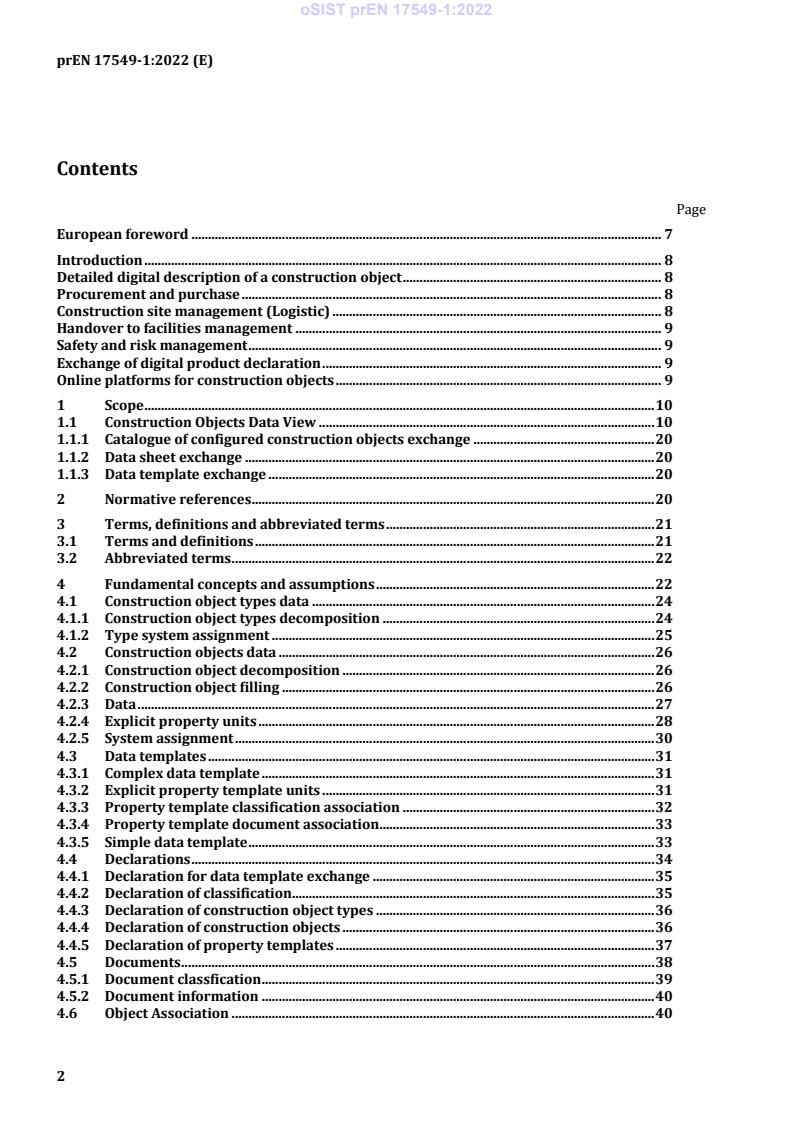
Contents
Page
European foreword . 7
Introduction . 8
Detailed digital description of a construction object . 8
Procurement and purchase . 8
Construction site management (Logistic) . 8
Handover to facilities management . 9
Safety and risk management . 9
Exchange of digital product declaration . 9
Online platforms for construction objects . 9
1 Scope . 10
1.1 Construction Objects Data View . 10
1.1.1 Catalogue of configured construction objects exchange . 20
1.1.2 Data sheet exchange . 20
1.1.3 Data template exchange . 20
2 Normative references . 20
3 Terms, definitions and abbreviated terms . 21
3.1 Terms and definitions . 21
3.2 Abbreviated terms . 22
4 Fundamental concepts and assumptions . 22
4.1 Construction object types data . 24
4.1.1 Construction object types decomposition . 24
4.1.2 Type system assignment . 25
4.2 Construction objects data . 26
4.2.1 Construction object decomposition . 26
4.2.2 Construction object filling . 26
4.2.3 Data . 27
4.2.4 Explicit property units . 28
4.2.5 System assignment . 30
4.3 Data templates . 31
4.3.1 Complex data template . 31
4.3.2 Explicit property template units . 31
4.3.3 Property template classification association . 32
4.3.4 Property template document association . 33
4.3.5 Simple data template . 33
4.4 Declarations . 34
4.4.1 Declaration for data template exchange . 35
4.4.2 Declaration of classification . 35
4.4.3 Declaration of construction object types . 36
4.4.4 Declaration of construction objects . 36
4.4.5 Declaration of property templates . 37
4.5 Documents . 38
4.5.1 Document classfication . 39
4.5.2 Document information . 40
4.6 Object Association . 40
4.6.1 Classification Association . 41
4.6.2 Document Association . 41
4.6.3 Material Layer Set . 42
4.7 Object Definition . 46
4.7.1 Object Typing . 47
4.7.2 Property Sets . 48
4.8 Partial Templates . 52
4.8.1 Material Styles . 52
4.8.2 Values . 52
4.9 Project Context . 54
4.9.1 Measures and units . 55
4.9.2 Project Document Information . 56
4.10 Root concepts . 57
4.10.1 Dictionaries . 57
4.10.2 Shapes . 63
4.10.3 Software Identity . 64
4.10.4 Transport . 64
5 Core data schemas . 65
5.1 IfcKernel . 65
5.1.1 Schema Definition . 65
5.1.2 Types . 67
5.1.3 Entities . 68
5.1.4 Functions . 142
5.1.5 Rules . 146
5.1.6 Property Sets . 146
5.2 IfcProductExtension . 146
5.2.1 Schema Definition . 146
5.2.2 Types . 146
5.2.3 Entities . 147
5.2.4 Property Sets . 167
5.2.5 Quantity Sets . 167
6 Shared element data schemas . 167
6.1 IfcSharedBldgElements . 167
6.1.1 Schema Definition . 167
6.1.2 Types . 168
6.1.3 Entities . 169
6.1.4 Property Sets . 172
6.1.5 Quantity Sets . 172
6.2 IfcSharedBldgServiceElements . 172
6.2.1 Schema Definition . 172
6.2.2 Types . 173
6.2.3 Entities . 177
6.2.4 Property Sets . 180
6.2.5 Quantity Sets . 180
7 Domain specific data schemas . 180
8 Resource definition data schemas . 180
8.1 IfcActorResource . 180
8.1.1 Schema Definition . 180
8.1.2 Types . 181
8.1.3 Entities . 184
8.2 IfcApprovalResource . 192
8.2.1 Schema Definition . 192
8.2.2 Entities . 192
8.3 IfcConstraintResource . 195
8.3.1 Schema Definition . 195
8.3.2 Types . 196
8.3.3 Entities . 197
8.4 IfcCostResource . 199
8.4.1 Schema Definition . 199
8.4.2 Types . 200
8.4.3 Entities . 200
8.5 IfcDateTimeResource . 203
8.5.1 Schema Definition . 203
8.5.2 Types . 203
8.5.3 Entities . 207
8.6 IfcExternalReferenceResource. 210
8.6.1 Schema Definition . 210
8.6.2 Types . 211
8.6.3 Entities . 216
8.7 IfcGeometryResource . 242
8.7.1 Schema Definition . 242
8.7.2 Types . 242
8.7.3 Entities . 242
8.7.4 Functions . 245
8.8 IfcMaterialResource . 245
8.8.1 Schema Definition . 245
8.8.2 Types . 246
8.8.3 Entities . 251
8.8.4 Functions . 287
8.8.5 Property Sets . 287
8.9 IfcMeasureResource . 287
8.9.1 Schema Definition . 287
8.9.2 Types . 288
8.9.3 Entities . 311
8.9.4 Functions . 330
8.10 IfcProfileResource . 334
8.10.1 Schema Definition . 334
8.10.2 Types . 334
8.10.3 Entities . 335
8.10.4 Property Sets . 337
8.11 IfcPropertyResource . 337
8.11.1 Schema Definition . 337
8.11.2 Types . 337
8.11.3 Entities . 338
8.11.4 Functions . 362
8.12 IfcQuantityResource . 362
8.12.1 Schema Definition . 362
8.12.2 Entities . 362
8.13 IfcRepresentationResource . 363
8.13.1 Schema Definition . 363
8.13.2 Types . 364
8.13.3 Entities . 364
8.13.4 Functions . 372
8.13.5 Rules . 372
8.14 IfcUtilityResource . 373
8.14.1 Schema Definition . 373
8.14.2 Types . 373
8.14.3 Entities . 374
Annex A (normative) Computer interpretable listings . 379
A.1 Construction Objects Data View . 379
Annex B (informative) Alphabetical listings . 380
B.1 Definitions . 380
B.1.1 Defined Types (16) . 380
B.1.2 Enumeration Types (15) . 380
B.1.3 Select Types (13). 381
B.1.4 Entities (101) . 381
B.1.5 Functions (7) . 384
B.1.6 Rules (2) . 384
B.1.7 Property Sets (0) . 385
B.1.8 Quantity Sets (0) . 385
B.1.10 Property Enumerations (0) . 385
B.6.1 Defined Types (2 translations out of 16) . 385
B.6.2 Enumeration Types (1 translations out of 15) . 385
B.6.3 Select Types (3 translations out of 13) . 385
B.6.4 Entities (101 translations out of 101) . 385
B.6.5 Functions (0 translations out of 7) . 388
B.6.6 Rules (0 translations out of 2) . 388
B.6.7 Property Sets (0 translations out of 0) . 388
B.6.8 Quantity Sets (0 translations out of 0) . 388
B.6.1 Defined Types (16 translations out of 16) . 388
B.6.2 Enumeration Types (15 translations out of 15) . 389
B.6.3 Select Types (13 translations out of 13) . 389
B.6.4 Entities (101 translations out of 101) . 390
B.6.5 Functions (5 translations out of 7) . 393
B.6.6 Rules (2 translations out of 2) . 393
B.6.7 Property Sets (0 translations out of 0) . 393
B.6.8 Quantity Sets (0 translations out of 0) . 393
B.6.1 Defined Types (16 translations out of 16) . 393
B.6.2 Enumeration Types (13 translations out of 15) . 394
B.6.3 Select Types (12 translations out of 13) . 394
B.6.4 Entities (91 translations out of 101) . 395
B.6.5 Functions (0 translations out of 7) . 397
B.6.6 Rules (0 translations out of 2) . 397
B.6.7 Property Sets (0 translations out of 0) . 398
B.6.8 Quantity Sets (0 translations out of 0) . 398
B.6.1 Defined Types (0 translations out of 16) . 398
B.6.2 Enumeration Types (0 translations out of 15) . 398
B.6.3 Select Types (0 translations out of 13) . 398
B.6.4 Entities (0 translations out of 101) . 398
B.6.5 Functions (0 translations out of 7) . 399
B.6.6 Rules (0 translations out of 2) . 399
B.6.7 Property Sets (0 translations out of 0) . 399
B.6.8 Quantity Sets (0 translations out of 0) . 399
B.6.1 Defined Types (0 translations out of 16) . 399
B.6.2 Enumeration Types (0 translations out of 15) . 399
B.6.3 Select Types (0 translations out of 13) . 399
B.6.4 Entities (0 translations out of 101) . 399
B.6.5 Functions (0 translations out of 7) . 400
B.6.6 Rules (0 translations out of 2) . 400
B.6.7 Property Sets (0 translations out of 0) . 400
B.6.8 Quantity Sets (0 translations out of 0) . 400
Annex C (informative) Inheritance listings . 401
C.1 Construction Objects Data View Inheritance . 422
Annex D (informative) Diagrams . 429
D.1 Schema diagrams . 429
D.1.1 Core data schemas . 429
D.1.2 Shared element data schemas . 429
D.1.3 Domain specific data schemas . 429
D.1.4 Resource definition data schemas . 429
D.2 Instance diagrams . 430
D.2.1 Construction Objects Data View Diagrams . 430
Annex E (informative) Examples . 439
Annex F (informative) Change logs . 440
F.1 IFC2x3 to IFC4 . 440
F.1.1 Entities . 445
F.1.2 Properties . 508
F.1.3 Quantities . 508
F.1.4 Model Views . 509
F.2 IFC4 Addendum 1 . 509
F.2.1 Entities . 509
F.2.2 Properties . 521
F.2.3 Quantities . 522
F.2.4 Model Views . 522
F.3 IFC4 Addendum 2 . 522
F.3.1 Entities . 523
F.3.2 Properties . 524
F.3.3 Quantities . 527
F.3.4 Model Views . 527
Bibliography . 528
European foreword
This document (prEN 17549-1:2022) has been prepared by Technical Committee CEN/TC 442
“Building Information Modelling (BIM)”, the secretariat of which is held by SN.
This document is currently submitted to the CEN Enquiry.
Building Information Modelling (BIM) can be used as a method to plan build and operate buildings in a
digital and collaborative way. One core aspect of BIM is the possibility to store information about
buildings in a consistent and comprehensive digital model. The standard EN ISO 16739-1:2018 defines
an open and vendor neutral structure for these building models. The application of this standard enables
all stakeholder in the construction industry to exchange the models, or to exchange parts of the models,
based on their use cases. The present standard defines a subset of EN ISO 16739-1:2018, that can be used
to describe, store and exchange single construction objects or a set of construction objects, e.g.
construction products or other model elements. The entirety of the objects together, then again results
in the model of the building.
The standard is applicable in the phases of planning, building and operating of buildings. The standard
defines related aspects, especially how to
• store and exchange data templates for construction objects based on prEN ISO 23386 and
prEN ISO 23387
• store and exchange data sheets that include the specify information for construction objects
The seamless compatibility to EN ISO 16739-1:2018 enables the users of this standard to assembly the
information about construction objects in the model of the building.
Any feedback and questions on this document should be directed to the users’ national standards body.
A complete listing of these bodies can be found on the CEN website.
Introduction
The digital transformation of the construction industry fully interests the production chain of
construction involving related activities as manufacturing, certification, promotion, marketing,
procurement, selection, supply, transportation, transformation, assembly, installation, maintenance and
replacement over the time. Effective digital dialogues between these activities overcomes the current
exchange traditionally based on documentation, no matter if printed or digital, which for the most cases
is not digitally interpretable.
The supply chain of construction needs a complete digitalization of information transactions sharing data
and construction objects characteristics. The digital supply chain shall comply to the standards used in
the design, construction and maintenance stages.
The smart transport of construction objects data needs a clear and common understanding of the format
to express the structure and the data. The data can be transported in several ways, e.g. via direct database
connect, or via webservices or file transfer. In all cases, the sender and the receiver of the digital data
need a standard to implement import and export of data.
This standard defines the format for the exchange of construction objects data, based on the
EN ISO 16739-1:2018 and contains of two parts. The Part 1 defines formats for the exchange of data
templates, catalogues of configured construction objects and construction data. The Part 1 includes basic
structures, that are reusable also by Part 2 (shared elements). The Part 2 includes the structures that are
used to express requirement requests and responses as declarative expressions.
The following not exhaustive list of purposes is identified in the context of digital construction object data
exchange:
Detailed digital description of a construction object
In order to identify and understand the function of a construction object, a technical description is
needed. This standard allows the exchange of descriptions, technical and business properties, geometry,
information like pictures and mounting instructions in a digital data structure. This digital object
description is used for design, specification, quotation processes that converge toward Asset Information
Models.
Procurement and purchase
The digital description of construction objects, based on properties with standardized structures, makes
searches in catalogues easier and automatable. It grants the possibility to query construction object
properties across digital marketplace. The purchase of products is more reliable if features and
performances are digitally available.
Construction site management (Logistic)
During construction phases, site managers assure daily operations to keep the construction project on
time and on budget. They also manage quality controls and the correspondence between built progresses
and design’s prescriptions. All players operating on site, both supervisors and contractors, exchange data
related to construction objec
...