

SIST EN 62258-2:2011
Semiconductor die products - Part 2: Exchange data formats
General Information
- Abstract
This part of EN 62258 has been developed to facilitate the production, supply and use of semiconductor die products, including but not limited to - singulated bare die, - minimally or partially encapsulated die and wafers. This standard specifies the data formats that may be used for the exchange of data covered by other parts in the EN 62258 series as well as definitions of all parameters used according to the principles and methods of EN 61360-1, EN 61360-2 and EN 61360-4. It introduces a Device Data Exchange (DDX) format, with the prime goal of facilitating the transfer of adequate geometric data between the die manufacturer and the CAD/CAE user and formal information models that allow data exchange in other formats such as STEP physical file format, fin accordance with ISO 10303-21 and XML. The data format has been kept intentionally flexible to permit usage beyond this initial scope. This standard reflects the DDX data format: version 1.2.1.
- Status
- Published
- Publication Date
- 13-Sep-2011
- Technical Committee
- I11 - Imaginarni 11
- Current Stage
- 6060 - National Implementation/Publication (Adopted Project)
- Start Date
- 23-Aug-2011
- Due Date
- 28-Oct-2011
- Completion Date
- 14-Sep-2011



Overview
EN 62258-2:2011 (CLC adoption of IEC 62258-2:2011) defines standardized exchange data formats for semiconductor die products - including singulated bare die, partially encapsulated die and wafers. The standard introduces the Device Data eXchange (DDX) format (version 1.2.1) to enable robust transfer of geometric, material, terminal, wafer, bump and test information between die manufacturers and CAD/CAE users. The DDX format is intentionally flexible and supports alternate representations such as STEP (ISO 10303-21) and XML.
Key Topics and Technical Requirements
- DDX file structure and syntax: rules for block structure (DEVICE block), parameter types, data types, reserved words, forward references and character sets.
- Geometric data: coordinate data, units, geometric view and origin, size and thickness with tolerances to support accurate CAD/CAE model generation.
- Terminal and connection data: terminal counts, terminal types, terminal groups, permutable definitions and mapping to electrical/thermal connection information.
- Material and packaging data: terminal materials, back-side details, minimally packaged device (MPD) parameters, bump geometry (shape, size, height) and attachment methods.
- Wafer-specific fields: wafer size, thickness, die step size, gross die count and wafer ink markers.
- Quality, reliability and test metadata: quality ratings, test references and traceable test parameters.
- Simulation support: fields for simulator models, model file references, simulator compliance and term group mappings.
- Control and parsing: parsing flags and rules ensuring data validity and interoperability.
Applications
- Facilitates transfer of accurate geometric models for PCB footprint creation, package mechanical verification and thermal/electrical simulations.
- Enables CAD/CAE toolchains to consume manufacturer-provided die geometry, terminal layouts and material data for simulation and assembly planning.
- Supports supply-chain activities: procurement, handling, packing, storage and assembly by providing consistent device metadata.
- Useful for wafer fabs, die suppliers, OSATs, EDA vendors, mechanical engineers and test/quality teams needing standardized data exchange.
Who would use this standard
- Die manufacturers and package designers
- CAD/CAE and EDA tool developers
- PCB layout and mechanical engineers
- Assembly houses, test engineers and procurement teams
- Data integration specialists working on MCAD/ECAD interoperability
Related Standards
- EN 62258-1 (Procurement and use)
- EN/IEC 61360 series (data element definitions)
- ISO 10303-21 (STEP physical file format)
- ISO 8601 (date/time representation)
- IPC/JEDEC J-STD-033 (moisture/reflow handling)
EN 62258-2:2011 is the reference for consistent, machine-readable die data exchange - essential for reducing errors across CAD/CAE workflows, manufacturing and supply-chain integration.
Relations
- Effective Date
- 28-Jan-2023
- Effective Date
- 09-Feb-2026
- Refers
SIST EN 62258-1:2011 - Semiconductor die products - Part 1: Procurement and use (IEC 62258-1:2009) - Effective Date
- 03-Feb-2026
- Effective Date
- 03-Feb-2026
- Effective Date
- 03-Feb-2026
- Effective Date
- 22-Jan-2010
Frequently Asked Questions
SIST EN 62258-2:2011 is a standard published by the Slovenian Institute for Standardization (SIST). Its full title is "Semiconductor die products - Part 2: Exchange data formats". This standard covers: This part of EN 62258 has been developed to facilitate the production, supply and use of semiconductor die products, including but not limited to - singulated bare die, - minimally or partially encapsulated die and wafers. This standard specifies the data formats that may be used for the exchange of data covered by other parts in the EN 62258 series as well as definitions of all parameters used according to the principles and methods of EN 61360-1, EN 61360-2 and EN 61360-4. It introduces a Device Data Exchange (DDX) format, with the prime goal of facilitating the transfer of adequate geometric data between the die manufacturer and the CAD/CAE user and formal information models that allow data exchange in other formats such as STEP physical file format, fin accordance with ISO 10303-21 and XML. The data format has been kept intentionally flexible to permit usage beyond this initial scope. This standard reflects the DDX data format: version 1.2.1.
This part of EN 62258 has been developed to facilitate the production, supply and use of semiconductor die products, including but not limited to - singulated bare die, - minimally or partially encapsulated die and wafers. This standard specifies the data formats that may be used for the exchange of data covered by other parts in the EN 62258 series as well as definitions of all parameters used according to the principles and methods of EN 61360-1, EN 61360-2 and EN 61360-4. It introduces a Device Data Exchange (DDX) format, with the prime goal of facilitating the transfer of adequate geometric data between the die manufacturer and the CAD/CAE user and formal information models that allow data exchange in other formats such as STEP physical file format, fin accordance with ISO 10303-21 and XML. The data format has been kept intentionally flexible to permit usage beyond this initial scope. This standard reflects the DDX data format: version 1.2.1.
SIST EN 62258-2:2011 is classified under the following ICS (International Classification for Standards) categories: 31.080.99 - Other semiconductor devices; 31.200 - Integrated circuits. Microelectronics. The ICS classification helps identify the subject area and facilitates finding related standards.
SIST EN 62258-2:2011 has the following relationships with other standards: It is inter standard links to SIST EN 62258-2:2006, kSIST-TP FprCEN ISO/TR 22391-7:2010, SIST EN 62258-1:2011, SIST EN 61360-4:2006, SIST-TP CLC/TR 62258-4:2013, SIST EN 62258-2:2006. Understanding these relationships helps ensure you are using the most current and applicable version of the standard.
SIST EN 62258-2:2011 is available in PDF format for immediate download after purchase. The document can be added to your cart and obtained through the secure checkout process. Digital delivery ensures instant access to the complete standard document.
Standards Content (Sample)
SLOVENSKI STANDARD
01-oktober-2011
Polprevodniški izdelki - 2. del: Izmenjava podatkovnih formatov
Semiconductor die products - Part 2: Exchange data formats
Halbleiter-Chip-Erzeugnisse - Teil 2: Datenaustausch-Formate
Produits à puce de semi-conducteur - Partie 2: Formats de données d'échange
Ta slovenski standard je istoveten z: EN 62258-2:2011
ICS:
31.080.99 Drugi polprevodniški elementi Other semiconductor devices
31.200 Integrirana vezja, Integrated circuits.
mikroelektronika Microelectronics
2003-01.Slovenski inštitut za standardizacijo. Razmnoževanje celote ali delov tega standarda ni dovoljeno.
EUROPEAN STANDARD
EN 62258-2
NORME EUROPÉENNE
July 2011
EUROPÄISCHE NORM
ICS 31.080.99 Supersedes EN 62258-2:2005
English version
Semiconductor die products -
Part 2: Exchange data formats
(IEC 62258-2:2011)
Produits de puces de semiconducteurs - Halbleiter-Chip-Erzeugnisse -
Partie 2: Formats d'échange de données Teil 2: Datenaustausch-Formate
(CEI 62258-2:2011) (IEC 62258-2:2011)
This European Standard was approved by CENELEC on 2011-06-29. CENELEC members are bound to comply
with the CEN/CENELEC Internal Regulations which stipulate the conditions for giving this European Standard
the status of a national standard without any alteration.
Up-to-date lists and bibliographical references concerning such national standards may be obtained on
application to the Central Secretariat or to any CENELEC member.
This European Standard exists in three official versions (English, French, German). A version in any other
language made by translation under the responsibility of a CENELEC member into its own language and notified
to the Central Secretariat has the same status as the official versions.
CENELEC members are the national electrotechnical committees of Austria, Belgium, Bulgaria, Croatia, Cyprus,
the Czech Republic, Denmark, Estonia, Finland, France, Germany, Greece, Hungary, Iceland, Ireland, Italy,
Latvia, Lithuania, Luxembourg, Malta, the Netherlands, Norway, Poland, Portugal, Romania, Slovakia, Slovenia,
Spain, Sweden, Switzerland and the United Kingdom.
CENELEC
European Committee for Electrotechnical Standardization
Comité Européen de Normalisation Electrotechnique
Europäisches Komitee für Elektrotechnische Normung
Management Centre: Avenue Marnix 17, B - 1000 Brussels
© 2011 CENELEC - All rights of exploitation in any form and by any means reserved worldwide for CENELEC members.
Ref. No. EN 62258-2:2011 E
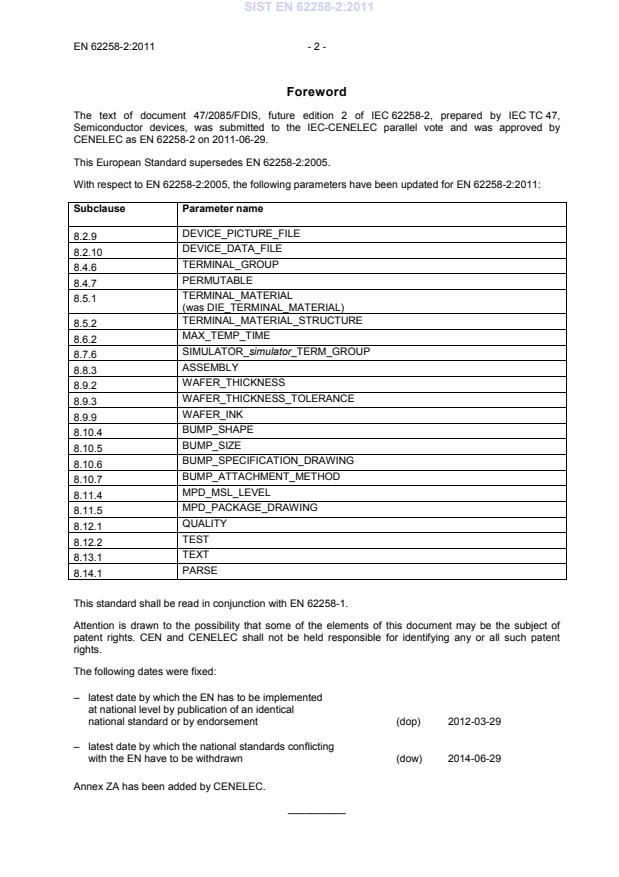
Foreword
The text of document 47/2085/FDIS, future edition 2 of IEC 62258-2, prepared by IEC TC 47,
Semiconductor devices, was submitted to the IEC-CENELEC parallel vote and was approved by
CENELEC as EN 62258-2 on 2011-06-29.
This European Standard supersedes EN 62258-2:2005.
With respect to EN 62258-2:2005, the following parameters have been updated for EN 62258-2:2011:
Subclause Parameter name
DEVICE_PICTURE_FILE
8.2.9
DEVICE_DATA_FILE
8.2.10
TERMINAL_GROUP
8.4.6
PERMUTABLE
8.4.7
TERMINAL_MATERIAL
8.5.1
(was DIE_TERMINAL_MATERIAL)
TERMINAL_MATERIAL_STRUCTURE
8.5.2
MAX_TEMP_TIME
8.6.2
SIMULATOR_simulator_TERM_GROUP
8.7.6
ASSEMBLY
8.8.3
WAFER_THICKNESS
8.9.2
WAFER_THICKNESS_TOLERANCE
8.9.3
WAFER_INK
8.9.9
BUMP_SHAPE
8.10.4
BUMP_SIZE
8.10.5
BUMP_SPECIFICATION_DRAWING
8.10.6
BUMP_ATTACHMENT_METHOD
8.10.7
MPD_MSL_LEVEL
8.11.4
MPD_PACKAGE_DRAWING
8.11.5
QUALITY
8.12.1
TEST
8.12.2
TEXT
8.13.1
PARSE
8.14.1
This standard shall be read in conjunction with EN 62258-1.
Attention is drawn to the possibility that some of the elements of this document may be the subject of
patent rights. CEN and CENELEC shall not be held responsible for identifying any or all such patent
rights.
The following dates were fixed:
– latest date by which the EN has to be implemented
at national level by publication of an identical
national standard or by endorsement (dop) 2012-03-29
– latest date by which the national standards conflicting
with the EN have to be withdrawn (dow) 2014-06-29
Annex ZA has been added by CENELEC.
__________
- 3 - EN 62258-2:2011
Endorsement notice
The text of the International Standard IEC 62258-2:2011 was approved by CENELEC as a European
Standard without any modification.
__________
Annex ZA
(normative)
Normative references to international publications
with their corresponding European publications
The following referenced documents are indispensable for the application of this document. For dated
references, only the edition cited applies. For undated references, the latest edition of the referenced
document (including any amendments) applies.
NOTE When an international publication has been modified by common modifications, indicated by (mod), the relevant EN/HD
applies.
Publication Year Title EN/HD Year
IEC 61360-4 2005 Standard data element types with associated EN 61360-4 2005
classification scheme for electric components - + corr. December 2005
Part 4: IEC reference collection of standard
data element types and component classes
IEC 62258-1 - Semiconductor die products - EN 62258-1 -
Part 1: Procurement and use
ISO 6093 1985 Information processing - Representation of - -
numerical values in character strings for
information interchange
ISO 8601 2004 Data elements and interchange formats - - -
Information interchange - Representation of
dates and times
ISO 10303-21 2002 Industrial automation systems and integration - -
- Product data representation and exchange -
Part 21: Implementation methods: Clear text
encoding of the exchange structure
IPC/JEDEC 2007 Handling, Packing, Shipping and Use of - -
J-STD-033B Moisture/Reflow Sensitive Surface Mount
Devices
IEC 62258-2 ®
Edition 2.0 2011-05
INTERNATIONAL
STANDARD
NORME
INTERNATIONALE
Semiconductor die products –
Part 2: Exchange data formats
Produits de puces de semiconducteurs –
Partie 2: Formats d'échange de données
INTERNATIONAL
ELECTROTECHNICAL
COMMISSION
COMMISSION
ELECTROTECHNIQUE
PRICE CODE
INTERNATIONALE
CODE PRIX XB
ICS 31.080.99 ISBN 978-2-88912-496-1
– 2 – 62258-2 © IEC:2011
CONTENTS
FOREWORD . 5
INTRODUCTION . 7
1 Scope and object . 8
2 Normative references. 8
3 Terms and definitions . 9
4 Requirements . 9
5 Device Data eXchange format (DDX) file goals and usage. 9
6 DDX file format and file format rules . 9
6.1 Data validity . 10
6.2 Character set . 10
6.3 SYNTAX RULES . 10
7 DDX file content. 11
7.1 DDX file content rules . 11
7.1.1 Block structure . 11
7.1.2 Parameter types . 11
7.1.3 Data types . 11
7.1.4 Forward references . 12
7.1.5 Units . 12
7.1.6 Co-ordinate data . 12
7.1.7 Reserved words . 12
7.2 DDX DEVICE block syntax . 13
7.3 DDX data syntax . 14
8 Definitions of DEVICE block parameters . 14
8.1 BLOCK DATA . 15
8.1.1 DEVICE_NAME Parameter . 15
8.1.2 DEVICE_FORM Parameter . 16
8.1.3 BLOCK_VERSION Parameter . 16
8.1.4 BLOCK_CREATION_DATE Parameter . 16
8.1.5 VERSION Parameter . 16
8.2 DEVICE DATA . 16
8.2.1 DIE_NAME Parameter . 16
8.2.2 DIE_PACKAGED_PART_NAME Parameter . 16
8.2.3 DIE_MASK_REVISION Parameter . 17
8.2.4 MANUFACTURER Parameter . 17
8.2.5 DATA_SOURCE Parameter . 17
8.2.6 DATA_VERSION Parameter . 17
8.2.7 FUNCTION Parameter . 17
8.2.8 IC_TECHNOLOGY Parameter . 18
8.2.9 DEVICE_PICTURE_FILE Parameter . 18
8.2.10 DEVICE_DATA_FILE Parameter . 18
8.3 GEOMETRIC DATA . 19
8.3.1 GEOMETRIC_UNITS Parameter . 19
8.3.2 GEOMETRIC_VIEW Parameter . 19
8.3.3 GEOMETRIC_ORIGIN Parameter . 19
8.3.4 SIZE Parameter . 20
8.3.5 SIZE_TOLERANCE Parameter. 20
62258-2 © IEC:2011 – 3 –
8.3.6 THICKNESS Parameter . 21
8.3.7 THICKNESS_TOLERANCE Parameter . 21
8.3.8 FIDUCIAL_TYPE Parameter . 21
8.3.9 FIDUCIAL Parameter . 23
8.4 TERMINAL DATA . 24
8.4.1 TERMINAL_COUNT Parameter . 24
8.4.2 TERMINAL_TYPE_COUNT Parameter . 24
8.4.3 CONNECTION_COUNT Parameter . 24
8.4.4 TERMINAL_TYPE Parameter . 25
8.4.5 TERMINAL Parameter . 26
8.4.6 TERMINAL_GROUP Parameter . 29
8.4.7 PERMUTABLE Parameter . 31
8.5 MATERIAL DATA . 32
8.5.1 TERMINAL_MATERIAL Parameter . 32
8.5.2 TERMINAL_MATERIAL_STRUCTURE Parameter . 32
8.5.3 DIE_SEMICONDUCTOR_MATERIAL Parameter . 32
8.5.4 DIE_SUBSTRATE_MATERIAL Parameter . 33
8.5.5 DIE_SUBSTRATE_CONNECTION Parameter . 33
8.5.6 DIE_PASSIVATION_MATERIAL Parameter . 33
8.5.7 DIE_BACK_DETAIL Parameter . 34
8.6 ELECTRICAL AND THERMAL RATING DATA. 34
8.6.1 MAX_TEMP Parameter . 34
8.6.2 MAX_TEMP_TIME Parameter . 34
8.6.3 POWER_RANGE Parameter . 34
8.6.4 TEMPERATURE_RANGE Parameter . 34
8.7 SIMULATION DATA . 35
8.7.1 Simulator MODEL FILE Parameter . 35
8.7.2 Simulator MODEL FILE DATE Parameter . 35
8.7.3 Simulator NAME Parameter . 35
8.7.4 Simulator VERSION Parameter . 35
8.7.5 Simulator COMPLIANCE Parameter . 36
8.7.6 Simulator TERM_GROUP Parameter . 36
8.8 HANDLING, PACKING, STORAGE and ASSEMBLY DATA . 36
8.8.1 DELIVERY_FORM Parameter . 36
8.8.2 PACKING_CODE Parameter . 36
8.8.3 ASSEMBLY Parameters . 36
8.9 WAFER SPECIFIC DATA . 37
8.9.1 WAFER_SIZE Parameter . 37
8.9.2 WAFER_THICKNESS Parameter . 37
8.9.3 WAFER_THICKNESS_TOLERANCE Parameter . 37
8.9.4 WAFER_DIE_STEP_SIZE Parameter . 38
8.9.5 WAFER_GROSS_DIE_COUNT Parameter . 38
8.9.6 WAFER_INDEX Parameter . 38
8.9.7 WAFER_RETICULE_STEP_SIZE Parameter. 38
8.9.8 WAFER_RETICULE_GROSS_DIE_COUNT Parameter . 39
8.9.9 WAFER_INK Parameters . 39
8.10 BUMP TERMINATION SPECIFIC DATA . 39
8.10.1 BUMP_MATERIAL Parameter . 39
– 4 – 62258-2 © IEC:2011
8.10.2 BUMP_HEIGHT Parameter . 40
8.10.3 BUMP_HEIGHT_TOLERANCE Parameter . 40
8.10.4 BUMP_SHAPE Parameter . 40
8.10.5 BUMP_SIZE Parameter . 40
8.10.6 BUMP_SPECIFICATION_DRAWING Parameter . 41
8.10.7 BUMP_ATTACHMENT_METHOD Parameter . 41
8.11 MINIMALLY PACKAGED DEVICE (MPD) SPECIFIC DATA . 41
8.11.1 MPD_PACKAGE_MATERIAL Parameter . 41
8.11.2 MPD_PACKAGE_STYLE Parameter . 41
8.11.3 MPD_CONNECTION_TYPE Parameter . 42
8.11.4 MPD_MSL_LEVEL Parameter . 42
8.11.5 MPD_PACKAGE_DRAWING Parameter . 42
8.12 QUALITY, RELIABILITY and TEST DATA . 42
8.12.1 QUALITY Parameters . 42
8.12.2 TEST Parameters . 43
8.13 OTHER DATA. 43
8.13.1 TEXT Parameters . 43
8.14 CONTROL DATA . 43
8.14.1 PARSE Parameters . 43
Annex A (informative) An example of a DDX DEVICE block . 47
Annex B (informative) Groups and Permutation . 49
Annex C (informative) A Typical CAD view from the DDX file block example given in
Annex A . 52
Annex D (informative) Properties for Simulation . 53
Annex E (informative) TERMINAL and TERMINAL_TYPE graphical usage for CAD/CAM
systems . 55
Annex F (informative) Cross-reference with IEC 61360-4 . 58
Annex G (informative) Notes on VERSION and NAME parameters . 61
Annex H (informative) Notes on WAFER parameters . 62
Annex I (informative) Additional notes . 64
Annex J (informative) DDX Version history . 65
Annex K (informative) Parse Control . 68
Figure 1 – Relationship between geometric centre and geometric origin . 20
Figure C.1 – CAD representation of DDX example from Annex A . 52
Figure E.1 – Highlighting the MX and MY orientation properties . 56
Figure E.2 – Highlighting the angular rotational orientation properties . 57
Figure H.1 – Illustrating the WAFER parameters . 63
Table 1 – Terminal shape types . 25
Table 2 – Terminal shape co-ordinates . 26
Table 3 – Terminal IO types . 28
Table 4 – Substrate Connection Parameters . 33
Table F.1 – Parameter List . 58
Table J.1 – Parameter Change History List . 65
62258-2 © IEC:2011 – 5 –
INTERNATIONAL ELECTROTECHNICAL COMMISSION
____________
SEMICONDUCTOR DIE PRODUCTS –
Part 2: Exchange data formats
FOREWORD
1) The International Electrotechnical Commission (IEC) is a worldwide organization for standardization comprising
all national electrotechnical committees (IEC National Committees). The object of IEC is to promote
international co-operation on all questions concerning standardization in the electrical and electronic fields. To
this end and in addition to other activities, IEC publishes International Standards, Technical Specifications,
Technical Reports, Publicly Available Specifications (PAS) and Guides (hereafter referred to as “IEC
Publication(s)”). Their preparation is entrusted to technical committees; any IEC National Committee interested
in the subject dealt with may participate in this preparatory work. International, governmental and non-
governmental organizations liaising with the IEC also participate in this preparation. IEC collaborates closely
with the International Organization for Standardization (ISO) in accordance with conditions determined by
agreement between the two organizations.
2) The formal decisions or agreements of IEC on technical matters express, as nearly as possible, an international
consensus of opinion on the relevant subjects since each technical committee has representation from all
interested IEC National Committees.
3) IEC Publications have the form of recommendations for international use and are accepted by IEC National
Committees in that sense. While all reasonable efforts are made to ensure that the technical content of IEC
Publications is accurate, IEC cannot be held responsible for the way in which they are used or for any
misinterpretation by any end user.
4) In order to promote international uniformity, IEC National Committees undertake to apply IEC Publications
transparently to the maximum extent possible in their national and regional publications. Any divergence
between any IEC Publication and the corresponding national or regional publication shall be clearly indicated in
the latter.
5) IEC itself does not provide any attestation of conformity. Independent certification bodies provide conformity
assessment services and, in some areas, access to IEC marks of conformity. IEC is not responsible for any
services carried out by independent certification bodies.
6) All users should ensure that they have the latest edition of this publication.
7) No liability shall attach to IEC or its directors, employees, servants or agents including individual experts and
members of its technical committees and IEC National Committees for any personal injury, property damage or
other damage of any nature whatsoever, whether direct or indirect, or for costs (including legal fees) and
expenses arising out of the publication, use of, or reliance upon, this IEC Publication or any other IEC
Publications.
8) Attention is drawn to the Normative references cited in this publication. Use of the referenced publications is
indispensable for the correct application of this publication.
9) Attention is drawn to the possibility that some of the elements of this IEC Publication may be the subject of
patent rights. IEC shall not be held responsible for identifying any or all such patent rights.
International Standard IEC 62258-2 has been prepared by IEC technical committee 47:
Semiconductor devices.
This standard shall be read in conjunction with IEC 62258-1.
This second edition cancels and replaces the first edition published in 2005, and constitutes a
technical revision.
– 6 – 62258-2 © IEC:2011
With respect to the first edition, the following parameters have been updated for this edition:
Subclause Parameter name
DEVICE_PICTURE_FILE
8.2.9
DEVICE_DATA_FILE
8.2.10
TERMINAL_GROUP
8.4.6
PERMUTABLE
8.4.7
TERMINAL_MATERIAL
8.5.1
(was DIE_TERMINAL_MATERIAL)
TERMINAL_MATERIAL_STRUCTURE
8.5.2
MAX_TEMP_TIME
8.6.2
8.7.6 SIMULATOR_simulator_TERM_GROUP
ASSEMBLY
8.8.3
WAFER_THICKNESS
8.9.2
WAFER_THICKNESS_TOLERANCE
8.9.3
WAFER_INK
8.9.9
BUMP_SHAPE
8.10.4
BUMP_SIZE
8.10.5
BUMP_SPECIFICATION_DRAWING
8.10.6
BUMP_ATTACHMENT_METHOD
8.10.7
MPD_MSL_LEVEL
8.11.4
MPD_PACKAGE_DRAWING
8.11.5
QUALITY
8.12.1
TEST
8.12.2
TEXT
8.13.1
PARSE
8.14.1
The text of this standard is based on the following documents:
FDIS Report on voting
47/2085/FDIS 47/2095/RVD
Full information on the voting for the approval of this standard can be found in the report on
voting indicated in the above table.
This publication has been drafted in accordance with the ISO/IEC Directives, Part 2.
The committee has decided that the contents of this publication will remain unchanged until the
stability date indicated on the IEC web site under "http://webstore.iec.ch" in the data related to
the specific publication. At this date, the publication will be
• reconfirmed,
• withdrawn,
• replaced by a revised edition, or
• amended.
62258-2 © IEC:2011 – 7 –
INTRODUCTION
th
This International Standard is based on the work carried out in the ESPRIT 4 Framework
project GOODDIE which resulted in publication of the ES 59008 series of European
specifications. Organisations that helped prepare this document include the ESPRIT ENCAST
and ENCASIT projects, the Die Products Consortium, JEITA, JEDEC and ZVEI.
The structure of this International Standard as currently conceived is as follows:
Under main title: IEC 62258: Semiconductor die products
Part 1: Procurement and use
Part 2: Exchange data formats
Part 3: Recommendations for good practice in handling, packing and storage
(Technical report)
Part 4: Questionnaire for die users and suppliers (Technical report)
Part 5: Requirements for information concerning electrical simulation
Part 6: Requirements for information concerning thermal simulation
Part 7: XML schema for data exchange (Technical report)
Part 8: EXPRESS model schema for data exchange (Technical report)
Further parts may be added as required.
– 8 – 62258-2 © IEC:2011
SEMICONDUCTOR DIE PRODUCTS –
Part 2: Exchange data formats
1 Scope and object
This Part of IEC 62258 specifies the data formats that may be used for the exchange of data
which is covered by other parts of the IEC 62258 series, as well as definitions of all parameters
used according to the principles and methods of IEC 61360. It introduces a Device Data
Exchange (DDX) format, with the prime goal of facilitating the transfer of adequate geometric
data between die manufacturer and CAD/CAE user and formal information models that allow
data exchange in other formats such as STEP physical file format, in accordance with
ISO 10303-21, and XML. The data format has been kept intentionally flexible to permit usage
beyond this initial scope.
It has been developed to facilitate the production, supply and use of semiconductor die
products, including but not limited to:
• wafers,
• singulated bare die,
• die and wafers with attached connection structures,
• minimally or partially encapsulated die and wafers.
This standard reflects the DDX data format at version 1.3.0
2 Normative references
The following referenced documents are indispensable for the application of this document. For
dated references, only the edition cited applies. For undated references, the latest edition of the
referenced document (including any amendments) applies.
IEC 62258-1, Semiconductor die products – Part 1: Procurement and use
IEC 61360-4:2005, Standard data element types with associated classification scheme for
electric components – Part 4: IEC reference collection of standard data element types,
component classes303-21
ISO 8601:2004, Data elements and interchange formats – Information interchange –
Representation of dates and times
ISO 6093:1985, Information processing – Representation of numerical values in character
strings for information interchange
IPC/JEDEC J-STD-033B:2007, Handling, Packing, Shipping and Use of Moisture/Reflow
Sensitive Surface Mount Devices
ISO 10303-21:2002, Industrial automation systems and integration – Product data
representation and exchange – Part 21: Implementation methods: Clear text encoding of the
exchange structure
62258-2 © IEC:2011 – 9 –
3 Terms and definitions
For the purposes of this document, the terms and definitions given in IEC 62258-1 apply.
4 Requirements
Specific reference for parameter variables is made to the IEC 61360 data element type (DET)
codes, which are defined in Part 4 of IEC 61360.
5 Device Data eXchange format (DDX) file goals and usage
5.1 To facilitate the transferral of data by electronic media from the device vendor to the end-
user for use within a CAD or CAE system, a data file format, Device Data eXchange, (DDX),
shall be used. This data file format has been deliberately kept flexible, to permit further
enhancements and additions for future use.
5.2 It is strongly recommended that Device Data eXchange files have the three letter DDX file
extension, and a Device Data eXchange file shall hereon be referred to as a DDX file.
5.3 Data that are to be transferred from a device vendor to a user shall be contained in a
single computer-readable DDX file, and the minimum contents of this file shall suffice a
geometric CAD/CAE software design system. The file shall be textually readable, to permit
simple manual verification.
5.4 The DDX file and its data contents shall be independent of both computer machine and
operating system.
5.5 The DDX file contents shall include mechanical and interconnectivity information, but may
additionally include electrical and functional data.
5.6 The DDX file may contain data for one or more devices, and shall be capable of being
used as a library file by a CAD/CAE software design system. The file may contain one or more
sets of data for the same device type, each having different delivery forms, such as bumped
die, bare die, and Chip-Scale packaging.
5.7 The DDX file shall be capable of being simply or automatically generated, such as by an
ASCII text editor or a spreadsheet.
5.8 The DDX file shall be capable of referencing additional external files, such as simulation
and thermal model files.
5.9 All data shall be defined in such a way that conversion to or from other exchange formats
is possible, such as GDSII and CIF for geometric data of die. As close compatibility to the
existing DIE (Die Information Exchange) data as possible is desired, to facilitate simple
translation of partial DIE data files.
5.10 Definitions of parameters shall be in conformity with IEC 61360 (refer to Clause 5 of
IEC 62258-1).
6 DDX file format and file format rules
NOTE 1 Version 1.2.1 of DDX supersedes version 1.0.0 contained in ES 59008-6-1.
NOTE 2 Version 1.3.0 of DDX supersedes version 1.2.1 contained in IEC 62258-2:2005.
– 10 – 62258-2 © IEC:2011
Refer to Clause 1 for the DDX version of this standard.
6.1 Data validity
6.1.1 All data not complying with the data syntax (refer to 7.3) shall be treated as a remark
and, as such, ignored.
6.1.2 All mandatory data shall be present. Missing data shall be flagged as an error,
rendering that data unusable.
6.1.3 Mathematical operations, calculations or formulae shall not be permitted within numeric
data.
6.2 Character set
6.2.1 The DDX file shall be an ASCII compatible text file with suitable line termination. Line
termination will depend upon the operating system. DOS/Windows generally uses a
carriage/line-feed terminator (ASCII 0Dh/0Ah), whereas UNIX invariably relies solely
upon a line-feed (ASCII 0x0A) terminator, the carriage return (ASCII 0x0D) being
present by implication.
6.2.2 ASCII characters 0x00 to 0x7F are permitted, ASCII characters 0x80 to 0xFF shall be
ignored.
6.2.3 All text data shall be case independent.
6.2.4 Space characters (ASCII 20h) and tab characters (ASCII 09h) shall both be treated as
space separators, multiple space and tab characters will syntactically be treated as a single
space separator.
6.3 SYNTAX RULES
6.3.1 All data lines shall be terminated with a semicolon: “;”.
6.3.2 A comma “,” shall be used as a data separator.
6.3.3 Lines beginning with a hash “#” shall be treated as an intentional comment. All data on
that line shall be ignored.
6.3.4 Underscores “_” shall be ignored in a variable or property name, and may be used as
intermediate name separators. Underscores are valid within textual string and name data.
6.3.5 Braces are used to open and close structures or BLOCKs. An open brace “{“ shall be
used to begin a structure or block, and a close brace “}” shall be used to terminate a structure
or block.
6.3.6 Brackets “()” shall be permitted, then ignored, in numeric data for clarity (e.g. in co-
ordinate pairs).
6.3.7 To accommodate typical spreadsheet CSV (Comma Separated Variable) format outputs,
textual data may be inside double quotes “”, and matching pairs of double quotes shall be
ignored.
6.3.8 There is no specific line continuation character. A textual string opened with a double
quote ‘”’ shall close with a matching double quote ‘”’, irrespective of the number of line breaks
within that text. As all DDX commands terminate with a semicolon, the non-textual data will be
62258-2 © IEC:2011 – 11 –
deemed to have ended at that semicolon. Textual data will be deemed to have ended at the
semicolon following the closing double quote. Textual data not enclosed within double quotes
may not include line break or control characters, and shall terminate at the first occurrence of a
semicolon. Textual data following this semicolon will be treated as erroneous data and
discarded.
6.3.9 For practicality, readability and ease of line parsing, is it recommended that the line
length (between line termination characters) does not exceed 255 characters. It is further
strongly recommended that a maximum limit of 1 023 characters per line be imposed to
prevent other parsing software from having an input buffer overrun error.
7 DDX file content
7.1 DDX file content rules
7.1.1 Block structure
Data shall only exist within a block structure, referred to as a DEVICE block, and one or more
DEVICE blocks, each containing data, may exist within a single file. Each DEVICE block is
unique, and shall only contain data relevant to a single device, having a specific device form.
All data within each DEVICE block shall be treated as being local and unique only to that block.
(Refer to 6.3.4)
7.1.2 Parameter types
There are two types of parameters use for data, structures and variables, and these
parameters shall only exist with a DEVICE block:
• a structure determines a set or multiple sets of data having different data types.
• a variable is equated to a single or multiple data of a single data type.
7.1.3 Data types
Data types are as follows.
7.1.3.1 Textual string data
All ASCII characters from ASCII 20h to ASCII 7Fh are permitted within textual data, characters
including and above ASCII 80h shall be ignored. Consideration may be given to special print
and display control characters to permit the printing of underscore or overscore characters. It is
advised that textual string data is placed within pairs of double quotes, refer to 6.3.7.
7.1.3.2 Textual name data
All names shall be unique, and shall only consist of the following characters from the ASCII
character set: -
A-Z a-z 0-9 $ - % & ! @ _ .
When textual name data are used to form a file name, it is advisable for the name to be limited
to eight characters for the file name and to three characters for the file extension, with a point
“.” used as the name/extension delimiter, in line with many common operating systems. It is
advisable for textual name data to be placed within pairs of double quotes (refer to 6.3.7).
Note that all textual name data is case independent, and spaces are not permitted within a
textual name.
– 12 – 62258-2 © IEC:2011
7.1.3.3 Real numeric data
Real numeric data shall comply with ISO 6093:1985, and shall consist of the characters: -
0-9 + - . E e
The data values may be signed, and use engineering or scientific notation, but shall not include
dimensional units, e.g.
90008, 9000.80, 9.0008E5, -5207, -5.207E3, 0.102, 102E-3
Note that a comma “,” is used as a data separator, and therefore shall not be used as a
replacement for a decimal point “.”.
7.1.3.4 Integer numeric data
Integer numeric data values shall comply to ISO 6093:1985, and only the characters 0 to 9 are
permitted. Integers shall be unsigned, and shall not include dimensional units.
For practical purposes, an integer shall be limited to 16-bit resolution, i.e. integer values
between and including 0 to 65536 only are acceptable.
7.1.3.5 Date data
Date data values shall comply with ISO 8601:2004 format, and may include time information
as well, e.g.
“YYYY-MM-DD”, “YYYYMMDD”, “YYYY-MM-DDTHH:MM:SS”.
7.1.4 Forward references
To permit single-pass parsing, no variable identifier or variable name shall be referenced prior
to being defined.
7.1.5 Units
–6
All units shall belong to the SI system, apart from the geometric unit of the micron (10 m), the
–3
inch and the mil (10 inch). Only one unit of dimension shall be permitted within a single
DEVICE block. Note that the inch and the mil are non-preferred units, and are only present due
to continued common usage.
7.1.6 Co-ordinate data
In all co-ordinate data, the X co-ordinate shall precede the Y co-ordinate and the Y co-ordinate
shall precede the Z co-ordinate (i.e. X,Y or X,Y,Z).
The X co-ordinate shall be the horizontal axis (numerically left to right), the Y co-ordinate shall
be the vertical axis (numerically bottom to top), and the Z co-ordinate shall be depth axis
(numerically near to far).
7.1.7 Reserved words
All parameter names shall be considered as reserved and no variable identifier or variable
name shall be permitted to have the same name. This restriction does not apply to free form
textual data within quotes or double quotes (as 7.1.3.1 and 7.1.3.2).
62258-2 © IEC:2011 – 13 –
7.2 DDX DEVICE block syntax
DEVICE device_name device_form {
relevant die data ……
}
The DDX file may contain one or more DEVICE blocks, all data pertaining to a particular device
shall be embedded within the relevant block. (Refer to clause 6.1.1 and clause 7.1.1).
A DEVICE block is opened by the DEVICE keyword and opening brace “{“, (as shown), and the
DEVICE block is closed by the matching closing brace “}”.
Data not within a DEVICE block structure shall be treated as a remark, permitting the future
addition of checksum information, file creation date and historical data etc., within the DDX file,
without affecting the actual device data.
The device_name is the given name by which the device shall be referred, and the
device_form is the mechanical form of the device to which the block data pertains.
Valid data for the device_form variable are:
• bare_die,
• bumped_die,
• lead_frame_die
• minimally_packaged_device (or MPD).
Further device_form types may be added at a later stage, refer to IEC 61360-4:2005, AAD004-
001, “die type code”, for further details.
Only one DEVICE block having device_name of type device_form shall be present within the
DDX file, but duplication of either device_name or device_form is permissible.
An example of a typical DDX file arrangement of DEVICE blocks:-
DEVICE name1 bare_die {
relevant data for device “name1” as a bare die.
}
DEVICE name1 bumped_die {
relevant data for device “name1”as a bumped die.
}
DEVICE name2 mpd {
relevant data for device “name2” as a minimally packaged device.
}
DEVICE name2 bare_die {
relevant data for device “name2” as a bare die.
}
DEVICE name1 mpd {
relevant data for device “name1” as a minimally packaged device.
}
DEVICE name3 bare_die {
relevant data for device “name3” as a bare die.
}
In the above example, there are three occurrences of a DEVICE block for device “name1”, and
two occurrences of a DEVICE block for device “name2”, but each of these DEVICE blocks
specify a different device_form. The order or sequencing of the DEVICE blocks has no
relevance.
– 14 – 62258-2 © IEC:2011
7.3 DDX data syntax
Property = value [, value];
[equate separator] }>[data terminator][line terminator]
::= Parameter name
[space] ::= {space character (20h) or tab character (09h)}0+
[equate separator] ::= [space]{equal =}[space]
[separator] ::= [space]{comma ,}[space]
[data terminator] ::= [space]{semicolon;}
[line terminator] ::= {CR or CR/LF}
For example:
thickness = 100.0 ;
Thickness=470;
geometric_units=micron;
geometricunits = micron;
GeometricUnits= “millimetres”;
terminal_type = T1, Circle, 220;
Terminal_Type = T2, Rectangle, 200 , 250;
TerminalType = T2, O, (200, 250);
TERMINALTYPE = T2, O, 200 , 250;
Thus, terminal_type, Terminal_Type, TerminalType and TERMINALTYPE will all reference
the same parameter name.
8 Definitions of DEVICE block parameters
8.0 General usage notes
8.0.1 Device form notes
Where a parameter is unique to the device_form, as defined in the DEVICE block, the
parameter will be preceded with the following …
8.0.1.1 DIE_ data parameter is unique to bare die or bumped die form
8.0.1.2 BUMP_ data parameter is unique to only bumped die
8.0.1.3 MPD_ data parameter is unique to a minimally packaged device, such as a
CSP
8.0.1.4 WAFER_ data parameter is unique to a die device delivered at wafer level
8.0.1.5 LEAD_ data parameter is unique to a die device with attached lead frame.
8.0.2 Data Parameter Items
Within the follow
...