


SIST EN 303 489 V1.1.1:2026
(Main)Air Traffic Control Surveillance - Wide Area Multilateration (WAM) systems operating at 1 030 MHz and 1 090 MHz - Harmonised Standard for access to radio spectrum
Air Traffic Control Surveillance - Wide Area Multilateration (WAM) systems operating at 1 030 MHz and 1 090 MHz - Harmonised Standard for access to radio spectrum
The present document specifies technical characteristics and methods of measurements for the following equipment used in ground-based ATC Surveillance for civil air navigation:
• Wide Area Multilateration (WAM) systems with Mode S capabilities which may include Mode A/C, transmitting at 1 030 MHz and at 1 090 MHz, and receiving at 1 090 MHz, used for air traffic control with or without 1 090 MHz phase overlay.
Antennas for this equipment are passive.
Remote Field Monitors (RFM) as described in ETSI EN 303 363-2 [i.6] as well as Vehicle transmitters as described in ETSI EN 303 213-5-2 [i.7] are not covered in the present document.
NOTE: The relationship between the present document and essential requirements of article 3.2 of Directive 2014/53/EU [i.1] is given in Annex A.
Nadzor zračnega prometa - Sistemi za širokopasovno multilateracijo (WAM), ki delujejo v območju 1030 MHz in 1090 MHz - Harmonizirani standard za dostop do radijskega spektra
Ta dokument določa tehnične lastnosti in merilne metode za opremo, navedeno v nadaljevanju, ki se uporablja pri talnem nadzoru zračnega prometa (ATC) za civilno zračno navigacijo: • sistemi za širokopasovno multilateracijo (WAM) z zmožnostmi načina S, ki lahko vključuje način A/C, z oddajanjem v območju 1030 MHz in 1090 MHz ter sprejemanjem v območju 1090 MHz, in se uporablja za nadzor zračnega prometa s skupno fazo 1090 MHz ali brez nje. Antene za to opremo so pasivne. Antenski nadzorni sistemi (RFM), opisani v standardu ETSI EN 303 363-2 [i.6], in oddajniki v vozilih, opisani v standardu ETSI EN 303 213-5-2 [i.7], niso zajeti v tem dokumentu. OPOMBA: Razmerje med tem dokumentom in bistvenimi zahtevami člena 3.2 Direktive 2014/53/EU [i.1] je podano v dodatku A.
General Information
- Status
- Published
- Public Enquiry End Date
- 31-Jul-2025
- Publication Date
- 08-Feb-2026
- Technical Committee
- MOC - Mobile Communications
- Current Stage
- 6060 - National Implementation/Publication (Adopted Project)
- Start Date
- 26-Jan-2026
- Due Date
- 02-Apr-2026
- Completion Date
- 09-Feb-2026
Buy Documents
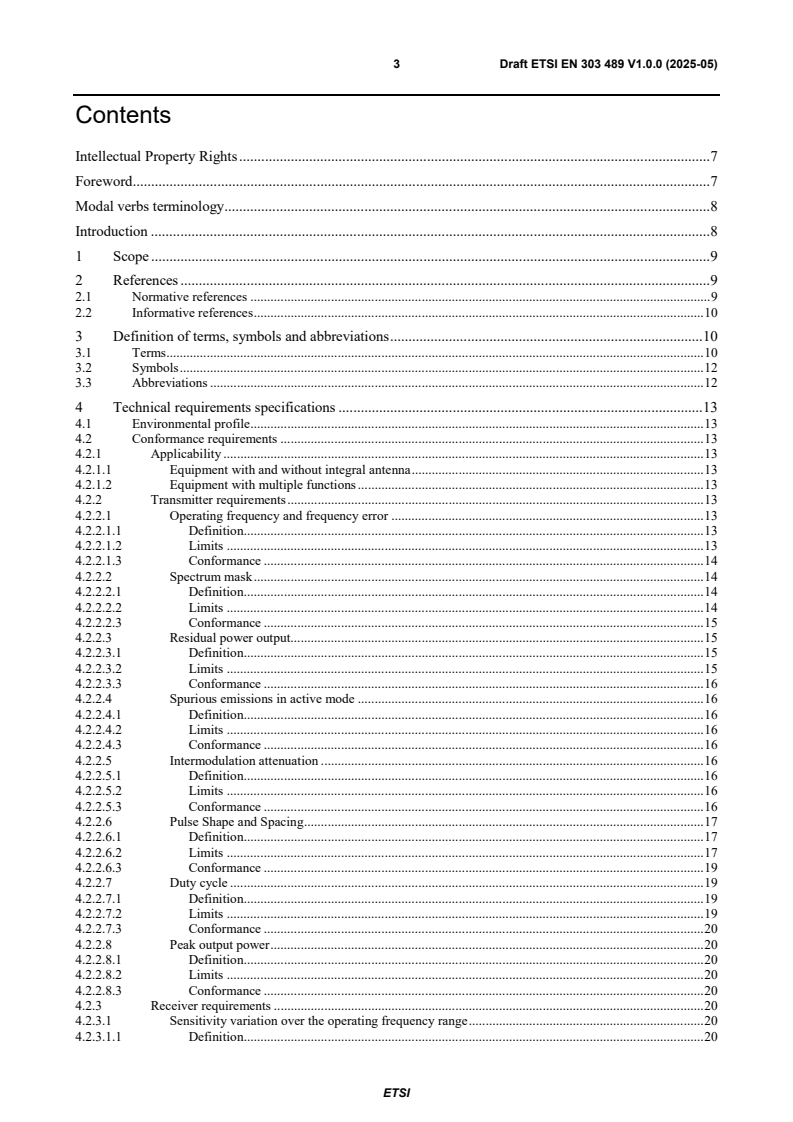
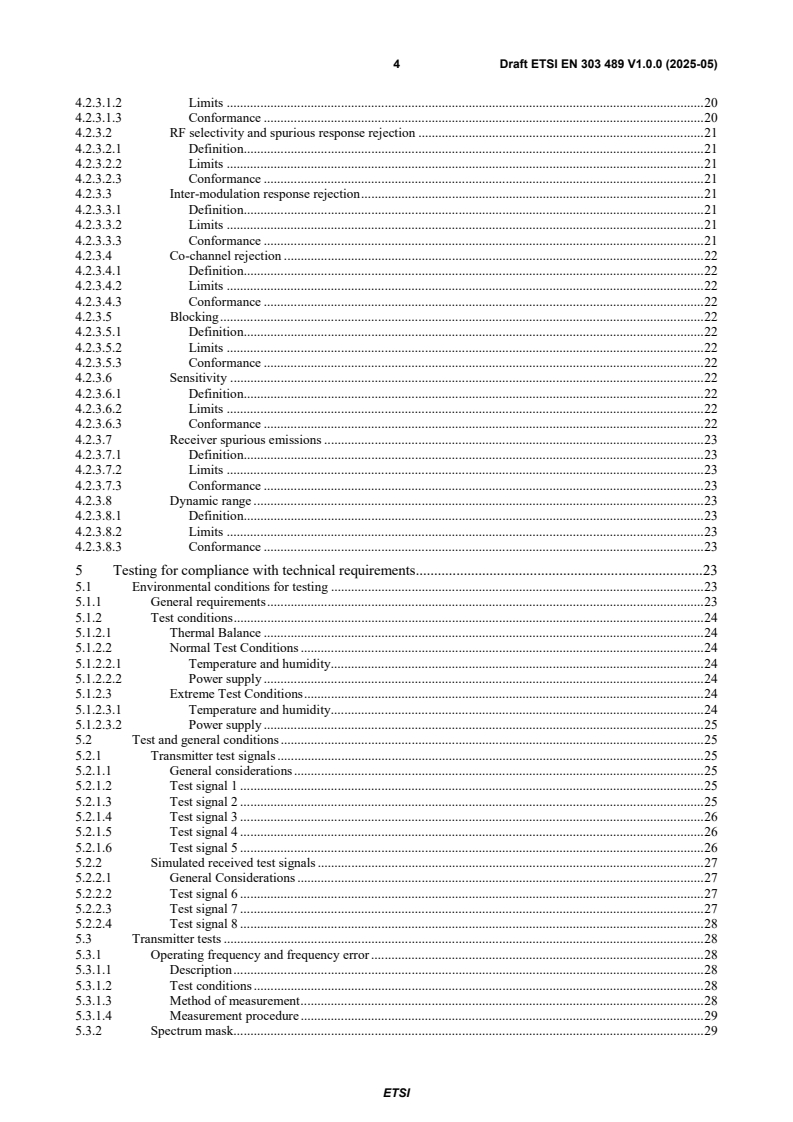
ETSI EN 303 489 V1.0.0 (2025-05) - Air Traffic Control Surveillance; Wide Area Multilateration (WAM) systems operating at 1 030 MHz and 1 090 MHz; Harmonised Standard for access to radio spectrum
ETSI EN 303 489 V1.1.0 (2025-11) - Air Traffic Control Surveillance; Wide Area Multilateration (WAM) systems operating at 1 030 MHz and 1 090 MHz; Harmonised Standard for access to radio spectrum
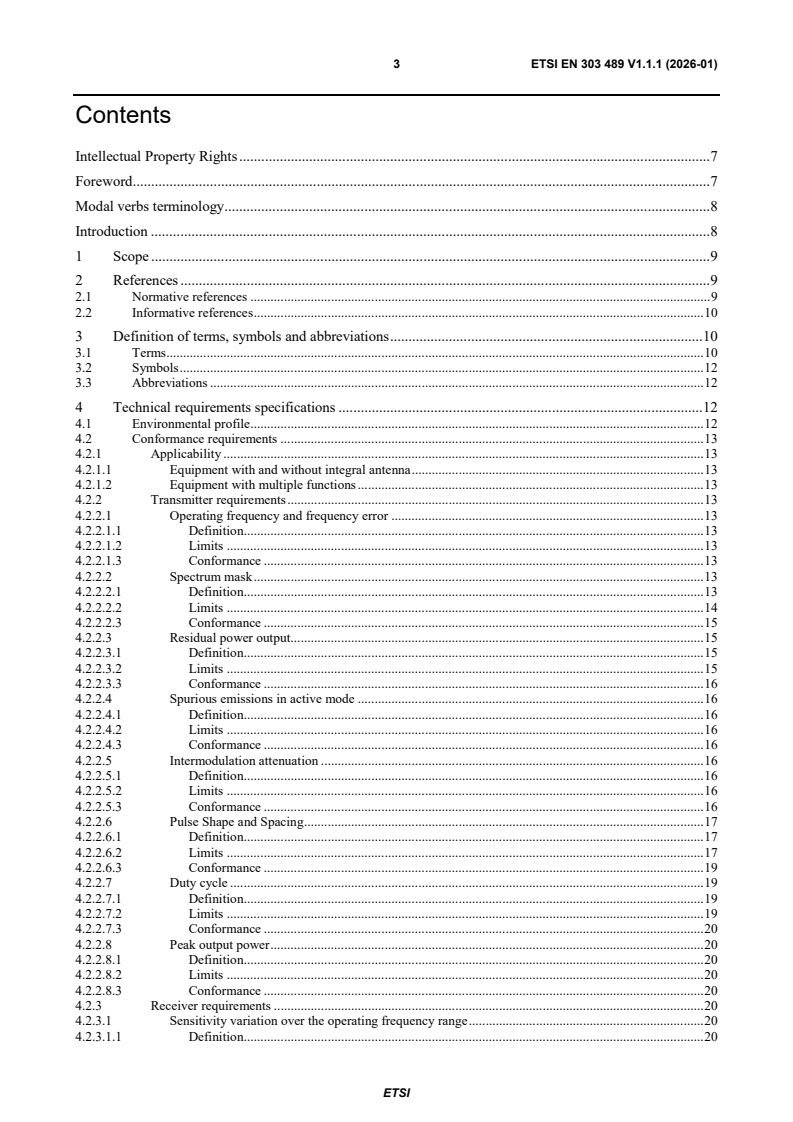
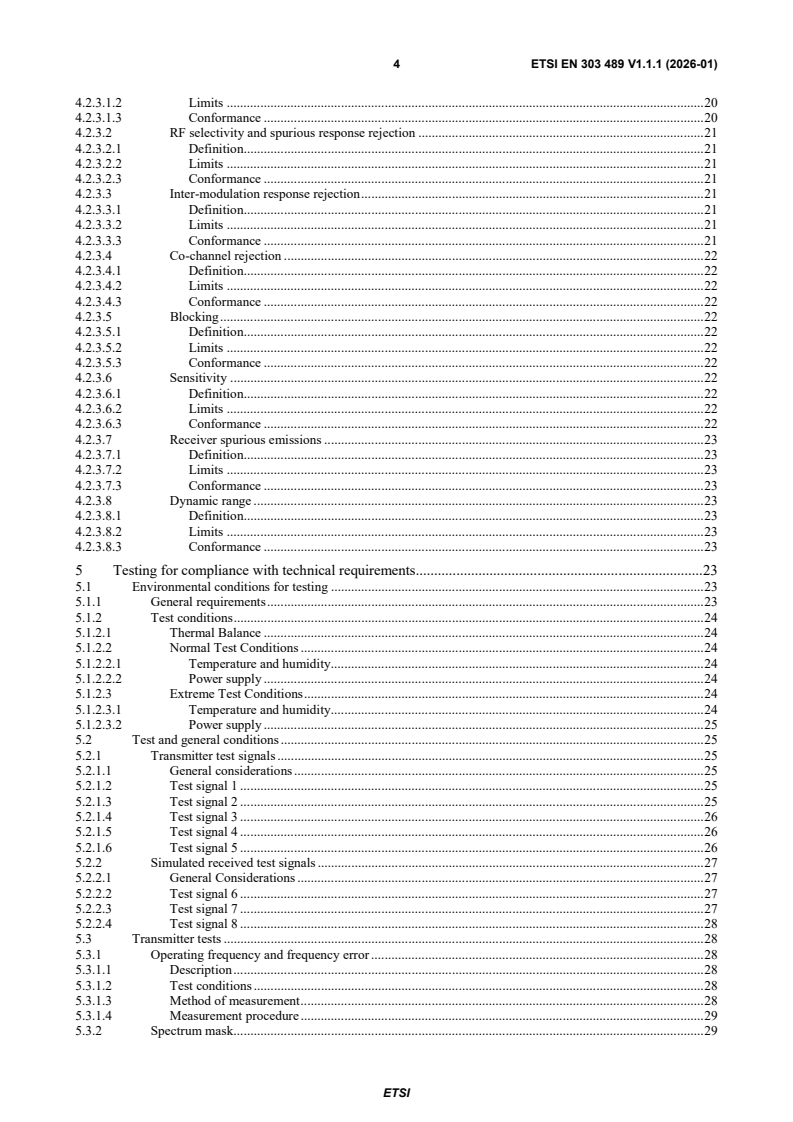
ETSI EN 303 489 V1.1.1 (2026-01) - Air Traffic Control Surveillance; Wide Area Multilateration (WAM) systems operating at 1 030 MHz and 1 090 MHz; Harmonised Standard for access to radio spectrum

Get Certified
Connect with accredited certification bodies for this standard

TL 9000 QuEST Forum
Telecommunications quality management system.

ANCE
Mexican certification and testing association.
Great Wall Tianjin Quality Assurance Center
Established 1993, first batch to receive national accreditation with IAF recognition.
Sponsored listings
Frequently Asked Questions
SIST EN 303 489 V1.1.1:2026 is a standard published by the Slovenian Institute for Standardization (SIST). Its full title is "Air Traffic Control Surveillance - Wide Area Multilateration (WAM) systems operating at 1 030 MHz and 1 090 MHz - Harmonised Standard for access to radio spectrum". This standard covers: The present document specifies technical characteristics and methods of measurements for the following equipment used in ground-based ATC Surveillance for civil air navigation: • Wide Area Multilateration (WAM) systems with Mode S capabilities which may include Mode A/C, transmitting at 1 030 MHz and at 1 090 MHz, and receiving at 1 090 MHz, used for air traffic control with or without 1 090 MHz phase overlay. Antennas for this equipment are passive. Remote Field Monitors (RFM) as described in ETSI EN 303 363-2 [i.6] as well as Vehicle transmitters as described in ETSI EN 303 213-5-2 [i.7] are not covered in the present document. NOTE: The relationship between the present document and essential requirements of article 3.2 of Directive 2014/53/EU [i.1] is given in Annex A.
The present document specifies technical characteristics and methods of measurements for the following equipment used in ground-based ATC Surveillance for civil air navigation: • Wide Area Multilateration (WAM) systems with Mode S capabilities which may include Mode A/C, transmitting at 1 030 MHz and at 1 090 MHz, and receiving at 1 090 MHz, used for air traffic control with or without 1 090 MHz phase overlay. Antennas for this equipment are passive. Remote Field Monitors (RFM) as described in ETSI EN 303 363-2 [i.6] as well as Vehicle transmitters as described in ETSI EN 303 213-5-2 [i.7] are not covered in the present document. NOTE: The relationship between the present document and essential requirements of article 3.2 of Directive 2014/53/EU [i.1] is given in Annex A.
SIST EN 303 489 V1.1.1:2026 is classified under the following ICS (International Classification for Standards) categories: 03.220.50 - Air transport; 33.060.99 - Other equipment for radiocommunications. The ICS classification helps identify the subject area and facilitates finding related standards.
SIST EN 303 489 V1.1.1:2026 is available in PDF format for immediate download after purchase. The document can be added to your cart and obtained through the secure checkout process. Digital delivery ensures instant access to the complete standard document.
Standards Content (Sample)
Draft ETSI EN 303 489 V1.0.0 (2025-05)
HARMONISED EUROPEAN STANDARD
Air Traffic Control Surveillance;
Wide Area Multilateration (WAM) systems operating
at 1 030 MHz and 1 090 MHz;
Harmonised Standard for access to radio spectrum
2 Draft ETSI EN 303 489 V1.0.0 (2025-05)
Reference
DEN/ERM-TGAERO-36
Keywords
aeronautical, harmonised standard, radio
ETSI
650 Route des Lucioles
F-06921 Sophia Antipolis Cedex - FRANCE
Tel.: +33 4 92 94 42 00 Fax: +33 4 93 65 47 16
Siret N° 348 623 562 00017 - APE 7112B
Association à but non lucratif enregistrée à la
Sous-Préfecture de Grasse (06) N° w061004871
Important notice
The present document can be downloaded from the
ETSI Search & Browse Standards application.
The present document may be made available in electronic versions and/or in print. The content of any electronic and/or
print versions of the present document shall not be modified without the prior written authorization of ETSI. In case of any
existing or perceived difference in contents between such versions and/or in print, the prevailing version of an ETSI
deliverable is the one made publicly available in PDF format on ETSI deliver repository.
Users should be aware that the present document may be revised or have its status changed,
this information is available in the Milestones listing.
If you find errors in the present document, please send your comments to
the relevant service listed under Committee Support Staff.
If you find a security vulnerability in the present document, please report it through our
Coordinated Vulnerability Disclosure (CVD) program.
Notice of disclaimer & limitation of liability
The information provided in the present deliverable is directed solely to professionals who have the appropriate degree of
experience to understand and interpret its content in accordance with generally accepted engineering or
other professional standard and applicable regulations.
No recommendation as to products and services or vendors is made or should be implied.
In no event shall ETSI be held liable for loss of profits or any other incidental or consequential damages.
Any software contained in this deliverable is provided "AS IS" with no warranties, express or implied, including but not
limited to, the warranties of merchantability, fitness for a particular purpose and non-infringement of intellectual property
rights and ETSI shall not be held liable in any event for any damages whatsoever (including, without limitation, damages
for loss of profits, business interruption, loss of information, or any other pecuniary loss) arising out of or related to the use
of or inability to use the software.
Copyright Notification
No part may be reproduced or utilized in any form or by any means, electronic or mechanical, including photocopying and
microfilm except as authorized by written permission of ETSI.
The content of the PDF version shall not be modified without the written authorization of ETSI.
The copyright and the foregoing restriction extend to reproduction in all media.
© ETSI 2025.
All rights reserved.
ETSI
3 Draft ETSI EN 303 489 V1.0.0 (2025-05)
Contents
Intellectual Property Rights . 7
Foreword . 7
Modal verbs terminology . 8
Introduction . 8
1 Scope . 9
2 References . 9
2.1 Normative references . 9
2.2 Informative references . 10
3 Definition of terms, symbols and abbreviations . 10
3.1 Terms . 10
3.2 Symbols . 12
3.3 Abbreviations . 12
4 Technical requirements specifications . 13
4.1 Environmental profile . 13
4.2 Conformance requirements . 13
4.2.1 Applicability . 13
4.2.1.1 Equipment with and without integral antenna . 13
4.2.1.2 Equipment with multiple functions . 13
4.2.2 Transmitter requirements . 13
4.2.2.1 Operating frequency and frequency error . 13
4.2.2.1.1 Definition. 13
4.2.2.1.2 Limits . 13
4.2.2.1.3 Conformance . 14
4.2.2.2 Spectrum mask . 14
4.2.2.2.1 Definition. 14
4.2.2.2.2 Limits . 14
4.2.2.2.3 Conformance . 15
4.2.2.3 Residual power output. 15
4.2.2.3.1 Definition. 15
4.2.2.3.2 Limits . 15
4.2.2.3.3 Conformance . 16
4.2.2.4 Spurious emissions in active mode . 16
4.2.2.4.1 Definition. 16
4.2.2.4.2 Limits . 16
4.2.2.4.3 Conformance . 16
4.2.2.5 Intermodulation attenuation . 16
4.2.2.5.1 Definition. 16
4.2.2.5.2 Limits . 16
4.2.2.5.3 Conformance . 16
4.2.2.6 Pulse Shape and Spacing . 17
4.2.2.6.1 Definition. 17
4.2.2.6.2 Limits . 17
4.2.2.6.3 Conformance . 19
4.2.2.7 Duty cycle . 19
4.2.2.7.1 Definition. 19
4.2.2.7.2 Limits . 19
4.2.2.7.3 Conformance . 20
4.2.2.8 Peak output power . 20
4.2.2.8.1 Definition. 20
4.2.2.8.2 Limits . 20
4.2.2.8.3 Conformance . 20
4.2.3 Receiver requirements . 20
4.2.3.1 Sensitivity variation over the operating frequency range . 20
4.2.3.1.1 Definition. 20
ETSI
4 Draft ETSI EN 303 489 V1.0.0 (2025-05)
4.2.3.1.2 Limits . 20
4.2.3.1.3 Conformance . 20
4.2.3.2 RF selectivity and spurious response rejection . 21
4.2.3.2.1 Definition. 21
4.2.3.2.2 Limits . 21
4.2.3.2.3 Conformance . 21
4.2.3.3 Inter-modulation response rejection . 21
4.2.3.3.1 Definition. 21
4.2.3.3.2 Limits . 21
4.2.3.3.3 Conformance . 21
4.2.3.4 Co-channel rejection . 22
4.2.3.4.1 Definition. 22
4.2.3.4.2 Limits . 22
4.2.3.4.3 Conformance . 22
4.2.3.5 Blocking . 22
4.2.3.5.1 Definition. 22
4.2.3.5.2 Limits . 22
4.2.3.5.3 Conformance . 22
4.2.3.6 Sensitivity . 22
4.2.3.6.1 Definition. 22
4.2.3.6.2 Limits . 22
4.2.3.6.3 Conformance . 22
4.2.3.7 Receiver spurious emissions . 23
4.2.3.7.1 Definition. 23
4.2.3.7.2 Limits . 23
4.2.3.7.3 Conformance . 23
4.2.3.8 Dynamic range . 23
4.2.3.8.1 Definition. 23
4.2.3.8.2 Limits . 23
4.2.3.8.3 Conformance . 23
5 Testing for compliance with technical requirements . 23
5.1 Environmental conditions for testing . 23
5.1.1 General requirements . 23
5.1.2 Test conditions . 24
5.1.2.1 Thermal Balance . 24
5.1.2.2 Normal Test Conditions . 24
5.1.2.2.1 Temperature and humidity. 24
5.1.2.2.2 Power supply . 24
5.1.2.3 Extreme Test Conditions . 24
5.1.2.3.1 Temperature and humidity. 24
5.1.2.3.2 Power supply . 25
5.2 Test and general conditions . 25
5.2.1 Transmitter test signals . 25
5.2.1.1 General considerations . 25
5.2.1.2 Test signal 1 . 25
5.2.1.3 Test signal 2 . 25
5.2.1.4 Test signal 3 . 26
5.2.1.5 Test signal 4 . 26
5.2.1.6 Test signal 5 . 26
5.2.2 Simulated received test signals . 27
5.2.2.1 General Considerations . 27
5.2.2.2 Test signal 6 . 27
5.2.2.3 Test signal 7 . 27
5.2.2.4 Test signal 8 . 28
5.3 Transmitter tests . 28
5.3.1 Operating frequency and frequency error . 28
5.3.1.1 Description . 28
5.3.1.2 Test conditions . 28
5.3.1.3 Method of measurement . 28
5.3.1.4 Measurement procedure . 29
5.3.2 Spectrum mask . 29
ETSI
5 Draft ETSI EN 303 489 V1.0.0 (2025-05)
5.3.2.1 Description . 29
5.3.2.2 Test conditions . 29
5.3.2.3 Method of measurement . 29
5.3.2.4 Measurement procedure . 30
5.3.3 Residual power output . 30
5.3.3.1 Description . 30
5.3.3.2 Test conditions . 30
5.3.3.3 Method of measurement . 30
5.3.3.4 Measurement procedure . 31
5.3.4 Spurious emissions in active mode . 31
5.3.4.1 Description . 31
5.3.4.2 Test conditions . 31
5.3.4.3 Method of measurement . 31
5.3.4.4 Measurement Procedure . 31
5.3.4.4.1 Part 1: Measurement of PEP and determination of spurious emission limit . 31
5.3.4.4.2 Part 2: Spurious emission measurement procedure . 32
5.3.5 Intermodulation attenuation . 33
5.3.5.1 Description . 33
5.3.5.2 Test Conditions . 33
5.3.5.3 Method of Measurement . 33
5.3.5.4 Measurement Procedure . 34
5.3.6 Pulse Shape and Spacing . 35
5.3.6.1 Description . 35
5.3.6.2 Test Conditions . 35
5.3.6.3 Method of Measurement . 35
5.3.6.4 Measurement procedure . 36
5.3.7 Duty cycle . 36
5.3.7.1 Description . 36
5.3.7.2 Test Conditions . 36
5.3.7.3 Method of Measurement . 37
5.3.7.4 Measurement procedure . 37
5.3.8 Peak output power . 37
5.3.8.1 Description . 37
5.3.8.2 Test Conditions . 37
5.3.8.3 Method of Measurement . 37
5.3.8.4 Measurement procedure . 38
5.4 Receiver tests . 38
5.4.1 Sensitivity and sensitivity variation over the operating frequency range. 38
5.4.1.1 Description . 38
5.4.1.2 Test Conditions . 38
5.4.1.3 Method of Measurement . 38
5.4.1.4 Measurement procedure . 38
5.4.2 RF selectivity and spurious response rejection . 39
5.4.2.1 Description . 39
5.4.2.2 Test Conditions . 39
5.4.2.3 Method of Measurement . 39
5.4.2.4 Measurement procedure . 39
5.4.3 Inter-modulation response rejection . 40
5.4.3.1 Description . 40
5.4.3.2 Test Conditions . 40
5.4.3.3 Method of Measurement . 40
5.4.3.4 Measurement procedure . 41
5.4.4 Co-channel rejection . 42
5.4.4.1 Description . 42
5.4.4.2 Test Conditions . 42
5.4.4.3 Method of Measurement . 42
5.4.4.4 Measurement procedure . 42
5.4.5 Blocking . 43
5.4.5.1 Description . 43
5.4.5.2 Test Conditions . 43
5.4.5.3 Method of Measurement . 43
5.4.5.4 Measurement procedure . 43
ETSI
6 Draft ETSI EN 303 489 V1.0.0 (2025-05)
5.4.6 Receiver spurious emissions . 44
5.4.6.1 Description . 44
5.4.6.2 Test Conditions . 44
5.4.6.3 Method of Measurement . 44
5.4.6.4 Measurement procedure . 44
5.4.7 Dynamic range . 44
5.4.7.1 Description . 44
5.4.7.2 Test Conditions . 44
5.4.7.3 Method of Measurement . 45
5.4.7.4 Measurement procedure . 45
Annex A (informative): Relationship between the present document and the essential
requirements of Directive 2014/53/EU . 46
Annex B (informative): Checklist . 48
Annex C (informative): Maximum measurement uncertainty . 49
History . 50
ETSI
7 Draft ETSI EN 303 489 V1.0.0 (2025-05)
Intellectual Property Rights
Essential patents
IPRs essential or potentially essential to normative deliverables may have been declared to ETSI. The declarations
pertaining to these essential IPRs, if any, are publicly available for ETSI members and non-members, and can be
found in ETSI SR 000 314: "Intellectual Property Rights (IPRs); Essential, or potentially Essential, IPRs notified to
ETSI in respect of ETSI standards", which is available from the ETSI Secretariat. Latest updates are available on the
ETSI IPR online database.
Pursuant to the ETSI Directives including the ETSI IPR Policy, no investigation regarding the essentiality of IPRs,
including IPR searches, has been carried out by ETSI. No guarantee can be given as to the existence of other IPRs not
referenced in ETSI SR 000 314 (or the updates on the ETSI Web server) which are, or may be, or may become,
essential to the present document.
Trademarks
The present document may include trademarks and/or tradenames which are asserted and/or registered by their owners.
ETSI claims no ownership of these except for any which are indicated as being the property of ETSI, and conveys no
right to use or reproduce any trademark and/or tradename. Mention of those trademarks in the present document does
not constitute an endorsement by ETSI of products, services or organizations associated with those trademarks.
DECT™, PLUGTESTS™, UMTS™ and the ETSI logo are trademarks of ETSI registered for the benefit of its
Members. 3GPP™, LTE™ and 5G™ logo are trademarks of ETSI registered for the benefit of its Members and of the
3GPP Organizational Partners. oneM2M™ logo is a trademark of ETSI registered for the benefit of its Members and of ®
the oneM2M Partners. GSM and the GSM logo are trademarks registered and owned by the GSM Association.
Foreword
This draft Harmonised European Standard (EN) has been produced by ETSI Technical Committee Electromagnetic
compatibility and Radio spectrum Matters (ERM), and is now submitted for the combined Public Enquiry and Vote
phase of the ETSI Standardisation Request deliverable Approval Procedure (SRdAP).
The present document has been prepared under the Commission's standardisation request C(2015) 5376 final [i.2] to
provide one voluntary means of conforming to the essential requirements of Directive 2014/53/EU on the harmonisation
of the laws of the Member States relating to the making available on the market of radio equipment and repealing
Directive 1999/5/EC [i.1].
Once the present document is cited in the Official Journal of the European Union under that Directive, compliance with
the normative clauses of the present document given in Table A.1 confers, within the limits of the scope of the present
document, a presumption of conformity with the corresponding essential requirements of that Directive, and associated
EFTA regulations.
Proposed national transposition dates
Date of latest announcement of this EN (doa): 3 months after ETSI publication
Date of latest publication of new National Standard
or endorsement of this EN (dop/e): 6 months after doa
Date of withdrawal of any conflicting National Standard (dow): 18 months after doa
ETSI
8 Draft ETSI EN 303 489 V1.0.0 (2025-05)
Modal verbs terminology
In the present document "shall", "shall not", "should", "should not", "may", "need not", "will", "will not", "can" and
"cannot" are to be interpreted as described in clause 3.2 of the ETSI Drafting Rules (Verbal forms for the expression of
provisions).
"must" and "must not" are NOT allowed in ETSI deliverables except when used in direct citation.
Introduction
Wide Area Multilateration (WAM) Systems provide cooperative surveillance service for all types of airspace covering
1 030 MHz / 1 090 MHz transponder equipped aircraft in flight. WAM systems typically extend over a larger region
with multiple ground stations that are equipped with a receive function, an interrogation function, or both. A central
processor coordinates and schedules interrogation activity and performs position calculation. WAM systems provide
their RF interface via non-rotating omni-directional or sectorial antennas. Multiple transmitters are simultaneously
operated both for redundancy and to cover disjunctive parts of the designated coverage volume. Interrogations serve to
perform range measurements supporting position calculation as well as for soliciting the downlink of aircraft derived
data.
An additional function is used for built-in end-to-end integrity testing of the WAM system. This test transmission
function provides 1 090 MHz Mode S signals at regular intervals for the WAM receivers to receive and process.
The test transmission function may also be used to establish a precise common time base throughout the entire WAM
system, in a similar way as this is done for airport multilateration systems (MLAT). This function is then referred to as
"reference transmission".
The 1 090 MHz test/reference transmission function may be integrated with the interrogation function, i.e. as a
1 030/1 090 MHz transmit function in some ground stations or implemented as a separate test transmitter or
transponder. As the WAM system elements (ground stations) can be distributed across a larger region, there can be
multiple test transmission sources distributed throughout the system.
ETSI
9 Draft ETSI EN 303 489 V1.0.0 (2025-05)
1 Scope
The present document specifies technical characteristics and methods of measurements for the following equipment
used in ground-based ATC Surveillance for civil air navigation:
• Wide Area Multilateration (WAM) systems with Mode S capabilities which may include Mode A/C,
transmitting at 1 030 MHz and at 1 090 MHz, and receiving at 1 090 MHz, used for air traffic control with or
without 1 090 MHz phase overlay.
The system operates in the frequencies as indicated in Table 1 below.
Table 1: WAM service frequencies
Signals Service frequencies
Interrogation Transmission 1 030 MHz
Reference/Test Transmission 1 090 MHz
Receive 1 090 MHz
Antennas for this equipment are passive.
Remote Field Monitors (RFM) as described in [i.6] as well as Vehicle transmitters as described in [i.7] are not covered
in the present document.
NOTE: The relationship between the present document and essential requirements of article 3.2 of
Directive 2014/53/EU [i.1] is given in Annex A.
2 References
2.1 Normative references
References are either specific (identified by date of publication and/or edition number or version number) or
non-specific. For specific references, only the cited version applies. For non-specific references, the latest version of the
referenced document (including any amendments) applies.
Referenced documents which are not found to be publicly available in the expected location might be found in the
ETSI docbox.
NOTE: While any hyperlinks included in this clause were valid at the time of publication, ETSI cannot guarantee
their long-term validity.
The following referenced documents are necessary for the application of the present document.
[1] ICAO Annex 10, Volume IV: "Aeronautical Telecommunications - Surveillance Radar and
th
Collision Avoidance Systems", 5 edition, July 2014, including amendments up to amendment 91.
[2] ETSI EN 300 019-1-3 (V2.4.1) (04-2014): "Environmental Engineering (EE); Environmental
conditions and environmental tests for telecommunications equipment; Part 1-3: Classification of
environmental conditions; Stationary use at weatherprotected locations".
[3] ETSI EN 300 019-1-4 (V2.2.1) (04-2014): "Environmental Engineering (EE); Environmental
conditions and environmental tests for telecommunications equipment; Part 1-4: Classification of
environmental conditions; Stationary use at non-weatherprotected locations".
ETSI
10 Draft ETSI EN 303 489 V1.0.0 (2025-05)
2.2 Informative references
References are either specific (identified by date of publication and/or edition number or version number) or
non-specific. For specific references, only the cited version applies. For non-specific references, the latest version of the
referenced document (including any amendments) applies.
NOTE: While any hyperlinks included in this clause were valid at the time of publication, ETSI cannot guarantee
their long-term validity.
The following referenced documents may be useful in implementing an ETSI deliverable or add to the reader's
understanding, but are not required for conformance to the present document.
[i.1] Directive 2014/53/EU of the European Parliament and of the Council of 16 April 2014 on the
harmonisation of the laws of the Member States relating to the making available on the market of
radio equipment and repealing Directive 1999/5/EC.
[i.2] Commission Implementing Decision C(2015) 5376 final of 4.8.2015 on a standardisation request
to the European Committee for Electrotechnical Standardisation and to the European
Telecommunications Standards Institute as regards radio equipment in support of
Directive 2014/53/EU of the European Parliament and of the Council.
[i.3] ETSI EG 203 336 (V1.2.1) (05-2020): "Guide for the selection of technical parameters for the
production of Harmonised Standards covering article 3.1(b) and article 3.2 of Directive
2014/53/EU".
[i.4] ERC/Recommendation 74-01 (May 2022): "Unwanted emissions in the spurious domain".
[i.5] ITU-R Radio Regulations (2024).
[i.6] ETSI EN 303 363-2 (V1.1.1) (10-2023): "Air Traffic Control Surveillance Radar Sensors;
Secondary Surveillance Radar (SSR); Harmonised Standard for access to radio spectrum; Part 2:
Far Field Monitor (FFM)".
[i.7] ETSI EN 303 213-5-2 (V1.1.1) (04-2022): "Advanced Surface Movement Guidance and Control
System (A-SMGCS); Part 5: Harmonised Standard for access to radio spectrum for Multilateration
(MLAT) equipment; Sub-part 2: Reference and Vehicle Transmitters".
[i.8] EUROCAE ED-102B (2020) + Change 1 (2022): "MOPS for 1090 MHz Extended Squitter
ADS-B and TIS-B".
[i.9] EUROCAE ED-142 (2010): "Technical Specification for Wide Area Multilateration (WAM)
Systems".
3 Definition of terms, symbols and abbreviations
3.1 Terms
For the purposes of the present document, the following terms apply:
conducted measurements: measurements which are made using a wired connection to the EUT
duty cycle: ratio, expressed as a percentage, of the cumulative duration of transmissions within an observation interval
and the interval itself, as measured in an observation bandwidth
equipment under test: system of constituents for qualification under the present document
ground station: r
...
Final draft ETSI EN 303 489 V1.1.0 (2025-11)
HARMONISED EUROPEAN STANDARD
Air Traffic Control Surveillance;
Wide Area Multilateration (WAM) systems operating
at 1 030 MHz and 1 090 MHz;
Harmonised Standard for access to radio spectrum
2 Final draft ETSI EN 303 489 V1.1.0 (2025-11)
Reference
DEN/ERM-TGAERO-36
Keywords
aeronautical, harmonised standard, radio
ETSI
650 Route des Lucioles
F-06921 Sophia Antipolis Cedex - FRANCE
Tel.: +33 4 92 94 42 00 Fax: +33 4 93 65 47 16
Siret N° 348 623 562 00017 - APE 7112B
Association à but non lucratif enregistrée à la
Sous-Préfecture de Grasse (06) N° w061004871
Important notice
The present document can be downloaded from the
ETSI Search & Browse Standards application.
The present document may be made available in electronic versions and/or in print. The content of any electronic and/or
print versions of the present document shall not be modified without the prior written authorization of ETSI. In case of any
existing or perceived difference in contents between such versions and/or in print, the prevailing version of an ETSI
deliverable is the one made publicly available in PDF format on ETSI deliver repository.
Users should be aware that the present document may be revised or have its status changed,
this information is available in the Milestones listing.
If you find errors in the present document, please send your comments to
the relevant service listed under Committee Support Staff.
If you find a security vulnerability in the present document, please report it through our
Coordinated Vulnerability Disclosure (CVD) program.
Notice of disclaimer & limitation of liability
The information provided in the present deliverable is directed solely to professionals who have the appropriate degree of
experience to understand and interpret its content in accordance with generally accepted engineering or
other professional standard and applicable regulations.
No recommendation as to products and services or vendors is made or should be implied.
In no event shall ETSI be held liable for loss of profits or any other incidental or consequential damages.
Any software contained in this deliverable is provided "AS IS" with no warranties, express or implied, including but not
limited to, the warranties of merchantability, fitness for a particular purpose and non-infringement of intellectual property
rights and ETSI shall not be held liable in any event for any damages whatsoever (including, without limitation, damages
for loss of profits, business interruption, loss of information, or any other pecuniary loss) arising out of or related to the use
of or inability to use the software.
Copyright Notification
No part may be reproduced or utilized in any form or by any means, electronic or mechanical, including photocopying and
microfilm except as authorized by written permission of ETSI.
The content of the PDF version shall not be modified without the written authorization of ETSI.
The copyright and the foregoing restriction extend to reproduction in all media.
© ETSI 2025.
All rights reserved.
ETSI
3 Final draft ETSI EN 303 489 V1.1.0 (2025-11)
Contents
Intellectual Property Rights . 7
Foreword . 7
Modal verbs terminology . 8
Introduction . 8
1 Scope . 9
2 References . 9
2.1 Normative references . 9
2.2 Informative references . 10
3 Definition of terms, symbols and abbreviations . 10
3.1 Terms . 10
3.2 Symbols . 12
3.3 Abbreviations . 12
4 Technical requirements specifications . 12
4.1 Environmental profile . 12
4.2 Conformance requirements . 13
4.2.1 Applicability . 13
4.2.1.1 Equipment with and without integral antenna . 13
4.2.1.2 Equipment with multiple functions . 13
4.2.2 Transmitter requirements . 13
4.2.2.1 Operating frequency and frequency error . 13
4.2.2.1.1 Definition. 13
4.2.2.1.2 Limits . 13
4.2.2.1.3 Conformance . 13
4.2.2.2 Spectrum mask . 13
4.2.2.2.1 Definition. 13
4.2.2.2.2 Limits . 14
4.2.2.2.3 Conformance . 15
4.2.2.3 Residual power output. 15
4.2.2.3.1 Definition. 15
4.2.2.3.2 Limits . 15
4.2.2.3.3 Conformance . 16
4.2.2.4 Spurious emissions in active mode . 16
4.2.2.4.1 Definition. 16
4.2.2.4.2 Limits . 16
4.2.2.4.3 Conformance . 16
4.2.2.5 Intermodulation attenuation . 16
4.2.2.5.1 Definition. 16
4.2.2.5.2 Limits . 16
4.2.2.5.3 Conformance . 16
4.2.2.6 Pulse Shape and Spacing . 17
4.2.2.6.1 Definition. 17
4.2.2.6.2 Limits . 17
4.2.2.6.3 Conformance . 19
4.2.2.7 Duty cycle . 19
4.2.2.7.1 Definition. 19
4.2.2.7.2 Limits . 19
4.2.2.7.3 Conformance . 20
4.2.2.8 Peak output power . 20
4.2.2.8.1 Definition. 20
4.2.2.8.2 Limits . 20
4.2.2.8.3 Conformance . 20
4.2.3 Receiver requirements . 20
4.2.3.1 Sensitivity variation over the operating frequency range . 20
4.2.3.1.1 Definition. 20
ETSI
4 Final draft ETSI EN 303 489 V1.1.0 (2025-11)
4.2.3.1.2 Limits . 20
4.2.3.1.3 Conformance . 20
4.2.3.2 RF selectivity and spurious response rejection . 21
4.2.3.2.1 Definition. 21
4.2.3.2.2 Limits . 21
4.2.3.2.3 Conformance . 21
4.2.3.3 Inter-modulation response rejection . 21
4.2.3.3.1 Definition. 21
4.2.3.3.2 Limits . 21
4.2.3.3.3 Conformance . 21
4.2.3.4 Co-channel rejection . 22
4.2.3.4.1 Definition. 22
4.2.3.4.2 Limits . 22
4.2.3.4.3 Conformance . 22
4.2.3.5 Blocking . 22
4.2.3.5.1 Definition. 22
4.2.3.5.2 Limits . 22
4.2.3.5.3 Conformance . 22
4.2.3.6 Sensitivity . 22
4.2.3.6.1 Definition. 22
4.2.3.6.2 Limits . 22
4.2.3.6.3 Conformance . 22
4.2.3.7 Receiver spurious emissions . 23
4.2.3.7.1 Definition. 23
4.2.3.7.2 Limits . 23
4.2.3.7.3 Conformance . 23
4.2.3.8 Dynamic range . 23
4.2.3.8.1 Definition. 23
4.2.3.8.2 Limits . 23
4.2.3.8.3 Conformance . 23
5 Testing for compliance with technical requirements . 23
5.1 Environmental conditions for testing . 23
5.1.1 General requirements . 23
5.1.2 Test conditions . 24
5.1.2.1 Thermal Balance . 24
5.1.2.2 Normal Test Conditions . 24
5.1.2.2.1 Temperature and humidity. 24
5.1.2.2.2 Power supply . 24
5.1.2.3 Extreme Test Conditions . 24
5.1.2.3.1 Temperature and humidity. 24
5.1.2.3.2 Power supply . 25
5.2 Test and general conditions . 25
5.2.1 Transmitter test signals . 25
5.2.1.1 General considerations . 25
5.2.1.2 Test signal 1 . 25
5.2.1.3 Test signal 2 . 25
5.2.1.4 Test signal 3 . 26
5.2.1.5 Test signal 4 . 26
5.2.1.6 Test signal 5 . 26
5.2.2 Simulated received test signals . 27
5.2.2.1 General Considerations . 27
5.2.2.2 Test signal 6 . 27
5.2.2.3 Test signal 7 . 27
5.2.2.4 Test signal 8 . 28
5.3 Transmitter tests . 28
5.3.1 Operating frequency and frequency error . 28
5.3.1.1 Description . 28
5.3.1.2 Test conditions . 28
5.3.1.3 Method of measurement . 28
5.3.1.4 Measurement procedure . 29
5.3.2 Spectrum mask . 29
ETSI
5 Final draft ETSI EN 303 489 V1.1.0 (2025-11)
5.3.2.1 Description . 29
5.3.2.2 Test conditions . 29
5.3.2.3 Method of measurement . 29
5.3.2.4 Measurement procedure . 30
5.3.3 Residual power output . 30
5.3.3.1 Description . 30
5.3.3.2 Test conditions . 30
5.3.3.3 Method of measurement . 30
5.3.3.4 Measurement procedure . 31
5.3.4 Spurious emissions in active mode . 31
5.3.4.1 Description . 31
5.3.4.2 Test conditions . 31
5.3.4.3 Method of measurement . 31
5.3.4.4 Measurement Procedure . 31
5.3.4.4.1 Part 1: Measurement of PEP and determination of spurious emission limit . 31
5.3.4.4.2 Part 2: Spurious emission measurement procedure . 32
5.3.5 Intermodulation attenuation . 33
5.3.5.1 Description . 33
5.3.5.2 Test Conditions . 33
5.3.5.3 Method of Measurement . 33
5.3.5.4 Measurement Procedure . 34
5.3.6 Pulse Shape and Spacing . 35
5.3.6.1 Description . 35
5.3.6.2 Test Conditions . 35
5.3.6.3 Method of Measurement . 35
5.3.6.4 Measurement procedure . 36
5.3.7 Duty cycle . 36
5.3.7.1 Description . 36
5.3.7.2 Test Conditions . 36
5.3.7.3 Method of Measurement . 37
5.3.7.4 Measurement procedure . 37
5.3.8 Peak output power . 37
5.3.8.1 Description . 37
5.3.8.2 Test Conditions . 37
5.3.8.3 Method of Measurement . 37
5.3.8.4 Measurement procedure . 38
5.3.8.4.1 Equipment containing a 1 030 MHz interrogation function . 38
5.3.8.4.2 Equipment containing a 1 090 MHz reference/test transmission function . 38
5.4 Receiver tests . 38
5.4.1 Sensitivity and sensitivity variation over the operating frequency range. 38
5.4.1.1 Description . 38
5.4.1.2 Test Conditions . 38
5.4.1.3 Method of Measurement . 38
5.4.1.4 Measurement procedure . 39
5.4.2 RF selectivity and spurious response rejection . 39
5.4.2.1 Description . 39
5.4.2.2 Test Conditions . 39
5.4.2.3 Method of Measurement . 39
5.4.2.4 Measurement procedure . 40
5.4.3 Inter-modulation response rejection . 40
5.4.3.1 Description . 40
5.4.3.2 Test Conditions . 41
5.4.3.3 Method of Measurement . 41
5.4.3.4 Measurement procedure . 41
5.4.4 Co-channel rejection . 42
5.4.4.1 Description . 42
5.4.4.2 Test Conditions . 42
5.4.4.3 Method of Measurement . 42
5.4.4.4 Measurement procedure . 42
5.4.5 Blocking . 43
5.4.5.1 Description . 43
5.4.5.2 Test Conditions . 43
ETSI
6 Final draft ETSI EN 303 489 V1.1.0 (2025-11)
5.4.5.3 Method of Measurement . 43
5.4.5.4 Measurement procedure . 43
5.4.6 Receiver spurious emissions . 44
5.4.6.1 Description . 44
5.4.6.2 Test Conditions . 44
5.4.6.3 Method of Measurement . 44
5.4.6.4 Measurement procedure . 44
5.4.7 Dynamic range . 45
5.4.7.1 Description . 45
5.4.7.2 Test Conditions . 45
5.4.7.3 Method of Measurement . 45
5.4.7.4 Measurement procedure . 45
Annex A (informative): Relationship between the present document and the essential
requirements of Directive 2014/53/EU . 46
Annex B (informative): Checklist . 48
Annex C (informative): Maximum measurement uncertainty . 49
History . 50
ETSI
7 Final draft ETSI EN 303 489 V1.1.0 (2025-11)
Intellectual Property Rights
Essential patents
IPRs essential or potentially essential to normative deliverables may have been declared to ETSI. The declarations
pertaining to these essential IPRs, if any, are publicly available for ETSI members and non-members, and can be
found in ETSI SR 000 314: "Intellectual Property Rights (IPRs); Essential, or potentially Essential, IPRs notified to
ETSI in respect of ETSI standards", which is available from the ETSI Secretariat. Latest updates are available on the
ETSI IPR online database.
Pursuant to the ETSI Directives including the ETSI IPR Policy, no investigation regarding the essentiality of IPRs,
including IPR searches, has been carried out by ETSI. No guarantee can be given as to the existence of other IPRs not
referenced in ETSI SR 000 314 (or the updates on the ETSI Web server) which are, or may be, or may become,
essential to the present document.
Trademarks
The present document may include trademarks and/or tradenames which are asserted and/or registered by their owners.
ETSI claims no ownership of these except for any which are indicated as being the property of ETSI, and conveys no
right to use or reproduce any trademark and/or tradename. Mention of those trademarks in the present document does
not constitute an endorsement by ETSI of products, services or organizations associated with those trademarks.
DECT™, PLUGTESTS™, UMTS™ and the ETSI logo are trademarks of ETSI registered for the benefit of its
Members. 3GPP™, LTE™ and 5G™ logo are trademarks of ETSI registered for the benefit of its Members and of the
3GPP Organizational Partners. oneM2M™ logo is a trademark of ETSI registered for the benefit of its Members and of ®
the oneM2M Partners. GSM and the GSM logo are trademarks registered and owned by the GSM Association.
Foreword
This final draft Harmonised European Standard (EN) has been produced by ETSI Technical Committee
Electromagnetic compatibility and Radio spectrum Matters (ERM) and is now submitted for the Vote phase of the ETSI
Standardisation Request deliverable Approval Procedure (SRdAP).
The present document has been prepared under the Commission's standardisation request C(2015) 5376 final [i.2] to
provide one voluntary means of conforming to the essential requirements of Directive 2014/53/EU on the harmonisation
of the laws of the Member States relating to the making available on the market of radio equipment and repealing
Directive 1999/5/EC [i.1].
Once the present document is cited in the Official Journal of the European Union under that Directive, compliance with
the normative clauses of the present document given in Table A.1 confers, within the limits of the scope of the present
document, a presumption of conformity with the corresponding essential requirements of that Directive, and associated
EFTA regulations.
Proposed national transposition dates
Date of latest announcement of this EN (doa): 3 months after ETSI publication
Date of latest publication of new National Standard
or endorsement of this EN (dop/e): 6 months after doa
Date of withdrawal of any conflicting National Standard (dow): 18 months after doa
ETSI
8 Final draft ETSI EN 303 489 V1.1.0 (2025-11)
Modal verbs terminology
In the present document "shall", "shall not", "should", "should not", "may", "need not", "will", "will not", "can" and
"cannot" are to be interpreted as described in clause 3.2 of the ETSI Drafting Rules (Verbal forms for the expression of
provisions).
"must" and "must not" are NOT allowed in ETSI deliverables except when used in direct citation.
Introduction
Wide Area Multilateration (WAM) Systems provide cooperative surveillance service for all types of airspace covering
1 030 MHz / 1 090 MHz transponder equipped aircraft in flight. WAM systems typically extend over a larger region
with multiple ground stations that are equipped with a receive function, an interrogation function, or both. A central
processor coordinates and schedules interrogation activity and performs position calculation. WAM systems provide
their RF interface via non-rotating omni-directional or sectorial antennas. Multiple transmitters are simultaneously
operated both for redundancy and to cover disjunctive parts of the designated coverage volume. Interrogations serve to
perform range measurements supporting position calculation as well as for soliciting the downlink of aircraft derived
data.
An additional function is used for built-in end-to-end integrity testing of the WAM system. This test transmission
function provides 1 090 MHz Mode S signals at regular intervals for the WAM receivers to receive and process.
The test transmission function may also be used to establish a precise common time base throughout the entire WAM
system, in a similar way as this is done for airport Multilateration systems (MLAT). This function is then referred to as
"reference transmission".
The 1 090 MHz test/reference transmission function may be integrated with the interrogation function, i.e. as a
1 030/1 090 MHz transmit function in some ground stations or implemented as a separate test transmitter or
transponder. As the WAM system elements (ground stations) can be distributed across a larger region, there can be
multiple test transmission sources distributed throughout the system.
ETSI
9 Final draft ETSI EN 303 489 V1.1.0 (2025-11)
1 Scope
The present document specifies technical characteristics and methods of measurements for the following equipment
used in ground-based ATC Surveillance for civil air navigation:
• Wide Area Multilateration (WAM) systems with Mode S capabilities which may include Mode A/C,
transmitting at 1 030 MHz and at 1 090 MHz, and receiving at 1 090 MHz, used for air traffic control with or
without 1 090 MHz phase overlay.
The system operates in the frequencies as indicated in Table 1 below.
Table 1: WAM service frequencies
Signals Service frequencies
Interrogation Transmission 1 030 MHz
Reference/Test Transmission 1 090 MHz
Receive 1 090 MHz
Antennas for this equipment are passive.
Remote Field Monitors (RFM) as described in ETSI EN 303 363-2 [i.6] as well as Vehicle transmitters as described in
ETSI EN 303 213-5-2 [i.7] are not covered in the present document.
NOTE: The relationship between the present document and essential requirements of article 3.2 of
Directive 2014/53/EU [i.1] is given in Annex A.
2 References
2.1 Normative references
References are either specific (identified by date of publication and/or edition number or version number) or
non-specific. For specific references, only the cited version applies. For non-specific references, the latest version of the
referenced document (including any amendments) applies.
Referenced documents which are not found to be publicly available in the expected location might be found in the
ETSI docbox.
NOTE: While any hyperlinks included in this clause were valid at the time of publication, ETSI cannot guarantee
their long-term validity.
The following referenced documents are necessary for the application of the present document.
[1] ICAO Annex 10, Volume IV: "Aeronautical Telecommunications - Surveillance Radar and
Collision Avoidance Systems", 5th edition, July 2014, including amendments up to
amendment 91.
[2] ETSI EN 300 019-1-3 (V2.4.1) (04-2014): "Environmental Engineering (EE); Environmental
conditions and environmental tests for telecommunications equipment; Part 1-3: Classification of
environmental conditions; Stationary use at weatherprotected locations". .
[3] ETSI EN 300 019-1-4 (V2.2.1) (04-2014): "Environmental Engineering (EE); Environmental
conditions and environmental tests for telecommunications equipment; Part 1-4: Classification of
environmental conditions; Stationary use at non-weatherprotected locations".
ETSI
10 Final draft ETSI EN 303 489 V1.1.0 (2025-11)
2.2 Informative references
References are either specific (identified by date of publication and/or edition number or version number) or
non-specific. For specific references, only the cited version applies. For non-specific references, the latest version of the
referenced document (including any amendments) applies.
NOTE: While any hyperlinks included in this clause were valid at the time of publication, ETSI cannot guarantee
their long-term validity.
The following referenced documents may be useful in implementing an ETSI deliverable or add to the reader's
understanding, but are not required for conformance to the present document.
[i.1] Directive 2014/53/EU of the European Parliament and of the Council of 16 April 2014 on the
harmonisation of the laws of the Member States relating to the making available on the market of
radio equipment and repealing Directive 1999/5/EC.
[i.2] Commission Implementing Decision C(2015) 5376 final of 4.8.2015 on a standardisation request
to the European Committee for Electrotechnical Standardisation and to the European
Telecommunications Standards Institute as regards radio equipment in support of
Directive 2014/53/EU of the European Parliament and of the Council.
[i.3] ETSI EG 203 336 (V1.2.1) (05-2020): "Guide for the selection of technical parameters for the
production of Harmonised Standards covering article 3.1(b) and article 3.2 of Directive
2014/53/EU".
[i.4] ERC/Recommendation 74-01 (May 2022): "Unwanted emissions in the spurious domain".
[i.5] ITU-R Radio Regulations (2024).
[i.6] ETSI EN 303 363-2 (V1.1.1) (10-2023): "Air Traffic Control Surveillance Radar Sensors;
Secondary Surveillance Radar (SSR); Harmonised Standard for access to radio spectrum; Part 2:
Far Field Monitor (FFM)".
[i.7] ETSI EN 303 213-5-2 (V1.1.1) (04-2022): "Advanced Surface Movement Guidance and Control
System (A-SMGCS); Part 5: Harmonised Standard for access to radio spectrum for Multilateration
(MLAT) equipment; Sub-part 2: Reference and Vehicle Transmitters".
[i.8] EUROCAE ED-102B (2020) + Change 1 (2022): "MOPS for 1090 MHz Extended Squitter
ADS-B and TIS-B".
[i.9] EUROCAE ED-142 (2010): "Technical Specification for Wide Area Multilateration (WAM)
Systems".
3 Definition of terms, symbols and abbreviations
3.1 Terms
For the purposes of the present document, the following terms apply:
conducted measurements: measurements which are made using a wir
...
HARMONISED EUROPEAN STANDARD
Air Traffic Control Surveillance;
Wide Area Multilateration (WAM) systems operating
at 1 030 MHz and 1 090 MHz;
Harmonised Standard for access to radio spectrum
2 ETSI EN 303 489 V1.1.1 (2026-01)
Reference
DEN/ERM-TGAERO-36
Keywords
aeronautical, harmonised standard, radio
ETSI
650 Route des Lucioles
F-06921 Sophia Antipolis Cedex - FRANCE
Tel.: +33 4 92 94 42 00 Fax: +33 4 93 65 47 16
Siret N° 348 623 562 00017 - APE 7112B
Association à but non lucratif enregistrée à la
Sous-Préfecture de Grasse (06) N° w061004871
Important notice
The present document can be downloaded from the
ETSI Search & Browse Standards application.
The present document may be made available in electronic versions and/or in print. The content of any electronic and/or
print versions of the present document shall not be modified without the prior written authorization of ETSI. In case of any
existing or perceived difference in contents between such versions and/or in print, the prevailing version of an ETSI
deliverable is the one made publicly available in PDF format on ETSI deliver repository.
Users should be aware that the present document may be revised or have its status changed,
this information is available in the Milestones listing.
If you find errors in the present document, please send your comments to
the relevant service listed under Committee Support Staff.
If you find a security vulnerability in the present document, please report it through our
Coordinated Vulnerability Disclosure (CVD) program.
Notice of disclaimer & limitation of liability
The information provided in the present deliverable is directed solely to professionals who have the appropriate degree of
experience to understand and interpret its content in accordance with generally accepted engineering or
other professional standard and applicable regulations.
No recommendation as to products and services or vendors is made or should be implied.
In no event shall ETSI be held liable for loss of profits or any other incidental or consequential damages.
Any software contained in this deliverable is provided "AS IS" with no warranties, express or implied, including but not
limited to, the warranties of merchantability, fitness for a particular purpose and non-infringement of intellectual property
rights and ETSI shall not be held liable in any event for any damages whatsoever (including, without limitation, damages
for loss of profits, business interruption, loss of information, or any other pecuniary loss) arising out of or related to the use
of or inability to use the software.
Copyright Notification
No part may be reproduced or utilized in any form or by any means, electronic or mechanical, including photocopying and
microfilm except as authorized by written permission of ETSI.
The content of the PDF version shall not be modified without the written authorization of ETSI.
The copyright and the foregoing restriction extend to reproduction in all media.
© ETSI 2026.
All rights reserved.
ETSI
3 ETSI EN 303 489 V1.1.1 (2026-01)
Contents
Intellectual Property Rights . 7
Foreword . 7
Modal verbs terminology . 8
Introduction . 8
1 Scope . 9
2 References . 9
2.1 Normative references . 9
2.2 Informative references . 10
3 Definition of terms, symbols and abbreviations . 10
3.1 Terms . 10
3.2 Symbols . 12
3.3 Abbreviations . 12
4 Technical requirements specifications . 12
4.1 Environmental profile . 12
4.2 Conformance requirements . 13
4.2.1 Applicability . 13
4.2.1.1 Equipment with and without integral antenna . 13
4.2.1.2 Equipment with multiple functions . 13
4.2.2 Transmitter requirements . 13
4.2.2.1 Operating frequency and frequency error . 13
4.2.2.1.1 Definition. 13
4.2.2.1.2 Limits . 13
4.2.2.1.3 Conformance . 13
4.2.2.2 Spectrum mask . 13
4.2.2.2.1 Definition. 13
4.2.2.2.2 Limits . 14
4.2.2.2.3 Conformance . 15
4.2.2.3 Residual power output. 15
4.2.2.3.1 Definition. 15
4.2.2.3.2 Limits . 15
4.2.2.3.3 Conformance . 16
4.2.2.4 Spurious emissions in active mode . 16
4.2.2.4.1 Definition. 16
4.2.2.4.2 Limits . 16
4.2.2.4.3 Conformance . 16
4.2.2.5 Intermodulation attenuation . 16
4.2.2.5.1 Definition. 16
4.2.2.5.2 Limits . 16
4.2.2.5.3 Conformance . 16
4.2.2.6 Pulse Shape and Spacing . 17
4.2.2.6.1 Definition. 17
4.2.2.6.2 Limits . 17
4.2.2.6.3 Conformance . 19
4.2.2.7 Duty cycle . 19
4.2.2.7.1 Definition. 19
4.2.2.7.2 Limits . 19
4.2.2.7.3 Conformance . 20
4.2.2.8 Peak output power . 20
4.2.2.8.1 Definition. 20
4.2.2.8.2 Limits . 20
4.2.2.8.3 Conformance . 20
4.2.3 Receiver requirements . 20
4.2.3.1 Sensitivity variation over the operating frequency range . 20
4.2.3.1.1 Definition. 20
ETSI
4 ETSI EN 303 489 V1.1.1 (2026-01)
4.2.3.1.2 Limits . 20
4.2.3.1.3 Conformance . 20
4.2.3.2 RF selectivity and spurious response rejection . 21
4.2.3.2.1 Definition. 21
4.2.3.2.2 Limits . 21
4.2.3.2.3 Conformance . 21
4.2.3.3 Inter-modulation response rejection . 21
4.2.3.3.1 Definition. 21
4.2.3.3.2 Limits . 21
4.2.3.3.3 Conformance . 21
4.2.3.4 Co-channel rejection . 22
4.2.3.4.1 Definition. 22
4.2.3.4.2 Limits . 22
4.2.3.4.3 Conformance . 22
4.2.3.5 Blocking . 22
4.2.3.5.1 Definition. 22
4.2.3.5.2 Limits . 22
4.2.3.5.3 Conformance . 22
4.2.3.6 Sensitivity . 22
4.2.3.6.1 Definition. 22
4.2.3.6.2 Limits . 22
4.2.3.6.3 Conformance . 22
4.2.3.7 Receiver spurious emissions . 23
4.2.3.7.1 Definition. 23
4.2.3.7.2 Limits . 23
4.2.3.7.3 Conformance . 23
4.2.3.8 Dynamic range . 23
4.2.3.8.1 Definition. 23
4.2.3.8.2 Limits . 23
4.2.3.8.3 Conformance . 23
5 Testing for compliance with technical requirements . 23
5.1 Environmental conditions for testing . 23
5.1.1 General requirements . 23
5.1.2 Test conditions . 24
5.1.2.1 Thermal Balance . 24
5.1.2.2 Normal Test Conditions . 24
5.1.2.2.1 Temperature and humidity. 24
5.1.2.2.2 Power supply . 24
5.1.2.3 Extreme Test Conditions . 24
5.1.2.3.1 Temperature and humidity. 24
5.1.2.3.2 Power supply . 25
5.2 Test and general conditions . 25
5.2.1 Transmitter test signals . 25
5.2.1.1 General considerations . 25
5.2.1.2 Test signal 1 . 25
5.2.1.3 Test signal 2 . 25
5.2.1.4 Test signal 3 . 26
5.2.1.5 Test signal 4 . 26
5.2.1.6 Test signal 5 . 26
5.2.2 Simulated received test signals . 27
5.2.2.1 General Considerations . 27
5.2.2.2 Test signal 6 . 27
5.2.2.3 Test signal 7 . 27
5.2.2.4 Test signal 8 . 28
5.3 Transmitter tests . 28
5.3.1 Operating frequency and frequency error . 28
5.3.1.1 Description . 28
5.3.1.2 Test conditions . 28
5.3.1.3 Method of measurement . 28
5.3.1.4 Measurement procedure . 29
5.3.2 Spectrum mask . 29
ETSI
5 ETSI EN 303 489 V1.1.1 (2026-01)
5.3.2.1 Description . 29
5.3.2.2 Test conditions . 29
5.3.2.3 Method of measurement . 29
5.3.2.4 Measurement procedure . 30
5.3.3 Residual power output . 30
5.3.3.1 Description . 30
5.3.3.2 Test conditions . 30
5.3.3.3 Method of measurement . 30
5.3.3.4 Measurement procedure . 31
5.3.4 Spurious emissions in active mode . 31
5.3.4.1 Description . 31
5.3.4.2 Test conditions . 31
5.3.4.3 Method of measurement . 31
5.3.4.4 Measurement Procedure . 31
5.3.4.4.1 Part 1: Measurement of PEP and determination of spurious emission limit . 31
5.3.4.4.2 Part 2: Spurious emission measurement procedure . 32
5.3.5 Intermodulation attenuation . 33
5.3.5.1 Description . 33
5.3.5.2 Test Conditions . 33
5.3.5.3 Method of Measurement . 33
5.3.5.4 Measurement Procedure . 34
5.3.6 Pulse Shape and Spacing . 35
5.3.6.1 Description . 35
5.3.6.2 Test Conditions . 35
5.3.6.3 Method of Measurement . 35
5.3.6.4 Measurement procedure . 36
5.3.7 Duty cycle . 36
5.3.7.1 Description . 36
5.3.7.2 Test Conditions . 36
5.3.7.3 Method of Measurement . 37
5.3.7.4 Measurement procedure . 37
5.3.8 Peak output power . 37
5.3.8.1 Description . 37
5.3.8.2 Test Conditions . 37
5.3.8.3 Method of Measurement . 37
5.3.8.4 Measurement procedure . 38
5.3.8.4.1 Equipment containing a 1 030 MHz interrogation function . 38
5.3.8.4.2 Equipment containing a 1 090 MHz reference/test transmission function . 38
5.4 Receiver tests . 38
5.4.1 Sensitivity and sensitivity variation over the operating frequency range. 38
5.4.1.1 Description . 38
5.4.1.2 Test Conditions . 38
5.4.1.3 Method of Measurement . 38
5.4.1.4 Measurement procedure . 39
5.4.2 RF selectivity and spurious response rejection . 39
5.4.2.1 Description . 39
5.4.2.2 Test Conditions . 39
5.4.2.3 Method of Measurement . 39
5.4.2.4 Measurement procedure . 40
5.4.3 Inter-modulation response rejection . 40
5.4.3.1 Description . 40
5.4.3.2 Test Conditions . 41
5.4.3.3 Method of Measurement . 41
5.4.3.4 Measurement procedure . 41
5.4.4 Co-channel rejection . 42
5.4.4.1 Description . 42
5.4.4.2 Test Conditions . 42
5.4.4.3 Method of Measurement . 42
5.4.4.4 Measurement procedure . 42
5.4.5 Blocking . 43
5.4.5.1 Description . 43
5.4.5.2 Test Conditions . 43
ETSI
6 ETSI EN 303 489 V1.1.1 (2026-01)
5.4.5.3 Method of Measurement . 43
5.4.5.4 Measurement procedure . 43
5.4.6 Receiver spurious emissions . 44
5.4.6.1 Description . 44
5.4.6.2 Test Conditions . 44
5.4.6.3 Method of Measurement . 44
5.4.6.4 Measurement procedure . 44
5.4.7 Dynamic range . 45
5.4.7.1 Description . 45
5.4.7.2 Test Conditions . 45
5.4.7.3 Method of Measurement . 45
5.4.7.4 Measurement procedure . 45
Annex A (informative): Relationship between the present document and the essential
requirements of Directive 2014/53/EU . 46
Annex B (informative): Checklist . 48
Annex C (informative): Maximum measurement uncertainty . 49
History . 50
ETSI
7 ETSI EN 303 489 V1.1.1 (2026-01)
Intellectual Property Rights
Essential patents
IPRs essential or potentially essential to normative deliverables may have been declared to ETSI. The declarations
pertaining to these essential IPRs, if any, are publicly available for ETSI members and non-members, and can be
found in ETSI SR 000 314: "Intellectual Property Rights (IPRs); Essential, or potentially Essential, IPRs notified to
ETSI in respect of ETSI standards", which is available from the ETSI Secretariat. Latest updates are available on the
ETSI IPR online database.
Pursuant to the ETSI Directives including the ETSI IPR Policy, no investigation regarding the essentiality of IPRs,
including IPR searches, has been carried out by ETSI. No guarantee can be given as to the existence of other IPRs not
referenced in ETSI SR 000 314 (or the updates on the ETSI Web server) which are, or may be, or may become,
essential to the present document.
Trademarks
The present document may include trademarks and/or tradenames which are asserted and/or registered by their owners.
ETSI claims no ownership of these except for any which are indicated as being the property of ETSI, and conveys no
right to use or reproduce any trademark and/or tradename. Mention of those trademarks in the present document does
not constitute an endorsement by ETSI of products, services or organizations associated with those trademarks.
DECT™, PLUGTESTS™, UMTS™ and the ETSI logo are trademarks of ETSI registered for the benefit of its
Members. 3GPP™, LTE™ and 5G™ logo are trademarks of ETSI registered for the benefit of its Members and of the
3GPP Organizational Partners. oneM2M™ logo is a trademark of ETSI registered for the benefit of its Members and of ®
the oneM2M Partners. GSM and the GSM logo are trademarks registered and owned by the GSM Association.
Foreword
This Harmonised European Standard (EN) has been produced by ETSI Technical Committee Electromagnetic
compatibility and Radio spectrum Matters (ERM).
The present document has been prepared under the Commission's standardisation request C(2015) 5376 final [i.2] to
provide one voluntary means of conforming to the essential requirements of Directive 2014/53/EU on the harmonisation
of the laws of the Member States relating to the making available on the market of radio equipment and repealing
Directive 1999/5/EC [i.1].
Once the present document is cited in the Official Journal of the European Union under that Directive, compliance with
the normative clauses of the present document given in Table A.1 confers, within the limits of the scope of the present
document, a presumption of conformity with the corresponding essential requirements of that Directive, and associated
EFTA regulations.
National transposition dates
Date of adoption of this EN: 20 January 2026
Date of latest announcement of this EN (doa): 30 April 2026
Date of latest publication of new National Standard
or endorsement of this EN (dop/e): 31 October 2026
Date of withdrawal of any conflicting National Standard (dow): 31 October 2027
ETSI
8 ETSI EN 303 489 V1.1.1 (2026-01)
Modal verbs terminology
In the present document "shall", "shall not", "should", "should not", "may", "need not", "will", "will not", "can" and
"cannot" are to be interpreted as described in clause 3.2 of the ETSI Drafting Rules (Verbal forms for the expression of
provisions).
"must" and "must not" are NOT allowed in ETSI deliverables except when used in direct citation.
Introduction
Wide Area Multilateration (WAM) Systems provide cooperative surveillance service for all types of airspace covering
1 030 MHz / 1 090 MHz transponder equipped aircraft in flight. WAM systems typically extend over a larger region
with multiple ground stations that are equipped with a receive function, an interrogation function, or both. A central
processor coordinates and schedules interrogation activity and performs position calculation. WAM systems provide
their RF interface via non-rotating omni-directional or sectorial antennas. Multiple transmitters are simultaneously
operated both for redundancy and to cover disjunctive parts of the designated coverage volume. Interrogations serve to
perform range measurements supporting position calculation as well as for soliciting the downlink of aircraft derived
data.
An additional function is used for built-in end-to-end integrity testing of the WAM system. This test transmission
function provides 1 090 MHz Mode S signals at regular intervals for the WAM receivers to receive and process.
The test transmission function may also be used to establish a precise common time base throughout the entire WAM
system, in a similar way as this is done for airport Multilateration systems (MLAT). This function is then referred to as
"reference transmission".
The 1 090 MHz test/reference transmission function may be integrated with the interrogation function, i.e. as a
1 030/1 090 MHz transmit function in some ground stations or implemented as a separate test transmitter or
transponder. As the WAM system elements (ground stations) can be distributed across a larger region, there can be
multiple test transmission sources distributed throughout the system.
ETSI
9 ETSI EN 303 489 V1.1.1 (2026-01)
1 Scope
The present document specifies technical characteristics and methods of measurements for the following equipment
used in ground-based ATC Surveillance for civil air navigation:
• Wide Area Multilateration (WAM) systems with Mode S capabilities which may include Mode A/C,
transmitting at 1 030 MHz and at 1 090 MHz, and receiving at 1 090 MHz, used for air traffic control with or
without 1 090 MHz phase overlay.
The system operates in the frequencies as indicated in Table 1 below.
Table 1: WAM service frequencies
Signals Service frequencies
Interrogation Transmission 1 030 MHz
Reference/Test Transmission 1 090 MHz
Receive 1 090 MHz
Antennas for this equipment are passive.
Remote Field Monitors (RFM) as described in ETSI EN 303 363-2 [i.6] as well as Vehicle transmitters as described in
ETSI EN 303 213-5-2 [i.7] are not covered in the present document.
NOTE: The relationship between the present document and essential requirements of article 3.2 of
Directive 2014/53/EU [i.1] is given in Annex A.
2 References
2.1 Normative references
References are either specific (identified by date of publication and/or edition number or version number) or
non-specific. For specific references, only the cited version applies. For non-specific references, the latest version of the
referenced document (including any amendments) applies.
Referenced documents which are not found to be publicly available in the expected location might be found in the
ETSI docbox.
NOTE: While any hyperlinks included in this clause were valid at the time of publication, ETSI cannot guarantee
their long-term validity.
The following referenced documents are necessary for the application of the present document.
[1] ICAO Annex 10, Volume IV: "Aeronautical Telecommunications - Surveillance Radar and
Collision Avoidance Systems", 5th edition, July 2014, including amendments up to
amendment 91.
[2] ETSI EN 300 019-1-3 (V2.4.1) (04-2014): "Environmental Engineering (EE); Environmental
conditions and environmental tests for telecommunications equipment; Part 1-3: Classification of
environmental conditions; Stationary use at weatherprotected locations". .
[3] ETSI EN 300 019-1-4 (V2.2.1) (04-2014): "Environmental Engineering (EE); Environmental
conditions and environmental tests for telecommunications equipment; Part 1-4: Classification of
environmental conditions; Stationary use at non-weatherprotected locations".
ETSI
10 ETSI EN 303 489 V1.1.1 (2026-01)
2.2 Informative references
References are either specific (identified by date of publication and/or edition number or version number) or
non-specific. For specific references, only the cited version applies. For non-specific references, the latest version of the
referenced document (including any amendments) applies.
NOTE: While any hyperlinks included in this clause were valid at the time of publication, ETSI cannot guarantee
their long-term validity.
The following referenced documents may be useful in implementing an ETSI deliverable or add to the reader's
understanding, but are not required for conformance to the present document.
[i.1] Directive 2014/53/EU of the European Parliament and of the Council of 16 April 2014 on the
harmonisation of the laws of the Member States relating to the making available on the market of
radio equipment and repealing Directive 1999/5/EC.
[i.2] Commission Implementing Decision C(2015) 5376 final of 4.8.2015 on a standardisation request
to the European Committee for Electrotechnical Standardisation and to the European
Telecommunications Standards Institute as regards radio equipment in support of
Directive 2014/53/EU of the European Parliament and of the Council.
[i.3] ETSI EG 203 336 (V1.2.1) (05-2020): "Guide for the selection of technical parameters for the
production of Harmonised Standards covering article 3.1(b) and article 3.2 of Directive
2014/53/EU".
[i.4] ERC/Recommendation 74-01 (May 2022): "Unwanted emissions in the spurious domain".
[i.5] ITU-R Radio Regulations (2024).
[i.6] ETSI EN 303 363-2 (V1.1.1) (10-2023): "Air Traffic Control Surveillance Radar Sensors;
Secondary Surveillance Radar (SSR); Harmonised Standard for access to radio spectrum; Part 2:
Far Field Monitor (FFM)".
[i.7] ETSI EN 303 213-5-2 (V1.1.1) (04-2022): "Advanced Surface Movement Guidance and Control
System (A-SMGCS); Part 5: Harmonised Standard for access to radio spectrum for Multilateration
(MLAT) equipment; Sub-part 2: Reference and Vehicle Transmitters".
[i.8] EUROCAE ED-102B (2020) + Change 1 (2022): "MOPS for 1090 MHz Extended Squitter
ADS-B and TIS-B".
[i.9] EUROCAE ED-142 (2010): "Technical Specification for Wide Area Multilateration (WAM)
Systems".
3 Definition of terms, symbols and abbreviations
3.1 Terms
For the purposes of the present document, the following terms apply:
conducted measurements: measurements which are made using a wired connection to the EUT
duty cycle: ratio, expressed as a percentage, of the cumulative duration of transmissions within an observation interval
and the interval itself, as measured in an observation bandwidth
equipment unde
...
SLOVENSKI STANDARD
01-marec-2026
Nadzor zračnega prometa - Sistemi za širokopasovno multilateracijo (WAM), ki
delujejo v območju 1030 MHz in 1090 MHz - Harmonizirani standard za dostop do
radijskega spektra
Air Traffic Control Surveillance - Wide Area Multilateration (WAM) systems operating at
1 030 MHz and 1 090 MHz - Harmonised Standard for access to radio spectrum
Ta slovenski standard je istoveten z: ETSI EN 303 489 V1.1.1 (2026-01)
ICS:
03.220.50 Zračni transport Air transport
33.060.99 Druga oprema za radijske Other equipment for
komunikacije radiocommunications
2003-01.Slovenski inštitut za standardizacijo. Razmnoževanje celote ali delov tega standarda ni dovoljeno.
HARMONISED EUROPEAN STANDARD
Air Traffic Control Surveillance;
Wide Area Multilateration (WAM) systems operating
at 1 030 MHz and 1 090 MHz;
Harmonised Standard for access to radio spectrum
2 ETSI EN 303 489 V1.1.1 (2026-01)
Reference
DEN/ERM-TGAERO-36
Keywords
aeronautical, harmonised standard, radio
ETSI
650 Route des Lucioles
F-06921 Sophia Antipolis Cedex - FRANCE
Tel.: +33 4 92 94 42 00 Fax: +33 4 93 65 47 16
Siret N° 348 623 562 00017 - APE 7112B
Association à but non lucratif enregistrée à la
Sous-Préfecture de Grasse (06) N° w061004871
Important notice
The present document can be downloaded from the
ETSI Search & Browse Standards application.
The present document may be made available in electronic versions and/or in print. The content of any electronic and/or
print versions of the present document shall not be modified without the prior written authorization of ETSI. In case of any
existing or perceived difference in contents between such versions and/or in print, the prevailing version of an ETSI
deliverable is the one made publicly available in PDF format on ETSI deliver repository.
Users should be aware that the present document may be revised or have its status changed,
this information is available in the Milestones listing.
If you find errors in the present document, please send your comments to
the relevant service listed under Committee Support Staff.
If you find a security vulnerability in the present document, please report it through our
Coordinated Vulnerability Disclosure (CVD) program.
Notice of disclaimer & limitation of liability
The information provided in the present deliverable is directed solely to professionals who have the appropriate degree of
experience to understand and interpret its content in accordance with generally accepted engineering or
other professional standard and applicable regulations.
No recommendation as to products and services or vendors is made or should be implied.
In no event shall ETSI be held liable for loss of profits or any other incidental or consequential damages.
Any software contained in this deliverable is provided "AS IS" with no warranties, express or implied, including but not
limited to, the warranties of merchantability, fitness for a particular purpose and non-infringement of intellectual property
rights and ETSI shall not be held liable in any event for any damages whatsoever (including, without limitation, damages
for loss of profits, business interruption, loss of information, or any other pecuniary loss) arising out of or related to the use
of or inability to use the software.
Copyright Notification
No part may be reproduced or utilized in any form or by any means, electronic or mechanical, including photocopying and
microfilm except as authorized by written permission of ETSI.
The content of the PDF version shall not be modified without the written authorization of ETSI.
The copyright and the foregoing restriction extend to reproduction in all media.
© ETSI 2026.
All rights reserved.
ETSI
3 ETSI EN 303 489 V1.1.1 (2026-01)
Contents
Intellectual Property Rights . 7
Foreword . 7
Modal verbs terminology . 8
Introduction . 8
1 Scope . 9
2 References . 9
2.1 Normative references . 9
2.2 Informative references . 10
3 Definition of terms, symbols and abbreviations . 10
3.1 Terms . 10
3.2 Symbols . 12
3.3 Abbreviations . 12
4 Technical requirements specifications . 12
4.1 Environmental profile . 12
4.2 Conformance requirements . 13
4.2.1 Applicability . 13
4.2.1.1 Equipment with and without integral antenna . 13
4.2.1.2 Equipment with multiple functions . 13
4.2.2 Transmitter requirements . 13
4.2.2.1 Operating frequency and frequency error . 13
4.2.2.1.1 Definition. 13
4.2.2.1.2 Limits . 13
4.2.2.1.3 Conformance . 13
4.2.2.2 Spectrum mask . 13
4.2.2.2.1 Definition. 13
4.2.2.2.2 Limits . 14
4.2.2.2.3 Conformance . 15
4.2.2.3 Residual power output. 15
4.2.2.3.1 Definition. 15
4.2.2.3.2 Limits . 15
4.2.2.3.3 Conformance . 16
4.2.2.4 Spurious emissions in active mode . 16
4.2.2.4.1 Definition. 16
4.2.2.4.2 Limits . 16
4.2.2.4.3 Conformance . 16
4.2.2.5 Intermodulation attenuation . 16
4.2.2.5.1 Definition. 16
4.2.2.5.2 Limits . 16
4.2.2.5.3 Conformance . 16
4.2.2.6 Pulse Shape and Spacing . 17
4.2.2.6.1 Definition. 17
4.2.2.6.2 Limits . 17
4.2.2.6.3 Conformance . 19
4.2.2.7 Duty cycle . 19
4.2.2.7.1 Definition. 19
4.2.2.7.2 Limits . 19
4.2.2.7.3 Conformance . 20
4.2.2.8 Peak output power . 20
4.2.2.8.1 Definition. 20
4.2.2.8.2 Limits . 20
4.2.2.8.3 Conformance . 20
4.2.3 Receiver requirements . 20
4.2.3.1 Sensitivity variation over the operating frequency range . 20
4.2.3.1.1 Definition. 20
ETSI
4 ETSI EN 303 489 V1.1.1 (2026-01)
4.2.3.1.2 Limits . 20
4.2.3.1.3 Conformance . 20
4.2.3.2 RF selectivity and spurious response rejection . 21
4.2.3.2.1 Definition. 21
4.2.3.2.2 Limits . 21
4.2.3.2.3 Conformance . 21
4.2.3.3 Inter-modulation response rejection . 21
4.2.3.3.1 Definition. 21
4.2.3.3.2 Limits . 21
4.2.3.3.3 Conformance . 21
4.2.3.4 Co-channel rejection . 22
4.2.3.4.1 Definition. 22
4.2.3.4.2 Limits . 22
4.2.3.4.3 Conformance . 22
4.2.3.5 Blocking . 22
4.2.3.5.1 Definition. 22
4.2.3.5.2 Limits . 22
4.2.3.5.3 Conformance . 22
4.2.3.6 Sensitivity . 22
4.2.3.6.1 Definition. 22
4.2.3.6.2 Limits . 22
4.2.3.6.3 Conformance . 22
4.2.3.7 Receiver spurious emissions . 23
4.2.3.7.1 Definition. 23
4.2.3.7.2 Limits . 23
4.2.3.7.3 Conformance . 23
4.2.3.8 Dynamic range . 23
4.2.3.8.1 Definition. 23
4.2.3.8.2 Limits . 23
4.2.3.8.3 Conformance . 23
5 Testing for compliance with technical requirements . 23
5.1 Environmental conditions for testing . 23
5.1.1 General requirements . 23
5.1.2 Test conditions . 24
5.1.2.1 Thermal Balance . 24
5.1.2.2 Normal Test Conditions . 24
5.1.2.2.1 Temperature and humidity. 24
5.1.2.2.2 Power supply . 24
5.1.2.3 Extreme Test Conditions . 24
5.1.2.3.1 Temperature and humidity. 24
5.1.2.3.2 Power supply . 25
5.2 Test and general conditions . 25
5.2.1 Transmitter test signals . 25
5.2.1.1 General considerations . 25
5.2.1.2 Test signal 1 . 25
5.2.1.3 Test signal 2 . 25
5.2.1.4 Test signal 3 . 26
5.2.1.5 Test signal 4 . 26
5.2.1.6 Test signal 5 . 26
5.2.2 Simulated received test signals . 27
5.2.2.1 General Considerations . 27
5.2.2.2 Test signal 6 . 27
5.2.2.3 Test signal 7 . 27
5.2.2.4 Test signal 8 . 28
5.3 Transmitter tests . 28
5.3.1 Operating frequency and frequency error . 28
5.3.1.1 Description . 28
5.3.1.2 Test conditions . 28
5.3.1.3 Method of measurement . 28
5.3.1.4 Measurement procedure . 29
5.3.2 Spectrum mask . 29
ETSI
5 ETSI EN 303 489 V1.1.1 (2026-01)
5.3.2.1 Description . 29
5.3.2.2 Test conditions . 29
5.3.2.3 Method of measurement . 29
5.3.2.4 Measurement procedure . 30
5.3.3 Residual power output . 30
5.3.3.1 Description . 30
5.3.3.2 Test conditions . 30
5.3.3.3 Method of measurement . 30
5.3.3.4 Measurement procedure . 31
5.3.4 Spurious emissions in active mode . 31
5.3.4.1 Description . 31
5.3.4.2 Test conditions . 31
5.3.4.3 Method of measurement . 31
5.3.4.4 Measurement Procedure . 31
5.3.4.4.1 Part 1: Measurement of PEP and determination of spurious emission limit . 31
5.3.4.4.2 Part 2: Spurious emission measurement procedure . 32
5.3.5 Intermodulation attenuation . 33
5.3.5.1 Description . 33
5.3.5.2 Test Conditions . 33
5.3.5.3 Method of Measurement . 33
5.3.5.4 Measurement Procedure . 34
5.3.6 Pulse Shape and Spacing . 35
5.3.6.1 Description . 35
5.3.6.2 Test Conditions . 35
5.3.6.3 Method of Measurement . 35
5.3.6.4 Measurement procedure . 36
5.3.7 Duty cycle . 36
5.3.7.1 Description . 36
5.3.7.2 Test Conditions . 36
5.3.7.3 Method of Measurement . 37
5.3.7.4 Measurement procedure . 37
5.3.8 Peak output power . 37
5.3.8.1 Description . 37
5.3.8.2 Test Conditions . 37
5.3.8.3 Method of Measurement . 37
5.3.8.4 Measurement procedure . 38
5.3.8.4.1 Equipment containing a 1 030 MHz interrogation function . 38
5.3.8.4.2 Equipment containing a 1 090 MHz reference/test transmission function . 38
5.4 Receiver tests . 38
5.4.1 Sensitivity and sensitivity variation over the operating frequency range. 38
5.4.1.1 Description . 38
5.4.1.2 Test Conditions . 38
5.4.1.3 Method of Measurement . 38
5.4.1.4 Measurement procedure . 39
5.4.2 RF selectivity and spurious response rejection . 39
5.4.2.1 Description . 39
5.4.2.2 Test Conditions . 39
5.4.2.3 Method of Measurement . 39
5.4.2.4 Measurement procedure . 40
5.4.3 Inter-modulation response rejection . 40
5.4.3.1 Description . 40
5.4.3.2 Test Conditions . 41
5.4.3.3 Method of Measurement . 41
5.4.3.4 Measurement procedure . 41
5.4.4 Co-channel rejection . 42
5.4.4.1 Description . 42
5.4.4.2 Test Conditions . 42
5.4.4.3 Method of Measurement . 42
5.4.4.4 Measurement procedure . 42
5.4.5 Blocking . 43
5.4.5.1 Description . 43
5.4.5.2 Test Conditions . 43
ETSI
6 ETSI EN 303 489 V1.1.1 (2026-01)
5.4.5.3 Method of Measurement . 43
5.4.5.4 Measurement procedure . 43
5.4.6 Receiver spurious emissions . 44
5.4.6.1 Description . 44
5.4.6.2 Test Conditions . 44
5.4.6.3 Method of Measurement . 44
5.4.6.4 Measurement procedure . 44
5.4.7 Dynamic range . 45
5.4.7.1 Description . 45
5.4.7.2 Test Conditions . 45
5.4.7.3 Method of Measurement . 45
5.4.7.4 Measurement procedure . 45
Annex A (informative): Relationship between the present document and the essential
requirements of Directive 2014/53/EU . 46
Annex B (informative): Checklist . 48
Annex C (informative): Maximum measurement uncertainty . 49
History . 50
ETSI
7 ETSI EN 303 489 V1.1.1 (2026-01)
Intellectual Property Rights
Essential patents
IPRs essential or potentially essential to normative deliverables may have been declared to ETSI. The declarations
pertaining to these essential IPRs, if any, are publicly available for ETSI members and non-members, and can be
found in ETSI SR 000 314: "Intellectual Property Rights (IPRs); Essential, or potentially Essential, IPRs notified to
ETSI in respect of ETSI standards", which is available from the ETSI Secretariat. Latest updates are available on the
ETSI IPR online database.
Pursuant to the ETSI Directives including the ETSI IPR Policy, no investigation regarding the essentiality of IPRs,
including IPR searches, has been carried out by ETSI. No guarantee can be given as to the existence of other IPRs not
referenced in ETSI SR 000 314 (or the updates on the ETSI Web server) which are, or may be, or may become,
essential to the present document.
Trademarks
The present document may include trademarks and/or tradenames which are asserted and/or registered by their owners.
ETSI claims no ownership of these except for any which are indicated as being the property of ETSI, and conveys no
right to use or reproduce any trademark and/or tradename. Mention of those trademarks in the present document does
not constitute an endorsement by ETSI of products, services or organizations associated with those trademarks.
DECT™, PLUGTESTS™, UMTS™ and the ETSI logo are trademarks of ETSI registered for the benefit of its
Members. 3GPP™, LTE™ and 5G™ logo are trademarks of ETSI registered for the benefit of its Members and of the
3GPP Organizational Partners. oneM2M™ logo is a trademark of ETSI registered for the benefit of its Members and of ®
the oneM2M Partners. GSM and the GSM logo are trademarks registered and owned by the GSM Association.
Foreword
This Harmonised European Standard (EN) has been produced by ETSI Technical Committee Electromagnetic
compatibility and Radio spectrum Matters (ERM).
The present document has been prepared under the Commission's standardisation request C(2015) 5376 final [i.2] to
provide one voluntary means of conforming to the essential requirements of Directive 2014/53/EU on the harmonisation
of the laws of the Member States relating to the making available on the market of radio equipment and repealing
Directive 1999/5/EC [i.1].
Once the present document is cited in the Official Journal of the European Union under that Directive, compliance with
the normative clauses of the present document given in Table A.1 confers, within the limits of the scope of the present
document, a presumption of conformity with the corresponding essential requirements of that Directive, and associated
EFTA regulations.
National transposition dates
Date of adoption of this EN: 20 January 2026
Date of latest announcement of this EN (doa): 30 April 2026
Date of latest publication of new National Standard
or endorsement of this EN (dop/e): 31 October 2026
Date of withdrawal of any conflicting National Standard (dow): 31 October 2027
ETSI
8 ETSI EN 303 489 V1.1.1 (2026-01)
Modal verbs terminology
In the present document "shall", "shall not", "should", "should not", "may", "need not", "will", "will not", "can" and
"cannot" are to be interpreted as described in clause 3.2 of the ETSI Drafting Rules (Verbal forms for the expression of
provisions).
"must" and "must not" are NOT allowed in ETSI deliverables except when used in direct citation.
Introduction
Wide Area Multilateration (WAM) Systems provide cooperative surveillance service for all types of airspace covering
1 030 MHz / 1 090 MHz transponder equipped aircraft in flight. WAM systems typically extend over a larger region
with multiple ground stations that are equipped with a receive function, an interrogation function, or both. A central
processor coordinates and schedules interrogation activity and performs position calculation. WAM systems provide
their RF interface via non-rotating omni-directional or sectorial antennas. Multiple transmitters are simultaneously
operated both for redundancy and to cover disjunctive parts of the designated coverage volume. Interrogations serve to
perform range measurements supporting position calculation as well as for soliciting the downlink of aircraft derived
data.
An additional function is used for built-in end-to-end integrity testing of the WAM system. This test transmission
function provides 1 090 MHz Mode S signals at regular intervals for the WAM receivers to receive and process.
The test transmission function may also be used to establish a precise common time base throughout the entire WAM
system, in a similar way as this is done for airport Multilateration systems (MLAT). This function is then referred to as
"reference transmission".
The 1 090 MHz test/reference transmission function may be integrated with the interrogation function, i.e. as a
1 030/1 090 MHz transmit function in some ground stations or implemented as a separate test transmitter or
transponder. As the WAM system elements (ground stations) can be distributed across a larger region, there can be
multiple test transmission sources distributed throughout the system.
ETSI
9 ETSI EN 303 489 V1.1.1 (2026-01)
1 Scope
The present document specifies technical characteristics and methods of measurements for the following equipment
used in ground-based ATC Surveillance for civil air navigation:
• Wide Area Multilateration (WAM) systems with Mode S capabilities which may include Mode A/C,
transmitting at 1 030 MHz and at 1 090 MHz, and receiving at 1 090 MHz, used for air traffic control with or
without 1 090 MHz phase overlay.
The system operates in the frequencies as indicated in Table 1 below.
Table 1: WAM service frequencies
Signals Service frequencies
Interrogation Transmission 1 030 MHz
Reference/Test Transmission 1 090 MHz
Receive 1 090 MHz
Antennas for this equipment are passive.
Remote Field Monitors (RFM) as described in ETSI EN 303 363-2 [i.6] as well as Vehicle transmitters as described in
ETSI EN 303 213-5-2 [i.7] are not covered in the present document.
NOTE: The relationship between the present document and essential requirements of article 3.2 of
Directive 2014/53/EU [i.1] is given in Annex A.
2 References
2.1 Normative references
References are either specific (identified by date of publication and/or edition number or version number) or
non-specific. For specific references, only the cited version applies. For non-specific references, the latest version of the
referenced document (including any amendments) applies.
Referenced documents which are not found to be publicly available in the expected location might be found in the
ETSI docbox.
NOTE: While any hyperlinks included in this clause were valid at the time of publication, ETSI cannot guarantee
their long-term validity.
The following referenced documents are necessary for the application of the present document.
[1] ICAO Annex 10, Volume IV: "Aeronautical Telecommunications - Surveillance Radar and
Collision Avoidance Systems", 5th edition, July 2014, including amendments up to
amendment 91.
[2] ETSI EN 300 019-1-3 (V2.4.1) (04-2014): "Environmental Engineering (EE); Environmental
conditions and environmental tests for telecommunications equipment; Part 1-3: Classification of
environmental conditions; Stationary use at weatherprotected locations". .
[3] ETSI EN 300 019-1-4 (V2.2.1) (04-2014): "Environmental Engineering (EE); Environmental
conditions and environmental tests for telecommunications equipment; Part 1-4: Classification of
environmental conditions; Stationary use at non-weatherprotected locations".
ETSI
10 ETSI EN 303 489 V1.1.1 (2026-01)
2.2 Informative references
References are either specific (identified by date of publication and/or edition number or version number) or
non-specific. For specific references, only the cited version applies. For non-specific references, the latest version of the
referenced document (including any amendments) applies.
NOTE: While any hyperlinks included in this clause were valid at the time of publication, ETSI cannot guarantee
their long-term validity.
The following referenced documents may be useful in implementing an ETSI deliverable or add to the reader's
understanding, but are not required for conformance to the present document.
[i.1] Directive 2014/53/EU of the European Parliament and of the Council of 16 April 2014 on the
harmonisation of the laws of the Member States relating to the making available on the market of
radio equipment and repealing Directive 1999/5/EC.
[i.2] Commission Implementing Decision C(2015) 5376 final of 4.8.2015 on a standardisation request
to the European Committee for Electrotechnical Standardisation and to the European
Telecommunications Standards Institute as regards radio equipment in support of
Directive 2014/53/EU of the European Parliament and of the Council.
[i.3] ETSI EG 203 336 (V1.2.1) (05-2020): "Guide for the selection of technical parameters for the
production of Harmonised Standards covering article 3.1(b) and article 3.2 of Directive
2014/53/EU".
[i.4] ERC/Recommendation 74-01 (May 2022
...
Questions, Comments and Discussion
Ask us and Technical Secretary will try to provide an answer. You can facilitate discussion about the standard in here.
Loading comments...