

SIST EN 4012:2026
(Main)Aerospace series - Nuts, bihexagonal, self-locking, in heat resisting nickel base alloy NI-PH2601 (Inconel 718), MoS2 coated - Classification: 1 550 MPa (at ambient temperature) / 425 °C
General Information
- Abstract
This document specifies the characteristics of self-locking bihexagonal nuts in NI-PH2601, MoS2 coated, for aerospace applications.
Classification: 1 550 MPa /425 °C .
- Status
- Published
- Public Enquiry End Date
- 19-Sep-2023
- Publication Date
- 16-Nov-2025
- Technical Committee
- I13 - Imaginarni 13
- Current Stage
- 6060 - National Implementation/Publication (Adopted Project)
- Start Date
- 10-Nov-2025
- Due Date
- 15-Jan-2026
- Completion Date
- 17-Nov-2025

Overview
SIST EN 4012:2026 is a European standard published by CEN that specifies the requirements for self-locking bihexagonal nuts made from the heat-resistant nickel base alloy NI-PH2601, commonly known as Inconel 718. These nuts are coated with molybdenum disulphide (MoS2) for lubrication and enhanced performance. This aerospace series standard addresses nuts classified to withstand tensile stresses of 1,550 MPa at ambient temperature and maintain integrity up to 425 °C. The standard replaces the previous EN 4012:2004 edition and includes updated technical and quality requirements.
Key Topics
- Material Specification: Nuts must be manufactured from NI-PH2601 (Inconel 718), a nickel-chromium alloy known for excellent mechanical strength and heat resistance, as specified in EN 2952.
- Dimensions and Tolerances: The nuts conform to precise bihexagonal configurations, dimensions, mass, and tolerances aligned with ISO 4095 and ISO 5855-2 to ensure interchangeability and optimum fit.
- Surface Treatment: The MoS2 dry lubricant coating follows EN 2491, while surface passivation adheres to EN 2516 (types C2, C8, or C9) to enhance corrosion resistance without compromising mechanical properties.
- Self-locking Design: The nuts feature an out-of-round deformation zone enabling self-locking performance, reducing the need for additional locking elements in aerospace fastenings.
- Marking and Traceability: Marking requirements comply with EN 2424 style A, ensuring clarity for identification, quality control, and regulatory compliance.
- Quality Management: Manufacturers must operate within approved aerospace production systems, certified under standards like EN 9100, guaranteeing consistent product quality and adherence to rigorous aerospace industry demands.
- Testing and Qualification: The standard mandates documented qualification procedures based on EN 9133 or equivalent aerospace qualification protocols, ensuring that each production series meets aerospace safety and functional requirements.
Applications
SIST EN 4012:2026 nuts are designed specifically for aerospace applications where components must withstand high mechanical loads and elevated temperatures without failure. Typical uses include:
- Aircraft structural assemblies requiring high-strength fasteners that endure thermal cycling.
- Engine and exhaust component fastening where temperature resistance is critical.
- Aerospace systems that demand reliable self-locking nuts to maintain preload under vibration and thermal expansion.
- Replacement and maintenance parts conforming to international aerospace quality and safety standards.
The MoS2 coating reduces friction during assembly and enhances wear resistance, which is vital for aerospace fastener performance and longevity. The self-locking feature ensures secure fastening, increasing safety and reducing maintenance frequency.
Related Standards
To fully comply with aerospace quality requirements, EN 4012 references several other key standards:
- EN 2952 - Defines the heat resistant nickel alloy NI-PH2601 for forged fasteners.
- EN 2491 - Specifies molybdenum disulphide dry lubricant coating methods.
- EN 2516 - Covers passivation processes for nickel and cobalt base alloys.
- EN 4048 - Details technical specifications for nuts in similar alloys and coatings.
- EN 2424 - Addresses marking requirements for aerospace products.
- ISO 4095 - Establishes wrenching configuration for bihexagonal drives.
- ISO 5855-2 - Defines thread limit dimensions for aerospace bolts and nuts.
- EN 9100 - Aerospace quality management system requirements.
- EN 9133 - Qualification procedures for aerospace standard products.
Utilizing nuts compliant with SIST EN 4012:2026 ensures certification-ready components that align with industry best practices for safety, performance, and reliability in aerospace manufacturing and maintenance sectors.
Keywords: EN 4012, aerospace nuts, self-locking nut, bihexagonal nuts, Inconel 718, NI-PH2601, MoS2 coating, heat resistant alloy, aerospace fasteners, nickel base alloy, tensile classification 1550 MPa, elevated temperature fasteners, aerospace quality management, EN 9100, aerospace standards, CEN fasteners
Relations
- Effective Date
- 01-Jan-2026
- Effective Date
- 28-Jan-2026
- Refers
SIST EN 14035-19:2003 - Fireworks - Part 19: Hand-held sparklers - Specification and test methods - Effective Date
- 28-Jan-2026
- Effective Date
- 28-Jan-2026
- Effective Date
- 28-Jan-2026
- Effective Date
- 28-Jan-2026
- Effective Date
- 28-Jan-2026
- Effective Date
- 28-Jan-2026
Get Certified
Connect with accredited certification bodies for this standard

BUREAU VERITAS Certification Germany
Bureau Veritas certification in Germany.

Element Materials Technology
Materials testing and product certification.

AQMS Ltd.
AQMS provides ISO certification to SMEs across the UK.
Sponsored listings
Frequently Asked Questions
SIST EN 4012:2026 is a standard published by the Slovenian Institute for Standardization (SIST). Its full title is "Aerospace series - Nuts, bihexagonal, self-locking, in heat resisting nickel base alloy NI-PH2601 (Inconel 718), MoS2 coated - Classification: 1 550 MPa (at ambient temperature) / 425 °C". This standard covers: This document specifies the characteristics of self-locking bihexagonal nuts in NI-PH2601, MoS2 coated, for aerospace applications. Classification: 1 550 MPa /425 °C .
This document specifies the characteristics of self-locking bihexagonal nuts in NI-PH2601, MoS2 coated, for aerospace applications. Classification: 1 550 MPa /425 °C .
SIST EN 4012:2026 is classified under the following ICS (International Classification for Standards) categories: 49.030.30 - Nuts. The ICS classification helps identify the subject area and facilitates finding related standards.
SIST EN 4012:2026 has the following relationships with other standards: It is inter standard links to SIST EN 4012:2005, SIST EN 4048:2005, SIST EN 14035-19:2003, SIST EN 2491:2011, SIST EN 840-6:2004+A1:2008, SIST EN 2516:2024, SIST EN 2952:2019, SIST EN 2424:2008. Understanding these relationships helps ensure you are using the most current and applicable version of the standard.
SIST EN 4012:2026 is available in PDF format for immediate download after purchase. The document can be added to your cart and obtained through the secure checkout process. Digital delivery ensures instant access to the complete standard document.
Standards Content (Sample)
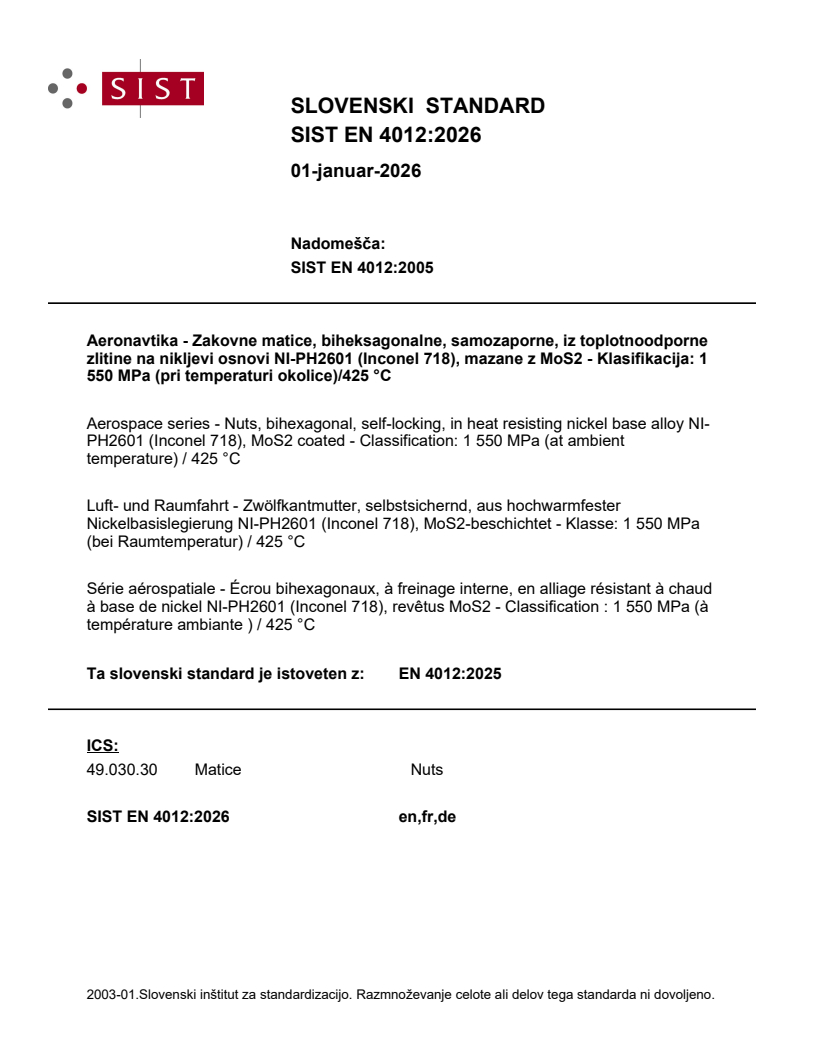
SLOVENSKI STANDARD
01-januar-2026
Nadomešča:
SIST EN 4012:2005
Aeronavtika - Zakovne matice, biheksagonalne, samozaporne, iz toplotnoodporne
zlitine na nikljevi osnovi NI-PH2601 (Inconel 718), mazane z MoS2 - Klasifikacija: 1
550 MPa (pri temperaturi okolice)/425 °C
Aerospace series - Nuts, bihexagonal, self-locking, in heat resisting nickel base alloy NI-
PH2601 (Inconel 718), MoS2 coated - Classification: 1 550 MPa (at ambient
temperature) / 425 °C
Luft- und Raumfahrt - Zwölfkantmutter, selbstsichernd, aus hochwarmfester
Nickelbasislegierung NI-PH2601 (Inconel 718), MoS2-beschichtet - Klasse: 1 550 MPa
(bei Raumtemperatur) / 425 °C
Série aérospatiale - Écrou bihexagonaux, à freinage interne, en alliage résistant à chaud
à base de nickel NI-PH2601 (Inconel 718), revêtus MoS2 - Classification : 1 550 MPa (à
température ambiante ) / 425 °C
Ta slovenski standard je istoveten z: EN 4012:2025
ICS:
49.030.30 Matice Nuts
2003-01.Slovenski inštitut za standardizacijo. Razmnoževanje celote ali delov tega standarda ni dovoljeno.
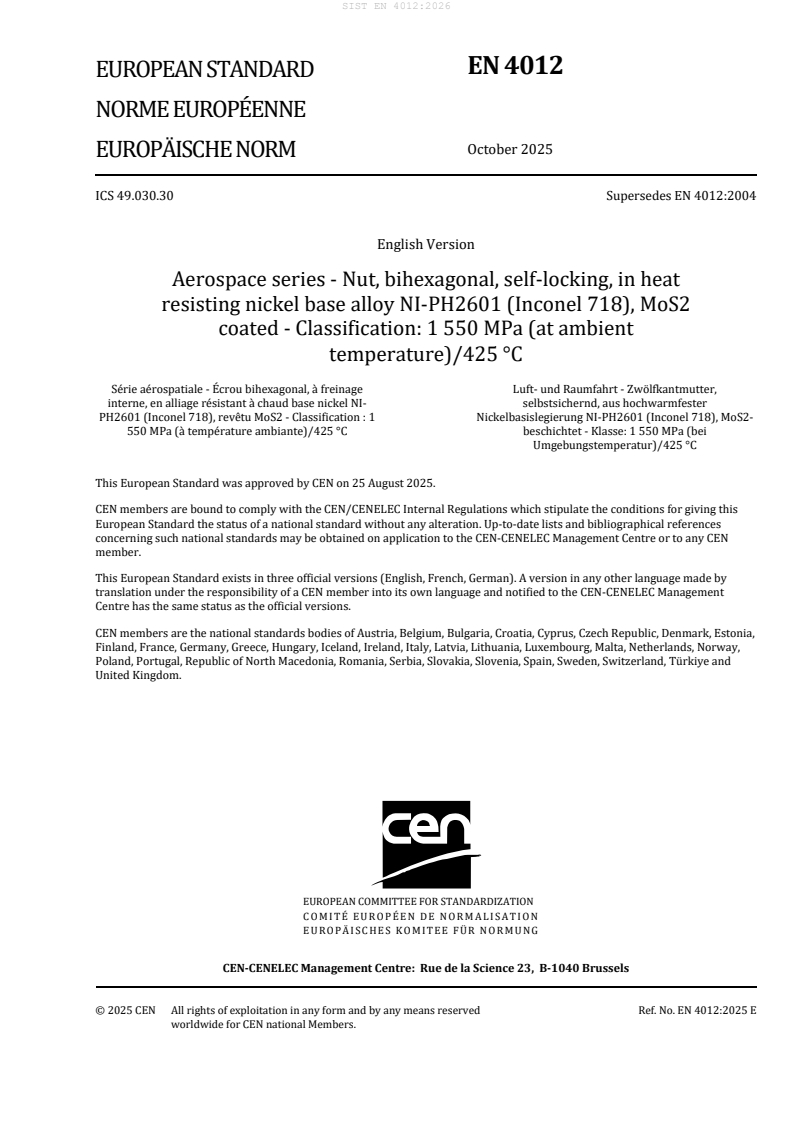
EN 4012
EUROPEAN STANDARD
NORME EUROPÉENNE
October 2025
EUROPÄISCHE NORM
ICS 49.030.30 Supersedes EN 4012:2004
English Version
Aerospace series - Nut, bihexagonal, self-locking, in heat
resisting nickel base alloy NI-PH2601 (Inconel 718), MoS2
coated - Classification: 1 550 MPa (at ambient
temperature)/425 °C
Série aérospatiale - Écrou bihexagonal, à freinage Luft- und Raumfahrt - Zwölfkantmutter,
interne, en alliage résistant à chaud base nickel NI- selbstsichernd, aus hochwarmfester
PH2601 (Inconel 718), revêtu MoS2 - Classification : 1 Nickelbasislegierung NI-PH2601 (Inconel 718), MoS2-
550 MPa (à température ambiante)/425 °C beschichtet - Klasse: 1 550 MPa (bei
Umgebungstemperatur)/425 °C
This European Standard was approved by CEN on 25 August 2025.
CEN members are bound to comply with the CEN/CENELEC Internal Regulations which stipulate the conditions for giving this
European Standard the status of a national standard without any alteration. Up-to-date lists and bibliographical references
concerning such national standards may be obtained on application to the CEN-CENELEC Management Centre or to any CEN
member.
This European Standard exists in three official versions (English, French, German). A version in any other language made by
translation under the responsibility of a CEN member into its own language and notified to the CEN-CENELEC Management
Centre has the same status as the official versions.
CEN members are the national standards bodies of Austria, Belgium, Bulgaria, Croatia, Cyprus, Czech Republic, Denmark, Estonia,
Finland, France, Germany, Greece, Hungary, Iceland, Ireland, Italy, Latvia, Lithuania, Luxembourg, Malta, Netherlands, Norway,
Poland, Portugal, Republic of North Macedonia, Romania, Serbia, Slovakia, Slovenia, Spain, Sweden, Switzerland, Türkiye and
United Kingdom.
EUROPEAN COMMITTEE FOR STANDARDIZATION
COMITÉ EUROPÉEN DE NORMALISATION
EUROPÄISCHES KOMITEE FÜR NORMUNG
CEN-CENELEC Management Centre: Rue de la Science 23, B-1040 Brussels
© 2025 CEN All rights of exploitation in any form and by any means reserved Ref. No. EN 4012:2025 E
worldwide for CEN national Members.
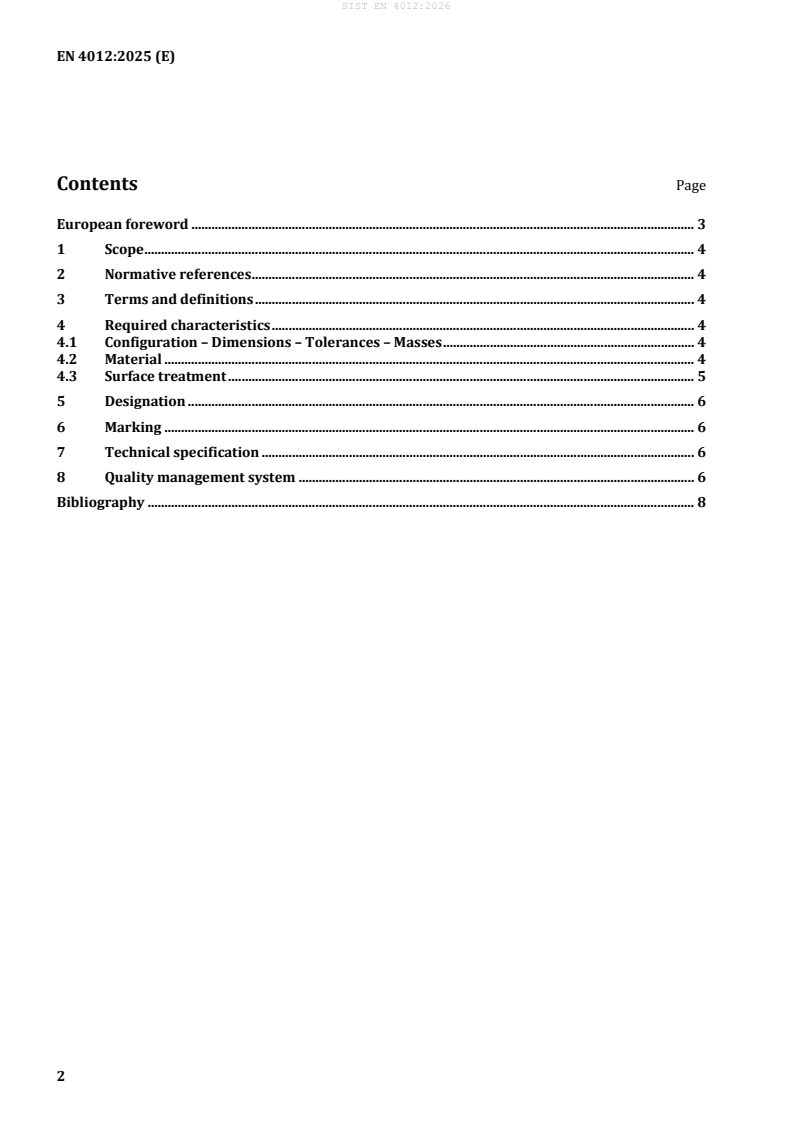
Contents Page
European foreword . 3
1 Scope . 4
2 Normative references . 4
3 Terms and definitions . 4
4 Required characteristics . 4
4.1 Configuration – Dimensions – Tolerances – Masses . 4
4.2 Material . 4
4.3 Surface treatment . 5
5 Designation . 6
6 Marking . 6
7 Technical specification . 6
8 Quality management system . 6
Bibliography . 8
European foreword
This document (EN 4012:2025) has been prepared by ASD-STAN.
After enquiries and votes carried out in accordance with the rules of this Association, this document has
received the approval of the National Associations and the Official Services of the member countries of
ASD-STAN, prior to its presentation to CEN.
This European Standard shall be given the status of a national standard, either by publication of an
identical text or by endorsement, at the latest by April 2026, and conflicting national standards shall be
withdrawn at the latest by April 2026.
Attention is drawn to the possibility that some of the elements of this document may be the subject of
patent rights. CEN shall not be held responsible for identifying any or all such patent rights.
This document supersedes EN 4012:2004.
This document inclu
...