

SIST EN 1177:2018+A1:2024
(Main)Impact attenuating playground surfacing - Methods of test for determination of impact attenuation
General Information
- Abstract
This European Standard specifies the test apparatus and the impact test methods for determining the impact attenuation of surfacing by measuring the acceleration experienced during impact. Test apparatus in compliance with this standard are applicable to tests carried out in a laboratory or on site by either methods described.
NOTE The test methods described in this standard are also applicable for impact areas required in other standards than for playground equipment, e.g. for outdoor fitness equipment and parkour equipment.
- Status
- Published
- Publication Date
- 11-Apr-2024
- Technical Committee
- SPO - Sports
- Current Stage
- 6060 - National Implementation/Publication (Adopted Project)
- Start Date
- 04-Jan-2024
- Due Date
- 10-Mar-2024
- Completion Date
- 12-Apr-2024

Overview
EN 1177:2018+A1:2023 - Impact attenuating playground surfacing: Methods of test for determination of impact attenuation (CEN) defines how to measure the ability of playground surfacing to reduce impact forces. The standard specifies test apparatus and two test methods - suitable for both laboratory and on-site testing - that measure acceleration during impact to determine critical fall height (CFH) and overall impact attenuation. It is applicable to playground surfacing and also to impact areas for outdoor fitness and parkour equipment.
Key Topics and Requirements
- Test methods
- Method 1: Determination of Critical Fall Height (CFH) - laboratory and on-site procedures to establish the maximum safe fall height for a surface.
- Method 2: On-site measurement of impact attenuation - for verification after installation or during periodic maintenance.
- Measurement metrics
- Head Injury Criterion (HIC) and peak acceleration (g) are used to assess impact severity. The committee retained HIC 1000 and introduced g 200 as upper limits when assessing surfacing in accordance with this standard.
- Test apparatus components (specified):
- Headform, guidance system, fall‑height measuring equipment, release system, signal transmission and impact measuring equipment, optional signal conditioner.
- Accuracy, calibration (laboratory calibration and operator checks), and verification of computer algorithms for HIC calculation are covered.
- Procedures and documentation
- Selection and recording of test positions, time/acceleration curve analysis, calculation of results, and reporting requirements for both laboratory and site tests.
- Annexes
- Informative and normative annexes give examples of test rigs, typical acceleration traces, selection criteria for test zones (Annex D), compaction methods for loose materials (Annex E), and maintenance/check regimes for test apparatus (Annex F).
Applications and Who Uses It
- Manufacturers of playground surfacing materials (rubber tiles, loose-fill, bonded surfaces) for product development and CE marking support.
- Testing laboratories and accredited test houses executing Method 1 and Method 2 measurements.
- Playground installers and contractors verifying installed surfacing meets required CFH and impact attenuation.
- Specifiers, landscape architects, park authorities and safety inspectors using EN 1177 test results to select appropriate surfaces, confirm compliance, and set maintenance schedules.
- Owners/operators performing periodic on-site checks to ensure ongoing safety for playgrounds, outdoor fitness, and parkour areas.
Related Standards
- EN 1176 series (playground equipment safety requirements and test methods)
- Relevant CEN technical reports (e.g., CEN/TR 16467, CEN/TR 16598) for complementary guidance on accessibility, rationale and interpretation.
Keywords: EN 1177:2018+A1:2023, impact attenuating playground surfacing, critical fall height, HIC, impact attenuation, on-site testing, laboratory testing, playground surfacing standard.
Relations
- Effective Date
- 28-Jan-2026
- Effective Date
- 28-Jan-2026
- Effective Date
- 28-Jan-2026
- Effective Date
- 28-Jan-2026
- Effective Date
- 28-Jan-2026
- Effective Date
- 28-Jan-2026
- Effective Date
- 28-Jan-2026
- Effective Date
- 28-Jan-2026
- Effective Date
- 28-Jan-2026
- Effective Date
- 28-Jan-2026
- Effective Date
- 28-Jan-2026
- Effective Date
- 28-Jan-2026
- Referred By
SIST EN 14960-1:2019 - Inflatable play equipment - Part 1: Safety requirements and test methods - Effective Date
- 28-Jan-2026
- Effective Date
- 28-Jan-2026
- Effective Date
- 01-May-2024
Frequently Asked Questions
SIST EN 1177:2018+A1:2024 is a standard published by the Slovenian Institute for Standardization (SIST). Its full title is "Impact attenuating playground surfacing - Methods of test for determination of impact attenuation". This standard covers: This European Standard specifies the test apparatus and the impact test methods for determining the impact attenuation of surfacing by measuring the acceleration experienced during impact. Test apparatus in compliance with this standard are applicable to tests carried out in a laboratory or on site by either methods described. NOTE The test methods described in this standard are also applicable for impact areas required in other standards than for playground equipment, e.g. for outdoor fitness equipment and parkour equipment.
This European Standard specifies the test apparatus and the impact test methods for determining the impact attenuation of surfacing by measuring the acceleration experienced during impact. Test apparatus in compliance with this standard are applicable to tests carried out in a laboratory or on site by either methods described. NOTE The test methods described in this standard are also applicable for impact areas required in other standards than for playground equipment, e.g. for outdoor fitness equipment and parkour equipment.
SIST EN 1177:2018+A1:2024 is classified under the following ICS (International Classification for Standards) categories: 97.200.40 - Playgrounds. The ICS classification helps identify the subject area and facilitates finding related standards.
SIST EN 1177:2018+A1:2024 has the following relationships with other standards: It is inter standard links to SIST EN 1176-1:2018, SIST EN ISO/IEC 17025:2017, SIST EN 933-1:2012, SIST EN 1176-1:2018+A1:2024, SIST EN 14960:2013, SIST EN 15330-1:2013, SIST EN 16899:2017, SIST EN 1176-10:2023, SIST EN 17232:2020, SIST EN 14960:2007, SIST EN 15330-1:2007, SIST EN 1176-1:2008, SIST EN 14960-1:2019, SIST EN 16630:2015, SIST EN 1177:2018+AC:2019. Understanding these relationships helps ensure you are using the most current and applicable version of the standard.
SIST EN 1177:2018+A1:2024 is available in PDF format for immediate download after purchase. The document can be added to your cart and obtained through the secure checkout process. Digital delivery ensures instant access to the complete standard document.
Standards Content (Sample)
SLOVENSKI STANDARD
01-maj-2024
Podloge otroških igrišč, ki ublažijo udarce - Ugotavljanje kritične višine padca
(Vključuje dopolnilo A1)
Impact attenuating playground surfacing - Methods of test for determination of impact
attenuation
Stoßdämpfende Spielplatzböden - Prüfverfahren zur Bestimmung der Stoßdämpfung
Sols d'aires de jeux absorbant l'impact - Méthodes d'essai pour la détermination de
l'atténuation de l'impact
Ta slovenski standard je istoveten z: EN 1177:2018+A1:2023
ICS:
97.200.40 Igrišča Playgrounds
2003-01.Slovenski inštitut za standardizacijo. Razmnoževanje celote ali delov tega standarda ni dovoljeno.
EN 1177:2018+A1
EUROPEAN STANDARD
NORME EUROPÉENNE
December 2023
EUROPÄISCHE NORM
ICS 97.200.40 Supersedes EN 1177:2018+AC:2019
English Version
Impact attenuating playground surfacing - Methods of test
for determination of impact attenuation
Sols d'aires de jeux absorbant l'impact - Méthodes Stoßdämpfende Spielplatzböden - Prüfverfahren zur
d'essai pour la détermination de l'atténuation de Bestimmung der Stoßdämpfung
l'impact
This European Standard was approved by CEN on 29 October 2017 and includes Amendment 1 approved by CEN on 27
November 2023.
CEN members are bound to comply with the CEN/CENELEC Internal Regulations which stipulate the conditions for giving this
European Standard the status of a national standard without any alteration. Up-to-date lists and bibliographical references
concerning such national standards may be obtained on application to the CEN-CENELEC Management Centre or to any CEN
member.
This European Standard exists in three official versions (English, French, German). A version in any other language made by
translation under the responsibility of a CEN member into its own language and notified to the CEN-CENELEC Management
Centre has the same status as the official versions.
CEN members are the national standards bodies of Austria, Belgium, Bulgaria, Croatia, Cyprus, Czech Republic, Denmark, Estonia,
Finland, France, Germany, Greece, Hungary, Iceland, Ireland, Italy, Latvia, Lithuania, Luxembourg, Malta, Netherlands, Norway,
Poland, Portugal, Republic of North Macedonia, Romania, Serbia, Slovakia, Slovenia, Spain, Sweden, Switzerland, Türkiye and
United Kingdom.
EUROPEAN COMMITTEE FOR STANDARDIZATION
COMITÉ EUROPÉEN DE NORMALISATION
EUROPÄISCHES KOMITEE FÜR NORMUNG
CEN-CENELEC Management Centre: Rue de la Science 23, B-1040 Brussels
© 2023 CEN All rights of exploitation in any form and by any means reserved Ref. No. EN 1177:2018+A1:2023 E
worldwide for CEN national Members.
EN 1177:2018+A:2023 (E)
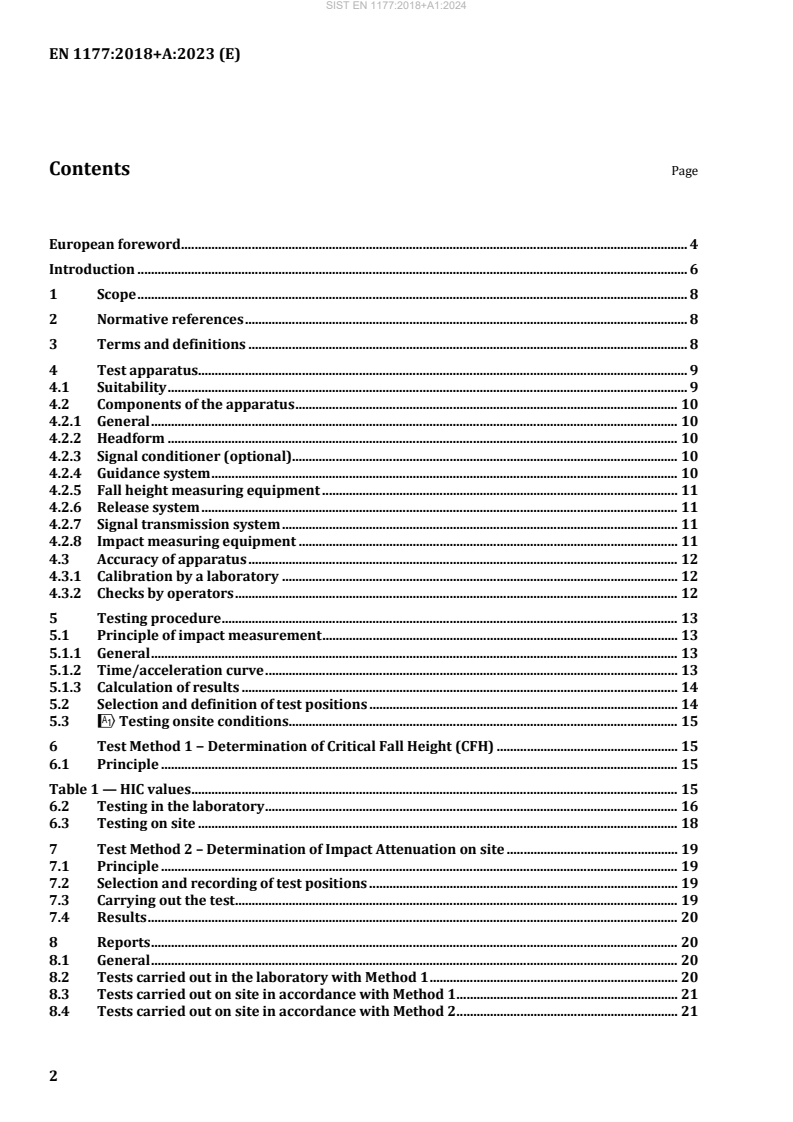
Contents Page
European foreword . 4
Introduction . 6
1 Scope . 8
2 Normative references . 8
3 Terms and definitions . 8
4 Test apparatus. 9
4.1 Suitability . 9
4.2 Components of the apparatus . 10
4.2.1 General . 10
4.2.2 Headform . 10
4.2.3 Signal conditioner (optional). 10
4.2.4 Guidance system . 10
4.2.5 Fall height measuring equipment . 11
4.2.6 Release system . 11
4.2.7 Signal transmission system . 11
4.2.8 Impact measuring equipment . 11
4.3 Accuracy of apparatus . 12
4.3.1 Calibration by a laboratory . 12
4.3.2 Checks by operators . 12
5 Testing procedure . 13
5.1 Principle of impact measurement . 13
5.1.1 General . 13
5.1.2 Time/acceleration curve . 13
5.1.3 Calculation of results . 14
5.2 Selection and definition of test positions . 14
5.3 !Testing onsite conditions. 15
6 Test Method 1 − Determination of Critical Fall Height (CFH) . 15
6.1 Principle . 15
Table 1 — HIC values . 15
6.2 Testing in the laboratory . 16
6.3 Testing on site . 18
7 Test Method 2 – Determination of Impact Attenuation on site . 19
7.1 Principle . 19
7.2 Selection and recording of test positions . 19
7.3 Carrying out the test . 19
7.4 Results . 20
8 Reports . 20
8.1 General . 20
8.2 Tests carried out in the laboratory with Method 1 . 20
8.3 Tests carried out on site in accordance with Method 1 . 21
8.4 Tests carried out on site in accordance with Method 2 . 21
Annex A (informative) Test rig for determination of impact attenuation . 23
Figure A.1 — Test rig for determination of critical fall height . 23
Annex B (informative) Typical examples of trace of acceleration against time and curve of
HIC and g values against drop height . 24
max
Figure B.1 — Typical trace of acceleration against time . 24
Figure B.2 — Example of typical curves from a test on rubber tiles for HIC and g values
max
against drop height . 25
Annex C (informative) Verification of computer algorithm used for the calculation of HIC
(see 4.3.1.4) . 26
Table C.1 — Calculation of the output voltage for a 20 kHz frequency . 26
Annex D (normative) Procedure for selection of test positions in playgrounds for Method 2
(see Clause 7) . 27
D.1 Principle . 27
D.2 Criteria for selection of test zones (3.12). 27
Table D.1 — Example for test zones – Swings . 28
Table D.2 — Example for test zones – Slides and cableways . 29
Table D.3 — Example for test zones – Carousels . 30
Table D.4 — Example for test zones – Rocking equipment and spatial nets . 30
Annex E (normative) Method for compaction of loose particulate impact attenuating
material (see 6.2.4.5.1) . 32
E.1 General . 32
E.2 Measurement of layer thickness . 32
E.3 Compaction procedure . 32
Table E.1 — Dimension of board sizes that can be used by different weight testers . 33
Annex F (informative) Example of a regime for checking the function of an HIC test
apparatus . 34
Table F.1 — Example of a regime for checking the correct function of an HIC test apparatus
used weekly . 34
Annex G (Informative) !History of HIC testing of impact attenuating surfaces for
playgrounds and variations in test results . 35
EN 1177:2018+A:2023 (E)
European foreword
This document (EN 1177:2018+A1:2023) has been prepared by Technical Committee CEN/TC 136
“Sports, playground and other recreational facilities and equipment”, the secretariat of which is held by
DIN.
This European Standard shall be given the status of a national standard, either by publication of an
identical text or by endorsement, at the latest by June 2024, and conflicting national standards shall be
withdrawn at the latest by June 2024.
Attention is drawn to the possibility that some of the elements of this document may be the subject of
patent rights. CEN shall not be held responsible for identifying any or all such patent rights.
This document includes Corrigendum 1 issued by CEN on 9 January 2019 and Amendment 1 approved
by CEN on 27 November 2023.
This document supersedes !EN 1177:2018+AC:2019".
This document includes the corrigendum 1 which corrects item k) in 8.3.
The start and finish of text introduced or altered by corrigendum is indicated in the text by tags ˜™.
The start and finish of text introduced or altered by amendment is indicated in the text by tags !"
European standards for playground equipment and surfacing comprise this document and the EN 1176
series, which consists of a number of parts as follows:
— Part 1: General safety requirements and test methods
— Part 2: Additional specific safety requirements and test methods for swings
— Part 3: Additional specific safety requirements and test methods for slides
— Part 4: Additional specific safety requirements and test methods for cableways
— Part 5: Additional specific safety requirements and test methods for carousels
— Part 6: Additional specific safety requirements and test methods for rocking equipment
— Part 7: Guidance on installation, inspection, maintenance and operation
— Part 10: Additional specific safety requirements and test methods for fully enclosed play equipment
— Part 11: Additional specific safety requirements and test methods for spatial network
This document should also be read in conjunction with:
— EN 1176:2017 series
— CEN/TR 16467:2013, Playground equipment accessible for all children
— CEN/TR 16598:2014, Collection of rationales for EN 1176 - Requirements
— CEN/TR 16396:2012, Playground equipment for children, replies to requests for interpretation of
EN 1176:2008 and its parts
For inflatable play equipment, see EN 14960, Inflatable play equipment — Safety requirements and test
methods.
The principal changes from the previous edition of this European Standard are as follows:
a) European foreword: References to CEN/TRs added.
b) Introduction: Rationale for retaining HIC 1 000 and introducing g 200 as upper limits for
max
surfacing when assessed in accordance with this standard has been added.
c) Scope: Two methods of impact testing are now provided. Method 1 (as in the previous edition) –
Test for determination of Critical Fall Height AND new Method 2 – Test for measurement of impact
attenuation on site to enable, upon installation or at periods later in its life, confirmation as
required of suitability of the product for that specific site location at the time of the test.
d) Body of standard:
1) change of the order and adding new clauses by implementation of Method 2;
2) adaption of recent technology for requirements on test apparatus and measurements in order
to improve accuracy of results (including checks by operators);
3) adapting Annex B and adding new Annexes C, D, E and F.
Any feedback and questions on this document should be directed to the users’ national standards body.
A complete listing of these bodies can be found on the CEN website.
According to the CEN-CENELEC Internal Regulations, the national standards organisations of the
following countries are bound to implement this European Standard: Austria, Belgium, Bulgaria,
Croatia, Cyprus, Czech Republic, Denmark, Estonia, Finland, France, Germany, Greece, Hungary, Iceland,
Ireland, Italy, Latvia, Lithuania, Luxembourg, Malta, Netherlands, Norway, Poland, Portugal, Republic of
North Macedonia, Romania, Serbia, Slovakia, Slovenia, Spain, Sweden, Switzerland, Türkiye and the
United Kingdom.
EN 1177:2018+A:2023 (E)
Introduction
This European Standard is based on the safety principles given in EN 1176-1 for playground equipment
and provides a method for the assessment of impact attenuation of surfaces intended for use in the
impact area as defined in EN 1176-1. This standard (EN 1177) aims to reduce consequences of
experiencing risks that are desirable for child development according to the principles set in EN 1176-1.
Injuries arise during the use of playground equipment for a variety of reasons and the great majority
are minor. Even the presence of protection features like impact attenuating surfacing is known to affect
the behaviour of children, as well as carers and play providers, which in turn can affect the risk. The
majority of more serious injuries are attributable to falls and there are many factors that influence
injury mechanisms during a fall that are independent of the surfacing, e.g. body orientation,
awkwardness of fall, bone density, etc.
The most severe injuries are likely to be injuries to the head. Recent research has indicated that arm
and leg injuries are more frequent and could be influenced by the duration of the acceleration pulse.
The committee responsible for this European Standard maintains a constant review of research in this
area for possible use in a future revision of this standard. The committee recognizes that there is a
relationship between the risk of arm and leg injuries and surface type but takes the view that such
injuries are not usually in the most severe category. At present the available injury data can be taken
into account by limitation of the maximum (peak) acceleration.
Consequently, the committee has chosen to make its priority the reduction of the likelihood of serious
head injuries caused by a fall from playground equipment, because even though such injuries are
relatively uncommon, they can have the most severe consequences. The severity of injury resulting
from an impact to the head can be quantified in terms of Head Injury Criterion (HIC) and the level of
HIC = 1 000 together with the upper limit of the peak acceleration of g = 200g ( g for gravity) have
max
been chosen as the upper limits for surfacing when assessed in accordance with this standard.
Limiting the HIC value at a maximum of 1 000 is equivalent to a 3 % chance of a critical head injury
(MAIS 5), an 18 % probability of a severe (MAIS 4) head injury, a 55 % probability of a serious
(MAIS 3) head injury, a 89 % probability of a moderate head injury (MAIS 2), and a 99,5 % chance of a
minor head injury (MAIS 1), to an average male adult.
Limiting g to a maximum of 200g as well as limiting HIC to a maximum of 1 000 takes account of
max
impacts of very short duration and follows the current research on arm injuries as a means of
improvement to the Standard.
Two methods of impact tests are provided. The first method is for determination of the Critical Fall
Height to enable full and detailed confirmation of a product's range of suitability. The second method
describes an on-site drop test, without determination of critical fall height to enable, upon installation
or at periods later in its life, confirmation as required of the performance of the surfacing in that specific
site location at the time of the test.
The EN committee is aware of discussions within ASTM International since 2014 about a reduction in
the HIC threshold to 700 in its corresponding standard. The current limiting value of HIC ≤ 1 000 has
been used in Europe since 1998 and the EN committee considers that at present, there is insufficient
evidence of net overall value to playground users to support a change. It has therefore chosen to retain
the value HIC ≤ 1 000 and to provide a second threshold of 200g as the criteria of acceptability in this
standard, whilst continuing to monitor research publications on this subject. The same has been
decided by ASTM for the time being.
Maximum Abbreviated Injury Scale, first developed by the Association for the Advancement of Automotive
Medicine and used extensively in the automotive industry as an indicator of the severity of head-related injuries.
A variety of materials, both natural and synthetic, may be used as impact attenuating surfacing with
different attributes and performance. These include grass growing in soil, sand, wood chips, bark,
gravel, and various rubber-based products which may be in the form of tiles or continuous coatings or
combinations of these materials. Whilst the methods described in this Standard can be used to assess
the impact attenuation performance of any of these surfaces, attention of users is drawn that the
behaviour of some materials can be highly variable and dependent on prevailing test conditions and
that test results will likely vary over time or with climatic conditions.
EN 1177:2018+A:2023 (E)
1 Scope
This European Standard specifies the test apparatus and the impact test methods for determining the
impact attenuation of surfacing by measuring the acceleration experienced during impact. Test
apparatus in compliance with this standard are applicable to tests carried out in a laboratory or on site
by either methods described.
NOTE The test methods described in this standard are also applicable for impact areas required in other
standards than for playground equipment, e.g. for outdoor fitness equipment and parkour equipment.
2 Normative references
The following documents, in whole or in part, are normatively referenced in this document and are
indispensable for its application. For dated references, only the edition cited applies. For undated
references, the latest edition of the referenced document (including any amendments) applies.
EN 933-1, Tests for geometrical properties of aggregates — Part 1: Determination of particle size
distribution — Sieving method
EN 1176-1:2017, Playground equipment and surfacing — Part 1: General safety requirements and test
methods
EN ISO/IEC 17025, General requirements for the competence of testing and calibration laboratories
(ISO/IEC 17025)
3 Terms and definitions
For the purposes of this document, the terms and definitions given in EN 1176-1 and the following
apply.
3.1
impact attenuation
property of a surface, which dissipates the kinetic energy of an impact by localized deformation or
displacement in such a way that the acceleration experienced by the impacting object is reduced
3.2
impact attenuating surfacing
IAS
surfacing intended to reduce the risk of injury when falling onto it
Note 1 to entry: product or material having the inherent ability to attenuate the impact of a user falling onto it
3.3
critical fall height
CFH
maximum Free Height of Fall (FHF), for which a surface will provide an adequate level of impact
attenuation, determined by test Method 1 as described in Clause 6 of this standard
3.4
head injury criterion
HIC
measure of the severity of a head injury likely to arise from an impact, determined as described in
Clause 5 of this standard
3.5
peak acceleration
g
max
maximum acceleration a experienced by the headform during an impact, expressed in units of g
(gravity)
3.6
impact measurement
HIC value and g calculated from the recorded acceleration a (in g) of the headform falling from one
max
drop height onto one test position of the surface (see 5.1)
3.7
test position
position on the surface to be tested, located vertically below the centre of the headform
3.8
drop height
Free Height of Fall, measured between the test position on the surface and the lowest point of the free
falling headform prior to release; or, in the case of a guided headform, calculated from measurement of
headform velocity immediately prior to impact
3.9
drop test
procedure for conducting impact measurements on one test position of the impact area
!Note 1 to entry: The number of drops and the drop heights of drop tests are specified separately in
Method 1 and in Method 2. Particularities exist for some specific types of surfacing material (e.g., for loose fill
material the four impacts measurement of the drop test are conduct in a different test position)."
3.10
loose particulate material
material consisting of separate, un-bound pieces of a substance
Note 1 to entry: Sand, gravel, bark and wood chips are examples of loose particulate materials.
3.11
impact area
area that can be hit by a user after falling through the falling space
3.12
test zone
subdivision of the impact area for the purpose of verification of impact attenuation. All test zones to be
verified constitute the impact area of the equipment (see 5.2).
4 Test apparatus
4.1 Suitability
The same apparatus and recording procedures are used for the two methods of test described in this
standard.
EN 1177:2018+A:2023 (E)
4.2 Components of the apparatus
4.2.1 General
The equipment comprises: a headform (4.2.2) fitted with one or more accelerometer(s) (4.2.2.3 a or b),
optionally a signal conditioner (4.2.3), a release system for the headform (4.2.6), means for measuring
the effective free fall height (4.2.5), a signal transmission system (4.2.7) and an impact measuring
equipment (4.2.8).
If using a uniaxial accelerometer, a guidance system for the headform shall be provided (4.2.4).
Principle of apparatus see Figure A.1.
4.2.2 Headform
4.2.2.1 The headform shall consist of either
a) an aluminium alloy ball; or
b) a hemispherical ended aluminium alloy missile.
4.2.2.2 The headform shall have a diameter of 160 mm ± 5 mm, a mass of 4,6 kg ± 0,05 kg, with a
maximum deviation from the hemispheric surface of 0,5 mm.
If the alloy from which the headform is made is too soft, deformation of the surface of the aluminium
may occur when testing loose particulate materials like gravel or any other hard and rigid elements in
the impact attenuating surface. This will result in unquantifiable errors in the measurement of gmax
and HIC. When testing materials of this type, the impacting surface of the headform should be inspected
frequently. If deformation of the headform surface is observed, the test is invalid.
In the case of a wired headform, the weight of any connector which is directly attached to or mounted
on the headform and the weight of 1,5 m of the wire or cable shall be included in the determination of
the mass of the headform.
4.2.2.3 Accelerometer(s) shall be incorporated as follows:
a) accelerometer(s) aligned to measure 3 axes for free falling headform, mounted at the centre of
gravity (±5mm in the vertical or horizontal axis) of the headform; or
b) a uniaxial accelerometer for guided headforms, aligned to measure in the vertical axis ±5° and
located directly above the centre of mass.
4.2.2.4 The impacting part of the headform below the mounting plane of the accelerometer shall be
homogeneous and free from voids.
NOTE This is to avoid errors in measurement caused by vibrations.
4.2.3 Signal conditioner (optional)
Depending on the accelerometer technology employed, different methods of signal conditioning may be
needed. Examples include: a charge amplifier, a Wheatstone bridge and amplifier, or an integrated
electronic conditioner.
4.2.4 Guidance system
When using a uniaxial accelerometer, a vertical guidance for the headform shall be provided, including a
means to measure the velocity of the headform immediately prior to impact (see 4.2.5.2).
4.2.5 Fall height measuring equipment
Methods for determination of the effective Free Height of Fall (FHF) of the headform when impacting
the surface are:
4.2.5.1 For the free-fall impact test, physical measuring of the drop height or calculating the drop
height from the measured time between release and contact of the headform with the surface.
When calculating the drop height from the measured time between release and contact of the headform
with the surface, special attention should be paid to possible time differences between the start of time
measurement and the effective release of the headform (e.g. caused by permanent magnetism in a
magnetic release system). A comparison of the measured height of fall and the calculated height of fall
may be needed.
4.2.5.2 For the guided impact test, measuring the velocity of the headform immediately prior to the
impact and calculating the theoretical free fall drop height.
To allow for frictional losses, the velocity of the headform immediately prior to impact is recorded in
order to calculate the equivalent drop height as if the headform had been in free fall.
In all cases, the effective Free Height of Fall (FHF) shall be recorded.
4.2.6 Release system
The release system for the free-fall impact test shall not create a significant rotation moment or any
other forces on the headform, when released.
NOTE A rotation moment or other forces on the headform would cause additional accelerations at impact in
the accelerometer, leading to an uncontrollable error of the resultant for the vertical measurement.
4.2.7 Signal transmission system
When using a signal cable for transmission, it shall not cause any significant restraining, pushing forces
or unsteadiness of the headform.
4.2.8 Impact measuring equipment
4.2.8.1 The impact measuring equipment shall consist of an accelerometer measurement system
(4.2.8.2), a recording device (4.2.8.3) and a calculation program for the head injury criterion (HIC)
(4.2.8.4).
4.2.8.2 The accelerometer measurement system shall be capable of measuring all signal frequencies
in the range 20 Hz to 1 000 Hz and having a sufficient response at all frequencies to keep amplitude
errors below 5 %. It shall be capable of measuring, recording and displaying the acceleration and time
duration of each complete impact (see 5.1.3).
For piezoelectric accelerometers, to have a sufficient response at low frequencies, the −3 dB lower
limiting frequency should be less than or equal to 0,3 Hz to reduce the errors resulting from signal
droop, which is most obviously visible in the form of baseline overshoot after the impact. Signal droop
also results in underestimation of g and as a result HIC, particularly for longer pulse durations.
max
Piezoelectric accelerometers with a time constant of 2 s or greater and appropriate signal conditioning
will generally meet this requirement. Other accelerometers are not affected.
EN 1177:2018+A:2023 (E)
4.2.8.3 Recording device
The recording device shall be capable of capturing and recording the acceleration/time signals
produced throughout an impact with a minimum sampling rate of at least 20 kHz, including the
maximum acceleration (g ) experienced during each impact. Signal conditioning and filtering shall
max
be compatible with the accelerometer and the data channel specified.
When the −3 dB upper frequency response of the accelerometer and its signal conditioning system is at
a frequency greater than one-quarter of the sampling frequency, an anti-aliasing filter with an
attenuation of at least 30 dB at half the sampling rate shall be employed.
4.2.8.4 Program for calculating the HIC value for the recorded acceleration time history of each
impact, in accordance with Clause 5.
4.3 Accuracy of apparatus
4.3.1 Calibration by a laboratory
4.3.1.1 The apparatus shall be calibrated periodically, by a laboratory in accordance with
EN ISO/IEC 17025.
4.3.1.2 All parts of the acceleration measurement system including accelerometers and electronic
part (analogue and numerical) shall be calibrated for the whole frequency range from 20 Hz to
1 000 Hz. Recalibration shall be carried out at time intervals recommended by the manufacturer of the
accelerometer or at least every two years. Calibrations shall be documented (e.g. by calibration
certificates) and uncertainties shall be indicated.
The uncertainty of the calibration of accelerometers shall not be greater than 5 %.
4.3.1.3 Velocity measurement systems as well as algorithms for calculating the fall height shall be
calibrated for the whole velocity range (up to 3.5 m drop height).
For free falling headforms the calculated fall height shall be compared with the physically measured
effective fall height.
In all cases, the effective Free Height of Fall (FHF) shall be measured with an uncertainty of not more
than ±1 %.
4.3.1.4 The computer algorithm used for the calculation of HIC shall be checked, e.g. by imposing a
half-sine curve and the result, when compared with an independent mathematical calculation of this
curve, shall not deviate by more than ±1 %.
NOTE An example for verification is given in Annex C.
4.3.2 Checks by operators
4.3.2.1 Operators shall verify the correct function of the apparatus they use at appropriate interval
(depending on the frequency and type of use of the apparatus). The results of any checks shall be
recorded during the life time of the apparatus (e.g. by using a monitoring log).
The tests given in 4.3.2.2 and 4.3.2.3 are for checking any deviations or anomalies in the components
and neither replaces calibration nor the validation for compliance of the apparatus with this European
Standard.
NOTE An example of a regime for checking the correct function of the apparatus is described in Annex F.
4.3.2.2 Comparative testing on reference surfaces
Conduct the testing procedure for determination of the Critical Fall Height (CFH) (Clause 6 – Method 1)
on a prefabricated reference surface with constant properties under conditions as described for
laboratory tests (6.2.4.1).
Carry out a series of at least three consecutive drop tests on the same test position on the reference
surface, using the same fall heights ±2cm for all drop tests. Record the results for HIC and g of each
max
drop test and determine the CFH.
The corresponding values for the CFH obtained shall not differ more than ±5 %.
In case of higher deviations, maintenance or re-calibration is required.
NOTE The reference surface can be any product giving constant properties under the range of drop heights
tested.
4.3.2.3 Uncertainty test on reference surfaces
Carry out a series of ten consecutive drops from the same drop height and on the same test position
continually (within 15 min) on a reference surface.
Discard any obvious incorrect results and calculate the standard deviation of the calculated HIC and the
measured g .
max
A standard deviation below 5 % of the ten calculated HIC and the ten measured g values is
max
considered satisfactory. If this is not the case, maintenance or calibration operations shall be conducted,
and a verification performed.
5 Testing procedure
5.1 Principle of impact measurement
5.1.1 General
The surfacing to be tested is struck by the instrumented headform of the test apparatus (see 4.2.1) from
different drop heights (drop test see 3.9). The signals emitted by the accelerometer(s) in the headform
during each impact are processed to yield a severity from the measured impact energy, defined as head
injury criterion (HIC) and to determine the peak acceleration (g ) experienced.
max
Figure A.1 shows a scheme of a test rig for impact measurement.
In Method 1 the drop heights at which an HIC of max. 1 000 and a g of 200 is obtained are used to
max
define the Critical Fall Height of the surfacing, in Method 2 the drop heights for measuring HIC and
g are related to equipment installed and are used to verify the performance of the surfacing in that
max
specific site location.
5.1.2 Time/acceleration curve
The time/acceleration trace for each impact of a drop test shall be displayed and examined for any
anomalies before being processed and evaluated (see Figure B.1). If any single drop gives an anomalous
result, investigate further by repeating the drop tests at the same test position or, in case of loose
particulate material, at a new untested ground position for the part of the curve in question.
EN 1177:2018+A:2023 (E)
If high frequency components appear as a consequence of vibrations of the drop test headform,
filtration of signals with a standardized filter will be necessary. Measure both with and without the filter
and compare the HIC and g values to decide if the collected data (time/acceleration curve(s)) are
max
valid.
5.1.3 Calculation of results
5.1.3.1 The head injury criterion (HIC) value shall be calculated and recorded for each
time/acceleration curve from the formula:
2,5
t
2
a×dt
∫
t
(1)
HIC ×−(t t ) max
tt−
where (see also Figure B.1)
t is the time, at the start of an impact event, when the acceleration of the headform first
start
exceeds zero;
t is the time, at the end of an impact event, when the acceleration of the headform first falls
end
back to zero
a is the acceleration experienced by the headform and expressed in g (acceleration due to
gravity);
t , t are any two intermediate values of t between t and t , t being the time expressed in
1 2 start end
milliseconds (ms).
The sampling rate from t to t shall be at least 20 kHz (see 4.2.8.3).
start end
Experience has shown that an impact time greater than or equal to 3 ms, i.e. (t − t ) ≥ 3 ms is expected
2 1
for impacts within the limits defined for the HIC (≤ 1 000) and for the maximum value of a
(g ≤ 200g). It has been observed that shorter impact times correspond to impacts with higher
max
values of g which tend to increase the risk, including injuries to the arms and legs; such surfacing
max
shall be excluded when tested in accordance with this standard.
5.1.3.2 For each time/acceleration curve the maximum acceleration (g ) occurring shall be
max
recorded for further processing.
5.2 Selection and definition of test positions
5.2.1 Impact measurements shall be carried out in all relevant test zones (3.12) of the surfacing, as far
as is practical, to determine the test positions having the lowest impact attenuation.
NOTE !Requirements for the adequate level of impact attenuation" in impact areas are defined for the
Free Height of Fall (FHF) and for forced movement on playground equipment in EN 1176 series (see
EN 1176-1:2017, 4.2.8.1 and 4.2.8.5) or in other standards, where surfacing is required.
5.2.2 The distance between any two test positions shall not be less than 250 mm and no position shall
be closer than 250 mm from the edge of the test specimen, assembly or test frame.
NOTE These distances are to avoid influences on the test position from previous tests and from the edges at
the perimeter of the test specimen.
=
5.2.3 The precise location of each test position shall be referenced to the test specimens or material
as related to the structure and/or geometry of the surfacing and indicated in the test report (see also
Clause 8 and Annex D).
5.3 !Testing onsite conditions
5.3.1 Testing shall only be carried out when the temperature of the surface is between 5 °C and 55 °C.
Temperature as well as all relevant climatic conditions existing throughout the test, e.g., humidity,
moisture, etc., shall be measured and recorded.
5.3.2 Testing shall not be carried out on surfaces that are saturated with water.
5.3.3 Tests shall not be conducted on a test zone if it is inclined at an angle of > 10° to the horizontal.
NOTE Guided systems will give invalid results on inclined surfaces and free-falling head forms can experience
excessive rotation forces.
5.3.4 If different types and/or layer thickness of substrate and/or surfacing are known to exist within
the impact area, each variation shall be considered as a separate test zone and tested separately.
For surfacing manufactured on site the drop tests shall be carried out on each test zone identified.
5.3.5 When testing on site, a variety of test positions shall be selected to ensure the worst-case
situation is included (e.g., access/exit areas of the equipment) (see also 5.2.1).
NOTE For method 2 see recommendations in Annex D."
6 Test Method 1 − Determination of Critical Fall Height (CFH)
6.1 Principle
6.1.1 Impact measurements shall be carried out according to the testing procedure in 5.1 by
conducting a drop test on each selected test position to the procedures as defined for testing !in
general (5.2)", in the laboratory (6.2) and on site (6.3).
6.1.2 Each drop test shall be completed within 15 min. The values for HIC and g for each drop test
max
shall be recorded.
!Whenever it is possible the drop heights should be chosen to obtain the HIC values given in Table 1,
subject to the following constraints:
Table 1 — HIC values
Impact number Targeted HIC value
Impact 1 → m 700 to 800
Impact 2 → m 850 to 950
Impact 3 → m 1050 to 1150
Impact 4 → m 1200 to 1300
NOTE An example of correct curves is illustrated in Figure B.2 (HIC and g )."
max
EN 1177:2018+A:2023 (E)
!6.1.3 For materials giving HIC values lower than 1 000 and g lower than 200g at the
max
maximum test height, the Critical Fall Height shall be quoted as > M (where M is the greatest drop
height measured).
NOTE The maximum Free Height of Fall (FHF) on playground equipment conforming with EN 1176-1 is 3 m
(see EN 1176-1:2017, 4.2.8.1)."
6.2 Testing in the laboratory
6.2.1 Testing shall be carried out at a temperature of 23 °C ± 5 °C.
6.2.2 Testing shall be carried out on a flat, rigid concrete, or equivalent substrate of sufficient mass,
density and thickness that its deformation during the test makes no significant contribution to the test
result.
Substrates other than the flat, rigid substrate are likely to contribute to the impact attenuation of the
material being tested and are applicable for test reports only with clearly defined limitations.
6.2.3 Selection of data for determination of critical fall height
6.2.3.1 The results for HIC and g (see 5.1.3) of each i
...