


SIST EN 13985:2003+A1:2009
(Main)Machine tools - Safety - Guillotine shears
Machine tools - Safety - Guillotine shears
1.1 This European Standard specifies technical safety requirements and measures to be adopted by persons undertaking the design as defined in 3.11 of EN 292-1:1991, manufacture and supply of guillotine shears which are intended to work cold metal or material partly of cold metal as defined in 3.1.7 and hereafter referred as machines.
1.2 This standard also covers guillotine shears whose primary intended use is to work cold metal, which are to be used in the same way to work other sheet materials (e.g. cardboard, plastic, rubber, leather).
1.3 The requirements in this standard take account of intended use, as defined in 3.12 of EN 292-1:1991. This standard presumes access to the guillotine shear from all directions, deals with the hazards described in clause 4, and specifies the safety requirements and/or protective measures for both the operator and other exposed persons.
1.4 This standard also applies to ancillary devices which are an integral part of the guillotine shear. This standard also applies to machines which are integrated into an automatic production line where the hazards and risk arising are comparable to those of machines working separately.
1.5 This standard includes guillotine shears in which energy is imparted to the blade by a number of means. e.g.:
a) mechanically driven from a motor through a friction clutch;
b) through a direct drive motor and brake;
c) through hydraulic pressure;
d) through pneumatic pressure.
1.6 This standard does not cover machines whose principal designed purpose is:
a) cutting in other than a straight line (e.g. at nibbling machines);
b) cutting by continuous action at crocodile shears (see 3.4).
1.7 This standard does not cover the safety requirements related to the use of PES or PPS. They will be dealt with at its next revision.
1.8 This standard is not applicable to machines which are manufactured before the date of publication of this document by CEN.
Werkzeugmaschinen - Sicherheit - Tafelscheren
1.1 Diese Europäische Norm legt technische Sicherheitsanforderungen und Schutzmaßnahmen für Tafelscheren fest. Die Anforderungen sind von Konstrukteuren (siehe Definition in EN 292-1:1991, 3.11), Herstellern und Lieferern zu beachten. Die Tafelscheren sind vorgesehen für die Kaltbearbeitung von Metall oder teilweise aus Metall (siehe Definition in 3.1.7) bestehenden Werkstoffen. Im Folgenden werden die Tafelscheren Maschinen genannt.
1.2 Diese Norm gilt auch für Tafelscheren, deren hauptsächlicher Verwendungszweck die Kaltbearbeitung von Metall ist und die in gleicher Weise für die Bearbeitung von anderem Tafelmaterial (z. B. Pappe, Kunststoff, Gummi, Leder) eingesetzt werden sollen.
1.3 Die in dieser Norm enthaltenen Anforderungen beziehen die bestimmungsgemäße Verwendung mit ein, wie in EN 292-1:1991, 3.12, definiert. Diese Norm unterstellt den Zugang zur Tafelschere von allen Seiten, behandelt die in Abschnitt 4 beschriebenen Gefährdungen und legt die Sicherheitsanforderungen und/oder Schutzmaßnahmen für den Bediener und andere exponierte Personen fest.
1.4 Diese Norm gilt auch für Zusatzeinrichtungen, die fester Bestandteil der Tafelschere sind. Diese Norm gilt auch für Maschinen, die in Fertigungssystemen integriert sind, wenn die auftretenden Gefahren und Risiken vergleichbar mit denen einer separat betriebenen Maschine sind.
1.5 Diese Norm bezieht Tafelscheren mit ein, bei denen Energie durch verschiedene Mittel auf das Messer übertragen wird, z. B.:
a) mechanischer Antrieb durch einen Motor mit Hilfe einer Reibungskupplung;
b) durch direkt angetriebenen Motor und direkt angetriebene Bremse;
c) durch hydraulischen Druck;
d) durch pneumatischen Druck.
1.6 Diese Norm gilt nicht für Maschinen, deren Hauptzweck ist:
a) Schneiden in einer anderen als der geraden Linie (z. B. bei Knabberscheren);
b) kontinuierliches Schneiden in Krokodilscheren (siehe 3.1.4).
1.7 Diese Norm behandelt nicht die mit PES oder PPS verbundenen Sicherheitsanforderungen. (...)
Machines-outils - Sécurité - Cisailles guillotines
1.1 La présente Norme européenne spécifie les prescriptions techniques de sécurité et les mesures de protection
que doivent respecter les personnes chargées de la conception, comme défini en 3.11 de l'EN 292-1:1991, de la
construction et de la fourniture des cisailles guillotines conçues pour le travail à froid des métaux ou des matériaux
partiellement constitués de métal telles que définies en 3.1.7 et ci-après désignées par le terme machine.
1.2 La présente norme s'applique également aux cisailles guillotines pour lesquelles l'utilisation normale première
est le travail à froid des métaux et qui sont utilisées de la même manière pour le travail d'autres matériaux en feuilles
(tels que le carton, le plastique, le caoutchouc ou le cuir).
1.3 Les prescriptions de la présente norme tiennent compte de l'utilisation normale telle que définie en 3.12 de
l'EN 292-1:1991. La présente norme suppose un accès possible à la cisaille guillotine de tous les côtés, traite des
phénomènes dangereux décrits à l'Article 4 et spécifie les prescriptions de sécurité et/ou les mesures de protection
à la fois pour l'opérateur et les autres personnes exposées.
1.4 La présente norme est applicable également aux dispositifs auxiliaires faisant partie intégrante de la cisaille
guillotine. La présente norme s’applique aussi aux machines intégrées dans une ligne de production pour autant que
les phénomènes dangereux et les risques soient comparables à ceux des machines isolées.
1.5 La présente norme inclue les cisailles guillotines dont l'énergie est transmise à la lame par différents moyens,
par exemple :
a) par entraînement mécanique à partir d'un moteur et d'un embrayage à friction ;
b) par entraînement direct d'un moteur et d'un frein ;
c) par pression hydraulique ;
d) par pression pneumatique ;
1.6 La présente norme ne traite pas des machines conçues principalement pour :
a) la coupe en ligne non droite (par exemple les machines de poinçonnage) ;
Obdelovalni stroji - Varnost - Škarje
General Information
- Status
- Published
- Publication Date
- 30-Mar-2009
- Technical Committee
- VSN - Safety of machinery
- Current Stage
- 6060 - National Implementation/Publication (Adopted Project)
- Start Date
- 13-Mar-2009
- Due Date
- 18-May-2009
- Completion Date
- 31-Mar-2009
- Directive
- 98/37/EC - Machinery
Relations
- Effective Date
- 01-May-2009
Overview
EN 13985:2003+A1:2009 - Machine tools - Safety - Guillotine shears (CEN) is a European (C‑type) harmonized standard that specifies technical safety requirements and protective measures for the design, manufacture and supply of guillotine shears. It covers machines intended to cut cold metal or similar sheet materials (cardboard, plastic, rubber, leather), including ancillary devices and machines integrated into automated production lines. The standard addresses access from all directions, a broad range of drive systems (mechanical, direct‑drive, hydraulic, pneumatic) and links to the EU Machinery Directive for CE conformity.
Key Topics
- Scope and exclusions
- Applies to guillotine shears for cold metal and equivalent sheet materials; excludes nibbling or crocodile shears and pre‑publication machines.
- Safety requirements for PES/PPS are deferred to future revision.
- Hazard identification
- Lists significant hazards relevant to guillotine shears (see Clause 4).
- Design and guarding
- Basic design considerations, fixed and movable guards, and protection of the blade and associated areas.
- Control systems
- Requirements for control, monitoring, interlocks, emergency stop and safety‑related control parts (including redundant systems and muting).
- Tooling, maintenance and access
- Safe procedures for tool‑setting, trial strokes, maintenance, lubrication and safe access.
- Verification and information
- Procedures for verification of safety measures (Clause 6) and required user information, marking and instruction handbook (Clause 7).
- Normative annexes
- Annex A: calculation of minimum safety distances
- Annex B: response time for redundant hydraulic/pneumatic systems
- Annex C: example hydraulic circuit (informative)
- Annex D: conditions for noise measurement
- Annex ZA/ZB: relationship to Machinery Directive essentials
Applications
Who uses EN 13985:
- Machine designers and manufacturers of guillotine shears
- Safety engineers and conformity assessors (CE marking)
- Plant managers and integrators adding shears to production lines
- Maintenance teams implementing safe maintenance and tool‑setting procedures
Practical uses:
- Designing guards, interlocks and control systems to meet safety performance.
- Calculating minimum safety distances and selecting redundant hydraulic/pneumatic safety measures.
- Preparing instruction manuals, marking, and conformity documentation for the Machinery Directive.
Related Standards
Commonly used with:
- EN 292‑1 / EN 292‑2 (basic concepts)
- EN 294 (safety distances)
- EN 953 (guards)
- EN 954‑1 / EN ISO 13849 (safety control systems)
- EN 60204‑1 (electrical equipment)
Keywords: EN 13985, guillotine shears safety, machine tools safety, CEN standard, Machinery Directive, CE marking, safety requirements, guards, control systems, hydraulic safety.



Frequently Asked Questions
SIST EN 13985:2003+A1:2009 is a standard published by the Slovenian Institute for Standardization (SIST). Its full title is "Machine tools - Safety - Guillotine shears". This standard covers: 1.1 This European Standard specifies technical safety requirements and measures to be adopted by persons undertaking the design as defined in 3.11 of EN 292-1:1991, manufacture and supply of guillotine shears which are intended to work cold metal or material partly of cold metal as defined in 3.1.7 and hereafter referred as machines. 1.2 This standard also covers guillotine shears whose primary intended use is to work cold metal, which are to be used in the same way to work other sheet materials (e.g. cardboard, plastic, rubber, leather). 1.3 The requirements in this standard take account of intended use, as defined in 3.12 of EN 292-1:1991. This standard presumes access to the guillotine shear from all directions, deals with the hazards described in clause 4, and specifies the safety requirements and/or protective measures for both the operator and other exposed persons. 1.4 This standard also applies to ancillary devices which are an integral part of the guillotine shear. This standard also applies to machines which are integrated into an automatic production line where the hazards and risk arising are comparable to those of machines working separately. 1.5 This standard includes guillotine shears in which energy is imparted to the blade by a number of means. e.g.: a) mechanically driven from a motor through a friction clutch; b) through a direct drive motor and brake; c) through hydraulic pressure; d) through pneumatic pressure. 1.6 This standard does not cover machines whose principal designed purpose is: a) cutting in other than a straight line (e.g. at nibbling machines); b) cutting by continuous action at crocodile shears (see 3.4). 1.7 This standard does not cover the safety requirements related to the use of PES or PPS. They will be dealt with at its next revision. 1.8 This standard is not applicable to machines which are manufactured before the date of publication of this document by CEN.
1.1 This European Standard specifies technical safety requirements and measures to be adopted by persons undertaking the design as defined in 3.11 of EN 292-1:1991, manufacture and supply of guillotine shears which are intended to work cold metal or material partly of cold metal as defined in 3.1.7 and hereafter referred as machines. 1.2 This standard also covers guillotine shears whose primary intended use is to work cold metal, which are to be used in the same way to work other sheet materials (e.g. cardboard, plastic, rubber, leather). 1.3 The requirements in this standard take account of intended use, as defined in 3.12 of EN 292-1:1991. This standard presumes access to the guillotine shear from all directions, deals with the hazards described in clause 4, and specifies the safety requirements and/or protective measures for both the operator and other exposed persons. 1.4 This standard also applies to ancillary devices which are an integral part of the guillotine shear. This standard also applies to machines which are integrated into an automatic production line where the hazards and risk arising are comparable to those of machines working separately. 1.5 This standard includes guillotine shears in which energy is imparted to the blade by a number of means. e.g.: a) mechanically driven from a motor through a friction clutch; b) through a direct drive motor and brake; c) through hydraulic pressure; d) through pneumatic pressure. 1.6 This standard does not cover machines whose principal designed purpose is: a) cutting in other than a straight line (e.g. at nibbling machines); b) cutting by continuous action at crocodile shears (see 3.4). 1.7 This standard does not cover the safety requirements related to the use of PES or PPS. They will be dealt with at its next revision. 1.8 This standard is not applicable to machines which are manufactured before the date of publication of this document by CEN.
SIST EN 13985:2003+A1:2009 is classified under the following ICS (International Classification for Standards) categories: 25.120.10 - Forging equipment. Presses. Shears. The ICS classification helps identify the subject area and facilitates finding related standards.
SIST EN 13985:2003+A1:2009 has the following relationships with other standards: It is inter standard links to SIST EN 13985:2003. Understanding these relationships helps ensure you are using the most current and applicable version of the standard.
SIST EN 13985:2003+A1:2009 is associated with the following European legislation: EU Directives/Regulations: 2006/42/EC, 98/37/EC; Standardization Mandates: M/079, M/396. When a standard is cited in the Official Journal of the European Union, products manufactured in conformity with it benefit from a presumption of conformity with the essential requirements of the corresponding EU directive or regulation.
SIST EN 13985:2003+A1:2009 is available in PDF format for immediate download after purchase. The document can be added to your cart and obtained through the secure checkout process. Digital delivery ensures instant access to the complete standard document.
Standards Content (Sample)
2003-01.Slovenski inštitut za standardizacijo. Razmnoževanje celote ali delov tega standarda ni dovoljeno.Obdelovalni stroji - Varnost - ŠkarjeWerkzeugmaschinen - Sicherheit - TafelscherenMachines-outils - Sécurité - Cisailles guillotinesMachine tools - Safety - Guillotine shears25.120.10Kovaški stroji. Stiskalnice. ŠkarjeForging equipment. Presses. ShearsICS:Ta slovenski standard je istoveten z:EN 13985:2003+A1:2009SIST EN 13985:2003+A1:2009en,fr01-maj-2009SIST EN 13985:2003+A1:2009SLOVENSKI
STANDARD
EUROPEAN STANDARD NORME EUROPÉENNE EUROPÄISCHE NORM
EN 13985:2003+A1
February 2009 ICS 25.120.10 Supersedes EN 13985:2003English Version
Machine tools - Safety - Guillotine shears
Machines-outils - Sécurité - Cisailles guillotines
Werkzeugmaschinen - Sicherheit - Tafelscheren This European Standard was approved by CEN on 14 November 2002 and includes Amendment 1 approved by CEN on 29 December 2008.
CEN members are bound to comply with the CEN/CENELEC Internal Regulations which stipulate the conditions for giving this European Standard the status of a national standard without any alteration. Up-to-date lists and bibliographical references concerning such national standards may be obtained on application to the CEN Management Centre or to any CEN member.
This European Standard exists in three official versions (English, French, German). A version in any other language made by translation under the responsibility of a CEN member into its own language and notified to the CEN Management Centre has the same status as the official versions.
CEN members are the national standards bodies of Austria, Belgium, Bulgaria, Cyprus, Czech Republic, Denmark, Estonia, Finland, France, Germany, Greece, Hungary, Iceland, Ireland, Italy, Latvia, Lithuania, Luxembourg, Malta, Netherlands, Norway, Poland, Portugal, Romania, Slovakia, Slovenia, Spain, Sweden, Switzerland and United Kingdom.
EUROPEAN COMMITTEE FOR STANDARDIZATION
COMITÉ EUROPÉEN DE NORMALISATION EUROPÄISCHES KOMITEE FÜR NORMUNG
Management Centre:
Avenue Marnix 17,
B-1000 Brussels © 2009 CEN All rights of exploitation in any form and by any means reserved worldwide for CEN national Members. Ref. No. EN 13985:2003+A1:2009: ESIST EN 13985:2003+A1:2009
Calculation of minimum safety distances . 40 Annex B (normative)
The response time of the redundant hydraulic/pneumatic systems . 42 Annex C (informative)
Example of a hydraulic control circuit for a guillotine shear provided with fixed guards or light curtain . 43 Annex D (normative)
Conditions for noise measurement of guillotine shears . 45 Annex ZA (informative)
!!!!Relationship between this European Standard and the Essential Requirements of EU Directive 98/37/EC, amended by Directive 98/79/EC"""" . 46 Annex ZB (informative)
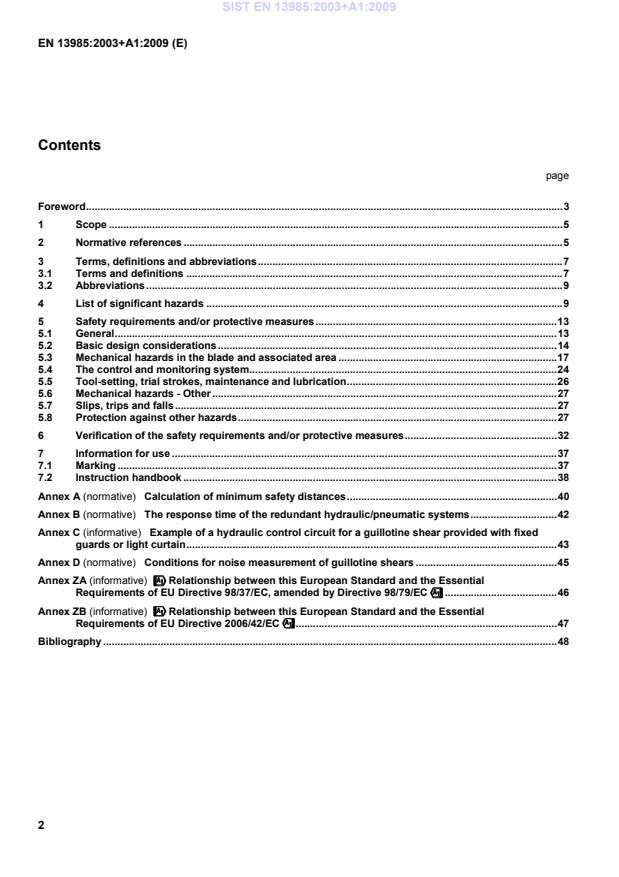
!!!!Relationship between this European Standard and the Essential Requirements of EU Directive 2006/42/EC"""" . 47 Bibliography . 48
The safety requirements related to the use of PES or PPS will be dealt with at its next revision. The European Standards produced by CEN/TC 143 are particular to machine tools and complement the relevant A and B standards on the subject of general safety (see introduction of EN 292-1:1991 for a description of A, B and C standards). Annexes A, B and D are normative. Annex C is informative. According to the CEN/CENELEC Internal Regulations, the national standards organizations of the following countries are bound to implement this European Standard: Austria, Belgium, Bulgaria, Cyprus, Czech Republic, Denmark, Estonia, Finland, France, Germany, Greece, Hungary, Iceland, Ireland, Italy, Latvia, Lithuania, Luxembourg, Malta, Netherlands, Norway, Poland, Portugal, Romania, Slovakia, Slovenia, Spain, Sweden, Switzerland and United Kingdom. SIST EN 13985:2003+A1:2009
0 Introduction This European Standard has been prepared to be a harmonised standard to provide one means of conforming to the essential safety requirements of the “Machinery“ Directive and associated EFTA Regulations. It is a C-type standard as described in EN 1070:1998. The machinery concerned and the extent to which hazards, hazardous situations and events are covered are indicated in the scope of this standard. When provisions of this C type standard are different from those which are stated in A or B standards, the provision of this C type standard take precedence over the provisions of the other standards for machines that have been designed and built according to the provisions of this C type standard. Complementary guidance is given in the A and B standards to which reference is made in the text (see clause 2). The figures are intended to be examples only and not to give the only interpretation of the text. The requirements of this European Standard concern designers, manufacturers, suppliers and importers of machines described in the scope. This standard also includes information to be provided by the manufacturer to the user.
Figure 1 — Guillotine shear 3.1.8 inching device; limited movement control device control device, the actuation of which permits only a limited amount of travel of a machine element, thus minimising risk as much as possible; further movement is precluded until there is subsequent and separate actuation of the control (see 3.23.8 of EN 292-1:1991) 3.1.9 monitoring safety function which ensures that a protective measure is initiated if the ability of a component or an element to perform its function is diminished, or if the process conditions are changed in such a way that hazards are generated (see 3.7.6 of EN 292-2:1991) 3.1.10 muting temporary automatic suspension of a safety function(s) by safety related parts of the control system (see 3.7 of EN 954-1:1996) SIST EN 13985:2003+A1:2009
EN 292-1:1991 Protective measures: relevant clauses in this standard 1.0 Mechanical hazards Generated by machine parts or work-pieces
Blades and associated area: 1.3 (except 1.3.6) 4.2
Generated by accumulation of energy inside the machinery caused, for example, by: – elastic elements (springs) – liquids and gases under pressure – between the moving blade and the work-piece – between the moving blade and the fixed blade – between moving and fixed parts of guillotine shear – between the table and work-piece – between the clamps and work-piece or table – between fixtures/positioning devices and work-piece – at power operated gauges – moving work-pieces,
1.5.3, 1.6.1, 1.6.3 4.2
5.2.6 5.5.2 5.3 5.5 1.1 Crushing hazard – ejection or falling of work-pieces at the rear of guillotine shear, 1.3 (except 1.3.6)
1.2 Shearing hazard – rear moving sheet supports, – rear sheet conveyor, – sheet stacking unit 1.4 (except 1.4.2.3), 1.5.14 4.2.1
1.3 Cutting of severing hazard From the hazardous event of falling objects
1.4 Entanglement hazard
1.5 Drawing-in or trapping hazard
1.6 Impact hazard Moving parts of electrical, hydraulic and pneumatic equipment Motor and drive machinery – moving flywheels, belts, pulleys and other motor driven parts Mechanical handling device 1.3 4.2.1 5.6 1.9 High pressure fluid injection or ejection hazard Hydraulic systems 1.3.2 4.2.1 5.8.3
(continued)
Table 1 (continued) No. Hazards Danger zone Relevant clauses in EN 292-2/A1:1995 Relevant clauses in
EN 292-1:1991 Protective measures: relevant clauses in this standard 2 Electrical hazards due to
2.1 Contact of persons with live parts (direct contact) Electrical equipment 1.5.1, 1.6.3 4.3 5.8.3 2.2 Contact of persons with parts which have become live under faulty conditions (indirect contact) Electrical equipment 1.5.1 4.3
3 Thermal hazards
3.1 Thermal hazards resulting in burns and scalds, by a possible contact of persons Parts of the hydraulic system 1.5.5, 1.5.6, 1.5.7 4.4 5.2.1.5, 5.8.2 4 Hazards generated by noise
4.1 Other physiological disorders (e.g. loss of balance, loss of awareness) hearing losses (deafness) Falling of work-pieces at the rear of guillotine shear
1.5.8 4.5 5.8.5, 7.2.2 g) 6 Hazards generated by radiation
6.5 Lasers Any area at the guillotine shear where there is a risk due to laser beam. 1.5.12 4.7 5.8.6 7.0 Hazards generated by materials and substances processed or used by machinery, for example:
5.8.7 7.1 Hazards from contact with or inhalation of harmful fluids, gases, mists, fumes and dusts Toxic materials used in the construction and intended use of the guillotine shear 1.1.3, 1.5.13, 1.6.5 4.8 5.8.7.1 5.8.7.2 5.8.7.3 8.0 Hazards generated by neglecting ergonomic principles in machinery design, as e.g. from:
8.1 Unhealthy postures or excessive effort
1.1.2 d), 1.1.5, 1.6.2, 1.6.4 4.9 5.8.8 8.2 Inadequate consideration of hand-arm or foot-leg anatomy
1.1.2 d), 2.2
8.4 Inadequate local lighting
1.1.4
5.8.8.3, 7.2.2d)
(continued)
Table 1 (continued) No. Hazards Danger zone Relevant clauses in EN 292-2/A1:1995 Relevant clauses in
EN 292-1:1991 Protective measures: relevant clauses in this standard 8.6 Human error, human behaviour
1.1.2 d), 1.2.2, 1.2.5, 1.2.8, 1.5.4, 1.7 4.9 5.4.5.1, 5.4.3, 5.4.6 8.7 Inadequate design, location or identification of manual controls
1.2.2
5.4.3, 5.4.4, 5.4.5, 5.8.8.2 8.8 Inadequate design or location of visual display units
1.7.1
5.8.8.2 10 Unexpected start-up, unexpected overrun/ over speed
10.1 Failure/disorder of the control system
Blades and associated area: 1.2.7, 1.6.3
5.2.1, 5.2.1.4, 5.2.1.7, 5.2.2, 5.4.1 10.2 Restoration of the energy supply after an interruption – between the moving blade and the work-piece – between the moving blade and the fixed blade – between the table and work-piece – between the clamps and work-piece or table – between fixtures/positioning devices and work-piece – safeguarding – at power operated gauges 1.2.6
5.4, 7.2.2 o)
(continued)
Table 1 (concluded) No. Hazards Danger zone Relevant clauses in EN 292-2/A1:1995 Relevant clauses in
EN 292-1:1991 Protective measures: relevant clauses in this standard 10.3 External influences on electrical equipment – ejection or falling of work-pieces at the rear of guillotine shear – rear moving sheet supports, 1.2.1, 1.5.11
5.4 10.4 Other external influences (gravity, wind etc.) – rear sheet conveyor, – sheet stacking unit 1.2.1
10.5 Errors in the software
1.2.1
5.4.2 10.6 Errors made by the operator (due to mismatch of machin-ery with human character-istics and abilities, see 8.6)
1.1.2 d), 1.2.2, 1.2.5, 1.2.8, 1.5.4, 1.7 4.9 7.2.2 13 Failure of the power supply see 10 1.2.6
5.2.1.12 14 Failure of the control circuit
1.2.1, 1.2.3, 1.2.4, 1.2.5, 1.2.7, 1.6.3
5.2.1.4 15 Errors of fitting Blades 1.5.4 4.9 5.5.1, 5.5.4 16 Break-up during operation Mechanical, electrical, hydrau-lic, and pneumatic equipment 1.3.2 4.2.2 5.2.1, 5.2.2 17 Falling or ejected objects or fluids Machine components Work-pieces and blades 1.3.3 4.2.2 5.2.6, 5.3.13, 5.6.4, 5.8.3 18 Loss of stability/ overturning of machinery Floor area around the guillotine shear 1.3.1 4.2.2 5.8.4 19 Slip, trip and fall of persons (related to machinery) All access and/or work at heights Floor area around the guillotine shear 1.5.15 4.2.3 5.7
5 Safety requirements and/or protective measures 5.1 General The guillotine shears covered by this standard range in size from small to large machines with a single operator or several operators. The methods or measures to be implemented to eliminate the significant hazards or reduce their associated risks are detailed in this clause in the following manner: basic design considerations for major guillotine components or systems (see 5.2); safeguarding against mechanical hazards in the blade area under different modes of production (see 5.3); protection against hazards due to control system or control component failures (see 5.4); safeguarding against hazards which can occur during setting, trial strokes, maintenance and lubrication (see 5.5); safeguarding against other hazards (see 5.6 to 5.8). SIST EN 13985:2003+A1:2009
Normally, a ratio of at least 3.5 to 1 between spring pressure in the brake and residual pressure in the cylinder is satisfactory. 5.2.2.12 Control valves and other control components (e.g. regulators, pressure gauges) shall be mounted in positions which provide accessibility and protection against damage. 5.2.2.13 Where valves are manually or mechanically (as distinct from electrically) operated, the arrangements for restoring the valves shall be positive (i.e. when the actuator of the valve is released, the valve shall automatically move to the safe position). See also 5.4.6. Any unintended movement due dissipation shall be avoided of stored energy according to EN 1037. NOTE
The safety position can be the open or closed position of a valve, depending upon the well-tried principles in the hydraulic or pneumatic circuit. SIST EN 13985:2003+A1:2009
EN 60529). 5.2.5.5 Arrangements shall be made to ensure that a short-circuit in the wiring outside the control cabinet (e.g. wiring to a foot pedal) shall not result in an unexpected start-up (see EN 1037). SIST EN 13985:2003+A1:2009
Key 1
Crushing hazard 2
Shear hazard 3
Moving blade 4
Moving clamp 5
Fixed guard
NOTE See Table 2 for values of A and B. Figure 2 — Feed opening in a fixed guard at the front side of a guillotine shear SIST EN 13985:2003+A1:2009
3a - Example of safeguarding using fixed guards SIST EN 13985:2003+A1:2009
Key
1 Machine 3 Detection zone 2 Light curtain 4 Table
3b - Example of safeguarding using light curtain Figure 3 — Guards fitted to guillotine shears to prevent front and side access 5.3.2 Guards and devices described in EN 292, EN 953,and 5.3.3.1, 5.3.5, 5.3.6.1 which are appropriate to the protection of any exposed person at the cutting area are listed below. Designers, manufacturers and suppliers shall provide wherever possible fixed guards to prevent access of exposed persons to the moving parts. Where fixed guarding is not practicable, designers, manufacturers, and suppliers shall select safeguarding methods which reduce the risks as far as possible, considering the principal hazards and the mode of production: a) interlocking guards (see EN 292, EN 953, EN 1088, 5.3.3.2, 5.3.3.3, 5.3.6.2); b) electro-sensitive protective devices (see EN 61496–1, pr EN 61496–2, 5.3.3.4, 5.3.6.3). SIST EN 13985:2003+A1:2009
EN 953 and 5.3.2, 5.3.5, 5.3.6.1. They shall be firmly secured to the machine. The openings giving access to danger zones and related safety distances of the fixed guard shall comply with Table 4 of EN 294:1992. The design of the fixed guard shall allow good visibility of the cutting line. Access shall be prevented to the danger zone via slots or grooves cut in the surface of the work table (see also Table 2). 5.3.3.3 Interlocking guards without guard locking Interlocking guards without guard locking shall comply with EN 953 and prevent, in conjunction with fixed guards, access to the danger zone (clamps, cutting line) during any hazardous movement. Initiation of the stroke shall be prevented until the guard gate is closed. The associated interlocking devices shall conform to EN 1088 and be designed and constructed in accordance with 6.2.2 of EN 1088:1995. The associated control system of the guillotine shear shall conform to category 4 of EN 954-1:1996. Interlocking guards without guard locking shall be placed in such a position that the operator does not have time to reach the danger zone before any hazardous movement in the tools area has ceased. Calculation of the safety distance shall be based on the overall response time of the guillotine shear coming to a stop and on the speed of movement of the operator. See EN 999 and annex A. 5.3.3.4 ESPE using AOPDs in the form light curtains ESPE using AOPDs in the form of light curtains shall comply with the following: a) light curtains and light beams shall conform to type 4 in accordance with 4.2.2.5 of EN 61496-1:1997, and be designed and constructed according to pr EN 61496-2:1997. The associated part of the control system of the guillotine shear shall conform to category 4 of EN 954-1:1996; b) access to the danger zone shall only be possible through the detection zone of the light curtain. Additional safeguarding shall prevent access to the danger zone from any other direc
...
Questions, Comments and Discussion
Ask us and Technical Secretary will try to provide an answer. You can facilitate discussion about the standard in here.
Loading comments...