

oSIST prEN 17422:2024
(Main)Chemical disinfectants and antiseptics - Quantitative surface test for the evaluation of teat disinfectants used in the veterinary area - Test method and requirements (phase 2 step 2)
General Information
- Abstract
This document specifies a test method and the minimum requirements for bactericidal activity of teat disinfectants that form a homogeneous, physically stable preparation when diluted with hard water or - in the case of ready-to-use products - with water.
This method applies to teat disinfectants that are used on teat skin without mechanical action as pre-milking and/or post-milking teat disinfectants in the veterinary area, e.g. in the breeding, husbandry, production, veterinary care facilities, transport and disposal of all animals except when in the food chain following death and entry into processing industry.
NOTE 1 The method described is intended to determine the activity of commercial formulations or active substances under the conditions in which they are used.
NOTE 2 This method corresponds to a phase 2 step 2 test.
- Status
- Not Published
- Public Enquiry End Date
- 01-Nov-2024
- Technical Committee
- KDS - Cosmetics, chemical disinfectants and surface active agents
- Current Stage
- 4020 - Public enquire (PE) (Adopted Project)
- Start Date
- 22-Aug-2024
- Due Date
- 09-Jan-2025
- Completion Date
- 30-Oct-2024

Overview
prEN 17422 (CEN) - Chemical disinfectants and antiseptics - Quantitative surface test for the evaluation of teat disinfectants used in the veterinary area (phase 2, step 2) - specifies a laboratory quantitative surface test and minimum bactericidal activity requirements for teat disinfectants. The method is intended for products that form a homogeneous, physically stable preparation when diluted with hard water (or with water for ready‑to‑use products) and are applied to teat skin without mechanical action as pre‑milking and/or post‑milking disinfectants.
Key topics and requirements
- Test scope: Veterinary teat disinfectants used in breeding, husbandry, production, veterinary care, transport and disposal of animals (excluding carcasses entering the food chain).
- Phase 2, step 2 test: Laboratory surface test simulating practical application conditions (contact time, temperature, interfering substances).
- Minimum efficacy thresholds:
- Post‑milking disinfectants: ≥ 4 log10 reduction vs water control under simulated soiling (10.0 g/L skimmed milk).
- Pre‑milking disinfectants: ≥ 3 log10 reduction vs water control under simulated soiling (3.0 g/L bovine albumin).
- Mandatory test organisms: Escherichia coli and Staphylococcus aureus (with option to include relevant additional organisms).
- Test conditions:
- Test temperature: 30 °C ± 1 °C
- Contact times: Pre‑milking minimum 30 s (max 3 min); Post‑milking minimum 1 min (max 5 min)
- Method highlights: Inoculation of a synthetic skin surface with bacteria + interfering substance, conditioning, immersion in product, neutralization, ultrasonic removal and quantitative viable counts of survivors. Controls, neutralizers and verification steps are required to ensure valid results.
- Outcome reporting: Reduction calculations, precision/repetition requirements, limiting organism determination and a standardized test report.
Applications and who uses it
- Manufacturers of teat disinfectants and antiseptic formulations - for product development, claim substantiation and labeling.
- Accredited microbiology and conformity testing laboratories - to perform standardized efficacy testing (phase 2, step 2).
- Regulatory authorities and procurement bodies - to assess product suitability for on‑farm use.
- Veterinary services, dairy producers and quality assurance teams - to select and validate effective pre‑milking and post‑milking teat disinfection products.
Related standards
- EN 17422:2022 (to be superseded by prEN 17422:2024)
- EN 14885 - application of European standards for chemical disinfectants and antiseptics
- EN 12353 - preservation of test organisms
Keywords: prEN 17422, teat disinfectants, quantitative surface test, phase 2 step 2, CEN, bactericidal activity, veterinary disinfection, pre‑milking, post‑milking, E. coli, Staphylococcus aureus.
Relations
- Effective Date
- 28-Jan-2026
- Effective Date
- 01-Oct-2024
Get Certified
Connect with accredited certification bodies for this standard

BSI Group
BSI (British Standards Institution) is the business standards company that helps organizations make excellence a habit.

TÜV Rheinland
TÜV Rheinland is a leading international provider of technical services.

TÜV SÜD
TÜV SÜD is a trusted partner of choice for safety, security and sustainability solutions.
Sponsored listings
Frequently Asked Questions
oSIST prEN 17422:2024 is a draft published by the Slovenian Institute for Standardization (SIST). Its full title is "Chemical disinfectants and antiseptics - Quantitative surface test for the evaluation of teat disinfectants used in the veterinary area - Test method and requirements (phase 2 step 2)". This standard covers: This document specifies a test method and the minimum requirements for bactericidal activity of teat disinfectants that form a homogeneous, physically stable preparation when diluted with hard water or - in the case of ready-to-use products - with water. This method applies to teat disinfectants that are used on teat skin without mechanical action as pre-milking and/or post-milking teat disinfectants in the veterinary area, e.g. in the breeding, husbandry, production, veterinary care facilities, transport and disposal of all animals except when in the food chain following death and entry into processing industry. NOTE 1 The method described is intended to determine the activity of commercial formulations or active substances under the conditions in which they are used. NOTE 2 This method corresponds to a phase 2 step 2 test.
This document specifies a test method and the minimum requirements for bactericidal activity of teat disinfectants that form a homogeneous, physically stable preparation when diluted with hard water or - in the case of ready-to-use products - with water. This method applies to teat disinfectants that are used on teat skin without mechanical action as pre-milking and/or post-milking teat disinfectants in the veterinary area, e.g. in the breeding, husbandry, production, veterinary care facilities, transport and disposal of all animals except when in the food chain following death and entry into processing industry. NOTE 1 The method described is intended to determine the activity of commercial formulations or active substances under the conditions in which they are used. NOTE 2 This method corresponds to a phase 2 step 2 test.
oSIST prEN 17422:2024 is classified under the following ICS (International Classification for Standards) categories: 11.080.20 - Disinfectants and antiseptics; 11.220 - Veterinary medicine; 71.100.35 - Chemicals for industrial and domestic disinfection purposes. The ICS classification helps identify the subject area and facilitates finding related standards.
oSIST prEN 17422:2024 has the following relationships with other standards: It is inter standard links to SIST EN ISO 21970-2:2019, SIST EN 17422:2022. Understanding these relationships helps ensure you are using the most current and applicable version of the standard.
oSIST prEN 17422:2024 is available in PDF format for immediate download after purchase. The document can be added to your cart and obtained through the secure checkout process. Digital delivery ensures instant access to the complete standard document.
Standards Content (Sample)
SLOVENSKI STANDARD
01-oktober-2024
Kemična razkužila in antiseptiki - Kvantitativni površinski preskus brez
mehanskega delovanja za vrednotenje razkužil za seske v veterini - Preskusna
metoda in zahteve (faza 2, stopnja 2)
Chemical disinfectants and antiseptics - Quantitative surface test for the evaluation of
teat disinfectants used in the veterinary area - Test method and requirements (phase 2
step 2)
Chemische Desinfektionsmittel und Antiseptika - Quantitativer Oberflächenversuch zur
Beurteilung von Zitzendesinfektionsmittel für den Veterinärbereich - Prüfverfahren und
Anforderungen (Phase 2, Stufe 2)
Antiseptiques et désinfectants chimiques - Essai quantitatif de surface pour l’évaluation
des désinfectants de trayons utilisés dans le domaine vétérinaire - Méthode d’essai et
prescriptions (phase 2, étape 2)
Ta slovenski standard je istoveten z: prEN 17422
ICS:
11.080.20 Dezinfektanti in antiseptiki Disinfectants and antiseptics
11.220 Veterinarstvo Veterinary medicine
2003-01.Slovenski inštitut za standardizacijo. Razmnoževanje celote ali delov tega standarda ni dovoljeno.
DRAFT
EUROPEAN STANDARD
NORME EUROPÉENNE
EUROPÄISCHE NORM
August 2024
ICS 71.100.35 Will supersede EN 17422:2022
English Version
Chemical disinfectants and antiseptics - Quantitative
surface test for the evaluation of teat disinfectants used in
the veterinary area - Test method and requirements
(phase 2 step 2)
Antiseptiques et désinfectants chimiques - Essai Chemische Desinfektionsmittel und Antiseptika -
quantitatif de surface pour l'évaluation des Quantitativer Oberflächenversuch zur Beurteilung von
désinfectants de trayons utilisés dans le domaine Zitzendesinfektionsmittel für den Veterinärbereich -
vétérinaire - Méthode d'essai et prescriptions (phase 2, Prüfverfahren und Anforderungen (Phase 2, Stufe 2)
étape 2)
This draft European Standard is submitted to CEN members for enquiry. It has been drawn up by the Technical Committee
CEN/TC 216.
If this draft becomes a European Standard, CEN members are bound to comply with the CEN/CENELEC Internal Regulations
which stipulate the conditions for giving this European Standard the status of a national standard without any alteration.
This draft European Standard was established by CEN in three official versions (English, French, German). A version in any other
language made by translation under the responsibility of a CEN member into its own language and notified to the CEN-CENELEC
Management Centre has the same status as the official versions.
CEN members are the national standards bodies of Austria, Belgium, Bulgaria, Croatia, Cyprus, Czech Republic, Denmark, Estonia,
Finland, France, Germany, Greece, Hungary, Iceland, Ireland, Italy, Latvia, Lithuania, Luxembourg, Malta, Netherlands, Norway,
Poland, Portugal, Republic of North Macedonia, Romania, Serbia, Slovakia, Slovenia, Spain, Sweden, Switzerland, Türkiye and
United Kingdom.
Recipients of this draft are invited to submit, with their comments, notification of any relevant patent rights of which they are
aware and to provide supporting documentation.
Warning : This document is not a European Standard. It is distributed for review and comments. It is subject to change without
notice and shall not be referred to as a European Standard.
EUROPEAN COMMITTEE FOR STANDARDIZATION
COMITÉ EUROPÉEN DE NORMALISATION
EUROPÄISCHES KOMITEE FÜR NORMUNG
CEN-CENELEC Management Centre: Rue de la Science 23, B-1040 Brussels
© 2024 CEN All rights of exploitation in any form and by any means reserved Ref. No. prEN 17422:2024 E
worldwide for CEN national Members.
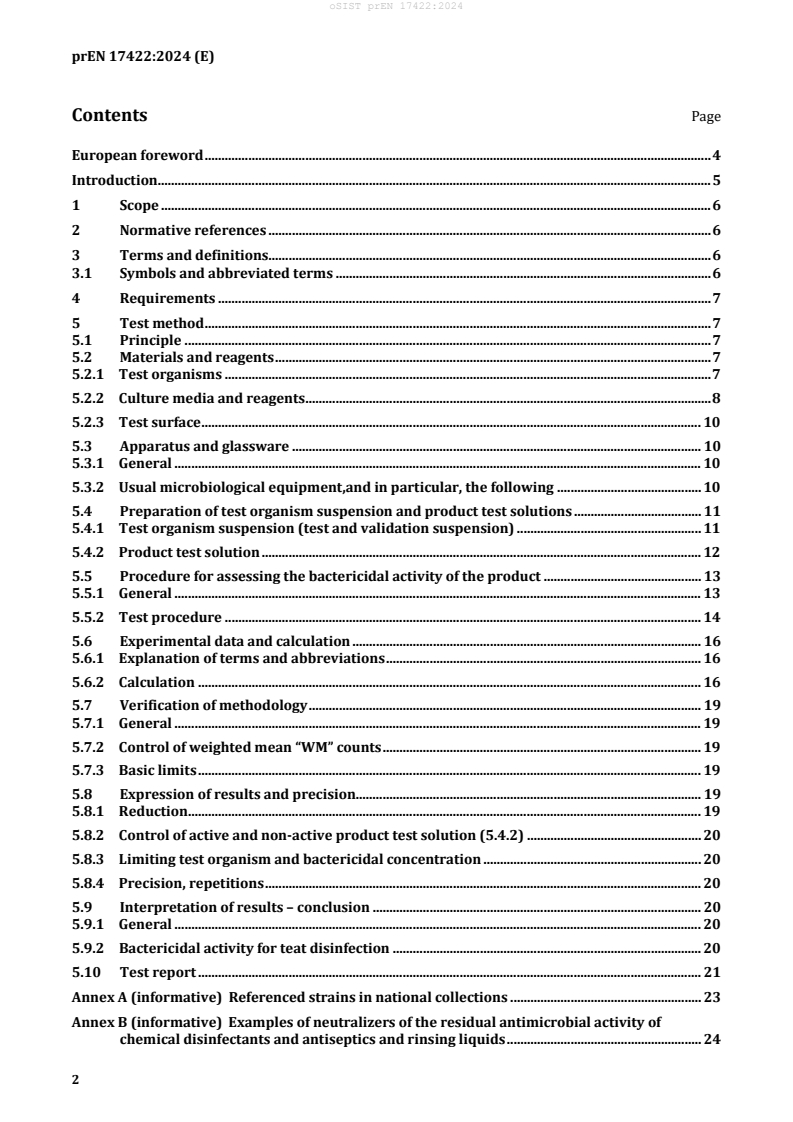
Contents Page
European foreword . 4
Introduction. 5
1 Scope . 6
2 Normative references . 6
3 Terms and definitions. 6
3.1 Symbols and abbreviated terms . 6
4 Requirements . 7
5 Test method . 7
5.1 Principle . 7
5.2 Materials and reagents . 7
5.2.1 Test organisms . 7
5.2.2 Culture media and reagents . 8
5.2.3 Test surface . 10
5.3 Apparatus and glassware . 10
5.3.1 General . 10
5.3.2 Usual microbiological equipment,and in particular, the following . 10
5.4 Preparation of test organism suspension and product test solutions . 11
5.4.1 Test organism suspension (test and validation suspension) . 11
5.4.2 Product test solution . 12
5.5 Procedure for assessing the bactericidal activity of the product . 13
5.5.1 General . 13
5.5.2 Test procedure . 14
5.6 Experimental data and calculation . 16
5.6.1 Explanation of terms and abbreviations . 16
5.6.2 Calculation . 16
5.7 Verification of methodology . 19
5.7.1 General . 19
5.7.2 Control of weighted mean “WM” counts . 19
5.7.3 Basic limits . 19
5.8 Expression of results and precision. 19
5.8.1 Reduction. 19
5.8.2 Control of active and non-active product test solution (5.4.2) . 20
5.8.3 Limiting test organism and bactericidal concentration . 20
5.8.4 Precision, repetitions . 20
5.9 Interpretation of results – conclusion . 20
5.9.1 General . 20
5.9.2 Bactericidal activity for teat disinfection . 20
5.10 Test report . 21
Annex A (informative) Referenced strains in national collections . 23
Annex B (informative) Examples of neutralizers of the residual antimicrobial activity of
chemical disinfectants and antiseptics and rinsing liquids . 24
Annex C (informative) Example of a typical test report . 25
Bibliography . 28
European foreword
This document (prEN 17422:2024) has been prepared by Technical Committee CEN/TC 216 “Chemical
disinfectants and antiseptics”, the secretariat of which is held by AFNOR.
This document will supersede EN 17422:2022.
This document was revised to harmonize the milk soiling levels, clarify terms and abbreviations and
provide clearer definitions around the calculations.
Introduction
This document specifies a surface test for establishing whether a chemical disinfectant or antiseptic has
a bactericidal activity in the fields described in the scope.
This laboratory test takes into account practical conditions of application of the product, including
contact time, temperature, test organisms and interfering substances, i.e. conditions which may influence
its action in practical situations.
The conditions are intended to cover general purposes and to allow reference between laboratories and
product types. Each utilization concentration of the chemical disinfectant or antiseptic found by this test
corresponds to defined experimental conditions. However, for some applications the recommendations
of use of a product may differ and therefore additional test conditions need to be used.
1 Scope
This document specifies a test method and the minimum requirements for bactericidal activity of teat
disinfectants that form a homogeneous, physically stable preparation when diluted with hard water or
— in the case of ready-to-use products — with water.
This method applies to teat disinfectants that are used on teat skin without mechanical action as pre-
milking and/or post-milking teat disinfectants in the veterinary area, e.g. in the breeding, husbandry,
production, veterinary care facilities, transport and disposal of all animals except when in the food chain
following death and entry into processing industry.
NOTE 1 The method described is intended to determine the activity of commercial formulations or active
substances under the conditions in which they are used.
NOTE 2 This method corresponds to a phase 2 step 2 test.
2 Normative references
The following documents are referred to in the text in such a way that some or all of their content
constitutes requirements of this document. For dated references, only the edition cited applies. For
undated references, the latest edition of the referenced document (including any amendments) applies.
EN 12353, Chemical disinfectants and antiseptics — Preservation of test organisms used for the
determination of bactericidal (including Legionella), mycobactericidal, sporicidal, fungicidal and virucidal
(including bacteriophages) activity
EN 14885, Chemical disinfectants and antiseptics — Application of European Standards for chemical
disinfectants and antiseptics
3 Terms and definitions
For the purposes of this document, the terms and definitions given in EN 14885 apply.
ISO and IEC maintain terminology databases for use in standardization at the following addresses:
• IEC Electromedical: available at https://www.electropedia.org/
• ISO Online browsing platform: available at https://www.iso.org/obp/
3.1 Symbols and abbreviated terms
N Test suspension
Na Test suspension + Interference substance
Nv Validation suspension
Nw Water control
B Control B
C Control C
Vc Viable count
NUw Used water
NUd Used disinfectant
Nws Water control surface
Nts Test surface
4 Requirements
The product shall demonstrate at least a 4 decimal log (lg) (post-milking disinfectant) or 3 decimal log
(lg) (pre-milking disinfectant) reduction from a water control, when tested in accordance with Table 1
and Clause 5 under simulated soiling (10,0 g/l skimmed milk for post-milking teat disinfectants, 3,0 g/l
bovine albumin for pre-milking teat disinfectants).
Table 1 — Test Conditions
Bactericidal activity on synthetic skin
Test Conditions
without mechanical action
Escherichia coli
Minimum spectrum of test
organisms
Staphylococcus aureus
Additional Any relevant test organism
Test temperature 30 °C ± 1 °C
Contact time Pre-milking teat Post-milking teat
disinfectants disinfectants
Minimum contact time
30 s ± 5 s 1 min ± 5 s
Pre-milking teat Post-milking teat
disinfectants disinfectants
Maximum contact time
3 min ± 10 s 5 min ± 10 s
Other contact times may be selected at intervals of 30 s for contact times up to
1 min and at intervals of 1 min for contact times > 1 min
Interfering substance
10,0 g/l milk powder
Post-milking teat disinfectants
3,0 g/l bovine albumin
Pre-milking teat disinfectants
5 Test method
5.1 Principle
A test suspension of bacteria mixed with interfering substance (5.2.2.7) is inoculated onto a synthetic
skin test surface and maintained at 30 °C for a period of conditioning.
After this conditioning time, the test surface is immersed in the product or dilutions of the product at
30 °C for 30 s soaking time, removed, and incubated at 30°C for the remaining defined period of time
specified in Table 1. At the end of that contact time, the surface is transferred into neutralizer so that the
action of the disinfectant is immediately neutralized. At the same time an aliquot of the used disinfectant
is sampled and neutralized as well.
The bacteria are removed from the surface by ultrasound treatment. The numbers of surviving bacteria
which can be recovered from the surface are determined quantitatively. The numbers of surviving
bacteria in the used disinfectant are determined quantitatively.
The number of bacteria on a surface treated with water in place of the disinfectant is also determined and
the reduction is calculated.
5.2 Materials and reagents
5.2.1 Test organisms
The bactericidal activity shall be evaluated using the following strains as test organisms:
- Escherichia coli
- Staphylococcus aureus
NOTE Refer to Annex A for strain references in other culture collections.
The required incubation temperature for these test organisms is 36 °C ± 1 °C or 37 °C ± 1 °C (5.3.2.3).
The same temperature (either 36 °C or 37 °C) shall be used for all growth incubations performed during
a test and its control and validation.
If additional test organisms are used, they shall be incubated under optimum growth conditions
(temperature, time, atmosphere, media) noted in the test report. If the additional test organisms selected
do not correspond to the specified strains, their suitability for supplying the required inocula shall be
verified. If these additional test organisms are not classified at a reference centre, their identification
characteristics shall be stated. In addition, they shall be held by the testing laboratory or national culture
collection under a reference for five years.
5.2.2 Culture media and reagents
5.2.2.1 General
All weights of chemical substances given in this document refer to the anhydrous salts. Hydrated forms
may be used as an alternative, but the weights required shall be adjusted to allow for consequent
molecular weight differences.
The reagents shall be of analytical grade and/or appropriate for microbiological purposes. They shall be
free from substances that are toxic or inhibitory to the test organisms.
If additional strains do not grow on the media (5.2.2.3) or cannot be used with diluent (5.2.2.4) additional
media shall be used and shall be reported as well as additional incubation conditions.
To improve reproducibility, it is recommended that commercially available dehydrated material is used
for the preparation of culture media. The manufacturers’ instructions relating to the preparation of these
products should be rigorously followed.
A ready-to-use media may be used if it complies with the required specification.
For each culture medium and reagent, a time limitation for use should be fixed.
5.2.2.2 Water
The water shall be freshly glass-distilled water and not demineralized water. If distilled water of adequate
quality is not available, water for injections (see bibliographic reference [2]) may be used.
Sterilize in the autoclave [5.3.2.1 a)]. Sterilization is not necessary if the water is used e.g. for preparation
of culture media and subsequently sterilized.
5.2.2.3 Tryptone soya agar (TSA)
Tryptone soya agar, consisting of:
Tryptone, pancreatic digest of casein 15,0 g;
Soya peptone, papaic digest of soybean meal 5,0 g;
Sodium chloride (NaCl) 5,0 g;
Agar 15,0 g;
Water (5.2.2.2) to 1 000,0 ml.
Sterilize in the autoclave [5.3.2.1 a)].
After sterilization the pH of the medium shall be equivalent to 7,2 ± 0,2 when measured at (20 ± 1) °C.
In case of encountering problems with neutralization (5.5.1.2 and 5.5.1.3), it may be necessary to add
neutralizer to the TSA. Annex B, Table B.1 gives guidance on the neutralizers that may be used. It is
recommended not to use a neutralizer that causes opalescence in the agar.
5.2.2.4 Diluent
Tryptone sodium chloride solution, consisting of:
Tryptone, pancreatic digest of casein 1,0 g;
Sodium chloride (NaCl) 8,5 g;
Water (5.2.2.2) to 1 000,0 ml
Sterilize in the autoclave [5.3.2.1 a)].
After sterilization, the pH of the diluent shall be equivalent to 7,0 ± 0,2 when measured at (20 ± 1) °C.
5.2.2.5 Neutralizer
The neutralizer shall be validated for the product being tested in accordance with 5.5.1.2. The neutralizer
shall be sterile.
NOTE Information on neutralizers that have been found to be suitable for some categories of products is given
in Annex B.
5.2.2.6 Hard water for dilution of products
For the preparation of 1 000 ml of hard water, the procedure is as follows:
— Prepare solution A: dissolve 19,84 g magnesium chloride (MgCl ) and 46,24 g calcium chloride
(CaCl ) in water (5.2.2.2) and dilute to 1 000 ml. Sterilize by membrane filtration (5.3.2.7) or in the
autoclave [5.3.2.1a)]. Autoclaving – if used - may cause a loss of liquid. In this case make up to 1
000 ml with water (5.2.2.2) under aseptic conditions. Store the solution in the refrigerator (5.3.2.8)
for no longer than one month.
— Prepare solution B: dissolve 35,02 g sodium bicarbonate (NaHCO ) in water (5.2.2.2) and dilute to 1
000 ml. Sterilize by membrane filtration (5.3.2.7). Store the solution in the refrigerator (5.3.2.8) for
no longer than one week.
Place 600 ml to 700 ml of water (5.2.2.2) in a 1 000 ml volumetric flask (5.3.2.12) and add 6,0 ml of
solution A, then 8,0 ml of solution B. Mix and dilute to 1 000 ml with water (5.2.2.2). The pH of the hard
water shall be 7,0 ± 0,2, when measured at (20 ± 1) °C (5.3.2.4). If necessary, adjust the pH by using a
solution of approximately 40 g/l (about 1 mol/l) of sodium hydroxide (NaOH) or approximately 36,5 g/l
(about 1 mol/l) of hydrochloric acid (HCl).
The hard water shall be freshly prepared under aseptic conditions and used within 12 h.
NOTE When preparing the product test solutions (5.4.2), the addition of the product to the hard water
produces different final water hardness in each test tube. In any case the final hardness expressed as calcium
carbonate (CaCO3) is in the test tube lower than 375 mg/l.
5.2.2.7 Interfering substances
5.2.2.7.1 General
Interfering substances shall be sterile and prepared at 2 times the final concentration in the test.
NOTE The term ‘interfering substance’ is used even if it contains more than one substance.
5.2.2.7.2 Skimmed milk
Prepare a solution of 20 g milk-powder guaranteed free of antibiotics and additives in 1 000 ml water
(5.2.2.2).
+3 +3
Heat for 30 min at 105 °C (or 5 min at 121 °C).
0 0
The final concentration in the test procedure (5.5) is 10 g/l milk powder.
5.2.2.7.3 Bovine albumin solution
Dissolve 0,6 g of bovine albumin fraction V (suitable for microbiological purposes) in 90 ml of water
(5.2.2.2) in a 100 ml volumetric flask. Make up to the mark with water (5.2.2.2).
Sterilize by membrane filtration (5.3.2.7). Keep in the refrigerator (5.3.2.8) at (5 ± 3) °C and use within
one month.
The final concentration of the bovine albumin in the test procedure (5.5.2) is 3 g/l.
5.2.3 Test surface
5.2.3.1 Synthetic skin
Handle skin with sterile tweezers/implements. Eight pieces are used for each test: 3 for the test dilutions,
1 for the water control, 1 for control B, 2 for control C (1 inoculated and 1 un-inoculated) and 1 for a
sterility check.
Mark with a pencil and ruler on the outside of the sealed skin packet eight 2 × 2 cm squares (per test).
Cut using sterile scissors and re-hydrate for 16 to 24 h before use (follow instructions provided from the
supplier). When ready to start the test, place each piece in a sterile wide necked vessel, with lid on.
NOTE Two types of synthetic skin were assessed in a ring trial with no significant difference in performance.
One of the two tested types, VITRO-SKIN ® , is commercially available. Other synthetic skins can become available
and can be used if it is shown that they give comparable results to the one referenced in this document.
5.3 Apparatus and glassware
5.3.1 General
Sterilize all glassware and parts of the apparatus that will come into contact with the culture media and
reagents or the sample, except those which are supplied sterile, by one of the following methods:
a) by moist heat, in an autoclave [5.3.2.1a)];
b) by dry heat, in a hot air oven [5.3.2.1b)].
5.3.2 Usual microbiological equipment ,and in particular, the following
5.3.2.1 Apparatus for sterilization (dry and moist heat):
+3
a) for moist heat sterilization, an autoclave capable of being maintained at ( 121 ) °C for a minimum
holding time of 15 min;
+3
b) for dry heat sterilization, a hot air oven capable of being maintained at ( 180 ) °C for a minimum
+5 +5
holding time of 30 min, at ( 170 ) °C for a minimum holding time of 1 h or at ( 160 ) °C for a
0 0
minimum holding time of 2 h.
5.3.2.2 Water bath, capable of being controlled at (20 ± 1) °C, (30 ± 1) °C, and (45 ± 1) °C.
VITRO-SKIN ® is a trademark of IMS Inc. This information is given for the convenience of users of this document
and does not constitute an endorsement by CEN of the product named.
Disposable sterile equipment is an acceptable alternative to reusable glassware.
5.3.2.3 Incubator, capable of being controlled at (30 ± 1) °C, (36 ± 1) °C or (37 ± 1) °C.
5.3.2.4 pH-meter, having an inaccuracy of calibration of no more than ± 0,1 pH units at (20 ± 1) °C.
A puncture electrode or a flat membrane electrode should be used for measuring the pH of the agar-
media.
5.3.2.5 Stopwatch
5.3.2.6 Shakers
a) Electromechanical agitator, e.g. vortex mixer;
b) Mechanical shaker.
5.3.2.7 Membrane filtration apparatus, constructed of a material compatible with the substances
to be filtered with a filter holder of at least 50 ml volume and suitable for use with filters of diameter
47 mm to 50 mm and 0,45 µm pore size for sterilization of hard water (5.2.2.6) and bovine albumin
(5.2.2.7.3).
5.3.2.8 Refrigerator, capable of being controlled at (5 ± 3) °C.
5.3.2.9 Graduated pipettes of nominal capacities 10 ml, 1 ml, 0,1 ml and 0,05 ml or calibrated
automatic pipettes.
5.3.2.10 Petri dishes, (plates) of size 90 mm to 100 mm.
5.3.2.11 Glass beads (diameter 3 mm to 4 mm).
5.3.2.12 Volumetric flasks
5.3.2.13 Ultrasonic bath, capable of operating at a frequency 30 kHz to 55 kHz, maximal output
1 000 W.
5.4 Preparation of test organism suspension and product test solutions
5.4.1 Test organism suspension (test and validation suspension)
5.4.1.1 General
NOTE The test and validation suspensions are the same in this document.
For each test, one suspension shall be prepared: this is used as the bacterial “test suspension” to perform
the test and the “validation suspension” to perform the controls and method validation.
5.4.1.2 Preservation and stock cultures of test organisms
The test organisms and their stock cultures shall be prepared and kept in accordance with EN 12353.
5.4.1.3 Working culture of test organisms
In order to prepare the working culture of test organisms, prepare a subculture from the stock culture by
streaking onto TSA slopes or plates and incubate. After 18 h to 24 h prepare a second subculture from the
first subculture in the same way and incubate for 18 h to 24 h. From this second subculture, a third
subculture may be produced in the same way. The second and (if produced) third subculture are the
working cultures.
If it is not possible to prepare the second subculture on a particular day, a 48 h subculture may be used
for subsequent sub-culturing, provided that the subculture has been kept in the incubator (5.3.2.3) during
the 48 h period. In these circumstances, prepare a further 24 h subculture before proceeding.
Never produce and use a fourth subculture.
5.4.1.4 Test suspension (“N”)
a) Take 10 ml of diluent and place in a 100 ml flask with 5 g of glass beads. Take the working culture
and transfer loopfuls of the cells into the diluent. The cells should be suspended in the diluent by
rubbing the loop against the wet wall of the flask to dislodge the cells before immersing in the diluent.
Shake the flask for 3 min using a mechanical shaker. Aspirate the suspension from the glass beads
and transfer to a tube.
9 3 9
b) Adjust the number of cells in the suspension to 1,5 × 10 cfu/ml to 5,0 × 10 cfu/ml using diluent,
estimating the number of cfu/ml by any suitable means. Maintain this test suspension in the water
bath at (20 ± 1) °C and use within 2 h. The use of a spectrophotometer for adjusting the number of
cells is highly recommended (about 620 nm wavelength – cuvette 10 mm path length). To achieve
reproducible results of this measurement it may be necessary to dilute the test suspension.
NOTE A colourimeter is a suitable alternative.
−7 −8
c) For counting prepare 10 and 10 dilutions of the test suspension using diluent.
Mix [5.3.2.6 a)].
Take a sample of 1,0 ml of each dilution in duplicate and inoculate using the pour plate or the spread plate
technique.
1) When using the pour plate technique, transfer each 1,0 ml sample into separate Petri dishes and add
15 ml to 20 ml melted TSA (5.2.2.3), cooled to (45 ± 1) °C.
2) When using the spread plate technique, spread each 1,0 ml sample – divided into portions of
approximately equal size - on an appropriate number (at least two) of surface dried plates containing
TSA.
For incubation and counting see 5.4.1.5.
5.4.1.5 Incubation and counting of the test suspension
Incubate (5.3.2.3) the plates for 20 h to 24 h. Discard any plates that are not countable (for any reason).
Count the plates and determine the total number of cfu. Incubate the plates for a further 20 h to 24 h. Do
not recount plates that no longer show well-separated colonies. Recount the remaining plates. If the
number has increased, use only the higher number for further evaluation.
Note for each plate the exact number of colonies but record > 330 for any counts higher than 330 and
determine the Vc values according to 5.6.2.2.
Calculate the numbers of cfu per 1 ml in the test suspension N (5.6.2.3).
5.4.2 Product test solution
Product test solutions shall be prepared in hard water (5.2.2.6) at a minimum of three different
concentrations to include one concentration in the active range and one concentration in the non-active
range (5.8.2). The product, as received, may be used as one of the product test solutions. Dilutions of
ready-to-use products, i.e. products that are not diluted when applied, shall be prepared in water (5.2.2.2)
instead of hard water.
For solid products, dissolve the product as received by weighing at least 1,0 g ± 10 mg of the product in a
volumetric flask and filling up with hard water (5.2.2.6). Subsequent dilutions (i.e. lower concentrations)
shall be prepared in volumetric flasks (5.3.2.12) on a volume/volume basis in hard water (5.2.2.6).
cfu/ml = colony forming unit per millilitre
For liquid products, dilutions of the product shall be prepared with hard water (5.2.2.6) in volumetric
flasks (5.3.2.12) on a volume/volume basis.
The product test solutions shall be prepared freshly and used in the test within 2 h. They shall give a
physically homogenous preparation, stable during the whole procedure.
The concentration of the product stated in the test report shall be the desired test concentration. Record
the test concentration in terms of mass per volume or volume per volume and details of the product
sample as received.
5.5 Procedure for assessing the bactericidal activity of the product
5.5.1 General
5.5.1.1 Experimental conditions
Besides the specified temperature, contact time, interfering substance and test organisms, additional
experimental conditions may be selected according to the practical use considered for the product
(Clause 4):
a) temperature (in °C):
The obligatory temperatur
...