

SIST EN 474-1:2022
(Main)Earth-moving machinery - Safety - Part 1: General requirements
General Information
- Abstract
This document specifies the general safety requirements for earth-moving machinery, hereinafter also referred to as machines, described in EN ISO 6165:2012, except horizontal directional drills.
NOTE 1 Horizontal directional drills are covered by EN 16228 1 and EN 16228 3.
This document gives the common safety requirements for earth-moving machinery families (see EN ISO 6165:2012, 3.4) and is intended to be used in conjunction with relevant parts of EN 474-2 to EN 474-13. These machine specific parts (EN 474 2 to EN 474−13) do not repeat the requirements from EN 474 1:2022 but supplement or modify the requirements for the family in question.
NOTE 2 The requirements specified in this part of the standard are common to two or more families of earth- moving machinery.
This document does not provide requirements for main electrical circuits and drives of machinery when the primary source of energy is an external electrical supply.
This document does not provide performance requirements for safety related functions of control system(s).
This document does not deal with towing of trailers.
This document does not deal with demolition machinery.
This document deals with significant hazards, hazardous situations and events relevant to earth-moving machinery, when used as intended and under conditions foreseen but also taking into account any reasonably foreseeable misuse thereof (see Annex A).
The following significant and relevant hazards are not covered in this document:
— Laser;
— Lightning.
This document specifies the appropriate technical measures to reduce risks arising from the significant hazards, hazardous situations and events during the whole foreseeable lifecycle of the machinery as described in EN ISO 12100:2010, 5.4.
This document is not applicable to earth-moving machinery which are manufactured before the date of publication of this document by CEN.
NOTE 3 For travelling on public roads, national traffic regulations apply (e.g. braking, steering, lighting, towing, etc.) until harmonized requirements are available.
- Status
- Published
- Public Enquiry End Date
- 21-Jun-2017
- Publication Date
- 11-Apr-2022
- Technical Committee
- I13 - Imaginarni 13
- Current Stage
- 6060 - National Implementation/Publication (Adopted Project)
- Start Date
- 06-Apr-2022
- Due Date
- 11-Jun-2022
- Completion Date
- 12-Apr-2022
- Directive
- 2006/42/EC - Directive 2006/42/EC of the European Parliament and of the Council of 17 May 2006 on machinery, and amending Directive 95/16/EC (recast)OJ Ref: OJ L 194, C, OMEJITEV***- 2026/546, UMIK 20.1.2027 OJ Date: 02-Aug-2023 Conflicting Date: 20-Jan-2027

Overview
SIST EN 474-1:2022 - Earth-moving machinery: Safety - Part 1: General requirements defines the common safety framework for earth‑moving machines described in EN ISO 6165:2012 (except horizontal directional drills). It provides general technical safety requirements, risk‑reduction measures and verification and information obligations that apply across two or more families of earth‑moving machinery. SIST EN 474-1:2022 is intended to be used together with the machine‑specific parts EN 474‑2 to EN 474‑13.
Key exclusions and scope notes:
- Excludes horizontal directional drills (covered by EN 16228‑1 / EN 16228‑3), demolition machinery, towing of trailers and main electrical circuits/drives when the primary energy source is an external electrical supply.
- Does not set performance requirements for safety‑related control system functions.
- Covers hazards during the whole foreseeable lifecycle per EN ISO 12100:2010.
- Some hazards (e.g., laser, lightning) are explicitly not covered.
Key topics and technical requirements
SIST EN 474-1:2022 organizes general safety measures across machine design, operation and documentation. Major topics include:
- Access and operator’s station design, seating and operator controls/indicators
- Steering and brake systems for travelling
- Visibility, horns and machine safety labelling
- Tyres, rims and machine stability
- Lifting operations, lifting devices and quick coupler requirements
- Hydraulic systems, fuel/DEF tanks and pressure vessels
- Electrical/electronic systems and electromagnetic compatibility (EMC) (note: main external electrical drives excluded)
- Fire protection, noise, protective devices and maintenance
- Recovery, towing away for recovery purposes (TARP), tying‑down, lifting and transport
- Underground operation (non‑explosive atmospheres) and speed limits for non‑riding machines
- Verification methods, operator’s manual and required machine marking and safety labels
- Normative and informative annexes (e.g., significant hazards list, requirements for movable operator’s stations, lifting devices, underground use, and relationship to Directive 2006/42/EC)
Practical applications - who uses this standard
SIST EN 474-1:2022 is designed for:
- Machine manufacturers developing or certifying earth‑moving equipment
- Design engineers and safety specialists performing risk assessments and design verification
- Regulators, market surveillance and health & safety bodies evaluating conformity
- Maintenance/service providers and fleet owners implementing safe operation and documentation
- Employers and operators using earth‑moving machinery in construction, mining, civil engineering and public works
Applying SIST EN 474-1 together with the relevant EN 474 part helps demonstrate conformity with EU machinery safety requirements and supports harmonized safety documentation and CE conformity procedures when cited in the Official Journal.
Related standards and references
- EN ISO 6165:2012 (machine classification/families)
- EN 474‑2 to EN 474‑13 (machine‑specific requirements)
- EN ISO 12100:2010 (risk assessment and lifecycle considerations)
- EN 16228‑1 / EN 16228‑3 (horizontal directional drills)
- Directive 2006/42/EC (Machinery Directive) - Annex ZA relates the standard to essential requirements
Keywords: SIST EN 474-1:2022, earth‑moving machinery safety, general requirements, EN 474, EN ISO 6165, machine safety, lifting requirements, EMC, operator’s station.
Relations
- Effective Date
- 08-Jun-2022
- Effective Date
- 18-Mar-2026
- Effective Date
- 18-Mar-2026
- Effective Date
- 09-Feb-2026
- Effective Date
- 09-Feb-2026
- Effective Date
- 09-Feb-2026
- Effective Date
- 09-Feb-2026
- Effective Date
- 09-Feb-2026
- Effective Date
- 09-Feb-2026
- Effective Date
- 09-Feb-2026
- Effective Date
- 28-Jan-2026
- Effective Date
- 28-Jan-2026
- Effective Date
- 28-Jan-2026
- Effective Date
- 28-Jan-2026
- Effective Date
- 28-Jan-2026
Frequently Asked Questions
SIST EN 474-1:2022 is a standard published by the Slovenian Institute for Standardization (SIST). Its full title is "Earth-moving machinery - Safety - Part 1: General requirements". This standard covers: This document specifies the general safety requirements for earth-moving machinery, hereinafter also referred to as machines, described in EN ISO 6165:2012, except horizontal directional drills. NOTE 1 Horizontal directional drills are covered by EN 16228 1 and EN 16228 3. This document gives the common safety requirements for earth-moving machinery families (see EN ISO 6165:2012, 3.4) and is intended to be used in conjunction with relevant parts of EN 474-2 to EN 474-13. These machine specific parts (EN 474 2 to EN 474−13) do not repeat the requirements from EN 474 1:2022 but supplement or modify the requirements for the family in question. NOTE 2 The requirements specified in this part of the standard are common to two or more families of earth- moving machinery. This document does not provide requirements for main electrical circuits and drives of machinery when the primary source of energy is an external electrical supply. This document does not provide performance requirements for safety related functions of control system(s). This document does not deal with towing of trailers. This document does not deal with demolition machinery. This document deals with significant hazards, hazardous situations and events relevant to earth-moving machinery, when used as intended and under conditions foreseen but also taking into account any reasonably foreseeable misuse thereof (see Annex A). The following significant and relevant hazards are not covered in this document: — Laser; — Lightning. This document specifies the appropriate technical measures to reduce risks arising from the significant hazards, hazardous situations and events during the whole foreseeable lifecycle of the machinery as described in EN ISO 12100:2010, 5.4. This document is not applicable to earth-moving machinery which are manufactured before the date of publication of this document by CEN. NOTE 3 For travelling on public roads, national traffic regulations apply (e.g. braking, steering, lighting, towing, etc.) until harmonized requirements are available.
This document specifies the general safety requirements for earth-moving machinery, hereinafter also referred to as machines, described in EN ISO 6165:2012, except horizontal directional drills. NOTE 1 Horizontal directional drills are covered by EN 16228 1 and EN 16228 3. This document gives the common safety requirements for earth-moving machinery families (see EN ISO 6165:2012, 3.4) and is intended to be used in conjunction with relevant parts of EN 474-2 to EN 474-13. These machine specific parts (EN 474 2 to EN 474−13) do not repeat the requirements from EN 474 1:2022 but supplement or modify the requirements for the family in question. NOTE 2 The requirements specified in this part of the standard are common to two or more families of earth- moving machinery. This document does not provide requirements for main electrical circuits and drives of machinery when the primary source of energy is an external electrical supply. This document does not provide performance requirements for safety related functions of control system(s). This document does not deal with towing of trailers. This document does not deal with demolition machinery. This document deals with significant hazards, hazardous situations and events relevant to earth-moving machinery, when used as intended and under conditions foreseen but also taking into account any reasonably foreseeable misuse thereof (see Annex A). The following significant and relevant hazards are not covered in this document: — Laser; — Lightning. This document specifies the appropriate technical measures to reduce risks arising from the significant hazards, hazardous situations and events during the whole foreseeable lifecycle of the machinery as described in EN ISO 12100:2010, 5.4. This document is not applicable to earth-moving machinery which are manufactured before the date of publication of this document by CEN. NOTE 3 For travelling on public roads, national traffic regulations apply (e.g. braking, steering, lighting, towing, etc.) until harmonized requirements are available.
SIST EN 474-1:2022 is classified under the following ICS (International Classification for Standards) categories: 53.100 - Earth-moving machinery. The ICS classification helps identify the subject area and facilitates finding related standards.
SIST EN 474-1:2022 has the following relationships with other standards: It is inter standard links to SIST EN 474-1:2007+A6:2019, SIST ISO 3795:1999, SIST ISO 6395:2009, SIST ISO 3864-1:2012, SIST ISO 3864-3:2013, SIST ISO 3864-4:2012, SIST EN 60529:1997/A2:2014, SIST EN 60529:1997/A1:2000, SIST ISO 3864-2:2017, SIST EN 60529:1997, SIST EN ISO 5353:1999, SIST EN 1677-2:2001+A1:2008, SIST EN 16602-70-58:2015, SIST EN ISO 4871:2009, SIST EN ISO 7096:2020. Understanding these relationships helps ensure you are using the most current and applicable version of the standard.
SIST EN 474-1:2022 is associated with the following European legislation: EU Directives/Regulations: 2006/42/EC, EUR-PUB; Standardization Mandates: M/396. When a standard is cited in the Official Journal of the European Union, products manufactured in conformity with it benefit from a presumption of conformity with the essential requirements of the corresponding EU directive or regulation.
SIST EN 474-1:2022 is available in PDF format for immediate download after purchase. The document can be added to your cart and obtained through the secure checkout process. Digital delivery ensures instant access to the complete standard document.
Standards Content (Sample)
SLOVENSKI STANDARD
01-maj-2022
Nadomešča:
SIST EN 474-1:2007+A6:2019
Stroji za zemeljska dela - Varnost - 1. del: Splošne zahteve
Earth-moving machinery - Safety - Part 1: General requirements
Erdbaumaschinen - Sicherheit - Teil 1: Allgemeine Anforderungen
Engins de terrassement - Sécurité - Partie 1 : Prescriptions générales
Ta slovenski standard je istoveten z: EN 474-1:2022
ICS:
53.100 Stroji za zemeljska dela Earth-moving machinery
2003-01.Slovenski inštitut za standardizacijo. Razmnoževanje celote ali delov tega standarda ni dovoljeno.
EN 474-1
EUROPEAN STANDARD
NORME EUROPÉENNE
March 2022
EUROPÄISCHE NORM
ICS 53.100 Supersedes EN 474-1:2006+A6:2019
English Version
Earth-moving machinery - Safety - Part 1: General
requirements
Engins de terrassement - Sécurité - Partie 1 : Erdbaumaschinen - Sicherheit - Teil 1: Allgemeine
Prescriptions générales Anforderungen
This European Standard was approved by CEN on 14 February 2022.
CEN members are bound to comply with the CEN/CENELEC Internal Regulations which stipulate the conditions for giving this
European Standard the status of a national standard without any alteration. Up-to-date lists and bibliographical references
concerning such national standards may be obtained on application to the CEN-CENELEC Management Centre or to any CEN
member.
This European Standard exists in three official versions (English, French, German). A version in any other language made by
translation under the responsibility of a CEN member into its own language and notified to the CEN-CENELEC Management
Centre has the same status as the official versions.
CEN members are the national standards bodies of Austria, Belgium, Bulgaria, Croatia, Cyprus, Czech Republic, Denmark, Estonia,
Finland, France, Germany, Greece, Hungary, Iceland, Ireland, Italy, Latvia, Lithuania, Luxembourg, Malta, Netherlands, Norway,
Poland, Portugal, Republic of North Macedonia, Romania, Serbia, Slovakia, Slovenia, Spain, Sweden, Switzerland, Turkey and
United Kingdom.
EUROPEAN COMMITTEE FOR STANDARDIZATION
COMITÉ EUROPÉEN DE NORMALISATION
EUROPÄISCHES KOMITEE FÜR NORMUNG
CEN-CENELEC Management Centre: Rue de la Science 23, B-1040 Brussels
© 2022 CEN All rights of exploitation in any form and by any means reserved Ref. No. EN 474-1:2022 E
worldwide for CEN national Members.
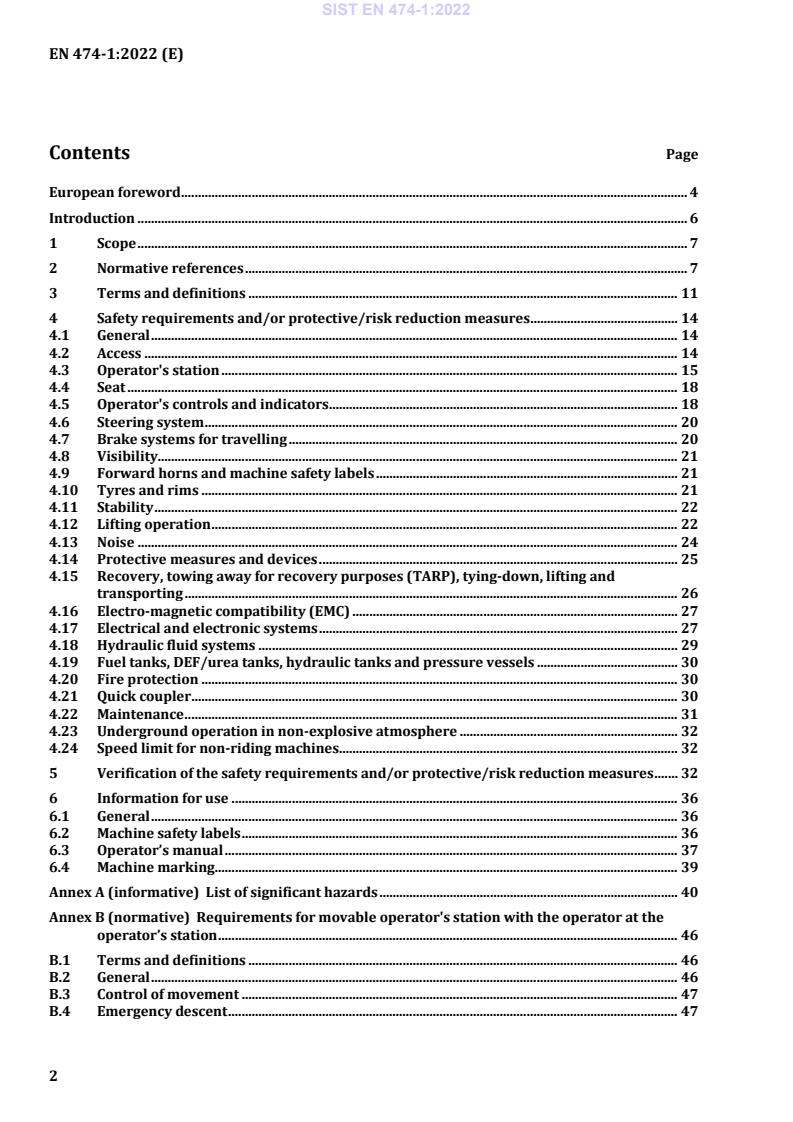
Contents Page
European foreword . 4
Introduction . 6
1 Scope . 7
2 Normative references . 7
3 Terms and definitions . 11
4 Safety requirements and/or protective/risk reduction measures . 14
4.1 General . 14
4.2 Access . 14
4.3 Operator's station . 15
4.4 Seat . 18
4.5 Operator's controls and indicators . 18
4.6 Steering system . 20
4.7 Brake systems for travelling . 20
4.8 Visibility. 21
4.9 Forward horns and machine safety labels . 21
4.10 Tyres and rims . 21
4.11 Stability . 22
4.12 Lifting operation . 22
4.13 Noise . 24
4.14 Protective measures and devices . 25
4.15 Recovery, towing away for recovery purposes (TARP), tying-down, lifting and
transporting . 26
4.16 Electro-magnetic compatibility (EMC) . 27
4.17 Electrical and electronic systems . 27
4.18 Hydraulic fluid systems . 29
4.19 Fuel tanks, DEF/urea tanks, hydraulic tanks and pressure vessels . 30
4.20 Fire protection . 30
4.21 Quick coupler . 30
4.22 Maintenance . 31
4.23 Underground operation in non-explosive atmosphere . 32
4.24 Speed limit for non-riding machines. 32
5 Verification of the safety requirements and/or protective/risk reduction measures . 32
6 Information for use . 36
6.1 General . 36
6.2 Machine safety labels . 36
6.3 Operator’s manual . 37
6.4 Machine marking . 39
Annex A (informative) List of significant hazards . 40
Annex B (normative) Requirements for movable operator's station with the operator at the
operator’s station . 46
B.1 Terms and definitions . 46
B.2 General . 46
B.3 Control of movement . 47
B.4 Emergency descent . 47
B.5 Crushing hazards . 47
B.6 Falling down protection for the operator . 47
B.7 ROPS . 47
B.8 Operator’s manual . 47
B.9 Marking . 48
B.10 Verification of the safety requirements and/or protective/risk reduction measures . 48
Annex C (normative) Requirements for lifting devices used for lifting operations . 50
C.1 General . 50
C.2 Terms, definitions and abbreviations . 50
C.3 Safety requirements . 50
C.4 Additional requirements for attachable hooks used as lifting device(s) . 52
C.5 Additional information to the operator’s manual . 54
C.6 Verification of the safety requirements and/or protective/risk reduction measures . 54
Annex D (normative) Requirements for earth-moving machinery used in underground
working in non-explosive atmosphere . 56
D.1 General . 56
D.2 Operator's station . 56
D.3 Engine exhaust emission and fuel . 56
D.4 Lighting, signalling and marking lights and reflex-reflector devices . 57
D.5 Fire protection . 57
D.6 Verification of the safety requirements and/or protective/risk reduction measures . 57
Annex ZA (informative) Relationship between this European Standard and the essential
requirements of Directive 2006/42/EC machinery, and amending Directive
95/16/EC (recast) [2006 L157] aimed to be covered . 59
Bibliography . 65
European foreword
This document (EN 474-1:2022) has been prepared by Technical Committee CEN/TC 151 “Construction
equipment and building material machines - Safety”, the secretariat of which is held by DIN.
This European Standard shall be given the status of a national standard, either by publication of an
identical text or by endorsement, at the latest by September 2022, and conflicting national standards shall
be withdrawn at the latest by March 2024.
Attention is drawn to the possibility that some of the elements of this document may be the subject of
patent rights. CEN shall not be held responsible for identifying any or all such patent rights.
This document supersedes EN 474-1:2006+A6:2019.
This document has been prepared under a standardization request given to CEN by the European
Commission and the European Free Trade Association, and supports essential requirements of
EU Directive(s).
For relationship with EU Directive(s), see informative Annex ZA, which is an integral part of this
document.
EN 474 “Earth-moving machinery — Safety” comprises the following parts:
— Part 1: General requirements
— Part 2: Requirements for tractor-dozers
— Part 3: Requirements for loaders
— Part 4: Requirements for backhoe-loaders
— Part 5: Requirements for hydraulic excavators
— Part 6: Requirements for dumpers
— Part 7: Requirements for scrapers
— Part 8: Requirements for graders
— Part 9: Requirements for pipelayers
— Part 10: Requirements for trenchers
— Part 11: Requirements for earth and landfill compactors
— Part 12: Requirements for cable excavators
— Part 13: Requirements for rollers
To confer a presumption of conformity with the relevant essential requirements of Directive
2006/42/EC, this standard (providing general/common requirements for a whole machine family) has
to be applied together with one of those standards as specified in the scope (providing specific
requirements for a particular category of machinery within this family), once this standard is cited in the
Official Journal of the European Communities under Directive 2006/42/EC.
The main differences between this document and EN 474-1:2006+A6:2019 are as follows:
a) safety-related functions of control systems (excluded);
b) requirements for demolition machinery (deleted);
c) requirements for attachments, multi-purpose and derivative machinery (deleted);
d) normative references (updated);
e) cab requirements for non-compact machines (added);
f) lifting requirements and fitness for purpose (added);
g) recovery, TARP, tying down lifting and transporting requirements (modified);
h) electrical and electronic systems requirements (modified);
i) quick couplers requirements (modified);
j) verification methods table (Clause 5) (added);
k) requirements for no-text safety signs (deleted);
l) requirements for moveable operator’s station (modified);
m) requirements for rollers, addressed in a new part 13 (added);
n) list of significant hazards (Annex A) (modified);
o) Annex ZA (modified).
Any feedback and questions on this document should be directed to the users’ national standards body.
A complete listing of these bodies can be found on the CEN website.
According to the CEN-CENELEC Internal Regulations, the national standards organisations of the
following countries are bound to implement this European Standard: Austria, Belgium, Bulgaria, Croatia,
Cyprus, Czech Republic, Denmark, Estonia, Finland, France, Germany, Greece, Hungary, Iceland, Ireland,
Italy, Latvia, Lithuania, Luxembourg, Malta, Netherlands, Norway, Poland, Portugal, Republic of North
Macedonia, Romania, Serbia, Slovakia, Slovenia, Spain, Sweden, Switzerland, Turkey and the United
Kingdom.
Introduction
This document is a type-C standard as stated in EN ISO 12100.
This document is of relevance, in particular, for the following stakeholder groups representing the market
players with regard to machinery safety:
— machine manufacturers (small, medium and large enterprises);
— health and safety bodies (regulators, accident prevention organizations, market surveillance, etc.).
Others can be affected by the level of machinery safety achieved with the means of the document by the
above-mentioned stakeholder groups:
— machine users/employers (small, medium and large enterprises);
— machine users/employees (e.g. trade unions, organizations for people with special needs);
— service providers, e.g. for maintenance (small, medium and large enterprises);
— consumers (in case of machinery intended for use by consumers).
The above-mentioned stakeholder groups have been given the possibility to participate at the drafting
process of this document.
The machinery concerned and the extent to which hazards, hazardous situations or hazardous events are
covered are indicated in the Scope of this document.
When requirements of this type-C standard are different from those which are stated in type-A or type-B
standards, the requirements of this type-C standard take precedence over the requirements of the other
standards for machines that have been designed and built according to the requirements of this type-C
standard.
1 Scope
This document specifies the general safety requirements for earth-moving machinery, hereinafter also
referred to as machines, described in EN ISO 6165:2012, except horizontal directional drills.
NOTE 1 Horizontal directional drills are covered by EN 16228-1 and EN 16228-3.
This document gives the common safety requirements for earth-moving machinery families (see
EN ISO 6165:2012, 3.4) and is intended to be used in conjunction with relevant parts of EN 474-2 to
EN 474-13. These machine specific parts (EN 474-2 to EN 474−13) do not repeat the requirements from
NOTE 2 The requirements specified in this part of the standard are common to two or more families of earth-
moving machinery.
This document does not provide requirements for main electrical circuits and drives of machinery when
the primary source of energy is an external electrical supply.
This document does not provide performance requirements for safety related functions of control
system(s).
This document does not deal with towing of trailers.
This document does not deal with demolition machinery.
This document deals with significant hazards, hazardous situations and events relevant to earth-moving
machinery, when used as intended and under conditions foreseen but also taking into account any
reasonably foreseeable misuse thereof (see Annex A).
The following significant and relevant hazards are not covered in this document:
— Laser;
— Lightning.
This document specifies the appropriate technical measures to reduce risks arising from the significant
hazards, hazardous situations and events during the whole foreseeable lifecycle of the machinery as
described in EN ISO 12100:2010, 5.4.
This document is not applicable to earth-moving machinery which are manufactured before the date of
publication of this document by CEN.
NOTE 3 For travelling on public roads, national traffic regulations apply (e.g. braking, steering, lighting, towing,
etc.) until harmonized requirements are available.
2 Normative references
The following documents are referred to in the text in such a way that some or all of their content
constitutes requirements of this document. For dated references, only the edition cited applies. For
undated references, the latest edition of the referenced document (including any amendments) applies.
EN 286-2:1992, Simple unfired pressure vessels designed to contain air or nitrogen — Part 2: Pressure
vessels for air braking and auxiliary systems for motor vehicles and their trailers
EN 1677-2:2000+A1:2008, Components for slings — Safety — Part 2: Forged steel lifting hooks with
latch, Grade 8
EN 1679-1:1998+A1:2011, Reciprocating internal combustion engines — Safety — Part 1: Compression
ignition engines
EN 60529:1991, Degrees of protection provided by enclosures (IP code) (IEC 60529:1989)
EN 60529:1991/A1:2000, Degrees of protection provided by enclosures (IP code)
(IEC 60529:1989/A1:1999)
EN 60529:1991/A2:2013, Degrees of protection provided by enclosures (IP code)
(IEC 60529:1989/A2:2013)
EN ISO 2860:2008, Earth-moving machinery — Minimum access dimensions (ISO 2860:1992)
EN ISO 2867:2011, Earth-moving machinery — Access systems (ISO 2867:2011)
EN ISO 3164:2013, Earth-moving machinery — Laboratory evaluations of protective structures —
Specifications for deflection-limiting volume (ISO 3164:2013)
EN ISO 3411:2007, Earth-moving machinery — Physical dimensions of operators and minimum operator
space envelope (ISO 3411:2007)
EN ISO 3449:2008, Earth-moving machinery — Falling-object protective structures — Laboratory tests
and performance requirements (ISO 3449:2005)
EN ISO 3450:2011, Earth-moving machinery — Wheeled or high-speed rubber-tracked machines —
Performance requirements and test procedures for brake systems (ISO 3450:2011)
EN ISO 3457:2008, Earth-moving machinery — Guards — Definitions and requirements (ISO 3457:2003)
EN ISO 3471:2008, Earth-moving machinery — Roll-over protective structures — Laboratory tests and
performance requirements (ISO 3471:2008)
EN ISO 4413:2010, Hydraulic fluid power — General rules and safety requirements for systems and their
components (ISO 4413:2010)
EN ISO 4871:2009, Acoustics — Declaration and verification of noise emission values of machinery and
equipment (ISO 4871:1996)
EN ISO 5010:2019, Earth-moving machinery — Wheeled machines — Steering requirements
(ISO 5010:2019)
EN ISO 5353:1998, Earth-moving machinery, and tractors and machinery for agriculture and forestry —
Seat index point (ISO 5353:1995)
EN ISO 6165:2012, Earth-moving machinery — Basic types — Identification and terms and definitions
(ISO 6165:2012)
EN ISO 6682:2008, Earth-moving machinery — Zones of comfort and reach for controls (ISO 6682:1986,
including Amd 1:1989)
EN ISO 6683:2008, Earth-moving machinery — Seat belts and seat belt anchorages — Performance
requirements and tests (ISO 6683:2005)
EN ISO 7010:2020, Graphical symbols — Safety colours and safety signs — Registered safety signs
(ISO 7010:2019)
EN ISO 7096:2020, Earth-moving machinery — Laboratory evaluation of operator seat vibration
(ISO 7096:2020)
EN ISO 12100:2010, Safety of machinery — General principles for design — Risk assessment and risk
reduction (ISO 12100:2010)
EN ISO 13766-1:2018, Earth-moving and building construction machinery — Electromagnetic
compatibility (EMC) of machines with internal electrical power supply — Part 1: General EMC
requirements under typical electromagnetic environmental conditions (ISO 13766-1:2018)
EN ISO 13766-2:2018, Earth-moving and building construction machinery — Electromagnetic
compatibility (EMC) of machines with internal electrical power supply — Part 2: Additional EMC
requirements for functional safety (ISO 13766-2:2018)
EN ISO 14119:2013, Safety of machinery — Interlocking devices associated with guards — Principles for
design and selection (ISO 14119:2013)
EN ISO 14120:2015, Safety of machinery — Guards — General requirements for the design and
construction of fixed and movable guards (ISO 14120:2015)
EN ISO 18752:2016, Rubber hoses and hose assemblies — Wire- or textile-reinforced single-pressure types
for hydraulic applications — Specification (ISO 18752:2014)
ISO 3795:1989, Road vehicles, and tractors and machinery for agriculture and forestry — Determination
of burning behaviour of interior materials
ISO 3864-1:2011, Graphical symbols — Safety colours and safety signs — Part 1: Design principles for
safety signs and safety markings
ISO 3864-2:2016, Graphical symbols — Safety colours and safety signs — Part 2: Design principles for
product safety labels
ISO 3864-3:2012, Graphical symbols — Safety colours and safety signs — Part 3: Design principles for
graphical symbols for use in safety signs
ISO 3864-4:2011, Graphical symbols — Safety colours and safety signs — Part 4: Colorimetric and
photometric properties of safety sign materials
ISO 5006:2017, Earth-moving machinery — Operator’s field of view — Test method and performance
criteria
ISO 6011:2003, Earth-moving machinery — Visual display of machine operation
ISO 6014:1986, Earth-moving machinery — Determination of ground speed
ISO 6016:2008, Earth-moving machinery — Methods of measuring the masses of whole machines, their
equipment and components
ISO 6395:2008, Earth-moving machinery — Determination of sound power level — Dynamic test
conditions
ISO 6396:2008, Earth-moving machinery — Determination of emission sound pressure level at operator’s
position — Dynamic test conditions
ISO 6396:2008/Cor. 1:2009, Earth-moving machinery — Determination of emission sound pressure level
at operator’s position — Dynamic test conditions; Technical Corrigendum 1
ISO 6405-1:2017 , Earth-moving machinery — Symbols for operator controls and other displays — Part
1: Common symbols
ISO 6405-2:2017 , Earth-moving machinery — Symbols for operator controls and other displays — Part
2: Symbols for specific machines, equipment and accessories
ISO 6750-1:2019, Earth-moving machinery — Operator’s manual — Content and format
ISO 8643:2017, Earth-moving machinery — Hydraulic excavator and backhoe loader lowering control
device — Requirements and tests
ISO 9244:2008, Earth-moving machinery — Machine safety labels — General principles
ISO 9244:2008/AMD 1:2016, Earth-moving machinery — Machine safety labels — General principles;
Amendment 1
As impacted by ISO 6405-1:2017/AMD1:2022.
As impacted by ISO 6405-2:2017/AMD1:2022.
ISO 9247:1990, Earth-moving machinery — Electrical wires and cables — Principles of identification and
marking
ISO 9247:1990/AMD 1:1998, Earth-moving machinery — Electrical wires and cables — Principles of
identification and marking — Amendment 1
ISO 9533:2010, Earth-moving machinery — Machine-mounted audible travel alarms and forward horns
— Test methods and performance criteria
ISO 10261:2021, Earth-moving machinery — Product identification numbering system
ISO 10263-2:2009, Earth-moving machinery — Operator enclosure environment — Part 2: Air filter
element test method
ISO 10263-3:2009, Earth-moving machinery — Operator enclosure environment — Part 3: Pressurization
test method
ISO 10263-4:2009, Earth-moving machinery — Operator enclosure environment — Part 4: Heating,
ventilating and air conditioning (HVAC) test method and performance
ISO 10263-5:2009, Earth-moving machinery — Operator enclosure environment — Part 5: Windscreen
defrosting system test method
ISO 10264:1990, Earth-moving machinery — Key-locked starting systems
ISO 10265:2008, Earth-moving machinery — Crawler machines — Performance requirements and test
procedures for braking systems
ISO 10532:1995, Earth-moving machinery — Machine-mounted retrieval device — Performance
requirements
ISO 10532:1995/AMD 1:2004, Earth-moving machinery — Machine-mounted retrieval device —
Performance requirements; Amendment 1
ISO 10533:1993, Earth-moving machinery — Lift-arm support devices
ISO 10533:1993/AMD 1:2005, Earth-moving machinery — Lift-arm support devices; Amendment 1
ISO 10570:2004, Earth-moving machinery — Articulated frame lock — Performance requirements
ISO 10968:2020, Earth-moving machinery — Operator’s controls
ISO 11112:1995, Earth-moving machinery — Operator’s seat — Dimensions and requirements
ISO 11112:1995/AMD 1:2001, Earth-moving machinery — Operator’s seat — Dimensions and
requirements, Amendment 1
ISO 11862:1993, Earth-moving machinery — Auxiliary starting aid electrical connector
ISO 12508:1994, Earth-moving machinery — Operator station and maintenance areas — Bluntness of
edges
ISO 12509:2004, Earth-moving machinery — Lighting, signalling and marking lights, and reflex-reflector
devices
ISO 13031:2016, Earth-moving machinery — Quick couplers — Safety
ISO 13333:1994, Earth-moving machinery — Dumper body support and operator’s cab tilt support
devices
ISO 13459:2012, Earth-moving machinery — Trainer seat — Deflection limiting volume, space envelope
and performance requirements
ISO 14396:2002, Reciprocating internal combustion engines — Determination and method for the
measurement of engine power — Additional requirements for exhaust emission tests in accordance with
ISO 8178
ISO 14401-2:2009, Earth-moving machinery — Field of vision of surveillance and rear-view mirrors —
Part 2: Performance criteria
ISO 14990-1:2016, Earth-moving machinery — Electrical safety of machines utilizing electric drives and
related components and systems — Part 1: General requirements
ISO 14990-3:2016, Earth-moving machinery — Electrical safety of machines utilizing electric drives and
related components and systems — Part 3: Particular requirements for self-powered machines
ISO 15817:2012, Earth-moving machinery — Safety requirements for remote operator control systems
ISO 15818:2017, Earth-moving machinery — Lifting and tying-down attachment points — Performance
requirements
ISO 17063:2003, Earth-moving machinery — Braking systems of pedestrian-controlled machines —
Performance requirements and test procedures
ISO 17398:2004, Safety colours and safety signs — Classification, performance and durability of safety
signs
ISO 21507:2010, Earth-moving machinery — Performance requirements for non-metallic fuel tanks
3 Terms and definitions
For the purposes of this document, the terms and definitions given in EN ISO 12100:2010 and the
definitions given below apply.
Earth-moving machinery and their families are defined in EN ISO 6165:2012.
ISO and IEC maintain terminological databases for use in standardization at the following addresses:
— IEC Electropedia: available at https://www.electropedia.org/
— ISO Online browsing platform: available at https://www.iso.org/obp
3.1
earth-moving machinery
self-propelled or towed machine on wheels, crawlers or legs, having equipment and/or attachment,
primarily designed to perform excavating, loading, transporting, spreading, compacting or trenching of
earth, rock or similar materials
Note 1 to entry: Earth-moving machinery can be of a type either directly controlled by an operator riding or not
riding on the machine, or can be remotely controlled by wired or wireless means.
Note 2 to entry: The basic function of earth-moving machinery can be changed by the installation of attachments
(see 3.2). EN 474 still applies in event of intended change to the basic function.
3.1.1
compact machine
earth-moving machinery having an operating mass (see ISO 6016:2008) of 4 500 kg or less, or in the case
of excavator or crawler loader having an operating mass (see ISO 6016:2008) of 6 000 kg or less
[SOURCE: EN ISO 6165:2012, 3.1.1]
3.2
attachment
component or assembly of components, which can be mounted onto the base machine or equipment (see
ISO 6746-1:2003, ISO 6746-2:2003 and ISO 6016:2008) for a specific use
Note 1 to entry: Attachments might be, in the meaning of the Machinery Directive 2006/42/EC, either
interchangeable equipment or tools. The term ‘attachments’ is used in this document to cover both.
3.3
quick coupler
device mounted on an earth-moving machine to allow the quick interchange of attachments
Note 1 to entry: Quick couplers are also commonly referred to under many different names, including “quick
hitch” and “attachment bracket”. For the purposes of this document, only the term “quick coupler” is used.
[SOURCE: ISO 13031:2016, 3.1]
3.4
lifting operation
raising or lowering of unit loads
Note 1 to entry: Raising and lowering includes changes of level in an upright vertical direction as well as at an
inclined angle.
Note 2 to entry: Movement of loose bulk materials by earth-moving machinery is not considered as lifting
operations.
3.5
unit load
objects or quantities of bulk material that are held together by means such as pallet, strapping, bag,
making them suitable for raising and lowering as a unit, and are moved as single items
3.6
maximum rated operating/lift capacity in lifting operation
maximum capacity which can be lifted at least in one position of the working range as specified by the
manufacturer (e.g. on the rated lift capacity table) in the most stable configuration (e.g. outriggers down)
Note 1 to entry: The term “rated operating capacity” is defined in ISO 14397-1:2007 and used in EN 474-3 and
EN 474-4. The term “rated lift capacity” is defined in ISO 10567:2007 and used in EN 474-5. Both terms are
equivalent.
3.7
base machine
machine with a cab or canopy and operator protective structures if required, without equipment or
attachments but possessing the necessary mountings for such equipment and attachments
[SOURCE: ISO 6016:2008, 3.1.1]
3.8
operator’s station
area on a ride-on machine from which an operator controls the functions of the machine
3.9
operator’s cab
enclosure on a ride-on machine from which an operator controls the travel and work functions of the
machine
3.10
routine maintenance
maintenance that is specified in the periodic maintenance schedule of the operator’s manual for
performing scheduled daily/weekly/monthly maintenance on the machine
3.11
hold-to-run control
control device which initiates and maintains machine functions only as long as the manual control
(actuator) is actuated
[SOURCE: EN ISO 12100:2010, 3.28.3]
3.12
ride-on machine
self-propelled direct-controlled machine where the control devices are located on the machine and the
machine is controlled by a seated or standing operator
[SOURCE: EN ISO 6165:2012, 3.2.1]
3.13
non-riding machine
self-propelled direct-controlled machine where the control devices are located on the machine and the
machine is controlled by an operator (neither seated nor standing on the machine)
[SOURCE: EN ISO 6165:2012, 3.2.2]
3.14
remote-controlled machine
self-propelled earth-moving machinery where the machine can be controlled by the transmission of
signals from a control box (transmitter) that is not located on the machine to a receiving unit (receiver)
located on the machine
3.15
FOPS
falling-object protective structure
system of structural members arranged in such a way as to provide operators with reasonable protection
from falling objects (trees, rocks, small concrete blocks, hand tools, etc.)
3.16
ROPS
roll-over protective structure
system of structural members whose primary purpose is to reduce the possibility of a seat-belted
operator being crushed in the event the machine should roll-over
Note 1 to entry: Structural members include any subframe, bracket, mounting, socket, bolt, pin, suspension or
flexible shock absorption used to secure the system to the machine frame, but exclude mounting provisions that are
integral with the machine frame.
3.17
load capacity indicator
device that warns the operator of a change to the load handling geometry which would increase the
longitudinal load moment, beyond pre-determined limit(s)
3.18
load moment
moment produced by the load, the attachment and the lifting means of the truck which acts at the load
centre of gravity from the tipping line in the forward direction
3.19
rated capacity limiting device
device that prevents the operator changing the load handling geometry in direction(s) which would
increase the longitudinal load moment, beyond the allowable limit(s)
3.20
operating mass
mass of the base machine, with equipment and empty attachment in the most usual configuration as
specified by the manufacturer, and with the operator (75 kg), full fuel tank and all fluid systems (i.e.
hydraulic oil, transmission oil, engine oil, engine coolant) at the levels specified by the manufacturer and,
when applicable, with sprinkler water tank(s) half full
Note 1 to entry: The mass of an operator is not included for non-riding machines.
Note 2 to entry: Ballast mass at delivery can be included if specified by the manufacturer.
[SOURCE: ISO 6016:2008, 3.2.1]
3.21
operator's manual
document that identifies machines covered and containing information describing and illustrating the
safe operation, maintenance, and safety precautions applicable to the machine
Note 1 to entry: This is correlating to the term Instruction handbook used in EN ISO 12100:2010.
[SOURCE: ISO 6750-1:2019, 3.13]
4 Safety requirements and/or protective/risk reduction measures
4.1 General
Earth-moving machinery shall comply with the safety requirements and/or protective/risk reduction
measures of this clause, unless modified by requirements of the relevant specific part of the standard
series. In addition, the machine shall be designed according to the principles of EN ISO 12100:2010 for
relevant but not significant hazards which are not dealt with by this document.
4.2 Access
4.2.1 General requirements
Access systems shall be provided to the operator's station and to routine maintenance points. Access
systems shall comply with EN ISO 2867:2011.
4.2.2 Access to articulated machines
On machines with articulated frames and in the fully articulated steering position, a minimum clearance
of 150 mm for the lower limbs shall be provided between firm structures and components with relative
movement in the path of the access systems to the operator's station, as illustrated in Figure 1.
Dimensions in millimetres
Figure 1 — Minimum clearance of lower limbs at access to the operator's station on machines
with articulated steering
4.3 Operator's station
4.3.1 General requirements
4.3.1.1 Machinery equipment
The operator’s station of seated ride-on machines shall be fitted with a cab. This requirement does not
apply to compact machines.
If the machine is intended for use in unhealthy environments, e.g. contaminated areas, this machine shall
be equipped with a cab and a contamination protective system.
4.3.1.2 Minimum space
The minimum space available to the operator at the operator’s station shall be as defined in
EN ISO 3411:2007 except the following amendments:
— the minimum space envelope height (dimension R1 in EN ISO 3411:2007, Table 1, and measured
from the seat index point (SIP), as defined in EN ISO 5353:1998), may be reduced to 920 mm for
compact machines and 1 000 mm for all other machines. The minimum dimensions given are also
required for machines having a front or rear window which are located (in an opened position) above
the operator's seat;
— for compact machines the minimum space envelope width at the operator’s station (dimension
920 mm in EN ISO 3411:2007, Figure 4) may be reduced to 650 mm.
The minimum space and location of the controls at the operator's station shall meet the requirements
specified in EN ISO 6682:2008.
4.3.1.3 Moving parts
The machine shall be designed so as to avoid accidental contact from the operating position with moving
parts, e.g. the wheels, tracks, working equipment or attachment in accordance with relevant subclauses
of 4.14.
4.3.1.4 Engine exhaust
The engine exhaust system shall release the exhaust gas away from the operator and the air inlet of the
cab.
4.3.1.5 Sharp edges
The operator's station shall be free of sharp edges or acute angles/corners. Radius of corners and
bluntness of edges shall comply with ISO 12508:1994 to avoid sharp edges (see also 4.14.3).
4.3.2 Operator's station equipped with a cab
4.3.2.1 Climatic conditions
4.3.2.1.1 General
The cab shall protect the operator against foreseeable adverse climatic conditions. The cab shall be
equipped with a ventilation system, an adjustable heating system and a system for defrosting windows.
If an air-condition system is installed it shall comply with ISO 10263-4:2009.
4.3.2.1.2 Heating system
A heating system shall comply with ISO 10263-4:2009.
4.3.2.1.3 Ventilation system
The ventilation system shall be capable of providing the cab with filtered fresh air at the minimum of
43 m /h. The filter shall be tested according to ISO 10263-2:2009.
4.3.2.1.4 Defrosting system
The defrosting system shall be capable of defrosting the front windscreen and rear window to meet the
visibility requirements of 4.8.1, for example by means of a heating system or a particular defrosting
device.
The defrosting system for the front windscreen shall meet the requirements specified in
ISO 10263-5:2009.
When visibility through the rear window is necessary to meet the requirements of 4.8.1, test procedures
according to ISO 10263-5:2009 apply.
4.3.2.2 Pipes and hoses
Pipes and hoses that contain fluids at pressures exceeding 5 MPa or temperatures above 60 °C located
inside the cab shall be guarded in accordance with EN ISO 3457:2008, Clause 9. See also 4.18.
Fixed parts or components of the machine placed between pipes or hoses and the operator which divert
a hazardous spray of fluid, are sufficient protection devices.
4.3.2.3 Alternative opening (emergency exit)
An alternative opening shall be provided on a side other than that of the primary opening. The dimensions
shall comply with EN ISO 2867:2011, Clause 5. A window panel or another door is acceptable if they are
easy to open or remove without the use of keys or tools. Latches may be used if they can be opened from
the inside without the use of keys or tools.
If the alternative opening is provided by the breaking of a glass pane then a device for breaking the glass
shall be fixed in a location adjacent to the relevant pane.
The alternative opening shall be marked in accordance with EN ISO 7010:2020 Table 2, symbol E001 or
E002.
4.3.2.4 Pressurization system
Where a cab is provided with a pressurization system, it shall be tested according to ISO 10263-3:2009
and shall be capable of providing an interior relative pressure of at least 50 Pa.
4.3.2.5 Doors and windows
Doors, windows and flaps shall be securely held in their intended operating positions. Doors shall be
secured in accordance with EN ISO 2867:2011, 5.6.
A primary opening designed to be held securely open as an intended operating position shall be
releasable from inside the operator's cab.
All windows shall be made of safety glass or any other material or arrangement providing equivalent
protection to UN ECE R43.
Windows where the risk of breakage from objects or projectiles is present shall have a p
...