

SIST ISO 10017:2021
Quality management - Guidance on statistical techniques for ISO 9001:2015
General Information
- Abstract
This document gives guidelines for the selection of appropriate statistical techniques that can be useful
to an organization, irrespective of size or complexity, in developing, implementing, maintaining and
improving a quality management system in conformity with ISO 9001:2015.
This document does not provide guidance on how to use the statistical techniques.
- Status
- Published
- Public Enquiry End Date
- 29-Sep-2020
- Publication Date
- 22-Aug-2021
- Technical Committee
- VZK - Quality management and quality assurance
- Current Stage
- 6060 - National Implementation/Publication (Adopted Project)
- Start Date
- 16-Jul-2021
- Due Date
- 20-Sep-2021
- Completion Date
- 23-Aug-2021


Overview
ISO 10017:2021 provides internationally recognized guidance on the application of statistical techniques within a quality management system (QMS) in accordance with ISO 9001:2015. Published by the International Organization for Standardization (ISO) and prepared by ISO/TC 176, this document assists organizations of all sizes and industries in selecting suitable statistical methods to enhance the analysis, control, and improvement of processes, products, and services.
This standard does not instruct on the implementation of individual techniques but supports organizations in determining the relevance and appropriateness of various statistical tools for their quality management needs.
Key Topics
Statistical Techniques for QMS: ISO 10017 offers succinct descriptions of widely used statistical techniques, such as:
- Descriptive statistics
- Design of experiments (DOE)
- Hypothesis testing
- Measurement system analysis (MSA)
- Process capability analysis
- Regression and reliability analysis
- Sampling and simulation
- Statistical process control (SPC)
- Statistical tolerances
- Time series analysis
Selection Guidance: The document helps organizations align statistical methods with specific ISO 9001:2015 clauses, identifying where quantitative data arise and which techniques may provide value in analysis.
Practical Benefits:
- Improved understanding of process and product variability
- Enhanced decision-making based on data-driven insights
- Better risk mitigation and problem prevention
Applicability: The guidance is intended for organizations regardless of size or complexity and can be adapted to various sectors, including manufacturing, services, and more. The selection of techniques depends on organizational context, process complexity, and intended outcomes.
Applications
Statistical techniques, as referenced in ISO 10017, play a critical role in supporting continuous improvement and maintaining product and process quality. Common applications include:
- Process Monitoring and Improvement: Using SPC and capability analysis to detect and control process variations, ensuring reliable operations and product conformity.
- Product and Service Evaluation: Leveraging hypothesis testing and MSA for verifying product requirements and measurement accuracy.
- Data Analysis and Decision Making: Applying descriptive and regression analysis for business performance evaluation and predicting future trends.
- Supplier and External Provider Assessment: Sampling and reliability analysis help evaluate and monitor the performance of external suppliers.
- Quality Audits and Reviews: Utilizing sampling, descriptive statistics, and time series analysis for internal audits and management reviews.
- Problem Solving: Design of experiments and simulation support root cause analysis and the evaluation of corrective actions.
- Customer Satisfaction: Assessing feedback using statistical methods to drive improvements aligned with ISO 9001:2015 compliance.
Related Standards
ISO 10017 works in conjunction with other essential quality management and statistical standards, including:
- ISO 9001:2015 - Quality management systems - Requirements
- ISO 9000:2015 - Quality management systems - Fundamentals and vocabulary
- ISO 3534 series - Statistics - Vocabulary and symbols (including general statistical terms, applied statistics, design of experiments, and survey sampling)
Organizations seeking to develop robust quality assurance strategies should also consult these related standards for terminology, definitions, and further methodological guidance.
By adopting ISO 10017, organizations can systematically choose and apply the most effective statistical tools to enhance quality management, bolster customer satisfaction, and achieve regulatory compliance in line with globally recognized best practices.
Relations
- Effective Date
- 01-Sep-2021
Get Certified
Connect with accredited certification bodies for this standard

BSI Group
BSI (British Standards Institution) is the business standards company that helps organizations make excellence a habit.

Bureau Veritas
Bureau Veritas is a world leader in laboratory testing, inspection and certification services.

DNV
DNV is an independent assurance and risk management provider.
Sponsored listings
Frequently Asked Questions
SIST ISO 10017:2021 is a standard published by the Slovenian Institute for Standardization (SIST). Its full title is "Quality management - Guidance on statistical techniques for ISO 9001:2015". This standard covers: This document gives guidelines for the selection of appropriate statistical techniques that can be useful to an organization, irrespective of size or complexity, in developing, implementing, maintaining and improving a quality management system in conformity with ISO 9001:2015. This document does not provide guidance on how to use the statistical techniques.
This document gives guidelines for the selection of appropriate statistical techniques that can be useful to an organization, irrespective of size or complexity, in developing, implementing, maintaining and improving a quality management system in conformity with ISO 9001:2015. This document does not provide guidance on how to use the statistical techniques.
SIST ISO 10017:2021 is classified under the following ICS (International Classification for Standards) categories: 03.100.70 - Management systems; 03.120.10 - Quality management and quality assurance; 03.120.30 - Application of statistical methods. The ICS classification helps identify the subject area and facilitates finding related standards.
SIST ISO 10017:2021 has the following relationships with other standards: It is inter standard links to SIST ISO/TR 10017:2003. Understanding these relationships helps ensure you are using the most current and applicable version of the standard.
SIST ISO 10017:2021 is available in PDF format for immediate download after purchase. The document can be added to your cart and obtained through the secure checkout process. Digital delivery ensures instant access to the complete standard document.
Standards Content (Sample)
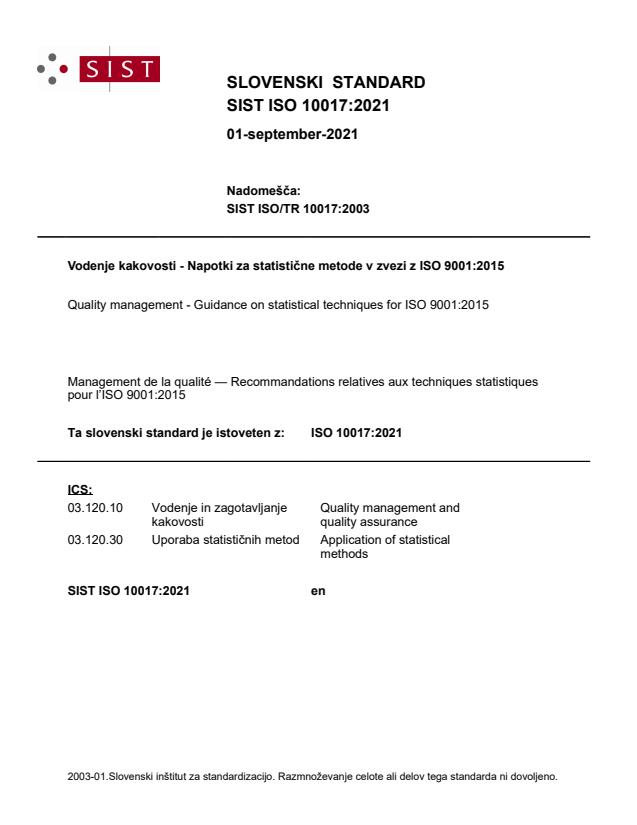
SLOVENSKI STANDARD
01-september-2021
Nadomešča:
SIST ISO/TR 10017:2003
Vodenje kakovosti - Napotki za statistične metode v zvezi z ISO 9001:2015
Quality management - Guidance on statistical techniques for ISO 9001:2015
Management de la qualité — Recommandations relatives aux techniques statistiques
pour l’ISO 9001:2015
Ta slovenski standard je istoveten z: ISO 10017:2021
ICS:
03.120.10 Vodenje in zagotavljanje Quality management and
kakovosti quality assurance
03.120.30 Uporaba statističnih metod Application of statistical
methods
2003-01.Slovenski inštitut za standardizacijo. Razmnoževanje celote ali delov tega standarda ni dovoljeno.
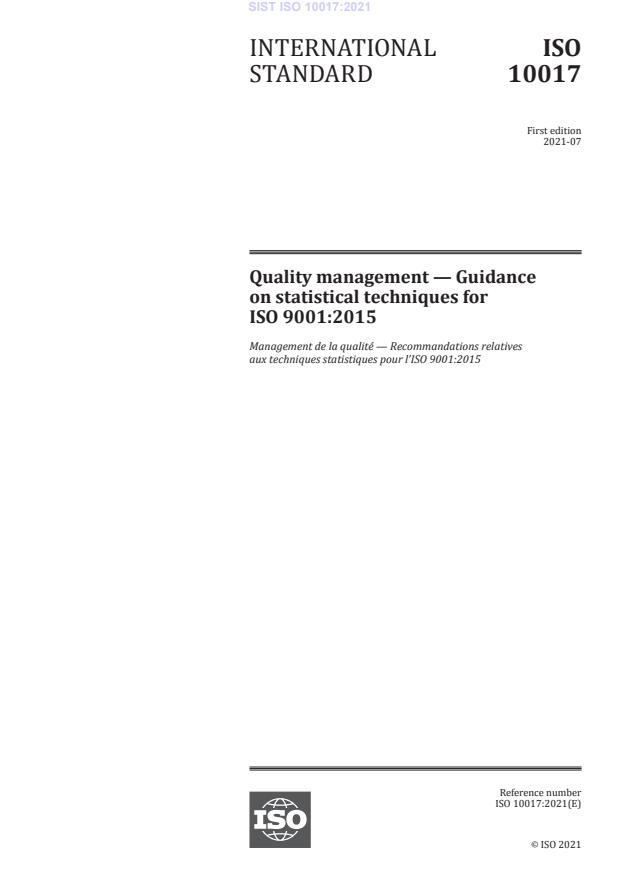
INTERNATIONAL ISO
STANDARD 10017
First edition
2021-07
Quality management — Guidance
on statistical techniques for
ISO 9001:2015
Management de la qualité — Recommandations relatives
aux techniques statistiques pour l’ISO 9001:2015
Reference number
ISO 10017:2021(E)
©
ISO 2021
ISO 10017:2021(E)
© ISO 2021
All rights reserved. Unless otherwise specified, or required in the context of its implementation, no part of this publication may
be reproduced or utilized otherwise in any form or by any means, electronic or mechanical, including photocopying, or posting
on the internet or an intranet, without prior written permission. Permission can be requested from either ISO at the address
below or ISO’s member body in the country of the requester.
ISO copyright office
CP 401 • Ch. de Blandonnet 8
CH-1214 Vernier, Geneva
Phone: +41 22 749 01 11
Email: copyright@iso.org
Website: www.iso.org
Published in Switzerland
ii © ISO 2021 – All rights reserved
ISO 10017:2021(E)
Contents Page
Foreword .v
Introduction .vi
1 Scope . 1
2 Normative references . 1
3 Terms and definitions . 1
4 Statistical techniques in the implementation of ISO 9001 . 1
5 Quantitative data and associated statistical techniques in ISO 9001 .2
6 Applicability of selected techniques . 9
7 Description of statistical techniques . 9
7.1 Descriptive statistics . 9
7.1.1 General description . 9
7.1.2 Benefits .11
7.1.3 Limitations and cautions .11
7.1.4 Examples of applications .12
7.2 Design of experiments .12
7.2.1 General description .12
7.2.2 Benefits .12
7.2.3 Limitations and cautions .13
7.2.4 Examples of applications .13
7.3 Hypothesis testing .13
7.3.1 General description .13
7.3.2 Benefits .14
7.3.3 Limitations and cautions .14
7.3.4 Examples of applications .14
7.4 Measurement system analysis .14
7.4.1 General description .14
7.4.2 Benefits .15
7.4.3 Limitations and cautions .15
7.4.4 Examples of applications .15
7.5 Process capability analysis .15
7.5.1 General description .15
7.5.2 Benefits .16
7.5.3 Limitations and cautions .16
7.5.4 Examples of applications .17
7.6 Regression analysis .17
7.6.1 General description .17
7.6.2 Benefits .18
7.6.3 Limitations and cautions .18
7.6.4 Examples of applications .19
7.7 Reliability analysis .19
7.7.1 General description .19
7.7.2 Benefits .20
7.7.3 Limitations and cautions .20
7.7.4 Examples of applications .20
7.8 Sampling .21
7.8.1 General description .21
7.8.2 Benefits .21
7.8.3 Limitations and cautions .21
7.8.4 Examples of applications .22
7.9 Simulation .22
7.9.1 General description .22
7.9.2 Benefits .22
ISO 10017:2021(E)
7.9.3 Limitations and cautions .23
7.9.4 Examples of applications .23
7.10 Statistical process control .23
7.10.1 General description .23
7.10.2 Benefits .24
7.10.3 Limitations and cautions .25
7.10.4 Examples of applications .25
7.11 Statistical tolerance .25
7.11.1 General description .25
7.11.2 Benefits .26
7.11.3 Limitations and cautions .26
7.11.4 Examples of applications .26
7.12 Time series analysis .26
7.12.1 General description .26
7.12.2 Benefits .27
7.12.3 Limitations and cautions .27
7.12.4 Examples of applications .28
Bibliography .29
iv © ISO 2021 – All rights reserved
ISO 10017:2021(E)
Foreword
ISO (the International Organization for Standardization) is a worldwide federation of national standards
bodies (ISO member bodies). The work of preparing International Standards is normally carried out
through ISO technical committees. Each member body interested in a subject for which a technical
committee has been established has the right to be represented on that committee. International
organizations, governmental and non-governmental, in liaison with ISO, also take part in the work.
ISO collaborates closely with the International Electrotechnical Commission (IEC) on all matters of
electrotechnical standardization.
The procedures used to develop this document and those intended for its further maintenance are
described in the ISO/IEC Directives, Part 1. In particular, the different approval criteria needed for the
different types of ISO documents should be noted. This document was drafted in accordance with the
editorial rules of the ISO/IEC Directives, Part 2 (see www .iso .org/ directives).
Attention is drawn to the possibility that some of the elements of this document may be the subject of
patent rights. ISO shall not be held responsible for identifying any or all such patent rights. Details of
any patent rights identified during the development of the document will be in the Introduction and/or
on the ISO list of patent declarations received (see www .iso .org/ patents).
Any trade name used in this document is information given for the convenience of users and does not
constitute an endorsement.
For an explanation of the voluntary nature of standards, the meaning of ISO specific terms and
expressions related to conformity assessment, as well as information about ISO’s adherence to the
World Trade Organization (WTO) principles in the Technical Barriers to Trade (TBT), see www .iso .org/
iso/ foreword .html.
This document was prepared by Technical Committee ISO/TC 176, Quality management and quality
assurance, Subcommittee SC 3, Supporting technologies.
This first edition of ISO 10017 cancels and replaces ISO/TR 10017:2003, which has been technically
revised. The main changes compared with ISO/TR 10017:2003 are as follows:
— it has been revised as a full guidance document and aligned with ISO 9001:2015.
Any feedback or questions on this document should be directed to the user’s national standards body. A
complete listing of these bodies can be found at www .iso .org/ members .html.
ISO 10017:2021(E)
Introduction
Variability is inherent in the behaviour and outcome of practically all processes and activities, even
under conditions of apparent stability. Such variability can be observed, over the total life cycle, in the
quantifiable characteristics of processes and in the resulting products and services.
Statistical techniques can help to measure, describe, analyse, interpret and model variability (whether
dealing with a relatively limited amount of data or with large data sets). Statistical analysis of data can
provide a better understanding of the nature, extent and causes of variability. It can help to solve and
even prevent problems and mitigate risks that can stem from such variability.
The analysis of data using statistical techniques can assist in decision-making and thereby help to
improve the performance of processes and the resulting outputs. Statistical techniques are applicable
to data in all sectors, with potentially beneficial outcomes.
The criteria for determining the need for statistical techniques, and the appropriateness of the
technique(s) selected, remain the prerogative of the organization.
The purpose of this document is to assist an organization in identifying statistical techniques against
the elements of a quality management system as defined by ISO 9001:2015. The application of such
techniques can yield considerable benefits in quality, productivity and cost.
This document can be also used to support other management systems and supporting standards, e.g.
an environmental management system, a health and safety management system.
vi © ISO 2021 – All rights reserved
INTERNATIONAL STANDARD ISO 10017:2021(E)
Quality management — Guidance on statistical techniques
for ISO 9001:2015
1 Scope
This document gives guidelines for the selection of appropriate statistical techniques that can be useful
to an organization, irrespective of size or complexity, in developing, implementing, maintaining and
improving a quality management system in conformity with ISO 9001:2015.
This document does not provide guidance on how to use the statistical techniques.
2 Normative references
The following documents are referred to in the text in such a way that some or all of their content
constitutes requirements of this document. For dated references, only the edition cited applies. For
undated references, the latest edition of the referenced document (including any amendments) applies.
ISO 3534-1, Statistics — Vocabulary and symbols — Part 1: General statistical terms and terms used in
probability
ISO 3534-2, Statistics — Vocabulary and symbols — Part 2: Applied statistics
ISO 3534-3, Statistics — Vocabulary and symbols — Part 3: Design of experiments
ISO 3534-4, Statistics — Vocabulary and symbols — Part 4: Survey sampling
ISO 9000:2015, Quality management systems — Fundamentals and vocabulary
3 Terms and definitions
For the purposes of this document, the terms and definitions given in ISO 3534-1, ISO 3534-2,
ISO 3534-3, ISO 3534-4, ISO 9000:2015 and the following apply.
ISO and IEC maintain terminological databases for use in standardization at the following addresses:
— ISO Online browsing platform: available at https:// www .iso .org/ obp
— IEC Electropedia: available at http:// www .electropedia .org/
3.1
statistical technique
statistical method
methodology for the analysis of quantitative data associated with variation in products, processes,
services and phenomena under study to provide information on the object of the study
Note 1 to entry: Statistical techniques are equally applicable to qualitative (non-numeric) data if such data can be
converted to quantitative (numeric) data.
4 Statistical techniques in the implementation of ISO 9001
Statistical techniques can help to evaluate, control and improve processes and their resulting outputs,
and help to assess and improve the effectiveness of a quality management system.
ISO 10017:2021(E)
Statistical techniques, or families of techniques, that are widely used, and which find useful application
in the implementation of ISO 9001 include:
— descriptive statistics (see 7.1);
— design of experiments (DOE) (see 7.2);
— hypothesis testing (see 7.3);
— measurement system analysis (MSA) (see 7.4);
— process capability analysis (see 7.5);
— regression analysis (see 7.6);
— reliability analysis (see 7.7);
— sampling (see 7.8);
— simulation (see 7.9);
— statistical process control (SPC) (see 7.10);
— statistical tolerance (see 7.11);
— time series analysis (see 7.12).
Many of these techniques are used in conjunction with other techniques or as sub-sets of other
statistical techniques.
The list of statistical techniques cited in this document is neither complete nor exhaustive and does not
preclude the use of any other techniques (statistical or otherwise) that are deemed to be beneficial to
the organization. Furthermore, this document does not attempt to specify which statistical technique(s)
should be used and it does not attempt to advise on how the technique(s) should be implemented.
5 Quantitative data and associated statistical techniques in ISO 9001
Quantitative data that can reasonably be encountered in activities associated with the clauses and
subclauses of ISO 9001:2015 are noted in Table 1. Listed against the quantitative data identified are
statistical techniques that can be of potential benefit to the organization when applied to such data.
No statistical techniques have been identified where quantitative data cannot be readily associated
with a clause or sub-clause of ISO 9001.
The statistical techniques cited in this document are limited to those that are well known. A brief
description of each of these statistical techniques is given in Clause 7.
The organization can assess the relevance and value of each statistical technique listed in Table 1 and
determine whether it is useful in the context of that clause.
Table 1 — Quantitative data and possible statistical technique(s)
Clause/subclause of Quantitative data involved Statistical technique(s)
ISO 9001:2015
1. Scope Not applicable —
2. Normative references Not applicable —
3. Terms and definitions Not applicable —
4. Context of the organization
2 © ISO 2021 – All rights reserved
ISO 10017:2021(E)
Table 1 (continued)
Clause/subclause of Quantitative data involved Statistical technique(s)
ISO 9001:2015
4.1 Understanding the organ- Data regarding internal and external Descriptive statistics
ization and its context issues, for example:
Statistical process control
— financial
Sampling
— employee surveys
Time series analysis
— market research
— sales
— product and service performance
— competition/benchmarking
— customer surveys
4.2 Understanding the needs Subjective and objective data regarding Descriptive statistics
and expectations of interest- the expectations of interested parties
Sampling
ed parties (e.g. market research, customer sur-
veys, employee surveys) Time series analysis
4.3 Determining the scope None identified —
of the quality management
system
4.4 Quality management system and its processes
4.4.1 None identified —
4.4.2 None identified —
5. Leadership
5.1 Leadership and commitment
5.1.1 General None identified —
5.1.2 Customer focus None identified —
5.2 Policy
5.2.1 Establishing the quality None identified —
policy
5.2.2 Communicating the Data to determine the extent to which Descriptive statistics
quality policy the policy is understood
Sampling
5.3 Organizational roles, re- None identified —
sponsibilities and authorities
6 Planning
6.1 Actions to address risks and opportunities
6.1.1 Business data to assess risks Descriptive statistics
6.1.2 Business data to assess the effective- Descriptive statistics
ness of actions taken
6.2 Quality objectives and planning to achieve them
6.2.1 Historical performance data to assist —
establishing quality goals
6.2.2 Historical performance data to assist —
establishing quality goals
6.3 Planning of changes Historical performance data to assist —
establishing quality goals
7 Support
7.1 Resources
ISO 10017:2021(E)
Table 1 (continued)
Clause/subclause of Quantitative data involved Statistical technique(s)
ISO 9001:2015
7.1.1 General Summary data on capability Descriptive statistics
7.1.2 People None identified —
7.1.3 Infrastructure Quantitative data related to the per- Descriptive statistics
formance and reliability of equipment
Process capability analysis
(hardware and software) and trans-
portation Reliability analysis
7.1.4 Environment for the Data on the environment, for example: Descriptive statistics
operation of processes
— contamination levels
Measurement system analysis
Process capability analysis
— antistatic controls
Sampling
— temperatures (e.g. bacteria
control) Statistical process control
Time series analysis
— morale (e.g. absenteeism)
7.1.5 Monitoring and measuring resources
7.1.5.1 General Data relating to measurement capabil- Descriptive statistics
ity
Measurement system analysis
Statistical tolerance
7.1.5.2 Measurement tracea- Data relating to the stability of meas- Descriptive statistics
bility urement systems
Time series analysis
7.1.6 Organizational knowl- None identified —
edge
7.2 Competence Quantitative data on training and the Descriptive statistics
effectiveness of training
Hypothesis testing
7.3 Awareness Data regarding the level of awareness Descriptive statistics
of quality policy and objectives
Sampling
7.4 Communication None identified —
7.5 Documented information
7.5.1 General None identified —
7.5.2 Creating and updating None identified —
7.5.3 Control of documented information
7.5.3.1 None identified —
7.5.3.2 None identified —
8 Operation
8.1 Operational planning and No specific data identified —
control
8.2 Requirements for products and services
8.2.1 Customer communica- None identified —
tion
4 © ISO 2021 – All rights reserved
ISO 10017:2021(E)
Table 1 (continued)
Clause/subclause of Quantitative data involved Statistical technique(s)
ISO 9001:2015
8.2.2 Determining the re- Data to demonstrate capability and Descriptive statistics
quirements for products and organizational performance
Hypothesis testing
services
Measurement system analysis
Process capability analysis
Regression analysis
Reliability analysis
Sampling
Statistical process control
8.2.3 Review of the requirements for products and services
8.2.3.1 Data to demonstrate capability and Descriptive statistics
organizational performance
Hypothesis testing
Measurement system analysis
Process capability analysis
Reliability analysis
Statistical process control
8.2.3.2 None identified —
8.2.4 Changes to require- None identified —
ments for products and
services
8.3 Design and development of products and services
8.3.1 General None identified —
8.3.2 Design and develop- None identified —
ment planning
8.3.3 Design and develop- None identified —
ment inputs
8.3.4 Design and develop- Verification and validation of design Descriptive statistics
ment controls data
Design of experiments
Hypothesis testing
Regression analysis
Sampling
Simulation
Statistical tolerance
8.3.5 Design and develop- Verification of design output data Descriptive statistics
ment outputs
Hypothesis testing
Process capability analysis
Simulation
8.3.6 Design and develop- Data related to-verification of the im- Descriptive statistics
ment changes pact of changes
Design of experiments
Hypothesis testing
Regression analysis
Sampling
Simulation
ISO 10017:2021(E)
Table 1 (continued)
Clause/subclause of Quantitative data involved Statistical technique(s)
ISO 9001:2015
8.4 Control of externally provided processes, products and services
8.4.1 General Data related to evaluation of external- Descriptive statistics
ly provided processes, products and
Sampling
services, and their providers
8.4.2 Type and extent of Incoming control data Descriptive statistics
control
Measurement system analysis
Regression analysis
Sampling
Time series analysis
External supplier process control data Descriptive statistics
Design of experiments
Hypothesis testing
Measurement system analysis
Process capability analysis
Reliability analysis
Sampling
Statistical process control
Statistical tolerances
Time series analysis
8.4.3 Information for exter- None identified —
nal providers
8.5 Production and service provision
8.5.1 Control of production Production and service data Descriptive statistics
and service provision
Design of experiments
Hypothesis testing
Measurement system analysis
Process capability analysis
Regression analysis
Sampling
Statistical process control
Time series analysis
8.5.2 Identification and trace- None identified —
ability
8.5.3 Property belonging None identified —
to customers or external
providers
8.5.4 Preservation None identified —
6 © ISO 2021 – All rights reserved
ISO 10017:2021(E)
Table 1 (continued)
Clause/subclause of Quantitative data involved Statistical technique(s)
ISO 9001:2015
8.5.5 Post-delivery activities Data to determine requirements for Descriptive statistics
post-delivery activities
Hypothesis testing
Reliability analysis
Statistical process control
Sampling
Time series analysis
8.5.6 Control of changes Data related to verification of the effec- Descriptive statistics
tiveness of changes
DOE
Hypothesis testing
Process capability analysis
Reliability analysis
SPC
8.6 Release of products and Data to demonstrate conformity to Descriptive statistics
services requirements
Hypothesis testing
Reliability analysis
Sampling
Statistical process control
8.7 Control of nonconforming outputs
8.7.1 None identified —
8.7.2 None identified —
9 Performance evaluation
9.1 Monitoring, measurement, analysis and evaluation
9.1.1 General None identified —
9.1.2 Customer satisfaction Data on customer satisfaction Descriptive statistics
Hypothesis testing
Sampling
Regression analysis
9.1.3 Analysis and evaluation Data on the performance of the quality Descriptive statistics
management system
Design of experiments
Hypothesis testing
Measurement system analysis
Process capability analysis
Reliability analysis
Sampling
Statistical process control
Time series analysis
9.2 Internal audit
9.2.1 None identified —
ISO 10017:2021(E)
Table 1 (continued)
Clause/subclause of Quantitative data involved Statistical technique(s)
ISO 9001:2015
9.2.2 Data serving as an input for audit Descriptive statistics
planning
Sampling
Time series analysis
9.3 Management review
9.3.1 General None identified —
9.3.2 Management review Product, process and customer satis- Descriptive statistics
inputs faction data
Time series analysis
9.3.3 Management review None identified —
outputs
10 Improvement
10.1 General None identified —
10.2 Nonconformity and corrective action
10.2.1 Data pertaining to nonconformities Descriptive statistics
Design of experiments
Hypothesis testing
Measurement system analysis
Process capability analysis
Regression analysis
Reliability analysis
Sampling
Simulation
Statistical process control
Statistical tolerance
Time series analysis
10.2.2 None identified —
10.3 Continual improvement Data pertaining to the state of the qual- Descriptive statistics
ity management system
Design of experiments
Hypothesis testing
Measurement system analysis
Process capability analysis
Regression analysis
Reliability analysis
Sampling
Simulation
Statistical process control
Statistical tolerance
Time series analysis
8 © ISO 2021 – All rights reserved
ISO 10017:2021(E)
6 Applicability of selected techniques
A brief description of each statistical technique, or family of techniques (cited in Table 1), is provided in
7.1 to 7.12. The descriptions are intended to assist a non-specialist to assess the potential applicability
and benefit of using the statistical techniques in the context of a quality management system.
The choice of technique and the manner of its application will depend on the circumstances and
purpose of the exercise, the size and complexity of the organization, and the potential benefit to the
organization.
The actual application of statistical techniques will require more guidance and expertise than is
provided by this guidance document. There is a large body of information on statistical techniques
available in the public domain, such as textbooks, journals, reports, industry handbooks, International
Standards and other sources of information, which can assist the organization in the use of statistical
techniques.
In addition to the techniques cited in this document, the reader is encouraged to consider other
statistical techniques that can meet the needs of the organization
NOTE 1 Listed in the Bibliography are ISO and IEC Standards and Technical Reports related to statistical
techniques. They are cited for information. This document does not specify conformance with them.
NOTE 2 Many of the statistical techniques cited here have an application in product, service, process or system
improvement initiatives such as “Six Sigma”.
7 Description of statistical techniques
7.1 Descriptive statistics
7.1.1 General description
7.1.1.1 Data characteristics
The term “descriptive statistics” refers to a broad range of techniques for summarizing and
characterizing data. It is usually the initial step in the analysis of quantitative data, and often constitutes
the first step towards the use of other statistical techniques. It should be regarded as a fundamental
component of statistical analysis.
Whereas the role of descriptive statistics is to record and present data, the procedures for drawing
an inference from the data constitute “inferential statistics”, and such procedures are invoked in
hypothesis testing (see 7.3).
The characteristics of data taken from a sample can serve as a basis for making inferences regarding
the characteristics of populations from which the samples were drawn, with a prescribed margin of
error and level of confidence.
The characteristics of the distribution of data can be presented numerically (see 7.1.2) or graphically
(see 7.1.3), or both.
7.1.1.2 Numerical
The characteristics of data that are typically of interest are their central value (most often described
by the average or “mean”), and the spread or dispersion (usually measured by the range or “standard
deviation”). Another characteristic of interest is the distribution of the data, for which there are
quantitative measures that describe the shape of the distribution (such as the degree of “skewness”).
ISO 10017:2021(E)
7.1.1.3 Graphical
Information regarding the distribution of the data can often be conveyed readily and effectively by
various graphical methods that include relatively simple displays of data such as:
— a histogram, which is a visual display of the distribution of values of a characteristic of interest (see
Figure 1);
— a scatter plot, which displays values of two variables to assess their possible relationship (see
Figure 2);
— a trend chart, also called a “run chart”, which is a plot of values of a characteristic of interest over
time (see Figure 3).
Key
X numerical value
Y frequency
Figure 1 — Graphical display of data via a histogram
There is a wide array of graphical displays that can aid the interpretation and analysis of data. These
range from the relatively simple tools cited above to techniques of a more complex nature.
Graphical methods can often reveal unusual features of the data that are not readily detected in
numerical analysis. They can be very useful in summarizing and presenting complex data and revealing
data relationships, and in communicating such information effectively to non-specialist audiences.
10 © ISO 2021 – All rights reserved
ISO 10017:2021(E)
Key
X variable A
Y variable B
Figure 2 — Scatter plot
Key
X time
Y product/process/service data
Figure 3 — Trend chart
7.1.2 Benefits
Descriptive statistics offers an efficient and relatively simple way of summarizing and characterizing
data.
Descriptive statistics is potentially applicable to all situations that involve the use of data. It can aid the
analysis and interpretation of data and is a valuable aid in decision-making.
7.1.3 Limitations and cautions
Descriptive statistics provides quantitative measures of the characteristics (such as the average
and spread) of sample data that are sometimes then used as estimates of the population. However,
these measures are subject to the limitations of the sample size and sampling method employed. The
conclusions are subject to meeting certain assumptions about the population.
ISO 10017:2021(E)
7.1.4 Examples of applications
Descriptive statistics has a useful application in almost all areas where quantitative data are collected.
It can provide information about the quality management system, its processes and its outputs and
often has a useful role in management reviews. Examples of such applications include:
— summarizing key measures of product, service or process characteristics, such as the average value
and spread;
— monitoring the performance of a product, service or process over time by means of a trend chart;
— characterizing and monitoring a process parameter, such as oven temperature;
— characterizing delivery time or response time in the service industry;
— summarizing data from customer surveys, such as customer satisfaction;
— illustrating measurement data, such as equipment calibration data;
— reporting financial performance data, such as stock price fluctuation over time;
— illustrating a possible relationship between variables such as, for example, employee satisfaction
and quality of delivered service, by a scatter plot;
— reporting trends and economic indicators, such as GDP, consumer price index, cost of living, etc.;
— reporting and tracking human resource data, such as staff turnover, employee performance, etc.
7.2 Design of experiments
7.2.1 General description
Design of experiments (DOE) can be used for evaluating and/or improving one or more characteristics
of a product, service, process or system such as defects, yield or variability.
DOE is particularly useful for investigating complex systems whose outcome can be influenced by a
potentially large number of factors. DOE can help to identify the more influential factors, the magnitude
of their effect and the relationships (if any) between the factors. The findings can be used to facilitate
the design, development and improvement of a product, service or process, or to control or improve an
existing system.
DOE can also be used to validate a characteristic of interest against a specified standard, or for the
comparative assessment of several systems.
There are several techniques that can be used to analyse data from the experiment. These range from
numerical techniques to those more graphical in nature.
DOE is the most efficient way of gaining insight into a process. The information from a designed
experiment can be used to formulate a mathematical model that describes the characteristic of interest
as a function of the influential factors. Such a model can be used for purposes of prediction of an
outcome at a stated level of confidence.
7.2.2 Benefits
When estimating or validating a characteristic of interest, there is a need to ensure that the results
obtained are not simply due to chance variation. This applies to assessments made against some
prescribed standard, or when comparing two or more systems. DOE allows such assessments to be
made with a prescribed level of confidence.
A major advantage of DOE is its relative efficiency and economy in investigating the effects of multiple
factors in a process, as compared to investigating each factor individually. Also, its ability to identify the
12 © ISO 2021 – All rights reserved
ISO 10017:2021(E)
interactions between certain factors can lead to a deeper understanding of the process. Such benefits
are especially pronounced when dealing with complex processes (i.e. processes that involve many
potentially influential factors).
Finally, when investigating a system, there is the risk of incorrectly assuming causality where there can
be only chance correlation between two or more variables. The risk of such error can be reduced using
sound principles of experiment design.
7.2.3 Limitations and cautions
Some level of inherent variation (often aptly called “noise”) is present in all systems, and this can
sometimes cloud the results of investigations and lead to incorrect conclusions. Other potential sources
of error include the confounding effect of unknown (or simply unrecognized) factors that can be present,
or the confounding effect of dependencies between the various factors in a system. The risk posed by
such errors can be mitigated by, for example, the choice of sample size or by other considerations in the
design of the experiment. However, such risks can never be eliminated and should therefore be borne in
mind when forming conclusions.
Finally, the experiment findings are valid only for the factors and the range of values considered in the
experiment. Therefore, caution should be exercised in extrapolating (or interpolating) much beyond
the range of values considered in the experiment.
7.2.4 Examples of applications
Typical examples of applications of designed experiments include:
— validating the effect of medical treatment, or assessing the relative effectiveness of several types of
treatment;
— verifying the characteristics of a product, service or process against some specified performance
standards;
— identifying the influential factors in complex processes to achieve desired outcomes, such as
improvement in the mean value, or reduced variability of characteristics such as process yield,
product strength, durability, noise level, etc.;
— solving problems in complex processes, by helping to identify the more significant process factors
in complex processes as well as the relationships between the factors;
— ensuring that a newly designed product can accommodate v
...