

SIST EN 1870-6:2018
(Main)Safety of woodworking machines - Circular sawing machines - Part 6: Circular sawing machines for fire wood
General Information
- Abstract
This European Standard deals with all significant hazards, hazardous situations and events as listed in Clause 4 which are relevant to circular sawing machines for firewood with manual loading and/or unloading with hand operated carriage, hereinafter referred to as "machines", designed to cut solid wood when they are used as intended and under the conditions foreseen by the manufacturer including reasonably foreseeable misuse.
This European Standard is not applicable to:
a) combined circular sawing machines for firewood with additional units, i.e. log splitting units or circular saw bench units;
NOTE 1 Circular saw benches are dealt with in EN 1870-19:2013.
NOTE 2 Log splitting machines are dealt with in EN 609-1:1999+A2:2009 and EN 609-2:1999+A1:2009.
NOTE 3 A draft is under consideration to cover "combined firewood processors".
b) machines where the saw blade is capable of tilting;
c) log sawing machines where the saw unit moves to cut the workpiece;
d) hand-held motor-operated electric tools or any adaptation permitting their use in a different mode, i.e. bench mounting;
NOTE 4 Hand-held motor-operated electric tools and saw benches to form an integrated whole with a hand-held motor-operated electric tools are covered by EN 60745-1:2009 together with EN 60745-2-5:2010.
For RIC engines driven machines hazard of engine electrical starting systems above 24 V are not dealt with in this standard.
This document is not applicable to machines which are manufactured before the date of its publication as EN.
NOTE 5 Machines covered by this document are listed under 1.1 and/or 1.2 of Annex IV of the Machinery Directive.
- Status
- Published
- Public Enquiry End Date
- 30-Nov-2012
- Publication Date
- 03-Jan-2018
- Technical Committee
- VSN - Safety of machinery
- Current Stage
- 6060 - National Implementation/Publication (Adopted Project)
- Start Date
- 05-Dec-2017
- Due Date
- 09-Feb-2018
- Completion Date
- 04-Jan-2018
- Directive
- 2006/42/EC - Directive 2006/42/EC of the European Parliament and of the Council of 17 May 2006 on machinery, and amending Directive 95/16/EC (recast)OJ Ref: L 75, TIP C, L 7.9.2026 UMIK 20.1.2027 OJ Date: 13-Mar-2019 Conflicting Date: 20-Jan-2027
Buy Documents






Overview
EN 1870-6:2017 - Safety of woodworking machines - Circular sawing machines - Part 6: Circular sawing machines for fire wood is a CEN type C standard that specifies safety requirements for circular saw machines used to cut solid firewood. It addresses significant hazards, hazardous situations and events relevant to machines with manual loading and/or unloading using a hand‑operated carriage when used as intended and under reasonably foreseeable misuse. The standard supports conformity with the Machinery Directive and includes annexed test methods (stability, spindle tolerances, brake tests, etc.).
Key topics and requirements
This standard focuses on practical machine‑safety measures rather than performance limits. Major technical topics covered include:
- Risk scope and exclusions - clear definition of machines covered and those excluded (e.g., combined processors with log splitters or saw benches, tilting blades, saw units that move to cut, hand‑held tools, certain engine electrical starting hazards).
- Controls and control reliability - requirements for position, start/stop functions, emergency stop and power‑failure behaviour.
- Protection against mechanical hazards - stability, prevention of access to moving parts, tool holder and blade design, braking systems and run‑down tests, workpiece supports and holding devices.
- Non‑mechanical hazards - provisions for fire risk, noise, dust and chip emission, electrical safety, ergonomics, lighting, pneumatic/hydraulic risks, and maintenance.
- Testing and verification - normative annexes provide methods for stability tests, torsional resistance, log positioning tests and brake/run‑down tests.
- Information for use - marking, warning devices and contents required in the instruction handbook to ensure safe operation and maintenance.
- Normative references - cross‑references to tools safety (EN 847‑1), ergonomics (EN 614‑1, EN 894 series), and other parts of EN 1870.
Applications and who uses it
EN 1870-6:2017 is used by:
- Manufacturers and designers of circular sawing machines for firewood to design compliant, safe machines.
- Product safety engineers and compliance officers conducting risk assessments and conformity assessments to the Machinery Directive.
- Test laboratories and notified bodies performing stability, braking and guarding verification.
- Technical writers and training providers preparing instructions, safety labels and operator manuals.
- Purchasers and facility managers specifying safe equipment for firewood processing operations.
Practical applications include machine design decisions (guards, blade fixing, braking), factory acceptance testing, safety labeling, and documentation required for CE marking.
Related standards
- EN 1870 series (other parts covering saw benches, log sawing, etc.)
- EN ISO 12100 (general machine safety / risk assessment)
- EN 847‑1 (tools for woodworking - safety requirements)
- EN 614‑1, EN 894‑1/‑2 (ergonomics and controls)
- EN 60745 / EN 62841 (hand‑held tools where applicable)
Keywords: EN 1870-6:2017, circular sawing machines, firewood, woodworking machines safety, Machinery Directive, CE conformity, machine guarding, brake tests, stability tests.
Relations
- Effective Date
- 08-Jun-2022
- Effective Date
- 01-Jul-2026
- Effective Date
- 09-Feb-2026
- Effective Date
- 09-Feb-2026
- Effective Date
- 09-Feb-2026
- Effective Date
- 09-Feb-2026
- Effective Date
- 09-Feb-2026
- Effective Date
- 09-Feb-2026
- Effective Date
- 09-Feb-2026
- Effective Date
- 09-Feb-2026
- Effective Date
- 09-Feb-2026
- Effective Date
- 09-Feb-2026
- Effective Date
- 09-Feb-2026
- Effective Date
- 09-Feb-2026
- Effective Date
- 28-Jan-2026
Buy Documents
Get Certified
Connect with accredited certification bodies for this standard

DVS-ZERT GmbH
German welding certification society.
CARES (UK Certification Authority for Reinforcing Steels)
UK certification for reinforcing steels and construction.
EWF/IIW (European/International Welding Federation)
International welding personnel certification.
Sponsored listings
Frequently Asked Questions
SIST EN 1870-6:2018 is a standard published by the Slovenian Institute for Standardization (SIST). Its full title is "Safety of woodworking machines - Circular sawing machines - Part 6: Circular sawing machines for fire wood". This standard covers: This European Standard deals with all significant hazards, hazardous situations and events as listed in Clause 4 which are relevant to circular sawing machines for firewood with manual loading and/or unloading with hand operated carriage, hereinafter referred to as "machines", designed to cut solid wood when they are used as intended and under the conditions foreseen by the manufacturer including reasonably foreseeable misuse. This European Standard is not applicable to: a) combined circular sawing machines for firewood with additional units, i.e. log splitting units or circular saw bench units; NOTE 1 Circular saw benches are dealt with in EN 1870-19:2013. NOTE 2 Log splitting machines are dealt with in EN 609-1:1999+A2:2009 and EN 609-2:1999+A1:2009. NOTE 3 A draft is under consideration to cover "combined firewood processors". b) machines where the saw blade is capable of tilting; c) log sawing machines where the saw unit moves to cut the workpiece; d) hand-held motor-operated electric tools or any adaptation permitting their use in a different mode, i.e. bench mounting; NOTE 4 Hand-held motor-operated electric tools and saw benches to form an integrated whole with a hand-held motor-operated electric tools are covered by EN 60745-1:2009 together with EN 60745-2-5:2010. For RIC engines driven machines hazard of engine electrical starting systems above 24 V are not dealt with in this standard. This document is not applicable to machines which are manufactured before the date of its publication as EN. NOTE 5 Machines covered by this document are listed under 1.1 and/or 1.2 of Annex IV of the Machinery Directive.
This European Standard deals with all significant hazards, hazardous situations and events as listed in Clause 4 which are relevant to circular sawing machines for firewood with manual loading and/or unloading with hand operated carriage, hereinafter referred to as "machines", designed to cut solid wood when they are used as intended and under the conditions foreseen by the manufacturer including reasonably foreseeable misuse. This European Standard is not applicable to: a) combined circular sawing machines for firewood with additional units, i.e. log splitting units or circular saw bench units; NOTE 1 Circular saw benches are dealt with in EN 1870-19:2013. NOTE 2 Log splitting machines are dealt with in EN 609-1:1999+A2:2009 and EN 609-2:1999+A1:2009. NOTE 3 A draft is under consideration to cover "combined firewood processors". b) machines where the saw blade is capable of tilting; c) log sawing machines where the saw unit moves to cut the workpiece; d) hand-held motor-operated electric tools or any adaptation permitting their use in a different mode, i.e. bench mounting; NOTE 4 Hand-held motor-operated electric tools and saw benches to form an integrated whole with a hand-held motor-operated electric tools are covered by EN 60745-1:2009 together with EN 60745-2-5:2010. For RIC engines driven machines hazard of engine electrical starting systems above 24 V are not dealt with in this standard. This document is not applicable to machines which are manufactured before the date of its publication as EN. NOTE 5 Machines covered by this document are listed under 1.1 and/or 1.2 of Annex IV of the Machinery Directive.
SIST EN 1870-6:2018 is classified under the following ICS (International Classification for Standards) categories: 25.080.60 - Sawing machines; 79.120.10 - Woodworking machines. The ICS classification helps identify the subject area and facilitates finding related standards.
SIST EN 1870-6:2018 has the following relationships with other standards: It is inter standard links to SIST EN 1870-6:2003+A1:2009, SIST ISO 7960:2002, SIST EN 61310-1:2008, SIST EN 50370-1:2007, SIST EN 60204-1:2006/A1:2009, SIST EN 50370-2:2003, SIST EN 50525-2-21:2011, SIST EN 60439-1:2000/A1:2004, SIST EN 60529:1997, SIST EN 60439-1:2000, SIST EN 60204-1:2006, SIST EN 60529:1997/A1:2000, SIST EN 50178:1999, SIST EN 60529:1997/A2:2014, SIST EN ISO 4871:2009. Understanding these relationships helps ensure you are using the most current and applicable version of the standard.
SIST EN 1870-6:2018 is associated with the following European legislation: EU Directives/Regulations: 2006/42/EC; Standardization Mandates: M/396. When a standard is cited in the Official Journal of the European Union, products manufactured in conformity with it benefit from a presumption of conformity with the essential requirements of the corresponding EU directive or regulation.
SIST EN 1870-6:2018 is available in PDF format for immediate download after purchase. The document can be added to your cart and obtained through the secure checkout process. Digital delivery ensures instant access to the complete standard document.
Standards Content (Sample)
2003-01.Slovenski inštitut za standardizacijo. Razmnoževanje celote ali delov tega standarda ni dovoljeno.Varnost lesnoobdelovalnih strojev - Krožne žage - 6. del: Krožne žage za drvaSicherheit von Holzbearbeitungsmaschinen - Kreissägemaschinen - Teil 6: BrennholzkreissägemaschinenSécurité des machines pour le travail du bois - Machines à scies circulaires - Partie 6: Scies circulaires à bois de chauffageSafety of woodworking machines - Circular sawing machines - Part 6: Circular sawing machines for fire wood79.120.10Lesnoobdelovalni strojiWoodworking machines25.080.60Strojne žageSawing machinesICS:Ta slovenski standard je istoveten z:EN 1870-6:2017SIST EN 1870-6:2018en,fr,de01-februar-2018SIST EN 1870-6:2018SLOVENSKI
STANDARD
EUROPEAN STANDARD NORME EUROPÉENNE EUROPÄISCHE NORM
EN 1870-6
November
t r s y ICS
y {ä s t rä s r Supersedes EN
s z y ræ xã t r r t ªA sã t r r {English Version
Safety of woodworking machines æ Circular sawing machines æ Part
xã Circular sawing machines for fire woodSécurité des machines à bois æ Machines à scies circulaires æ Partie
x ã Scies circulaires à bois de chauffage
Sicherheit von Holzbearbeitungsmaschinen æ Kreissägemaschinen æ Teil
xã Brennholzkreissägemaschinen This European Standard was approved by CEN on
t y February
t r s yä
egulations which stipulate the conditions for giving this European Standard the status of a national standard without any alterationä Upætoædate lists and bibliographical references concerning such national standards may be obtained on application to the CENæCENELEC Management Centre or to any CEN memberä
translation under the responsibility of a CEN member into its own language and notified to the CENæCENELEC Management Centre has the same status as the official versionsä
CEN members are the national standards bodies of Austriaá Belgiumá Bulgariaá Croatiaá Cyprusá Czech Republicá Denmarká Estoniaá Finlandá Former Yugoslav Republic of Macedoniaá Franceá Germanyá Greeceá Hungaryá Icelandá Irelandá Italyá Latviaá Lithuaniaá Luxembourgá Maltaá Netherlandsá Norwayá Polandá Portugalá Romaniaá Serbiaá Slovakiaá Sloveniaá Spainá Swedená Switzerlandá Turkey and United Kingdomä
EUROPEAN COMMITTEE FOR STANDARDIZATION COMITÉ EUROPÉEN DE NORMALISATION EUROPÄISCHES KOMITEE FÜR NORMUNG
CEN-CENELEC Management Centre:
Avenue Marnix 17,
B-1000 Brussels
t r s y CEN All rights of exploitation in any form and by any means reserved worldwide for CEN national Membersä Refä Noä EN
s z y ræ xã t r s y ESIST EN 1870-6:2018
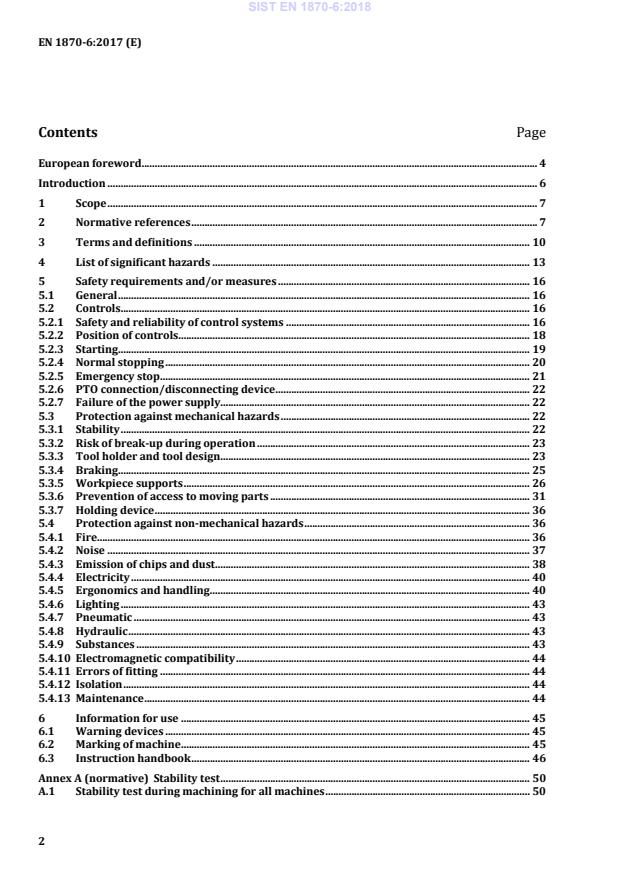
Stability test . 50 A.1 Stability test during machining for all machines . 50 SIST EN 1870-6:2018
Saw spindle dimensional tolerances . 53 Annex C (normative)
Test for safe log positioning on machines with pivoting log carriage . 54 C.1 Safe positioning without holding the work piece . 54 C.2 Safe positioning with holding the workpiece . 54 Annex D (normative)
Brake tests . 55 D.1 Conditions for all tests . 55 D.2 Tests . 55 D.2.1 Un-braked run-down time . 55 D.2.2 Braked run-down time . 55 Annex ZA (informative)
Relationship between this European Standard and the essential requirements of Directive 2006/42/ EC aimed to be covered . 56 Bibliography . 59
1) EN 60204-1:2006 is impacted by EN 60204-1:2006/A1:2009 and EN 60204-1:2006/corrigendum Feb. 2010. 2) EN 60439-1:1999 is impacted by EN 60439-1:1999/A1:2004. 3) EN 60529:1991 is impacted by EN 60529:1991/A1:2000, EN 60529:1991/A2:2013 and EN 60529:1991/corrigendum May 1993. SIST EN 1870-6:2018
Key 1 pivoting log carriage 2 moveable guard 3 handle 4 saw blade guard Figure 1 — Example 1 of a circular sawing machine for firewood
Key 1 frame 2 pivoting log carriage and clamp 3 hinged guard 4 device for transportation Figure 2 — Example 2 of a circular sawing machine for firewood SIST EN 1870-6:2018
Key 1 sliding table 2 log holding device 3 handle 4 fixed guard mounted on the table 5 fixed guard below the table Figure 3 — Example 3 of a circular sawing machine for firewood Note 2 to entry:
The workpiece is moved manually to the saw blade either by: — a pivoting log carriage (circular sawing machine for firewood with pivoting log carriage – see Figure 1 or Figure 2); or — a sliding table with a log holding device (circular sawing machine for firewood with sliding table – see Figure 3) 3.3 log holding device device manually actuated by the operator which hold the log in position during cutting 3.4 stationary machine machine designed to be located on or fixed to the floor or other parts of the structure of the premises and to be stationary during use 3.5 displaceable machine machine which is located on the floor stationary during use and equipped with a device, normally wheels, which allows it to be moved between locations 3.6 machine actuator power mechanism used to effect motion of the machine SIST EN 1870-6:2018
a) shape; 6.2.2.1, 6.2.2.2, 6.3 5.3.3, 5.3.5, 5.3.6, 5.3.7
b) relative location; 5.2.2, 5.3.5, 5.3.6, 5.3.7
c) mass and stability (potential energy of elements which may move under the effect of gravity) 5.3.6
d) mass and velocity (kinetic energy of elements in controlled or uncontrolled motion); 5.3.6, 5.3.7
e) mechanical strength. 5.3.1, 5.3.2, 5.3.3, 5.3.5, 5.3.6, 5.3.7, Annex A
- accumulation of energy inside the machinery:
g) liquids and gases under pressure; 6.2.10, 6.3.5.4 5.4.7, 5.4.8 1.1 Crushing hazard
5.3.5, 5.3.6 1.2 Shearing hazard 5.3.5, 5.3.6 1.3 Cutting or severing hazard 5.3.2, 5.3.3, 5.3.4, 5.3.6 1.4 Entanglement hazard 5.3.6 1.5 Drawing-in or trapping hazard 5.3.6 1.9 High pressure fluid injection or ejection hazard 6.2.10 5.4.7, 5.4.8 2 Electrical hazards due to: 2.1 Contact of persons with live parts (direct contact) 6.2.9, 6.3.5.4 5.4.4, 5.4.12 2.2 Contact of persons with parts which have become live under faulty conditions (indirect contact) 6.2.9 5.4.4, 5.4.12 SIST EN 1870-6:2018
5.4.2 7 Hazards generated by materials and substances (and their constituent elements) processed or used by the machinery 7.1 Hazards from contact with or inhalation of harmful fluids and dusts 6.2.3b, 6.2.4 5.4.3 7.2 Fire hazard 6.2.4 5.4.1, 5.4.3, 5.4.4, 6.3 8 Hazards generated by neglecting ergonomic principles in machinery design related to: 8.1 Unhealthy postures or excessive effort 6.2.7, 6.2.8.2, 6.2.11.12, 6.3.5.5, 6.3.5.6 5.2.2 8.2 Hand-arm or foot-leg anatomy 6.2.8.3 5.2.2 8.4 Local lighting 6.2.8.6 6.3 8.6 Human error, human behaviour 6.2.8, 6.2.11.8, 6.2.11.10, 6.3.5.2, 6.4 6.3 8.7 Design, location or identification of manual controls 6.2.8.7, 6.2.11.8 5.2.2 8.8 Design or location of visual display units 6.2.8.8, 6.4.2 5.2.2 9 Combination of hazards 6.3.2.1 5.2.7 10 Unexpected start up, unexpected overrun/overspeed (or any similar malfunction) from: 10.1 Failure/disorder of the control system 6.2.11, 6.3.5.4 5.2.1 10.2 Restoration of energy supply after an interruption 6.2.11.4 5.2.7, 5.4.7, 5.4.8 10.3 External influences on electrical equipment 6.2.11.11 5.2.1, 5.4.4, 5.4.10 SIST EN 1870-6:2018
EN ISO 13849-1:2015 Clause of this document 1 starting, restarting, prevention of unexpected start-up c 5.2.3 5.2.3 5.2.7 2 stop function (normal stopping (braking function excluded), emergency stop (braking function excluded)) c 5.2.1 5.2.4, 5.2.5 3 safety-related stop function initiated by protective devices or by interlocking of moveable guards c 5.2.1 5.2.4, 5.3.5.2, 5.3.6 4 guard locking c
5.3.5.2 5 interlocking of guards, protective devices, movements and functions, if not otherwise specified c
5.2.3, 5.2.6, 5.3.6.2, 5.3.6.3, 5.3.7 6 braking function b or c
5.2.5, 5.3.4 7 clamping c
5.3.7 Verification By checking the relevant documentation, drawings and/or circuit diagrams, calculation, inspection of the machine and/or relevant functional testing of the machine. Verification that PL of safety functions and safeguards achieves at least the required PL shall be according to EN ISO 13849-1:2015, 4.7. SIST EN 1870-6:2018
Key A shaded areas indicate control positions B
¶ 800 C
· 600,
¶ 1 500 Figure 4 — Position of controls on machine with pivoting log carriage SIST EN 1870-6:2018
Key A shaded areas indicate control positions Figure 5 — Position of controls on machine with sliding table 5.2.3 Starting For electrically driven machines see EN 60204-1:2006, 9.2.5.2, and in addition: For the purpose of this document “all of the safeguards in place and functional” is achieved by the interlocking arrangements described in 5.3.6 and “operation” means rotation of the saw spindle. The exceptions described in EN 60204-1:2006, 9.2.4 are not relevant. The safety related part of the control systems (also see 5.2.1) for start and restart of the machine shall be at least PL = c in accordance with the requirements of EN ISO 13849-1:2015. For RIC engines driven machines engine starting systems may be triggered manually or automatically. Electrical starting systems normally operate at voltages of 24 V or below and therefore do not present a hazard. Electrical starting systems above 24 V are not dealt with in this standard and the installer of the engine shall ensure safe operation after connecting the engine to the driven machinery. For engines with compressed air starting, the starting pneumatic system shall comply with the requirements of EN ISO 4414:2010. Crank handle starting systems shall meet the requirements specified in EN ISO 11102-1:2009 and EN ISO 11102-2:2009. Additionally the following requirements apply: — Starting handles shall have sufficient clearance from the mounting surface to ensure safe turning; — Diesel engines with a manual starter shall have a decompression facility which does not require to be hand-held during cranking; — The only permissible hand starting systems are crank handle (as defined above) and recoil starting devices as described in EN ISO 14314:2009. The instruments for the monitoring of the RIC engine shall comply with the following requirements: — Monitoring instruments shall be identified on or adjacent to them, preferably by a symbol according to ISO 8999:2001 or a descriptive wording for the system being monitored. SIST EN 1870-6:2018
overspeed (see ISO 3046-6); 2)
low lubricating oil pressure; 3)
high coolant temperature; 4)
low coolant level; ii) for the RIC engine driven machine: 1)
overload. Verification By checking relevant drawings and/or system diagrams, inspection and relevant functional testing of the machine. 5.2.5 Emergency stop For machines with electric drive, RIC engine drive, PTO drive or electric and PTO drive an emergency stop is not necessary. For other machines which need more than one power source for the operating work process an emergency stop control device reachable from the operator’s position is required. If the machine is fitted with an emergency stop it shall conform to the requirements of EN 60204-1:2006, 9.2.5.4 and 10.7. The emergency stop control device shall be at any time of self-latching type. The requirements of EN ISO 13850:2015 apply and in addition: — If the machine is fitted with a spring operated mechanical brake this stop control shall be of category 0 in accordance with the requirements of EN 60204-1:2006, 9.2.2; — If the machine is fitted with any other type of brake, e.g. an electrical brake, this stop control shall be of category 1 in accordance with the requirements of EN 60204-1:2006, 9.2.2.
When initiated the stopping sequence shall be: a) cut power to all machine actuators and actuate the brake; b) cut power to the brake after the braking sequence is complete. The stopping sequence shall be satisfied at the level of the contro
...
2003-01.Slovenski inštitut za standardizacijo. Razmnoževanje celote ali delov tega standarda ni dovoljeno.Varnost lesnoobdelovalnih strojev - Krožne žage - 6. del: Krožne žage za drvaSicherheit von Holzbearbeitungsmaschinen - Kreissägemaschinen - Teil 6: BrennholzkreissägemaschinenSécurité des machines pour le travail du bois - Machines à scies circulaires - Partie 6: Scies circulaires à bois de chauffageSafety of woodworking machines - Circular sawing machines - Part 6: Circular sawing machines for fire wood79.120.10Lesnoobdelovalni strojiWoodworking machines25.080.60Strojne žageSawing machinesICS:Ta slovenski standard je istoveten z:EN 1870-6:2017SIST EN 1870-6:2018en,fr,de01-februar-2018SIST EN 1870-6:2018SLOVENSKI
STANDARD
EUROPÄISCHE NORM EUROPEAN STANDARD NORME EUROPÉENNE
EN 1870-6
November
t r s y ICS
y {ä s t rä s r Ersatz für EN
s z y ræ xã t r r t ªA sã t r r {Deutsche Fassung
Sicherheit von Holzbearbeitungsmaschinen æ Kreissägemaschinen æ Teil
xã BrennholzkreissägemaschinenSafety of woodworking machines æ Circular sawing machines æ Part
xã Circular sawing machines for fire wood
Sécurité des machines à bois æ Machines à scies circulaires æ Partie
x ã Scies circulaires à bois de chauffage Diese Europäische Norm wurde vom CEN am
t yä Februar
t r s y angenommenä
ung zu erfüllená in der die Bedingungen festgelegt sindá unter denen dieser Europäischen Norm ohne jede Änderung der Status einer nationalen Norm zu geben istä Auf dem letzten Stand befindliche Listen dieser nationalen Normen mit ihren bibliographischen Angaben sind beim CENæCENELECæManagementæZentrum oder bei jedem CENæMitglied auf Anfrage erhältlichä
Spracheá die von einem CENæMitglied in eigener Verantwortung durch Übersetzung in seine Landessprache gemacht und dem ManagementæZentrum mitgeteilt worden istá hat den gleichen Status wie die offiziellen Fassungenä
CENæMitglieder sind die nationalen Normungsinstitute von Belgiená Bulgariená Dänemarká Deutschlandá der ehemaligen jugoslawischen Republik Mazedoniená Estlandá Finnlandá Frankreichá Griechenlandá Irlandá Islandá Italiená Kroatiená Lettlandá Litauená Luxemburgá Maltaá den Niederlandená Norwegená Österreichá Polená Portugalá Rumäniená Schwedená der Schweizá Serbiená der Slowakeiá Sloweniená Spaniená der Tschechischen Republiká der Türkeiá Ungarná dem Vereinigten Königreich und Zypernä
EUROPÄISCHES KOMITEE FÜR NORMUNG EUROPEAN COMMITTEE FOR STANDARDIZATION
COMITÉ EUROPÉEN DE NORMALISATION
CEN-CENELEC Management-Zentrum:
Rue de la Science 23,
B-1040 Brüssel
t r s y CEN Alle Rechte der Verwertungá gleich in welcher Form und in welchem Verfahrená sind weltweit den nationalen Mitgliedern von CEN vorbehaltenä Refä Nrä EN
s z y ræ xã t r s y DSIST EN 1870-6:2018
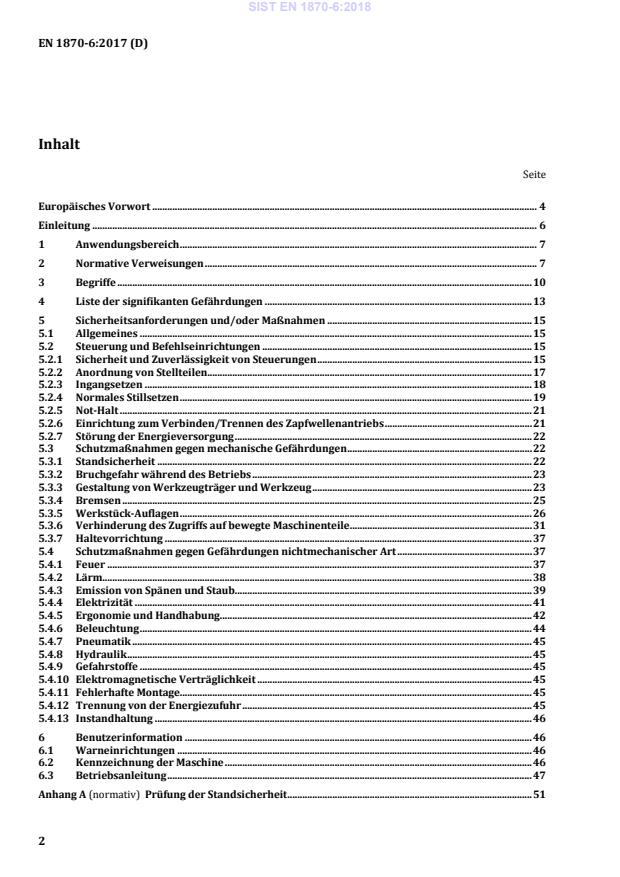
Prüfung der Standsicherheit . 51 SIST EN 1870-6:2018
Maßtoleranzen von Sägewellen . 54 Anhang C (normativ)
Prüfung des sicheren Auflegens von Rundholz bei Maschinen mit Zuführwippe . 55 C.1 Sicheres Auflegen ohne Halten des Werkstücks . 55 C.2 Sicheres Auflegen mit Halten des Werkstücks . 55 Anhang D (normativ)
Bremsenprüfungen . 56 D.1 Bedingungen für alle Prüfungen . 56 D.2 Prüfungen . 56 D.2.1 Ungebremste Auslaufzeit . 56 D.2.2 Gebremste Auslaufzeit. 56 Anhang ZA (informativ)
Zusammenhang zwischen dieser Europäischen Norm und den grundlegenden Anforderungen der abzudeckenden Richtlinie 2006/42/EG . 57 Literaturhinweise. 60
Die Bestimmungen dieses Dokuments betreffen Hersteller und ihre bevollmächtigten Repräsentanten von Brennholzkreissägemaschinen. Es ist auch für Konstrukteure hilfreich. Dieses Dokument enthält auch Hinweise, die der Hersteller zur Information der Betreiber vorsehen muss. Gemeinsame Sicherheitsanforderungen für Werkzeuge sind in EN 847-1:2013 enthalten. SIST EN 1870-6:2018
1) EN 60204-1 ist von EN 60204-1:2006/A1:2009 und EN 60204-1:2006/Berichtigung Februar 2010 betroffen. 2) EN 60439-1:1999 ist von EN 60439-1:1999/A1:2004 betroffen. 3) EN 60529:1991 ist von EN 60529:1991/A1:2000, EN 60529:1991/A2:2013 und EN 60529:1991/Berichtigung Mai 1993 betroffen. SIST EN 1870-6:2018
ISO 8999:2001, Reciprocating internal combustion engines — Graphical symbols 3 Begriffe Für die Anwendung dieses Dokuments gelten die Begriffe nach EN ISO 12100:2010 und die folgenden Begriffe. 3.1 Querschneiden Schneiden quer zur Faserrichtung eines Werkstückes aus Holz 3.2 Brennholzkreissägemaschine Sägemaschine zum Querschneiden von Rundholz für Brennholz, mit einem einzelnen Sägeblatt, mit Antrieb entweder durch einen Elektromotor oder ein in den Traktor eingebautes Hydraulikaggregat oder eine Zapfwellenvorrichtung (en: Power Take Off device, PTO device), mit Handbeschickung und/oder Handentnahme Anmerkung 1 zum Begriff: Die verschiedenen Typen von Brennholzkreissägemaschinen und deren wichtigste Teile sind in den Bildern 1, 2 und 3 dargestellt.
Legende 1 Zuführwippe 2 bewegliche trennende Schutzeinrichtung 3 Handgriff 4 Sägeblatt-Schutzeinrichtung Bild 1 — Beispiel 1 einer Brennholzkreissägemaschine SIST EN 1870-6:2018
Legende 1 Gestell 2 Zuführwippe und Spannvorrichtung 3 schwenkbare trennende Schutzeinrichtung 4 Transportvorrichtung Bild 2 — Beispiel 2 einer Brennholzkreissägemaschine
Legende 1 Rolltisch 2 Rundholz-Haltevorrichtung 3 Handgriff 4 am Tisch befestigte feststehende trennende Schutzeinrichtung 5 feststehende trennende Schutzeinrichtung unter dem Tisch Bild 3 — Beispiel 3 einer Brennholzkreissägemaschine SIST EN 1870-6:2018
EN ISO 12100:2010 Zutreffender Unterabschnitt in diesem Dokument 1 Mechanische Gefährdung durch: – Maschinenteile oder Werkstücke aufgrund Folgendem:
a) Form
6.2.2.1, 6.2.2.2, 6.3 5.3.3, 5.3.5, 5.3.6, 5.3.7
b) relative Anordnung 5.2.2, 5.3.5, 5.3.6, 5.3.7
c) Masse und Standfestigkeit (potentielle Energie von Elementen, die sich unter dem Einfluss der Schwerkraft bewegen können);
5.3.6
d) Masse und Geschwindigkeit (kinetische Energie von Elementen in kontrollierter oder unkontrollierter Bewegung);
5.3.6, 5.3.7
e) mechanischen Festigkeit
5.3.1, 5.3.2, 5.3.3, 5.3.5, 5.3.6, 5.3.7, Anhang A
— Ansammlung von Energie im Inneren der Maschine, verursacht durch:
g) Flüssigkeiten und Gase unter Druck 6.2.10, 6.3.5.4 5.4.7, 5.4.8 1.1 Gefährdung durch Quetschen
5.3.5, 5.3.6 1.2 Gefährdung durch Scheren 5.3.5, 5.3.6 1.3 Gefährdung durch Schneiden oder Abschneiden
5.3.2, 5.3.3, 5.3.4, 5.3.6 1.4 Gefährdung durch Erfassen oder Aufwickeln 5.3.6 1.5 Gefährdung durch Einziehen oder Fangen 5.3.6 1.9 Gefährdung durch Herausspritzen von Flüssigkeiten unter hohem Druck 6.2.10 5.4.7, 5.4.8 SIST EN 1870-6:2018
EN ISO 12100:2010 Zutreffender Unterabschnitt in diesem Dokument 2 elektrische Gefährdungen durch:
2.1 direkte Berührung von Personen mit unter Spannung stehenden Teilen 6.2.9, 6.3.5.4 5.4.4, 5.4.12 2.2 Berührung von Personen mit Teilen, die durch Fehlzustände spannungsführend geworden sind 6.2.9 5.4.4, 5.4.12 4 Gefährdungen durch Lärm und in der Folge:
4.1 Gehörverlust (Taubheit), andere physiologische Beeinträchtigungen (z. B. Gleichgewichtsverlust, Nachlassen der Aufmerksamkeit) 6.2.2.2, 6.3 5.4.2
4.2 Störung der Sprachkommunikation, Störung akustischer Signale usw.
5.4.2
7 Gefährdungen durch Werkstoffe und andere Stoffe (und durch ihre Bestandteile), die von Maschinen verarbeitet oder verwendet werden
7.1 Gefährdungen durch Kontakt mit oder Einatmung von gefährlichen Flüssigkeiten und Stäuben 6.2.3 b), 6.2.4 5.4.3
7.2 Gefährdung durch Feuer
6.2.4
5.4.1, 5.4.3, 5.4.4, 6.3 8 Gefährdungen durch die Vernachlässigung ergonomischer Grundsätze bei der Gestaltung der Maschine durch: 8.1 ungesunde Körperhaltung oder besondere Anstrengung
6.2.7, 6.2.8.2, 6.2.11.12, 6.3.5.5, 6.3.5.6 5.2.2
8.2 die Anatomie von Hand/Arm oder Fuß/Bein 6.2.8.3 5.2.2 8.4 die örtliche Beleuchtung 6.2.8.6 6.3 8.6 menschliches Fehlverhalten, menschliches Verhalten 6.2.8, 6.2.11.8, 6.2.11.10, 6.3.5.2, 6.4 6.3
8.7 die Konstruktion, Platzierung oder Kenntlichmachung von handbetätigten Stellteilen 6.2.8.7, 6.2.11.8 5.2.2
8.8 die Konstruktion oder Platzierung von Sichtanzeigen 6.2.8.8, 6.4.2 5.2.2 9 Kombination von Gefährdungen 6.3.2.1 5.2.7 10 unerwarteter Anlauf, unerwartetes Durchdrehen/Überdrehen (oder jede vergleichbare Fehlfunktion) durch: 10.1 Ausfall/Störung des Steuerungssystems 6.2.11, 6.3.5.4 5.2.1 10.2 Wiederherstellung der Energiezuführung nach einer Unterbrechung 6.2.11.4 5.2.7, 5.4.7, 5.4.8 SIST EN 1870-6:2018
EN ISO 12100:2010 Zutreffender Unterabschnitt in diesem Dokument 10.3 äußere Einflüsse auf elektrische Betriebsmittel
6.2.11.11 5.2.1, 5.4.4, 5.4.10 10.6 Bedienungsfehler (zurückzuführen auf unzureichende Anpassung der Maschine an menschliche Eigenschaften und Fähigkeiten, siehe 8.6) 6.2.8, 6.2.11.8, 6.2.11.10, 6.3.5.2, 6 5.2.1, 5.2.2, 5.4.5, 6.3 11 fehlende Möglichkeit, die Maschine unter optimalen Bedingungen still zu setzen 6.2.11.1, 6.2.11.3, 6.3.5.2 5.2.2, 5.2.4, 5.2.5, 5.2.6, 5.3.4 13 Ausfall der Energieversorgung 6.2.11.1, 6.2.11.4 5.2.7 14 Ausfall des Steuer- bzw. Regelkreises 6.2.11, 6.3.5.4 5.2.1 15 fehlerhafte Montage 6.2.7, 6.4.5 5.3.3, 5.4.11 16 Bruch beim Betrieb 6.2.3 5.3.2 17 herabfallende oder herausgeworfene Gegenstände oder Flüssigkeiten 6.2.3, 6.2.10 5.3.2, 5.3.3, 5.3.5, 5.3.6, 5.3.7 18 Verlust der Standfestigkeit/Umkippen der Maschine 6.3.2.6 5.3.1
5 Sicherheitsanforderungen und/oder Maßnahmen 5.1 Allgemeines Die Maschine muss den Sicherheitsanforderungen und/oder Schutzmaßnahmen in Abschnitt 5 entsprechen. Außerdem sollte die Maschine im Hinblick auf Gefährdungen, die zutreffend, aber nicht signifikant sind und die nicht in diesem Dokument behandelt werden (z. B. scharfe Kanten am Maschinenständer), nach den Grundsätzen in EN ISO 12100:2010 gestaltet sein. ANMERKUNG Für Hinweise im Zusammenhang mit Risikominderung durch Konstruktion siehe EN ISO 12100:2010, 6.2, und hinsichtlich technischer Schutzmaßnahmen siehe EN ISO 12100:2010, 6.3. 5.2 Steuerung und Befehlseinrichtungen 5.2.1 Sicherheit und Zuverlässigkeit von Steuerungen 5.2.1.1 Allgemeines Hinsichtlich der Gestaltung und Ausführung jeglicher Sicherheitsfunktion, ausgeführt in elektrischer, pneumatischer, hydraulischer oder mechanische Technik, gelten die zutreffenden Anforderungen nach EN ISO 13849 1:2015. Sicherheitsbezogene Teile der Steuerung (SRP/CS) von Maschinen, die in diesem Dokument behandelt sind, schließen diejenigen für die in 5.2.1.2 aufgeführten Sicherheitsfunktionen ein. An allen Stellen, an denen in diesem Dokument ein PL erwähnt wird, beziehen sich die Anforderungen an den PL auf EN ISO 13849-1:2015. Für SRP/CS, die Teil eines Sicherheitsbauteils oder einer nichttrennenden Schutzeinrichtung sind, für das/die eine einschlägige Norm vorhanden ist, gelten alle Anforderungen der speziellen Norm. SIST EN 1870-6:2018
5.3.5.2 5 Verriegelung von trennenden Schutzeinrichtungen, nichttrennenden Schutzeinrichtungen, Bewegungen und Funktionen, soweit nicht anderweitig angegeben c
5.2.3, 5.2.6, 5.3.6.2, 5.3.6.3, 5.3.7 6 Bremsfunktion b oder c
5.2.5, 5.3.4 7 Spannen c
5.3.7
Prüfung: Kontrolle der entsprechenden Dokumentation, Zeichnungen und/oder Schaltpläne, Berechnung, Besichtigung der Maschine und/oder zutreffende Funktionsprüfung der Maschine. Der Nachweis, dass der PL von Sicherheitsfunktionen und Schutzeinrichtungen mindestens den geforderten PL erreicht, muss nach EN ISO 13849-1:2015, 4.7, erfolgen. 5.2.2 Anordnung von Stellteilen Die nach 5.2.3, 5.2.4, 5.2.5 und 5.2.6 dieses Dokuments erforderlichen Stellteile zum Ingangsetzen und zum Stillsetzen müssen an einem feststehenden Teil der Maschine wie folgt angeordnet sein: a) an Maschinen mit Zuführwippe innerhalb des maximalen Abstands von 800 mm, gemessen vom vorderen Rand der Zuführwippe in ihrer Ausgangsstellung und einem Abstand von mindestens 600 mm und nicht mehr als 1 500 mm zum Fußboden (siehe Bild 4); b) an Maschinen mit Rolltisch mindestens 50 mm unter der Tischkante innerhalb eines Abstands von höchstens 800 mm zur Vorderkante des Rolltisches in seiner Ausgangsstellung und einem Abstand von mindestens 600 mm und nicht mehr als 1 500 mm zum Fußboden (siehe Bild 5). An Maschinen mit Zapfwellenantrieb, Hydraulikantrieb, Antrieb durch einen Hubkolbenmotor muss das Stellteil zum Ingangsetzen und Stillsetzen vom Standplatz der Bedienperson während des Schneidens erreichbar sein. Prüfung: Kontrolle der entsprechenden Zeichnungen, Messung und Besichtigung der Maschine. SIST EN 1870-6:2018
Legende A Die schattierten Bereiche zeigen die Anordnung der Stellteile B
¶ 800 C
· 600,
¶ 1500 Bild 4 — Anordnung von Stellteilen bei einer Maschine mit Zuführwippe Maße in Millimeter
Legende A Die schattierten Bereiche zeigen die Anordnung der Stellteile Bild 5 — Anordnung von Stellteilen bei einer Maschine mit Rolltisch 5.2.3 Ingangsetzen Bei elektrisch angetriebenen Maschinen siehe EN 60204-1:2006, 9.2.5.2, und in Ergänzung: Im Zusammenhang mit diesem Dokument wird „alle Schutzeinrichtungen angebracht und funktionsfähig“, durch die in 5.3.6 beschriebenen Verriegelungsschaltungen erfüllt und „Betriebsstart“ bedeutet die Drehung der Sägespindel. SIST EN 1870-6:2018
...