

SIST EN 15878:2010
(Main)Steel static storage systems - Terms and definitions
General Information
- Abstract
This European Standard specifies terms and definitions for steel storage systems, as listed in Table 1, and their basic components and accessories.
NOTE Terms and definitions for mechanical handling equipment and load make-up accessories are included in informative annexes.
- Status
- Published
- Public Enquiry End Date
- 05-Apr-2009
- Publication Date
- 15-Aug-2010
- Technical Committee
- I13 - Imaginarni 13
- Current Stage
- 6060 - National Implementation/Publication (Adopted Project)
- Start Date
- 29-Jul-2010
- Due Date
- 03-Oct-2010
- Completion Date
- 16-Aug-2010

Overview
SIST EN 15878:2010 (EN 15878:2010) is the European standard that defines terms and definitions for steel static storage systems and their basic components and accessories. Its primary purpose is to harmonize vocabulary used by manufacturers, designers, installers and users of racking and shelving across Europe so that documentation, specification and communication are consistent and unambiguous. The standard covers the range of steel storage system types listed in Table 1 (pallet racking, shelving, cantilever, dynamic systems, mezzanines, etc.) and provides informative annexes on mechanical handling equipment and load make-up accessories (pallets, containers).
Key topics and technical content
SIST EN 15878:2010 focuses on clear, standardized definitions rather than performance criteria. Key topics include:
- Core definitions: storage system, unit load, bay, run, compartment, storage level, bay load, single/double entry racking.
- Component terminology: upright, base plate, beam, beam connector/lock, pallet support bar, deck, plan and spine bracing, tie beam, portal tie beam, arm, stop, safety/ buffer back stops, pick-up & deposit (P&D) station, upright protector and frame barrier.
- Storage system types (Table 1): adjustable pallet racking, drive‑in/drive‑through, S/R machine racking, open face pallet racking, miniload systems, shelving, multi-tier shelving, cantilever, cassette racking, mobile racking, pallet live and carton live storage, shuttle racking, carousels, storage lifts, mezzanine and rack-clad systems.
- Layout and space definitions: operating aisle, gangway, passageway, pedestrian passageway, operating aisle width, clearance and marshalling area.
- Informative annexes: overview of mechanical handling equipment and load make-up accessories (pallets, containers) to support consistent terminology across interfacing systems.
Practical applications
- Establishing a common vocabulary for technical specifications, contracts and drawings for warehouses and distribution centres.
- Supporting procurement and tender documents so buyers and suppliers use consistent terms (e.g., “single entry run”, “pallet support bar”).
- Improving safety and training materials by removing ambiguity about components and layout terms.
- Enabling interoperability and clearer interfaces between racking systems, material handling equipment (MHE) and load carriers.
Who should use this standard
- Racking and shelving manufacturers and suppliers
- Warehouse designers and logistics consultants
- Architects and building services engineers
- Material handling equipment integrators and system specifiers
- Safety inspectors, compliance officers and standards committees
Related standards
- EN 15878 cross‑references other standards and notes the use of EN 528 for certain safety back stop definitions. Annexes discuss pallet and container terminology to align with load‑make‑up standards. For design, performance or safety rules, consult complementary EN standards applicable to racking calculations, MHE and load carriers.
Keywords: EN 15878, SIST EN 15878:2010, steel static storage systems, racking terminology, shelving definitions, pallet racking, storage components, storage systems standard.
Relations
- Effective Date
- 28-Jan-2026
- Effective Date
- 28-Jan-2026
- Effective Date
- 28-Jan-2026
- Referred By
SIST EN 15620:2021 - Steel static storage systems - Tolerances, deformations and clearances - Effective Date
- 28-Jan-2026
Frequently Asked Questions
SIST EN 15878:2010 is a standard published by the Slovenian Institute for Standardization (SIST). Its full title is "Steel static storage systems - Terms and definitions". This standard covers: This European Standard specifies terms and definitions for steel storage systems, as listed in Table 1, and their basic components and accessories. NOTE Terms and definitions for mechanical handling equipment and load make-up accessories are included in informative annexes.
This European Standard specifies terms and definitions for steel storage systems, as listed in Table 1, and their basic components and accessories. NOTE Terms and definitions for mechanical handling equipment and load make-up accessories are included in informative annexes.
SIST EN 15878:2010 is classified under the following ICS (International Classification for Standards) categories: 01.040.53 - Materials handling equipment (Vocabularies); 53.080 - Storage equipment. The ICS classification helps identify the subject area and facilitates finding related standards.
SIST EN 15878:2010 has the following relationships with other standards: It is inter standard links to SIST EN 15512:2009, SIST EN 16681:2016, SIST-TS CEN ISO/TS 11133-2:2004, SIST EN 15620:2021. Understanding these relationships helps ensure you are using the most current and applicable version of the standard.
SIST EN 15878:2010 is available in PDF format for immediate download after purchase. The document can be added to your cart and obtained through the secure checkout process. Digital delivery ensures instant access to the complete standard document.
Standards Content (Sample)
2003-01.Slovenski inštitut za standardizacijo. Razmnoževanje celote ali delov tega standarda ni dovoljeno.Ortsfeste Regale aus Stahl - BegriffeSystèmes de stockage statiques en acier - Termes et définitionsSteel static storage systems - Terms and definitions53.080Storage equipment01.040.53Oprema za transport materiala (Slovarji)Materials handling equipment (Vocabularies)ICS:Ta slovenski standard je istoveten z:EN 15878:2010SIST EN 15878:2010en,fr01-september-2010SIST EN 15878:2010SLOVENSKI
STANDARD
EUROPEAN STANDARD NORME EUROPÉENNE EUROPÄISCHE NORM
EN 15878
July 2010 ICS 01.040.53; 53.080 English Version
Steel static storage systems - Terms and definitions
Système de stockage statiques en acier - Termes et définitions
Ortsfeste Regale aus Stahl - Begriffe This European Standard was approved by CEN on 19 June 2010.
CEN members are bound to comply with the CEN/CENELEC Internal Regulations which stipulate the conditions for giving this European Standard the status of a national standard without any alteration. Up-to-date lists and bibliographical references concerning such national standards may be obtained on application to the CEN Management Centre or to any CEN member.
This European Standard exists in three official versions (English, French, German). A version in any other language made by translation under the responsibility of a CEN member into its own language and notified to the CEN Management Centre has the same status as the official versions.
CEN members are the national standards bodies of Austria, Belgium, Bulgaria, Croatia, Cyprus, Czech Republic, Denmark, Estonia, Finland, France, Germany, Greece, Hungary, Iceland, Ireland, Italy, Latvia, Lithuania, Luxembourg, Malta, Netherlands, Norway, Poland, Portugal, Romania, Slovakia, Slovenia, Spain, Sweden, Switzerland and United Kingdom.
EUROPEAN COMMITTEE FOR STANDARDIZATION
COMITÉ EUROPÉEN DE NORMALISATION EUROPÄISCHES KOMITEE FÜR NORMUNG
Management Centre:
Avenue Marnix 17,
B-1000 Brussels © 2010 CEN All rights of exploitation in any form and by any means reserved worldwide for CEN national Members. Ref. No. EN 15878:2010: ESIST EN 15878:2010
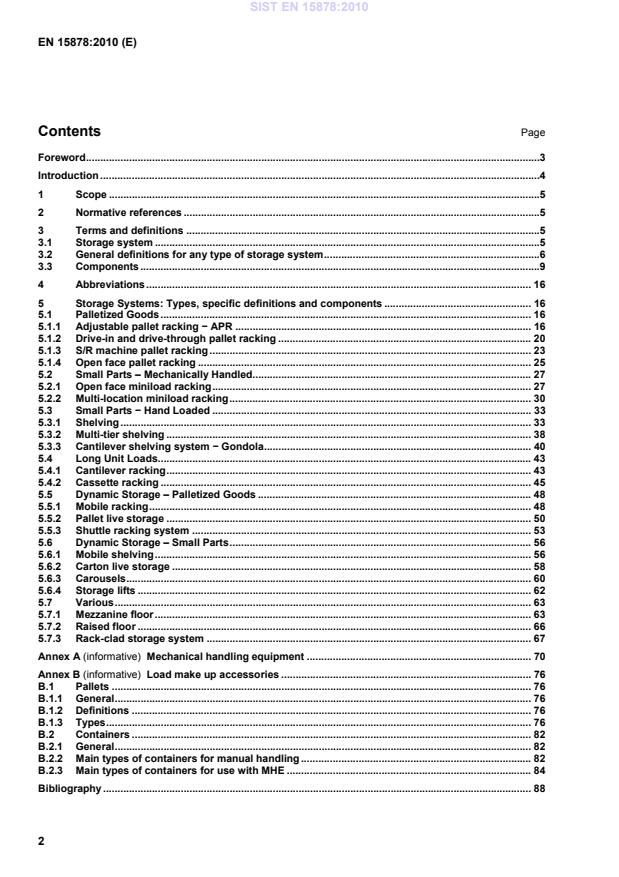
Mechanical handling equipment . 70Annex B (informative)
Load make up accessories . 76B.1 Pallets . 76B.1.1 General . 76B.1.2 Definitions . 76B.1.3 Types . 76B.2 Containers . 82B.2.1 General . 82B.2.2 Main types of containers for manual handling . 82B.2.3 Main types of containers for use with MHE . 84Bibliography . 88SIST EN 15878:2010
This standard will clarify this position and result in a positive identification of the various items of storage equipment. SIST EN 15878:2010
NOTE Terms and definitions for mechanical handling equipment and load make-up accessories are included in informative annexes. 2 Normative references Not applicable. 3 Terms and definitions For the purposes of this document, the following terms and definitions apply. 3.1 Storage system 3.1.1 storage system steel racking or shelving structure designed to store unit loads in a safe and organized way
NOTE
Table 1 shows the types of storage systems.
5.1 Palletized Goods 5.1.1 Adjustable pallet racking
5.1.2 Drive-in and drive-through pallet racking
5.1.3 S/R machine pallet racking 5.1.4 Open face pallet racking
5.2 Small Parts Mechanically Handled 5.2.1 Open face miniload racking
5.2.2 Multi-location miniload racking
5.3 Small Parts Hand Loaded 5.3.1 Shelving 5.3.2 Multi-tier shelving 5.3.3 Cantilever shelving - Gondola 5.4 Long Unit Loads
5.4.1 Cantilever racking 5.4.2 Cassette racking 5.5 Dynamic Storage Palletized Goods 5.5.1 Mobile racking 5.5.2 Pallet live storage 5.5.3 Shuttle racking 5.6 Dynamic Storage Small Parts 5.6.1 Mobile shelving 5.6.2 Carton live storage 5.6.3 Carousels 5.6.4 Storage lifts 5.7 Various 5.7.1 Mezzanine floor 5.7.2 Raised floor 5.7.3 Rack-clad
3.2 General definitions for any type of storage system 3.2.1 general arrangement plan view and elevation of the installation
NOTE
See Figure 1. SIST EN 15878:2010
Key a gangway b pedestrian passageway c bay d passageway e compartment f storage level g marshalling area h single entry run i double entry run j operating aisle Figure 1 — Example of racking general arrangement 3.2.2 unit load individual item which can be placed or retrieved in one operation, e.g. a pallet or a container with goods in a racking system or an individual box or a package in a shelving system
NOTE 1
See Figure 2. NOTE 2 More than one unit load may be handled in one operation. SIST EN 15878:2010
a) Loaded pallet
b) Loaded container
c) Individual boxes Figure 2 — Examples of unit loads 3.2.3 bay module between uprights or upright frames
3.2.4 run series of connected bays
3.2.5 warehouse building for storing and handling unit loads 3.2.6 compartment volume limited by adjacent frames down-aisle and adjacent storage levels in height 3.2.7 storage level area or set of components intended to support the stored unit loads at a particular height
3.2.8 compartment load load which can be stored in one compartment 3.2.9 bay load total allowable weight of all the unit loads in a bay not including unit loads which might be stored on the floor of the bay 3.2.10 single entry rack run of racking or shelving accessible from one operating aisle only 3.2.11 double entry rack run of racking or shelving accessible from two operating aisles SIST EN 15878:2010
racking in which unit loads can be stored two deep from one operating aisle 3.2.14 down-aisle direction
direction parallel to a run 3.2.15 cross-aisle direction
direction perpendicular to a run 3.2.16 clearance nominal dimension between items to ensure safe operation related to a tolerance-free, undeformed system 3.2.17 operating aisle space giving direct access to picking and loading faces 3.2.18 operating aisle width minimum dimension across the aisle at any level between either unit loads located in their nominal position or between the rack structure components 3.2.19
gangway space for movement or transport but not giving direct access to picking or loading faces 3.2.20
passageway gangway resulting from eliminating one or more levels so the MHE can pass under the remaining levels 3.2.21 pedestrian passageway space for pedestrian use only 3.2.22 escape route space giving pedestrians access to emergency exits 3.2.23 marshalling area area to receive or collate unit load 3.3 Components 3.3.1 upright vertical component (often perforated) on which beams, arms, supports, etc. are fixed, supporting the loads transmitted by them
NOTE
See Figure 4. SIST EN 15878:2010
NOTE
See Figure 4. 3.3.3 upright frame two or more upright sections linked together by means of a lattice or battens and fitted with base plates, intended to support the storage levels
NOTE
See Figure 4. 3.3.4
anchor bolt device that connects the base plate to the floor
NOTE
See Figure 4. 3.3.5 shim component located beneath the base plate to level the storage system
NOTE
See Figure 4. 3.3.6 non-shrink grout special mortar placed on site under the base plate to level the storage system
3.3.7 upright protector free standing component to protect the lower part of uprights against accidental impact from MHE
NOTE
See Figure 4. 3.3.8 frame barrier free standing component(s) to protect the lower part of upright frames at the ends of runs and at passageways against accidental impact from MHE
NOTE
See Figure 4. 3.3.9 beam horizontal load carrying member linking adjacent frames, parallel to the operating aisle
NOTE
See Figure 4. 3.3.10 beam end connector component welded to or otherwise formed as an integral part of the beams which has hooks or other devices which engage in holes or slots in the upright
NOTE
See Figure 4. 3.3.11 beam connector lock device, independent or built into the connector, to reduce the risk of accidental vertical dislodgement of the beam
3.3.14 run spacer component connecting and spacing two upright frames back to back
NOTE
See Figure 4. 3.3.15 deck load carrying surface, supported by beams or arms NOTE It might consist of shelves, steel panels, chipboard, mesh, etc.
3.3.16 deck support structural component spanning between beams cross-aisle to increase the load carrying capacity of the deck
3.3.17 plan bracing horizontal structure in the run at load levels which, together with the spine bracing, provides stability to the storage system
NOTE See Figure 3. 3.3.18 top plan bracing top horizontal structure which, together with the spine bracing, provides stability to the storage system
3.3.19 spine bracing set of components in the vertical plane which, together with the plan and/or top plan bracing, provides stability to the storage system in the down aisle direction
NOTE See Figure 3. SIST EN 15878:2010
Key a plan bracing b spine bracing Figure 3 — Plan and spine bracing 3.3.20 tie beam horizontal structural component which does not support unit loads and is generally part of the plan bracing system
3.3.23 beam rail horizontal component perpendicular to the operating aisle, directly supporting the unit loads at each storage level 3.3.24 fork spacer component supported by the beams to provide a fork entry beneath the unit load NOTE These may sometimes be referred as top-hats. 3.3.25 pallet support bar structural component spanning between beams in the cross-aisle direction for the safe support of the pallet on the compartment
NOTE See Figure 4. 3.3.26 stop component intended to retain unit loads, restricting their sliding or rolling when stored 3.3.27 safety back stop component used to prevent accidental collision of a moving object with other unit loads or equipment when the unit load is placed or removed from its storage location NOTE In EN 528 safety back stops are used to prevent unintentional unit load movement. 3.3.28 buffer back stop component used as an aid for MHE to deposit the unit load in the correct position in the racking 3.3.29 upper guide rail structural component, fixed to the portal tie beams of the storage system, used to provide horizontal support and guidance to the S/R machine 3.3.30 bottom rail structural component to support and guide the base of the S/R machine or other handling equipment 3.3.31 busbar support structural component mounted on the floor or storage system to support the power supply to the S/R machine
3.3.32 S/R machine run-outs top structure located at one or both ends of the operating aisle extending the upper guide rail to facilitate the S/R machine operations SIST EN 15878:2010
3.3.35 raised floor surface supported by means of a racking/shelving system to carry the load of mechanical equipment, personnel, unit loads, etc.
3.3.36 pallet loading gate assembly located at the edge of a raised or mezzanine floor, allowing depositing and retrieval of unit loads safely 3.3.37 handrailing protection system comprising handrail, knee rail, kick plate and sometimes infill panels, to prevent a fall over an exposed edge 3.3.38 safety mesh component fixed to the storage system to prevent goods from falling
3.3.39 safety fencing component fixed to the floor to prevent personnel to access to restricted areas 3.3.40 back sheet cladding used to close the back of a bay 3.3.41 bin front component fitted to the front edge of a shelf or compartment level to retain goods
3.3.42 divider vertical component used to horizontally subdivide the compartment
3.3.43 plinth component closing the gap between the bottom shelf and the floor
3.3.44 sprinkler support structural component fixed to the storage system to support the piping for the fire extinguishing system
NOTE See Figure 4. 3.3.45 load warning notice component fixed in prominent locations to provide personnel with important information about the safe use of the storage system SIST EN 15878:2010
Key a upright frame b beam
c pallet support bar d beam connector lock e beam end connector f base plate g upright protector h sprinkler support i upright j run spacer k shim l anchor m frame barrier Figure 4 — General system components SIST EN 15878:2010
Storage and Retrieval VNA Very Narrow Aisle P&D Pick and Deposit APR Adjustable Pallet Racking FIFO First In – First Out LIFO Last In – First Out DM
Defined Movement FM
Free Movement LMA Load Make up Accessory PRS Person Responsible for Safety DIR
Drive In Racking RSA Raised Storage Area 5 Storage Systems: Types, specific definitions and components
5.1 Palletized Goods 5.1.1 Adjustable pallet racking − APR 5.1.1.1 General System of upright frames connected by horizontal beams to provide unit load storage levels which can be adjusted vertically (see Figure 5). 5.1.1.2 Definitions In addition to the definitions given in 3.3, the following specific definitions apply to this system. 5.1.1.2.1 coil/reel cradle component to locate and support coils/reels between beams with their longitudinal axis located horizontally and perpendicular to the operating aisle 5.1.1.2.2 drum chock component to locate cylindrical unit loads between beams with their longitudinal axis located horizontally and perpendicular to the operating aisle 5.1.1.2.3 container support component spanning the beams to support stillage/container feet
container support (see 5.1.1.2.3);
top tie beam. SIST EN 15878:2010
Key a container support b deck c deck support d beam e shelf panel f fork spacer g coil cradle
h drum chock i upright j base plate k shim l anchor bolt m upright frame n frame barrier o upright protector p VNA truck guide rail q run spacer r load warning notice Figure 5 — Adjustable pallet racking – APR SIST EN 15878:2010
5.1.2.2.2 block group of interconnected lanes 5.1.2.2.3 pallet entry guard component to help the operator to visually centre the unit load at the lane entry
5.1.2.2.4 pallet guard rail member parallel to the beam rail, or and integral part of it, which provides guidance in the positioning of pallets on the beam rail 5.1.2.2.5 upright spacer structural component joining a single upright (mono-post) with an upright frame in the down-lane direction 5.1.2.2.6 bump stop component fixed to the floor to limit the travel of the MHE 5.1.2.3 Basic components See 3.3 and Figure 6 for definitions of the system basic components (depending on the system design, not all basic components may be required): upright frame; base plate; shim; anchor bolt; top tie beam; SIST EN 15878:2010
Key a upright b base plate c anchor bolt d shim e non-shrink grout f upright frame
g mono-post h tie beam i arm j beam rail k pallet guide rail l pallet entry guard m top plan bracing n spine bracing o upright spacer p upright protector q forklift truck guide rail r load warning notice Figure 6 — Drive-in pallet racking – DIR SIST EN 15878:2010
5.1.3.2 Definitions Definitions given in 3.3 apply.
5.1.3.3 Basic components See 3.3 and Figure 7 for definitions of the system basic components (depending on the system design, not all basic components may be required): upright frame; base plate; non-shrink grout; shim; anchor bolt; beam; beam connector lock; top beam; portal tie beam; spine bracing; plan bracing; top plan bracing; upper guide rail; bottom rail; S/R machine run-out; load warning notice. 5.1.3.4 Accessories See 3.3 and Figure 7 for definitions of the system accessories, except where indicated otherwise: notice; mesh guard; SIST EN 15878:2010
Key a conveyors b S/R machine run-out c S/R machine d upper guide rail e beam f bottom rail
g portal tie beam h single entry run i double entry run j maintenance area Figure 7 — S/R machine pallet racking SIST EN 15878:2010
Key a tie beam b ledger angle c reel shaft support d reel shaft e upright frame f upright g base plate h shim i anchor bolt j load warning notice Figure 8 — Open face pallet racking 5.2 Small Parts – Mechanically Handled
5.2.1 Open face miniload racking
5.2.1.1 General System consisting of upright frames joined by top and tie beams in order to provide stability to the system. Storage levels for unit loads consist of support profiles and are accessed by S/R machines; unit loads are usually boxes or trays. SIST EN 15878:2010
Key a double entry run b single entry run
c input/output area d maintenance area e upper guide rail
f tie beam
g portal tie beam h ledger angle i storage levels
j
upright k bottom rail l S/R machine m conveyors
n S/R machine run-out Figure 9 — Open face miniload racking SIST EN 15878:2010
NOTE See Figure 11. 5.2.2.3 Basic components See 3.3 and Figure 10 for definitions of the system basic components (depending on the system design, not all basic components may be required): upright frame; base plate; non-shrink grout; anchor bolt; beam; beam connector lock; deck; cross support profile (see 5.2.2.2.1); portal tie beam; spine bracing; plan bracing; top plan bracing; upper guide rail; bottom rail; S/R machine run-out; load warning notice. SIST EN 15878:2010
Key a double entry run b single entry run
c input/output area d maintenance area
e upper guide rail f beam
g portal tie beam h deck i storage levels
j
upright k bottom rail
l S/R machine m conveyors
n S/R machine run-out Figure 10 — Multi-location miniload racking – Cross support profile SIST EN 15878:2010
Figure 11 — Multi-location miniload racking – Cross support profile 5.3 Small Parts − Hand Loaded 5.3.1 Shelving
5.3.1.1 General System of upright frames connected by horizontal shelves or beams with decks to provide unit load storage levels which can be adjusted vertically. 5.3.1.2 Definitions In addition to the definitions given in 3.3, the following specific definitions apply to this system. 5.3.1.2.1 top dust cover
surface not supporting unit loads, covering the top of the shelving system 5.3.1.2.2 corner plate component fixed to the upright and shelf used as an alternative to spine bracing to stabilize the shelving
5.3.1.2.3 card holder component fixed to the front edge of a shelf to hold an identification card or label
5.3.1.2.4 drawer guide component allowing the sliding in and out of a drawer
5.3.1.2.5 side sheet cladding to close the side of a bay
5.3.1.2.7 shelf clip component connected to the upright and supporting the shelf 5.3.1.2.8 lug feature pressed out of the upright or the shelf and performing the same function as a shelf clip 5.3.1.2.9 aesthetic end panel decorative cladding at the end of a run 5.3.1.3 Basic components See 3.3 and Figure 12, Figure 13 and Figure 14 for definitions of the system basic components (depending on the system design, not all basic components may be required): upright frame; upright; base plate; shim; anchor bolt; shelf; shelf clip (see 5.3.1.2.7); corner plate (see 5.3.1.2.2); beam; spine bracing; load warning notice. 5.3.1.4 Accessories See 3.3 and Figure 12, Figure 13 and Figure 14 for definitions of the system accessories, except where indicated otherwise: notice; top dust cover (see 5.3.1.2.1); card holder (see 5.3.1.2.3); back sheet; bin front; SIST EN 15878:2010
Key a base plate b upright frame c deck support d deck e beam Figure 12 — Beam shelving system
Key a shelf clip
b shelf
c corner plate d upright e shelf reinforcement Figure 13 — Unbraced frame shelving detail
Key a top dust cover b drawer guide c drawer d plinth e bin front f side sheet g back sheet h divider Figure 14 — Shelving accessories SIST EN 15878:2010
Key a handrail b knee rail c floor d kick plate e shelf Figure 15 — Example of a two-tier shelving system
5.3.3.2.2 peg hook exhibiting component normally fixed to the back of the racking for small products 5.3.3.2.3 fascia cosmetic item located at the top of the shelving 5.3.3.2.4 base horizontal structural component fixed to the bottom to upright, usually fitted with adjustable feet 5.3.3.2.5 column assembly consisting of the upright and the base 5.3.3.2.6 label holder component fixed to the front edge of a shelf to hold an identification card or label
5.3.3.2.7 module set of two adjacent columns and the elements between them 5.3.3.2.8 adjustable foot component fixed to the base to level the shelving system 5.3.3.2.9 crash bar component located at the bottom of the shelving, normally fixed to the base, in order to minimize the effect of impacts from shopping trolleys, etc. 5.3.3.2.10 tie bar component to join uprights down-aisle 5.3.3.3 Basic components See 3.3 and Figure 16 for definitions of the system basic components (depending on the system design, not all basic components may be required): upright; SIST EN 15878:2010
Key a fascia b peg hook c bin front d label holder e plinth with crash bar f adjustable foot g base h bracket i divider j shelf k upright l back sheet Figure 16 — Cantilever shelving system – Gondola shelving SIST EN 15878:2010
5.4.1 Cantilever racking
5.4.1.1 General System of uprights with horizontal cantilever arms connected in the down-aisle direction by tie beams and spine bracing; it can be loaded/unloaded by MHE or by hand. 5.4.1.2 Definitions In addition to the definitions given in 3.3, the following specific definitions apply to this system. 5.4.1.2.1 column vertical member supporting the cantilever arms that can either be single sided or double sided 5.4.1.2.2 base horizontal structural component fixed to the bottom of the column and to allow load transfer and fixing to the floor 5.4.1.2.3 down-aisle support beam structural down-aisle beam fixed to the arms and columns or bases to support unit loads
5.4.1.2.4 cross support bar structural component joined to the down-aisle support beams cross-aisle to support unit loads 5.4.1.3 Basic components See 3.3 and Figure 17 for definitions of the system basic components (depending on the system design, not all basic components may be required): column; base (see 5.4.1.2.2); shim; anchor bolt; tie beam; arm; spine bracing; load warning notice. 5.4.1.4 Accessories See 3.3 and Figure 17 for definitions of the system accessories, except where indicated otherwise: notice; SIST EN 15878:2010
Key a column b base c arm d bracing e stop
f down aisle support beam g cross support bar h truck guide rail i deck j tie beam Figure 17 — Cantilever racking
5.4.2.1 General System consisting of frames joined by beams with perpendicular components in depth (beam rails, roller/wheel tracks, low friction bearers, etc.) fixed to them which support and guide the sliding platforms. The system is serviced by S/R machines.
5.4.2.2 Definitions In addition to the definitions given in 3.3, the following specific definitions apply to this system. 5.4.2.2.1 cassette captive container supporting long materials
5.4.2.2.2 roller track horizontal frame arranged in the cross aisle direction, fixed to two or more beams, equipped with rollers which allow the sliding and support of the cassettes
5.4.2.2.3 low friction bearer horizontal component arranged in the cross aisle direction, fixed to two or more beams, which allow the sliding of the cassettes 5.4.2.2.4 cassette retainer component fixed to frames to stop the cassettes from moving into the aisle
5.4.2.3 Basic components See 3.3 and Figure 18 for definitions of the system basic components (depending on the system design, not all basic components may be required): anchor; plan bracing; top plan bracing; spine bracing; base plate; upright frame; roller track (see 5.4.2.2.2); low friction bearer (see 5.4.2.2.3); beam; bottom rail; upper guide rail; SIST EN 15878:2010
a) Cross-aisle section
b) Storage location
c) Beam rail Key a unit load b roller track
c upright d beam rail e beam Figure 18 — Cassette racking SIST EN 15878:2010
5.5.1 Mobile racking 5.5.1.1 General A skeleton framework of fixed or adjustable design supporting unit loads generally without the use of shelves. This skeleton framework is in turn fixed to moveable base units supported on wheels mounted in the base unit, which run on rails mounted in the floor. 5.5.1.2 Definitions In addition to the definitions given in 3.3, the following specific definitions apply to this system. 5.5.1.2.1 master control panel enclosure containing electrical equipment to isolate the mobiles from the power supply or when master control of a block of mobiles is required, for powered operated systems only
5.5.1.2.2 individual control panel electric or electronic controls fitted to each mobile base, for powered operated systems only
5.5.1.2.3 wheel carriage assembly fitted with wheels which run on rails 5.5.1.2.4 mobile base assembly of wheel carriages joined by longitudinal sections and bracing 5.5.1.2.5 rail steel section to provide a running surface for the wheels and to transfer and distribute the wheel loads into the concrete floor slab or foundation 5.5.1.2.6 guide rail steel section shaped to provide guidance to the mobile base via the guide wheels and usually to transfer and distribute the wheel loads into the concrete floor slab or foundation 5.5.1.2.7 access photoelectric cells safety device to stop or prevent base movement if a person or MHE enters the operating aisle, for powered operated systems only 5.5.1.2.8 safety kick plate safety device (mechanical or photoelectric) used to stop the mobile base if there is an obstruction in the operating aisle, for powered operated systems only 5.5.1.3 Basic components In addition to the components listed below, the basic components for the specific racking system used on the mobile bases shall be considered. See 5.5.1.2, Figure 19 and Figure 20 for definitions of the system basic components: mobile base;
...