


SIST IEC 62642-2-3:2024
(Main)Alarm systems - Intrusion and hold-up systems - Part 2-3: Intrusion detectors - Microwave detectors
Alarm systems - Intrusion and hold-up systems - Part 2-3: Intrusion detectors - Microwave detectors
IEC 62642-2-3:2010 is for microwave detectors installed in buildings and provides for security grades 1 to 4 (see IEC 62642-1), specific or non-specific wired or wire-free detectors, and uses environmental classes I to IV (see IEC 62599-1).
Systèmes d'alarme - Systèmes d'alarme contre l'intrusion et les hold-up - Partie 2-3: Détecteurs d'intrusion - Détecteurs à hyperfréquences
La CEI 62642-2-3:2010 concerne les détecteurs à hyperfréquences installés dans les immeubles et est prévue pour les grades de sécurité 1 à 4 (voir la CEI 62642-1), les détecteurs filaires spécifiques ou non spécifiques ou non filaires, et l'utilisation des classes d'environnement I à IV (voir la CEI 62599-1).
Alarmni sistemi - Sistemi za javljanje vloma in ropa - 2-3. del: Detektorji vloma - Mikrovalovni javljalniki (IEC 62642-2-3:2010)
General Information
- Status
- Published
- Publication Date
- 01-Jul-2024
- Technical Committee
- EAL - Alarm systems
- Current Stage
- 6060 - National Implementation/Publication (Adopted Project)
- Start Date
- 21-Jun-2024
- Due Date
- 26-Aug-2024
- Completion Date
- 02-Jul-2024
Relations
- Effective Date
- 01-Dec-2010
- Effective Date
- 01-Dec-2010
Overview - IEC 62642-2-3:2010 (Microwave detectors)
IEC 62642-2-3:2010 specifies requirements and tests for microwave intrusion detectors used inside buildings as part of intrusion and hold‑up alarm systems. It defines how detectors must detect intruders by emitting microwave radiation and analysing returned signals, and it covers detectors for security grades 1 to 4 and environmental classes I to IV (see IEC 62642-1 and IEC 62599-1). This part applies to specific or non‑specific wired or wire‑free detectors and excludes outdoor detectors and system interconnections.
Key topics and technical requirements
- Security grades & environmental classes
- Support for Grades 1–4 (increasing functional and signalling requirements).
- Environmental classification per IEC 62599‑1 (Classes I–IV).
- Core functions and event processing
- Mandatory/optional event handling (Table summary): intrusion, tamper, masking, significant range reduction, low supply voltage, total loss of power, local/remote self tests.
- Signal/message generation rules and recommended prioritisation (e.g., intrusion, fault, masking).
- Detection and testing
- Requirements for basic detection tests, walk tests (standard walk‑test target and simulated targets), and masking tests.
- Annexes providing walk‑test diagrams, test magnets, masking materials and test matrices.
- Operational and immunity requirements
- Tests for immunity to incorrect operation, electrical requirements (power, low‑voltage behaviour), EMC considerations (see IEC 62599‑2), and tamper security.
- Marking, documentation and self‑test
- Mandatory identification, documentation and provisions for local and remote self‑testing and fault signalling.
Practical applications - who uses this standard
- Manufacturers designing and certifying indoor microwave detectors.
- System integrators and security installers selecting detectors for building intrusion systems.
- Test laboratories and certification bodies performing compliance and performance testing.
- Security consultants and facility managers specifying detectors by required security grade and environmental class.
- Typical use cases: perimeter-free interior detection zones, retail and office intrusion detection, integration with control and indicating equipment (CIE), wired or wireless alarm subsystems.
Related standards
- IEC 62642‑1 (System requirements)
- IEC 62642‑2‑2 (Passive infrared detectors)
- IEC 62642‑2‑4 (Combined PIR/Microwave)
- IEC 62599‑1 (Environmental test methods)
- IEC 62599‑2 (EMC immunity for fire/security components)
- IEC 62642‑6 (Power supplies)
Keywords: IEC 62642-2-3, microwave detectors, intrusion alarm systems, security grades, environmental classes, masking detection, tamper detection, walk test, EMC.



Frequently Asked Questions
SIST IEC 62642-2-3:2024 is a standard published by the Slovenian Institute for Standardization (SIST). Its full title is "Alarm systems - Intrusion and hold-up systems - Part 2-3: Intrusion detectors - Microwave detectors". This standard covers: IEC 62642-2-3:2010 is for microwave detectors installed in buildings and provides for security grades 1 to 4 (see IEC 62642-1), specific or non-specific wired or wire-free detectors, and uses environmental classes I to IV (see IEC 62599-1).
IEC 62642-2-3:2010 is for microwave detectors installed in buildings and provides for security grades 1 to 4 (see IEC 62642-1), specific or non-specific wired or wire-free detectors, and uses environmental classes I to IV (see IEC 62599-1).
SIST IEC 62642-2-3:2024 is classified under the following ICS (International Classification for Standards) categories: 01 - GENERALITIES. TERMINOLOGY. STANDARDIZATION. DOCUMENTATION; 13.310 - Protection against crime; 13.320 - Alarm and warning systems. The ICS classification helps identify the subject area and facilitates finding related standards.
SIST IEC 62642-2-3:2024 has the following relationships with other standards: It is inter standard links to SIST IEC 60839-2-2:1995, SIST IEC 60839-2-5:1995. Understanding these relationships helps ensure you are using the most current and applicable version of the standard.
SIST IEC 62642-2-3:2024 is available in PDF format for immediate download after purchase. The document can be added to your cart and obtained through the secure checkout process. Digital delivery ensures instant access to the complete standard document.
Standards Content (Sample)
SLOVENSKI STANDARD
01-september-2024
Nadomešča:
SIST IEC 60839-2-2:1995
SIST IEC 60839-2-5:1995
Alarmni sistemi - Sistemi za javljanje vloma in ropa - 2-3. del: Detektorji vloma -
Mikrovalovni javljalniki (IEC 62642-2-3:2010)
Alarm systems - Intrusion and hold-up systems - Part 2-3: Intrusion detectors -
Microwave detectors
Systèmes d'alarme - Systèmes d'alarme contre l'intrusion et les hold-up - Partie 2-3:
Détecteurs d'intrusion - Détecteurs à hyperfréquences
Ta slovenski standard je istoveten z: IEC 62642-2-3:2010
ICS:
13.310 Varstvo pred kriminalom Protection against crime
13.320 Alarmni in opozorilni sistemi Alarm and warning systems
2003-01.Slovenski inštitut za standardizacijo. Razmnoževanje celote ali delov tega standarda ni dovoljeno.
IEC 62642-2-3 ®
Edition 1.0 2010-12
INTERNATIONAL
STANDARD
NORME
INTERNATIONALE
Alarm systems – Intrusion and hold-up systems –
Part 2-3: Intrusion detectors – Microwave detectors
Systèmes d’alarme – Systèmes d'alarme contre l’intrusion et les hold-up –
Partie 2-3: Détecteurs d'intrusion – Détecteurs à hyperfréquences
INTERNATIONAL
ELECTROTECHNICAL
COMMISSION
COMMISSION
ELECTROTECHNIQUE
PRICE CODE
INTERNATIONALE
W
CODE PRIX
ICS 13.320 ISBN 978-2-88912-304-9
– 2 – 62642-2-3 Ó IEC:2010
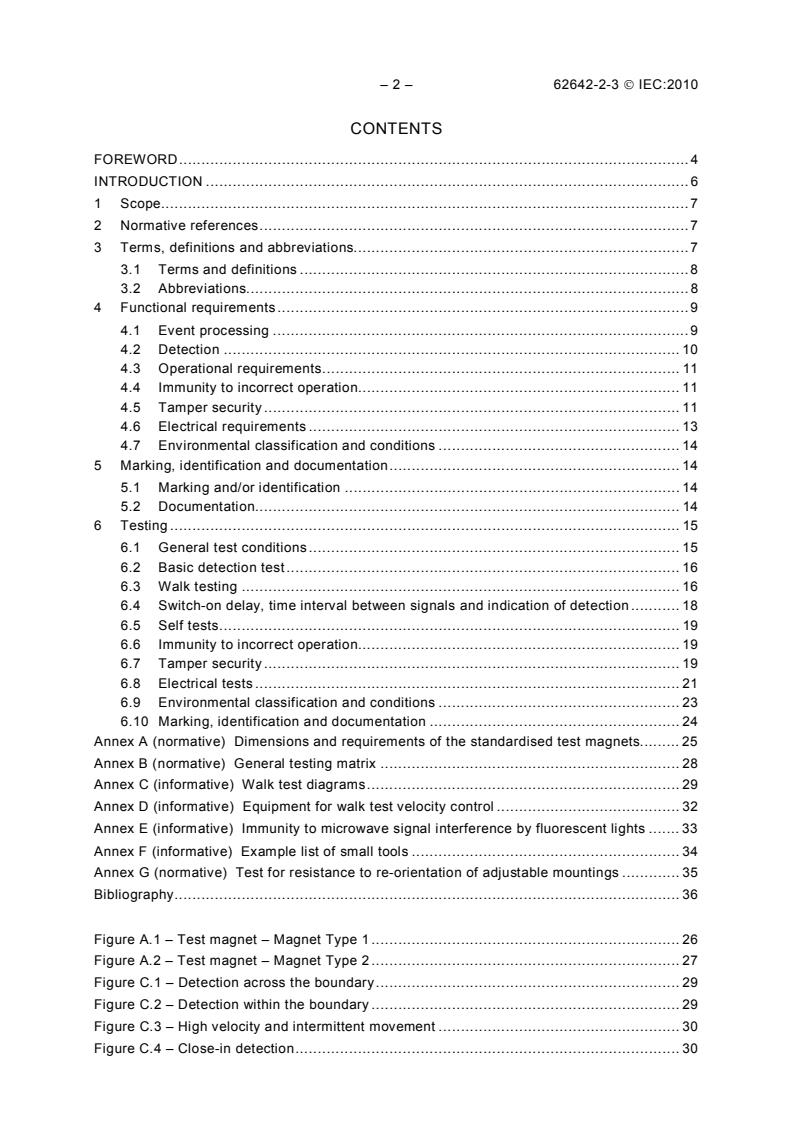
CONTENTS
FOREW ORD . 4
INTRODUCTION . 6
1 Sc o pe . 7
2 Normative references . 7
3 Terms, definitions and abbreviations. 7
3.1 Terms and definitions . 8
3.2 Abbrev iations. 8
4 Functional requirements . 9
4.1 Event processing . 9
4.2 Detection . 10
4.3 Operational requirements . 11
4.4 Immunity to incorrect operation. 11
4.5 Tamper security . 11
4.6 Electrical requirements . 13
4.7 Environmental classification and conditions . 14
5 Marking, identification and documentation . 14
5.1 Marking and/or identification . 14
5.2 Documentation. 14
6 Testing . 15
6.1 General test conditions . 15
6.2 Basic detection test . 16
6.3 Walk testing . 16
6.4 Switch-on delay, time interval between signals and indication of detection . 18
6.5 Self tests . 19
6.6 Immunity to incorrect operation. 19
6.7 Tamper security . 19
6.8 Electrical tests . 21
6.9 Environmental classification and conditions . 23
6.10 Marking, identification and documentation . 24
Annex A (normative) Dimensions and requirements of the standardised test magnets. 25
Annex B (normative) General testing matrix . 28
Annex C (informative) Walk test diagrams . 29
Annex D (informative) Equipment for walk test velocity control . 32
Annex E (informative) Immunity to microwave signal interference by fluorescent lights . 33
Annex F (informative) Example list of small tools . 34
Annex G (normative) Test for resistance to re-orientation of adjustable mountings . 35
Bibliography . 36
Figure A.1 – Test magnet – Magnet Type 1 . 26
Figure A.2 – Test magnet – Magnet Type 2 . 27
Figure C.1 – Detection across the boundary . 29
Figure C.2 – Detection within the boundary . 29
Figure C.3 – High velocity and intermittent movement . 30
Figure C.4 – Close-in detection . 30
62642-2-3 Ó IEC:2010 – 3 –
Figure C.5 – Significant range reduction . 31
Figure E.1 – Immunity to fluorescent lamp interference . 33
Figure G.1 – Re-orientation test . 35
Table 1 – Events to be processed by grade . 9
Table 2 – Generation of signals or messages . 9
Table 3 – General walk test velocity and attitude requirements. 10
Table 4 – Tamper security requirements . 13
Table 5 – Electrical requirements . 13
Table 6 – Range of materials for masking tests . 21
Table 7 – Operational tests. 24
Table 8 – Endurance tests . 24
– 4 – 62642-2-3 Ó IEC:2010
INTERNATIONAL ELECTROTECHNICAL COMMISSION
____________
ALARM SYSTEMS –
INTRUSION AND HOLD-UP SYSTEMS –
Part 2-3: Intrusion detectors –
Microwave detectors
FOREWORD
1) The International Electrotechnical Commission (IEC) is a worldwide organization for standardization comprising
all national electrotechnical committees (IEC National Committees). The object of IEC is to promote
international co-operation on all questions concerning standardization in the electrical and electronic fields. To
this end and in addition to other activities, IEC publishes International Standards, Technical Specifications,
Technical Reports, Publicly Available Specifications (PAS) and Guides (hereafter referred to as “IEC
Publication(s)”). Their preparation is entrusted to technical committees; any IEC National Committee interested
in the subject dealt with may participate in this preparatory work. International, governmental and non-
governmental organizations liaising with the IEC also participate in this preparation. IEC collaborates closely
with the International Organization for Standardization (ISO) in accordance with conditions determined by
agreement between the two organizations.
2) The formal decisions or agreements of IEC on technical matters express, as nearly as possible, an international
consensus of opinion on the relevant subjects since each technical committee has representation from all
interested IEC National Committees.
3) IEC Publications have the form of recommendations for international use and are accepted by IEC National
Committees in that sense. While all reasonable efforts are made to ensure that the technical content of IEC
Publications is accurate, IEC cannot be held responsible for the way in which they are used or for any
misinterpretation by any end user.
4) In order to promote international uniformity, IEC National Committees undertake to apply IEC Publications
transparently to the maximum extent possible in their national and regional publications. Any divergence
between any IEC Publication and the corresponding national or regional publication shall be clearly indicated in
the latter.
5) IEC itself does not provide any attestation of conformity. Independent certification bodies provide conformity
assessment services and, in some areas, access to IEC marks of conformity. IEC is not responsible for any
services carried out by independent certification bodies.
6) All users should ensure that they have the latest edition of this publication.
7) No liability shall attach to IEC or its directors, employees, servants or agents including individual experts and
members of its technical committees and IEC National Committees for any personal injury, property damage or
other damage of any nature whatsoever, whether direct or indirect, or for costs (including legal fees) and
expenses arising out of the publication, use of, or reliance upon, this IEC Publication or any other IEC
Publications.
8) Attention is drawn to the Normative references cited in this publication. Use of the referenced publications is
indispensable for the correct application of this publication.
9) Attention is drawn to the possibility that some of the elements of this IEC Publication may be the subject of
patent rights. IEC shall not be held responsible for identifying any or all such patent rights.
International Standard IEC 62642-2-3 has been prepared by IEC technical committee 79:
Alarm and electronic security systems.
This standard is based on EN 50131-2-3 (2008).
The text of this standard is based on the following documents:
FDIS Report on voting
79/322/FDIS 79/328/RVD
Full information on the voting for the approval of this standard can be found in the report on
voting indicated in the above table.
This publication has been drafted in accordance with the ISO/IEC Directives, Part 2.
62642-2-3 Ó IEC:2010 – 5 –
A list of all parts of the IEC 62642 series can be found, under the general title Alarm systems
– Intrusion and hold-up systems, on the IEC website.
The committee has decided that the contents of this publication will remain unchanged until
the stability result date indicated on the IEC web site under "http://webstore.iec.ch" in the data
related to the specific publication. At this date, the publication will be
• reconfirmed,
• withdrawn,
• replaced by a revised edition, or
• amended.
– 6 – 62642-2-3 Ó IEC:2010
INTRODUCTION
This Part 2-3 of the IEC 62642 series of standards gives requirements for microwave
detectors. The other parts of this series of standards are as follows:
Part 1 System requirements
Part 2-2 Intrusion detectors – Passive infrared detectors
Part 2-3 Intrusion detectors – Microwave detectors
Part 2-4 Intrusion detectors – Combined passive infrared / Microwave detectors
Part 2-5 Intrusion detectors – Combined passive infrared / Ultrasonic detectors
Part 2-6 Intrusion detectors – Opening contacts (magnetic)
Part 2-71 Intrusion detectors – Glass break detectors – Acoustic
Part 2-72 Intrusion detectors – Glass break detectors – Passive
Part 2-73 Intrusion detectors – Glass break detectors – Active
Part 3 Control and indicating equipment
Part 4 Warning devices
Part 5-3 Requirements for interconnections equipment using radio frequency
techniques
Part 6 Power supplies
Part 7 Application guidelines
Part 8 Security fog devices/systems
This standard deals with microwave detectors (to be referred to as the detector) used as part
of intrusion alarm systems installed in buildings. It includes four security grades and four
environmental classes.
The purpose of a detector is to emit microwave radiation and analyse returned signals to
detect an intruder and to provide the necessary range of signals or messages to be used by
the rest of the intrusion alarm system.
The number and scope of these signals or messages will be more comprehensive for systems
that are specified at the higher grades.
This specification is only concerned with the requirements and tests for the detector. Other
types of detector are covered by other documents identified as IEC 62642-2 series.
62642-2-3 Ó IEC:2010 – 7 –
ALARM SYSTEMS –
INTRUSION AND HOLD-UP SYSTEMS –
Part 2-3: Intrusion detectors –
Microwave detectors
1 Scope
This part of the IEC 62642 is for microwave detectors installed in buildings and provides for
security grades 1 to 4 (see IEC 62642-1), specific or non-specific wired or wire-free detectors,
and uses environmental classes I to IV (see IEC 62599-1). This standard does not include
requirements for microwave detectors intended for use outdoors.
A detector fulfils all the requirements of the specified grade.
Functions additional to the mandatory functions specified in this standard may be included in
the detector, providing they do not influence the correct operation of the mandatory functions.
This standard does not apply to system interconnections.
2 Normative references
The following referenced documents are indispensable for the application of this document.
For dated references, only the edition cited applies. For undated references, the latest edition
of the referenced document (including any amendments) applies.
IEC 60068-1:1988, Environmental testing – Part 1: General and guidance
IEC 60068-2-52, Environmental testing – Part 2-52: Tests – Test Kb: Salt mist, cyclic (sodium
chloride solution)
IEC 62599-1, Alarm systems – Part 1: Environmental test methods
IEC 62599-2, Alarm systems – Part 2: Electromagnetic compatibility – Immunity requirements
for components of fire and security alarm systems
IEC 62642-1, Alarm systems – Intrusion and hold-up systems – Part 1: System requirements
IEC 62642-6, Alarm systems – Intrusion and hold-up systems – Part 6: Power supplies
3 Terms, definitions and abbreviations
For the purposes of this document, the terms, definitions and abbreviations given in the
IEC 62642-1, as well as the following apply.
– 8 – 62642-2-3 Ó IEC:2010
3.1 Terms and definitions
3.1.1
basic detection target
microwave reflector designed to verify the operation of a detector
3.1.2
incorrect operation
physical condition that causes an inappropriate signal or message from a detector
3.1.3
masking
interference with the detector input capability by the introduction of a physical barrier such as
metal, plastics, paper or sprayed paints or lacquers in close proximity to the detector
3.1.4
microwave detector
detector having an active microwave emitter and receiver installed in the same casing
3.1.5
simulated walk test target
non-human or synthetic microwave reflector designed to simulate the standard walk test
target
3.1.6
standard walk test target
human being of standard weight and height clothed in close fitting clothing appropriate to the
simulation of an intruder
3.1.7
walk test
operational test during which a detector is stimulated by the standard walk test target in a
controlled environment
3.1.8
walk test attitude, crawling
crawling attitude that consists of the standard walk test target moving with hands and knees in
contact with the floor
3.1.9
walk test attitude, upright
upright attitude that consists of the standard walk test target standing and walking with arms
by the sides of the body. The standard walk test target begins and ends a traverse with feet
together
3.2 Abbreviations
HDPE high density polyethylene
EMC electromagnetic compatibility
SWT standard walk-test target
BDT basic detection target
FOV field of view
62642-2-3 Ó IEC:2010 – 9 –
4 Functional requirements
4.1 Event processing
Detectors shall process the events shown in Table 1. Detectors shall generate signals or
messages as shown in Table 2.
Table 1 – Events to be processed by grade
Grade
Event
1 2 3 4
Intrusion detection M M M M
Tamper detection Op M M M
Masking detection Op Op M M
Significant reduction of range Op Op Op M
Low supply voltage Op Op M M
Total loss of power supply Op M M M
Local self test Op Op M M
Remote self test Op Op Op M
M = Mandatory
Op = Optional
Table 2 – Generation of signals or messages
Signals or messages
Event
Intrusion Tamper Fault
No event NP NP NP
Intrusion M NP NP
Tamper NP M NP
a
Masking M Op M
a
Significant reduction of range M Op M
Low supply voltage Op Op M
b
Total loss of power supply M Op Op
Local self test pass NP NP NP
Local self test fail NP NP M
Remote self test pass M NP NP
Remote self test fail NP NP M
M = Mandatory
NP = Not Permitted
Op = Optional
NOTE 1 This permits two methods of signalling a masking or reduction of range event: either by the intrusion
signal and fault signal, or by a dedicated masking or reduction of range signal or message. Use of the intrusion
signal and fault signal is preferable, as this requires fewer connections between CIE and detector. If multiple
events overlap there will be some signal combinations that may be ambiguous. To overcome this ambiguity it is
suggested that detectors should not signal ‘intrusion‘ and ‘fault‘ at the same time except to indicate masking. This
implies that the detector should prioritise signals, e.g. 1 Intrusion, 2 Fault, 3 Masking.
NOTE 2 When, in Table 1, an event may optionally generate signals or messages, they are as shown in this table.
NOTE 3 It is accepted that a bus system may send out dedicated signals or messages and does not necessarily
have to follow the mapping of Table 2 provided that all of the required events are signalled.
a
An independent signal or message may be provided instead.
b
Alternatively total loss of power supply shall be determined by loss of communication with the detector.
– 10 – 62642-2-3 Ó IEC:2010
4.2 Detection
4.2.1 Detection performance
The detector shall generate an intrusion signal or message when the standard or simulated
walk-test target moves at velocities and attitudes specified in Table 3. For detection across
the boundary, the walk-test distance shall be 1,5 m either side of the boundary. For detection
within the boundary, the walk-test distance shall be 3,0 m.
Table 3 – General walk test velocity and attitude requirements
Test Grade 1 Grade 2 Grade 3 Grade 4
Detection across the boundary Required Required Required Required
–1 –1 –1 –1
Velocity 1,0 ms 1,0 ms 1,0 ms 1,0 ms
Attitude Upright Upright Upright Upright
Detection within the boundary Required Required Required Required
–1 –1 –1 –1
Velocity 0,3 ms 0,3 ms 0,2 ms 0,1 ms
Attitude Upright Upright Upright Upright
Detection at high velocity Not required Required Required Required
–1 –1 –1
Velocity N/A 2,0 ms 2,5 ms 3,0 ms
Attitude N/A Upright Upright Upright
Close-in detection performance Required Required Required Required
Distance 2,0 m 2,0 m 0,5 m 0,5 m
–1 –1 –1 –1
Velocity 0,5 ms 0,4 ms 0,3 ms 0,2 ms
Attitude Upright Upright Crawling Crawling
Intermittent movement detection
Not required Not required Required Required
a
performance
–1 –1
Velocity N/A N/A 1,0 ms 1,0 ms
Attitude N/A N/A Upright Upright
b
Significant reduction of specified range Not required Not required Not required Required
–1
Velocity N/A N/A N/A 1,0 ms
Attitude N/A N/A N/A Upright
a
For grade 3 and 4 detectors, the intermittent movement shall consist of the SWT walking 1 m at a velocity of
–1
1,0 ms then pausing for 5 s before continuing. The sequence shall be maintained until the SWT has traversed
through the entire detection area. This constitutes one walk test. The test shall be repeated in each of the
directions shown in Figure C.3.
b
The means to detect a significant reduction in range may be met either by detectors having the appropriate
function (4.2.3) or by suitable system design. Two or more devices (e.g. a detector in conjunction with a
camera, active transmitter or additional detector), may cooperate and interconnect with the system to provide
means to detect a significant reduction of range.
4.2.2 Indication of detection
An indicator shall be provided at the detector to indicate when an intrusion signal or message
has been generated. At grades 1 and 2 this indicator shall be capable of being enabled and
disabled either remotely at access level 2 and/or locally after removal of a cover which
provides tamper detection as described in Tables 1 and 4. At grades 3 and 4 this indicator
shall be capable of being enabled and disabled remotely at access level 2.
4.2.3 Significant reduction of range
Grade 4 detectors shall detect significant reduction of range or coverage area due, for
example, to deliberate or accidental introduction of objects or obstructions into the coverage
area.
62642-2-3 Ó IEC:2010 – 11 –
Range reduction along the principal axis of detection of more than 50 % shall generate a
signal or message within 180 s, according to the requirements of Table 2 and Table 3.
If additional equipment is required to detect significant reduction of range, reference shall be
made to this equipment and its operation in the manufacturer’s documentation.
4.3 Operational requirements
4.3.1 Time interval between intrusion signals or messages
Detectors using wired interconnections shall be able to provide an intrusion signal or message
not more than 15 s after the end of the preceding intrusion signal or message.
Detectors using wire free interconnections shall be able to provide an intrusion signal or
message after the end of the preceding intrusion signal or message within the following times:
– Grade 1 300 s;
– Grade 2 180 s;
– Grade 3 30 s;
– Grade 4 15 s.
4.3.2 Switch on delay
The detector shall meet all functional requirements within 180 s of the power supply reaching
its nominal voltage as specified by the manufacturer.
4.3.3 Self tests
4.3.3.1 Local self test
The detector shall automatically test itself at least once every 24 h according to the
requirements of Tables 1 and 2. If normal operation of the detector is inhibited during a local
self-test, the detector inhibition time shall be limited to a maximum of 30 s in any period of
2 h.
4.3.3.2 Remote self test
A detector shall process remote self tests and generate signals or messages in accordance
with Tables 1 and 2 within 10 s of the remote self test signal being received, and shall return
to normal operation within 30 s of the remote test signal being received.
4.4 Immunity to incorrect operation
The detector shall be considered to have sufficient immunity to incorrect operation if the
following requirements have been met. No intrusion signal or message shall be generated
during the tests.
4.4.1 Immunity to microwave signal interference by fluorescent lights
The detector shall not generate any signals or messages due to the operation of a fluorescent
light source mounted nearby.
4.5 Tamper security
Tamper security requirements for each grade of detector are shown in Table 4.
– 12 – 62642-2-3 Ó IEC:2010
4.5.1 Resistance to and detection of unauthorised access to components and means of
adjustment
All components, means of adjustment and access to mounting screws, which, when interfered
with, could adversely affect the operation of the detector, shall be located within the detector
housing. Such access shall require the use of an appropriate tool and depending on the grade
as specified in Table 4 shall generate a tamper signal or message before access can be
gained.
It shall not be possible to gain such access without generating a tamper signal or message or
causing visible damage.
4.5.2 Detection of removal from the mounting surface
A tamper signal or message shall be generated if the detector is removed from its mounting
surface, in accordance with Table 4.
4.5.3 Resistance to, or detection of, re-orientation
When the torque given in Table 4 is applied to the detector, it shall not rotate more than 5°.
Alternatively, when the torque given in Table 4 is applied, a tamper signal or message shall
be generated before the detector has rotated by 5°.
4.5.4 Immunity to magnetic field interference
It shall not be possible to inhibit any signals or messages with a magnet of grade dependence
according to Table 4. The magnet types shall be as described in Annex A.
4.5.5 Detection of masking
Means shall be provided to detect inhibition of the operation of the detector by masking
according to the requirements of Table 4.
The maximum response time for the masking detection device shall be 180 s. Masking shall
be signalled according to the requirements of Table 2. The signals or messages shall remain
for at least as long as the masking condition is present. A masking signal or message shall
not be reset while the masking condition is still present. Alternatively the masking signal or
message shall be generated again within 180 s of being reset if the masking condition is still
present.
NOTE From a system design point of view, it would be preferable for masked detectors to automatically reset
after the masking condition is removed.
–1
No masking signal or message shall be generated by normal human movement at 1 ms at a
distance equal to or greater than 1 m.
For detectors where detection of masking may be remotely disabled, the detection of masking
shall operate when the I&HAS is unset; it is not required to operate when the I&HAS is set.
62642-2-3 Ó IEC:2010 – 13 –
Table 4 – Tamper security requirements
Requirement Grade 1 Grade 2 Grade 3 Grade 4
Resistance to access to the inside of the Required Required Required Required
detector
Detection of access to the inside of the detector Not required Required Required Required
Removal from the mounting surface wired Not required Not required Required Required
detectors
Removal from the mounting surface wirefree Not required Required Required Required
detectors
Resistance to, or detection of, re-orientation – Not required Required Required Required
for detectors mounted on brackets only
Applied torque 2 Nm 5 Nm 10 Nm
Magnetic field immunity Not required Required Required Required
Magnet type defined in Annex A Type 1 Type 2 Type 2
Masking detection Not required Not required Required Required
4.6 Electrical requirements
The grade dependencies appear in Table 5. These requirements do not apply to detectors
having Type C power supplies. For these detectors refer to IEC 62642-6.
Table 5 – Electrical requirements
Test Grade 1 Grade 2 Grade 3 Grade 4
Detector current consumption Required Required Required Required
Input voltage range Required Required Required Required
Slow input voltage rise Not required Required Required Required
Input voltage ripple Not required Required Required Required
Input voltage step change Not required Required Required Required
4.6.1 Detector current consumption
The detector’s quiescent and maximum current consumption shall not exceed the figures
claimed by the manufacturer at the nominal input voltage.
4.6.2 Slow input voltage change and voltage range limits
The detector shall meet all functional requirements when the input voltage lies between
± 25 % of the nominal value, or between the manufacturer’s stated values if greater. When the
supply voltage is raised slowly, the detector shall function normally at the specified range
limits.
4.6.3 Input voltage ripple
The detector shall meet all functional requirements during the sinusoidal variation of the input
voltage by 10 % of nominal, at a frequency of 100 Hz.
4.6.4 Input voltage step change
No signals or messages shall be caused by a step in the input voltage between nominal and
maximum and between nominal and minimum.
– 14 – 62642-2-3 Ó IEC:2010
4.7 Environmental classification and conditions
4.7.1 Environmental classification
The environmental classification is described in IEC 62642-1 and shall be specified by the
manufacturer.
4.7.2 Immunity to environmental conditions
Detectors shall meet the requirements of the environmental tests described in Tables 7 and 8.
These tests shall be performed in accordance with IEC 62599-1 and IEC 62599-2.
Unless specified otherwise for operational tests, the detector shall not generate unintentional
intrusion, tamper, fault or other signals or messages when subjected to the specified range of
environmental conditions.
Impact tests shall not be carried out on delicate detector components such as LEDs, optical
windows or lenses.
For endurance tests, the detector shall continue to meet the requirements of this standard
after being subjected to the specified range of environmental conditions.
5 Marking, identification and documentation
5.1 Marking and/or identification
Marking and/or identification shall be applied to the product in accordance with the
requirements of IEC 62642-1.
5.2 Documentation
The product shall be accompanied with clear and concise documentation conforming to the
main systems document IEC 62642-1. The documentation shall additionally state
a) a list of all options, functions, inputs, signals or messages, indications and their relevant
characteristics,
b) the manufacturer’s diagram of the detector and its claimed detection boundary showing
top and side elevations at 2,0 m mounting height or at a height specified by the
manufacturer, superimposed upon a scaled 2 m squared grid. The size of the grid shall be
directly related to the size of the claimed detection boundary,
c) the recommended mounting height, and the effect of changes to it on the claimed
detection boundary,
d) the effect of adjustable controls on the detector’s performance or on the claimed detection
boundary including at least the minimum and maximum settings,
e) any disallowed field adjustable control settings or combinations of these,
f) any specific settings needed to meet the requirements of this specification at the claimed
grade,
g) where alignment adjustments are provided, these shall be labelled as to their function,
h) a warning to the user not to obscure partially or completely the detector’s field of view,
i) the manufacturer’s quoted nominal operating voltage, and the maximum and quiescent
current consumption at that voltage,
j) any special requirements needed for detecting a 50 % reduction in range, where provided.
62642-2-3 Ó IEC:2010 – 15 –
6 Testing
The tests are intended to be primarily concerned with verifying the correct operation of the
detector to the specification provided by the manufacturer. All the test parameters specified
shall carry a general tolerance of ± 10 % unless otherwise stated. A list of tests appears as a
general test matrix in Annex B.
6.1 General test conditions
6.1.1 Standard conditions for testing
The general atmospheric conditions in the measurement and tests laboratory shall be those
specified in IEC 60068-1, 5.3.1, unless stated otherwise:
– temperature 15 °C to 35 °C;
– relative humidity 25 % RH to 75 % RH;
– air pressure 86 kPa to 106 kPa.
6.1.2 General detection testing environment and procedures
Manufacturer’s documented instructions regarding mounting and operation shall be read and
applied to all tests.
6.1.3 Testing environment
The detection tests require an enclosed, unobstructed area that enables testing of the
manufacturer’s claimed coverage pattern. The test area shall be large enough so as not to
significantly affect the microwave coverage pattern due to reflections.
The default mounting height shall be 2,0 m unless otherwise specified by the manufacturer.
Annex C provides example diagrams for the range of walk tests for one format of detection
pattern. Many others are possible.
6.1.4 Standard walk-test target (SWT)
The SWT shall have the physical dimensions of 1,60 m to 1,85 m in height, shall weigh
70 kg ± 10 kg and shall wear close-fitting clothing.
There shall be a means of calibration and control of the desired velocity at which the SWT is
required to move.
NOTE The use of a simulator/robot in place of the SWT is permitted, provided that it meets the specification of
the SWT with regard to reflection of microwave signal. It is known as the simulated target. In case of conflict, a
human walk test is the primary reference.
6.1.5 Testing procedures
The detector shall be mounted at a height of 2,0 m unless otherwise specified by the
manufacturer. The orientation shall be as specified by the manufacturer with unobstructed
view of the walk test to be performed. The detector shall be connected to the nominal supply
voltage, and connected to equipment with a means of monitoring intrusion signals or
messages. The detector shall be allowed to stabilise for 180 s. If multiple sensitivity modes
such as pulse counting are available, any non-compliant modes shall be identified by the
manufacturer. All compliant modes shall be tested.
– 16 – 62642-2-3 Ó IEC:2010
6.2 Basic detection test
The purpose of the basic detection test is to verify that a detector is still operational after a
test or tests has/have been carried out. The basic detection test verifies only the qualitative
performance of a detector. The basic detection test is performed using the BDT.
6.2.1 Basic detection target (BDT)
The microwave BDT shall be a metal plate having equivalent microwave reflectivity to that of
the human hand, which can be moved across the field of view of the detector.
A close-in walk test may be carried out as an alternative to using the BDT.
6.2.2 Basic test of detection capability
A stimulus that is similar to that produced by the SWT is applied to the detector, using the
BDT. Move the BDT along the centre line of the detection field from a distance of 2 m to a
distance of 1 m from the detector at a height where the manufacturer claims detection will
–1 –1
occur and at a velocity of 0,5 ms to 1,0 ms . The detector shall produce an intrusion signal
or message when exposed to an alarm stimulus both before and after being subjected to any
test that may adversely affect its performance.
6.3 Walk testing
6.3.1 General walk test method
Walk testing is accomplished by the controlled movement of a SWT across the field of view of
the detector. The grade dependent velocities and attitudes to be used by the SWT are
specified in Table 3. The tolerance of these velocities shall be better than ± 10 %. The SWT
begins and ends a walk with feet together. Annex D is an informative description of two
systems that may be used to control and monitor the desired velocity.
6.3.2 Verification of detection performance
The general test conditions of 6.1.1, 6.1.2 and 6.1.3 shall apply to all tests in this series.
Detection performance shall be tested against the manufacturer’s documented claims.
Example walk test diagrams are shown in Annex C.
Any variable controls shall be set to the values recommended by the manufacturer to achieve
the claimed performance.
Microwave detectors of all types shall be assessed in the specified test environment.
The SWT or a suitable simulated target shall be used. Grade dependent velocities and
attitudes are specified in Table 3.
6.3.3 Detection across and within the detection boundary
The tests assess detection of intruders moving within and across the boundaries of the
detection area. The diagrams in Annex C show an example of the detection boundary
superimposed where appropriate upon a scaled 2 m squared grid. A variety of boundary
formats is possible and can be tested.
6.3.3.1 Verify detection across the boundary
Figure C.1 shows an example of a manufacturer’s claimed detection boundary.
62642-2-3 Ó IEC:2010 – 17 –
Place test points at 2 m intervals around the boundary of the detection pattern, starting from
the detector, and finishing where the boundary crosses the detector axis. Repeat for the
opposite side of the detection pattern. If the gap between the final point on each side is
greater than 2 m, place a test point where the boundary crosses the detector axis. For
grade 1 detectors it is only necessary to test alternate test points.
Each test point is connected to the detector by a radial line. At each test point, two test
directions into the detection coverage pattern are available at +45° and –45° to the radial line.
Both directions shall be tested beginning at a distance of 1,5 m from the test point, and finish
1,5 m after it.
A walk test is a walk in one direction through a test point. Before commencing and after
completing each walk test, the SWT shall stand still for at least 20 s.
A walk test that generates an intrusion signal or message is a passed walk test. Alternatively
if the first walk test attempt does not generate an intrusion signal or message then four further
attempts shall be carried out. All of these further attempts shall generate an intrusion signal or
message to constitute a passed walk test.
Pass/Fail criteria: There shall be a passed walk test in both directions for every test point.
6.3.3.2 Verify detection within the boundary
Figure C.2 shows an example of a manufacturer’s claimed detection boundary superimposed
upon a scaled 2 m squared grid.
Starting at the detector, place the first test point at 4 m along the detector axis. Using the 2 m
squared grid, place further test points at every alternate grid intersection, on both sides of the
detector axis. No test point shall be less than 1 m from, or lie outside, the claimed boundary.
Each test point is connected to the detector by a radial line. At each test point, two test
directions are available, at +45° and –45° to the radial line. Both directions shall be tested
beginning at a distance of 1,5 m from the test point, and finish 1,5 m after it.
A walk test is a walk in one direction through a test point. Before commencing and after
completing each walk test the SWT shall stand still for at least 20 s.
A walk test that generates an intrusion signal or message is a passed walk test. Alternatively
if the first walk test attempt does not generate an intrusion signal or message then four further
attempts shall be carried out. All of these further attempts shall generate an intrusion signal or
message to constitute a passed walk test.
Pass/Fail criteria: There shall be a passed walk test in both directions for every test point.
6.3.4 Verify the high-velocity detection performance
Four walk tests are performed. Two walk tests begin outside the boundary of the area, from
opposite sides, and pass through the detector axis mid-range point at +45° and –45° to the
detector axis, moving towards the detector. The third and fourth walk tests pass in opposite
directions at right angles to the detector axis at a distance of 2 m in front of, and parallel to
the detector reference line. Examples are shown in Figure C.3.
The SWT shall cross all of the specified detection area, coming to rest after clearing the other
detection boundary. Before commencing and after completing each walk test, the SWT shall
stand still for at least 20 s.
Pass/Fail criteria: An intrusion signal or message shall be generated for each of the three
walk tests.
– 18 – 62642-2-3 Ó IEC:2010
6.3.5 Verify the intermittent movement detection performance
Two walk tests are performed, crossing the entire detection area. Before commencing and
after completing each walk test the SWT shall stand still for at least 20 s.
The tests begin outside the detection boundary, from opposite sides, and pass through the
detector axis mid-range point at +45° and –45° to the detector axis, moving towards the
detector.
For grade 3 and 4 detectors the intermittent movement shall consist of the SWT walking 1 m
–1
at a velocity of 1,0 ms , then pausing for 5 s before continuing. The sequence shall be
maintained until the SWT has traversed the entire detection area.
Pass/Fail criteria: An intrusion signal or message shall be generated for both walk tests.
6.3.6 Verify the close-in detection performance
Two walk tests are performed beginning and ending outside the boundary of the detection
area as detailed in Figure C.4. The tests begin outside the detection boundary with the centre
of the SWT at a distance (for grades 1 and 2) of 2,0 m ± 0,2 m from, and (for grades 3 and 4)
of 0,5 m ± 0,05 m from the vertical axis of the detector.
The SWT shall cross all of the specified detection area, coming to rest after clearing the other
detection boundary. Before commencing and after completing each walk test the SWT shall
stand still for at least 20 s.
Pass/Fail criteria: An intrusion signal or message shall be generated for both walk tests.
6.3.7 Verify the significant reduction of specified range
Select a test point on the detector axis at a distance of 55 % of the manufacturer’s claimed
detection range. Erect a barrier which blocks microwave radiation across the axis and
perpendicular to it, at a distance of 45 % of the manufacturer’s claimed detection range,
covering a horizontal distance of ± 2,5 m on either side of the detector axis, and a vertical
height of 3 m as detailed in Figure C.5.
At the test point, two test directions are used, beginning at a distance of 1,5 m before the test
point, and finishing 1,5 m after it, moving perpendicularly to the detector axis.
The SWT shall move along each path from start to finish. At the end of each walk test, the
SWT shall pause for at least 20 s before carrying out any further test.
Pass/Fail criteria: A masking signal or message shall be generated when the barrier is
present.
6.4 Switch-on delay, time interval between signals and indication of detection
Switch on the detector power with the indicator enabled and a
...
IEC 62642-2-3 ®
Edition 1.0 2010-12
INTERNATIONAL
STANDARD
NORME
INTERNATIONALE
Alarm systems – Intrusion and hold-up systems –
Part 2-3: Intrusion detectors – Microwave detectors
Systèmes d’alarme – Systèmes d'alarme contre l’intrusion et les hold-up –
Partie 2-3: Détecteurs d'intrusion – Détecteurs à hyperfréquences
All rights reserved. Unless otherwise specified, no part of this publication may be reproduced or utilized in any form or by
any means, electronic or mechanical, including photocopying and microfilm, without permission in writing from either IEC or
IEC's member National Committee in the country of the requester.
If you have any questions about IEC copyright or have an enquiry about obtaining additional rights to this publication,
please contact the address below or your local IEC member National Committee for further information.
Droits de reproduction réservés. Sauf indication contraire, aucune partie de cette publication ne peut être reproduite
ni utilisée sous quelque forme que ce soit et par aucun procédé, électronique ou mécanique, y compris la photocopie
et les microfilms, sans l'accord écrit de la CEI ou du Comité national de la CEI du pays du demandeur.
Si vous avez des questions sur le copyright de la CEI ou si vous désirez obtenir des droits supplémentaires sur cette
publication, utilisez les coordonnées ci-après ou contactez le Comité national de la CEI de votre pays de résidence.
IEC Central Office
3, rue de Varembé
CH-1211 Geneva 20
Switzerland
Email: inmail@iec.ch
Web: www.iec.ch
About the IEC
The International Electrotechnical Commission (IEC) is the leading global organization that prepares and publishes
International Standards for all electrical, electronic and related technologies.
About IEC publications
The technical content of IEC publications is kept under constant review by the IEC. Please make sure that you have the
latest edition, a corrigenda or an amendment might have been published.
§ Catalogue of IEC publications: www.iec.ch/searchpub
The IEC on-line Catalogue enables you to search by a variety of criteria (reference number, text, technical committee,…).
It also gives information on projects, withdrawn and replaced publications.
§ IEC Just Published: www.iec.ch/online_news/justpub
Stay up to date on all new IEC publications. Just Published details twice a month all new publications released. Available
on-line and also by email.
§ Electropedia: www.electropedia.org
The world's leading online dictionary of electronic and electrical terms containing more than 20 000 terms and definitions
in English and French, with equivalent terms in additional languages. Also known as the International Electrotechnical
Vocabulary online.
§ Customer Service Centre: www.iec.ch/webstore/custserv
If you wish to give us your feedback on this publication or need further assistance, please visit the Customer Service
Centre FAQ or contact us:
Email: csc@iec.ch
Tel.: +41 22 919 02 11
Fax: +41 22 919 03 00
A propos de la CEI
La Commission Electrotechnique Internationale (CEI) est la première organisation mondiale qui élabore et publie des
normes internationales pour tout ce qui a trait à l'électricité, à l'électronique et aux technologies apparentées.
A propos des publications CEI
Le contenu technique des publications de la CEI est constamment revu. Veuillez vous assurer que vous possédez
l’édition la plus récente, un corrigendum ou amendement peut avoir été publié.
§ Catalogue des publications de la CEI: www.iec.ch/searchpub/cur_fut-f.htm
Le Catalogue en-ligne de la CEI vous permet d’effectuer des recherches en utilisant différents critères (numéro de référence,
texte, comité d’études,…). Il donne aussi des informations sur les projets et les publications retirées ou remplacées.
§ Just Published CEI: www.iec.ch/online_news/justpub
Restez informé sur les nouvelles publications de la CEI. Just Published détaille deux fois par mois les nouvelles
publications parues. Disponible en-ligne et aussi par email.
§ Electropedia: www.electropedia.org
Le premier dictionnaire en ligne au monde de termes électroniques et électriques. Il contient plus de 20 000 termes et
définitions en anglais et en français, ainsi que les termes équivalents dans les langues additionnelles. Egalement appelé
Vocabulaire Electrotechnique International en ligne.
§ Service Clients: www.iec.ch/webstore/custserv/custserv_entry-f.htm
Si vous désirez nous donner des commentaires sur cette publication ou si vous avez des questions, visitez le FAQ du
Service clients ou contactez-nous:
Email: csc@iec.ch
Tél.: +41 22 919 02 11
Fax: +41 22 919 03 00
IEC 62642-2-3 ®
Edition 1.0 2010-12
INTERNATIONAL
STANDARD
NORME
INTERNATIONALE
Alarm systems – Intrusion and hold-up systems –
Part 2-3: Intrusion detectors – Microwave detectors
Systèmes d’alarme – Systèmes d'alarme contre l’intrusion et les hold-up –
Partie 2-3: Détecteurs d'intrusion – Détecteurs à hyperfréquences
INTERNATIONAL
ELECTROTECHNICAL
COMMISSION
COMMISSION
ELECTROTECHNIQUE
PRICE CODE
INTERNATIONALE
W
CODE PRIX
ICS 13.320 ISBN 978-2-88912-304-9
– 2 – 62642-2-3 Ó IEC:2010
CONTENTS
FOREW ORD . 4
INTRODUCTION . 6
1 Sc o pe . 7
2 Normative references . 7
3 Terms, definitions and abbreviations. 7
3.1 Terms and definitions . 8
3.2 Abbrev iations. 8
4 Functional requirements . 9
4.1 Event processing . 9
4.2 Detection . 10
4.3 Operational requirements . 11
4.4 Immunity to incorrect operation. 11
4.5 Tamper security . 11
4.6 Electrical requirements . 13
4.7 Environmental classification and conditions . 14
5 Marking, identification and documentation . 14
5.1 Marking and/or identification . 14
5.2 Documentation. 14
6 Testing . 15
6.1 General test conditions . 15
6.2 Basic detection test . 16
6.3 Walk testing . 16
6.4 Switch-on delay, time interval between signals and indication of detection . 18
6.5 Self tests . 19
6.6 Immunity to incorrect operation. 19
6.7 Tamper security . 19
6.8 Electrical tests . 21
6.9 Environmental classification and conditions . 23
6.10 Marking, identification and documentation . 24
Annex A (normative) Dimensions and requirements of the standardised test magnets. 25
Annex B (normative) General testing matrix . 28
Annex C (informative) Walk test diagrams . 29
Annex D (informative) Equipment for walk test velocity control . 32
Annex E (informative) Immunity to microwave signal interference by fluorescent lights . 33
Annex F (informative) Example list of small tools . 34
Annex G (normative) Test for resistance to re-orientation of adjustable mountings . 35
Bibliography . 36
Figure A.1 – Test magnet – Magnet Type 1 . 26
Figure A.2 – Test magnet – Magnet Type 2 . 27
Figure C.1 – Detection across the boundary . 29
Figure C.2 – Detection within the boundary . 29
Figure C.3 – High velocity and intermittent movement . 30
Figure C.4 – Close-in detection . 30
62642-2-3 Ó IEC:2010 – 3 –
Figure C.5 – Significant range reduction . 31
Figure E.1 – Immunity to fluorescent lamp interference . 33
Figure G.1 – Re-orientation test . 35
Table 1 – Events to be processed by grade . 9
Table 2 – Generation of signals or messages . 9
Table 3 – General walk test velocity and attitude requirements. 10
Table 4 – Tamper security requirements . 13
Table 5 – Electrical requirements . 13
Table 6 – Range of materials for masking tests . 21
Table 7 – Operational tests. 24
Table 8 – Endurance tests . 24
– 4 – 62642-2-3 Ó IEC:2010
INTERNATIONAL ELECTROTECHNICAL COMMISSION
____________
ALARM SYSTEMS –
INTRUSION AND HOLD-UP SYSTEMS –
Part 2-3: Intrusion detectors –
Microwave detectors
FOREWORD
1) The International Electrotechnical Commission (IEC) is a worldwide organization for standardization comprising
all national electrotechnical committees (IEC National Committees). The object of IEC is to promote
international co-operation on all questions concerning standardization in the electrical and electronic fields. To
this end and in addition to other activities, IEC publishes International Standards, Technical Specifications,
Technical Reports, Publicly Available Specifications (PAS) and Guides (hereafter referred to as “IEC
Publication(s)”). Their preparation is entrusted to technical committees; any IEC National Committee interested
in the subject dealt with may participate in this preparatory work. International, governmental and non-
governmental organizations liaising with the IEC also participate in this preparation. IEC collaborates closely
with the International Organization for Standardization (ISO) in accordance with conditions determined by
agreement between the two organizations.
2) The formal decisions or agreements of IEC on technical matters express, as nearly as possible, an international
consensus of opinion on the relevant subjects since each technical committee has representation from all
interested IEC National Committees.
3) IEC Publications have the form of recommendations for international use and are accepted by IEC National
Committees in that sense. While all reasonable efforts are made to ensure that the technical content of IEC
Publications is accurate, IEC cannot be held responsible for the way in which they are used or for any
misinterpretation by any end user.
4) In order to promote international uniformity, IEC National Committees undertake to apply IEC Publications
transparently to the maximum extent possible in their national and regional publications. Any divergence
between any IEC Publication and the corresponding national or regional publication shall be clearly indicated in
the latter.
5) IEC itself does not provide any attestation of conformity. Independent certification bodies provide conformity
assessment services and, in some areas, access to IEC marks of conformity. IEC is not responsible for any
services carried out by independent certification bodies.
6) All users should ensure that they have the latest edition of this publication.
7) No liability shall attach to IEC or its directors, employees, servants or agents including individual experts and
members of its technical committees and IEC National Committees for any personal injury, property damage or
other damage of any nature whatsoever, whether direct or indirect, or for costs (including legal fees) and
expenses arising out of the publication, use of, or reliance upon, this IEC Publication or any other IEC
Publications.
8) Attention is drawn to the Normative references cited in this publication. Use of the referenced publications is
indispensable for the correct application of this publication.
9) Attention is drawn to the possibility that some of the elements of this IEC Publication may be the subject of
patent rights. IEC shall not be held responsible for identifying any or all such patent rights.
International Standard IEC 62642-2-3 has been prepared by IEC technical committee 79:
Alarm and electronic security systems.
This standard is based on EN 50131-2-3 (2008).
The text of this standard is based on the following documents:
FDIS Report on voting
79/322/FDIS 79/328/RVD
Full information on the voting for the approval of this standard can be found in the report on
voting indicated in the above table.
This publication has been drafted in accordance with the ISO/IEC Directives, Part 2.
62642-2-3 Ó IEC:2010 – 5 –
A list of all parts of the IEC 62642 series can be found, under the general title Alarm systems
– Intrusion and hold-up systems, on the IEC website.
The committee has decided that the contents of this publication will remain unchanged until
the stability result date indicated on the IEC web site under "http://webstore.iec.ch" in the data
related to the specific publication. At this date, the publication will be
• reconfirmed,
• withdrawn,
• replaced by a revised edition, or
• amended.
– 6 – 62642-2-3 Ó IEC:2010
INTRODUCTION
This Part 2-3 of the IEC 62642 series of standards gives requirements for microwave
detectors. The other parts of this series of standards are as follows:
Part 1 System requirements
Part 2-2 Intrusion detectors – Passive infrared detectors
Part 2-3 Intrusion detectors – Microwave detectors
Part 2-4 Intrusion detectors – Combined passive infrared / Microwave detectors
Part 2-5 Intrusion detectors – Combined passive infrared / Ultrasonic detectors
Part 2-6 Intrusion detectors – Opening contacts (magnetic)
Part 2-71 Intrusion detectors – Glass break detectors – Acoustic
Part 2-72 Intrusion detectors – Glass break detectors – Passive
Part 2-73 Intrusion detectors – Glass break detectors – Active
Part 3 Control and indicating equipment
Part 4 Warning devices
Part 5-3 Requirements for interconnections equipment using radio frequency
techniques
Part 6 Power supplies
Part 7 Application guidelines
Part 8 Security fog devices/systems
This standard deals with microwave detectors (to be referred to as the detector) used as part
of intrusion alarm systems installed in buildings. It includes four security grades and four
environmental classes.
The purpose of a detector is to emit microwave radiation and analyse returned signals to
detect an intruder and to provide the necessary range of signals or messages to be used by
the rest of the intrusion alarm system.
The number and scope of these signals or messages will be more comprehensive for systems
that are specified at the higher grades.
This specification is only concerned with the requirements and tests for the detector. Other
types of detector are covered by other documents identified as IEC 62642-2 series.
62642-2-3 Ó IEC:2010 – 7 –
ALARM SYSTEMS –
INTRUSION AND HOLD-UP SYSTEMS –
Part 2-3: Intrusion detectors –
Microwave detectors
1 Scope
This part of the IEC 62642 is for microwave detectors installed in buildings and provides for
security grades 1 to 4 (see IEC 62642-1), specific or non-specific wired or wire-free detectors,
and uses environmental classes I to IV (see IEC 62599-1). This standard does not include
requirements for microwave detectors intended for use outdoors.
A detector fulfils all the requirements of the specified grade.
Functions additional to the mandatory functions specified in this standard may be included in
the detector, providing they do not influence the correct operation of the mandatory functions.
This standard does not apply to system interconnections.
2 Normative references
The following referenced documents are indispensable for the application of this document.
For dated references, only the edition cited applies. For undated references, the latest edition
of the referenced document (including any amendments) applies.
IEC 60068-1:1988, Environmental testing – Part 1: General and guidance
IEC 60068-2-52, Environmental testing – Part 2-52: Tests – Test Kb: Salt mist, cyclic (sodium
chloride solution)
IEC 62599-1, Alarm systems – Part 1: Environmental test methods
IEC 62599-2, Alarm systems – Part 2: Electromagnetic compatibility – Immunity requirements
for components of fire and security alarm systems
IEC 62642-1, Alarm systems – Intrusion and hold-up systems – Part 1: System requirements
IEC 62642-6, Alarm systems – Intrusion and hold-up systems – Part 6: Power supplies
3 Terms, definitions and abbreviations
For the purposes of this document, the terms, definitions and abbreviations given in the
IEC 62642-1, as well as the following apply.
– 8 – 62642-2-3 Ó IEC:2010
3.1 Terms and definitions
3.1.1
basic detection target
microwave reflector designed to verify the operation of a detector
3.1.2
incorrect operation
physical condition that causes an inappropriate signal or message from a detector
3.1.3
masking
interference with the detector input capability by the introduction of a physical barrier such as
metal, plastics, paper or sprayed paints or lacquers in close proximity to the detector
3.1.4
microwave detector
detector having an active microwave emitter and receiver installed in the same casing
3.1.5
simulated walk test target
non-human or synthetic microwave reflector designed to simulate the standard walk test
target
3.1.6
standard walk test target
human being of standard weight and height clothed in close fitting clothing appropriate to the
simulation of an intruder
3.1.7
walk test
operational test during which a detector is stimulated by the standard walk test target in a
controlled environment
3.1.8
walk test attitude, crawling
crawling attitude that consists of the standard walk test target moving with hands and knees in
contact with the floor
3.1.9
walk test attitude, upright
upright attitude that consists of the standard walk test target standing and walking with arms
by the sides of the body. The standard walk test target begins and ends a traverse with feet
together
3.2 Abbreviations
HDPE high density polyethylene
EMC electromagnetic compatibility
SWT standard walk-test target
BDT basic detection target
FOV field of view
62642-2-3 Ó IEC:2010 – 9 –
4 Functional requirements
4.1 Event processing
Detectors shall process the events shown in Table 1. Detectors shall generate signals or
messages as shown in Table 2.
Table 1 – Events to be processed by grade
Grade
Event
1 2 3 4
Intrusion detection M M M M
Tamper detection Op M M M
Masking detection Op Op M M
Significant reduction of range Op Op Op M
Low supply voltage Op Op M M
Total loss of power supply Op M M M
Local self test Op Op M M
Remote self test Op Op Op M
M = Mandatory
Op = Optional
Table 2 – Generation of signals or messages
Signals or messages
Event
Intrusion Tamper Fault
No event NP NP NP
Intrusion M NP NP
Tamper NP M NP
a
Masking M Op M
a
Significant reduction of range M Op M
Low supply voltage Op Op M
b
Total loss of power supply M Op Op
Local self test pass NP NP NP
Local self test fail NP NP M
Remote self test pass M NP NP
Remote self test fail NP NP M
M = Mandatory
NP = Not Permitted
Op = Optional
NOTE 1 This permits two methods of signalling a masking or reduction of range event: either by the intrusion
signal and fault signal, or by a dedicated masking or reduction of range signal or message. Use of the intrusion
signal and fault signal is preferable, as this requires fewer connections between CIE and detector. If multiple
events overlap there will be some signal combinations that may be ambiguous. To overcome this ambiguity it is
suggested that detectors should not signal ‘intrusion‘ and ‘fault‘ at the same time except to indicate masking. This
implies that the detector should prioritise signals, e.g. 1 Intrusion, 2 Fault, 3 Masking.
NOTE 2 When, in Table 1, an event may optionally generate signals or messages, they are as shown in this table.
NOTE 3 It is accepted that a bus system may send out dedicated signals or messages and does not necessarily
have to follow the mapping of Table 2 provided that all of the required events are signalled.
a
An independent signal or message may be provided instead.
b
Alternatively total loss of power supply shall be determined by loss of communication with the detector.
– 10 – 62642-2-3 Ó IEC:2010
4.2 Detection
4.2.1 Detection performance
The detector shall generate an intrusion signal or message when the standard or simulated
walk-test target moves at velocities and attitudes specified in Table 3. For detection across
the boundary, the walk-test distance shall be 1,5 m either side of the boundary. For detection
within the boundary, the walk-test distance shall be 3,0 m.
Table 3 – General walk test velocity and attitude requirements
Test Grade 1 Grade 2 Grade 3 Grade 4
Detection across the boundary Required Required Required Required
–1 –1 –1 –1
Velocity 1,0 ms 1,0 ms 1,0 ms 1,0 ms
Attitude Upright Upright Upright Upright
Detection within the boundary Required Required Required Required
–1 –1 –1 –1
Velocity 0,3 ms 0,3 ms 0,2 ms 0,1 ms
Attitude Upright Upright Upright Upright
Detection at high velocity Not required Required Required Required
–1 –1 –1
Velocity N/A 2,0 ms 2,5 ms 3,0 ms
Attitude N/A Upright Upright Upright
Close-in detection performance Required Required Required Required
Distance 2,0 m 2,0 m 0,5 m 0,5 m
–1 –1 –1 –1
Velocity 0,5 ms 0,4 ms 0,3 ms 0,2 ms
Attitude Upright Upright Crawling Crawling
Intermittent movement detection
Not required Not required Required Required
a
performance
–1 –1
Velocity N/A N/A 1,0 ms 1,0 ms
Attitude N/A N/A Upright Upright
b
Significant reduction of specified range Not required Not required Not required Required
–1
Velocity N/A N/A N/A 1,0 ms
Attitude N/A N/A N/A Upright
a
For grade 3 and 4 detectors, the intermittent movement shall consist of the SWT walking 1 m at a velocity of
–1
1,0 ms then pausing for 5 s before continuing. The sequence shall be maintained until the SWT has traversed
through the entire detection area. This constitutes one walk test. The test shall be repeated in each of the
directions shown in Figure C.3.
b
The means to detect a significant reduction in range may be met either by detectors having the appropriate
function (4.2.3) or by suitable system design. Two or more devices (e.g. a detector in conjunction with a
camera, active transmitter or additional detector), may cooperate and interconnect with the system to provide
means to detect a significant reduction of range.
4.2.2 Indication of detection
An indicator shall be provided at the detector to indicate when an intrusion signal or message
has been generated. At grades 1 and 2 this indicator shall be capable of being enabled and
disabled either remotely at access level 2 and/or locally after removal of a cover which
provides tamper detection as described in Tables 1 and 4. At grades 3 and 4 this indicator
shall be capable of being enabled and disabled remotely at access level 2.
4.2.3 Significant reduction of range
Grade 4 detectors shall detect significant reduction of range or coverage area due, for
example, to deliberate or accidental introduction of objects or obstructions into the coverage
area.
62642-2-3 Ó IEC:2010 – 11 –
Range reduction along the principal axis of detection of more than 50 % shall generate a
signal or message within 180 s, according to the requirements of Table 2 and Table 3.
If additional equipment is required to detect significant reduction of range, reference shall be
made to this equipment and its operation in the manufacturer’s documentation.
4.3 Operational requirements
4.3.1 Time interval between intrusion signals or messages
Detectors using wired interconnections shall be able to provide an intrusion signal or message
not more than 15 s after the end of the preceding intrusion signal or message.
Detectors using wire free interconnections shall be able to provide an intrusion signal or
message after the end of the preceding intrusion signal or message within the following times:
– Grade 1 300 s;
– Grade 2 180 s;
– Grade 3 30 s;
– Grade 4 15 s.
4.3.2 Switch on delay
The detector shall meet all functional requirements within 180 s of the power supply reaching
its nominal voltage as specified by the manufacturer.
4.3.3 Self tests
4.3.3.1 Local self test
The detector shall automatically test itself at least once every 24 h according to the
requirements of Tables 1 and 2. If normal operation of the detector is inhibited during a local
self-test, the detector inhibition time shall be limited to a maximum of 30 s in any period of
2 h.
4.3.3.2 Remote self test
A detector shall process remote self tests and generate signals or messages in accordance
with Tables 1 and 2 within 10 s of the remote self test signal being received, and shall return
to normal operation within 30 s of the remote test signal being received.
4.4 Immunity to incorrect operation
The detector shall be considered to have sufficient immunity to incorrect operation if the
following requirements have been met. No intrusion signal or message shall be generated
during the tests.
4.4.1 Immunity to microwave signal interference by fluorescent lights
The detector shall not generate any signals or messages due to the operation of a fluorescent
light source mounted nearby.
4.5 Tamper security
Tamper security requirements for each grade of detector are shown in Table 4.
– 12 – 62642-2-3 Ó IEC:2010
4.5.1 Resistance to and detection of unauthorised access to components and means of
adjustment
All components, means of adjustment and access to mounting screws, which, when interfered
with, could adversely affect the operation of the detector, shall be located within the detector
housing. Such access shall require the use of an appropriate tool and depending on the grade
as specified in Table 4 shall generate a tamper signal or message before access can be
gained.
It shall not be possible to gain such access without generating a tamper signal or message or
causing visible damage.
4.5.2 Detection of removal from the mounting surface
A tamper signal or message shall be generated if the detector is removed from its mounting
surface, in accordance with Table 4.
4.5.3 Resistance to, or detection of, re-orientation
When the torque given in Table 4 is applied to the detector, it shall not rotate more than 5°.
Alternatively, when the torque given in Table 4 is applied, a tamper signal or message shall
be generated before the detector has rotated by 5°.
4.5.4 Immunity to magnetic field interference
It shall not be possible to inhibit any signals or messages with a magnet of grade dependence
according to Table 4. The magnet types shall be as described in Annex A.
4.5.5 Detection of masking
Means shall be provided to detect inhibition of the operation of the detector by masking
according to the requirements of Table 4.
The maximum response time for the masking detection device shall be 180 s. Masking shall
be signalled according to the requirements of Table 2. The signals or messages shall remain
for at least as long as the masking condition is present. A masking signal or message shall
not be reset while the masking condition is still present. Alternatively the masking signal or
message shall be generated again within 180 s of being reset if the masking condition is still
present.
NOTE From a system design point of view, it would be preferable for masked detectors to automatically reset
after the masking condition is removed.
–1
No masking signal or message shall be generated by normal human movement at 1 ms at a
distance equal to or greater than 1 m.
For detectors where detection of masking may be remotely disabled, the detection of masking
shall operate when the I&HAS is unset; it is not required to operate when the I&HAS is set.
62642-2-3 Ó IEC:2010 – 13 –
Table 4 – Tamper security requirements
Requirement Grade 1 Grade 2 Grade 3 Grade 4
Resistance to access to the inside of the Required Required Required Required
detector
Detection of access to the inside of the detector Not required Required Required Required
Removal from the mounting surface wired Not required Not required Required Required
detectors
Removal from the mounting surface wirefree Not required Required Required Required
detectors
Resistance to, or detection of, re-orientation – Not required Required Required Required
for detectors mounted on brackets only
Applied torque 2 Nm 5 Nm 10 Nm
Magnetic field immunity Not required Required Required Required
Magnet type defined in Annex A Type 1 Type 2 Type 2
Masking detection Not required Not required Required Required
4.6 Electrical requirements
The grade dependencies appear in Table 5. These requirements do not apply to detectors
having Type C power supplies. For these detectors refer to IEC 62642-6.
Table 5 – Electrical requirements
Test Grade 1 Grade 2 Grade 3 Grade 4
Detector current consumption Required Required Required Required
Input voltage range Required Required Required Required
Slow input voltage rise Not required Required Required Required
Input voltage ripple Not required Required Required Required
Input voltage step change Not required Required Required Required
4.6.1 Detector current consumption
The detector’s quiescent and maximum current consumption shall not exceed the figures
claimed by the manufacturer at the nominal input voltage.
4.6.2 Slow input voltage change and voltage range limits
The detector shall meet all functional requirements when the input voltage lies between
± 25 % of the nominal value, or between the manufacturer’s stated values if greater. When the
supply voltage is raised slowly, the detector shall function normally at the specified range
limits.
4.6.3 Input voltage ripple
The detector shall meet all functional requirements during the sinusoidal variation of the input
voltage by 10 % of nominal, at a frequency of 100 Hz.
4.6.4 Input voltage step change
No signals or messages shall be caused by a step in the input voltage between nominal and
maximum and between nominal and minimum.
– 14 – 62642-2-3 Ó IEC:2010
4.7 Environmental classification and conditions
4.7.1 Environmental classification
The environmental classification is described in IEC 62642-1 and shall be specified by the
manufacturer.
4.7.2 Immunity to environmental conditions
Detectors shall meet the requirements of the environmental tests described in Tables 7 and 8.
These tests shall be performed in accordance with IEC 62599-1 and IEC 62599-2.
Unless specified otherwise for operational tests, the detector shall not generate unintentional
intrusion, tamper, fault or other signals or messages when subjected to the specified range of
environmental conditions.
Impact tests shall not be carried out on delicate detector components such as LEDs, optical
windows or lenses.
For endurance tests, the detector shall continue to meet the requirements of this standard
after being subjected to the specified range of environmental conditions.
5 Marking, identification and documentation
5.1 Marking and/or identification
Marking and/or identification shall be applied to the product in accordance with the
requirements of IEC 62642-1.
5.2 Documentation
The product shall be accompanied with clear and concise documentation conforming to the
main systems document IEC 62642-1. The documentation shall additionally state
a) a list of all options, functions, inputs, signals or messages, indications and their relevant
characteristics,
b) the manufacturer’s diagram of the detector and its claimed detection boundary showing
top and side elevations at 2,0 m mounting height or at a height specified by the
manufacturer, superimposed upon a scaled 2 m squared grid. The size of the grid shall be
directly related to the size of the claimed detection boundary,
c) the recommended mounting height, and the effect of changes to it on the claimed
detection boundary,
d) the effect of adjustable controls on the detector’s performance or on the claimed detection
boundary including at least the minimum and maximum settings,
e) any disallowed field adjustable control settings or combinations of these,
f) any specific settings needed to meet the requirements of this specification at the claimed
grade,
g) where alignment adjustments are provided, these shall be labelled as to their function,
h) a warning to the user not to obscure partially or completely the detector’s field of view,
i) the manufacturer’s quoted nominal operating voltage, and the maximum and quiescent
current consumption at that voltage,
j) any special requirements needed for detecting a 50 % reduction in range, where provided.
62642-2-3 Ó IEC:2010 – 15 –
6 Testing
The tests are intended to be primarily concerned with verifying the correct operation of the
detector to the specification provided by the manufacturer. All the test parameters specified
shall carry a general tolerance of ± 10 % unless otherwise stated. A list of tests appears as a
general test matrix in Annex B.
6.1 General test conditions
6.1.1 Standard conditions for testing
The general atmospheric conditions in the measurement and tests laboratory shall be those
specified in IEC 60068-1, 5.3.1, unless stated otherwise:
– temperature 15 °C to 35 °C;
– relative humidity 25 % RH to 75 % RH;
– air pressure 86 kPa to 106 kPa.
6.1.2 General detection testing environment and procedures
Manufacturer’s documented instructions regarding mounting and operation shall be read and
applied to all tests.
6.1.3 Testing environment
The detection tests require an enclosed, unobstructed area that enables testing of the
manufacturer’s claimed coverage pattern. The test area shall be large enough so as not to
significantly affect the microwave coverage pattern due to reflections.
The default mounting height shall be 2,0 m unless otherwise specified by the manufacturer.
Annex C provides example diagrams for the range of walk tests for one format of detection
pattern. Many others are possible.
6.1.4 Standard walk-test target (SWT)
The SWT shall have the physical dimensions of 1,60 m to 1,85 m in height, shall weigh
70 kg ± 10 kg and shall wear close-fitting clothing.
There shall be a means of calibration and control of the desired velocity at which the SWT is
required to move.
NOTE The use of a simulator/robot in place of the SWT is permitted, provided that it meets the specification of
the SWT with regard to reflection of microwave signal. It is known as the simulated target. In case of conflict, a
human walk test is the primary reference.
6.1.5 Testing procedures
The detector shall be mounted at a height of 2,0 m unless otherwise specified by the
manufacturer. The orientation shall be as specified by the manufacturer with unobstructed
view of the walk test to be performed. The detector shall be connected to the nominal supply
voltage, and connected to equipment with a means of monitoring intrusion signals or
messages. The detector shall be allowed to stabilise for 180 s. If multiple sensitivity modes
such as pulse counting are available, any non-compliant modes shall be identified by the
manufacturer. All compliant modes shall be tested.
– 16 – 62642-2-3 Ó IEC:2010
6.2 Basic detection test
The purpose of the basic detection test is to verify that a detector is still operational after a
test or tests has/have been carried out. The basic detection test verifies only the qualitative
performance of a detector. The basic detection test is performed using the BDT.
6.2.1 Basic detection target (BDT)
The microwave BDT shall be a metal plate having equivalent microwave reflectivity to that of
the human hand, which can be moved across the field of view of the detector.
A close-in walk test may be carried out as an alternative to using the BDT.
6.2.2 Basic test of detection capability
A stimulus that is similar to that produced by the SWT is applied to the detector, using the
BDT. Move the BDT along the centre line of the detection field from a distance of 2 m to a
distance of 1 m from the detector at a height where the manufacturer claims detection will
–1 –1
occur and at a velocity of 0,5 ms to 1,0 ms . The detector shall produce an intrusion signal
or message when exposed to an alarm stimulus both before and after being subjected to any
test that may adversely affect its performance.
6.3 Walk testing
6.3.1 General walk test method
Walk testing is accomplished by the controlled movement of a SWT across the field of view of
the detector. The grade dependent velocities and attitudes to be used by the SWT are
specified in Table 3. The tolerance of these velocities shall be better than ± 10 %. The SWT
begins and ends a walk with feet together. Annex D is an informative description of two
systems that may be used to control and monitor the desired velocity.
6.3.2 Verification of detection performance
The general test conditions of 6.1.1, 6.1.2 and 6.1.3 shall apply to all tests in this series.
Detection performance shall be tested against the manufacturer’s documented claims.
Example walk test diagrams are shown in Annex C.
Any variable controls shall be set to the values recommended by the manufacturer to achieve
the claimed performance.
Microwave detectors of all types shall be assessed in the specified test environment.
The SWT or a suitable simulated target shall be used. Grade dependent velocities and
attitudes are specified in Table 3.
6.3.3 Detection across and within the detection boundary
The tests assess detection of intruders moving within and across the boundaries of the
detection area. The diagrams in Annex C show an example of the detection boundary
superimposed where appropriate upon a scaled 2 m squared grid. A variety of boundary
formats is possible and can be tested.
6.3.3.1 Verify detection across the boundary
Figure C.1 shows an example of a manufacturer’s claimed detection boundary.
62642-2-3 Ó IEC:2010 – 17 –
Place test points at 2 m intervals around the boundary of the detection pattern, starting from
the detector, and finishing where the boundary crosses the detector axis. Repeat for the
opposite side of the detection pattern. If the gap between the final point on each side is
greater than 2 m, place a test point where the boundary crosses the detector axis. For
grade 1 detectors it is only necessary to test alternate test points.
Each test point is connected to the detector by a radial line. At each test point, two test
directions into the detection coverage pattern are available at +45° and –45° to the radial line.
Both directions shall be tested beginning at a distance of 1,5 m from the test point, and finish
1,5 m after it.
A walk test is a walk in one direction through a test point. Before commencing and after
completing each walk test, the SWT shall stand still for at least 20 s.
A walk test that generates an intrusion signal or message is a passed walk test. Alternatively
if the first walk test attempt does not generate an intrusion signal or message then four further
attempts shall be carried out. All of these further attempts shall generate an intrusion signal or
message to constitute a passed walk test.
Pass/Fail criteria: There shall be a passed walk test in both directions for every test point.
6.3.3.2 Verify detection within the boundary
Figure C.2 shows an example of a manufacturer’s claimed detection boundary superimposed
upon a scaled 2 m squared grid.
Starting at the detector, place the first test point at 4 m along the detector axis. Using the 2 m
squared grid, place further test points at every alternate grid intersection, on both sides of the
detector axis. No test point shall be less than 1 m from, or lie outside, the claimed boundary.
Each test point is connected to the detector by a radial line. At each test point, two test
directions are available, at +45° and –45° to the radial line. Both directions shall be tested
beginning at a distance of 1,5 m from the test point, and finish 1,5 m after it.
A walk test is a walk in one direction through a test point. Before commencing and after
completing each walk test the SWT shall stand still for at least 20 s.
A walk test that generates an intrusion signal or message is a passed walk test. Alternatively
if the first walk test attempt does not generate an intrusion signal or message then four further
attempts shall be carried out. All of these further attempts shall generate an intrusion signal or
message to constitute a
...
Questions, Comments and Discussion
Ask us and Technical Secretary will try to provide an answer. You can facilitate discussion about the standard in here.
Loading comments...