


kSIST FprEN IEC 62841-2-25:2026
(Main)Electric motor-operated hand-held tools, transportable tools and lawn and garden machinery - Safety - Part 2-25: Particular requirements for hand-held chain beam saws
General Information
- Abstract
IEC 62841-2-25:2026 applies to hand-held chain beam saws for cutting wood or similar material and designed for use by one person. This document does not apply to chain beam saw attachments that convert a circular saw or a chain saw into a chain beam saw. This document does not apply to chain saws, chain saws for tree service, and pole-mounted pruners.
NOTE 101 Chain saws are covered by IEC 62841-4-1.
NOTE 102 Chain saws for tree service will be covered by a future part of IEC 62841.
NOTE 103 Pole-mounted pruners will be covered by a future part of IEC 62841.
This document is to be used in conjunction with IEC 62841-1:2014 and IEC 62841-1:2014/AMD1:2025.
This document supplements or modifies the corresponding clauses in IEC 62841-1, so as to convert it into the IEC Standard: Particular requirements for hand-held chain beam saws. Where a particular subclause of IEC 62841-1 is not mentioned in this document, that subclause applies as far as reasonable. Where this document states "addition", "modification" or "replacement", the relevant text in IEC 62841-1 is to be adapted accordingly. Subclauses, notes, tables and figures which are additional to those in IEC 62841-1 are numbered starting from 101. Subclauses, notes, tables and figures in Annex K and Annex L which are additional to those in the main body of this document are numbered starting from 301.
NOTE The attention of National Committees is drawn to the fact that equipment manufacturers and testing organizations may need a transitional period following publication of a new, amended or revised IEC publication in which to make products in accordance with the new requirements and to equip themselves for conducting new or revised tests. It is the recommendation of the committee that the content of this publication be adopted for implementation nationally not earlier than 36 months from the date of publication.
- Status
- Not Published
- Public Enquiry End Date
- 26-Dec-2024
- Technical Committee
- VGA - Safety of household and similar electrical appliances
- Current Stage
- 5020 - Formal vote (FV) (Adopted Project)
- Start Date
- 28-May-2026
- Due Date
- 16-Jul-2026
- Completion Date
- 29-May-2026

Overview
kSIST FprEN IEC 62841-2-25:2026 specifies the particular safety requirements for electric motor-operated hand-held chain beam saws. Developed by the Slovenian Institute for Standardization (SIST), this standard is a harmonized adoption of prEN IEC 62841-2-25:2024, underlining the commitment to aligned safety practices across Europe and internationally.
Chain beam saws are specialized power tools designed for cutting wood and similar materials. This standard establishes rules and requirements focused on minimizing electrical, mechanical, and operational hazards to ensure the safety of operators and others in the working area. It does not apply to chain beam saw attachments, standard chainsaws, chainsaws for tree service, or pole-mounted pruners, which are covered by other standards.
Key Topics
This standard covers a wide spectrum of safety considerations across the life cycle of hand-held chain beam saws, including:
- Definitions and Terminology: Comprehensive definitions for parts such as the auxiliary handle, bar tip guard, chain barrier, guide bar, run down time, and saw chain are provided to ensure clarity and consistency.
- General and Specific Safety Requirements: Addresses guarding of hazardous parts, safe design of handles, and requirements for marking and instructions.
- Marking and Instructions: Manufacturers must include safety warnings on the tool and in the instruction manual, such as "WARNING - Hold saw with both hands" and technical details on proper tool configuration and adjustment.
- Kickback Prevention: Detailed operational advice and design features to reduce kickback risks, including safe handling, workpiece support, and proper use of safety devices like the chain barrier and bar tip guard.
- Operational Safety: Requirements for correct use, including the necessity of two-handed operation, use of appropriate personal protective equipment, safe handling during transportation and storage, and instructions for lubrication and chain maintenance.
- Mechanical and Electrical Hazards: Guidelines for protecting users from moving parts, live electrical components, heat, and abnormal use scenarios.
- Maintenance and Service: Instructions for safe chain sharpening, tensioning, and authorized servicing, as well as the use of recommended replacement parts.
Applications
Hand-held chain beam saws are essential in construction, carpentry, and timber industries, particularly for precise structural cutting of beams and large wood sections. By adhering to kSIST FprEN IEC 62841-2-25:2026, manufacturers and professionals benefit from:
- Enhanced Operator Safety: Standardized design and operational instructions help prevent injuries from kickback, accidental contact, and misuse.
- Market Access and Compliance: Meeting this standard facilitates easier access to European and international markets and supports the CE marking process.
- Reduced Liability and Risk: Clear guidance for manufacturers and users helps reduce workplace incidents and potential legal liability.
- Assured Product Quality: Harmonized safety measures enhance the robustness and reliability of chain beam saws, building customer trust.
Related Standards
For holistic compliance and product development, reference to the following related standards is recommended:
- IEC 62841-1: General requirements for electric motor-operated hand-held tools, transportable tools, and lawn and garden machinery - the foundational document this Part 2-25 builds upon.
- IEC 62841-4-1: Safety requirements for general chain saws.
- ISO 630-2:2021: Technical delivery conditions for structural steels, relevant for material specifications in tool construction.
- Future parts of IEC 62841: For emerging requirements regarding tree service chain saws and pole-mounted pruners.
By applying kSIST FprEN IEC 62841-2-25:2026, manufacturers, importers, and professionals reinforce safe hand-held chain beam saw use, fostering safer workplaces and more reliable electrical tools across the industry.
Relations
- Effective Date
- 09-Sep-2025
Get Certified
Connect with accredited certification bodies for this standard

National Aerospace and Defense Contractors Accreditation Program (NADCAP)
Global cooperative program for special process quality in aerospace.
CARES (UK Certification Authority for Reinforcing Steels)
UK certification for reinforcing steels and construction.
DVS-ZERT GmbH
German welding certification society.
Sponsored listings
Frequently Asked Questions
kSIST FprEN IEC 62841-2-25:2026 is a draft published by the Slovenian Institute for Standardization (SIST). Its full title is "Electric motor-operated hand-held tools, transportable tools and lawn and garden machinery - Safety - Part 2-25: Particular requirements for hand-held chain beam saws". This standard covers: IEC 62841-2-25:2026 applies to hand-held chain beam saws for cutting wood or similar material and designed for use by one person. This document does not apply to chain beam saw attachments that convert a circular saw or a chain saw into a chain beam saw. This document does not apply to chain saws, chain saws for tree service, and pole-mounted pruners. NOTE 101 Chain saws are covered by IEC 62841-4-1. NOTE 102 Chain saws for tree service will be covered by a future part of IEC 62841. NOTE 103 Pole-mounted pruners will be covered by a future part of IEC 62841. This document is to be used in conjunction with IEC 62841-1:2014 and IEC 62841-1:2014/AMD1:2025. This document supplements or modifies the corresponding clauses in IEC 62841-1, so as to convert it into the IEC Standard: Particular requirements for hand-held chain beam saws. Where a particular subclause of IEC 62841-1 is not mentioned in this document, that subclause applies as far as reasonable. Where this document states "addition", "modification" or "replacement", the relevant text in IEC 62841-1 is to be adapted accordingly. Subclauses, notes, tables and figures which are additional to those in IEC 62841-1 are numbered starting from 101. Subclauses, notes, tables and figures in Annex K and Annex L which are additional to those in the main body of this document are numbered starting from 301. NOTE The attention of National Committees is drawn to the fact that equipment manufacturers and testing organizations may need a transitional period following publication of a new, amended or revised IEC publication in which to make products in accordance with the new requirements and to equip themselves for conducting new or revised tests. It is the recommendation of the committee that the content of this publication be adopted for implementation nationally not earlier than 36 months from the date of publication.
IEC 62841-2-25:2026 applies to hand-held chain beam saws for cutting wood or similar material and designed for use by one person. This document does not apply to chain beam saw attachments that convert a circular saw or a chain saw into a chain beam saw. This document does not apply to chain saws, chain saws for tree service, and pole-mounted pruners. NOTE 101 Chain saws are covered by IEC 62841-4-1. NOTE 102 Chain saws for tree service will be covered by a future part of IEC 62841. NOTE 103 Pole-mounted pruners will be covered by a future part of IEC 62841. This document is to be used in conjunction with IEC 62841-1:2014 and IEC 62841-1:2014/AMD1:2025. This document supplements or modifies the corresponding clauses in IEC 62841-1, so as to convert it into the IEC Standard: Particular requirements for hand-held chain beam saws. Where a particular subclause of IEC 62841-1 is not mentioned in this document, that subclause applies as far as reasonable. Where this document states "addition", "modification" or "replacement", the relevant text in IEC 62841-1 is to be adapted accordingly. Subclauses, notes, tables and figures which are additional to those in IEC 62841-1 are numbered starting from 101. Subclauses, notes, tables and figures in Annex K and Annex L which are additional to those in the main body of this document are numbered starting from 301. NOTE The attention of National Committees is drawn to the fact that equipment manufacturers and testing organizations may need a transitional period following publication of a new, amended or revised IEC publication in which to make products in accordance with the new requirements and to equip themselves for conducting new or revised tests. It is the recommendation of the committee that the content of this publication be adopted for implementation nationally not earlier than 36 months from the date of publication.
kSIST FprEN IEC 62841-2-25:2026 is classified under the following ICS (International Classification for Standards) categories: 25.080.60 - Sawing machines; 25.140.20 - Electric tools. The ICS classification helps identify the subject area and facilitates finding related standards.
kSIST FprEN IEC 62841-2-25:2026 has the following relationships with other standards: It is inter standard links to oSIST prEN IEC 62841-2-25:2024/oprAA:2026. Understanding these relationships helps ensure you are using the most current and applicable version of the standard.
kSIST FprEN IEC 62841-2-25:2026 is associated with the following European legislation: EU Directives/Regulations: 2006/42/EC, 2023/1230; Standardization Mandates: M/605. When a standard is cited in the Official Journal of the European Union, products manufactured in conformity with it benefit from a presumption of conformity with the essential requirements of the corresponding EU directive or regulation.
kSIST FprEN IEC 62841-2-25:2026 is available in PDF format for immediate download after purchase. The document can be added to your cart and obtained through the secure checkout process. Digital delivery ensures instant access to the complete standard document.
Standards Content (Sample)
SLOVENSKI STANDARD
oSIST prEN IEC 62841-2-25:2024
01-december-2024
Elektromotorna ročna orodja, prenosna orodja ter stroji za trato in vrt - Varnost - 2-
25. del: Posebne zahteve za ročne verižne žage za tramove
Electric motor-operated hand-held tools, transportable tools and lawn and garden
machinery - Safety - Part 2-25: Particular requirements for hand-held chain beam saws
Outils électroportatifs à moteur, outils portables et machines pour jardin et pelouses -
Sécurité - Partie 2-25: Exigences particulières pour les scies à chaîne de poutre
portatives
Ta slovenski standard je istoveten z: prEN IEC 62841-2-25:2024
ICS:
25.080.60 Strojne žage Sawing machines
25.140.20 Električna orodja Electric tools
oSIST prEN IEC 62841-2-25:2024 en
2003-01.Slovenski inštitut za standardizacijo. Razmnoževanje celote ali delov tega standarda ni dovoljeno.
oSIST prEN IEC 62841-2-25:2024
oSIST prEN IEC 62841-2-25:2024
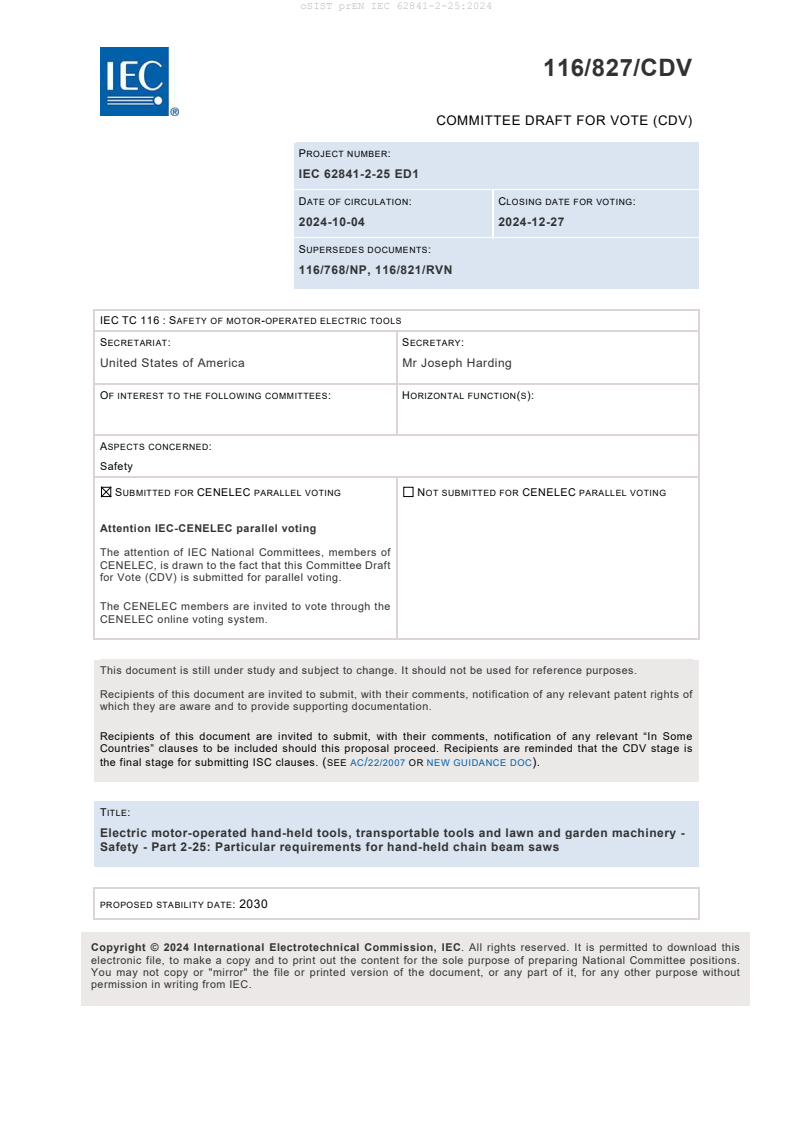
116/827/CDV
COMMITTEE DRAFT FOR VOTE (CDV)
PROJECT NUMBER:
IEC 62841-2-25 ED1
DATE OF CIRCULATION: CLOSING DATE FOR VOTING:
2024-10-04 2024-12-27
SUPERSEDES DOCUMENTS:
116/768/NP, 116/821/RVN
IEC TC 116 : SAFETY OF MOTOR-OPERATED ELECTRIC TOOLS
SECRETARIAT: SECRETARY:
United States of America Mr Joseph Harding
OF INTEREST TO THE FOLLOWING COMMITTEES: HORIZONTAL FUNCTION(S):
ASPECTS CONCERNED:
Safety
SUBMITTED FOR CENELEC PARALLEL VOTING NOT SUBMITTED FOR CENELEC PARALLEL VOTING
Attention IEC-CENELEC parallel voting
The attention of IEC National Committees, members of
CENELEC, is drawn to the fact that this Committee Draft
for Vote (CDV) is submitted for parallel voting.
The CENELEC members are invited to vote through the
CENELEC online voting system.
This document is still under study and subject to change. It should not be used for reference purposes.
Recipients of this document are invited to submit, with their comments, notification of any relevant patent rights of
which they are aware and to provide supporting documentation.
Recipients of this document are invited to submit, with their comments, notification of any relevant “In Some
Countries” clauses to be included should this proposal proceed. Recipients are reminded that the CDV stage is
the final stage for submitting ISC clauses. (SEE AC/22/2007 OR NEW GUIDANCE DOC).
TITLE:
Electric motor-operated hand-held tools, transportable tools and lawn and garden machinery -
Safety - Part 2-25: Particular requirements for hand-held chain beam saws
PROPOSED STABILITY DATE: 2030
NOTE FROM TC/SC OFFICERS:
electronic file, to make a copy and to print out the content for the sole purpose of preparing National Committee positions.
You may not copy or "mirror" the file or printed version of the document, or any part of it, for any other purpose without
permission in writing from IEC.
oSIST prEN IEC 62841-2-25:2024
IEC CDV 62841-2-25 © IEC 2024 2 116/827/CDV
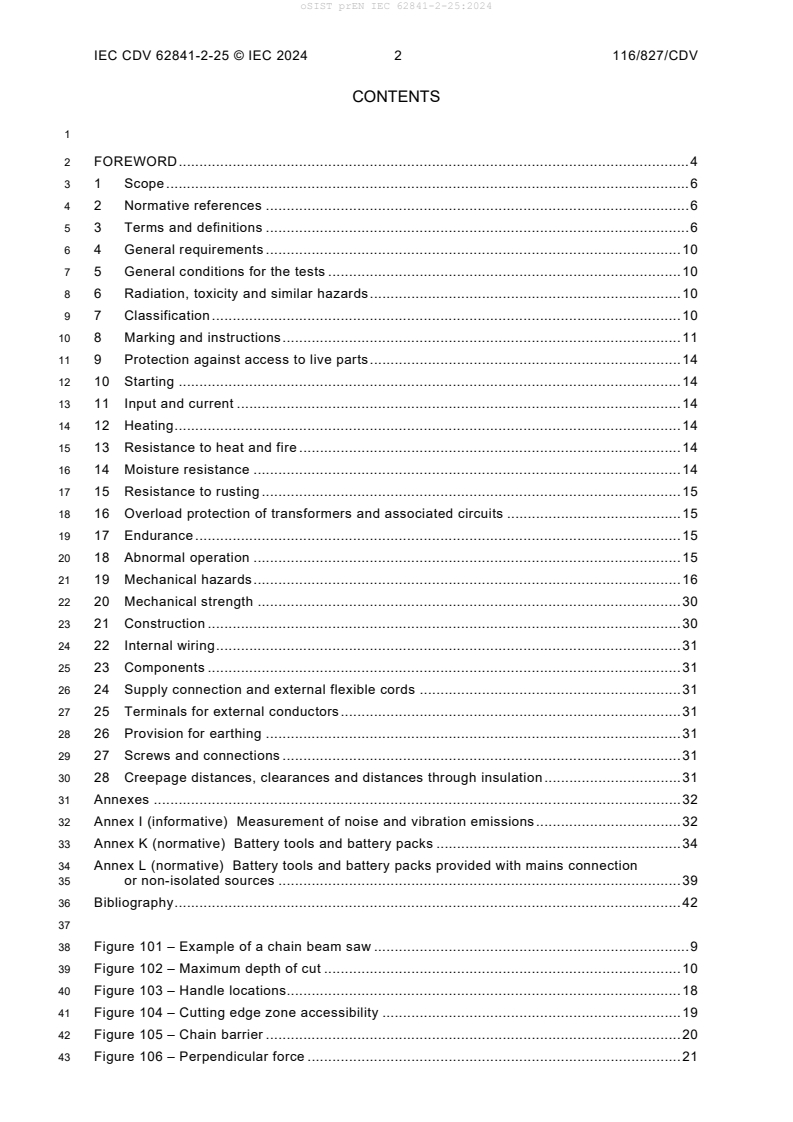
CONTENTS
2 FOREWORD . 4
3 1 Scope . 6
4 2 Normative references . 6
5 3 Terms and definitions . 6
6 4 General requirements . 10
7 5 General conditions for the tests . 10
8 6 Radiation, toxicity and similar hazards . 10
9 7 Classification . 10
10 8 Marking and instructions . 11
11 9 Protection against access to live parts . 14
12 10 Starting . 14
13 11 Input and current . 14
14 12 Heating . 14
15 13 Resistance to heat and fire . 14
16 14 Moisture resistance . 14
17 15 Resistance to rusting . 15
18 16 Overload protection of transformers and associated circuits . 15
19 17 Endurance . 15
20 18 Abnormal operation . 15
21 19 Mechanical hazards . 16
22 20 Mechanical strength . 30
23 21 Construction . 30
24 22 Internal wiring . 31
25 23 Components . 31
26 24 Supply connection and external flexible cords . 31
27 25 Terminals for external conductors . 31
28 26 Provision for earthing . 31
29 27 Screws and connections . 31
30 28 Creepage distances, clearances and distances through insulation . 31
31 Annexes . 32
32 Annex I (informative) Measurement of noise and vibration emissions . 32
33 Annex K (normative) Battery tools and battery packs . 34
34 Annex L (normative) Battery tools and battery packs provided with mains connection
35 or non-isolated sources . 39
36 Bibliography . 42
38 Figure 101 – Example of a chain beam saw . 9
39 Figure 102 – Maximum depth of cut . 10
40 Figure 103 – Handle locations. 18
41 Figure 104 – Cutting edge zone accessibility . 19
42 Figure 105 – Chain barrier . 20
43 Figure 106 – Perpendicular force . 21
oSIST prEN IEC 62841-2-25:2024
IEC CDV 62841-2-25 © IEC 2024 3 116/827/CDV
44 Figure 107 – Parallel force . 22
45 Figure 108 – Intersect force . 22
46 Figure 109 – Clearance. 23
47 Figure 110 – Principal distance of the base plate . 25
48 Figure 111 – Saw chain binding test . 26
49 Figure 112 – Straight test probe . 27
50 Figure 113 – Guarding above the base plate . 28
51 Figure 114 – Saw chain drive link spacing . 29
52 Figure I.101 – Position of transducers for chain beam saws . 33
54 Table 4 – Required performance levels . 16
55 Table I.101 – Operating conditions for chain beam saws cutting wood . 32
56 Table 4 – Required performance levels . 36
oSIST prEN IEC 62841-2-25:2024
IEC CDV 62841-2-25 © IEC 2024 4 116/827/CDV
59 INTERNATIONAL ELECTROTECHNICAL COMMISSION
60 ____________
62 ELECTRIC MOTOR-OPERATED HAND-HELD TOOLS, TRANSPORTABLE
63 TOOLS AND LAWN AND GARDEN MACHINERY – SAFETY –
65 Part 2-25: Particular requirements for hand-held chain beam saws
67 FOREWORD
68 1) The International Electrotechnical Commission (IEC) is a worldwide organization for standardization comprising
69 all national electrotechnical committees (IEC National Committees). The object of IEC is to promote international
70 co-operation on all questions concerning standardization in the electrical and electronic fields. To this end and
71 in addition to other activities, IEC publishes International Standards, Technical Specifications, Technical Reports,
72 Publicly Available Specifications (PAS) and Guides (hereafter referred to as "IEC Publication(s)"). Their
73 preparation is entrusted to technical committees; any IEC National Committee interested in the subject dealt with
74 may participate in this preparatory work. International, governmental and non-governmental organizations liaising
75 with the IEC also participate in this preparation. IEC collaborates closely with the International Organization for
76 Standardization (ISO) in accordance with conditions determined by agreement between the two organizations.
77 2) The formal decisions or agreements of IEC on technical matters express, as nearly as possible, an international
78 consensus of opinion on the relevant subjects since each technical committee has representation from all
79 interested IEC National Committees.
80 3) IEC Publications have the form of recommendations for international use and are accepted by IEC National
81 Committees in that sense. While all reasonable efforts are made to ensure that the technical content of IEC
82 Publications is accurate, IEC cannot be held responsible for the way in which they are used or for any
83 misinterpretation by any end user.
84 4) In order to promote international uniformity, IEC National Committees undertake to apply IEC Publications
85 transparently to the maximum extent possible in their national and regional publications. Any divergence between
86 any IEC Publication and the corresponding national or regional publication shall be clearly indicated in the latter.
87 5) IEC itself does not provide any attestation of conformity. Independent certification bodies provide conformity
88 assessment services and, in some areas, access to IEC marks of conformity. IEC is not responsible for any
89 services carried out by independent certification bodies.
90 6) All users should ensure that they have the latest edition of this publication.
91 7) No liability shall attach to IEC or its directors, employees, servants or agents including individual experts and
92 members of its technical committees and IEC National Committees for any personal injury, property damage or
93 other damage of any nature whatsoever, whether direct or indirect, or for costs (including legal fees) and
94 expenses arising out of the publication, use of, or reliance upon, this IEC Publication or any other IEC
95 Publications.
96 8) Attention is drawn to the Normative references cited in this publication. Use of the referenced publications is
97 indispensable for the correct application of this publication.
98 9) Attention is drawn to the possibility that some of the elements of this IEC Publication may be the subject of patent
99 rights. IEC shall not be held responsible for identifying any or all such patent rights.
100 IEC 62841-2-25 has been prepared by IEC technical committee 116: Safety of motor-operated
101 electric tools. It is an International Standard.
102 The text of this International Standard is based on the following documents:
FDIS Report on voting
116/XX/FDIS 116/XX/RVD
104 Full information on the voting for its approval can be found in the report on voting indicated in
105 the above table.
106 The language used for the development of this International Standard is English.
107 This document is to be used in conjunction with the first edition of IEC 62841-1:2014.
108 This document supplements or modifies the corresponding clauses in IEC 62841-1, so as to
109 convert it into the IEC Standard: Particular requirements for hand-held chain beam saws.
oSIST prEN IEC 62841-2-25:2024
IEC CDV 62841-2-25 © IEC 2024 5 116/827/CDV
110 Where a particular subclause of IEC 62841-1 is not mentioned in this document, that subclause
111 applies as far as reasonable. Where this document states "addition", "modification" or
112 "replacement", the relevant text in IEC 62841-1 is to be adapted accordingly.
113 The following print types are used:
114 – requirements: in roman type;
115 – test specifications: in italic type;
116 – notes: in small roman type.
117 The terms defined in Clause 3 are printed in bold typeface.
118 Subclauses, notes, tables and figures which are additional to those in IEC 62841-1 are
119 numbered starting from 101.
120 Subclauses, notes, tables and figures in Annex K and Annex L which are additional to those in
121 the main body of this document are numbered starting from 301.
122 A list of all parts in the IEC 62841 series, published under the general title Electric motor-
123 operated hand-held tools, transportable tools and lawn and garden machinery – Safety, can be
124 found on the IEC website.
125 This document was drafted in accordance with ISO/IEC Directives, Part 2, and developed in
126 accordance with ISO/IEC Directives, Part 1 and ISO/IEC Directives, IEC Supplement, available
127 at www.iec.ch/members_experts/refdocs. The main document types developed by IEC are
128 described in greater detail at www.iec.ch/standardsdev/publications.
129 The committee has decided that the contents of this document will remain unchanged until the
130 stability date indicated on the IEC website under webstore.iec.ch in the data related to the
131 specific document. At this date, the document will be
132 • reconfirmed,
133 • withdrawn,
134 • replaced by a revised edition, or
135 • amended.
136 NOTE The attention of National Committees is drawn to the fact that equipment manufacturers and testing
137 organizations may need a transitional period following publication of a new, amended or revised IEC publication in
138 which to make products in accordance with the new requirements and to equip themselves for conducting new or
139 revised tests.
140 It is the recommendation of the committee that the content of this publication be adopted for implementation nationally
141 not earlier than 36 months from the date of publication.
oSIST prEN IEC 62841-2-25:2024
IEC CDV 62841-2-25 © IEC 2024 6 116/827/CDV
143 ELECTRIC MOTOR-OPERATED HAND-HELD TOOLS, TRANSPORTABLE
144 TOOLS AND LAWN AND GARDEN MACHINERY – SAFETY –
146 Part 2-25: Particular requirements for hand-held chain beam saws
150 1 Scope
151 IEC 62841-1:2014, Clause 1 is applicable, except as follows.
152 Addition:
153 This document applies to hand-held chain beam saws for cutting wood or similar material and
154 designed for use by one person.
155 This document does not apply to chain beam saw attachments that convert a circular saw or
156 a chain saw into a chain beam saw.
157 This document does not apply to
158 – chain saws;
159 – chain saws for tree service; and
160 – pole-mounted pruners.
161 NOTE 101 Chain saws are covered by IEC 62841-4-1.
162 NOTE 102 Chain saws for tree service will be covered by a future part of IEC 62841.
163 NOTE 103 Pole-mounted pruners will be covered by a future part of IEC 62841.
164 2 Normative references
165 IEC 62841-1:2014, Clause 2 is applicable, except as follows.
166 Addition:
167 IEC 62841-1:2014, Electric motor-operated hand-held tools, transportable tools and lawn and
168 garden machinery - Safety - Part 1: General requirements
169 ISO 630-2:2021, Structural steels - Part 2: Technical delivery conditions for structural steels for
170 general purposes
171 3 Terms and definitions
172 IEC 62841-1:2014, Clause 3 is applicable, except as follows.
173 Addition:
174 3.101
175 auxiliary handle
176 support handle located at or towards the front of the motor housing (see Figure 101)
177 3.102
178 bar tip guard
179 shield that prevents contact with the saw chain near the tip of the guide bar
oSIST prEN IEC 62841-2-25:2024
IEC CDV 62841-2-25 © IEC 2024 7 116/827/CDV
180 3.103
181 base plate
182 part supporting the saw on the material being cut or on a guide rail
183 3.104
184 bevel angle
185 angular displacement of the guide bar plane with respect to the base plate plane, the position
186 of the guide bar plane that is perpendicular to the base plate being the 0° bevel position
187 3.105
188 chain barrier
189 device located behind and in the plane of the guide bar in a fixed proximity to the saw chain
190 through the entire depth of cut range of the chain beam saw, intended to reduce the risk of
191 chain pinching and binding
192 3.106
193 chain beam saw
194 tool designed to cut wood or similar material with a saw chain on a guide bar and consists of
195 an integral unit of handles, cutting attachment, motor, base plate, and chain barrier, designed
196 to be supported with two hands (see Figure 101)
197 Note 101 to entry: The base plate of a chain beam saw is in contact with the workpiece during operation.
198 3.107
199 drive sprocket
200 chain drive wheel with teeth
201 3.108
202 guide bar
203 attachment that supports and guides the saw chain
204 3.109
205 guide rail
206 attachment mounted on the material being cut and on which the base plate of the chain beam
207 saw glides during cutting
208 3.110
209 kickback
210 sudden reaction to a pinched, jammed or misaligned saw chain, causing a sudden motion of
211 the chain beam saw in a direction opposite to the saw chain motion at the point of the saw
212 chain being jammed
213 3.111
214 main handle
215 support handle located toward the rear of the motor housing (see Figure 101)
216 3.112
217 maximum depth of cut
218 maximum thickness of the material being cut between the bottom plane of the base plate and
219 the top side of the bar tip guard when the guide bar is set perpendicular to the base plate or
220 the tip of the chain barrier in cases where a guard is not required (see Figure 102)
221 3.113
222 maximum speed
223 highest saw chain speed attainable under all conditions of normal use, including no load
224 3.114
225 run down time
226 elapsed time from the release of the power switch until the saw chain stops
oSIST prEN IEC 62841-2-25:2024
IEC CDV 62841-2-25 © IEC 2024 8 116/827/CDV
227 3.115
228 saw chain
229 attachment, serving as a cutting tool, consisting of drive links and cutters (see Figure 101)
230 3.116
231 upper guard
232 fixed cover of the saw chain situated above the base plate
oSIST prEN IEC 62841-2-25:2024
IEC CDV 62841-2-25 © IEC 2024 9 116/827/CDV
235 Key
236 1 main handle
237 2 power switch
238 3 chain barrier
239 4 bar tip guard
240 5 saw chain
241 6 guide bar
242 7 base plate
243 8 drive sprocket cover
244 9 dust extraction
245 10 chain tensioning knob
246 11 auxiliary handle
247 12 lubrication oil tank
248 13 upper guard
249 Figure 101 – Example of a chain beam saw
oSIST prEN IEC 62841-2-25:2024
IEC CDV 62841-2-25 © IEC 2024 10 116/827/CDV
251 Key
252 1 maximum depth of cut (with bar tip guard)
253 2 maximum depth of cut (without bar tip guard)
254 Figure 102 – Maximum depth of cut
255 4 General requirements
256 IEC 62841-1:2014, Clause 4 is applicable.
257 5 General conditions for the tests
258 IEC 62841-1:2014, Clause 5 is applicable, except as follows.
259 5.17 Addition:
260 The mass of the tool includes the heaviest guide bar and saw chain combination in accordance
261 with 8.14.2 a) 101) as well as the lubrication tank filled to the maximum specified level, but
262 excludes the guide bar cover.
263 5.101 For tests that are performed at maximum speed and no load, the manufacturer may
264 need to provide special hardware and/or software.
265 5.102 For tests carried out at any percentage of rated input or rated current, except for no-
266 load, the saw chain and the guide bar may be removed and the chain beam saw loaded by
267 means of a brake.
268 6 Radiation, toxicity and similar hazards
269 IEC 62841-1:2014, Clause 6 is applicable.
270 7 Classification
271 IEC 62841-1:2014, Clause 7 is applicable.
oSIST prEN IEC 62841-2-25:2024
IEC CDV 62841-2-25 © IEC 2024 11 116/827/CDV
272 8 Marking and instructions
273 IEC 62841-1:2014, Clause 8 is applicable, except as follows.
274 8.2 Addition:
275 Chain beam saws shall be marked with the following additional safety warnings:
276 For all chain beam saws:
277 – “ WARNING — Hold saw with both hands” or a product safety label that is described in
278 the instruction manual.
279 NOTE 101 In Canada and the United States of America, the following additional requirements apply.
280 Chain beam saws shall be marked with the following additional safety warning:
281 – “ DANGER — Keep hands and body away from the saw chain or guide bar. Chain barrier shall always be
282 attached and properly aligned when operating the chain beam saw. Contact with the saw chain will result in
283 serious injury.”
284 In Canada, the equivalent French wording of the above warning is as follows: “ DANGER — Maintenir les mains et
285 le corps à l’écart de la chaîne coupante ou du guide-chaîne. La barrière de chaîne doit toujours être fixée et
286 correctement alignée lors de l’utilisation de la scie à chaîne de poutre. Tout contact avec la chaîne coupante causera
287 une blessure grave”
288 8.3 Addition:
289 Chain beam saws shall be marked with the following:
290 – specified nominal guide bar length(s) and thickness(es) in mm (in);
291 NOTE 101 The nominal guide bar size(s) is not necessarily the same as the cutting length(s).
292 – identification of the direction of rotation of the saw chain by a legible and durable mark on
293 the body of the tool; and
294 – a guide bar and saw chain combination(s) and corresponding chain barrier, if more than
295 one chain barrier is permitted to be used with the tool in accordance with 8.14.2 a) 103).
296 The chain barrier shall be permanently marked (e.g., by engraving, stamping, or etching) with
297 its thickness, the guide bar thickness, the maximum depth of cut and the direction of the saw
298 chain rotation.
299 8.14.1 Addition:
300 The additional safety instructions as specified in 8.14.1.101 and 8.14.1.102 shall be given. This
301 part may be printed separately from the "General Power Tool Safety Warnings".
oSIST prEN IEC 62841-2-25:2024
IEC CDV 62841-2-25 © IEC 2024 12 116/827/CDV
303 8.14.1.101 Safety instructions for chain beam saws
304 a) Wear eye protection. Appropriate protective equipment for face and eyes, hands, legs,
305 and feet is recommended. Adequate protective clothing will reduce personal injury by
306 flying debris or accidental contact with the saw chain.
307 b) Do not operate the chain beam saw in a tree, on a ladder, from a rooftop, or any
308 unstable support. Operation of a chain beam saw in this manner could result in serious
309 personal injury.
310 c) Always keep proper footing and operate the chain beam saw only when standing on
311 fixed, secure, and level surface. Slippery or unstable surfaces such as ladders can cause
312 a loss of balance or control of the chain beam saw.
313 d) Hold the chain beam saw by insulated gripping surfaces only, because the saw chain
314 can contact hidden wiring or its own cord. Saw chains contacting a “live” wire can make
315 exposed metal parts of the power tool “live” and could give the operator an electric shock.
316 e) Keep hands away from cutting area and the saw chain. Keep your second hand on
317 auxiliary handle. If both hands are holding the saw, they cannot be cut by the saw chain,
318 and the chain beam saw can be effectively guided and any kickback can be controlled
319 effectively.
320 f) Keep hands and legs away from the saw chain and guide bar when the chain beam
321 saw is operating. A moment of inattention while operating the chain beam saw can cause
322 entanglement of your clothing or body with the saw chain.
323 g) Do not use the chain beam saw for operations that are not intended. Use of the chain
324 beam saw for operations different than intended could result in a hazardous situation.
325 h) Never hold the material being cut in your hands or across your leg while cutting.
326 Secure the material to be cut to a stable platform. It is important to support the work
327 properly to minimize body exposure, saw chain binding, or loss of control.
328 i) Follow all instructions when clearing jammed material, storing, or servicing the chain
329 beam saw. Make sure the switch is off and disconnect the plug from the power source.
330 Unexpected actuation of the chain beam saw while clearing jammed material or servicing
331 can result in serious personal injury.
332 j) Carry the chain beam saw by the auxiliary handle with the chain beam saw switched
333 off and the saw chain away from your body. When transporting or storing the chain
334 beam saw always fit the guide bar cover. Proper handling of the chain beam saw will
335 reduce the likelihood of accidental contact with the moving saw chain.
336 k) Keep handles dry, clean, and free from oil and grease. Greasy, oily handles are slippery
337 causing loss of control.
338 l) Follow instructions for lubricating, chain tensioning, and changing bar and chain.
339 Improperly tensioned or lubricated chain can either break or increase the chance for
340 kickback.
341 8.14.1.102 Further safety instructions for kickback
342 Kickback causes and related warnings
343 Kickback is a reaction to a pinched or jammed saw chain, mostly occurring at the back side of
344 the guide bar not adequately protected by the chain barrier or at the nose of the guide bar not
345 protected by the tip guard. Kickback causes a sudden motion of the chain beam saw in a
346 direction opposite to the saw chain motion at the point where the saw chain is being jammed.
347 When the saw chain is jammed at the front of the guide bar, the cutting action will pull the chain
348 beam saw tightly to the workpiece surface, but when the saw chain is jammed at the back of
349 the guide bar, the kickback will suddenly push the chain beam saw up and away from the
350 workpiece surface. The jamming of the saw chain at the nose of the guide bar will create a
351 kickback that rotates the chain beam saw’s guide bar back towards the operator.
352 During the cutting process, most frequently the saw chain pinching/jamming occurs when the
353 workpiece is weakened by the cut and sags under its own weight or when the operator is trying
354 to “steer” and correct the line of the cut.
oSIST prEN IEC 62841-2-25:2024
IEC CDV 62841-2-25 © IEC 2024 13 116/827/CDV
355 An improperly installed/adjusted chain barrier guard or tip guard can also allow undue exposure
356 and pinching/jamming of the saw chain.
357 Kickback is the result of tool misuse, incorrect operating procedures or conditions, or both, and
358 can be avoided by taking proper precautions, as follows. The kickback force can be managed
359 by an alert operator properly bracing and controlling the chain beam saw with both hands.
360 a) Support large workpieces to minimise the risk of saw chain pinching and kickback.
361 Large workpieces tend to sag under their own weight. Supports shall be placed under the
362 workpiece on both sides of the guide bar, near the line of cut and near the edge of the
363 workpiece.
364 b) All adjustment levers for the base plate shall be tight and secure before making the
365 cut. If the guide bar adjustments shift while cutting, it can cause binding and kickback.
366 c) Saw chain depth of cut and bevel adjusting locking levers must be tight and secure
367 before making the cut. If saw chain adjustment shifts while cutting, it may cause binding
368 and kickback.
369 d) The base plate of the chain beam saw shall be resting on the surface of the workpiece,
370 and the saw chain shall not be in contact with the material prior to starting the motor.
371 If the base plate is held above the workpiece surface during the cutting process and the
372 moving saw chain makes contact with the workpiece, the reaction to the cutting action can
373 slam the chain beam saw onto the workpiece, causing loss of operator control.
374 e) Maintain a firm grip with both hands on the handles of the chain beam saw and
375 position your arms to resist kickback forces. Position your body to either side of the
376 saw chain, but not in line with the plane of the guide bar. Kickback could cause the
377 chain beam saw to jump up and/or backwards.
378 f) If the saw chain is binding, or when interrupting a cut for any reason, release the
379 trigger and hold the chain beam saw motionless in the material until the saw chain
380 comes to a complete stop. Never attempt to remove the chain beam saw from the work
381 or pull the chain beam saw backward while the saw chain is in motion or kickback
382 may occur. Investigate and take corrective actions to eliminate the cause of saw chain
383 binding.
384 g) When restarting a chain beam saw in the workpiece, centre the saw chain in the kerf
385 so that the saw chain teeth are not engaged into the material. If a saw chain binds in
386 the workpiece as the motor is restarted, it can cause sudden jerking of the chain beam saw
387 and loss of control.
388 h) Follow the manufacturer’s sharpening and maintenance instructions for the saw
389 chain. Decreasing the depth gauge height can lead to increased kickback.
390 i) Only use replacement guide bars and saw chains specified by the manufacturer.
391 Incorrect replacement guide bars and saw chains can cause chain breakage and/or
392 kickback.
393 8.14.2 a) Addition:
394 101) Explanation of chain beam saw safety devices (e.g. chain barrier, bar tip guard, upper
395 guard, etc.);
396 102) Instructions for properly installing and adjusting the chain barrier, guide bar and saw
397 chain tensioning;
398 103) Recommended guide bar, chain barrier and saw chain combination(s) that can be
399 used;
400 104) Instructions on attack angle and bevel angle adjustments and locking levers of the
401 guide bar;
402 105) Information regarding the maximum depth of cut;
403 106) Information on recommended lubricants for use with the chain beam saw.
404 8.14.2 b) Addition:
405 101) Instruction to position the supply cord so that it will not be caught on objects and the
406 like, or contacted by the guide bar or saw chain during cutting;
oSIST prEN IEC 62841-2-25:2024
IEC CDV 62841-2-25 © IEC 2024 14 116/827/CDV
407 102) If a manual lubrication control is provided, instructions regarding its use;
408 103) Instructions on the correct use of the dust collection system, if any;
409 104) Instruction to wear a dust mask;
410 105) Instruction not to operate the chain beam saw without lubrication and to replenish the lubrication
411 tank before it is empty;
412 106) Identification of the main handle and auxiliary handle(s) in accordance with 19.101.1.
413 8.14.2 c) Addition:
414 101) Instructions on sharpening and maintenance of the saw chain, a recommendation to
415 have sharpening and maintenance of the saw chain performed by authorized service
416 centres, or both.
417 8.14.3 Replacement:
418 If information about the mass or weight of the tool is provided, it shall be the mass of the tool
419 without the saw chain, guide bar, guide bar cover, oil and optional accessories.
420 Compliance is checked by inspection.
421 9 Protection against access to live parts
422 IEC 62841-1:2014, Clause 9 is applicable.
423 10 Starting
424 IEC 62841-1:2014, Clause 10 is applicable.
425 11 Input and current
426 IEC 62841-1:2014, Clause 11 is applicable.
427 12 Heating
428 IEC 62841-1:2014, Clause 12 is applicable, except as follows.
429 12.2.1 Replacement:
430 The load conditions for the heating test of 12.2 are as follows.
431 The tool is operated with a torque load applied such that rated input or rated current is drawn.
432 The tool is operated for 30 min. During this period, the torque load is adjusted as necessary to
433 maintain rated input or rated current.
434 13 Resistance to heat and fire
435 IEC 62841-1:2014, Clause 13 is applicable.
436 14 Moisture resistance
437 IEC 62841-1:2014, Clause 14 is applicable, except as follows.
438 Addition:
oSIST prEN IEC 62841-2-25:2024
IEC CDV 62841-2-25 © IEC 2024 15 116/827/CDV
439 NOTE 101 Saw chain lubrication tanks and lubrication systems intended for use with oil as specified in
440 8.14.2 a) 106) are not considered to be liquid systems.
441 14.2.1 Replacement:
442 The tool is not connected to the supply.
443 The tool is placed in its normal rest position on a perforated turntable. The turntable is then
444 turned continuously at approximately 1 /min during the test.
445 Electrical components, covers, and other detachable parts are removed and subjected, if
446 necessary, to the relevant treatment with the main part. Movable covers that are non-
447 detachable parts and are not self-restoring are placed in the most unfavourable position.
448 NOTE Examples of self-restoring covers include those that are spring loaded or closed by gravity.
449 14.3 Addition:
450 Subclause 14.3 of IEC 62841-1:2014 is not applicable for saw chain lubrication tanks and
451 lubrication systems intended for use with oil as specified in 8.14.2 a) 106).
452 15 Resistance to rusting
453 IEC 62841-1:2014, Clause 15 is applicable.
454 16 Overload protection of transformers and associated circuits
455 IEC 62841-1:2014, Clause 16 is applicable.
456 17 Endurance
457 IEC 62841-1:2014, Clause 17 is applicable, except as follows.
458 17.2 Modification:
459 The saw chain and guide bar are removed for the endurance test.
460 18 Abnormal operation
461 IEC 62841-1:2014, Clause 18 is applicable, except as follows.
462 18.3 Replacement:
463 Tools incorporating a series motor are operated without the saw chain at a voltage equal to
464 1,3 times rated voltage for 1 min at no-load.
465 During the test, parts shall not be ejected from the tool. After this test, the tool need not be
466 capable of further use.
467 An additional device incorporated in the tool to limit the speed may operate during the test.
468 18.8.1 Replacement of Table 4 by the following:
oSIST prEN IEC 62841-2-25:2024
IEC CDV 62841-2-25 © IEC 2024 16 116/827/CDV
469 Table 4 – Required performance levels
Type and purpose of SCF Minimum performance
level (PL)
Power switch - prevent unwanted switch-on Shall be evaluated using
the fault conditions of
18.6.1 without the loss of
this SCF
Power switch - provide desired switch-off Shall be evaluated using
the fault conditions of
18.6.1 without the loss of
this SCF
Provide desired direction of rotation c
Starting current limitation as in 10.2 Not an SCF
Any electronic control to pass the test of 18.3 a
Prevent exceeding thermal limits as in 18.4 and 18.5.3 a
Lock-off function as required by 21.18.102 b
Provide automatic lubrication of the saw chain as in 19.106 Not an SCF
Prevent exceeding the maximum run down time as in 19.107 a
471 19 Mechanical hazards
472 IEC 62841-1:2014, Clause 19 is applicable, except as follows.
473 19.1 Replacement of the first paragraph:
474 All power-driven hazardous parts (e.g. gears), other than the moving parts which are separately
475 covered by 19.104, shall be so positioned or enclosed to provide adequate protection.
476 19.4 Subclause 19.6 of IEC 62841-1:2014 is not applicable.
477 19.6 Subclause 19.6 of IEC 62841-1:2014 is not applicable.
478 19.7 Subclause 19.7 of IEC 62841-1:2014 is not applicable.
479 19.8 Subclause 19.8 of IEC 62841-1:2014 is not applicable.
480 19.9 Replacement:
481 If, in accordance with 8.14.2, the user is instructed to remove a drive sprocket cover, such as
482 for maintenance, to change the saw chain or guide bar, then the fastenings shall remain
483 attached to the drive sprocket cover or to the tool, unless the drive sprocket cover fastenings
484 are the only means for retaining the guide bar. If a fastening is not removed in order to remove
485 the drive sprocket cover, it is considered as still attached.
486 Compliance is checked by inspection and by manual test.
oSIST prEN IEC 62841-2-25:2024
IEC CDV 62841-2-25 © IEC 2024 17 116/827/CDV
489 19.101 Handles
490 19.101.1 General
491 Chain beam saws shall be provided with one main handle and with at least one auxiliary
492 handle. The handle surface shall be so designed and shaped that a firm grip can be applied.
493 Compliance is checked by inspection.
494 19.101.2 Specific requirements
495 19.101.2.1 Handles
496 The main handle shall be positioned toward the rear of the motor.
497 The minimum distance from the vertex of the angle α to the outer surface of the main handle
498 at the middle of the handle gripping length shall be a minimum of 0,5 times the maximum depth
499 of cut. See Figure 103.
500 The angle α is set as the horizontal plane of the lower surface of the base plate and the plane
501 that passes through the middle of the gripping length of the main handle. The vertex of angle
502 α shall be at the intersection of the horizontal plane of the lower surface of the base plate and
503 the vertical median plane that bisects the width of the guide bar. See Figure 103.
504 The minimum rope distance around any obstructions from the centre of any auxiliary handle
505 referenced in 8.14 in the operator’s manual to the exposed saw chain teeth at the front of the
506 guide bar and above the base plate shall be 120 mm as shown in Figure 103.
507 Compliance is checked by inspection and by measurement.
oSIST prEN IEC 62841-2-25:2024
IEC CDV 62841-2-25 © IEC 2024 18 116/827/CDV
509 Key
510 1 rope distance around any obstructions from the centre of an auxiliary handle to the exposed saw chain teeth at
511 the front of the guide bar and above the base plate (minimum 120 mm)
512 2 rope distance around any obstructions from the centre of an auxiliary handle to the exposed saw chain teeth at
513 the front of the guide bar and above the base plate (minimum 120 mm)
514 3 distance from the vertex of the angle α to the outer surface of the main handle at the middle of the handle
515 gripping length (minimum of 0,5 times the maximum depth of cut)
516 4 rope distance around any obstructions from the centre of an auxiliary handle to the exposed saw chain teeth at
517 the front of the guide bar and above the base plate (minimum 120 mm)
518 Figure 103 – Handle locations
519 19.101.2.2 Accessibility
520 The saw chain above the base plate shall not be accessible from the front of the chain beam
521 saw.
522 Compliance is checked with the rigid test probe of Figure 104 a), which shall not contact the
523 periphery of the saw chain when the chain beam saw is set for a 0° bevel angle and with the
524 guide bar swiveled into any position in accordance with 8.14.2. The test probe is centred with
525 the saw chain then advanced in any single plane perpendicular to the saw chain and parallel
526 to the base plate, as illustrated in Figure 104 b). The test is repeated with test probe offset
527 13 mm to the right of the saw chain centre and then offset 13 mm to the left of the saw chain
528 centre.
oSIST prEN IEC 62841-2-25:2024
IEC CDV 62841-2-25 © IEC 2024 19 116/827/CDV
530 a) Test probe
533 Key
534 1 test probe
535 2 saw chain
536 b) Application of test probe
537 Figure 104 – Cutting edge zone accessibility
538 19.102 Chain barrier
539 19.102.1 A chain beam saw shall be equipped with a chain barrier that is removable only
540 with the aid of a tool.
541 The chain barrier shall cover the saw chain at the back side of the guide bar and shall be
542 thicker than the guide bar body and thinner than the saw chain kerf.
543 The chain barrier shall be made of steel with a minimum material grade of E235B in accordance
544 with ISO 630-2:2021.
545 The chain barrier shall be mounted to the fixed or nonremovable parts of the chain beam saw,
546 such as the motor, gear housing, or both. Mounting the chain barrier to the base plate is
547 acceptable only if the base plate is fixed and nonadjustable.
548 For tools without a bar tip guard, the chain barrier shall wrap around the guide bar nose to
549 prevent plunge cutting and avoid cutting at the tip of the guide bar. The geometry of the chain
550 barrier shall extend from the back side of the guide bar to at least the line that is tangent to
551 the lowest point of the saw tooth of the saw chain and parallel to the base plate (see Figure 105).
oSIST prEN IEC 62841-2-25:2024
IEC CDV 62841-2-25 © IEC 2024 20 116/827/CDV
552 For tools with a bar tip guard, it is not required that the chain barrier wraps around the guide
553 bar nose.
554 Compliance is checked by inspection and by measurement.
556 Key
557 1 chain barrier
558 2 base plate
559 3 line that is tangent to the lowest point of the saw tooth of the saw chain and parallel to the base plate
560 Figure 105 – Chain barrier
561 19.102
...