

SIST EN 1021-2:2014
(Main)Furniture - Assessment of the ignitability of upholstered furniture - Part 2: Ignition source match flame equivalent
General Information
- Abstract
This European Standard specifies a test method to assess the ignitability of material combinations, such as covers and fillings used in upholstered seating, when subjected to a small flame as an ignition source.
The test measures only the ignitability of a combination of materials used in upholstered seating and not the ignitability of a particular finished item of furniture incorporating these materials.
- Status
- Published
- Public Enquiry End Date
- 19-Mar-2013
- Publication Date
- 18-Aug-2014
- Technical Committee
- POH - Furniture
- Current Stage
- 6060 - National Implementation/Publication (Adopted Project)
- Start Date
- 18-Aug-2014
- Due Date
- 23-Oct-2014
- Completion Date
- 19-Aug-2014


Overview
EN 1021-2:2014 (CEN) is the European test standard for assessing the ignitability of upholstered furniture material combinations when exposed to a small flame equivalent to a burning match. It specifies a standardized test method and apparatus to evaluate how covers, inner covers and fillings used in seating assemblies respond to a match-flame–equivalent gas ignition source. The standard measures the ignitability of the composite materials on the test rig and does not certify the ignition performance of a finished piece of furniture.
Key topics and technical requirements
- Scope and purpose: Test method for material combinations (outer cover, inner cover ≤2 mm, fillings) used in upholstered seating.
- Ignition source: A gas flame designed to be match-flame equivalent (burner tube dimensions and arrangement are specified; a nominal regulator outlet pressure of 2.8 kPa is referenced).
- Test rig and specimen assembly: Hinged steel frames with steel mesh platforms and specified dimensions to represent a stylized seat/back junction. Frames are locked at right angles for testing.
- Test environment: Conduct tests in a non-combustible fume cupboard or a suitable enclosure/room (>20 m3) with controlled airflow (draught-free, extraction recommended).
- Timing and measurement: Clock/stopwatch accuracy to 1 s for test durations (tests include up to 1 hour observations).
- Criteria of ignition:
- Progressive smouldering - self-propagating non‑flaming oxidation (examples: smouldering to specimen margins, continuing after 1 hour).
- Flaming ignition - sustained flame behavior (examples: flaming to specimen margins, flaming >120 s after burner removal).
- Health & safety: Operator protection, ventilation, and adequate extinguishing means (water spray, extinguishers, immersion if needed).
- Documentation: Test report details and final examination requirements; informative annexes provide guidance for designers and sample report forms.
Applications and users
Who uses EN 1021-2:2014:
- Furniture manufacturers and component suppliers verifying material combinations for compliance.
- Product designers and specifiers assessing fire risk at the material-selection stage.
- Test laboratories and conformity assessment bodies performing ignitability testing.
- Safety engineers and procurement teams specifying seating for public/commercial environments.
Practical use:
- Screening cover/filling combinations during product development.
- Supporting risk assessments and regulatory conformity for upholstered seating.
- Informing design choices to reduce ignition risk from small open flames (matches, lighters).
Related standards
- EN 1021-1 (part of the same series covering cigarette ignition source) - often used together to evaluate different ignition scenarios for upholstered furniture.
Keywords: EN 1021-2:2014, upholstered furniture, ignitability test, match flame equivalent, CEN, upholstery filling, outer cover, test rig, progressive smouldering, flaming ignition.
Relations
- Effective Date
- 01-Oct-2014
- Effective Date
- 28-Jan-2026
- Effective Date
- 28-Jan-2026
- Effective Date
- 28-Jan-2026
- Effective Date
- 28-Jan-2026
- Effective Date
- 28-Jan-2026
- Effective Date
- 28-Jan-2026
- Effective Date
- 28-Jan-2026
- Effective Date
- 28-Jan-2026
- Referred By
SIST EN ISO 21856:2022 - Assistive products - General requirements and test methods (ISO 21856:2022) - Effective Date
- 28-Jan-2026
- Effective Date
- 28-Jan-2026
- Effective Date
- 28-Jan-2026
- Effective Date
- 28-Jan-2026
- Effective Date
- 28-Jan-2026
- Effective Date
- 28-Jan-2026
Get Certified
Connect with accredited certification bodies for this standard

CIS Institut d.o.o.
Personal Protective Equipment (PPE) certification body. Notified Body NB-2890 for EU Regulation 2016/425 PPE.

Kiwa BDA Testing
Building and construction product certification.
Kmetijski inštitut Slovenije
Agricultural Institute of Slovenia. Soil testing, plant health, agricultural product analysis.
Sponsored listings
Frequently Asked Questions
SIST EN 1021-2:2014 is a standard published by the Slovenian Institute for Standardization (SIST). Its full title is "Furniture - Assessment of the ignitability of upholstered furniture - Part 2: Ignition source match flame equivalent". This standard covers: This European Standard specifies a test method to assess the ignitability of material combinations, such as covers and fillings used in upholstered seating, when subjected to a small flame as an ignition source. The test measures only the ignitability of a combination of materials used in upholstered seating and not the ignitability of a particular finished item of furniture incorporating these materials.
This European Standard specifies a test method to assess the ignitability of material combinations, such as covers and fillings used in upholstered seating, when subjected to a small flame as an ignition source. The test measures only the ignitability of a combination of materials used in upholstered seating and not the ignitability of a particular finished item of furniture incorporating these materials.
SIST EN 1021-2:2014 is classified under the following ICS (International Classification for Standards) categories: 13.220.40 - Ignitability and burning behaviour of materials and products; 97.140 - Furniture. The ICS classification helps identify the subject area and facilitates finding related standards.
SIST EN 1021-2:2014 has the following relationships with other standards: It is inter standard links to SIST EN 1021-2:2006, SIST EN 15618:2023, SIST EN 15618:2009+A1:2012, SIST EN 12182:2012, SIST EN 12184:2022, SIST EN 12183:2022, SIST EN ISO 10535:2007, SIST EN 1176-10:2008, SIST EN ISO 10535:2022, SIST EN ISO 21856:2022, SIST EN 1176-10:2023, SIST EN 17064:2019, SIST EN 13336:2013, SIST EN 81-40:2020, SIST EN 13336:2022. Understanding these relationships helps ensure you are using the most current and applicable version of the standard.
SIST EN 1021-2:2014 is associated with the following European legislation: EU Directives/Regulations: TRRTP127. When a standard is cited in the Official Journal of the European Union, products manufactured in conformity with it benefit from a presumption of conformity with the essential requirements of the corresponding EU directive or regulation.
SIST EN 1021-2:2014 is available in PDF format for immediate download after purchase. The document can be added to your cart and obtained through the secure checkout process. Digital delivery ensures instant access to the complete standard document.
Standards Content (Sample)
2003-01.Slovenski inštitut za standardizacijo. Razmnoževanje celote ali delov tega standarda ni dovoljeno.Pohištvo - Ocenjevanje vžigljivosti oblazinjenega pohištva - 2. del: Vir vžiga: enakovreden plamenu vžigaliceMöbel - Bewertung der Entzündbarkeit von Polstermöbeln - Teil 2: Eine einem Streichholz vergleichbare Gasflamme als ZündquelleAmeublement - Evaluation de l'allumabilité des meubles rembourrés - Partie 2: Source d'allumage flamme équivalente à une allumetteFurniture - Assessment of the ignitability of upholstered furniture - Part 2: Ignition source match flame equivalent97.140PohištvoFurniture13.220.40Sposobnost vžiga in obnašanje materialov in proizvodov pri gorenjuIgnitability and burning behaviour of materials and productsICS:Ta slovenski standard je istoveten z:EN 1021-2:2014SIST EN 1021-2:2014en,fr,de01-oktober-2014SIST EN 1021-2:2014SLOVENSKI
STANDARD
EUROPEAN STANDARD NORME EUROPÉENNE EUROPÄISCHE NORM
EN 1021-2
August 2014 ICS 97.140; 13.220.40 Supersedes EN 1021-2:2006English Version
Furniture - Assessment of the ignitability of upholstered furniture - Part 2: Ignition source match flame equivalent
Ameublement - Évaluation de l'allumabilité des meubles rembourrés - Partie 2 : Source d'allumage : flamme équivalente à celle d'une allumette
Möbel - Bewertung der Entzündbarkeit von Polstermöbeln -Teil 2: Eine einem Streichholz vergleichbare Gasflamme als Zündquelle This European Standard was approved by CEN on 28 June 2014.
CEN members are bound to comply with the CEN/CENELEC Internal Regulations which stipulate the conditions for giving this European Standard the status of a national standard without any alteration. Up-to-date lists and bibliographical references concerning such national standards may be obtained on application to the CEN-CENELEC Management Centre or to any CEN member.
This European Standard exists in three official versions (English, French, German). A version in any other language made by translation under the responsibility of a CEN member into its own language and notified to the CEN-CENELEC Management Centre has the same status as the official versions.
CEN members are the national standards bodies of Austria, Belgium, Bulgaria, Croatia, Cyprus, Czech Republic, Denmark, Estonia, Finland, Former Yugoslav Republic of Macedonia, France, Germany, Greece, Hungary, Iceland, Ireland, Italy, Latvia, Lithuania, Luxembourg, Malta, Netherlands, Norway, Poland, Portugal, Romania, Slovakia, Slovenia, Spain, Sweden, Switzerland, Turkey and United Kingdom.
EUROPEAN COMMITTEE FOR STANDARDIZATION
COMITÉ EUROPÉEN DE NORMALISATION EUROPÄISCHES KOMITEE FÜR NORMUNG
CEN-CENELEC Management Centre:
Avenue Marnix 17,
B-1000 Brussels © 2014 CEN All rights of exploitation in any form and by any means reserved worldwide for CEN national Members. Ref. No. EN 1021-2:2014 ESIST EN 1021-2:2014
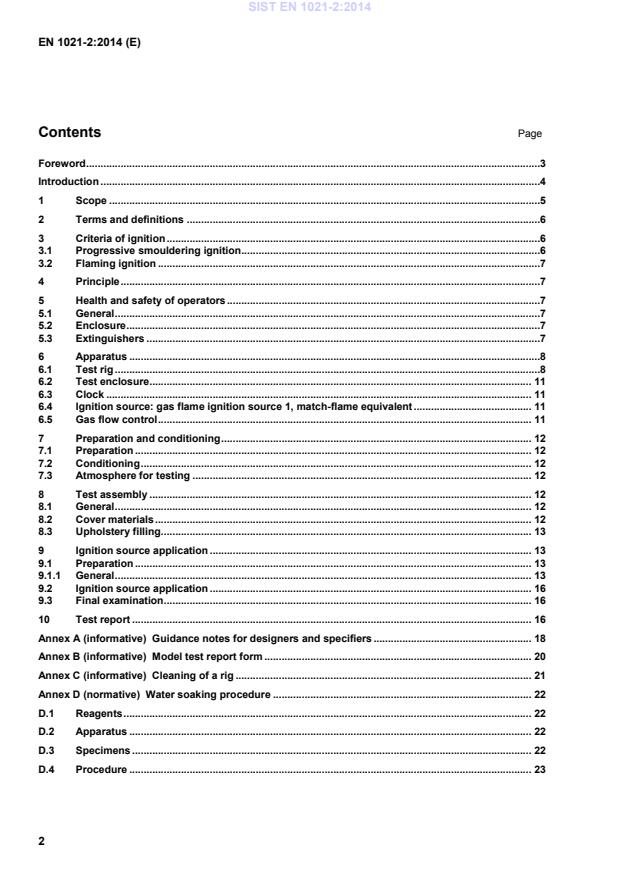
Guidance notes for designers and specifiers . 18 Annex B (informative)
Model test report form . 20 Annex C (informative)
Cleaning of a rig . 21 Annex D (normative)
Water soaking procedure . 22 D.1 Reagents . 22 D.2 Apparatus . 22 D.3 Specimens . 22 D.4 Procedure . 23
450 mm x 65 mm x 3 mm to prevent the test filling moving during the assembly of the test specimen (see Figures 1 and 2). The internal width and height of the back frame shall be (450 ± 2) mm x (300 ± 2) mm and the width and depth of the base frame (450 ± 2) mm x (150 ± 2) mm. A standard edging section may be used around the mesh steel platform to give protection and greater rigidity. The sides of the frame shall extend beyond the back of each frame to provide for the hinge holes and to form the back legs. The hinge rod shall be of nominal 10 mm diameter steel, continuous across the back of the rig and its axis (22,5 ± 0,5) mm beyond the back member of each frame. SIST EN 1021-2:2014
Key a) test rig b) test rig with cover and fillings c) vertical section X detail of fitting cover to frame 1 filling 2 end plate of frame 3 cover 4 overlap 20 mm 5 clips 6 fold cover overlap under frame to touch the steel mesh supporting the filling and fasten with clips as below Figure 1 — Test rig assembly SIST EN 1021-2:2014
NOTE 1 Unless tolerances are indicated, dimensions are nominal. NOTE 2 All parts are made of steel. Key 1 end plate of frame 65 mm x 3 mm 2 edging section 3 expanded metal mesh size 28 mm x 6 mm (see 6.1) 4 side member of frame 25 × 3 mm 5 M10 bolt, nut and washers 6 Ø 10 hinge rod Figure 2 — Test rig detail The frames shall be lockable at right angles by a bolt or pin through each of the pairs of members forming the back legs. The front legs may be welded across the front corners of the base frame. The height of the legs shall be such as to leave a gap not less than 50 mm high between the base and frame and the supporting surface. SIST EN 1021-2:2014
(6,5 ± 0,1) mm internal diameter and (200 ± 5) mm in length] is connected by flexible tubing to a cylinder containing butane via a flowmeter, fine control valve, on-off valve (optional) and cylinder regulator providing outlet pressure of nominal 2,8 kPa1) ). Where tubing of these dimensions is not readily available, stainless steel tubing of approximately similar dimensions may be used provided that the 50 mm length at the ‘flame’ end of the tube is machined to the given size. To facilitate positioning the tube, a suitable handle may be fitted to it at least 100 mm from the flame end of the burner tube. A calibrated flow metre shall supply butane gas at a flow rate of (45 ± 2) ml/min at (25 ± 3) °C. The flexible tubing connecting the output of the flowmeter to the burner tube shall be 2,5 m to 3 m in length with an internal diameter of (7 ± 1) mm. NOTE 2 This corresponds to a flame height of approximately 35 mm. 6.5 Gas flow control It is essential that the rate of supply of gas to the burner tube conforms to the flow rate specified. Some difficulties have been reported with the supply and measurement of the gas, particularly where the gas cylinder has, of necessity, to be stored in an environment cooler than the defined test conditions and/or at some distance from the test rig. In these cases, and other situations where difficulties occur, it is important that there should be sufficient length of tubing inside the controlled environment (10 °C to 30 °C) to ensure that the gas equilibrates to the required temperature before flow measurement. One way to assist this is to pass the gas (before flow measurement) through a metal tube immersed in water maintained at a constant temperature such that the gas temperature at entry to the flow metre is (25 ± 3)°C, so that flow corrections for temperature variations can be avoided. Great care also needs to be exercised with the measurement and setting of the flow rate o
...