

SIST EN ISO 80000-1:2023
(Main)Quantities and units - Part 1: General (ISO 80000-1:2022)
General Information
- Abstract
This document gives general information and definitions concerning quantities, systems of quantities, units, quantity and unit symbols, and coherent unit systems, especially the International System of Quantities (ISQ).
The principles laid down in this document are intended for general use within the various fields of science and technology, and as an introduction to other parts of this International Standard.
The ISO/IEC 80000 series does not, as yet, cover ordinal quantities and nominal properties.
- Status
- Published
- Public Enquiry End Date
- 29-Apr-2022
- Publication Date
- 19-Jan-2023
- Technical Committee
- TRS - Technical drawings, quantities, units, symbols and graphical symbols
- Current Stage
- 6100 - Translation of adopted SIST standards (Adopted Project)
- Start Date
- 25-Apr-2023
- Due Date
- 23-Apr-2024
- Completion Date
- 27-Feb-2024
Buy Documents



Overview
EN ISO 80000-1:2022 - Quantities and units - Part 1: General (ISO 80000-1:2022) provides the foundational definitions, concepts and conventions for representing physical quantities and units. Adopted by CEN and published December 2022, this part of the ISO/IEC 80000 series defines the International System of Quantities (ISQ), coherent unit systems, quantity and unit symbols, and general principles intended for broad use across science, engineering and technology. It supplements and introduces other parts of the ISO 80000 series and does not cover ordinal quantities or nominal properties.
Key topics
The standard covers general information and terminology rather than exhaustive unit lists. Major topics include:
- Terms and definitions aligned with ISO/IEC Guide 99 (VIM)
- Concept of quantity and systems of quantities (base and derived quantities)
- International System of Quantities (ISQ) and its role relative to the SI
- Dimensions and dimensional analysis
- Units and numerical values, including coherent unit systems (e.g., SI coherence)
- Quantity equations and numerical-value equations
- Printing and notation rules for symbols, subscripts, expressions and dimensions
- Rules for numbers: decimal sign, multiplication/division conventions, rounding and uncertainty/error reporting
- Supplementary material: chemical element/nuclide notation, Greek alphabet, annexes on specific terms and rounding
Practical applications
EN ISO 80000-1:2022 is a practical reference for ensuring consistent, unambiguous representation of quantities and units across documents, data and systems:
- Standardizing technical documentation, datasheets and specifications
- Harmonizing unit usage in engineering drawings, test reports and lab records
- Guiding software developers implementing unit-aware calculations and unit-conversion libraries
- Informing educational materials and scientific publications to comply with international conventions
- Supporting measurement, calibration and metrology activities where clear notation and coherent units are required
Who should use it
- Engineers, scientists and technical authors
- Metrologists and laboratory managers
- Standards writers and regulatory bodies
- Software developers working on scientific/engineering applications
- Publishers and educators producing technical content
Related standards
- ISO/IEC Guide 99 - International vocabulary of metrology (VIM)
- BIPM - The International System of Units (SI Brochure, 9th edition)
- Other parts of the ISO/IEC 80000 series covering specific quantities and domains
Using EN ISO 80000-1:2022 helps organizations and professionals achieve clarity, interoperability and international alignment when working with quantities, units and their symbols.
Relations
- Effective Date
- 01-Mar-2023
- Replaces
SIST EN ISO 80000-1:2013 - Quantities and units - Part 1: General (ISO 80000-1:2009 + Cor 1:2011) - Effective Date
- 01-Mar-2023
- Effective Date
- 09-Feb-2026
- Effective Date
- 15-Sep-2026
- Effective Date
- 09-Feb-2026
- Effective Date
- 09-Feb-2026
- Effective Date
- 09-Feb-2026
- Effective Date
- 09-Feb-2026
- Effective Date
- 09-Feb-2026
- Effective Date
- 09-Feb-2026
- Effective Date
- 09-Feb-2026
- Effective Date
- 09-Feb-2026
- Effective Date
- 09-Feb-2026
- Effective Date
- 09-Feb-2026
- Effective Date
- 09-Feb-2026
Buy Documents
Frequently Asked Questions
SIST EN ISO 80000-1:2023 is a standard published by the Slovenian Institute for Standardization (SIST). Its full title is "Quantities and units - Part 1: General (ISO 80000-1:2022)". This standard covers: This document gives general information and definitions concerning quantities, systems of quantities, units, quantity and unit symbols, and coherent unit systems, especially the International System of Quantities (ISQ). The principles laid down in this document are intended for general use within the various fields of science and technology, and as an introduction to other parts of this International Standard. The ISO/IEC 80000 series does not, as yet, cover ordinal quantities and nominal properties.
This document gives general information and definitions concerning quantities, systems of quantities, units, quantity and unit symbols, and coherent unit systems, especially the International System of Quantities (ISQ). The principles laid down in this document are intended for general use within the various fields of science and technology, and as an introduction to other parts of this International Standard. The ISO/IEC 80000 series does not, as yet, cover ordinal quantities and nominal properties.
SIST EN ISO 80000-1:2023 is classified under the following ICS (International Classification for Standards) categories: 01.060 - Quantities and units. The ICS classification helps identify the subject area and facilitates finding related standards.
SIST EN ISO 80000-1:2023 has the following relationships with other standards: It is inter standard links to SIST ISO 80000-1:2013, SIST EN ISO 80000-1:2013, SIST-V ISO/IEC Vodilo 99:2012, SIST EN IEC 61591:2023/oprA1:2026, SIST EN 62884-2:2018, SIST EN 60679-1:2018, SIST EN 60115-1:2023, SIST EN IEC 61293:2020, SIST EN 60079-35-2:2012, SIST EN 61082-1:2015, SIST EN IEC 62083:2026, SIST EN 50723:2023, SIST EN 60939-3:2016, SIST EN 62604-1:2015, SIST EN 60384-1:2016. Understanding these relationships helps ensure you are using the most current and applicable version of the standard.
SIST EN ISO 80000-1:2023 is associated with the following European legislation: EU Directives/Regulations: 2001-01-1594. When a standard is cited in the Official Journal of the European Union, products manufactured in conformity with it benefit from a presumption of conformity with the essential requirements of the corresponding EU directive or regulation.
SIST EN ISO 80000-1:2023 is available in PDF format for immediate download after purchase. The document can be added to your cart and obtained through the secure checkout process. Digital delivery ensures instant access to the complete standard document.
Standards Content (Sample)
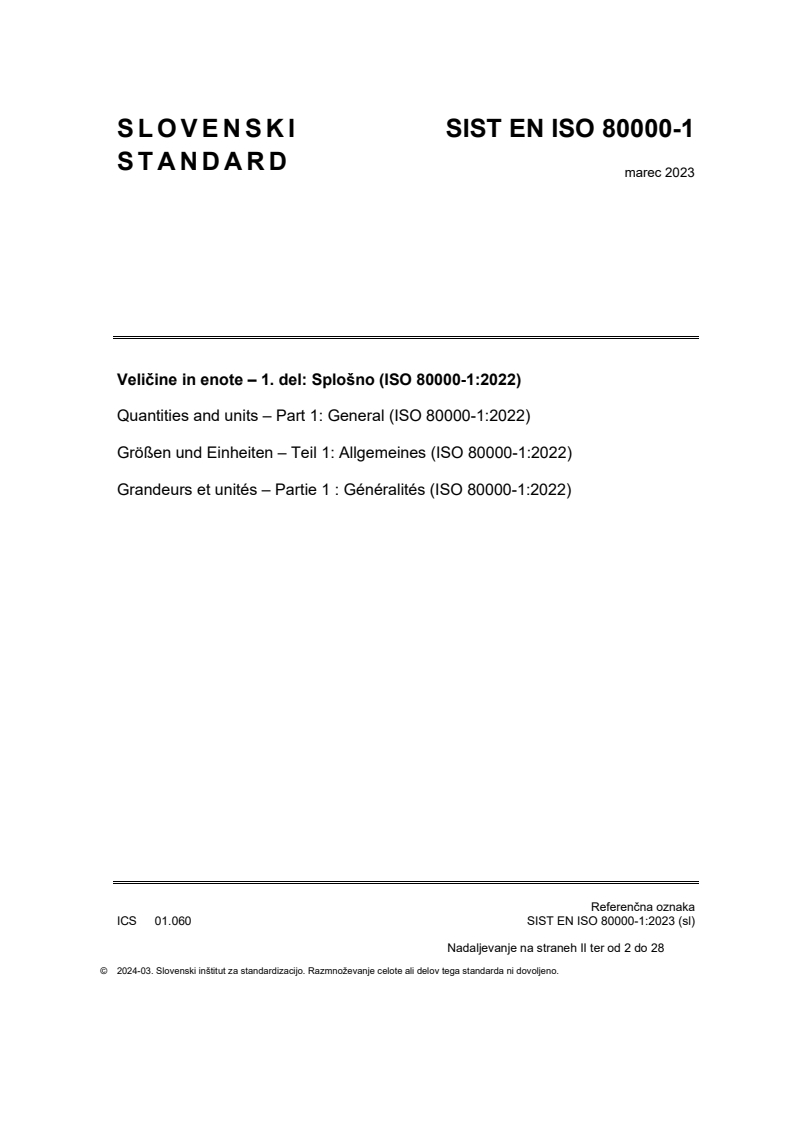
SLOVENSKI STANDARD
01-marec-2023
Nadomešča:
SIST EN ISO 80000-1:2013
SIST ISO 80000-1:2013
Veličine in enote - 1. del: Splošno (ISO 80000-1:2022)
Quantities and units - Part 1: General (ISO 80000-1:2022)
Größen und Einheiten – Teil 1: Allgemeines (ISO 80000-1:2022)
Grandeurs et unités - Partie 1 : Généralités (ISO 80000-1:2022)
Ta slovenski standard je istoveten z: EN ISO 80000-1:2022
ICS:
01.060 Veličine in enote Quantities and units
2003-01.Slovenski inštitut za standardizacijo. Razmnoževanje celote ali delov tega standarda ni dovoljeno.
EN ISO 80000-1
EUROPEAN STANDARD
NORME EUROPÉENNE
December 2022
EUROPÄISCHE NORM
ICS 01.060 Supersedes EN ISO 80000-1:2013
English Version
Quantities and units - Part 1: General (ISO 80000-1:2022)
Grandeurs et unités - Partie 1: Généralités (ISO 80000- Größen und Einheiten - Teil 1: Allgemeines (ISO
1:2022) 80000-1:2022)
This European Standard was approved by CEN on 2 December 2022.
CEN members are bound to comply with the CEN/CENELEC Internal Regulations which stipulate the conditions for giving this
European Standard the status of a national standard without any alteration. Up-to-date lists and bibliographical references
concerning such national standards may be obtained on application to the CEN-CENELEC Management Centre or to any CEN
member.
This European Standard exists in three official versions (English, French, German). A version in any other language made by
translation under the responsibility of a CEN member into its own language and notified to the CEN-CENELEC Management
Centre has the same status as the official versions.
CEN members are the national standards bodies of Austria, Belgium, Bulgaria, Croatia, Cyprus, Czech Republic, Denmark, Estonia,
Finland, France, Germany, Greece, Hungary, Iceland, Ireland, Italy, Latvia, Lithuania, Luxembourg, Malta, Netherlands, Norway,
Poland, Portugal, Republic of North Macedonia, Romania, Serbia, Slovakia, Slovenia, Spain, Sweden, Switzerland, Türkiye and
United Kingdom.
EUROPEAN COMMITTEE FOR STANDARDIZATION
COMITÉ EUROPÉEN DE NORMALISATION
EUROPÄISCHES KOMITEE FÜR NORMUNG
CEN-CENELEC Management Centre: Rue de la Science 23, B-1040 Brussels
© 2022 CEN All rights of exploitation in any form and by any means reserved Ref. No. EN ISO 80000-1:2022 E
worldwide for CEN national Members.
Contents Page
European foreword . 3
European foreword
This document (EN ISO 80000-1:2022) has been prepared by Technical Committee ISO/TC 12
"Quantities and units" in collaboration with CCMC.
This European Standard shall be given the status of a national standard, either by publication of an
identical text or by endorsement, at the latest by June 2023, and conflicting national standards shall be
withdrawn at the latest by June 2023.
Attention is drawn to the possibility that some of the elements of this document may be the subject of
patent rights. CEN shall not be held responsible for identifying any or all such patent rights.
This document supersedes EN ISO 80000-1:2013.
Any feedback and questions on this document should be directed to the users’ national standards
body/national committee. A complete listing of these bodies can be found on the CEN website.
According to the CEN-CENELEC Internal Regulations, the national standards organizations of the
following countries are bound to implement this European Standard: Austria, Belgium, Bulgaria,
Croatia, Cyprus, Czech Republic, Denmark, Estonia, Finland, France, Germany, Greece, Hungary, Iceland,
Ireland, Italy, Latvia, Lithuania, Luxembourg, Malta, Netherlands, Norway, Poland, Portugal, Republic of
North Macedonia, Romania, Serbia, Slovakia, Slovenia, Spain, Sweden, Switzerland, Türkiye and the
United Kingdom.
Endorsement notice
The text of ISO 80000-1:2022 has been approved by CEN as EN ISO 80000-1:2022 without any
modification.
INTERNATIONAL ISO
STANDARD 80000-1
Second edition
2022-12
Quantities and units —
Part 1:
General
Grandeurs et unités —
Partie 1: Généralités
Reference number
ISO 80000-1:2022(E)
ISO 80000-1:2022(E)
© ISO 2022
All rights reserved. Unless otherwise specified, or required in the context of its implementation, no part of this publication may
be reproduced or utilized otherwise in any form or by any means, electronic or mechanical, including photocopying, or posting on
the internet or an intranet, without prior written permission. Permission can be requested from either ISO at the address below
or ISO’s member body in the country of the requester.
ISO copyright office
CP 401 • Ch. de Blandonnet 8
CH-1214 Vernier, Geneva
Phone: +41 22 749 01 11
Email: copyright@iso.org
Website: www.iso.org
Published in Switzerland
ii
ISO 80000-1:2022(E)
Contents Page
Foreword .iv
Introduction .v
1 Scope . 1
2 Normative references . 1
3 Terms and definitions . 1
4 Quantities . 1
4.1 The concept of quantity . 1
4.2 System of quantities ─ Base quantities and derived quantities . 2
4.3 Universal constants and empirical constants . 2
4.4 Constant multipliers in quantity equations. 3
4.5 International System of Quantities, ISQ . 3
5 Dimensions .3
6 Units. 5
6.1 General . 5
6.2 Units and numerical values . 5
6.3 Mathematical operations . 5
6.4 Quantity equations and numerical value equations . 6
6.5 Coherent systems of units . 7
7 Printing rules .7
7.1 Symbols for quantities . 7
7.1.1 General . 7
7.1.2 Subscripts . 7
7.1.3 Combination of symbols for quantities . 8
7.1.4 Expressions for quantities . 9
7.1.5 Expressions for dimensions . 10
7.2 Numbers . 10
7.2.1 General . 10
7.2.2 Decimal sign . 10
7.2.3 Multiplication and division . 11
7.2.4 Error and uncertainty .12
7.3 Chemical elements and nuclides . 13
7.4 Greek alphabet . 14
Annex A (normative) Specific terms used for quantities .15
Annex B (normative) Rounding of numbers .19
Bibliography .22
iii
ISO 80000-1:2022(E)
Foreword
ISO (the International Organization for Standardization) is a worldwide federation of national standards
bodies (ISO member bodies). The work of preparing International Standards is normally carried out
through ISO technical committees. Each member body interested in a subject for which a technical
committee has been established has the right to be represented on that committee. International
organizations, governmental and non-governmental, in liaison with ISO, also take part in the work.
ISO collaborates closely with the International Electrotechnical Commission (IEC) on all matters of
electrotechnical standardization.
The procedures used to develop this document and those intended for its further maintenance are
described in the ISO/IEC Directives, Part 1. In particular, the different approval criteria needed for the
different types of ISO documents should be noted. This document was drafted in accordance with the
editorial rules of the ISO/IEC Directives, Part 2 (see www.iso.org/directives).
Attention is drawn to the possibility that some of the elements of this document may be the subject of
patent rights. ISO shall not be held responsible for identifying any or all such patent rights. Details of
any patent rights identified during the development of the document will be in the Introduction and/or
on the ISO list of patent declarations received (see www.iso.org/patents).
Any trade name used in this document is information given for the convenience of users and does not
constitute an endorsement.
For an explanation of the voluntary nature of standards, the meaning of ISO specific terms and
expressions related to conformity assessment, as well as information about ISO's adherence to
the World Trade Organization (WTO) principles in the Technical Barriers to Trade (TBT), see
www.iso.org/iso/foreword.html.
This document was prepared by Technical Committee ISO/TC 12, Quantities and units, in collaboration
with IEC/TC 25, Quantities and units.
This second edition cancels the first edition (ISO 80000-1:2009), which has been technically revised. It
also incorporates the Technical Corrigendum ISO 80000-1:2009/Cor.1:2011.
The main changes are as follows:
— More focus on concepts and terminology based on a system of quantities, particularly following the
recent major revision of the International System of Units (SI) and the proposed revisions of the
International vocabulary of metrology (VIM).
— At the same time, subclauses of previous editions of this document which essentially reproduced
content from other sources – particularly metrological vocabulary, descriptions of SI units and
compilations of fundamental constants – have been substantially removed from the present edition,
in accordance with a resolution taken by ISO/TC 12 in 2020.
A list of all parts in the ISO 80000 and IEC 80000 series can be found on the ISO website.
Any feedback or questions on this document should be directed to the user’s national standards body. A
complete listing of these bodies can be found at www.iso.org/members.html.
iv
ISO 80000-1:2022(E)
Introduction
Systems of quantities – as defined in ISO/IEC Guide 99 – can be treated in many consistent, but different,
ways. Which treatment to use is partly a matter of convention.
The quantities and relations among the quantities used here are those almost universally accepted for
use throughout the physical sciences. They are presented in the majority of scientific textbooks today
and are familiar to all scientists and technologists.
The quantities and the relations among them are essentially infinite in number and are continually
evolving as new fields of science and technology are developed. Thus, it is not possible to list all these
quantities and relations in the ISO/IEC 80000 series; instead, a selection of the more commonly used
quantities and the relations among them is presented.
It is inevitable that some readers working in particular specialized fields may find that the quantities
they are interested in using may not be listed in this document or in another International Standard.
However, provided that they can relate their quantities to more familiar examples that are listed, this
will not prevent them from defining units for their quantities.
The system of quantities presented in this document is named the International System of Quantities
(ISQ), in all languages. This name was not used in ISO 31 series, from which the present harmonized
series has evolved. However, the ISQ does appear in ISO/IEC Guide 99 and is the system of quantities
underlying the International System of Units, denoted “SI”, in all languages according to the SI Brochure.
v
INTERNATIONAL STANDARD ISO 80000-1:2022(E)
Quantities and units —
Part 1:
General
1 Scope
This document gives general information and definitions concerning quantities, systems of quantities,
units, quantity and unit symbols, and coherent unit systems, especially the International System of
Quantities (ISQ).
The principles laid down in this document are intended for general use within the various fields of
science and technology, and as an introduction to other parts of this International Standard.
The ISO/IEC 80000 series does not, as yet, cover ordinal quantities and nominal properties.
2 Normative references
The following documents are referred to in the text in such a way that some or all of their content
constitutes requirements of this document. For dated references, only the edition cited applies. For
undated references, the latest edition of the referenced document (including any amendments) applies.
ISO/IEC Guide 99, International vocabulary of metrology — Basic and general concepts and associated
terms (VIM)
th
BIPM The International System of Units (SI), 9 edition (2019),
https:// www .bipm .org/ en/ publications/ si -brochure
3 Terms and definitions
For the purposes of this document, the terms and definitions given in ISO/IEC Guide 99 apply.
ISO and IEC maintain terminology databases for use in standardization at the following addresses:
— ISO Online browsing platform: available at https:// www .iso .org/ obp
— IEC Electropedia: available at https:// www .electropedia .org/
4 Quantities
4.1 The concept of quantity
In this document, it is accepted that things (including physical bodies and phenomena, substances,
events, etc.) are characterized by properties, according to which things can be compared, in terms of
having the same property or not, such as the shape of rigid bodies or the blood group of human beings.
Some properties make things comparable also by order, so that for example winds can be compared by
their strength and earthquakes can be compared by their magnitude. Finally, some properties make
things comparable not only in terms of equivalence and order, but also in more complex ways, and
in particular by ratio, as is the case for most physical quantities, according to which the mass or the
electric charge of a body might be twice the mass or the electric charge of another body, and so on.
ISO 80000-1:2022(E)
Not all properties, and more specifically quantities, can be compared with each other. For example,
while the diameter of a cylindrical rod can be compared to the height of a block, the diameter of a rod
cannot be compared to the mass of a block.
[4]
Quantities that are comparable are said to be of the same kind and are instances of the same general
quantity. Hence, diameters and heights are quantities of the same kind, being instances of the general
quantity length.
It is customary to use the same term, "quantity", to refer to both general quantities, such as length, mass,
etc., and their instances, such as given lengths, given masses, etc. Accordingly, we are used to saying
both that length is a quantity and that a given length is a quantity, by maintaining the specification
– "general quantity, Q" or "individual quantity, Q " – implicit and exploiting the linguistic context to
a
remove the ambiguity.
When specific terms are used for quantities, Annex A shall be followed.
4.2 System of quantities ─ Base quantities and derived quantities
A set of quantities and their relations are called a system of quantities. General quantities are related
through equations that express laws of nature or define new general quantities. Each equation between
quantities is called a quantity equation.
It is convenient to consider some quantities of different kinds as mutually independent. Such quantities
are called base quantities. Other quantities, called derived quantities, are defined or expressed in terms
of base quantities by means of equations.
It is a matter of choice how many and which quantities are considered to be base quantities. It is also a
matter of choice which equations are used to define the derived quantities.
4.3 Universal constants and empirical constants
Some individual quantities are considered to be constant under all circumstances. Such quantities are
[5]
called universal constants or fundamental physical constants .
EXAMPLE 1 The Planck constant, h.
EXAMPLE 2 The Faraday constant, F.
Other quantities may be constant under some circumstances but depend on others. Their values are
generally obtained by measurement. They are called empirical constants.
EXAMPLE 3
The result of measuring at a certain location the length l and the periodic time T, for each of several
pendulums, can be expressed by one quantity equation
TC= l
where C is an empirical constant that depends on the location.
Theory shows that
2π
C=
g
where g is the local acceleration of free fall, which is another empirical constant.
ISO 80000-1:2022(E)
4.4 Constant multipliers in quantity equations
Equations between quantities sometimes contain constant multipliers. These multipliers depend on the
definitions chosen for the quantities occurring in the equations, i.e., on the system of quantities chosen.
Such multipliers may be purely numerical and are then called numerical factors.
EXAMPLE 1
In a system of quantities where length, mass, and time are three base quantities, the kinetic energy of a
particle in classical mechanics is
Tm= v
where T is kinetic energy, m is mass and v is speed. This equation contains the numerical factor .
A multiplier may include one or more universal (or empirical) constants.
EXAMPLE 2
The Coulomb law for electric charges in a system of quantities with three base quantities is
qq
F =
r
where F is scalar force, q and q are two point-like electric charges, r is distance.
1 2
For a rationalised system of quantities with four base quantities, where a base quantity of an electrical
nature is added, the expression becomes
1 qq
F =
4πε
r
where ε is, since the 2019 redefinition of SI base units, an empirical constant, i.e., the electric constant (it
was formerly a universal constant).
A multiplier may also include one or more conventional quantity values, such as ε in the last example.
Constant multipliers other than numerical factors are often called coefficients (see A.2.2).
4.5 International System of Quantities, ISQ
The special choice of base quantities and quantity equations, including multipliers, given in ISO 80000
and IEC 80000 defines the International System of Quantities (ISQ). Derived quantities can be defined
in terms of the base units by quantity equations, see 6.4. There are seven base quantities in the ISQ:
length, mass, time, electric current, thermodynamic temperature, amount of substance, and luminous
intensity.
5 Dimensions
In the system of quantities under consideration, the relation between any general quantity Q and the
base quantities can be expressed by means of an equation. The equation may include a sum of terms,
each of which can be expressed as a product of powers of base quantities A, B, C, … from a chosen set,
αβ γ
sometimes multiplied by a numerical factor ξ, i.e., ξ⋅AB C , where the set of exponents α, β, γ, … is
the same for each term.
ISO 80000-1:2022(E)
The dimension of the quantity Q is then expressed by the dimensional product
α β γ
dim Q = A B C …
where A, B, C, … denote the dimensions of the base quantities A, B, C, …, respectively, and α, β, γ, … are
called the dimensional exponents.
Quantities that are of the same kind (e.g., length) have the same dimension, even if they are originally
expressed in different units (such as yards and metres). If quantities have different dimensions (such as
[4][6] [7]
length vs. mass), they are of different kinds and cannot be compared .
A quantity whose dimensional exponents are all equal to zero has the dimensional product denoted
0 0 0
A B C … = 1, where the symbol 1 denotes the corresponding dimension. There is no agreement on how
to refer to such quantities. They have been called dimensionless quantities (although this term should
now be avoided), quantities with dimension one, quantities with dimension number, or quantities with
the unit one. Such quantities are dimensionally simply numbers. To avoid confusion, it is helpful to
use explicit units with these quantities where possible, e.g., m/m, nmol/mol, rad, as specified in the SI
Brochure. It is especially important to have a clear description of any such quantity when expressing a
measurement result.
NOTE 1 These quantities include those defined as a quotient of two quantities of the same dimension and
those defined as numbers of entities.
In the ISQ, with the seven base quantities length, mass, time, electric current, thermodynamic
temperature, amount of substance and luminous intensity, the dimensions of the base quantities are
denoted by L, M, T, I, Θ, N and J, respectively. Hence, in the ISQ, the dimension of a quantity Q in general
becomes
α β γ δ ε ζ η
dim Q = L M T I Θ N J
EXAMPLE
Quantity Dimension
–1
speed LT
–1
frequency T
–2
force LMT
2 –2
energy L MT
2 –2 –1
entropy L MT Θ
2 –3 –1
electric tension L MT I
2 –2 –1
magnetic flux L MT I
–2
illuminance L J
2 –2 –1 –1
molar entropy L MT Θ N
efficiency 1
ISO 80000-1:2022(E)
6 Units
6.1 General
In this clause units are dealt with in relation to systems of quantities. Further guidance about units,
given in the SI Brochure, shall be followed.
6.2 Units and numerical values
If a particular instance of a quantity of a given kind is chosen as a reference quantity called the unit,
then any other quantity of the same kind can be expressed in terms of this unit, as a product of this unit
and a number. That number is called the numerical value of the quantity expressed in this unit.
EXAMPLE 1 The wavelength of one of the sodium spectral lines is
–7
λ ≈ 5,896 × 10 m
Here, λ is the symbol for the quantity wavelength, m is the symbol for the unit of length, the metre, and
–7
5,896 ⋅ 10 is the numerical value of the wavelength expressed in metres.
[6]
In formal treatments, this relation between quantities and units may be expressed in the form
Q = {Q } [Q]
a a
where Q is the symbol for an individual quantity, [Q] is the symbol for the unit and {Q } is the symbol
a a
for the numerical value of the quantity Q expressed in the unit [Q]. For vectors and tensors, the
a
components are quantities that can be expressed as described above. Vectors and tensors can also be
expressed as a numerical value vector or tensor, respectively, multiplied by a unit.
If a quantity is expressed in another unit that is k times the first unit, the new numerical value becomes
1 / k times the first numerical value because the quantity, expressed as the product of the numerical
value and the unit, is independent of the unit.
EXAMPLE 2
Changing the unit for the wavelength in the previous example from the metre to the nanometre, which is
–9 9
10 times the metre, leads to a numerical value which is 10 the numerical value of the quantity expressed
in metres.
Thus,
–7 –7 9
λ ≈ 5,896 × 10 m = 5,896 × 10 × 10 nm = 589,6 nm
It is essential to distinguish between the quantity itself and the numerical value of the quantity
expressed in a particular unit. The numerical value of a quantity expressed in a particular unit could
be indicated by placing braces (curly brackets) around the quantity symbol and using the unit as a
subscript, e.g. {λ} . It is, however, preferable to indicate the numerical value explicitly as the ratio of
nm
the quantity to the unit.
EXAMPLE 3 λ / nm ≈ 589,6
This notation is particularly recommended for use in graphs and headings of columns in tables.
6.3 Mathematical operations
The product and the quotient of two quantities, Q and Q , satisfy the relations
1 2
Q Q = {Q } {Q } · [Q ] [Q ]
1 2 1 2 1 2
ISO 80000-1:2022(E)
Q {}Q []Q
1 1 1
= ⋅
Q Q Q
{} []
2 2 2
Thus, the product {Q } {Q } is the numerical value {Q Q } of the quantity Q Q , and the product [Q ] [Q ]
1 2 1 2 1 2 1 2
is the unit [Q Q ] of the quantity Q Q . Similarly, the quotient {Q } / {Q } is the numerical value {Q / Q }
1 2 1 2 1 2 1 2
of the quantity Q / Q , and the quotient [Q ] / [Q ] is the unit [Q / Q ] of the quantity Q / Q . Units such
1 2 1 2 1 2 1 2
as [Q ] [Q ] and [Q ] / [Q ] are called compound units.
1 2 1 2
EXAMPLE 1
The speed, v, of a particle in uniform motion is given by
l
v=
t
where l is the distance travelled in the duration t.
Thus, if the particle travels a distance l = 6 m in the duration t = 2 s, the speed, v, is equal to
v = l / t = (6 m) / (2 s) = 3 m / s
NOTE A quantity defined as A / B is called “quotient of A by B” or “A per B”, but not “A per unit B”.
Equations between numerical values, such as {Q Q } = {Q } {Q }, are called numerical value equations
...
SIST EN ISO 80000-1
SL O V EN S K I
S T ANDAR D
marec 2023
Veličine in enote – 1. del: Splošno (ISO 80000-1:2022)
Quantities and units – Part 1: General (ISO 80000-1:2022)
Größen und Einheiten – Teil 1: Allgemeines (ISO 80000-1:2022)
Grandeurs et unités – Partie 1 : Généralités (ISO 80000-1:2022)
Referenčna oznaka
ICS 01.060 SIST EN ISO 80000-1:2023 (sl)
Nadaljevanje na straneh II ter od 2 do 28
© 2024-03. Slovenski inštitut za standardizacijo. Razmnoževanje celote ali delov tega standarda ni dovoljeno.
SIST EN ISO 80000-1 : 2023
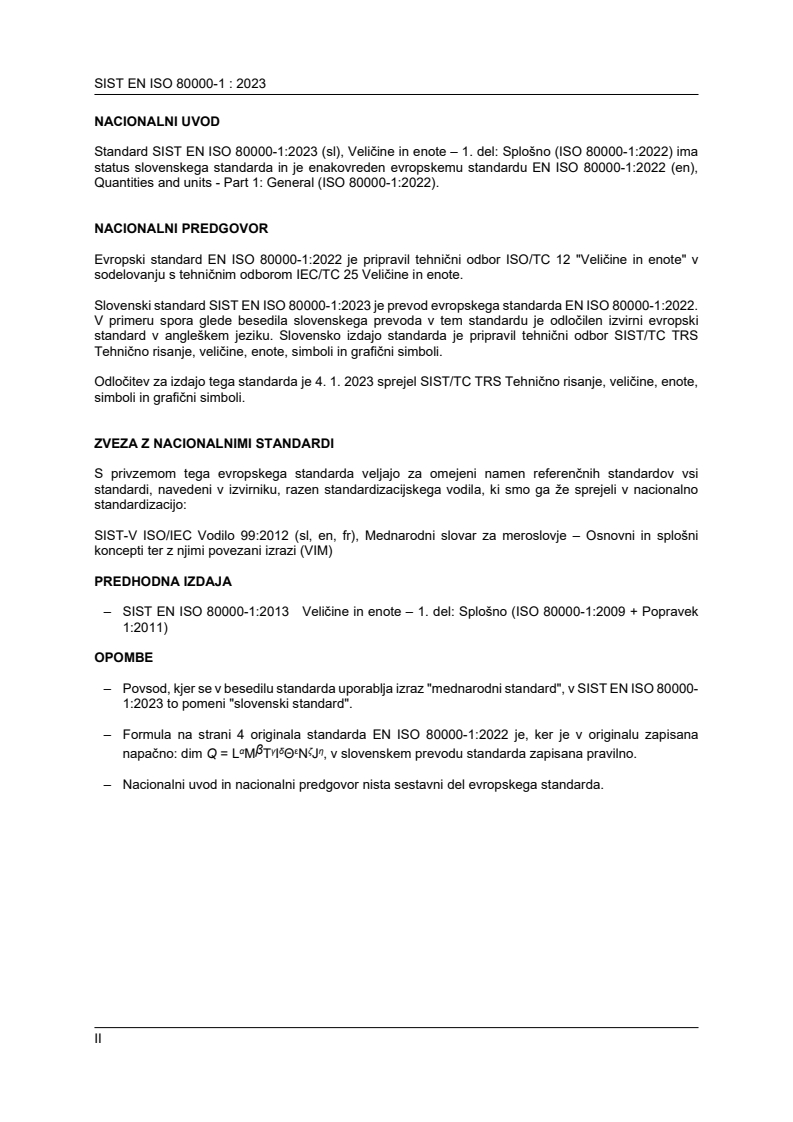
NACIONALNI UVOD
Standard SIST EN ISO 80000-1:2023 (sl), Veličine in enote – 1. del: Splošno (ISO 80000-1:2022) ima
status slovenskega standarda in je enakovreden evropskemu standardu EN ISO 80000-1:2022 (en),
Quantities and units - Part 1: General (ISO 80000-1:2022).
NACIONALNI PREDGOVOR
Evropski standard EN ISO 80000-1:2022 je pripravil tehnični odbor ISO/TC 12 "Veličine in enote" v
sodelovanju s tehničnim odborom IEC/TC 25 Veličine in enote.
Slovenski standard SIST EN ISO 80000-1:2023 je prevod evropskega standarda EN ISO 80000-1:2022.
V primeru spora glede besedila slovenskega prevoda v tem standardu je odločilen izvirni evropski
standard v angleškem jeziku. Slovensko izdajo standarda je pripravil tehnični odbor SIST/TC TRS
Tehnično risanje, veličine, enote, simboli in grafični simboli.
Odločitev za izdajo tega standarda je 4. 1. 2023 sprejel SIST/TC TRS Tehnično risanje, veličine, enote,
simboli in grafični simboli.
ZVEZA Z NACIONALNIMI STANDARDI
S privzemom tega evropskega standarda veljajo za omejeni namen referenčnih standardov vsi
standardi, navedeni v izvirniku, razen standardizacijskega vodila, ki smo ga že sprejeli v nacionalno
standardizacijo:
SIST-V ISO/IEC Vodilo 99:2012 (sl, en, fr), Mednarodni slovar za meroslovje – Osnovni in splošni
koncepti ter z njimi povezani izrazi (VIM)
PREDHODNA IZDAJA
– SIST EN ISO 80000-1:2013 Veličine in enote – 1. del: Splošno (ISO 80000-1:2009 + Popravek
1:2011)
OPOMBE
– Povsod, kjer se v besedilu standarda uporablja izraz "mednarodni standard", v SIST EN ISO 80000-
1:2023 to pomeni "slovenski standard".
– Formula na strani 4 originala standarda EN ISO 80000-1:2022 je, ker je v originalu zapisana
α β γδ ε ζ η
M T I Θ N J , v slovenskem prevodu standarda zapisana pravilno.
napačno: dim Q = L
– Nacionalni uvod in nacionalni predgovor nista sestavni del evropskega standarda.
II
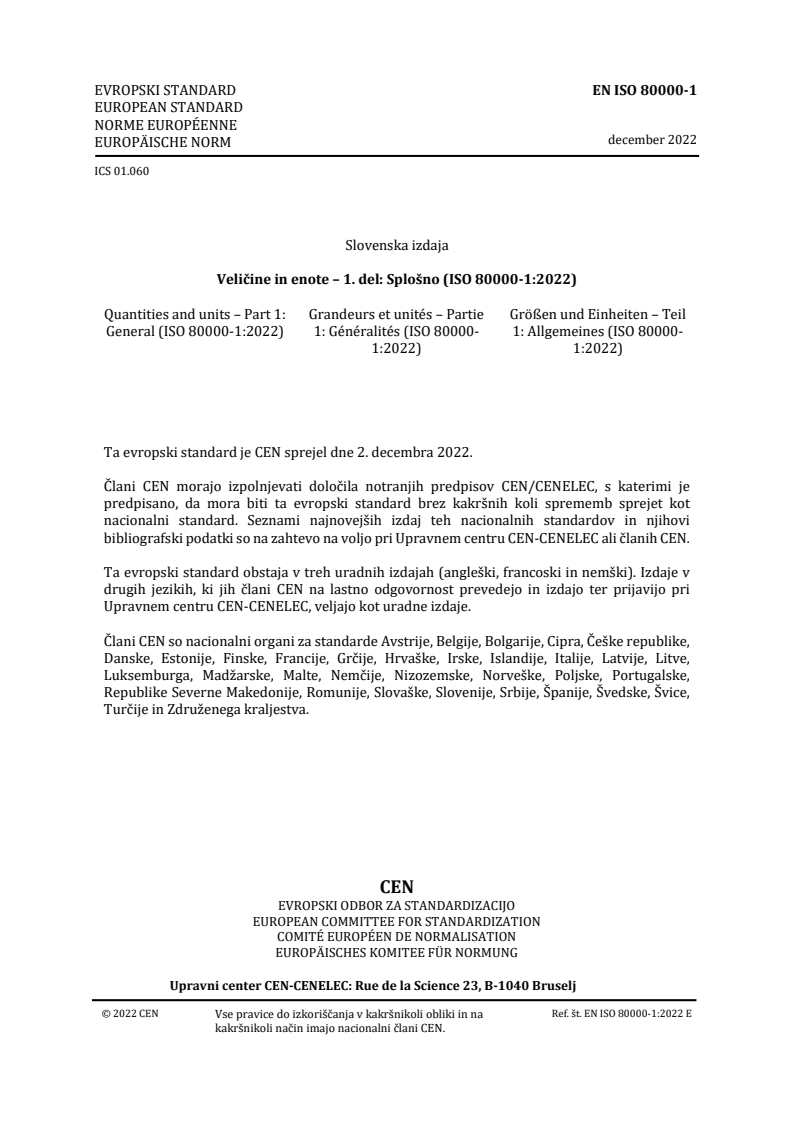
EVROPSKI STANDARD EN ISO 80000-1
EUROPEAN STANDARD
NORME EUROPÉENNE
december 2022
EUROPÄISCHE NORM
ICS 01.060
Slovenska izdaja
Veličine in enote – 1. del: Splošno (ISO 80000-1:2022)
Quantities and units – Part 1: Grandeurs et unités – Partie Größen und Einheiten – Teil
General (ISO 80000-1:2022) 1: Généralités (ISO 80000- 1: Allgemeines (ISO 80000-
1:2022) 1:2022)
Ta evropski standard je CEN sprejel dne 2. decembra 2022.
Člani CEN morajo izpolnjevati določila notranjih predpisov CEN/CENELEC, s katerimi je
predpisano, da mora biti ta evropski standard brez kakršnih koli sprememb sprejet kot
nacionalni standard. Seznami najnovejših izdaj teh nacionalnih standardov in njihovi
bibliografski podatki so na zahtevo na voljo pri Upravnem centru CEN-CENELEC ali članih CEN.
Ta evropski standard obstaja v treh uradnih izdajah (angleški, francoski in nemški). Izdaje v
drugih jezikih, ki jih člani CEN na lastno odgovornost prevedejo in izdajo ter prijavijo pri
Upravnem centru CEN-CENELEC, veljajo kot uradne izdaje.
Člani CEN so nacionalni organi za standarde Avstrije, Belgije, Bolgarije, Cipra, Češke republike,
Danske, Estonije, Finske, Francije, Grčije, Hrvaške, Irske, Islandije, Italije, Latvije, Litve,
Luksemburga, Madžarske, Malte, Nemčije, Nizozemske, Norveške, Poljske, Portugalske,
Republike Severne Makedonije, Romunije, Slovaške, Slovenije, Srbije, Španije, Švedske, Švice,
Turčije in Združenega kraljestva.
CEN
EVROPSKI ODBOR ZA STANDARDIZACIJO
EUROPEAN COMMITTEE FOR STANDARDIZATION
COMITÉ EUROPÉEN DE NORMALISATION
EUROPÄISCHES KOMITEE FÜR NORMUNG
Upravni center CEN-CENELEC: Rue de la Science 23, B-1040 Bruselj
© 2022 CEN Ref. št. EN ISO 80000-1:2022 E
Vse pravice do izkoriščanja v kakršnikoli obliki in na
kakršnikoli način imajo nacionalni člani CEN.
SIST EN ISO 80000-1 : 2023
VSEBINA Stran
Evropski predgovor . 3
Evropski predgovor
Ta dokument (EN ISO 80000-1:2022) je pripravil tehnični odbor ISO/TC 12 "Veličine in enote" v
sodelovanju s CCMC.
Ta evropski standard mora z objavo istovetnega besedila ali z razglasitvijo dobiti status
nacionalnega standarda najpozneje do junija 2023, nacionalne standarde, ki so v nasprotju s tem
standardom, pa je treba razveljaviti najpozneje do junija 2023.
Opozoriti je treba na možnost, da je lahko nekaj elementov tega dokumenta predmet patentnih
pravic. CEN ne prevzema odgovornosti za identifikacijo katerihkoli ali vseh takih patentnih pravic.
Ta dokument nadomešča dokument EN ISO 80000-1:2013.
Za morebitne povratne informacije ali vprašanja glede tega dokumenta naj se uporabniki obrnejo
na svoj nacionalni organ za standarde oziroma nacionalni odbor. Popolni seznam teh organov se
nahaja na spletni strani CEN.
V skladu z notranjimi pravili CEN/CENELEC morajo ta evropski standard obvezno uvesti
nacionalne organizacije za standarde naslednjih držav: Avstrije, Belgije, Bolgarije, Cipra, Češke
republike, Danske, Estonije, Finske, Francije, Grčije, Hrvaške, Irske, Islandije, Italije, Latvije, Litve,
Luksemburga, Madžarske, Malte, Nemčije, Nizozemske, Norveške, Poljske, Portugalske, Republike
Severne Makedonije, Romunije, Slovaške, Slovenije, Srbije, Španije, Švedske, Švice, Turčije in
Združenega kraljestva.
Razglasitvena objava
Besedilo mednarodnega standarda ISO 80000-1:2022 je CEN brez kakršnihkoli sprememb odobril
kot evropski standard EN ISO 80000-1:2022.
VSEBINA Stran
Predgovor . 5
Uvod . 6
1 Področje uporabe . 7
2 Zveze s standardi . 7
3 Izrazi in definicije . 7
4 Veličine . 7
4.1 Pojem veličine . 7
4.2 Sistem veličin – Osnovne veličine in izpeljane veličine . 8
4.3 Univerzalne in empirične konstante . 8
4.4 Množitelji konstant v veličinskih enačbah . 9
4.5 Mednarodni sistem veličin ISQ . 10
5 Dimenzije . 10
6 Enote . 11
6.1 Splošno . 11
6.2 Enote in številske vrednosti . 11
6.3 Matematične operacije . 12
6.4 Veličinske in številske enačbe . 13
6.5 Koherentni sistem enot . 13
7 Pravila tiskanja . 13
7.1 Simboli za veličine . 13
7.1.1 Splošno . 13
7.1.2 Indeksi . 14
7.1.3 Kombinacija simbolov za veličine . 14
7.1.4 Izrazi za veličine . 16
7.1.5 Izrazi za dimenzije . 16
7.2 Števila . 16
7.2.1 Splošno . 16
7.2.2 Decimalni znak . 17
7.2.3 Množenje in deljenje . 18
7.2.4 Pogrešek in negotovost . 19
7.3 Kemični elementi in nuklidi . 20
7.4 Grška abeceda . 21
Dodatek A (normativni) Posebni izrazi, ki se uporabljajo za veličine . 22
Dodatek B (normativni) Zaokroževanje števil . 27
Literatura. 30
Predgovor
ISO (Mednarodna organizacija za standardizacijo) je svetovna zveza nacionalnih organov za standarde
(članov ISO). Mednarodne standarde praviloma pripravljajo tehnični odbori ISO. Vsak član, ki želi delovati
na določenem področju, za katero je bil ustanovljen tehnični odbor, ima pravico biti zastopan v tem odboru.
Pri delu sodelujejo tudi vladne in nevladne mednarodne organizacije, povezane z ISO. V vseh zadevah, ki so
povezane s standardizacijo na področju elektrotehnike, ISO tesno sodeluje z Mednarodno elektrotehniško
komisijo (IEC).
Postopki, uporabljeni pri razvoju tega dokumenta, in postopki, predvideni za njegovo nadaljnje vzdrževanje,
so opisani v Direktivah ISO/IEC, 1. del. Posebna pozornost naj se nameni različnim kriterijem odobritve,
potrebnim za različne vrste dokumentov ISO. Ta dokument je bil pripravljen v skladu z uredniškimi pravili
Direktiv ISO/IEC, 2. del (glej www.iso.org/directives).
Opozoriti je treba na možnost, da je lahko nekaj elementov tega dokumenta predmet patentnih pravic. ISO
ne prevzema odgovornosti za identifikacijo katerihkoli ali vseh takih patentnih pravic. Podrobnosti o
morebitnih patentnih pravicah, identificiranih med pripravo tega dokumenta, bodo navedene v Uvodu
in/ali na seznamu patentnih izjav, ki jih je prejela ISO (glej www.iso.org/patents).
Morebitna trgovska imena, uporabljena v tem dokumentu, so informacije za uporabnike in ne pomenijo
podpore blagovni znamki.
Za razlago prostovoljne narave standardov, pomena specifičnih pojmov in izrazov ISO, povezanih z
ugotavljanjem skladnosti, ter informacij o tem, kako ISO spoštuje načela Mednarodne trgovinske
organizacije (WTO) v Tehničnih ovirah pri trgovanju (TBT), glej www.iso.org/iso/foreword.html.
Ta dokument je pripravil tehnični odbor ISO/TC 12, Veličine in enote, v sodelovanju s tehničnim odborom
IEC/TC 25, Veličine in enote.
Ta druga izdaja razveljavlja in nadomešča prvo izdajo (ISO 80000-1:2009), ki je tehnično spremenjena.
Vsebuje tudi Tehnični popravek ISO 80000-1:2009/Cor.1:2011.
Glavne spremembe so naslednje:
– več poudarka je na pojmih in terminologiji, temelječih na sistemu veličin, zlasti po nedavni večji reviziji
Mednarodnega sistema enot (SI) in predlaganih revizijah Mednarodnega slovarja meroslovja (VIM);
– hkrati so v skladu s sklepom ISO/TC 12 iz leta 2020 iz te izdaje v veliki meri odstranjene podtočke
prejšnjih izdaj tega dokumenta, ki so v pravzaprav reproducirala vsebino iz drugih virov – predvsem
iz meroslovnega slovarja, opisov enot SI in zbirk temeljnih konstant.
Na spletni strani ISO je seznam vseh delov skupine standardov ISO 80000 in IEC 80000.
Za morebitne povratne informacije ali vprašanja glede tega dokumenta naj se uporabniki obrnejo na svoj
nacionalni organ za standarde. Popolni seznam teh organov je na povezavi www.iso.org/members.html.
Uvod
Sisteme veličin – kot so opredeljeni v Vodilu ISO/IEC 99 – je mogoče obravnavati na več usklajenih, vendar
različnih načinov. Kateri način obravnavanja se uporabi, je delno stvar dogovora.
Veličine in povezave med veličinami, ki so uporabljene v tem dokumentu, se skoraj enotno uporabljajo v
vseh fizikalnih vedah. Predstavljene so v večini današnjih znanstvenih učbenikov in jih poznajo vsi
znanstveniki in tehniki.
Veličine in povezave med njimi dejansko predstavljajo neskončno število in se z razvojem novih znanstveno
tehničnih področij nenehno razvijajo. Zato v skupini ISO/IEC 80000 ni mogoče našteti vseh teh veličin in
povezav in je namesto tega predstavljen izbor pogosteje uporabljenih veličin ter povezav med njimi.
Neizogibno lahko pride do tega, da bodo nekateri uporabniki, ki delajo na določenih posebnih področjih,
ugotovili, da veličine, katerih uporaba jih zanima, niso navedene v tem ali katerem drugem mednarodnem
standardu. Vendar če bodo svoje veličine povezali z bolj znanimi primeri, ki so navedeni, jim to ne bo
preprečilo definirati enot za svoje veličine.
Sistem veličin, predstavljen v tem dokumentu, se v vseh jezikih imenuje Mednarodni sistem veličin (ISQ).
To ime ni bilo uporabljeno v standardu ISO 31, iz katerega je nastala sedanja skupina harmoniziranih
standardov. Oznaka ISQ je prisotna v Vodilu ISO/IEC 99 in je sistem veličin, podlaga za Mednarodni sistem
enot, ki je v skladu z Brošuro SI, v vseh jezikih označen kot "SI".
Veličine in enote
1. del:
Splošno
1 Področje uporabe
Ta dokument podaja splošne informacije in definicije, ki se nanašajo na veličine, sisteme veličin,
enote, simbole veličin in enot ter na koherentne (soodvisne) sisteme enot, zlasti mednarodni
sistem veličin (ISQ).
Načela, opisana v tem dokumentu, so namenjena za splošno uporabo na različnih področjih
naravoslovja in tehnike ter kot uvod v druge dele tega mednarodnega standarda.
Skupina standardov ISO/IEC 80000 zaenkrat še ne zajema vrstilnih veličin in nazivnih lastnosti.
2 Zveze s standardi
V tem besedilu se sklicuje na naslednje dokumente na tak način, da nekaj ali vsa njihova vsebina
predstavlja zahteve tega dokumenta. Pri datiranem sklicevanju se upošteva samo navedena
izdaja. Pri nedatiranem sklicevanju se upošteva zadnja izdaja navedenega dokumenta (vključno z
morebitnimi dopolnili).
Vodilo ISO/IEC 99, Mednarodni slovar meroslovja – Osnovni in splošni pojmi ter z njimi povezani
izrazi (VIM)
BIPM Mednarodni sistem enot (SI), 9. izdaja (2019),
https://www.bipm.org/en/publications/sibrochure
3 Izrazi in definicije
V tem dokumentu se uporabljajo izrazi in definicije, podani v Vodilu ISO/IEC 99.
ISO in IEC vzdržujeta terminološke podatkovne baze za uporabo na področju standardizacije na
naslednjih naslovih:
– platforma za spletno brskanje ISO: na voljo na https://www.iso.org/obp
– elektropedija IEC: na voljo na https://www.electropedia.org/
4 Veličine
4.1 Pojem veličine
V tem dokumentu je sprejeto, da so stvari (vključno s fizičnimi telesi in pojavi, snovmi, dogodki
itd.) opredeljene z lastnostmi, v skladu s katerimi je stvari mogoče primerjati po tem, ali imajo
enako lastnost ali ne, kot je npr. oblika pri togih telesih ali krvna skupina pri ljudeh. Po nekaterih
lastnostih so stvari primerljive tudi glede na red velikosti, tako da se na primer vetrovi lahko
primerjajo po moči in potresi po magnitudi. Končno pa so stvari zaradi nekaterih lastnosti
primerljive ne samo glede na enakovrednost in red velikosti, temveč tudi na bolj zapletene načine,
še posebej glede na razmerje, kot je to primer pri večini fizikalnih veličin, v skladu s katerim bi
bila lahko masa ali električni naboj telesa dvakratna masa ali dvakratni električni naboj drugega
telesa itd.
Ne morejo pa se vse lastnosti oziroma natančneje veličine primerjati druga z drugo. Na primer,
medtem ko se premer valjaste palice lahko primerja z višino bloka, pa se premer palice ne more
primerjati z maso bloka.
[4]
Medsebojno primerljive veličine se imenujejo istovrstne veličine in so primeri iste splošne
veličine. Tako so premeri in višine istovrstne veličine, saj so primeri splošne veličine dolžina.
Običajno se isti izraz "veličina" nanaša na splošne veličine, kot so dolžina, masa itd., in na njihove
primere, kot so dane dolžine, dane mase itd. Skladno s tem običajno govorimo, da sta dolžina in
dana dolžina veličini, s tem da specifikacijo – "splošna veličina Q" ali "posamezna veličina Q " –
a
ohranjamo kot implicitno in za odpravo dvoumnosti uporabimo jezikovni kontekst.
Kadar se za veličine uporabljajo posebni izrazi, se postopa v skladu z dodatkom A.
4.2 Sistem veličin – Osnovne veličine in izpeljane veličine
Niz veličin in njihove medsebojne povezave se imenujejo sistem veličin. Splošne veličine so med
seboj povezane z enačbami, ki izražajo zakone narave ali določajo nove splošne veličine. Vsaka
enačba med veličinami se imenuje veličinska enačba.
Nekatere raznovrstne veličine je primerno šteti za medsebojno neodvisne. Take veličine se
imenujejo osnovne veličine. Druge veličine je mogoče glede na osnovne veličine opredeliti ali
izraziti z enačbami in se imenujejo izpeljane veličine.
Koliko in katere veličine se štejejo za osnovne, je odvisno od izbire. Prav tako je odvisno od izbire,
katere enačbe se uporabijo za določanje izpeljanih veličin.
4.3 Univerzalne in empirične konstante
Za nekatere veličine se šteje, da so v vseh okoliščinah konstantne. Take veličine se imenujejo
[5]
univerzalne konstante ali temeljne fizikalne konstante .
PRIMER 1: Planckova konstanta (h)
PRIMER 2: Faradayeva konstanta (F)
Tudi ostale veličine so lahko v nekaterih okoliščinah konstantne, a so odvisne od drugih. Njihove
vrednosti je na splošno mogoče dobiti z merjenjem. Imenujejo se empirične konstante.
PRIMER 3:
Rezultat merjenja dolžine l in nihajnega časa T za vsako od več nihal na določenem kraju je lahko izražen
z veličinsko enačbo:
T= Cl ,
kjer je C empirična konstanta, ki je odvisna od kraja.
Po teoriji je:
2π
C= ,
g
pri čemer je ɡ krajevni pospešek prostega pada, ki je druga empirična konstanta.
4.4 Množitelji konstant v veličinskih enačbah
Veličinske enačbe včasih vsebujejo množitelje konstant. Ti množitelji so odvisni od izbire definicij
za veličine, ki se pojavljajo v enačbah, tj. od izbire sistema veličin. Taki množitelji so lahko povsem
številski in se zato imenujejo številski faktorji.
PRIMER 1:
V sistemu veličin, kjer so dolžina, masa in čas tri osnovne veličine, je kinetična energija delca v klasični
mehaniki:
T= mv ,
kjer so T kinetična energija, m masa in v hitrost. Ta enačba vsebuje številski faktor .
Množitelj lahko vključuje eno ali več univerzalnih (ali empiričnih) konstant.
PRIMER 2:
V mednarodnem sistemu veličin s tremi osnovnimi veličinami je Coulombov zakon za električna naboja:
qq
1 2
,
F=
r
kjer je F skalarna sila, q1 in q2 sta točkasta električna naboja in r razdalja.
Za racionaliziran sistem veličin s štirimi osnovnimi veličinami, ki mu je dodana osnovna električna
veličina, postane izraz:
qq
1 2
F= ,
4πε
r
kjer je ε , od ponovne opredelitve osnovnih enot SI leta 2019, empirična konstanta, tj. električna
konstanta (pred tem univerzalna konstanta).
Množitelj lahko vključuje tudi eno ali več dogovorjenih vrednosti veličine, kakršna je v zadnjem
primeru ε .
Množitelji konstant, razen številskih faktorjev, se pogosto imenujejo koeficienti (glej A.2.2).
4.5 Mednarodni sistem veličin ISQ
Mednarodni sistem veličin (ISQ) določa posebno izbiro osnovnih veličin in veličinskih enačb,
vključno z množitelji, podanih v standardih ISO 80000 in IEC 80000. Izpeljane veličine je mogoče
glede na osnovne veličine določiti z veličinskimi enačbami, glej 6.4. ISQ sestavlja sedem osnovnih
veličin: dolžina, masa, čas, električni tok, termodinamična temperatura, množina snovi in
svetilnost.
5 Dimenzije
V obravnavanem sistemu veličin se lahko razmerje med katerokoli splošno veličino Q in
osnovnimi veličinami izrazi s pomočjo enačb. Enačba lahko vključuje vsoto členov, od katerih je
vsak lahko izražen kot zmnožek potenc osnovnih veličin A, B, C . iz izbranega niza, včasih
α βγ
pomnožen s številskim faktorjem ξ, tj. ξ⋅ A B C , kjer je niz eksponentov α, β, γ . enak za vsak
člen.
Dimenzija veličine Q se nato izrazi z dimenzijskim zmnožkom:
α β γ
dim Q = A B C …
kjer A, B, C … označujejo dimenzije osnovnih veličin A, B, C … in kjer so α, β, γ … dimenzijski
eksponenti.
Istovrstne veličine (npr. dolžina) imajo isto dimenzijo, tudi če so prvotno izražene v različnih
enotah (kot so jardi in metri). Če imajo veličine različne dimenzije (npr. dolžina proti masi), so
[4] [6] [7]
raznovrstne in jih ni mogoče primerjati .
Veličina, pri kateri so vsi dimenzijski eksponenti enaki nič, ima dimenzijski zmnožek označen z
0 0 0
A B C … = 1, kjer simbol 1 označuje ustrezno dimenzijo. Glede tega, kako naj bi se sklicevali na
take veličine, ni dogovora. Imenujejo se brezdimenzijske veličine, (čeprav naj bi se temu izrazu
izogibali), veličine z dimenzijo ena, veličine z dimenzijo številke ali veličine z enoto ena. Take
veličine so dimenzijsko preprosto številke. V izogib zmedi je koristno s temi veličinami navajati
skrite enote, kjer je to mogoče, npr. m/m, nmol/mol, rad, kot je navedeno v Brošuri SI. Posebno
pomembno je, da ima vsaka taka veličina jasen opis, kadar izraža merilni rezultat.
OPOMBA 1: Te veličine vključujejo tudi veličine, določene kot količnik med dvema veličinama iste
dimenzije, in veličine, določene kot števila osnovnih delcev.
V sistemu ISQ, ki temelji na sedmih osnovnih veličinah: dolžini, masi, času, električnem toku,
termodinamični temperaturi, množini snovi in svetilnosti, so dimenzije osnovnih veličin označene
z L, M, T, I, Θ, N in J, in je torej dimenzija veličine Q v ISQ na splošno enaka
α β γ δ ε ζ η
dim Q = L M T I Θ N J
PRIMER:
Veličina Dimenzija
–1
hitrost LT
–1
frekvenca T
–2
sila LMT
2 –2
energija L MT
2 –2 –1
entropija L MT Θ
2 –3 –1
električna napetost L MT I
2 –2 –1
magnetni pretok L MT I
–2
osvetljenost L J
2 –2 –1 –1
molska entropija L MT Θ N
učinkovitost 1
6 Enote
6.1 Splošno
V tej točki se enote obravnavajo v povezavi s sistemi veličin. Upoštevati je treba nadaljnja navodila,
podana v Brošuri SI.
6.2 Enote in številske vrednosti
Če je določena veličina dane vrste izbrana kot referenčna veličina, imenovana enota, potem je
lahko vsaka druga istovrstna veličina izražena z zmnožkom te enote in števila. To število se
imenuje številska vrednost veličine, ki je izražena s to enoto.
PRIMER 1:
Valovna dolžina ene od natrijevih črt je
–7
λ ≈ 5,896 × 10 m
–7
je številska
kjer je λ simbol za veličino valovna dolžina, m je simbol za enoto dolžine meter in 5,896 ⋅ 10
vrednost valovne dolžine, izražene v metrih.
[6]
Povezava veličin in enot se lahko formalno izrazi v obliki
Qa = {Qa} [Q]
kjer so Qa simbol za posamezno veličino, [Q] simbol za enoto in {Q } simbol za številsko vrednost
a
veličine Q , izražene z enoto [Q]. Komponente vektorjev in tenzorjev se prav tako lahko izrazijo
a
kot številske vrednosti vektorja oziroma tenzorja, pomnožene z enoto.
Če je veličina izražena z drugo enoto, ki je k-kratnik prve enote, potem je nova številska vrednost
1/k-kratnik prve številske vrednosti, ker je veličina, ki je zmnožek številske vrednosti in enote,
neodvisna od enote.
PRIMER 2:
–9
Sprememba enote za valovno dolžino iz prejšnjega primera iz metra v nanometer, ki je 10 -kratnik
metra, daje številsko vrednost, ki je enaka 10 -kratniku številske vrednosti veličine, izražene v metrih.
Tako je,
–7 –7 9
λ ≈ 5,896 × 10 m = 5,896 × 10 × 10 nm = 589,6 nm
Bistveno je razlikovati med samo veličino, izraženo z določeno enoto, in njeno številsko
vrednostjo. Številska vrednost veličine, izražene z določeno enoto, se lahko označi tako, da je
simbol veličine med zavitima oklepajema, enota pa zapisana kot indeks, npr. {λ} . Bolj
nm
priporočljivo pa je, da se številska vrednost izrecno označuje kot razmerje med veličino in enoto.
PRIMER 3: λ / nm ≈ 589,6
Ta zapis se posebej priporoča za uporabo pri diagramih in glavah stolpcev v preglednicah.
6.3 Matematične operacije
Zmnožek in količnik dveh veličin, Q in Q , ustrezata zvezi
1 2
Q Q = {Q } {Q } · [Q ] [Q ]
1 2 1 2 1 2
Q QQ
{ } [ ]
1 1 1
⋅
Q {Q} [Q ]
2 22
Torej je zmnožek {Q }{Q } številska vrednost {Q Q } veličine Q Q , zmnožek [Q ][Q ] pa je enota
1 2 1 2 1 2, 1 2
[Q Q ] veličine Q Q . Podobno je količnik {Q }/{Q } številska vrednost {Q /Q } veličine Q /Q
1 2 1 2 1 2 1 2 1 2,
količnik [Q ]/[Q ] pa je enota [Q /Q ] veličine Q /Q . Enote, kot sta [Q ] [Q ] in [Q ]/[Q ], se
1 2 1 2 1 2 1 2 1 2
imenujejo sestavljene enote.
PRIMER 1:
Hitrost delca v je pri enakomernem gibanju podana z enačbo
l
v=
t
kjer je l razdalja, ki jo delec prepotuje v času t.
Če torej delec prepotuje razdaljo l = 6 m v času t = 2 s, je hitrost v enaka
v = l / t = (6 m) / (2 s) = 3 m / s
OPOMBA: Veličina, določena kot A/B, se imenuje "količnik med A in B" ali "A na B", ne pa "A na enoto B".
Enačbe med številskimi vrednostmi, kot sta {Q Q } = {Q } {Q }, se imenujejo številske enačbe.
1 2 1 2
Enačbe med enotami, kot sta [Q Q ] = [Q ] [Q ], se imenujejo enotske enačbe.
1 2 1 2
Argumenti eksponentnih, logaritemskih, trigonometričnih funkcij itd. so š
...